×
Request Free Sample ×

Kindly complete the form below to receive a free sample of this Report

* Please use a valid business email

Leading companies partner with us for data-driven Insights

clients tt-cursor
Hero Background

managed-services-market

ID: MRFR/ICT/65438-CR
200 Pages
MRFR Team
December 2025

Share:
Download PDF ×

We do not share your information with anyone. However, we may send you emails based on your report interest from time to time. You may contact us at any time to opt-out.

managed-services-market Infographic
Purchase Options

managed-services-market Summary

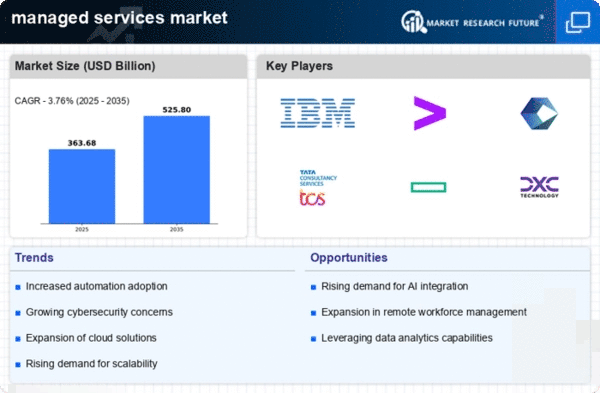
As per MRFR analysis, the managed services market was estimated at 350.5 USD Billion in 2024. The managed services industry is projected to grow from 363.68 USD Billion in 2025 to 525.8 USD Billion by 2035, exhibiting a compound annual growth rate (CAGR) of 3.76 during the forecast period 2025 - 2035.

Key Market Trends & Highlights

The managed services market is experiencing robust growth driven by technological advancements and evolving customer needs.

  • The integration of advanced technologies is reshaping service delivery models across the managed services market.
  • North America remains the largest market, while the Asia-Pacific region is emerging as the fastest-growing area for managed services.
  • Infrastructure management continues to dominate the market, whereas security management is witnessing the fastest growth due to increasing cyber threats.
  • Rising demand for cost efficiency and an increased focus on data security are key drivers propelling the managed services market forward.

Market Size & Forecast

2024 Market Size 350.5 (USD Billion)
2035 Market Size 525.8 (USD Billion)
CAGR (2025 - 2035) 3.76%

Major Players

IBM (US), Accenture (IE), Cognizant (US), Tata Consultancy Services (IN), Hewlett Packard Enterprise (US), DXC Technology (US), Capgemini (FR), NTT Data (JP), Atos (FR), Wipro (IN)

managed-services-market Trends

The managed services market is currently experiencing a transformative phase, characterized by a shift towards more integrated and comprehensive service offerings. Organizations are increasingly recognizing the value of outsourcing specific IT functions to specialized providers, which allows them to focus on core business activities. This trend appears to be driven by the need for enhanced operational efficiency, cost reduction, and access to advanced technologies. As businesses navigate a complex digital landscape, the demand for managed services that encompass cloud management, cybersecurity, and data analytics is likely to grow. Furthermore, the rise of remote work and digital collaboration tools has prompted organizations to seek managed services that can support their evolving infrastructure needs. In addition, the managed services market seems to be influenced by the increasing importance of compliance and regulatory requirements. Companies are more aware of the risks associated with data breaches and are therefore seeking managed service providers that can ensure adherence to industry standards. This focus on security and compliance may lead to a greater emphasis on partnerships between businesses and managed service providers. Overall, the managed services market is poised for continued growth as organizations strive to leverage external expertise to enhance their operational capabilities and maintain a competitive edge.

Integration of Advanced Technologies

The managed services market is witnessing a trend towards the integration of advanced technologies such as artificial intelligence and machine learning. These innovations enable service providers to offer more efficient solutions, automate processes, and enhance decision-making capabilities for their clients.

Focus on Cybersecurity Solutions

As cyber threats become increasingly sophisticated, there is a growing emphasis on cybersecurity within the managed services market. Organizations are prioritizing partnerships with providers that can deliver robust security measures, ensuring the protection of sensitive data and compliance with regulations.

Customization and Flexibility in Offerings

The demand for tailored solutions is rising within the managed services market. Businesses are seeking providers that can offer flexible service models, allowing them to adapt to changing needs and scale their operations effectively.

Market Segment Insights

By Service Type: Infrastructure Management (Largest) vs. Security Management (Fastest-Growing)

In the managed services market, the distribution of market share among various service types reveals that Infrastructure Management holds the largest slice. This segment benefits from the increasing demand for efficient and reliable IT infrastructure solutions, ensuring optimal performance and high availability for businesses. Following closely, Security Management is rapidly gaining traction, reflecting the heightened focus on cybersecurity threats and regulatory compliance across industries. As organizations continue to prioritize their digital security posture, this segment's importance and share are set to swell further. The growth trends within this segment indicate a robust expansion driven by technological advancements and changing business needs. Infrastructure Management is primarily growing due to organizations seeking to streamline operations, reduce costs, and enhance their infrastructure's scalability and performance. On the other hand, Security Management is emerging as the fastest-growing service type, propelled by increasing cyber threats and the growing emphasis on data protection. Emerging technologies like Artificial Intelligence and Machine Learning are also providing innovative solutions that bolster the security landscape, making it essential for businesses to adapt swiftly to these changes.

Infrastructure Management (Dominant) vs. Application Management (Emerging)

Infrastructure Management remains the dominant service type within the managed services market, primarily due to its critical role in supporting IT operations. Organizations rely heavily on efficient infrastructure to ensure seamless service delivery, leading to a consistent demand. This segment encompasses the management of hardware, software, and networks, which are essential for business continuity. Contrast this with Application Management, which is emerging as an important segment driven by the rapid development of software applications in response to evolving business needs. As companies invest in digital transformation, managing tailored applications becomes vital, leading to an increased focus on application performance, optimization, and lifecycle management. The interplay of these segments showcases a diverse market landscape with varying needs and priorities.

By Deployment Model: Cloud-Based (Largest) vs. Hybrid (Fastest-Growing)

In the managed services market, the deployment model segmentation reveals a dynamic landscape characterized by distinct preferences among organizations. Cloud-Based solutions dominate the market, capturing the largest share due to their scalability, cost-effectiveness, and flexibility, appealing to a wide range of businesses looking to streamline operations and enhance efficiency. On-Premises models also maintain a significant presence, particularly among enterprises prioritizing data security and control, while Hybrid models are rapidly gaining traction as organizations seek to leverage the advantages of both cloud and on-premises solutions. The growth trends within the deployment model segment are influenced by several key drivers. The increasing adoption of cloud technology is propelling Cloud-Based solutions, as organizations recognize the benefits of remote accessibility and reduced IT overheads. Simultaneously, the Hybrid model is emerging as the fastest-growing segment, driven by businesses that need to balance the urgency of cloud migration with the necessity of maintaining legacy systems. As such, the demand for managed services that support these models continues to rise, presenting significant opportunities for service providers.

Cloud-Based (Dominant) vs. Hybrid (Emerging)

Cloud-Based deployment models are positioned as the dominant force in the managed services market, driven by their ability to offer organizations enhanced operational flexibility and lowered costs. These solutions are particularly appealing for small and medium enterprises that aim to leverage technology without the overhead of extensive IT infrastructure. Conversely, Hybrid deployment models represent the emerging trend, allowing organizations to amalgamate on-premises solutions with cloud services to create a balanced IT ecosystem. This versatility enables businesses to customize their service delivery according to specific needs while maintaining robust data security. The increasing complexity of operational requirements is steering companies towards Hybrid solutions, making it a unique and attractive option in the evolving landscape of managed services.

By End User: Small and Medium Enterprises (Largest) vs. Large Enterprises (Fastest-Growing)

In the managed services market, Small and Medium Enterprises (SMEs) account for a significant share due to the increasing need for cost-effective IT solutions and operational efficiency. They rely heavily on managed services to streamline processes and enhance productivity without extensive internal IT investments. Large Enterprises, while not holding the majority share, are rapidly adopting managed services to integrate advanced technologies and optimize their extensive operations, making them a pivotal driver of market growth.

Small and Medium Enterprises: Dominant vs. Large Enterprises: Emerging

Small and Medium Enterprises (SMEs) represent a dominant force in the managed services market, driven by their need for flexible IT support and the agility that managed services provide. SMEs leverage these services to reduce operational costs and focus on core business areas. In contrast, Large Enterprises, though categorized as emerging in this context, are increasingly recognizing the value of managed services to manage complexity and enhance scalability. Their focus on digital transformation is prompting a surge in demand for managed services, making them a key segment to watch for future growth.

By Industry Vertical: Information Technology (Largest) vs. Telecommunications (Fastest-Growing)

The managed services market presents a dynamic landscape where Information Technology holds the largest market share, significantly outpacing other sectors in revenue generation and adoption rates. This dominance is driven by increasing reliance on digital solutions and the vital role of IT infrastructure in various enterprises. Telecommunications follows closely, emerging as the fastest-growing segment, propelled by the surge in mobile data usage and the expansion of IoT, positioning it as a lucrative area for managed services providers.

Information Technology: Dominant vs. Telecommunications: Emerging

Information Technology remains the dominant sector in the managed services market, characterized by its robust infrastructure and a vast array of services that cater to the evolving needs of businesses. This segment thrives on the complexity and scale of IT operations, where businesses seek to optimize performance and reduce operational risks. On the other hand, Telecommunications is an emerging sector, rapidly gaining traction due to the increasing demand for connectivity and communication services. Managed services in this vertical are essential for managing diverse networks and enhancing customer experiences, making it a critical area for service providers looking to innovate and capture market opportunities.

Get more detailed insights about managed-services-market

Regional Insights

North America : Leading Market Innovators

North America continues to lead the managed services market, holding a significant share of 175.25M in 2025. The region's growth is driven by increasing demand for cloud computing, cybersecurity, and IT infrastructure management. Regulatory support and investment in digital transformation initiatives further catalyze this growth, making it a hub for technological advancements and service innovation. The competitive landscape is robust, with key players like IBM, Accenture, and Cognizant dominating the market. The U.S. remains the largest contributor, leveraging its technological expertise and innovation. Companies are focusing on strategic partnerships and acquisitions to enhance service offerings, ensuring they remain at the forefront of the managed services sector.

Europe : Emerging Digital Transformation Hub

Europe's managed services market is projected to reach 90.15M by 2025, driven by the increasing adoption of cloud services and the need for efficient IT management. Regulatory frameworks promoting digital transformation and data protection are key growth catalysts. The region is witnessing a shift towards hybrid IT solutions, enhancing service delivery and operational efficiency. Leading countries like Germany, the UK, and France are at the forefront of this growth, with major players such as Accenture and Capgemini expanding their footprints. The competitive landscape is characterized by a mix of established firms and emerging startups, all vying for market share in this dynamic environment. The focus on sustainability and compliance is shaping service offerings, ensuring alignment with regulatory standards.

Asia-Pacific : Rapidly Growing Market Potential

The Asia-Pacific region is experiencing rapid growth in the managed services market, projected to reach 70.0M by 2025. This growth is fueled by increasing digitalization, the rise of SMEs, and a growing demand for IT outsourcing. Governments are actively promoting technology adoption through various initiatives, creating a favorable environment for managed services to thrive. Countries like India, Japan, and Australia are leading the charge, with major players such as Tata Consultancy Services and NTT Data making significant inroads. The competitive landscape is evolving, with local firms gaining traction alongside global giants. The focus on innovation and customer-centric solutions is driving service differentiation, positioning the region as a key player in The managed services market.

Middle East and Africa : Emerging Market Opportunities

The Middle East and Africa (MEA) region is gradually emerging in the managed services market, with a projected size of 15.05M by 2025. The growth is driven by increasing investments in IT infrastructure and a rising demand for cloud-based solutions. Governments are implementing policies to enhance digital transformation, which is crucial for the region's economic diversification efforts. Countries like South Africa and the UAE are leading the market, with a growing presence of global players and local firms. The competitive landscape is characterized by partnerships and collaborations aimed at enhancing service delivery. As businesses increasingly recognize the value of managed services, the region is poised for significant growth in the coming years.

Key Players and Competitive Insights

The managed services market is currently characterized by a dynamic competitive landscape, driven by the increasing demand for digital transformation and operational efficiency across various sectors. Key players such as IBM (US), Accenture (IE), and Tata Consultancy Services (IN) are strategically positioning themselves to leverage these trends. IBM (US) focuses on integrating advanced technologies like AI and cloud computing into its service offerings, while Accenture (IE) emphasizes partnerships and acquisitions to enhance its capabilities in emerging technologies. Tata Consultancy Services (IN) is concentrating on regional expansion and localized service delivery, which appears to be a response to the growing need for tailored solutions in diverse markets. Collectively, these strategies contribute to a competitive environment that is increasingly centered around innovation and technological advancement.

In terms of business tactics, companies are adopting various approaches to optimize their operations. For instance, localizing service delivery and enhancing supply chain efficiency are becoming prevalent strategies. The market structure is moderately fragmented, with several key players exerting considerable influence. This fragmentation allows for a diverse range of service offerings, yet the presence of major companies like IBM (US) and Accenture (IE) suggests a competitive hierarchy where larger firms can leverage their resources to maintain a competitive edge.

In November 2025, IBM (US) announced a strategic partnership with a leading cloud provider to enhance its managed services portfolio. This collaboration is expected to bolster IBM's capabilities in delivering hybrid cloud solutions, which are increasingly sought after by enterprises looking to optimize their IT infrastructure. The strategic importance of this partnership lies in its potential to position IBM as a frontrunner in the rapidly evolving cloud services market, thereby enhancing its competitive stance.

In October 2025, Accenture (IE) completed the acquisition of a cybersecurity firm, which is anticipated to significantly strengthen its managed security services. This move reflects Accenture's commitment to addressing the growing concerns around cybersecurity threats, thereby enhancing its value proposition to clients. The acquisition is likely to provide Accenture with advanced tools and expertise, enabling it to offer more comprehensive and robust security solutions in an increasingly digital landscape.

In September 2025, Tata Consultancy Services (IN) launched a new suite of AI-driven managed services aimed at improving operational efficiency for its clients. This initiative underscores TCS's focus on innovation and its commitment to integrating cutting-edge technologies into its service offerings. By leveraging AI, TCS aims to provide clients with enhanced insights and automation capabilities, which could lead to significant cost savings and improved service delivery.

As of December 2025, the managed services market is witnessing a pronounced shift towards digitalization, sustainability, and AI integration. Strategic alliances are playing a crucial role in shaping the competitive landscape, as companies seek to combine their strengths to deliver more comprehensive solutions. Looking ahead, it appears that competitive differentiation will increasingly hinge on innovation and technological prowess rather than merely price competition. The emphasis on supply chain reliability and advanced technological integration suggests a future where companies that can effectively harness these trends will likely emerge as leaders in the managed services market.


Key Companies in the managed-services-market market include

Future Outlook

managed-services-market Future Outlook

The managed services market is projected to grow at a 3.76% CAGR from 2024 to 2035, driven by digital transformation, cloud adoption, and cybersecurity needs.

New opportunities lie in:

  • Expansion of AI-driven analytics services for proactive IT management.
  • Development of tailored cybersecurity solutions for small and medium enterprises.
  • Integration of IoT management services to enhance operational efficiency.

By 2035, the managed services market is expected to be robust, reflecting sustained growth and innovation.

Market Segmentation

managed-services-market End User Outlook

  • Small and Medium Enterprises
  • Large Enterprises
  • Government Organizations
  • Healthcare Institutions

managed-services-market Service Type Outlook

  • Infrastructure Management
  • Application Management
  • Network Management
  • Security Management
  • Cloud Management

managed-services-market Deployment Model Outlook

  • On-Premises
  • Cloud-Based
  • Hybrid

managed-services-market Industry Vertical Outlook

  • Information Technology
  • Telecommunications
  • Financial Services
  • Manufacturing

Report Scope

MARKET SIZE 2024350.5(USD Billion)
MARKET SIZE 2025363.68(USD Billion)
MARKET SIZE 2035525.8(USD Billion)
COMPOUND ANNUAL GROWTH RATE (CAGR)3.76% (2024 - 2035)
REPORT COVERAGERevenue Forecast, Competitive Landscape, Growth Factors, and Trends
BASE YEAR2024
Market Forecast Period2025 - 2035
Historical Data2019 - 2024
Market Forecast UnitsUSD Billion
Key Companies ProfiledIBM (US), Accenture (IE), Cognizant (US), Tata Consultancy Services (IN), Hewlett Packard Enterprise (US), DXC Technology (US), Capgemini (FR), NTT Data (JP), Atos (FR), Wipro (IN)
Segments CoveredService Type, Deployment Model, End User, Industry Vertical
Key Market OpportunitiesIntegration of artificial intelligence and automation in the managed services market enhances operational efficiency and service delivery.
Key Market DynamicsRising demand for cloud-based solutions drives competitive dynamics in the managed services market.

Countries CoveredNorth America, Europe, APAC, South America, MEA

Leave a Comment

Download Free Sample

Kindly complete the form below to receive a free sample of this Report

Compare Licence

×
Features License Type
Single User Multiuser License Enterprise User
Price $4,950 $5,950 $7,250
Maximum User Access Limit 1 User Upto 10 Users Unrestricted Access Throughout the Organization
Free Customization
Direct Access to Analyst
Deliverable Format
Platform Access
Discount on Next Purchase 10% 15% 15%
Printable Versions