×
Request Free Sample ×

Kindly complete the form below to receive a free sample of this Report

* Please use a valid business email

Leading companies partner with us for data-driven Insights

clients tt-cursor
Hero Background
English
Chinese
French
Japanese
Korean
German
Spanish

Magnet Bearings Market Share

ID: MRFR/Equip/4484-CR
100 Pages
Harshita Gorade
April 2018

Magnet Bearings Market Research Report Information By Application (Compressor, Turbine, Pumps, Motors, Generators and Others), By Type (Active Magnet Bearing, Passive Magnet Bearing and Hybrid Magnet Bearing), By End-User (Oil & Gas, Petrochemicals, Power and Others) And By Region (North America, Europe, Asia-Pacific, And Rest Of The World) –Market Forecast Till 2035

Share:
Download PDF ×

We do not share your information with anyone. However, we may send you emails based on your report interest from time to time. You may contact us at any time to opt-out.

Magnet Bearings Market Infographic
Purchase Options

Market Share

Magnet Bearings Market Share Analysis

The magnet bearings market is characterized by technological advancements and a growing demand for efficient and reliable bearing solutions. In this competitive landscape, companies employ various market share positioning strategies to gain a foothold and thrive in the industry. Differentiation is a common approach, with companies focusing on developing unique and innovative magnet bearing technologies. This might involve improvements in magnetic levitation systems, advanced control algorithms, or enhanced durability, setting them apart from competitors and attracting customers seeking cutting-edge solutions. A common strategy in the magnet bearings market is cost leadership. Companies aspire to be the most efficient producers by improving their production process, sourcing materials productively, and developing the economies of scale. Providing excellent magnet bearings at reasonable prices enables companies sell to price-sensitive segments of the market and gain a substantial share. First, market segmentation is a notable aspect of the magnet bearings industry, as companies produce their items to suit particular uses or industries. This could include developing bearings that are suitable for different load capacities, operating conditions, or environmental conditions. By addressing the distinct preferences of different groups, companies are able to address niche markets and further solidify their dominance in particular vertical industries. Strategic collaborations and partnerships have become a critical feature of the magnet bearings market. Companies enter into alliances with other firms in the same industry, research institutions, or technology suppliers to derive benefits from complementary strengths and resources. The partnerships may result to the creation of sophisticated magnet bearing technologies, shared projects, and larger market scope. By combining knowledge and assets, businesses can improve their abilities and gain a competitive edge. Customer-centric approaches are essential for long-term success in the magnet bearings market. Customer loyalty and repeat business can be achieved by establishing the customer needs and providing top class support services. Investment in responsive customer service, training programs, and consistent communication can help companies to create healthy relationships with clients, which positively affects their market position. Innovation is crucial in the dynamic magnet bearings market. By keeping up with technology and market trends, companies can stay agile and introduce new solutions accordingly. It is important for a company to invest in research and development that can help enhance the bearing performance, energy efficiency, and reliability for competitive advantages and the retention of strong market presence. Magnet bearing market share positioning strategies has an emerging aspect of environmental sustainability. Eco-friendly and energy-efficient magnet bearings will appeal to more environmentally conscious customers as industries concentrate on carbon emissions reduction. Companies that align their products and services with global sustainability goals can improve their reputation on the market and expand their customer base.


Author
Harshita Gorade
Research Analyst

Harshita Post graduate MBA in Business Administration from Welingkar Institute, Mumbai and 5 years of experience in the field of product market research. As a Research Analyst, I have cross-domain experience in packaging, and industrial Automation & Equipment. I am currently looking after the research process of packaging, logistics & transportation, and industrial automation & equipment at Market Research Future Reports. My responsibilities at the organization involve handling syndicate and custom reports as well as responding to client inquiries, and organize, co-ordinate with a group of 5 to 6 persons to manage all workflows.

Leave a Comment

FAQs

What is the projected market valuation of the Magnet Bearings Market by 2035?

<p>The Magnet Bearings Market is projected to reach a valuation of 4.971 USD Billion by 2035.</p>

What was the market valuation of the Magnet Bearings Market in 2024?

<p>In 2024, the Magnet Bearings Market was valued at 3.35 USD Billion.</p>

What is the expected CAGR for the Magnet Bearings Market during the forecast period 2025 - 2035?

<p>The expected CAGR for the Magnet Bearings Market during the forecast period 2025 - 2035 is 3.65%.</p>

Which companies are considered key players in the Magnet Bearings Market?

<p>Key players in the Magnet Bearings Market include SKF, Siemens, Honeywell, Thyssenkrupp, Mitsubishi Electric, General Electric, Emerson Electric, Magnetic Innovations, and Schaeffler.</p>

What are the main application segments of the Magnet Bearings Market?

<p>The main application segments of the Magnet Bearings Market include compressors, turbines, pumps, motors, generators, and others.</p>

How did the valuation of active magnet bearings compare to passive and hybrid types in 2024?

In 2024, active magnet bearings were valued at 1.34 USD Billion, while passive and hybrid magnet bearings were valued at 1.01 USD Billion and 0.99 USD Billion, respectively.

What is the valuation range for the oil and gas end-user segment in the Magnet Bearings Market?

The oil and gas end-user segment was valued between 1.0 USD Billion and 1.5 USD Billion in 2024.

What is the projected growth for the turbine application segment by 2035?

The turbine application segment is expected to grow from 0.55 USD Billion in 2024 to 0.79 USD Billion by 2035.

Which end-user segment is anticipated to have the highest valuation by 2035?

The power end-user segment is anticipated to have the highest valuation, projected to reach between 1.2 USD Billion and 1.8 USD Billion by 2035.

What is the expected valuation for the motors application segment by 2035?

The motors application segment is expected to reach a valuation between 0.8 USD Billion and 1.15 USD Billion by 2035.

Market Summary

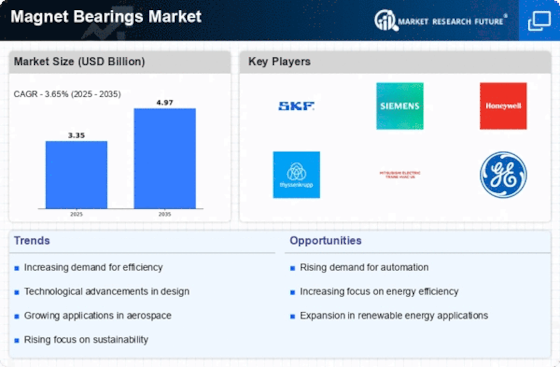
As per Market Research Future analysis, the Magnet Bearings Market Size was estimated at 3.35 USD Billion in 2024. The Magnet Bearings industry is projected to grow from 3.472 USD Billion in 2025 to 4.971 USD Billion by 2035, exhibiting a compound annual growth rate (CAGR) of 3.65% during the forecast period 2025 - 2035

Key Market Trends & Highlights

The Magnet Bearings Market is poised for substantial growth driven by technological advancements and increasing demand for energy efficiency.

  • North America remains the largest market for magnet bearings, driven by robust industrial applications. Asia-Pacific is emerging as the fastest-growing region, fueled by rapid industrialization and technological adoption. The compressor segment holds the largest share, while the turbine segment is witnessing the fastest growth due to diverse applications. Technological advancements and the rising demand for energy efficiency are key drivers propelling market expansion.

Market Size & Forecast

2024 Market Size 3.35 (USD Billion)
2035 Market Size 4.971 (USD Billion)
CAGR (2025 - 2035) 3.65%
Largest Regional Market Share in 2024 North America

Major Players

<a href="https://www.skf.com/group/products/magnetic-bearings-and-systems">SKF </a>(SE), Siemens (DE), Honeywell (US), Thyssenkrupp (DE), Mitsubishi Electric (JP), General Electric (US), <a href="https://www.emersonbearing.com/ball-bearings/">Emerson Electric</a> (US), Magnetic Innovations (US), Schaeffler (DE)

Market Trends

The Magnet Bearings Market is currently experiencing a transformative phase, characterized by advancements in technology and increasing demand across various sectors. The shift towards energy-efficient solutions is driving innovation, as industries seek to reduce operational costs and enhance performance. This market is witnessing a growing interest in applications such as electric vehicles, aerospace, and industrial machinery, where the benefits of magnet bearings, including reduced friction and maintenance, are becoming increasingly apparent. Furthermore, the emphasis on sustainability is prompting manufacturers to explore eco-friendly materials and production methods, aligning with global environmental goals. In addition, the competitive landscape of the Magnet Bearings Market is evolving, with numerous players striving to establish their presence through strategic partnerships and collaborations. Research and development efforts are intensifying, as companies aim to introduce cutting-edge products that meet the specific needs of diverse applications. The integration of smart technologies, such as IoT and AI, is also anticipated to enhance the functionality and efficiency of magnet bearings, potentially revolutionizing their use in various industries. As the market continues to expand, stakeholders are likely to focus on innovation and sustainability to maintain a competitive edge.

Technological Advancements

The Magnet Bearings Market is witnessing rapid technological advancements that enhance performance and efficiency. Innovations in materials and design are leading to the development of more robust and reliable magnet bearings, which are crucial for high-performance applications. This trend indicates a shift towards integrating smart technologies, allowing for real-time monitoring and predictive maintenance.

Sustainability Initiatives

There is a growing emphasis on sustainability within the Magnet Bearings Market, as manufacturers seek to reduce their environmental impact. This trend involves the exploration of eco-friendly materials and production processes, aligning with global efforts to promote greener technologies. Companies are increasingly adopting practices that not only improve efficiency but also contribute to environmental conservation.

Diverse Applications

The range of applications for magnet bearings is expanding, particularly in sectors such as automotive, aerospace, and renewable energy. This diversification suggests that industries are recognizing the advantages of magnet bearings, including reduced friction and enhanced performance. As new applications emerge, the market is likely to see increased demand and innovation.

Magnet Bearings Market Market Drivers

Expansion of Industrial Automation

The Magnet Bearings Market is closely linked to the expansion of industrial automation. As manufacturers increasingly adopt automated systems to enhance productivity, the need for reliable and efficient components like magnet bearings becomes more pronounced. These bearings are integral to the operation of automated machinery, providing the necessary precision and durability. Market analysis indicates that the industrial automation sector is projected to grow significantly, with magnet bearings playing a pivotal role in this transformation. The integration of magnet bearings into automated systems not only improves operational efficiency but also reduces downtime, making them a preferred choice for modern manufacturing processes.

Growing Demand for Energy Efficiency

The Magnet Bearings Market is witnessing a growing demand for energy-efficient solutions across various sectors. As industries strive to reduce their carbon footprint, magnet bearings offer a compelling alternative due to their low friction and high efficiency. This is particularly relevant in applications such as wind turbines and electric vehicles, where energy conservation is critical. Market data indicates that the energy-efficient segment of the magnet bearings market is expected to account for a significant share, driven by regulatory pressures and consumer preferences for sustainable products. The shift towards energy efficiency not only aligns with environmental goals but also enhances the overall performance of machinery, thereby driving further adoption of magnet bearings.

Technological Advancements in Magnet Bearings

The Magnet Bearings Market is experiencing a surge in technological advancements that enhance performance and efficiency. Innovations in materials, such as the development of high-temperature superconductors, are enabling magnet bearings to operate under more demanding conditions. This has led to increased adoption in sectors like aerospace and automotive, where precision and reliability are paramount. According to recent data, the market for magnet bearings is projected to grow at a compound annual growth rate of approximately 8% over the next five years. These advancements not only improve the operational lifespan of equipment but also reduce maintenance costs, making magnet bearings an attractive option for manufacturers seeking to optimize their processes.

Rising Demand in Aerospace and Defense Sectors

The Magnet Bearings Market is experiencing a notable rise in demand from the aerospace and defense sectors. These industries require components that can withstand extreme conditions while maintaining high performance. Magnet bearings, with their ability to operate without lubrication and their reduced wear and tear, are increasingly being utilized in aircraft engine bearings and defense systems. Recent Market Research Future suggest that the aerospace segment is expected to grow at a robust rate, driven by advancements in aircraft technology and the need for more efficient systems. This trend underscores the critical role that magnet bearings play in enhancing the reliability and efficiency of aerospace applications.

Increased Investment in Research and Development

The Magnet Bearings Market is benefiting from increased investment in research and development activities. Companies are allocating substantial resources to explore new applications and improve existing technologies. This focus on R&D is crucial for fostering innovation and maintaining competitive advantage in a rapidly evolving market. Recent statistics suggest that R&D spending in the magnet bearings sector has risen by over 15% in the past year, reflecting a commitment to advancing the technology. As new applications emerge, particularly in the fields of robotics and automation, the demand for advanced magnet bearings is likely to escalate, further propelling market growth.

Market Segment Insights

By Application: Compressor (Largest) vs. Turbine (Fastest-Growing)

<p>The Magnet Bearings Market exhibits a diverse application landscape. The largest segment, compressors, dominate the market with significant adoption across various industries, including HVAC, automotive, and manufacturing. Turbines, both for power generation and aviation, are quickly emerging as another crucial segment, showcasing substantial market potential due to their unique capabilities and efficiency improvements.</p>

<p>Compressor (Dominant) vs. Turbine (Emerging)</p>

<p>Compressors serve as a dominant application in the Magnet Bearings Market, leveraging their widespread usage and essential role in energy efficiency and operational reliability. Their design integrates seamlessly with magnetic technologies, enhancing performance while minimizing maintenance requirements. In contrast, turbines represent an emerging application with rapidly growing popularity. Turbine systems benefit from reduced friction and increased efficiency, making them increasingly favorable in energy generation and propulsion industries. The transition towards renewable energy sources further drives the adoption of turbine systems, positioning them as a formidable segment in the market for magnet bearings.</p>

By Type: Active Magnet Bearing (Largest) vs. Passive Magnet Bearing (Fastest-Growing)

<p>In the Magnet Bearings Market, Active Magnet Bearings hold a significant share, dominating the landscape due to their superior performance and control capabilities. These bearings are integral in applications requiring precise alignment and dynamic adjustment, thus establishing a strong foothold in industries such as aerospace and automotive. In contrast, Passive Magnet Bearings are achieving remarkable traction as they offer cost advantages and simpler designs, making them increasingly popular in various industrial applications.</p>

<p>Active Magnet Bearing (Dominant) vs. Passive Magnet Bearing (Emerging)</p>

<p>Active Magnet Bearings are characterized by their ability to dynamically adjust their magnetic fields, providing unparalleled precision and stability in high-performance applications. This segment is widely embraced in aerospace and high-speed machinery due to its advanced features, catering to the demands for reliability and efficiency. On the other hand, Passive Magnet Bearings are emerging as a competitive alternative, offering simplicity and cost-effectiveness. These bearings use permanent magnets to achieve levitation without active control, making them suitable for a broader range of applications where budget constraints and modular designs are prioritized.</p>

By End-User: Oil & Gas (Largest) vs. Petrochemicals (Fastest-Growing)

<p>The Magnet Bearings Market shows a diverse distribution of end-user segments. The Oil & Gas sector remains the largest segment, driven by the need for high reliability and performance in demanding environments. Following closely, the Petrochemicals segment is witnessing significant growth, fueled by the increasing demand for innovative solutions that enhance efficiency and sustainability in chemical processing. Both sectors are crucial, contributing to advancements in magnet technology. Growth trends reveal that while the Oil & Gas sector focuses primarily on reliability due to the harsh operating conditions, the Petrochemicals sector is rapidly evolving, adapting to technological changes and economic factors. The rising demand for energy-efficient and environmentally friendly solutions continues to propel the Petrochemicals segment forward, making it the fastest-growing area in the Magnet Bearings Market as companies strive to optimize operations and reduce environmental impact.</p>

<p>Oil & Gas: Dominant vs. Petrochemicals: Emerging</p>

<p>The Oil & Gas segment is characterized by its robust requirements for durability and dependability, leading the market in magnet bearing adoption. This segment relies heavily on high-performance bearings to reduce friction and enhance equipment longevity in extreme conditions. In contrast, the Petrochemicals segment is emerging as a significant player, adapting fast to innovations in magnetic bearing technology to improve processing efficiency. The focus here is on integrating sustainable practices while meeting rising demands for production efficiency. This dichotomy highlights how traditional sectors evolve alongside emerging ones, each addressing unique challenges within the Magnet Bearings Market.</p>

Get more detailed insights about Global Magnet Bearings Market Research Report – Forecast till 2035

Regional Insights

North America : Innovation and Technology Leader

North America is the largest market for magnet bearings, holding approximately 40% of the global share. The region's growth is driven by advancements in technology, increasing demand for energy-efficient solutions, and supportive government regulations promoting sustainable practices. The automotive and aerospace sectors are significant contributors to this demand, with a focus on reducing emissions and enhancing performance. The United States and Canada are the leading countries in this market, with major players like Honeywell, General Electric, and Emerson Electric establishing a strong presence. The competitive landscape is characterized by continuous innovation and strategic partnerships among key players. The region's focus on research and development further enhances its market position, ensuring a robust pipeline of advanced magnet bearing solutions.

Europe : Sustainable Manufacturing Hub

Europe is the second-largest market for magnet bearings, accounting for around 30% of the global share. The region's growth is fueled by stringent environmental regulations and a strong emphasis on sustainability in manufacturing processes. Countries are increasingly adopting magnet bearings to enhance energy efficiency and reduce carbon footprints, aligning with the European Green Deal initiatives aimed at achieving climate neutrality by 2050. Germany, France, and the UK are the leading countries in this market, with key players like Siemens and Schaeffler driving innovation. The competitive landscape is marked by a focus on high-quality manufacturing and technological advancements. European manufacturers are investing in R&D to develop next-generation magnet bearings, ensuring they remain competitive in the global market.

Asia-Pacific : Emerging Market Potential

Asia-Pacific is witnessing rapid growth in the magnet bearings market, holding approximately 25% of the global share. The region's expansion is driven by increasing industrialization, urbanization, and a growing focus on renewable energy sources. Countries like China and India are investing heavily in infrastructure and manufacturing, leading to a surge in demand for advanced bearing solutions that enhance efficiency and performance. China is the largest market in the region, followed by Japan and India. The competitive landscape features both local and international players, with companies like Mitsubishi Electric and SKF expanding their operations. The region's market is characterized by a mix of established manufacturers and emerging startups, fostering innovation and competitive pricing strategies to capture market share.

Middle East and Africa : Resource-Rich Opportunities

The Middle East and Africa region is gradually emerging in the magnet bearings market, holding about 5% of the global share. The growth is primarily driven by the increasing industrial sector, particularly in oil and gas, mining, and renewable energy. Governments are investing in infrastructure development, which is expected to boost demand for advanced bearing technologies that enhance operational efficiency and reliability. Countries like South Africa and the UAE are leading the market, with a growing presence of international players. The competitive landscape is evolving, with local manufacturers beginning to enter the market. The region's unique challenges, such as fluctuating oil prices, are being addressed through diversification strategies, paving the way for sustainable growth in the magnet bearings sector.

Key Players and Competitive Insights

Leading market players are investing heavily in research and development in order to expand their product lines, which will help the magnet bearings market, grow even more. Market participants are also undertaking a variety of strategic activities to expand their global footprint, with important market developments including new product launches, contractual agreements, mergers and acquisitions, higher investments, and collaboration with other organizations. To expand and survive in a more competitive and rising market climate, magnet bearings industry must offer cost-effective items. Manufacturing locally to minimize operational costs is one of the key business tactics used by manufacturers in the global magnet bearings industry to benefit clients and increase the market sector. In recent years, the magnet bearings industry has offered some of the most significant advantages to market. Major players in the magnet bearings market attempting to increase market demand by investing in research and development operations include Calnetix Technologies, Siemens AG, Waukesha Bearings Corporation, Mecos AG, Foshan Genesis, Synchrony, SKF AB and Celeroton AG. The company Calnetix Technologies, LLC creates, develops, and produces industrial equipment. The business sells high-end CNC machines as well as motors, generators, magnetic bearings, and power electronics. Global customer service is provided by Calnetix Technologies. The mission of Calnetix Technologies, LLC is "Innovation That Drives Industries". They are changing the way the world produces and uses energy, which benefits both society and the environment. Innovative, fast technologies from Calnetix deliver great system efficiency, dependability, power density, and low total cost of ownership. In a number of applications, including defence, aerospace, maritime, oil and gas, racing, and others, its solutions improve energy security, lower energy consumption, and produce fewer hazardous emissions. The largest provider of gas-bearing turbo compressors worldwide is Celeroton. As a system supplier for compressors, they offer converters for fuel cells, noble gas recirculation and compression, pneumatics, cryogenics, clean/sterile air supply, gas recovery, and other industrial applications. With regard to compactness, service life, and performance, ultra-high-speed turbo compressors with contact- and oil-free gas bearings provide remarkable solutions. Its systems are substantially lighter and smaller as well as incredibly efficient when compared to compressors with typical speeds. A wide range of pressure ratios, mass flows, pressure differences, and volume flows are all covered by the Celeroton family of turbo compressor products.

Key Companies in the Magnet Bearings Market include

Industry Developments

February 2023: SKF AB committed SEK 700 Mn to locating engineering and manufacturing capabilities at a brand-new, greenfield site in Monterrey, Mexico. The company's ability to develop and produce high-performance bearings will probably benefit from the investment's potential to help build a solid regional basis.

June 2022: On the occasion of the Hannover Messe 2022 show, SpinDrive Oy. introduced a new generation magma magnetic bearing controller. For systems with active magnetic bearings, Magma X800 is a cutting-edge magnetic bearing controller. It is intended for demanding industrial applications and can handle typical power ranges of 35 kW to 3 MW with rotating speeds of 10,000 to 150,001 rpm and above.

April 2022: The IFAT trade show in Munich, May 30-June 3, will feature a presentation of the "recently developed range of mobile overband [cross belt] magnets," according to Dutch magnetic equipment manufacturer Goudsmit Magnetics. A five-year contract between REEtec of Norway and Schaeffler has been reached. According to COO Andreas Schick, Reuters will begin receiving rare earth oxides as of 2024.

Future Outlook

Magnet Bearings Market Future Outlook

The Magnet Bearings Market is projected to grow at a 3.65% CAGR from 2025 to 2035, driven by advancements in technology, increasing demand for energy efficiency, and expanding applications in various industries.

New opportunities lie in:

  • <p>Development of advanced magnetic levitation systems for high-speed trains. Integration of IoT technology for predictive maintenance in industrial applications. Expansion into renewable energy sectors, particularly wind turbine applications.</p>

By 2035, the Magnet Bearings Market is expected to achieve robust growth, reflecting evolving technological advancements and diverse applications.

Market Segmentation

Magnet Bearings Market Type Outlook

  • Active Magnet Bearing
  • Passive Magnet Bearing
  • Hybrid Magnet Bearing

Magnet Bearings Market End-User Outlook

  • Oil & Gas
  • Petrochemicals
  • Power
  • Others

Magnet Bearings Market Application Outlook

  • Compressor
  • Turbine
  • Pumps
  • Motors
  • Generators
  • Others

Report Scope

MARKET SIZE 2024 3.35(USD Billion)
MARKET SIZE 2025 3.472(USD Billion)
MARKET SIZE 2035 4.971(USD Billion)
COMPOUND ANNUAL GROWTH RATE (CAGR) 3.65% (2025 - 2035)
REPORT COVERAGE Revenue Forecast, Competitive Landscape, Growth Factors, and Trends
BASE YEAR 2024
Market Forecast Period 2025 - 2035
Historical Data 2019 - 2024
Market Forecast Units USD Billion
Key Companies Profiled SKF (SE), Siemens (DE), Honeywell (US), Thyssenkrupp (DE), Mitsubishi Electric (JP), General Electric (US), Emerson Electric (US), Magnetic Innovations (US), Schaeffler (DE)
Segments Covered Application, Type, End-User, Region
Key Market Opportunities Advancements in electric vehicle technology drive demand for efficient solutions in the Magnet Bearings Market.
Key Market Dynamics Technological advancements and increasing demand for energy efficiency drive growth in the Magnet Bearings Market.
Countries Covered North America, Europe, APAC, South America, MEA

FAQs

What is the projected market valuation of the Magnet Bearings Market by 2035?

<p>The Magnet Bearings Market is projected to reach a valuation of 4.971 USD Billion by 2035.</p>

What was the market valuation of the Magnet Bearings Market in 2024?

<p>In 2024, the Magnet Bearings Market was valued at 3.35 USD Billion.</p>

What is the expected CAGR for the Magnet Bearings Market during the forecast period 2025 - 2035?

<p>The expected CAGR for the Magnet Bearings Market during the forecast period 2025 - 2035 is 3.65%.</p>

Which companies are considered key players in the Magnet Bearings Market?

<p>Key players in the Magnet Bearings Market include SKF, Siemens, Honeywell, Thyssenkrupp, Mitsubishi Electric, General Electric, Emerson Electric, Magnetic Innovations, and Schaeffler.</p>

What are the main application segments of the Magnet Bearings Market?

<p>The main application segments of the Magnet Bearings Market include compressors, turbines, pumps, motors, generators, and others.</p>

How did the valuation of active magnet bearings compare to passive and hybrid types in 2024?

In 2024, active magnet bearings were valued at 1.34 USD Billion, while passive and hybrid magnet bearings were valued at 1.01 USD Billion and 0.99 USD Billion, respectively.

What is the valuation range for the oil and gas end-user segment in the Magnet Bearings Market?

The oil and gas end-user segment was valued between 1.0 USD Billion and 1.5 USD Billion in 2024.

What is the projected growth for the turbine application segment by 2035?

The turbine application segment is expected to grow from 0.55 USD Billion in 2024 to 0.79 USD Billion by 2035.

Which end-user segment is anticipated to have the highest valuation by 2035?

The power end-user segment is anticipated to have the highest valuation, projected to reach between 1.2 USD Billion and 1.8 USD Billion by 2035.

What is the expected valuation for the motors application segment by 2035?

The motors application segment is expected to reach a valuation between 0.8 USD Billion and 1.15 USD Billion by 2035.

  1. SECTION I: EXECUTIVE SUMMARY AND KEY HIGHLIGHTS
    1. | 1.1 EXECUTIVE SUMMARY
    2. | | 1.1.1 Market Overview
    3. | | 1.1.2 Key Findings
    4. | | 1.1.3 Market Segmentation
    5. | | 1.1.4 Competitive Landscape
    6. | | 1.1.5 Challenges and Opportunities
    7. | | 1.1.6 Future Outlook
  2. SECTION II: SCOPING, METHODOLOGY AND MARKET STRUCTURE
    1. | 2.1 MARKET INTRODUCTION
    2. | | 2.1.1 Definition
    3. | | 2.1.2 Scope of the study
    4. | | | 2.1.2.1 Research Objective
    5. | | | 2.1.2.2 Assumption
    6. | | | 2.1.2.3 Limitations
    7. | 2.2 RESEARCH METHODOLOGY
    8. | | 2.2.1 Overview
    9. | | 2.2.2 Data Mining
    10. | | 2.2.3 Secondary Research
    11. | | 2.2.4 Primary Research
    12. | | | 2.2.4.1 Primary Interviews and Information Gathering Process
    13. | | | 2.2.4.2 Breakdown of Primary Respondents
    14. | | 2.2.5 Forecasting Model
    15. | | 2.2.6 Market Size Estimation
    16. | | | 2.2.6.1 Bottom-Up Approach
    17. | | | 2.2.6.2 Top-Down Approach
    18. | | 2.2.7 Data Triangulation
    19. | | 2.2.8 Validation
  3. SECTION III: QUALITATIVE ANALYSIS
    1. | 3.1 MARKET DYNAMICS
    2. | | 3.1.1 Overview
    3. | | 3.1.2 Drivers
    4. | | 3.1.3 Restraints
    5. | | 3.1.4 Opportunities
    6. | 3.2 MARKET FACTOR ANALYSIS
    7. | | 3.2.1 Value chain Analysis
    8. | | 3.2.2 Porter's Five Forces Analysis
    9. | | | 3.2.2.1 Bargaining Power of Suppliers
    10. | | | 3.2.2.2 Bargaining Power of Buyers
    11. | | | 3.2.2.3 Threat of New Entrants
    12. | | | 3.2.2.4 Threat of Substitutes
    13. | | | 3.2.2.5 Intensity of Rivalry
    14. | | 3.2.3 COVID-19 Impact Analysis
    15. | | | 3.2.3.1 Market Impact Analysis
    16. | | | 3.2.3.2 Regional Impact
    17. | | | 3.2.3.3 Opportunity and Threat Analysis
  4. SECTION IV: QUANTITATIVE ANALYSIS
    1. | 4.1 Construction, BY Application (USD Billion)
    2. | | 4.1.1 Compressor
    3. | | 4.1.2 Turbine
    4. | | 4.1.3 Pumps
    5. | | 4.1.4 Motors
    6. | | 4.1.5 Generators
    7. | | 4.1.6 Others
    8. | 4.2 Construction, BY Type (USD Billion)
    9. | | 4.2.1 Active Magnet Bearing
    10. | | 4.2.2 Passive Magnet Bearing
    11. | | 4.2.3 Hybrid Magnet Bearing
    12. | 4.3 Construction, BY End-User (USD Billion)
    13. | | 4.3.1 Oil & Gas
    14. | | 4.3.2 Petrochemicals
    15. | | 4.3.3 Power
    16. | | 4.3.4 Others
    17. | 4.4 Construction, BY Region (USD Billion)
    18. | | 4.4.1 North America
    19. | | | 4.4.1.1 US
    20. | | | 4.4.1.2 Canada
    21. | | 4.4.2 Europe
    22. | | | 4.4.2.1 Germany
    23. | | | 4.4.2.2 UK
    24. | | | 4.4.2.3 France
    25. | | | 4.4.2.4 Russia
    26. | | | 4.4.2.5 Italy
    27. | | | 4.4.2.6 Spain
    28. | | | 4.4.2.7 Rest of Europe
    29. | | 4.4.3 APAC
    30. | | | 4.4.3.1 China
    31. | | | 4.4.3.2 India
    32. | | | 4.4.3.3 Japan
    33. | | | 4.4.3.4 South Korea
    34. | | | 4.4.3.5 Malaysia
    35. | | | 4.4.3.6 Thailand
    36. | | | 4.4.3.7 Indonesia
    37. | | | 4.4.3.8 Rest of APAC
    38. | | 4.4.4 South America
    39. | | | 4.4.4.1 Brazil
    40. | | | 4.4.4.2 Mexico
    41. | | | 4.4.4.3 Argentina
    42. | | | 4.4.4.4 Rest of South America
    43. | | 4.4.5 MEA
    44. | | | 4.4.5.1 GCC Countries
    45. | | | 4.4.5.2 South Africa
    46. | | | 4.4.5.3 Rest of MEA
  5. SECTION V: COMPETITIVE ANALYSIS
    1. | 5.1 Competitive Landscape
    2. | | 5.1.1 Overview
    3. | | 5.1.2 Competitive Analysis
    4. | | 5.1.3 Market share Analysis
    5. | | 5.1.4 Major Growth Strategy in the Construction
    6. | | 5.1.5 Competitive Benchmarking
    7. | | 5.1.6 Leading Players in Terms of Number of Developments in the Construction
    8. | | 5.1.7 Key developments and growth strategies
    9. | | | 5.1.7.1 New Product Launch/Service Deployment
    10. | | | 5.1.7.2 Merger & Acquisitions
    11. | | | 5.1.7.3 Joint Ventures
    12. | | 5.1.8 Major Players Financial Matrix
    13. | | | 5.1.8.1 Sales and Operating Income
    14. | | | 5.1.8.2 Major Players R&D Expenditure. 2023
    15. | 5.2 Company Profiles
    16. | | 5.2.1 SKF (SE)
    17. | | | 5.2.1.1 Financial Overview
    18. | | | 5.2.1.2 Products Offered
    19. | | | 5.2.1.3 Key Developments
    20. | | | 5.2.1.4 SWOT Analysis
    21. | | | 5.2.1.5 Key Strategies
    22. | | 5.2.2 Siemens (DE)
    23. | | | 5.2.2.1 Financial Overview
    24. | | | 5.2.2.2 Products Offered
    25. | | | 5.2.2.3 Key Developments
    26. | | | 5.2.2.4 SWOT Analysis
    27. | | | 5.2.2.5 Key Strategies
    28. | | 5.2.3 Honeywell (US)
    29. | | | 5.2.3.1 Financial Overview
    30. | | | 5.2.3.2 Products Offered
    31. | | | 5.2.3.3 Key Developments
    32. | | | 5.2.3.4 SWOT Analysis
    33. | | | 5.2.3.5 Key Strategies
    34. | | 5.2.4 Thyssenkrupp (DE)
    35. | | | 5.2.4.1 Financial Overview
    36. | | | 5.2.4.2 Products Offered
    37. | | | 5.2.4.3 Key Developments
    38. | | | 5.2.4.4 SWOT Analysis
    39. | | | 5.2.4.5 Key Strategies
    40. | | 5.2.5 Mitsubishi Electric (JP)
    41. | | | 5.2.5.1 Financial Overview
    42. | | | 5.2.5.2 Products Offered
    43. | | | 5.2.5.3 Key Developments
    44. | | | 5.2.5.4 SWOT Analysis
    45. | | | 5.2.5.5 Key Strategies
    46. | | 5.2.6 General Electric (US)
    47. | | | 5.2.6.1 Financial Overview
    48. | | | 5.2.6.2 Products Offered
    49. | | | 5.2.6.3 Key Developments
    50. | | | 5.2.6.4 SWOT Analysis
    51. | | | 5.2.6.5 Key Strategies
    52. | | 5.2.7 Emerson Electric (US)
    53. | | | 5.2.7.1 Financial Overview
    54. | | | 5.2.7.2 Products Offered
    55. | | | 5.2.7.3 Key Developments
    56. | | | 5.2.7.4 SWOT Analysis
    57. | | | 5.2.7.5 Key Strategies
    58. | | 5.2.8 Magnetic Innovations (US)
    59. | | | 5.2.8.1 Financial Overview
    60. | | | 5.2.8.2 Products Offered
    61. | | | 5.2.8.3 Key Developments
    62. | | | 5.2.8.4 SWOT Analysis
    63. | | | 5.2.8.5 Key Strategies
    64. | | 5.2.9 Schaeffler (DE)
    65. | | | 5.2.9.1 Financial Overview
    66. | | | 5.2.9.2 Products Offered
    67. | | | 5.2.9.3 Key Developments
    68. | | | 5.2.9.4 SWOT Analysis
    69. | | | 5.2.9.5 Key Strategies
    70. | 5.3 Appendix
    71. | | 5.3.1 References
    72. | | 5.3.2 Related Reports
  6. LIST OF FIGURES
    1. | 6.1 MARKET SYNOPSIS
    2. | 6.2 NORTH AMERICA MARKET ANALYSIS
    3. | 6.3 US MARKET ANALYSIS BY APPLICATION
    4. | 6.4 US MARKET ANALYSIS BY TYPE
    5. | 6.5 US MARKET ANALYSIS BY END-USER
    6. | 6.6 CANADA MARKET ANALYSIS BY APPLICATION
    7. | 6.7 CANADA MARKET ANALYSIS BY TYPE
    8. | 6.8 CANADA MARKET ANALYSIS BY END-USER
    9. | 6.9 EUROPE MARKET ANALYSIS
    10. | 6.10 GERMANY MARKET ANALYSIS BY APPLICATION
    11. | 6.11 GERMANY MARKET ANALYSIS BY TYPE
    12. | 6.12 GERMANY MARKET ANALYSIS BY END-USER
    13. | 6.13 UK MARKET ANALYSIS BY APPLICATION
    14. | 6.14 UK MARKET ANALYSIS BY TYPE
    15. | 6.15 UK MARKET ANALYSIS BY END-USER
    16. | 6.16 FRANCE MARKET ANALYSIS BY APPLICATION
    17. | 6.17 FRANCE MARKET ANALYSIS BY TYPE
    18. | 6.18 FRANCE MARKET ANALYSIS BY END-USER
    19. | 6.19 RUSSIA MARKET ANALYSIS BY APPLICATION
    20. | 6.20 RUSSIA MARKET ANALYSIS BY TYPE
    21. | 6.21 RUSSIA MARKET ANALYSIS BY END-USER
    22. | 6.22 ITALY MARKET ANALYSIS BY APPLICATION
    23. | 6.23 ITALY MARKET ANALYSIS BY TYPE
    24. | 6.24 ITALY MARKET ANALYSIS BY END-USER
    25. | 6.25 SPAIN MARKET ANALYSIS BY APPLICATION
    26. | 6.26 SPAIN MARKET ANALYSIS BY TYPE
    27. | 6.27 SPAIN MARKET ANALYSIS BY END-USER
    28. | 6.28 REST OF EUROPE MARKET ANALYSIS BY APPLICATION
    29. | 6.29 REST OF EUROPE MARKET ANALYSIS BY TYPE
    30. | 6.30 REST OF EUROPE MARKET ANALYSIS BY END-USER
    31. | 6.31 APAC MARKET ANALYSIS
    32. | 6.32 CHINA MARKET ANALYSIS BY APPLICATION
    33. | 6.33 CHINA MARKET ANALYSIS BY TYPE
    34. | 6.34 CHINA MARKET ANALYSIS BY END-USER
    35. | 6.35 INDIA MARKET ANALYSIS BY APPLICATION
    36. | 6.36 INDIA MARKET ANALYSIS BY TYPE
    37. | 6.37 INDIA MARKET ANALYSIS BY END-USER
    38. | 6.38 JAPAN MARKET ANALYSIS BY APPLICATION
    39. | 6.39 JAPAN MARKET ANALYSIS BY TYPE
    40. | 6.40 JAPAN MARKET ANALYSIS BY END-USER
    41. | 6.41 SOUTH KOREA MARKET ANALYSIS BY APPLICATION
    42. | 6.42 SOUTH KOREA MARKET ANALYSIS BY TYPE
    43. | 6.43 SOUTH KOREA MARKET ANALYSIS BY END-USER
    44. | 6.44 MALAYSIA MARKET ANALYSIS BY APPLICATION
    45. | 6.45 MALAYSIA MARKET ANALYSIS BY TYPE
    46. | 6.46 MALAYSIA MARKET ANALYSIS BY END-USER
    47. | 6.47 THAILAND MARKET ANALYSIS BY APPLICATION
    48. | 6.48 THAILAND MARKET ANALYSIS BY TYPE
    49. | 6.49 THAILAND MARKET ANALYSIS BY END-USER
    50. | 6.50 INDONESIA MARKET ANALYSIS BY APPLICATION
    51. | 6.51 INDONESIA MARKET ANALYSIS BY TYPE
    52. | 6.52 INDONESIA MARKET ANALYSIS BY END-USER
    53. | 6.53 REST OF APAC MARKET ANALYSIS BY APPLICATION
    54. | 6.54 REST OF APAC MARKET ANALYSIS BY TYPE
    55. | 6.55 REST OF APAC MARKET ANALYSIS BY END-USER
    56. | 6.56 SOUTH AMERICA MARKET ANALYSIS
    57. | 6.57 BRAZIL MARKET ANALYSIS BY APPLICATION
    58. | 6.58 BRAZIL MARKET ANALYSIS BY TYPE
    59. | 6.59 BRAZIL MARKET ANALYSIS BY END-USER
    60. | 6.60 MEXICO MARKET ANALYSIS BY APPLICATION
    61. | 6.61 MEXICO MARKET ANALYSIS BY TYPE
    62. | 6.62 MEXICO MARKET ANALYSIS BY END-USER
    63. | 6.63 ARGENTINA MARKET ANALYSIS BY APPLICATION
    64. | 6.64 ARGENTINA MARKET ANALYSIS BY TYPE
    65. | 6.65 ARGENTINA MARKET ANALYSIS BY END-USER
    66. | 6.66 REST OF SOUTH AMERICA MARKET ANALYSIS BY APPLICATION
    67. | 6.67 REST OF SOUTH AMERICA MARKET ANALYSIS BY TYPE
    68. | 6.68 REST OF SOUTH AMERICA MARKET ANALYSIS BY END-USER
    69. | 6.69 MEA MARKET ANALYSIS
    70. | 6.70 GCC COUNTRIES MARKET ANALYSIS BY APPLICATION
    71. | 6.71 GCC COUNTRIES MARKET ANALYSIS BY TYPE
    72. | 6.72 GCC COUNTRIES MARKET ANALYSIS BY END-USER
    73. | 6.73 SOUTH AFRICA MARKET ANALYSIS BY APPLICATION
    74. | 6.74 SOUTH AFRICA MARKET ANALYSIS BY TYPE
    75. | 6.75 SOUTH AFRICA MARKET ANALYSIS BY END-USER
    76. | 6.76 REST OF MEA MARKET ANALYSIS BY APPLICATION
    77. | 6.77 REST OF MEA MARKET ANALYSIS BY TYPE
    78. | 6.78 REST OF MEA MARKET ANALYSIS BY END-USER
    79. | 6.79 KEY BUYING CRITERIA OF CONSTRUCTION
    80. | 6.80 RESEARCH PROCESS OF MRFR
    81. | 6.81 DRO ANALYSIS OF CONSTRUCTION
    82. | 6.82 DRIVERS IMPACT ANALYSIS: CONSTRUCTION
    83. | 6.83 RESTRAINTS IMPACT ANALYSIS: CONSTRUCTION
    84. | 6.84 SUPPLY / VALUE CHAIN: CONSTRUCTION
    85. | 6.85 CONSTRUCTION, BY APPLICATION, 2024 (% SHARE)
    86. | 6.86 CONSTRUCTION, BY APPLICATION, 2024 TO 2035 (USD Billion)
    87. | 6.87 CONSTRUCTION, BY TYPE, 2024 (% SHARE)
    88. | 6.88 CONSTRUCTION, BY TYPE, 2024 TO 2035 (USD Billion)
    89. | 6.89 CONSTRUCTION, BY END-USER, 2024 (% SHARE)
    90. | 6.90 CONSTRUCTION, BY END-USER, 2024 TO 2035 (USD Billion)
    91. | 6.91 BENCHMARKING OF MAJOR COMPETITORS
  7. LIST OF TABLES
    1. | 7.1 LIST OF ASSUMPTIONS
    2. | | 7.1.1
    3. | 7.2 North America MARKET SIZE ESTIMATES; FORECAST
    4. | | 7.2.1 BY APPLICATION, 2025-2035 (USD Billion)
    5. | | 7.2.2 BY TYPE, 2025-2035 (USD Billion)
    6. | | 7.2.3 BY END-USER, 2025-2035 (USD Billion)
    7. | 7.3 US MARKET SIZE ESTIMATES; FORECAST
    8. | | 7.3.1 BY APPLICATION, 2025-2035 (USD Billion)
    9. | | 7.3.2 BY TYPE, 2025-2035 (USD Billion)
    10. | | 7.3.3 BY END-USER, 2025-2035 (USD Billion)
    11. | 7.4 Canada MARKET SIZE ESTIMATES; FORECAST
    12. | | 7.4.1 BY APPLICATION, 2025-2035 (USD Billion)
    13. | | 7.4.2 BY TYPE, 2025-2035 (USD Billion)
    14. | | 7.4.3 BY END-USER, 2025-2035 (USD Billion)
    15. | 7.5 Europe MARKET SIZE ESTIMATES; FORECAST
    16. | | 7.5.1 BY APPLICATION, 2025-2035 (USD Billion)
    17. | | 7.5.2 BY TYPE, 2025-2035 (USD Billion)
    18. | | 7.5.3 BY END-USER, 2025-2035 (USD Billion)
    19. | 7.6 Germany MARKET SIZE ESTIMATES; FORECAST
    20. | | 7.6.1 BY APPLICATION, 2025-2035 (USD Billion)
    21. | | 7.6.2 BY TYPE, 2025-2035 (USD Billion)
    22. | | 7.6.3 BY END-USER, 2025-2035 (USD Billion)
    23. | 7.7 UK MARKET SIZE ESTIMATES; FORECAST
    24. | | 7.7.1 BY APPLICATION, 2025-2035 (USD Billion)
    25. | | 7.7.2 BY TYPE, 2025-2035 (USD Billion)
    26. | | 7.7.3 BY END-USER, 2025-2035 (USD Billion)
    27. | 7.8 France MARKET SIZE ESTIMATES; FORECAST
    28. | | 7.8.1 BY APPLICATION, 2025-2035 (USD Billion)
    29. | | 7.8.2 BY TYPE, 2025-2035 (USD Billion)
    30. | | 7.8.3 BY END-USER, 2025-2035 (USD Billion)
    31. | 7.9 Russia MARKET SIZE ESTIMATES; FORECAST
    32. | | 7.9.1 BY APPLICATION, 2025-2035 (USD Billion)
    33. | | 7.9.2 BY TYPE, 2025-2035 (USD Billion)
    34. | | 7.9.3 BY END-USER, 2025-2035 (USD Billion)
    35. | 7.10 Italy MARKET SIZE ESTIMATES; FORECAST
    36. | | 7.10.1 BY APPLICATION, 2025-2035 (USD Billion)
    37. | | 7.10.2 BY TYPE, 2025-2035 (USD Billion)
    38. | | 7.10.3 BY END-USER, 2025-2035 (USD Billion)
    39. | 7.11 Spain MARKET SIZE ESTIMATES; FORECAST
    40. | | 7.11.1 BY APPLICATION, 2025-2035 (USD Billion)
    41. | | 7.11.2 BY TYPE, 2025-2035 (USD Billion)
    42. | | 7.11.3 BY END-USER, 2025-2035 (USD Billion)
    43. | 7.12 Rest of Europe MARKET SIZE ESTIMATES; FORECAST
    44. | | 7.12.1 BY APPLICATION, 2025-2035 (USD Billion)
    45. | | 7.12.2 BY TYPE, 2025-2035 (USD Billion)
    46. | | 7.12.3 BY END-USER, 2025-2035 (USD Billion)
    47. | 7.13 APAC MARKET SIZE ESTIMATES; FORECAST
    48. | | 7.13.1 BY APPLICATION, 2025-2035 (USD Billion)
    49. | | 7.13.2 BY TYPE, 2025-2035 (USD Billion)
    50. | | 7.13.3 BY END-USER, 2025-2035 (USD Billion)
    51. | 7.14 China MARKET SIZE ESTIMATES; FORECAST
    52. | | 7.14.1 BY APPLICATION, 2025-2035 (USD Billion)
    53. | | 7.14.2 BY TYPE, 2025-2035 (USD Billion)
    54. | | 7.14.3 BY END-USER, 2025-2035 (USD Billion)
    55. | 7.15 India MARKET SIZE ESTIMATES; FORECAST
    56. | | 7.15.1 BY APPLICATION, 2025-2035 (USD Billion)
    57. | | 7.15.2 BY TYPE, 2025-2035 (USD Billion)
    58. | | 7.15.3 BY END-USER, 2025-2035 (USD Billion)
    59. | 7.16 Japan MARKET SIZE ESTIMATES; FORECAST
    60. | | 7.16.1 BY APPLICATION, 2025-2035 (USD Billion)
    61. | | 7.16.2 BY TYPE, 2025-2035 (USD Billion)
    62. | | 7.16.3 BY END-USER, 2025-2035 (USD Billion)
    63. | 7.17 South Korea MARKET SIZE ESTIMATES; FORECAST
    64. | | 7.17.1 BY APPLICATION, 2025-2035 (USD Billion)
    65. | | 7.17.2 BY TYPE, 2025-2035 (USD Billion)
    66. | | 7.17.3 BY END-USER, 2025-2035 (USD Billion)
    67. | 7.18 Malaysia MARKET SIZE ESTIMATES; FORECAST
    68. | | 7.18.1 BY APPLICATION, 2025-2035 (USD Billion)
    69. | | 7.18.2 BY TYPE, 2025-2035 (USD Billion)
    70. | | 7.18.3 BY END-USER, 2025-2035 (USD Billion)
    71. | 7.19 Thailand MARKET SIZE ESTIMATES; FORECAST
    72. | | 7.19.1 BY APPLICATION, 2025-2035 (USD Billion)
    73. | | 7.19.2 BY TYPE, 2025-2035 (USD Billion)
    74. | | 7.19.3 BY END-USER, 2025-2035 (USD Billion)
    75. | 7.20 Indonesia MARKET SIZE ESTIMATES; FORECAST
    76. | | 7.20.1 BY APPLICATION, 2025-2035 (USD Billion)
    77. | | 7.20.2 BY TYPE, 2025-2035 (USD Billion)
    78. | | 7.20.3 BY END-USER, 2025-2035 (USD Billion)
    79. | 7.21 Rest of APAC MARKET SIZE ESTIMATES; FORECAST
    80. | | 7.21.1 BY APPLICATION, 2025-2035 (USD Billion)
    81. | | 7.21.2 BY TYPE, 2025-2035 (USD Billion)
    82. | | 7.21.3 BY END-USER, 2025-2035 (USD Billion)
    83. | 7.22 South America MARKET SIZE ESTIMATES; FORECAST
    84. | | 7.22.1 BY APPLICATION, 2025-2035 (USD Billion)
    85. | | 7.22.2 BY TYPE, 2025-2035 (USD Billion)
    86. | | 7.22.3 BY END-USER, 2025-2035 (USD Billion)
    87. | 7.23 Brazil MARKET SIZE ESTIMATES; FORECAST
    88. | | 7.23.1 BY APPLICATION, 2025-2035 (USD Billion)
    89. | | 7.23.2 BY TYPE, 2025-2035 (USD Billion)
    90. | | 7.23.3 BY END-USER, 2025-2035 (USD Billion)
    91. | 7.24 Mexico MARKET SIZE ESTIMATES; FORECAST
    92. | | 7.24.1 BY APPLICATION, 2025-2035 (USD Billion)
    93. | | 7.24.2 BY TYPE, 2025-2035 (USD Billion)
    94. | | 7.24.3 BY END-USER, 2025-2035 (USD Billion)
    95. | 7.25 Argentina MARKET SIZE ESTIMATES; FORECAST
    96. | | 7.25.1 BY APPLICATION, 2025-2035 (USD Billion)
    97. | | 7.25.2 BY TYPE, 2025-2035 (USD Billion)
    98. | | 7.25.3 BY END-USER, 2025-2035 (USD Billion)
    99. | 7.26 Rest of South America MARKET SIZE ESTIMATES; FORECAST
    100. | | 7.26.1 BY APPLICATION, 2025-2035 (USD Billion)
    101. | | 7.26.2 BY TYPE, 2025-2035 (USD Billion)
    102. | | 7.26.3 BY END-USER, 2025-2035 (USD Billion)
    103. | 7.27 MEA MARKET SIZE ESTIMATES; FORECAST
    104. | | 7.27.1 BY APPLICATION, 2025-2035 (USD Billion)
    105. | | 7.27.2 BY TYPE, 2025-2035 (USD Billion)
    106. | | 7.27.3 BY END-USER, 2025-2035 (USD Billion)
    107. | 7.28 GCC Countries MARKET SIZE ESTIMATES; FORECAST
    108. | | 7.28.1 BY APPLICATION, 2025-2035 (USD Billion)
    109. | | 7.28.2 BY TYPE, 2025-2035 (USD Billion)
    110. | | 7.28.3 BY END-USER, 2025-2035 (USD Billion)
    111. | 7.29 South Africa MARKET SIZE ESTIMATES; FORECAST
    112. | | 7.29.1 BY APPLICATION, 2025-2035 (USD Billion)
    113. | | 7.29.2 BY TYPE, 2025-2035 (USD Billion)
    114. | | 7.29.3 BY END-USER, 2025-2035 (USD Billion)
    115. | 7.30 Rest of MEA MARKET SIZE ESTIMATES; FORECAST
    116. | | 7.30.1 BY APPLICATION, 2025-2035 (USD Billion)
    117. | | 7.30.2 BY TYPE, 2025-2035 (USD Billion)
    118. | | 7.30.3 BY END-USER, 2025-2035 (USD Billion)
    119. | 7.31 PRODUCT LAUNCH/PRODUCT DEVELOPMENT/APPROVAL
    120. | | 7.31.1
    121. | 7.32 ACQUISITION/PARTNERSHIP
    122. | | 7.32.1

Construction Market Segmentation

Construction By Application (USD Billion, 2025-2035)

  • Compressor
  • Turbine
  • Pumps
  • Motors
  • Generators
  • Others

Construction By Type (USD Billion, 2025-2035)

  • Active Magnet Bearing
  • Passive Magnet Bearing
  • Hybrid Magnet Bearing

Construction By End-User (USD Billion, 2025-2035)

  • Oil & Gas
  • Petrochemicals
  • Power
  • Others
Infographic

Free Sample Request

Kindly complete the form below to receive a free sample of this Report

Get Free Sample

Customer Strories

Compare Licence

×
Features License Type
Single User Multiuser License Enterprise User
Price $4,950 $5,950 $7,250
Maximum User Access Limit 1 User Upto 10 Users Unrestricted Access Throughout the Organization
Free Customization
Direct Access to Analyst
Deliverable Format
Platform Access
Discount on Next Purchase 10% 15% 15%
Printable Versions