×
Request Free Sample ×

Kindly complete the form below to receive a free sample of this Report

* Please use a valid business email

Leading companies partner with us for data-driven Insights

clients tt-cursor
Hero Background

Machine Learning Market

ID: MRFR/ICT/1855-CR
166 Pages
Shubham Munde
February 2020

Machine Learning Market Size, Share and Trends Analysis Report by Component (Hardware, Software), Organization Size (Large Enterprise, Small and Medium-Sized Enterprises) Vertical (BFSI, Media and Entertainment, Automotive, Telecommunication, Retail and E-commerce, Education, Healthcare, Government and Defense, others) and Region (North America, Europe, Asia-Pacific, Rest of the World) - Forecast to 2035

Share:
Download PDF ×

We do not share your information with anyone. However, we may send you emails based on your report interest from time to time. You may contact us at any time to opt-out.

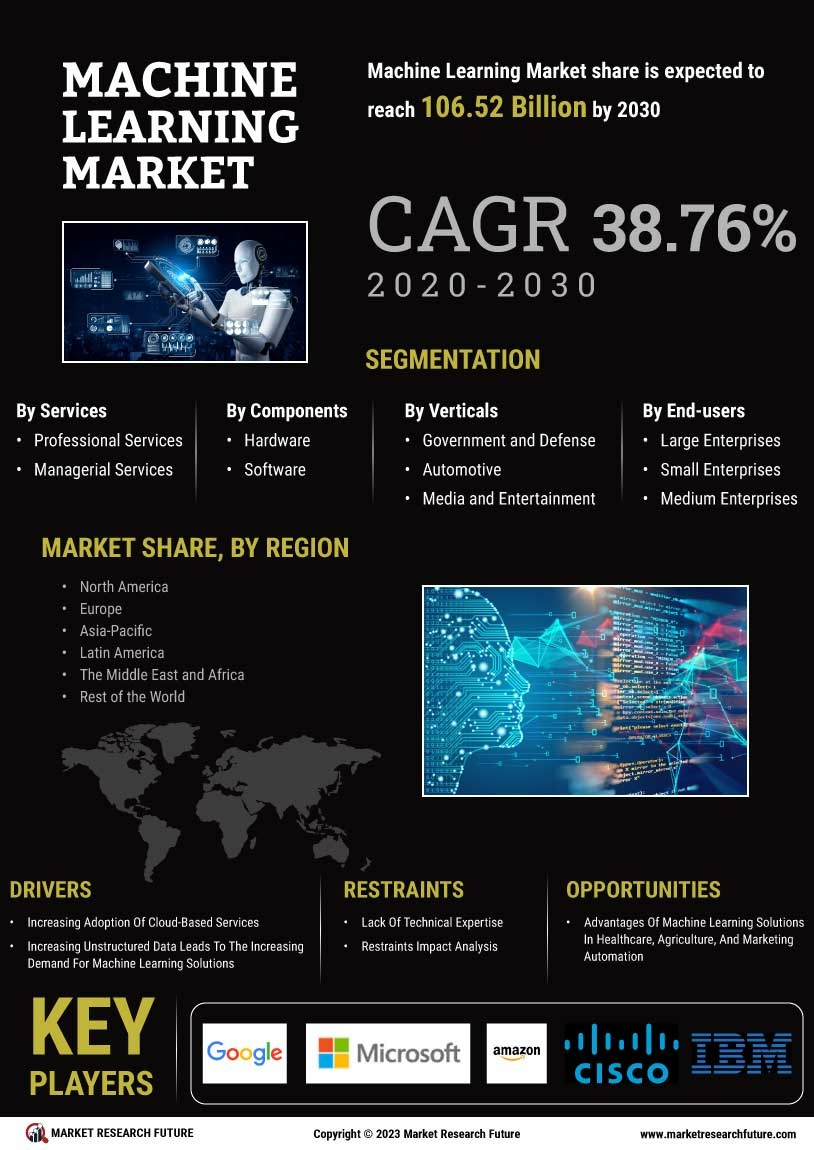
Machine Learning Market Infographic
Purchase Options

Machine Learning Market Summary

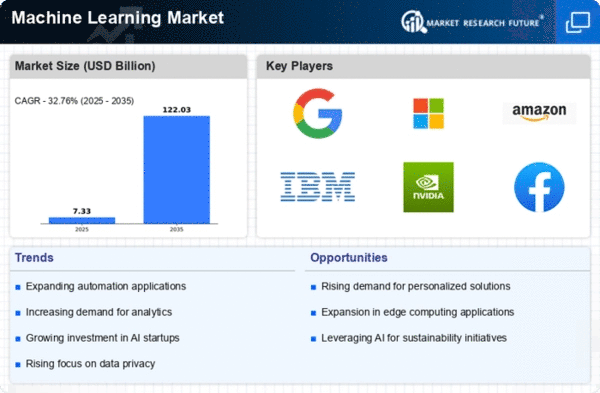
As per MRFR analysis, the Machine Learning Market Size was estimated at 5.52 USD Billion in 2024. The Machine Learning industry is projected to grow from 7.17 USD Billion in 2025 to 122.03 USD Billion by 2035, exhibiting a compound annual growth rate (CAGR) of 32.76 during the forecast period 2025 - 2035.

Key Market Trends & Highlights

The Machine Learning Market is experiencing robust growth driven by automation and advanced analytics.

  • North America remains the largest market for machine learning, showcasing a strong demand for innovative solutions.
  • The Asia-Pacific region is recognized as the fastest-growing area, fueled by rapid technological advancements and investments.
  • Natural Language Processing continues to dominate the market, while Computer Vision is emerging as the fastest-growing segment.
  • Rising demand for predictive analytics and advancements in natural language processing are key drivers propelling market expansion.

Market Size & Forecast

2024 Market Size 5.52 (USD Billion)
2035 Market Size 122.03 (USD Billion)
CAGR (2025 - 2035) 32.76%

Major Players

Google (US), Microsoft (US), Amazon (US), IBM (US), NVIDIA (US), Facebook (US), Salesforce (US), Alibaba (CN), SAP (DE)

Our Impact
Enabled $4.3B Revenue Impact for Fortune 500 and Leading Multinationals
Partnering with 2000+ Global Organizations Each Year
30K+ Citations by Top-Tier Firms in the Industry

Machine Learning Market Trends

The Machine Learning Market is currently experiencing a transformative phase characterized by rapid advancements in technology and increasing adoption across various sectors. Organizations are increasingly recognizing the potential of machine learning to enhance operational efficiency, improve decision-making processes, and drive innovation. This trend is particularly evident in industries such as healthcare, finance, and retail, where machine learning applications are being integrated to analyze vast amounts of data, predict outcomes, and personalize customer experiences. As businesses strive to remain competitive, the demand for machine learning solutions continues to grow, prompting investments in research and development, talent acquisition, and infrastructure enhancement. Moreover, the Machine Learning Market is witnessing a shift towards more accessible and user-friendly platforms. This democratization of technology allows smaller enterprises to leverage machine learning capabilities without requiring extensive technical expertise. Cloud-based solutions are becoming increasingly popular, enabling organizations to scale their operations and access advanced analytics tools with relative ease. As the landscape evolves, collaboration between technology providers and end-users is likely to foster innovation, leading to the emergence of novel applications and services that could redefine industry standards. The future of the Machine Learning Market appears promising, with ongoing developments suggesting a sustained trajectory of growth and diversification. The growing integration of machine learning and business processes is transforming how organizations analyze data, automate operations, and improve strategic decision-making. Today, machine learning in business has become a core driver of digital transformation across industries such as healthcare, finance, and retail. The rising adoption of machine learning for business optimization is driving strong demand for advanced analytics and automation solutions. 

Increased Automation in Business Processes

The Machine Learning Market is seeing a notable trend towards automation, where businesses are utilizing machine learning algorithms to streamline operations. This shift allows organizations to reduce manual intervention, enhance productivity, and minimize errors. As automation becomes more prevalent, companies are likely to invest in machine learning technologies that facilitate real-time data processing and decision-making. Enterprises are increasingly deploying machine learning in business operations to enhance productivity, reduce costs, and improve customer experiences. In the retail and e-commerce sector, machine learning in digital marketing is being used for customer segmentation, personalized recommendations, and campaign optimization. The convergence of machine learning and digital marketing is enabling businesses to deliver data-driven, personalized customer experiences at scale. 

Focus on Ethical AI Practices

There is a growing emphasis on ethical considerations within the Machine Learning Market. Stakeholders are increasingly aware of the implications of biased algorithms and data privacy concerns. As a result, organizations are prioritizing the development of transparent and fair machine learning models. This trend suggests a potential shift towards regulatory frameworks that ensure responsible AI deployment. Companies are adopting machine learning for marketing to improve lead scoring, churn prediction, and customer lifetime value analysis. The expanding role of machine learning and business innovation is expected to create new growth opportunities across both large enterprises and SMEs. Investments in machine learning for business intelligence and automation will remain a key growth driver throughout the forecast period.

Integration of Machine Learning with IoT

The convergence of machine learning and the Internet of Things (IoT) is emerging as a significant trend. By combining these technologies, businesses can harness real-time data from connected devices to enhance predictive analytics and operational efficiency. This integration may lead to innovative applications across various sectors, including smart cities, healthcare, and manufacturing.

Machine Learning Market Drivers

Market Growth Projections

The Global Machine Learning Market Industry is projected to experience substantial growth, with estimates indicating a rise from 5.63 USD Billion in 2024 to 116.8 USD Billion by 2035. This remarkable increase reflects a compound annual growth rate of 31.73% from 2025 to 2035, underscoring the industry's potential. The growth trajectory is influenced by various factors, including technological advancements, increased data generation, and the demand for automation. These projections highlight the dynamic nature of the market and the opportunities it presents for stakeholders across different sectors.

Increasing Data Generation

The Global Machine Learning Market Industry is significantly influenced by the exponential increase in data generation across various domains. With the proliferation of IoT devices, social media, and digital transactions, vast amounts of data are created daily. This data serves as a critical resource for training machine learning models, enabling more accurate predictions and insights. As organizations recognize the value of data-driven decision-making, the demand for machine learning solutions is expected to rise. This trend aligns with the market's projected growth from 5.63 USD Billion in 2024 to 116.8 USD Billion by 2035, highlighting the importance of data in shaping the industry.

Enhanced Customer Experience

The Global Machine Learning Market Industry is increasingly focused on enhancing customer experience through personalized services and recommendations. Businesses are utilizing machine learning algorithms to analyze customer behavior and preferences, allowing for tailored marketing strategies and improved service delivery. For instance, e-commerce platforms employ machine learning to recommend products based on user interactions, leading to higher conversion rates. This emphasis on customer-centric solutions is likely to drive market growth, as organizations strive to meet evolving consumer expectations and preferences, further solidifying the industry's trajectory.

Growing Demand for Automation

The Global Machine Learning Market Industry experiences a surge in demand for automation across numerous sectors, including manufacturing, finance, and healthcare. Organizations are increasingly leveraging machine learning to automate repetitive tasks, enhance operational efficiency, and reduce human error. For example, in the finance sector, machine learning algorithms are utilized for fraud detection and risk assessment, significantly improving decision-making processes. This growing reliance on automation is expected to contribute to a compound annual growth rate of 31.73% from 2025 to 2035, indicating a robust future for the industry.

Regulatory Support and Funding

The Global Machine Learning Market Industry benefits from supportive regulatory frameworks and increased funding from governments and private sectors. Various initiatives aim to promote research and development in machine learning technologies, fostering innovation and collaboration. For example, government grants and subsidies are often allocated to projects that leverage machine learning for public benefit, such as healthcare improvements and smart city developments. This supportive environment is expected to facilitate market expansion, as stakeholders recognize the potential of machine learning to address complex societal challenges.

Rapid Technological Advancements

The Global Machine Learning Market Industry is propelled by rapid technological advancements that enhance machine learning algorithms and frameworks. Innovations in hardware, such as GPUs and TPUs, enable faster processing and more complex computations. For instance, the integration of quantum computing is anticipated to revolutionize data processing capabilities. As of 2024, the market is valued at approximately 5.63 USD Billion, reflecting the increasing adoption of machine learning across various sectors. This trend is likely to continue, with projections indicating a market growth to 116.8 USD Billion by 2035, driven by ongoing technological improvements.

Market Segment Insights

By Application: Natural Language Processing (Largest) vs. Computer Vision (Fastest-Growing)

In the Machine Learning Market, Natural Language Processing (NLP) holds the largest market share due to its pivotal role in enabling machines to understand and interpret human language. Following closely, Computer Vision is recognized as one of the fastest-growing segments, driven by advancements in technology and increasing applications in industries such as healthcare and automotive. Meanwhile, other segments like Predictive Analytics, Robotics, and Speech Recognition are also contributing to the diverse landscape of machine learning applications, though they hold comparatively smaller market shares. The growth trends in this segment are primarily fueled by the escalating demand for automation and enhanced decision-making capabilities across various sectors. Increased investments in AI technologies and machine learning applications further boost the potential for these segments. Notably, the rise of edge computing and the integration of AI into everyday devices are particularly beneficial for segments like Computer Vision, making it a focal point for substantial growth in the coming years.

Natural Language Processing (Dominant) vs. Robotics (Emerging)

Natural Language Processing (NLP) stands out as a dominant force in the Machine Learning Market, with its extensive applications ranging from chatbots to advanced sentiment analysis. Its ability to enhance user experiences and streamline operations across various sectors positions it favorably among enterprises seeking competitive advantages. In contrast, Robotics represents an emerging segment, leveraging machine learning to enhance automation and efficiency. The intersection of robotics with AI allows for improved decision-making in automated processes, fostering innovations in manufacturing, logistics, and service industries. As organizations increasingly adopt intelligent robotic solutions, the robotics segment is expected to gain traction, presenting unique opportunities despite its current smaller footprint in comparison to NLP.

By End Use: Healthcare (Largest) vs. Transportation (Fastest-Growing)

The Machine Learning Market shows a remarkable distribution across various end-use sectors. Healthcare emerges as the largest segment, driven by an increasing reliance on AI technologies for diagnosis, treatment planning, and personalized medicine. This is followed closely by Finance, where machine learning models help in risk assessment and fraud detection. The Manufacturing sector also captures a significant share as companies leverage predictive maintenance and automation to optimize processes, while Retail is experiencing growth due to personalized marketing. Transportation, though smaller, is quickly gaining momentum with the rise of autonomous vehicles and smart logistics solutions.

Healthcare: Diagnosis (Dominant) vs. Transportation: Logistics (Emerging)

In the Healthcare sector, machine learning is revolutionizing diagnosis by enabling healthcare practitioners to analyze vast amounts of data efficiently, leading to more accurate and timely patient care. Hospitals and clinics are adopting AI-driven tools for predictive analytics, improving patient outcomes significantly. In contrast, the Transportation sector is witnessing an emerging trend where machine learning enhances logistics. Companies are focusing on route optimization and predictive maintenance to reduce operational costs and improve service efficiency. This segment's growth is fueled by advancements in autonomous systems and increased investments in smart infrastructure.

By Deployment Type: Cloud (Largest) vs. On-Premises (Fastest-Growing)

The Machine Learning Market is witnessing a significant distribution across various deployment types, with Cloud deployment leading the way. Businesses are increasingly opting for Cloud solutions due to their scalability and lower upfront costs, capturing a significant portion of market interest. In contrast, On-Premises solutions are gaining traction, particularly among organizations that prioritize data security and regulatory compliance, holding a smaller yet notable market share. Meanwhile, the Hybrid approach, combining both models, is also seeing interest but is less predominant than the two mentioned deployment types.

Cloud (Dominant) vs. On-Premises (Emerging)

The Cloud deployment of machine learning solutions is dominant due to its flexibility, ease of access, and integration capabilities with various data services. Organizations value the capacity to scale resources dynamically according to their needs, allowing rapid experimentation and deployment without significant initial investments. On the other hand, On-Premises solutions represent an emerging trend, particularly among industries with strict regulatory requirements, where data privacy and control are paramount. These solutions provide organizations with a secure environment tailored to their specific needs, allowing for customization and direct oversight of data processes. As the Machine Learning Market evolves, a nuanced understanding of both deployment types will be critical for stakeholders.

By Technology: Deep Learning (Largest) vs. Reinforcement Learning (Fastest-Growing)

In the Machine Learning Market, Deep Learning holds the largest market share, driven by its extensive applicability in various sectors such as healthcare, finance, and automotive. Supervised Learning follows closely, leveraging labeled data to improve model accuracy. Unsupervised Learning and Reinforcement Learning are also significant segments, with Unsupervised Learning focusing on pattern recognition and data clustering, while Reinforcement Learning emphasizes on sequential decision-making under uncertainties.

Technology: Deep Learning (Dominant) vs. Reinforcement Learning (Emerging)

Deep Learning is characterized by its deep neural networks that enable the processing of large volumes of unstructured data, making it the dominant technique in the Machine Learning Market. Its ability to improve performance as more data becomes available drives its strong adoption across multiple industries. On the other hand, Reinforcement Learning is an emerging segment, gaining traction for its application in areas such as robotics and autonomous systems. Its growth is fueled by advancements in algorithms and the increasing demand for intelligent systems capable of learning and adapting through experience, making it an attractive area for innovation and investment.

By Component: Software (Largest) vs. Services (Fastest-Growing)

In the Machine Learning Market, the component segment is primarily dominated by Software, which takes the largest market share. This includes a broad range of applications such as predictive analytics, natural language processing, and image recognition, which continue to expand as they find applications across various industries. Hardware, while significant, lags behind Software in terms of share, encompassing specific components like GPUs and FPGAs that facilitate machine learning processes. Meanwhile, Services, which encompass consulting, integration, and support services, while smaller in share, are rapidly increasing due to the growing number of organizations eager to adopt machine learning solutions effectively.

Software (Dominant) vs. Services (Emerging)

Software serves as the dominant force in the Machine Learning Market, characterized by its diverse range of applications that enhance business processes across multiple sectors. With advancements in algorithms and increased accessibility to data, Software solutions are becoming critical for organizations aiming to leverage AI capabilities. Conversely, Services, seen as an emerging player, are gaining traction as companies seek expert guidance in implementing machine learning strategies. The demand for customized solutions and ongoing support is driving growth in this segment, as firms recognize the necessity of integrating machine learning into their operations comprehensively. Together, these components exhibit a dynamic interplay, highlighting the need for synergistic approaches in technology adoption.

Get more detailed insights about Machine Learning Market

Regional Insights

North America : Innovation and Leadership Hub

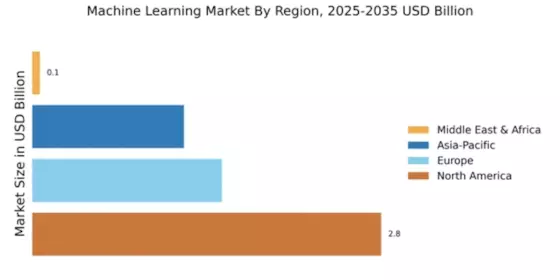
North America continues to lead The Machine Learning, holding a significant share of 2.76B in 2025. The region's growth is driven by rapid technological advancements, increased investment in AI, and a strong focus on research and development. Regulatory support from government initiatives further catalyzes the adoption of machine learning technologies across various sectors, including healthcare, finance, and retail. The competitive landscape is characterized by the presence of major players such as Google, Microsoft, and IBM, which are at the forefront of innovation. The U.S. remains the leading country, with a robust ecosystem that fosters startups and established firms alike. This dynamic environment is expected to sustain growth, as companies leverage machine learning to enhance operational efficiency and customer experiences.

Europe : Emerging AI Powerhouse

Europe's Machine Learning market is projected to reach 1.5B by 2025, driven by stringent regulations and a strong emphasis on data privacy. The European Union's initiatives, such as the General Data Protection Regulation (GDPR), have created a framework that encourages responsible AI development. This regulatory environment fosters trust and accelerates the adoption of machine learning technologies across various industries. Leading countries like Germany, France, and the UK are at the forefront of this growth, with significant investments in AI research and development. Key players such as SAP and emerging startups are contributing to a vibrant competitive landscape. The region's focus on ethical AI and sustainability is expected to shape future innovations, making Europe a critical player in the global machine learning arena.

Asia-Pacific : Rapid Growth and Adoption

The Asia-Pacific region is witnessing rapid growth in the Machine Learning market, projected to reach 1.2B by 2025. This growth is fueled by increasing digital transformation initiatives, a burgeoning tech-savvy population, and significant investments from both public and private sectors. Countries like China and India are leading the charge, with government support for AI research and development playing a crucial role in market expansion. China, in particular, is home to major players like Alibaba, which are driving innovation in machine learning applications across various sectors. The competitive landscape is becoming increasingly dynamic, with numerous startups emerging to capitalize on the growing demand for AI solutions. As the region continues to embrace machine learning, it is set to become a key player in the global market.

Middle East and Africa : Emerging Frontier for AI

The Middle East and Africa (MEA) region represents a nascent market for Machine Learning, with a projected size of 0.06B by 2025. Despite the slow growth, there is a high potential for expansion driven by increasing investments in technology and digital infrastructure. Governments in the region are beginning to recognize the importance of AI and are implementing strategies to foster innovation and attract foreign investment. Countries like the UAE and South Africa are leading the way, with initiatives aimed at integrating AI into various sectors, including healthcare and finance. The presence of global players is gradually increasing, and local startups are emerging to meet the growing demand for machine learning solutions. As awareness and adoption increase, the MEA region is poised for significant growth in the coming years.

Machine Learning Market Regional Image

Key Players and Competitive Insights

The Machine Learning Market is currently characterized by intense competition and rapid innovation, driven by advancements in artificial intelligence (AI) and increasing demand for data-driven decision-making across various sectors. Major players such as Google (US), Microsoft (US), and NVIDIA (US) are at the forefront, leveraging their technological prowess to enhance their offerings. Google (US) focuses on integrating machine learning capabilities into its cloud services, while Microsoft (US) emphasizes partnerships and acquisitions to bolster its AI portfolio. NVIDIA (US) continues to innovate in hardware solutions that support machine learning applications, thereby shaping a competitive landscape that is both dynamic and multifaceted.The market structure appears moderately fragmented, with a mix of established giants and emerging startups. Key players are employing various business tactics, such as localizing their services to cater to regional demands and optimizing supply chains to enhance efficiency. This collective influence of major companies fosters a competitive environment where innovation and strategic partnerships are paramount, allowing them to maintain a competitive edge.
In November Google (US) announced the launch of its new AI-driven analytics platform aimed at small and medium-sized enterprises (SMEs). This strategic move is significant as it not only expands Google's market reach but also democratizes access to advanced machine learning tools for smaller businesses, potentially transforming their operational capabilities. By focusing on SMEs, Google (US) positions itself as a leader in making sophisticated technology accessible, thereby enhancing its competitive stance.
In October Microsoft (US) unveiled a partnership with a leading healthcare provider to develop AI solutions tailored for patient care. This collaboration underscores Microsoft's commitment to leveraging machine learning in critical sectors such as healthcare, where data-driven insights can lead to improved outcomes. The strategic importance of this partnership lies in its potential to enhance Microsoft's reputation as a key player in the healthcare technology space, while also driving innovation in patient management systems.
In September NVIDIA (US) launched a new line of GPUs specifically designed for machine learning applications, which are reported to deliver up to 50% faster processing speeds compared to previous models. This development is crucial as it not only reinforces NVIDIA's dominance in the hardware segment but also addresses the growing demand for high-performance computing in machine learning tasks. The introduction of these GPUs is likely to attract a broader customer base, further solidifying NVIDIA's competitive position in the market.
As of December the Machine Learning Market is witnessing trends that emphasize digitalization, sustainability, and the integration of AI across various industries. Strategic alliances are increasingly shaping the competitive landscape, enabling companies to pool resources and expertise to drive innovation. Looking ahead, it appears that competitive differentiation will evolve from traditional price-based strategies to a focus on technological innovation and supply chain reliability. This shift suggests that companies that prioritize R&D and strategic partnerships will likely emerge as leaders in the market.

Key Companies in the Machine Learning Market include

Industry Developments

  • Q2 2024: Microsoft launches new Copilot+ PCs with advanced AI and machine learning features Microsoft unveiled its Copilot+ PCs, integrating advanced machine learning capabilities directly into Windows devices, marking a major product launch aimed at accelerating AI adoption in personal computing.
  • Q2 2024: Nvidia acquires Run:ai to bolster machine learning workload orchestration Nvidia announced the acquisition of Israeli startup Run:ai, which specializes in machine learning workload management, to enhance its AI infrastructure offerings for enterprise customers.
  • Q2 2024: Anthropic raises $450 million in Series C funding to expand machine learning research AI startup Anthropic secured $450 million in a Series C funding round led by Spark Capital, with the funds earmarked for scaling up its machine learning research and product development.
  • Q3 2024: Google announces partnership with Mayo Clinic to deploy machine learning in healthcare diagnostics Google and Mayo Clinic entered a strategic partnership to deploy machine learning models for improving diagnostic accuracy and operational efficiency in healthcare settings.
  • Q3 2024: OpenAI appoints Sarah Friar as Chief Financial Officer OpenAI named former Nextdoor CEO Sarah Friar as its new CFO, signaling a focus on scaling its machine learning business operations and preparing for potential public offerings.
  • Q3 2024: NVIDIA opens new AI research center in Cambridge, UK NVIDIA inaugurated a new research facility in Cambridge dedicated to advancing machine learning and AI, aiming to foster innovation and collaboration with academic and industry partners.
  • Q4 2024: Databricks acquires Tabular to expand machine learning data management capabilities Databricks acquired Tabular, a data management startup, to enhance its machine learning platform with improved data versioning and governance features.
  • Q4 2024: Amazon Web Services wins $1.2 billion contract to provide machine learning cloud services to U.S. Department of Defense AWS secured a $1.2 billion contract to deliver machine learning-powered cloud infrastructure and analytics tools to the U.S. Department of Defense, supporting national security initiatives.
  • Q1 2025: Apple launches on-device machine learning features in iOS 19 Apple introduced new on-device machine learning capabilities in iOS 19, enabling advanced privacy-preserving AI features for users without relying on cloud processing.
  • Q1 2025: Siemens and Google Cloud announce partnership to integrate machine learning in industrial automation Siemens and Google Cloud formed a partnership to embed machine learning models into industrial automation systems, aiming to optimize manufacturing processes and reduce downtime.
  • Q2 2025: OpenAI launches enterprise-grade machine learning API for regulated industries OpenAI released a new API tailored for highly regulated sectors such as finance and healthcare, offering enhanced compliance and security features for machine learning applications.
  • Q2 2025: Hugging Face raises $300 million in Series D to expand open-source machine learning platform Hugging Face closed a $300 million Series D funding round to accelerate development of its open-source machine learning tools and expand its global engineering team.

Future Outlook

Machine Learning Market Future Outlook

The Machine Learning Market is projected to grow at a 32.76% CAGR from 2025 to 2035, driven by advancements in AI technologies, increased data availability, and demand for automation.

New opportunities lie in:

  • Development of AI-driven predictive maintenance solutions for manufacturing sectors. Integration of machine learning in personalized healthcare applications. Expansion of machine learning platforms for real-time data analytics in finance.

By 2035, the Machine Learning Market is expected to be a cornerstone of technological innovation and economic growth.

Market Segmentation

Machine Learning Market End Use Outlook

  • Healthcare
  • Finance
  • Retail
  • Manufacturing
  • Transportation

Machine Learning Market Component Outlook

  • Software
  • Hardware
  • Services

Machine Learning Market Technology Outlook

  • Supervised Learning
  • Unsupervised Learning
  • Reinforcement Learning
  • Deep Learning

Machine Learning Market Application Outlook

  • Natural Language Processing
  • Computer Vision
  • Predictive Analytics
  • Robotics
  • Speech Recognition

Machine Learning Market Deployment Type Outlook

  • Cloud
  • On-Premises
  • Hybrid

Report Scope

MARKET SIZE 2024 5.52(USD Billion)
MARKET SIZE 2025 7.17(USD Billion)
MARKET SIZE 2035 122.03(USD Billion)
COMPOUND ANNUAL GROWTH RATE (CAGR) 32.76% (2025 - 2035)
REPORT COVERAGE Revenue Forecast, Competitive Landscape, Growth Factors, and Trends
BASE YEAR 2024
Market Forecast Period 2025 - 2035
Historical Data 2019 - 2024
Market Forecast Units USD Billion
Key Companies Profiled Google (US), Microsoft (US), Amazon (US), IBM (US), NVIDIA (US), Facebook (US), Salesforce (US), Alibaba (CN), SAP (DE)
Segments Covered Application, End Use, Deployment Type, Technology, Component
Key Market Opportunities Integration of advanced algorithms in diverse industries enhances efficiency and drives innovation in the Machine Learning Market.
Key Market Dynamics Rising demand for automation drives competitive innovation and investment in machine learning technologies across various industries.
Countries Covered North America, Europe, APAC, South America, MEA

Market Highlights

Author
Shubham Munde
Research Analyst Level II

With a technical background in information technology & semiconductors, Shubham has 4.5+ years of experience in market research and analytics with the tasks of data mining, analysis, and project execution. He is the POC for our clients, for their consulting projects running under the ICT/Semiconductor domain. Shubham holds a Bachelor’s in Information and Technology and a Master of Business Administration (MBA). Shubham has executed over 150 research projects for our clients under the brand name Market Research Future in the last 2 years. His core skill is building the research respondent relation for gathering the primary information from industry and market estimation for niche markets. He is having expertise in conducting secondary & primary research, market estimations, market projections, competitive analysis, analysing current market trends and market dynamics, deep-dive analysis on market scenarios, consumer behaviour, technological impact analysis, consulting, analytics, etc. He has worked on fortune 500 companies' syndicate and consulting projects along with several government projects. He has worked on the projects of top tech brands such as IBM, Google, Microsoft, AWS, Meta, Oracle, Cisco Systems, Samsung, Accenture, VMware, Schneider Electric, Dell, HP, Ericsson, and so many others. He has worked on Metaverse, Web 3.0, Zero-Trust security, cyber-security, blockchain, quantum computing, robotics, 5G technology, High-Performance computing, data centers, AI, automation, IT equipment, sensors, semiconductors, consumer electronics and so many tech domain projects.

Leave a Comment

FAQs

How big is the ML market?

The global ML Market size is projected to reach USD 49.875 Billion by 2032, growing at a CAGR of 32.8% from 2024 to 2032.

Who are the key players in the global machine learning market?

Google (US), Amazon.com, Inc. (US), Microsoft Corporation. (US), Nuance Communications (US), Cisco Systems, Inc. (US), Apple Inc (US), IBM Corporation (US), Intel Corporation (US), Baidu Inc (China), Facebook, Inc. (the US), and Wipro Limited (India).

Which regions have been analyzed for the regional analysis of the global machine learning market?

The regional analysis of the global machine learning market has been conducted in five major regions, namely, North America, Asia Pacific, Europe, Latin America, and the Middle East and Africa.

What is the segmentation of the global machine learning market?

The segmentation of the global machine learning market is done on the basis of component, organization size, and vertical.

What are the driving factors of the global machine learning market?

An increase in unstructured data has led to increasing demand for machine learning solutions. The need for machine learning is driven by the growing adoption of cloud-based services. This growth in the deployment of cloud-based services has positively impacted the global machine learning market.

Which industry uses machine learning the most?

In the Artificial Intelligence (AI) is beginning to play a leading role as well as Automotive, Telecommunication, Healthcare, Education and in life science also mostly used machine learning.

Download Free Sample

Kindly complete the form below to receive a free sample of this Report

Compare Licence

×
Features License Type
Single User Multiuser License Enterprise User
Price $4,950 $5,950 $7,250
Maximum User Access Limit 1 User Upto 10 Users Unrestricted Access Throughout the Organization
Free Customization
Direct Access to Analyst
Deliverable Format
Platform Access
Discount on Next Purchase 10% 15% 15%
Printable Versions