Request Free Sample ×

Kindly complete the form below to receive a free sample of this Report

* Please use a valid business email

Leading companies partner with us for data-driven Insights

clients tt-cursor
Hero Background

Luxury Travel Market

ID: MRFR/CG/17348-HCR
128 Pages
Sakshi Gupta
Last Updated: April 06, 2026

Luxury Travel Market Size, Share, Industry Trend & Analysis Research Report By Travel Type (Leisure Travel, Business Travel, Wellness Travel, Adventure Travel, Cultural Travel), By Service Type (Luxury Hotels, Private Jets, Yacht Charters, Personalized Travel Services, Luxury Tours), By Demographics (Affluent Individuals, Honeymooners, Families, Corporate Executives, Retirees), By Duration of Travel (Short-term, Medium-term, Long-term) and By Region (North America, Europe, South America, Asia Pacific, Middle East and Africa)- Forecast to 2035.

Share:
Download PDF ×

We do not share your information with anyone. However, we may send you emails based on your report interest from time to time. You may contact us at any time to opt-out.

Luxury Travel Market Infographic
Purchase Options

Luxury Travel Market Summary

As per Market Research Future analysis, the Luxury Travel Market Size was estimated at 1400 USD Billion in 2024. The Luxury Travel industry is projected to grow from 1486.8 USD Billion in 2025 to 2713.3 USD Billion by 2035, exhibiting a compound annual growth rate (CAGR) of 6.2% during the forecast period 2025 - 2035

Key Market Trends & Highlights

The Luxury Travel Market is experiencing a dynamic shift towards personalized and sustainable travel experiences.

  • Personalized travel experiences are increasingly sought after by affluent travelers, enhancing customer satisfaction and loyalty.
  • Sustainability in luxury travel is becoming a priority, with travelers favoring eco-friendly options and practices.
  • Wellness tourism is gaining traction, as consumers prioritize health and well-being during their travel experiences.
  • Rising disposable incomes and a growing demand for experiential travel are driving the expansion of leisure travel and private jets in North America and Asia-Pacific.

Market Size & Forecast

2024 Market Size 1400 (USD Billion)
2035 Market Size 1486.8 (USD Billion)
CAGR (2025 - 2035) 6.2%

Major Players

Trafalgar (GB), Abercrombie & Kent (GB), Four Seasons Hotels and Resorts (CA), The Ritz-Carlton Hotel Company (US), Belmond (GB), Aman Resorts (SG), Banyan Tree Holdings (SG), Luxury Escapes (AU), Oetker Collection (DE)

Our Impact
Enabled $4.3B Revenue Impact for Fortune 500 and Leading Multinationals
Partnering with 2000+ Global Organizations Each Year
30K+ Citations by Top-Tier Firms in the Industry

Luxury Travel Market Trends

The Luxury Travel Market Trends currently experiencing a dynamic evolution, characterized by a growing demand for personalized and unique travel experiences. Travelers are increasingly seeking bespoke itineraries that cater to their individual preferences, which often include exclusive access to high-end accommodations, private tours, and tailored services. This shift towards customization reflects a broader trend where luxury is defined not merely by opulence but by the quality of experiences and the level of service provided. Furthermore, sustainability has emerged as a pivotal consideration, with affluent consumers showing a preference for eco-friendly options that align with their values. As a result, luxury travel providers are adapting their offerings to incorporate sustainable practices, thereby appealing to a conscientious clientele.

In addition to personalization and sustainability, the Luxury Travel Market is witnessing a rise in wellness tourism. Travelers are increasingly prioritizing their health and well-being, seeking retreats that offer rejuvenation and relaxation. This trend encompasses a variety of experiences, from spa retreats to wellness-focused itineraries that promote physical and mental health. The integration of wellness into luxury travel not only enhances the overall experience but also addresses the growing awareness of health issues among affluent travelers. As the market continues to evolve, these trends indicate a shift towards a more holistic approach to luxury travel, where the emphasis is placed on meaningful experiences and personal well-being.

Personalized Travel Experiences

The Luxury Travel Market is witnessing a notable shift towards personalized travel experiences. Affluent travelers are increasingly seeking bespoke itineraries that cater to their unique preferences and desires. This trend emphasizes the importance of customization, where high-end accommodations and exclusive access to attractions are tailored to individual tastes, enhancing the overall travel experience.

Sustainability in Luxury Travel

Sustainability has become a crucial factor in the Luxury Travel Market, as discerning consumers show a preference for eco-friendly options. Luxury travel providers are adapting their offerings to incorporate sustainable practices, such as responsible sourcing and environmentally conscious accommodations. This trend reflects a growing awareness among affluent travelers regarding their impact on the environment.

Wellness Tourism

The rise of wellness tourism is significantly influencing the Luxury Travel Market. Travelers are increasingly prioritizing health and well-being, seeking retreats that offer rejuvenation and relaxation. This trend encompasses a variety of experiences, from spa retreats to wellness-focused itineraries, highlighting the importance of personal well-being in luxury travel.

Luxury Travel Market Drivers

Health and Wellness Focus

The focus on health and wellness is a prominent driver in the luxury travel Market. As consumers become more health-conscious, there is a growing demand for travel experiences that promote well-being and relaxation. Luxury travel providers are responding by offering wellness retreats, spa experiences, and holistic health programs that cater to this trend. Data suggests that wellness tourism is a rapidly growing segment, with many luxury travelers prioritizing their physical and mental health during their journeys. This emphasis on wellness not only enhances the travel experience but also aligns with the broader societal shift towards healthier lifestyles. As the Luxury Travel Market continues to evolve, the integration of health and wellness offerings is likely to become a standard expectation among discerning travelers.

Rising Disposable Incomes

The Luxury Travel Market appears to be significantly influenced by the increasing disposable incomes of affluent consumers. As wealth distribution continues to evolve, a growing segment of the population is entering the upper-middle and high-income brackets. This trend is particularly evident in emerging economies, where the number of high-net-worth individuals is on the rise. According to recent data, the number of millionaires has increased substantially, leading to a greater demand for luxury travel experiences. This demographic shift suggests that more individuals are willing to invest in exclusive travel options, thereby propelling the Luxury Travel Market forward. The willingness to spend on unique and personalized experiences indicates a robust potential for growth in this sector.

Experiential Travel Demand

The Luxury Travel Market is witnessing a notable shift towards experiential travel, where consumers seek immersive and authentic experiences rather than traditional sightseeing. This trend reflects a broader desire for meaningful connections and personal growth during travel. Data suggests that luxury travelers are increasingly interested in activities that allow them to engage with local cultures, cuisines, and communities. This demand for unique experiences is driving luxury travel providers to curate bespoke itineraries that cater to these preferences. As a result, the Luxury Travel Market is evolving to offer more personalized and enriching travel options, which may include culinary tours, adventure activities, and cultural exchanges. This focus on experiential travel is likely to continue shaping the industry, as consumers prioritize experiences that resonate with their values and interests.

Sustainability Initiatives

Sustainability initiatives are becoming increasingly important within the Luxury Travel Market. As awareness of environmental issues grows, luxury travelers are more inclined to choose eco-friendly options that align with their values. This shift is prompting luxury travel providers to adopt sustainable practices, such as reducing carbon footprints, supporting local communities, and promoting conservation efforts. Data indicates that a significant portion of luxury travelers is willing to pay a premium for sustainable travel experiences, suggesting that the Luxury Travel Market must adapt to this demand. By integrating sustainability into their offerings, luxury brands can not only attract environmentally conscious consumers but also enhance their brand reputation. This trend towards sustainability is likely to shape the future of luxury travel, as consumers increasingly seek responsible travel options.

Technological Advancements

Technological advancements play a pivotal role in shaping the Luxury Travel Market. Innovations in travel technology, such as mobile applications, artificial intelligence, and virtual reality, enhance the overall travel experience for consumers. These technologies facilitate personalized services, streamline booking processes, and provide real-time information, which are increasingly expected by luxury travelers. Furthermore, the integration of smart technologies in accommodations and transportation options elevates the level of comfort and convenience. Data indicates that a significant percentage of luxury travelers prioritize technology-driven experiences, suggesting that the Luxury Travel Market must adapt to these evolving preferences. As technology continues to advance, it is likely to further transform the landscape of luxury travel, creating new opportunities for service providers.

Market Segment Insights

By Type: Leisure Travel (Largest) vs. Business Travel (Fastest-Growing)

Leisure Travel (Dominant) vs. Wellness Travel (Emerging)

Leisure travel remains the dominant force in the luxury travel market, characterized by tailored experiences and a focus on high-end accommodations, gourmet dining, and immersive cultural experiences. Travelers in this segment prioritize unique adventures and personalized services, contributing to the segment's market strength. In contrast, wellness travel is emerging rapidly, driven by the increasing awareness around health and well-being. Traveling for wellness includes spa retreats, holistic treatments, and fitness-focused itineraries, catering to health-conscious consumers. The wellness travel segment is redefining luxury standards by emphasizing rejuvenation, relaxation, and whole-person experiences, resonating well with the growing number of affluent individuals seeking balance in their lives.

By Service Type: Luxury Hotels (Largest) vs. Private Jets (Fastest-Growing)

In the Luxury Travel Market Analysis, 'Luxury Hotels' hold the largest market share, catering to affluent travelers seeking exceptional comfort and exclusivity. The hotel segment is characterized by iconic brands and high-end amenities that define luxury stays. Following closely, 'Private Jets' are marked as the fastest-growing segment, appealing to jet-setters prioritizing convenience and privacy in their travel experiences. The demand for personalized and swift travel solutions is driving the expansion of this segment.

luxury hotels (Dominant) vs. Private Jets (Emerging)

Luxury Hotels are the cornerstone of the luxury travel experience, offering sumptuous accommodations and unparalleled services tailored to elite clientele. This segment thrives on heritage, exclusivity, and the ability to provide unique experiences, often located in prime destinations. On the other hand, Private Jets have emerged strongly as an essential service for high-net-worth individuals, allowing for bespoke itineraries and unparalleled flexibility. The growing trend towards personalized travel experiences positions Private Jets as a critical choice for luxury travelers looking to maximize convenience and comfort on their journeys.

By Demographics: Affluent Individuals (Largest) vs. Honeymooners (Fastest-Growing)

The Luxury Travel Market is primarily driven by affluent individuals, who hold the largest share in this segment. These travelers seek unique, personalized experiences and are willing to spend on high-end services that cater to their desires. Honeymooners follow closely as a rapidly expanding demographic, emphasizing luxury and romance, thus reflecting significant potential for growth in tailored travel packages and exclusive destinations. The combined influence of both segments shapes travel trends and preferences in the luxury market.

Affluent Individuals (Dominant) vs. Honeymooners (Emerging)

Affluent individuals represent the dominant force within the Luxury Travel Market, characterized by their high disposable income and a preference for lavish experiences. This demographic often opts for bespoke services, luxury accommodations, and exclusive access to events and activities. In contrast, honeymooners are emerging as a dynamic segment driven by the desire for romantic and memorable experiences post-wedding. They tend to seek destinations that offer luxurious settings, relaxing atmospheres, and unique activities designed for couples, aligning with the trend for personalized and experiential travel. Together, these segments illustrate the diverse motivations and spending patterns in luxury travel.

By Duration of Travel: Medium-term (Largest) vs. Long-term (Fastest-Growing)

In the Luxury Travel Market Research, the duration of travel plays a pivotal role in shaping consumer preferences and market dynamics. The segment distribution reveals that the Medium-term travel category, typically comprising trips ranging from a week to a month, dominates the market in terms of share. This segment appeals to affluent travelers who seek an immersive experience without the commitment of lengthy travel plans. In contrast, the Short-term segment, defined by quick getaways lasting just a few days, garners a smaller share, while Long-term travel options, often extending beyond a month, are emerging as a popular choice for travelers seeking transformative journeys across multiple destinations.
The trends in the Luxury Travel Market indicate a notable shift towards Long-term travel as affluent consumers increasingly prioritize experiences over material possessions. This longer duration allows for deeper engagement with destinations, fostering personalized experiences that resonate with travelers. Factors such as the rise of remote work, which enables professionals to combine leisure and work, are further propelling the growth of Long-term travel. As luxury travelers seek greater flexibility and enriched cultural interactions during their trips, the Long-term segment is witnessing rapid expansion, thereby reshaping the traditional travel landscape and diversifying offerings within the market.

Medium-term (Dominant) vs. Long-term (Emerging)

Within the Luxury Travel Market, the Medium-term travel segment stands out as a dominant category, primarily catering to high-income individuals who prefer longer vacations with curated experiences. This segment typically features trips ranging from a week to a month, appealing to travelers who seek a balance between escapism and meaningful engagements. Medium-term travel allows for the exploration of luxury accommodations, gourmet dining, and bespoke experiences that add value to the journey. In contrast, the Long-term travel segment, characterized by extended vacations often exceeding a month, is emerging rapidly as traveler preferences evolve. This segment attracts affluent consumers eager to immerse themselves in different cultures, landscapes, and experiences, supported by factors such as flexible work arrangements. Both segments ultimately reflect the growing demand for unique, high-quality travel experiences, with Medium-term occupancy still leading while Long-term travel expands its footprint.

Get more detailed insights about Luxury Travel Market

Regional Insights

North America : Luxury Travel Market Leader

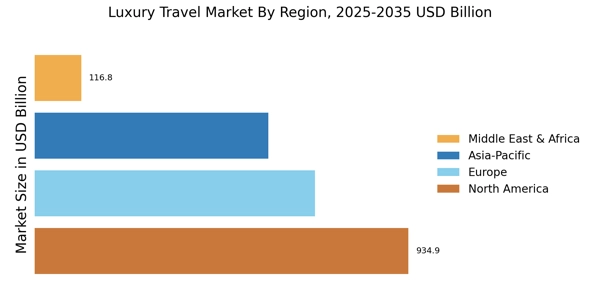
North America is the largest market for luxury travel, accounting for approximately 40% of the global share. The region's growth is driven by increasing disposable incomes, a strong demand for personalized experiences, and a growing trend towards sustainable travel. Regulatory support for tourism and hospitality sectors further enhances market dynamics, fostering innovation and investment in luxury offerings. The United States and Canada are the leading countries in this region, with the U.S. holding a significant share of the luxury travel market. Key players such as Four Seasons Hotels and Resorts and The Ritz-Carlton Hotel Company dominate the landscape, offering high-end services and unique experiences. The competitive environment is characterized by a focus on customer satisfaction and exclusive offerings, ensuring a robust market presence.

Europe : Cultural Richness and Luxury

Europe is a significant player in the luxury travel market, holding approximately 30% of the global share. The region's growth is fueled by its rich cultural heritage, diverse destinations, and a strong emphasis on experiential travel. Regulatory frameworks promoting tourism and environmental sustainability are also key drivers, enhancing the appeal of luxury travel in countries like France and Italy. Leading countries in Europe include France, Italy, and the United Kingdom, each offering unique luxury experiences. The competitive landscape features renowned brands such as Belmond and Aman Resorts, which cater to affluent travelers seeking exclusive and personalized services. The presence of high-end hotels and bespoke travel agencies further strengthens Europe's position in the luxury travel market.

Asia-Pacific : Emerging Luxury Travel Market Hub

Asia-Pacific is emerging as a powerhouse in the luxury travel market, accounting for approximately 25% of the global share. The region's growth is driven by rising affluence, a growing middle class, and increasing interest in unique travel experiences. Regulatory support for tourism infrastructure and investment in luxury accommodations are also significant factors contributing to this growth. Countries like China, Japan, and Australia are at the forefront of this market, with a competitive landscape featuring key players such as Banyan Tree Holdings and Luxury Escapes. The region is characterized by a blend of traditional and modern luxury offerings, catering to diverse traveler preferences. The increasing number of high-net-worth individuals is further propelling demand for luxury travel experiences.

Middle East and Africa : Luxury in Diverse Landscapes

The Middle East and Africa region is witnessing a surge in luxury travel, holding approximately 5% of the global market share. The growth is driven by significant investments in tourism infrastructure, luxury resorts, and a focus on attracting high-end travelers. Regulatory initiatives aimed at enhancing tourism experiences and promoting cultural heritage are also pivotal in this region's development. Leading countries include the United Arab Emirates and South Africa, which are known for their luxury offerings and unique experiences. The competitive landscape features prominent players like Oetker Collection, catering to affluent travelers seeking exclusivity. The region's diverse landscapes and rich cultural heritage further enhance its appeal in the luxury travel market.

Luxury Travel Market Regional Image

Key Players and Competitive Insights

As income levels rise, people are looking for individualised and distinctive travel experiences. This factor primarily drives growth of the international luxury travel market. Exclusive products, luxury hotels, and customized itineraries that cater to demands of affluent travellers define this industry. Insights on competition in this field demonstrates a scene where market players strive to acquire a competitive edge by providing outstanding services, engaging in creative marketing techniques, and providing unique offers. With many companies spending significantly on technology and alliances to improve their service delivery, the ability to generate customized experiences and maintaining luxury standards are important. As businesses negotiate changing customer tastes and new travel patterns, this vibrant ecosystem offers both chances and obstacles. Abercrombie and Kent is a prominent player in the luxury travel market, renowned for its exceptional service and curated travel experiences. The company has established a strong reputation for offering high-end, tailor-made itineraries across various destinations worldwide. Abercrombie and Kent's strength lies in its deep destination knowledge, luxurious accommodations, and exclusive VIP access to unique experiences that are often unavailable through traditional travel agencies. The company's commitment to personalized service and attention to detail helps build strong relationships with clientele, ensuring a high level of customer satisfaction. Additionally, Abercrombie and Kent leverages its vast network of local connections to provide travelers with authentic experiences, enabling the company to maintain a competitive edge in an ever-evolving market. Booking Holdings is another major competitor in the luxury travel market, noted for its diverse portfolio of travel services and cutting-edge technology platform. The company operates several well-known brands, each of which provides various services such as hotel accommodations, vehicle rentals, and vacation packages suited to luxury travellers. Booking Holdings has positioned itself well in the worldwide market through strategic acquisitions and mergers, allowing it to dramatically increase its service offerings and market footprint. The company's strength lie in its robust technological infrastructure, allowing for seamless booking experience and exceptional customer support. As a leader in the online travel agency sector, Booking Holdings continues to innovate by integrating cutting-edge technologies to enhance user experience and streamline the luxury travel planning process, thus solidifying its position in this competitive landscape.

Key Companies in the Luxury Travel Market include

Future Outlook

Luxury Travel Market Future Outlook

The Luxury Travel Market is projected to grow at a 6.2% CAGR from 2025 to 2035, driven by rising disposable incomes, experiential travel demand, and technological advancements.

New opportunities lie in:

  • Personalized luxury travel packages leveraging AI-driven insights. Sustainable luxury accommodations focusing on eco-friendly practices. Exclusive partnerships with high-end brands for unique travel experiences.

By 2035, the Luxury Travel Market is poised for robust growth, reflecting evolving consumer preferences and increased spending.

Market Segmentation

Luxury Travel Market Type Outlook

  • Leisure Travel
  • Business Travel
  • Wellness Travel
  • Adventure Travel
  • Cultural Travel

Luxury Travel Market Demographics Outlook

  • Affluent Individuals
  • Honeymooners
  • Families
  • Corporate Executives
  • Retirees

Luxury Travel Market Service Type Outlook

  • Luxury Hotels
  • Private Jets
  • Yacht Charters
  • Personalized Travel Services
  • Luxury Tours

Luxury Travel Market Duration of Travel Outlook

  • Short-term
  • Medium-term
  • Long-term

Report Scope

MARKET SIZE 2024 1400 (USD Billion)
MARKET SIZE 2025 1486.8 (USD Billion)
MARKET SIZE 2035 2713.3 (USD Billion)
COMPOUND ANNUAL GROWTH RATE (CAGR) 6.2% (2025 - 2035)
REPORT COVERAGE Revenue Forecast, Competitive Landscape, Growth Factors, and Trends
BASE YEAR 2024
Market Forecast Period 2025 - 2035
Historical Data 2019 - 2024
Market Forecast Units USD Billion
Key Companies Profiled Trafalgar (GB), Abercrombie & Kent (GB), Four Seasons Hotels and Resorts (CA), The Ritz-Carlton Hotel Company (US), Belmond (GB), Aman Resorts (SG), Banyan Tree Holdings (SG), Luxury Escapes (AU), Oetker Collection (DE)
Segments Covered Travel Type, Service Type, Demographics, Duration of Travel, Region
Key Market Opportunities Integration of personalized digital experiences enhances customer engagement in the Luxury Travel Market.
Key Market Dynamics Rising consumer demand for personalized experiences drives innovation and competition in the luxury travel sector.
Countries Covered North America, Europe, APAC, South America, MEA

Market Highlights

FAQs

What is the current valuation of the Luxury Travel Market as of 2024?

The Luxury Travel Market was valued at 2337.22 USD Billion in 2024.

What is the projected market size for the Luxury Travel Market by 2035?

The market is projected to reach 4530.65 USD Billion by 2035.

What is the expected CAGR for the Luxury Travel Market during the forecast period 2025 - 2035?

The expected CAGR for the Luxury Travel Market during 2025 - 2035 is 6.2%.

Which segment of the Luxury Travel Market had the highest valuation in 2024?

Leisure Travel had the highest valuation at 800.0 USD Billion in 2024.

What are the projected valuations for Business Travel in 2035?

Business Travel is projected to reach between 600.0 and 1200.0 USD Billion by 2035.

How do Luxury Hotels compare to Private Jets in terms of market valuation?

Luxury Hotels were valued at 800.0 USD Billion in 2024, while Private Jets were valued at 400.0 USD Billion.

What demographic segment is expected to show significant growth in the Luxury Travel Market?

Affluent Individuals, valued at 700.0 USD Billion in 2024, are expected to show significant growth.

What is the projected valuation for Luxury Tours by 2035?

Luxury Tours are projected to reach between 337.22 and 530.65 USD Billion by 2035.

Which key player in the Luxury Travel Market is known for its luxury hotel offerings?

Four Seasons Hotels and Resorts is a prominent player known for its luxury hotel offerings.

What is the expected trend for Adventure Travel in the Luxury Travel Market by 2035?

Adventure Travel is projected to grow, with valuations expected to reach between 250.0 and 500.0 USD Billion by 2035.
Author
Author
Author Profile
Sakshi Gupta LinkedIn
Team Lead - Research
Currently a Team Lead in consumer goods, FMCG, and F&B, she translates rigorous research into decisive strategy. She develops GTM roadmaps, pricing architectures, and competitive benchmarks for companies across Europe, the US, and APAC. She synthesize insights, align cross-functional teams, and drive execution from brief to measurable outcomes. She leads end-to-end engagements with crisp analysis, compelling storytelling, and a strong command of Power BI, Tableau, SQL, and advanced research platforms.
Leave a Comment

Research Approach

Secondary Research

The secondary research process involved comprehensive analysis of regulatory databases, industry publications, tourism statistics, and authoritative travel & hospitality organizations. Key sources included:

Government & Regulatory Sources:

UNWTO (United Nations World Tourism Organization) – Global tourism statistics, international arrival data, and travel forecasting

World Travel & Tourism Council (WTTC) – Economic impact data, employment statistics, and regional tourism contribution metrics

U.S. Travel Association – Domestic and outbound U.S. luxury travel spending, traveler sentiment indices

Eurostat Tourism Statistics (EU) – European tourism flows, accommodation statistics, and seasonal travel patterns

OECD Tourism Statistics – International tourism expenditure and policy frameworks

National Tourism Organizations (NTOs) – VisitBritain, Tourism Australia, Brand USA, Japan Tourism Agency (JTA), Tourism Authority of Thailand (TAT)

U.S. Department of Commerce / National Travel and Tourism Office – Inbound travel data, international visitor spending

European Travel Commission (ETC) – European travel trends and market monitoring

Statistics bureaus of key markets – UK Office for National Statistics (ONS), Australian Bureau of Statistics (ABS), Statistics Canada

Industry Associations & Organizations:

Virtuoso Network – Luxury travel agency consortium data, booking trends, advisor insights

Signature Travel Network – Luxury travel advisor sentiment and destination popularity

International Air Transport Association (IATA) – Premium class passenger traffic, aviation metrics

Airlines Reporting Corporation (ARC) – Air travel booking data and premium cabin trends

STR Global – Luxury hotel performance data, ADR and occupancy rates for 5-star properties

Leading Hotels of the World, Relais & Châteaux, Small Luxury Hotels of the World – Brand-specific performance and guest demographics

ILTM (International Luxury Travel Market) – Industry event data and buyer insights

The International Ecotourism Society – Sustainable luxury travel trends

Virtuoso Luxe Report, Travel + Leisure, Condé Nast Traveler – Consumer preference surveys and trend reports

Financial & Market Intelligence Sources:

Bloomberg, Reuters, Skift, Phocuswright – Industry news, M&A activity, funding rounds

Moody's, S&P Global – Hotel and hospitality sector credit ratings and analysis

Deloitte, McKinsey, Bain & Company – Luxury sector reports and consumer insights

These sources were utilized to collect market size data, traveler demographic trends, spending patterns, destination popularity indices, accommodation performance metrics, and competitive landscape analysis across experiential travel, adventure tourism, wellness retreats, private aviation, luxury cruises, and high-end hospitality segments.

Primary Research

In order to gather both qualitative and quantitative insights, supply-side and demand-side stakeholders were interviewed during the primary research process. CEOs, VPs of guest experience, chief marketing officers, heads of revenue management, and commercial directors from the following companies were examples of supply-side sources:

Ultra-luxury hotel chains and resort operators

Private jet and yacht charter companies

Luxury cruise lines and expedition operators

High-end tour operators and DMCs (Destination Management Companies)

Premium travel agencies and consortia leadership

Luxury villa and private accommodation platforms

Experiential and adventure travel providers

Demand-side sources comprised:

High-net-worth individuals (HNWIs) and ultra-HNWIs

Family office travel coordinators

Corporate travel managers for C-suite executives

Private aviation members and fractional ownership clients

Luxury travel advisors and concierges

Event planners specializing in luxury destination weddings and corporate retreats

Primary research validated market segmentation, confirmed product pipeline timelines, and gathered insights on booking behavior patterns, pricing sensitivity, destination emerging trends, sustainability priorities, and technology adoption in luxury travel experiences.

Primary Respondent Breakdown

By Company Tier:

Tier 1 (>USD 5B revenue): 38%

Tier 2 (USD 500M–5B): 31%

By Designation:

C-level Primaries (CEO, MD, President): 29%

Director Level (VP, Director, Head of): 34%

Others (Senior Managers, Specialists, Owners): 37%

By Region:

North America: 31%

Europe: 29%

Asia-Pacific: 32%

Rest of World (Middle East, Latin America, Africa): 8%

Market Size Estimation

Global market valuation was derived through revenue mapping and traveler volume analysis. The methodology included:

Identification of 60+ key operators across North America, Europe, Asia-Pacific, Middle East, and Latin America

Product mapping across luxury hotels & resorts, private aviation, yacht charters, luxury cruises, experiential/adventure travel, wellness retreats, and bespoke tour services

Analysis of reported and modeled annual revenues specific to luxury travel portfolios

Coverage of operators representing 65-70% of global market share in 2024

Extrapolation using bottom-up (traveler volume × average spend per trip by country/segment) and top-down (operator revenue validation) approaches to derive segment-specific valuations

Integration of ancillary spending data (dining, spa, excursions, retail) to capture total trip economics

Would you like me to adjust any specific sources for particular geographic regions or modify the respondent breakdown percentages further?

Download Free Sample

Kindly complete the form below to receive a free sample of this Report

Compare Licence

×
Features License Type
Single User Multiuser License Enterprise User
Price $4,950 $5,950 $7,250
Maximum User Access Limit 1 User Upto 10 Users Unrestricted Access Throughout the Organization
Free Customization
Direct Access to Analyst
Deliverable Format
Platform Access
Discount on Next Purchase 10% 15% 15%
Printable Versions