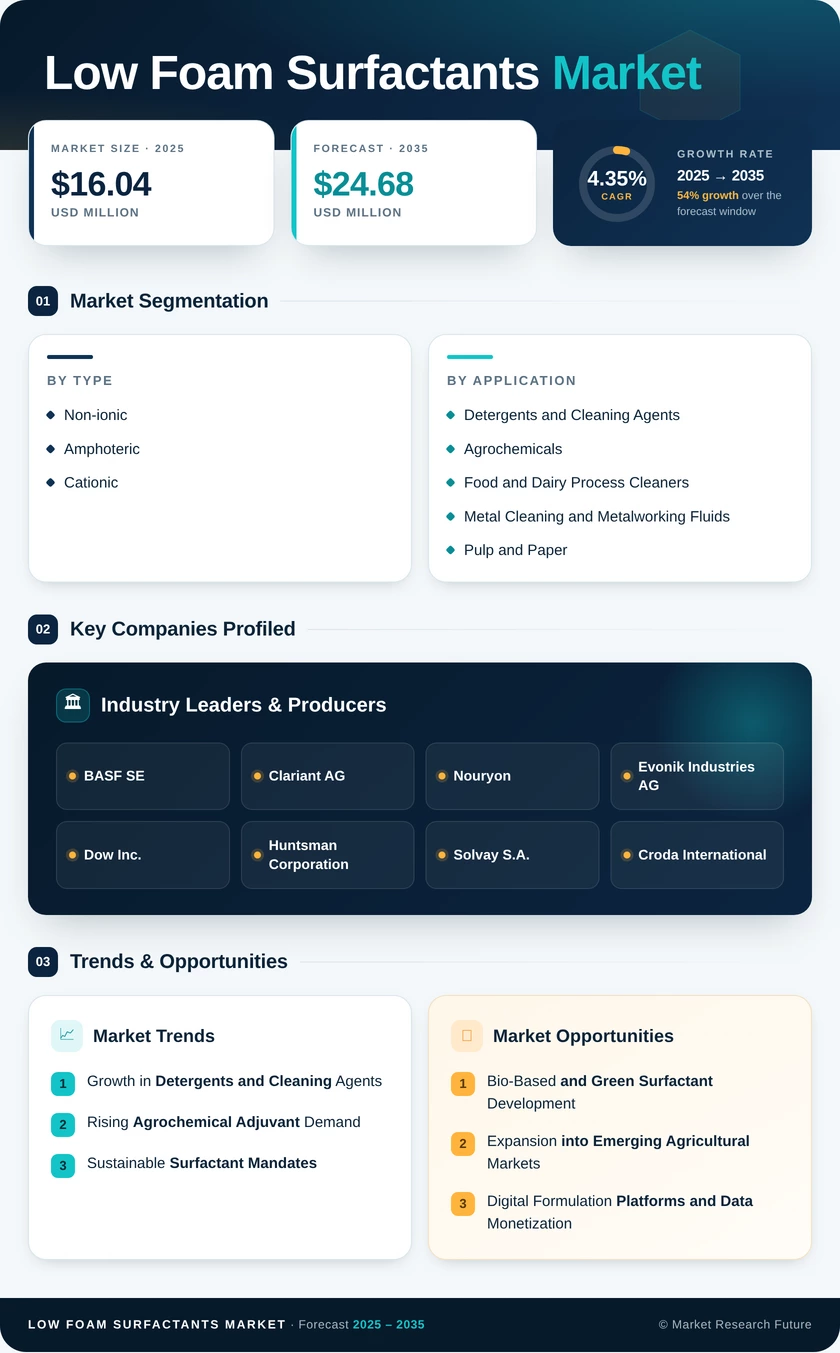
Segmentation Quick Reference
| Dimension | Sub-Segments | Dominant Segment | Fastest Growing Segment |
| By Type | Non-ionic, Amphoteric, Cationic | Non-ionic | Amphoteric |
| By End-User Industry | Low Foam Surfactants Market, Food and Dairy Process Cleaners, Detergents and Cleaning Agents, Pulp and Paper, Metal Cleaning and Metalworking Fluids, Oilfield Chemicals, Others (Textiles, Personal Care, etc.) | Detergents and Cleaning Agents | Low Foam Surfactants Market |
| By Geography | Asia-Pacific, North America, Europe, South America, the Middle East & Africa | Asia-Pacific | Asia-Pacific |
Market Segmentation Overview
By Type
| Sub-Segment | Key Trend |
| Non-ionic | Dominates due to hard-water stability and broad industrial compatibility; alkyl polyglucosides are gaining bio-based share. |
| Amphoteric | Fastest growth driven by personal care mildness requirements and food-grade CIP applications |
| Cationic | Steady niche demand in textile softening, antimicrobial treatment, and oilfield corrosion inhibition |
Non-ionic surfactants remain the backbone of the Low Foam Surfactants Market, valued for consistent performance across variable water-quality conditions in automated cleaning systems. Amphoteric types are emerging as the growth leader, propelled by regulatory shifts favoring gentler formulations in consumer-facing and food-contact applications.
By End-User Industry
| Sub-Segment | Key Trend |
| Low Foam Surfactants Market | Fastest growth; precision-spray adjuvant adoption drives demand for drift-reducing low-foam formulations |
| Food and Dairy Process Cleaners | CIP hygiene compliance tightening globally; residue-free rinsing is a non-negotiable specification |
| Detergents and Cleaning Agents | Largest segment: automatic dishwashers and tunnel-wash systems require controlled-foam surfactants. |
| Pulp and Paper | Steady demand for de-inking and washing-stage wetting agents in recycled-fiber processing |
| Metal Cleaning and Metalworking Fluids | Growing as occupational-health standards tighten mist-exposure limits in machining environments |
| Oilfield Chemicals | Cyclical demand tied to upstream activity; EOR and well-stimulation fluids specify foam-free surfactants. |
| Others (Textiles, Personal Care, etc.) | Reformulation trends in cosmetics and fabric care drive diversified demand. |
Detergents and cleaning agents anchor market revenue owing to the irreplaceable role of low-foam chemistry in high-throughput automated washing systems. Low Foam Surfactants Market are the standout growth vertical, as global precision-agriculture adoption accelerates demand for spray adjuvants that combine superior wetting with minimal foam generation.
By Geography
| Sub-Segment | Key Trend |
| Asia-Pacific | Dominant and fastest-growing; driven by agrochemical manufacturing in China and India, textile processing, and food-industry expansion |
| North America | Mature market with growth from food-safety compliance, oilfield recovery, and advanced metalworking |
| Europe | Regulatory-driven premiumization under REACH and Ecolabel frameworks; strong bio-based transition |
| South America | Agricultural powerhouse Brazil drives regional growth; I&I cleaning adoption expanding. |
| Middle East & Africa | Petrochemical feedstock advantage: oilfield and nascent food-processing demand |
Asia-Pacific continues to command the largest share of the global Low Foam Surfactants Market, reinforced by the region's scale in agrochemical production and its rapidly modernizing food-processing and textile industries. Europe's regulatory environment positions it as the premium-pricing region, while South America and the Middle East & Africa represent the highest-potential emerging geographies for volume expansion through 2035.

 Noah Malgeri
Co-Founder
Noah Malgeri
Co-Founder

 Peter Groot koerkamp
Account and Business Manager
Peter Groot koerkamp
Account and Business Manager

 Younghwan Choi
Senior Retail Manager
Younghwan Choi
Senior Retail Manager

 Mark Irwin
Management Consultant
Mark Irwin
Management Consultant

 Akif Moroglu
Strategy & Business Development Director
Akif Moroglu
Strategy & Business Development Director

 Guilherme Gomes Martins
Product Management Director
Guilherme Gomes Martins
Product Management Director

 Joseph Aguayo
Sales Operations & Pricing Manager
Joseph Aguayo
Sales Operations & Pricing Manager

 La Terria Dodd
Program Support Specialist
La Terria Dodd
Program Support Specialist

 Rob Kooiker
Group Product Manager HVAC & Fire Protection GMA
Rob Kooiker
Group Product Manager HVAC & Fire Protection GMA