×
Hero Background
English
Chinese
French
Japanese
Korean
German
Spanish

Loungewear Market Trends

ID: MRFR/CG/8955-HCR
128 Pages
Snehal Singh
October 2025

Loungewear Market Research Report Information By Material Type (Cotton, Wool, Silk and Others), By End User (Female, Male and Kids), By Distribution Channel (Store-Based and Non-Store-Based), and By Region (North America, Europe, Asia-Pacific, And Rest Of The World) – Market Forecast Till 2035

Share:
Download PDF ×

We do not share your information with anyone. However, we may send you emails based on your report interest from time to time. You may contact us at any time to opt-out.

Loungewear Market Infographic
Purchase Options

Market Trends

Key Emerging Trends in the Loungewear Market

In the dynamic world of fashion, the Loungewear Market has witnessed a surge in popularity, especially with the changing lifestyle trends and the rise of remote work setups. Within this bustling market, companies deploy various market share positioning strategies to differentiate themselves, capture market share, and stay ahead of the competition.

One of the key strategies in the Loungewear Market revolves around product innovation and differentiation. With a plethora of brands vying for consumer attention, offering unique and innovative loungewear designs is crucial. Companies often invest in research and development to create loungewear pieces that not only prioritize comfort but also incorporate trendy elements and functional features. This could include innovative fabric blends for enhanced breathability and moisture-wicking properties, stylish designs that blur the line between loungewear and casual wear, or sustainable materials to cater to eco-conscious consumers. By offering distinct products that stand out in terms of style, comfort, and functionality, companies can carve out their niche in the market and attract a loyal customer base.

Pricing strategy is another pivotal aspect of market share positioning in the Loungewear Market. Companies must strike the right balance between affordability and perceived value to appeal to their target audience. Some brands opt for a premium pricing strategy, positioning themselves as luxury loungewear options crafted from high-quality materials with meticulous attention to detail. These brands target consumers who are willing to pay a premium for superior comfort and craftsmanship. Conversely, other brands may adopt a more affordable pricing strategy to cater to budget-conscious consumers, offering stylish loungewear at competitive price points without compromising on quality. By aligning their pricing strategy with their target market's preferences and purchasing power, companies can effectively compete for market share.

Distribution channels play a crucial role in reaching consumers and gaining market share in the Loungewear Market. Companies must ensure that their products are readily available through various channels to maximize accessibility and convenience for customers. This involves partnering with retail outlets, department stores, specialty boutiques, and e-commerce platforms to expand their reach. Additionally, direct-to-consumer channels such as brand websites and exclusive online stores offer companies greater control over their brand image and customer experience. By leveraging a diverse range of distribution channels, companies can increase their market penetration and capture a larger share of the loungewear market.

Brand positioning and marketing communication are essential components of market share positioning strategies in the Loungewear Market. Building a strong brand identity that resonates with consumers is crucial for differentiation and brand loyalty. Companies invest in branding efforts that convey their unique value proposition, whether it's a focus on sustainability, inclusivity, or versatility. This could involve extensive marketing campaigns across various channels, influencer partnerships, social media engagement, and experiential marketing initiatives. By establishing a compelling brand narrative and forging emotional connections with consumers, companies can differentiate themselves from competitors and solidify their position in the market.

Market segmentation is another strategy employed by companies to capture market share in the Loungewear Market. By identifying and targeting specific consumer segments based on demographics, psychographics, or behavior, companies can tailor their product offerings and marketing strategies to meet the unique needs and preferences of different customer groups. For example, targeting millennials with athleisure-inspired loungewear designed for both comfort and style, or offering maternity loungewear for expectant mothers seeking comfortable yet fashionable options. By catering to niche markets, companies can effectively compete for market share and foster customer loyalty.


Author
Snehal Singh
Assistant Manager - Research

High acumen in analyzing complex macro & micro markets with more than 6 years of work experience in the field of market research. By implementing her analytical skills in forecasting and estimation into market research reports, she has expertise in Packaging, Construction, and Equipment domains. She handles a team size of 20-25 resources and ensures smooth running of the projects, associated marketing activities, and client servicing.

Leave a Comment

FAQs

What is the current valuation of the Loungewear Market as of 2024?

The Loungewear Market was valued at 6.87 USD Billion in 2024.

What is the projected market size for the Loungewear Market in 2035?

The Loungewear Market is projected to reach 19.04 USD Billion by 2035.

What is the expected CAGR for the Loungewear Market from 2025 to 2035?

The expected CAGR for the Loungewear Market during the forecast period 2025 - 2035 is 9.71%.

Which material types dominate the Loungewear Market?

Cotton, with a valuation increase from 2.74 to 7.43 USD Billion, appears to dominate the market.

How does the Loungewear Market segment by end user?

The Loungewear Market segments by end user include Female at 2.74 to 7.52 USD Billion, Male at 2.06 to 5.63 USD Billion, and Kids at 2.07 to 5.89 USD Billion.

What distribution channels are prevalent in the Loungewear Market?

The market distribution channels include Store-Based at 4.13 to 11.42 USD Billion and Non-Store-Based at 2.74 to 7.62 USD Billion.

Market Summary

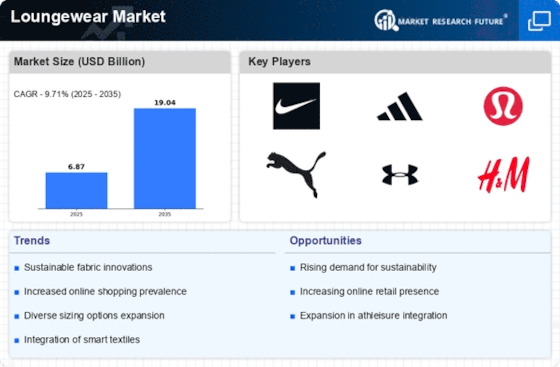
As per MRFR analysis, the Loungewear Market Size was estimated at 6.87 USD Billion in 2024. The Loungewear industry is projected to grow from 7.537 USD Billion in 2025 to 19.04 USD Billion by 2035, exhibiting a compound annual growth rate (CAGR) of 9.71 during the forecast period 2025 - 2035.

Key Market Trends & Highlights

The loungewear market is experiencing a dynamic shift towards sustainability and versatility, driven by evolving consumer preferences.

  • The North American market remains the largest, characterized by a strong demand for comfortable and stylish loungewear. In the Asia-Pacific region, the loungewear market is the fastest-growing, fueled by increasing disposable incomes and changing lifestyle habits. Cotton loungewear continues to dominate the market, while silk options are rapidly gaining popularity among consumers seeking luxury and comfort. The rise of remote work culture and health and wellness trends are significant drivers propelling the loungewear market forward.

Market Size & Forecast

2024 Market Size 6.87 (USD Billion)
2035 Market Size 19.04 (USD Billion)
CAGR (2025 - 2035) 9.71%
Largest Regional Market Share in 2024 North America

Major Players

<p>Nike (US), Adidas (DE), <a href="https://shop.lululemon.com/">Lululemon (CA)</a>, Puma (DE), Under Armour (US), H&amp;M (SE), Gap (US), Zara (ES), American Eagle Outfitters (US)</p>

Market Trends

The Loungewear Market is currently experiencing a notable transformation, driven by evolving consumer preferences and lifestyle changes. As individuals increasingly prioritize comfort and versatility in their clothing choices, loungewear has emerged as a staple in wardrobes across various demographics. This shift is not merely a trend but appears to reflect a broader cultural movement towards casualization in fashion. The rise of remote work and a growing emphasis on self-care have further propelled the demand for stylish yet comfortable apparel, suggesting that loungewear is likely to maintain its relevance in the foreseeable future. Moreover, sustainability is becoming a pivotal factor influencing purchasing decisions within the Loungewear Market. Consumers are increasingly seeking eco-friendly materials and ethical production practices, indicating a shift towards more conscious consumption. Brands that align with these values may find themselves better positioned to capture the attention of environmentally aware shoppers. As the market continues to evolve, it seems that the intersection of comfort, style, and sustainability will define the future landscape of loungewear, potentially leading to innovative designs and new market entrants that cater to these emerging preferences.

Sustainability Focus

The Loungewear Market is witnessing a growing emphasis on sustainable practices. Consumers are increasingly inclined to choose brands that prioritize eco-friendly materials and ethical production methods. This trend suggests a shift towards more responsible consumption, where environmental considerations play a crucial role in purchasing decisions.

Versatility in Design

Loungewear Market is evolving to encompass a wider range of styles, blurring the lines between homewear and streetwear. This versatility allows consumers to transition seamlessly from relaxation to social settings, indicating a demand for multifunctional apparel that meets diverse lifestyle needs.

Influence of Social Media

Social media platforms are significantly shaping trends within the Loungewear Market. Influencers and brand collaborations are driving visibility and desirability, suggesting that digital marketing strategies are essential for brands aiming to connect with younger audiences and enhance their market presence.

Loungewear Market Market Drivers

E-commerce Expansion

The expansion of e-commerce has transformed the Loungewear Market, providing consumers with unprecedented access to a wide array of products. Online shopping platforms have become essential for loungewear brands, allowing them to reach a global audience without the constraints of physical retail spaces. Data indicates that online sales of loungewear have surged, with e-commerce channels accounting for a significant portion of total sales. This shift has prompted brands to enhance their online presence and invest in digital marketing strategies to attract consumers. The Loungewear Market is thus witnessing a paradigm shift, where convenience and accessibility are paramount, potentially leading to sustained growth in online loungewear sales.

Health and Wellness Trends

The growing emphasis on health and wellness is significantly impacting the Loungewear Market. Consumers are increasingly seeking clothing that promotes comfort and well-being, leading to a rise in demand for loungewear made from breathable, sustainable materials. This trend aligns with a broader societal shift towards healthier lifestyles, where individuals prioritize self-care and relaxation. Market data suggests that loungewear sales have seen a substantial increase, with a projected market value reaching several billion dollars by 2026. Brands are responding by incorporating features such as moisture-wicking fabrics and ergonomic designs, which enhance the overall user experience. The Loungewear Market is thus evolving to reflect these health-conscious consumer preferences, indicating a potential for continued growth in this segment.

Rise of Remote Work Culture

The rise of remote work culture has profoundly influenced the Loungewear Market. As more individuals work from home, the demand for comfortable yet stylish clothing has surged. This shift has led to a notable increase in loungewear sales, with reports indicating that the loungewear segment has experienced a growth rate of approximately 20% annually. Consumers are increasingly prioritizing comfort without sacrificing aesthetics, prompting brands to innovate in fabric technology and design. The Loungewear Market is thus adapting to meet the needs of a workforce that values flexibility and ease, resulting in a broader range of products that cater to both work and leisure. This trend appears to be a lasting change in consumer behavior, suggesting that loungewear will remain a staple in wardrobes for the foreseeable future.

Influence of Celebrity Endorsements

Celebrity endorsements play a pivotal role in shaping consumer preferences within the Loungewear Market. High-profile figures often set trends that resonate with the public, leading to increased visibility and desirability of loungewear brands. This phenomenon is particularly evident in social media platforms, where influencers showcase their loungewear choices, driving consumer engagement and sales. Market analysis indicates that brands leveraging celebrity partnerships have experienced a notable uptick in sales, with some reporting increases of over 30% following high-profile endorsements. The Loungewear Market is thus heavily influenced by the dynamics of celebrity culture, suggesting that strategic collaborations could be a key driver for future growth.

Sustainability and Ethical Production

Sustainability and ethical production practices are increasingly becoming focal points within the Loungewear Market. As consumers become more environmentally conscious, there is a growing demand for loungewear made from sustainable materials and produced through ethical practices. Brands that prioritize eco-friendly production methods are likely to attract a loyal customer base, as consumers are willing to pay a premium for products that align with their values. Market trends suggest that the sustainable fashion segment is expanding rapidly, with projections indicating that it could account for a significant share of the overall loungewear market. The Loungewear Market is thus adapting to these consumer preferences, indicating a potential shift towards more responsible production practices in the future.

Market Segment Insights

Loungewear Market Material Type Insights

<p>The loungewear market segmentation based on material type is divided into <a href="https://www.marketresearchfuture.com/reports/cotton-sock-market-36439">cotton</a>, wool, silk, and other categories. Due to its high revenue share and ease of product accessibility, the cotton category is regarded as the industry leader. This market's expansion is fueled by appealing packaging and the rising popularity of the loungewear market revenue. Cotton is the most often used material for clothing in the category of loungewear due to its comfort. Additionally, it may be worn in almost every season. This factor has contributed to the growth of the loungewear market.</p>

<p>Cotton is positioned next to silk because, although being more expensive, it conveys an air of refinement and polish. Wool and other textiles are suitable for use throughout specific seasons.</p>

Loungewear Market End User Insights

<p>The loungewear market segmentation based on end-user divided into males, females, and children is included in the end-use part. The female segment now holds the biggest share in the market growth for loungewear, and it will keep growing steadily during the projected period. Their acceptance and appeal are driving the desire for expensive, high-quality clothes. Obese women typically prefer to wear nightwear, such as lingerie, that reduces their physical size.</p>

<p>Figure 2: &nbsp;Loungewear Market, by End-User, 2021 &amp; 2030 (USD Million)Source: Secondary Research, Primary Research, Market Research Future Database and Analyst Review</p>

<p>The loungewear market data, based on distribution channels is segmented into store-based and non-store-based. The store-based market is split further into supermarkets, hypermarkets, specialty shops, and other establishments. The biggest channels in these sub-segments, which also account for the highest loungewear sales, are supermarkets and hypermarkets. The distribution of the product is greatly aided by specialized or convenience retailers.</p>

Get more detailed insights about Loungewear Market Research Report - Forecast till 2035

Regional Insights

North America : Market Leader in Loungewear Market

North America is the largest market for loungewear, accounting for approximately 40% of the global share. The growth is driven by increasing consumer preference for comfort and casual wear, especially post-pandemic. Regulatory support for e-commerce and retail sectors has further fueled demand, with a notable rise in online shopping. The U.S. and Canada are the leading countries, with a strong focus on sustainability and innovation in fabric technology. The competitive landscape is robust, featuring key players like Nike, Lululemon, and Under Armour. These brands are leveraging their strong online presence and innovative marketing strategies to capture market share. The U.S. market is characterized by a diverse range of offerings, from high-end to budget-friendly options, catering to various consumer segments. The emphasis on athleisure and versatile loungewear continues to shape purchasing decisions.

Europe : Emerging Loungewear Market Hub

Europe is witnessing a significant rise in loungewear demand, holding approximately 30% of the global market share. The growth is driven by changing lifestyle trends, with consumers increasingly prioritizing comfort and versatility in their wardrobes. Regulatory initiatives promoting sustainable fashion are also influencing purchasing behaviors. Germany and the UK are the largest markets, contributing significantly to the overall growth in the region. Leading countries like Germany, France, and the UK are home to major brands such as Adidas and H&M, which are innovating to meet consumer preferences. The competitive landscape is marked by a blend of established players and emerging brands focusing on eco-friendly materials. The presence of fashion-forward consumers in urban areas is further propelling the loungewear trend, making Europe a key player in the global market.

Asia-Pacific : Rapidly Expanding Market

Asia-Pacific is rapidly emerging as a significant player in the loungewear market, accounting for about 25% of the global share. The region's growth is fueled by rising disposable incomes, urbanization, and a growing trend towards casual and comfortable clothing. Countries like China and India are leading this expansion, with increasing demand for both local and international brands. Regulatory support for retail and e-commerce is also enhancing market accessibility. China is the largest market in the region, with a burgeoning middle class driving demand for loungewear. The competitive landscape features both global giants like Nike and local brands that cater to regional tastes. The focus on online retail is strong, with many consumers preferring to shop for loungewear through e-commerce platforms, further boosting market growth.

Middle East and Africa : Emerging Market Potential

The Middle East and Africa region is gradually emerging in the loungewear market, holding approximately 5% of the global share. The growth is driven by a young population, increasing urbanization, and a shift towards casual wear. Countries like South Africa and the UAE are leading the market, with a growing interest in international brands and e-commerce platforms. Regulatory frameworks supporting retail development are also contributing to market expansion. In South Africa, local brands are gaining traction alongside international players, creating a competitive landscape that caters to diverse consumer preferences. The presence of key players like Puma and H&M is notable, as they adapt their offerings to meet regional tastes. The increasing popularity of athleisure and comfortable clothing is expected to drive further growth in this emerging market.

Key Players and Competitive Insights

The Loungewear is currently characterized by a dynamic competitive landscape, driven by evolving consumer preferences for comfort and versatility in apparel. Major players such as Nike (US), Lululemon (CA), and H&M (SE) are strategically positioning themselves to capitalize on these trends. Nike (US) continues to innovate with its sustainable product lines, while Lululemon (CA) focuses on premium quality and community engagement through experiential retail. H&M (SE), on the other hand, emphasizes affordability and accessibility, appealing to a broader demographic. Collectively, these strategies not only enhance brand loyalty but also intensify competition, as companies vie for market share in an increasingly crowded space.

Key business tactics within the loungewear market include localized manufacturing and supply chain optimization, which are essential for meeting consumer demand efficiently. The market structure appears moderately fragmented, with a mix of established brands and emerging players. This fragmentation allows for diverse consumer choices but also necessitates that key players continuously innovate to maintain their competitive edge. The influence of major companies is significant, as they set trends that smaller brands often follow, thereby shaping the overall market dynamics.

In August 2025, Nike (US) announced a partnership with a leading sustainable fabric manufacturer to enhance its eco-friendly loungewear line. This strategic move underscores Nike's commitment to sustainability, aligning with consumer expectations for environmentally responsible products. By integrating sustainable materials, Nike not only strengthens its brand image but also positions itself favorably in a market increasingly driven by ethical considerations.

In September 2025, Lululemon (CA) launched a new digital platform aimed at enhancing customer engagement through personalized shopping experiences. This initiative reflects Lululemon's focus on digital transformation, allowing the brand to leverage data analytics for tailored marketing strategies. Such a move is likely to deepen customer loyalty and drive sales, particularly among tech-savvy consumers who value personalized interactions.

In July 2025, H&M (SE) expanded its loungewear collection to include a new line of organic cotton products, responding to the growing demand for sustainable fashion. This expansion not only broadens H&M's product offerings but also reinforces its commitment to sustainability, appealing to environmentally conscious consumers. By prioritizing organic materials, H&M positions itself as a leader in the sustainable loungewear segment, potentially attracting a new customer base.

As of October 2025, the loungewear market is witnessing significant trends such as digitalization, sustainability, and the integration of artificial intelligence in customer service. Strategic alliances among brands are increasingly shaping the competitive landscape, fostering innovation and collaboration. Looking ahead, competitive differentiation is likely to evolve, with a pronounced shift from price-based competition to a focus on innovation, technology, and supply chain reliability. Companies that can effectively leverage these trends will likely emerge as leaders in the loungewear market.

Key Companies in the Loungewear Market market include

Industry Developments

August 2022: Introducing a range of reasonably priced period underwear is Hanes®. The new Comfort, Period, line from the company. When it comes to period comfort and confidence, even while sleeping, T.M. underwear is made to help. It provides quality period protection without the premium period underwear price tag.

May 2021: M&S stated that it planned to replace its largest location, the Marble Arch branch on Oxford Street in London, with a 10-story structure that would include two and a half levels of retail space below six floors of offices.

Future Outlook

Loungewear Market Future Outlook

<p>The Loungewear Market is projected to grow at a 9.71% CAGR from 2024 to 2035, driven by increasing consumer demand for comfort and versatility in apparel.</p>

New opportunities lie in:

  • <p>Expansion into sustainable fabric lines to attract eco-conscious consumers.</p>
  • <p>Development of smart loungewear integrating wearable technology for enhanced comfort.</p>
  • <p>Collaboration with influencers for targeted marketing campaigns to boost brand visibility.</p>

<p>By 2035, the Loungewear Market is expected to solidify its position as a leading segment in the apparel industry.</p>

Market Segmentation

Loungewear Market End User Outlook

  • Female
  • Male
  • Kids

Loungewear Market Material Type Outlook

  • Cotton
  • Wool
  • Silk
  • Others

Loungewear Market Distribution Channel Outlook

  • Store-Based
  • Non-Store-Based

Report Scope

MARKET SIZE 2024 6.87(USD Billion)
MARKET SIZE 2025 7.537(USD Billion)
MARKET SIZE 2035 19.04(USD Billion)
COMPOUND ANNUAL GROWTH RATE (CAGR) 9.71% (2024 - 2035)
REPORT COVERAGE Revenue Forecast, Competitive Landscape, Growth Factors, and Trends
BASE YEAR 2024
Market Forecast Period 2025 - 2035
Historical Data 2019 - 2024
Market Forecast Units USD Billion
Key Companies Profiled Market analysis in progress
Segments Covered Market segmentation analysis in progress
Key Market Opportunities Growing consumer preference for comfort and sustainability drives innovation in the Loungewear Market.
Key Market Dynamics Rising consumer preference for comfort drives innovation and competition in the loungewear market.
Countries Covered North America, Europe, APAC, South America, MEA

FAQs

What is the current valuation of the Loungewear Market as of 2024?

The Loungewear Market was valued at 6.87 USD Billion in 2024.

What is the projected market size for the Loungewear Market in 2035?

The Loungewear Market is projected to reach 19.04 USD Billion by 2035.

What is the expected CAGR for the Loungewear Market from 2025 to 2035?

The expected CAGR for the Loungewear Market during the forecast period 2025 - 2035 is 9.71%.

Which material types dominate the Loungewear Market?

Cotton, with a valuation increase from 2.74 to 7.43 USD Billion, appears to dominate the market.

How does the Loungewear Market segment by end user?

The Loungewear Market segments by end user include Female at 2.74 to 7.52 USD Billion, Male at 2.06 to 5.63 USD Billion, and Kids at 2.07 to 5.89 USD Billion.

What distribution channels are prevalent in the Loungewear Market?

The market distribution channels include Store-Based at 4.13 to 11.42 USD Billion and Non-Store-Based at 2.74 to 7.62 USD Billion.

  1. SECTION I: EXECUTIVE SUMMARY AND KEY HIGHLIGHTS
    1. EXECUTIVE SUMMARY
      1. Market Overview
      2. Key Findings
      3. Market Segmentation
      4. Competitive Landscape
      5. Challenges and Opportunities
      6. Future Outlook 2
  2. SECTION II: SCOPING, METHODOLOGY AND MARKET STRUCTURE
    1. MARKET INTRODUCTION
      1. Definition
      2. Scope of the study
    2. RESEARCH METHODOLOGY
      1. Overview
      2. Data Mining
      3. Secondary Research
      4. Primary Research
      5. Forecasting Model
      6. Market Size Estimation
      7. Data Triangulation
      8. Validation 3
  3. SECTION III: QUALITATIVE ANALYSIS
    1. MARKET DYNAMICS
      1. Overview
      2. Drivers
      3. Restraints
      4. Opportunities
    2. MARKET FACTOR ANALYSIS
      1. Value chain Analysis
      2. Porter's Five Forces Analysis
      3. COVID-19 Impact Analysis
  4. SECTION IV: QUANTITATIVE ANALYSIS
    1. Consumer and Retail, BY Material Type (USD Billion)
      1. Cotton
      2. Wool
      3. Silk
      4. Others
    2. Consumer and Retail, BY End User (USD Billion)
      1. Female
      2. Male
      3. Kids
    3. Consumer and Retail, BY Distribution Channel (USD Billion)
      1. Store-Based
      2. Non-Store-Based
    4. Consumer and Retail, BY Region (USD Billion)
      1. North America
      2. Europe
      3. APAC
      4. South America
      5. MEA
  5. SECTION V: COMPETITIVE ANALYSIS
    1. Competitive Landscape
      1. Overview
      2. Competitive Analysis
      3. Market share Analysis
      4. Major Growth Strategy in the Consumer and Retail
      5. Competitive Benchmarking
      6. Leading Players in Terms of Number of Developments in the Consumer and Retail
      7. Key developments and growth strategies
      8. Major Players Financial Matrix
    2. Company Profiles
      1. Nike (US)
      2. Adidas (DE)
      3. Lululemon (CA)
      4. Puma (DE)
      5. Under Armour (US)
      6. H&M (SE)
      7. Gap (US)
      8. Zara (ES)
      9. American Eagle Outfitters (US)
    3. Appendix
      1. References
      2. Related Reports 6 LIST OF FIGURES
    4. MARKET SYNOPSIS
    5. NORTH AMERICA MARKET ANALYSIS
    6. US MARKET ANALYSIS BY MATERIAL TYPE
    7. US MARKET ANALYSIS BY END USER
    8. US MARKET ANALYSIS BY DISTRIBUTION CHANNEL
    9. CANADA MARKET ANALYSIS BY MATERIAL TYPE
    10. CANADA MARKET ANALYSIS BY END USER
    11. CANADA MARKET ANALYSIS BY DISTRIBUTION CHANNEL
    12. EUROPE MARKET ANALYSIS
    13. GERMANY MARKET ANALYSIS BY MATERIAL TYPE
    14. GERMANY MARKET ANALYSIS BY END USER
    15. GERMANY MARKET ANALYSIS BY DISTRIBUTION CHANNEL
    16. UK MARKET ANALYSIS BY MATERIAL TYPE
    17. UK MARKET ANALYSIS BY END USER
    18. UK MARKET ANALYSIS BY DISTRIBUTION CHANNEL
    19. FRANCE MARKET ANALYSIS BY MATERIAL TYPE
    20. FRANCE MARKET ANALYSIS BY END USER
    21. FRANCE MARKET ANALYSIS BY DISTRIBUTION CHANNEL
    22. RUSSIA MARKET ANALYSIS BY MATERIAL TYPE
    23. RUSSIA MARKET ANALYSIS BY END USER
    24. RUSSIA MARKET ANALYSIS BY DISTRIBUTION CHANNEL
    25. ITALY MARKET ANALYSIS BY MATERIAL TYPE
    26. ITALY MARKET ANALYSIS BY END USER
    27. ITALY MARKET ANALYSIS BY DISTRIBUTION CHANNEL
    28. SPAIN MARKET ANALYSIS BY MATERIAL TYPE
    29. SPAIN MARKET ANALYSIS BY END USER
    30. SPAIN MARKET ANALYSIS BY DISTRIBUTION CHANNEL
    31. REST OF EUROPE MARKET ANALYSIS BY MATERIAL TYPE
    32. REST OF EUROPE MARKET ANALYSIS BY END USER
    33. REST OF EUROPE MARKET ANALYSIS BY DISTRIBUTION CHANNEL
    34. APAC MARKET ANALYSIS
    35. CHINA MARKET ANALYSIS BY MATERIAL TYPE
    36. CHINA MARKET ANALYSIS BY END USER
    37. CHINA MARKET ANALYSIS BY DISTRIBUTION CHANNEL
    38. INDIA MARKET ANALYSIS BY MATERIAL TYPE
    39. INDIA MARKET ANALYSIS BY END USER
    40. INDIA MARKET ANALYSIS BY DISTRIBUTION CHANNEL
    41. JAPAN MARKET ANALYSIS BY MATERIAL TYPE
    42. JAPAN MARKET ANALYSIS BY END USER
    43. JAPAN MARKET ANALYSIS BY DISTRIBUTION CHANNEL
    44. SOUTH KOREA MARKET ANALYSIS BY MATERIAL TYPE
    45. SOUTH KOREA MARKET ANALYSIS BY END USER
    46. SOUTH KOREA MARKET ANALYSIS BY DISTRIBUTION CHANNEL
    47. MALAYSIA MARKET ANALYSIS BY MATERIAL TYPE
    48. MALAYSIA MARKET ANALYSIS BY END USER
    49. MALAYSIA MARKET ANALYSIS BY DISTRIBUTION CHANNEL
    50. THAILAND MARKET ANALYSIS BY MATERIAL TYPE
    51. THAILAND MARKET ANALYSIS BY END USER
    52. THAILAND MARKET ANALYSIS BY DISTRIBUTION CHANNEL
    53. INDONESIA MARKET ANALYSIS BY MATERIAL TYPE
    54. INDONESIA MARKET ANALYSIS BY END USER
    55. INDONESIA MARKET ANALYSIS BY DISTRIBUTION CHANNEL
    56. REST OF APAC MARKET ANALYSIS BY MATERIAL TYPE
    57. REST OF APAC MARKET ANALYSIS BY END USER
    58. REST OF APAC MARKET ANALYSIS BY DISTRIBUTION CHANNEL
    59. SOUTH AMERICA MARKET ANALYSIS
    60. BRAZIL MARKET ANALYSIS BY MATERIAL TYPE
    61. BRAZIL MARKET ANALYSIS BY END USER
    62. BRAZIL MARKET ANALYSIS BY DISTRIBUTION CHANNEL
    63. MEXICO MARKET ANALYSIS BY MATERIAL TYPE
    64. MEXICO MARKET ANALYSIS BY END USER
    65. MEXICO MARKET ANALYSIS BY DISTRIBUTION CHANNEL
    66. ARGENTINA MARKET ANALYSIS BY MATERIAL TYPE
    67. ARGENTINA MARKET ANALYSIS BY END USER
    68. ARGENTINA MARKET ANALYSIS BY DISTRIBUTION CHANNEL
    69. REST OF SOUTH AMERICA MARKET ANALYSIS BY MATERIAL TYPE
    70. REST OF SOUTH AMERICA MARKET ANALYSIS BY END USER
    71. REST OF SOUTH AMERICA MARKET ANALYSIS BY DISTRIBUTION CHANNEL
    72. MEA MARKET ANALYSIS
    73. GCC COUNTRIES MARKET ANALYSIS BY MATERIAL TYPE
    74. GCC COUNTRIES MARKET ANALYSIS BY END USER
    75. GCC COUNTRIES MARKET ANALYSIS BY DISTRIBUTION CHANNEL
    76. SOUTH AFRICA MARKET ANALYSIS BY MATERIAL TYPE
    77. SOUTH AFRICA MARKET ANALYSIS BY END USER
    78. SOUTH AFRICA MARKET ANALYSIS BY DISTRIBUTION CHANNEL
    79. REST OF MEA MARKET ANALYSIS BY MATERIAL TYPE
    80. REST OF MEA MARKET ANALYSIS BY END USER
    81. REST OF MEA MARKET ANALYSIS BY DISTRIBUTION CHANNEL
    82. KEY BUYING CRITERIA OF CONSUMER AND RETAIL
    83. RESEARCH PROCESS OF MRFR
    84. DRO ANALYSIS OF CONSUMER AND RETAIL
    85. DRIVERS IMPACT ANALYSIS: CONSUMER AND RETAIL
    86. RESTRAINTS IMPACT ANALYSIS: CONSUMER AND RETAIL
    87. SUPPLY / VALUE CHAIN: CONSUMER AND RETAIL
    88. CONSUMER AND RETAIL, BY MATERIAL TYPE, 2024 (% SHARE)
    89. CONSUMER AND RETAIL, BY MATERIAL TYPE, 2024 TO 2035 (USD Billion)
    90. CONSUMER AND RETAIL, BY END USER, 2024 (% SHARE)
    91. CONSUMER AND RETAIL, BY END USER, 2024 TO 2035 (USD Billion)
    92. CONSUMER AND RETAIL, BY DISTRIBUTION CHANNEL, 2024 (% SHARE)
    93. CONSUMER AND RETAIL, BY DISTRIBUTION CHANNEL, 2024 TO 2035 (USD Billion)
    94. BENCHMARKING OF MAJOR COMPETITORS 7 LIST OF TABLES
    95. LIST OF ASSUMPTIONS
    96. North America MARKET SIZE ESTIMATES; FORECAST
      1. BY MATERIAL TYPE, 2025-2035 (USD Billion)
      2. BY END USER, 2025-2035 (USD Billion)
      3. BY DISTRIBUTION CHANNEL, 2025-2035 (USD Billion)
    97. US MARKET SIZE ESTIMATES; FORECAST
      1. BY MATERIAL TYPE, 2025-2035 (USD Billion)
      2. BY END USER, 2025-2035 (USD Billion)
      3. BY DISTRIBUTION CHANNEL, 2025-2035 (USD Billion)
    98. Canada MARKET SIZE ESTIMATES; FORECAST
      1. BY MATERIAL TYPE, 2025-2035 (USD Billion)
      2. BY END USER, 2025-2035 (USD Billion)
      3. BY DISTRIBUTION CHANNEL, 2025-2035 (USD Billion)
    99. Europe MARKET SIZE ESTIMATES; FORECAST
      1. BY MATERIAL TYPE, 2025-2035 (USD Billion)
      2. BY END USER, 2025-2035 (USD Billion)
      3. BY DISTRIBUTION CHANNEL, 2025-2035 (USD Billion)
    100. Germany MARKET SIZE ESTIMATES; FORECAST
      1. BY MATERIAL TYPE, 2025-2035 (USD Billion)
      2. BY END USER, 2025-2035 (USD Billion)
      3. BY DISTRIBUTION CHANNEL, 2025-2035 (USD Billion)
    101. UK MARKET SIZE ESTIMATES; FORECAST
      1. BY MATERIAL TYPE, 2025-2035 (USD Billion)
      2. BY END USER, 2025-2035 (USD Billion)
      3. BY DISTRIBUTION CHANNEL, 2025-2035 (USD Billion)
    102. France MARKET SIZE ESTIMATES; FORECAST
      1. BY MATERIAL TYPE, 2025-2035 (USD Billion)
      2. BY END USER, 2025-2035 (USD Billion)
      3. BY DISTRIBUTION CHANNEL, 2025-2035 (USD Billion)
    103. Russia MARKET SIZE ESTIMATES; FORECAST
      1. BY MATERIAL TYPE, 2025-2035 (USD Billion)
      2. BY END USER, 2025-2035 (USD Billion)
      3. BY DISTRIBUTION CHANNEL, 2025-2035 (USD Billion)
    104. Italy MARKET SIZE ESTIMATES; FORECAST
      1. BY MATERIAL TYPE, 2025-2035 (USD Billion)
      2. BY END USER, 2025-2035 (USD Billion)
      3. BY DISTRIBUTION CHANNEL, 2025-2035 (USD Billion)
    105. Spain MARKET SIZE ESTIMATES; FORECAST
      1. BY MATERIAL TYPE, 2025-2035 (USD Billion)
      2. BY END USER, 2025-2035 (USD Billion)
      3. BY DISTRIBUTION CHANNEL, 2025-2035 (USD Billion)
    106. Rest of Europe MARKET SIZE ESTIMATES; FORECAST
      1. BY MATERIAL TYPE, 2025-2035 (USD Billion)
      2. BY END USER, 2025-2035 (USD Billion)
      3. BY DISTRIBUTION CHANNEL, 2025-2035 (USD Billion)
    107. APAC MARKET SIZE ESTIMATES; FORECAST
      1. BY MATERIAL TYPE, 2025-2035 (USD Billion)
      2. BY END USER, 2025-2035 (USD Billion)
      3. BY DISTRIBUTION CHANNEL, 2025-2035 (USD Billion)
    108. China MARKET SIZE ESTIMATES; FORECAST
      1. BY MATERIAL TYPE, 2025-2035 (USD Billion)
      2. BY END USER, 2025-2035 (USD Billion)
      3. BY DISTRIBUTION CHANNEL, 2025-2035 (USD Billion)
    109. India MARKET SIZE ESTIMATES; FORECAST
      1. BY MATERIAL TYPE, 2025-2035 (USD Billion)
      2. BY END USER, 2025-2035 (USD Billion)
      3. BY DISTRIBUTION CHANNEL, 2025-2035 (USD Billion)
    110. Japan MARKET SIZE ESTIMATES; FORECAST
      1. BY MATERIAL TYPE, 2025-2035 (USD Billion)
      2. BY END USER, 2025-2035 (USD Billion)
      3. BY DISTRIBUTION CHANNEL, 2025-2035 (USD Billion)
    111. South Korea MARKET SIZE ESTIMATES; FORECAST
      1. BY MATERIAL TYPE, 2025-2035 (USD Billion)
      2. BY END USER, 2025-2035 (USD Billion)
      3. BY DISTRIBUTION CHANNEL, 2025-2035 (USD Billion)
    112. Malaysia MARKET SIZE ESTIMATES; FORECAST
      1. BY MATERIAL TYPE, 2025-2035 (USD Billion)
      2. BY END USER, 2025-2035 (USD Billion)
      3. BY DISTRIBUTION CHANNEL, 2025-2035 (USD Billion)
    113. Thailand MARKET SIZE ESTIMATES; FORECAST
      1. BY MATERIAL TYPE, 2025-2035 (USD Billion)
      2. BY END USER, 2025-2035 (USD Billion)
      3. BY DISTRIBUTION CHANNEL, 2025-2035 (USD Billion)
    114. Indonesia MARKET SIZE ESTIMATES; FORECAST
      1. BY MATERIAL TYPE, 2025-2035 (USD Billion)
      2. BY END USER, 2025-2035 (USD Billion)
      3. BY DISTRIBUTION CHANNEL, 2025-2035 (USD Billion)
    115. Rest of APAC MARKET SIZE ESTIMATES; FORECAST
      1. BY MATERIAL TYPE, 2025-2035 (USD Billion)
      2. BY END USER, 2025-2035 (USD Billion)
      3. BY DISTRIBUTION CHANNEL, 2025-2035 (USD Billion)
    116. South America MARKET SIZE ESTIMATES; FORECAST
      1. BY MATERIAL TYPE, 2025-2035 (USD Billion)
      2. BY END USER, 2025-2035 (USD Billion)
      3. BY DISTRIBUTION CHANNEL, 2025-2035 (USD Billion)
    117. Brazil MARKET SIZE ESTIMATES; FORECAST
      1. BY MATERIAL TYPE, 2025-2035 (USD Billion)
      2. BY END USER, 2025-2035 (USD Billion)
      3. BY DISTRIBUTION CHANNEL, 2025-2035 (USD Billion)
    118. Mexico MARKET SIZE ESTIMATES; FORECAST
      1. BY MATERIAL TYPE, 2025-2035 (USD Billion)
      2. BY END USER, 2025-2035 (USD Billion)
      3. BY DISTRIBUTION CHANNEL, 2025-2035 (USD Billion)
    119. Argentina MARKET SIZE ESTIMATES; FORECAST
      1. BY MATERIAL TYPE, 2025-2035 (USD Billion)
      2. BY END USER, 2025-2035 (USD Billion)
      3. BY DISTRIBUTION CHANNEL, 2025-2035 (USD Billion)
    120. Rest of South America MARKET SIZE ESTIMATES; FORECAST
      1. BY MATERIAL TYPE, 2025-2035 (USD Billion)
      2. BY END USER, 2025-2035 (USD Billion)
      3. BY DISTRIBUTION CHANNEL, 2025-2035 (USD Billion)
    121. MEA MARKET SIZE ESTIMATES; FORECAST
      1. BY MATERIAL TYPE, 2025-2035 (USD Billion)
      2. BY END USER, 2025-2035 (USD Billion)
      3. BY DISTRIBUTION CHANNEL, 2025-2035 (USD Billion)
    122. GCC Countries MARKET SIZE ESTIMATES; FORECAST
      1. BY MATERIAL TYPE, 2025-2035 (USD Billion)
      2. BY END USER, 2025-2035 (USD Billion)
      3. BY DISTRIBUTION CHANNEL, 2025-2035 (USD Billion)
    123. South Africa MARKET SIZE ESTIMATES; FORECAST
      1. BY MATERIAL TYPE, 2025-2035 (USD Billion)
      2. BY END USER, 2025-2035 (USD Billion)
      3. BY DISTRIBUTION CHANNEL, 2025-2035 (USD Billion)
    124. Rest of MEA MARKET SIZE ESTIMATES; FORECAST
      1. BY MATERIAL TYPE, 2025-2035 (USD Billion)
      2. BY END USER, 2025-2035 (USD Billion)
      3. BY DISTRIBUTION CHANNEL, 2025-2035 (USD Billion)
    125. PRODUCT LAUNCH/PRODUCT DEVELOPMENT/APPROVAL
    126. ACQUISITION/PARTNERSHIP

Market Segmentation 

Loungewear Type Outlook (USD Million, 2018-2032)

Cotton

Wool

Silk

Others

Loungewear End User Outlook (USD Million, 2018-2032)

Female

Male

Kids

Loungewear Distribution Channel Outlook (USD Million, 2018-2032)

Store-Based

Non-Store-Based

Loungewear Regional Outlook (USD Million, 2018-2032)

North America Outlook (USD Million, 2018-2032)

North America Loungewear by Type

Cotton

Wool

Silk

Others

North America Loungewear by End User

Female

Male

Kids

North America Loungewear by Distribution Channel

Store-Based

Non-Store-Based

US Outlook (USD Million, 2018-2032)

US Loungewear by Type

Cotton

Wool

Silk

Others

US Loungewear by End User

Female

Male

Kids

US Loungewear by Distribution Channel

Store-Based

Non-Store-Based

CANADA Outlook (USD Million, 2018-2032)

CANADA Loungewear by Type

Cotton

Wool

Silk

Others

CANADA Loungewear by End User

Female

Male

Kids

CANADA Loungewear by Distribution Channel

Store-Based

Non-Store-Based

Europe Outlook (USD Million, 2018-2032)

Europe Loungewear by Type

Cotton

Wool

Silk

Others

Europe Loungewear by End User

Female

Male

Kids

Europe Loungewear by Distribution Channel

Store-Based

Non-Store-Based

Germany Outlook (USD Million, 2018-2032)

Germany Loungewear by Type

Cotton

Wool

Silk

Others

Germany Loungewear by End User

Female

Male

Kids

Germany Loungewear by Distribution Channel

Store-Based

Non-Store-Based

France Outlook (USD Million, 2018-2032)

France Loungewear by Type

Cotton

Wool

Silk

Others

France Loungewear by End User

Female

Male

Kids

France Loungewear by Distribution Channel

Store-Based

Non-Store-Based

UK Outlook (USD Million, 2018-2032)

UK Loungewear by Type

Cotton

Wool

Silk

Others

UK Loungewear by End User

Female

Male

Kids

UK Loungewear by Distribution Channel

Store-Based

Non-Store-Based

ITALY Outlook (USD Million, 2018-2032)

ITALY Loungewear by Type

Cotton

Wool

Silk

Others

ITALY Loungewear by End User

Female

Male

Kids

ITALY Loungewear by Distribution Channel

Store-Based

Non-Store-Based

SPAIN Outlook (USD Million, 2018-2032)

Spain Loungewear by Type

Cotton

Wool

Silk

Others

Spain Loungewear by End User

Female

Male

Kids

Spain Loungewear by Distribution Channel

Store-Based

Non-Store-Based

Rest Of Europe Outlook (USD Million, 2018-2032)

REST OF EUROPE Loungewear by Type

Cotton

Wool

Silk

Others

REST OF EUROPE Loungewear by End User

Female

Male

Kids

REST OF EUROPE Loungewear by Distribution Channel

Store-Based

Non-Store-Based

Asia-Pacific Outlook (USD Million, 2018-2032)

Asia-Pacific Loungewear by Type

Cotton

Wool

Silk

Others

Asia-Pacific Loungewear by End User

Female

Male

Kids

Asia-Pacific Loungewear by Distribution Channel

Store-Based

Non-Store-Based

China Outlook (USD Million, 2018-2032)

China Loungewear by Type

Cotton

Wool

Silk

Others

China Loungewear by End User

Female

Male

Kids

China Loungewear by Distribution Channel

Store-Based

Non-Store-Based

Japan Outlook (USD Million, 2018-2032)

Japan Loungewear by Type

Cotton

Wool

Silk

Others

Japan Loungewear by End User

Female

Male

Kids

Japan Loungewear by Distribution Channel

Store-Based

Non-Store-Based

India Outlook (USD Million, 2018-2032)

India Loungewear by Type

Cotton

Wool

Silk

Others

India Loungewear by End User

Female

Male

Kids

India Loungewear by Distribution Channel

Store-Based

Non-Store-Based

Australia Outlook (USD Million, 2018-2032)

Australia Loungewear by Type

Cotton

Wool

Silk

Others

Australia Loungewear by End User

Female

Male

Kids

Australia Loungewear by Distribution Channel

Store-Based

Non-Store-Based

Rest of Asia-Pacific Outlook (USD Million, 2018-2032)

Rest of Asia-Pacific Loungewear by Type

Cotton

Wool

Silk

Others

Rest of Asia-Pacific Loungewear by End User

Female

Male

Kids

Rest of Asia-Pacific Loungewear by Distribution Channel

Store-Based

Non-Store-Based

Rest of the World Outlook (USD Million, 2018-2032)

Rest of the World Loungewear by Type

Cotton

Wool

Silk

Others

Rest of the World Loungewear by End User

Female

Male

Kids

Rest of the World Loungewear by Distribution Channel

Store-Based

Non-Store-Based

Middle East Outlook (USD Million, 2018-2032)

Middle East Loungewear by Type

Cotton

Wool

Silk

Others

Middle East Loungewear by End User

Female

Male

Kids

Middle East Loungewear by Distribution Channel

Store-Based

Non-Store-Based

Africa Outlook (USD Million, 2018-2032)

Africa Loungewear by Type

Cotton

Wool

Silk

Others

Africa Loungewear by End User

Female

Male

Kids

Africa Loungewear by Distribution Channel

Store-Based

Non-Store-Based

Latin America Outlook (USD Million, 2018-2032)

Latin America Loungewear by Type

Cotton

Wool

Silk

Others

Latin America Loungewear by End User

Female

Male

Kids

Latin America Loungewear by Distribution Channel

Store-Based

Non-Store-Based


Infographic

Free Sample Request

Kindly complete the form below to receive a free sample of this Report

Get Free Sample

Customer Strories

Compare Licence

×
Features License Type
Single User Multiuser License Enterprise User
Price $4,950 $5,950 $7,250
Maximum User Access Limit 1 User Upto 10 Users Unrestricted Access Throughout the Organization
Free Customization
Direct Access to Analyst
Deliverable Format
Platform Access
Discount on Next Purchase 10% 15% 15%
Printable Versions