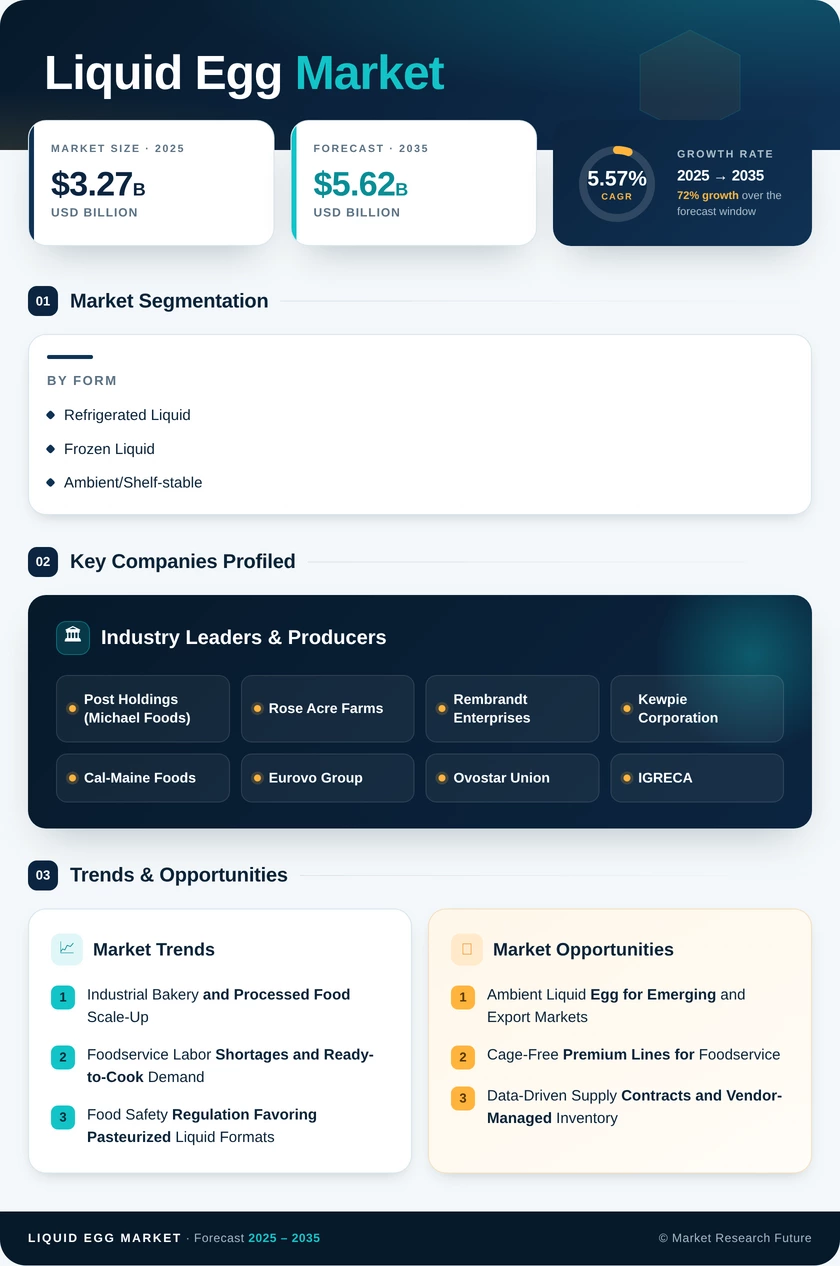
Liquid Egg Market (2026 - 2035)

ID: MRFR/FnB/25434-HCR 100 Pages Harshita Gorde Last Updated: October 09, 2026
Liquid Egg Market Size, Share, Industry Trend & Analysis Research Report By Form (Refrigerated Liquid, Frozen Liquid, Ambient/Shelf-stable), By Region (North America, Europe, Asia-Pacific, South America, Middle East & Africa) - Forecast to 2035
Liquid Egg Market
Market Size
Forecast Period2026-2035
CAGR (2026-2035)5.57%
2025 Market SizeUSD 3.27 Billion
2035 Market SizeUSD 5.62 Billion
Key Players
Post Holdings
Rose Acre Farms
Rembrandt Enterprises
Kewpie Corporation
Cal-Maine Foods
Eurovo Group
Opportunities
  • Ambient Liquid Egg for Emerging and Export Markets
  • Cage-Free Premium Lines for Foodservice
  • Data-Driven Supply Contracts and Vendor-Managed Inventory
  1. 1 Market Summary | |
  2. 2 Key Report Takeaways | |
    1. 2.1 By Form | |
    2. 2.2 By Region | |
  3. 3 Market Size and Forecast (2021–2035) | |
  4. 4 Driver Impact Analysis | |
    1. 4.1 Industrial Bakery and Processed Food Scale-Up | |
    2. 4.2 Foodservice Labor Shortages and Ready-to-Cook Demand | |
    3. 4.3 Food Safety Regulation Favoring Pasteurized Liquid Formats | |
    4. 4.4 Avian Influenza-Driven Supply Contracting | |
    5. 4.5 Cage-Free Transition and Traceability | |
    6. 4.6 Cold-Chain and UHT Capacity Expansion in Asia-Pacific | |
    7. 4.7 Protein-Focused Formulations | |
  5. 5 Restraints Impact Analysis | |
    1. 5.1 Avian Influenza Outbreaks and Raw-Egg Price Volatility | |
    2. 5.2 Cold-Chain Cost and Infrastructure Gaps | |
    3. 5.3 Feed Cost Inflation | |
    4. 5.4 Plant-Based Egg Substitutes | |
    5. 5.5 Shell-Egg Preference in Retail | |
  6. 6 Opportunities | |
    1. 6.1 Ambient Liquid Egg for Emerging and Export Markets | |
    2. 6.2 Cage-Free Premium Lines for Foodservice | |
    3. 6.3 Data-Driven Supply Contracts and Vendor-Managed Inventory | |
    4. 6.4 Institutional Ready-to-Cook Blends | |
  7. 7 Regional Market Share and Country-Level Analysis | |
    1. 7.1 North America | | |
      1. 7.1.1 US | | |
      2. 7.1.2 Canada | | |
      3. 7.1.3 Mexico | |
    2. 7.2 Europe | | |
      1. 7.2.1 Germany | | |
      2. 7.2.2 UK | | |
      3. 7.2.3 France | | |
      4. 7.2.4 Italy | | |
      5. 7.2.5 Spain | | |
      6. 7.2.6 Nordic Countries | | |
      7. 7.2.7 Russia | | |
      8. 7.2.8 Rest of Europe | |
    3. 7.3 Asia-Pacific | | |
      1. 7.3.1 China | | |
      2. 7.3.2 India | | |
      3. 7.3.3 Japan | | |
      4. 7.3.4 South Korea | | |
      5. 7.3.5 ASEAN | | |
      6. 7.3.6 Rest of Asia-Pacific | |
    4. 7.4 South America | | |
      1. 7.4.1 Brazil | | |
      2. 7.4.2 Argentina | | |
      3. 7.4.3 Rest of South America | |
    5. 7.5 Middle East & Africa | | |
      1. 7.5.1 Saudi Arabia | | |
      2. 7.5.2 UAE | | |
      3. 7.5.3 South Africa | | |
      4. 7.5.4 Egypt | | |
      5. 7.5.5 Rest of MEA | |
  8. 8 Future Outlook (2026–2035) | |
    1. 8.1 Biosecurity and Vaccination Reshape Supply Risk | |
    2. 8.2 Automation and Digital Breaking Plants | |
    3. 8.3 Ambient Formats and Cross-Border Trade | |
    4. 8.4 Sustainability Reporting and Cage-Free Compliance | |
  9. 9 Segmentation Analysis | |
    1. 9.1 By Form | | |
      1. 9.1.1 Refrigerated Liquid | | |
      2. 9.1.2 Frozen Liquid | | |
      3. 9.1.3 Ambient/Shelf-stable | |
  10. 10 Competitive Landscape | |
    1. 10.1 Market Concentration Overview | |
    2. 10.2 Competitive Benchmarking | |
  11. 11 Recent News & Developments | |
  12. 12 Report Scope and Methodology | |
  13. 13 Detailed Sources and Citations | |
  14. 14 Frequently Asked Questions (FAQs) | | LIST OF TABLES | |
  15. TABLE 1 Global Market Snapshot, 2025–2035 | |
  16. TABLE 2 Global Market Size & Forecast, by Revenue (USD Billion), 2021–2035 | |
  17. TABLE 3 Driver Impact Analysis, 2026–2035 | |
  18. TABLE 4 Restraints Impact Analysis, 2026–2035 | |
  19. TABLE 5 Regional Summary, 2025 (USD Billion) | |
  20. TABLE 6 North America, by Country, 2025 | |
  21. TABLE 7 Europe, by Country, 2025 | |
  22. TABLE 8 Asia-Pacific, by Country, 2025 | |
  23. TABLE 9 South America, by Country, 2025 | |
  24. TABLE 10 Middle East & Africa, by Country, 2025 | |
  25. TABLE 11 Segmentation by Form, 2025 | |
  26. TABLE 12 Competitive Benchmarking Table, 2025 | |
  27. TABLE 13 Report Scope and Methodology | |
  28. TABLE 14 Detailed Sources and Citations | |
  29. TABLE 15 Segmentation Quick Reference | |
  30. TABLE 16 Market Segmentation Overview – By Form | | LIST OF FIGURES | |
  31. FIGURE 1 Market Dynamics Overview – Drivers, Restraints, Opportunities | |
  32. FIGURE 2 Value Chain Analysis – Layer Farm to End User | |
  33. FIGURE 3 Porter's Five Forces Analysis | |
  34. FIGURE 4 Global Market Size Trend, 2021–2035 (USD Billion) | |
  35. FIGURE 5 Share by Form, 2025 (%) | |
  36. FIGURE 6 Regional Share, 2025 (%) | |
  37. FIGURE 7 Country-Level Distribution by Region, 2025 | |
  38. FIGURE 8 Competitive Landscape – Estimated Revenue Share Ranges, 2025

Segmentation Quick Reference

DimensionSub-SegmentsDominant SegmentFastest Growing Segment
By FormRefrigerated Liquid, Frozen Liquid, Ambient/Shelf-stableRefrigerated Liquid (51.0% share)Ambient/Shelf-stable (7.5% CAGR)
By RegionNorth America, Europe, Asia-Pacific, South America, Middle East & AfricaNorth America (36.8% share)Asia-Pacific (7.4% CAGR)


Market Segmentation Overview

By Form

Sub-SegmentKey Trend
Refrigerated LiquidShort-cycle chilled delivery to bakeries and multi-unit kitchens; UHT extending refrigerated life to several weeks
Frozen LiquidInventory buffering against outbreak-driven supply shocks; preferred format for long-distance export
Ambient/Shelf-stableAseptic cartons opening retail and export channels without reefer dependence


Refrigerated Liquid holds the lead because North American and European buyers already run chilled ingredient systems and receive frequent deliveries from nearby breaking plants. Ambient/Shelf-stable is growing fastest at a 7.5% CAGR, as UHT processing and aseptic filling let suppliers serve Gulf, Southeast Asian, and African buyers that lack reliable cold storage. Frozen Liquid sits between the two, valued by industrial users that hedge against avian influenza supply shocks by holding larger inventories.


 

Download PDF ×

We do not share your information with anyone. However, we may send you emails based on your report interest from time to time. You may contact us at any time to opt-out.