×
Request Free Sample ×

Kindly complete the form below to receive a free sample of this Report

* Please use a valid business email

Leading companies partner with us for data-driven Insights

clients tt-cursor
Hero Background
English
Chinese
French
Japanese
Korean
German
Spanish

LIDAR Market Size

ID: MRFR/SEM/1827-CR
108 Pages
Aarti Dhapte
February 2020

LiDAR Market Size, Share and Research Report: By Product Type (Airborne LiDAR, and Terrestrial LiDAR), By Type (Metal, Polymer, And Others), By Technology (1D, 2D, and 3D), By Component (Laser Scanner, Navigation & Positioning Systems, and Other Component), By Functional Areas (Engineering, and Corridor Mapping, Environment, ADAS & Driverless Car, Urban Planning, Cartography, Meteorology), And By Region (North America, Europe, Asia-Pacific, And Rest Of The World) – Industry Forecast Till 2035

Share:
Download PDF ×

We do not share your information with anyone. However, we may send you emails based on your report interest from time to time. You may contact us at any time to opt-out.

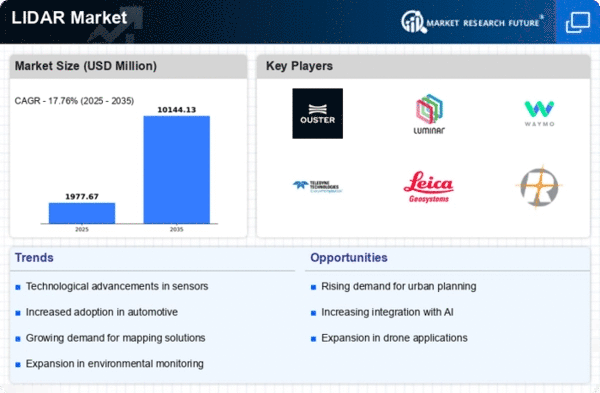
LIDAR Market Infographic
×
LIDAR Market Infographic Full View
Purchase Options

Lidar Size

LIDAR Market Growth Projections and Opportunities

The LiDAR market is on track to achieve significant growth in the coming years. LiDAR, which stands for Light Detection and Ranging, utilizes laser techniques to provide various advantages to different industries, especially in areas like automotive, geographical survey, land mapping applications, and construction. The market is thriving due to its ability to offer continuous 360 degrees of visibility and provide accurate depth information. Key factors contributing to this growth include the rising demand for 3D imaging technology and the increased adoption of laser technology by government agencies.

Projections indicate that the global LiDAR market is poised to grow at a Compound Annual Growth Rate (CAGR) of 14.14% during the forecast period from 2018 to 2023. In 2017, the airborne LiDAR market dominated with the highest market share, followed closely by terrestrial LiDAR. This growth is spurred by a significant increase in investments in emerging economies, particularly aimed at developing public infrastructure and the real estate sector.

The global LiDAR market is categorized based on product type, component, technology, functional areas, and region. Looking at the regional aspect, Asia Pacific is expected to experience the fastest growth, starting with a market value of USD 451.3 million in 2017 and projected to reach USD 1154.2 million. This growth is estimated to have a CAGR of 17.06% during the forecast period. On the other hand, North America led the LiDAR market in 2017 and is anticipated to achieve a market value of approximately USD 1474.7 million by 2023.

The significance of LiDAR lies in its widespread applications across diverse sectors. In the automotive industry, LiDAR plays a crucial role in enhancing safety through its 360-degree visibility and accurate depth information. This technology is also extensively used in geographical surveys, providing valuable data for mapping and analysis. Moreover, in construction and land mapping applications, LiDAR's capabilities contribute to efficient planning and execution.

The driving forces behind the market's growth are the increasing demands for 3D imaging technology and the growing acceptance of laser technology by government agencies. As technology evolves, the LiDAR market is likely to witness further advancements, fueling its expansion into new sectors and applications. The continuous development and integration of LiDAR technology are expected to be pivotal in shaping the market's trajectory in the coming years.

Investors and stakeholders are keenly observing the market dynamics, particularly in emerging economies, where substantial investments are being made to boost public infrastructure and the real estate sector. This focus on development is propelling the demand for LiDAR technology, creating new opportunities and driving overall market growth.
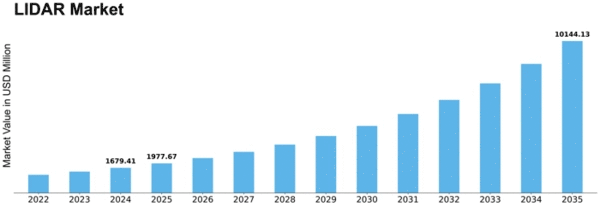

LIDAR Market Size Graph
Author
Aarti Dhapte
Team Lead - Research

She holds an experience of about 6+ years in Market Research and Business Consulting, working under the spectrum of Information Communication Technology, Telecommunications and Semiconductor domains. Aarti conceptualizes and implements a scalable business strategy and provides strategic leadership to the clients. Her expertise lies in market estimation, competitive intelligence, pipeline analysis, customer assessment, etc.

Leave a Comment

FAQs

How much is the LiDAR Market?

The LiDAR Market size was valued at USD 1679.41 billion in 2024.

What is the growth rate of the LiDAR market?

The global market is projected to grow at a CAGR of 17.76% during the forecast period, 2025 to 2035.

Which region held the largest market share in the LiDAR Market?

North America had the largest share in the global LiDAR market

Who are the key players in the LiDAR market?

The key players in the market are Beike Tianhui Technology Co. Ltd (China), Hexagon AB (Sweden), and others .

Which product type led the LiDAR market?

The airborne Lidar category dominated the market in 2021.

Which technology had the largest market share in the LiDAR market?

The 3D technology had the largest share in the global LiDAR market.

Market Summary

As per MRFR analysis, the LIDAR Market Size was estimated at 1679.41 USD Million in 2024. The LIDAR industry is projected to grow from 1977.71 in 2025 to 10144.13 by 2035, exhibiting a compound annual growth rate (CAGR) of 17.76 during the forecast period 2025 - 2035.

Key Market Trends & Highlights

The LIDAR market is experiencing robust growth driven by technological advancements and increasing applications across various sectors.

  • The market is witnessing increased adoption in autonomous vehicles, particularly in North America, which remains the largest market.
  • Smart city initiatives are propelling the demand for LIDAR technology, especially in the rapidly growing Asia-Pacific region.
  • Advancements in miniaturization and cost efficiency are making LIDAR systems more accessible across various applications.
  • Rising demand for precision agriculture and expansion of infrastructure development are key drivers fueling market growth.

Market Size & Forecast

2024 Market Size 1679.41 (USD Million)
2035 Market Size 10144.13 (USD Million)
CAGR (2025 - 2035) 17.76%
Largest Regional Market Share in 2024 North America

Major Players

Velodyne Lidar (US), Luminar Technologies (US), Waymo (US), Teledyne Technologies (US), Leica Geosystems (CH), Riegl (AT), Quanergy Systems (US), Ouster (US), Innoviz Technologies (IL)

Market Trends

The LIDAR Market is currently experiencing a transformative phase, driven by advancements in technology and increasing applications across various sectors. The integration of LIDAR systems into industries such as automotive, aerospace, and construction is becoming more prevalent, as organizations seek to enhance precision and efficiency in their operations. This trend is further fueled by the growing demand for autonomous vehicles, which rely heavily on LIDAR for navigation and obstacle detection. Additionally, the rise of smart cities and infrastructure development is propelling the adoption of LIDAR technology, as it provides critical data for urban planning and management. Moreover, the LIDAR Market is witnessing a shift towards miniaturization and cost reduction of devices, making them more accessible to a broader range of users. Innovations in solid-state LIDAR technology are emerging, which promise improved performance and reliability. As environmental concerns gain prominence, LIDAR is also being utilized for applications in forestry, agriculture, and environmental monitoring, indicating its versatility. Overall, the LIDAR Market appears poised for substantial growth, with diverse applications and technological advancements shaping its future landscape.

Increased Adoption in Autonomous Vehicles

The LIDAR Market is seeing a notable rise in the integration of LIDAR systems within autonomous vehicles. This trend is largely driven by the necessity for accurate environmental mapping and obstacle detection, which are critical for safe navigation. As automotive manufacturers invest in research and development, the reliance on LIDAR technology is expected to expand, enhancing the capabilities of self-driving cars.

Growth in Smart City Initiatives

The emergence of smart city projects is significantly influencing the LIDAR Market. Urban planners and local governments are increasingly utilizing LIDAR for infrastructure development, traffic management, and environmental monitoring. This trend suggests a growing recognition of LIDAR's potential to improve urban living conditions and optimize resource allocation.

Advancements in Miniaturization and Cost Efficiency

The LIDAR Market is experiencing a shift towards smaller, more affordable LIDAR systems. Innovations in technology are leading to the development of compact devices that maintain high performance while reducing costs. This trend may open new avenues for various industries, allowing wider adoption of LIDAR technology in applications previously deemed economically unfeasible.

LIDAR Market Market Drivers

Technological Advancements

The LiDAR Industry is experiencing rapid technological advancements, particularly in sensor technology and data processing capabilities. Innovations such as solid-state LiDAR and aerial LiDAR systems are enhancing the accuracy and efficiency of data collection. For instance, the integration of artificial intelligence in LiDAR systems is enabling real-time data analysis, which is crucial for applications in autonomous vehicles and urban planning. As these technologies evolve, they are expected to drive the market's growth, contributing to an estimated market value of 1.68 USD Billion in 2024 and a projected increase to 10.1 USD Billion by 2035.

Growing Demand in Various Sectors

The LiDAR Industry is witnessing a surge in demand across multiple sectors, including transportation, construction, and environmental monitoring. The increasing need for precise mapping and surveying in infrastructure projects is particularly noteworthy. For example, LiDAR technology is utilized in road construction to ensure accurate topographical data, which aids in project planning and execution. This growing demand is likely to propel the market forward, with a projected compound annual growth rate of 17.76% from 2025 to 2035, indicating a robust expansion in the coming years.

Government Initiatives and Funding

Government initiatives play a pivotal role in the expansion of the LiDAR Industry. Various countries are investing in LiDAR technology for applications such as disaster management, urban planning, and environmental conservation. For instance, the United States government has allocated significant funding for LiDAR projects aimed at improving flood risk assessments and enhancing infrastructure resilience. Such initiatives not only promote the adoption of LiDAR technology but also stimulate market growth, as public sector investments often lead to increased private sector interest and innovation.

Increased Adoption of Autonomous Systems

The rise of autonomous systems, particularly in the automotive and drone industries, is significantly influencing the LiDAR Industry. LiDAR technology is essential for the navigation and obstacle detection capabilities of autonomous vehicles. Companies like Waymo and Tesla are integrating advanced LiDAR systems to enhance safety and efficiency in their vehicles. This trend is expected to continue, with the market for LiDAR in autonomous applications likely to expand rapidly, contributing to the overall market growth and the anticipated valuation of 10.1 USD Billion by 2035.

Environmental Monitoring and Conservation

The LiDAR Industry is increasingly being utilized for environmental monitoring and conservation efforts. LiDAR technology enables detailed analysis of forest structures, land use changes, and habitat mapping, which are crucial for biodiversity conservation. For example, LiDAR is employed in forestry management to assess tree heights and biomass, aiding in sustainable practices. As environmental concerns grow globally, the demand for such applications is likely to rise, further driving the market's expansion and contributing to the projected CAGR of 17.76% from 2025 to 2035.

Market Segment Insights

By Application: Geospatial Mapping (Largest) vs. Autonomous Vehicles (Fastest-Growing)

In the LIDAR market, applications are diverse, with Geospatial Mapping representing the largest share. This sector leverages LIDAR technology for precise terrain mapping, urban planning, and infrastructure management, benefiting significantly from advancements in sensor technology. Autonomous Vehicles are emerging rapidly, fueled by the demand for precision in navigation and safety. Together, these applications highlight a competitive landscape where innovation drives market dynamics.

Geospatial Mapping (Dominant) vs. Autonomous Vehicles (Emerging)

Geospatial Mapping has established itself as a dominant application within the LIDAR market due to its extensive use in creating detailed maps and models for various industries, including urban planning and environmental analysis. The accuracy and detail provided by LIDAR technology facilitate better decision-making and resource management. Conversely, Autonomous Vehicles represent an emerging application fueled by rapid advancements in automation and artificial intelligence. This segment is characterized by its innovative use of LIDAR for real-time obstacle detection and navigation, positioning it at the forefront of technological evolution in transportation.

By End Use: Transportation (Largest) vs. Defense (Fastest-Growing)

The LIDAR market reveals a robust segmentation by end use, with Transportation leading the pack in market share. It encompasses applications in autonomous vehicles, traffic monitoring, and road mapping, making it critical for future mobility solutions. The Defense sector follows closely, leveraging LIDAR technology for surveillance, target acquisition, and reconnaissance. Each segment is essential, while Transportation dominates, Defense is rapidly expanding its footprint in the market.

Transportation (Dominant) vs. Defense (Emerging)

Transportation holds the dominant position in the LIDAR market due to its incorporation in various applications such as autonomous vehicles and smart city infrastructure. This segment benefits from technological advancements, regulatory support for autonomous systems, and the increasing need for accurate mapping and navigation. In contrast, the Defense segment is labeled as emerging because of its growing adoption in military applications, thanks to advancements in detection and ranging capabilities. The need for precision in defense operations fuels its expansion, even as it still plays catch-up with Transportation in terms of overall marketing presence.

By Technology: Solid State LIDAR (Largest) vs. Mechanical LIDAR (Fastest-Growing)

In the LIDAR market, the technology segment is characterized by a robust distribution among various types of LIDAR systems. Solid State LIDAR leads the market significantly, thanks to its compact design and reliability, making it the preferred choice for several automotive and industrial applications. Mechanical LIDAR, while currently holding a smaller market share, is witnessing rapid adoption due to its accuracy and long-range capabilities, appealing to new sectors such as robotics and aerial mapping. Growth trends in the LIDAR segment are heavily influenced by advancements in solid state technology, which enable lower costs and higher integration in consumer electronics. Furthermore, the increasing demand for automation and smart technologies drives the development of Mechanical LIDAR, as industries seek precise and efficient solutions. This creates a competitive landscape where emerging technologies are gaining traction alongside dominant players, offering a dynamic market evolution.

Technology: Solid State LIDAR (Dominant) vs. Mechanical LIDAR (Emerging)

Solid State LIDAR dominates the technology segment due to its advantages in size, weight, and cost, fostering its integration into consumer vehicles and drones. Its non-mechanical components enhance durability and reduce maintenance needs, making it preferable for mass deployment. On the other hand, Mechanical LIDAR is emerging strongly, driven by its high-resolution imaging and reliable performance in complex environments. While it may be bulkier and costlier, its exceptional accuracy allows it to carve out niche markets in autonomous vehicle navigation and topographic surveys. As each technology develops, the competition will intensify, with Solid State LIDAR innovating on price while Mechanical LIDAR focuses on enhancing functionality.

By Component: Laser Source (Largest) vs. Scanner (Fastest-Growing)

In the LIDAR market, the component segment is divided into four key areas: Laser Source, Receiver, Scanner, and GPS Unit. Among these, the Laser Source stands out as the largest contributor, owing to its critical role in generating the laser pulses essential for distance measurement. Scanners, on the other hand, have emerged as the fastest-growing segment, driven by increasing demand for high-resolution imaging and advanced 3D mapping applications in various industries.

Scanner (Dominant) vs. GPS Unit (Emerging)

The Scanner segment in the LIDAR market has established itself as a dominant force, due to its capability to capture accurate, high-density spatial data essential for applications such as topographical surveying, forestry, and urban planning. Its versatility and advancements in technology have made it the preferred choice for numerous sectors. Meanwhile, the GPS Unit represents an emerging component, gaining traction for its role in providing critical positioning data. As the demand for seamless integration in UAVs and mobile mapping systems increases, GPS Units are set to grow in importance, although they currently trail behind Scanners in market share.

By Type: Terrestrial LIDAR (Largest) vs. Aerial LIDAR (Fastest-Growing)

In the LIDAR market, Terrestrial LIDAR leads in market share due to its extensive applications in surveying, construction, and environmental management. This segment has been favored for its precise ground-level data collection capabilities, making it indispensable for various projects ranging from urban planning to forestry and vegetation mapping. Meanwhile, Aerial LIDAR, though currently smaller in market share, has seen a surge in adoption owing to its efficiency in covering larger areas quickly, particularly in topographical mapping and infrastructure monitoring.

Aerial LIDAR (Emerging) vs. Mobile LIDAR (Dominant)

Mobile LIDAR, known for its dynamic data collection capabilities, dominates the LIDAR market due to its compact size and versatility in applications like transportation and infrastructure mapping. It enables data gathering on-the-go, facilitating real-time analysis and decision-making. In contrast, Aerial LIDAR is emerging as a key player, leveraging advancements in drone technology for aerial data acquisition. Its growth is propelled by increasing demands for large-scale mapping projects and environmental monitoring. Aerial LIDAR provides rapid coverage and high-resolution data, making it a preferred option for geospatial professionals.

Get more detailed insights about LiDAR Market Research Report - Forecast till 2035

Regional Insights

North America : Market Leader in LIDAR Technology

North America continues to lead the LIDAR market, holding a significant share of 839.7M in 2025. The growth is driven by advancements in autonomous vehicles, smart city initiatives, and increased demand for precision mapping. Regulatory support, particularly from the U.S. government, is fostering innovation and investment in LIDAR technologies, enhancing safety and efficiency in transportation and infrastructure. The competitive landscape is robust, with key players like Velodyne Lidar, Luminar Technologies, and Waymo spearheading innovations. The U.S. remains the primary market, with Canada also showing promising growth. The presence of established companies and startups alike is creating a dynamic environment, ensuring that North America remains at the forefront of LIDAR technology development.

Europe : Emerging LIDAR Innovations

Europe's LIDAR market is projected to reach 450.0M by 2025, driven by increasing investments in autonomous vehicles and smart infrastructure. The region benefits from stringent regulations promoting safety and environmental sustainability, which are key catalysts for LIDAR adoption. Countries like Germany and the UK are leading the charge, with government initiatives supporting research and development in LIDAR technologies. The competitive landscape features prominent players such as Leica Geosystems and Riegl, alongside emerging startups. Germany is a significant contributor, with a strong automotive sector pushing for advanced LIDAR solutions. The European market is characterized by collaboration between industry and academia, fostering innovation and ensuring compliance with regulatory standards.

Asia-Pacific : Rapidly Growing LIDAR Sector

The Asia-Pacific LIDAR market is expected to grow to 320.0M by 2025, fueled by rising demand for smart city projects and advancements in transportation technologies. Countries like China and Japan are at the forefront, investing heavily in LIDAR for applications in autonomous vehicles and urban planning. Government policies promoting technological innovation are acting as significant growth drivers in the region. China is emerging as a key player, with numerous companies entering the LIDAR space, enhancing competition. The presence of global firms like Quanergy Systems and Innoviz Technologies is also notable. The region's market dynamics are characterized by rapid technological advancements and increasing collaborations between local and international firms, positioning Asia-Pacific as a vital player in The LIDAR.

Middle East and Africa : Developing LIDAR Applications

The Middle East and Africa LIDAR market is projected to reach 69.71M by 2025, driven by increasing investments in infrastructure and urban development. Countries like the UAE and South Africa are leading the way, with government initiatives aimed at enhancing transportation and public safety. The growing interest in smart city projects is also contributing to the demand for LIDAR technologies in the region. The competitive landscape is still developing, with a mix of local and international players entering the market. Companies are focusing on adapting LIDAR solutions to meet regional needs, particularly in construction and environmental monitoring. As the region continues to invest in technology, the LIDAR market is expected to expand significantly, offering new opportunities for growth.

Key Players and Competitive Insights

The LIDAR Market is currently characterized by a dynamic competitive landscape, driven by advancements in technology and increasing applications across various sectors, including automotive, aerospace, and urban planning. Key players such as Velodyne Lidar (US), Luminar Technologies (US), and Waymo (US) are at the forefront, each adopting distinct strategies to enhance their market positioning. Velodyne Lidar (US) focuses on innovation through continuous product development, while Luminar Technologies (US) emphasizes strategic partnerships with automotive manufacturers to integrate LIDAR systems into next-generation vehicles. Waymo (US), a leader in autonomous driving technology, leverages its extensive data collection capabilities to refine its LIDAR applications, thereby shaping the competitive environment through technological superiority and operational efficiency.The business tactics employed by these companies reflect a concerted effort to optimize supply chains and localize manufacturing processes. The market structure appears moderately fragmented, with several players vying for dominance. However, the collective influence of major companies is significant, as they drive technological advancements and set industry standards. This competitive interplay fosters an environment where innovation is paramount, compelling companies to continuously adapt and evolve their strategies.

In November Velodyne Lidar (US) announced a strategic partnership with a leading automotive manufacturer to develop a new generation of LIDAR sensors tailored for electric vehicles. This collaboration is poised to enhance Velodyne's market share by integrating its cutting-edge technology into high-demand electric vehicle platforms, thereby reinforcing its position as a key player in the automotive sector. The strategic importance of this partnership lies in its potential to accelerate the adoption of LIDAR technology in mainstream automotive applications.

In October Luminar Technologies (US) unveiled a new LIDAR sensor designed for enhanced performance in adverse weather conditions. This innovation is particularly relevant as it addresses a critical challenge in the deployment of autonomous vehicles. By improving the reliability of LIDAR systems in various environmental conditions, Luminar is likely to strengthen its competitive edge and appeal to a broader range of automotive clients, thereby solidifying its market presence.

In September Waymo (US) expanded its autonomous vehicle testing program to include urban environments with complex traffic patterns. This strategic move not only showcases Waymo's commitment to real-world applications of LIDAR technology but also positions the company as a leader in the development of autonomous driving solutions. The implications of this expansion are profound, as it may lead to enhanced data collection and refinement of LIDAR systems, further advancing the state of autonomous vehicle technology.

As of December the LIDAR Market is witnessing trends that emphasize digitalization, sustainability, and the integration of artificial intelligence. Strategic alliances among key players are increasingly shaping the competitive landscape, fostering innovation and collaboration. The shift from price-based competition to a focus on technological differentiation and supply chain reliability is evident. Companies that prioritize innovation and adaptability are likely to thrive, as the market continues to evolve in response to emerging technologies and consumer demands.

Key Companies in the LIDAR Market include

Industry Developments

  • Q2 2025: Luminar Technologies: Navigating the LiDAR Crossroads in 2025 Luminar Technologies accelerated production of its Halo LiDAR platform in Thailand in 2025, targeting B-sample delivery in 2026 and shifting strategic focus toward commercial and defense markets to diversify revenue amid automotive sector headwinds.
  • Q1 2025: Lidar firms Luminar and Ouster set 2025 targets amid tariff uncertainty Luminar announced it will narrow its focus to the new 'Halo' platform, aiming to reduce costs and achieve long-term profitability, while Ouster plans to transform its product portfolio in 2025 to target broader applications.
  • Q3 2025: Chinese providers continue to dominate automotive lidar 'arms race' Hesai Technology maintained its leadership in the automotive LiDAR sector in 2025, shipping over half a million units in the previous year and benefiting from rapid product cycles and strong integration strategies in China.

Future Outlook

LIDAR Market Future Outlook

The LIDAR market is projected to grow at a 17.76% CAGR from 2025 to 2035, driven by advancements in autonomous vehicles, urban planning, and environmental monitoring.

New opportunities lie in:

  • Development of LIDAR-integrated drones for precision agriculture
  • Expansion of LIDAR applications in smart city infrastructure
  • Creation of subscription-based LIDAR data analytics services

By 2035, the LIDAR market is expected to be a pivotal technology across multiple industries.

Market Segmentation

LIDAR Market Type Outlook

  • Terrestrial LIDAR
  • Aerial LIDAR
  • Mobile LIDAR
  • Bathymetric LIDAR

LIDAR Market End Use Outlook

  • Transportation
  • Defense
  • Mining
  • Forestry
  • Urban Planning

LIDAR Market Component Outlook

  • Laser Source
  • Receiver
  • Scanner
  • GPS Unit

LIDAR Market Technology Outlook

  • Solid State LIDAR
  • Mechanical LIDAR
  • Frequency Modulated Continuous Wave LIDAR
  • Time of Flight LIDAR

LIDAR Market Application Outlook

  • Geospatial Mapping
  • Autonomous Vehicles
  • Environmental Monitoring
  • Construction
  • Agriculture

Report Scope

MARKET SIZE 20241679.41(USD Million)
MARKET SIZE 20251977.71(USD Million)
MARKET SIZE 203510144.13(USD Million)
COMPOUND ANNUAL GROWTH RATE (CAGR)17.76% (2025 - 2035)
REPORT COVERAGERevenue Forecast, Competitive Landscape, Growth Factors, and Trends
BASE YEAR2024
Market Forecast Period2025 - 2035
Historical Data2019 - 2024
Market Forecast UnitsUSD Million
Key Companies ProfiledVelodyne Lidar (US), Luminar Technologies (US), Waymo (US), Teledyne Technologies (US), Leica Geosystems (CH), Riegl (AT), Quanergy Systems (US), Ouster (US), Innoviz Technologies (IL)
Segments CoveredApplication, End Use, Technology, Component, Type
Key Market OpportunitiesIntegration of LIDAR technology in autonomous vehicles enhances navigation and safety capabilities.
Key Market DynamicsRising demand for autonomous vehicles drives innovation and competition in the LIDAR market, enhancing technological advancements.
Countries CoveredNorth America, Europe, APAC, South America, MEA

FAQs

How much is the LiDAR Market?

The LiDAR Market size was valued at USD 1679.41 billion in 2024.

What is the growth rate of the LiDAR market?

The global market is projected to grow at a CAGR of 17.76% during the forecast period, 2025 to 2035.

Which region held the largest market share in the LiDAR Market?

North America had the largest share in the global LiDAR market

Who are the key players in the LiDAR market?

The key players in the market are Beike Tianhui Technology Co. Ltd (China), Hexagon AB (Sweden), and others .

Which product type led the LiDAR market?

The airborne Lidar category dominated the market in 2021.

Which technology had the largest market share in the LiDAR market?

The 3D technology had the largest share in the global LiDAR market.

  1. SECTION I: EXECUTIVE SUMMARY AND KEY HIGHLIGHTS
    1. | 1.1 EXECUTIVE SUMMARY
    2. | 1.1.1 Market Overview
    3. | 1.1.2 Key Findings
    4. | 1.1.3 Market Segmentation
    5. | 1.1.4 Competitive Landscape
    6. | 1.1.5 Challenges and Opportunities
    7. | 1.1.6 Future Outlook
  2. SECTION II: SCOPING, METHODOLOGY AND MARKET STRUCTURE
    1. | 2.1 MARKET INTRODUCTION
    2. | 2.1.1 Definition
    3. | 2.1.2 Scope of the study
    4. |-- 2.1.2.1 Research Objective
    5. |-- 2.1.2.2 Assumption
    6. |-- 2.1.2.3 Limitations
    7. | 2.2 RESEARCH METHODOLOGY
    8. | 2.2.1 Overview
    9. | 2.2.2 Data Mining
    10. | 2.2.3 Secondary Research
    11. | 2.2.4 Primary Research
    12. |-- 2.2.4.1 Primary Interviews and Information Gathering Process
    13. |-- 2.2.4.2 Breakdown of Primary Respondents
    14. | 2.2.5 Forecasting Model
    15. | 2.2.6 Market Size Estimation
    16. |-- 2.2.6.1 Bottom-Up Approach
    17. |-- 2.2.6.2 Top-Down Approach
    18. | 2.2.7 Data Triangulation
    19. | 2.2.8 Validation
  3. SECTION III: QUALITATIVE ANALYSIS
    1. | 3.1 MARKET DYNAMICS
    2. | 3.1.1 Overview
    3. | 3.1.2 Drivers
    4. | 3.1.3 Restraints
    5. | 3.1.4 Opportunities
    6. | 3.2 MARKET FACTOR ANALYSIS
    7. | 3.2.1 Value chain Analysis
    8. | 3.2.2 Porter's Five Forces Analysis
    9. |-- 3.2.2.1 Bargaining Power of Suppliers
    10. |-- 3.2.2.2 Bargaining Power of Buyers
    11. |-- 3.2.2.3 Threat of New Entrants
    12. |-- 3.2.2.4 Threat of Substitutes
    13. |-- 3.2.2.5 Intensity of Rivalry
    14. | 3.2.3 COVID-19 Impact Analysis
    15. |-- 3.2.3.1 Market Impact Analysis
    16. |-- 3.2.3.2 Regional Impact
    17. |-- 3.2.3.3 Opportunity and Threat Analysis
  4. SECTION IV: QUANTITATIVE ANALYSIS
    1. | 4.1 Semiconductor & Electronics, BY Application (USD Million)
    2. | 4.1.1 Geospatial Mapping
    3. | 4.1.2 Autonomous Vehicles
    4. | 4.1.3 Environmental Monitoring
    5. | 4.1.4 Construction
    6. | 4.1.5 Agriculture
    7. | 4.2 Semiconductor & Electronics, BY End Use (USD Million)
    8. | 4.2.1 Transportation
    9. | 4.2.2 Defense
    10. | 4.2.3 Mining
    11. | 4.2.4 Forestry
    12. | 4.2.5 Urban Planning
    13. | 4.3 Semiconductor & Electronics, BY Technology (USD Million)
    14. | 4.3.1 Solid State LIDAR
    15. | 4.3.2 Mechanical LIDAR
    16. | 4.3.3 Frequency Modulated Continuous Wave LIDAR
    17. | 4.3.4 Time of Flight LIDAR
    18. | 4.4 Semiconductor & Electronics, BY Component (USD Million)
    19. | 4.4.1 Laser Source
    20. | 4.4.2 Receiver
    21. | 4.4.3 Scanner
    22. | 4.4.4 GPS Unit
    23. | 4.5 Semiconductor & Electronics, BY Type (USD Million)
    24. | 4.5.1 Terrestrial LIDAR
    25. | 4.5.2 Aerial LIDAR
    26. | 4.5.3 Mobile LIDAR
    27. | 4.5.4 Bathymetric LIDAR
    28. | 4.6 Semiconductor & Electronics, BY Region (USD Million)
    29. | 4.6.1 North America
    30. |-- 4.6.1.1 US
    31. |-- 4.6.1.2 Canada
    32. | 4.6.2 Europe
    33. |-- 4.6.2.1 Germany
    34. |-- 4.6.2.2 UK
    35. |-- 4.6.2.3 France
    36. |-- 4.6.2.4 Russia
    37. |-- 4.6.2.5 Italy
    38. |-- 4.6.2.6 Spain
    39. |-- 4.6.2.7 Rest of Europe
    40. | 4.6.3 APAC
    41. |-- 4.6.3.1 China
    42. |-- 4.6.3.2 India
    43. |-- 4.6.3.3 Japan
    44. |-- 4.6.3.4 South Korea
    45. |-- 4.6.3.5 Malaysia
    46. |-- 4.6.3.6 Thailand
    47. |-- 4.6.3.7 Indonesia
    48. |-- 4.6.3.8 Rest of APAC
    49. | 4.6.4 South America
    50. |-- 4.6.4.1 Brazil
    51. |-- 4.6.4.2 Mexico
    52. |-- 4.6.4.3 Argentina
    53. |-- 4.6.4.4 Rest of South America
    54. | 4.6.5 MEA
    55. |-- 4.6.5.1 GCC Countries
    56. |-- 4.6.5.2 South Africa
    57. |-- 4.6.5.3 Rest of MEA
  5. SECTION V: COMPETITIVE ANALYSIS
    1. | 5.1 Competitive Landscape
    2. | 5.1.1 Overview
    3. | 5.1.2 Competitive Analysis
    4. | 5.1.3 Market share Analysis
    5. | 5.1.4 Major Growth Strategy in the Semiconductor & Electronics
    6. | 5.1.5 Competitive Benchmarking
    7. | 5.1.6 Leading Players in Terms of Number of Developments in the Semiconductor & Electronics
    8. | 5.1.7 Key developments and growth strategies
    9. |-- 5.1.7.1 New Product Launch/Service Deployment
    10. |-- 5.1.7.2 Merger & Acquisitions
    11. |-- 5.1.7.3 Joint Ventures
    12. | 5.1.8 Major Players Financial Matrix
    13. |-- 5.1.8.1 Sales and Operating Income
    14. |-- 5.1.8.2 Major Players R&D Expenditure. 2023
    15. | 5.2 Company Profiles
    16. | 5.2.1 Velodyne Lidar (US)
    17. |-- 5.2.1.1 Financial Overview
    18. |-- 5.2.1.2 Products Offered
    19. |-- 5.2.1.3 Key Developments
    20. |-- 5.2.1.4 SWOT Analysis
    21. |-- 5.2.1.5 Key Strategies
    22. | 5.2.2 Luminar Technologies (US)
    23. |-- 5.2.2.1 Financial Overview
    24. |-- 5.2.2.2 Products Offered
    25. |-- 5.2.2.3 Key Developments
    26. |-- 5.2.2.4 SWOT Analysis
    27. |-- 5.2.2.5 Key Strategies
    28. | 5.2.3 Waymo (US)
    29. |-- 5.2.3.1 Financial Overview
    30. |-- 5.2.3.2 Products Offered
    31. |-- 5.2.3.3 Key Developments
    32. |-- 5.2.3.4 SWOT Analysis
    33. |-- 5.2.3.5 Key Strategies
    34. | 5.2.4 Teledyne Technologies (US)
    35. |-- 5.2.4.1 Financial Overview
    36. |-- 5.2.4.2 Products Offered
    37. |-- 5.2.4.3 Key Developments
    38. |-- 5.2.4.4 SWOT Analysis
    39. |-- 5.2.4.5 Key Strategies
    40. | 5.2.5 Leica Geosystems (CH)
    41. |-- 5.2.5.1 Financial Overview
    42. |-- 5.2.5.2 Products Offered
    43. |-- 5.2.5.3 Key Developments
    44. |-- 5.2.5.4 SWOT Analysis
    45. |-- 5.2.5.5 Key Strategies
    46. | 5.2.6 Riegl (AT)
    47. |-- 5.2.6.1 Financial Overview
    48. |-- 5.2.6.2 Products Offered
    49. |-- 5.2.6.3 Key Developments
    50. |-- 5.2.6.4 SWOT Analysis
    51. |-- 5.2.6.5 Key Strategies
    52. | 5.2.7 Quanergy Systems (US)
    53. |-- 5.2.7.1 Financial Overview
    54. |-- 5.2.7.2 Products Offered
    55. |-- 5.2.7.3 Key Developments
    56. |-- 5.2.7.4 SWOT Analysis
    57. |-- 5.2.7.5 Key Strategies
    58. | 5.2.8 Ouster (US)
    59. |-- 5.2.8.1 Financial Overview
    60. |-- 5.2.8.2 Products Offered
    61. |-- 5.2.8.3 Key Developments
    62. |-- 5.2.8.4 SWOT Analysis
    63. |-- 5.2.8.5 Key Strategies
    64. | 5.2.9 Innoviz Technologies (IL)
    65. |-- 5.2.9.1 Financial Overview
    66. |-- 5.2.9.2 Products Offered
    67. |-- 5.2.9.3 Key Developments
    68. |-- 5.2.9.4 SWOT Analysis
    69. |-- 5.2.9.5 Key Strategies
    70. | 5.3 Appendix
    71. | 5.3.1 References
    72. | 5.3.2 Related Reports

Semiconductor & Electronics Market Segmentation

Semiconductor & Electronics By Application (USD Million, 2025-2035)

  • Geospatial Mapping
  • Autonomous Vehicles
  • Environmental Monitoring
  • Construction
  • Agriculture

Semiconductor & Electronics By End Use (USD Million, 2025-2035)

  • Transportation
  • Defense
  • Mining
  • Forestry
  • Urban Planning

Semiconductor & Electronics By Technology (USD Million, 2025-2035)

  • Solid State LIDAR
  • Mechanical LIDAR
  • Frequency Modulated Continuous Wave LIDAR
  • Time of Flight LIDAR

Semiconductor & Electronics By Component (USD Million, 2025-2035)

  • Laser Source
  • Receiver
  • Scanner
  • GPS Unit

Semiconductor & Electronics By Type (USD Million, 2025-2035)

  • Terrestrial LIDAR
  • Aerial LIDAR
  • Mobile LIDAR
  • Bathymetric LIDAR
Infographic

Free Sample Request

Kindly complete the form below to receive a free sample of this Report

Get Free Sample

Customer Strories

Compare Licence

×
Features License Type
Single User Multiuser License Enterprise User
Price $4,950 $5,950 $7,250
Maximum User Access Limit 1 User Upto 10 Users Unrestricted Access Throughout the Organization
Free Customization
Direct Access to Analyst
Deliverable Format
Platform Access
Discount on Next Purchase 10% 15% 15%
Printable Versions