

Request Free Sample ×

Kindly complete the form below to receive a free sample of this Report

* Please use a valid business email

Leading companies partner with us for data-driven Insights

clients tt-cursor
Hero Background
English
Chinese
French
Japanese
Korean
German
Spanish

Legal Marijuana Market Analysis

ID: MRFR/HC/3235-HCR
200 Pages
Vikita Thakur
Last Updated: April 06, 2026

Legal Marijuana Market Research Report By Application (Recreational Use, Medicinal Use, Industrial Use, Cosmetics, Food and Beverages), By Product Type (Dried Flowers, Concentrates, Edibles, Oils, Tinctures), By Distribution Channel (Online Retail, Physical Stores, Dispensaries, Pharmacies, Direct Sales), By End Use (Personal Use, Commercial Use, Research, Development) and By Regional (North America, Europe, South America, Asia Pacific, Middle East and Africa) - Growth & Industry Forecast 2025 To 2035

Share:
Download PDF ×

We do not share your information with anyone. However, we may send you emails based on your report interest from time to time. You may contact us at any time to opt-out.

Legal Marijuana Market Infographic
Purchase Options

Market Analysis

In-depth Analysis of Legal Marijuana Market Industry Landscape

The legal marijuana industry's market dynamics are defined by the intricate interactions of social, economic, regulatory, and technical elements. One of the main forces behind the legalization of marijuana for both medical and recreational use in many parts of the world is the change in public perceptions about the drug. The legal marijuana industry is becoming more accepted as public perception changes, which is increasing demand for a wide variety of cannabis goods. Economic considerations, such as investment possibilities, tax revenues, and the generation of jobs, heavily influence market dynamics. The legal marijuana market has grown to be a major employer in the retail, processing, auxiliary services, and production sectors. In turn, tax revenues help governments and business owners discover rich prospects, creating a vibrant economic environment. One of the most important factors influencing market dynamics is regulation. The legal marijuana industry is governed by a complicated system of laws that differ greatly between states. Regulations have an impact on marketing strategies, distribution channels, product standards, and growing techniques. Market participants maneuver across this complex terrain, modifying their approaches to adhere to changing laws and maintain the industry's validity. Technological developments influence the legal marijuana market's dynamics in product creation, extraction, and production. Novel product formulations, effective extraction processes, and sophisticated cultivation strategies are just a few examples of innovations that improve the caliber and variety of cannabis goods. In response, the industry provides a wide range of products, including edibles, concentrates, and topicals, to satisfy changing customer demands. Changes in society and culture are also very important to market dynamics. The growing interest in alternative wellness methods and the de-stigmatization of marijuana usage are factors in the rising acceptability among consumers. As a result of the market's expansion beyond recreational usage to serve customers with a focus on health and medicine, product development and marketing tactics have become increasingly innovative. Globalization and industry stakeholder engagement influence the legal marijuana market dynamics. An industry becomes more interconnected through international alliances for corporate collaboration, sharing of data, and research. Globalization makes it easier to share best practices, transfer technology, and grow legal marijuana markets internationally. Market dynamics are influenced by consumer education and desires. Products with particular terpene profiles, cannabinoid profiles, and delivery options are in greater demand as customers get pickier. Industry participants and authorities' educational initiatives help consumers make well-informed decisions, directing the market toward goods that suit personal tastes and requirements. Environmental sustainability is becoming more and more important in the legal marijuana industry. Due to the energy-intensive nature of indoor growing, eco-friendly packaging and energy-efficient technology are among the sustainable practices that are being prioritized. Market participants are adopting eco-friendly methods more frequently in order to support industry-wide initiatives aimed at sustainability in the cannabis sector. One major factor influencing dynamics in the legal marijuana industry is competition among enterprises. Businesses work hard to set their brands apart via inventiveness, high-quality products, and successful marketing techniques. This rivalry promotes ongoing advancements in product creation, consumer experiences, and cultivation methods, which propels the market's expansion and development as a whole. The use of digital technologies, such as e-commerce platforms, online learning, and digital marketing, is impacting market dynamics. Digital solutions are being adopted by the legal marijuana business in order to improve consumer outreach, optimize operations, and guarantee regulatory compliance. The future of the legal marijuana business is anticipated to be significantly shaped by the increasing incorporation of digital tools as technology develops.

Author
Author Profile
Vikita Thakur
Senior Research Analyst

She holds an experience of about 5+ years in market research and business consulting projects for sectors such as life sciences, medical devices, and healthcare IT. She possesses a robust background in data analysis, market estimation, competitive intelligence, pipeline analysis market trend identification, and consumer behavior insights. Her expertise lies in technical Sales support, client interaction and project management, designing and implementing market research studies, conducting competitive analysis, and synthesizing complex data into actionable recommendations that drive business growth.

Leave a Comment

FAQs

What is the current valuation of the Legal Marijuana Market as of 2024?

<p>The overall market valuation was 18.96 USD Billion in 2024.</p>

What is the projected market valuation for the market in 2035?

The projected valuation for 2035 is 50.02 USD Billion.

What is the expected CAGR for the Legal Marijuana Market during the forecast period 2025 - 2035?

The expected CAGR for the market during the forecast period 2025 - 2035 is 9.22%.

Which segments are expected to show the highest growth in the Legal Marijuana Market?

<p>Recreational use and commercial use segments are expected to show the highest growth, with projected valuations of 18.0 USD Billion and 22.0 USD Billion respectively by 2035.</p>

What are the key product types in the market?

Key product types include dried flowers, concentrates, edibles, oils, and tinctures, with dried flowers projected to reach 15.0 USD Billion by 2035.

How does the distribution channel impact the Legal Marijuana Market?

<p>The distribution channel is crucial, with dispensaries expected to dominate, reaching a valuation of 15.0 USD Billion by 2035.</p>

Who are the major players in the market?

Major players include Canopy Growth Corporation, Aurora Cannabis Inc., Curaleaf Holdings Inc., and Trulieve Cannabis Corp.

What is the expected growth for the food and beverages segment in the Legal Marijuana Market?

<p>The food and beverages segment is projected to grow to 9.02 USD Billion by 2035.</p>

What is the significance of personal use in the market?

Personal use is projected to reach 20.5 USD Billion by 2035, indicating a strong consumer demand.

How does the market for medicinal use compare to recreational use in the Legal Marijuana Market?

<p>Medicinal use is projected to grow to 15.0 USD Billion by 2035, while recreational use is expected to reach 18.0 USD Billion, suggesting a competitive landscape.</p>

Market Summary

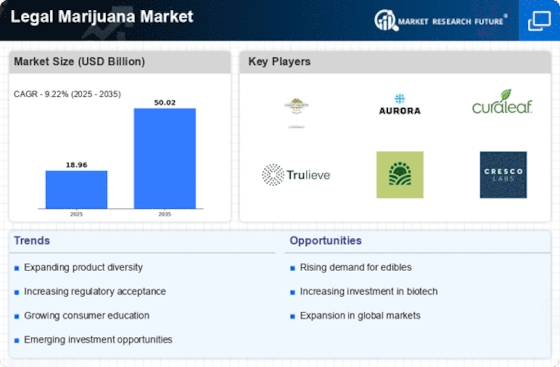
According to Market Research Future Reports analysis, the Legal Marijuana Market size was valued at USD 18.96 Billion in 2024. The market is projected to grow from USD 20.71 Billion in 2025 to USD 50.02 Billion by 2035, registering a CAGR of 9.22% during the forecast 2025–2035. North America led the market with 75% share, generating around USD 14.2 billion in revenue.
 
Expanding legalization of cannabis for medical and recreational use is the primary growth driver, encouraging investment, product innovation, and wider consumer adoption, while improving regulatory clarity and enabling structured market expansion across developed and emerging economies globally.
 
According to the World Health Organization (WHO), over 55 countries have adopted medical cannabis frameworks, while CDC highlights increasing cannabis use prevalence in regulated regions. IHME supports growing research into therapeutic applications, reinforcing demand for regulated cannabis-based products globally.

Key Market Trends & Highlights

The legal marijuana market is experiencing robust growth driven by evolving consumer preferences and regulatory advancements.

  • North America dominated with 75% share in 2024, driven by early legalization, strong infrastructure, and high consumer demand. Europe valued at USD 4.5 billion in 2024, projected to reach USD 12.0 billion by 2035 with regulatory expansion. Recreational use dominated with 58% share in 2024, driven by legalization expansion and increasing consumer acceptance globally. Dried flowers led product segment with 54% share, supported by traditional consumption patterns and widespread dispensary availability worldwide.

Market Size & Forecast

2024 Market Size 18.96 (USD Billion)
2035 Market Size 50.02 (USD Billion)
CAGR (2025 - 2035) 9.22%
Largest Regional Market Share in 2024 North America

Major Players

Companies such as Canopy Growth Corporation (CA), Aurora Cannabis Inc. (CA), Curaleaf Holdings Inc. (US), Trulieve Cannabis Corp. (US), <a href="https://investors.gtigrows.com/news-events/press-releases">Green Thumb Industries Inc</a>. (US), Cresco Labs Inc. (US), Harvest Health &amp; Recreation Inc. (US), MedMen Enterprises Inc. (US) are some of the major participants in the global market.

Market Trends

The Legal Marijuana Market is currently experiencing a transformative phase characterized by evolving regulations and increasing consumer acceptance. As more jurisdictions recognize the potential benefits of legalizing marijuana, the market landscape is shifting. This change is not merely a reflection of changing laws but also an indication of a broader societal shift towards the normalization of cannabis use.  

The global cannabis industry trends suggest that the expansion of legal frameworks is likely to encourage investment and innovation within the sector, fostering a diverse range of products and services. Furthermore, the growing interest in cannabis for medicinal purposes appears to be driving research and development efforts, which may lead to new therapeutic applications and enhanced consumer trust.

In addition to regulatory changes, the market is witnessing a surge in consumer demand for high-quality, sustainably sourced products. This trend suggests that consumers are becoming more discerning, seeking out brands that align with their values. The rise of e-commerce platforms dedicated to cannabis products is also noteworthy, as it provides consumers with greater access and convenience. 

As the market continues to mature, it seems poised for further growth, with potential opportunities for both established players and new entrants. The interplay of these factors indicates a dynamic environment that could reshape the future of the Legal Marijuana Market.

Increased Regulatory Support

The trend towards increased regulatory support for the Legal Marijuana Market is becoming more pronounced. Governments are gradually implementing frameworks that facilitate legal access to cannabis, which may enhance market stability and encourage responsible consumption. Global cannabis industry trends suggest that this regulatory shift could lead to a more structured environment, fostering growth and innovation.

Growing regulatory acceptance is supported by global public health policy evolution. PAHO highlights that multiple countries in the Americas are implementing controlled cannabis frameworks to ensure safe access and reduce illicit trade. Additionally, WHO emphasizes policy reforms supporting regulated medicinal cannabis use, fostering structured market expansion.

Consumer Preference for Quality

There is a noticeable shift in consumer preferences towards high-quality cannabis products. As the legal cannabis industry matures, consumers are increasingly seeking products that are organic, sustainably sourced, and free from harmful additives. This trend suggests a growing awareness of health and wellness, influencing purchasing decisions.

The shift toward high-quality cannabis products aligns with broader health and safety awareness. ECDC emphasizes increasing regulatory monitoring of substances to ensure consumer safety, while UNICEF highlights rising public awareness regarding product safety and health impacts. This drives demand for standardized, tested, and premium cannabis products globally.

Expansion of E-commerce Platforms

The expansion of e-commerce platforms dedicated to cannabis products is reshaping the Legal Marijuana Market. Online sales channels are providing consumers with greater access to a variety of products, enhancing convenience and choice. This trend may also facilitate the entry of new brands, further diversifying the market.

Digital healthcare and product accessibility trends support cannabis e-commerce growth. UNFPA highlights expanding digital access and online healthcare ecosystems globally, while MSF reports increased use of digital channels for healthcare delivery in underserved regions. These developments contribute to improved accessibility and consumer reach for regulated cannabis products.

Legal Marijuana Market Market Drivers

Diverse Product Offerings

The diversification of product offerings within the Legal Marijuana Market appears to be a significant driver of growth. Companies are increasingly introducing a wide range of cannabis products, including edibles, oils, and topicals, catering to various consumer preferences.
 
This variety not only attracts a broader customer base but also encourages repeat purchases. Market data suggests that the edibles segment is experiencing rapid growth, with consumers seeking alternative consumption methods. As companies innovate and expand their product lines, the market is likely to see sustained growth, driven by consumer demand for diverse and high-quality cannabis products.

Growing Acceptance of Cannabis

The increasing acceptance of cannabis for both medicinal and recreational use appears to be a pivotal driver in the Legal Marijuana Market. As societal attitudes shift, more individuals are advocating for legalization, which has led to a surge in demand.
 
Recent surveys indicate that a significant percentage of the population supports legalization, which has prompted various jurisdictions to reconsider their cannabis laws. This cultural shift not only enhances market visibility but also encourages investment in cannabis-related businesses. The market is likely to benefit from this growing acceptance, as it fosters an environment conducive to expansion and innovation.

Advancements in Cannabis Research

Ongoing advancements in cannabis research are likely to play a crucial role in shaping the Legal Marijuana Market. Scientific studies continue to unveil the therapeutic benefits of cannabis, leading to increased interest from healthcare professionals and patients alike.
 
For instance, research has shown that cannabinoids can effectively manage chronic pain and other medical conditions, which has resulted in a rise in medical cannabis prescriptions. This growing body of evidence may encourage more countries to adopt favorable regulations, thereby expanding the market. The market stands to gain from these developments, as they enhance the credibility and acceptance of cannabis as a legitimate treatment option.

Technological Innovations in Cultivation

Technological innovations in cultivation practices are emerging as a key driver in the Legal Marijuana Market. Advances in agricultural technology, such as hydroponics and automated growing systems, are enhancing the efficiency and yield of cannabis production.
 
These innovations not only reduce operational costs but also improve product quality, which is essential in a competitive market. As producers adopt these technologies, they are likely to meet the increasing demand for high-quality cannabis products. The market may experience significant growth as these technological advancements enable producers to scale operations and respond effectively to market needs.

Regulatory Developments and Legalization Efforts

Regulatory developments and ongoing legalization efforts are fundamental drivers in the Legal Marijuana Market. As more regions implement regulatory frameworks for cannabis, the market is poised for expansion. Recent legislative changes in several countries have facilitated the establishment of legal cannabis markets, which has led to increased investment and business opportunities.
 
The establishment of clear regulations not only provides a safer environment for consumers but also encourages businesses to enter the market. This trend suggests that the market will continue to evolve, driven by the need for compliance and the desire for legitimate business operations.

Market Segment Insights

By Application: Recreational Use (Largest) vs. Medicinal Use (Fastest-Growing)

In the Legal Marijuana Market, Recreational Use dominates the application segment with a 58% share, driven by growing legalization, shifting consumer attitudes, and rising demand for non-medical cannabis products. Medicinal Use, however, is gaining traction and is expected to witness rapid growth due to the rising awareness of medical marijuana benefits and the increasing number of states legalizing its use for health purposes. Other segments, such as Industrial Use and Cosmetics, although smaller, are beginning to carve out niche markets fueled by consumer interest and emerging regulations.

Recreational Use: Dominant vs. Medicinal Use: Emerging

Recreational Use of marijuana has established itself as the dominant force in the market, attracting substantial consumer interest and investment. This segment thrives on consumer preferences for leisure and social enjoyment, leading to an enhanced product variety including various strains and formats. On the other hand, Medicinal Use is emerging rapidly, driven by clinical research supporting its health benefits and endorsements from health professionals. Increasing legalization and a greater societal acceptance of cannabis for therapeutic purposes are propelling growth. As awareness grows, the Medicinal segment is attracting both patients and investments, indicating a strong future trajectory.

By Product Type: Dried Flowers (Largest) vs. Concentrates (Fastest-Growing)

In the Legal Marijuana Market, dried flowers hold the largest product segment with a 54% share, driven by their widespread availability, affordability, and strong consumer preference for traditional cannabis consumption methods. This segment appeals to traditional consumers and is often regarded as the primary form of marijuana usage. In contrast, concentrates are rapidly gaining traction, especially among younger consumers looking for potent options and innovative consumption methods. The growing interest in these products has enhanced their visibility and availability in various dispensaries.

Dried Flowers (Dominant) vs. Concentrates (Emerging)

Dried flowers remain the backbone of the legal marijuana market, characterized by their rich variety, robust flavors, and familiar forms. This segment benefits from a longstanding history of use and cultural significance, appealing to both new consumers and seasoned users. On the other hand, concentrates are emerging as a powerhouse within the marijuana industry, focusing on products like shatter, wax, and oils. Their concentrated forms offer enhanced potency and diverse consumption methods, making them particularly popular among experienced users seeking an intensified experience. As educational resources grow and consumer preferences shift toward innovative products, concentrates are poised for substantial growth.

By Distribution Channel: Online Retail (Largest) vs. Physical Stores (Fastest-Growing)

In the Legal Marijuana Market, online retail leads the distribution channel segment with a 57% share, driven by its convenience, wider product selection, and increasing consumer preference for discreet and accessible purchasing options. Consumers increasingly prefer purchasing cannabis products online for their privacy and the variety offered. Physical Stores, while still crucial, have seen increased competition as online sales rise, making it imperative for these traditional outlets to innovate and elevate the in-store experience to attract customers.

Online Retail: Dominant vs. Physical Stores: Emerging

Online Retail stands at the forefront of the distribution channels in the Legal Marijuana Market, catering to tech-savvy consumers who favor the ease of browsing and purchasing from home. This segment thrives due to its extensive reach and ability to provide diverse product selections, driving the cannabis industry growth. Conversely, Physical Stores represent an emerging trend, adapting to changing consumer preferences. They aim to create a personalized shopping experience that emphasizes education and product knowledge, appealing to both new and experienced users. Their growth is bolstered by targeted local marijuana marketing strategies and community engagement, making them an essential player in the evolving marijuana industry.

By End Use: Personal Use (Largest) vs. Commercial Use (Fastest-Growing)

In the legal marijuana market, the end-use segment is characterized by three main categories: personal use, commercial use, and research and development. Personal use dominates the marijuana industry, accounting for a 63% share of consumption, driven by increasing adoption for both recreational enjoyment and therapeutic benefits as consumer acceptance continues to rise. This segment has grown steadily, driven by increasing social acceptance and changing legislation in various regions. In contrast, commercial use has emerged as the fastest-growing category, propelled by the proliferation of dispensaries and the development of innovative products tailored for businesses.

Personal Use (Dominant) vs. Commercial Use (Emerging)

The personal use segment represents the dominant force within the market, characterized by consumers seeking products for recreational or medicinal purposes. This segment attracts a diverse demographic, ranging from casual users to patients relying on cannabis for medical treatments. Its growth can be attributed to changing societal attitudes and increased legalization efforts. On the other hand, the commercial use segment is emerging rapidly, captivating the attention of entrepreneurs and investors alike. This category encompasses a wide range of activities, from cultivation to distribution, and is fueled by advancements in product development and marijuana marketing strategies that emphasize quality and accessibility for consumers.

Get more detailed insights about Legal Marijuana Market Research Report-Forecast to 2035

Regional Insights

The Regional analysis of the Legal Marijuana Market reveals a significant landscape of growth and opportunities across various areas. In 2024, North America led the market, accounting for 75% of the global revenue in 2024 and leads the cannabis market, valued at 10.0 USD Billion, and is expected to grow to 25.0 USD Billion by 2035, showcasing its majority holding in the cannabis industry due to the early legalization and robust consumer base.

Europe follows, valued at 4.5 USD Billion in 2024, with projections of reaching 12.0 USD Billion by 2035, owing to the fact that EU legalize weed and driven by progressive legislation and an increasing acceptance of cannabis use. South America, valued at 2.0 USD Billion in 2024 and expected to reach 5.0 USD Billion in 2035, is emerging as a significant player due to evolving regulations and rising demand for medical marijuana. The Asia Pacific region, though currently smaller at 1.8 USD Billion in 2024, is anticipated to grow to 4.5 USD Billion by 2035, fueled by changing perceptions and potential regulatory shifts.

Lastly, the Middle East and Africa, valued at 1.66 USD Billion in 2024, is set to reach 3.0 USD Billion by 2035, as legalization efforts gain momentum. Overall, the Legal Marijuana Market segmentation highlights varying dynamics, with North America dominating significantly, primarily due to established markets and consumer readiness, while other regions are poised for growth through evolving policies and societal acceptance.

Key Players and Competitive Insights

The Legal Marijuana Market has been experiencing significant growth and transformation, driven by evolving regulations, changing consumer perceptions, and increasing health awareness regarding cannabis use. The competitive landscape is characterized by a mix of biggest pot companies and new entrants vying for market share across different geographies. This competitive environment leads to heightened innovation, with firms expanding their product lines to include a range of cannabis-derived goods such as oils, edibles, and infused beverages.
 
Companies are also focusing on strategic partnerships, mergers, and acquisitions to enhance their capabilities and presence in the cannabis market, which, in turn, helps them navigate the complexities of local laws and guidelines that govern the legal use of marijuana products. The dynamic nature of this sector, fueled by shifting cultural attitudes and legislative changes, offers numerous opportunities for competitive participants to differentiate themselves through branding, quality, and consumer engagement.MedMen Enterprises has carved a significant niche within the Legal Marijuana Market with its strong retail presence and commitment to quality.
 
The company has established a network of dispensaries in various regions, emphasizing customer experience and product education, which has helped it build a loyal customer base. MedMen’s strengths include its strong brand identity, efficient healthcare supply chain management, and dedication to transparency in its operations. The company is known for offering a diverse range of high-quality cannabis products, including flower, edibles, and concentrates, catering to different consumer segments. This comprehensive product lineup, alongside strategic marijuana marketing efforts, positions MedMen Enterprises as a formidable player in the cannabis industry.
 
Its innovative approach in navigating regulatory landscapes while focusing on customer trends contributes to its competitiveness in the global arena.Aphria has also emerged as a key player in the Legal Marijuana Market, distinguished by its extensive operations and product offerings. The company specializes in producing high-quality medical and recreational cannabis products while focusing on research and development to align with global health standards. Aphria's strengths lie in its scalability, forward-thinking approach, and robust distribution networks that facilitate access to various markets.
 
The company's portfolio includes a variety of cannabis products, such as oils, capsules, and other derivative products tailored to meet diverse consumer needs. Alongside its commitment to innovation, Aphria has engaged in strategic mergers and acquisitions, enhancing its operational capabilities and expanding its international footprint. This agility in scaling its operations and integrating advanced technologies reinforces its competitive edge in the rapidly evolving global marketplace. Aphria’s strong presence in the cannabis market and focus on quality align well with the increasing demand for legal marijuana products worldwide, further solidifying its role in the cannabis industry.

Key Companies in the Legal Marijuana Market include

Industry Developments

The market has witnessed significant developments recently, with notable transactions and expansions among key cannabis industry players.In June 2025, The U.S. Cannabis Roundtable was established by the main MSOs in the United States (Cresco Labs, Curaleaf, Verano, Trulieve, Green Thumb) to advocate for federal cannabis reform under the new administration. In June 2025, Hybrid NYC (Gotham) has initiated a federal lawsuit to contest the New York State's labor-peace agreement requirement for cannabis licensees.

In June 2025, Thailand reversed its 2022 decriminalization and reclassified cannabis as a narcotic unless it was prescribed medically.Regulatory frameworks continue to evolve globally, influencing investment flows and competitive strategies. Reports show a surge in consumer interest in both recreational and medicinal cannabis products, significantly impacting sales trajectories. The broader implications of these developments signal a dynamic landscape for the weed market, poised for further expansion as regulatory acceptance increases and cannabis market infrastructure strengthens.

Future Outlook

Legal Marijuana Market Future Outlook

The Legal Marijuana Market size is projected to reach USD 50.02 Billion by 2035, growing at a CAGR of 9.22%, driven by increasing legalization, consumer demand, and product innovation.

New opportunities lie in:

  • <p>Expansion of e-commerce platforms for cannabis sales. Development of premium cannabis-infused beverages. Investment in sustainable cultivation technologies.</p>

By 2035, the market is expected to be robust, reflecting substantial growth and diversification.

Market Segmentation

Legal Marijuana Market End Use Outlook

  • Personal Use
  • Commercial Use
  • Research and Development

Legal Marijuana Market Application Outlook

  • Recreational Use
  • Medicinal Use
  • Industrial Use
  • Cosmetics
  • Food and Beverages

Legal Marijuana Market Product Type Outlook

  • Dried Flowers
  • Concentrates
  • Edibles
  • Oils
  • Tinctures

Legal Marijuana Market Distribution Channel Outlook

  • Online Retail
  • Physical Stores
  • Dispensaries
  • Pharmacies
  • Direct Sales

Report Scope

MARKET SIZE 2024 18.96(USD Billion)
MARKET SIZE 2025 20.71(USD Billion)
MARKET SIZE 2035 50.02(USD Billion)
COMPOUND ANNUAL GROWTH RATE (CAGR) 9.22% (2025 - 2035)
REPORT COVERAGE Revenue Forecast, Competitive Landscape, Growth Factors, and Trends
BASE YEAR 2024
Market Forecast Period 2025 - 2035
Historical Data 2019 - 2024
Market Forecast Units USD Billion
Key Companies Profiled Canopy Growth Corporation (CA), Aurora Cannabis Inc. (CA), Curaleaf Holdings Inc. (US), Trulieve Cannabis Corp. (US), Green Thumb Industries Inc. (US), Cresco Labs Inc. (US), Harvest Health & Recreation Inc. (US), MedMen Enterprises Inc. (US)
Segments Covered Application, Product Type, Distribution Channel, End Use, Regional
Key Market Opportunities Expansion of product lines catering to diverse consumer preferences in the market.
Key Market Dynamics Evolving regulatory frameworks and shifting consumer preferences drive innovation and competition in the market.
Countries Covered North America, Europe, APAC, South America, MEA

FAQs

What is the current valuation of the Legal Marijuana Market as of 2024?

<p>The overall market valuation was 18.96 USD Billion in 2024.</p>

What is the projected market valuation for the market in 2035?

The projected valuation for 2035 is 50.02 USD Billion.

What is the expected CAGR for the Legal Marijuana Market during the forecast period 2025 - 2035?

The expected CAGR for the market during the forecast period 2025 - 2035 is 9.22%.

Which segments are expected to show the highest growth in the Legal Marijuana Market?

<p>Recreational use and commercial use segments are expected to show the highest growth, with projected valuations of 18.0 USD Billion and 22.0 USD Billion respectively by 2035.</p>

What are the key product types in the market?

Key product types include dried flowers, concentrates, edibles, oils, and tinctures, with dried flowers projected to reach 15.0 USD Billion by 2035.

How does the distribution channel impact the Legal Marijuana Market?

<p>The distribution channel is crucial, with dispensaries expected to dominate, reaching a valuation of 15.0 USD Billion by 2035.</p>

Who are the major players in the market?

Major players include Canopy Growth Corporation, Aurora Cannabis Inc., Curaleaf Holdings Inc., and Trulieve Cannabis Corp.

What is the expected growth for the food and beverages segment in the Legal Marijuana Market?

<p>The food and beverages segment is projected to grow to 9.02 USD Billion by 2035.</p>

What is the significance of personal use in the market?

Personal use is projected to reach 20.5 USD Billion by 2035, indicating a strong consumer demand.

How does the market for medicinal use compare to recreational use in the Legal Marijuana Market?

<p>Medicinal use is projected to grow to 15.0 USD Billion by 2035, while recreational use is expected to reach 18.0 USD Billion, suggesting a competitive landscape.</p>

  1. SECTION I: EXECUTIVE SUMMARY AND KEY HIGHLIGHTS |
    1. EXECUTIVE SUMMARY | |
      1. Market Overview | |
      2. Key Findings | |
      3. Market Segmentation | |
      4. Competitive Landscape | |
      5. Challenges and Opportunities | |
      6. Future Outlook 2
  2. SECTION II: SCOPING, METHODOLOGY AND MARKET STRUCTURE |
    1. MARKET INTRODUCTION | |
      1. Definition | |
      2. Scope of the study | | |
    2. RESEARCH METHODOLOGY | |
      1. Overview | |
      2. Data Mining | |
      3. Secondary Research | |
      4. Primary Research | | |
      5. Forecasting Model | |
      6. Market Size Estimation | | |
      7. Data Triangulation | |
      8. Validation 3
  3. SECTION III: QUALITATIVE ANALYSIS |
    1. MARKET DYNAMICS | |
      1. Overview | |
      2. Drivers | |
      3. Restraints | |
      4. Opportunities |
    2. MARKET FACTOR ANALYSIS | |
      1. Value chain Analysis | |
      2. Porter's Five Forces Analysis | | |
      3. COVID-19 Impact Analysis | | |
  4. SECTION IV: QUANTITATIVE ANALYSIS |
    1. Healthcare, BY Application (USD Billion) | |
      1. Recreational Use | |
      2. Medicinal Use | |
      3. Industrial Use | |
      4. Cosmetics | |
      5. Food and Beverages |
    2. Healthcare, BY Product Type (USD Billion) | |
      1. Dried Flowers | |
      2. Concentrates | |
      3. Edibles | |
      4. Oils | |
      5. Tinctures |
    3. Healthcare, BY Distribution Channel (USD Billion) | |
      1. Online Retail | |
      2. Physical Stores | |
      3. Dispensaries | |
      4. Pharmacies | |
      5. Direct Sales |
    4. Healthcare, BY End Use (USD Billion) | |
      1. Personal Use | |
      2. Commercial Use | |
      3. Research and Development |
    5. Healthcare, BY Region (USD Billion) | |
      1. North America | | |
      2. Europe | | |
      3. APAC | | |
      4. South America | | |
      5. MEA | | |
  5. SECTION V: COMPETITIVE ANALYSIS |
    1. Competitive Landscape | |
      1. Overview | |
      2. Competitive Analysis | |
      3. Market share Analysis | |
      4. Major Growth Strategy in the Healthcare | |
      5. Competitive Benchmarking | |
      6. Leading Players in Terms of Number of Developments in the Healthcare | |
      7. Key developments and growth strategies | | |
      8. Major Players Financial Matrix | | |
    2. Company Profiles | |
      1. Canopy Growth Corporation (CA) | | |
      2. Aurora Cannabis Inc. (CA) | | |
      3. Curaleaf Holdings Inc. (US) | | |
      4. Trulieve Cannabis Corp. (US) | | |
      5. Green Thumb Industries Inc. (US) | | |
      6. Cresco Labs Inc. (US) | | |
      7. Harvest Health & Recreation Inc. (US) | | |
      8. MedMen Enterprises Inc. (US) | | |
    3. Appendix | |
      1. References | |
      2. Related Reports 6 LIST OF FIGURES |
    4. MARKET SYNOPSIS |
    5. NORTH AMERICA MARKET ANALYSIS |
    6. US MARKET ANALYSIS BY APPLICATION |
    7. US MARKET ANALYSIS BY PRODUCT TYPE |
    8. US MARKET ANALYSIS BY DISTRIBUTION CHANNEL |
    9. US MARKET ANALYSIS BY END USE |
    10. CANADA MARKET ANALYSIS BY APPLICATION |
    11. CANADA MARKET ANALYSIS BY PRODUCT TYPE |
    12. CANADA MARKET ANALYSIS BY DISTRIBUTION CHANNEL |
    13. CANADA MARKET ANALYSIS BY END USE |
    14. EUROPE MARKET ANALYSIS |
    15. GERMANY MARKET ANALYSIS BY APPLICATION |
    16. GERMANY MARKET ANALYSIS BY PRODUCT TYPE |
    17. GERMANY MARKET ANALYSIS BY DISTRIBUTION CHANNEL |
    18. GERMANY MARKET ANALYSIS BY END USE |
    19. UK MARKET ANALYSIS BY APPLICATION |
    20. UK MARKET ANALYSIS BY PRODUCT TYPE |
    21. UK MARKET ANALYSIS BY DISTRIBUTION CHANNEL |
    22. UK MARKET ANALYSIS BY END USE |
    23. FRANCE MARKET ANALYSIS BY APPLICATION |
    24. FRANCE MARKET ANALYSIS BY PRODUCT TYPE |
    25. FRANCE MARKET ANALYSIS BY DISTRIBUTION CHANNEL |
    26. FRANCE MARKET ANALYSIS BY END USE |
    27. RUSSIA MARKET ANALYSIS BY APPLICATION |
    28. RUSSIA MARKET ANALYSIS BY PRODUCT TYPE |
    29. RUSSIA MARKET ANALYSIS BY DISTRIBUTION CHANNEL |
    30. RUSSIA MARKET ANALYSIS BY END USE |
    31. ITALY MARKET ANALYSIS BY APPLICATION |
    32. ITALY MARKET ANALYSIS BY PRODUCT TYPE |
    33. ITALY MARKET ANALYSIS BY DISTRIBUTION CHANNEL |
    34. ITALY MARKET ANALYSIS BY END USE |
    35. SPAIN MARKET ANALYSIS BY APPLICATION |
    36. SPAIN MARKET ANALYSIS BY PRODUCT TYPE |
    37. SPAIN MARKET ANALYSIS BY DISTRIBUTION CHANNEL |
    38. SPAIN MARKET ANALYSIS BY END USE |
    39. REST OF EUROPE MARKET ANALYSIS BY APPLICATION |
    40. REST OF EUROPE MARKET ANALYSIS BY PRODUCT TYPE |
    41. REST OF EUROPE MARKET ANALYSIS BY DISTRIBUTION CHANNEL |
    42. REST OF EUROPE MARKET ANALYSIS BY END USE |
    43. APAC MARKET ANALYSIS |
    44. CHINA MARKET ANALYSIS BY APPLICATION |
    45. CHINA MARKET ANALYSIS BY PRODUCT TYPE |
    46. CHINA MARKET ANALYSIS BY DISTRIBUTION CHANNEL |
    47. CHINA MARKET ANALYSIS BY END USE |
    48. INDIA MARKET ANALYSIS BY APPLICATION |
    49. INDIA MARKET ANALYSIS BY PRODUCT TYPE |
    50. INDIA MARKET ANALYSIS BY DISTRIBUTION CHANNEL |
    51. INDIA MARKET ANALYSIS BY END USE |
    52. JAPAN MARKET ANALYSIS BY APPLICATION |
    53. JAPAN MARKET ANALYSIS BY PRODUCT TYPE |
    54. JAPAN MARKET ANALYSIS BY DISTRIBUTION CHANNEL |
    55. JAPAN MARKET ANALYSIS BY END USE |
    56. SOUTH KOREA MARKET ANALYSIS BY APPLICATION |
    57. SOUTH KOREA MARKET ANALYSIS BY PRODUCT TYPE |
    58. SOUTH KOREA MARKET ANALYSIS BY DISTRIBUTION CHANNEL |
    59. SOUTH KOREA MARKET ANALYSIS BY END USE |
    60. MALAYSIA MARKET ANALYSIS BY APPLICATION |
    61. MALAYSIA MARKET ANALYSIS BY PRODUCT TYPE |
    62. MALAYSIA MARKET ANALYSIS BY DISTRIBUTION CHANNEL |
    63. MALAYSIA MARKET ANALYSIS BY END USE |
    64. THAILAND MARKET ANALYSIS BY APPLICATION |
    65. THAILAND MARKET ANALYSIS BY PRODUCT TYPE |
    66. THAILAND MARKET ANALYSIS BY DISTRIBUTION CHANNEL |
    67. THAILAND MARKET ANALYSIS BY END USE |
    68. INDONESIA MARKET ANALYSIS BY APPLICATION |
    69. INDONESIA MARKET ANALYSIS BY PRODUCT TYPE |
    70. INDONESIA MARKET ANALYSIS BY DISTRIBUTION CHANNEL |
    71. INDONESIA MARKET ANALYSIS BY END USE |
    72. REST OF APAC MARKET ANALYSIS BY APPLICATION |
    73. REST OF APAC MARKET ANALYSIS BY PRODUCT TYPE |
    74. REST OF APAC MARKET ANALYSIS BY DISTRIBUTION CHANNEL |
    75. REST OF APAC MARKET ANALYSIS BY END USE |
    76. SOUTH AMERICA MARKET ANALYSIS |
    77. BRAZIL MARKET ANALYSIS BY APPLICATION |
    78. BRAZIL MARKET ANALYSIS BY PRODUCT TYPE |
    79. BRAZIL MARKET ANALYSIS BY DISTRIBUTION CHANNEL |
    80. BRAZIL MARKET ANALYSIS BY END USE |
    81. MEXICO MARKET ANALYSIS BY APPLICATION |
    82. MEXICO MARKET ANALYSIS BY PRODUCT TYPE |
    83. MEXICO MARKET ANALYSIS BY DISTRIBUTION CHANNEL |
    84. MEXICO MARKET ANALYSIS BY END USE |
    85. ARGENTINA MARKET ANALYSIS BY APPLICATION |
    86. ARGENTINA MARKET ANALYSIS BY PRODUCT TYPE |
    87. ARGENTINA MARKET ANALYSIS BY DISTRIBUTION CHANNEL |
    88. ARGENTINA MARKET ANALYSIS BY END USE |
    89. REST OF SOUTH AMERICA MARKET ANALYSIS BY APPLICATION |
    90. REST OF SOUTH AMERICA MARKET ANALYSIS BY PRODUCT TYPE |
    91. REST OF SOUTH AMERICA MARKET ANALYSIS BY DISTRIBUTION CHANNEL |
    92. REST OF SOUTH AMERICA MARKET ANALYSIS BY END USE |
    93. MEA MARKET ANALYSIS |
    94. GCC COUNTRIES MARKET ANALYSIS BY APPLICATION |
    95. GCC COUNTRIES MARKET ANALYSIS BY PRODUCT TYPE |
    96. GCC COUNTRIES MARKET ANALYSIS BY DISTRIBUTION CHANNEL |
    97. GCC COUNTRIES MARKET ANALYSIS BY END USE |
    98. SOUTH AFRICA MARKET ANALYSIS BY APPLICATION |
    99. SOUTH AFRICA MARKET ANALYSIS BY PRODUCT TYPE |
    100. SOUTH AFRICA MARKET ANALYSIS BY DISTRIBUTION CHANNEL |
    101. SOUTH AFRICA MARKET ANALYSIS BY END USE |
    102. REST OF MEA MARKET ANALYSIS BY APPLICATION |
    103. REST OF MEA MARKET ANALYSIS BY PRODUCT TYPE |
    104. REST OF MEA MARKET ANALYSIS BY DISTRIBUTION CHANNEL |
    105. REST OF MEA MARKET ANALYSIS BY END USE |
    106. KEY BUYING CRITERIA OF HEALTHCARE |
    107. RESEARCH PROCESS OF MRFR |
    108. DRO ANALYSIS OF HEALTHCARE |
    109. DRIVERS IMPACT ANALYSIS: HEALTHCARE |
    110. RESTRAINTS IMPACT ANALYSIS: HEALTHCARE |
    111. SUPPLY / VALUE CHAIN: HEALTHCARE |
    112. HEALTHCARE, BY APPLICATION, 2024 (% SHARE) |
    113. HEALTHCARE, BY APPLICATION, 2024 TO 2035 (USD Billion) |
    114. HEALTHCARE, BY PRODUCT TYPE, 2024 (% SHARE) |
    115. HEALTHCARE, BY PRODUCT TYPE, 2024 TO 2035 (USD Billion) |
    116. HEALTHCARE, BY DISTRIBUTION CHANNEL, 2024 (% SHARE) |
    117. HEALTHCARE, BY DISTRIBUTION CHANNEL, 2024 TO 2035 (USD Billion) |
    118. HEALTHCARE, BY END USE, 2024 (% SHARE) |
    119. HEALTHCARE, BY END USE, 2024 TO 2035 (USD Billion) |
    120. BENCHMARKING OF MAJOR COMPETITORS 7 LIST OF TABLES |
    121. LIST OF ASSUMPTIONS | |
      1. |
    122. North America MARKET SIZE ESTIMATES; FORECAST | |
      1. BY APPLICATION, 2025-2035 (USD Billion) | |
      2. BY PRODUCT TYPE, 2025-2035 (USD Billion) | |
      3. BY DISTRIBUTION CHANNEL, 2025-2035 (USD Billion) | |
      4. BY END USE, 2025-2035 (USD Billion) |
    123. US MARKET SIZE ESTIMATES; FORECAST | |
      1. BY APPLICATION, 2025-2035 (USD Billion) | |
      2. BY PRODUCT TYPE, 2025-2035 (USD Billion) | |
      3. BY DISTRIBUTION CHANNEL, 2025-2035 (USD Billion) | |
      4. BY END USE, 2025-2035 (USD Billion) |
    124. Canada MARKET SIZE ESTIMATES; FORECAST | |
      1. BY APPLICATION, 2025-2035 (USD Billion) | |
      2. BY PRODUCT TYPE, 2025-2035 (USD Billion) | |
      3. BY DISTRIBUTION CHANNEL, 2025-2035 (USD Billion) | |
      4. BY END USE, 2025-2035 (USD Billion) |
    125. Europe MARKET SIZE ESTIMATES; FORECAST | |
      1. BY APPLICATION, 2025-2035 (USD Billion) | |
      2. BY PRODUCT TYPE, 2025-2035 (USD Billion) | |
      3. BY DISTRIBUTION CHANNEL, 2025-2035 (USD Billion) | |
      4. BY END USE, 2025-2035 (USD Billion) |
    126. Germany MARKET SIZE ESTIMATES; FORECAST | |
      1. BY APPLICATION, 2025-2035 (USD Billion) | |
      2. BY PRODUCT TYPE, 2025-2035 (USD Billion) | |
      3. BY DISTRIBUTION CHANNEL, 2025-2035 (USD Billion) | |
      4. BY END USE, 2025-2035 (USD Billion) |
    127. UK MARKET SIZE ESTIMATES; FORECAST | |
      1. BY APPLICATION, 2025-2035 (USD Billion) | |
      2. BY PRODUCT TYPE, 2025-2035 (USD Billion) | |
      3. BY DISTRIBUTION CHANNEL, 2025-2035 (USD Billion) | |
      4. BY END USE, 2025-2035 (USD Billion) |
    128. France MARKET SIZE ESTIMATES; FORECAST | |
      1. BY APPLICATION, 2025-2035 (USD Billion) | |
      2. BY PRODUCT TYPE, 2025-2035 (USD Billion) | |
      3. BY DISTRIBUTION CHANNEL, 2025-2035 (USD Billion) | |
      4. BY END USE, 2025-2035 (USD Billion) |
    129. Russia MARKET SIZE ESTIMATES; FORECAST | |
      1. BY APPLICATION, 2025-2035 (USD Billion) | |
      2. BY PRODUCT TYPE, 2025-2035 (USD Billion) | |
      3. BY DISTRIBUTION CHANNEL, 2025-2035 (USD Billion) | |
      4. BY END USE, 2025-2035 (USD Billion) |
    130. Italy MARKET SIZE ESTIMATES; FORECAST | |
      1. BY APPLICATION, 2025-2035 (USD Billion) | |
      2. BY PRODUCT TYPE, 2025-2035 (USD Billion) | |
      3. BY DISTRIBUTION CHANNEL, 2025-2035 (USD Billion) | |
      4. BY END USE, 2025-2035 (USD Billion) |
    131. Spain MARKET SIZE ESTIMATES; FORECAST | |
      1. BY APPLICATION, 2025-2035 (USD Billion) | |
      2. BY PRODUCT TYPE, 2025-2035 (USD Billion) | |
      3. BY DISTRIBUTION CHANNEL, 2025-2035 (USD Billion) | |
      4. BY END USE, 2025-2035 (USD Billion) |
    132. Rest of Europe MARKET SIZE ESTIMATES; FORECAST | |
      1. BY APPLICATION, 2025-2035 (USD Billion) | |
      2. BY PRODUCT TYPE, 2025-2035 (USD Billion) | |
      3. BY DISTRIBUTION CHANNEL, 2025-2035 (USD Billion) | |
      4. BY END USE, 2025-2035 (USD Billion) |
    133. APAC MARKET SIZE ESTIMATES; FORECAST | |
      1. BY APPLICATION, 2025-2035 (USD Billion) | |
      2. BY PRODUCT TYPE, 2025-2035 (USD Billion) | |
      3. BY DISTRIBUTION CHANNEL, 2025-2035 (USD Billion) | |
      4. BY END USE, 2025-2035 (USD Billion) |
    134. China MARKET SIZE ESTIMATES; FORECAST | |
      1. BY APPLICATION, 2025-2035 (USD Billion) | |
      2. BY PRODUCT TYPE, 2025-2035 (USD Billion) | |
      3. BY DISTRIBUTION CHANNEL, 2025-2035 (USD Billion) | |
      4. BY END USE, 2025-2035 (USD Billion) |
    135. India MARKET SIZE ESTIMATES; FORECAST | |
      1. BY APPLICATION, 2025-2035 (USD Billion) | |
      2. BY PRODUCT TYPE, 2025-2035 (USD Billion) | |
      3. BY DISTRIBUTION CHANNEL, 2025-2035 (USD Billion) | |
      4. BY END USE, 2025-2035 (USD Billion) |
    136. Japan MARKET SIZE ESTIMATES; FORECAST | |
      1. BY APPLICATION, 2025-2035 (USD Billion) | |
      2. BY PRODUCT TYPE, 2025-2035 (USD Billion) | |
      3. BY DISTRIBUTION CHANNEL, 2025-2035 (USD Billion) | |
      4. BY END USE, 2025-2035 (USD Billion) |
    137. South Korea MARKET SIZE ESTIMATES; FORECAST | |
      1. BY APPLICATION, 2025-2035 (USD Billion) | |
      2. BY PRODUCT TYPE, 2025-2035 (USD Billion) | |
      3. BY DISTRIBUTION CHANNEL, 2025-2035 (USD Billion) | |
      4. BY END USE, 2025-2035 (USD Billion) |
    138. Malaysia MARKET SIZE ESTIMATES; FORECAST | |
      1. BY APPLICATION, 2025-2035 (USD Billion) | |
      2. BY PRODUCT TYPE, 2025-2035 (USD Billion) | |
      3. BY DISTRIBUTION CHANNEL, 2025-2035 (USD Billion) | |
      4. BY END USE, 2025-2035 (USD Billion) |
    139. Thailand MARKET SIZE ESTIMATES; FORECAST | |
      1. BY APPLICATION, 2025-2035 (USD Billion) | |
      2. BY PRODUCT TYPE, 2025-2035 (USD Billion) | |
      3. BY DISTRIBUTION CHANNEL, 2025-2035 (USD Billion) | |
      4. BY END USE, 2025-2035 (USD Billion) |
    140. Indonesia MARKET SIZE ESTIMATES; FORECAST | |
      1. BY APPLICATION, 2025-2035 (USD Billion) | |
      2. BY PRODUCT TYPE, 2025-2035 (USD Billion) | |
      3. BY DISTRIBUTION CHANNEL, 2025-2035 (USD Billion) | |
      4. BY END USE, 2025-2035 (USD Billion) |
    141. Rest of APAC MARKET SIZE ESTIMATES; FORECAST | |
      1. BY APPLICATION, 2025-2035 (USD Billion) | |
      2. BY PRODUCT TYPE, 2025-2035 (USD Billion) | |
      3. BY DISTRIBUTION CHANNEL, 2025-2035 (USD Billion) | |
      4. BY END USE, 2025-2035 (USD Billion) |
    142. South America MARKET SIZE ESTIMATES; FORECAST | |
      1. BY APPLICATION, 2025-2035 (USD Billion) | |
      2. BY PRODUCT TYPE, 2025-2035 (USD Billion) | |
      3. BY DISTRIBUTION CHANNEL, 2025-2035 (USD Billion) | |
      4. BY END USE, 2025-2035 (USD Billion) |
    143. Brazil MARKET SIZE ESTIMATES; FORECAST | |
      1. BY APPLICATION, 2025-2035 (USD Billion) | |
      2. BY PRODUCT TYPE, 2025-2035 (USD Billion) | |
      3. BY DISTRIBUTION CHANNEL, 2025-2035 (USD Billion) | |
      4. BY END USE, 2025-2035 (USD Billion) |
    144. Mexico MARKET SIZE ESTIMATES; FORECAST | |
      1. BY APPLICATION, 2025-2035 (USD Billion) | |
      2. BY PRODUCT TYPE, 2025-2035 (USD Billion) | |
      3. BY DISTRIBUTION CHANNEL, 2025-2035 (USD Billion) | |
      4. BY END USE, 2025-2035 (USD Billion) |
    145. Argentina MARKET SIZE ESTIMATES; FORECAST | |
      1. BY APPLICATION, 2025-2035 (USD Billion) | |
      2. BY PRODUCT TYPE, 2025-2035 (USD Billion) | |
      3. BY DISTRIBUTION CHANNEL, 2025-2035 (USD Billion) | |
      4. BY END USE, 2025-2035 (USD Billion) |
    146. Rest of South America MARKET SIZE ESTIMATES; FORECAST | |
      1. BY APPLICATION, 2025-2035 (USD Billion) | |
      2. BY PRODUCT TYPE, 2025-2035 (USD Billion) | |
      3. BY DISTRIBUTION CHANNEL, 2025-2035 (USD Billion) | |
      4. BY END USE, 2025-2035 (USD Billion) |
    147. MEA MARKET SIZE ESTIMATES; FORECAST | |
      1. BY APPLICATION, 2025-2035 (USD Billion) | |
      2. BY PRODUCT TYPE, 2025-2035 (USD Billion) | |
      3. BY DISTRIBUTION CHANNEL, 2025-2035 (USD Billion) | |
      4. BY END USE, 2025-2035 (USD Billion) |
    148. GCC Countries MARKET SIZE ESTIMATES; FORECAST | |
      1. BY APPLICATION, 2025-2035 (USD Billion) | |
      2. BY PRODUCT TYPE, 2025-2035 (USD Billion) | |
      3. BY DISTRIBUTION CHANNEL, 2025-2035 (USD Billion) | |
      4. BY END USE, 2025-2035 (USD Billion) |
    149. South Africa MARKET SIZE ESTIMATES; FORECAST | |
      1. BY APPLICATION, 2025-2035 (USD Billion) | |
      2. BY PRODUCT TYPE, 2025-2035 (USD Billion) | |
      3. BY DISTRIBUTION CHANNEL, 2025-2035 (USD Billion) | |
      4. BY END USE, 2025-2035 (USD Billion) |
    150. Rest of MEA MARKET SIZE ESTIMATES; FORECAST | |
      1. BY APPLICATION, 2025-2035 (USD Billion) | |
      2. BY PRODUCT TYPE, 2025-2035 (USD Billion) | |
      3. BY DISTRIBUTION CHANNEL, 2025-2035 (USD Billion) | |
      4. BY END USE, 2025-2035 (USD Billion) |
    151. PRODUCT LAUNCH/PRODUCT DEVELOPMENT/APPROVAL | |
      1. |
    152. ACQUISITION/PARTNERSHIP | |

Healthcare Market Segmentation

Healthcare By Application (USD Billion, 2025-2035)

  • Recreational Use
  • Medicinal Use
  • Industrial Use
  • Cosmetics
  • Food and Beverages

Healthcare By Product Type (USD Billion, 2025-2035)

  • Dried Flowers
  • Concentrates
  • Edibles
  • Oils
  • Tinctures

Healthcare By Distribution Channel (USD Billion, 2025-2035)

  • Online Retail
  • Physical Stores
  • Dispensaries
  • Pharmacies
  • Direct Sales

Healthcare By End Use (USD Billion, 2025-2035)

  • Personal Use
  • Commercial Use
  • Research and Development
Infographic

Free Sample Request

Kindly complete the form below to receive a free sample of this Report

Get Free Sample

Customer Strories

Compare Licence

×
Features License Type
Single User Multiuser License Enterprise User
Price $4,950 $5,950 $7,250
Maximum User Access Limit 1 User Upto 10 Users Unrestricted Access Throughout the Organization
Free Customization
Direct Access to Analyst
Deliverable Format
Platform Access
Discount on Next Purchase 10% 15% 15%
Printable Versions















