×
Request Free Sample ×

Kindly complete the form below to receive a free sample of this Report

* Please use a valid business email

Leading companies partner with us for data-driven Insights

clients tt-cursor
Hero Background
English
Chinese
French
Japanese
Korean
German
Spanish

Lawn & Garden Equipment Market Size

ID: MRFR/Equip/8752-CR
154 Pages
Snehal Singh
November 2020

Lawn and Garden Equipment Market Research Report By Type (Handheld Equipment, Power Tools, Riding Equipment, Walk-Behind Equipment), By Equipment Category (Lawn Mowers, Trimmers and Edgers, Chainsaws, Blowers and Vacuums, Tillers), By Power Source (Electric, Gasoline, Battery Operated), By End Use (Residential, Commercial, Public Sector) and By Regional (North America, Europe, South America, Asia Pacific, Middle East and Africa) - Forecast to 2035

Share:
Download PDF ×

We do not share your information with anyone. However, we may send you emails based on your report interest from time to time. You may contact us at any time to opt-out.

Lawn Garden Equipment Market Infographic
×
Lawn Garden Equipment Market Infographic Full View
Purchase Options

Lawn Garden Equipment Size

Market Size Snapshot

Year Value
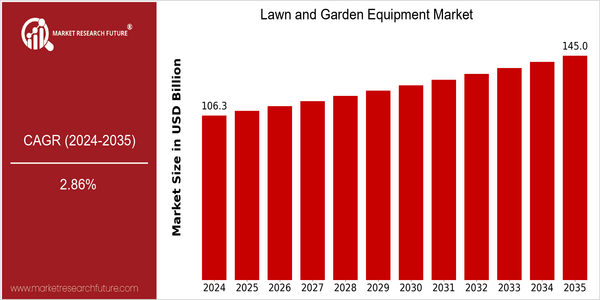
2024 USD 106.28 Billion
2035 USD 145.0 Billion
CAGR (2025-2035) 2.86 %

Note – Market size depicts the revenue generated over the financial year

The market for garden tools is growing at a good rate, and is expected to reach $ 146 billion by 2035. This growth represents a CAGR of 2.86% between 2025 and 2035. The market is growing due to several factors, such as the growing interest of consumers in gardening and gardening, due to the increased awareness of the environment and the benefits of greenery. Also, technological developments, such as the integration of smart technology in lawn mowers, improve the experience and efficiency of the end users, thus boosting market growth. The main players in the garden tools market, such as Husqvarna, John Deere and Toro, are investing in the development of new products and strategic alliances to gain a larger market share. Husqvarna, for example, has developed robot mowers to meet the increasing demand for automation in gardening. John Deere, on the other hand, with its focus on precision agriculture and its commitment to the environment, has been able to position itself well in a market where the green consciousness of consumers is growing. The above strategic initiatives illustrate the dynamic nature of the garden tools market, as companies adapt to the changing preferences and technological developments of consumers.
home-ubuntu-www-mrf_ne_design-batch-6-cp-lawn-and-garden-equipment-market size

Regional Market Size

Regional Deep Dive

The Garden and Lawn Equipment Market is experiencing a dynamic growth in the regions of the world, mainly due to the increasing interest of consumers in outdoor living, the sustainable development and the technological progress. In North America, the market is characterized by a strong self-help culture and a growing tendency towards electric and battery-powered equipment. In Europe, the focus is on eco-friendly products. The Asian-Pacific region is booming with the increasing urbanization and the rising incomes. The Middle East and Africa are investing in gardening and landscaping as the cities develop. In Latin America, the agricultural machinery, which is used both in commercial and in private gardens, is the main focus.

Europe

  • The European Union's Green Deal is promoting sustainable practices, leading to a surge in demand for electric lawn and garden equipment, with companies like Stiga and Bosch innovating in this space.
  • In the UK, the recent ban on petrol-powered garden equipment is driving consumers towards battery-operated alternatives, significantly impacting purchasing decisions and market dynamics.

Asia Pacific

  • Rapid urbanization in countries like China and India is leading to increased demand for compact and efficient lawn and garden equipment, with local manufacturers like STIHL and Honda expanding their product lines.
  • Government initiatives promoting urban greening and landscaping projects are creating new opportunities for market growth, particularly in metropolitan areas.

Latin America

  • The growing trend of urban gardening in cities like São Paulo and Buenos Aires is driving demand for compact gardening tools and equipment, with local startups emerging to meet this need.
  • Government programs aimed at promoting agricultural efficiency are encouraging the adoption of modern lawn and garden equipment, particularly in rural areas.

North America

  • The rise of smart gardening technologies, such as IoT-enabled lawn mowers and automated irrigation systems, is transforming the market landscape, with companies like Husqvarna leading the charge.
  • Regulatory changes in California aimed at reducing water usage are pushing consumers towards more efficient lawn care solutions, thereby increasing demand for drought-resistant landscaping equipment.

Middle East And Africa

  • The UAE's Vision 2021 initiative is encouraging investment in green spaces and landscaping, leading to increased demand for lawn and garden equipment in urban developments.
  • Sustainable gardening practices are gaining traction, with organizations like the African Green Revolution Forum promoting eco-friendly gardening solutions to combat desertification.

Did You Know?

“Did you know that the global lawn and garden equipment market is expected to see a significant shift towards electric and battery-operated tools, with projections indicating that these products could account for over 50% of the market by 2025?” — Market Research Future

Segmental Market Size

During the last few years, the garden and lawn equipment market has grown steadily, driven by an increased interest in the garden and lawn aesthetics and the sustainable gardening of the lawn. Post-pandemic, the trend towards gardening in private households is expected to increase. And meanwhile, the growing interest in electric tools and batteries, which are more environmentally friendly, also contributes to the growing interest in the market. At the present time, the market is in a mature phase of development, where companies such as Husqvarna and Toro lead in the development of new products, such as robot mowers and smart watering systems. The main applications are private gardens, commercial gardens and urban gardening. The main trends driving growth are sustainable development and the government's encouragement of eco-friendly practices. The evolution of the market is characterized by the use of IoT-enabled devices and AI-based analysis, which lead to more efficient resource management and better customer experiences.

Future Outlook

From 2024 to 2035, the market for lawn and garden equipment will grow steadily, from $105 billion to $145 billion, at a compound annual growth rate of 2.86%. This growth is based on a growing interest in outdoor living and the growing trend towards sustainable gardening. As urbanization continues, more and more households are buying lawn and garden equipment to beautify their outside areas, which will lead to a higher penetration of the market, so that about 60% of households will have some kind of lawn and garden equipment by 2035, up from 50% in 2024. Also, major technological innovations, such as the integration of smart technology and automation into lawn and garden equipment, will continue to drive the market. The market for robot lawn mowers and Internet of Things-enabled garden tools is growing steadily, as they appeal to tech-savvy consumers who value convenience and efficiency. Moreover, government policies promoting sustainable practices and the use of eco-friendly products will stimulate the market. As consumers become more concerned with the environment, the market will be dominated by electric and battery-powered equipment, which will account for more than 30% of total sales by 2035. Consequently, the lawn and garden equipment market is set to change significantly, driven by changes in consumer preferences, technological innovations and government support.

Lawn Garden Equipment Market Size Graph
Author
Snehal Singh
Assistant Manager - Research

High acumen in analyzing complex macro & micro markets with more than 6 years of work experience in the field of market research. By implementing her analytical skills in forecasting and estimation into market research reports, she has expertise in Packaging, Construction, and Equipment domains. She handles a team size of 20-25 resources and ensures smooth running of the projects, associated marketing activities, and client servicing.

Leave a Comment

FAQs

What is the projected market size of the Global Lawn and Garden Equipment Market in 2024?

The projected market size of the Global Lawn and Garden Equipment Market in 2024 is 106.28 billion USD.

What is the expected market size of the Global Lawn and Garden Equipment Market by 2035?

By 2035, the expected market size of the Global Lawn and Garden Equipment Market is 145.0 billion USD.

What is the estimated CAGR for the Global Lawn and Garden Equipment Market during the forecast period from 2025 to 2035?

The estimated CAGR for the Global Lawn and Garden Equipment Market from 2025 to 2035 is 2.86%.

Which region is expected to dominate the Global Lawn and Garden Equipment Market by 2035?

North America is expected to dominate the Global Lawn and Garden Equipment Market, with a projected value of 45.0 billion USD by 2035.

What will be the market size for Handheld Equipment in the Global Lawn and Garden Equipment Market by 2035?

The market size for Handheld Equipment is expected to reach 34.0 billion USD by 2035.

How much is the Power Tools segment expected to be valued at in 2035?

The Power Tools segment of the Global Lawn and Garden Equipment Market is projected to be valued at 36.0 billion USD by 2035.

What is the expected size of the Ride-On Equipment segment in 2035?

The Ride-On Equipment segment is expected to reach a size of 28.0 billion USD by 2035.

Which are the key players in the Global Lawn and Garden Equipment Market?

Key players in the Global Lawn and Garden Equipment Market include Toro Company, STIHL AG, Black & Decker, and John Deere.

What is the expected market size for the Walk-Behind Equipment segment by 2035?

The Walk-Behind Equipment segment is projected to be valued at 47.0 billion USD by 2035.

What will be the market size for the Asia Pacific region in 2035?

The Asia Pacific region is expected to have a market size of 30.0 billion USD by 2035.

Market Summary

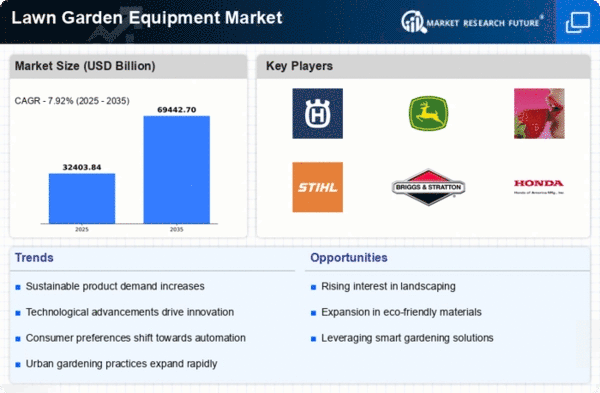
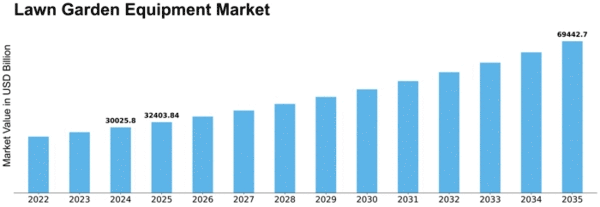
As per MRFR analysis, the Lawn Garden Equipment Market was estimated at 30025.8 USD Billion in 2024. The Lawn Garden Equipment industry is projected to grow from 32403.92 USD Billion in 2025 to 69442.7 USD Billion by 2035, exhibiting a compound annual growth rate (CAGR) of 7.92 during the forecast period 2025 - 2035.

Key Market Trends & Highlights

The Lawn Garden Equipment Market is experiencing a shift towards sustainability and technology integration.

  • The market is increasingly embracing sustainable practices, reflecting a growing consumer preference for eco-friendly gardening solutions.
  • Smart technology integration is becoming prevalent, enhancing user experience and operational efficiency in lawn care equipment.
  • Investment in outdoor living spaces is driving demand, particularly in North America, where homeowners prioritize landscaping and gardening.
  • Rising consumer interest in gardening and technological advancements in equipment are key drivers, particularly in the residential and commercial segments.

Market Size & Forecast

2024 Market Size 30025.8 (USD Billion)
2035 Market Size 69442.7 (USD Billion)
CAGR (2025 - 2035) 7.92%
Largest Regional Market Share in 2024 North America

Major Players

<p>Husqvarna (SE), John Deere (US), Toro (US), Stihl (DE), Briggs & Stratton (US), Honda (JP), Black & Decker (US), Echo (JP), Craftsman (US), Snapper (US)</p>

Market Trends

The Lawn Garden Equipment Market is currently experiencing a dynamic evolution, driven by various factors that influence consumer preferences and technological advancements. As environmental concerns gain prominence, there is a noticeable shift towards sustainable practices within the industry. This trend is reflected in the increasing demand for eco-friendly equipment, which not only minimizes environmental impact but also appeals to a growing segment of environmentally conscious consumers. Furthermore, the integration of smart technology into lawn and garden tools is reshaping the market landscape. Consumers are increasingly drawn to products that offer enhanced efficiency and convenience, such as robotic mowers and smart irrigation systems. In addition to technological innovations, the Lawn Garden Equipment Market is witnessing a rise in outdoor living trends. Homeowners are investing more in their outdoor spaces, leading to a surge in demand for landscaping tools and equipment. This trend is further fueled by the desire for personalized outdoor environments that reflect individual tastes and lifestyles. As the market continues to evolve, it appears poised for growth, with potential opportunities emerging from the intersection of sustainability, technology, and lifestyle preferences. The future landscape of the Lawn Garden Equipment Market may be characterized by a blend of traditional gardening practices and modern innovations, catering to a diverse range of consumer needs and aspirations.

Sustainable Practices

The Lawn Garden Equipment Market is increasingly influenced by a shift towards sustainability. Consumers are showing a preference for eco-friendly products that reduce environmental impact. This trend is prompting manufacturers to innovate and develop equipment that aligns with green practices, such as battery-powered tools and biodegradable materials.

Smart Technology Integration

The incorporation of smart technology into lawn and garden equipment is transforming consumer experiences. Products equipped with advanced features, such as automation and connectivity, are gaining traction. This trend reflects a growing demand for convenience and efficiency, appealing to tech-savvy consumers.

Outdoor Living Investment

There is a notable increase in consumer investment in outdoor living spaces. Homeowners are enhancing their gardens and yards, leading to a higher demand for landscaping tools and equipment. This trend indicates a shift in lifestyle preferences, as individuals seek to create personalized outdoor environments.

Lawn Garden Equipment Market Market Drivers

Sustainability Trends in Lawn Care

Sustainability trends are increasingly influencing the Lawn and Garden Equipment Market Industry. Consumers are becoming more environmentally conscious, leading to a demand for eco-friendly equipment and practices. This includes the use of electric powered lawn mower tools and organic gardening supplies, which align with sustainable living principles. As a result, manufacturers are adapting their product lines to meet these preferences, potentially increasing their market share. The shift towards sustainability may contribute to a compound annual growth rate of 2.86% from 2025 to 2035, as more consumers prioritize environmentally responsible choices in their gardening endeavors.

Urbanization and Landscaping Demand

Urbanization is a significant driver of the Lawn and Garden Equipment Industry. As cities expand, the demand for landscaping and outdoor beautification increases. Homeowners and municipalities alike invest in maintaining green spaces, which necessitates the use of various lawn and garden equipment, including cordless lawn mowers. This trend is particularly evident in densely populated urban areas where outdoor aesthetics are prioritized. The market's growth trajectory suggests that as urbanization continues, the demand for lawn and garden equipment, especially cordless lawn mowers, will follow suit, further solidifying its economic impact in the coming years.

Rising Consumer Interest in Gardening

The Lawn and Garden Equipment Industry experiences a notable surge in consumer interest in gardening activities. This trend is driven by a growing awareness of the benefits of gardening, including mental well-being and environmental sustainability. As more individuals engage in gardening, the demand for various equipment, such as lawnmowers, trimmers, and garden tools, increases. The market is projected to reach 106.3 USD Billion in 2024, reflecting this heightened consumer engagement. Furthermore, the trend suggests that as urban spaces evolve, more people are likely to invest in gardening, thereby further propelling the market's growth.

Technological Advancements in Equipment

Technological innovations play a crucial role in shaping the Lawn and Garden Equipment Industry. The introduction of smart gardening tools, such as robotic lawnmowers and automated irrigation systems, enhances user convenience and efficiency. These advancements not only improve the functionality of traditional equipment but also attract tech-savvy consumers. As the market adapts to these innovations, it is expected to grow significantly, with projections indicating a rise to 145 USD Billion by 2035. The integration of technology into gardening practices may lead to increased adoption rates, thereby driving overall market growth.

Increased Focus on Outdoor Living Spaces

The Lawn and Garden Equipment Industry is witnessing a shift towards enhancing outdoor living spaces. Homeowners are increasingly investing in their yards and gardens to create functional and aesthetically pleasing environments. This trend is driven by a desire for outdoor relaxation and entertainment areas, which in turn boosts the demand for landscaping tools and equipment. As the market evolves, it is likely to reflect this growing emphasis on outdoor living, contributing to its projected growth to 145 USD Billion by 2035. The focus on outdoor spaces may also lead to innovations in equipment design and functionality.

Market Segment Insights

By Application: Residential (Largest) vs. Commercial (Fastest-Growing)

<p>The Lawn Garden Equipment Market is segmented into four primary applications: Residential, Commercial, Agricultural, and Landscaping. Among these, the Residential segment holds a substantial market share, driven by the increasing trend of home gardening and landscaping by homeowners. This segment benefits from the growth of DIY gardening projects and the rising disposable income of consumers looking to enhance their outdoor spaces with various equipment such as mowers, trimmers, and tillers. Meanwhile, the Commercial segment, while smaller in share, is witnessing rapid growth due to increased landscaping services and the demand for maintenance in corporate settings, parks, and recreational areas.</p>

<p>Landscaping: Residential (Dominant) vs. Commercial (Emerging)</p>

<p>The Landscaping sector within the Lawn Garden Equipment Market is characterized by its diverse range of services and products designed to enhance outdoor aesthetics. The Residential application dominates this segment, driven by individual homeowners investing in high-quality lawn care and landscaping equipment to elevate their home environment. On the other hand, the Commercial segment is emerging rapidly, fueled by professional landscaping services that cater to businesses and public spaces. This includes an array of tools engineered for efficiency and performance, addressing the needs of landscape professionals who require reliable, robust equipment to handle larger projects. The interplay between these segment values showcases a dynamic market that balances personal investment with professional demand.</p>

By Product Type: Lawn Mowers (Largest) vs. Trimmers (Fastest-Growing)

<p>In the Lawn Garden Equipment Market, the product type segment exhibits a varied distribution of market shares. Lawn mowers command the largest share, driven by their necessity in maintaining lawns across residential and commercial properties. Trimmers, while smaller in share, are rapidly gaining traction, appealing to consumers who seek efficient lawn maintenance solutions for edges and hard-to-reach areas. Blowers and edgers hold more niche roles but contribute to the overall dynamics of the market by enhancing garden aesthetics and cleanup efficiency. The growth trends within this segment are increasingly influenced by technological advancements and eco-friendly developments. For instance, the shift towards electric and battery-operated lawn mowers and trimmers is gaining momentum, aligning with environmental sustainability goals. Consumers' preferences are evolving, favoring products with lower emissions and noise levels. Additionally, the rise in residential gardening activities, spurred by trends in home improvement and landscaping access, fuels the expansion of both lawn mowers and trimmers in the market.</p>

<p>Lawn Mowers (Dominant) vs. Trimmers (Emerging)</p>

<p>Lawn mowers are the dominant product type in the Lawn Garden Equipment Market, recognized as essential tools for lawn maintenance. Their stronghold stems from consistent demand across various end-users, including homeowners, landscapers, and commercial services. Innovations in mowers, such as robotic models and those equipped with smart technology, are enhancing their appeal. On the other hand, trimmers are considered an emerging segment, increasingly popular due to their role in precision landscaping. They complement lawn mowers by allowing users to achieve a polished finish around obstacles. The growth of battery-powered options is making trimmers more attractive due to their portability and ease of use, thus expanding their market reach.</p>

By Power Source: Electric (Largest) vs. Battery (Fastest-Growing)

<p>In the Lawn Garden Equipment Market, the power source segment is characterized by a diverse distribution among electric, gasoline, battery, and manual options. Electric power sources currently dominate the market due to their efficiency and minimal environmental impact. Battery-powered equipment is emerging swiftly, attracting consumers looking for convenience and portability, while gasoline remains a strong player for higher power needs. Manual tools, although less prevalent, still hold niche markets, particularly among traditional gardeners and eco-conscious users.</p>

<p>Electric (Dominant) vs. Battery (Emerging)</p>

<p>Electric power sources in lawn garden equipment are becoming the dominant choice due to their ease of use, lower emissions, and availability of efficient technology. They are preferred by residential users and professionals seeking reliable performance without the noise and pollution associated with gasoline models. In contrast, battery-powered equipment is gaining momentum as battery technology improves, leading to longer run times and faster charge capabilities. Consumers are increasingly attracted to the versatility and convenience that battery-powered tools offer, making them a compelling choice for those who prioritize portability and lower maintenance.</p>

By End User: Homeowners (Largest) vs. Professional Landscapers (Fastest-Growing)

<p>In the Lawn Garden Equipment Market, homeowners constitute the largest segment, holding a significant share driven by the increasing interest in residential outdoor spaces. This segment has benefitted from DIY trends and a heightened focus on home improvement projects, resulting in a strong demand for lawn and garden equipment. Professional landscapers, on the other hand, represent the fastest-growing segment. Their need for specialized tools and reliable equipment has surged due to the rising popularity of landscaping services, especially among urban dwellers seeking beautification of their surroundings.</p>

<p>Homeowners (Dominant) vs. Professional Landscapers (Emerging)</p>

<p>Homeowners remain the dominant force in the Lawn Garden Equipment Market, characterized by their varied needs ranging from basic lawn maintenance to elaborate gardening projects. This segment is typically driven by personal enjoyment and investment in outdoor aesthetics, with a focus on user-friendly tools that cater to all skill levels. In contrast, professional landscapers are emerging as a key segment, requiring advanced, durable equipment to handle larger projects efficiently. Their demand is fueled by an expanding client base, emphasizing quality and reliability, as they provide tailored services in landscaping and garden care.</p>

Get more detailed insights about Lawn and Garden Equipment Market Research Report - Global Forecast till 2035

Regional Insights

North America : Market Leader in Lawn Equipment

North America continues to lead the Lawn Garden Equipment market, holding a significant share of 15000.0. The growth is driven by increasing consumer interest in landscaping and gardening, alongside a rise in disposable income. Regulatory support for eco-friendly equipment is also a catalyst for market expansion, as consumers seek sustainable options. The region's robust distribution networks further enhance accessibility to a variety of products. The competitive landscape is characterized by major players such as John Deere, Husqvarna, and Toro, which dominate the market with innovative products and strong brand loyalty. The U.S. remains the largest market, driven by a high demand for both residential and commercial lawn care solutions. The presence of established companies ensures a diverse range of offerings, catering to various consumer needs and preferences.

Key Players and Competitive Insights

The Lawn Garden Equipment Market is currently characterized by a dynamic competitive landscape, driven by innovation, sustainability, and technological advancements. Key players such as Husqvarna (SE), John Deere (US), and Stihl (DE) are at the forefront, each adopting distinct strategies to enhance their market positioning. Husqvarna (SE) emphasizes digital transformation, integrating smart technology into its product lines, which not only improves user experience but also aligns with the growing consumer demand for smart gardening solutions. Meanwhile, John Deere (US) focuses on regional expansion, particularly in emerging markets, leveraging its strong brand reputation to capture new customer segments. Stihl (DE), on the other hand, is heavily investing in sustainability initiatives, aiming to reduce its carbon footprint and appeal to environmentally conscious consumers. Collectively, these strategies contribute to a competitive environment that is increasingly focused on innovation and sustainability.

In terms of business tactics, companies are localizing manufacturing to enhance supply chain efficiency and reduce costs. This approach is particularly evident in the moderately fragmented market structure, where several key players coexist, each vying for market share. The collective influence of these companies shapes a competitive landscape that is both challenging and ripe with opportunities for growth, as they adapt to changing consumer preferences and market demands.

In November 2025, Husqvarna (SE) announced the launch of its new line of robotic lawn mowers, which utilize advanced AI technology to optimize mowing patterns and energy efficiency. This strategic move not only reinforces Husqvarna's commitment to innovation but also positions the company as a leader in the smart gardening segment. The introduction of these products is likely to attract tech-savvy consumers looking for convenience and efficiency in lawn care.

In October 2025, John Deere (US) completed the acquisition of a regional landscaping equipment manufacturer, which is expected to enhance its product offerings and expand its distribution network. This acquisition reflects John Deere's strategy to strengthen its foothold in the landscaping sector, allowing it to provide a more comprehensive range of solutions to its customers. The integration of this new entity is anticipated to bolster John Deere's competitive edge in the market.

In September 2025, Stihl (DE) launched a new initiative aimed at promoting sustainable gardening practices among consumers. This program includes educational resources and tools designed to encourage eco-friendly gardening techniques. By positioning itself as a champion of sustainability, Stihl not only enhances its brand image but also aligns with the increasing consumer demand for environmentally responsible products. This initiative is likely to resonate well with a growing segment of the market that prioritizes sustainability in their purchasing decisions.

As of December 2025, the Lawn Garden Equipment Market is witnessing a shift towards digitalization, sustainability, and AI integration, which are defining current competitive trends. Strategic alliances among key players are increasingly shaping the landscape, fostering innovation and collaboration. Looking ahead, competitive differentiation is expected to evolve, with a notable shift from price-based competition to a focus on innovation, technology, and supply chain reliability. Companies that can effectively leverage these trends will likely secure a competitive advantage in this rapidly changing market.

Key Companies in the Lawn Garden Equipment Market include

Industry Developments

  • Q2 2024: Lawn and Garden Category Sees Growth With Lawn Mower Segment Zero-turn lawn mowers accounted for 28% of the lawn mower category in 2024, with sales growing 21% year over year, reflecting a significant product segment expansion and increased consumer adoption among independent retailers.

Future Outlook

Lawn Garden Equipment Market Future Outlook

<p>The Lawn Garden Equipment Market is projected to grow at a 7.92% CAGR from 2024 to 2035, driven by technological advancements, increasing consumer interest in gardening, and sustainability trends.</p>

New opportunities lie in:

  • <p>Development of smart lawn care technologies for precision gardening.</p>
  • <p>Expansion into eco-friendly equipment targeting environmentally conscious consumers.</p>
  • <p>Partnerships with landscaping services for bundled equipment rental solutions.</p>

<p>By 2035, the market is expected to achieve robust growth, reflecting evolving consumer preferences and technological innovations.</p>

Market Segmentation

Lawn Garden Equipment Market End User Outlook

  • Homeowners
  • Professional Landscapers
  • Gardeners
  • Contractors

Lawn Garden Equipment Market Application Outlook

  • Residential
  • Commercial
  • Agricultural
  • Landscaping

Lawn Garden Equipment Market Power Source Outlook

  • Electric
  • Gasoline
  • Battery
  • Manual

Lawn Garden Equipment Market Product Type Outlook

  • Lawn Mowers
  • Trimmers
  • Blowers
  • Edgers

Report Scope

MARKET SIZE 202430025.8(USD Billion)
MARKET SIZE 202532403.92(USD Billion)
MARKET SIZE 203569442.7(USD Billion)
COMPOUND ANNUAL GROWTH RATE (CAGR)7.92% (2024 - 2035)
REPORT COVERAGERevenue Forecast, Competitive Landscape, Growth Factors, and Trends
BASE YEAR2024
Market Forecast Period2025 - 2035
Historical Data2019 - 2024
Market Forecast UnitsUSD Billion
Key Companies ProfiledHusqvarna (SE), John Deere (US), Toro (US), Stihl (DE), Briggs & Stratton (US), Honda (JP), Black & Decker (US), Echo (JP), Craftsman (US), Snapper (US)
Segments CoveredApplication, Product Type, Power Source, End User
Key Market OpportunitiesIntegration of smart technology in Lawn Garden Equipment enhances user experience and operational efficiency.
Key Market DynamicsRising consumer preference for eco-friendly lawn garden equipment drives innovation and competition among manufacturers.
Countries CoveredNorth America, Europe, APAC, South America, MEA

FAQs

What is the projected market size of the Global Lawn and Garden Equipment Market in 2024?

The projected market size of the Global Lawn and Garden Equipment Market in 2024 is 106.28 billion USD.

What is the expected market size of the Global Lawn and Garden Equipment Market by 2035?

By 2035, the expected market size of the Global Lawn and Garden Equipment Market is 145.0 billion USD.

What is the estimated CAGR for the Global Lawn and Garden Equipment Market during the forecast period from 2025 to 2035?

The estimated CAGR for the Global Lawn and Garden Equipment Market from 2025 to 2035 is 2.86%.

Which region is expected to dominate the Global Lawn and Garden Equipment Market by 2035?

North America is expected to dominate the Global Lawn and Garden Equipment Market, with a projected value of 45.0 billion USD by 2035.

What will be the market size for Handheld Equipment in the Global Lawn and Garden Equipment Market by 2035?

The market size for Handheld Equipment is expected to reach 34.0 billion USD by 2035.

How much is the Power Tools segment expected to be valued at in 2035?

The Power Tools segment of the Global Lawn and Garden Equipment Market is projected to be valued at 36.0 billion USD by 2035.

What is the expected size of the Ride-On Equipment segment in 2035?

The Ride-On Equipment segment is expected to reach a size of 28.0 billion USD by 2035.

Which are the key players in the Global Lawn and Garden Equipment Market?

Key players in the Global Lawn and Garden Equipment Market include Toro Company, STIHL AG, Black &amp; Decker, and John Deere.

What is the expected market size for the Walk-Behind Equipment segment by 2035?

The Walk-Behind Equipment segment is projected to be valued at 47.0 billion USD by 2035.

What will be the market size for the Asia Pacific region in 2035?

The Asia Pacific region is expected to have a market size of 30.0 billion USD by 2035.

  1. SECTION I: EXECUTIVE SUMMARY AND KEY HIGHLIGHTS
    1. | 1.1 EXECUTIVE SUMMARY
  2. SECTION II: SCOPING, METHODOLOGY AND MARKET STRUCTURE
    1. | 2.1 MARKET INTRODUCTION
    2. | 2.2 RESEARCH METHODOLOGY
  3. SECTION III: QUALITATIVE ANALYSIS
    1. | 3.1 MARKET DYNAMICS
    2. | 3.2 MARKET FACTOR ANALYSIS
  4. SECTION IV: QUANTITATIVE ANALYSIS
    1. | 4.1 Life Sciences, BY Application (USD Billion)
    2. | 4.2 Life Sciences, BY Product Type (USD Billion)
    3. | 4.3 Life Sciences, BY Power Source (USD Billion)
    4. | 4.4 Life Sciences, BY End User (USD Billion)
    5. | 4.5 Life Sciences, BY Region (USD Billion)
  5. SECTION V: COMPETITIVE ANALYSIS
    1. | 5.1 Competitive Landscape
    2. | 5.2 Company Profiles
    3. | 5.3 Appendix

Lawn and Garden Equipment Market Segmentation

Market Segmentation Overview

  • Detailed segmentation data will be available in the full report
  • Comprehensive analysis by multiple parameters
  • Regional and country-level breakdowns
  • Market size forecasts by segment
Infographic

Free Sample Request

Kindly complete the form below to receive a free sample of this Report

Get Free Sample

Customer Strories

Compare Licence

×
Features License Type
Single User Multiuser License Enterprise User
Price $4,950 $5,950 $7,250
Maximum User Access Limit 1 User Upto 10 Users Unrestricted Access Throughout the Organization
Free Customization
Direct Access to Analyst
Deliverable Format
Platform Access
Discount on Next Purchase 10% 15% 15%
Printable Versions