Law Enforcement Software Market

Law Enforcement Software Size, Share and Trends Analysis Report: By Component (Solution, Services), Deployment (On-Premise, Cloud), Solution (CAD, Jail Management, Incident Response, Digital Policing), Services (Implementation, Training and Support)— Forecast till 2035
ID: MRFR/ICT/4979-HCR
100 Pages
Ankit Gupta
Last Updated: June 04, 2026

Law Enforcement Software Market Summary

The Law Enforcement Software Market stood at an estimated USD 21.17 Billion in 2025, with the forecast period opening at USD 22.89 Billion in 2026 and climbing to USD 47.82 Billion by 2035 at an 8.72% CAGR. Persistent staffing shortages across police departments — the Police Executive Research Forum recorded a 65% increase in resignation rates since 2020 — have made automation of dispatch, records, and digital evidence management a budget priority rather than a discretionary upgrade [2]. Federal catalysts such as the Edward Byrne Memorial Justice Assistance Grant, which earmarked roughly USD 450 million for public safety technology improvements in 2025, are compressing procurement cycles and opening the law enforcement analytics pipeline for mid-sized agencies that previously relied on paper-based workflows [1].

Legacy client-server architectures built in the early 2000s are giving way to cloud-native platforms that unify crime investigation software, computer-aided dispatch, and body-worn-camera ingestion into a single evidence chain. The U.S. Department of Justice allocated over USD 280 million in 2024 toward CJIS-compliant cloud migration grants, signaling that on-premise holdouts face growing regulatory and interoperability pressure to modernize [3]. This shift is accelerating demand for police records management suites capable of real-time data sharing across jurisdictions.

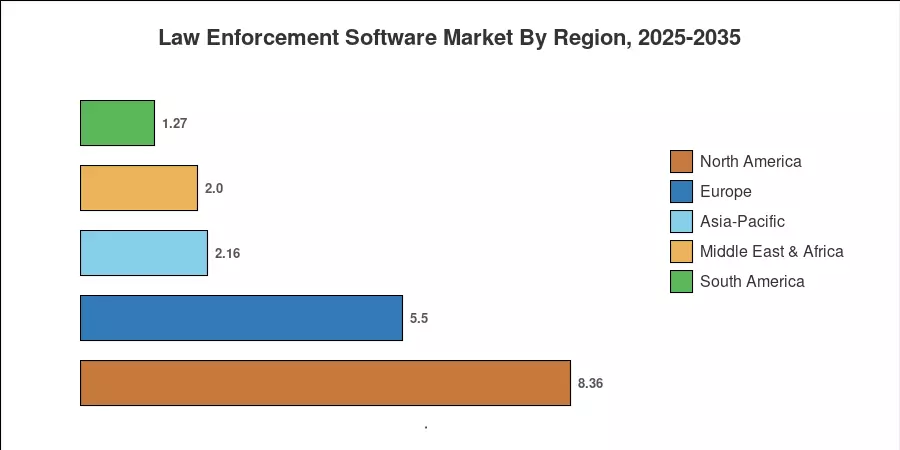
North America commands approximately 39.5% of the Law Enforcement Software Market, anchored by the United States' massive installed base and federal grant infrastructure Asia-Pacific is the fastest-growing region, projected at a 10.18% CAGR through 2035, driven by India's Safe City Programme and China's Xueliang (Sharp Eyes) surveillance expansion [4]. Europe holds the second-largest share at roughly 26%, where EU data-sovereignty mandates are reshaping vendor hosting strategies. The next decade will reward public safety software tools providers that balance analytics depth with strict compliance frameworks.

Key Report Takeaways

• By Solution

  • Computer-aided dispatch platforms captured a leading 26.2% revenue share of the Law Enforcement Software Market in 2025, reflecting the mission-critical nature of real-time call routing and officer allocation
  • Predictive and crime analytics solutions are on track for a 10.22% CAGR through 2035, as agencies invest in law enforcement analytics to pre-empt crime hotspots
  • Digital evidence management platforms reached USD 3.78 Billion in 2025, fueled by body-camera mandates and rising video data volumes

• By Deployment & Component

  • On-premise deployment held 62.4% of the Law Enforcement Software Market in 2025, though cloud adoption is accelerating rapidly
  • Cloud deployment is pacing an 11.07% CAGR to 2035 as CJIS Security Policy updates enable FedRAMP-authorized hosting
  • Software accounted for 75.3% of component revenue, while managed services are growing at a 9.85% CAGR

• By End User & Geography

  • Municipal and local agencies represented 49.1% of demand in the Law Enforcement Software Market, reflecting the sheer number of sub-federal departments
  • Federal and national police agencies are the fastest-growing end-user cohort at a 10.82% CAGR
  • Asia-Pacific's 10.18% CAGR outpaces all other regions, with North America maintaining the largest absolute revenue base

Market Size and Forecast (2021–2035)

MRFR's proprietary estimation framework combines bottom-up vendor revenue modeling with top-down macroeconomic benchmarking. Historical data (2021–2024) draws on agency procurement disclosures, vendor annual filings, and freedom-of-information requests. Forecast values (2026–2035) apply a calibrated CAGR anchored to grant funding trajectories, cloud migration timelines, and demographic policing demand curves.
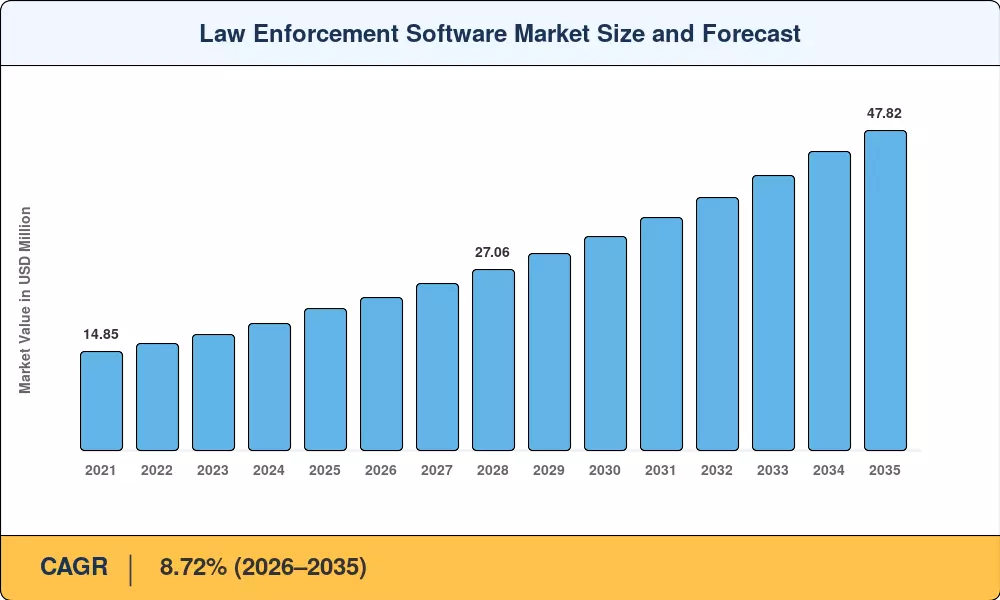
Law Enforcement Software Market Size and Forecast
Our Impact
Enabled $4.3B Revenue Impact for Fortune 500 and Leading Multinationals
Partnering with 2000+ Global Organizations Each Year
30K+ Citations by Top-Tier Firms in the Industry
 

Driver Impact Analysis

Driver ~% Impact on CAGR Geographic Relevance Impact Timeline
Federal & state grant funding cycles 18–22% North America Short-term (≤2 yr)
Cloud-first mandates & CJIS modernization 15–19% North America, Europe Medium-term (2–4 yr)
AI-driven law enforcement analytics adoption 14–17% Global Medium-term (2–4 yr)
Body-worn camera & digital evidence management integration 12–15% North America, Europe Short-term (≤2 yr)
Smart city & Safe City Programme expansion 10–13% Asia-Pacific, MEA Long-term (≥4 yr)
Staffing shortages driving automation 9–12% Global Short-term (≤2 yr)
Cross-border data sharing frameworks 6–8% Europe, Asia-Pacific Long-term (≥4 yr)


Federal Grant Funding and Procurement Acceleration

The Edward Byrne Memorial Justice Assistance Grant program allocated approximately USD 96.4 million million in FY2025 specifically for law enforcement technology upgrades, with an additional USD 190 million flowing through the Community Oriented Policing Services (COPS) technology grants [1]. These combined funding streams have compressed average procurement timelines from 18 months to under 10 months for police records management system replacements. Agencies receiving Byrne JAG funding must demonstrate technology interoperability, which effectively mandates adoption of modern public safety software tools with open API architectures. This funding engine disproportionately benefits the Law Enforcement Software Market in North America, where roughly 18,000 state and local agencies qualify.

Cloud Migration and CJIS Compliance Modernization

The FBI's Criminal Justice Information Services division updated its Security Policy in 2024 to formally recognize FedRAMP-authorized cloud environments as compliant hosting platforms for criminal justice data [3]. This policy shift unlocked a wave of cloud migration projects — the International Association of Chiefs of Police reported that 42% of departments initiated cloud transition plans within six months of the update [5]. Cloud deployment slashes infrastructure costs by an estimated 30–40% over five-year cycles and enables real-time crime investigation software capabilities that on-premise systems cannot match. For the Law Enforcement Software Market, this transition represents a structural growth driver through at least 2030.

AI-Powered Predictive Analytics and Real-Time Crime Centers

Real-time crime centers (RTCCs) now operate in over 120 U.S. cities, up from 35 in 2019, integrating license-plate readers, gunshot-detection sensors, and law enforcement analytics dashboards into unified command environments [8]. The National Institute of Justice funded USD 85 million in AI-related policing research during 2023–2025, accelerating development of predictive deployment algorithms that have demonstrated 15–20% improvements in response-time optimization during pilot programs in Chicago and Los Angeles [6]. These capabilities are expanding the addressable scope of crime investigation software well beyond traditional records management.

Body-Worn Camera Ecosystem Expansion

Over 60% of U.S. law enforcement agencies with 500+ officers now mandate body-worn cameras, generating an estimated 2.5 petabytes of video evidence annually [10]. This data deluge has created acute demand for digital evidence management platforms capable of automated redaction, chain-of-custody tracking, and AI-powered tagging. Axon's Evidence.com platform alone processes over 30 million uploads per month. European agencies are following suit — the UK Home Office committed GBP 8.3 million in 2024 to expand body-camera programs to all 43 territorial police forces [15].

Restraints Impact Analysis

Restraint impact percentages are directional indicators representing headwinds to adoption velocity. They do not offset the CAGR on a one-to-one basis and should be read as relative drag assessments.

Restraint ~% Drag on CAGR Geographic Relevance Impact Timeline
Data privacy & civil-liberties litigation –8 to –11% North America, Europe Medium-term
Budget constraints in small/rural agencies –7 to –10% Global Long-term
Legacy system integration complexity –6 to –9% Global Short-term
Vendor lock-in & interoperability gaps –5 to –7% North America Medium-term
Cybersecurity vulnerability exposure –4 to –6% Global Long-term


Data Privacy Litigation and Algorithmic Accountability

Predictive policing tools face mounting legal challenges — over 30 U.S. cities enacted restrictions or outright bans on facial-recognition technology between 2020 and 2025, and the EU's AI Act classifies most law enforcement analytics applications as "high risk," triggering mandatory conformity assessments [16]. These regulatory headwinds add 12–18 months to procurement cycles for crime investigation software that incorporates biometric or predictive components. San Francisco's 2019 ban, later partially relaxed in 2024, illustrates the policy volatility that vendors must price into product roadmaps.

Budget Constraints Among Small and Rural Departments

Approximately 75% of U.S. law enforcement agencies employ fewer than 25 sworn officers and operate on annual technology budgets below USD 50,000 [2]. These departments often lack the IT staff to manage police records management migrations and cannot meet the co-funding requirements of federal grants. The resulting digital divide means that advanced public safety software tools remain concentrated in large urban departments, limiting the Law Enforcement Software Market's addressable base in rural corridors.

Legacy System Integration and Data Migration Risk

Many agencies still run COBOL-based records management systems dating to the 1990s, and migrating decades of case files, warrant records, and evidence logs to modern platforms carries significant data-integrity risk [7]. The National Law Enforcement Telecommunications System reported that 28% of data-migration projects experience at least one critical integrity failure during transition, creating reluctance among risk-averse police IT leaders.

Law Enforcement Software Market Opportunities

SaaS and Subscription-Based Licensing for Mid-Tier Agencies

The move from perpetual license to subscription-based SaaS models is creating opportunities for the Law Enforcement Software Market to be accessible to organizations that previously had the budget for enterprise systems. Monthly per-officer price, typically $35–75 per seat, makes police records management systems available to the 12,000+ U.S. departments with fewer than 50 officers, avoiding major capital outlays and linking costs to real manpower


AI-Powered Digital Evidence Management and Automated Redaction

It is predicted that the volume of body-camera footage is doubling every 18 months and that manual video examination now takes 22% of detective labor hours [10]. Automated redaction and AI-assisted tagging technologies can shorten review times by as much as 70%, establishing a high-ROI value proposition for digital evidence management companies. This prospect extends beyond cameras to drone footage, in-car devices and interview recordings


Emerging Market Smart City and Safe City Programs

In India, the Safe City Programme has allocated INR 2,900 crore (about USD 345 million) for integrated command-and-control centres in eight metropolitan cities, which will require end-to-end criminal investigation software and law enforcement analytics platforms [4]. The NEOM project in Saudi Arabia and the Johannesburg metropolitan effort in South Africa are analogous programs that represent greenfield deployment potential for the Law Enforcement Software Market


Cross-Jurisdictional Data-Sharing Platforms

Today, the U.S. National Data Exchange (N-DEx) connects approximately 7800 agencies; there are still interoperability gaps with state-level systems [11]. Fast-growing is the niche for integration services that vendors can capitalize on by providing middleware to tie together N-DEx, regional fusion centers and local police records management systems. The EU’s Prüm II regulation, which mandates member states to cross-border sharing of biometric data by 2027, presents a similar European potential


Data Monetization Through Anonymized Crime Analytics

Aggregated, anonymized crime-pattern data holds commercial value for insurance underwriters, urban planners, and real-estate developers. Vendors offering law enforcement analytics platforms can generate ancillary revenue streams by packaging trend insights — provided they navigate privacy frameworks carefully. The global crime-data-as-a-service niche is estimated to reach USD 1.2 Billion by 2030.

Law Enforcement Software Market Future Outlook

AI-Augmented Policing and Autonomous Decision Support

Generative AI will reshape crime investigation software by enabling natural-language querying of case databases, automated report drafting, and pattern recognition across disparate data sources. The National Institute of Standards and Technology's AI Risk Management Framework, updated in 2025, provides the compliance scaffolding agencies need to adopt these tools without triggering civil-liberties challenges [6]. By 2030, an estimated 40% of investigative labor hours in Tier-1 agencies will involve AI-assisted workflows.

Platform Consolidation and Vendor Ecosystem Economics

The Law Enforcement Software Market is shifting from best-of-breed point solutions toward integrated platform suites that combine dispatch, records, evidence, and law enforcement analytics on a single data layer. Vendors pursuing platform strategies are acquiring niche providers at a rapid clip — over 35 M&A transactions occurred in the public safety software tools space during 2023–2025 [17]. This consolidation rewards scale players and compresses margins for standalone crime investigation software vendors.

Edge Computing and 5G-Enabled Field Operations

The rollout of 5G networks enables real-time video streaming, augmented-reality crime-scene overlays, and edge-processed digital evidence management directly from body cameras and patrol vehicles [9]. The U.S. Department of Defense's FirstNet Authority expanded its public safety broadband coverage to 99.7% of the U.S. population by 2025, providing the connectivity backbone for next-generation police records management applications that operate in disconnected-intermittent-limited (DIL) environments.

ESG, Transparency, and Algorithmic Accountability Reporting

Public pressure for police accountability is driving demand for transparency dashboards, use-of-force analytics, and algorithmic audit trails within the Law Enforcement Software Market [16]. The International Association of Chiefs of Police published its first Algorithmic Accountability Standard in 2024, and agencies seeking federal accreditation will increasingly require public safety software tools that embed audit logging and bias-detection modules. This ESG dimension will differentiate vendors through 2035.


Law Enforcement Software Market Segmentation

By Solution

Segment Key Metric Primary Demand Driver
Records Management Systems USD 4.12 Billion (2025) Federal interoperability mandates
Computer-Aided Dispatch 26.2% share (2025) Mission-critical dispatch operations
Jail Management 7.15% CAGR (2026–2035) Incarceration facility modernization
Evidence Management USD 3.78 Billion (2025) Body-camera data volumes
GIS/Mapping 8.28% CAGR (2026–2035) Real-time crime center expansion
Predictive & Crime Analytics 10.22% CAGR (2026–2035) AI and machine-learning adoption


Computer-aided dispatch platforms anchor the Law Enforcement Software Market's solution landscape because every patrol deployment, emergency response, and resource allocation flows through dispatch infrastructure. These platforms are evolving from simple call-routing systems into intelligent decision engines that factor in historical crime investigation software data, traffic patterns, and officer availability to optimize response times.

Predictive and crime analytics represent the fastest-growing solution category, as agencies deploy law enforcement analytics engines to identify emerging crime hotspots before incidents occur. Digital evidence management is the second-largest growth segment, propelled by the exponential increase in body-camera, drone, and surveillance footage requiring chain-of-custody compliance.

By Deployment Mode

Segment Key Metric Primary Demand Driver
On-Premise 62.4% share (2025) CJIS data residency requirements
Cloud 11.07% CAGR (2026–2035) FedRAMP authorization expansion
Hybrid USD 2.45 Billion (2025) Transition-period flexibility


On-premise deployment still dominates the Law Enforcement Software Market due to longstanding CJIS Security Policy requirements that historically mandated local data control. Cloud deployment is eroding that dominance rapidly — FedRAMP authorization of public safety software tools vendors jumped from 12 to 31 certified providers between 2022 and 2025 [3]. Hybrid architectures serve as a bridge, allowing agencies to keep sensitive police records management data on local servers while pushing analytics workloads to the cloud.

By Component

Segment Key Metric Primary Demand Driver
Software 75.3% share (2025) License and subscription revenue
Services (Managed) 9.85% CAGR (2026–2035) Outsourced IT for small agencies
Services (Professional) USD 2.89 Billion (2025) Implementation and integration


Software remains the revenue engine of the Law Enforcement Software Market, though the shift from perpetual licenses to SaaS subscriptions is reshaping revenue recognition patterns. Managed services are the fastest-growing component as resource-constrained agencies outsource system administration, patching, and digital evidence management hosting to specialized providers.

By End-User Agency

Segment Key Metric Primary Demand Driver
Municipal & Local Agencies 49.1% share (2025) Volume of sub-federal departments
State Agencies USD 4.38 Billion (2025) Statewide RMS consolidation
Federal & National Police 10.82% CAGR (2026–2035) Counter-terrorism and border security
Correctional Facilities 7.45% CAGR (2026–2035) Jail management system upgrades


Municipal and local agencies dominate the Law Enforcement Software Market by volume, though their per-agency spend is significantly lower than that of federal buyers. Federal and national police agencies represent the fastest-growing end-user segment, driven by counter-terrorism mandates and cross-border crime investigation software requirements that demand advanced law enforcement analytics capabilities.

Regional Market Share Analysis

Region Key Metric Primary Investment Themes
North America 39.5% of 2025 revenue Federal grants, CJIS cloud migration, RTCC expansion
Europe 26.0% of 2025 revenue EU AI Act compliance, Prüm II data sharing, GDPR
Asia-Pacific 10.18% CAGR (2026–2035) Safe City programs, surveillance integration, 5G
South America USD 1.27 Billion in 2025 Urban security investment, organized crime response
Middle East & Africa 9.45% CAGR (2026–2035) Smart city mega-projects, border security
Total USD 21.17 Billion (2025)

The Law Enforcement Software Market exhibits pronounced regional variation shaped by grant funding structures, data-sovereignty regulations, and policing model differences. North America dominates in absolute spend, while Asia-Pacific leads in growth velocity as public safety software tools penetrate rapidly modernizing security infrastructures.


North America

Country Key Metric Key Driver
United States 82.3% of regional revenue Byrne JAG and COPS grants [1]
Canada 10.52% CAGR (2026–2035) RCMP digital transformation [19]
Mexico USD 0.48 Billion (2025) National Guard modernization [20]


The United States accounts for the vast majority of North American spending on the Law Enforcement Software Market, with over 18,000 agencies representing one of the world's most fragmented policing structures. Canada's Royal Canadian Mounted Police launched a CAD 240 million digital transformation roadmap in 2024, driving demand for crime investigation software and integrated digital evidence management across provincial forces [19].

Europe

Country Key Metric Key Driver
Germany 23.5% of regional revenue Polizei 2020 digitization program [15]
United Kingdom 8.85% CAGR (2026–2035) Home Office body-camera mandates [15]
France USD 0.97 Billion (2025) Gendarmerie NEO platform [21]
Italy 7.92% CAGR (2026–2035) Carabinieri smart operations centers
Spain USD 0.41 Billion (2025) National Police CNP digital upgrade
Nordic Countries 9.15% CAGR (2026–2035) Cross-border Nordic Police cooperation
Russia USD 0.52 Billion (2025) Domestic vendor substitution mandates
Rest of Europe 7.68% CAGR (2026–2035) EU Structural Fund allocations


Europe's Law Enforcement Software Market is shaped by the dual pressures of GDPR compliance and the forthcoming AI Act, which classifies most law enforcement analytics applications as high-risk AI systems requiring third-party conformity assessment [16]. Germany's Polizei 2020 initiative, consolidating 16 state-level police IT systems into a unified federal architecture, represents one of Europe's largest single public safety software tools procurement programs.

Asia-Pacific

Country Key Metric Key Driver
China 34.8% of regional revenue Sharp Eyes surveillance integration [4]
India 11.35% CAGR (2026–2035) Safe City Programme rollout [4]
Japan USD 0.62 Billion (2025) National Police Agency digital plan
South Korea 10.45% CAGR (2026–2035) Smart policing R&D investment
ASEAN USD 0.71 Billion (2025) INTERPOL-ASEAN cybercrime center
Rest of Asia-Pacific 9.72% CAGR (2026–2035) Urban security infrastructure build-out


Asia-Pacific represents the fastest-growing corridor for the Law Enforcement Software Market, driven by China's massive surveillance infrastructure and India's ambitious Safe City Programme spanning eight metropolitan regions. Digital evidence management adoption is accelerating as body-camera deployment expands across Indian state police forces, with Telangana and Uttar Pradesh leading pilot programs [4].

South America

Country Key Metric Key Driver
Brazil 58.2% of regional revenue SUSP integrated public safety system [22]
Argentina 8.92% CAGR (2026–2035) Buenos Aires smart city initiative
Rest of South America USD 0.24 Billion (2025) Inter-American Development Bank grants


Brazil's Sistema Único de Segurança Pública (SUSP) framework is driving police records management consolidation across 27 states, creating procurement opportunities for vendors capable of Portuguese-language localization and integration with the country's existing INFOSEG criminal database [22].

Middle East & Africa

Country Key Metric Key Driver
Saudi Arabia 31.4% of regional revenue NEOM and Vision 2030 security spend [23]
UAE 10.72% CAGR (2026–2035) Dubai Police AI strategy [23]
South Africa USD 0.19 Billion (2025) SAPS Technology Modernization Programme
Egypt 9.38% CAGR (2026–2035) New Administrative Capital security build
Rest of MEA USD 0.31 Billion (2025) African Union ACSRT digital framework


The Middle East & Africa region's Law Enforcement Software Market is anchored by Gulf Cooperation Council states investing heavily in AI-driven policing. Dubai Police operate one of the world's most advanced real-time crime centers, integrating crime investigation software with autonomous patrol robots and predictive deployment algorithms [23].


Law Enforcement Software Market By Region, 2025-2035
 

Competitive Benchmarking

The Law Enforcement Software Market exhibits medium concentration, with the top five vendors capturing an estimated 38–44% of global revenue. The competitive field includes both pure-play public safety software tools specialists and diversified defense/IT conglomerates. The Herfindahl-Hirschman Index sits in the 800–1,100 range, indicating a moderately fragmented structure where mid-tier specialists compete effectively in regional and functional niches.

Company Est. Revenue Share Range Key Offerings Strategic Positioning
Axon Enterprise ~8–11% Evidence.com, Axon Records, body cameras End-to-end evidence and records ecosystem
Motorola Solutions ~7–10% CommandCentral, PremierOne CAD/RMS Integrated communications and software
Hexagon Safety & Infrastructure ~5–8% Intergraph CAD, I/Dispatch GIS-centric dispatch and crime investigation software
Tyler Technologies ~5–7% New World Systems, Brazos Municipal-focused police records management
Mark43 ~3–5% Mark43 CAD/RMS, Analytics Cloud-native platform for mid-size agencies
Oracle (Niche Solutions) ~3–5% Public Safety Suite Enterprise database-driven law enforcement analytics
IBM (i2 Analyst's Notebook) ~2–4% i2 Intelligence, COPLINK Intelligence analysis and digital evidence management
Palantir Technologies ~2–4% Gotham, Foundry for Law Enforcement Advanced analytics and data integration
CentralSquare Technologies ~3–5% Pro Suite, Enterprise CAD Public-sector-focused ERP and public safety software tools
Genetec ~2–4% Citigraf, Security Center Unified security and crime investigation software
 

Recent News & Developments


  • Motorola Solutions (February 2025): acquired RapidDeploy, adding NG911 mapping and analytics that support 1,600 PSAPs across 24 states to its command-center cloud suite.


  • Mark43 (2021 ): Secured USD 100 million in Series E funding to expand its cloud-native police records management platform across state-level contracts in Texas and Florida [5].


  • European Commission (March 2024 ): Published Prüm II implementing regulations requiring 27 EU member states to establish interoperable biometric-data-sharing gateways by December 2027, creating substantial demand for compliant crime investigation software [11].
 

Law Enforcement Software Market Report Scope

Parameter Detail
Market Scope Global Law Enforcement Software Market across solutions, deployment, components, end users, and regions
Study Period 2021–2035
CAGR (Forecast Period) 8.72% (2026–2035)
Market Size, Base Year (2025) USD 21.17 Billion
Market Size, Forecast End (2035) USD 47.82 Billion
Fastest Growing Segments Cloud deployment (11.07% CAGR); Federal agencies (10.82% CAGR); Predictive analytics (10.22% CAGR)
Companies Profiled Axon Enterprise, Motorola Solutions, Hexagon, Tyler Technologies, Mark43, Oracle, IBM, Palantir, CentralSquare, Genetec
Valuation Currency USD Billion


FAQs

How do agencies evaluate total cost of ownership when choosing between cloud and on-premise law enforcement software?

Agencies compare five-year TCO models factoring in hardware refresh cycles, FTE system-administration costs, and CJIS audit expenses. Cloud deployments typically show 30–35% lower TCO for departments under 200 officers, while larger agencies with existing data centers often find hybrid models most cost-effective [3].

What interoperability standards should buyers require when procuring police records management systems?

Buyers should mandate NIEM (National Information Exchange Model) compliance and NIBRS-compatible data schemas. These standards ensure crime investigation software can exchange incident, arrest, and evidence data with federal repositories like N-DEx without costly middleware [7].

How is edge computing changing digital evidence management for patrol officers?

Edge devices pre-process body-camera video at the point of capture, applying automatic classification and redaction before upload. This reduces bandwidth requirements by up to 60% and accelerates evidence availability from hours to minutes [9].

What cybersecurity certifications matter most for Law Enforcement Software Market vendors?

FedRAMP Authorization and CJIS Security Policy compliance are mandatory for U.S. market access. Internationally, ISO 27001 and SOC 2 Type II certifications serve as baseline trust indicators for public safety software tools procurement [18].

How are small agencies overcoming budget barriers to adopt modern Law Enforcement Software Market solutions?

Regional consortia and cooperative purchasing agreements — such as NASPO ValuePoint contracts — allow small departments to access enterprise-grade pricing. SaaS per-officer licensing further reduces entry costs to USD 35–75 monthly per seat [2].

What role does natural-language processing play in crime investigation software today?

NLP engines auto-generate incident narratives from body-camera audio, extract entity relationships from witness statements, and enable plain-English querying of case databases. Axon's Draft One tool demonstrated a 50% reduction in report-writing time during 2024 field trials [6].

How will the EU AI Act specifically affect law enforcement analytics vendors selling into European markets?

Vendors must complete mandatory conformity assessments for any AI system used in criminal-justice contexts, including predictive policing and biometric identification. Non-compliant products face fines of up to EUR 35 million or 7% of global turnover [16].

Author
Author
Author Profile
Ankit Gupta LinkedIn
Team Lead - Research
Ankit Gupta is a seasoned market intelligence and strategic research professional with over six plus years of experience in the ICT and Semiconductor industries. With academic roots in Telecom, Marketing, and Electronics, he blends technical insight with business strategy. Ankit has led 200+ projects, including work for Fortune 500 clients like Microsoft and Rio Tinto, covering market sizing, tech forecasting, and go-to-market strategies. Known for bridging engineering and enterprise decision-making, his insights support growth, innovation, and investment planning across diverse technology markets.
Download Free Sample

Kindly complete the form below to receive a free sample of this Report

Download PDF ×

We do not share your information with anyone. However, we may send you emails based on your report interest from time to time. You may contact us at any time to opt-out.














