×
Request Free Sample ×

Kindly complete the form below to receive a free sample of this Report

* Please use a valid business email

Leading companies partner with us for data-driven Insights

clients tt-cursor
Hero Background
English
Chinese
French
Japanese
Korean
German
Spanish

Lactose Free Food Market Analysis

ID: MRFR/FnB/1071-HCR
110 Pages
Harshita Gorade
October 2025

Lactose Free Foods Market Size, Share, Industry Trend & Analysis Research Report Information by Type (Milk, Bread, Fats, Soups and Sauces, Desserts, And Others), Source (Soy, Rice, Coconut, Almond, And Hemp Milk), By Region – Forecast Till 2035

Share:
Download PDF ×

We do not share your information with anyone. However, we may send you emails based on your report interest from time to time. You may contact us at any time to opt-out.

Lactose Free Food Market Infographic
×
Lactose Free Food Market Infographic Full View
Purchase Options

Market Analysis

In-depth Analysis of Lactose Free Food Market Industry Landscape

The Lactose-Free Foods Market is dynamic, affected by customer choices, health awareness, and food industry developments. The global rise in lactose intolerance drives the industry. Lactose-Free Foods Market is booming with appealing and healthy goods to meet customer needs. Innovative products that improve taste, flavor, and diversity are being introduced to broaden the lactose-free food industry. Manufacturers introduce new lactose-free food products to meet consumers' changing desires.

Despite new products, the lactose-free food business, especially in poorer countries, has hurdles. The cost is a major issue, as lactose-free goods are not always affordable in these places. In economically limited markets, lactose-free goods may be difficult to afford. The rise of alternative dairy products in industrialized nations is another problem for the Lactose-Free Foods Market. Traditional lactose-free foods may struggle to increase from 2022 to 2030 as customers choose plant-based, nut, and soy-based goods. These alternative dairy sources may change customer preferences away from lactose-free products.

Despite rising demand for lactose-free goods, economic factors, especially in developing nations, present a dynamic challenge. Lactose-free meals, frequently considered luxury items, may be unaffordable in low-income areas. To make lactose-free solutions available to more people, a careful balance must be struck between offering accessible options and resolving consumer cost restrictions.

The popularity of alternative dairy products, especially in industrialized countries, affects the Lactose-Free Foods Market. Plant-based, nut, and soy-based milks are competing with lactose-free options as they gain popularity. Plant-based choices are growing because to health, ethical, and environmental concerns. Traditional lactose-free brands must adapt to changing consumer demands and differentiate themselves in a market with more dairy alternatives.

Consumer education is vital to the Lactose-Free Foods Market. Consumer education regarding lactose-free choices is needed as lactose intolerance awareness rises. Brands educate consumers about lactose intolerance and promote their goods as fun and nutritious ways to improve digestive health. This dynamic shapes customer perceptions and choices, favoring lactose-free options.

Globalization and demography affect market dynamics. Regional and demographic differences affect lactose sensitivity and lactose-free product demand. The industry tailors services to varied cultural preferences and nutritional patterns since one-size-fits-all solutions may not appeal to global consumers.

Retail and distribution channels also drive the market. Consumer reach and brand awareness depend on lactose-free product availability in supermarkets, specialist health shops, and online platforms. An expanded and diverse distribution network helps lactose-free companies reach new markets and demographics, boosting growth and market dynamics."

Author
Harshita Gorade
Research Analyst

Harshita Post graduate MBA in Business Administration from Welingkar Institute, Mumbai and 5 years of experience in the field of product market research. As a Research Analyst, I have cross-domain experience in packaging, and industrial Automation & Equipment. I am currently looking after the research process of packaging, logistics & transportation, and industrial automation & equipment at Market Research Future Reports. My responsibilities at the organization involve handling syndicate and custom reports as well as responding to client inquiries, and organize, co-ordinate with a group of 5 to 6 persons to manage all workflows.

Leave a Comment

FAQs

Which region will have the largest share in the Market for Lactose Free Foods?

Europe will have the largest share in the lactose free foods market.

What are the key factors driving the Market for Lactose Free Foods growth?

Rising prevalence of lactose intolerance and evolving dietary pattern are the key factors driving the lactose free foods market growth.

Which factors may limit the lactose free foods market growth?

Availability of alternative dairy products may limit the lactose free foods market growth.

Which type segment will lead the Market for Lactose Free Foods?

Milk segment will lead the lactose free foods market.

Name the leading players profiled in the lactose free foods market.

Leading players profiled in the lactose free foods market report include Fonterra Co-operative Group Limited (New Zealand), Dean Foods (U.S.), Daiya Foods (Canada), Amy's Kitchen (U.S.), Barry Callebaut (Switzerland), WhiteWave Foods (U.S.), Land O'Lakes, Inc. (U.S.), Galaxy Nutritional Foods Inc. (India), Arla Foods (Denmark), and General Mills Inc. (U.S.).

Market Summary

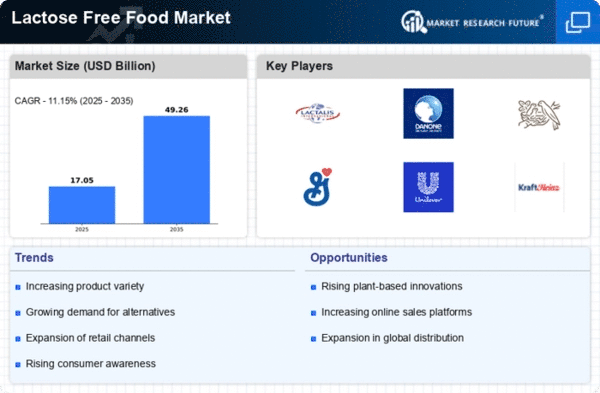
As per MRFR analysis, the Lactose Free Food Market Size was estimated at 15.34 USD Billion in 2024. The Lactose Free Food industry is projected to grow from 17.22 USD Billion in 2025 to 49.26 USD Billion by 2035, exhibiting a compound annual growth rate (CAGR) of 11.15 during the forecast period 2025 - 2035.

Key Market Trends & Highlights

The Lactose Free Food Market is experiencing robust growth driven by health trends and increasing consumer awareness.

  • The demand for dairy alternatives is rising, particularly in North America, where lactose-free products dominate the market.
  • Health and wellness trends are influencing consumer choices, leading to a surge in lactose-free snacks in the Asia-Pacific region.
  • E-commerce is rapidly expanding, enhancing accessibility to lactose-free products, especially in online sales segments.
  • Increasing awareness of lactose intolerance and health-conscious consumer trends are key drivers propelling market growth.

Market Size & Forecast

2024 Market Size 15.34 (USD Billion)
2035 Market Size 49.26 (USD Billion)
CAGR (2025 - 2035) 11.15%
Largest Regional Market Share in 2024 North America

Major Players

Lactalis (FR), Danone (FR), Nestle (CH), General Mills (US), Unilever (GB), Kraft Heinz (US), Arla Foods (DK), Schreiber Foods (US), Oatly (SE)

Market Trends

The Lactose Free Food Market is currently experiencing a notable transformation, driven by a growing awareness of lactose intolerance among consumers. This condition, which affects a significant portion of the global population, has led to an increased demand for products that cater to dietary restrictions. As a result, manufacturers are innovating and expanding their offerings to include a wider variety of lactose-free options, ranging from dairy alternatives to baked goods. The market appears to be evolving in response to changing consumer preferences, with a focus on health and wellness. Furthermore, the rise of plant-based diets has contributed to the popularity of lactose-free products, as individuals seek alternatives that align with their lifestyle choices. In addition to dietary considerations, the Lactose Free Food Market is influenced by broader trends in food production and distribution. The emphasis on clean labels and transparency in ingredient sourcing is becoming increasingly important to consumers. This shift suggests that brands are likely to invest in marketing strategies that highlight the quality and safety of their lactose-free offerings. Moreover, the expansion of e-commerce platforms is facilitating easier access to lactose-free products, allowing consumers to explore a diverse range of options from the comfort of their homes. Overall, the Lactose Free Food Market is poised for continued growth as it adapts to the evolving needs and preferences of health-conscious consumers.

Rising Demand for Dairy Alternatives

The Lactose Free Food Market is witnessing a surge in the popularity of dairy alternatives. Consumers are increasingly opting for plant-based substitutes, such as almond, soy, and oat milk, which cater to lactose intolerance while also appealing to those seeking vegan options. This trend indicates a shift towards more diverse dietary choices.

Focus on Health and Wellness

There is a growing emphasis on health and wellness among consumers, which is influencing their food choices. The Lactose Free Food Market reflects this trend as individuals seek products that promote digestive health and overall well-being. This focus is likely to drive innovation in lactose-free formulations.

E-commerce Growth and Accessibility

The expansion of e-commerce platforms is enhancing the accessibility of lactose-free products. Consumers are increasingly turning to online shopping for convenience and variety. This trend suggests that brands may prioritize their online presence to reach a broader audience.

Lactose Free Food Market Market Drivers

Market Growth Projections

The Global Lactose Free Food Industry is poised for substantial growth, with projections indicating a market value of 18.7 USD Billion by 2035. This growth trajectory is supported by a compound annual growth rate (CAGR) of 8.88% from 2025 to 2035. The increasing prevalence of lactose intolerance, coupled with rising health consciousness and innovative product development, contributes to this positive outlook. As consumers continue to seek lactose-free options, the market is expected to expand significantly, reflecting broader dietary trends and changing consumer preferences.

Innovative Product Development

Innovation in product development plays a crucial role in shaping the Global Lactose Free Food Industry. Manufacturers are increasingly investing in research and development to create a diverse range of lactose-free products that cater to various consumer preferences. This includes lactose-free cheeses, yogurts, and ice creams that maintain taste and texture comparable to their traditional counterparts. The introduction of fortified lactose-free options, enriched with vitamins and minerals, further enhances their appeal. Such innovations not only attract lactose-intolerant consumers but also health-conscious individuals, thereby expanding the market's reach and contributing to its projected CAGR of 8.88% from 2025 to 2035.

Health Conscious Consumer Trends

The trend towards health consciousness among consumers significantly influences the Global Lactose Free Food Industry. Individuals are increasingly prioritizing their dietary choices, leading to a surge in demand for healthier food options. Lactose-free products are perceived as healthier alternatives, appealing to those seeking to avoid digestive discomfort. This shift is evident in the growing availability of lactose-free dairy products, snacks, and beverages. As a result, the market is expected to grow substantially, with projections indicating a value of 18.7 USD Billion by 2035. This growth reflects a broader trend towards wellness and nutrition-focused consumption.

Growing Vegan and Plant-Based Diets

The rise of veganism and plant-based diets significantly impacts the Global Lactose Free Food Industry. As more consumers adopt these dietary preferences, the demand for lactose-free and dairy alternatives has surged. Plant-based milk, yogurt, and cheese products are increasingly popular, catering to both lactose-intolerant individuals and those seeking to reduce animal product consumption. This trend is reflected in the expanding range of lactose-free options available in supermarkets and specialty stores. The market's growth trajectory is expected to continue, driven by the increasing acceptance of plant-based diets and the projected market value of 18.7 USD Billion by 2035.

Rising Lactose Intolerance Prevalence

The increasing prevalence of lactose intolerance globally drives the Global Lactose Free Food Industry. It is estimated that approximately 68% of the world's population experiences some form of lactose malabsorption. This condition is particularly common in regions such as Asia and Africa, where the majority of adults exhibit reduced lactase enzyme activity. As awareness of lactose intolerance grows, consumers are actively seeking lactose-free alternatives, contributing to the market's expansion. The Global Lactose Free Food Market is projected to reach 7.35 USD Billion in 2024, reflecting the rising demand for products that cater to lactose-sensitive individuals.

Increased Availability of Lactose-Free Products

The increased availability of lactose-free products in retail and online channels significantly influences the Global Lactose Free Food Industry. Retailers are expanding their offerings to include a wider variety of lactose-free options, making it easier for consumers to access these products. This trend is supported by the growing number of specialty stores and online platforms dedicated to health and wellness foods. As consumers become more aware of lactose-free alternatives, the market is likely to see continued growth. The projected market value of 7.35 USD Billion in 2024 underscores the importance of accessibility in driving consumer adoption of lactose-free foods.

Market Segment Insights

By Application: Dairy Products (Largest) vs. Snacks (Fastest-Growing)

In the Lactose Free Food Market, dairy products have established themselves as the largest segment, largely due to the increasing consumption of lactose-free milk, <a href="https://www.marketresearchfuture.com/reports/cheese-market-2213" target="_blank">cheese</a>, and yogurt. This trend caters to consumers seeking healthier alternatives without sacrificing taste. Following dairy in prominence are <a href="https://www.marketresearchfuture.com/reports/bakery-products-market-1985" target="_blank">bakery products</a>, beverages, snacks, and confectionery, each contributing to the diverse offerings in the lactose-free space, thereby accommodating varying consumer preferences and dietary needs. Snacks, on the other hand, have emerged as the fastest-growing segment, driven by the rising demand for convenient and on-the-go food options. As consumer awareness about lactose intolerance spreads, snack manufacturers are increasingly reformulating products to be lactose-free, thereby attracting health-conscious and lactose-sensitive consumers. This rising trend showcases an ongoing shift in eating habits, favoring lactose-free snacks that align with lifestyle choices focused on wellness and convenience.

Dairy Products (Dominant) vs. Snacks (Emerging)

Dairy products remain the dominant category in the lactose-free food market, primarily characterized by their wide array of options including lactose-free milk, yogurt, and cheese that are highly favored among lactose-intolerant consumers. This segment thrives on innovations aimed at enhancing taste and texture, making these alternatives increasingly appealing. Contrastingly, snacks are recognized as an emerging segment with rapid growth, reflecting shifts in consumer behavior towards healthier snack options. This segment benefits from the development of lactose-free versions of popular snacks, including chips and bars, which cater to a demographic seeking nutrition alongside convenience. Together, these segments illustrate the dynamic nature of the lactose-free market.

By End Use: Household (Largest) vs. Online Sales (Fastest-Growing)

In the Lactose Free Food Market, the Household segment holds the largest share, driven by the increasing prevalence of lactose intolerance and the rising trend of health-conscious consumers. This segment has established a strong foothold due to its ease of access and variety of lactose-free products available for daily consumption. The Food Service and Retail segments also play important roles, providing lactose-free options in restaurants and grocery stores respectively, while Institutional use is gaining traction as dietary needs shift towards lactose-free solutions. Emerging trends highlight the rapid growth of the Online Sales segment, which has become the fastest-growing channel for lactose-free products. The convenience of online shopping, coupled with improved delivery services, positions this segment to capitalize on the increasing demand for lactose-free foods. Additionally, the COVID-19 pandemic have accelerated digital purchasing behaviors, further driving this growth, while the Food Service and Institutional segments adapt to meet changing consumer preferences and dietary requirements.

Household (Dominant) vs. Online Sales (Emerging)

The Household segment in the Lactose Free Food Market is characterized by its broad consumer base, catering to families and individuals seeking lactose-free alternatives. This dominance is bolstered by significant marketing efforts and the availability of diverse products that resonate well with health-conscious consumers. In contrast, the Online Sales segment is emerging rapidly, appealing especially to tech-savvy consumers who prefer the convenience of shopping from home. This segment offers a wide range of lactose-free products, often unavailable in traditional retail outlets, and benefits from competitive pricing and exclusive deals. Together, these segments illustrate the evolving landscape of lactose-free foods, reflecting consumer priorities toward health, accessibility, and convenience.

By Product Type: Lactose Free Milk (Largest) vs. Lactose Free Yogurt (Fastest-Growing)

The Lactose Free Food Market is seeing a diverse distribution across various product types. Lactose Free Milk holds the largest market share due to its foundational role in dairy consumption and increasing awareness of lactose intolerance among consumers. Following closely, Lactose Free Cheese and Lactose Free Yogurt are also significant segment values, appealing to both health-conscious consumers and those seeking dairy alternatives. Lactose Free Ice Cream and Lactose Free Cream, although smaller in market share, are carving their niche by appealing to a growing base of lactose-sensitive individuals looking for indulgent treats without digestive concerns.

Lactose Free Milk (Dominant) vs. Lactose Free Yogurt (Emerging)

Lactose Free Milk continues to dominate the lactose-free sector, beloved for its versatility and use in everyday cooking and personal consumption. Its wide acceptance and availability in various forms cater to traditional dairy consumers who are looking to avoid lactose without sacrificing taste. On the other hand, Lactose Free Yogurt is rapidly emerging in the market, driven by the increasing demand for probiotic-rich foods and healthy snacking options. This segment is particularly popular among younger consumers who view yogurt as a convenient, nutritious choice. Both segments are experiencing enhancements in flavor profiles and product offerings, which are essential to keeping pace with consumer preferences.

Get more detailed insights about Lactose Free Food Market Research Report - Forecast to 2035

Regional Insights

North America : Market Leader in Lactose-Free

North America is the largest market for lactose-free foods, holding a significant share of 7.67 billion in 2024. The growth is driven by increasing lactose intolerance awareness, rising health consciousness, and a growing demand for dairy alternatives. Regulatory support for lactose-free labeling and health claims further fuels market expansion. The trend towards plant-based diets is also contributing to the demand for lactose-free products, making it a vibrant market for innovation and growth. The competitive landscape in North America is robust, with key players like Lactalis, Danone, and General Mills leading the charge. The U.S. is the primary market, driven by a large consumer base and a variety of lactose-free options available. Companies are investing in product development and marketing strategies to capture the growing health-conscious demographic. The presence of established brands and new entrants is intensifying competition, ensuring a dynamic market environment.

Europe : Emerging Market for Alternatives

Europe's lactose-free food market is valued at 4.6 billion, reflecting a growing trend towards healthier eating habits. The rise in lactose intolerance awareness and dietary preferences for lactose-free options are key growth drivers. Regulatory frameworks in the EU support the labeling of lactose-free products, enhancing consumer trust and market penetration. The increasing availability of lactose-free dairy and plant-based alternatives is also contributing to market growth, appealing to a diverse consumer base. Leading countries in this region include Germany, France, and the UK, where consumer demand for lactose-free products is on the rise. Major players like Danone and Unilever are actively expanding their product lines to cater to this demand. The competitive landscape is characterized by innovation, with companies focusing on quality and variety to attract health-conscious consumers. The presence of both established brands and local producers creates a dynamic market environment.

Asia-Pacific : Emerging Powerhouse in Demand

The Asia-Pacific lactose-free food market is valued at 2.8 billion, showing significant growth potential driven by rising lactose intolerance awareness and changing dietary preferences. The region is witnessing an increase in health-conscious consumers seeking lactose-free options, supported by regulatory initiatives promoting healthier food choices. The growing middle class and urbanization are also contributing to the demand for lactose-free products, making it a key area for market expansion. Countries like Australia and Japan are leading the market, with increasing availability of lactose-free dairy products and plant-based alternatives. Key players such as Nestle and Oatly are expanding their presence in this region, focusing on product innovation and marketing strategies tailored to local tastes. The competitive landscape is evolving, with both international and local brands vying for market share, ensuring a vibrant and dynamic market environment.

Middle East and Africa : Niche Market with Potential

The Middle East and Africa lactose-free food market is valued at 0.27 billion, representing a niche yet growing segment. The rise in lactose intolerance awareness and changing consumer preferences towards healthier options are driving market growth. Regulatory support for food labeling and health claims is also enhancing consumer confidence in lactose-free products. The increasing availability of lactose-free options in retail channels is further supporting market expansion in this region. Leading countries include South Africa and the UAE, where there is a growing demand for lactose-free dairy products. The competitive landscape is characterized by a mix of local and international players, with companies like Arla Foods and Kraft Heinz focusing on product diversification to meet consumer needs. The market is still developing, but the potential for growth is significant as awareness and demand continue to rise.

Key Players and Competitive Insights

The Lactose Free Food Market is currently characterized by a dynamic competitive landscape, driven by increasing consumer awareness regarding lactose intolerance and a growing preference for healthier dietary options. Major players such as Lactalis (FR), Danone (FR), and Oatly (SE) are strategically positioning themselves through innovation and product diversification. Lactalis (FR) has focused on expanding its lactose-free dairy offerings, while Danone (FR) emphasizes sustainability in its production processes. Oatly (SE), on the other hand, has carved a niche in the plant-based segment, appealing to health-conscious consumers. Collectively, these strategies not only enhance their market presence but also intensify competition, as companies strive to meet evolving consumer demands.Key business tactics within the Lactose Free Food Market include localizing manufacturing and optimizing supply chains to enhance efficiency and responsiveness. The market structure appears moderately fragmented, with several key players exerting influence over various segments. This fragmentation allows for niche players to thrive, while larger companies leverage their scale to optimize distribution and marketing efforts. The collective influence of these key players shapes the competitive dynamics, as they engage in both direct competition and collaborative efforts to expand market reach.

In November Danone (FR) announced a partnership with a leading technology firm to enhance its digital marketing capabilities, aiming to better target lactose-intolerant consumers. This strategic move is significant as it reflects the growing importance of data-driven marketing in reaching specific consumer segments, thereby potentially increasing market share. By leveraging technology, Danone (FR) seeks to create personalized experiences that resonate with health-conscious individuals.

In October Oatly (SE) launched a new line of lactose-free oat-based products, which includes yogurt alternatives and ice creams. This expansion into new product categories is indicative of Oatly's commitment to innovation and meeting diverse consumer preferences. The introduction of these products not only diversifies their portfolio but also positions Oatly (SE) as a leader in the plant-based lactose-free segment, appealing to a broader audience.

In September Lactalis (FR) invested in a state-of-the-art production facility dedicated to lactose-free cheese products. This investment underscores Lactalis's focus on enhancing production capabilities and meeting the rising demand for lactose-free cheese alternatives. By increasing production efficiency, Lactalis (FR) aims to solidify its market position and cater to the growing consumer base seeking lactose-free options.

As of December current competitive trends in the Lactose Free Food Market are increasingly defined by digitalization, sustainability, and the integration of artificial intelligence in product development and marketing strategies. Strategic alliances are becoming more prevalent, as companies recognize the value of collaboration in navigating complex market dynamics. Looking ahead, competitive differentiation is likely to evolve from traditional price-based competition to a focus on innovation, technology, and supply chain reliability. This shift suggests that companies that prioritize these aspects will be better positioned to capture market share and meet the demands of an increasingly discerning consumer base.

Key Companies in the Lactose Free Food Market include

Industry Developments

butter

Future Outlook

Lactose Free Food Market Future Outlook

The Lactose Free Food Market is projected to grow at 11.15% CAGR from 2024 to 2035, driven by rising health awareness and increasing lactose intolerance prevalence.

New opportunities lie in:

  • Expansion of lactose-free product lines in retail chains
  • Development of innovative lactose-free dairy alternatives
  • Strategic partnerships with health-focused food brands

By 2035, the market is expected to be robust, reflecting strong consumer demand and diverse product offerings.

Market Segmentation

Lactose Free Food Market End Use Outlook

  • Household
  • Food Service
  • Retail
  • Institutional
  • Online Sales

Lactose Free Food Market Application Outlook

  • Dairy Products
  • Bakery Products
  • Snacks
  • Beverages
  • Confectionery

Lactose Free Food Market Product Type Outlook

  • Lactose Free Milk
  • Lactose Free Cheese
  • Lactose Free Yogurt
  • Lactose Free Ice Cream
  • Lactose Free Cream

Report Scope

MARKET SIZE 202415.34(USD Billion)
MARKET SIZE 202517.22(USD Billion)
MARKET SIZE 203549.26(USD Billion)
COMPOUND ANNUAL GROWTH RATE (CAGR)11.15% (2025 - 2035)
REPORT COVERAGERevenue Forecast, Competitive Landscape, Growth Factors, and Trends
BASE YEAR2024
Market Forecast Period2025 - 2035
Historical Data2019 - 2024
Market Forecast UnitsUSD Billion
Key Companies ProfiledLactalis (FR), Danone (FR), Nestle (CH), General Mills (US), Unilever (GB), Kraft Heinz (US), Arla Foods (DK), Schreiber Foods (US), Oatly (SE)
Segments CoveredApplication, End Use, Product Type
Key Market OpportunitiesGrowing consumer demand for lactose-free options drives innovation in the Lactose Free Food Market.
Key Market DynamicsRising consumer demand for lactose-free products drives innovation and competition among food manufacturers.
Countries CoveredNorth America, Europe, APAC, South America, MEA

FAQs

Which region will have the largest share in the Market for Lactose Free Foods?

Europe will have the largest share in the lactose free foods market.

What are the key factors driving the Market for Lactose Free Foods growth?

Rising prevalence of lactose intolerance and evolving dietary pattern are the key factors driving the lactose free foods market growth.

Which factors may limit the lactose free foods market growth?

Availability of alternative dairy products may limit the lactose free foods market growth.

Which type segment will lead the Market for Lactose Free Foods?

Milk segment will lead the lactose free foods market.

Name the leading players profiled in the lactose free foods market.

Leading players profiled in the lactose free foods market report include Fonterra Co-operative Group Limited (New Zealand), Dean Foods (U.S.), Daiya Foods (Canada), Amy's Kitchen (U.S.), Barry Callebaut (Switzerland), WhiteWave Foods (U.S.), Land O'Lakes, Inc. (U.S.), Galaxy Nutritional Foods Inc. (India), Arla Foods (Denmark), and General Mills Inc. (U.S.).

  1. SECTION I: EXECUTIVE SUMMARY AND KEY HIGHLIGHTS
    1. | 1.1 EXECUTIVE SUMMARY
  2. SECTION II: SCOPING, METHODOLOGY AND MARKET STRUCTURE
    1. | 2.1 MARKET INTRODUCTION
    2. | 2.2 RESEARCH METHODOLOGY
  3. SECTION III: QUALITATIVE ANALYSIS
    1. | 3.1 MARKET DYNAMICS
    2. | 3.2 MARKET FACTOR ANALYSIS
  4. SECTION IV: QUANTITATIVE ANALYSIS
    1. | 4.1 Food, Beverages & Nutrition, BY Application (USD Billion)
    2. | 4.2 Food, Beverages & Nutrition, BY End Use (USD Billion)
    3. | 4.3 Food, Beverages & Nutrition, BY Product Type (USD Billion)
    4. | 4.4 Food, Beverages & Nutrition, BY Region (USD Billion)
  5. SECTION V: COMPETITIVE ANALYSIS
    1. | 5.1 Competitive Landscape
    2. | 5.2 Company Profiles
    3. | 5.3 Appendix

Lactose Free Food Market Segmentation

Market Segmentation Overview

  • Detailed segmentation data will be available in the full report
  • Comprehensive analysis by multiple parameters
  • Regional and country-level breakdowns
  • Market size forecasts by segment
Infographic

Free Sample Request

Kindly complete the form below to receive a free sample of this Report

Get Free Sample

Customer Strories

Compare Licence

×
Features License Type
Single User Multiuser License Enterprise User
Price $4,950 $5,950 $7,250
Maximum User Access Limit 1 User Upto 10 Users Unrestricted Access Throughout the Organization
Free Customization
Direct Access to Analyst
Deliverable Format
Platform Access
Discount on Next Purchase 10% 15% 15%
Printable Versions