Request Free Sample ×

Kindly complete the form below to receive a free sample of this Report

* Please use a valid business email

Leading companies partner with us for data-driven Insights

clients tt-cursor
Hero Background
English
Chinese
French
Japanese
Korean
German
Spanish

Keratoacanthoma Market Share

ID: MRFR/MED/1233-HCR
90 Pages
Nidhi Mandole
March 2026

Keratoacanthoma Market Research Report Information,by Treatment (Medication, Surgery – Cryosurgery and Mohs’ Microscopic Surgery, Intralesional Injection, Radiation Treatment & X-ray Therapy, and Others), by end user (Hospitals,Medical Research Laboratoriesand Others) and by Regions- Growth & Industry Forecast 2025 To 2035

Share:
Download PDF ×

We do not share your information with anyone. However, we may send you emails based on your report interest from time to time. You may contact us at any time to opt-out.

Keratoacanthoma Market Infographic
Purchase Options

Market Share

Keratoacanthoma Market Share Analysis

Market share positioning inside the Keratoacanthoma market begins with a thorough know-how of dermatology and the wider landscape of pores and skin cancers. Providers examine developments, prevalence, and evolving treatment protocols for Keratoacanthoma, permitting them to tailor their offerings to the specific wishes of patients and healthcare specialists. Providers put money into studies and development to create non-invasive diagnostic technologies. Innovations in imaging, molecular diagnostics, and other non-invasive methods help in the early and correct prognosis of Keratoacanthoma, improving patient results and organizing companies as leaders in superior diagnostics. Recognizing the various degrees of Keratoacanthoma, companies provide tailored healing approaches. Market leaders prioritize patient education and consciousness applications. Conducting instructional campaigns helps enhance attention to Keratoacanthoma, its dangerous elements, and the importance of early detection. Empowering patients with facts fosters proactive healthcare in search of behavior and helps early intervention. Staying at the vanguard of scientific advancements involves lively participation in clinical trials and studies initiatives. Providers make contributions to the improvement of the latest treatments, diagnostic equipment, and healing techniques for Keratoacanthoma, positioning themselves as individuals to the evolution of pores and skin cancer care. Providers emphasize global collaboration with most cancer research agencies. Engaging with international cancer research entities allows Keratoacanthoma vendors access a broader pool of expertise, make contributions to worldwide studies efforts, and align their strategies with rising trends in skin cancer studies. A middle method involves strict adherence to oncology remedy guidelines. Keratoacanthoma vendors make certain that their diagnostic and remedy protocols align with set-up pointers, instilling confidence in healthcare experts and selling the adoption of their answers in medical practice. Actively assisting affected persons and advocacy companies is vital. Collaborating with corporations devoted to keratoacanthoma cognizance and affected person aid enables carriers to connect with the patient network, benefit from treasured insights, and contribute to initiatives that decorate affected persons' proper well-being. Establishing an obvious communique with healthcare providers is essential. Keratoacanthoma carriers engage in open talk with dermatologists, oncologists, and different healthcare professionals, imparting clear data on their merchandise, diagnostic gear, and treatment processes. A transparent communique builds agreement and fosters strong professional relationships. Offering affected person-centric care models and assistance services is critical. Keratoacanthoma carriers increase complete care plans that remember the bodily and emotional well-being of patients. Support offerings, together with counseling, informational resources, and remedy compliance, contribute to a holistic technique of patient care.

Author
Author Profile
Nidhi Mandole
Senior Research Analyst

She is an extremely curious individual currently working in Healthcare and Medical Devices Domain. Nidhi is comfortably versed in data centric research backed by healthcare educational background. She leverages extensive data mining and analytics tools such as Primary and Secondary Research, Statistical Analysis, Machine Learning, Data Modelling. Her key role also involves Technical Sales Support, Client Interaction and Project management within the Healthcare team. Lastly, she showcases extensive affinity towards learning new skills and remain fascinated in implementing them.

Leave a Comment

FAQs

What is the current market valuation of the Keratoacanthoma Market?

<p>The Keratoacanthoma Market was valued at approximately 3514.6 USD Million in 2024.</p>

What is the projected market valuation for the Keratoacanthoma Market by 2035?

<p>The market is expected to reach a valuation of around 7560.46 USD Million by 2035.</p>

What is the expected CAGR for the Keratoacanthoma Market during the forecast period?

<p>The anticipated CAGR for the Keratoacanthoma Market from 2025 to 2035 is 7.17%.</p>

Which companies are considered key players in the Keratoacanthoma Market?

<p>Key players include Amgen Inc, Bristol-Myers Squibb Company, Eli Lilly and Company, Novartis AG, Pfizer Inc, Regeneron Pharmaceuticals Inc, Sanofi S.A., Merck & Co., Inc., and AstraZeneca PLC.</p>

What are the primary applications in the Keratoacanthoma Market?

<p>The main applications include Surgical Excision, Cryotherapy, Topical Chemotherapy, and Radiation Therapy, with Surgical Excision valued at 1000.0 to 2200.0 USD Million.</p>

How is the Keratoacanthoma Market segmented by diagnosis method?

The market is segmented into Histopathology, Dermatoscopy, Imaging Techniques, and Clinical Examination, with Histopathology valued between 1050.0 and 2200.0 USD Million.

What treatment types are available in the Keratoacanthoma Market?

Treatment types include Surgical Treatment, Non-Surgical Treatment, and Adjuvant Therapy, with Non-Surgical Treatment valued at 1200.0 to 2500.0 USD Million.

How does patient demographics influence the Keratoacanthoma Market?

The market is segmented by patient demographics, including Age Group, Gender, Skin Type, and Health Status, with Health Status valued between 1614.6 and 3460.46 USD Million.

What is the significance of the projected growth in the Keratoacanthoma Market?

The projected growth indicates a robust expansion, reflecting increasing awareness and advancements in treatment options over the forecast period.

How do the key players impact the Keratoacanthoma Market?

Key players like Pfizer Inc and Merck &amp; Co., Inc. likely drive innovation and competition, influencing market dynamics and treatment advancements.

Market Summary

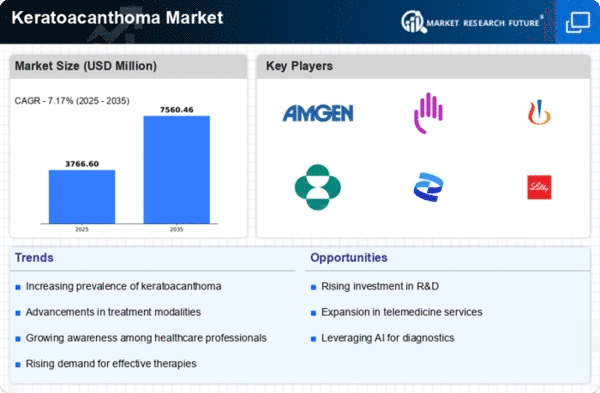
As per MRFR analysis, the Keratoacanthoma Market Size was estimated at 3514.6 USD Million in 2024. The Keratoacanthoma industry is projected to grow from 3806.87 in 2025 to 7560.46 by 2035, exhibiting a compound annual growth rate (CAGR) of 7.17% during the forecast period 2025 - 2035.

Key Market Trends & Highlights

The Keratoacanthoma Market is poised for growth driven by advancements in treatment and increasing awareness.

  • North America remains the largest market for keratoacanthoma treatments, reflecting a robust healthcare infrastructure.
  • The Asia-Pacific region is emerging as the fastest-growing market, driven by rising healthcare access and awareness.
  • Surgical excision continues to dominate the treatment segment, while cryotherapy is gaining traction as the fastest-growing option.
  • Key market drivers include the rising incidence of skin disorders and innovations in surgical techniques, which are shaping treatment approaches.

Market Size & Forecast

2024 Market Size 3514.6 (USD Million)
2035 Market Size 7560.46 (USD Million)
CAGR (2025 - 2035) 7.17%
Largest Regional Market Share in 2024 North America

Major Players

Amgen (US), Bristol-Myers Squibb (US), Novartis (CH), Merck & Co. (US), Pfizer (US), Eli Lilly and Company (US), Bayer (DE), Sanofi (FR), AstraZeneca (GB)

Market Trends

The Keratoacanthoma Market is currently experiencing a notable evolution, driven by a combination of factors including advancements in treatment modalities and increasing awareness regarding skin conditions. The rise in dermatological research has led to the development of innovative therapies, which appear to enhance patient outcomes. Furthermore, the growing emphasis on early diagnosis and intervention is likely to contribute to an uptick in the number of diagnosed cases, thereby expanding the market landscape. As healthcare systems worldwide continue to prioritize skin health, the Keratoacanthoma Market is poised for further growth, reflecting a broader trend towards personalized medicine and targeted therapies. In addition, the demographic shift towards an aging population may influence the Keratoacanthoma Market, as older individuals are generally more susceptible to skin disorders. This demographic trend suggests a potential increase in demand for effective treatment options. Moreover, the integration of telemedicine in dermatology could facilitate access to specialized care, allowing for timely diagnosis and management of keratoacanthoma. Overall, the Keratoacanthoma Market appears to be on a trajectory of expansion, characterized by innovation, increased awareness, and evolving patient needs.

Advancements in Treatment Options

The Keratoacanthoma Market is witnessing a surge in innovative treatment options, including targeted therapies and minimally invasive procedures. These advancements are likely to improve patient outcomes and satisfaction, as they offer more effective and less invasive alternatives to traditional surgical methods.

Increased Awareness and Education

There is a growing emphasis on public awareness and education regarding skin health, particularly concerning keratoacanthoma. This trend may lead to earlier diagnosis and treatment, ultimately expanding the market as more individuals seek medical attention for skin lesions.

Demographic Shifts and Aging Population

The aging population is expected to significantly impact the Keratoacanthoma Market, as older adults are more prone to skin conditions. This demographic shift could drive demand for effective treatment solutions, prompting healthcare providers to focus on tailored approaches for this population.

Keratoacanthoma Market Market Drivers

Aging Population

The aging population is a significant factor influencing the Global Keratoacanthoma Market Industry. As individuals age, their skin becomes more susceptible to various disorders, including keratoacanthoma. This demographic shift is particularly evident in developed countries, where life expectancy continues to rise. The increasing number of elderly individuals is likely to result in a higher incidence of skin cancers and related conditions, thereby driving demand for effective treatment options. This trend suggests a robust market growth potential, with a projected CAGR of 7.34% from 2025 to 2035.

Rising Incidence of Skin Disorders

The increasing prevalence of skin disorders, particularly keratoacanthoma, is a primary driver of the Global Keratoacanthoma Market Industry. Factors such as environmental exposure, UV radiation, and lifestyle changes contribute to this rise. For instance, studies indicate that the incidence of keratoacanthoma has been on the rise, particularly in older populations. This trend is expected to boost the market significantly, as healthcare providers seek effective treatment options. The Global Keratoacanthoma Market Industry is projected to reach 2.27 USD Billion in 2024, reflecting the growing demand for dermatological interventions.

Advancements in Treatment Modalities

Innovations in treatment modalities for keratoacanthoma are enhancing the Global Keratoacanthoma Market Industry. The introduction of targeted therapies, immunotherapy, and minimally invasive surgical techniques is transforming patient outcomes. For example, the development of topical chemotherapeutic agents has shown promise in managing keratoacanthoma effectively. These advancements not only improve patient compliance but also reduce the burden on healthcare systems. As a result, the market is likely to expand, with projections indicating a growth trajectory that could see it reach 4.95 USD Billion by 2035.

Increased Awareness and Early Diagnosis

Growing awareness regarding skin health and the importance of early diagnosis is driving the Global Keratoacanthoma Market Industry. Public health campaigns and educational initiatives are encouraging individuals to seek medical attention for skin lesions. This heightened awareness leads to earlier detection of keratoacanthoma, which is crucial for effective treatment. Consequently, healthcare providers are witnessing an uptick in patient consultations, thereby stimulating market growth. The Global Keratoacanthoma Market Industry is expected to benefit from this trend, as early diagnosis correlates with improved treatment outcomes.

Regulatory Support for Dermatological Research

Regulatory bodies are increasingly supporting research and development in dermatology, which is positively impacting the Global Keratoacanthoma Market Industry. Initiatives aimed at expediting the approval process for new therapies and treatments are fostering innovation. For instance, the FDA has implemented programs to facilitate the development of novel dermatological products. This regulatory support encourages pharmaceutical companies to invest in research focused on keratoacanthoma, potentially leading to the introduction of new treatment options. As a result, the market is likely to experience growth driven by enhanced product offerings.

Market Segment Insights

By Application: Surgical Excision (Largest) vs. Cryotherapy (Fastest-Growing)

<p>In the Keratoacanthoma market, the application segment is segmented into Surgical Excision, Cryotherapy, Topical Chemotherapy, and Radiation Therapy. Surgical Excision holds the largest share due to its established effectiveness and preference among healthcare providers. In contrast, Cryotherapy has gained momentum among patients looking for less invasive options, leading it to become the fastest-growing treatment modality in this segment.</p>

<p>Surgical Excision (Dominant) vs. Cryotherapy (Emerging)</p>

<p>Surgical Excision remains the dominant application used in the Keratoacanthoma treatment landscape, largely attributed to its efficacy in completely removing lesions and preventing recurrence. It is the go-to method for many dermatologists, often preferred for its straightforward approach and reliability. On the other hand, Cryotherapy is emerging as a vigorous contender in the market, appealing particularly to patients seeking minimally invasive treatments. Its growing popularity stems from advancements in technology that increase safety and efficacy, making it a viable alternative. As awareness and acceptance of Cryotherapy rise, it is expected to capture a larger share of the market and potentially reshape treatment preferences.</p>

By Diagnosis Method: Histopathology (Largest) vs. Dermatoscopy (Fastest-Growing)

<p>The diagnosis method segment of the Keratoacanthoma market is led by histopathology, which holds the largest market share due to its long-standing application in confirming diagnoses of skin lesions. Following closely is dermatoscopy, which is gaining traction for its non-invasive imaging capabilities, allowing for enhanced visualization of skin conditions. While imaging techniques and clinical examinations serve as important supplemental approaches, they command less market presence compared to histopathology and dermatoscopy, which are increasingly preferred for accurate diagnostic assessment.</p>

<p>Diagnosis Method: Histopathology (Dominant) vs. Dermatoscopy (Emerging)</p>

<p>Histopathology remains the dominant diagnosis method in the Keratoacanthoma market, heralded for its reliability in providing definitive diagnoses through microscopic examination of tissue samples. In contrast, dermatoscopy is emerging as a vital tool in this segment, favored for its efficiency and ability to visualize skin structures without invasive procedures. This technique is particularly beneficial in early detection and diagnosis, which is driving its rapid growth. The shift towards non-invasive diagnostic methods is reshaping preferences as clinicians seek faster, patient-friendly options without compromising accuracy, facilitating an evolving landscape in keratoacanthoma diagnostics.</p>

By Treatment Type: Surgical Treatment (Largest) vs. Non-Surgical Treatment (Fastest-Growing)

<p>In the Keratoacanthoma Market, the treatment type segment is primarily dominated by Surgical Treatment, which holds the largest share. Various surgical methods, including excision and cryotherapy, remain the gold standard due to their effectiveness in completely removing lesions. This surgical approach is often favored by healthcare professionals, contributing to its significant market presence. Non-Surgical Treatment, meanwhile, is emerging as a rapidly growing alternative, employing methods such as topical chemotherapy and immunotherapy. Although it currently lags behind surgical options in terms of market share, the non-invasive nature of these therapies attracts an increasing number of patients seeking less aggressive treatment options.</p>

<p>Surgical Treatment (Dominant) vs. Non-Surgical Treatment (Emerging)</p>

<p>The landscape of the Keratoacanthoma Market reveals Surgical Treatment as the dominant force, characterized by its reliable efficacy and comprehensive techniques tailored to patient needs. Surgical methods such as Mohs micrographic surgery and local excision are preferred for their ability to ensure complete removal of cancerous lesions, leading to minimal recurrence. Additionally, the competitive edge lies in the experience of surgeons and established surgical protocols. Conversely, Non-Surgical Treatment is carving out an emerging niche, appealing to patients who favor more conservative approaches. This segment includes innovative options like topical applications and systemic therapies, which not only provide effective results but also demonstrate a strong safety profile with lower complication rates, thus gaining traction among a wider patient demographic.</p>

By Patient Demographics: Age Group (Largest) vs. Gender (Fastest-Growing)

<p>In the keratoacanthoma market, the distribution of patient demographics is significantly varied, with age group representing the largest segment. Older adults, specifically those over 60 years, constitute a major portion of diagnosed cases, while both younger and middle-aged populations show rising trends. Gender-wise, the market has traditionally seen a higher prevalence in males; however, the gap has been closing as awareness and diagnostic capabilities improve among females, making gender the fastest-growing segment. Growth trends indicate that demographic changes, such as the aging population and increased sun exposure, are primary drivers for the keratoacanthoma market. Furthermore, advancements in detection and treatment modalities are leading to enhanced diagnosis rates across all age and gender groups, especially as skin health awareness increases. Increased screening among younger demographics is also on the rise, contributing to this accelerated growth.</p>

<p>Age Group (Dominant) vs. Gender (Emerging)</p>

<p>The age group segment is dominant in the keratoacanthoma market, primarily driven by an older population that is more susceptible to skin disorders. This demographic typically includes elderly patients, particularly those over 60, who are at higher risk due to cumulative sun exposure and skin aging factors. In contrast, the gender segment, while traditionally male-dominated, is emerging with increasing female patients being diagnosed. This shift can be attributed to a growing awareness of skin conditions and an increase in preventive care among females. The emerging trend in the gender demographic indicates a need for targeted informational campaigns that educate both men and women about keratoacanthoma, emphasizing recognition of early signs and symptoms.</p>

Get more detailed insights about Keratoacanthoma Market Research Report-Forecast to 2035

Regional Insights

North America : Market Leader in Keratoacanthoma

North America is poised to maintain its leadership in the Keratoacanthoma market, holding a significant market share of $1750.0M as of 2024. The region's growth is driven by increasing incidences of skin cancers, advancements in treatment options, and supportive regulatory frameworks. The FDA's expedited approval processes for innovative therapies further catalyze market expansion, ensuring timely access to effective treatments for patients. The competitive landscape in North America is robust, featuring key players such as Amgen, Bristol-Myers Squibb, and Merck & Co. These companies are at the forefront of research and development, focusing on novel therapies and combination treatments. The presence of established healthcare infrastructure and high healthcare expenditure also contribute to the region's dominance, making it a focal point for market activities.

Europe : Emerging Market with Growth Potential

Europe is witnessing a growing interest in the Keratoacanthoma market, with a market size of $1050.0M. The region benefits from increasing awareness of skin cancer and the availability of advanced treatment options. Regulatory bodies, such as the European Medicines Agency (EMA), are actively promoting research and development in dermatological therapies, which is expected to drive market growth. The emphasis on patient-centric care and innovative treatment modalities is also a significant growth driver. Leading countries in Europe, such as Germany, France, and the UK, are pivotal in shaping the market landscape. The presence of major pharmaceutical companies, including Novartis and Bayer, enhances competition and innovation. Collaborative efforts between public and private sectors are fostering a conducive environment for new product launches and clinical trials, further solidifying Europe's position in the global market.

Asia-Pacific : Emerging Powerhouse in Dermatology

The Asia-Pacific region is emerging as a significant player in the Keratoacanthoma market, with a market size of $600.0M. Factors such as rising skin cancer prevalence, increasing healthcare expenditure, and growing awareness about dermatological conditions are driving demand. Regulatory bodies in countries like Australia and Japan are enhancing their frameworks to facilitate faster approvals for new treatments, which is expected to boost market growth in the coming years. Countries like Japan, Australia, and China are leading the charge in this region, with a growing number of clinical trials and research initiatives. The competitive landscape is characterized by both local and international players, including Pfizer and Eli Lilly. The increasing focus on personalized medicine and innovative therapies is likely to shape the future of the market, making Asia-Pacific a key region for growth.

Middle East and Africa : Resource-Rich Frontier for Treatments

The Middle East and Africa (MEA) region is gradually developing its Keratoacanthoma market, currently valued at $114.6M. The growth is driven by increasing healthcare investments, rising awareness of skin diseases, and the introduction of advanced treatment options. Regulatory bodies are beginning to implement frameworks that support the approval of new therapies, which is essential for market expansion. The region's diverse demographics also contribute to varying treatment needs and opportunities. Leading countries in the MEA region, such as South Africa and the UAE, are making strides in improving healthcare access and treatment options. The presence of key players like Sanofi and AstraZeneca is enhancing competition and innovation. Collaborative efforts between governments and private sectors are crucial for fostering a sustainable market environment, paving the way for future growth in the Keratoacanthoma market.

Key Players and Competitive Insights

The Keratoacanthoma Market is currently characterized by a dynamic competitive landscape, driven by increasing awareness of skin cancers and advancements in treatment modalities. Key players such as Amgen (US), Bristol-Myers Squibb (US), and Novartis (CH) are strategically positioned to leverage their extensive research capabilities and established market presence. Amgen (US) focuses on innovation through the development of targeted therapies, while Bristol-Myers Squibb (US) emphasizes partnerships to enhance its product pipeline. Novartis (CH) is actively pursuing regional expansion, particularly in emerging markets, to capture a broader patient base. Collectively, these strategies contribute to a competitive environment that is increasingly focused on innovation and patient-centric solutions.In terms of business tactics, companies are localizing manufacturing and optimizing supply chains to enhance efficiency and reduce costs. The market appears moderately fragmented, with several players vying for market share. However, the collective influence of major companies like Merck & Co. (US) and Pfizer (US) is notable, as they continue to shape market dynamics through strategic collaborations and product launches.

In November Merck & Co. (US) announced a collaboration with a leading biotechnology firm to develop a novel immunotherapy for keratoacanthoma. This strategic move is significant as it not only enhances Merck's product portfolio but also positions the company at the forefront of innovative treatment options, potentially improving patient outcomes. The collaboration underscores the importance of partnerships in accelerating drug development and addressing unmet medical needs.

In October Pfizer (US) launched a new topical treatment specifically targeting keratoacanthoma, which has shown promising results in clinical trials. This launch is pivotal as it reflects Pfizer's commitment to addressing niche markets within dermatology, thereby expanding its therapeutic offerings. The introduction of this treatment could potentially reshape patient management strategies and enhance the company's competitive edge in the market.

In September Bristol-Myers Squibb (US) expanded its research initiatives focused on skin cancers, including keratoacanthoma, by investing in advanced genomic studies. This investment is crucial as it aims to uncover new biomarkers that could lead to more personalized treatment approaches. By prioritizing research and development, Bristol-Myers Squibb is likely to strengthen its position as a leader in the oncology space, particularly in dermatological applications.

As of December current competitive trends in the Keratoacanthoma Market are increasingly defined by digitalization, sustainability, and the integration of artificial intelligence (AI) in drug development processes. Strategic alliances are becoming more prevalent, as companies recognize the value of collaboration in navigating complex regulatory environments and accelerating innovation. Looking ahead, competitive differentiation is expected to evolve, shifting from price-based competition to a focus on technological advancements, innovative therapies, and reliable supply chains. This transition may ultimately enhance patient care and drive growth within the market.

Key Companies in the Keratoacanthoma Market include

Industry Developments

Pfizer Inc. has completed the spin-off of its Upjohn business and the merger of it with Mylan N.V. to become Viatris Inc.

Bausch Health Companies Inc. has agreed to purchase an option to buy Allegro Ophthalmics' entire ophthalmology business.


Future Outlook

Keratoacanthoma Market Future Outlook

The Keratoacanthoma Market is projected to grow at a 7.17% CAGR from 2025 to 2035, driven by advancements in treatment options and increasing awareness.

New opportunities lie in:

  • Development of targeted therapies for high-risk patients
  • Expansion of telemedicine services for remote consultations
  • Investment in AI-driven diagnostic tools for early detection

By 2035, the Keratoacanthoma Market is expected to achieve substantial growth and innovation.

Market Segmentation

Keratoacanthoma Market Disease Stage Outlook

  • Early Stage
  • Moderate Stage
  • Advanced Stage

Keratoacanthoma Market Treatment Type Outlook

  • Surgical Excision
  • Cryotherapy
  • Electrosurgery
  • Topical Chemotherapy

Keratoacanthoma Market Diagnosis Method Outlook

  • Histopathological Examination
  • Dermatoscopy
  • Clinical Examination
  • Imaging Techniques

Keratoacanthoma Market Patient Demographics Outlook

  • Age Group
  • Gender
  • Skin Type
  • Ethnicity

Report Scope

MARKET SIZE 2024 3514.6(USD Million)
MARKET SIZE 2025 3806.87(USD Million)
MARKET SIZE 2035 7560.46(USD Million)
COMPOUND ANNUAL GROWTH RATE (CAGR) 7.17% (2025 - 2035)
REPORT COVERAGE Revenue Forecast, Competitive Landscape, Growth Factors, and Trends
BASE YEAR 2024
Market Forecast Period 2025 - 2035
Historical Data 2019 - 2024
Market Forecast Units USD Million
Key Companies Profiled Amgen (US), Bristol-Myers Squibb (US), Novartis (CH), Merck & Co. (US), Pfizer (US), Eli Lilly and Company (US), Bayer (DE), Sanofi (FR), AstraZeneca (GB)
Segments Covered Treatment Type, Diagnosis Method, Patient Demographics, Disease Stage
Key Market Opportunities Advancements in targeted therapies and personalized medicine enhance treatment options in the Keratoacanthoma Market.
Key Market Dynamics Rising demand for targeted therapies drives innovation and competition in the Keratoacanthoma treatment landscape.
Countries Covered North America, Europe, APAC, South America, MEA

FAQs

What is the current market valuation of the Keratoacanthoma Market?

<p>The Keratoacanthoma Market was valued at approximately 3514.6 USD Million in 2024.</p>

What is the projected market valuation for the Keratoacanthoma Market by 2035?

<p>The market is expected to reach a valuation of around 7560.46 USD Million by 2035.</p>

What is the expected CAGR for the Keratoacanthoma Market during the forecast period?

<p>The anticipated CAGR for the Keratoacanthoma Market from 2025 to 2035 is 7.17%.</p>

Which companies are considered key players in the Keratoacanthoma Market?

<p>Key players include Amgen Inc, Bristol-Myers Squibb Company, Eli Lilly and Company, Novartis AG, Pfizer Inc, Regeneron Pharmaceuticals Inc, Sanofi S.A., Merck & Co., Inc., and AstraZeneca PLC.</p>

What are the primary applications in the Keratoacanthoma Market?

<p>The main applications include Surgical Excision, Cryotherapy, Topical Chemotherapy, and Radiation Therapy, with Surgical Excision valued at 1000.0 to 2200.0 USD Million.</p>

How is the Keratoacanthoma Market segmented by diagnosis method?

The market is segmented into Histopathology, Dermatoscopy, Imaging Techniques, and Clinical Examination, with Histopathology valued between 1050.0 and 2200.0 USD Million.

What treatment types are available in the Keratoacanthoma Market?

Treatment types include Surgical Treatment, Non-Surgical Treatment, and Adjuvant Therapy, with Non-Surgical Treatment valued at 1200.0 to 2500.0 USD Million.

How does patient demographics influence the Keratoacanthoma Market?

The market is segmented by patient demographics, including Age Group, Gender, Skin Type, and Health Status, with Health Status valued between 1614.6 and 3460.46 USD Million.

What is the significance of the projected growth in the Keratoacanthoma Market?

The projected growth indicates a robust expansion, reflecting increasing awareness and advancements in treatment options over the forecast period.

How do the key players impact the Keratoacanthoma Market?

Key players like Pfizer Inc and Merck &amp; Co., Inc. likely drive innovation and competition, influencing market dynamics and treatment advancements.

  1. SECTION I: EXECUTIVE SUMMARY AND KEY HIGHLIGHTS
    1. | 1.1 EXECUTIVE SUMMARY
    2. | | 1.1.1 Market Overview
    3. | | 1.1.2 Key Findings
    4. | | 1.1.3 Market Segmentation
    5. | | 1.1.4 Competitive Landscape
    6. | | 1.1.5 Challenges and Opportunities
    7. | | 1.1.6 Future Outlook
  2. SECTION II: SCOPING, METHODOLOGY AND MARKET STRUCTURE
    1. | 2.1 MARKET INTRODUCTION
    2. | | 2.1.1 Definition
    3. | | 2.1.2 Scope of the study
    4. | | | 2.1.2.1 Research Objective
    5. | | | 2.1.2.2 Assumption
    6. | | | 2.1.2.3 Limitations
    7. | 2.2 RESEARCH METHODOLOGY
    8. | | 2.2.1 Overview
    9. | | 2.2.2 Data Mining
    10. | | 2.2.3 Secondary Research
    11. | | 2.2.4 Primary Research
    12. | | | 2.2.4.1 Primary Interviews and Information Gathering Process
    13. | | | 2.2.4.2 Breakdown of Primary Respondents
    14. | | 2.2.5 Forecasting Model
    15. | | 2.2.6 Market Size Estimation
    16. | | | 2.2.6.1 Bottom-Up Approach
    17. | | | 2.2.6.2 Top-Down Approach
    18. | | 2.2.7 Data Triangulation
    19. | | 2.2.8 Validation
  3. SECTION III: QUALITATIVE ANALYSIS
    1. | 3.1 MARKET DYNAMICS
    2. | | 3.1.1 Overview
    3. | | 3.1.2 Drivers
    4. | | 3.1.3 Restraints
    5. | | 3.1.4 Opportunities
    6. | 3.2 MARKET FACTOR ANALYSIS
    7. | | 3.2.1 Value chain Analysis
    8. | | 3.2.2 Porter's Five Forces Analysis
    9. | | | 3.2.2.1 Bargaining Power of Suppliers
    10. | | | 3.2.2.2 Bargaining Power of Buyers
    11. | | | 3.2.2.3 Threat of New Entrants
    12. | | | 3.2.2.4 Threat of Substitutes
    13. | | | 3.2.2.5 Intensity of Rivalry
    14. | | 3.2.3 COVID-19 Impact Analysis
    15. | | | 3.2.3.1 Market Impact Analysis
    16. | | | 3.2.3.2 Regional Impact
    17. | | | 3.2.3.3 Opportunity and Threat Analysis
  4. SECTION IV: QUANTITATIVE ANALYSIS
    1. | 4.1 Healthcare, BY Application (USD Million)
    2. | | 4.1.1 Surgical Excision
    3. | | 4.1.2 Cryotherapy
    4. | | 4.1.3 Topical Chemotherapy
    5. | | 4.1.4 Radiation Therapy
    6. | 4.2 Healthcare, BY Diagnosis Method (USD Million)
    7. | | 4.2.1 Histopathology
    8. | | 4.2.2 Dermatoscopy
    9. | | 4.2.3 Imaging Techniques
    10. | | 4.2.4 Clinical Examination
    11. | 4.3 Healthcare, BY Treatment Type (USD Million)
    12. | | 4.3.1 Surgical Treatment
    13. | | 4.3.2 Non-Surgical Treatment
    14. | | 4.3.3 Adjuvant Therapy
    15. | 4.4 Healthcare, BY Patient Demographics (USD Million)
    16. | | 4.4.1 Age Group
    17. | | 4.4.2 Gender
    18. | | 4.4.3 Skin Type
    19. | | 4.4.4 Health Status
    20. | 4.5 Healthcare, BY Region (USD Million)
    21. | | 4.5.1 North America
    22. | | | 4.5.1.1 US
    23. | | | 4.5.1.2 Canada
    24. | | 4.5.2 Europe
    25. | | | 4.5.2.1 Germany
    26. | | | 4.5.2.2 UK
    27. | | | 4.5.2.3 France
    28. | | | 4.5.2.4 Russia
    29. | | | 4.5.2.5 Italy
    30. | | | 4.5.2.6 Spain
    31. | | | 4.5.2.7 Rest of Europe
    32. | | 4.5.3 APAC
    33. | | | 4.5.3.1 China
    34. | | | 4.5.3.2 India
    35. | | | 4.5.3.3 Japan
    36. | | | 4.5.3.4 South Korea
    37. | | | 4.5.3.5 Malaysia
    38. | | | 4.5.3.6 Thailand
    39. | | | 4.5.3.7 Indonesia
    40. | | | 4.5.3.8 Rest of APAC
    41. | | 4.5.4 South America
    42. | | | 4.5.4.1 Brazil
    43. | | | 4.5.4.2 Mexico
    44. | | | 4.5.4.3 Argentina
    45. | | | 4.5.4.4 Rest of South America
    46. | | 4.5.5 MEA
    47. | | | 4.5.5.1 GCC Countries
    48. | | | 4.5.5.2 South Africa
    49. | | | 4.5.5.3 Rest of MEA
  5. SECTION V: COMPETITIVE ANALYSIS
    1. | 5.1 Competitive Landscape
    2. | | 5.1.1 Overview
    3. | | 5.1.2 Competitive Analysis
    4. | | 5.1.3 Market share Analysis
    5. | | 5.1.4 Major Growth Strategy in the Healthcare
    6. | | 5.1.5 Competitive Benchmarking
    7. | | 5.1.6 Leading Players in Terms of Number of Developments in the Healthcare
    8. | | 5.1.7 Key developments and growth strategies
    9. | | | 5.1.7.1 New Product Launch/Service Deployment
    10. | | | 5.1.7.2 Merger & Acquisitions
    11. | | | 5.1.7.3 Joint Ventures
    12. | | 5.1.8 Major Players Financial Matrix
    13. | | | 5.1.8.1 Sales and Operating Income
    14. | | | 5.1.8.2 Major Players R&D Expenditure. 2023
    15. | 5.2 Company Profiles
    16. | | 5.2.1 Amgen Inc (US)
    17. | | | 5.2.1.1 Financial Overview
    18. | | | 5.2.1.2 Products Offered
    19. | | | 5.2.1.3 Key Developments
    20. | | | 5.2.1.4 SWOT Analysis
    21. | | | 5.2.1.5 Key Strategies
    22. | | 5.2.2 Bristol-Myers Squibb Company (US)
    23. | | | 5.2.2.1 Financial Overview
    24. | | | 5.2.2.2 Products Offered
    25. | | | 5.2.2.3 Key Developments
    26. | | | 5.2.2.4 SWOT Analysis
    27. | | | 5.2.2.5 Key Strategies
    28. | | 5.2.3 Eli Lilly and Company (US)
    29. | | | 5.2.3.1 Financial Overview
    30. | | | 5.2.3.2 Products Offered
    31. | | | 5.2.3.3 Key Developments
    32. | | | 5.2.3.4 SWOT Analysis
    33. | | | 5.2.3.5 Key Strategies
    34. | | 5.2.4 Novartis AG (CH)
    35. | | | 5.2.4.1 Financial Overview
    36. | | | 5.2.4.2 Products Offered
    37. | | | 5.2.4.3 Key Developments
    38. | | | 5.2.4.4 SWOT Analysis
    39. | | | 5.2.4.5 Key Strategies
    40. | | 5.2.5 Pfizer Inc (US)
    41. | | | 5.2.5.1 Financial Overview
    42. | | | 5.2.5.2 Products Offered
    43. | | | 5.2.5.3 Key Developments
    44. | | | 5.2.5.4 SWOT Analysis
    45. | | | 5.2.5.5 Key Strategies
    46. | | 5.2.6 Regeneron Pharmaceuticals Inc (US)
    47. | | | 5.2.6.1 Financial Overview
    48. | | | 5.2.6.2 Products Offered
    49. | | | 5.2.6.3 Key Developments
    50. | | | 5.2.6.4 SWOT Analysis
    51. | | | 5.2.6.5 Key Strategies
    52. | | 5.2.7 Sanofi S.A. (FR)
    53. | | | 5.2.7.1 Financial Overview
    54. | | | 5.2.7.2 Products Offered
    55. | | | 5.2.7.3 Key Developments
    56. | | | 5.2.7.4 SWOT Analysis
    57. | | | 5.2.7.5 Key Strategies
    58. | | 5.2.8 Merck & Co., Inc. (US)
    59. | | | 5.2.8.1 Financial Overview
    60. | | | 5.2.8.2 Products Offered
    61. | | | 5.2.8.3 Key Developments
    62. | | | 5.2.8.4 SWOT Analysis
    63. | | | 5.2.8.5 Key Strategies
    64. | | 5.2.9 AstraZeneca PLC (GB)
    65. | | | 5.2.9.1 Financial Overview
    66. | | | 5.2.9.2 Products Offered
    67. | | | 5.2.9.3 Key Developments
    68. | | | 5.2.9.4 SWOT Analysis
    69. | | | 5.2.9.5 Key Strategies
    70. | 5.3 Appendix
    71. | | 5.3.1 References
    72. | | 5.3.2 Related Reports
  6. LIST OF FIGURES
    1. | 6.1 MARKET SYNOPSIS
    2. | 6.2 NORTH AMERICA MARKET ANALYSIS
    3. | 6.3 US MARKET ANALYSIS BY APPLICATION
    4. | 6.4 US MARKET ANALYSIS BY DIAGNOSIS METHOD
    5. | 6.5 US MARKET ANALYSIS BY TREATMENT TYPE
    6. | 6.6 US MARKET ANALYSIS BY PATIENT DEMOGRAPHICS
    7. | 6.7 CANADA MARKET ANALYSIS BY APPLICATION
    8. | 6.8 CANADA MARKET ANALYSIS BY DIAGNOSIS METHOD
    9. | 6.9 CANADA MARKET ANALYSIS BY TREATMENT TYPE
    10. | 6.10 CANADA MARKET ANALYSIS BY PATIENT DEMOGRAPHICS
    11. | 6.11 EUROPE MARKET ANALYSIS
    12. | 6.12 GERMANY MARKET ANALYSIS BY APPLICATION
    13. | 6.13 GERMANY MARKET ANALYSIS BY DIAGNOSIS METHOD
    14. | 6.14 GERMANY MARKET ANALYSIS BY TREATMENT TYPE
    15. | 6.15 GERMANY MARKET ANALYSIS BY PATIENT DEMOGRAPHICS
    16. | 6.16 UK MARKET ANALYSIS BY APPLICATION
    17. | 6.17 UK MARKET ANALYSIS BY DIAGNOSIS METHOD
    18. | 6.18 UK MARKET ANALYSIS BY TREATMENT TYPE
    19. | 6.19 UK MARKET ANALYSIS BY PATIENT DEMOGRAPHICS
    20. | 6.20 FRANCE MARKET ANALYSIS BY APPLICATION
    21. | 6.21 FRANCE MARKET ANALYSIS BY DIAGNOSIS METHOD
    22. | 6.22 FRANCE MARKET ANALYSIS BY TREATMENT TYPE
    23. | 6.23 FRANCE MARKET ANALYSIS BY PATIENT DEMOGRAPHICS
    24. | 6.24 RUSSIA MARKET ANALYSIS BY APPLICATION
    25. | 6.25 RUSSIA MARKET ANALYSIS BY DIAGNOSIS METHOD
    26. | 6.26 RUSSIA MARKET ANALYSIS BY TREATMENT TYPE
    27. | 6.27 RUSSIA MARKET ANALYSIS BY PATIENT DEMOGRAPHICS
    28. | 6.28 ITALY MARKET ANALYSIS BY APPLICATION
    29. | 6.29 ITALY MARKET ANALYSIS BY DIAGNOSIS METHOD
    30. | 6.30 ITALY MARKET ANALYSIS BY TREATMENT TYPE
    31. | 6.31 ITALY MARKET ANALYSIS BY PATIENT DEMOGRAPHICS
    32. | 6.32 SPAIN MARKET ANALYSIS BY APPLICATION
    33. | 6.33 SPAIN MARKET ANALYSIS BY DIAGNOSIS METHOD
    34. | 6.34 SPAIN MARKET ANALYSIS BY TREATMENT TYPE
    35. | 6.35 SPAIN MARKET ANALYSIS BY PATIENT DEMOGRAPHICS
    36. | 6.36 REST OF EUROPE MARKET ANALYSIS BY APPLICATION
    37. | 6.37 REST OF EUROPE MARKET ANALYSIS BY DIAGNOSIS METHOD
    38. | 6.38 REST OF EUROPE MARKET ANALYSIS BY TREATMENT TYPE
    39. | 6.39 REST OF EUROPE MARKET ANALYSIS BY PATIENT DEMOGRAPHICS
    40. | 6.40 APAC MARKET ANALYSIS
    41. | 6.41 CHINA MARKET ANALYSIS BY APPLICATION
    42. | 6.42 CHINA MARKET ANALYSIS BY DIAGNOSIS METHOD
    43. | 6.43 CHINA MARKET ANALYSIS BY TREATMENT TYPE
    44. | 6.44 CHINA MARKET ANALYSIS BY PATIENT DEMOGRAPHICS
    45. | 6.45 INDIA MARKET ANALYSIS BY APPLICATION
    46. | 6.46 INDIA MARKET ANALYSIS BY DIAGNOSIS METHOD
    47. | 6.47 INDIA MARKET ANALYSIS BY TREATMENT TYPE
    48. | 6.48 INDIA MARKET ANALYSIS BY PATIENT DEMOGRAPHICS
    49. | 6.49 JAPAN MARKET ANALYSIS BY APPLICATION
    50. | 6.50 JAPAN MARKET ANALYSIS BY DIAGNOSIS METHOD
    51. | 6.51 JAPAN MARKET ANALYSIS BY TREATMENT TYPE
    52. | 6.52 JAPAN MARKET ANALYSIS BY PATIENT DEMOGRAPHICS
    53. | 6.53 SOUTH KOREA MARKET ANALYSIS BY APPLICATION
    54. | 6.54 SOUTH KOREA MARKET ANALYSIS BY DIAGNOSIS METHOD
    55. | 6.55 SOUTH KOREA MARKET ANALYSIS BY TREATMENT TYPE
    56. | 6.56 SOUTH KOREA MARKET ANALYSIS BY PATIENT DEMOGRAPHICS
    57. | 6.57 MALAYSIA MARKET ANALYSIS BY APPLICATION
    58. | 6.58 MALAYSIA MARKET ANALYSIS BY DIAGNOSIS METHOD
    59. | 6.59 MALAYSIA MARKET ANALYSIS BY TREATMENT TYPE
    60. | 6.60 MALAYSIA MARKET ANALYSIS BY PATIENT DEMOGRAPHICS
    61. | 6.61 THAILAND MARKET ANALYSIS BY APPLICATION
    62. | 6.62 THAILAND MARKET ANALYSIS BY DIAGNOSIS METHOD
    63. | 6.63 THAILAND MARKET ANALYSIS BY TREATMENT TYPE
    64. | 6.64 THAILAND MARKET ANALYSIS BY PATIENT DEMOGRAPHICS
    65. | 6.65 INDONESIA MARKET ANALYSIS BY APPLICATION
    66. | 6.66 INDONESIA MARKET ANALYSIS BY DIAGNOSIS METHOD
    67. | 6.67 INDONESIA MARKET ANALYSIS BY TREATMENT TYPE
    68. | 6.68 INDONESIA MARKET ANALYSIS BY PATIENT DEMOGRAPHICS
    69. | 6.69 REST OF APAC MARKET ANALYSIS BY APPLICATION
    70. | 6.70 REST OF APAC MARKET ANALYSIS BY DIAGNOSIS METHOD
    71. | 6.71 REST OF APAC MARKET ANALYSIS BY TREATMENT TYPE
    72. | 6.72 REST OF APAC MARKET ANALYSIS BY PATIENT DEMOGRAPHICS
    73. | 6.73 SOUTH AMERICA MARKET ANALYSIS
    74. | 6.74 BRAZIL MARKET ANALYSIS BY APPLICATION
    75. | 6.75 BRAZIL MARKET ANALYSIS BY DIAGNOSIS METHOD
    76. | 6.76 BRAZIL MARKET ANALYSIS BY TREATMENT TYPE
    77. | 6.77 BRAZIL MARKET ANALYSIS BY PATIENT DEMOGRAPHICS
    78. | 6.78 MEXICO MARKET ANALYSIS BY APPLICATION
    79. | 6.79 MEXICO MARKET ANALYSIS BY DIAGNOSIS METHOD
    80. | 6.80 MEXICO MARKET ANALYSIS BY TREATMENT TYPE
    81. | 6.81 MEXICO MARKET ANALYSIS BY PATIENT DEMOGRAPHICS
    82. | 6.82 ARGENTINA MARKET ANALYSIS BY APPLICATION
    83. | 6.83 ARGENTINA MARKET ANALYSIS BY DIAGNOSIS METHOD
    84. | 6.84 ARGENTINA MARKET ANALYSIS BY TREATMENT TYPE
    85. | 6.85 ARGENTINA MARKET ANALYSIS BY PATIENT DEMOGRAPHICS
    86. | 6.86 REST OF SOUTH AMERICA MARKET ANALYSIS BY APPLICATION
    87. | 6.87 REST OF SOUTH AMERICA MARKET ANALYSIS BY DIAGNOSIS METHOD
    88. | 6.88 REST OF SOUTH AMERICA MARKET ANALYSIS BY TREATMENT TYPE
    89. | 6.89 REST OF SOUTH AMERICA MARKET ANALYSIS BY PATIENT DEMOGRAPHICS
    90. | 6.90 MEA MARKET ANALYSIS
    91. | 6.91 GCC COUNTRIES MARKET ANALYSIS BY APPLICATION
    92. | 6.92 GCC COUNTRIES MARKET ANALYSIS BY DIAGNOSIS METHOD
    93. | 6.93 GCC COUNTRIES MARKET ANALYSIS BY TREATMENT TYPE
    94. | 6.94 GCC COUNTRIES MARKET ANALYSIS BY PATIENT DEMOGRAPHICS
    95. | 6.95 SOUTH AFRICA MARKET ANALYSIS BY APPLICATION
    96. | 6.96 SOUTH AFRICA MARKET ANALYSIS BY DIAGNOSIS METHOD
    97. | 6.97 SOUTH AFRICA MARKET ANALYSIS BY TREATMENT TYPE
    98. | 6.98 SOUTH AFRICA MARKET ANALYSIS BY PATIENT DEMOGRAPHICS
    99. | 6.99 REST OF MEA MARKET ANALYSIS BY APPLICATION
    100. | 6.100 REST OF MEA MARKET ANALYSIS BY DIAGNOSIS METHOD
    101. | 6.101 REST OF MEA MARKET ANALYSIS BY TREATMENT TYPE
    102. | 6.102 REST OF MEA MARKET ANALYSIS BY PATIENT DEMOGRAPHICS
    103. | 6.103 KEY BUYING CRITERIA OF HEALTHCARE
    104. | 6.104 RESEARCH PROCESS OF MRFR
    105. | 6.105 DRO ANALYSIS OF HEALTHCARE
    106. | 6.106 DRIVERS IMPACT ANALYSIS: HEALTHCARE
    107. | 6.107 RESTRAINTS IMPACT ANALYSIS: HEALTHCARE
    108. | 6.108 SUPPLY / VALUE CHAIN: HEALTHCARE
    109. | 6.109 HEALTHCARE, BY APPLICATION, 2024 (% SHARE)
    110. | 6.110 HEALTHCARE, BY APPLICATION, 2024 TO 2035 (USD Million)
    111. | 6.111 HEALTHCARE, BY DIAGNOSIS METHOD, 2024 (% SHARE)
    112. | 6.112 HEALTHCARE, BY DIAGNOSIS METHOD, 2024 TO 2035 (USD Million)
    113. | 6.113 HEALTHCARE, BY TREATMENT TYPE, 2024 (% SHARE)
    114. | 6.114 HEALTHCARE, BY TREATMENT TYPE, 2024 TO 2035 (USD Million)
    115. | 6.115 HEALTHCARE, BY PATIENT DEMOGRAPHICS, 2024 (% SHARE)
    116. | 6.116 HEALTHCARE, BY PATIENT DEMOGRAPHICS, 2024 TO 2035 (USD Million)
    117. | 6.117 BENCHMARKING OF MAJOR COMPETITORS
  7. LIST OF TABLES
    1. | 7.1 LIST OF ASSUMPTIONS
    2. | | 7.1.1
    3. | 7.2 North America MARKET SIZE ESTIMATES; FORECAST
    4. | | 7.2.1 BY APPLICATION, 2025-2035 (USD Million)
    5. | | 7.2.2 BY DIAGNOSIS METHOD, 2025-2035 (USD Million)
    6. | | 7.2.3 BY TREATMENT TYPE, 2025-2035 (USD Million)
    7. | | 7.2.4 BY PATIENT DEMOGRAPHICS, 2025-2035 (USD Million)
    8. | 7.3 US MARKET SIZE ESTIMATES; FORECAST
    9. | | 7.3.1 BY APPLICATION, 2025-2035 (USD Million)
    10. | | 7.3.2 BY DIAGNOSIS METHOD, 2025-2035 (USD Million)
    11. | | 7.3.3 BY TREATMENT TYPE, 2025-2035 (USD Million)
    12. | | 7.3.4 BY PATIENT DEMOGRAPHICS, 2025-2035 (USD Million)
    13. | 7.4 Canada MARKET SIZE ESTIMATES; FORECAST
    14. | | 7.4.1 BY APPLICATION, 2025-2035 (USD Million)
    15. | | 7.4.2 BY DIAGNOSIS METHOD, 2025-2035 (USD Million)
    16. | | 7.4.3 BY TREATMENT TYPE, 2025-2035 (USD Million)
    17. | | 7.4.4 BY PATIENT DEMOGRAPHICS, 2025-2035 (USD Million)
    18. | 7.5 Europe MARKET SIZE ESTIMATES; FORECAST
    19. | | 7.5.1 BY APPLICATION, 2025-2035 (USD Million)
    20. | | 7.5.2 BY DIAGNOSIS METHOD, 2025-2035 (USD Million)
    21. | | 7.5.3 BY TREATMENT TYPE, 2025-2035 (USD Million)
    22. | | 7.5.4 BY PATIENT DEMOGRAPHICS, 2025-2035 (USD Million)
    23. | 7.6 Germany MARKET SIZE ESTIMATES; FORECAST
    24. | | 7.6.1 BY APPLICATION, 2025-2035 (USD Million)
    25. | | 7.6.2 BY DIAGNOSIS METHOD, 2025-2035 (USD Million)
    26. | | 7.6.3 BY TREATMENT TYPE, 2025-2035 (USD Million)
    27. | | 7.6.4 BY PATIENT DEMOGRAPHICS, 2025-2035 (USD Million)
    28. | 7.7 UK MARKET SIZE ESTIMATES; FORECAST
    29. | | 7.7.1 BY APPLICATION, 2025-2035 (USD Million)
    30. | | 7.7.2 BY DIAGNOSIS METHOD, 2025-2035 (USD Million)
    31. | | 7.7.3 BY TREATMENT TYPE, 2025-2035 (USD Million)
    32. | | 7.7.4 BY PATIENT DEMOGRAPHICS, 2025-2035 (USD Million)
    33. | 7.8 France MARKET SIZE ESTIMATES; FORECAST
    34. | | 7.8.1 BY APPLICATION, 2025-2035 (USD Million)
    35. | | 7.8.2 BY DIAGNOSIS METHOD, 2025-2035 (USD Million)
    36. | | 7.8.3 BY TREATMENT TYPE, 2025-2035 (USD Million)
    37. | | 7.8.4 BY PATIENT DEMOGRAPHICS, 2025-2035 (USD Million)
    38. | 7.9 Russia MARKET SIZE ESTIMATES; FORECAST
    39. | | 7.9.1 BY APPLICATION, 2025-2035 (USD Million)
    40. | | 7.9.2 BY DIAGNOSIS METHOD, 2025-2035 (USD Million)
    41. | | 7.9.3 BY TREATMENT TYPE, 2025-2035 (USD Million)
    42. | | 7.9.4 BY PATIENT DEMOGRAPHICS, 2025-2035 (USD Million)
    43. | 7.10 Italy MARKET SIZE ESTIMATES; FORECAST
    44. | | 7.10.1 BY APPLICATION, 2025-2035 (USD Million)
    45. | | 7.10.2 BY DIAGNOSIS METHOD, 2025-2035 (USD Million)
    46. | | 7.10.3 BY TREATMENT TYPE, 2025-2035 (USD Million)
    47. | | 7.10.4 BY PATIENT DEMOGRAPHICS, 2025-2035 (USD Million)
    48. | 7.11 Spain MARKET SIZE ESTIMATES; FORECAST
    49. | | 7.11.1 BY APPLICATION, 2025-2035 (USD Million)
    50. | | 7.11.2 BY DIAGNOSIS METHOD, 2025-2035 (USD Million)
    51. | | 7.11.3 BY TREATMENT TYPE, 2025-2035 (USD Million)
    52. | | 7.11.4 BY PATIENT DEMOGRAPHICS, 2025-2035 (USD Million)
    53. | 7.12 Rest of Europe MARKET SIZE ESTIMATES; FORECAST
    54. | | 7.12.1 BY APPLICATION, 2025-2035 (USD Million)
    55. | | 7.12.2 BY DIAGNOSIS METHOD, 2025-2035 (USD Million)
    56. | | 7.12.3 BY TREATMENT TYPE, 2025-2035 (USD Million)
    57. | | 7.12.4 BY PATIENT DEMOGRAPHICS, 2025-2035 (USD Million)
    58. | 7.13 APAC MARKET SIZE ESTIMATES; FORECAST
    59. | | 7.13.1 BY APPLICATION, 2025-2035 (USD Million)
    60. | | 7.13.2 BY DIAGNOSIS METHOD, 2025-2035 (USD Million)
    61. | | 7.13.3 BY TREATMENT TYPE, 2025-2035 (USD Million)
    62. | | 7.13.4 BY PATIENT DEMOGRAPHICS, 2025-2035 (USD Million)
    63. | 7.14 China MARKET SIZE ESTIMATES; FORECAST
    64. | | 7.14.1 BY APPLICATION, 2025-2035 (USD Million)
    65. | | 7.14.2 BY DIAGNOSIS METHOD, 2025-2035 (USD Million)
    66. | | 7.14.3 BY TREATMENT TYPE, 2025-2035 (USD Million)
    67. | | 7.14.4 BY PATIENT DEMOGRAPHICS, 2025-2035 (USD Million)
    68. | 7.15 India MARKET SIZE ESTIMATES; FORECAST
    69. | | 7.15.1 BY APPLICATION, 2025-2035 (USD Million)
    70. | | 7.15.2 BY DIAGNOSIS METHOD, 2025-2035 (USD Million)
    71. | | 7.15.3 BY TREATMENT TYPE, 2025-2035 (USD Million)
    72. | | 7.15.4 BY PATIENT DEMOGRAPHICS, 2025-2035 (USD Million)
    73. | 7.16 Japan MARKET SIZE ESTIMATES; FORECAST
    74. | | 7.16.1 BY APPLICATION, 2025-2035 (USD Million)
    75. | | 7.16.2 BY DIAGNOSIS METHOD, 2025-2035 (USD Million)
    76. | | 7.16.3 BY TREATMENT TYPE, 2025-2035 (USD Million)
    77. | | 7.16.4 BY PATIENT DEMOGRAPHICS, 2025-2035 (USD Million)
    78. | 7.17 South Korea MARKET SIZE ESTIMATES; FORECAST
    79. | | 7.17.1 BY APPLICATION, 2025-2035 (USD Million)
    80. | | 7.17.2 BY DIAGNOSIS METHOD, 2025-2035 (USD Million)
    81. | | 7.17.3 BY TREATMENT TYPE, 2025-2035 (USD Million)
    82. | | 7.17.4 BY PATIENT DEMOGRAPHICS, 2025-2035 (USD Million)
    83. | 7.18 Malaysia MARKET SIZE ESTIMATES; FORECAST
    84. | | 7.18.1 BY APPLICATION, 2025-2035 (USD Million)
    85. | | 7.18.2 BY DIAGNOSIS METHOD, 2025-2035 (USD Million)
    86. | | 7.18.3 BY TREATMENT TYPE, 2025-2035 (USD Million)
    87. | | 7.18.4 BY PATIENT DEMOGRAPHICS, 2025-2035 (USD Million)
    88. | 7.19 Thailand MARKET SIZE ESTIMATES; FORECAST
    89. | | 7.19.1 BY APPLICATION, 2025-2035 (USD Million)
    90. | | 7.19.2 BY DIAGNOSIS METHOD, 2025-2035 (USD Million)
    91. | | 7.19.3 BY TREATMENT TYPE, 2025-2035 (USD Million)
    92. | | 7.19.4 BY PATIENT DEMOGRAPHICS, 2025-2035 (USD Million)
    93. | 7.20 Indonesia MARKET SIZE ESTIMATES; FORECAST
    94. | | 7.20.1 BY APPLICATION, 2025-2035 (USD Million)
    95. | | 7.20.2 BY DIAGNOSIS METHOD, 2025-2035 (USD Million)
    96. | | 7.20.3 BY TREATMENT TYPE, 2025-2035 (USD Million)
    97. | | 7.20.4 BY PATIENT DEMOGRAPHICS, 2025-2035 (USD Million)
    98. | 7.21 Rest of APAC MARKET SIZE ESTIMATES; FORECAST
    99. | | 7.21.1 BY APPLICATION, 2025-2035 (USD Million)
    100. | | 7.21.2 BY DIAGNOSIS METHOD, 2025-2035 (USD Million)
    101. | | 7.21.3 BY TREATMENT TYPE, 2025-2035 (USD Million)
    102. | | 7.21.4 BY PATIENT DEMOGRAPHICS, 2025-2035 (USD Million)
    103. | 7.22 South America MARKET SIZE ESTIMATES; FORECAST
    104. | | 7.22.1 BY APPLICATION, 2025-2035 (USD Million)
    105. | | 7.22.2 BY DIAGNOSIS METHOD, 2025-2035 (USD Million)
    106. | | 7.22.3 BY TREATMENT TYPE, 2025-2035 (USD Million)
    107. | | 7.22.4 BY PATIENT DEMOGRAPHICS, 2025-2035 (USD Million)
    108. | 7.23 Brazil MARKET SIZE ESTIMATES; FORECAST
    109. | | 7.23.1 BY APPLICATION, 2025-2035 (USD Million)
    110. | | 7.23.2 BY DIAGNOSIS METHOD, 2025-2035 (USD Million)
    111. | | 7.23.3 BY TREATMENT TYPE, 2025-2035 (USD Million)
    112. | | 7.23.4 BY PATIENT DEMOGRAPHICS, 2025-2035 (USD Million)
    113. | 7.24 Mexico MARKET SIZE ESTIMATES; FORECAST
    114. | | 7.24.1 BY APPLICATION, 2025-2035 (USD Million)
    115. | | 7.24.2 BY DIAGNOSIS METHOD, 2025-2035 (USD Million)
    116. | | 7.24.3 BY TREATMENT TYPE, 2025-2035 (USD Million)
    117. | | 7.24.4 BY PATIENT DEMOGRAPHICS, 2025-2035 (USD Million)
    118. | 7.25 Argentina MARKET SIZE ESTIMATES; FORECAST
    119. | | 7.25.1 BY APPLICATION, 2025-2035 (USD Million)
    120. | | 7.25.2 BY DIAGNOSIS METHOD, 2025-2035 (USD Million)
    121. | | 7.25.3 BY TREATMENT TYPE, 2025-2035 (USD Million)
    122. | | 7.25.4 BY PATIENT DEMOGRAPHICS, 2025-2035 (USD Million)
    123. | 7.26 Rest of South America MARKET SIZE ESTIMATES; FORECAST
    124. | | 7.26.1 BY APPLICATION, 2025-2035 (USD Million)
    125. | | 7.26.2 BY DIAGNOSIS METHOD, 2025-2035 (USD Million)
    126. | | 7.26.3 BY TREATMENT TYPE, 2025-2035 (USD Million)
    127. | | 7.26.4 BY PATIENT DEMOGRAPHICS, 2025-2035 (USD Million)
    128. | 7.27 MEA MARKET SIZE ESTIMATES; FORECAST
    129. | | 7.27.1 BY APPLICATION, 2025-2035 (USD Million)
    130. | | 7.27.2 BY DIAGNOSIS METHOD, 2025-2035 (USD Million)
    131. | | 7.27.3 BY TREATMENT TYPE, 2025-2035 (USD Million)
    132. | | 7.27.4 BY PATIENT DEMOGRAPHICS, 2025-2035 (USD Million)
    133. | 7.28 GCC Countries MARKET SIZE ESTIMATES; FORECAST
    134. | | 7.28.1 BY APPLICATION, 2025-2035 (USD Million)
    135. | | 7.28.2 BY DIAGNOSIS METHOD, 2025-2035 (USD Million)
    136. | | 7.28.3 BY TREATMENT TYPE, 2025-2035 (USD Million)
    137. | | 7.28.4 BY PATIENT DEMOGRAPHICS, 2025-2035 (USD Million)
    138. | 7.29 South Africa MARKET SIZE ESTIMATES; FORECAST
    139. | | 7.29.1 BY APPLICATION, 2025-2035 (USD Million)
    140. | | 7.29.2 BY DIAGNOSIS METHOD, 2025-2035 (USD Million)
    141. | | 7.29.3 BY TREATMENT TYPE, 2025-2035 (USD Million)
    142. | | 7.29.4 BY PATIENT DEMOGRAPHICS, 2025-2035 (USD Million)
    143. | 7.30 Rest of MEA MARKET SIZE ESTIMATES; FORECAST
    144. | | 7.30.1 BY APPLICATION, 2025-2035 (USD Million)
    145. | | 7.30.2 BY DIAGNOSIS METHOD, 2025-2035 (USD Million)
    146. | | 7.30.3 BY TREATMENT TYPE, 2025-2035 (USD Million)
    147. | | 7.30.4 BY PATIENT DEMOGRAPHICS, 2025-2035 (USD Million)
    148. | 7.31 PRODUCT LAUNCH/PRODUCT DEVELOPMENT/APPROVAL
    149. | | 7.31.1
    150. | 7.32 ACQUISITION/PARTNERSHIP
    151. | | 7.32.1

Healthcare Market Segmentation

Healthcare By Application (USD Million, 2025-2035)

  • Surgical Excision
  • Cryotherapy
  • Topical Chemotherapy
  • Radiation Therapy

Healthcare By Diagnosis Method (USD Million, 2025-2035)

  • Histopathology
  • Dermatoscopy
  • Imaging Techniques
  • Clinical Examination

Healthcare By Treatment Type (USD Million, 2025-2035)

  • Surgical Treatment
  • Non-Surgical Treatment
  • Adjuvant Therapy

Healthcare By Patient Demographics (USD Million, 2025-2035)

  • Age Group
  • Gender
  • Skin Type
  • Health Status
Infographic

Free Sample Request

Kindly complete the form below to receive a free sample of this Report

Get Free Sample

Customer Strories

Compare Licence

×
Features License Type
Single User Multiuser License Enterprise User
Price $4,950 $5,950 $7,250
Maximum User Access Limit 1 User Upto 10 Users Unrestricted Access Throughout the Organization
Free Customization
Direct Access to Analyst
Deliverable Format
Platform Access
Discount on Next Purchase 10% 15% 15%
Printable Versions