×
Hero Background
English
Chinese
French
Japanese
Korean
German
Spanish

IV Fluid Monitoring Devices Market Trends

ID: MRFR/MED/10214-HCR
128 Pages
Rahul Gotadki
October 2025

IV Fluid Monitoring Devices Market Size, Growth Research Report By End User (Hospitals and Clinics, ASCs, and Home Care), By Type (Desktop and Portable), and By Region (North America, Europe, Asia-Pacific, and Rest Of The World) – Competitor Industry Analysis and Trends Forecast Till 2035

Share:
Download PDF ×

We do not share your information with anyone. However, we may send you emails based on your report interest from time to time. You may contact us at any time to opt-out.

IV Fluid Monitoring Devices Market Infographic
Purchase Options

Market Trends

Key Emerging Trends in the IV Fluid Monitoring Devices Market

The IV fluid monitoring devices market is experiencing a surge in demand due to the increasing prevalence of chronic diseases, rising surgical procedures, and the growing elderly population, leading to higher demand for accurate fluid management. Becoming it real-life, technology changes, like sensors, the Internet of things, and real-time examination enhancement, are pressurizing the precision, and efficiency of IV fluid monitoring devices, making market quickly growing. The introduction of home tele-nursing, wherein remote monitoring solutions for IV fluid administering are performed through wearable devices and online platforms, is enhancing the quality of care offered leading to high growth of market particularly in home care settings. A sharp healthcare focus on patient safety and the reduction of medication errors has led hospitals to invest in IV fluid monitoring devices that enable the ultimate product delivery into the vein and the avoidance of adverse events, which contributes to the faster market growth. IV fluid monitoring devices have an option to link to electronic health record systems which facilitates secure data transmission and documentation without workflow disruption. Electronic health records (EHR) make real-time data integration possible which in turn makes the market hugely promising. The introduction of stringent regulatory specifications for medical devices, including IV fluid monitoring systems, in turn plays a critical role in changing market mechanics and fostering innovation that is primarily focused on the compliance with ever growing, tight regulatory requirements, consequently influencing the market growth. Among the principal advantages of IV fluid monitoring features incorporated in smart infusion pumps lifting patient follow up up to the current state of instant infusion rate adjustment if patient’s parameters change and IV fluid monitoring equipment thereby improve outcomes and drive the demand. Healthcare providers continue to be on a mission to seek the most economical options of IV fluid monitoring devices that can be sold in the market at competitive rates, have value features and help in cost reducing. The adoption of a patient-centric approach in healthcare delivery, with a focus on personalized treatment and improved patient outcomes, is driving market demand for IV fluid monitoring devices that offer tailored solutions for individual patient needs.


Author
Rahul Gotadki
Assistant Manager

He holds an experience of about 7+ years in Market Research and Business Consulting, working under the spectrum of Life Sciences and Healthcare domains. Rahul conceptualizes and implements a scalable business strategy and provides strategic leadership to the clients. His expertise lies in market estimation, competitive intelligence, pipeline analysis, customer assessment, etc. In addition to the above, his other responsibility includes strategic tracking of high growth markets & advising clients on the potential areas of focus they could direct their business initiatives

Leave a Comment

FAQs

What is the projected market valuation of the IV Fluid Monitoring Devices Market by 2035?

The projected market valuation for the IV Fluid Monitoring Devices Market by 2035 is 10.37 USD Billion.

What was the market valuation of the IV Fluid Monitoring Devices Market in 2024?

The market valuation of the IV Fluid Monitoring Devices Market in 2024 was 4.824 USD Billion.

What is the expected CAGR for the IV Fluid Monitoring Devices Market during the forecast period 2025 - 2035?

The expected CAGR for the IV Fluid Monitoring Devices Market during the forecast period 2025 - 2035 is 7.2%.

Which end-user segment is projected to have the highest valuation in 2035?

The Hospitals and Clinics segment is projected to reach a valuation of 5.5 USD Billion by 2035.

How do the valuations of desktop and portable IV fluid monitoring devices compare in 2035?

Both desktop and portable IV fluid monitoring devices are projected to have equal valuations of 5.185 USD Billion in 2035.

Who are the key players in the IV Fluid Monitoring Devices Market?

Key players in the IV Fluid Monitoring Devices Market include Baxter International, B. Braun Melsungen AG, and Fresenius Kabi AG.

Market Summary

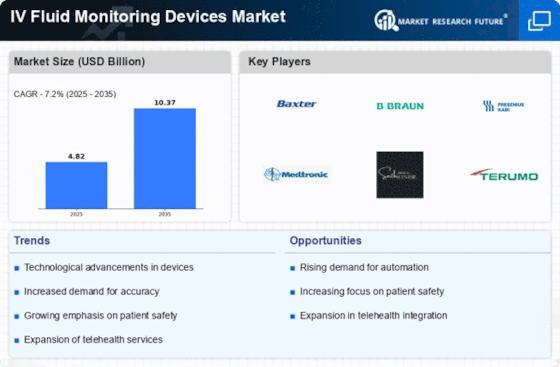
As per MRFR analysis, the IV Fluid Monitoring Devices Market was estimated at 4.824 USD Billion in 2024. The IV Fluid Monitoring Devices industry is projected to grow from 5.172 USD Billion in 2025 to 10.37 USD Billion by 2035, exhibiting a compound annual growth rate (CAGR) of 7.2 during the forecast period 2025 - 2035.

Key Market Trends & Highlights

The IV Fluid Monitoring Devices Market is experiencing robust growth driven by technological advancements and an increasing focus on patient safety.

  • North America remains the largest market for IV fluid monitoring devices, driven by advanced healthcare infrastructure. Asia-Pacific is emerging as the fastest-growing region, fueled by rising healthcare investments and increasing patient populations. Hospitals and clinics represent the largest segment, while home care is rapidly gaining traction due to the growing demand for at-home healthcare solutions. Technological advancements and an increased focus on patient safety are key drivers propelling market growth.

Market Size & Forecast

2024 Market Size 4.824 (USD Billion)
2035 Market Size 10.37 (USD Billion)
CAGR (2025 - 2035) 7.2%
Largest Regional Market Share in 2024 North America

Major Players

<p>Baxter International (US), B. Braun Melsungen AG (DE), Fresenius Kabi AG (DE), Medtronic (US), Smiths Medical (US), Terumo Corporation (JP), ICU Medical (US), Halyard Health (US), Vygon (FR)</p>

Market Trends

The IV Fluid Monitoring Devices Market is currently experiencing a notable evolution, driven by advancements in technology and an increasing emphasis on patient safety. The integration of smart technologies into these devices appears to enhance their functionality, allowing for real-time monitoring and data collection. This shift not only improves clinical outcomes but also streamlines workflow for healthcare professionals. Furthermore, the growing prevalence of chronic diseases necessitates more efficient fluid management solutions, thereby propelling demand for innovative monitoring devices. As healthcare systems worldwide strive for improved efficiency and patient-centric care, the IV Fluid Monitoring Devices Market is poised for substantial growth. In addition, regulatory bodies are increasingly focusing on the safety and efficacy of medical devices, which may lead to stricter compliance requirements. This trend could potentially drive manufacturers to invest in research and development, fostering innovation within the sector. Moreover, the rising awareness of the importance of accurate fluid management in critical care settings suggests that the market will continue to expand. Overall, the IV Fluid Monitoring Devices Market is likely to witness significant transformations, influenced by technological advancements and evolving healthcare needs.

Technological Integration

The incorporation of advanced technologies into IV fluid monitoring devices is reshaping the market landscape. Innovations such as wireless connectivity and artificial intelligence are enhancing the accuracy and efficiency of fluid management. These developments enable healthcare providers to monitor patients remotely, thus improving response times and overall care.

Regulatory Compliance

As regulatory agencies intensify their scrutiny of medical devices, manufacturers in the IV Fluid Monitoring Devices Market are compelled to adhere to stricter guidelines. This trend may lead to increased investment in quality assurance and product development, ensuring that devices meet the highest safety standards.

Focus on Patient Safety

There is a growing emphasis on patient safety within healthcare systems, which is driving demand for reliable IV fluid monitoring solutions. Enhanced monitoring capabilities can help prevent complications associated with fluid imbalances, thereby improving patient outcomes and fostering trust in healthcare providers.

IV Fluid Monitoring Devices Market Market Drivers

Technological Advancements

The IV Fluid Monitoring Devices Market is experiencing a surge in technological advancements that enhance the efficiency and accuracy of fluid management. Innovations such as smart infusion pumps and integrated monitoring systems are becoming increasingly prevalent. These devices utilize advanced algorithms and connectivity features to provide real-time data, which is crucial for patient care. The market is projected to grow at a compound annual growth rate (CAGR) of approximately 8% over the next few years, driven by the demand for improved patient outcomes and reduced medication errors. Furthermore, the integration of artificial intelligence and machine learning into these devices is likely to revolutionize the way healthcare providers monitor and manage IV fluids, thereby increasing the overall effectiveness of treatment protocols.

Regulatory Support and Standards

The IV Fluid Monitoring Devices Market is bolstered by regulatory support and the establishment of stringent standards aimed at ensuring device safety and efficacy. Regulatory agencies are actively working to create frameworks that facilitate the approval and monitoring of IV fluid devices, which in turn fosters innovation and market growth. Compliance with these regulations not only enhances the credibility of manufacturers but also instills confidence among healthcare providers and patients. As the industry adapts to these evolving standards, it is likely to witness an influx of new products designed to meet regulatory requirements. This supportive environment is expected to drive the expansion of the IV fluid monitoring devices market, as stakeholders recognize the importance of adhering to established guidelines for improved patient care.

Increased Focus on Patient Safety

The IV Fluid Monitoring Devices Market is witnessing an increased focus on patient safety, which is driving the adoption of advanced monitoring technologies. Healthcare institutions are prioritizing the implementation of systems that minimize the risk of medication errors and adverse events associated with IV fluid administration. Regulatory bodies are also emphasizing the importance of safety standards, leading to the development of more sophisticated monitoring devices. As a result, hospitals and clinics are investing in IV fluid monitoring solutions that provide alerts for potential issues, thereby enhancing patient safety. This trend is expected to contribute to the growth of the market, as healthcare providers recognize the value of investing in technologies that protect patients and improve clinical outcomes.

Growing Demand for Home Healthcare

The IV Fluid Monitoring Devices Market is experiencing a shift towards home healthcare, driven by the growing demand for patient-centered care. As more patients prefer receiving treatment in the comfort of their homes, the need for portable and user-friendly IV fluid monitoring devices is increasing. This trend is supported by advancements in technology that allow for remote monitoring and data transmission, enabling healthcare providers to oversee patient care from a distance. The home healthcare market is projected to expand significantly, with estimates suggesting a growth rate of around 10% annually. Consequently, the IV fluid monitoring devices market is likely to benefit from this trend, as manufacturers develop solutions tailored for home use, ensuring that patients receive the necessary care without frequent hospital visits.

Rising Incidence of Chronic Diseases

The IV Fluid Monitoring Devices Market is significantly influenced by the rising incidence of chronic diseases, which necessitate continuous and precise fluid management. Conditions such as diabetes, heart disease, and renal failure often require patients to receive IV fluids regularly. As the prevalence of these diseases continues to rise, the demand for effective monitoring solutions is expected to increase correspondingly. According to recent statistics, chronic diseases account for nearly 70% of all deaths worldwide, underscoring the urgent need for reliable IV fluid management systems. This trend is likely to propel the IV fluid monitoring devices market, as healthcare providers seek to enhance patient care and ensure optimal fluid administration.

Market Segment Insights

By End User: Hospitals and Clinics (Largest) vs. Home Care (Fastest-Growing)

<p>In the IV Fluid Monitoring Devices Market, Hospitals and Clinics represent the largest segment, accounting for a significant portion of market share due to their extensive use of advanced monitoring technologies. This segment benefits from the increasing number of patient admissions and the rising complexity of healthcare services provided, which necessitate effective IV fluid management. In contrast, the Home Care segment is experiencing rapid growth, driven by the shift towards home healthcare services and the growing aging population that requires continuous monitoring away from traditional clinical settings.</p>

<p>Hospitals and Clinics (Dominant) vs. Home Care (Emerging)</p>

<p>Hospitals and Clinics hold a dominant position in the IV Fluid Monitoring Devices Market, as they extensively utilize various monitoring devices for patient care. These facilities require robust and reliable technologies to ensure patient safety and optimize treatment outcomes. The shift in healthcare practices towards outpatient services and improved patient monitoring ensures that Hospitals and Clinics will continue to be at the forefront of this sector. Meanwhile, the Home Care market is emerging rapidly, characterized by a growing demand for portable and user-friendly monitoring devices. This segment is gaining traction as technologies improve and patient preferences shift toward home-based care, offering convenience and personalized treatment options, thereby fueling its growth.</p>

By Type: Portable (Largest) vs. Desktop (Fastest-Growing)

<p>In the IV Fluid Monitoring Devices Market, the distribution of market share between the two primary segment values reveals a clear leader in portability. Portable devices dominate the market due to their convenience and adaptability in various healthcare settings, particularly in emergency and at-home care. Conversely, desktop devices cater to more traditional usage in hospitals and clinics, offering robust performance in a fixed environment. Their share is significant but reflects a different approach to IV fluid monitoring, which is becoming increasingly streamlined and efficient. The growth trends in this segment are driven primarily by technological advancements and evolving healthcare practices. The demand for portable IV fluid monitoring devices is surging, as healthcare providers seek efficient ways to manage patient care on-the-go. Meanwhile, desktop devices are adapting to incorporate new features that enhance usability and accuracy, appealing to healthcare professionals seeking reliable monitoring solutions in clinical settings.</p>

<p>Type: Portable (Dominant) vs. Desktop (Emerging)</p>

<p>The Portable segment of IV Fluid Monitoring Devices Market stands as the dominant force in the market, characterized by its lightweight design and ease of use, allowing for bedside monitoring and emergency applications. Its popularity is attributed to the increasing need for flexible healthcare solutions that support patient mobility. With features such as wireless connectivity and user-friendly interfaces, portable options provide a significant advantage in varied settings. In contrast, the Desktop segment, while traditionally viewed as the stable option for hospitals, is emerging with innovations aimed at enhancing performance and integration into electronic health records. As healthcare facilities recognize the importance of seamless data flow and real-time monitoring, the desktop devices are undergoing transformation to meet these novel demands, positioning themselves as a crucial player in the evolving landscape of IV monitoring.</p>

Get more detailed insights about IV Fluid Monitoring Devices Market Research Report—Global Forecast till 2035

Regional Insights

North America : Innovation and Market Leadership

North America is the largest market for IV fluid monitoring devices, holding approximately 45% of the global market share. The region's growth is driven by advanced healthcare infrastructure, increasing prevalence of chronic diseases, and a strong emphasis on patient safety. Regulatory support from agencies like the FDA further catalyzes innovation and adoption of new technologies in this sector. The United States leads the market, followed by Canada, with key players such as Baxter International, Medtronic, and ICU Medical dominating the landscape. The competitive environment is characterized by continuous product development and strategic partnerships, ensuring a robust supply of advanced monitoring solutions to healthcare providers. The presence of established companies fosters a dynamic market, enhancing patient care and operational efficiency.

Europe : Regulatory Framework and Growth

Europe is the second-largest market for IV fluid monitoring devices, accounting for approximately 30% of the global market share. The region's growth is propelled by stringent regulatory frameworks and increasing investments in healthcare technology. Countries like Germany and France are at the forefront, with a rising demand for advanced monitoring solutions driven by an aging population and a focus on improving healthcare outcomes. Germany is the leading country in this market, followed by France and the UK. The competitive landscape features major players such as B. Braun Melsungen AG and Fresenius Kabi AG, which are known for their innovative products. The European market is characterized by a strong emphasis on quality and safety, with regulations ensuring that devices meet high standards. This regulatory environment fosters trust and encourages the adoption of new technologies.

Asia-Pacific : Rapid Growth and Adoption

Asia-Pacific is witnessing rapid growth in the IV fluid monitoring devices market, holding approximately 20% of the global market share. The region's expansion is driven by increasing healthcare expenditure, rising awareness of patient safety, and a growing number of hospitals and healthcare facilities. Countries like China and India are leading this growth, supported by government initiatives aimed at improving healthcare infrastructure. China is the largest market in the region, followed by Japan and India. The competitive landscape is becoming increasingly dynamic, with both local and international players vying for market share. Key companies such as Terumo Corporation and Halyard Health are expanding their presence, focusing on innovative solutions tailored to meet the specific needs of the region's diverse healthcare systems. This competitive environment is fostering advancements in technology and service delivery.

Middle East and Africa : Untapped Potential and Growth

The Middle East and Africa region is gradually emerging in the IV fluid monitoring devices market, holding about 5% of the global market share. The growth is driven by increasing healthcare investments, rising awareness of advanced medical technologies, and a growing population. Countries like South Africa and the UAE are leading the way, with government initiatives aimed at enhancing healthcare services and infrastructure. South Africa is the largest market in the region, followed by the UAE. The competitive landscape is characterized by a mix of local and international players, with companies like Vygon and Smiths Medical making significant inroads. The region presents untapped opportunities for growth, as healthcare providers seek to improve patient monitoring and safety standards, paving the way for increased adoption of IV fluid monitoring devices.

Key Players and Competitive Insights

The IV Fluid Monitoring Devices Market is currently characterized by a dynamic competitive landscape, driven by technological advancements and an increasing emphasis on patient safety. Key players such as Baxter International (US), B. Braun Melsungen AG (DE), and Medtronic (US) are strategically positioned to leverage innovation and expand their market presence. Baxter International (US) focuses on enhancing its product portfolio through continuous research and development, while B. Braun Melsungen AG (DE) emphasizes partnerships with healthcare providers to improve service delivery. Medtronic (US) is actively pursuing digital transformation initiatives, integrating advanced data analytics into its monitoring devices, which collectively shapes a competitive environment that prioritizes quality and efficiency.

In terms of business tactics, companies are increasingly localizing manufacturing to reduce costs and enhance supply chain resilience. The market structure appears moderately fragmented, with several players vying for market share. However, the collective influence of major companies like ICU Medical (US) and Fresenius Kabi AG (DE) is notable, as they engage in strategic collaborations and acquisitions to strengthen their foothold in the market.

In August 2025, Fresenius Kabi AG (DE) announced a strategic partnership with a leading telehealth provider to integrate remote monitoring capabilities into its IV fluid management systems. This move is significant as it aligns with the growing trend of telemedicine, allowing healthcare providers to monitor patients' fluid intake and output remotely, thereby enhancing patient care and operational efficiency.

In September 2025, Medtronic (US) launched a new line of IV fluid monitoring devices equipped with artificial intelligence capabilities. This innovation is poised to revolutionize patient monitoring by providing real-time data analytics, which can lead to more informed clinical decisions. The integration of AI into their devices suggests a commitment to staying at the forefront of technological advancements in healthcare.

In July 2025, ICU Medical (US) completed the acquisition of a smaller competitor specializing in IV fluid management solutions. This acquisition is likely to bolster ICU Medical's product offerings and expand its market reach, indicating a trend towards consolidation in the industry as companies seek to enhance their competitive edge through strategic mergers.

As of October 2025, the IV Fluid Monitoring Devices Market is witnessing trends such as digitalization, sustainability, and the integration of artificial intelligence. Strategic alliances are increasingly shaping the competitive landscape, as companies recognize the value of collaboration in driving innovation. Looking ahead, competitive differentiation is expected to evolve, with a shift from price-based competition to a focus on technological innovation, supply chain reliability, and enhanced patient outcomes. This transition underscores the importance of adaptability and forward-thinking strategies in maintaining a competitive advantage.

Key Companies in the IV Fluid Monitoring Devices Market market include

Industry Developments

May 2019: In the U.S. healthcare system, B. Braun Melsungen AG announced a $1 billion investment and improved IV treatment manufacturing facilities. For the intravenous administration of drugs for a variety of chronic diseases like cancer, diabetes, kidney ailments, etc., intravenous (IV) fluid bags are employed.

Future Outlook

IV Fluid Monitoring Devices Market Future Outlook

<p>The IV Fluid Monitoring Devices Market is projected to grow at a 7.2% CAGR from 2024 to 2035, driven by technological advancements, increasing healthcare demands, and enhanced patient safety protocols.</p>

New opportunities lie in:

  • <p>Integration of AI for predictive analytics in fluid management systems.</p><p>Development of portable IV monitoring devices for home healthcare.</p><p>Expansion into emerging markets with tailored product offerings.</p>

<p>By 2035, the IV Fluid Monitoring Devices Market is expected to be robust, reflecting substantial growth and innovation.</p>

Market Segmentation

IV Fluid Monitoring Devices Market Type Outlook

  • Desktop
  • Portable

IV Fluid Monitoring Devices Market End User Outlook

  • Hospitals and Clinics
  • ASCs
  • Home Care

Report Scope

MARKET SIZE 20244.824(USD Billion)
MARKET SIZE 20255.172(USD Billion)
MARKET SIZE 203510.37(USD Billion)
COMPOUND ANNUAL GROWTH RATE (CAGR)7.2% (2024 - 2035)
REPORT COVERAGERevenue Forecast, Competitive Landscape, Growth Factors, and Trends
BASE YEAR2024
Market Forecast Period2025 - 2035
Historical Data2019 - 2024
Market Forecast UnitsUSD Billion
Key Companies ProfiledMarket analysis in progress
Segments CoveredMarket segmentation analysis in progress
Key Market OpportunitiesIntegration of advanced sensors and AI for real-time IV fluid monitoring and patient safety.
Key Market DynamicsTechnological advancements and regulatory changes drive innovation and competition in the IV Fluid Monitoring Devices market.
Countries CoveredNorth America, Europe, APAC, South America, MEA

FAQs

What is the projected market valuation of the IV Fluid Monitoring Devices Market by 2035?

The projected market valuation for the IV Fluid Monitoring Devices Market by 2035 is 10.37 USD Billion.

What was the market valuation of the IV Fluid Monitoring Devices Market in 2024?

The market valuation of the IV Fluid Monitoring Devices Market in 2024 was 4.824 USD Billion.

What is the expected CAGR for the IV Fluid Monitoring Devices Market during the forecast period 2025 - 2035?

The expected CAGR for the IV Fluid Monitoring Devices Market during the forecast period 2025 - 2035 is 7.2%.

Which end-user segment is projected to have the highest valuation in 2035?

The Hospitals and Clinics segment is projected to reach a valuation of 5.5 USD Billion by 2035.

How do the valuations of desktop and portable IV fluid monitoring devices compare in 2035?

Both desktop and portable IV fluid monitoring devices are projected to have equal valuations of 5.185 USD Billion in 2035.

Who are the key players in the IV Fluid Monitoring Devices Market?

Key players in the IV Fluid Monitoring Devices Market include Baxter International, B. Braun Melsungen AG, and Fresenius Kabi AG.

  1. SECTION I: EXECUTIVE SUMMARY AND KEY HIGHLIGHTS
    1. EXECUTIVE SUMMARY
      1. Market Overview
      2. Key Findings
      3. Market Segmentation
      4. Competitive Landscape
      5. Challenges and Opportunities
      6. Future Outlook 2 SECTION II: SCOPING, METHODOLOGY AND MARKET STRUCTURE
    2. MARKET INTRODUCTION
      1. Definition
      2. Scope of the study
    3. RESEARCH METHODOLOGY
      1. Overview
      2. Data Mining
      3. Secondary Research
      4. Primary Research
      5. Forecasting Model
      6. Market Size Estimation
      7. Data Triangulation
      8. Validation 3 SECTION III: QUALITATIVE ANALYSIS
    4. MARKET DYNAMICS
      1. Overview
      2. Drivers
      3. Restraints
      4. Opportunities
    5. MARKET FACTOR ANALYSIS
      1. Value chain Analysis
      2. Porter's Five Forces Analysis
      3. COVID-19 Impact Analysis
    6. Healthcare, BY End User (USD Billion)
      1. Hospitals and Clinics
      2. ASCs
      3. Home Care
    7. Healthcare, BY Type (USD Billion)
      1. Desktop
      2. Portable
    8. Healthcare, BY Region (USD Billion)
      1. North America
      2. Europe
      3. APAC
      4. South America
      5. MEA
    9. Competitive Landscape
      1. Overview
      2. Competitive Analysis
      3. Market share Analysis
      4. Major Growth Strategy in the Healthcare
      5. Competitive Benchmarking
      6. Leading Players in Terms of Number of Developments in the Healthcare
      7. Key developments and growth strategies
      8. Major Players Financial Matrix
    10. Company Profiles
      1. Baxter International (US)
      2. B. Braun Melsungen AG (DE)
      3. Fresenius Kabi AG (DE)
      4. Medtronic (US)
      5. Smiths Medical (US)
      6. Terumo Corporation (JP)
      7. ICU Medical (US)
      8. Halyard Health (US)
      9. Vygon (FR)
    11. Appendix
      1. References
      2. Related Reports 6 LIST OF FIGURES
    12. MARKET SYNOPSIS
    13. NORTH AMERICA MARKET ANALYSIS
    14. US MARKET ANALYSIS BY END USER
    15. US MARKET ANALYSIS BY TYPE
    16. CANADA MARKET ANALYSIS BY END USER
    17. CANADA MARKET ANALYSIS BY TYPE
    18. EUROPE MARKET ANALYSIS
    19. GERMANY MARKET ANALYSIS BY END USER
    20. GERMANY MARKET ANALYSIS BY TYPE
    21. UK MARKET ANALYSIS BY END USER
    22. UK MARKET ANALYSIS BY TYPE
    23. FRANCE MARKET ANALYSIS BY END USER
    24. FRANCE MARKET ANALYSIS BY TYPE
    25. RUSSIA MARKET ANALYSIS BY END USER
    26. RUSSIA MARKET ANALYSIS BY TYPE
    27. ITALY MARKET ANALYSIS BY END USER
    28. ITALY MARKET ANALYSIS BY TYPE
    29. SPAIN MARKET ANALYSIS BY END USER
    30. SPAIN MARKET ANALYSIS BY TYPE
    31. REST OF EUROPE MARKET ANALYSIS BY END USER
    32. REST OF EUROPE MARKET ANALYSIS BY TYPE
    33. APAC MARKET ANALYSIS
    34. CHINA MARKET ANALYSIS BY END USER
    35. CHINA MARKET ANALYSIS BY TYPE
    36. INDIA MARKET ANALYSIS BY END USER
    37. INDIA MARKET ANALYSIS BY TYPE
    38. JAPAN MARKET ANALYSIS BY END USER
    39. JAPAN MARKET ANALYSIS BY TYPE
    40. SOUTH KOREA MARKET ANALYSIS BY END USER
    41. SOUTH KOREA MARKET ANALYSIS BY TYPE
    42. MALAYSIA MARKET ANALYSIS BY END USER
    43. MALAYSIA MARKET ANALYSIS BY TYPE
    44. THAILAND MARKET ANALYSIS BY END USER
    45. THAILAND MARKET ANALYSIS BY TYPE
    46. INDONESIA MARKET ANALYSIS BY END USER
    47. INDONESIA MARKET ANALYSIS BY TYPE
    48. REST OF APAC MARKET ANALYSIS BY END USER
    49. REST OF APAC MARKET ANALYSIS BY TYPE
    50. SOUTH AMERICA MARKET ANALYSIS
    51. BRAZIL MARKET ANALYSIS BY END USER
    52. BRAZIL MARKET ANALYSIS BY TYPE
    53. MEXICO MARKET ANALYSIS BY END USER
    54. MEXICO MARKET ANALYSIS BY TYPE
    55. ARGENTINA MARKET ANALYSIS BY END USER
    56. ARGENTINA MARKET ANALYSIS BY TYPE
    57. REST OF SOUTH AMERICA MARKET ANALYSIS BY END USER
    58. REST OF SOUTH AMERICA MARKET ANALYSIS BY TYPE
    59. MEA MARKET ANALYSIS
    60. GCC COUNTRIES MARKET ANALYSIS BY END USER
    61. GCC COUNTRIES MARKET ANALYSIS BY TYPE
    62. SOUTH AFRICA MARKET ANALYSIS BY END USER
    63. SOUTH AFRICA MARKET ANALYSIS BY TYPE
    64. REST OF MEA MARKET ANALYSIS BY END USER
    65. REST OF MEA MARKET ANALYSIS BY TYPE
    66. KEY BUYING CRITERIA OF HEALTHCARE
    67. RESEARCH PROCESS OF MRFR
    68. DRO ANALYSIS OF HEALTHCARE
    69. DRIVERS IMPACT ANALYSIS: HEALTHCARE
    70. RESTRAINTS IMPACT ANALYSIS: HEALTHCARE
    71. SUPPLY / VALUE CHAIN: HEALTHCARE
    72. HEALTHCARE, BY END USER, 2024 (% SHARE)
    73. HEALTHCARE, BY END USER, 2024 TO 2035 (USD Billion)
    74. HEALTHCARE, BY TYPE, 2024 (% SHARE)
    75. HEALTHCARE, BY TYPE, 2024 TO 2035 (USD Billion)
    76. BENCHMARKING OF MAJOR COMPETITORS 7 LIST OF TABLES
    77. LIST OF ASSUMPTIONS
    78. North America MARKET SIZE ESTIMATES; FORECAST
      1. BY END USER, 2025-2035 (USD Billion)
      2. BY TYPE, 2025-2035 (USD Billion)
    79. US MARKET SIZE ESTIMATES; FORECAST
      1. BY END USER, 2025-2035 (USD Billion)
      2. BY TYPE, 2025-2035 (USD Billion)
    80. Canada MARKET SIZE ESTIMATES; FORECAST
      1. BY END USER, 2025-2035 (USD Billion)
      2. BY TYPE, 2025-2035 (USD Billion)
    81. Europe MARKET SIZE ESTIMATES; FORECAST
      1. BY END USER, 2025-2035 (USD Billion)
      2. BY TYPE, 2025-2035 (USD Billion)
    82. Germany MARKET SIZE ESTIMATES; FORECAST
      1. BY END USER, 2025-2035 (USD Billion)
      2. BY TYPE, 2025-2035 (USD Billion)
    83. UK MARKET SIZE ESTIMATES; FORECAST
      1. BY END USER, 2025-2035 (USD Billion)
      2. BY TYPE, 2025-2035 (USD Billion)
    84. France MARKET SIZE ESTIMATES; FORECAST
      1. BY END USER, 2025-2035 (USD Billion)
      2. BY TYPE, 2025-2035 (USD Billion)
    85. Russia MARKET SIZE ESTIMATES; FORECAST
      1. BY END USER, 2025-2035 (USD Billion)
      2. BY TYPE, 2025-2035 (USD Billion)
    86. Italy MARKET SIZE ESTIMATES; FORECAST
      1. BY END USER, 2025-2035 (USD Billion)
      2. BY TYPE, 2025-2035 (USD Billion)
    87. Spain MARKET SIZE ESTIMATES; FORECAST
      1. BY END USER, 2025-2035 (USD Billion)
      2. BY TYPE, 2025-2035 (USD Billion)
    88. Rest of Europe MARKET SIZE ESTIMATES; FORECAST
      1. BY END USER, 2025-2035 (USD Billion)
      2. BY TYPE, 2025-2035 (USD Billion)
    89. APAC MARKET SIZE ESTIMATES; FORECAST
      1. BY END USER, 2025-2035 (USD Billion)
      2. BY TYPE, 2025-2035 (USD Billion)
    90. China MARKET SIZE ESTIMATES; FORECAST
      1. BY END USER, 2025-2035 (USD Billion)
      2. BY TYPE, 2025-2035 (USD Billion)
    91. India MARKET SIZE ESTIMATES; FORECAST
      1. BY END USER, 2025-2035 (USD Billion)
      2. BY TYPE, 2025-2035 (USD Billion)
    92. Japan MARKET SIZE ESTIMATES; FORECAST
      1. BY END USER, 2025-2035 (USD Billion)
      2. BY TYPE, 2025-2035 (USD Billion)
    93. South Korea MARKET SIZE ESTIMATES; FORECAST
      1. BY END USER, 2025-2035 (USD Billion)
      2. BY TYPE, 2025-2035 (USD Billion)
    94. Malaysia MARKET SIZE ESTIMATES; FORECAST
      1. BY END USER, 2025-2035 (USD Billion)
      2. BY TYPE, 2025-2035 (USD Billion)
    95. Thailand MARKET SIZE ESTIMATES; FORECAST
      1. BY END USER, 2025-2035 (USD Billion)
      2. BY TYPE, 2025-2035 (USD Billion)
    96. Indonesia MARKET SIZE ESTIMATES; FORECAST
      1. BY END USER, 2025-2035 (USD Billion)
      2. BY TYPE, 2025-2035 (USD Billion)
    97. Rest of APAC MARKET SIZE ESTIMATES; FORECAST
      1. BY END USER, 2025-2035 (USD Billion)
      2. BY TYPE, 2025-2035 (USD Billion)
    98. South America MARKET SIZE ESTIMATES; FORECAST
      1. BY END USER, 2025-2035 (USD Billion)
      2. BY TYPE, 2025-2035 (USD Billion)
    99. Brazil MARKET SIZE ESTIMATES; FORECAST
      1. BY END USER, 2025-2035 (USD Billion)
      2. BY TYPE, 2025-2035 (USD Billion)
    100. Mexico MARKET SIZE ESTIMATES; FORECAST
      1. BY END USER, 2025-2035 (USD Billion)
      2. BY TYPE, 2025-2035 (USD Billion)
    101. Argentina MARKET SIZE ESTIMATES; FORECAST
      1. BY END USER, 2025-2035 (USD Billion)
      2. BY TYPE, 2025-2035 (USD Billion)
    102. Rest of South America MARKET SIZE ESTIMATES; FORECAST
      1. BY END USER, 2025-2035 (USD Billion)
      2. BY TYPE, 2025-2035 (USD Billion)
    103. MEA MARKET SIZE ESTIMATES; FORECAST
      1. BY END USER, 2025-2035 (USD Billion)
      2. BY TYPE, 2025-2035 (USD Billion)
    104. GCC Countries MARKET SIZE ESTIMATES; FORECAST
      1. BY END USER, 2025-2035 (USD Billion)
      2. BY TYPE, 2025-2035 (USD Billion)
    105. South Africa MARKET SIZE ESTIMATES; FORECAST
      1. BY END USER, 2025-2035 (USD Billion)
      2. BY TYPE, 2025-2035 (USD Billion)
    106. Rest of MEA MARKET SIZE ESTIMATES; FORECAST
      1. BY END USER, 2025-2035 (USD Billion)
      2. BY TYPE, 2025-2035 (USD Billion)
    107. PRODUCT LAUNCH/PRODUCT DEVELOPMENT/APPROVAL
    108. ACQUISITION/PARTNERSHIP

IV Fluid Monitoring Devices Market Segmentation

IV Fluid Monitoring Devices End-user Outlook (USD Billion, 2018-2032)

Hospitals and clinics

ASCs

Home care

IV Fluid Monitoring Devices Type Outlook (USD Billion, 2018-2032)

Desktop

Portable

IV Fluid Monitoring Devices Regional Outlook (USD Billion, 2018-2032)

North America Outlook (USD Billion, 2018-2032)

IV Fluid Monitoring Devices by End-user

Hospitals and clinics

ASCs

Home care

IV Fluid Monitoring Devices by Type

Desktop

Portable

US Outlook (USD Billion, 2018-2032)

IV Fluid Monitoring Devices by End-user

Hospitals and clinics

ASCs

Home care

IV Fluid Monitoring Devices by Type

Desktop

Portable

Canada Outlook (USD Billion, 2018-2032)

IV Fluid Monitoring Devices by End-user

Hospitals and clinics

ASCs

Home care

IV Fluid Monitoring Devices by Type

Desktop

Portable

Europe Outlook (USD Billion, 2018-2032)

IV Fluid Monitoring Devices by End-user

Hospitals and clinics

ASCs

Home care

IV Fluid Monitoring Devices by Type

Desktop

Portable

Germany Outlook (USD Billion, 2018-2032)

IV Fluid Monitoring Devices by End-user

Hospitals and clinics

ASCs

Home care

IV Fluid Monitoring Devices by Type

Desktop

Portable

France Outlook (USD Billion, 2018-2032)

IV Fluid Monitoring Devices by End-user

Hospitals and clinics

ASCs

Home care

IV Fluid Monitoring Devices by Type

Desktop

Portable

UK Outlook (USD Billion, 2018-2032)

IV Fluid Monitoring Devices by End-user

Hospitals and clinics

ASCs

Home care

IV Fluid Monitoring Devices by Type

Desktop

Portable

Italy Outlook (USD Billion, 2018-2032)

IV Fluid Monitoring Devices by End-user

Hospitals and clinics

ASCs

Home care

IV Fluid Monitoring Devices by Type

Desktop

Portable

Spain Outlook (USD Billion, 2018-2032)

IV Fluid Monitoring Devices by End-user

Hospitals and clinics

ASCs

Home care

IV Fluid Monitoring Devices by Type

Desktop

Portable

Rest Of Europe Outlook (USD Billion, 2018-2032)

IV Fluid Monitoring Devices by End-user

Hospitals and clinics

ASCs

Home care

IV Fluid Monitoring Devices by Type

Desktop

Portable

Asia-Pacific Outlook (USD Billion, 2018-2032)

IV Fluid Monitoring Devices by End-user

Hospitals and clinics

ASCs

Home care

IV Fluid Monitoring Devices by Type

Desktop

Portable

China Outlook (USD Billion, 2018-2032)

IV Fluid Monitoring Devices by End-user

Hospitals and clinics

ASCs

Home care

IV Fluid Monitoring Devices by Type

Desktop

Portable

Japan Outlook (USD Billion, 2018-2032)

IV Fluid Monitoring Devices by End-user

Hospitals and clinics

ASCs

Home care

IV Fluid Monitoring Devices by Type

Desktop

Portable

India Outlook (USD Billion, 2018-2032)

IV Fluid Monitoring Devices by End-user

Hospitals and clinics

ASCs

Home care

IV Fluid Monitoring Devices by Type

Desktop

Portable

Australia Outlook (USD Billion, 2018-2032)

IV Fluid Monitoring Devices by End-user

Hospitals and clinics

ASCs

Home care

IV Fluid Monitoring Devices by Type

Desktop

Portable

Rest of Asia-Pacific Outlook (USD Billion, 2018-2032)

IV Fluid Monitoring Devices by End-user

Hospitals and clinics

ASCs

Home care

IV Fluid Monitoring Devices by Type

Desktop

Portable

Rest of the World Outlook (USD Billion, 2018-2032)

IV Fluid Monitoring Devices by End-user

Hospitals and clinics

ASCs

Home care

IV Fluid Monitoring Devices by Type

Desktop

Portable

Middle East Outlook (USD Billion, 2018-2032)

IV Fluid Monitoring Devices by End-user

Hospitals and clinics

ASCs

Home care

IV Fluid Monitoring Devices by Type

Desktop

Portable

Africa Outlook (USD Billion, 2018-2032)

IV Fluid Monitoring Devices by End-user

Hospitals and clinics

ASCs

Home care

IV Fluid Monitoring Devices by Type

Desktop

Portable

Latin America Outlook (USD Billion, 2018-2032)

IV Fluid Monitoring Devices by End-user

Hospitals and clinics

ASCs

Home care

IV Fluid Monitoring Devices by Type

Desktop

Portable

Infographic

Free Sample Request

Kindly complete the form below to receive a free sample of this Report

Get Free Sample

Customer Strories

Compare Licence

×
Features License Type
Single User Multiuser License Enterprise User
Price $4,950 $5,950 $7,250
Maximum User Access Limit 1 User Upto 10 Users Unrestricted Access Throughout the Organization
Free Customization
Direct Access to Analyst
Deliverable Format
Platform Access
Discount on Next Purchase 10% 15% 15%
Printable Versions