
Request Free Sample ×

Kindly complete the form below to receive a free sample of this Report

* Please use a valid business email

Leading companies partner with us for data-driven Insights

clients tt-cursor
Hero Background
English
Chinese
French
Japanese
Korean
German
Spanish

IT Asset Disposition Market Analysis

ID: MRFR/ICT/0496-HCR
110 Pages
Ankit Gupta
March 2026

IT Asset Disposition (ITAD) Market Size, Share and Research Report: By Asset Type (Computer, Mobile Devices, Servers, Storage Devices, and Peripherals), By Service (Data Destruction, Recycling, Reverse Logistics, De-Manufacturing, Remarketing), By Size (SMEs, Large Enterprise), By Vertical (Aerospace & Defense, Energy, and Power, Pharmaceutical, Oil), And By Region (North America, Europe, Asia-Pacific, And Rest Of The World) – Market Forecast Till 2035

Share:
Download PDF ×

We do not share your information with anyone. However, we may send you emails based on your report interest from time to time. You may contact us at any time to opt-out.

IT Asset Disposition Market Infographic
Purchase Options

Market Analysis

In-depth Analysis of IT Asset Disposition Market Industry Landscape

The ITAD market is changing fast and always getting more important. This shows how much companies need to handle old computer stuff the right way. A big reason for this market is the quick changes in technology, which often lead to new and updated IT equipment. As companies try to stay ahead by using new technology, it's really important for them to quickly and safely get rid of old computer stuff. Rules and worries about the environment also change how markets function. Strict rules on trash from electronic gadgets like computers are making businesses use safer ways of getting rid old computer parts without breaking any laws or hurting nature. Keeping vital data safe is crucial for how the ITAD market functions. With more data leaks and computer threats, businesses now pay close attention to discarding old technology properly.

This is so that private information doesn't become visible by others after being thrown away improperly. The market provides full services to erase and remove data. This includes safely getting rid of data from gadgets, smashing them into smaller pieces. They do this now because they have more concerns about keeping data safe and following privacy rules. The world is becoming more linked and the increase in supply chains plays a huge role in how ITAD market changes. As businesses operate worldwide, handling computers and technology in various parts while obeying many rules becomes a big issue.

ITAD firms must solve these hard parts by providing global solutions that cover tracking assets, following rules and having simple methods for doing things the same way everywhere. This aids businesses in easily getting rid of their IT things at all the places where they work. The growth of fancy things like the Internet and smart machines, called AI or IoT, is changing how we use ITAD in the market. Basically, IoT devices can have issues with data safety and environment effect because they are made up of built-in parts. ITAD assistants are making changes to handle the unique ways we dispose of internet-connected things. This ensures that our personal things are removed and used nicely for nature, like recycling or fixing them well.


Author
Author Profile
Ankit Gupta
Team Lead - Research

Ankit Gupta is a seasoned market intelligence and strategic research professional with over six plus years of experience in the ICT and Semiconductor industries. With academic roots in Telecom, Marketing, and Electronics, he blends technical insight with business strategy. Ankit has led 200+ projects, including work for Fortune 500 clients like Microsoft and Rio Tinto, covering market sizing, tech forecasting, and go-to-market strategies. Known for bridging engineering and enterprise decision-making, his insights support growth, innovation, and investment planning across diverse technology markets.

Leave a Comment

FAQs

What is the current valuation of the IT Asset Disposition Market as of 2024?

<p>The IT Asset Disposition Market was valued at 21.68 USD Billion in 2024.</p>

What is the projected market size for the IT Asset Disposition Market in 2035?

<p>The market is projected to reach 50.65 USD Billion by 2035.</p>

What is the expected CAGR for the IT Asset Disposition Market during the forecast period 2025 - 2035?

<p>The expected CAGR for the IT Asset Disposition Market during 2025 - 2035 is 8.02%.</p>

Which companies are considered key players in the IT Asset Disposition Market?

<p>Key players include Iron Mountain, Sims Recycling Solutions, Dell Technologies, Hewlett Packard Enterprise, and IBM.</p>

What are the primary applications of IT Asset Disposition services?

<p>The primary applications include Data Destruction, Recycling, Remarketing, and Asset Recovery.</p>

How much revenue is generated from Data Sanitization Services in the IT Asset Disposition Market?

<p>Data Sanitization Services generated approximately 9.93 USD Billion in 2024 and are projected to reach 21.15 USD Billion by 2035.</p>

What is the revenue outlook for the Healthcare sector in the IT Asset Disposition Market?

The Healthcare sector was valued at 5.0 USD Billion in 2024 and is expected to grow to 12.0 USD Billion by 2035.

What segment of the IT Asset Disposition Market is projected to see the highest growth?

Remarketing is projected to grow from 6.0 USD Billion in 2024 to 14.0 USD Billion by 2035.

What types of assets are primarily involved in IT Asset Disposition?

The primary asset types include Computers, Mobile Devices, Networking Equipment, and Storage Devices.

What is the revenue potential for On-site Services in the IT Asset Disposition Market?

On-site Services were valued at 3.25 USD Billion in 2024 and are projected to reach 7.5 USD Billion by 2035.

Market Summary

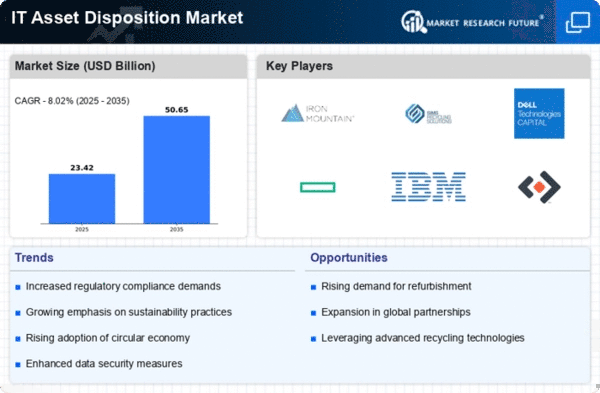
As per MRFR analysis, the IT Asset Disposition Market Size was estimated at 21.68 USD Billion in 2024. The IT Asset Disposition industry is projected to grow from 23.42 USD Billion in 2025 to 50.65 USD Billion by 2035, exhibiting a compound annual growth rate (CAGR) of 8.02% during the forecast period 2025 - 2035.

Key Market Trends & Highlights

The IT Asset Disposition Market is poised for growth driven by sustainability and security demands.

  • North America remains the largest market for IT asset disposition, reflecting a strong emphasis on data security and regulatory compliance. Asia-Pacific is emerging as the fastest-growing region, propelled by increasing technological adoption and sustainability initiatives. The data destruction segment continues to dominate the market, while the remarketing segment is experiencing rapid growth due to rising demand for refurbished devices. Key market drivers include sustainability initiatives and enhanced data security, which are shaping the future of IT asset disposition.

Market Size & Forecast

2024 Market Size 21.68 (USD Billion)
2035 Market Size 50.65 (USD Billion)
CAGR (2025 - 2035) 8.02%
Largest Regional Market Share in 2024 North America

Major Players

Iron Mountain (US), Sims Recycling Solutions (US), Dell Technologies (US), Hewlett Packard Enterprise (US), IBM (US), Cimpress (IE), GEEP (CA), Ecovadis (FR), Arrow Electronics (US)

Market Trends

The IT Asset Disposition Market is currently experiencing a notable transformation driven by the increasing emphasis on sustainability and data security. Organizations are becoming more aware of the environmental impact of electronic waste, leading to a growing demand for responsible disposal methods. This shift is prompting companies to seek IT asset disposition services that not only ensure compliance with regulations but also promote eco-friendly practices. As a result, service providers are adapting their offerings to include recycling, refurbishment, and resale options, thereby enhancing their value propositions. Furthermore, the rise of remote work and digital transformation initiatives has led to an uptick in the volume of retired IT assets, necessitating efficient and secure disposition strategies. In addition to sustainability, the IT Asset Disposition Market is witnessing an increased focus on data protection. With the proliferation of data breaches and stringent regulations surrounding data privacy, organizations are prioritizing secure data destruction methods. This trend is compelling service providers to invest in advanced technologies and processes that guarantee the complete eradication of sensitive information from retired devices. Consequently, the market is evolving to meet these heightened security demands, ensuring that businesses can confidently dispose of their IT assets without compromising their data integrity. Asset disposition plays a critical role in managing the end-of-life lifecycle of enterprise IT equipment in the modern digital economy. Information technology asset disposition involves the secure, compliant, and environmentally responsible disposal of retired IT equipment. IT asset disposition (ITAD) refers to the systematic process of retiring, recycling, and securely destroying obsolete IT assets. 

Sustainability Initiatives

The IT Asset Disposition Market is increasingly influenced by sustainability initiatives, as organizations strive to minimize their environmental footprint. This trend encourages the adoption of eco-friendly disposal methods, including recycling and refurbishment, which not only comply with regulations but also promote responsible waste management. The ITAD industry is evolving rapidly as regulatory compliance and sustainability become top priorities for enterprises. Global IT asset disposition companies such as Iron Mountain and Dell Technologies dominate the competitive landscape. The largest ITAD companies continue to strengthen their market positions through acquisitions and global expansion. 

Enhanced Data Security

As data breaches become more prevalent, the IT Asset Disposition Market is seeing a heightened emphasis on data security. Organizations are prioritizing secure data destruction methods, prompting service providers to implement advanced technologies that ensure the complete eradication of sensitive information from retired devices. The data center IT asset disposition market is expanding rapidly as hyperscale facilities retire large volumes of servers and networking equipment. Information technology asset disposition (ITAD) plays a vital role in enabling secure and sustainable asset disposition across enterprises.

Regulatory Compliance

The landscape of the IT Asset Disposition Market is shaped by evolving regulatory requirements. Organizations must adhere to strict guidelines regarding electronic waste disposal and data protection. This trend drives demand for compliant services, compelling providers to stay updated on regulations and enhance their offerings.

IT Asset Disposition Market Market Drivers

Rising Data Security Threats

The surge in data security threats is a crucial driver for the Global IT Asset Disposition Market ITAD Market Industry. Cybersecurity incidents are becoming more prevalent, prompting organizations to prioritize secure data destruction during asset disposal. High-profile data breaches have underscored the importance of safeguarding sensitive information, leading to increased investments in ITAD services. Companies are seeking certified ITAD providers to ensure compliance with data protection regulations and mitigate risks associated with data leaks. This heightened focus on data security is likely to bolster the market, as organizations recognize the necessity of secure IT asset disposal.

Growing Environmental Concerns

Environmental sustainability is a pivotal driver in the Global IT Asset Disposition Market ITAD Market Industry. With increasing awareness of electronic waste and its detrimental effects on the environment, organizations are compelled to adopt responsible disposal practices. Governments are promoting recycling initiatives and encouraging businesses to minimize their carbon footprint. For example, the U.S. Environmental Protection Agency (EPA) emphasizes the importance of e-waste recycling. This growing environmental consciousness is likely to propel the market, as companies seek ITAD solutions that align with sustainability goals. The Global IT Asset Disposition Market ITAD Market Industry is expected to grow significantly, potentially reaching 50.7 USD Billion by 2035.

Increasing Regulatory Compliance

The Global IT Asset Disposition Market ITAD Market Industry is experiencing heightened demand due to increasing regulatory compliance requirements. Governments worldwide are implementing stringent regulations regarding data protection and environmental sustainability. For instance, the General Data Protection Regulation (GDPR) in Europe mandates strict data handling practices, compelling organizations to ensure secure disposal of IT assets. This regulatory landscape drives companies to seek reliable ITAD services, thereby expanding the market. As organizations prioritize compliance, the Global IT Asset Disposition Market ITAD Market Industry is projected to reach 21.3 USD Billion in 2024, reflecting the urgency for secure and compliant asset disposal.

Rapid Technological Advancements

Technological advancements are reshaping the Global IT Asset Disposition Market ITAD Market Industry. The rapid pace of innovation leads to frequent upgrades of IT equipment, resulting in a growing volume of obsolete assets. Organizations are increasingly aware of the need to dispose of outdated technology securely and responsibly. As new technologies emerge, such as cloud computing and artificial intelligence, the demand for efficient ITAD solutions intensifies. This trend indicates a robust growth trajectory for the market, with a projected compound annual growth rate of 8.2% from 2025 to 2035. Consequently, businesses are investing in ITAD services to manage their asset lifecycle effectively.

Increased Adoption of Circular Economy Practices

The Global IT Asset Disposition Market ITAD Market Industry is witnessing a shift towards circular economy practices. Organizations are increasingly adopting strategies that emphasize the reuse and recycling of IT assets to minimize waste and maximize resource efficiency. This trend aligns with global sustainability goals and is supported by government initiatives promoting circular economy principles. As businesses strive to reduce their environmental impact, the demand for ITAD services that facilitate asset recovery and responsible recycling is likely to grow. This shift not only enhances corporate social responsibility but also contributes to the overall expansion of the Global IT Asset Disposition Market ITAD Market Industry.

Market Segment Insights

By Application: Data Destruction (Largest) vs. Remarketing (Fastest-Growing)

<p>The IT Asset Disposition Market segments itself into Data Destruction, Recycling, Remarketing, and Asset Recovery, each holding significant market shares. Among these, Data Destruction stands out as the largest segment due to the increasing need for stringent security measures in data handling. This heightened awareness of data privacy regulations and security compliance has propelled Data Destruction to the forefront, while Recycling and Asset Recovery follow closely. Remarketing has emerged as a vital segment as organizations seek to maximize value from retired IT assets, making it an area of growing interest in the market.</p>

<p>Data Destruction (Dominant) vs. Remarketing (Emerging)</p>

<p>Data Destruction is the dominant segment in the IT Asset Disposition Market, largely driven by the necessity for organizations to protect sensitive information. This segment offers comprehensive solutions that ensure physical destruction or overwriting of data, thus reducing the risks associated with data breaches. Conversely, Remarketing is the emerging segment, characterized by the refurbishment and resale of retired IT assets. Companies are increasingly realizing the potential to recoup costs through effective remarketing strategies, leading to a rise in demand for services that can facilitate the resale of pre-owned hardware. Both segments are essential, with Data Destruction focusing on security and Remarketing emphasizing value recovery from retired assets.</p>

By End Use: IT Companies (Largest) vs. Healthcare (Fastest-Growing)

<p>In the IT Asset Disposition Market, IT Companies represent the largest segment due to their extensive need to securely dispose of obsolete hardware and data. This sector benefits from the rise in cybersecurity measures, making it imperative for companies to utilize professional disposal services to prevent data breaches. Meanwhile, Healthcare is rapidly gaining ground as a significant player, emphasizing the need for compliance with stringent regulations governing the disposal of sensitive patient information and medical devices.</p>

<p>IT Companies (Dominant) vs. Healthcare (Emerging)</p>

<p>The IT Companies segment is characterized by a high volume of electronic disposals, leveraging advanced asset recovery solutions and data destruction techniques. This category prioritizes urgency, confidentiality, and environmental compliance, as these firms often manage a large amount of sensitive information. In contrast, Healthcare has emerged as a fast-growing segment driven by heightened regulatory scrutiny and an increasing focus on data privacy. Organizations within this sector are investing more in secure IT asset disposition methods to mitigate risks associated with data breaches, positioning Healthcare as a vital player in the ongoing digital transformation.</p>

By Service Type: Data Sanitization Services (Largest) vs. On-site Services (Fastest-Growing)

<p>The IT Asset Disposition Market has seen distinct distribution among its service types, with Data Sanitization Services holding the largest share due to escalating concerns regarding data security and regulatory compliance. Off-site Services and Logistics Services follow, catering to businesses looking to streamline asset management. On-site Services have gained traction, reflecting a growing trend towards companies prioritizing immediate data security solutions and control during the disposal process.</p>

<p>Data Sanitization Services (Dominant) vs. On-site Services (Emerging)</p>

<p>Data Sanitization Services have emerged as the dominant player in the IT Asset Disposition sector, driven by an increasing awareness of data breaches and stringent data protection regulations. These services ensure that sensitive information is irretrievably erased, thus protecting client privacy. In contrast, On-site Services are an emerging aspect of this market, offering convenience and real-time oversight to enterprises looking to mitigate risks associated with asset disposal. As organizations prioritize effective data management right at their premises, On-site Services are witnessing rapid adoption, positioning them as a pivotal solution in the broader IT Asset Disposition landscape.</p>

By Asset Type: Computers (Largest) vs. Mobile Devices (Fastest-Growing)

<p>In the IT Asset Disposition Market, the asset type segment exhibits varied distribution across its major categories. Computers dominate this segment, holding the largest share due to their widespread use in corporate settings. As organizations continue to upgrade their technology, computers generate significant volumes of surplus equipment that require responsible disposal. Following closely are mobile devices, which are rapidly gaining prominence as users shift towards handheld technology, thus creating challenges and opportunities in the disposition process.</p>

<p>Devices: Computers (Dominant) vs. Mobile Devices (Emerging)</p>

<p>Computers have firmly established their dominance in the IT Asset Disposition Market due to their extensive usage and the regularity of upgrades within corporate environments. These devices typically consist of desktops and laptops that are phased out to make way for newer models. On the other hand, mobile devices, which include smartphones and tablets, represent an emerging sector fueled by consumer demand and technological advances. With the relentless pace of innovation, these devices have the fastest-growing market segment, making their disposal an increasingly critical focus for businesses to manage securely and sustainably.</p>

Get more detailed insights about IT Asset Disposition (ITAD) Market Research Report - Global Forecast till 2035

Regional Insights

North America : Market Leader in ITAD

North America continues to lead the IT Asset Disposition (ITAD) market, holding a significant share of 10.5 in 2025. The region's growth is driven by stringent regulations on electronic waste disposal and increasing awareness of data security. Companies are increasingly adopting ITAD services to ensure compliance and sustainability, which is further fueled by government initiatives promoting responsible recycling practices. The competitive landscape is robust, with key players like Iron Mountain, Dell Technologies, and IBM dominating the market. The U.S. is the primary contributor, supported by a strong infrastructure for e-waste management. As organizations prioritize secure data destruction and environmental responsibility, the demand for ITAD services is expected to rise, solidifying North America's position as a market leader.

Europe : Emerging ITAD Hub

Europe's IT Asset Disposition market is projected to reach 6.5 by 2025, driven by increasing regulatory pressures and a growing emphasis on sustainability. The European Union's Waste Electrical and Electronic Equipment (WEEE) Directive mandates responsible disposal and recycling of electronic waste, which is a significant catalyst for market growth. Companies are investing in ITAD solutions to comply with these regulations and enhance their corporate social responsibility initiatives. Leading countries such as Germany, the UK, and France are at the forefront of this market, with a competitive landscape featuring players like Cimpress and Ecovadis. The presence of established ITAD providers and a growing number of startups are contributing to innovation and service diversification. As businesses seek to optimize their IT asset lifecycle, the demand for ITAD services is expected to rise significantly.

Asia-Pacific : Rapidly Growing Market

The Asia-Pacific region is witnessing rapid growth in the IT Asset Disposition market, projected to reach 4.5 by 2025. This growth is fueled by increasing digitalization, rising e-waste generation, and a growing awareness of data security among businesses. Governments in countries like China and India are implementing stricter regulations on e-waste management, which is driving demand for ITAD services. Key players in this region include Dell Technologies and Arrow Electronics, with a competitive landscape that is becoming increasingly dynamic. Countries such as Japan and Australia are also emerging as significant markets, with local firms enhancing their ITAD capabilities. As organizations prioritize secure disposal and compliance, the ITAD market in Asia-Pacific is expected to expand rapidly, reflecting the region's growing technological landscape.

Middle East and Africa : Developing ITAD Landscape

The Middle East and Africa (MEA) region is in the early stages of developing its IT Asset Disposition market, with a projected size of 0.18 by 2025. The growth is primarily driven by increasing awareness of data security and the need for responsible e-waste management. Governments are beginning to recognize the importance of ITAD services, leading to the formulation of regulations aimed at promoting sustainable practices. Countries like South Africa and the UAE are taking the lead in establishing frameworks for ITAD, with local players starting to emerge. However, the market remains fragmented, with many organizations still unaware of the benefits of ITAD. As awareness grows and regulations tighten, the potential for market expansion in the MEA region is significant, paving the way for future growth.

Key Players and Competitive Insights

The IT Asset Disposition Market is characterized by a dynamic competitive landscape, driven by the increasing need for secure data destruction and environmental sustainability. Leading asset disposition companies are expanding their service portfolios to address rising data security and sustainability demands Key players such as Iron Mountain (US), Dell Technologies (US), and Sims Recycling Solutions (US) are strategically positioned to leverage these trends. Iron Mountain (US) focuses on expanding its service offerings through technological innovation and partnerships, enhancing its capabilities in data security and compliance. Meanwhile, Dell Technologies (US) emphasizes sustainability in its operations, aiming to reduce electronic waste through its circular economy initiatives. Sims Recycling Solutions (US) adopts a comprehensive approach to asset recovery, integrating advanced recycling technologies to maximize resource recovery and minimize environmental impact. Collectively, these strategies shape a competitive environment that prioritizes security, sustainability, and technological advancement.In terms of business tactics, companies are increasingly localizing their operations to enhance supply chain efficiency and responsiveness to regional demands. The market appears moderately fragmented, with a mix of large multinational corporations and smaller specialized firms. This structure allows for diverse service offerings, yet the influence of key players remains substantial, as they set industry standards and drive innovation.
In November Iron Mountain (US) announced a strategic partnership with a leading cybersecurity firm to enhance its data protection services. This collaboration is poised to strengthen Iron Mountain's position in the market by integrating advanced cybersecurity measures into its asset disposition processes, thereby addressing growing concerns over data breaches and compliance. The partnership underscores the importance of security in IT asset disposition, aligning with market demands for robust data protection.
In October Dell Technologies (US) launched a new initiative aimed at increasing the recycling rate of its products to 100% by 2030. This ambitious goal reflects Dell's commitment to sustainability and positions the company as a leader in environmentally responsible IT asset disposition. By focusing on circular economy principles, Dell not only enhances its brand reputation but also responds to consumer preferences for sustainable practices, potentially attracting a broader customer base.
In September Sims Recycling Solutions (US) expanded its operations in Europe by acquiring a local recycling firm. This acquisition is strategically significant as it allows Sims to enhance its service capabilities and market reach in a region where demand for responsible e-waste management is growing. The move indicates a trend towards consolidation in the market, as companies seek to strengthen their competitive positions through strategic acquisitions.
As of December the IT Asset Disposition Market is increasingly defined by trends such as digitalization, sustainability, and the integration of artificial intelligence (AI) in operations. Strategic alliances are becoming more prevalent, enabling companies to pool resources and expertise to address complex challenges. Looking ahead, competitive differentiation is likely to evolve, shifting from price-based competition to a focus on innovation, technology, and supply chain reliability. Companies that can effectively leverage these trends will likely secure a competitive edge in the market.

Key Companies in the IT Asset Disposition Market include

Industry Developments

  • Q2 2024: Iron Mountain Completes Acquisition of Regency Technologies, Expanding IT Asset Disposition Market Capabilities Iron Mountain announced the completion of its acquisition of Regency Technologies, a leading provider of IT asset disposition (ITAD) services, to strengthen its position in secure IT asset lifecycle management.
  • Q1 2024: Sims Lifecycle Services Opens New IT Asset Disposition Market Facility in Atlanta Sims Lifecycle Services opened a new ITAD processing facility in Atlanta, Georgia, expanding its North American footprint and increasing capacity for secure electronics recycling and data destruction.
  • Q2 2024: Apto Solutions Announces Partnership with Dell Technologies for Secure IT Asset Disposition Market Apto Solutions entered into a partnership with Dell Technologies to provide secure IT asset disposition services for Dell’s enterprise customers, focusing on data security and environmental compliance.
  • Q3 2024: TES (SK ecoplant) Launches New IT Asset Disposition Market Service for Cloud Data Centers TES, a subsidiary of SK ecoplant, launched a specialized ITAD service targeting cloud data centers, offering secure decommissioning and recycling of end-of-life servers and networking equipment.
  • Q2 2024: Ingram Micro ITAD Expands Operations with New Facility in Singapore Ingram Micro ITAD opened a new processing facility in Singapore to serve the growing demand for secure IT asset disposition and e-waste recycling in Southeast Asia.
  • Q1 2025: Iron Mountain Appoints New Head of IT Asset Disposition Market Business Unit Iron Mountain announced the appointment of a new executive to lead its IT Asset Disposition Market business unit, aiming to drive growth and innovation in secure asset lifecycle services.
  • Q2 2025: Sims Lifecycle Services Wins Major IT Asset Disposition Market Contract with European Bank Sims Lifecycle Services secured a multi-year contract to provide IT asset disposition and data destruction services for a leading European financial institution.
  • Q1 2024: LifeSpan International Expands ITAD Services to Latin America LifeSpan International announced the expansion of its IT asset disposition services into Latin America, establishing new partnerships and logistics capabilities in the region.
  • Q3 2024: CompuCom Launches Enhanced IT Asset Disposition Market Platform with Blockchain Tracking CompuCom introduced a new ITAD platform featuring blockchain-based tracking for improved transparency and auditability in the asset disposition process.
  • Q2 2024: Cascade Asset Management Receives R2v3 Certification for IT Asset Disposition Market Facilities Cascade Asset Management achieved R2v3 certification for its ITAD facilities, demonstrating compliance with the latest industry standards for responsible recycling and data security.
  • Q4 2024: Dell Technologies Expands Circular Economy Program with New IT Asset Recovery Services Dell Technologies expanded its circular economy initiatives by launching new IT asset recovery and disposition services, enabling customers to securely retire and recycle end-of-life equipment.
  • Q1 2025: Iron Mountain Secures IT Asset Disposition Market Contract with U.S. Federal Agency Iron Mountain was awarded a contract to provide IT asset disposition and secure data destruction services for a major U.S. federal government agency.

IT Asset Disposition Market (ITAD)

Future Outlook

IT Asset Disposition Market Future Outlook

The IT Asset Disposition Market is projected to grow at 8.02% CAGR from 2025 to 2035, driven by increasing regulatory compliance and sustainability initiatives.

New opportunities lie in:

  • <p>Development of advanced data sanitization technologies for secure disposal. Expansion of reverse logistics services to streamline asset recovery. Partnerships with e-waste recycling firms to enhance sustainability efforts.</p>

By 2035, the market is expected to be robust, driven by innovation and strategic partnerships.

Market Segmentation

IT Asset Disposition Market End User Outlook

  • Corporations
  • Government Agencies
  • Educational Institutions
  • Healthcare Organizations

IT Asset Disposition Market Asset Type Outlook

  • Computers
  • Mobile Devices
  • Networking Equipment
  • Storage Devices

IT Asset Disposition Market Service Type Outlook

  • Recycling
  • Resale
  • Data Destruction
  • Remarketing

IT Asset Disposition Market Lifecycle Stage Outlook

  • Deployment
  • Maintenance
  • Disposal
  • Recovery

Report Scope

MARKET SIZE 2024 21.68(USD Billion)
MARKET SIZE 2025 23.42(USD Billion)
MARKET SIZE 2035 50.65(USD Billion)
COMPOUND ANNUAL GROWTH RATE (CAGR) 8.02% (2025 - 2035)
REPORT COVERAGE Revenue Forecast, Competitive Landscape, Growth Factors, and Trends
BASE YEAR 2024
Market Forecast Period 2025 - 2035
Historical Data 2019 - 2024
Market Forecast Units USD Billion
Key Companies Profiled Iron Mountain (US), Sims Recycling Solutions (US), Dell Technologies (US), Hewlett Packard Enterprise (US), IBM (US), Cimpress (IE), GEEP (CA), Ecovadis (FR), Arrow Electronics (US)
Segments Covered Service Type, Asset Type, End User, Lifecycle Stage
Key Market Opportunities Integration of advanced data security measures in IT Asset Disposition Market enhances compliance and consumer trust.
Key Market Dynamics Rising regulatory scrutiny drives demand for compliant IT asset disposition solutions amid evolving technological landscapes.
Countries Covered North America, Europe, APAC, South America, MEA

FAQs

What is the current valuation of the IT Asset Disposition Market as of 2024?

<p>The IT Asset Disposition Market was valued at 21.68 USD Billion in 2024.</p>

What is the projected market size for the IT Asset Disposition Market in 2035?

<p>The market is projected to reach 50.65 USD Billion by 2035.</p>

What is the expected CAGR for the IT Asset Disposition Market during the forecast period 2025 - 2035?

<p>The expected CAGR for the IT Asset Disposition Market during 2025 - 2035 is 8.02%.</p>

Which companies are considered key players in the IT Asset Disposition Market?

<p>Key players include Iron Mountain, Sims Recycling Solutions, Dell Technologies, Hewlett Packard Enterprise, and IBM.</p>

What are the primary applications of IT Asset Disposition services?

<p>The primary applications include Data Destruction, Recycling, Remarketing, and Asset Recovery.</p>

How much revenue is generated from Data Sanitization Services in the IT Asset Disposition Market?

<p>Data Sanitization Services generated approximately 9.93 USD Billion in 2024 and are projected to reach 21.15 USD Billion by 2035.</p>

What is the revenue outlook for the Healthcare sector in the IT Asset Disposition Market?

The Healthcare sector was valued at 5.0 USD Billion in 2024 and is expected to grow to 12.0 USD Billion by 2035.

What segment of the IT Asset Disposition Market is projected to see the highest growth?

Remarketing is projected to grow from 6.0 USD Billion in 2024 to 14.0 USD Billion by 2035.

What types of assets are primarily involved in IT Asset Disposition?

The primary asset types include Computers, Mobile Devices, Networking Equipment, and Storage Devices.

What is the revenue potential for On-site Services in the IT Asset Disposition Market?

On-site Services were valued at 3.25 USD Billion in 2024 and are projected to reach 7.5 USD Billion by 2035.

  1. SECTION I: EXECUTIVE SUMMARY AND KEY HIGHLIGHTS
    1. | 1.1 EXECUTIVE SUMMARY
    2. | | 1.1.1 Market Overview
    3. | | 1.1.2 Key Findings
    4. | | 1.1.3 Market Segmentation
    5. | | 1.1.4 Competitive Landscape
    6. | | 1.1.5 Challenges and Opportunities
    7. | | 1.1.6 Future Outlook
  2. SECTION II: SCOPING, METHODOLOGY AND MARKET STRUCTURE
    1. | 2.1 MARKET INTRODUCTION
    2. | | 2.1.1 Definition
    3. | | 2.1.2 Scope of the study
    4. | | | 2.1.2.1 Research Objective
    5. | | | 2.1.2.2 Assumption
    6. | | | 2.1.2.3 Limitations
    7. | 2.2 RESEARCH METHODOLOGY
    8. | | 2.2.1 Overview
    9. | | 2.2.2 Data Mining
    10. | | 2.2.3 Secondary Research
    11. | | 2.2.4 Primary Research
    12. | | | 2.2.4.1 Primary Interviews and Information Gathering Process
    13. | | | 2.2.4.2 Breakdown of Primary Respondents
    14. | | 2.2.5 Forecasting Model
    15. | | 2.2.6 Market Size Estimation
    16. | | | 2.2.6.1 Bottom-Up Approach
    17. | | | 2.2.6.2 Top-Down Approach
    18. | | 2.2.7 Data Triangulation
    19. | | 2.2.8 Validation
  3. SECTION III: QUALITATIVE ANALYSIS
    1. | 3.1 MARKET DYNAMICS
    2. | | 3.1.1 Overview
    3. | | 3.1.2 Drivers
    4. | | 3.1.3 Restraints
    5. | | 3.1.4 Opportunities
    6. | 3.2 MARKET FACTOR ANALYSIS
    7. | | 3.2.1 Value chain Analysis
    8. | | 3.2.2 Porter's Five Forces Analysis
    9. | | | 3.2.2.1 Bargaining Power of Suppliers
    10. | | | 3.2.2.2 Bargaining Power of Buyers
    11. | | | 3.2.2.3 Threat of New Entrants
    12. | | | 3.2.2.4 Threat of Substitutes
    13. | | | 3.2.2.5 Intensity of Rivalry
    14. | | 3.2.3 COVID-19 Impact Analysis
    15. | | | 3.2.3.1 Market Impact Analysis
    16. | | | 3.2.3.2 Regional Impact
    17. | | | 3.2.3.3 Opportunity and Threat Analysis
  4. SECTION IV: QUANTITATIVE ANALYSIS
    1. | 4.1 Information and Communications Technology, BY Application (USD Billion)
    2. | | 4.1.1 Data Destruction
    3. | | 4.1.2 Recycling
    4. | | 4.1.3 Remarketing
    5. | | 4.1.4 Asset Recovery
    6. | 4.2 Information and Communications Technology, BY End Use (USD Billion)
    7. | | 4.2.1 IT Companies
    8. | | 4.2.2 Healthcare
    9. | | 4.2.3 Education
    10. | | 4.2.4 Government
    11. | 4.3 Information and Communications Technology, BY Service Type (USD Billion)
    12. | | 4.3.1 On-site Services
    13. | | 4.3.2 Off-site Services
    14. | | 4.3.3 Logistics Services
    15. | | 4.3.4 Data Sanitization Services
    16. | 4.4 Information and Communications Technology, BY Asset Type (USD Billion)
    17. | | 4.4.1 Computers
    18. | | 4.4.2 Mobile Devices
    19. | | 4.4.3 Networking Equipment
    20. | | 4.4.4 Storage Devices
    21. | 4.5 Information and Communications Technology, BY Region (USD Billion)
    22. | | 4.5.1 North America
    23. | | | 4.5.1.1 US
    24. | | | 4.5.1.2 Canada
    25. | | 4.5.2 Europe
    26. | | | 4.5.2.1 Germany
    27. | | | 4.5.2.2 UK
    28. | | | 4.5.2.3 France
    29. | | | 4.5.2.4 Russia
    30. | | | 4.5.2.5 Italy
    31. | | | 4.5.2.6 Spain
    32. | | | 4.5.2.7 Rest of Europe
    33. | | 4.5.3 APAC
    34. | | | 4.5.3.1 China
    35. | | | 4.5.3.2 India
    36. | | | 4.5.3.3 Japan
    37. | | | 4.5.3.4 South Korea
    38. | | | 4.5.3.5 Malaysia
    39. | | | 4.5.3.6 Thailand
    40. | | | 4.5.3.7 Indonesia
    41. | | | 4.5.3.8 Rest of APAC
    42. | | 4.5.4 South America
    43. | | | 4.5.4.1 Brazil
    44. | | | 4.5.4.2 Mexico
    45. | | | 4.5.4.3 Argentina
    46. | | | 4.5.4.4 Rest of South America
    47. | | 4.5.5 MEA
    48. | | | 4.5.5.1 GCC Countries
    49. | | | 4.5.5.2 South Africa
    50. | | | 4.5.5.3 Rest of MEA
  5. SECTION V: COMPETITIVE ANALYSIS
    1. | 5.1 Competitive Landscape
    2. | | 5.1.1 Overview
    3. | | 5.1.2 Competitive Analysis
    4. | | 5.1.3 Market share Analysis
    5. | | 5.1.4 Major Growth Strategy in the Information and Communications Technology
    6. | | 5.1.5 Competitive Benchmarking
    7. | | 5.1.6 Leading Players in Terms of Number of Developments in the Information and Communications Technology
    8. | | 5.1.7 Key developments and growth strategies
    9. | | | 5.1.7.1 New Product Launch/Service Deployment
    10. | | | 5.1.7.2 Merger & Acquisitions
    11. | | | 5.1.7.3 Joint Ventures
    12. | | 5.1.8 Major Players Financial Matrix
    13. | | | 5.1.8.1 Sales and Operating Income
    14. | | | 5.1.8.2 Major Players R&D Expenditure. 2023
    15. | 5.2 Company Profiles
    16. | | 5.2.1 Iron Mountain (US)
    17. | | | 5.2.1.1 Financial Overview
    18. | | | 5.2.1.2 Products Offered
    19. | | | 5.2.1.3 Key Developments
    20. | | | 5.2.1.4 SWOT Analysis
    21. | | | 5.2.1.5 Key Strategies
    22. | | 5.2.2 Sims Recycling Solutions (US)
    23. | | | 5.2.2.1 Financial Overview
    24. | | | 5.2.2.2 Products Offered
    25. | | | 5.2.2.3 Key Developments
    26. | | | 5.2.2.4 SWOT Analysis
    27. | | | 5.2.2.5 Key Strategies
    28. | | 5.2.3 Dell Technologies (US)
    29. | | | 5.2.3.1 Financial Overview
    30. | | | 5.2.3.2 Products Offered
    31. | | | 5.2.3.3 Key Developments
    32. | | | 5.2.3.4 SWOT Analysis
    33. | | | 5.2.3.5 Key Strategies
    34. | | 5.2.4 Hewlett Packard Enterprise (US)
    35. | | | 5.2.4.1 Financial Overview
    36. | | | 5.2.4.2 Products Offered
    37. | | | 5.2.4.3 Key Developments
    38. | | | 5.2.4.4 SWOT Analysis
    39. | | | 5.2.4.5 Key Strategies
    40. | | 5.2.5 IBM (US)
    41. | | | 5.2.5.1 Financial Overview
    42. | | | 5.2.5.2 Products Offered
    43. | | | 5.2.5.3 Key Developments
    44. | | | 5.2.5.4 SWOT Analysis
    45. | | | 5.2.5.5 Key Strategies
    46. | | 5.2.6 Cimpress (IE)
    47. | | | 5.2.6.1 Financial Overview
    48. | | | 5.2.6.2 Products Offered
    49. | | | 5.2.6.3 Key Developments
    50. | | | 5.2.6.4 SWOT Analysis
    51. | | | 5.2.6.5 Key Strategies
    52. | | 5.2.7 GEEP (CA)
    53. | | | 5.2.7.1 Financial Overview
    54. | | | 5.2.7.2 Products Offered
    55. | | | 5.2.7.3 Key Developments
    56. | | | 5.2.7.4 SWOT Analysis
    57. | | | 5.2.7.5 Key Strategies
    58. | | 5.2.8 Ecovadis (FR)
    59. | | | 5.2.8.1 Financial Overview
    60. | | | 5.2.8.2 Products Offered
    61. | | | 5.2.8.3 Key Developments
    62. | | | 5.2.8.4 SWOT Analysis
    63. | | | 5.2.8.5 Key Strategies
    64. | | 5.2.9 Arrow Electronics (US)
    65. | | | 5.2.9.1 Financial Overview
    66. | | | 5.2.9.2 Products Offered
    67. | | | 5.2.9.3 Key Developments
    68. | | | 5.2.9.4 SWOT Analysis
    69. | | | 5.2.9.5 Key Strategies
    70. | 5.3 Appendix
    71. | | 5.3.1 References
    72. | | 5.3.2 Related Reports
  6. LIST OF FIGURES
    1. | 6.1 MARKET SYNOPSIS
    2. | 6.2 NORTH AMERICA MARKET ANALYSIS
    3. | 6.3 US MARKET ANALYSIS BY APPLICATION
    4. | 6.4 US MARKET ANALYSIS BY END USE
    5. | 6.5 US MARKET ANALYSIS BY SERVICE TYPE
    6. | 6.6 US MARKET ANALYSIS BY ASSET TYPE
    7. | 6.7 CANADA MARKET ANALYSIS BY APPLICATION
    8. | 6.8 CANADA MARKET ANALYSIS BY END USE
    9. | 6.9 CANADA MARKET ANALYSIS BY SERVICE TYPE
    10. | 6.10 CANADA MARKET ANALYSIS BY ASSET TYPE
    11. | 6.11 EUROPE MARKET ANALYSIS
    12. | 6.12 GERMANY MARKET ANALYSIS BY APPLICATION
    13. | 6.13 GERMANY MARKET ANALYSIS BY END USE
    14. | 6.14 GERMANY MARKET ANALYSIS BY SERVICE TYPE
    15. | 6.15 GERMANY MARKET ANALYSIS BY ASSET TYPE
    16. | 6.16 UK MARKET ANALYSIS BY APPLICATION
    17. | 6.17 UK MARKET ANALYSIS BY END USE
    18. | 6.18 UK MARKET ANALYSIS BY SERVICE TYPE
    19. | 6.19 UK MARKET ANALYSIS BY ASSET TYPE
    20. | 6.20 FRANCE MARKET ANALYSIS BY APPLICATION
    21. | 6.21 FRANCE MARKET ANALYSIS BY END USE
    22. | 6.22 FRANCE MARKET ANALYSIS BY SERVICE TYPE
    23. | 6.23 FRANCE MARKET ANALYSIS BY ASSET TYPE
    24. | 6.24 RUSSIA MARKET ANALYSIS BY APPLICATION
    25. | 6.25 RUSSIA MARKET ANALYSIS BY END USE
    26. | 6.26 RUSSIA MARKET ANALYSIS BY SERVICE TYPE
    27. | 6.27 RUSSIA MARKET ANALYSIS BY ASSET TYPE
    28. | 6.28 ITALY MARKET ANALYSIS BY APPLICATION
    29. | 6.29 ITALY MARKET ANALYSIS BY END USE
    30. | 6.30 ITALY MARKET ANALYSIS BY SERVICE TYPE
    31. | 6.31 ITALY MARKET ANALYSIS BY ASSET TYPE
    32. | 6.32 SPAIN MARKET ANALYSIS BY APPLICATION
    33. | 6.33 SPAIN MARKET ANALYSIS BY END USE
    34. | 6.34 SPAIN MARKET ANALYSIS BY SERVICE TYPE
    35. | 6.35 SPAIN MARKET ANALYSIS BY ASSET TYPE
    36. | 6.36 REST OF EUROPE MARKET ANALYSIS BY APPLICATION
    37. | 6.37 REST OF EUROPE MARKET ANALYSIS BY END USE
    38. | 6.38 REST OF EUROPE MARKET ANALYSIS BY SERVICE TYPE
    39. | 6.39 REST OF EUROPE MARKET ANALYSIS BY ASSET TYPE
    40. | 6.40 APAC MARKET ANALYSIS
    41. | 6.41 CHINA MARKET ANALYSIS BY APPLICATION
    42. | 6.42 CHINA MARKET ANALYSIS BY END USE
    43. | 6.43 CHINA MARKET ANALYSIS BY SERVICE TYPE
    44. | 6.44 CHINA MARKET ANALYSIS BY ASSET TYPE
    45. | 6.45 INDIA MARKET ANALYSIS BY APPLICATION
    46. | 6.46 INDIA MARKET ANALYSIS BY END USE
    47. | 6.47 INDIA MARKET ANALYSIS BY SERVICE TYPE
    48. | 6.48 INDIA MARKET ANALYSIS BY ASSET TYPE
    49. | 6.49 JAPAN MARKET ANALYSIS BY APPLICATION
    50. | 6.50 JAPAN MARKET ANALYSIS BY END USE
    51. | 6.51 JAPAN MARKET ANALYSIS BY SERVICE TYPE
    52. | 6.52 JAPAN MARKET ANALYSIS BY ASSET TYPE
    53. | 6.53 SOUTH KOREA MARKET ANALYSIS BY APPLICATION
    54. | 6.54 SOUTH KOREA MARKET ANALYSIS BY END USE
    55. | 6.55 SOUTH KOREA MARKET ANALYSIS BY SERVICE TYPE
    56. | 6.56 SOUTH KOREA MARKET ANALYSIS BY ASSET TYPE
    57. | 6.57 MALAYSIA MARKET ANALYSIS BY APPLICATION
    58. | 6.58 MALAYSIA MARKET ANALYSIS BY END USE
    59. | 6.59 MALAYSIA MARKET ANALYSIS BY SERVICE TYPE
    60. | 6.60 MALAYSIA MARKET ANALYSIS BY ASSET TYPE
    61. | 6.61 THAILAND MARKET ANALYSIS BY APPLICATION
    62. | 6.62 THAILAND MARKET ANALYSIS BY END USE
    63. | 6.63 THAILAND MARKET ANALYSIS BY SERVICE TYPE
    64. | 6.64 THAILAND MARKET ANALYSIS BY ASSET TYPE
    65. | 6.65 INDONESIA MARKET ANALYSIS BY APPLICATION
    66. | 6.66 INDONESIA MARKET ANALYSIS BY END USE
    67. | 6.67 INDONESIA MARKET ANALYSIS BY SERVICE TYPE
    68. | 6.68 INDONESIA MARKET ANALYSIS BY ASSET TYPE
    69. | 6.69 REST OF APAC MARKET ANALYSIS BY APPLICATION
    70. | 6.70 REST OF APAC MARKET ANALYSIS BY END USE
    71. | 6.71 REST OF APAC MARKET ANALYSIS BY SERVICE TYPE
    72. | 6.72 REST OF APAC MARKET ANALYSIS BY ASSET TYPE
    73. | 6.73 SOUTH AMERICA MARKET ANALYSIS
    74. | 6.74 BRAZIL MARKET ANALYSIS BY APPLICATION
    75. | 6.75 BRAZIL MARKET ANALYSIS BY END USE
    76. | 6.76 BRAZIL MARKET ANALYSIS BY SERVICE TYPE
    77. | 6.77 BRAZIL MARKET ANALYSIS BY ASSET TYPE
    78. | 6.78 MEXICO MARKET ANALYSIS BY APPLICATION
    79. | 6.79 MEXICO MARKET ANALYSIS BY END USE
    80. | 6.80 MEXICO MARKET ANALYSIS BY SERVICE TYPE
    81. | 6.81 MEXICO MARKET ANALYSIS BY ASSET TYPE
    82. | 6.82 ARGENTINA MARKET ANALYSIS BY APPLICATION
    83. | 6.83 ARGENTINA MARKET ANALYSIS BY END USE
    84. | 6.84 ARGENTINA MARKET ANALYSIS BY SERVICE TYPE
    85. | 6.85 ARGENTINA MARKET ANALYSIS BY ASSET TYPE
    86. | 6.86 REST OF SOUTH AMERICA MARKET ANALYSIS BY APPLICATION
    87. | 6.87 REST OF SOUTH AMERICA MARKET ANALYSIS BY END USE
    88. | 6.88 REST OF SOUTH AMERICA MARKET ANALYSIS BY SERVICE TYPE
    89. | 6.89 REST OF SOUTH AMERICA MARKET ANALYSIS BY ASSET TYPE
    90. | 6.90 MEA MARKET ANALYSIS
    91. | 6.91 GCC COUNTRIES MARKET ANALYSIS BY APPLICATION
    92. | 6.92 GCC COUNTRIES MARKET ANALYSIS BY END USE
    93. | 6.93 GCC COUNTRIES MARKET ANALYSIS BY SERVICE TYPE
    94. | 6.94 GCC COUNTRIES MARKET ANALYSIS BY ASSET TYPE
    95. | 6.95 SOUTH AFRICA MARKET ANALYSIS BY APPLICATION
    96. | 6.96 SOUTH AFRICA MARKET ANALYSIS BY END USE
    97. | 6.97 SOUTH AFRICA MARKET ANALYSIS BY SERVICE TYPE
    98. | 6.98 SOUTH AFRICA MARKET ANALYSIS BY ASSET TYPE
    99. | 6.99 REST OF MEA MARKET ANALYSIS BY APPLICATION
    100. | 6.100 REST OF MEA MARKET ANALYSIS BY END USE
    101. | 6.101 REST OF MEA MARKET ANALYSIS BY SERVICE TYPE
    102. | 6.102 REST OF MEA MARKET ANALYSIS BY ASSET TYPE
    103. | 6.103 KEY BUYING CRITERIA OF INFORMATION AND COMMUNICATIONS TECHNOLOGY
    104. | 6.104 RESEARCH PROCESS OF MRFR
    105. | 6.105 DRO ANALYSIS OF INFORMATION AND COMMUNICATIONS TECHNOLOGY
    106. | 6.106 DRIVERS IMPACT ANALYSIS: INFORMATION AND COMMUNICATIONS TECHNOLOGY
    107. | 6.107 RESTRAINTS IMPACT ANALYSIS: INFORMATION AND COMMUNICATIONS TECHNOLOGY
    108. | 6.108 SUPPLY / VALUE CHAIN: INFORMATION AND COMMUNICATIONS TECHNOLOGY
    109. | 6.109 INFORMATION AND COMMUNICATIONS TECHNOLOGY, BY APPLICATION, 2024 (% SHARE)
    110. | 6.110 INFORMATION AND COMMUNICATIONS TECHNOLOGY, BY APPLICATION, 2024 TO 2035 (USD Billion)
    111. | 6.111 INFORMATION AND COMMUNICATIONS TECHNOLOGY, BY END USE, 2024 (% SHARE)
    112. | 6.112 INFORMATION AND COMMUNICATIONS TECHNOLOGY, BY END USE, 2024 TO 2035 (USD Billion)
    113. | 6.113 INFORMATION AND COMMUNICATIONS TECHNOLOGY, BY SERVICE TYPE, 2024 (% SHARE)
    114. | 6.114 INFORMATION AND COMMUNICATIONS TECHNOLOGY, BY SERVICE TYPE, 2024 TO 2035 (USD Billion)
    115. | 6.115 INFORMATION AND COMMUNICATIONS TECHNOLOGY, BY ASSET TYPE, 2024 (% SHARE)
    116. | 6.116 INFORMATION AND COMMUNICATIONS TECHNOLOGY, BY ASSET TYPE, 2024 TO 2035 (USD Billion)
    117. | 6.117 BENCHMARKING OF MAJOR COMPETITORS
  7. LIST OF TABLES
    1. | 7.1 LIST OF ASSUMPTIONS
    2. | | 7.1.1
    3. | 7.2 North America MARKET SIZE ESTIMATES; FORECAST
    4. | | 7.2.1 BY APPLICATION, 2025-2035 (USD Billion)
    5. | | 7.2.2 BY END USE, 2025-2035 (USD Billion)
    6. | | 7.2.3 BY SERVICE TYPE, 2025-2035 (USD Billion)
    7. | | 7.2.4 BY ASSET TYPE, 2025-2035 (USD Billion)
    8. | 7.3 US MARKET SIZE ESTIMATES; FORECAST
    9. | | 7.3.1 BY APPLICATION, 2025-2035 (USD Billion)
    10. | | 7.3.2 BY END USE, 2025-2035 (USD Billion)
    11. | | 7.3.3 BY SERVICE TYPE, 2025-2035 (USD Billion)
    12. | | 7.3.4 BY ASSET TYPE, 2025-2035 (USD Billion)
    13. | 7.4 Canada MARKET SIZE ESTIMATES; FORECAST
    14. | | 7.4.1 BY APPLICATION, 2025-2035 (USD Billion)
    15. | | 7.4.2 BY END USE, 2025-2035 (USD Billion)
    16. | | 7.4.3 BY SERVICE TYPE, 2025-2035 (USD Billion)
    17. | | 7.4.4 BY ASSET TYPE, 2025-2035 (USD Billion)
    18. | 7.5 Europe MARKET SIZE ESTIMATES; FORECAST
    19. | | 7.5.1 BY APPLICATION, 2025-2035 (USD Billion)
    20. | | 7.5.2 BY END USE, 2025-2035 (USD Billion)
    21. | | 7.5.3 BY SERVICE TYPE, 2025-2035 (USD Billion)
    22. | | 7.5.4 BY ASSET TYPE, 2025-2035 (USD Billion)
    23. | 7.6 Germany MARKET SIZE ESTIMATES; FORECAST
    24. | | 7.6.1 BY APPLICATION, 2025-2035 (USD Billion)
    25. | | 7.6.2 BY END USE, 2025-2035 (USD Billion)
    26. | | 7.6.3 BY SERVICE TYPE, 2025-2035 (USD Billion)
    27. | | 7.6.4 BY ASSET TYPE, 2025-2035 (USD Billion)
    28. | 7.7 UK MARKET SIZE ESTIMATES; FORECAST
    29. | | 7.7.1 BY APPLICATION, 2025-2035 (USD Billion)
    30. | | 7.7.2 BY END USE, 2025-2035 (USD Billion)
    31. | | 7.7.3 BY SERVICE TYPE, 2025-2035 (USD Billion)
    32. | | 7.7.4 BY ASSET TYPE, 2025-2035 (USD Billion)
    33. | 7.8 France MARKET SIZE ESTIMATES; FORECAST
    34. | | 7.8.1 BY APPLICATION, 2025-2035 (USD Billion)
    35. | | 7.8.2 BY END USE, 2025-2035 (USD Billion)
    36. | | 7.8.3 BY SERVICE TYPE, 2025-2035 (USD Billion)
    37. | | 7.8.4 BY ASSET TYPE, 2025-2035 (USD Billion)
    38. | 7.9 Russia MARKET SIZE ESTIMATES; FORECAST
    39. | | 7.9.1 BY APPLICATION, 2025-2035 (USD Billion)
    40. | | 7.9.2 BY END USE, 2025-2035 (USD Billion)
    41. | | 7.9.3 BY SERVICE TYPE, 2025-2035 (USD Billion)
    42. | | 7.9.4 BY ASSET TYPE, 2025-2035 (USD Billion)
    43. | 7.10 Italy MARKET SIZE ESTIMATES; FORECAST
    44. | | 7.10.1 BY APPLICATION, 2025-2035 (USD Billion)
    45. | | 7.10.2 BY END USE, 2025-2035 (USD Billion)
    46. | | 7.10.3 BY SERVICE TYPE, 2025-2035 (USD Billion)
    47. | | 7.10.4 BY ASSET TYPE, 2025-2035 (USD Billion)
    48. | 7.11 Spain MARKET SIZE ESTIMATES; FORECAST
    49. | | 7.11.1 BY APPLICATION, 2025-2035 (USD Billion)
    50. | | 7.11.2 BY END USE, 2025-2035 (USD Billion)
    51. | | 7.11.3 BY SERVICE TYPE, 2025-2035 (USD Billion)
    52. | | 7.11.4 BY ASSET TYPE, 2025-2035 (USD Billion)
    53. | 7.12 Rest of Europe MARKET SIZE ESTIMATES; FORECAST
    54. | | 7.12.1 BY APPLICATION, 2025-2035 (USD Billion)
    55. | | 7.12.2 BY END USE, 2025-2035 (USD Billion)
    56. | | 7.12.3 BY SERVICE TYPE, 2025-2035 (USD Billion)
    57. | | 7.12.4 BY ASSET TYPE, 2025-2035 (USD Billion)
    58. | 7.13 APAC MARKET SIZE ESTIMATES; FORECAST
    59. | | 7.13.1 BY APPLICATION, 2025-2035 (USD Billion)
    60. | | 7.13.2 BY END USE, 2025-2035 (USD Billion)
    61. | | 7.13.3 BY SERVICE TYPE, 2025-2035 (USD Billion)
    62. | | 7.13.4 BY ASSET TYPE, 2025-2035 (USD Billion)
    63. | 7.14 China MARKET SIZE ESTIMATES; FORECAST
    64. | | 7.14.1 BY APPLICATION, 2025-2035 (USD Billion)
    65. | | 7.14.2 BY END USE, 2025-2035 (USD Billion)
    66. | | 7.14.3 BY SERVICE TYPE, 2025-2035 (USD Billion)
    67. | | 7.14.4 BY ASSET TYPE, 2025-2035 (USD Billion)
    68. | 7.15 India MARKET SIZE ESTIMATES; FORECAST
    69. | | 7.15.1 BY APPLICATION, 2025-2035 (USD Billion)
    70. | | 7.15.2 BY END USE, 2025-2035 (USD Billion)
    71. | | 7.15.3 BY SERVICE TYPE, 2025-2035 (USD Billion)
    72. | | 7.15.4 BY ASSET TYPE, 2025-2035 (USD Billion)
    73. | 7.16 Japan MARKET SIZE ESTIMATES; FORECAST
    74. | | 7.16.1 BY APPLICATION, 2025-2035 (USD Billion)
    75. | | 7.16.2 BY END USE, 2025-2035 (USD Billion)
    76. | | 7.16.3 BY SERVICE TYPE, 2025-2035 (USD Billion)
    77. | | 7.16.4 BY ASSET TYPE, 2025-2035 (USD Billion)
    78. | 7.17 South Korea MARKET SIZE ESTIMATES; FORECAST
    79. | | 7.17.1 BY APPLICATION, 2025-2035 (USD Billion)
    80. | | 7.17.2 BY END USE, 2025-2035 (USD Billion)
    81. | | 7.17.3 BY SERVICE TYPE, 2025-2035 (USD Billion)
    82. | | 7.17.4 BY ASSET TYPE, 2025-2035 (USD Billion)
    83. | 7.18 Malaysia MARKET SIZE ESTIMATES; FORECAST
    84. | | 7.18.1 BY APPLICATION, 2025-2035 (USD Billion)
    85. | | 7.18.2 BY END USE, 2025-2035 (USD Billion)
    86. | | 7.18.3 BY SERVICE TYPE, 2025-2035 (USD Billion)
    87. | | 7.18.4 BY ASSET TYPE, 2025-2035 (USD Billion)
    88. | 7.19 Thailand MARKET SIZE ESTIMATES; FORECAST
    89. | | 7.19.1 BY APPLICATION, 2025-2035 (USD Billion)
    90. | | 7.19.2 BY END USE, 2025-2035 (USD Billion)
    91. | | 7.19.3 BY SERVICE TYPE, 2025-2035 (USD Billion)
    92. | | 7.19.4 BY ASSET TYPE, 2025-2035 (USD Billion)
    93. | 7.20 Indonesia MARKET SIZE ESTIMATES; FORECAST
    94. | | 7.20.1 BY APPLICATION, 2025-2035 (USD Billion)
    95. | | 7.20.2 BY END USE, 2025-2035 (USD Billion)
    96. | | 7.20.3 BY SERVICE TYPE, 2025-2035 (USD Billion)
    97. | | 7.20.4 BY ASSET TYPE, 2025-2035 (USD Billion)
    98. | 7.21 Rest of APAC MARKET SIZE ESTIMATES; FORECAST
    99. | | 7.21.1 BY APPLICATION, 2025-2035 (USD Billion)
    100. | | 7.21.2 BY END USE, 2025-2035 (USD Billion)
    101. | | 7.21.3 BY SERVICE TYPE, 2025-2035 (USD Billion)
    102. | | 7.21.4 BY ASSET TYPE, 2025-2035 (USD Billion)
    103. | 7.22 South America MARKET SIZE ESTIMATES; FORECAST
    104. | | 7.22.1 BY APPLICATION, 2025-2035 (USD Billion)
    105. | | 7.22.2 BY END USE, 2025-2035 (USD Billion)
    106. | | 7.22.3 BY SERVICE TYPE, 2025-2035 (USD Billion)
    107. | | 7.22.4 BY ASSET TYPE, 2025-2035 (USD Billion)
    108. | 7.23 Brazil MARKET SIZE ESTIMATES; FORECAST
    109. | | 7.23.1 BY APPLICATION, 2025-2035 (USD Billion)
    110. | | 7.23.2 BY END USE, 2025-2035 (USD Billion)
    111. | | 7.23.3 BY SERVICE TYPE, 2025-2035 (USD Billion)
    112. | | 7.23.4 BY ASSET TYPE, 2025-2035 (USD Billion)
    113. | 7.24 Mexico MARKET SIZE ESTIMATES; FORECAST
    114. | | 7.24.1 BY APPLICATION, 2025-2035 (USD Billion)
    115. | | 7.24.2 BY END USE, 2025-2035 (USD Billion)
    116. | | 7.24.3 BY SERVICE TYPE, 2025-2035 (USD Billion)
    117. | | 7.24.4 BY ASSET TYPE, 2025-2035 (USD Billion)
    118. | 7.25 Argentina MARKET SIZE ESTIMATES; FORECAST
    119. | | 7.25.1 BY APPLICATION, 2025-2035 (USD Billion)
    120. | | 7.25.2 BY END USE, 2025-2035 (USD Billion)
    121. | | 7.25.3 BY SERVICE TYPE, 2025-2035 (USD Billion)
    122. | | 7.25.4 BY ASSET TYPE, 2025-2035 (USD Billion)
    123. | 7.26 Rest of South America MARKET SIZE ESTIMATES; FORECAST
    124. | | 7.26.1 BY APPLICATION, 2025-2035 (USD Billion)
    125. | | 7.26.2 BY END USE, 2025-2035 (USD Billion)
    126. | | 7.26.3 BY SERVICE TYPE, 2025-2035 (USD Billion)
    127. | | 7.26.4 BY ASSET TYPE, 2025-2035 (USD Billion)
    128. | 7.27 MEA MARKET SIZE ESTIMATES; FORECAST
    129. | | 7.27.1 BY APPLICATION, 2025-2035 (USD Billion)
    130. | | 7.27.2 BY END USE, 2025-2035 (USD Billion)
    131. | | 7.27.3 BY SERVICE TYPE, 2025-2035 (USD Billion)
    132. | | 7.27.4 BY ASSET TYPE, 2025-2035 (USD Billion)
    133. | 7.28 GCC Countries MARKET SIZE ESTIMATES; FORECAST
    134. | | 7.28.1 BY APPLICATION, 2025-2035 (USD Billion)
    135. | | 7.28.2 BY END USE, 2025-2035 (USD Billion)
    136. | | 7.28.3 BY SERVICE TYPE, 2025-2035 (USD Billion)
    137. | | 7.28.4 BY ASSET TYPE, 2025-2035 (USD Billion)
    138. | 7.29 South Africa MARKET SIZE ESTIMATES; FORECAST
    139. | | 7.29.1 BY APPLICATION, 2025-2035 (USD Billion)
    140. | | 7.29.2 BY END USE, 2025-2035 (USD Billion)
    141. | | 7.29.3 BY SERVICE TYPE, 2025-2035 (USD Billion)
    142. | | 7.29.4 BY ASSET TYPE, 2025-2035 (USD Billion)
    143. | 7.30 Rest of MEA MARKET SIZE ESTIMATES; FORECAST
    144. | | 7.30.1 BY APPLICATION, 2025-2035 (USD Billion)
    145. | | 7.30.2 BY END USE, 2025-2035 (USD Billion)
    146. | | 7.30.3 BY SERVICE TYPE, 2025-2035 (USD Billion)
    147. | | 7.30.4 BY ASSET TYPE, 2025-2035 (USD Billion)
    148. | 7.31 PRODUCT LAUNCH/PRODUCT DEVELOPMENT/APPROVAL
    149. | | 7.31.1
    150. | 7.32 ACQUISITION/PARTNERSHIP
    151. | | 7.32.1

Information and Communications Technology Market Segmentation

Information and Communications Technology By Application (USD Billion, 2025-2035)

  • Data Destruction
  • Recycling
  • Remarketing
  • Asset Recovery

Information and Communications Technology By End Use (USD Billion, 2025-2035)

  • IT Companies
  • Healthcare
  • Education
  • Government

Information and Communications Technology By Service Type (USD Billion, 2025-2035)

  • On-site Services
  • Off-site Services
  • Logistics Services
  • Data Sanitization Services

Information and Communications Technology By Asset Type (USD Billion, 2025-2035)

  • Computers
  • Mobile Devices
  • Networking Equipment
  • Storage Devices
Infographic

Free Sample Request

Kindly complete the form below to receive a free sample of this Report

Get Free Sample

Customer Strories

Compare Licence

×
Features License Type
Single User Multiuser License Enterprise User
Price $4,950 $5,950 $7,250
Maximum User Access Limit 1 User Upto 10 Users Unrestricted Access Throughout the Organization
Free Customization
Direct Access to Analyst
Deliverable Format
Platform Access
Discount on Next Purchase 10% 15% 15%
Printable Versions