×
Hero Background
English
Chinese
French
Japanese
Korean
German
Spanish

Isobutyl Acrylate Market Share

ID: MRFR/CnM/2868-HCR
140 Pages
Chitranshi Jaiswal
October 2025

Isobutyl Acrylate Market by Application (Adhesives, Sealants, Coatings, Plasticizers, Thermoplastics and Chemical Intermediates), by End Use Industry (Building & Construction, Paints & Coatings, Automotive, Plastics, Chemicals and Others), by Region till 2030

Share:
Download PDF ×

We do not share your information with anyone. However, we may send you emails based on your report interest from time to time. You may contact us at any time to opt-out.

Isobutyl Acrylate Market Infographic
Purchase Options

Market Share

Isobutyl Acrylate Market Share Analysis

The Isobutyl Acrylate market uses various strategies to position and grow its market share. Companies differentiate their isobutyl acrylate products from competition as a core strategy. This may require producing custom formulations, enhancing chemical characteristics, or making industrial-specific acrylates. Companies emphasize these unique properties to attract clients seeking higher performance or specific traits and increase market share.

Isobutyl Acrylates' market positioning depends on pricing. Companies may provide competitive pricing to attract cost-conscious customers and expand their market share. Premium pricing may be used to represent acrylates as high-quality or fulfilling strict industry standards, encouraging buyers willing to pay more for perceived value. To position a brand and achieve market share, price and value must be balanced.

Distribution routes are key to Isobutyl Acrylates' market share. Acrylates are widely available due to strong distributor, producer, and end-user ties. This accessibility helps clients source Isobutyl Acrylates, increasing market share. Companies can also use digital platforms and internet channels to reach more customers than traditional distribution techniques.

Brand recognition and creative marketing initiatives are key to Isobutyl Acrylate market share positioning. A good brand image and pleasant connections with acrylates can greatly impact customer preferences. Companies use industry-specific advertising, trade exhibitions, and internet promotions to increase brand awareness and market share.

Innovation and adaptability are essential in the dynamic Isobutyl Acrylate market. Offering cutting-edge solutions can help companies lead in technology and industry. Continuous improvement, new acrylates with improved qualities, and environmentally friendly formulations make a more competitive market position, enticing consumers seeking sophisticated and sustainable chemical solutions.

Isobutyl Acrylate market share positioning also depends on collaboration and strategic alliances. Alliances with raw material suppliers, research institutions, and other industry participants can improve product quality, streamline manufacturing, and boost market share. These collaborations give Isobutyl Acrylate a complete and competitive position.

Isobutyl Acrylates market share positioning depends on global and regional factors. Understanding regional wants and preferences helps organizations customize their strategy to specific markets, making them more targeted and effective.

Author
Chitranshi Jaiswal
Research Analyst Level I

In her 3 years of experience in the market research field, she has handled critical cross-domain projects. She has an in-depth knowledge of market estimation & analysis, problem-solving, primary as well as secondary research, and team management.She holds an engineering degree and is an MBA professional from a well-known university, capable of evaluating the market and competitive conditions. An exceptional strategist with excellent communication skills and a passion for delivering cutting-edge & practical insights for the market. Proficient in multi-tasking, and can successfully deal with competing demands, while maintaining complete confidentiality. Generated business through active client and project development, networking, and high-quality responses. Her knowledge and skills have helped in making solid business decisions, securing funding from investors, and avoiding business failures.

Leave a Comment

FAQs

At what CAGR is the Isobutyl Acrylate Market predicted to grow during the forecast period?

Isobutyl Acrylate Market is predicted to grow at 5.50% through forecast period of 2025-2035

What is the forecast period of Isobutyl Acrylate Market research report?

The forecast period for Isobutyl Acrylate Market research report is 2025-2035.

Which region will lead the global Isobutyl Acrylate Market?

Global Isobutyl Acrylate Market is dominated by APAC region.

What are the key factors driving the Isobutyl Acrylate Market?

Growing construction activities and rapid industrialization around the world

Who are the key players in the Isobutyl Acrylate Market?

BASF SE (Germany), Mitsubishi Chemical Corporation (Japan), BAMM (U.S.), OSAKA ORGANIC CHEMICAL INDUSRTY LTD. (Japan), NIPPON SHOKUBAI CO., LTD. (JAPAN), Sigma-Aldrich Co. LLC. (U.S.), Solventis Limited (U.K

Market Summary

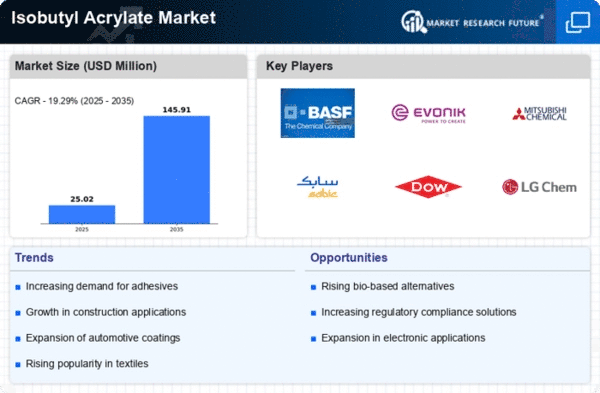
As per MRFR analysis, the Isobutyl Acrylate Market Size was estimated at 20.97 USD Million in 2024. The Isobutyl Acrylate industry is projected to grow from 25.01 in 2025 to 145.91 by 2035, exhibiting a compound annual growth rate (CAGR) of 19.29 during the forecast period 2025 - 2035.

Key Market Trends & Highlights

The Isobutyl Acrylate Market is poised for growth driven by sustainability and technological advancements.

  • North America remains the largest market for isobutyl acrylate, primarily due to its robust demand in the adhesives segment.
  • Asia-Pacific is emerging as the fastest-growing region, fueled by increasing industrialization and urbanization.
  • The coatings segment is witnessing rapid growth, reflecting a shift towards innovative and sustainable solutions.
  • Rising demand for coatings and adhesives, alongside the expansion of the textile industry, serves as a key driver for market growth.

Market Size & Forecast

2024 Market Size 20.97 (USD Million)
2035 Market Size 145.91 (USD Million)
CAGR (2025 - 2035) 19.29%
Largest Regional Market Share in 2024 North America

Major Players

<p>BASF SE (DE), Evonik Industries AG (DE), Mitsubishi Chemical Corporation (JP), SABIC (SA), LG Chem Ltd. (KR), Dow Inc. (US), Huntsman Corporation (US), Nippon Shokubai Co., Ltd. (JP)</p>

Market Trends

The Isobutyl Acrylate Market is currently experiencing a dynamic phase characterized by evolving consumer preferences and technological advancements. This compound, primarily utilized in the production of coatings, adhesives, and sealants, is witnessing increased demand due to its favorable properties such as flexibility and durability. As industries strive for sustainable solutions, the market appears to be shifting towards bio-based alternatives, which may influence production methods and sourcing strategies. Furthermore, the expansion of the construction and automotive sectors is likely to bolster the consumption of isobutyl acrylate, as these industries increasingly rely on high-performance materials to meet regulatory standards and consumer expectations. In addition, the Isobutyl Acrylate Market is influenced by global economic trends and trade dynamics. The ongoing integration of advanced manufacturing technologies, such as automation and digitalization, seems to enhance production efficiency and reduce costs. This technological evolution could lead to a more competitive landscape, where companies that adopt innovative practices may gain a significant advantage. Moreover, the potential for strategic partnerships and collaborations among key players may further drive market growth, as stakeholders seek to leverage each other's strengths to capture emerging opportunities. Overall, the Isobutyl Acrylate Market appears poised for continued evolution, shaped by a confluence of factors that may redefine its future trajectory.

Sustainability Initiatives

The Isobutyl Acrylate Market is increasingly influenced by sustainability initiatives, as manufacturers seek to reduce their environmental footprint. This trend is prompting a shift towards bio-based feedstocks and eco-friendly production processes, which may appeal to environmentally conscious consumers and regulatory bodies alike.

Technological Advancements

Technological advancements are playing a crucial role in the Isobutyl Acrylate Market, with innovations in production techniques enhancing efficiency and product quality. Automation and digitalization are likely to streamline operations, potentially leading to cost reductions and improved competitiveness among market players.

Growth in End-Use Industries

The growth of end-use industries, particularly construction and automotive, is driving demand for isobutyl acrylate. As these sectors expand, the need for high-performance materials that meet stringent regulations and consumer expectations appears to be increasing, thereby bolstering market prospects.

Isobutyl Acrylate Market Market Drivers

Market Growth Projections

The Global Isobutyl Acrylate Market Industry is projected to experience substantial growth over the coming years. With a market value of 1250 USD Million in 2024, it is anticipated to reach 2750 USD Million by 2035, indicating a compound annual growth rate of 7.43% from 2025 to 2035. This growth is driven by various factors, including increasing demand from end-use industries such as adhesives, coatings, and textiles. The market's expansion reflects broader trends in industrial growth and innovation, positioning isobutyl acrylate as a critical component in the development of advanced materials.

Growth in Coatings and Paints

The coatings and paints sector plays a pivotal role in the expansion of the Global Isobutyl Acrylate Market Industry. Isobutyl acrylate is utilized in formulating water-based coatings that offer superior performance and environmental benefits. As regulations tighten around volatile organic compounds, manufacturers are increasingly shifting towards eco-friendly alternatives, further boosting the demand for isobutyl acrylate. The market's growth trajectory is supported by the rising construction activities globally, which necessitate high-quality coatings. This trend indicates a sustained increase in market value, contributing to the overall growth of the industry.

Advancements in Polymer Technology

Technological advancements in polymer science significantly influence the Global Isobutyl Acrylate Market Industry. Innovations in polymerization techniques enhance the efficiency and performance of isobutyl acrylate-based products, leading to improved properties such as adhesion, flexibility, and durability. These advancements enable manufacturers to develop specialized formulations that cater to diverse applications, including textiles and automotive components. As industries continue to seek high-performance materials, the demand for isobutyl acrylate is likely to rise, thereby propelling the market forward. This trend suggests a dynamic evolution within the industry, driven by continuous research and development efforts.

Increasing Applications in Textiles

The textile industry is emerging as a significant driver for the Global Isobutyl Acrylate Market Industry. Isobutyl acrylate is increasingly used in textile coatings and finishes, providing enhanced properties such as water resistance and durability. As consumer preferences shift towards high-performance textiles, manufacturers are adopting isobutyl acrylate to meet these demands. The growing trend of functional textiles, particularly in sportswear and outdoor apparel, is expected to further bolster the market. This shift indicates a diversification of applications, which could lead to a broader market reach and increased revenue streams for industry players.

Rising Demand from Adhesives and Sealants

The Global Isobutyl Acrylate Market Industry experiences a notable surge in demand driven by the adhesives and sealants sector. This segment is projected to account for a significant portion of the market, as isobutyl acrylate is a key component in formulating high-performance adhesives. The increasing application of these adhesives in construction, automotive, and packaging industries contributes to the market's growth. In 2024, the market value is estimated at 1250 USD Million, with expectations to reach 2750 USD Million by 2035, reflecting a robust compound annual growth rate of 7.43% from 2025 to 2035.

Environmental Regulations Favoring Water-Based Products

The Global Isobutyl Acrylate Market Industry is positively impacted by stringent environmental regulations promoting the use of water-based products. Governments worldwide are implementing policies to reduce the environmental footprint of chemical products, encouraging manufacturers to adopt isobutyl acrylate in formulations that comply with these regulations. This shift towards sustainable practices is likely to drive the demand for isobutyl acrylate in various applications, including coatings and adhesives. As industries adapt to these regulatory changes, the market is expected to witness a steady growth trajectory, aligning with global sustainability goals.

Market Segment Insights

By Application: Adhesives (Largest) vs. Coatings (Fastest-Growing)

<p>In the Isobutyl Acrylate Market, the application segment is primarily dominated by adhesives, which hold a significant share due to their wide usage in various industries, including construction and automotive. Coatings, while not as large, are the fastest-growing segment, driven by increasing demand for protective and decorative finishes across multiple sectors, including industrial and consumer products.</p>

<p>Adhesives (Dominant) vs. Coatings (Emerging)</p>

<p>Adhesives are regarded as the dominant application in the Isobutyl Acrylate Market, characterized by their essential role in bonding materials together, thus finding applications in various industries such as packaging, automotive, and construction. They offer excellent adhesion to a wide range of substrates, high tack and cohesive strength, and good flexibility, making them indispensable for manufacturers. Conversely, coatings represent an emerging segment with soaring demand, attributed to innovations in formulation that provide enhanced performance, durability, and aesthetic appeal. Their use is proliferating in sectors like automotive, furniture, and architectural design, reflecting a growing trend towards sustainable and eco-friendly solutions.</p>

By End Use Industry: Construction (Largest) vs. Consumer Goods (Fastest-Growing)

<p>The End Use Industry segment of the Isobutyl Acrylate Market is primarily dominated by the construction sector, which utilizes isobutyl acrylate in adhesives, sealants, and coatings. The rapid urbanization and increasing infrastructure development globally are contributing significantly to the strength of this segment. In contrast, while construction holds the largest share, consumer goods are emerging as a significant player, driven by rising consumer demand for innovative products that require high-performance adhesive solutions. The growth trends within this segment are heavily influenced by technological advancements and increased investment in research and development. The automotive and electronics industries also represent notable markets, benefiting from the expansion of electric vehicles and smart technology. Additionally, health and safety regulations are prompting innovations in healthcare-related applications, driving the demand for high-quality isobutyl acrylate in medical products. It is evident that the sector is adapting to meet the changing needs of consumers and industries alike.</p>

<p>Construction (Dominant) vs. Healthcare (Emerging)</p>

<p>The Construction segment remains the dominant force within the Isobutyl Acrylate Market due to its extensive use in various applications such as adhesives and sealants. This segment is characterized by its stability and reliability, supported by a consistent demand for construction materials in both residential and commercial projects. In contrast, the Healthcare segment is emerging rapidly, fueled by the increasing need for biocompatible materials and advanced manufacturing processes in medical devices. Healthcare applications necessitate high levels of precision and adherence to safety standards, rendering isobutyl acrylate a preferred choice. The innovations within this segment are thus essential for enhancing product performance, while also catering to a growing population that requires superior medical solutions. Together, these segments illustrate the diversity and adaptability of isobutyl acrylate across industries.</p>

By Formulation Type: Waterborne (Largest) vs. UV-Curable (Fastest-Growing)

<p>The Isobutyl Acrylate Market exhibits a diverse distribution in formulation types, with Waterborne formulations holding the largest market share. Solventborne formulations follow closely, while UV-Curable and Powder Coatings are notable for their innovative applications. The preference for Waterborne systems stems from their low environmental impact and regulatory compliance. Furthermore, Emulsion formulations continue to find significant traction in various coatings and adhesives, reflecting a steady demand across industries.</p>

<p>Waterborne (Dominant) vs. UV-Curable (Emerging)</p>

<p>Waterborne formulations dominate the Isobutyl Acrylate Market, largely due to their eco-friendly properties and compliance with stringent environmental regulations. These formulations are characterized by their ease of use and versatility in applications such as paints, coatings, and adhesives. On the other hand, UV-Curable formulations represent an emerging segment marked by rapid technological advancements and increasing demand for fast curing processes in industrial applications. They offer superior performance, durability, and efficiency, making them a popular choice for manufacturers seeking high-quality finishes. As the market evolves, both formulations will play critical roles, with Waterborne remaining the preferred choice and UV-Curable rapidly gaining attention for its innovative capabilities.</p>

By Chemical Properties: Viscosity (Largest) vs. Molecular Weight (Fastest-Growing)

<p>In the Isobutyl Acrylate Market, viscosity holds the largest share, driven by its critical role in determining the flow characteristics of coatings and adhesives. High viscosity materials are often preferred for applications requiring durability and reliability, leading to their dominant position in the market. Conversely, molecular weight is emerging rapidly, attracting manufacturers looking to optimize the performance of acrylate products. It is often linked to functionality, enhancing the versatility of formulations and driving innovation in product development.</p>

<p>Viscosity (Dominant) vs. Thermal Stability (Emerging)</p>

<p>Viscosity, being the most dominant property in the Isobutyl Acrylate Market, significantly influences the processing and application of the product. High viscosity solutions are desirable for their enhanced film-forming properties and excellent adhesion capabilities, making them suitable for diverse applications such as paints, coatings, and sealants. On the other hand, thermal stability is becoming an emerging focus, as manufacturers are increasingly aware of the impact of heat on polymer performance. Improvements in thermal stability can lead to better durability and lifespan of end products, thereby enhancing their market attractiveness.</p>

By Production Method: Batch Process (Largest) vs. Continuous Process (Fastest-Growing)

<p>In the Isobutyl Acrylate Market, the production method segment is primarily divided into Batch Process, Continuous Process, Polymerization, Distillation, and Extraction. Among these, the Batch Process holds the largest market share due to its flexibility and suitability for various production scales. Continuous Process is experiencing rapid growth, driven by increasing demand for efficiency and cost-effectiveness in manufacturing. As companies strive for sustainability and reduced lead times, these two methods represent critical pathways for growth and adaptation within the sector. Recent trends indicate that Continuous Process may soon surpass Batch Process in terms of market traction, fueled by technological advancements that allow for real-time optimization and superior quality control. The shift toward automation and integrated manufacturing processes positions Continuous Method as the future of production in the Isobutyl Acrylate landscape, appealing to the evolving preferences of end-users seeking faster delivery and more consistent product quality.</p>

<p>Batch Process: Dominant vs. Continuous Process: Emerging</p>

<p>The Batch Process stands out as the dominant production method in the Isobutyl Acrylate Market, as it allows manufacturers to produce various quantities and formulations tailored to specific customer requirements. This flexibility is particularly beneficial for businesses dealing with diverse applications across industries such as adhesives, paints, and coatings. However, the Continuous Process is emerging rapidly, driven by its efficiency in streamlining production and reducing operational costs. Continuous manufacturing provides advantages like lower material waste and shorter lead times, making it an attractive option for manufacturers looking to meet increasing demand while maintaining competitive pricing. Both methods possess unique strengths, indicating a dynamic landscape within the production method segment.</p>

Get more detailed insights about Isobutyl Acrylate Market Research Report- Forecast to 2035

Regional Insights

North America : Market Leader in Isobutyl Acrylate

North America is poised to maintain its leadership in the Isobutyl Acrylate market, holding a significant share of 10.49 in 2024. The region's growth is driven by robust demand from the automotive, construction, and coatings industries, alongside favorable regulatory frameworks that promote the use of acrylics. The increasing focus on sustainable and eco-friendly products further propels market expansion, as manufacturers adapt to evolving consumer preferences. The competitive landscape in North America is characterized by the presence of major players such as Dow Inc., BASF SE, and Huntsman Corporation. These companies are investing in innovative technologies and expanding their production capacities to meet the rising demand. The U.S. remains the leading country in this market, supported by a strong industrial base and significant R&D investments aimed at enhancing product performance and sustainability.

Europe : Emerging Market with Growth Potential

Europe's Isobutyl Acrylate market is witnessing a notable growth trajectory, with a market size of 5.89 in 2024. The region's demand is primarily driven by the increasing use of acrylics in adhesives, paints, and coatings, supported by stringent regulations promoting low-VOC products. The European Union's commitment to sustainability and environmental protection is catalyzing innovation in the sector, encouraging manufacturers to develop eco-friendly alternatives. Leading countries in this region include Germany, France, and the UK, where key players like Evonik Industries AG and BASF SE are actively enhancing their market presence. The competitive landscape is marked by strategic partnerships and collaborations aimed at expanding product offerings. As the market evolves, companies are focusing on R&D to meet regulatory standards and consumer demands for high-performance, sustainable products.

Asia-Pacific : Rapid Growth in Emerging Economies

The Asia-Pacific region is emerging as a significant player in the Isobutyl Acrylate market, with a market size of 3.87 in 2024. The growth is fueled by rapid industrialization, urbanization, and increasing demand from end-use industries such as automotive and construction. Additionally, favorable government policies and investments in infrastructure are expected to further boost market growth in the coming years. Countries like China, Japan, and India are leading the charge, with major companies such as Mitsubishi Chemical Corporation and Nippon Shokubai Co., Ltd. expanding their operations. The competitive landscape is becoming increasingly dynamic, with local players entering the market and established firms enhancing their production capabilities to cater to the growing demand. This region's focus on innovation and sustainability is likely to shape its future market dynamics.

Middle East and Africa : Emerging Market with Challenges

The Middle East and Africa region is still in the nascent stages of developing its Isobutyl Acrylate market, with a market size of 0.72 in 2024. The growth potential is significant, driven by increasing industrial activities and a growing demand for coatings and adhesives. However, challenges such as limited infrastructure and regulatory hurdles may impede rapid growth. Governments are beginning to recognize the importance of the chemical sector, which could lead to supportive policies in the future. Key countries in this region include South Africa and the UAE, where local players are starting to emerge. The competitive landscape is characterized by a mix of multinational corporations and regional companies. As the market matures, there is potential for increased investment and collaboration among stakeholders to enhance production capabilities and meet the rising demand for Isobutyl Acrylate products.

Key Players and Competitive Insights

The Isobutyl Acrylate Market is currently characterized by a competitive landscape that is both dynamic and multifaceted. Key growth drivers include the increasing demand for adhesives, coatings, and sealants across various industries, particularly in construction and automotive sectors. Major players such as BASF SE (Germany), Evonik Industries AG (Germany), and Dow Inc. (US) are strategically positioned to leverage their extensive R&D capabilities and global reach. These companies are focusing on innovation and sustainability, which are becoming critical differentiators in the market. Their collective strategies not only enhance their competitive edge but also shape the overall market dynamics, fostering a climate of continuous improvement and adaptation.

In terms of business tactics, companies are increasingly localizing manufacturing to reduce lead times and optimize supply chains. The market structure appears moderately fragmented, with several key players exerting considerable influence. This fragmentation allows for niche players to thrive, while larger corporations capitalize on economies of scale. The interplay between these entities creates a competitive environment where agility and responsiveness to market demands are paramount.

In November 2025, BASF SE (Germany) announced the expansion of its production capacity for isobutyl acrylate at its Ludwigshafen site. This strategic move is anticipated to enhance BASF's ability to meet the growing demand in Europe, particularly in the automotive and construction sectors. The expansion underscores BASF's commitment to maintaining a leading position in the market while addressing regional demand fluctuations.

In October 2025, Evonik Industries AG (Germany) launched a new line of bio-based isobutyl acrylate products, aligning with the increasing emphasis on sustainability. This initiative not only diversifies Evonik's product portfolio but also positions the company as a pioneer in eco-friendly solutions within the industry. The introduction of bio-based products is likely to attract environmentally conscious customers and strengthen Evonik's market presence.

In September 2025, Dow Inc. (US) entered into a strategic partnership with a leading automotive manufacturer to develop advanced adhesive solutions utilizing isobutyl acrylate. This collaboration is expected to enhance Dow's innovation capabilities and expand its footprint in the automotive sector. By aligning with a key player in the industry, Dow is poised to leverage synergies that could lead to the development of cutting-edge products tailored to evolving market needs.

As of December 2025, current competitive trends indicate a pronounced shift towards digitalization, sustainability, and the integration of AI technologies. Strategic alliances are increasingly shaping the landscape, enabling companies to pool resources and expertise. The competitive differentiation is likely to evolve from traditional price-based competition to a focus on innovation, technology, and supply chain reliability. This transition suggests that companies that prioritize R&D and sustainable practices will be better positioned to thrive in the future.

Key Companies in the Isobutyl Acrylate Market market include

Industry Developments

    • May 2018: Bombardier shipped off its item game plan, Train Control and Monitoring System (TCMS), which is currently presented on Singapore's Downtown Line (DTL). This new game plan increases explorer comfort and the structure's useful efficiency by showing consistent voyager load information on LCD screens at stages.
    • May 2018: Siemens has charged a consent to supply the Hungarian line Százhalombatta — Pusztaszabolcs. Siemens would control structure type Trainguard 200, including foundation of ETCS Level 2, one radio block place (RBC) and two electronic transmission boxes type Trackguard Simis IS. This solicitation incorporates six railroad convergences type Wayguard Simis LC, the entire power supply, get together, and broadcast interchanges.
    • May 2018: GE went into a simultaneousness with Wabtec, a US-based voyager rail transport association, to mix GE Transportation, a unit of GE, with Wabtec to transform into an overall provider of rail equipment, organizations, and programming.
    • April 2018: Bombardier denoted a concurrence with Metro Trains Melbourne (MTM) to give 10 years of help organizations for its rail control plan, conveyed for Melbourne's new Metro Tunnel Project. This arrangement would help with chipping away at metropolitan transportability across Melbourne. Bombardier's extent of hailing organizations would overhaul rail network execution and uncommonly further foster the voyager experience.

Report Overview:

The Isobutyl acrylates report is a gathering of direct data, subjective and quantitative evaluation by industry investigators, contributions from industry specialists and industry members across the worth chain. The Isobutyl acrylates report gives a top to bottom examination of parent market patterns, macroeconomic pointers and administering factors alongside market allure according to sections. The Isobutyl acrylates report additionally maps the subjective effect of different market factors on market fragments and geologies. The exploration report presents a complete evaluation of the market and contains smart experiences, realities, verifiable information, and measurably upheld and industry-approved market information.

It likewise contains projections utilizing a reasonable series of expectations and procedures. The exploration report gives investigation and data as indicated by market sections like topographies, application, and industry.

 Key Industrial Segments

Based on item type, the Butyl Acrylate Market can be portioned as:

    • I-Butyl Acrylate
    • n-Butyl Acrylate
    • t-Butyl Acrylate

Based on Application, the Butyl Acrylate Market can be portioned as:

    • Glues and sealants
    • Plastics
    • Paint and Coatings
    • Materials
    • Others(Consumer Goods, Water treatment)

Future Outlook

Isobutyl Acrylate Market Future Outlook

<p>The Isobutyl Acrylate Market is projected to grow at a 19.29% CAGR from 2024 to 2035, driven by increasing demand in adhesives, coatings, and textiles.</p>

New opportunities lie in:

  • <p>Expansion into bio-based isobutyl acrylate production</p>
  • <p>Development of high-performance coatings for automotive applications</p>
  • <p>Strategic partnerships with textile manufacturers for innovative fabric treatments</p>

<p>By 2035, the Isobutyl Acrylate Market is expected to achieve robust growth and diversification.</p>

Market Segmentation

Isobutyl Acrylate Market Application Outlook

  • Adhesives
  • Coatings
  • Inks
  • Textiles
  • Sealants

Isobutyl Acrylate Market End Use Industry Outlook

  • Construction
  • Automotive
  • Electronics
  • Consumer Goods
  • Healthcare

Isobutyl Acrylate Market Formulation Type Outlook

  • Waterborne
  • Solventborne
  • Powder Coatings
  • UV-Curable
  • Emulsion

Isobutyl Acrylate Market Production Method Outlook

  • Batch Process
  • Continuous Process
  • Polymerization
  • Distillation
  • Extraction

Isobutyl Acrylate Market Chemical Properties Outlook

  • Viscosity
  • Molecular Weight
  • Reactivity
  • Solubility
  • Thermal Stability

Report Scope

MARKET SIZE 202420.97(USD Million)
MARKET SIZE 202525.01(USD Million)
MARKET SIZE 2035145.91(USD Million)
COMPOUND ANNUAL GROWTH RATE (CAGR)19.29% (2024 - 2035)
REPORT COVERAGERevenue Forecast, Competitive Landscape, Growth Factors, and Trends
BASE YEAR2024
Market Forecast Period2025 - 2035
Historical Data2019 - 2024
Market Forecast UnitsUSD Million
Key Companies ProfiledBASF SE (DE), Evonik Industries AG (DE), Mitsubishi Chemical Corporation (JP), SABIC (SA), LG Chem Ltd. (KR), Dow Inc. (US), Huntsman Corporation (US), Nippon Shokubai Co., Ltd. (JP)
Segments CoveredApplication, End Use Industry, Formulation Type, Chemical Properties, Production Method
Key Market OpportunitiesGrowing demand for eco-friendly coatings drives innovation in the Isobutyl Acrylate Market.
Key Market DynamicsRising demand for eco-friendly coatings drives innovation and competition in the Isobutyl Acrylate Market.
Countries CoveredNorth America, Europe, APAC, South America, MEA

FAQs

At what CAGR is the Isobutyl Acrylate Market predicted to grow during the forecast period?

Isobutyl Acrylate Market is predicted to grow at 5.50% through forecast period of 2025-2035

What is the forecast period of Isobutyl Acrylate Market research report?

The forecast period for Isobutyl Acrylate Market research report is 2025-2035.

Which region will lead the global Isobutyl Acrylate Market?

Global Isobutyl Acrylate Market is dominated by APAC region.

What are the key factors driving the Isobutyl Acrylate Market?

Growing construction activities and rapid industrialization around the world

Who are the key players in the Isobutyl Acrylate Market?

BASF SE (Germany), Mitsubishi Chemical Corporation (Japan), BAMM (U.S.), OSAKA ORGANIC CHEMICAL INDUSRTY LTD. (Japan), NIPPON SHOKUBAI CO., LTD. (JAPAN), Sigma-Aldrich Co. LLC. (U.S.), Solventis Limited (U.K

  1. Executive Summary
  2. Scope of the Report
    1. Market Definition
    2. Scope of the
      1. Research Objectives
      2. Assumptions & Limitations
    3. Study
    4. Markets Structure
    5. Market Research Methodology
    6. Research
    7. Process
    8. Secondary Research
    9. Primary Research
    10. Forecast Model
  3. Market Landscape
    1. Five Forces Analysis
      1. Bargaining
      2. Threat of substitutes
      3. Segment rivalry
    2. Threat of New Entrants
    3. power of buyers
    4. Value Chain/Supply Chain of Global Isobutyl acrylate Market
  4. Industry Overview of Global Isobutyl acrylate Market
    1. Introduction
    2. Growth Drivers
    3. Impact analysis
    4. Market Challenges
    5. Impact analysis
  5. Market Trends
    1. Introduction
    2. Growth Trends
    3. Impact analysis
  6. Global Isobutyl acrylate Market by Region
  7. Global Isobutyl acrylate Market by application
    1. (adhesives, sealants, coatings, plasticizers, thermoplastics and chemical intermediates)
  8. Global Isobutyl acrylate Market by end use industry (building
    1. & construction, paints & coatings, automotive, plastics, and chemicals)
  9. Company Landscape
  10. Company Profiles
    1. BASF SE
      1. Company
      2. Product/Business Segment Overview
      3. Key Developments
      4. Company Overview
      5. Product/Business Segment Overview
      6. Key Developments
      7. Company Overview
      8. Financial
      9. Key Developments
    2. Overview
    3. Financial Updates
    4. Mitsubishi Chemical Corporation
    5. Financial Updates
    6. BAMM
    7. Product/Business Segment Overview
    8. Updates
    9. OSAKA
      1. Company Overview
      2. Product/Business Segment Overview
      3. Key Developments
      4. Company Overview
      5. Product/Business Segment Overview
      6. Key Developments
      7. Company Overview
      8. Product/Business Segment Overview
      9. Key Developments
      10. Company Overview
      11. Product/Business Segment Overview
      12. Key Developments
    10. ORGANIC CHEMICAL INDUSRTY LTD
    11. Financial Updates
    12. NIPPON SHOKUBAI CO., LTD.
    13. Financial Updates
    14. Sigma-Aldrich Co. LLC.
    15. Financial Updates
    16. Solventis Limited
    17. Financial Updates
    18. Conclusion
    19. LIST OF TABLES:
    20. Table
  11. World Population by Major Regions (2020-2027)
    1. Table
  12. Global Isobutyl acrylate Market: By Region, 2020-2027
  13. North America Isobutyl acrylate Market: By Country,
  14. Europe Isobutyl acrylate Market:
    1. By Country, 2020-2027
  15. Asia-Pacific Isobutyl
    1. acrylate Market: By Country, 2020-2027
  16. Middle
    1. East & Africa Isobutyl acrylate Market: By Country, 2020-2027
    2. Table
  17. Latin America Isobutyl acrylate Market: By Country, 2020-2027
  18. Global Isobutyl acrylate by End use industry
    1. Market: By Regions, 2020-2027
  19. North America
    1. Isobutyl acrylate by End use industry Market: By Country, 2020-2027
  20. Europe Isobutyl acrylate by End use industry Market: By Country,
    1. Table11 Asia-Pacific Isobutyl acrylate by
    2. End use industry Market: By Country, 2020-2027
    3. Table13 Middle
    4. East & Africa Isobutyl acrylate by End use industry Market: By Country,
    5. Table12 Latin America Isobutyl acrylate
    6. by End use industry Market: By Country, 2020-2027
    7. Table14
    8. North America Isobutyl acrylate for Application Market: By Country,
    9. Table13 Europe Isobutyl acrylate for
    10. Application Market: By Country, 2020-2027
    11. Table14 Asia-Pacific
    12. Isobutyl acrylate for Application Market: By Country, 2020-2027
    13. Table16
    14. Middle East & Africa Isobutyl acrylate for Application Market: By Country,
    15. Table15 Latin America Isobutyl acrylate
    16. for Application Market: By Country, 2020-2027
    17. Table23 Global
    18. End use industry Market: By Region, 2020-2027
    19. Table24
    20. Global Application Market: By Region, 2020-2027
    21. Table25
  21. North America Isobutyl acrylate Market, By Country
    1. Table26
  22. North America Isobutyl acrylate Market, By End use industry
  23. Table27 North America Isobutyl acrylate Market, By Application
  24. Table28 Europe : Isobutyl acrylate Market, By Country
  25. Table29 Europe : Isobutyl acrylate Market, By End use industry
  26. Table30 Europe : Isobutyl acrylate Market, By Application
  27. Table31 Asia-Pacific: Isobutyl acrylate Market, By Country
  28. Table32 Asia-Pacific: Isobutyl acrylate Market, By End use industry
    1. Table33 Asia-Pacific: Isobutyl acrylate Market, By
    2. Application
    3. Table34 Middle East & Africa: Isobutyl
  29. acrylate Market, By Country
    1. Table35 Middle East &
  30. Africa Isobutyl acrylate Market, By End use industry
    1. Table36 Middle
  31. East & Africa: Isobutyl acrylate Market, By Application
    1. Table37
  32. Latin America: Isobutyl acrylate Market, By Country
    1. Table38
  33. Latin America Isobutyl acrylate Market, By End use industry
    1. Table39
  34. Latin America: Isobutyl acrylate Market, By Application
    1. LIST OF FIGURES:
  35. Global Isobutyl
    1. acrylate Market segmentation
  36. Forecast Methodology
  37. Five
    1. Forces Analysis of Global Isobutyl acrylate Market
  38. Value Chain of
    1. Global Isobutyl acrylate Market
  39. Share of Global Isobutyl acrylate
  40. Market in 2020, by country (in %)
  41. Global Isobutyl acrylate Market,
  42. Sub-segments of end use
  43. Global
    1. Isobutyl acrylate Market size by application, 2020
  44. Share of Global
    1. Isobutyl acrylate Market by application, 2020-2027
  45. Global Isobutyl acrylate Market size by End use industry, 2020
    1. FIGURE
  46. Share of Global Isobutyl acrylate Market by End use industry, 2020-2027

Isobutyl Acrylate Market Segmentation

Market Segmentation Overview

  • Detailed segmentation data will be available in the full report
  • Comprehensive analysis by multiple parameters
  • Regional and country-level breakdowns
  • Market size forecasts by segment
Infographic

Free Sample Request

Kindly complete the form below to receive a free sample of this Report

Get Free Sample

Customer Strories

Compare Licence

×
Features License Type
Single User Multiuser License Enterprise User
Price $4,950 $5,950 $7,250
Maximum User Access Limit 1 User Upto 10 Users Unrestricted Access Throughout the Organization
Free Customization
Direct Access to Analyst
Deliverable Format
Platform Access
Discount on Next Purchase 10% 15% 15%
Printable Versions