×
Hero Background
English
Chinese
French
Japanese
Korean
German
Spanish

Isoamyl Acetate Market Share

ID: MRFR/CnM/9339-HCR
100 Pages
Anshula Mandaokar
October 2025

Isoamyl Acetate Market Research Report Information By Application (Food and Beverage, Cosmetics, Textile, Pharmaceticals, Other End User Industries) Forecast till 2035

Share:
Download PDF ×

We do not share your information with anyone. However, we may send you emails based on your report interest from time to time. You may contact us at any time to opt-out.

Isoamyl Acetate Market Infographic
Purchase Options

Market Share

Isoamyl Acetate Market Share Analysis

Isoamyl Acetate Market, as a major participant in the field of chemical and fragrance industry, applies to market some strategies in order to avoid difficult competition in the market. Naturally, there are several approaches to positioning the product including differentiation through quality and versatility. This is counted as the main reason behind the remarkable investment of companies within the isoamyl acetate market in research and development. The goal is to manufacture formulations with a high purity level and unique characteristics, such as the fruity flavor and the ability to be mixed with various kinds of apps. Through diverse and top-quality solutions, these businesses get to be the role models in offering isoamyl acetate for flavors, fragrance and industrial solvents manufacturing which whereby purity and the distinct scent are the key drivers.

The cheapest approach is one of the most important tactics in the isoamyl acetate market. Some companies work on process creation and optimization; they want to get adequate raw materials, to use these materials in a wise way and to have scale economies that allow providing consumers with this goods at low price. Cost is the factor that often affects the choice of the chemical ingredients, especially in business areas that highly value cost details, such as fragrance flavors industry. Through delivering efficient and also premium grade isoamyl acetate, companies may expand their target market and become the leading choice among budget-conscious consumers in such sectors.

Collaboration and strategic alliances between manufacturers is an important element in the market development for the isoamyl acetate industry. Many times firms enter into alliances with other major players among large companies such as perfume and taste contractors, cosmetics manufacturers, and chemical supply sellers. Kolyborativnye delavyu, in which join the links of a chain of supply, provide for its sustainability, making the distribution channel reliable and wholesome. Main goal of proper partnership strategy is creation of new market opportunities, new technological developments and more potential clients resulting in growing the market while benefiting brand recognition.

A consumer will decide what products or brands to purchase and will give reviews, which continually affect the growth of products or brands. Therefore, a customer-centric approach is vital nowadays. Knowing and resolving customer problem such as the pufiness, as well as compliance with industries regulations, and techniacal support are the elements that facilitate longer market share to the business. Products are formulated from isoamyl acetate and also blend other enhanced and structured products keeping in mind the industry gradations and customers acceptable doses. Enhanced relationships with customers are achieved by provision of quality CSR, quick technical support and always being on time in deliveries. These, in turn, make them loyal customers, who give testimonies to other potential customers, which eventually contribute to market share.

Author
Anshula Mandaokar
Team Lead - Research

Anshula Mandaokar holds an academic degree in Chemical Engineering and has been contributing to the field for more than 5 years. She has expertise in Market Research and Business Consulting and serves as a Team Lead for a reputed Market Research firm under the Chemicals and Materials domain spectrum. She has worked on multiple projects, generating explicit results in a quick turnaround time. Her understanding of data interpretation justifies her role as a leader.

Leave a Comment

FAQs

What growth rate global Isoamyl Acetate market would register in the future?

The global Isoamyl Acetate market would register a growth of 5.5%.

Which industry will play a crucial role in taking the Isoamyl Acetate market ahead??

The personal care industry will play a prominent role in taking the market forward.

What is the key restraining factor for the global Isoamyl Acetate market?

Stringent regulation on isoamyl acetate could restrain the market.

Which region would enjoy the upper hand in the Isoamyl Acetate market?

Asia-Pacific would enjoy the upper hand in the Isoamyl Acetate market.

Which Asia-Pacific country would set the trend in the Isoamyl Acetate market?

China, as the largest consumer, would set the trend.

Market Summary

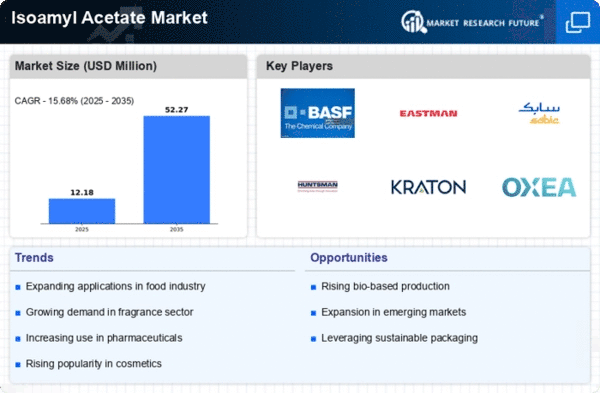
As per MRFR analysis, the Isoamyl Acetate Market Size was estimated at 10.53 USD Million in 2024. The Isoamyl Acetate industry is projected to grow from 12.18 USD Million in 2025 to 52.27 USD Million by 2035, exhibiting a compound annual growth rate (CAGR) of 15.68 during the forecast period 2025 - 2035.

Key Market Trends & Highlights

The Isoamyl Acetate Market is experiencing robust growth driven by diverse applications and regional dynamics.

  • The demand for isoamyl acetate is rising significantly in the food and beverage sector, particularly in North America, which remains the largest market.
  • Asia-Pacific is emerging as the fastest-growing region, with increasing applications in cosmetics and personal care products.
  • The food flavoring segment continues to dominate the market, while the fragrance segment is witnessing the fastest growth due to evolving consumer preferences.
  • Key market drivers include the rising demand in the fragrance industry and technological advancements in production processes.

Market Size & Forecast

2024 Market Size 10.53 (USD Million)
2035 Market Size 52.27 (USD Million)
CAGR (2025 - 2035) 15.68%
Largest Regional Market Share in 2024 North America

Major Players

<p>BASF SE (DE), Eastman Chemical Company (US), SABIC (SA), Huntsman Corporation (US), Kraton Corporation (US), Oxea GmbH (DE), Solvay S.A. (BE), Mitsubishi Chemical Corporation (JP), Daicel Corporation (JP)</p>

Market Trends

The Isoamyl Acetate Market is currently experiencing a dynamic phase characterized by evolving consumer preferences and increasing applications across various industries. This compound, known for its fruity aroma, finds extensive use in food and beverage flavoring, cosmetics, and pharmaceuticals. The growing trend towards natural and organic products appears to be influencing demand, as manufacturers seek to incorporate Isoamyl Acetate into their formulations to meet consumer expectations for cleaner labels. Additionally, the expansion of the food and beverage sector, particularly in emerging markets, seems to be driving the need for this compound, as it enhances product appeal and sensory experience. Moreover, sustainability initiatives are gaining traction within the Isoamyl Acetate Market. Companies are increasingly focusing on eco-friendly production methods and sourcing raw materials responsibly. This shift not only aligns with global sustainability goals but also caters to a consumer base that is becoming more environmentally conscious. As the market continues to evolve, it is likely that innovation in production techniques and applications will play a crucial role in shaping the future landscape of the Isoamyl Acetate Market, potentially leading to new opportunities and challenges for stakeholders involved.

Rising Demand in Food and Beverage Sector

The Isoamyl Acetate Market is witnessing heightened interest from the food and beverage industry. This compound is favored for its ability to impart a pleasant flavor profile, making it a popular choice among manufacturers aiming to enhance product appeal. As consumer preferences shift towards unique and natural flavors, the demand for Isoamyl Acetate is expected to grow.

Focus on Sustainable Practices

Sustainability is becoming a focal point within the Isoamyl Acetate Market. Companies are increasingly adopting eco-friendly production methods and sourcing practices. This trend reflects a broader commitment to environmental responsibility, appealing to consumers who prioritize sustainability in their purchasing decisions.

Expansion in Personal Care Applications

The use of Isoamyl Acetate in personal care products is on the rise. Its pleasant scent and functional properties make it an attractive ingredient for cosmetics and toiletries. As the personal care industry continues to innovate, the incorporation of Isoamyl Acetate is likely to increase, driven by consumer demand for high-quality, fragrant products.

Isoamyl Acetate Market Market Drivers

Emerging Markets and Global Expansion

The Global Isoamyl Acetate Market Industry is witnessing growth driven by emerging markets and global expansion. Regions such as Asia-Pacific and Latin America are experiencing increased industrialization and urbanization, leading to higher demand for isoamyl acetate in food, cosmetics, and fragrances. As these markets develop, they present significant opportunities for manufacturers to expand their reach and enhance market share. The anticipated growth in these regions is likely to contribute to the overall market value, reinforcing the industry's position on a global scale. This trend underscores the importance of strategic investments in emerging markets to capitalize on growth opportunities.

Technological Advancements in Production

The Global Isoamyl Acetate Market Industry is poised for growth due to technological advancements in production processes. Innovations in synthesis methods and extraction techniques are enhancing the efficiency and cost-effectiveness of isoamyl acetate production. These advancements not only improve yield but also reduce environmental impact, aligning with global sustainability goals. As manufacturers adopt these technologies, the industry is likely to experience increased competitiveness and profitability. This technological evolution is expected to play a crucial role in meeting the rising demand for isoamyl acetate across various sectors, thereby supporting the overall market growth.

Rising Demand in Food and Beverage Sector

The Global Isoamyl Acetate Market Industry experiences a notable surge in demand from the food and beverage sector, primarily due to its application as a flavoring agent. Isoamyl acetate is recognized for its banana-like aroma, making it a popular choice in confectionery, beverages, and baked goods. As consumer preferences shift towards natural flavors, the industry is likely to witness an increase in the use of isoamyl acetate. This trend is supported by the projected market value of 266.8 USD Million in 2024, indicating a robust growth trajectory fueled by the food and beverage industry's expansion.

Regulatory Support for Natural Ingredients

The Global Isoamyl Acetate Market Industry benefits from regulatory support promoting the use of natural ingredients in various applications. Governments worldwide are increasingly advocating for the use of safer, naturally derived substances in food, cosmetics, and fragrances. This regulatory environment encourages manufacturers to adopt isoamyl acetate, which is perceived as a safer alternative to synthetic compounds. As regulations evolve, the industry is likely to see a shift towards more sustainable practices, further driving the demand for isoamyl acetate. This regulatory support may enhance the industry's growth prospects, contributing to its projected expansion in the coming years.

Growth in Fragrance and Cosmetic Applications

The Global Isoamyl Acetate Market Industry is significantly influenced by the growth in fragrance and cosmetic applications. Isoamyl acetate serves as a key ingredient in perfumes and personal care products, contributing to their olfactory profiles. The increasing consumer inclination towards premium and natural fragrances is likely to bolster the demand for isoamyl acetate. As the global cosmetics market continues to expand, the industry anticipates a sustained rise in isoamyl acetate utilization. This trend aligns with the overall market growth, which is expected to reach 595.0 USD Million by 2035, reflecting a compound annual growth rate of 7.56% from 2025 to 2035.

Market Segment Insights

By Application: Food Flavoring (Largest) vs. Fragrance (Fastest-Growing)

<p>In the Isoamyl Acetate Market, the application segment showcases a diverse range of uses, including food flavoring, fragrance, solvent, chemical intermediate, and pharmaceuticals. Among these, food flavoring holds the largest market share due to its popular use in various food product formulations, specifically in the production of candy and baked goods. Conversely, fragrance emerges as the fastest-growing segment, driven by a rising demand for natural ingredients in perfumes and personal care products. This increasing awareness of the use of environmentally friendly ingredients is reshaping consumer preferences and boosting market opportunities.</p>

<p>Food Flavoring: Dominant vs. Fragrance: Emerging</p>

<p>Food flavoring remains the dominant application in the Isoamyl Acetate Market, highly favored in the culinary sector for its fruity flavor profile that enhances the taste of various food items. It is utilized extensively in both commercial and domestic food production, leading to a consistent demand. On the other side, fragrance applications are emerging rapidly due to the increasing consumer shift towards organic and natural scents. As the personal care industry continues to innovate, fragrance applications are set to grow, leveraging trends towards sustainability while appealing to health-conscious consumers. This duality in market positions signifies a dynamic landscape, where established segments continuously adapt to evolving consumer preferences.</p>

By End Use: Food and Beverage (Largest) vs. Cosmetics and Personal Care (Fastest-Growing)

<p>The Isoamyl Acetate market shows a diverse distribution among its key end use segments. The Food and Beverage sector holds a substantial share, driven by the compound's use as a flavoring agent and aroma enhancer in various consumables. While this segment maintains dominance, the Cosmetics and Personal Care segment is rapidly gaining momentum, leveraging Isoamyl Acetate's properties for fragrance applications in perfumes and personal care products, thus reflecting a shift in consumer preferences towards innovative formulations. Growth trends in the Isoamyl Acetate market are significantly influenced by evolving consumer trends and increasing demand in several sectors. The Food and Beverage industry continues to witness steady growth, while the Cosmetics and Personal Care segment is positioned for rapid expansion. This is fueled by rising disposable incomes and a growing awareness of personal grooming and hygiene products. Additionally, the demand from the pharmaceutical and chemical manufacturing sectors also contributes to the overall growth potential of Isoamyl Acetate, making it an attractive option for manufacturers aiming to diversify their product offerings.</p>

<p>Food and Beverage (Dominant) vs. Cosmetics and Personal Care (Emerging)</p>

<p>In the Isoamyl Acetate market, the Food and Beverage segment stands out as the dominant end use, characterized by its crucial role in enhancing flavors and aromas in a variety of culinary applications. This segment benefits from consistent demand driven by the food industry's quest for natural and appealing flavoring solutions. Conversely, the Cosmetics and Personal Care segment represents an emerging market, utilizing Isoamyl Acetate for its pleasant fragrance profile. This segment's rapid growth is attributed to the increasing popularity of organic and naturally derived ingredients among consumers, leading to innovative uses in skincare and cosmetic products. As brands focus on cleaner formulations, the potential for Isoamyl Acetate in this space continues to expand.</p>

By Formulation Type: Natural Isoamyl Acetate (Largest) vs. Synthetic Isoamyl Acetate (Fastest-Growing)

<p>The formulation type segment of the Isoamyl Acetate market is primarily dominated by Natural Isoamyl Acetate, which commands a significant market share due to its appeal among consumers seeking natural products. This growing preference for natural ingredients is bolstered by increasing awareness of health and wellness, making natural formulations more prominent. In contrast, Synthetic Isoamyl Acetate is gaining traction, particularly for its cost-effectiveness and versatility in various applications, including food flavoring and fragrance, thus showcasing its potential to grow rapidly in this segment. Furthermore, the growth trends indicate a marked shift towards eco-friendly and sustainable formulations, driving the demand for Natural Isoamyl Acetate. However, the synthetic variant continues to rise in popularity due to manufacturers' ongoing efforts to improve product quality and performance. This dual growth illustrates a dynamic market where both natural and synthetic formulations are experiencing distinctive but complementary growth trajectories, influenced by consumer preferences and technological advancements.</p>

<p>Natural Isoamyl Acetate (Dominant) vs. Synthetic Isoamyl Acetate (Emerging)</p>

<p>Natural Isoamyl Acetate represents a robust presence in the market, characterized by its extraction from natural sources such as ripe bananas, leading to a strong consumer preference for health-conscious products. Its market dominance is attributed to trends favoring clean labels and organic ingredients among manufacturers and consumers alike. Conversely, Synthetic Isoamyl Acetate, while considered an emerging alternative, is recognized for its efficiency and cost advantages in production. This formulation appeals particularly to industries requiring large quantities of flavoring agents at lower prices. The rising demand for personalized fragrances and flavorings among consumers is prompting innovation in synthetic formulations, enhancing their position in the market and steadily increasing their market share.</p>

By Distribution Channel: Direct Sales (Largest) vs. Wholesale (Fastest-Growing)

<p>The Isoamyl Acetate Market's distribution is predominantly driven by direct sales, which cater to businesses needing bulk supplies for industrial applications. This method remains favored due to the personalized service and tailored solutions it offers to customers, ensuring efficient supply chain management. Other distribution channels, such as retail and online sales, also play significant roles, but they don't match the direct sales volume in this particular market.</p>

<p>Direct Sales (Dominant) vs. Wholesale (Emerging)</p>

<p>Direct sales emerge as the dominant distribution channel in the Isoamyl Acetate Market, catering directly to manufacturers and industries that require precise quantities and formulations. This method secures long-term relationships and enhances customer loyalty. In contrast, wholesale is characterized as an emerging channel that has been gaining traction, particularly due to the increasing focus on bulk purchasing and cost-effectiveness among retailers and distributors. This shift towards wholesale distribution is being driven by the rising demand for lower prices and the need for expedited supply chain solutions, positioning wholesale as a key player in future market dynamics.</p>

By Purity Level: High Purity (Largest) vs. Medium Purity (Fastest-Growing)

<p>In the Isoamyl Acetate market, the share distribution among purity levels reveals a clear hierarchy, with high purity products dominating the market. This segment is preferred for its superior quality and performance in various applications, particularly in food and fragrance industries. Medium purity, on the other hand, while smaller in market share, is gaining traction as a cost-effective alternative for numerous uses, appealing to budget-conscious consumers without compromising too much on quality. The growth trends in the purity level segment indicate a strong movement towards higher purity products, driven by increased demand in sectors such as cosmetics and pharmaceuticals where quality standards are paramount. However, the medium purity segment is emerging rapidly, supported by manufacturers seeking to optimize production costs while meeting adequate quality standards. This dynamic creates a healthy competition that may lead to innovations in quality and affordability within the market.</p>

<p>High Purity (Dominant) vs. Medium Purity (Emerging)</p>

<p>High purity isoamyl acetate is characterized by its exceptional quality, making it the preferred choice for applications requiring stringent quality standards, such as in the food and fragrance industries. Its dominance in the market stems from its ability to enhance product efficacy and consumer satisfaction. In contrast, medium purity isoamyl acetate serves as a practical alternative, appealing to manufacturers and consumers who prioritize cost-effectiveness without significant quality trade-offs. As demand for versatile solutions increases, medium purity products are emerging strongly, targeting a wider range of industrial applications. This dual existence of purity levels reflects a balanced approach to meeting diverse consumer needs while promoting healthy market competition.</p>

Get more detailed insights about Isoamyl Acetate Market Research Report—Global Forecast till 2035

Regional Insights

Key Players and Competitive Insights

The Isoamyl Acetate Market is currently characterized by a dynamic competitive landscape, driven by increasing demand across various applications, including food flavoring, fragrances, and solvents. Key players such as BASF SE (Germany), Eastman Chemical Company (US), and Huntsman Corporation (US) are strategically positioned to leverage their extensive product portfolios and innovative capabilities. BASF SE (Germany) focuses on sustainability and has been investing in bio-based production methods, which aligns with the growing consumer preference for environmentally friendly products. Meanwhile, Eastman Chemical Company (US) emphasizes digital transformation and operational efficiency, enhancing its supply chain resilience and responsiveness to market changes. Huntsman Corporation (US) is actively pursuing strategic partnerships to expand its market reach, particularly in emerging economies, thereby shaping a competitive environment that is increasingly collaborative and innovation-driven.

In terms of business tactics, companies are localizing manufacturing to reduce lead times and optimize supply chains, which is crucial in a moderately fragmented market. This approach not only enhances operational efficiency but also allows for better alignment with regional customer preferences. The collective influence of these key players is significant, as they drive market trends and set benchmarks for quality and innovation, thereby influencing smaller competitors and new entrants.

In November 2025, BASF SE (Germany) announced the launch of a new line of bio-based isoamyl acetate, which is expected to cater to the growing demand for sustainable products. This strategic move underscores BASF's commitment to sustainability and positions the company as a leader in eco-friendly chemical solutions. The introduction of this product line is likely to enhance BASF's competitive edge, particularly among environmentally conscious consumers and businesses.

In October 2025, Eastman Chemical Company (US) unveiled a new digital platform aimed at streamlining its supply chain operations. This initiative is designed to improve transparency and efficiency, allowing Eastman to respond more swiftly to market demands. The strategic importance of this digital transformation lies in its potential to enhance customer satisfaction and operational agility, which are critical in today’s fast-paced market environment.

In September 2025, Huntsman Corporation (US) entered into a strategic partnership with a leading fragrance manufacturer to co-develop innovative applications for isoamyl acetate in the fragrance industry. This collaboration is expected to leverage both companies' strengths, fostering innovation and expanding market opportunities. The strategic importance of this partnership lies in its potential to create unique product offerings that can differentiate Huntsman in a competitive market.

As of December 2025, current trends in the Isoamyl Acetate Market are increasingly defined by digitalization, sustainability, and the integration of advanced technologies such as AI. Strategic alliances are becoming more prevalent, as companies recognize the value of collaboration in driving innovation and enhancing market presence. Looking ahead, competitive differentiation is likely to evolve from traditional price-based competition to a focus on innovation, technology, and supply chain reliability. This shift suggests that companies that prioritize sustainable practices and technological advancements will be better positioned to thrive in the future.

Key Companies in the Isoamyl Acetate Market market include

Industry Developments

Future Outlook

Isoamyl Acetate Market Future Outlook

<p>The Isoamyl Acetate Market is projected to grow at a 15.68% CAGR from 2024 to 2035, driven by increasing demand in food and fragrance applications.</p>

New opportunities lie in:

  • <p>Expansion into emerging markets with tailored product offerings.</p>
  • <p>Development of eco-friendly production methods to attract sustainability-focused clients.</p>
  • <p>Investment in advanced distribution networks to enhance market reach and efficiency.</p>

<p>By 2035, the Isoamyl Acetate Market is expected to achieve robust growth and increased market share.</p>

Market Segmentation

Isoamyl Acetate Market End Use Outlook

  • Food and Beverage
  • Cosmetics and Personal Care
  • Pharmaceuticals
  • Chemical Manufacturing
  • Agriculture

Isoamyl Acetate Market Application Outlook

  • Food Flavoring
  • Fragrance
  • Solvent
  • Chemical Intermediate
  • Pharmaceuticals

Isoamyl Acetate Market Purity Level Outlook

  • Low Purity
  • Medium Purity
  • High Purity

Isoamyl Acetate Market Formulation Type Outlook

  • Natural Isoamyl Acetate
  • Synthetic Isoamyl Acetate
  • Blended Isoamyl Acetate

Isoamyl Acetate Market Distribution Channel Outlook

  • Direct Sales
  • Online Sales
  • Retail Sales
  • Wholesale

Report Scope

MARKET SIZE 202410.53(USD Million)
MARKET SIZE 202512.18(USD Million)
MARKET SIZE 203552.27(USD Million)
COMPOUND ANNUAL GROWTH RATE (CAGR)15.68% (2024 - 2035)
REPORT COVERAGERevenue Forecast, Competitive Landscape, Growth Factors, and Trends
BASE YEAR2024
Market Forecast Period2025 - 2035
Historical Data2019 - 2024
Market Forecast UnitsUSD Million
Key Companies ProfiledBASF SE (DE), Eastman Chemical Company (US), SABIC (SA), Huntsman Corporation (US), Kraton Corporation (US), Oxea GmbH (DE), Solvay S.A. (BE), Mitsubishi Chemical Corporation (JP), Daicel Corporation (JP)
Segments CoveredApplication, End Use, Formulation Type, Distribution Channel, Purity Level
Key Market OpportunitiesGrowing demand for natural flavoring agents in food and beverage applications drives the Isoamyl Acetate Market.
Key Market DynamicsRising demand for natural flavoring agents drives innovation and competition in the Isoamyl Acetate market.
Countries CoveredNorth America, Europe, APAC, South America, MEA

FAQs

What growth rate global Isoamyl Acetate market would register in the future?

The global Isoamyl Acetate market would register a growth of 5.5%.

Which industry will play a crucial role in taking the Isoamyl Acetate market ahead??

The personal care industry will play a prominent role in taking the market forward.

What is the key restraining factor for the global Isoamyl Acetate market?

Stringent regulation on isoamyl acetate could restrain the market.

Which region would enjoy the upper hand in the Isoamyl Acetate market?

Asia-Pacific would enjoy the upper hand in the Isoamyl Acetate market.

Which Asia-Pacific country would set the trend in the Isoamyl Acetate market?

China, as the largest consumer, would set the trend.

  1. EXECUTIVE SUMMARY
    1. Market Attractiveness
    2. Analysis
  2. Global Biochar Market, by Application
  3. Global Biochar Market, by Region
  4. MARKET INTRODUCTION
    1. Definition
    2. Scope of Study
    3. Market Structure
  5. RESEARCH METHODOLOGY
    1. Research Process
    2. Primary Research
    3. Secondary Research
    4. Market Size Estimation
    5. Forecast Model
    6. List of Assumptions
    7. & Assumptions
  6. MARKET DYNAMICS
    1. Introduction
    2. Drivers
    3. Restraints
    4. Opportunities
    5. Challenges
    6. Trends
  7. MARKET FACTOR ANALYSIS
    1. Supply Chain Analysis
    2. Raw Material Suppliers
    3. Biochar Manufacturers
    4. Distribution & Sales Channel
    5. Entrants
    6. Threat of Substitutes
    7. Intensity of Rivalry
    8. Pricing Analysis (USD/Tons), by Region
  8. End Users
    1. Porter’s Five Forces Model
      1. Bargaining Power of Suppliers
      2. Bargaining Power of Buyers
      3. Threat of New
    2. Impact of COVID-19 on the Global Biochar Market
  9. GLOBAL BIOCHAR MARKET,
    1. BY APPLICATION (KILOTONS) (USD MILLION)
    2. Introduction
    3. Food & Beverages
      1. Market Estimates & Forecast, by Region/Country,
    4. Cosmetics
  10. Market Estimates & Forecast, by Region/Country, 2019–2030
    1. Textile
      1. Market Estimates &
    2. Forecast, by Region/Country, 2019–2030
    3. Pharmaceuticals
      1. Market Estimates & Forecast, by Region/Country,
    4. Others
  11. Market Estimates & Forecast, by Region/Country, 2019–2030
  12. GLOBAL BIOCHAR MARKET, BY
    1. REGION (KILOTONS) (USD MILLION)
    2. Overview
    3. North America
      1. US
      2. France
      3. Russia
      4. Spain
      5. Italy
      6. Rest of Europe
    4. Canada
    5. Europe
    6. Germany
    7. UK
    8. Asia-Pacific
      1. China
      2. Japan
      3. India
      4. South Korea
      5. Australia &
      6. Turkey
      7. GCC Countries
      8. South Africa
      9. Rest of the Middle East & Africa
    9. New Zealand
    10. Rest of Asia-Pacific
    11. Latin America
    12. Brazil
    13. Mexico
    14. Argentina
    15. Rest of Latin America
    16. Middle East & Africa
  13. COMPETITIVE LANDSCAPE
    1. Market Introduction
    2. Recent Developments
      1. Mergers/Acquisitions, Expansion, Investment,
    3. Partnership, Collaboration, Product Launch
    4. Global Market Strategy Analysis
    5. Competitive Benchmarking
  14. COMPANY PROFILES
    1. Thermo Fisher Scientific
      1. Company Overview
      2. Financial Overview
      3. Products
      4. Company Overview
      5. Financial Overview
      6. Products Offered
      7. Key Developments
      8. SWOT Analysis
      9. Key Strategies
    2. Offered
    3. Key Developments
    4. SWOT Analysis
    5. Key Strategies
    6. Finetech Industry Limited
    7. Chemoxy International Ltd
      1. Company Overview
      2. Financial Overview
      3. Products
      4. Company Overview
      5. Financial Overview
      6. Products Offered
      7. Key Developments
      8. SWOT Analysis
      9. Key Strategies
    8. Offered
    9. Key Developments
    10. SWOT Analysis
    11. Key Strategies
    12. Ernesto Ventós, S.A.
    13. Merck KGaA
      1. Company Overview
      2. Financial Overview
      3. Products Offered
      4. Key Developments
      5. SWOT Analysis
      6. Key Strategies
    14. LGC Limited
      1. Company Overview
      2. Financial Overview
      3. Products Offered
      4. Key Developments
      5. SWOT Analysis
      6. Key Strategies
    15. BASF SE
      1. Company Overview
      2. Financial Overview
      3. Products Offered
      4. Key Developments
      5. SWOT Analysis
      6. Key Strategies
    16. Dow
      1. Company Overview
      2. Financial Overview
      3. Products Offered
      4. Key Developments
      5. SWOT Analysis
      6. Key Strategies
    17. Neostar United Industrial
      1. Company Overview
      2. Financial Overview
      3. Products
      4. Company Overview
      5. Financial Overview
      6. Products Offered
      7. Key Developments
      8. SWOT Analysis
      9. Key Strategies
    18. Offered
    19. Key Developments
    20. SWOT Analysis
    21. Key Strategies
    22. Hubei Jusheng Technology
  15. APPENDIX
  16. Discussion Blueprint

Isoamyl Acetate Market Segmentation

Market Segmentation Overview

  • Detailed segmentation data will be available in the full report
  • Comprehensive analysis by multiple parameters
  • Regional and country-level breakdowns
  • Market size forecasts by segment
Infographic

Free Sample Request

Kindly complete the form below to receive a free sample of this Report

Get Free Sample

Customer Strories

Compare Licence

×
Features License Type
Single User Multiuser License Enterprise User
Price $4,950 $5,950 $7,250
Maximum User Access Limit 1 User Upto 10 Users Unrestricted Access Throughout the Organization
Free Customization
Direct Access to Analyst
Deliverable Format
Platform Access
Discount on Next Purchase 10% 15% 15%
Printable Versions