×
Request Free Sample ×

Kindly complete the form below to receive a free sample of this Report

* Please use a valid business email

Leading companies partner with us for data-driven Insights

clients tt-cursor
Hero Background
English
Chinese
French
Japanese
Korean
German
Spanish

Isoamyl Acetate Market Analysis

ID: MRFR/CnM/9339-HCR
100 Pages
Anshula Mandaokar
October 2025

Isoamyl Acetate Market Research Report Information By Application (Food and Beverage, Cosmetics, Textile, Pharmaceticals, Other End User Industries) Forecast till 2035

Share:
Download PDF ×

We do not share your information with anyone. However, we may send you emails based on your report interest from time to time. You may contact us at any time to opt-out.

Isoamyl Acetate Market Infographic
×
Isoamyl Acetate Market Infographic Full View
Purchase Options

Market Analysis

In-depth Analysis of Isoamyl Acetate Market Industry Landscape

The isoamyl acetate market is on the ramping up, since it has a vast range of industries applying it, flavors & fragrances, cosmetics, and food. Isoamyl acetate, known also as banana oil, is an ester which has a recognizable fruity aroma and thus it is an widely used flavoring agent for the introduction of banana-like notes into different products. One of the primary drivers of market dynamics is the rising interest in organic and plant-based flavors that consumers seek now. Isoamyl acetate found in the nature and extracted through biosynthetic means is appreciated for its flavor augmentation property and strongly aligned with the consumer demand for the authentic and natural flavors.

Isoamyl acetate use is largely responsible for the shifts in its market dynamics in relation to vast production and commercialization of artificial flavors and fragrances. The industry of he fragrance uses isoamyl acetate to generate the fruity and floral scents that comprise the makeup of perfumes, personal care items, and household products. In the world of flavor, isoamyl acetate is an important entity to recreate the banana, the other fruits flavors in many food products such as candies, drinks and cakes. The additional need of unusual and sugary profile of the isoamyl acetate also favors the market growth.

Then, from the clients’ point of view the cosmetics industry becomes the main factor that influences the demand for isoamyl acetate. Light and sweet scent of the ester made it to the favored ingredient for use in the production perfumes, lotions, and skincare products. The sensory appeal and the creation of brand names as a part of the cosmetic industry is the driving force which results in the increased demand for isoamyl acetate, and thus, is widely used as a fragrance ingredient. The fruitiness and tartness of Stevia which ensures the products have sweet notes makes them more presentable.

Aside from demand, regulatory trends, and environmental issue are also vital influencing factors of the isoamyl acetate market. With the regulations getting tighter, especially flavoring and fragrance industry manufacturers, isoamyl acetate should be shipped to meet these product safety, as well as quality standards and certifications. Along with this, the industry is being subjected to growing environmental sustainability pressures which incite researchers to develop green production techniques and the use of bio-based feedstocks for efficient acetate synthesis.

Author
Anshula Mandaokar
Team Lead - Research

Anshula Mandaokar holds an academic degree in Chemical Engineering and has been contributing to the field for more than 5 years. She has expertise in Market Research and Business Consulting and serves as a Team Lead for a reputed Market Research firm under the Chemicals and Materials domain spectrum. She has worked on multiple projects, generating explicit results in a quick turnaround time. Her understanding of data interpretation justifies her role as a leader.

Leave a Comment

FAQs

What growth rate global Isoamyl Acetate market would register in the future?

The global Isoamyl Acetate market would register a growth of 5.5%.

Which industry will play a crucial role in taking the Isoamyl Acetate market ahead??

The personal care industry will play a prominent role in taking the market forward.

What is the key restraining factor for the global Isoamyl Acetate market?

Stringent regulation on isoamyl acetate could restrain the market.

Which region would enjoy the upper hand in the Isoamyl Acetate market?

Asia-Pacific would enjoy the upper hand in the Isoamyl Acetate market.

Which Asia-Pacific country would set the trend in the Isoamyl Acetate market?

China, as the largest consumer, would set the trend.

Market Summary

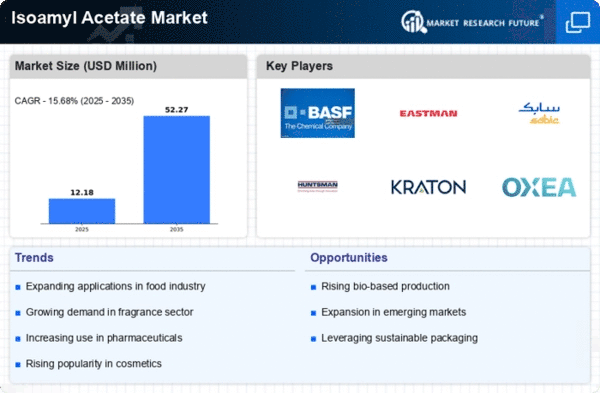
As per MRFR analysis, the Isoamyl Acetate Market Size was estimated at 10.53 USD Million in 2024. The Isoamyl Acetate industry is projected to grow from 12.18 USD Million in 2025 to 52.27 USD Million by 2035, exhibiting a compound annual growth rate (CAGR) of 15.68 during the forecast period 2025 - 2035.

Key Market Trends & Highlights

The Isoamyl Acetate Market is experiencing robust growth driven by diverse applications and increasing consumer preferences.

  • The North American region remains the largest market for isoamyl acetate, primarily due to its extensive use in food flavoring applications.
  • Asia-Pacific is identified as the fastest-growing region, with rising demand in cosmetics and personal care products.
  • The food and beverage segment continues to dominate the market, while the fragrance segment is witnessing rapid growth.
  • Key market drivers include the rising demand in the food and beverage sector and technological advancements in production.

Market Size & Forecast

2024 Market Size 10.53 (USD Million)
2035 Market Size 52.27 (USD Million)
CAGR (2025 - 2035) 15.68%
Largest Regional Market Share in 2024 North America

Major Players

BASF SE (DE), Eastman Chemical Company (US), SABIC (SA), Huntsman Corporation (US), Kraton Corporation (US), Oxea GmbH (DE), Solvay S.A. (BE), Mitsubishi Chemical Corporation (JP), Daicel Corporation (JP)

Market Trends

The Isoamyl Acetate Market is currently experiencing a dynamic phase characterized by evolving consumer preferences and increasing applications across various industries. This compound, known for its fruity aroma, is widely utilized in food and beverage, cosmetics, and fragrance sectors. The growing trend towards natural and organic products appears to be influencing demand, as manufacturers seek to incorporate isoamyl acetate into their formulations to enhance sensory experiences. Furthermore, the expansion of the food industry, particularly in developing regions, seems to be driving the need for flavoring agents, thereby bolstering the market's growth potential. In addition to the food and beverage sector, the Isoamyl Acetate Market is witnessing a rise in demand from the pharmaceutical industry, where it is employed as a solvent and in drug formulation. The increasing focus on research and development activities indicates a potential for innovation in applications, which may further stimulate market expansion. As sustainability becomes a priority, companies are likely to explore eco-friendly production methods, aligning with global environmental goals. Overall, the Isoamyl Acetate Market appears poised for continued growth, driven by diverse applications and shifting consumer trends.

Rising Demand in Food and Beverage Sector

The Isoamyl Acetate Market is seeing heightened interest from the food and beverage industry, where this compound is valued for its flavoring properties. As consumers increasingly seek natural ingredients, manufacturers are incorporating isoamyl acetate to enhance product appeal.

Growth in Cosmetic Applications

There is a notable trend towards the use of isoamyl acetate in cosmetic formulations. Its pleasant scent and potential skin benefits are attracting attention from brands aiming to create more appealing and effective products.

Sustainability Initiatives

The Isoamyl Acetate Market is likely to witness a shift towards sustainable production practices. As environmental concerns rise, companies may explore greener methods of synthesis, aligning with consumer preferences for eco-friendly products.

Isoamyl Acetate Market Market Drivers

Emerging Markets and Global Expansion

The Global Isoamyl Acetate Market Industry is witnessing growth driven by emerging markets and global expansion. Regions such as Asia-Pacific and Latin America are experiencing increased industrialization and urbanization, leading to higher demand for isoamyl acetate in food, cosmetics, and fragrances. As these markets develop, they present significant opportunities for manufacturers to expand their reach and enhance market share. The anticipated growth in these regions is likely to contribute to the overall market value, reinforcing the industry's position on a global scale. This trend underscores the importance of strategic investments in emerging markets to capitalize on growth opportunities.

Technological Advancements in Production

The Global Isoamyl Acetate Market Industry is poised for growth due to technological advancements in production processes. Innovations in synthesis methods and extraction techniques are enhancing the efficiency and cost-effectiveness of isoamyl acetate production. These advancements not only improve yield but also reduce environmental impact, aligning with global sustainability goals. As manufacturers adopt these technologies, the industry is likely to experience increased competitiveness and profitability. This technological evolution is expected to play a crucial role in meeting the rising demand for isoamyl acetate across various sectors, thereby supporting the overall market growth.

Rising Demand in Food and Beverage Sector

The Global Isoamyl Acetate Market Industry experiences a notable surge in demand from the food and beverage sector, primarily due to its application as a flavoring agent. Isoamyl acetate is recognized for its banana-like aroma, making it a popular choice in confectionery, beverages, and baked goods. As consumer preferences shift towards natural flavors, the industry is likely to witness an increase in the use of isoamyl acetate. This trend is supported by the projected market value of 266.8 USD Million in 2024, indicating a robust growth trajectory fueled by the food and beverage industry's expansion.

Regulatory Support for Natural Ingredients

The Global Isoamyl Acetate Market Industry benefits from regulatory support promoting the use of natural ingredients in various applications. Governments worldwide are increasingly advocating for the use of safer, naturally derived substances in food, cosmetics, and fragrances. This regulatory environment encourages manufacturers to adopt isoamyl acetate, which is perceived as a safer alternative to synthetic compounds. As regulations evolve, the industry is likely to see a shift towards more sustainable practices, further driving the demand for isoamyl acetate. This regulatory support may enhance the industry's growth prospects, contributing to its projected expansion in the coming years.

Growth in Fragrance and Cosmetic Applications

The Global Isoamyl Acetate Market Industry is significantly influenced by the growth in fragrance and cosmetic applications. Isoamyl acetate serves as a key ingredient in perfumes and personal care products, contributing to their olfactory profiles. The increasing consumer inclination towards premium and natural fragrances is likely to bolster the demand for isoamyl acetate. As the global cosmetics market continues to expand, the industry anticipates a sustained rise in isoamyl acetate utilization. This trend aligns with the overall market growth, which is expected to reach 595.0 USD Million by 2035, reflecting a compound annual growth rate of 7.56% from 2025 to 2035.

Market Segment Insights

By Application: Food Flavoring (Largest) vs. Fragrance (Fastest-Growing)

In the Isoamyl Acetate market, the application segments are diverse and showcase different market shares. Food flavoring remains the largest segment, driven by the compound's naturally derived qualities that appeal to both manufacturers and consumers seeking authentic taste experiences. Following closely is the fragrance segment, which has been gaining significant traction due to its versatility in various products, including perfumes and household items. Other applications such as solvents, chemical intermediates, and pharmaceuticals are also notable, but they represent smaller portions of the overall market share. As consumer preferences shift towards natural and sustainable products, the demand for Isoamyl Acetate in food flavoring is expanding steadily. Additionally, the fragrance segment is experiencing the fastest growth as brands increasingly adopt this compound in their formulations to create unique and appealing scents. Innovations in product formulations and heightened awareness around the benefits of Isoamyl Acetate are likely to catalyze growth across all application segments, though food flavoring remains at the forefront.

Food Flavoring (Dominant) vs. Pharmaceuticals (Emerging)

Food flavoring is a dominant application of Isoamyl Acetate, known for its pleasant flavor profile that enhances various food products. The segment thrives on trends favoring natural ingredients, as consumers seek products with a reduced chemical footprint. This application has established itself as a preferred choice among food manufacturers. On the other hand, the pharmaceuticals segment represents an emerging market, capitalizing on Isoamyl Acetate's therapeutic benefits. While still in the early stages of growth, its potential for use as a solvent and excipient in drug formulations positions it as a future contender. As regulatory frameworks evolve and research uncovers further applications, both segments are expected to show dynamic growth, although food flavoring currently leads in market presence.

By End Use: Food and Beverage (Largest) vs. Cosmetics and Personal Care (Fastest-Growing)

In the Isoamyl Acetate Market, the distribution of market share across various end-use segments reveals that the Food and Beverage sector holds the largest share, capitalizing on its diverse applications as a flavoring agent and solvent. Meanwhile, sectors like Cosmetics and Personal Care have seen a notable increase in their share, driven by the demand for natural fragrances and formulations that contain Isoamyl Acetate as a key ingredient. This growing preference emphasizes the segment's significance in consumer products, highlighting its role in the overall market landscape. The growth trends within the Isoamyl Acetate Market are significantly influenced by the evolving preferences of consumers for safe, high-quality products. The Food and Beverage industry continues to leverage Isoamyl Acetate for its flavor-enhancing properties, while the Cosmetics and Personal Care sector is rapidly adapting to include this compound in various formulations. Additionally, increased regulations promoting the use of eco-friendly ingredients contribute to the growth of existing and emerging segments, positioning Isoamyl Acetate as a versatile and vital component across numerous applications.

Food and Beverage (Dominant) vs. Cosmetics and Personal Care (Emerging)

The Food and Beverage segment dominates the Isoamyl Acetate market due to its prevalent use as a flavoring agent in various food products, particularly in candies, baked goods, and beverages. This enduring demand is strengthened by the increasing trend toward natural and organic flavor solutions, further bolstering the segment's market position. In contrast, the Cosmetics and Personal Care segment is emerging rapidly thanks to the rising consumer inclination towards products that incorporate plant-based compounds. Isoamyl Acetate serves as a natural fragrance in personal care items, enabling brands to cater to environmentally conscious consumers. This segment's growth is also driven by innovation in formulations and the rising importance of sensory attributes, creating a competitive landscape where both segments play crucial roles.

By Formulation Type: Natural Isoamyl Acetate (Largest) vs. Synthetic Isoamyl Acetate (Fastest-Growing)

The Isoamyl Acetate market is segmented into Natural, Synthetic, and Blended formulations. Natural Isoamyl Acetate holds the largest share due to its preference in applications such as food flavoring and fragrance production. On the other hand, Synthetic Isoamyl Acetate is witnessing rapid growth, driven by its cost-effectiveness and versatility, particularly in the cosmetic and personal care industries. Blended Isoamyl Acetate serves niche markets but remains smaller in comparison to the natural and synthetic variants.

Natural Isoamyl Acetate (Dominant) vs. Synthetic Isoamyl Acetate (Emerging)

Natural Isoamyl Acetate emerges as the dominant formulation due to its appeal in natural and organic products, which are increasingly favored by consumers. It is derived from natural sources, making it a preferred choice for manufacturers focusing on clean labeling and environmentally sustainable products. Conversely, Synthetic Isoamyl Acetate, which is gaining traction as an emerging formulation, offers benefits such as consistency and lower production costs. This formulation is especially popular in sectors like cosmetics, where unique scent profiles are crucial. As consumers seek a balance between cost and natural appeal, both formulations are positioned to play significant roles in shaping the market dynamics.

By Distribution Channel: Direct Sales (Largest) vs. Online Sales (Fastest-Growing)

In the Isoamyl Acetate Market, the distribution channel landscape is predominantly characterized by Direct Sales which holds the largest market share due to the established relationships between manufacturers and their key clients. Distributors play a vital role in the supply chain, ensuring that isoamyl acetate reaches various sectors such as pharmaceuticals and food and beverages. Retail sales are less significant yet contribute to market accessibility for small-scale buyers and niches.

Direct Sales (Dominant) vs. Online Sales (Emerging)

Direct Sales in the Isoamyl Acetate Market are characterized by manufacturers selling directly to businesses, which fosters strong customer relationships and allows for tailored service. This segment emerges as the dominant channel due to its efficiency and reliability. Conversely, Online Sales are rapidly emerging, driven by the digital transformation in purchasing behavior among customers. Online platforms enable broader access and convenience, catering especially to smaller businesses that seek to procure isoamyl acetate without intermediaries. This shift towards online channels reflects evolving consumer preferences and the broader trend of digitalization across industries.

Get more detailed insights about Isoamyl Acetate Market Research Report—Global Forecast till 2035

Regional Insights

North America : Market Leader in Isoamyl Acetate

North America is poised to maintain its leadership in the Isoamyl Acetate market, holding a significant share of 4.5 in 2025. The region's growth is driven by increasing demand in the food and beverage sector, coupled with stringent regulations promoting the use of natural flavoring agents. Additionally, the rise in consumer preference for organic products is further propelling market expansion. The United States stands as the primary contributor, with key players like Eastman Chemical Company and Huntsman Corporation leading the charge. The competitive landscape is characterized by innovation and strategic partnerships, ensuring a robust supply chain. As regulations evolve, companies are adapting to meet new standards, enhancing their market position and driving growth.

Europe : Emerging Market with Growth Potential

Europe's Isoamyl Acetate market is projected to grow significantly, with a market size of 3.0 in 2025. The region benefits from a strong regulatory framework that encourages the use of bio-based chemicals, aligning with sustainability goals. Increasing demand from the cosmetics and personal care industries is also a key driver, as consumers seek natural ingredients in their products. Leading countries such as Germany and France are at the forefront, with major players like BASF SE and Solvay S.A. actively participating in the market. The competitive landscape is marked by innovation and a focus on sustainable practices. As the European Union continues to implement stringent regulations, companies are investing in R&D to comply and capture market share.

Asia-Pacific : Rapidly Growing Market Dynamics

The Asia-Pacific region is witnessing a burgeoning Isoamyl Acetate market, with a size of 2.5 in 2025. This growth is fueled by rising industrialization and urbanization, leading to increased demand in various sectors, including food and beverages, and pharmaceuticals. Regulatory support for the use of eco-friendly chemicals is also a significant catalyst for market expansion. Countries like Japan and China are leading the charge, with key players such as Mitsubishi Chemical Corporation and Daicel Corporation making substantial investments. The competitive landscape is evolving, with a focus on innovation and sustainability. As the region continues to develop, the demand for Isoamyl Acetate is expected to rise, driven by both consumer preferences and regulatory frameworks.

Middle East and Africa : Emerging Market with Challenges

The Middle East and Africa region is gradually emerging in the Isoamyl Acetate market, with a size of 0.53 in 2025. The growth is primarily driven by increasing industrial activities and a rising demand for flavoring agents in the food sector. However, challenges such as regulatory hurdles and limited production capabilities may hinder rapid growth. Countries like South Africa and Saudi Arabia are key players in this market, with local companies beginning to explore opportunities in the chemical sector. The competitive landscape is still developing, with a few international players establishing a presence. As the region focuses on diversifying its economy, the Isoamyl Acetate market is expected to gain traction, albeit slowly.

Key Players and Competitive Insights

The Isoamyl Acetate Market is currently characterized by a dynamic competitive landscape, driven by increasing demand across various applications, including food and beverage, cosmetics, and pharmaceuticals. Key players such as BASF SE (Germany), Eastman Chemical Company (US), and Huntsman Corporation (US) are strategically positioned to leverage their extensive product portfolios and innovative capabilities. BASF SE (Germany) focuses on sustainability and has been investing in green chemistry initiatives, which aligns with the growing consumer preference for eco-friendly products. Meanwhile, Eastman Chemical Company (US) emphasizes digital transformation and operational efficiency, enhancing its supply chain resilience and customer engagement. Huntsman Corporation (US) is actively pursuing strategic partnerships to expand its market reach, particularly in emerging economies, thereby shaping a competitive environment that is increasingly collaborative and innovation-driven.In terms of business tactics, companies are localizing manufacturing to reduce lead times and optimize supply chains, which is particularly crucial in a moderately fragmented market. The collective influence of these key players fosters a competitive structure that encourages innovation while also addressing regional market needs. This localized approach not only enhances operational efficiency but also allows companies to respond swiftly to changing consumer preferences and regulatory requirements.

In November BASF SE (Germany) announced the launch of a new line of bio-based isoamyl acetate products, which are derived from renewable resources. This strategic move underscores the company's commitment to sustainability and positions it favorably in a market increasingly driven by eco-conscious consumers. The introduction of these products is expected to enhance BASF's competitive edge, particularly among clients seeking sustainable alternatives.

In October Eastman Chemical Company (US) unveiled a new digital platform aimed at streamlining customer interactions and improving order fulfillment processes. This initiative is significant as it reflects the company's focus on digitalization, which is becoming a critical factor in enhancing customer satisfaction and operational efficiency. By leveraging technology, Eastman is likely to strengthen its market position and foster deeper customer relationships.

In September Huntsman Corporation (US) entered into a strategic partnership with a leading flavor and fragrance company to co-develop innovative applications for isoamyl acetate in the food industry. This collaboration is indicative of the trend towards strategic alliances that enhance product offerings and market penetration. Such partnerships not only expand Huntsman's product capabilities but also allow for shared resources and expertise, which can lead to accelerated innovation.

As of December the competitive trends in the Isoamyl Acetate Market are increasingly defined by digitalization, sustainability, and the integration of advanced technologies such as AI. Strategic alliances are playing a pivotal role in shaping the current landscape, enabling companies to pool resources and innovate more effectively. Looking ahead, competitive differentiation is likely to evolve from traditional price-based competition to a focus on innovation, technology, and supply chain reliability, as companies strive to meet the demands of a more discerning consumer base.

Key Companies in the Isoamyl Acetate Market include

Industry Developments

Future Outlook

Isoamyl Acetate Market Future Outlook

The Isoamyl Acetate Market is projected to grow at a 15.68% CAGR from 2025 to 2035, driven by increasing demand in food and fragrance applications.

New opportunities lie in:

  • Expansion into emerging markets with tailored product offerings.
  • Development of eco-friendly production processes to attract sustainability-focused clients.
  • Investment in advanced distribution networks to enhance market reach and efficiency.

By 2035, the Isoamyl Acetate Market is expected to achieve robust growth and increased global presence.

Market Segmentation

Isoamyl Acetate Market End Use Outlook

  • Food and Beverage
  • Cosmetics and Personal Care
  • Pharmaceuticals
  • Chemical Manufacturing
  • Agriculture

Isoamyl Acetate Market Application Outlook

  • Food Flavoring
  • Fragrance
  • Solvent
  • Chemical Intermediate
  • Pharmaceuticals

Isoamyl Acetate Market Formulation Type Outlook

  • Natural Isoamyl Acetate
  • Synthetic Isoamyl Acetate
  • Blended Isoamyl Acetate

Isoamyl Acetate Market Distribution Channel Outlook

  • Direct Sales
  • Online Sales
  • Distributors
  • Retail

Report Scope

MARKET SIZE 202410.53(USD Million)
MARKET SIZE 202512.18(USD Million)
MARKET SIZE 203552.27(USD Million)
COMPOUND ANNUAL GROWTH RATE (CAGR)15.68% (2025 - 2035)
REPORT COVERAGERevenue Forecast, Competitive Landscape, Growth Factors, and Trends
BASE YEAR2024
Market Forecast Period2025 - 2035
Historical Data2019 - 2024
Market Forecast UnitsUSD Million
Key Companies ProfiledBASF SE (DE), Eastman Chemical Company (US), SABIC (SA), Huntsman Corporation (US), Kraton Corporation (US), Oxea GmbH (DE), Solvay S.A. (BE), Mitsubishi Chemical Corporation (JP), Daicel Corporation (JP)
Segments CoveredApplication, End Use, Formulation Type, Distribution Channel
Key Market OpportunitiesGrowing demand for natural flavoring agents in food and beverage applications within the Isoamyl Acetate Market.
Key Market DynamicsRising demand for natural flavoring agents drives innovation and competition in the Isoamyl Acetate market.
Countries CoveredNorth America, Europe, APAC, South America, MEA

FAQs

What growth rate global Isoamyl Acetate market would register in the future?

The global Isoamyl Acetate market would register a growth of 5.5%.

Which industry will play a crucial role in taking the Isoamyl Acetate market ahead??

The personal care industry will play a prominent role in taking the market forward.

What is the key restraining factor for the global Isoamyl Acetate market?

Stringent regulation on isoamyl acetate could restrain the market.

Which region would enjoy the upper hand in the Isoamyl Acetate market?

Asia-Pacific would enjoy the upper hand in the Isoamyl Acetate market.

Which Asia-Pacific country would set the trend in the Isoamyl Acetate market?

China, as the largest consumer, would set the trend.

  1. SECTION I: EXECUTIVE SUMMARY AND KEY HIGHLIGHTS
    1. | 1.1 EXECUTIVE SUMMARY
    2. | 1.1.1 Market Overview
    3. | 1.1.2 Key Findings
    4. | 1.1.3 Market Segmentation
    5. | 1.1.4 Competitive Landscape
    6. | 1.1.5 Challenges and Opportunities
    7. | 1.1.6 Future Outlook
  2. SECTION II: SCOPING, METHODOLOGY AND MARKET STRUCTURE
    1. | 2.1 MARKET INTRODUCTION
    2. | 2.1.1 Definition
    3. | 2.1.2 Scope of the study
    4. |-- 2.1.2.1 Research Objective
    5. |-- 2.1.2.2 Assumption
    6. |-- 2.1.2.3 Limitations
    7. | 2.2 RESEARCH METHODOLOGY
    8. | 2.2.1 Overview
    9. | 2.2.2 Data Mining
    10. | 2.2.3 Secondary Research
    11. | 2.2.4 Primary Research
    12. |-- 2.2.4.1 Primary Interviews and Information Gathering Process
    13. |-- 2.2.4.2 Breakdown of Primary Respondents
    14. | 2.2.5 Forecasting Model
    15. | 2.2.6 Market Size Estimation
    16. |-- 2.2.6.1 Bottom-Up Approach
    17. |-- 2.2.6.2 Top-Down Approach
    18. | 2.2.7 Data Triangulation
    19. | 2.2.8 Validation
  3. SECTION III: QUALITATIVE ANALYSIS
    1. | 3.1 MARKET DYNAMICS
    2. | 3.1.1 Overview
    3. | 3.1.2 Drivers
    4. | 3.1.3 Restraints
    5. | 3.1.4 Opportunities
    6. | 3.2 MARKET FACTOR ANALYSIS
    7. | 3.2.1 Value chain Analysis
    8. | 3.2.2 Porter's Five Forces Analysis
    9. |-- 3.2.2.1 Bargaining Power of Suppliers
    10. |-- 3.2.2.2 Bargaining Power of Buyers
    11. |-- 3.2.2.3 Threat of New Entrants
    12. |-- 3.2.2.4 Threat of Substitutes
    13. |-- 3.2.2.5 Intensity of Rivalry
    14. | 3.2.3 COVID-19 Impact Analysis
    15. |-- 3.2.3.1 Market Impact Analysis
    16. |-- 3.2.3.2 Regional Impact
    17. |-- 3.2.3.3 Opportunity and Threat Analysis
  4. SECTION IV: QUANTITATIVE ANALYSIS
    1. | 4.1 Chemicals and Materials, BY Application (USD Million)
    2. | 4.1.1 Food Flavoring
    3. | 4.1.2 Fragrance
    4. | 4.1.3 Solvent
    5. | 4.1.4 Chemical Intermediate
    6. | 4.1.5 Pharmaceuticals
    7. | 4.2 Chemicals and Materials, BY End Use (USD Million)
    8. | 4.2.1 Food and Beverage
    9. | 4.2.2 Cosmetics and Personal Care
    10. | 4.2.3 Pharmaceuticals
    11. | 4.2.4 Chemical Manufacturing
    12. | 4.2.5 Agriculture
    13. | 4.3 Chemicals and Materials, BY Formulation Type (USD Million)
    14. | 4.3.1 Natural Isoamyl Acetate
    15. | 4.3.2 Synthetic Isoamyl Acetate
    16. | 4.3.3 Blended Isoamyl Acetate
    17. | 4.4 Chemicals and Materials, BY Distribution Channel (USD Million)
    18. | 4.4.1 Direct Sales
    19. | 4.4.2 Online Sales
    20. | 4.4.3 Distributors
    21. | 4.4.4 Retail
    22. | 4.5 Chemicals and Materials, BY Region (USD Million)
    23. | 4.5.1 North America
    24. |-- 4.5.1.1 US
    25. |-- 4.5.1.2 Canada
    26. | 4.5.2 Europe
    27. |-- 4.5.2.1 Germany
    28. |-- 4.5.2.2 UK
    29. |-- 4.5.2.3 France
    30. |-- 4.5.2.4 Russia
    31. |-- 4.5.2.5 Italy
    32. |-- 4.5.2.6 Spain
    33. |-- 4.5.2.7 Rest of Europe
    34. | 4.5.3 APAC
    35. |-- 4.5.3.1 China
    36. |-- 4.5.3.2 India
    37. |-- 4.5.3.3 Japan
    38. |-- 4.5.3.4 South Korea
    39. |-- 4.5.3.5 Malaysia
    40. |-- 4.5.3.6 Thailand
    41. |-- 4.5.3.7 Indonesia
    42. |-- 4.5.3.8 Rest of APAC
    43. | 4.5.4 South America
    44. |-- 4.5.4.1 Brazil
    45. |-- 4.5.4.2 Mexico
    46. |-- 4.5.4.3 Argentina
    47. |-- 4.5.4.4 Rest of South America
    48. | 4.5.5 MEA
    49. |-- 4.5.5.1 GCC Countries
    50. |-- 4.5.5.2 South Africa
    51. |-- 4.5.5.3 Rest of MEA
  5. SECTION V: COMPETITIVE ANALYSIS
    1. | 5.1 Competitive Landscape
    2. | 5.1.1 Overview
    3. | 5.1.2 Competitive Analysis
    4. | 5.1.3 Market share Analysis
    5. | 5.1.4 Major Growth Strategy in the Chemicals and Materials
    6. | 5.1.5 Competitive Benchmarking
    7. | 5.1.6 Leading Players in Terms of Number of Developments in the Chemicals and Materials
    8. | 5.1.7 Key developments and growth strategies
    9. |-- 5.1.7.1 New Product Launch/Service Deployment
    10. |-- 5.1.7.2 Merger & Acquisitions
    11. |-- 5.1.7.3 Joint Ventures
    12. | 5.1.8 Major Players Financial Matrix
    13. |-- 5.1.8.1 Sales and Operating Income
    14. |-- 5.1.8.2 Major Players R&D Expenditure. 2023
    15. | 5.2 Company Profiles
    16. | 5.2.1 BASF SE (DE)
    17. |-- 5.2.1.1 Financial Overview
    18. |-- 5.2.1.2 Products Offered
    19. |-- 5.2.1.3 Key Developments
    20. |-- 5.2.1.4 SWOT Analysis
    21. |-- 5.2.1.5 Key Strategies
    22. | 5.2.2 Eastman Chemical Company (US)
    23. |-- 5.2.2.1 Financial Overview
    24. |-- 5.2.2.2 Products Offered
    25. |-- 5.2.2.3 Key Developments
    26. |-- 5.2.2.4 SWOT Analysis
    27. |-- 5.2.2.5 Key Strategies
    28. | 5.2.3 SABIC (SA)
    29. |-- 5.2.3.1 Financial Overview
    30. |-- 5.2.3.2 Products Offered
    31. |-- 5.2.3.3 Key Developments
    32. |-- 5.2.3.4 SWOT Analysis
    33. |-- 5.2.3.5 Key Strategies
    34. | 5.2.4 Huntsman Corporation (US)
    35. |-- 5.2.4.1 Financial Overview
    36. |-- 5.2.4.2 Products Offered
    37. |-- 5.2.4.3 Key Developments
    38. |-- 5.2.4.4 SWOT Analysis
    39. |-- 5.2.4.5 Key Strategies
    40. | 5.2.5 Kraton Corporation (US)
    41. |-- 5.2.5.1 Financial Overview
    42. |-- 5.2.5.2 Products Offered
    43. |-- 5.2.5.3 Key Developments
    44. |-- 5.2.5.4 SWOT Analysis
    45. |-- 5.2.5.5 Key Strategies
    46. | 5.2.6 Oxea GmbH (DE)
    47. |-- 5.2.6.1 Financial Overview
    48. |-- 5.2.6.2 Products Offered
    49. |-- 5.2.6.3 Key Developments
    50. |-- 5.2.6.4 SWOT Analysis
    51. |-- 5.2.6.5 Key Strategies
    52. | 5.2.7 Solvay S.A. (BE)
    53. |-- 5.2.7.1 Financial Overview
    54. |-- 5.2.7.2 Products Offered
    55. |-- 5.2.7.3 Key Developments
    56. |-- 5.2.7.4 SWOT Analysis
    57. |-- 5.2.7.5 Key Strategies
    58. | 5.2.8 Mitsubishi Chemical Corporation (JP)
    59. |-- 5.2.8.1 Financial Overview
    60. |-- 5.2.8.2 Products Offered
    61. |-- 5.2.8.3 Key Developments
    62. |-- 5.2.8.4 SWOT Analysis
    63. |-- 5.2.8.5 Key Strategies
    64. | 5.2.9 Daicel Corporation (JP)
    65. |-- 5.2.9.1 Financial Overview
    66. |-- 5.2.9.2 Products Offered
    67. |-- 5.2.9.3 Key Developments
    68. |-- 5.2.9.4 SWOT Analysis
    69. |-- 5.2.9.5 Key Strategies
    70. | 5.3 Appendix
    71. | 5.3.1 References
    72. | 5.3.2 Related Reports

Chemicals and Materials Market Segmentation

Chemicals and Materials By Application (USD Million, 2025-2035)

  • Food Flavoring
  • Fragrance
  • Solvent
  • Chemical Intermediate
  • Pharmaceuticals

Chemicals and Materials By End Use (USD Million, 2025-2035)

  • Food and Beverage
  • Cosmetics and Personal Care
  • Pharmaceuticals
  • Chemical Manufacturing
  • Agriculture

Chemicals and Materials By Formulation Type (USD Million, 2025-2035)

  • Natural Isoamyl Acetate
  • Synthetic Isoamyl Acetate
  • Blended Isoamyl Acetate

Chemicals and Materials By Distribution Channel (USD Million, 2025-2035)

  • Direct Sales
  • Online Sales
  • Distributors
  • Retail
Infographic

Free Sample Request

Kindly complete the form below to receive a free sample of this Report

Get Free Sample

Customer Strories

Compare Licence

×
Features License Type
Single User Multiuser License Enterprise User
Price $4,950 $5,950 $7,250
Maximum User Access Limit 1 User Upto 10 Users Unrestricted Access Throughout the Organization
Free Customization
Direct Access to Analyst
Deliverable Format
Platform Access
Discount on Next Purchase 10% 15% 15%
Printable Versions