
×
Request Free Sample ×

Kindly complete the form below to receive a free sample of this Report

* Please use a valid business email

Leading companies partner with us for data-driven Insights

clients tt-cursor
Hero Background
English
Chinese
French
Japanese
Korean
German
Spanish

IOT Node Gateway Market Trends

ID: MRFR/SEM/2941-HCR
200 Pages
Shubham Munde
February 2026

IoT Node and Gateway Market Size, Share & Industry Analysis: By Hardware (Processor, Sensor, Wired, Wireless, Connectivity IC, And Memory Device), By End-User (BFSI, Healthcare, Wearable, Consumer Electronics, Agriculture, And Building & Automation), And By Region (North America, Europe, Asia-Pacific, And Rest Of The World) – Forecast Till 2035

Share:
Download PDF ×

We do not share your information with anyone. However, we may send you emails based on your report interest from time to time. You may contact us at any time to opt-out.

IOT Node Gateway Market Infographic
Purchase Options

Market Trends

Key Emerging Trends in the IOT Node Gateway Market

The IoT Node and Gateway market is witnessing dynamic trends that underscore the evolution of the Internet of Things landscape. One prominent trend is the increasing integration of edge computing capabilities within nodes and gateways. Edge computing allows data processing to occur closer to the source of data generation, reducing latency and enhancing real-time decision-making. As industries prioritize faster and more efficient data processing, the trend towards incorporating edge computing functionalities in IoT nodes and gateways is gaining momentum.

Interconnectivity is another prevailing trend shaping the IoT Node and Gateway market. With the proliferation of IoT devices across various domains, there is a growing emphasis on creating seamlessly connected ecosystems. This trend is driving the development of nodes and gateways that can facilitate smooth communication and interoperability among diverse devices. The ability to connect and integrate with a wide range of sensors and devices enhances the overall efficiency and functionality of the IoT ecosystem.

Security remains a top concern, leading to a notable trend in the incorporation of advanced security features in IoT nodes and gateways. As the number of connected devices increases, so does the potential vulnerability to cyber threats. The market trend reflects a heightened focus on implementing robust security protocols, encryption mechanisms, and authentication measures to safeguard sensitive data. Companies that prioritize security features in their IoT solutions are likely to gain the trust of businesses and consumers alike.

Edge AI (Artificial Intelligence) is emerging as a transformative trend in the IoT Node and Gateway market. Integrating AI capabilities at the edge allows for local processing of data, enabling devices to make intelligent decisions without relying solely on cloud-based AI systems. This trend is particularly significant in scenarios where low latency and real-time responses are critical, such as in industrial automation and autonomous vehicles. The integration of Edge AI in nodes and gateways enhances the overall efficiency and autonomy of IoT devices.

A notable trend is the increasing focus on energy efficiency in IoT nodes and gateways. As the deployment of IoT devices continues to rise, there is a growing awareness of the need to optimize energy consumption. Companies are developing nodes and gateways that are energy-efficient, leveraging technologies such as low-power processors and optimized communication protocols. This trend aligns with the broader industry goal of creating sustainable and environmentally friendly IoT solutions.

The trend towards 5G connectivity is influencing the IoT Node and Gateway market significantly. The rollout of 5G networks promises faster and more reliable connectivity, addressing the current limitations of communication bandwidth in IoT deployments. Nodes and gateways equipped with 5G capabilities can leverage high-speed, low-latency connectivity, opening up new possibilities for applications such as smart cities, autonomous vehicles, and industrial automation. The market trend reflects a shift towards the adoption of 5G-enabled nodes and gateways to harness the full potential of the next-generation connectivity.

Data analytics and real-time insights are driving a trend towards more sophisticated and intelligent nodes and gateways. Businesses are increasingly seeking IoT solutions that not only facilitate data collection but also provide advanced analytics capabilities. The integration of analytics at the edge enables quicker decision-making based on actionable insights derived from the data generated by IoT devices. This trend aligns with the growing demand for data-driven decision support systems across various industries.


Author
Shubham Munde
Team Lead - Research

Shubham brings over 7 years of expertise in Market Intelligence and Strategic Consulting, with a strong focus on the Automotive, Aerospace, and Defense sectors. Backed by a solid foundation in semiconductors, electronics, and software, he has successfully delivered high-impact syndicated and custom research on a global scale. His core strengths include market sizing, forecasting, competitive intelligence, consumer insights, and supply chain mapping. Widely recognized for developing scalable growth strategies, Shubham empowers clients to navigate complex markets and achieve a lasting competitive edge. Trusted by start-ups and Fortune 500 companies alike, he consistently converts challenges into strategic opportunities that drive sustainable growth.

Leave a Comment

FAQs

What is the projected market valuation of the IoT Node and Gateway Market by 2035?

<p>The IoT Node and Gateway Market is projected to reach a valuation of 55.11 USD Billion by 2035.</p>

What was the market valuation of the IoT Node and Gateway Market in 2024?

<p>In 2024, the IoT Node and Gateway Market was valued at 4.7 USD Billion.</p>

What is the expected CAGR for the IoT Node and Gateway Market during the forecast period 2025 - 2035?

<p>The expected CAGR for the IoT Node and Gateway Market during the forecast period 2025 - 2035 is 25.08%.</p>

Which companies are considered key players in the IoT Node and Gateway Market?

<p>Key players in the IoT Node and Gateway Market include Cisco Systems, IBM, Microsoft, Amazon Web Services, Intel, Siemens, Huawei Technologies, Schneider Electric, and Qualcomm.</p>

What segment of the IoT Node and Gateway Market had the highest valuation in 2024?

<p>In 2024, the Consumer Electronics segment had the highest valuation at 1.2 USD Billion.</p>

How much is the Sensor segment projected to grow by 2035?

<p>The Sensor segment is projected to grow from 1.2 USD Billion in 2024 to 15.0 USD Billion by 2035.</p>

What is the projected valuation for the Healthcare segment by 2035?

The Healthcare segment is projected to reach a valuation of 13.0 USD Billion by 2035.

What was the valuation of the Wireless segment in 2024?

The Wireless segment was valued at 1.0 USD Billion in 2024.

How does the Agriculture segment's growth compare to other segments by 2035?

The Agriculture segment is projected to grow to 4.0 USD Billion by 2035, which is comparatively lower than other segments.

What is the projected valuation for the Building & Automation segment by 2035?

The Building &amp; Automation segment is projected to reach a valuation of 4.11 USD Billion by 2035.

Market Summary

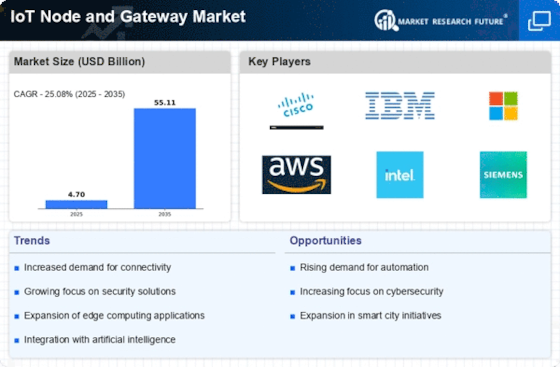
As per Market Research Future analysis, the IoT Node and Gateway Market Size was estimated at 4.7 USD Billion in 2024. The IoT Node and Gateway industry is projected to grow from 5.879 USD Billion in 2025 to 55.11 USD Billion by 2035, exhibiting a compound annual growth rate (CAGR) of 25.08% during the forecast period 2025 - 2035

Key Market Trends & Highlights

The IoT Node and Gateway Market is poised for substantial growth driven by technological advancements and increasing demand across various sectors.

  • The market is witnessing an increased focus on edge computing, enhancing data processing capabilities at the source. There is a notable emphasis on security solutions to protect IoT devices from emerging cyber threats. Integration of artificial intelligence is becoming prevalent, enabling smarter and more efficient IoT applications. Rising demand for smart devices and advancements in network infrastructure are key drivers propelling market expansion, particularly in North America and the healthcare segment.

Market Size & Forecast

2024 Market Size 4.7 (USD Billion)
2035 Market Size 55.11 (USD Billion)
CAGR (2025 - 2035) 25.08%
Largest Regional Market Share in 2024 North America

Major Players

Cisco Systems (US), IBM (US), Microsoft (US), Amazon Web Services (US), Intel (US), Siemens (DE), Huawei Technologies (CN), Schneider Electric (FR), Qualcomm (US)

Market Trends

The IoT Node and Gateway Market is currently experiencing a transformative phase within the broader iot gateways market, driven by the increasing demand for connectivity and automation across various sectors. As industries embrace digital transformation, the integration of IoT nodes and gateways becomes essential for facilitating seamless communication between devices, strengthening the overall iot gateway market ecosystem. Furthermore, the growing emphasis on data security and privacy is likely to shape the development of more robust and secure IoT infrastructures. In addition, the expansion of smart cities and the rising adoption of smart home technologies are contributing to the growth of the iot gateway market size globally.  Stakeholders are increasingly recognizing the potential of IoT to optimize operations, improve efficiency, and enhance user experiences. As a result, investments in research and development are expected to surge, fostering a competitive landscape where companies strive to offer cutting-edge solutions. Overall, the future of the IoT Node and Gateway Market appears promising, with numerous opportunities for innovation and growth on the horizon across the iot gateways market.

Increased Focus on Edge Computing

The trend towards edge computing is becoming more pronounced within the IoT Node and Gateway Market. By processing data closer to the source, organizations can reduce latency and improve response times. This shift not only enhances operational efficiency but also alleviates bandwidth constraints associated with cloud computing. As a result, more companies are likely to invest in edge-enabled devices and gateways, positively impacting the iot gateway market size.

Emphasis on Security Solutions

With the proliferation of connected devices, the need for robust security measures is paramount. The IoT Node and Gateway Market and the wider iot gateways market are witnessing a heightened focus on developing advanced security protocols and solutions. This trend suggests that manufacturers are prioritizing the protection of sensitive data and ensuring compliance with regulatory standards, thereby fostering consumer trust and strengthening the iot gateway market.

Integration of Artificial Intelligence

The incorporation of artificial intelligence into IoT solutions is gaining traction. AI technologies are being utilized to analyze vast amounts of data generated by IoT devices, enabling predictive analytics and smarter decision-making. This trend indicates a shift towards more intelligent and autonomous systems, which could significantly enhance the functionality of IoT nodes and gateways.

IOT Node Gateway Market Market Drivers

Rising Demand for Smart Devices

The proliferation of smart devices is a primary driver for the IoT Node and Gateway Market. As consumers increasingly adopt smart home technologies, wearables, and connected appliances, the need for efficient communication between these devices intensifies. According to recent estimates, the number of connected devices is projected to reach over 30 billion by 2030, necessitating robust IoT nodes and gateways to manage data flow and connectivity. This surge in demand compels manufacturers to innovate and enhance their offerings, thereby expanding the IoT Node and Gateway Market. Furthermore, the integration of these devices into everyday life fosters a seamless user experience, which is likely to further accelerate market growth.

Increased Focus on Data Analytics

The increasing focus on data analytics is a crucial driver for the IoT Node and Gateway Market. As organizations collect vast amounts of data from connected devices, the need for effective data processing and analysis becomes paramount. IoT nodes and gateways are essential for aggregating and transmitting this data to cloud platforms where advanced analytics can be performed. The IoT Node and Gateway is projected to reach USD 274 billion by 2022, indicating a growing recognition of the value of data-driven decision-making. This trend is likely to spur demand for IoT solutions that can seamlessly integrate with analytics platforms, thereby enhancing the capabilities of the IoT Node and Gateway Market.

Growing Adoption of Industrial IoT

The industrial sector's growing adoption of IoT technologies serves as a significant driver for the IoT Node and Gateway Market. Industries such as manufacturing, logistics, and energy are increasingly utilizing IoT solutions to enhance operational efficiency and reduce costs. Reports indicate that the industrial IoT market is expected to reach USD 1 trillion by 2025, highlighting the substantial investment in IoT nodes and gateways to facilitate data collection and analysis. These devices play a crucial role in enabling real-time monitoring and predictive maintenance, which are essential for optimizing production processes. Consequently, the demand for reliable and scalable IoT solutions is likely to propel the growth of the IoT Node and Gateway Market.

Advancements in Network Infrastructure

The ongoing advancements in network infrastructure significantly influence the IoT Node and Gateway Market. The rollout of 5G technology is particularly noteworthy, as it promises to enhance connectivity speeds and reduce latency, which are critical for IoT applications. With 5G expected to cover a substantial portion of the population by 2026, the demand for IoT nodes and gateways that can leverage this technology is likely to increase. Additionally, improvements in Wi-Fi standards and the expansion of LPWAN (Low Power Wide Area Network) technologies are also contributing to a more robust infrastructure. This evolution in network capabilities enables more devices to connect simultaneously, thereby driving the growth of the IoT Node and Gateway Market.

Regulatory Support for IoT Initiatives

Regulatory support for IoT initiatives is emerging as a pivotal driver for the IoT Node and Gateway Market. Governments across various regions are recognizing the potential of IoT technologies to enhance public services, improve infrastructure, and drive economic growth. Initiatives aimed at fostering smart cities and connected transportation systems are gaining traction, leading to increased investments in IoT solutions. For instance, policies promoting the deployment of smart meters and environmental monitoring systems are likely to create a favorable environment for the IoT Node and Gateway Market. This regulatory backing not only encourages innovation but also instills confidence among stakeholders, thereby facilitating market expansion.

Market Segment Insights

By Hardware: Processor (Largest) vs. Sensor (Fastest-Growing)

The Hardware segment of the IoT Node and Gateway Market is primarily dominated by Processors, which play a critical role in managing the hardware operations and communications of IoT devices within the iot gateway market. Sensors also hold a significant position in this segment, showcasing strong growth due to their essential functions in data collection and environmental monitoring. Together, these components drive the overall efficiency and performance of IoT systems, influencing their market share dynamics.

Sensors: Processors (Dominant) vs. Sensors (Emerging)

Processors are foundational to the IoT ecosystem, facilitating complex computing tasks and ensuring efficient data handling across devices. Their impact on power consumption and processing speed makes them indispensable in both consumer and industrial IoT applications. Alternatively, Sensors are emerging as a vital component with rapid advancements in technology and miniaturization. They are crucial for real-time data acquisition, thereby enabling smarter decision-making processes. As IoT applications demand more precise and immediate environmental monitoring, the relevance of Sensors continues to escalate, marking them as one of the fastest-growing sectors within the Hardware segment.

By End-User: Healthcare (Largest) vs. Consumer Electronics (Fastest-Growing)

In the IoT Node and Gateway Market, the end-user segment is primarily dominated by the Healthcare sector, which takes a significant share due to the increasing adoption of connected medical devices and remote monitoring solutions. Following closely, the Consumer Electronics segment is emerging rapidly, fueled by the demand for smart home appliances and wearable technology, which are enhancing personal connectivity and user experience. Growth trends in this segment are driven by technological advancements and heightened consumer awareness regarding health and convenience. The Healthcare segment is supported by regulatory policies and a focus on improving patient outcomes, while the Consumer Electronics sector experiences accelerated growth from innovations in IoT devices. This dynamic landscape positions both segments strongly, each fulfilling distinct, yet complementary, needs in the market.

Healthcare (Dominant) vs. Agriculture (Emerging)

The Healthcare segment is currently the dominant force in the IoT Node and Gateway Market, leveraging technology to deliver improved patient care through real-time health monitoring and data analytics. Connected devices such as wearables and telehealth solutions have not only increased efficiency in healthcare delivery but also enhanced patient engagement. In contrast, the Agriculture sector is an emerging market for IoT technology, integrating smart farming solutions like precision agriculture and livestock monitoring. This sector is recognizing the value of IoT in optimizing resource use, improving crop yield, and fostering sustainable practices. Together, these segments illustrate the broad applicability of IoT technologies across different industries, each tailored to address specific challenges.

Get more detailed insights about IOT Node and Gateway Market Research Report - Global Forecast 2035

Regional Insights

By region, the study provides market insights into North America, Europe, Asia-Pacific and Rest of the World. The North American IoT Node and Gateway market will dominate this market, owing to the rise in government initiatives towards transforming cities into smart cities. In addition, the increasing demand for advanced IoT solutions due to the rising availability of high-speed data will boost market growth in this region.

Further, the major countries studied in the market report are The US, Canada, German, France, the UK, Italy, Spain, China, Japan, India, Australia, South Korea, and Brazil.

Figure 2: IoT Node and Gateway Market SHARE BY REGION 2022 (USD Billion)

Europe IoT Node and Gateway market accounts for the second-largest market share due to the key players' supportive policies and investment. Further, the German IoT Node and Gateway market held the largest market share, and the UK IoT Node and Gateway market was the fastest-growing market in the European region.

The Asia-Pacific IoT Node and Gateway Market are expected to grow at the fastest CAGR from 2023 to 2032 due to the rapid improvement in infrastructure and rising per capita disposable income. Moreover, China’s IoT Node and Gateway market held the largest market share, and the Indian IoT Node and Gateway market was the fastest-growing market in the Asia-Pacific region.

Key Players and Competitive Insights

Leading market players are investing heavily in research and development to expand their product lines, which will help the IoT Node and Gateway market, grow even more. Market participants are also undertaking various strategic activities to expand their global footprint, with important market developments including new product launches, contractual agreements, mergers and acquisitions, higher investments, and collaboration with other organizations. To expand and survive in a more competitive and rising market climate, IoT Node and Gateway industry must offer cost-effective items.Manufacturing locally to minimize operational costs is one of the key business tactics manufacturer’s use in the global IoT Node and Gateway industry to benefit clients and increase the market sector. In recent years, the IoT Node and Gateway industry has offered some of the most significant advantages to technology. Major players in the IoT Node and Gateway market, including Intel Corporation (US), NXP Semiconductor N.V. (Netherlands), Texas Instruments Incorporated (US), Cisco Systems Inc. (US), Hewlett Packard Enterprise Co.(US), STMicroelectronics N.V. (Switzerland), Advantech Co/.Ltd. (Taiwan), Eurotech S.P.A. (Italy), Aaeon Components Inc. (Taiwan), Adlink Components Inc. (Taiwan), and others, are attempting to increase market demand by investing in research and development operations.Texas Instruments Incorporated (TI) is an American technological business with its main office in Dallas, Texas. It creates and produces integrated circuits and semiconductors, which it then sells to producers and designers of electronics worldwide. According to sales volume, it ranks among the top 10 semiconductor businesses globally. The company concentrates on making inserted analog circuits and CPUs, which provide more than 80% of its sales. Additionally, TI produces educational technology and TI digital light processing technology. Products like multi-core CPUs, microcontrollers, and calculators.For Instance: In April 2023, Texas Instruments, to help designers implement highly dependable, secure, and efficient Wi-Fi connections for applications to operate with high-density or high-temperature settings up to 105 0C at a reasonable cost, created the SimpleLink series of Wi-Fi 6 companion integrated circuits (ICs).METCAL is an innovative Benchtop Solutions Expert that has provided extensive value to customers as a leader in innovative benchtop solutions. The company provides electronics makers with the tools and the confidence- to produce quicker, safer, more sophisticated devices by providing unmatched performance, risk reduction, and ROI. For Instance: METCAL, a manufacturer of benchtop soldering systems, has made its new CV-IoT gateway module and desktop applications available. These tools let operations management get sophisticated soldering data from any benchtop station connected to their network.By linking the CV-IoT gateway to Metcal Connection Validation (CV) soldering equipment, a computer, or a network, operations can improve process control and efficiency in the soldering process.

Key Companies in the IOT Node Gateway Market include

Industry Developments

June 2023: The first Wi-Fi Certified HaLow IoT gateway was made available globally by AsiaRF, a provider of wireless connection solutions; the Morse Micro MM6108 Wi-Fi HaLow SoC powers it. The new gateway establishes a new benchmark for the industry by offering dependable, low-power, and long-range connectivity for the IoT networks because it supports the IEEE 802.11 Wi-Fi HaLow standards. This discovery will significantly contribute to developing global IoT ecosystems by enabling better, more extensive, and energy-efficient communication for IoT devices globally.

May 2022: ADB SAFEGATE will launch LINC Node, an IoT Node, an IoT gateway for the infrastructure of airfield ground lighting. It is Wi-Fi and transmits telemetry and status updates to the cloud wirelessly. CCRs and ILCMS units, among other airfield ground illumination equipment, are connected to the mobile device or HMI via the LINC Node.

Future Outlook

IOT Node Gateway Market Future Outlook

The IoT Node and Gateway Market is projected to grow at a 25.08% CAGR from 2025 to 2035, driven by advancements in connectivity, increased automation, and demand for smart devices.

New opportunities lie in:

  • <p>Development of edge computing solutions for real-time data processing.</p>
  • <p> </p>
  • <p>Integration of AI-driven analytics in IoT gateways for enhanced decision-making.</p>
  • <p>Expansion of IoT security frameworks to protect connected devices and networks.</p>

By 2035, the market is expected to be robust, driven by innovation and widespread adoption.

Market Segmentation

IOT Node Gateway Market End-User Outlook

  • BFSI
  • Healthcare
  • Wearable
  • Consumer Electronics
  • Agriculture
  • Building & Automation

IOT Node Gateway Market Hardware Outlook

  • Processor
  • Sensor
  • Wired
  • Wireless
  • Connectivity IC
  • Memory Device

Report Scope

MARKET SIZE 2024 4.7(USD Billion)
MARKET SIZE 2025 5.879(USD Billion)
MARKET SIZE 2035 55.11(USD Billion)
COMPOUND ANNUAL GROWTH RATE (CAGR) 25.08% (2025 - 2035)
REPORT COVERAGE Revenue Forecast, Competitive Landscape, Growth Factors, and Trends
BASE YEAR 2024
Market Forecast Period 2025 - 2035
Historical Data 2019 - 2024
Market Forecast Units USD Billion
Key Companies Profiled Cisco Systems (US), IBM (US), Microsoft (US), Amazon Web Services (US), Intel (US), Siemens (DE), Huawei Technologies (CN), Schneider Electric (FR), Qualcomm (US)
Segments Covered Hardware, End-User, Region
Key Market Opportunities Integration of advanced security protocols enhances trust in the IoT Node and Gateway Market.
Key Market Dynamics Rising demand for seamless connectivity drives innovation in IoT nodes and gateways, enhancing interoperability and efficiency.
Countries Covered North America, Europe, APAC, South America, MEA

FAQs

What is the projected market valuation of the IoT Node and Gateway Market by 2035?

<p>The IoT Node and Gateway Market is projected to reach a valuation of 55.11 USD Billion by 2035.</p>

What was the market valuation of the IoT Node and Gateway Market in 2024?

<p>In 2024, the IoT Node and Gateway Market was valued at 4.7 USD Billion.</p>

What is the expected CAGR for the IoT Node and Gateway Market during the forecast period 2025 - 2035?

<p>The expected CAGR for the IoT Node and Gateway Market during the forecast period 2025 - 2035 is 25.08%.</p>

Which companies are considered key players in the IoT Node and Gateway Market?

<p>Key players in the IoT Node and Gateway Market include Cisco Systems, IBM, Microsoft, Amazon Web Services, Intel, Siemens, Huawei Technologies, Schneider Electric, and Qualcomm.</p>

What segment of the IoT Node and Gateway Market had the highest valuation in 2024?

<p>In 2024, the Consumer Electronics segment had the highest valuation at 1.2 USD Billion.</p>

How much is the Sensor segment projected to grow by 2035?

<p>The Sensor segment is projected to grow from 1.2 USD Billion in 2024 to 15.0 USD Billion by 2035.</p>

What is the projected valuation for the Healthcare segment by 2035?

The Healthcare segment is projected to reach a valuation of 13.0 USD Billion by 2035.

What was the valuation of the Wireless segment in 2024?

The Wireless segment was valued at 1.0 USD Billion in 2024.

How does the Agriculture segment's growth compare to other segments by 2035?

The Agriculture segment is projected to grow to 4.0 USD Billion by 2035, which is comparatively lower than other segments.

What is the projected valuation for the Building & Automation segment by 2035?

The Building &amp; Automation segment is projected to reach a valuation of 4.11 USD Billion by 2035.

  1. SECTION I: EXECUTIVE SUMMARY AND KEY HIGHLIGHTS
    1. | 1.1 EXECUTIVE SUMMARY
    2. | | 1.1.1 Market Overview
    3. | | 1.1.2 Key Findings
    4. | | 1.1.3 Market Segmentation
    5. | | 1.1.4 Competitive Landscape
    6. | | 1.1.5 Challenges and Opportunities
    7. | | 1.1.6 Future Outlook
  2. SECTION II: SCOPING, METHODOLOGY AND MARKET STRUCTURE
    1. | 2.1 MARKET INTRODUCTION
    2. | | 2.1.1 Definition
    3. | | 2.1.2 Scope of the study
    4. | | | 2.1.2.1 Research Objective
    5. | | | 2.1.2.2 Assumption
    6. | | | 2.1.2.3 Limitations
    7. | 2.2 RESEARCH METHODOLOGY
    8. | | 2.2.1 Overview
    9. | | 2.2.2 Data Mining
    10. | | 2.2.3 Secondary Research
    11. | | 2.2.4 Primary Research
    12. | | | 2.2.4.1 Primary Interviews and Information Gathering Process
    13. | | | 2.2.4.2 Breakdown of Primary Respondents
    14. | | 2.2.5 Forecasting Model
    15. | | 2.2.6 Market Size Estimation
    16. | | | 2.2.6.1 Bottom-Up Approach
    17. | | | 2.2.6.2 Top-Down Approach
    18. | | 2.2.7 Data Triangulation
    19. | | 2.2.8 Validation
  3. SECTION III: QUALITATIVE ANALYSIS
    1. | 3.1 MARKET DYNAMICS
    2. | | 3.1.1 Overview
    3. | | 3.1.2 Drivers
    4. | | 3.1.3 Restraints
    5. | | 3.1.4 Opportunities
    6. | 3.2 MARKET FACTOR ANALYSIS
    7. | | 3.2.1 Value chain Analysis
    8. | | 3.2.2 Porter's Five Forces Analysis
    9. | | | 3.2.2.1 Bargaining Power of Suppliers
    10. | | | 3.2.2.2 Bargaining Power of Buyers
    11. | | | 3.2.2.3 Threat of New Entrants
    12. | | | 3.2.2.4 Threat of Substitutes
    13. | | | 3.2.2.5 Intensity of Rivalry
    14. | | 3.2.3 COVID-19 Impact Analysis
    15. | | | 3.2.3.1 Market Impact Analysis
    16. | | | 3.2.3.2 Regional Impact
    17. | | | 3.2.3.3 Opportunity and Threat Analysis
  4. SECTION IV: QUANTITATIVE ANALYSIS
    1. | 4.1 Semiconductor & Electronics, BY Hardware (USD Billion)
    2. | | 4.1.1 Processor
    3. | | 4.1.2 Sensor
    4. | | 4.1.3 Wired
    5. | | 4.1.4 Wireless
    6. | | 4.1.5 Connectivity IC
    7. | | 4.1.6 Memory Device
    8. | 4.2 Semiconductor & Electronics, BY End-User (USD Billion)
    9. | | 4.2.1 BFSI
    10. | | 4.2.2 Healthcare
    11. | | 4.2.3 Wearable
    12. | | 4.2.4 Consumer Electronics
    13. | | 4.2.5 Agriculture
    14. | | 4.2.6 Building & Automation
    15. | 4.3 Semiconductor & Electronics, BY Region (USD Billion)
    16. | | 4.3.1 North America
    17. | | | 4.3.1.1 US
    18. | | | 4.3.1.2 Canada
    19. | | 4.3.2 Europe
    20. | | | 4.3.2.1 Germany
    21. | | | 4.3.2.2 UK
    22. | | | 4.3.2.3 France
    23. | | | 4.3.2.4 Russia
    24. | | | 4.3.2.5 Italy
    25. | | | 4.3.2.6 Spain
    26. | | | 4.3.2.7 Rest of Europe
    27. | | 4.3.3 APAC
    28. | | | 4.3.3.1 China
    29. | | | 4.3.3.2 India
    30. | | | 4.3.3.3 Japan
    31. | | | 4.3.3.4 South Korea
    32. | | | 4.3.3.5 Malaysia
    33. | | | 4.3.3.6 Thailand
    34. | | | 4.3.3.7 Indonesia
    35. | | | 4.3.3.8 Rest of APAC
    36. | | 4.3.4 South America
    37. | | | 4.3.4.1 Brazil
    38. | | | 4.3.4.2 Mexico
    39. | | | 4.3.4.3 Argentina
    40. | | | 4.3.4.4 Rest of South America
    41. | | 4.3.5 MEA
    42. | | | 4.3.5.1 GCC Countries
    43. | | | 4.3.5.2 South Africa
    44. | | | 4.3.5.3 Rest of MEA
  5. SECTION V: COMPETITIVE ANALYSIS
    1. | 5.1 Competitive Landscape
    2. | | 5.1.1 Overview
    3. | | 5.1.2 Competitive Analysis
    4. | | 5.1.3 Market share Analysis
    5. | | 5.1.4 Major Growth Strategy in the Semiconductor & Electronics
    6. | | 5.1.5 Competitive Benchmarking
    7. | | 5.1.6 Leading Players in Terms of Number of Developments in the Semiconductor & Electronics
    8. | | 5.1.7 Key developments and growth strategies
    9. | | | 5.1.7.1 New Product Launch/Service Deployment
    10. | | | 5.1.7.2 Merger & Acquisitions
    11. | | | 5.1.7.3 Joint Ventures
    12. | | 5.1.8 Major Players Financial Matrix
    13. | | | 5.1.8.1 Sales and Operating Income
    14. | | | 5.1.8.2 Major Players R&D Expenditure. 2023
    15. | 5.2 Company Profiles
    16. | | 5.2.1 Cisco Systems (US)
    17. | | | 5.2.1.1 Financial Overview
    18. | | | 5.2.1.2 Products Offered
    19. | | | 5.2.1.3 Key Developments
    20. | | | 5.2.1.4 SWOT Analysis
    21. | | | 5.2.1.5 Key Strategies
    22. | | 5.2.2 IBM (US)
    23. | | | 5.2.2.1 Financial Overview
    24. | | | 5.2.2.2 Products Offered
    25. | | | 5.2.2.3 Key Developments
    26. | | | 5.2.2.4 SWOT Analysis
    27. | | | 5.2.2.5 Key Strategies
    28. | | 5.2.3 Microsoft (US)
    29. | | | 5.2.3.1 Financial Overview
    30. | | | 5.2.3.2 Products Offered
    31. | | | 5.2.3.3 Key Developments
    32. | | | 5.2.3.4 SWOT Analysis
    33. | | | 5.2.3.5 Key Strategies
    34. | | 5.2.4 Amazon Web Services (US)
    35. | | | 5.2.4.1 Financial Overview
    36. | | | 5.2.4.2 Products Offered
    37. | | | 5.2.4.3 Key Developments
    38. | | | 5.2.4.4 SWOT Analysis
    39. | | | 5.2.4.5 Key Strategies
    40. | | 5.2.5 Intel (US)
    41. | | | 5.2.5.1 Financial Overview
    42. | | | 5.2.5.2 Products Offered
    43. | | | 5.2.5.3 Key Developments
    44. | | | 5.2.5.4 SWOT Analysis
    45. | | | 5.2.5.5 Key Strategies
    46. | | 5.2.6 Siemens (DE)
    47. | | | 5.2.6.1 Financial Overview
    48. | | | 5.2.6.2 Products Offered
    49. | | | 5.2.6.3 Key Developments
    50. | | | 5.2.6.4 SWOT Analysis
    51. | | | 5.2.6.5 Key Strategies
    52. | | 5.2.7 Huawei Technologies (CN)
    53. | | | 5.2.7.1 Financial Overview
    54. | | | 5.2.7.2 Products Offered
    55. | | | 5.2.7.3 Key Developments
    56. | | | 5.2.7.4 SWOT Analysis
    57. | | | 5.2.7.5 Key Strategies
    58. | | 5.2.8 Schneider Electric (FR)
    59. | | | 5.2.8.1 Financial Overview
    60. | | | 5.2.8.2 Products Offered
    61. | | | 5.2.8.3 Key Developments
    62. | | | 5.2.8.4 SWOT Analysis
    63. | | | 5.2.8.5 Key Strategies
    64. | | 5.2.9 Qualcomm (US)
    65. | | | 5.2.9.1 Financial Overview
    66. | | | 5.2.9.2 Products Offered
    67. | | | 5.2.9.3 Key Developments
    68. | | | 5.2.9.4 SWOT Analysis
    69. | | | 5.2.9.5 Key Strategies
    70. | 5.3 Appendix
    71. | | 5.3.1 References
    72. | | 5.3.2 Related Reports
  6. LIST OF FIGURES
    1. | 6.1 MARKET SYNOPSIS
    2. | 6.2 NORTH AMERICA MARKET ANALYSIS
    3. | 6.3 US MARKET ANALYSIS BY HARDWARE
    4. | 6.4 US MARKET ANALYSIS BY END-USER
    5. | 6.5 CANADA MARKET ANALYSIS BY HARDWARE
    6. | 6.6 CANADA MARKET ANALYSIS BY END-USER
    7. | 6.7 EUROPE MARKET ANALYSIS
    8. | 6.8 GERMANY MARKET ANALYSIS BY HARDWARE
    9. | 6.9 GERMANY MARKET ANALYSIS BY END-USER
    10. | 6.10 UK MARKET ANALYSIS BY HARDWARE
    11. | 6.11 UK MARKET ANALYSIS BY END-USER
    12. | 6.12 FRANCE MARKET ANALYSIS BY HARDWARE
    13. | 6.13 FRANCE MARKET ANALYSIS BY END-USER
    14. | 6.14 RUSSIA MARKET ANALYSIS BY HARDWARE
    15. | 6.15 RUSSIA MARKET ANALYSIS BY END-USER
    16. | 6.16 ITALY MARKET ANALYSIS BY HARDWARE
    17. | 6.17 ITALY MARKET ANALYSIS BY END-USER
    18. | 6.18 SPAIN MARKET ANALYSIS BY HARDWARE
    19. | 6.19 SPAIN MARKET ANALYSIS BY END-USER
    20. | 6.20 REST OF EUROPE MARKET ANALYSIS BY HARDWARE
    21. | 6.21 REST OF EUROPE MARKET ANALYSIS BY END-USER
    22. | 6.22 APAC MARKET ANALYSIS
    23. | 6.23 CHINA MARKET ANALYSIS BY HARDWARE
    24. | 6.24 CHINA MARKET ANALYSIS BY END-USER
    25. | 6.25 INDIA MARKET ANALYSIS BY HARDWARE
    26. | 6.26 INDIA MARKET ANALYSIS BY END-USER
    27. | 6.27 JAPAN MARKET ANALYSIS BY HARDWARE
    28. | 6.28 JAPAN MARKET ANALYSIS BY END-USER
    29. | 6.29 SOUTH KOREA MARKET ANALYSIS BY HARDWARE
    30. | 6.30 SOUTH KOREA MARKET ANALYSIS BY END-USER
    31. | 6.31 MALAYSIA MARKET ANALYSIS BY HARDWARE
    32. | 6.32 MALAYSIA MARKET ANALYSIS BY END-USER
    33. | 6.33 THAILAND MARKET ANALYSIS BY HARDWARE
    34. | 6.34 THAILAND MARKET ANALYSIS BY END-USER
    35. | 6.35 INDONESIA MARKET ANALYSIS BY HARDWARE
    36. | 6.36 INDONESIA MARKET ANALYSIS BY END-USER
    37. | 6.37 REST OF APAC MARKET ANALYSIS BY HARDWARE
    38. | 6.38 REST OF APAC MARKET ANALYSIS BY END-USER
    39. | 6.39 SOUTH AMERICA MARKET ANALYSIS
    40. | 6.40 BRAZIL MARKET ANALYSIS BY HARDWARE
    41. | 6.41 BRAZIL MARKET ANALYSIS BY END-USER
    42. | 6.42 MEXICO MARKET ANALYSIS BY HARDWARE
    43. | 6.43 MEXICO MARKET ANALYSIS BY END-USER
    44. | 6.44 ARGENTINA MARKET ANALYSIS BY HARDWARE
    45. | 6.45 ARGENTINA MARKET ANALYSIS BY END-USER
    46. | 6.46 REST OF SOUTH AMERICA MARKET ANALYSIS BY HARDWARE
    47. | 6.47 REST OF SOUTH AMERICA MARKET ANALYSIS BY END-USER
    48. | 6.48 MEA MARKET ANALYSIS
    49. | 6.49 GCC COUNTRIES MARKET ANALYSIS BY HARDWARE
    50. | 6.50 GCC COUNTRIES MARKET ANALYSIS BY END-USER
    51. | 6.51 SOUTH AFRICA MARKET ANALYSIS BY HARDWARE
    52. | 6.52 SOUTH AFRICA MARKET ANALYSIS BY END-USER
    53. | 6.53 REST OF MEA MARKET ANALYSIS BY HARDWARE
    54. | 6.54 REST OF MEA MARKET ANALYSIS BY END-USER
    55. | 6.55 KEY BUYING CRITERIA OF SEMICONDUCTOR & ELECTRONICS
    56. | 6.56 RESEARCH PROCESS OF MRFR
    57. | 6.57 DRO ANALYSIS OF SEMICONDUCTOR & ELECTRONICS
    58. | 6.58 DRIVERS IMPACT ANALYSIS: SEMICONDUCTOR & ELECTRONICS
    59. | 6.59 RESTRAINTS IMPACT ANALYSIS: SEMICONDUCTOR & ELECTRONICS
    60. | 6.60 SUPPLY / VALUE CHAIN: SEMICONDUCTOR & ELECTRONICS
    61. | 6.61 SEMICONDUCTOR & ELECTRONICS, BY HARDWARE, 2024 (% SHARE)
    62. | 6.62 SEMICONDUCTOR & ELECTRONICS, BY HARDWARE, 2024 TO 2035 (USD Billion)
    63. | 6.63 SEMICONDUCTOR & ELECTRONICS, BY END-USER, 2024 (% SHARE)
    64. | 6.64 SEMICONDUCTOR & ELECTRONICS, BY END-USER, 2024 TO 2035 (USD Billion)
    65. | 6.65 BENCHMARKING OF MAJOR COMPETITORS
  7. LIST OF TABLES
    1. | 7.1 LIST OF ASSUMPTIONS
    2. | | 7.1.1
    3. | 7.2 North America MARKET SIZE ESTIMATES; FORECAST
    4. | | 7.2.1 BY HARDWARE, 2025-2035 (USD Billion)
    5. | | 7.2.2 BY END-USER, 2025-2035 (USD Billion)
    6. | 7.3 US MARKET SIZE ESTIMATES; FORECAST
    7. | | 7.3.1 BY HARDWARE, 2025-2035 (USD Billion)
    8. | | 7.3.2 BY END-USER, 2025-2035 (USD Billion)
    9. | 7.4 Canada MARKET SIZE ESTIMATES; FORECAST
    10. | | 7.4.1 BY HARDWARE, 2025-2035 (USD Billion)
    11. | | 7.4.2 BY END-USER, 2025-2035 (USD Billion)
    12. | 7.5 Europe MARKET SIZE ESTIMATES; FORECAST
    13. | | 7.5.1 BY HARDWARE, 2025-2035 (USD Billion)
    14. | | 7.5.2 BY END-USER, 2025-2035 (USD Billion)
    15. | 7.6 Germany MARKET SIZE ESTIMATES; FORECAST
    16. | | 7.6.1 BY HARDWARE, 2025-2035 (USD Billion)
    17. | | 7.6.2 BY END-USER, 2025-2035 (USD Billion)
    18. | 7.7 UK MARKET SIZE ESTIMATES; FORECAST
    19. | | 7.7.1 BY HARDWARE, 2025-2035 (USD Billion)
    20. | | 7.7.2 BY END-USER, 2025-2035 (USD Billion)
    21. | 7.8 France MARKET SIZE ESTIMATES; FORECAST
    22. | | 7.8.1 BY HARDWARE, 2025-2035 (USD Billion)
    23. | | 7.8.2 BY END-USER, 2025-2035 (USD Billion)
    24. | 7.9 Russia MARKET SIZE ESTIMATES; FORECAST
    25. | | 7.9.1 BY HARDWARE, 2025-2035 (USD Billion)
    26. | | 7.9.2 BY END-USER, 2025-2035 (USD Billion)
    27. | 7.10 Italy MARKET SIZE ESTIMATES; FORECAST
    28. | | 7.10.1 BY HARDWARE, 2025-2035 (USD Billion)
    29. | | 7.10.2 BY END-USER, 2025-2035 (USD Billion)
    30. | 7.11 Spain MARKET SIZE ESTIMATES; FORECAST
    31. | | 7.11.1 BY HARDWARE, 2025-2035 (USD Billion)
    32. | | 7.11.2 BY END-USER, 2025-2035 (USD Billion)
    33. | 7.12 Rest of Europe MARKET SIZE ESTIMATES; FORECAST
    34. | | 7.12.1 BY HARDWARE, 2025-2035 (USD Billion)
    35. | | 7.12.2 BY END-USER, 2025-2035 (USD Billion)
    36. | 7.13 APAC MARKET SIZE ESTIMATES; FORECAST
    37. | | 7.13.1 BY HARDWARE, 2025-2035 (USD Billion)
    38. | | 7.13.2 BY END-USER, 2025-2035 (USD Billion)
    39. | 7.14 China MARKET SIZE ESTIMATES; FORECAST
    40. | | 7.14.1 BY HARDWARE, 2025-2035 (USD Billion)
    41. | | 7.14.2 BY END-USER, 2025-2035 (USD Billion)
    42. | 7.15 India MARKET SIZE ESTIMATES; FORECAST
    43. | | 7.15.1 BY HARDWARE, 2025-2035 (USD Billion)
    44. | | 7.15.2 BY END-USER, 2025-2035 (USD Billion)
    45. | 7.16 Japan MARKET SIZE ESTIMATES; FORECAST
    46. | | 7.16.1 BY HARDWARE, 2025-2035 (USD Billion)
    47. | | 7.16.2 BY END-USER, 2025-2035 (USD Billion)
    48. | 7.17 South Korea MARKET SIZE ESTIMATES; FORECAST
    49. | | 7.17.1 BY HARDWARE, 2025-2035 (USD Billion)
    50. | | 7.17.2 BY END-USER, 2025-2035 (USD Billion)
    51. | 7.18 Malaysia MARKET SIZE ESTIMATES; FORECAST
    52. | | 7.18.1 BY HARDWARE, 2025-2035 (USD Billion)
    53. | | 7.18.2 BY END-USER, 2025-2035 (USD Billion)
    54. | 7.19 Thailand MARKET SIZE ESTIMATES; FORECAST
    55. | | 7.19.1 BY HARDWARE, 2025-2035 (USD Billion)
    56. | | 7.19.2 BY END-USER, 2025-2035 (USD Billion)
    57. | 7.20 Indonesia MARKET SIZE ESTIMATES; FORECAST
    58. | | 7.20.1 BY HARDWARE, 2025-2035 (USD Billion)
    59. | | 7.20.2 BY END-USER, 2025-2035 (USD Billion)
    60. | 7.21 Rest of APAC MARKET SIZE ESTIMATES; FORECAST
    61. | | 7.21.1 BY HARDWARE, 2025-2035 (USD Billion)
    62. | | 7.21.2 BY END-USER, 2025-2035 (USD Billion)
    63. | 7.22 South America MARKET SIZE ESTIMATES; FORECAST
    64. | | 7.22.1 BY HARDWARE, 2025-2035 (USD Billion)
    65. | | 7.22.2 BY END-USER, 2025-2035 (USD Billion)
    66. | 7.23 Brazil MARKET SIZE ESTIMATES; FORECAST
    67. | | 7.23.1 BY HARDWARE, 2025-2035 (USD Billion)
    68. | | 7.23.2 BY END-USER, 2025-2035 (USD Billion)
    69. | 7.24 Mexico MARKET SIZE ESTIMATES; FORECAST
    70. | | 7.24.1 BY HARDWARE, 2025-2035 (USD Billion)
    71. | | 7.24.2 BY END-USER, 2025-2035 (USD Billion)
    72. | 7.25 Argentina MARKET SIZE ESTIMATES; FORECAST
    73. | | 7.25.1 BY HARDWARE, 2025-2035 (USD Billion)
    74. | | 7.25.2 BY END-USER, 2025-2035 (USD Billion)
    75. | 7.26 Rest of South America MARKET SIZE ESTIMATES; FORECAST
    76. | | 7.26.1 BY HARDWARE, 2025-2035 (USD Billion)
    77. | | 7.26.2 BY END-USER, 2025-2035 (USD Billion)
    78. | 7.27 MEA MARKET SIZE ESTIMATES; FORECAST
    79. | | 7.27.1 BY HARDWARE, 2025-2035 (USD Billion)
    80. | | 7.27.2 BY END-USER, 2025-2035 (USD Billion)
    81. | 7.28 GCC Countries MARKET SIZE ESTIMATES; FORECAST
    82. | | 7.28.1 BY HARDWARE, 2025-2035 (USD Billion)
    83. | | 7.28.2 BY END-USER, 2025-2035 (USD Billion)
    84. | 7.29 South Africa MARKET SIZE ESTIMATES; FORECAST
    85. | | 7.29.1 BY HARDWARE, 2025-2035 (USD Billion)
    86. | | 7.29.2 BY END-USER, 2025-2035 (USD Billion)
    87. | 7.30 Rest of MEA MARKET SIZE ESTIMATES; FORECAST
    88. | | 7.30.1 BY HARDWARE, 2025-2035 (USD Billion)
    89. | | 7.30.2 BY END-USER, 2025-2035 (USD Billion)
    90. | 7.31 PRODUCT LAUNCH/PRODUCT DEVELOPMENT/APPROVAL
    91. | | 7.31.1
    92. | 7.32 ACQUISITION/PARTNERSHIP
    93. | | 7.32.1

Semiconductor & Electronics Market Segmentation

Semiconductor & Electronics By Hardware (USD Billion, 2025-2035)

  • Processor
  • Sensor
  • Wired
  • Wireless
  • Connectivity IC
  • Memory Device

Semiconductor & Electronics By End-User (USD Billion, 2025-2035)

  • BFSI
  • Healthcare
  • Wearable
  • Consumer Electronics
  • Agriculture
  • Building & Automation
Infographic

Free Sample Request

Kindly complete the form below to receive a free sample of this Report

Get Free Sample

Customer Strories

Compare Licence

×
Features License Type
Single User Multiuser License Enterprise User
Price $4,950 $5,950 $7,250
Maximum User Access Limit 1 User Upto 10 Users Unrestricted Access Throughout the Organization
Free Customization
Direct Access to Analyst
Deliverable Format
Platform Access
Discount on Next Purchase 10% 15% 15%
Printable Versions