×
Request Free Sample ×

Kindly complete the form below to receive a free sample of this Report

* Please use a valid business email

Leading companies partner with us for data-driven Insights

clients tt-cursor
Hero Background
English
Chinese
French
Japanese
Korean
German
Spanish

Intrinsically Safe Equipment Market Trends

ID: MRFR/SEM/10374-HCR
128 Pages
Ankit Gupta
October 2025

Intrinsically Safe Equipment Market Size, Share and Research Report By Zone (Zone 0, Zone 20, Zone 1, Zone 21, Zone 2, Zone 22), Class (Class 1, Class 2, Class 3), Product (Sensors, Detectors, Switches, Transmitters, Insulators, LED Indicators, Others), End User (Oil and Gas, Mining, Power, Chemical and Petrochemical, Processing, Others) And By Region (North America, Europe, Asia-Pacific, And Rest Of The World) –Industry Forecast Till 2035

Share:
Download PDF ×

We do not share your information with anyone. However, we may send you emails based on your report interest from time to time. You may contact us at any time to opt-out.

Intrinsically Safe Equipment Market Infographic
Purchase Options

Market Trends

Key Emerging Trends in the Intrinsically Safe Equipment Market

The Intrinsically Safe Equipment Market is witnessing notable trends that are shaping its current landscape and future trajectory. One prominent trend is the increasing integration of Internet of Things (IoT) technology in intrinsically safe devices. This connectivity allows for real-time monitoring and data collection, enhancing the overall safety and efficiency of industrial operations. The IoT trend also contributes to predictive maintenance capabilities, reducing downtime and improving the lifespan of equipment.

Another significant trend is the rising demand for wireless communication solutions in intrinsically safe equipment. With industries becoming more digitally connected, there is a shift towards wireless communication protocols such as Bluetooth and Wi-Fi in intrinsically safe devices. This trend not only simplifies installation but also enhances flexibility and scalability in implementing safety measures across diverse industrial environments.

The market is experiencing a notable shift towards lightweight and compact designs in intrinsically safe equipment. Manufacturers are focusing on creating devices that are not only robust in terms of safety but are also ergonomic and easy to handle. This trend caters to the increasing need for mobility and flexibility in various industries, allowing workers to move freely while ensuring their safety in hazardous environments.

Advancements in materials and manufacturing processes are influencing the market trend towards more durable and resilient intrinsically safe equipment. The use of advanced materials, such as high-strength alloys and polymers, enhances the ruggedness of these devices, making them suitable for harsh industrial conditions. This trend aligns with the growing emphasis on long-lasting and reliable safety solutions.

Integration of artificial intelligence (AI) and machine learning (ML) capabilities is emerging as a notable trend in the Intrinsically Safe Equipment Market. These technologies enable devices to learn from operational data, identify patterns, and predict potential safety hazards. AI and ML applications contribute to the proactive management of safety risks, reinforcing the preventive nature of intrinsically safe equipment.

The market is witnessing a trend towards increased focus on training and awareness programs related to intrinsically safe equipment. As industries recognize the importance of human factors in ensuring safety, there is a growing emphasis on educating workers about the proper use and maintenance of intrinsically safe devices. Training programs aim to enhance the understanding of safety protocols and foster a safety-conscious culture within organizations.

Environmental sustainability is becoming a prevalent trend in the Intrinsically Safe Equipment Market. Manufacturers are incorporating eco-friendly materials and design practices to reduce the environmental impact of their products. This trend aligns with the broader global focus on sustainable business practices and corporate responsibility.

An interesting trend in the market is the adoption of cloud-based solutions for managing and monitoring intrinsically safe equipment. Cloud platforms offer centralized data storage, analysis, and remote access, providing a more efficient way to manage safety systems across multiple locations. This trend is particularly beneficial for industries with dispersed operations.

The market is witnessing increased demand for intrinsically safe equipment with enhanced human-machine interface (HMI) features. User-friendly interfaces, intuitive controls, and clear visual indicators are becoming essential elements in the design of these devices. This trend aims to simplify the operation of safety equipment, reducing the likelihood of errors and ensuring quick response in emergency situations.

Author
Ankit Gupta
Senior Research Analyst

Ankit Gupta is an analyst in market research industry in ICT and SEMI industry. With post-graduation in "Telecom and Marketing Management" and graduation in "Electronics and Telecommunication" vertical he is well versed with recent development in ICT industry as a whole. Having worked on more than 150+ reports including consultation for fortune 500 companies such as Microsoft and Rio Tinto in identifying solutions with respect to business problems his opinions are inclined towards mixture of technical and managerial aspects.

Leave a Comment

FAQs

How much is the Intrinsically Safe Equipment market?

The Intrinsically Safe Equipment Market size was valued at USD 3.63 billion in 2024.

What is the growth rate of the Intrinsically Safe Equipment market?

The global market is projected to grow at a CAGR of 7.80% during the forecast period, 2025 to 2035.

Which region held the largest market share in the Intrinsically Safe Equipment market?

Asia-Pacific had the largest share in the global market

Who are the key players in the Intrinsically Safe Equipment market?

The key players in the market are Pepperl + Fuchs, Fluke Corporation, OMEGA Engineering (Spectris PLC), R. Stahl AG, RAE Systems (Honeywell), Eaton Corporation, CorDEX Instruments Ltd., Bayco Products, Inc., Kyland Technology Co., Ltd., Banner Engineering Corp., Georgin.

Which Zone led the Intrinsically Safe Equipment market?

The Zone 1 category dominated the market in 2022.

Which Class had the largest market share in the Intrinsically Safe Equipment market?

The Class 1 had the largest share in the global market.

Market Summary

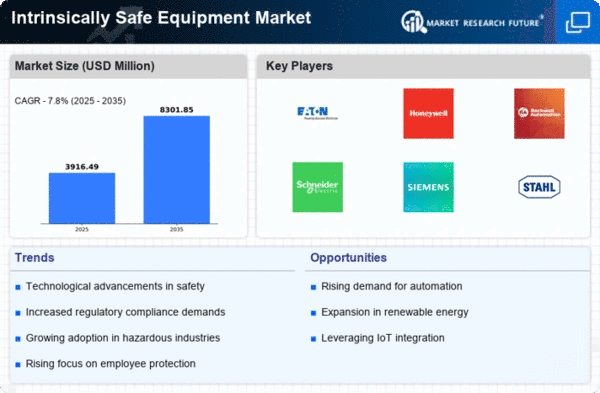
As per MRFR analysis, the Intrinsically Safe Equipment Market Size was estimated at 3633.11 USD Million in 2024. The Intrinsically Safe Equipment industry is projected to grow from 3916.57 USD Million in 2025 to 8301.85 USD Million by 2035, exhibiting a compound annual growth rate (CAGR) of 7.8 during the forecast period 2025 - 2035.

Key Market Trends & Highlights

The Intrinsically Safe Equipment Market is poised for robust growth driven by technological advancements and regulatory compliance.

  • North America remains the largest market for intrinsically safe equipment, driven by stringent safety regulations. The Asia-Pacific region is emerging as the fastest-growing market, reflecting a surge in industrial activities and safety awareness. The oil and gas sector continues to dominate the market, while the mining segment is experiencing rapid growth due to increased safety demands. Technological advancements and rising investment in safety infrastructure are key drivers propelling market expansion.

Market Size & Forecast

2024 Market Size 3633.11 (USD Million)
2035 Market Size 8301.85 (USD Million)
CAGR (2025 - 2035) 7.8%
Largest Regional Market Share in 2024 North America

Major Players

Pepperl+Fuchs (DE), Eaton (US), Honeywell (US), Rockwell Automation (US), Schneider Electric (FR), Siemens (DE), R. STAHL (DE), Extron (US), Bartec (DE)

Market Trends

The Intrinsically Safe Equipment Market is currently experiencing a notable evolution, driven by the increasing demand for safety in hazardous environments. Industries such as oil and gas, mining, and chemical manufacturing are prioritizing the implementation of equipment that minimizes the risk of explosions and fires. This heightened focus on safety standards is prompting manufacturers to innovate and enhance their product offerings, ensuring compliance with stringent regulations. Furthermore, the integration of advanced technologies, such as IoT and smart sensors, is likely to play a pivotal role in shaping the future landscape of this market. As organizations seek to optimize operational efficiency while maintaining safety, the adoption of intrinsically safe equipment appears to be on the rise. In addition to regulatory compliance, the growing awareness of workplace safety among employees and stakeholders is influencing purchasing decisions. Companies are increasingly investing in training and education to ensure that personnel are well-versed in the use of intrinsically safe equipment. This trend suggests a shift towards a more safety-conscious culture within industries that operate in potentially explosive atmospheres. As the Intrinsically Safe Equipment Market continues to expand, it is expected that collaboration between manufacturers, regulatory bodies, and end-users will be essential in driving innovation and ensuring the effectiveness of safety measures in the workplace.

Technological Advancements

The integration of cutting-edge technologies, such as IoT and smart sensors, is transforming the Intrinsically Safe Equipment Market. These innovations enhance monitoring capabilities and improve operational efficiency, allowing for real-time data analysis and decision-making.

Regulatory Compliance

Stringent safety regulations are compelling industries to adopt intrinsically safe equipment. Compliance with these standards not only mitigates risks but also fosters a culture of safety, encouraging organizations to prioritize employee well-being.

Increased Awareness of Safety

There is a growing recognition of the importance of safety in hazardous environments. This heightened awareness is driving companies to invest in training and education, ensuring that personnel are equipped to handle intrinsically safe equipment effectively.

Intrinsically Safe Equipment Market Market Drivers

Market Growth Projections

The Global Intrinsically Safe Equipment Market Industry is projected to experience substantial growth over the next decade. With a market value of 3.5 USD Billion in 2024, it is anticipated to reach 7.2 USD Billion by 2035. This growth trajectory suggests a compound annual growth rate of 6.78% from 2025 to 2035, indicating a robust demand for intrinsically safe equipment across various sectors. The increasing focus on safety regulations, technological advancements, and the expansion of industries requiring such equipment are key factors contributing to this positive outlook.

Expansion of Oil and Gas Sector

The expansion of the oil and gas sector is a crucial driver for the Global Intrinsically Safe Equipment Market Industry. As exploration and production activities intensify in remote and hazardous locations, the demand for intrinsically safe equipment rises. This sector's growth necessitates equipment that can withstand extreme conditions while ensuring safety. The market's trajectory is closely linked to the oil and gas industry's performance, which is projected to contribute significantly to the market's growth, with a compound annual growth rate of 6.78% anticipated from 2025 to 2035.

Growing Demand for Safety Regulations

The increasing emphasis on workplace safety regulations across various industries is a primary driver for the Global Intrinsically Safe Equipment Market Industry. Governments and regulatory bodies are mandating stricter safety standards, particularly in hazardous environments such as oil and gas, mining, and chemical manufacturing. This regulatory push is likely to enhance the adoption of intrinsically safe equipment, which is designed to prevent ignition in explosive atmospheres. As a result, the market is projected to reach 3.5 USD Billion in 2024, reflecting a robust response to these safety mandates.

Increased Awareness of Workplace Safety

There is a growing awareness of workplace safety among employers and employees, which is driving the Global Intrinsically Safe Equipment Market Industry. Organizations are increasingly recognizing the importance of investing in safety equipment to protect their workforce and minimize liability. This heightened awareness is leading to greater demand for intrinsically safe devices, particularly in sectors such as manufacturing and construction. As companies prioritize safety, the market is likely to see substantial growth, reflecting a cultural shift towards prioritizing employee well-being.

Rising Incidents of Workplace Accidents

The rising incidents of workplace accidents in hazardous environments are propelling the Global Intrinsically Safe Equipment Market Industry. As accidents lead to severe consequences, including injuries and fatalities, there is a pressing need for effective safety solutions. This urgency drives organizations to invest in intrinsically safe equipment to mitigate risks. The increasing frequency of accidents highlights the necessity for compliance with safety regulations, further boosting market demand. Consequently, the market is expected to experience significant growth as industries seek to enhance safety measures.

Technological Advancements in Equipment

Technological innovations in intrinsically safe equipment are significantly influencing the Global Intrinsically Safe Equipment Market Industry. The integration of advanced materials and smart technologies enhances the performance and reliability of safety equipment. For instance, the development of wireless intrinsically safe devices allows for real-time monitoring and data collection in hazardous areas. These advancements not only improve operational efficiency but also reduce the risk of accidents. As industries increasingly adopt these technologies, the market is expected to grow, potentially reaching 7.2 USD Billion by 2035.

Market Segment Insights

By Application: Oil and Gas (Largest) vs. Mining (Fastest-Growing)

In the Intrinsically Safe Equipment Market, the Oil and Gas sector holds significant market share, dominating due to its stringent safety requirements driven by an ever-present risk of explosions and fires. This sector's large-scale operations necessitate the use of intrinsically safe equipment to protect personnel and assets, ensuring compliance with safety regulations. Mines worldwide increasingly adopt these technologies, recognizing that even minor equipment failures can have catastrophic consequences in hazardous environments, thereby enhancing operational safety and efficiency. Conversely, the Mining sector has emerged as the fastest-growing segment within the Intrinsically Safe Equipment Market. The rising demand for minerals, coupled with increasing regulatory pressures for safety standards in mining operations, is propelling this growth. As mining companies strive to modernize their processes and reduce accidents in underground operations, the implementation of intrinsically safe equipment is becoming a priority, ensuring worker protection and regulatory compliance in increasingly complex environments.

Oil and Gas (Dominant) vs. Mining (Emerging)

The Oil and Gas segment remains the dominant application for intrinsically safe equipment, characterized by its rigorous operational environments requiring the highest safety standards. Companies in this sector prioritize technologies that mitigate risks associated with flammable materials, enhancing worker safety and equipment reliability. On the other hand, the Mining segment is recognized as an emerging application area, with rapid adoption of intrinsically safe technologies as companies seek to mitigate hazards associated with underground mining. This sector is experiencing a transformation, where safety compliance and technological innovation converge to enhance operational safety against the backdrop of increasing regulatory frameworks.

By End Use: Manufacturing (Largest) vs. Utilities (Fastest-Growing)

The Intrinsically Safe Equipment Market is notably dominated by the manufacturing sector, which holds a significant portion of the market share. This sector benefits from stringent safety regulations and an increasing focus on industrial automation, leading to the widespread adoption of intrinsically safe equipment. Meanwhile, the utilities segment is rapidly gaining traction, driven by rising infrastructure investments and the necessity for safe operations in volatile environments, enhancing its market share and relevance.

Manufacturing (Dominant) vs. Utilities (Emerging)

The manufacturing sector is a cornerstone of the Intrinsically Safe Equipment Market, primarily due to its extensive use in oil and gas, chemicals, and pharmaceuticals where safety is paramount. This sector values high reliability and compliance with safety standards, making intrinsically safe equipment essential for minimizing hazards. On the other hand, the utilities sector represents an emerging area, expanding quickly as energy companies increasingly prioritize safety in handling explosive gases and flammable substances. This growth is propelled by technological advancements, regulatory compliance, and a focus on enhancing safety measures, indicating a strong upward trajectory for intrinsically safe equipment.

By Product Type: Intrinsically Safe Sensors (Largest) vs. Intrinsically Safe Barriers (Fastest-Growing)

In the Intrinsically Safe Equipment Market, Intrinsically Safe <a href="https://www.marketresearchfuture.com/reports/sensor-market-4392">Sensors</a> hold the largest market share, as they are crucial for monitoring and detecting hazardous conditions in various industrial applications. Following closely, Intrinsically Safe Barriers are emerging as a significant player, contributing to safety by isolating hazardous signals. Other segments, including Intrinsically Safe Communication Devices, Lighting, and Control Systems, also play vital roles but command a smaller share of the overall market. These segments collectively ensure operational safety in environments where explosive gases or dust are present. The growth trends in this segment are influenced by increasing safety regulations and technological advancements that drive the adoption of intrinsically safe equipment. Intrinsically Safe Barriers are particularly seeing rapid growth due to the rising demand for safety-critical applications in industries such as oil and gas, chemical processing, and mining. Additionally, the push for more reliable and efficient communication devices and better lighting systems is facilitating market expansion, showcasing the need for sustainable and safe operations.

Intrinsically Safe Sensors (Dominant) vs. Intrinsically Safe Communication Devices (Emerging)

Intrinsically Safe Sensors are central to the market, offering reliable monitoring of hazardous areas and ensuring worker safety through precise detection capabilities. They dominate the landscape due to their wide applicability across various industries, providing a critical line of defense against potential explosions. On the other hand, Intrinsically Safe Communication Devices are emerging as essential contributors to maintaining safety in environments where traditional communication systems may fail. These devices enhance operational efficiency and promote seamless real-time communication, which is vital in emergency scenarios. As industry demands shift towards more integrated safety solutions, the focus on communication devices is likely to intensify, highlighting their potential for significant growth in conjunction with established sensor technologies.

Get more detailed insights about Intrinsically Safe Equipment Market Research Report—Global Forecast till 2035

Regional Insights

North America : Market Leader in Safety Solutions

North America is poised to maintain its leadership in the intrinsically safe equipment market, holding a significant share of 1813.24 million in 2024. The region's growth is driven by stringent safety regulations, increasing industrial automation, and a rising focus on workplace safety. The demand for advanced safety solutions in sectors like oil and gas, chemicals, and mining is propelling market expansion. Regulatory bodies are emphasizing compliance, further boosting the market's growth trajectory. The United States stands as the largest market, supported by key players such as Honeywell, Eaton, and Rockwell Automation. These companies are investing in innovative technologies to enhance safety standards. The competitive landscape is characterized by a mix of established firms and emerging players, all striving to capture market share. The presence of robust manufacturing capabilities and a strong distribution network further solidifies North America's position in the global market.

Europe : Growing Demand for Safety Equipment

Europe is witnessing a growing demand for intrinsically safe equipment, with a market size of 1099.87 million in 2024. The region's growth is driven by stringent EU regulations aimed at enhancing workplace safety and environmental protection. The increasing adoption of automation in industries such as pharmaceuticals and chemicals is also contributing to market expansion. Regulatory frameworks are evolving to ensure compliance, which is expected to further stimulate demand for safety equipment across various sectors. Germany and France are leading the market, with significant contributions from companies like Siemens and Schneider Electric. The competitive landscape is marked by innovation and collaboration among key players to develop advanced safety solutions. The presence of a well-established manufacturing base and a focus on R&D are critical factors driving the market forward. As regulations tighten, the demand for compliant safety equipment is anticipated to rise significantly.

Asia-Pacific : Emerging Market with Potential

Asia-Pacific is emerging as a significant player in the intrinsically safe equipment market, with a market size of 575.0 million in 2024. The region's growth is fueled by rapid industrialization, increasing safety awareness, and government initiatives aimed at enhancing workplace safety. Countries like China and India are investing heavily in infrastructure and industrial projects, which is driving the demand for safety equipment. Regulatory bodies are also implementing stricter safety standards, further catalyzing market growth. China is the largest market in the region, with a growing presence of key players such as Extron and Bartec. The competitive landscape is evolving, with both local and international companies vying for market share. The increasing focus on automation and smart technologies in industries like manufacturing and construction is expected to create new opportunities for intrinsically safe equipment. As the region continues to develop, the demand for safety solutions is projected to rise significantly.

Middle East and Africa : Untapped Market Opportunities

The Middle East and Africa region is gradually recognizing the importance of intrinsically safe equipment, with a market size of 145.0 million in 2024. The growth is driven by increasing industrial activities, particularly in oil and gas, mining, and construction sectors. Governments are beginning to implement regulations aimed at improving safety standards, which is expected to boost demand for safety equipment. The region's diverse industrial landscape presents unique opportunities for market expansion. Countries like South Africa and the UAE are leading the market, with a growing interest from international players. The competitive landscape is characterized by a mix of established companies and new entrants looking to capitalize on the emerging opportunities. As awareness of safety regulations increases, the demand for intrinsically safe equipment is anticipated to grow, paving the way for future investments in the sector.

Key Players and Competitive Insights

The Intrinsically Safe Equipment Market is characterized by a dynamic competitive landscape, driven by the increasing demand for safety in hazardous environments. Key players are focusing on innovation, strategic partnerships, and regional expansion to enhance their market presence. Companies such as Pepperl+Fuchs (DE), Eaton (US), and Honeywell (US) are at the forefront, leveraging their technological expertise to develop advanced solutions that meet stringent safety standards. Their collective strategies not only foster competition but also push the boundaries of safety technology, thereby shaping the market's evolution.
In terms of business tactics, companies are increasingly localizing manufacturing to reduce lead times and optimize supply chains. The market appears moderately fragmented, with several players vying for market share. However, the influence of major companies like Rockwell Automation (US) and Schneider Electric (FR) is substantial, as they implement strategies that enhance operational efficiency and customer engagement. This competitive structure suggests that while there is room for smaller players, the dominance of established firms is likely to persist.
In November 2025, Honeywell (US) announced the launch of a new line of intrinsically safe sensors designed for use in oil and gas applications. This strategic move is significant as it not only expands Honeywell's product portfolio but also reinforces its commitment to innovation in safety technology. By addressing specific industry needs, Honeywell positions itself as a leader in providing tailored solutions that enhance operational safety in high-risk environments.
Similarly, in October 2025, Eaton (US) unveiled a partnership with a leading energy company to develop integrated safety solutions for renewable energy applications. This collaboration is indicative of Eaton's strategy to diversify its offerings and tap into the growing renewable sector. By aligning with industry leaders, Eaton enhances its competitive edge and demonstrates a proactive approach to market demands.
In December 2025, Pepperl+Fuchs (DE) revealed its investment in a new manufacturing facility in Asia, aimed at increasing production capacity for intrinsically safe equipment. This expansion reflects the company's strategy to localize production and cater to the growing demand in the Asia-Pacific region. Such investments are crucial for maintaining competitiveness in a market that is increasingly focused on rapid delivery and customization.
As of December 2025, the competitive trends in the Intrinsically Safe Equipment Market are heavily influenced by digitalization, sustainability, and the integration of AI technologies. Strategic alliances are becoming more prevalent, as companies recognize the need to collaborate to enhance innovation and address complex safety challenges. The shift from price-based competition to a focus on technological advancement and supply chain reliability is evident, suggesting that future differentiation will hinge on the ability to innovate and respond swiftly to market needs.

Key Companies in the Intrinsically Safe Equipment Market include

Industry Developments

August 2020 - The 360-degree LED E-Stop buttons from Banner Engineering Corporation include a unique feature that uses In-Series Diagnostics (ISD) technology. When a button is pressed, it provides access to device-level data, making troubleshooting even simpler. It is simpler to determine which E-stop button was hit and to handle the problem in a secure and fast manner thanks to the ISD technology, which can support up to 32 devices in a single chain.

Future Outlook

Intrinsically Safe Equipment Market Future Outlook

The Intrinsically Safe Equipment Market is projected to grow at a 7.8% CAGR from 2025 to 2035, driven by increasing safety regulations and technological advancements.

New opportunities lie in:

  • Development of advanced wireless intrinsically safe devices
  • Expansion into emerging markets with high industrial growth
  • Integration of IoT technology for real-time monitoring solutions

By 2035, the market is expected to achieve robust growth, driven by innovation and regulatory compliance.

Market Segmentation

Intrinsically Safe Equipment Market End Use Outlook

  • Manufacturing
  • Construction
  • Utilities
  • Transportation
  • Telecommunications

Intrinsically Safe Equipment Market Application Outlook

  • Oil and Gas
  • Mining
  • Chemical Processing
  • Pharmaceuticals
  • Wastewater Treatment

Intrinsically Safe Equipment Market Product Type Outlook

  • Intrinsically Safe Sensors
  • Intrinsically Safe Barriers
  • Intrinsically Safe Communication Devices
  • Intrinsically Safe Lighting
  • Intrinsically Safe Control Systems

Report Scope

MARKET SIZE 2024 3633.11(USD Million)
MARKET SIZE 2025 3916.57(USD Million)
MARKET SIZE 2035 8301.85(USD Million)
COMPOUND ANNUAL GROWTH RATE (CAGR) 7.8% (2025 - 2035)
REPORT COVERAGE Revenue Forecast, Competitive Landscape, Growth Factors, and Trends
BASE YEAR 2024
Market Forecast Period 2025 - 2035
Historical Data 2019 - 2024
Market Forecast Units USD Million
Key Companies Profiled Pepperl+Fuchs (DE), Eaton (US), Honeywell (US), Rockwell Automation (US), Schneider Electric (FR), Siemens (DE), R. STAHL (DE), Extron (US), Bartec (DE)
Segments Covered Application, End Use, Product Type
Key Market Opportunities Growing demand for safety in hazardous environments drives innovation in the Intrinsically Safe Equipment Market.
Key Market Dynamics Rising regulatory standards drive demand for intrinsically safe equipment across various hazardous industries.
Countries Covered North America, Europe, APAC, South America, MEA

FAQs

How much is the Intrinsically Safe Equipment market?

The Intrinsically Safe Equipment Market size was valued at USD 3.63 billion in 2024.

What is the growth rate of the Intrinsically Safe Equipment market?

The global market is projected to grow at a CAGR of 7.80% during the forecast period, 2025 to 2035.

Which region held the largest market share in the Intrinsically Safe Equipment market?

Asia-Pacific had the largest share in the global market

Who are the key players in the Intrinsically Safe Equipment market?

The key players in the market are Pepperl + Fuchs, Fluke Corporation, OMEGA Engineering (Spectris PLC), R. Stahl AG, RAE Systems (Honeywell), Eaton Corporation, CorDEX Instruments Ltd., Bayco Products, Inc., Kyland Technology Co., Ltd., Banner Engineering Corp., Georgin.

Which Zone led the Intrinsically Safe Equipment market?

The Zone 1 category dominated the market in 2022.

Which Class had the largest market share in the Intrinsically Safe Equipment market?

The Class 1 had the largest share in the global market.

  1. SECTION I: EXECUTIVE SUMMARY AND KEY HIGHLIGHTS
    1. EXECUTIVE SUMMARY
      1. Market Overview
      2. Key Findings
      3. Market Segmentation
      4. Competitive Landscape
      5. Challenges and Opportunities
      6. Future Outlook
  2. SECTION II: SCOPING, METHODOLOGY AND MARKET STRUCTURE
    1. MARKET INTRODUCTION
      1. Definition
      2. Scope of the study
    2. RESEARCH METHODOLOGY
      1. Overview
      2. Data Mining
      3. Secondary Research
      4. Primary Research
      5. Forecasting Model
      6. Market Size Estimation
      7. Data Triangulation
      8. Validation
  3. SECTION III: QUALITATIVE ANALYSIS
    1. MARKET DYNAMICS
      1. Overview
      2. Drivers
      3. Restraints
      4. Opportunities
    2. MARKET FACTOR ANALYSIS
      1. Value chain Analysis
      2. Porter's Five Forces Analysis
      3. COVID-19 Impact Analysis
  4. SECTION IV: QUANTITATIVE ANALYSIS
    1. Semiconductor & Electronics, BY Application (USD Million)
      1. Oil and Gas
      2. Mining
      3. Chemical Processing
      4. Pharmaceuticals
      5. Wastewater Treatment
    2. Semiconductor & Electronics, BY End Use (USD Million)
      1. Manufacturing
      2. Construction
      3. Utilities
      4. Transportation
      5. Telecommunications
    3. Semiconductor & Electronics, BY Product Type (USD Million)
      1. Intrinsically Safe Sensors
      2. Intrinsically Safe Barriers
      3. Intrinsically Safe Communication Devices
      4. Intrinsically Safe Lighting
      5. Intrinsically Safe Control Systems
    4. Semiconductor & Electronics, BY Region (USD Million)
      1. North America
      2. Europe
      3. APAC
      4. South America
      5. MEA
  5. SECTION V: COMPETITIVE ANALYSIS
    1. Competitive Landscape
      1. Overview
      2. Competitive Analysis
      3. Market share Analysis
      4. Major Growth Strategy in the Semiconductor & Electronics
      5. Competitive Benchmarking
      6. Leading Players in Terms of Number of Developments in the Semiconductor & Electronics
      7. Key developments and growth strategies
      8. Major Players Financial Matrix
    2. Company Profiles
      1. Pepperl+Fuchs (DE)
      2. Eaton (US)
      3. Honeywell (US)
      4. Rockwell Automation (US)
      5. Schneider Electric (FR)
      6. Siemens (DE)
      7. R. STAHL (DE)
      8. Extron (US)
      9. Bartec (DE)
    3. Appendix
      1. References
      2. Related Reports

Semiconductor & Electronics Market Segmentation

Semiconductor & Electronics By Application (USD Million, 2025-2035)

  • Oil and Gas
  • Mining
  • Chemical Processing
  • Pharmaceuticals
  • Wastewater Treatment

Semiconductor & Electronics By End Use (USD Million, 2025-2035)

  • Manufacturing
  • Construction
  • Utilities
  • Transportation
  • Telecommunications

Semiconductor & Electronics By Product Type (USD Million, 2025-2035)

  • Intrinsically Safe Sensors
  • Intrinsically Safe Barriers
  • Intrinsically Safe Communication Devices
  • Intrinsically Safe Lighting
  • Intrinsically Safe Control Systems
Infographic

Free Sample Request

Kindly complete the form below to receive a free sample of this Report

Get Free Sample

Customer Strories

Compare Licence

×
Features License Type
Single User Multiuser License Enterprise User
Price $4,950 $5,950 $7,250
Maximum User Access Limit 1 User Upto 10 Users Unrestricted Access Throughout the Organization
Free Customization
Direct Access to Analyst
Deliverable Format
Platform Access
Discount on Next Purchase 10% 15% 15%
Printable Versions