Request Free Sample ×

Kindly complete the form below to receive a free sample of this Report

* Please use a valid business email

Leading companies partner with us for data-driven Insights

clients tt-cursor
Hero Background
English
Chinese
French
Japanese
Korean
German
Spanish

IoT in Healthcare Market Size

ID: MRFR/HC/9187-HCR
200 Pages
Rahul Gotadki
March 2026

IoT in Healthcare Market Research Report: Size, Share, Trend Analysis By Applications (Patient Monitoring, Medication Management, Telemedicine, Clinical Operations, Asset Management), By Component (Devices, Software, Services), By End Use (Hospitals, Diagnostics Centers, Home Care), By Technology (Wearable Technology, Remote Patient Monitoring, Smart Medical Devices) and By Regional (North America, Europe, South America, Asia Pacific, Middle East and Africa) - Growth Outlook & Industry Forecast Till 2035

Share:
Download PDF ×

We do not share your information with anyone. However, we may send you emails based on your report interest from time to time. You may contact us at any time to opt-out.

Internet of Things in Healthcare Market Infographic
Purchase Options

Internet Of Things In Healthcare Size

Internet of Things in Healthcare Market Growth Projections and Opportunities

The Internet of Things (IoT) represents a revolutionary paradigm in the health care industry, and market dynamics that are supported by numerous factors contributing to its development. One of the major drivers is an increase in demand for connected healthcare solutions. With the digital transformation of healthcare, there is a need for IoT applications that allow communication and data exchange between medicine devices, wearables as well as health systems. Such demand arises from the need to improve patient care quality and efficiency of operations, as well as through real-time analytics’ data insights. Medical technological innovations and the rising popularity of wearable devices play an important role in the development of IoT healthcare market. Smart technologies that include wearables with sensors and connectivity features help to keep track of the vital signs, activity levels, etc., in a continuous manner. In addition to making individuals active players in their health, these devices enable healthcare providers with essential data needed for preventive and personalized care. The IoT integration into medical devices, and wearables contributes to innovation in the market that results from progressive growth. Data privacy and security are critical considerations determining the development of IoT in healthcare market. Given the sensitive nature of health data, adequate security has to be ensured for preventing breaches and unwarranted access. Strict data protection regulations and suitable IoT architectures must be implemented to ensure the establishment of trust among healthcare providers, patients, and other stakeholders. Purchase decisions and the adoption of healthcare industry for IoT solutions are influenced by security concerns. The regulatory landscape is one of the factors that affect deployments and adoption for IoT in healthcare. The safety and efficacy requirements for connected medical devices in regulatory frameworks, along with rules governing the ethical use of patient data play an important role at market dynamics. Conformity to regulatory standards is not only a requirement for market access but also the basis of building a safe and ethical IoT environment within healthcare. Both interoperability and standards play an important role in the IoT in healthcare market. Integration and interoperability of disparate devices and systems are also vital to the establishment of a seamless connected healthcare environment. Industry standards promote interoperability by enabling common set of problems to be solved across healthcare ecosystems, leading to streamlined information flow and enhanced decision-making.
Internet of Things in Healthcare Market Size Graph
Author
Author Profile
Rahul Gotadki
Research Manager

He holds an experience of about 9+ years in Market Research and Business Consulting, working under the spectrum of Life Sciences and Healthcare domains. Rahul conceptualizes and implements a scalable business strategy and provides strategic leadership to the clients. His expertise lies in market estimation, competitive intelligence, pipeline analysis, customer assessment, etc.

Leave a Comment

FAQs

What is the projected market valuation for the Internet of Things (IoT) in Healthcare by 2035?

<p>The projected market valuation for the IoT in Healthcare is 200.01 USD Billion by 2035.</p>

What was the market valuation for the IoT in Healthcare in 2024?

<p>The overall market valuation for the IoT in Healthcare was 60.34 USD Billion in 2024.</p>

What is the expected CAGR for the IoT in Healthcare market during the forecast period 2025 - 2035?

<p>The expected CAGR for the IoT in Healthcare market during 2025 - 2035 is 11.51%.</p>

Which segment of the IoT in Healthcare market had the highest valuation in 2024?

<p>The Asset Management segment had the highest valuation at 15.34 USD Billion in 2024.</p>

What are the key applications of IoT in Healthcare?

<p>Key applications include Patient Monitoring, Medication Management, Telemedicine, Clinical Operations, and Asset Management.</p>

Which companies are considered key players in the IoT in Healthcare market?

<p>Key players include Philips, GE Healthcare, Siemens Healthineers, Medtronic, IBM, Cisco, Honeywell, Oracle, and Samsung.</p>

What is the projected valuation for the Remote Patient Monitoring segment by 2035?

<p>The Remote Patient Monitoring segment is projected to reach 70.0 USD Billion by 2035.</p>

How does the valuation of wearable technology in 2024 compare to its projected value in 2035?

<p>Wearable Technology was valued at 15.0 USD Billion in 2024 and is projected to reach 50.0 USD Billion by 2035.</p>

What is the expected growth in the Services component of the IoT in Healthcare market?

<p>The Services component is expected to grow from 25.34 USD Billion in 2024 to 80.01 USD Billion by 2035.</p>

What end-use segment is projected to have the highest valuation by 2035?

<p>The Hospitals end-use segment is projected to have the highest valuation at 100.0 USD Billion by 2035.</p>

Market Summary

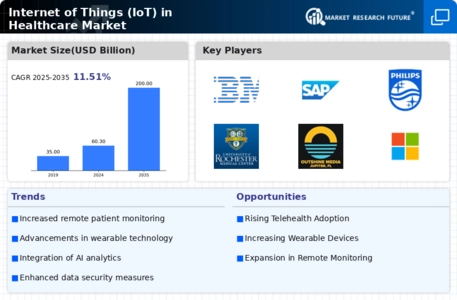
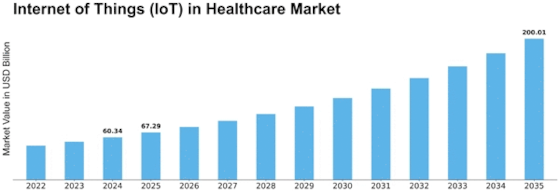
According to MRFR analysis, the IoT in Healthcare Market Size was valued at USD 60.34 Billion in 2024. The market is projected to grow from USD 67.29 Billion in 2025 to USD 200.01 Billion by 2035, registering a CAGR of 11.51% during the forecast period (2026–2035). North America led the market with over 44.91% share, generating around USD 27.1 billion in revenue.
 
The IoT in Healthcare Market is growing rapidly due to rising adoption of connected medical devices and increasing demand for remote patient monitoring. Key trends include integration of IoT with AI and cloud platforms, expansion of smart hospitals, and growing use of wearable health devices to improve patient care and operational efficiency.

Key Market Trends & Highlights

The IoT in Healthcare Market is experiencing robust growth driven by technological advancements and increasing demand for remote solutions.

  • The market is witnessing increased adoption of wearable devices, particularly in North America, which remains the largest market. Enhanced data analytics capabilities are becoming crucial for effective patient monitoring, especially in the Patient Monitoring segment. There is a growing focus on interoperability and integration, which is essential for the fast-growing Telemedicine segment in the Asia-Pacific region. Rising demand for remote patient monitoring and advancements in IoT technology are key drivers propelling market expansion.

Market Size & Forecast

2024 Market Size 60.34 (USD Billion)
2035 Market Size 200.01 (USD Billion)
CAGR (2025 - 2035) 11.51%
Largest Regional Market Share in 2024 North America

Major Players

Companies such as <a href="https://www.philips.co.in/healthcare">Philips</a> (NL), GE Healthcare (US), Siemens Healthineers (DE), <a title="Medtronic" href="https://www.medtronic.com/en-us/our-company/ai-healthcare-technology.html" target="_blank" rel="noopener">Medtronic</a> (US), IBM (US), Cisco (US), Honeywell (US), Oracle (US), Samsung (KR) are some of the major participants in the global market.

Market Trends

The IoT in Healthcare Market is currently experiencing a transformative phase, characterized by the integration of advanced technologies that enhance patient care and operational efficiency. This market encompasses a wide array of devices and applications, including wearable health monitors, remote patient management systems, and smart medical equipment. As healthcare providers increasingly adopt IoT solutions, the potential for improved patient outcomes and streamlined processes becomes more apparent.

The ongoing evolution of data analytics and connectivity is likely to further drive innovation in this sector, enabling real-time monitoring and personalized treatment plans. Moreover, the growing emphasis on preventive care and chronic disease management appears to be a significant factor influencing the expansion of the market.

By leveraging connected devices, healthcare professionals can gather valuable insights into patient health, facilitating timely interventions and reducing hospital readmissions. The collaboration between technology companies and healthcare organizations seems to foster an environment ripe for innovation, suggesting that the future of healthcare may be increasingly reliant on IoT solutions to meet the demands of a dynamic healthcare landscape.

Increased Adoption of Wearable Devices

The trend towards wearable health technology is gaining momentum, as more individuals utilize devices that monitor vital signs and physical activity. These wearables not only empower patients to take charge of their health but also provide healthcare providers with critical data for informed decision-making.

The number of connected IoT devices worldwide is expanding rapidly, with over 30 billion IoT devices expected to be deployed globally by 2030 according to the International Data Corporation, a trend that is significantly accelerating the adoption of IoT solutions in healthcare environments.

Enhanced Data Analytics Capabilities

The integration of sophisticated data analytics tools within the IoT in Healthcare Market is becoming more prevalent. This trend enables healthcare organizations to analyze vast amounts of data collected from connected devices, leading to improved patient outcomes and operational efficiencies.

Wearable health technologies are becoming mainstream, with more than 320 million wearable devices shipped globally in recent years according to the International Data Corporation, many of which integrate IoT sensors to monitor vital signs, physical activity, and chronic conditions.

Focus on Interoperability and Integration

There is a growing emphasis on ensuring that various IoT devices and systems can communicate effectively with one another. This trend towards interoperability is crucial for creating a seamless healthcare ecosystem, allowing for better data sharing and collaboration among healthcare providers.

Chronic diseases account for approximately 74% of global deaths according to the World Health Organization, increasing the need for remote patient monitoring solutions powered by IoT technologies to support continuous health tracking and early intervention.

Internet of Things in Healthcare Market Market Drivers

Advancements in IoT Technology

Technological advancements play a crucial role in the evolution of the IoT in Healthcare Market. Innovations in sensor technology, connectivity, and data processing capabilities are enabling the development of more sophisticated healthcare applications. 
 
For instance, the emergence of 5G technology is expected to enhance the performance of IoT devices, allowing for faster data transmission and improved reliability. This is particularly important for applications that require real-time data analysis, such as telemedicine and remote surgery.
 
Furthermore, the integration of artificial intelligence with IoT devices is likely to enhance predictive analytics, enabling healthcare providers to make more informed decisions. As these technologies continue to evolve, they are expected to drive further adoption of IoT solutions in healthcare, ultimately leading to improved patient care and operational efficiency.

Growing Focus on Preventive Healthcare

The IoT in Healthcare Market is increasingly influenced by a growing focus on preventive healthcare. This shift is characterized by a proactive approach to health management, where individuals and healthcare providers prioritize prevention over treatment. IoT devices, such as wearables and smart health monitors, facilitate this transition by providing real-time health data that can be used to identify potential health issues before they escalate.
 
Market data indicates that the preventive healthcare segment is expected to witness substantial growth, driven by rising healthcare costs and a greater emphasis on wellness. By leveraging IoT technologies, healthcare systems can enhance their preventive care strategies, leading to better health outcomes and reduced healthcare expenditures. This trend underscores the importance of integrating IoT solutions into healthcare practices to foster a culture of prevention.

Regulatory Support and Standardization

Regulatory support and standardization are emerging as key drivers in the IoT in Healthcare Market. Governments and regulatory bodies are increasingly recognizing the potential of IoT technologies to improve healthcare delivery and patient outcomes. Initiatives aimed at establishing standards for data security, interoperability, and device certification are gaining traction. Such regulatory frameworks are essential for fostering trust among stakeholders and ensuring the safe deployment of IoT solutions in healthcare settings.
 
Moreover, as regulations evolve, they are likely to encourage innovation and investment in IoT technologies. This supportive environment may lead to the development of new applications and services that enhance patient care. Consequently, the alignment of regulatory efforts with technological advancements is expected to play a pivotal role in shaping the future of IoT in healthcare.

Rising Demand for Remote Patient Monitoring

The market is witnessing a notable increase in the demand for remote patient monitoring solutions. This trend is driven by the need for continuous health monitoring, particularly for chronic disease management. According to recent data, the remote patient monitoring segment is projected to grow at a compound annual growth rate of over 25% in the coming years.
 
This growth is largely attributed to the increasing prevalence of chronic diseases and the aging population, which necessitates innovative healthcare solutions. Remote monitoring devices enable healthcare providers to track patient health metrics in real-time, thereby enhancing patient engagement and improving health outcomes. As a result, the integration of IoT technologies into healthcare systems is becoming increasingly vital, as it allows for timely interventions and reduces the need for hospital visits.

Increased Investment in Healthcare Technology

Investment in healthcare technology is a significant driver of growth in the IoT in Healthcare Market. As healthcare organizations seek to enhance operational efficiency and improve patient care, they are increasingly allocating resources towards IoT solutions. Recent reports indicate that healthcare technology investments are projected to reach several billion dollars in the next few years, reflecting a strong commitment to digital transformation. 
 
This influx of capital is likely to accelerate the development and deployment of IoT devices and applications, ranging from smart medical equipment to advanced data analytics platforms. Furthermore, as healthcare providers recognize the value of data-driven decision-making, the demand for IoT solutions that facilitate real-time data collection and analysis is expected to rise. This trend underscores the critical role of investment in driving innovation and improving healthcare outcomes through IoT technologies.

Market Segment Insights

By Application: Patient Monitoring (Largest) vs. Telemedicine (Fastest-Growing)

The application segment is predominantly driven by patient monitoring, which commands the largest IoT in Healthcare Market share. This segment encompasses various IoT-enabled devices that facilitate real-time health tracking and data analysis, making it crucial in enhancing patient care and outcomes. Following closely, telemedicine is emerging as a key player, leveraging IoT technologies to enhance remote consultations and healthcare delivery, making this area ripe for growth.

Patient Monitoring (Dominant) vs. Telemedicine (Emerging)

Patient monitoring in IoT healthcare is characterized by devices and systems designed to observe patients' health metrics in real-time, enabling timely interventions and proactive care. This segment is often pivotal in chronic disease management and preventive healthcare. Conversely, telemedicine, referred to as the fastest-growing application, integrates IoT to facilitate virtual consultations over digital platforms, thereby expanding access to medical professionals. The surge in telemedicine can be attributed to increased demand for remote healthcare services, improved internet connectivity, and advanced mobile health technologies, which make healthcare delivery more accessible and efficient.

By Component: Devices (Largest) vs. Software (Fastest-Growing)

The component segment has experienced a diverse allocation of market share across its values. Devices possess the largest IoT in Healthcare Market share, representing a crucial element within the ecosystem, featuring a wide range of connected tools such as wearables, monitoring equipment, and diagnostic devices. Conversely, Software is rapidly gaining traction as it encompasses a growing suite of applications designed to optimize patient care and operational efficiency, solidifying its reputation as the fastest-growing segment in the market.

Devices (Dominant) vs. Software (Emerging)

Devices dominate the IoT in Healthcare realm, serving as the primary interface through which data is collected and monitored. This segment includes an array of products like smart sensors, health trackers, and remote patient monitoring solutions. Their widespread adoption is driven by the increasing demand for real-time health monitoring and chronic disease management. On the other hand, the Software segment, emerging at a swift pace, focuses on analytics, cloud-based management systems, and integrated platforms for data processing and visualization. This trend reflects the growing importance of data analytics in enhancing patient outcomes and operational efficiency, marking software as a key player in the future of healthcare.

By End-Use: Hospitals (Largest) vs. Home Care (Fastest-Growing)

In the IoT in Healthcare Market, hospitals dominate the end-use segment, commanding a significant share due to their extensive adoption of advanced technologies for patient monitoring and care management. This involves integrating various IoT devices that improve operational efficiency and enhance patient outcomes. On the other hand, home care is rapidly gaining traction, with an increasing number of patients and caregivers adopting IoT solutions to monitor health conditions remotely, underscoring a shift towards more personalized healthcare solutions.

End-Use: Hospitals (Dominant) vs. Home Care (Emerging)

Hospitals represent the dominant application of IoT technology in healthcare, characterized by large-scale implementations that enhance service delivery and patient safety. Their need for real-time data analytics and device connectivity drives the development of IoT applications tailored for improved patient management and operational efficiency. Conversely, home care emerges as a rapidly expanding segment, with devices designed for remote patient monitoring, medication adherence, and chronic disease management. This segment appeals to tech-savvy consumers who seek convenience and efficiency in managing their health, supported by an increasing trend towards telehealth services that encourage patient engagement and independence.

By Technology: Wearable Technology (Largest) vs. Remote Patient Monitoring (Fastest-Growing)

The IoT in Healthcare Market is seeing a diverse landscape with three primary segments: <a title="wearable technology" href="https://www.marketresearchfuture.com/reports/wearable-technology-market-2336" target="_blank" rel="noopener">Wearable Technology</a>, Remote Patient Monitoring, and Smart <a title="medical devices" href="https://www.marketresearchfuture.com/reports/medical-devices-market-2869" target="_blank" rel="noopener">Medical Devices</a>. Wearable Technology holds the largest market share, driven by the widespread adoption of fitness trackers and smartwatches that monitor health metrics. In contrast, Remote Patient Monitoring is gaining significant traction as healthcare systems pivot toward more patient-centered approaches. The increased demand for at-home care solutions is propelling this segment to rapid growth, although its overall market share remains below that of wearable technology.

Technology: Wearable Technology (Dominant) vs. Remote Patient Monitoring (Emerging)

Wearable Technology stands out as the dominant force in the IoT in Healthcare market, owing to its ability to empower patients with real-time health data through devices that are both convenient and user-friendly. These technologies are complemented by significant advancements in sensor technology and data analytics that enhance patient engagement and health outcomes. On the other hand, Remote Patient Monitoring is emerging quickly, facilitating the continuous monitoring of patients’ health metrics outside traditional clinical settings. This segment is primarily driven by the increasing need for chronic disease management and the growing acceptance of telehealth solutions, leading to enhanced patient care and reduced hospital visits.

Get more detailed insights about IoT in Healthcare Market Research Report-Forecast to 2035

Regional Insights

North America : Innovation and Investment Hub

North America leads in the IoT in Healthcare Market Size, accounting for over 44.91% of the global revenue in 2024. The region's growth is driven by increasing investments in healthcare technology, a rising demand for remote patient monitoring, and supportive regulatory frameworks.

The U.S. government has been proactive in promoting digital health initiatives, which further catalyzes market expansion. The competitive landscape is dominated by key players such as GE Healthcare, Medtronic, and IBM, which are leveraging advanced technologies to enhance patient care. The U.S. is the leading country, followed by Canada, which is also witnessing significant growth in IoT healthcare solutions. The presence of major tech firms and healthcare providers fosters a robust ecosystem for innovation.

Europe : Regulatory Framework and Growth

Europe IoT in Healthcare Market size was valued at USD 18.10 Billion in 2024, making it the second-largest regional market with a 30% share. The region's growth is propelled by stringent regulations aimed at improving patient safety and data security, alongside increasing adoption of telehealth services. The European Union's Digital Health Strategy is a key regulatory catalyst, promoting interoperability and innovation in healthcare technologies.

Leading countries in this region include Germany, the UK, and France, where significant investments in digital health are being made. Major players like Siemens Healthineers and Philips are actively involved in developing IoT solutions tailored to the European market. The competitive landscape is characterized by a mix of established companies and innovative startups, driving advancements in healthcare delivery.

Asia-Pacific : Rapid Growth and Adoption

Asia-Pacific is witnessing rapid growth in the IoT healthcare market, holding approximately 20% of the global share. The region's expansion is driven by increasing healthcare expenditure, a growing aging population, and rising demand for smart healthcare solutions. Countries like China and India are at the forefront, supported by government initiatives aimed at enhancing healthcare infrastructure and technology adoption.

China is the largest market in the region, followed by Japan and India, where local players are emerging alongside global giants like Samsung and Cisco. The competitive landscape is evolving, with a focus on innovative solutions that cater to the unique healthcare challenges faced by these countries. The region's diverse market dynamics present both opportunities and challenges for stakeholders.

Middle East and Africa : Emerging Market Potential

The Middle East and Africa (MEA) region is an emerging market for IoT in healthcare, accounting for about 5% of the global share. The growth is driven by increasing investments in healthcare infrastructure, rising awareness of digital health solutions, and government initiatives aimed at improving healthcare delivery. Countries like the UAE and South Africa are leading the way, with significant projects focused on smart healthcare technologies.

The competitive landscape is characterized by a mix of local and international players, with companies like Honeywell and Oracle making strides in the region. The presence of various healthcare initiatives and partnerships is fostering innovation, making MEA a promising market for IoT healthcare solutions. The region's unique challenges also present opportunities for tailored solutions that address specific healthcare needs.

Key Players and Competitive Insights

The IoT in Healthcare Market is currently characterized by a dynamic competitive landscape, driven by rapid technological advancements and an increasing demand for connected healthcare solutions. Major players such as Philips (NL), GE Healthcare (US), and Medtronic (US) are strategically positioning themselves through innovation and partnerships, which collectively enhance their operational capabilities.
 
Philips (NL) focuses on integrating advanced analytics and AI into its healthcare solutions, while GE Healthcare (US) emphasizes the development of interoperable systems that facilitate seamless data exchange. Medtronic (US) is leveraging its extensive portfolio to enhance remote patient monitoring, thereby addressing the growing need for telehealth solutions. These strategies not only bolster their market presence but also contribute to a more interconnected healthcare ecosystem. 
 
In terms of business tactics, companies are increasingly localizing manufacturing and optimizing supply chains to enhance responsiveness to market demands. The competitive structure of the IoT in Healthcare Market appears moderately fragmented, with several key players exerting influence across various segments. This fragmentation allows for a diverse range of solutions, yet the collective impact of these major companies shapes the market dynamics significantly, as they vie for leadership through technological innovation and strategic collaborations. 
 
In August 2025, Philips (NL) announced a partnership with a leading AI firm to enhance its imaging solutions, aiming to improve diagnostic accuracy and patient outcomes. This collaboration is strategically important as it aligns with the growing trend of integrating AI into healthcare, potentially setting a new standard for imaging technologies. By leveraging AI capabilities, Philips (NL) not only enhances its product offerings but also positions itself as a leader in the digital transformation of healthcare. 
 
Similarly, in September 2025, GE Healthcare (US) launched a new cloud-based platform designed to streamline data management for healthcare providers. This initiative is significant as it addresses the critical need for efficient data handling in an increasingly digital healthcare environment. By providing a robust platform for data integration, GE Healthcare (US) enhances its competitive edge, enabling healthcare providers to make informed decisions based on real-time data analytics.
 
In October 2025, Medtronic (US) unveiled a new remote monitoring device that utilizes IoT technology to track patient health metrics in real-time. This development is crucial as it reflects the ongoing shift towards proactive healthcare management, allowing for timely interventions and improved patient care. Medtronic's focus on remote monitoring aligns with broader industry trends towards personalized medicine and patient-centric care, further solidifying its position in the market.
 
As of October 2025, the competitive trends within the IoT in Healthcare Market are increasingly defined by digitalization, sustainability, and the integration of artificial intelligence. Strategic alliances are becoming pivotal, as companies recognize the value of collaboration in enhancing technological capabilities and market reach.
 
Looking ahead, competitive differentiation is likely to evolve from traditional price-based competition to a focus on innovation, technological advancement, and supply chain reliability. This shift underscores the importance of adaptability and forward-thinking strategies in navigating the complexities of the healthcare landscape.

Key Companies in the Internet of Things in Healthcare Market include

Industry Developments

Recent developments in the Global Internet of Things in the Healthcare Market highlight a significant integration of technology and healthcare solutions. In October 2023, IBM announced enhancements in its Watson Health technologies, aiming to improve patient outcomes through data analytics. Similarly, Philips has been expanding its remote monitoring capabilities, facilitating better healthcare access and efficiency. Current affairs focus on the surge in connected devices post-COVID-19, with industry reports indicating an estimated market growth of over 30% year-over-year, mainly driven by healthcare providers' adoption of IoT solutions.

In the realm of mergers and acquisitions, in August 2023, Siemens Healthineers acquired Varian Medical Systems, bolstering its portfolio in digital health and precision oncology. In July 2023, Johnson and Johnson announced the acquisition of a digital health startup to enhance its surgical technologies. Additionally, Medtronic's partnership with Qualcomm, established in early 2023, aims to innovate through advanced health monitoring devices. Over the last two years, significant market activities have also included increased collaborations for Research and Development, enhancing patient care through real-time data and analytics, reflecting a robust trajectory in this global market space.

Future Outlook

Internet of Things in Healthcare Market Future Outlook

The IoT in Healthcare Market size is projected to reach USD 200.01 Billion by 2035, growing at a CAGR of 11.51%, driven by advancements in telemedicine, wearable devices, and data analytics.

New opportunities lie in:

  • <p>Development of AI-driven remote patient monitoring systems Integration of IoT with electronic health records for real-time data access Expansion of smart medical devices for chronic disease management</p>

By 2035, the IoT in Healthcare Market is expected to be a pivotal component of global healthcare systems.

Market Segmentation

IoT in Healthcare Market End-Use Outlook

  • Hospitals
  • Diagnostics Centers
  • Home Care

IoT in Healthcare Market Component Outlook

  • Devices
  • Software
  • Services

IoT in Healthcare Market Technology Outlook

  • Wearable Technology
  • Remote Patient Monitoring
  • Smart Medical Devices

IoT in Healthcare Market Application Outlook

  • Patient Monitoring
  • Medication Management
  • Telemedicine
  • Clinical Operations
  • Asset Management

Report Scope

MARKET SIZE 2024 60.34(USD Billion)
MARKET SIZE 2025 67.29(USD Billion)
MARKET SIZE 2035 200.01(USD Billion)
COMPOUND ANNUAL GROWTH RATE (CAGR) 11.51% (2025 - 2035)
REPORT COVERAGE Revenue Forecast, Competitive Landscape, Growth Factors, and Trends
BASE YEAR 2024
Market Forecast Period 2026 - 2035
Historical Data 2019 - 2024
Market Forecast Units USD Billion
Key Companies Profiled Philips (NL), GE Healthcare (US), Siemens Healthineers (DE), Medtronic (US), IBM (US), Cisco (US), Honeywell (US), Oracle (US), Samsung (KR)
Segments Covered Applications, Component, End Use, Technology, Regional
Key Market Opportunities Integration of advanced analytics and artificial intelligence in the market.
Key Market Dynamics Rising integration of IoT devices enhances patient monitoring and streamlines healthcare delivery processes.
Countries Covered North America, Europe, APAC, South America, MEA

FAQs

What is the projected market valuation for the Internet of Things (IoT) in Healthcare by 2035?

<p>The projected market valuation for the IoT in Healthcare is 200.01 USD Billion by 2035.</p>

What was the market valuation for the IoT in Healthcare in 2024?

<p>The overall market valuation for the IoT in Healthcare was 60.34 USD Billion in 2024.</p>

What is the expected CAGR for the IoT in Healthcare market during the forecast period 2025 - 2035?

<p>The expected CAGR for the IoT in Healthcare market during 2025 - 2035 is 11.51%.</p>

Which segment of the IoT in Healthcare market had the highest valuation in 2024?

<p>The Asset Management segment had the highest valuation at 15.34 USD Billion in 2024.</p>

What are the key applications of IoT in Healthcare?

<p>Key applications include Patient Monitoring, Medication Management, Telemedicine, Clinical Operations, and Asset Management.</p>

Which companies are considered key players in the IoT in Healthcare market?

<p>Key players include Philips, GE Healthcare, Siemens Healthineers, Medtronic, IBM, Cisco, Honeywell, Oracle, and Samsung.</p>

What is the projected valuation for the Remote Patient Monitoring segment by 2035?

<p>The Remote Patient Monitoring segment is projected to reach 70.0 USD Billion by 2035.</p>

How does the valuation of wearable technology in 2024 compare to its projected value in 2035?

<p>Wearable Technology was valued at 15.0 USD Billion in 2024 and is projected to reach 50.0 USD Billion by 2035.</p>

What is the expected growth in the Services component of the IoT in Healthcare market?

<p>The Services component is expected to grow from 25.34 USD Billion in 2024 to 80.01 USD Billion by 2035.</p>

What end-use segment is projected to have the highest valuation by 2035?

<p>The Hospitals end-use segment is projected to have the highest valuation at 100.0 USD Billion by 2035.</p>

  1. SECTION I: EXECUTIVE SUMMARY AND KEY HIGHLIGHTS |
    1. EXECUTIVE SUMMARY | |
      1. Market Overview | |
      2. Key Findings | |
      3. Market Segmentation | |
      4. Competitive Landscape | |
      5. Challenges and Opportunities | |
      6. Future Outlook 2
  2. SECTION II: SCOPING, METHODOLOGY AND MARKET STRUCTURE |
    1. MARKET INTRODUCTION | |
      1. Definition | |
      2. Scope of the study | | |
    2. RESEARCH METHODOLOGY | |
      1. Overview | |
      2. Data Mining | |
      3. Secondary Research | |
      4. Primary Research | | |
      5. Forecasting Model | |
      6. Market Size Estimation | | |
      7. Data Triangulation | |
      8. Validation 3
  3. SECTION III: QUALITATIVE ANALYSIS |
    1. MARKET DYNAMICS | |
      1. Overview | |
      2. Drivers | |
      3. Restraints | |
      4. Opportunities |
    2. MARKET FACTOR ANALYSIS | |
      1. Value chain Analysis | |
      2. Porter's Five Forces Analysis | | |
      3. COVID-19 Impact Analysis | | |
  4. SECTION IV: QUANTITATIVE ANALYSIS |
    1. Healthcare, BY Application (USD Billion) | |
      1. Patient Monitoring | |
      2. Medication Management | |
      3. Telemedicine | |
      4. Clinical Operations | |
      5. Asset Management |
    2. Healthcare, BY Component (USD Billion) | |
      1. Devices | |
      2. Software | |
      3. Services |
    3. Healthcare, BY End-Use (USD Billion) | |
      1. Hospitals | |
      2. Diagnostics Centers | |
      3. Home Care |
    4. Healthcare, BY Technology (USD Billion) | |
      1. Wearable Technology | |
      2. Remote Patient Monitoring | |
      3. Smart Medical Devices |
    5. Healthcare, BY Region (USD Billion) | |
      1. North America | | |
      2. Europe | | |
      3. APAC | | |
      4. South America | | |
      5. MEA | | |
  5. SECTION V: COMPETITIVE ANALYSIS |
    1. Competitive Landscape | |
      1. Overview | |
      2. Competitive Analysis | |
      3. Market share Analysis | |
      4. Major Growth Strategy in the Healthcare | |
      5. Competitive Benchmarking | |
      6. Leading Players in Terms of Number of Developments in the Healthcare | |
      7. Key developments and growth strategies | | |
      8. Major Players Financial Matrix | | |
    2. Company Profiles | |
      1. Philips (NL) | | |
      2. GE Healthcare (US) | | |
      3. Siemens Healthineers (DE) | | |
      4. Medtronic (US) | | |
      5. IBM (US) | | |
      6. Cisco (US) | | |
      7. Honeywell (US) | | |
      8. Oracle (US) | | |
      9. Samsung (KR) | | |
    3. Appendix | |
      1. References | |
      2. Related Reports 6 LIST OF FIGURES |
    4. MARKET SYNOPSIS |
    5. NORTH AMERICA MARKET ANALYSIS |
    6. US MARKET ANALYSIS BY APPLICATION |
    7. US MARKET ANALYSIS BY COMPONENT |
    8. US MARKET ANALYSIS BY END-USE |
    9. US MARKET ANALYSIS BY TECHNOLOGY |
    10. CANADA MARKET ANALYSIS BY APPLICATION |
    11. CANADA MARKET ANALYSIS BY COMPONENT |
    12. CANADA MARKET ANALYSIS BY END-USE |
    13. CANADA MARKET ANALYSIS BY TECHNOLOGY |
    14. EUROPE MARKET ANALYSIS |
    15. GERMANY MARKET ANALYSIS BY APPLICATION |
    16. GERMANY MARKET ANALYSIS BY COMPONENT |
    17. GERMANY MARKET ANALYSIS BY END-USE |
    18. GERMANY MARKET ANALYSIS BY TECHNOLOGY |
    19. UK MARKET ANALYSIS BY APPLICATION |
    20. UK MARKET ANALYSIS BY COMPONENT |
    21. UK MARKET ANALYSIS BY END-USE |
    22. UK MARKET ANALYSIS BY TECHNOLOGY |
    23. FRANCE MARKET ANALYSIS BY APPLICATION |
    24. FRANCE MARKET ANALYSIS BY COMPONENT |
    25. FRANCE MARKET ANALYSIS BY END-USE |
    26. FRANCE MARKET ANALYSIS BY TECHNOLOGY |
    27. RUSSIA MARKET ANALYSIS BY APPLICATION |
    28. RUSSIA MARKET ANALYSIS BY COMPONENT |
    29. RUSSIA MARKET ANALYSIS BY END-USE |
    30. RUSSIA MARKET ANALYSIS BY TECHNOLOGY |
    31. ITALY MARKET ANALYSIS BY APPLICATION |
    32. ITALY MARKET ANALYSIS BY COMPONENT |
    33. ITALY MARKET ANALYSIS BY END-USE |
    34. ITALY MARKET ANALYSIS BY TECHNOLOGY |
    35. SPAIN MARKET ANALYSIS BY APPLICATION |
    36. SPAIN MARKET ANALYSIS BY COMPONENT |
    37. SPAIN MARKET ANALYSIS BY END-USE |
    38. SPAIN MARKET ANALYSIS BY TECHNOLOGY |
    39. REST OF EUROPE MARKET ANALYSIS BY APPLICATION |
    40. REST OF EUROPE MARKET ANALYSIS BY COMPONENT |
    41. REST OF EUROPE MARKET ANALYSIS BY END-USE |
    42. REST OF EUROPE MARKET ANALYSIS BY TECHNOLOGY |
    43. APAC MARKET ANALYSIS |
    44. CHINA MARKET ANALYSIS BY APPLICATION |
    45. CHINA MARKET ANALYSIS BY COMPONENT |
    46. CHINA MARKET ANALYSIS BY END-USE |
    47. CHINA MARKET ANALYSIS BY TECHNOLOGY |
    48. INDIA MARKET ANALYSIS BY APPLICATION |
    49. INDIA MARKET ANALYSIS BY COMPONENT |
    50. INDIA MARKET ANALYSIS BY END-USE |
    51. INDIA MARKET ANALYSIS BY TECHNOLOGY |
    52. JAPAN MARKET ANALYSIS BY APPLICATION |
    53. JAPAN MARKET ANALYSIS BY COMPONENT |
    54. JAPAN MARKET ANALYSIS BY END-USE |
    55. JAPAN MARKET ANALYSIS BY TECHNOLOGY |
    56. SOUTH KOREA MARKET ANALYSIS BY APPLICATION |
    57. SOUTH KOREA MARKET ANALYSIS BY COMPONENT |
    58. SOUTH KOREA MARKET ANALYSIS BY END-USE |
    59. SOUTH KOREA MARKET ANALYSIS BY TECHNOLOGY |
    60. MALAYSIA MARKET ANALYSIS BY APPLICATION |
    61. MALAYSIA MARKET ANALYSIS BY COMPONENT |
    62. MALAYSIA MARKET ANALYSIS BY END-USE |
    63. MALAYSIA MARKET ANALYSIS BY TECHNOLOGY |
    64. THAILAND MARKET ANALYSIS BY APPLICATION |
    65. THAILAND MARKET ANALYSIS BY COMPONENT |
    66. THAILAND MARKET ANALYSIS BY END-USE |
    67. THAILAND MARKET ANALYSIS BY TECHNOLOGY |
    68. INDONESIA MARKET ANALYSIS BY APPLICATION |
    69. INDONESIA MARKET ANALYSIS BY COMPONENT |
    70. INDONESIA MARKET ANALYSIS BY END-USE |
    71. INDONESIA MARKET ANALYSIS BY TECHNOLOGY |
    72. REST OF APAC MARKET ANALYSIS BY APPLICATION |
    73. REST OF APAC MARKET ANALYSIS BY COMPONENT |
    74. REST OF APAC MARKET ANALYSIS BY END-USE |
    75. REST OF APAC MARKET ANALYSIS BY TECHNOLOGY |
    76. SOUTH AMERICA MARKET ANALYSIS |
    77. BRAZIL MARKET ANALYSIS BY APPLICATION |
    78. BRAZIL MARKET ANALYSIS BY COMPONENT |
    79. BRAZIL MARKET ANALYSIS BY END-USE |
    80. BRAZIL MARKET ANALYSIS BY TECHNOLOGY |
    81. MEXICO MARKET ANALYSIS BY APPLICATION |
    82. MEXICO MARKET ANALYSIS BY COMPONENT |
    83. MEXICO MARKET ANALYSIS BY END-USE |
    84. MEXICO MARKET ANALYSIS BY TECHNOLOGY |
    85. ARGENTINA MARKET ANALYSIS BY APPLICATION |
    86. ARGENTINA MARKET ANALYSIS BY COMPONENT |
    87. ARGENTINA MARKET ANALYSIS BY END-USE |
    88. ARGENTINA MARKET ANALYSIS BY TECHNOLOGY |
    89. REST OF SOUTH AMERICA MARKET ANALYSIS BY APPLICATION |
    90. REST OF SOUTH AMERICA MARKET ANALYSIS BY COMPONENT |
    91. REST OF SOUTH AMERICA MARKET ANALYSIS BY END-USE |
    92. REST OF SOUTH AMERICA MARKET ANALYSIS BY TECHNOLOGY |
    93. MEA MARKET ANALYSIS |
    94. GCC COUNTRIES MARKET ANALYSIS BY APPLICATION |
    95. GCC COUNTRIES MARKET ANALYSIS BY COMPONENT |
    96. GCC COUNTRIES MARKET ANALYSIS BY END-USE |
    97. GCC COUNTRIES MARKET ANALYSIS BY TECHNOLOGY |
    98. SOUTH AFRICA MARKET ANALYSIS BY APPLICATION |
    99. SOUTH AFRICA MARKET ANALYSIS BY COMPONENT |
    100. SOUTH AFRICA MARKET ANALYSIS BY END-USE |
    101. SOUTH AFRICA MARKET ANALYSIS BY TECHNOLOGY |
    102. REST OF MEA MARKET ANALYSIS BY APPLICATION |
    103. REST OF MEA MARKET ANALYSIS BY COMPONENT |
    104. REST OF MEA MARKET ANALYSIS BY END-USE |
    105. REST OF MEA MARKET ANALYSIS BY TECHNOLOGY |
    106. KEY BUYING CRITERIA OF HEALTHCARE |
    107. RESEARCH PROCESS OF MRFR |
    108. DRO ANALYSIS OF HEALTHCARE |
    109. DRIVERS IMPACT ANALYSIS: HEALTHCARE |
    110. RESTRAINTS IMPACT ANALYSIS: HEALTHCARE |
    111. SUPPLY / VALUE CHAIN: HEALTHCARE |
    112. HEALTHCARE, BY APPLICATION, 2024 (% SHARE) |
    113. HEALTHCARE, BY APPLICATION, 2024 TO 2035 (USD Billion) |
    114. HEALTHCARE, BY COMPONENT, 2024 (% SHARE) |
    115. HEALTHCARE, BY COMPONENT, 2024 TO 2035 (USD Billion) |
    116. HEALTHCARE, BY END-USE, 2024 (% SHARE) |
    117. HEALTHCARE, BY END-USE, 2024 TO 2035 (USD Billion) |
    118. HEALTHCARE, BY TECHNOLOGY, 2024 (% SHARE) |
    119. HEALTHCARE, BY TECHNOLOGY, 2024 TO 2035 (USD Billion) |
    120. BENCHMARKING OF MAJOR COMPETITORS 7 LIST OF TABLES |
    121. LIST OF ASSUMPTIONS | |
      1. |
    122. North America MARKET SIZE ESTIMATES; FORECAST | |
      1. BY APPLICATION, 2025-2035 (USD Billion) | |
      2. BY COMPONENT, 2025-2035 (USD Billion) | |
      3. BY END-USE, 2025-2035 (USD Billion) | |
      4. BY TECHNOLOGY, 2025-2035 (USD Billion) |
    123. US MARKET SIZE ESTIMATES; FORECAST | |
      1. BY APPLICATION, 2025-2035 (USD Billion) | |
      2. BY COMPONENT, 2025-2035 (USD Billion) | |
      3. BY END-USE, 2025-2035 (USD Billion) | |
      4. BY TECHNOLOGY, 2025-2035 (USD Billion) |
    124. Canada MARKET SIZE ESTIMATES; FORECAST | |
      1. BY APPLICATION, 2025-2035 (USD Billion) | |
      2. BY COMPONENT, 2025-2035 (USD Billion) | |
      3. BY END-USE, 2025-2035 (USD Billion) | |
      4. BY TECHNOLOGY, 2025-2035 (USD Billion) |
    125. Europe MARKET SIZE ESTIMATES; FORECAST | |
      1. BY APPLICATION, 2025-2035 (USD Billion) | |
      2. BY COMPONENT, 2025-2035 (USD Billion) | |
      3. BY END-USE, 2025-2035 (USD Billion) | |
      4. BY TECHNOLOGY, 2025-2035 (USD Billion) |
    126. Germany MARKET SIZE ESTIMATES; FORECAST | |
      1. BY APPLICATION, 2025-2035 (USD Billion) | |
      2. BY COMPONENT, 2025-2035 (USD Billion) | |
      3. BY END-USE, 2025-2035 (USD Billion) | |
      4. BY TECHNOLOGY, 2025-2035 (USD Billion) |
    127. UK MARKET SIZE ESTIMATES; FORECAST | |
      1. BY APPLICATION, 2025-2035 (USD Billion) | |
      2. BY COMPONENT, 2025-2035 (USD Billion) | |
      3. BY END-USE, 2025-2035 (USD Billion) | |
      4. BY TECHNOLOGY, 2025-2035 (USD Billion) |
    128. France MARKET SIZE ESTIMATES; FORECAST | |
      1. BY APPLICATION, 2025-2035 (USD Billion) | |
      2. BY COMPONENT, 2025-2035 (USD Billion) | |
      3. BY END-USE, 2025-2035 (USD Billion) | |
      4. BY TECHNOLOGY, 2025-2035 (USD Billion) |
    129. Russia MARKET SIZE ESTIMATES; FORECAST | |
      1. BY APPLICATION, 2025-2035 (USD Billion) | |
      2. BY COMPONENT, 2025-2035 (USD Billion) | |
      3. BY END-USE, 2025-2035 (USD Billion) | |
      4. BY TECHNOLOGY, 2025-2035 (USD Billion) |
    130. Italy MARKET SIZE ESTIMATES; FORECAST | |
      1. BY APPLICATION, 2025-2035 (USD Billion) | |
      2. BY COMPONENT, 2025-2035 (USD Billion) | |
      3. BY END-USE, 2025-2035 (USD Billion) | |
      4. BY TECHNOLOGY, 2025-2035 (USD Billion) |
    131. Spain MARKET SIZE ESTIMATES; FORECAST | |
      1. BY APPLICATION, 2025-2035 (USD Billion) | |
      2. BY COMPONENT, 2025-2035 (USD Billion) | |
      3. BY END-USE, 2025-2035 (USD Billion) | |
      4. BY TECHNOLOGY, 2025-2035 (USD Billion) |
    132. Rest of Europe MARKET SIZE ESTIMATES; FORECAST | |
      1. BY APPLICATION, 2025-2035 (USD Billion) | |
      2. BY COMPONENT, 2025-2035 (USD Billion) | |
      3. BY END-USE, 2025-2035 (USD Billion) | |
      4. BY TECHNOLOGY, 2025-2035 (USD Billion) |
    133. APAC MARKET SIZE ESTIMATES; FORECAST | |
      1. BY APPLICATION, 2025-2035 (USD Billion) | |
      2. BY COMPONENT, 2025-2035 (USD Billion) | |
      3. BY END-USE, 2025-2035 (USD Billion) | |
      4. BY TECHNOLOGY, 2025-2035 (USD Billion) |
    134. China MARKET SIZE ESTIMATES; FORECAST | |
      1. BY APPLICATION, 2025-2035 (USD Billion) | |
      2. BY COMPONENT, 2025-2035 (USD Billion) | |
      3. BY END-USE, 2025-2035 (USD Billion) | |
      4. BY TECHNOLOGY, 2025-2035 (USD Billion) |
    135. India MARKET SIZE ESTIMATES; FORECAST | |
      1. BY APPLICATION, 2025-2035 (USD Billion) | |
      2. BY COMPONENT, 2025-2035 (USD Billion) | |
      3. BY END-USE, 2025-2035 (USD Billion) | |
      4. BY TECHNOLOGY, 2025-2035 (USD Billion) |
    136. Japan MARKET SIZE ESTIMATES; FORECAST | |
      1. BY APPLICATION, 2025-2035 (USD Billion) | |
      2. BY COMPONENT, 2025-2035 (USD Billion) | |
      3. BY END-USE, 2025-2035 (USD Billion) | |
      4. BY TECHNOLOGY, 2025-2035 (USD Billion) |
    137. South Korea MARKET SIZE ESTIMATES; FORECAST | |
      1. BY APPLICATION, 2025-2035 (USD Billion) | |
      2. BY COMPONENT, 2025-2035 (USD Billion) | |
      3. BY END-USE, 2025-2035 (USD Billion) | |
      4. BY TECHNOLOGY, 2025-2035 (USD Billion) |
    138. Malaysia MARKET SIZE ESTIMATES; FORECAST | |
      1. BY APPLICATION, 2025-2035 (USD Billion) | |
      2. BY COMPONENT, 2025-2035 (USD Billion) | |
      3. BY END-USE, 2025-2035 (USD Billion) | |
      4. BY TECHNOLOGY, 2025-2035 (USD Billion) |
    139. Thailand MARKET SIZE ESTIMATES; FORECAST | |
      1. BY APPLICATION, 2025-2035 (USD Billion) | |
      2. BY COMPONENT, 2025-2035 (USD Billion) | |
      3. BY END-USE, 2025-2035 (USD Billion) | |
      4. BY TECHNOLOGY, 2025-2035 (USD Billion) |
    140. Indonesia MARKET SIZE ESTIMATES; FORECAST | |
      1. BY APPLICATION, 2025-2035 (USD Billion) | |
      2. BY COMPONENT, 2025-2035 (USD Billion) | |
      3. BY END-USE, 2025-2035 (USD Billion) | |
      4. BY TECHNOLOGY, 2025-2035 (USD Billion) |
    141. Rest of APAC MARKET SIZE ESTIMATES; FORECAST | |
      1. BY APPLICATION, 2025-2035 (USD Billion) | |
      2. BY COMPONENT, 2025-2035 (USD Billion) | |
      3. BY END-USE, 2025-2035 (USD Billion) | |
      4. BY TECHNOLOGY, 2025-2035 (USD Billion) |
    142. South America MARKET SIZE ESTIMATES; FORECAST | |
      1. BY APPLICATION, 2025-2035 (USD Billion) | |
      2. BY COMPONENT, 2025-2035 (USD Billion) | |
      3. BY END-USE, 2025-2035 (USD Billion) | |
      4. BY TECHNOLOGY, 2025-2035 (USD Billion) |
    143. Brazil MARKET SIZE ESTIMATES; FORECAST | |
      1. BY APPLICATION, 2025-2035 (USD Billion) | |
      2. BY COMPONENT, 2025-2035 (USD Billion) | |
      3. BY END-USE, 2025-2035 (USD Billion) | |
      4. BY TECHNOLOGY, 2025-2035 (USD Billion) |
    144. Mexico MARKET SIZE ESTIMATES; FORECAST | |
      1. BY APPLICATION, 2025-2035 (USD Billion) | |
      2. BY COMPONENT, 2025-2035 (USD Billion) | |
      3. BY END-USE, 2025-2035 (USD Billion) | |
      4. BY TECHNOLOGY, 2025-2035 (USD Billion) |
    145. Argentina MARKET SIZE ESTIMATES; FORECAST | |
      1. BY APPLICATION, 2025-2035 (USD Billion) | |
      2. BY COMPONENT, 2025-2035 (USD Billion) | |
      3. BY END-USE, 2025-2035 (USD Billion) | |
      4. BY TECHNOLOGY, 2025-2035 (USD Billion) |
    146. Rest of South America MARKET SIZE ESTIMATES; FORECAST | |
      1. BY APPLICATION, 2025-2035 (USD Billion) | |
      2. BY COMPONENT, 2025-2035 (USD Billion) | |
      3. BY END-USE, 2025-2035 (USD Billion) | |
      4. BY TECHNOLOGY, 2025-2035 (USD Billion) |
    147. MEA MARKET SIZE ESTIMATES; FORECAST | |
      1. BY APPLICATION, 2025-2035 (USD Billion) | |
      2. BY COMPONENT, 2025-2035 (USD Billion) | |
      3. BY END-USE, 2025-2035 (USD Billion) | |
      4. BY TECHNOLOGY, 2025-2035 (USD Billion) |
    148. GCC Countries MARKET SIZE ESTIMATES; FORECAST | |
      1. BY APPLICATION, 2025-2035 (USD Billion) | |
      2. BY COMPONENT, 2025-2035 (USD Billion) | |
      3. BY END-USE, 2025-2035 (USD Billion) | |
      4. BY TECHNOLOGY, 2025-2035 (USD Billion) |
    149. South Africa MARKET SIZE ESTIMATES; FORECAST | |
      1. BY APPLICATION, 2025-2035 (USD Billion) | |
      2. BY COMPONENT, 2025-2035 (USD Billion) | |
      3. BY END-USE, 2025-2035 (USD Billion) | |
      4. BY TECHNOLOGY, 2025-2035 (USD Billion) |
    150. Rest of MEA MARKET SIZE ESTIMATES; FORECAST | |
      1. BY APPLICATION, 2025-2035 (USD Billion) | |
      2. BY COMPONENT, 2025-2035 (USD Billion) | |
      3. BY END-USE, 2025-2035 (USD Billion) | |
      4. BY TECHNOLOGY, 2025-2035 (USD Billion) |
    151. PRODUCT LAUNCH/PRODUCT DEVELOPMENT/APPROVAL | |
      1. |
    152. ACQUISITION/PARTNERSHIP | |

Healthcare Market Segmentation

Healthcare By Application (USD Billion, 2025-2035)

  • Patient Monitoring
  • Medication Management
  • Telemedicine
  • Clinical Operations
  • Asset Management

Healthcare By Component (USD Billion, 2025-2035)

  • Devices
  • Software
  • Services

Healthcare By End-Use (USD Billion, 2025-2035)

  • Hospitals
  • Diagnostics Centers
  • Home Care

Healthcare By Technology (USD Billion, 2025-2035)

  • Wearable Technology
  • Remote Patient Monitoring
  • Smart Medical Devices
Infographic

Free Sample Request

Kindly complete the form below to receive a free sample of this Report

Get Free Sample

Customer Strories

Compare Licence

×
Features License Type
Single User Multiuser License Enterprise User
Price $4,950 $5,950 $7,250
Maximum User Access Limit 1 User Upto 10 Users Unrestricted Access Throughout the Organization
Free Customization
Direct Access to Analyst
Deliverable Format
Platform Access
Discount on Next Purchase 10% 15% 15%
Printable Versions