×
Hero Background
English
Chinese
French
Japanese
Korean
German
Spanish

Internet of Packaging Market Trends

ID: MRFR/PCM/10243-HCR
128 Pages
Snehal Singh
October 2025

Internet of Packaging Market Research Report Information By Technology (Barcode & QR Code, Sensors & Tags, Radio Frequency Identification, Near Field Communications, and Indicators), By Packaging Type (Boxes & Cartons, Bottles & Jars, Films & Wraps, Mailers, Bags, Tubes, Pouches, Blisters), By End User (Food & Beverages, Healthcare, Personal Care & Cosmetics, Homecare, Consumer Electronics, Logistics & Transport, Sport & Retail) and By Region (North America, Europe, Asia-Pacific, and Rest Of The World) – M... read more

Share:
Download PDF ×

We do not share your information with anyone. However, we may send you emails based on your report interest from time to time. You may contact us at any time to opt-out.

Internet of Packaging Market Infographic
Purchase Options

Market Trends

Key Emerging Trends in the Internet of Packaging Market

The Internet of Packaging (IoP) market has seen notable trends lately, which demonstrate how digital technologies are increasingly being integrated into traditional packaging solutions. One such trend is the growing use of intelligent packaging, which exploits Internet of Things (IoT) capacities such as network connections for improving product visibility and customer engagement. It also incorporates sensors together with other connectivity features, enabling manufacturers and customers to follow different stages or phases during a product's lifecycle. Furthermore, sustainability has emerged as one major theme across IoP markets. As consumers become more environmentally aware, both individuals and governments are demanding eco-friendly forms of package design. Smart packaging developed using Internet of Things technology contributes towards waste reduction by encouraging reusing or recycling products through improved recycling programs. Temperature monitoring prevents spoilage while reducing unnecessary wrapping, leading to "smart" packages that contribute to a greener supply chain. Additionally, AR and VR applications have started making their way into packaging materials. A number of businesses have adopted virtual reality technology to enhance user experience or develop interactive packaging besides just consuming them. With this feature, a product becomes enjoyable and interactive as well as giving the brand an opportunity to share more information or even personalized content with customers through their packaging. Blockchain is also being used in IoP applications that aim to address issues of traceability and transparency. Through blockchain, every transaction in the supply chain is recorded securely so that consumers can know where a given product comes from and tell if it is authentic. Moreover, the growth of e-commerce has led to the development of new IoP solutions targeting online retailers. Smart packages have become crucial for ensuring products are delivered without tampering during transportation by incorporating functionalities such as real-time location tracking or temperature control. The Covid-19 pandemic, on its part, has had some impact on IoP trends, thus fast-tracking the adoption of non-contact and touch-free packaging options. Because of concerns over contamination, there is growing interest in technologies like antimicrobial coatings for packaging surfaces and no-touch opening devices. This behavioral change among consumers has compelled the packaging industry to focus more on materials innovation and design to meet the changing needs of the post-pandemic era.


Author
Snehal Singh
Assistant Manager - Research

High acumen in analyzing complex macro & micro markets with more than 6 years of work experience in the field of market research. By implementing her analytical skills in forecasting and estimation into market research reports, she has expertise in Packaging, Construction, and Equipment domains. She handles a team size of 20-25 resources and ensures smooth running of the projects, associated marketing activities, and client servicing.

Leave a Comment

FAQs

What is the projected market valuation of the Internet of Packaging Market by 2035?

The Internet of Packaging Market is projected to reach a valuation of 36.4 USD Billion by 2035.

What was the market valuation of the Internet of Packaging Market in 2024?

In 2024, the Internet of Packaging Market was valued at 19.57 USD Billion.

What is the expected CAGR for the Internet of Packaging Market during the forecast period 2025 - 2035?

The expected CAGR for the Internet of Packaging Market during the forecast period 2025 - 2035 is 5.8%.

Which technology segment is anticipated to show significant growth in the Internet of Packaging Market?

The Radio Frequency Identification segment is anticipated to grow from 5.0 USD Billion in 2024 to 10.0 USD Billion by 2035.

What are the key players in the Internet of Packaging Market?

Key players in the Internet of Packaging Market include Zebra Technologies, Avery Dennison, Smurfit Kappa, and Tetra Pak.

How does the Food & Beverages segment perform in the Internet of Packaging Market?

The Food & Beverages segment was valued at 4.5 USD Billion in 2024 and is expected to reach 8.5 USD Billion by 2035.

Market Summary

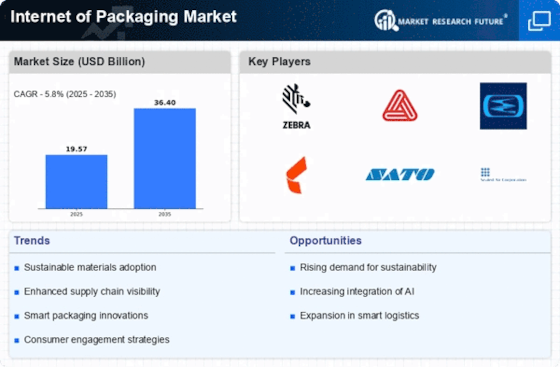
As per MRFR analysis, the Internet of Packaging Market Size was estimated at 19.57 USD Billion in 2024. The Internet of Packaging industry is projected to grow from 20.71 USD Billion in 2025 to 36.4 USD Billion by 2035, exhibiting a compound annual growth rate (CAGR) of 5.8 during the forecast period 2025 - 2035.

Key Market Trends & Highlights

The Internet of Packaging Market is poised for substantial growth driven by technological advancements and evolving consumer preferences.

  • The integration of smart technologies is transforming packaging solutions across various industries. Sustainability initiatives are increasingly influencing packaging design and materials, particularly in North America. Consumer engagement strategies are becoming essential for brands to connect with their audience effectively, especially in the Asia-Pacific region. Rising demand for traceability and consumer preference for sustainable packaging are key drivers propelling market expansion.

Market Size & Forecast

2024 Market Size 19.57 (USD Billion)
2035 Market Size 36.4 (USD Billion)
CAGR (2025 - 2035) 5.8%
Largest Regional Market Share in 2024 North America

Major Players

<p>Zebra Technologies (US), Avery Dennison (US), Smurfit Kappa (IE), Mondi Group (GB), SATO Holdings (JP), Sealed Air Corporation (US), Tetra Pak (SE), Amcor (AU), Schneider Electric (FR)</p>

Market Trends

The Internet of Packaging Market is currently experiencing a transformative phase, driven by advancements in technology and increasing demand for smart packaging solutions. This market encompasses a wide array of applications, including supply chain management, product tracking, and consumer engagement. As businesses seek to enhance operational efficiency and improve customer experiences, the integration of IoT technologies into packaging is becoming more prevalent. Companies are leveraging sensors, RFID tags, and QR codes to provide real-time data, which appears to facilitate better decision-making and resource allocation. Moreover, sustainability concerns are influencing the Internet of Packaging Market, as organizations strive to reduce waste and promote eco-friendly practices. The adoption of recyclable materials and energy-efficient processes is gaining traction, reflecting a broader commitment to environmental stewardship. As consumers become increasingly aware of their purchasing choices, brands are likely to prioritize transparency and sustainability in their packaging strategies. This evolving landscape suggests that the Internet of Packaging Market will continue to grow, driven by innovation and a focus on meeting consumer expectations.

Integration of Smart Technologies

The Internet of Packaging Market is witnessing a notable trend towards the integration of smart technologies. This encompasses the use of sensors, RFID tags, and IoT devices that enable real-time monitoring and data collection. Such advancements facilitate enhanced supply chain visibility and improve inventory management, thereby optimizing operational efficiency.

Sustainability Initiatives

A growing emphasis on sustainability is shaping the Internet of Packaging Market. Companies are increasingly adopting eco-friendly materials and practices to minimize environmental impact. This trend reflects a broader societal shift towards responsible consumption, as consumers demand transparency and sustainability in packaging solutions.

Consumer Engagement Strategies

The Internet of Packaging Market is also evolving in terms of consumer engagement. Brands are utilizing interactive packaging solutions, such as QR codes and augmented reality, to create immersive experiences. This approach not only enhances customer interaction but also provides valuable insights into consumer preferences and behaviors.

Internet of Packaging Market Market Drivers

Rising Demand for Traceability

The increasing emphasis on traceability within the supply chain is a pivotal driver for the Internet of Packaging Market. Consumers and businesses alike are demanding transparency regarding product origins and handling. This trend is particularly pronounced in sectors such as food and pharmaceuticals, where safety and authenticity are paramount. According to recent data, approximately 70% of consumers express a preference for brands that provide detailed product information. Consequently, packaging solutions that incorporate IoT technologies, such as RFID tags and QR codes, are gaining traction. These technologies enable real-time tracking and monitoring, thereby enhancing supply chain efficiency and consumer trust. As a result, the Internet of Packaging Market is likely to witness substantial growth as companies invest in smart packaging solutions that facilitate traceability.

Advancements in IoT Technologies

Technological advancements in IoT are significantly influencing the Internet of Packaging Market. Innovations such as sensors, smart labels, and connected devices are transforming traditional packaging into interactive and intelligent solutions. These advancements allow for real-time data collection and analysis, which can optimize inventory management and reduce waste. For instance, the integration of temperature and humidity sensors in packaging can ensure product quality during transit. Market data indicates that the adoption of IoT technologies in packaging is expected to grow at a compound annual growth rate of over 20% in the coming years. This growth is driven by the need for enhanced operational efficiency and improved customer experiences, positioning the Internet of Packaging Market as a key player in the broader IoT ecosystem.

Regulatory Compliance and Standards

The evolving landscape of regulatory compliance is a crucial driver for the Internet of Packaging Market. Governments and regulatory bodies are increasingly implementing stringent guidelines regarding packaging materials, labeling, and waste management. These regulations aim to promote sustainability and consumer safety, compelling companies to adopt smart packaging solutions that meet compliance requirements. For example, the European Union's Packaging and Packaging Waste Directive mandates that packaging must be recyclable or reusable by 2030. As businesses strive to adhere to these regulations, the demand for IoT-enabled packaging solutions that facilitate compliance tracking and reporting is likely to rise. This trend not only enhances brand reputation but also positions the Internet of Packaging Market as a vital component in achieving sustainability goals.

Enhancement of Supply Chain Efficiency

The enhancement of supply chain efficiency is a vital driver for the Internet of Packaging Market. Companies are increasingly recognizing the importance of optimizing their supply chains to reduce costs and improve service levels. IoT-enabled packaging solutions facilitate real-time monitoring of products throughout the supply chain, allowing for better inventory management and reduced spoilage. For instance, smart packaging can provide insights into product conditions during transit, enabling timely interventions when necessary. Market data suggests that businesses implementing IoT technologies in their packaging processes can achieve cost savings of up to 30%. This focus on efficiency not only benefits companies but also enhances customer satisfaction, thereby driving the growth of the Internet of Packaging Market.

Consumer Preference for Sustainable Packaging

The growing consumer preference for sustainable packaging is a significant driver for the Internet of Packaging Market. As environmental awareness increases, consumers are actively seeking products that utilize eco-friendly packaging materials. This shift in consumer behavior is prompting companies to innovate and adopt sustainable practices in their packaging strategies. Industry expert's indicates that nearly 60% of consumers are willing to pay more for products with sustainable packaging. Consequently, the Internet of Packaging Market is witnessing a surge in demand for smart packaging solutions that incorporate biodegradable materials and recycling capabilities. By leveraging IoT technologies, companies can enhance their sustainability efforts while also providing consumers with transparent information about the environmental impact of their packaging choices.

Market Segment Insights

By Technology: Radio Frequency Identification (Largest) vs. Sensors & Tags (Fastest-Growing)

<p>In the Internet of Packaging Market, Radio Frequency Identification (RFID) has established itself as the leading technology due to its extensive adoption across various industries. It significantly contributes to improving supply chain efficiency and inventory management, thereby holding a large share of the market. Following RFID, Sensors and Tags exhibit remarkable growth potential as businesses increasingly integrate smart technologies into their packaging solutions, enhancing real-time monitoring capabilities.</p>

<p>Technology: RFID (Dominant) vs. Sensors &amp; Tags (Emerging)</p>

<p>Radio Frequency Identification (RFID) remains dominant in the Internet of Packaging Market, offering superior tracking and identification capabilities which streamline logistics and improve accuracy in inventory management. This technology enables automatic scanning and data transmission, leading to reduced errors and increased operational efficiency. Conversely, Sensors &amp; Tags are emerging as a transformative force, driven by advancements in IoT and consumer demand for smarter packaging solutions. These innovations allow for dynamic data collection, enhancing user engagement and operational insights. As industries evolve, the integration of Sensors &amp; Tags stands to redefine packaging functionalities, catering to the growing trend of <a href="https://www.marketresearchfuture.com/reports/smart-packaging-market-1981">smart packaging</a>.</p>

By Packaging Type: Boxes & Cartons (Largest) vs. Bags (Fastest-Growing)

<p>In the Internet of Packaging Market, Boxes &amp; Cartons have established themselves as the largest packaging type, capturing a significant share due to their versatility and durability. This traditional packaging solution is widely used across various industries, driving the demand for environmentally friendly and innovative designs. Following closely is Bags, which are rapidly gaining traction among consumers looking for lightweight, <a href="https://www.marketresearchfuture.com/reports/flexible-packaging-market-1151">flexible</a>, and sustainable options. As e-commerce continues to thrive, packaging solutions that optimize shipping efficiency are in high demand, contributing to the growing popularity of Bags.</p>

<p>Boxes &amp; Cartons (Dominant) vs. Bags (Emerging)</p>

<p>Boxes &amp; Cartons serve as the dominant packaging choice in the Internet of Packaging Market, favored for their robustness and capability to protect products during transit. These packages are extensively utilized in sectors such as food and beverages, electronics, and consumer goods. On the other hand, Bags are considered an emerging segment due to their customizable designs and eco-friendly alternatives. They cater to the growing trend of sustainability, appealing to consumers who prioritize environmental responsibility. Both packaging types play crucial roles in enhancing user experience while contributing to the overall efficiency of supply chain management.</p>

By End User: Food & Beverages (Largest) vs. Healthcare (Fastest-Growing)

<p>In the Internet of Packaging Market, the end-user segment showcases a diverse distribution, with Food &amp; Beverages leading as the largest contributor. It capitalizes on the rising demand for innovative packaging solutions that ensure freshness and safety. Following closely, the Healthcare sector is emerging as the fastest-growing end-user, driven by the need for advanced packaging technologies that support traceability and maintain sterility. The Consumer Electronics and Homecare segments also hold significant shares, reflecting the ongoing digital transformation and consumer preference for sustainable packaging solutions. The growth trends within this segment are being propelled by several factors. Food &amp; Beverage companies are increasingly investing in smart packaging to enhance consumer engagement and safety. Meanwhile, the Healthcare industry's growth stems from the increased use of IoT devices in medical packaging, aiming at improving patient outcomes and compliance. Personal Care &amp; Cosmetics also boosts demand for innovative and attractive packaging, emphasizing sustainability, while Logistics &amp; Transport experiences transformation through automated tracking solutions.</p>

<p>Food &amp; Beverages: Dominant vs. Healthcare: Emerging</p>

<p>The Food &amp; Beverages sector remains the dominant force within the Internet of Packaging Market, fueled by the continuous demand for safe and sustainable packaging solutions. This segment is characterized by innovative designs that enhance product visibility and protect against contamination, appealing to health-conscious consumers. In contrast, the Healthcare sector is marked as emerging due to its rapid integration of IoT technologies. With an increasing focus on patient-centric solutions, healthcare packaging is evolving to include functionalities such as real-time tracking, authentication, and compliance verification. Both segments exemplify the shift towards smart, sustainable packaging, with Food &amp; Beverages setting the trend and Healthcare responding with cutting-edge innovations.</p>

Get more detailed insights about Internet of Packaging Market Research Report—Global Forecast till 2035

Regional Insights

North America : Innovation and Technology Leader

North America is the largest market for the Internet of Packaging Market, holding approximately 40% of the global share. The region's growth is driven by technological advancements, increasing demand for smart packaging solutions, and stringent regulations promoting sustainability. The U.S. leads the market, followed by Canada, as companies invest in IoT technologies to enhance supply chain efficiency and consumer engagement. The competitive landscape is robust, featuring key players like Zebra Technologies, Avery Dennison, and Sealed Air Corporation. These companies are at the forefront of innovation, developing smart labels and packaging solutions that integrate seamlessly with IoT systems. The presence of advanced manufacturing capabilities and a strong focus on R&D further solidifies North America's position as a leader in the Internet of Packaging Market.

Europe : Sustainability and Compliance Focus

Europe is the second-largest market for the Internet of Packaging Market, accounting for around 30% of the global share. The region's growth is fueled by stringent regulations aimed at reducing waste and promoting sustainable practices. Countries like Germany and France are leading the charge, with initiatives that encourage the adoption of smart packaging technologies to enhance traceability and reduce environmental impact. The competitive landscape in Europe is characterized by strong players such as Smurfit Kappa and Mondi Group, who are investing heavily in IoT solutions. The presence of regulatory bodies ensures compliance and drives innovation in packaging technologies. The European market is also witnessing collaborations between tech companies and packaging manufacturers to develop integrated solutions that meet consumer demands for sustainability and efficiency.

Asia-Pacific : Emerging Market with High Potential

Asia-Pacific is witnessing rapid growth in the Internet of Packaging Market, holding approximately 25% of the global share. The region's expansion is driven by increasing urbanization, rising disposable incomes, and a growing demand for packaged goods. Countries like China and Japan are at the forefront, with significant investments in smart packaging technologies to enhance supply chain efficiency and consumer experience. The competitive landscape is evolving, with key players like SATO Holdings and Tetra Pak leading the charge. The region is characterized by a mix of established companies and emerging startups, fostering innovation in IoT solutions. As the demand for smart packaging continues to rise, Asia-Pacific is poised to become a major player in the global market, attracting investments and partnerships to drive growth.

Middle East and Africa : Resource-Rich with Growth Opportunities

The Middle East and Africa region is gradually emerging in the Internet of Packaging Market, holding about 5% of the global share. The growth is driven by increasing investments in infrastructure and a rising demand for packaged goods. Countries like South Africa and the UAE are leading the way, focusing on enhancing supply chain efficiency through smart packaging solutions that cater to local market needs. The competitive landscape is still developing, with a mix of local and international players entering the market. Companies are exploring partnerships to leverage IoT technologies for better tracking and management of packaging. As the region continues to invest in technology and infrastructure, the Internet of Packaging Market is expected to grow, presenting new opportunities for innovation and collaboration.

Key Players and Competitive Insights

The Internet of Packaging Market is currently characterized by a dynamic competitive landscape, driven by technological advancements and increasing demand for smart packaging solutions. Key players are actively engaging in strategies that emphasize innovation, sustainability, and digital transformation. Companies such as Zebra Technologies (US), Avery Dennison (US), and Tetra Pak (SE) are at the forefront, leveraging their expertise to enhance operational efficiencies and customer engagement. Zebra Technologies (US) focuses on integrating IoT solutions into packaging, while Avery Dennison (US) emphasizes sustainable materials and smart labeling technologies. Tetra Pak (SE) is committed to developing eco-friendly packaging solutions, which collectively shape a competitive environment that prioritizes technological integration and sustainability.

In terms of business tactics, companies are increasingly localizing manufacturing and optimizing supply chains to enhance responsiveness to market demands. The competitive structure of the Internet of Packaging Market appears moderately fragmented, with several key players exerting influence through strategic partnerships and technological advancements. This fragmentation allows for a diverse range of offerings, catering to various customer needs while fostering innovation across the sector.

In August 2025, Zebra Technologies (US) announced a partnership with a leading logistics firm to enhance supply chain visibility through IoT-enabled packaging solutions. This strategic move is likely to bolster Zebra's position in the market by providing real-time tracking and data analytics capabilities, thereby improving operational efficiencies for clients. Such initiatives not only enhance customer satisfaction but also align with the growing demand for transparency in supply chains.

In September 2025, Avery Dennison (US) launched a new line of smart labels that utilize NFC technology, enabling consumers to access product information via their smartphones. This innovation is indicative of the company's commitment to enhancing consumer engagement and providing value-added services. By integrating digital technology into packaging, Avery Dennison is positioning itself as a leader in the smart packaging segment, which is expected to gain traction in the coming years.

In July 2025, Tetra Pak (SE) unveiled a new sustainable packaging solution made from renewable materials, aimed at reducing carbon footprints. This initiative underscores Tetra Pak's dedication to sustainability and aligns with global trends towards environmentally friendly packaging. The introduction of such products not only meets regulatory demands but also resonates with environmentally conscious consumers, potentially enhancing brand loyalty and market share.

As of October 2025, the competitive trends in the Internet of Packaging Market are increasingly defined by digitalization, sustainability, and the integration of artificial intelligence. Strategic alliances among key players are shaping the landscape, fostering innovation and enhancing supply chain reliability. Moving forward, competitive differentiation is likely to evolve from traditional price-based competition to a focus on technological innovation and sustainable practices, reflecting the changing priorities of consumers and businesses alike.

Key Companies in the Internet of Packaging Market market include

Industry Developments

  • Q2 2024: Amcor, Sealed Air, Tetra Pak, and Industry Leaders Leverage R&D, Global Manufacturing, and Tech Partnerships to Sustain Leadership Amcor, Sealed Air, and Tetra Pak announced new technology partnerships and expanded global manufacturing initiatives to strengthen their positions in the smart food packaging sector, focusing on R&D and collaborative innovation.

Future Outlook

Internet of Packaging Market Future Outlook

<p>The Internet of Packaging Market is projected to grow at a 5.8% CAGR from 2024 to 2035, driven by advancements in smart packaging technologies and increasing demand for supply chain transparency.</p>

New opportunities lie in:

  • <p>Integration of IoT sensors for real-time tracking and monitoring of packaging conditions.</p>
  • <p>Development of smart labels with QR codes for enhanced consumer engagement.</p>
  • <p>Implementation of blockchain technology for improved traceability in supply chains.</p>

<p>By 2035, the Internet of Packaging Market is expected to be a pivotal component of global supply chains.</p>

Market Segmentation

Internet of Packaging Market End User Outlook

  • Food & Beverages
  • Healthcare
  • Personal Care & Cosmetics
  • Homecare
  • Consumer Electronics
  • Logistics & Transport
  • Apparel & Accessories
  • Sport & Retail
  • Others

Internet of Packaging Market Technology Outlook

  • Barcode & QR Code
  • Sensors & Tags
  • Radio Frequency Identification
  • Near Field Communications
  • Indicators

Internet of Packaging Market Packaging Type Outlook

  • Boxes & Cartons
  • Bottles & Jars
  • Films & Wraps
  • Mailers
  • Bags
  • Tubes
  • Pouches
  • Blisters
  • Others

Report Scope

MARKET SIZE 2024 19.57(USD Billion)
MARKET SIZE 2025 20.71(USD Billion)
MARKET SIZE 2035 36.4(USD Billion)
COMPOUND ANNUAL GROWTH RATE (CAGR) 5.8% (2024 - 2035)
REPORT COVERAGE Revenue Forecast, Competitive Landscape, Growth Factors, and Trends
BASE YEAR 2024
Market Forecast Period 2025 - 2035
Historical Data 2019 - 2024
Market Forecast Units USD Billion
Key Companies Profiled Market analysis in progress
Segments Covered Market segmentation analysis in progress
Key Market Opportunities Integration of smart sensors in packaging enhances supply chain transparency and consumer engagement.
Key Market Dynamics Rising demand for smart packaging solutions drives innovation and competition in the Internet of Packaging Market.
Countries Covered North America, Europe, APAC, South America, MEA

FAQs

What is the projected market valuation of the Internet of Packaging Market by 2035?

The Internet of Packaging Market is projected to reach a valuation of 36.4 USD Billion by 2035.

What was the market valuation of the Internet of Packaging Market in 2024?

In 2024, the Internet of Packaging Market was valued at 19.57 USD Billion.

What is the expected CAGR for the Internet of Packaging Market during the forecast period 2025 - 2035?

The expected CAGR for the Internet of Packaging Market during the forecast period 2025 - 2035 is 5.8%.

Which technology segment is anticipated to show significant growth in the Internet of Packaging Market?

The Radio Frequency Identification segment is anticipated to grow from 5.0 USD Billion in 2024 to 10.0 USD Billion by 2035.

What are the key players in the Internet of Packaging Market?

Key players in the Internet of Packaging Market include Zebra Technologies, Avery Dennison, Smurfit Kappa, and Tetra Pak.

How does the Food & Beverages segment perform in the Internet of Packaging Market?

The Food &amp; Beverages segment was valued at 4.5 USD Billion in 2024 and is expected to reach 8.5 USD Billion by 2035.

  1. SECTION I: EXECUTIVE SUMMARY AND KEY HIGHLIGHTS
    1. EXECUTIVE SUMMARY
      1. Market Overview
      2. Key Findings
      3. Market Segmentation
      4. Competitive Landscape
      5. Challenges and Opportunities
      6. Future Outlook 2
  2. SECTION II: SCOPING, METHODOLOGY AND MARKET STRUCTURE
    1. MARKET INTRODUCTION
      1. Definition
      2. Scope of the study
    2. RESEARCH METHODOLOGY
      1. Overview
      2. Data Mining
      3. Secondary Research
      4. Primary Research
      5. Forecasting Model
      6. Market Size Estimation
      7. Data Triangulation
      8. Validation 3
  3. SECTION III: QUALITATIVE ANALYSIS
    1. MARKET DYNAMICS
      1. Overview
      2. Drivers
      3. Restraints
      4. Opportunities
    2. MARKET FACTOR ANALYSIS
      1. Value chain Analysis
      2. Porter's Five Forces Analysis
      3. COVID-19 Impact Analysis
  4. SECTION IV: QUANTITATIVE ANALYSIS
    1. Packaging & Transport, BY Technology (USD Billion)
      1. Barcode & QR Code
      2. Sensors & Tags
      3. Radio Frequency Identification
      4. Near Field Communications
      5. Indicators
    2. Packaging & Transport, BY Packaging Type (USD Billion)
      1. Boxes & Cartons
      2. Bottles & Jars
      3. Films & Wraps
      4. Mailers
      5. Bags
      6. Tubes
      7. Pouches
      8. Blisters
      9. Others
    3. Packaging & Transport, BY End User (USD Billion)
      1. Food & Beverages
      2. Healthcare
      3. Personal Care & Cosmetics
      4. Homecare
      5. Consumer Electronics
      6. Logistics & Transport
      7. Apparel & Accessories
      8. Sport & Retail
      9. Others
    4. Packaging & Transport, BY Region (USD Billion)
      1. North America
      2. Europe
      3. APAC
      4. South America
      5. MEA
  5. SECTION V: COMPETITIVE ANALYSIS
    1. Competitive Landscape
      1. Overview
      2. Competitive Analysis
      3. Market share Analysis
      4. Major Growth Strategy in the Packaging & Transport
      5. Competitive Benchmarking
      6. Leading Players in Terms of Number of Developments in the Packaging & Transport
      7. Key developments and growth strategies
      8. Major Players Financial Matrix
    2. Company Profiles
      1. Zebra Technologies (US)
      2. Avery Dennison (US)
      3. Smurfit Kappa (IE)
      4. Mondi Group (GB)
      5. SATO Holdings (JP)
      6. Sealed Air Corporation (US)
      7. Tetra Pak (SE)
      8. Amcor (AU)
      9. Schneider Electric (FR)
    3. Appendix
      1. References
      2. Related Reports 6 LIST OF FIGURES
    4. MARKET SYNOPSIS
    5. NORTH AMERICA MARKET ANALYSIS
    6. US MARKET ANALYSIS BY TECHNOLOGY
    7. US MARKET ANALYSIS BY PACKAGING TYPE
    8. US MARKET ANALYSIS BY END USER
    9. CANADA MARKET ANALYSIS BY TECHNOLOGY
    10. CANADA MARKET ANALYSIS BY PACKAGING TYPE
    11. CANADA MARKET ANALYSIS BY END USER
    12. EUROPE MARKET ANALYSIS
    13. GERMANY MARKET ANALYSIS BY TECHNOLOGY
    14. GERMANY MARKET ANALYSIS BY PACKAGING TYPE
    15. GERMANY MARKET ANALYSIS BY END USER
    16. UK MARKET ANALYSIS BY TECHNOLOGY
    17. UK MARKET ANALYSIS BY PACKAGING TYPE
    18. UK MARKET ANALYSIS BY END USER
    19. FRANCE MARKET ANALYSIS BY TECHNOLOGY
    20. FRANCE MARKET ANALYSIS BY PACKAGING TYPE
    21. FRANCE MARKET ANALYSIS BY END USER
    22. RUSSIA MARKET ANALYSIS BY TECHNOLOGY
    23. RUSSIA MARKET ANALYSIS BY PACKAGING TYPE
    24. RUSSIA MARKET ANALYSIS BY END USER
    25. ITALY MARKET ANALYSIS BY TECHNOLOGY
    26. ITALY MARKET ANALYSIS BY PACKAGING TYPE
    27. ITALY MARKET ANALYSIS BY END USER
    28. SPAIN MARKET ANALYSIS BY TECHNOLOGY
    29. SPAIN MARKET ANALYSIS BY PACKAGING TYPE
    30. SPAIN MARKET ANALYSIS BY END USER
    31. REST OF EUROPE MARKET ANALYSIS BY TECHNOLOGY
    32. REST OF EUROPE MARKET ANALYSIS BY PACKAGING TYPE
    33. REST OF EUROPE MARKET ANALYSIS BY END USER
    34. APAC MARKET ANALYSIS
    35. CHINA MARKET ANALYSIS BY TECHNOLOGY
    36. CHINA MARKET ANALYSIS BY PACKAGING TYPE
    37. CHINA MARKET ANALYSIS BY END USER
    38. INDIA MARKET ANALYSIS BY TECHNOLOGY
    39. INDIA MARKET ANALYSIS BY PACKAGING TYPE
    40. INDIA MARKET ANALYSIS BY END USER
    41. JAPAN MARKET ANALYSIS BY TECHNOLOGY
    42. JAPAN MARKET ANALYSIS BY PACKAGING TYPE
    43. JAPAN MARKET ANALYSIS BY END USER
    44. SOUTH KOREA MARKET ANALYSIS BY TECHNOLOGY
    45. SOUTH KOREA MARKET ANALYSIS BY PACKAGING TYPE
    46. SOUTH KOREA MARKET ANALYSIS BY END USER
    47. MALAYSIA MARKET ANALYSIS BY TECHNOLOGY
    48. MALAYSIA MARKET ANALYSIS BY PACKAGING TYPE
    49. MALAYSIA MARKET ANALYSIS BY END USER
    50. THAILAND MARKET ANALYSIS BY TECHNOLOGY
    51. THAILAND MARKET ANALYSIS BY PACKAGING TYPE
    52. THAILAND MARKET ANALYSIS BY END USER
    53. INDONESIA MARKET ANALYSIS BY TECHNOLOGY
    54. INDONESIA MARKET ANALYSIS BY PACKAGING TYPE
    55. INDONESIA MARKET ANALYSIS BY END USER
    56. REST OF APAC MARKET ANALYSIS BY TECHNOLOGY
    57. REST OF APAC MARKET ANALYSIS BY PACKAGING TYPE
    58. REST OF APAC MARKET ANALYSIS BY END USER
    59. SOUTH AMERICA MARKET ANALYSIS
    60. BRAZIL MARKET ANALYSIS BY TECHNOLOGY
    61. BRAZIL MARKET ANALYSIS BY PACKAGING TYPE
    62. BRAZIL MARKET ANALYSIS BY END USER
    63. MEXICO MARKET ANALYSIS BY TECHNOLOGY
    64. MEXICO MARKET ANALYSIS BY PACKAGING TYPE
    65. MEXICO MARKET ANALYSIS BY END USER
    66. ARGENTINA MARKET ANALYSIS BY TECHNOLOGY
    67. ARGENTINA MARKET ANALYSIS BY PACKAGING TYPE
    68. ARGENTINA MARKET ANALYSIS BY END USER
    69. REST OF SOUTH AMERICA MARKET ANALYSIS BY TECHNOLOGY
    70. REST OF SOUTH AMERICA MARKET ANALYSIS BY PACKAGING TYPE
    71. REST OF SOUTH AMERICA MARKET ANALYSIS BY END USER
    72. MEA MARKET ANALYSIS
    73. GCC COUNTRIES MARKET ANALYSIS BY TECHNOLOGY
    74. GCC COUNTRIES MARKET ANALYSIS BY PACKAGING TYPE
    75. GCC COUNTRIES MARKET ANALYSIS BY END USER
    76. SOUTH AFRICA MARKET ANALYSIS BY TECHNOLOGY
    77. SOUTH AFRICA MARKET ANALYSIS BY PACKAGING TYPE
    78. SOUTH AFRICA MARKET ANALYSIS BY END USER
    79. REST OF MEA MARKET ANALYSIS BY TECHNOLOGY
    80. REST OF MEA MARKET ANALYSIS BY PACKAGING TYPE
    81. REST OF MEA MARKET ANALYSIS BY END USER
    82. KEY BUYING CRITERIA OF PACKAGING & TRANSPORT
    83. RESEARCH PROCESS OF MRFR
    84. DRO ANALYSIS OF PACKAGING & TRANSPORT
    85. DRIVERS IMPACT ANALYSIS: PACKAGING & TRANSPORT
    86. RESTRAINTS IMPACT ANALYSIS: PACKAGING & TRANSPORT
    87. SUPPLY / VALUE CHAIN: PACKAGING & TRANSPORT
    88. PACKAGING & TRANSPORT, BY TECHNOLOGY, 2024 (% SHARE)
    89. PACKAGING & TRANSPORT, BY TECHNOLOGY, 2024 TO 2035 (USD Billion)
    90. PACKAGING & TRANSPORT, BY PACKAGING TYPE, 2024 (% SHARE)
    91. PACKAGING & TRANSPORT, BY PACKAGING TYPE, 2024 TO 2035 (USD Billion)
    92. PACKAGING & TRANSPORT, BY END USER, 2024 (% SHARE)
    93. PACKAGING & TRANSPORT, BY END USER, 2024 TO 2035 (USD Billion)
    94. BENCHMARKING OF MAJOR COMPETITORS 7 LIST OF TABLES
    95. LIST OF ASSUMPTIONS
    96. North America MARKET SIZE ESTIMATES; FORECAST
      1. BY TECHNOLOGY, 2025-2035 (USD Billion)
      2. BY PACKAGING TYPE, 2025-2035 (USD Billion)
      3. BY END USER, 2025-2035 (USD Billion)
    97. US MARKET SIZE ESTIMATES; FORECAST
      1. BY TECHNOLOGY, 2025-2035 (USD Billion)
      2. BY PACKAGING TYPE, 2025-2035 (USD Billion)
      3. BY END USER, 2025-2035 (USD Billion)
    98. Canada MARKET SIZE ESTIMATES; FORECAST
      1. BY TECHNOLOGY, 2025-2035 (USD Billion)
      2. BY PACKAGING TYPE, 2025-2035 (USD Billion)
      3. BY END USER, 2025-2035 (USD Billion)
    99. Europe MARKET SIZE ESTIMATES; FORECAST
      1. BY TECHNOLOGY, 2025-2035 (USD Billion)
      2. BY PACKAGING TYPE, 2025-2035 (USD Billion)
      3. BY END USER, 2025-2035 (USD Billion)
    100. Germany MARKET SIZE ESTIMATES; FORECAST
      1. BY TECHNOLOGY, 2025-2035 (USD Billion)
      2. BY PACKAGING TYPE, 2025-2035 (USD Billion)
      3. BY END USER, 2025-2035 (USD Billion)
    101. UK MARKET SIZE ESTIMATES; FORECAST
      1. BY TECHNOLOGY, 2025-2035 (USD Billion)
      2. BY PACKAGING TYPE, 2025-2035 (USD Billion)
      3. BY END USER, 2025-2035 (USD Billion)
    102. France MARKET SIZE ESTIMATES; FORECAST
      1. BY TECHNOLOGY, 2025-2035 (USD Billion)
      2. BY PACKAGING TYPE, 2025-2035 (USD Billion)
      3. BY END USER, 2025-2035 (USD Billion)
    103. Russia MARKET SIZE ESTIMATES; FORECAST
      1. BY TECHNOLOGY, 2025-2035 (USD Billion)
      2. BY PACKAGING TYPE, 2025-2035 (USD Billion)
      3. BY END USER, 2025-2035 (USD Billion)
    104. Italy MARKET SIZE ESTIMATES; FORECAST
      1. BY TECHNOLOGY, 2025-2035 (USD Billion)
      2. BY PACKAGING TYPE, 2025-2035 (USD Billion)
      3. BY END USER, 2025-2035 (USD Billion)
    105. Spain MARKET SIZE ESTIMATES; FORECAST
      1. BY TECHNOLOGY, 2025-2035 (USD Billion)
      2. BY PACKAGING TYPE, 2025-2035 (USD Billion)
      3. BY END USER, 2025-2035 (USD Billion)
    106. Rest of Europe MARKET SIZE ESTIMATES; FORECAST
      1. BY TECHNOLOGY, 2025-2035 (USD Billion)
      2. BY PACKAGING TYPE, 2025-2035 (USD Billion)
      3. BY END USER, 2025-2035 (USD Billion)
    107. APAC MARKET SIZE ESTIMATES; FORECAST
      1. BY TECHNOLOGY, 2025-2035 (USD Billion)
      2. BY PACKAGING TYPE, 2025-2035 (USD Billion)
      3. BY END USER, 2025-2035 (USD Billion)
    108. China MARKET SIZE ESTIMATES; FORECAST
      1. BY TECHNOLOGY, 2025-2035 (USD Billion)
      2. BY PACKAGING TYPE, 2025-2035 (USD Billion)
      3. BY END USER, 2025-2035 (USD Billion)
    109. India MARKET SIZE ESTIMATES; FORECAST
      1. BY TECHNOLOGY, 2025-2035 (USD Billion)
      2. BY PACKAGING TYPE, 2025-2035 (USD Billion)
      3. BY END USER, 2025-2035 (USD Billion)
    110. Japan MARKET SIZE ESTIMATES; FORECAST
      1. BY TECHNOLOGY, 2025-2035 (USD Billion)
      2. BY PACKAGING TYPE, 2025-2035 (USD Billion)
      3. BY END USER, 2025-2035 (USD Billion)
    111. South Korea MARKET SIZE ESTIMATES; FORECAST
      1. BY TECHNOLOGY, 2025-2035 (USD Billion)
      2. BY PACKAGING TYPE, 2025-2035 (USD Billion)
      3. BY END USER, 2025-2035 (USD Billion)
    112. Malaysia MARKET SIZE ESTIMATES; FORECAST
      1. BY TECHNOLOGY, 2025-2035 (USD Billion)
      2. BY PACKAGING TYPE, 2025-2035 (USD Billion)
      3. BY END USER, 2025-2035 (USD Billion)
    113. Thailand MARKET SIZE ESTIMATES; FORECAST
      1. BY TECHNOLOGY, 2025-2035 (USD Billion)
      2. BY PACKAGING TYPE, 2025-2035 (USD Billion)
      3. BY END USER, 2025-2035 (USD Billion)
    114. Indonesia MARKET SIZE ESTIMATES; FORECAST
      1. BY TECHNOLOGY, 2025-2035 (USD Billion)
      2. BY PACKAGING TYPE, 2025-2035 (USD Billion)
      3. BY END USER, 2025-2035 (USD Billion)
    115. Rest of APAC MARKET SIZE ESTIMATES; FORECAST
      1. BY TECHNOLOGY, 2025-2035 (USD Billion)
      2. BY PACKAGING TYPE, 2025-2035 (USD Billion)
      3. BY END USER, 2025-2035 (USD Billion)
    116. South America MARKET SIZE ESTIMATES; FORECAST
      1. BY TECHNOLOGY, 2025-2035 (USD Billion)
      2. BY PACKAGING TYPE, 2025-2035 (USD Billion)
      3. BY END USER, 2025-2035 (USD Billion)
    117. Brazil MARKET SIZE ESTIMATES; FORECAST
      1. BY TECHNOLOGY, 2025-2035 (USD Billion)
      2. BY PACKAGING TYPE, 2025-2035 (USD Billion)
      3. BY END USER, 2025-2035 (USD Billion)
    118. Mexico MARKET SIZE ESTIMATES; FORECAST
      1. BY TECHNOLOGY, 2025-2035 (USD Billion)
      2. BY PACKAGING TYPE, 2025-2035 (USD Billion)
      3. BY END USER, 2025-2035 (USD Billion)
    119. Argentina MARKET SIZE ESTIMATES; FORECAST
      1. BY TECHNOLOGY, 2025-2035 (USD Billion)
      2. BY PACKAGING TYPE, 2025-2035 (USD Billion)
      3. BY END USER, 2025-2035 (USD Billion)
    120. Rest of South America MARKET SIZE ESTIMATES; FORECAST
      1. BY TECHNOLOGY, 2025-2035 (USD Billion)
      2. BY PACKAGING TYPE, 2025-2035 (USD Billion)
      3. BY END USER, 2025-2035 (USD Billion)
    121. MEA MARKET SIZE ESTIMATES; FORECAST
      1. BY TECHNOLOGY, 2025-2035 (USD Billion)
      2. BY PACKAGING TYPE, 2025-2035 (USD Billion)
      3. BY END USER, 2025-2035 (USD Billion)
    122. GCC Countries MARKET SIZE ESTIMATES; FORECAST
      1. BY TECHNOLOGY, 2025-2035 (USD Billion)
      2. BY PACKAGING TYPE, 2025-2035 (USD Billion)
      3. BY END USER, 2025-2035 (USD Billion)
    123. South Africa MARKET SIZE ESTIMATES; FORECAST
      1. BY TECHNOLOGY, 2025-2035 (USD Billion)
      2. BY PACKAGING TYPE, 2025-2035 (USD Billion)
      3. BY END USER, 2025-2035 (USD Billion)
    124. Rest of MEA MARKET SIZE ESTIMATES; FORECAST
      1. BY TECHNOLOGY, 2025-2035 (USD Billion)
      2. BY PACKAGING TYPE, 2025-2035 (USD Billion)
      3. BY END USER, 2025-2035 (USD Billion)
    125. PRODUCT LAUNCH/PRODUCT DEVELOPMENT/APPROVAL
    126. ACQUISITION/PARTNERSHIP

Internet of Packaging Market Segmentation

Internet of Packaging Technology Outlook (USD Billion, 2018-2032)

  • Barcode & QR Code
  • Sensors & Tags
  • Radio Frequency Identification
  • Near Field Communications
  • Indicators

Internet of Packaging Packaging Type Outlook (USD Billion, 2018-2032)

  • Boxes & Cartons
  • Bottles & Jars
  • Films & Wraps
  • Mailers
  • Bags
  • Tubes
  • Pouches
  • Blisters
  • Others

Internet of Packaging End-user Outlook (USD Billion, 2018-2032)

  • Food & Beverages
  • Healthcare
  • Personal Care & Cosmetics
  • Homecare
  • Consumer Electronics
  • Logistics & Transport
  • Apparel & Accessories
  • Sport & Retail
  • Others

Internet of Packaging Regional Outlook (USD Billion, 2018-2032)

  • North America Outlook (USD Billion, 2018-2032)

    • Internet of Packaging by Technology
      • Barcode & QR Code
      • Sensors & Tags
      • Radio Frequency Identification
      • Near Field Communications
      • Indicators
    • Internet of Packaging by Packaging Type
      • Boxes & Cartons
      • Bottles & Jars
      • Films & Wraps
      • Mailers
      • Bags
      • Tubes
      • Pouches
      • Blisters
      • Others
    • Internet of Packaging by End-user
      • Food & Beverages
      • Healthcare
      • Personal Care & Cosmetics
      • Homecare
      • Consumer Electronics
      • Logistics & Transport
      • Apparel & Accessories
      • Sport & Retail
      • Others
    • US Outlook (USD Billion, 2018-2032)

    • Internet of Packaging by Technology
      • Barcode & QR Code
      • Sensors & Tags
      • Radio Frequency Identification
      • Near Field Communications
      • Indicators
    • Internet of Packaging by Packaging Type
      • Boxes & Cartons
      • Bottles & Jars
      • Films & Wraps
      • Mailers
      • Bags
      • Tubes
      • Pouches
      • Blisters
      • Others
    • Internet of Packaging by End-user
      • Food & Beverages
      • Healthcare
      • Personal Care & Cosmetics
      • Homecare
      • Consumer Electronics
      • Logistics & Transport
      • Apparel & Accessories
      • Sport & Retail
      • Others
    • Canada Outlook (USD Billion, 2018-2032)

    • Internet of Packaging by Technology
      • Barcode & QR Code
      • Sensors & Tags
      • Radio Frequency Identification
      • Near Field Communications
      • Indicators
    • Internet of Packaging by Packaging Type
      • Boxes & Cartons
      • Bottles & Jars
      • Films & Wraps
      • Mailers
      • Bags
      • Tubes
      • Pouches
      • Blisters
      • Others
    • Internet of Packaging by End-user
      • Food & Beverages
      • Healthcare
      • Personal Care & Cosmetics
      • Homecare
      • Consumer Electronics
      • Logistics & Transport
      • Apparel & Accessories
      • Sport & Retail
      • Others
  • Europe Outlook (USD Billion, 2018-2032)

    • Internet of Packaging by Technology
      • Barcode & QR Code
      • Sensors & Tags
      • Radio Frequency Identification
      • Near Field Communications
      • Indicators
    • Internet of Packaging by Packaging Type
      • Boxes & Cartons
      • Bottles & Jars
      • Films & Wraps
      • Mailers
      • Bags
      • Tubes
      • Pouches
      • Blisters
      • Others
    • Internet of Packaging by End-user
      • Food & Beverages
      • Healthcare
      • Personal Care & Cosmetics
      • Homecare
      • Consumer Electronics
      • Logistics & Transport
      • Apparel & Accessories
      • Sport & Retail
      • Others
    • Germany Outlook (USD Billion, 2018-2032)

    • Internet of Packaging by Technology
      • Barcode & QR Code
      • Sensors & Tags
      • Radio Frequency Identification
      • Near Field Communications
      • Indicators
    • Internet of Packaging by Packaging Type
      • Boxes & Cartons
      • Bottles & Jars
      • Films & Wraps
      • Mailers
      • Bags
      • Tubes
      • Pouches
      • Blisters
      • Others
    • Internet of Packaging by End-user
      • Food & Beverages
      • Healthcare
      • Personal Care & Cosmetics
      • Homecare
      • Consumer Electronics
      • Logistics & Transport
      • Apparel & Accessories
      • Sport & Retail
      • Others
    • France Outlook (USD Billion, 2018-2032)

    • Internet of Packaging by Technology
      • Barcode & QR Code
      • Sensors & Tags
      • Radio Frequency Identification
      • Near Field Communications
      • Indicators
    • Internet of Packaging by Packaging Type
      • Boxes & Cartons
      • Bottles & Jars
      • Films & Wraps
      • Mailers
      • Bags
      • Tubes
      • Pouches
      • Blisters
      • Others
    • Internet of Packaging by End-user
      • Food & Beverages
      • Healthcare
      • Personal Care & Cosmetics
      • Homecare
      • Consumer Electronics
      • Logistics & Transport
      • Apparel & Accessories
      • Sport & Retail
      • Others
    • UK Outlook (USD Billion, 2018-2032)

    • Internet of Packaging by Technology
      • Barcode & QR Code
      • Sensors & Tags
      • Radio Frequency Identification
      • Near Field Communications
      • Indicators
    • Internet of Packaging by Packaging Type
      • Boxes & Cartons
      • Bottles & Jars
      • Films & Wraps
      • Mailers
      • Bags
      • Tubes
      • Pouches
      • Blisters
      • Others
    • Internet of Packaging by End-user
      • Food & Beverages
      • Healthcare
      • Personal Care & Cosmetics
      • Homecare
      • Consumer Electronics
      • Logistics & Transport
      • Apparel & Accessories
      • Sport & Retail
      • Others
    • Italy Outlook (USD Billion, 2018-2032)

    • Internet of Packaging by Technology
      • Barcode & QR Code
      • Sensors & Tags
      • Radio Frequency Identification
      • Near Field Communications
      • Indicators
    • Internet of Packaging by Packaging Type
      • Boxes & Cartons
      • Bottles & Jars
      • Films & Wraps
      • Mailers
      • Bags
      • Tubes
      • Pouches
      • Blisters
      • Others
    • Internet of Packaging by End-user
      • Food & Beverages
      • Healthcare
      • Personal Care & Cosmetics
      • Homecare
      • Consumer Electronics
      • Logistics & Transport
      • Apparel & Accessories
      • Sport & Retail
      • Others
    • Spain Outlook (USD Billion, 2018-2032)

    • Internet of Packaging by Technology
      • Barcode & QR Code
      • Sensors & Tags
      • Radio Frequency Identification
      • Near Field Communications
      • Indicators
    • Internet of Packaging by Packaging Type
      • Boxes & Cartons
      • Bottles & Jars
      • Films & Wraps
      • Mailers
      • Bags
      • Tubes
      • Pouches
      • Blisters
      • Others
    • Internet of Packaging by End-user
      • Food & Beverages
      • Healthcare
      • Personal Care & Cosmetics
      • Homecare
      • Consumer Electronics
      • Logistics & Transport
      • Apparel & Accessories
      • Sport & Retail
      • Others
    • Rest Of Europe Outlook (USD Billion, 2018-2032)

    • Internet of Packaging by Technology
      • Barcode & QR Code
      • Sensors & Tags
      • Radio Frequency Identification
      • Near Field Communications
      • Indicators
    • Internet of Packaging by Packaging Type
      • Boxes & Cartons
      • Bottles & Jars
      • Films & Wraps
      • Mailers
      • Bags
      • Tubes
      • Pouches
      • Blisters
      • Others
    • Internet of Packaging by End-user
      • Food & Beverages
      • Healthcare
      • Personal Care & Cosmetics
      • Homecare
      • Consumer Electronics
      • Logistics & Transport
      • Apparel & Accessories
      • Sport & Retail
      • Others
  • Asia-Pacific Outlook (USD Billion, 2018-2032)

    • Internet of Packaging by Technology
      • Barcode & QR Code
      • Sensors & Tags
      • Radio Frequency Identification
      • Near Field Communications
      • Indicators
    • Internet of Packaging by Packaging Type
      • Boxes & Cartons
      • Bottles & Jars
      • Films & Wraps
      • Mailers
      • Bags
      • Tubes
      • Pouches
      • Blisters
      • Others
    • Internet of Packaging by End-user
      • Food & Beverages
      • Healthcare
      • Personal Care & Cosmetics
      • Homecare
      • Consumer Electronics
      • Logistics & Transport
      • Apparel & Accessories
      • Sport & Retail
      • Others
    • China Outlook (USD Billion, 2018-2032)

    • Internet of Packaging by Technology
      • Barcode & QR Code
      • Sensors & Tags
      • Radio Frequency Identification
      • Near Field Communications
      • Indicators
    • Internet of Packaging by Packaging Type
      • Boxes & Cartons
      • Bottles & Jars
      • Films & Wraps
      • Mailers
      • Bags
      • Tubes
      • Pouches
      • Blisters
      • Others
    • Internet of Packaging by End-user
      • Food & Beverages
      • Healthcare
      • Personal Care & Cosmetics
      • Homecare
      • Consumer Electronics
      • Logistics & Transport
      • Apparel & Accessories
      • Sport & Retail
      • Others
    • Japan Outlook (USD Billion, 2018-2032)

    • Internet of Packaging by Technology
      • Barcode & QR Code
      • Sensors & Tags
      • Radio Frequency Identification
      • Near Field Communications
      • Indicators
    • Internet of Packaging by Packaging Type
      • Boxes & Cartons
      • Bottles & Jars
      • Films & Wraps
      • Mailers
      • Bags
      • Tubes
      • Pouches
      • Blisters
      • Others
    • Internet of Packaging by End-user
      • Food & Beverages
      • Healthcare
      • Personal Care & Cosmetics
      • Homecare
      • Consumer Electronics
      • Logistics & Transport
      • Apparel & Accessories
      • Sport & Retail
      • Others
    • India Outlook (USD Billion, 2018-2032)

    • Internet of Packaging by Technology
      • Barcode & QR Code
      • Sensors & Tags
      • Radio Frequency Identification
      • Near Field Communications
      • Indicators
    • Internet of Packaging by Packaging Type
      • Boxes & Cartons
      • Bottles & Jars
      • Films & Wraps
      • Mailers
      • Bags
      • Tubes
      • Pouches
      • Blisters
      • Others
    • Internet of Packaging by End-user
      • Food & Beverages
      • Healthcare
      • Personal Care & Cosmetics
      • Homecare
      • Consumer Electronics
      • Logistics & Transport
      • Apparel & Accessories
      • Sport & Retail
      • Others
    • Australia Outlook (USD Billion, 2018-2032)

    • Internet of Packaging by Technology
      • Barcode & QR Code
      • Sensors & Tags
      • Radio Frequency Identification
      • Near Field Communications
      • Indicators
    • Internet of Packaging by Packaging Type
      • Boxes & Cartons
      • Bottles & Jars
      • Films & Wraps
      • Mailers
      • Bags
      • Tubes
      • Pouches
      • Blisters
      • Others
    • Internet of Packaging by End-user
      • Food & Beverages
      • Healthcare
      • Personal Care & Cosmetics
      • Homecare
      • Consumer Electronics
      • Logistics & Transport
      • Apparel & Accessories
      • Sport & Retail
      • Others
    • Rest of Asia-Pacific Outlook (USD Billion, 2018-2032)

    • Internet of Packaging by Technology
      • Barcode & QR Code
      • Sensors & Tags
      • Radio Frequency Identification
      • Near Field Communications
      • Indicators
    • Internet of Packaging by Packaging Type
      • Boxes & Cartons
      • Bottles & Jars
      • Films & Wraps
      • Mailers
      • Bags
      • Tubes
      • Pouches
      • Blisters
      • Others
    • Internet of Packaging by End-user
      • Food & Beverages
      • Healthcare
      • Personal Care & Cosmetics
      • Homecare
      • Consumer Electronics
      • Logistics & Transport
      • Apparel & Accessories
      • Sport & Retail
      • Others
  • Rest of the World Outlook (USD Billion, 2018-2032)

    • Internet of Packaging by Technology
      • Barcode & QR Code
      • Sensors & Tags
      • Radio Frequency Identification
      • Near Field Communications
      • Indicators
    • Internet of Packaging by Packaging Type
      • Boxes & Cartons
      • Bottles & Jars
      • Films & Wraps
      • Mailers
      • Bags
      • Tubes
      • Pouches
      • Blisters
      • Others
    • Internet of Packaging by End-user
      • Food & Beverages
      • Healthcare
      • Personal Care & Cosmetics
      • Homecare
      • Consumer Electronics
      • Logistics & Transport
      • Apparel & Accessories
      • Sport & Retail
      • Others
    • Middle East Outlook (USD Billion, 2018-2032)

    • Internet of Packaging by Technology
      • Barcode & QR Code
      • Sensors & Tags
      • Radio Frequency Identification
      • Near Field Communications
      • Indicators
    • Internet of Packaging by Packaging Type
      • Boxes & Cartons
      • Bottles & Jars
      • Films & Wraps
      • Mailers
      • Bags
      • Tubes
      • Pouches
      • Blisters
      • Others
    • Internet of Packaging by End-user
      • Food & Beverages
      • Healthcare
      • Personal Care & Cosmetics
      • Homecare
      • Consumer Electronics
      • Logistics & Transport
      • Apparel & Accessories
      • Sport & Retail
      • Others
    • Africa Outlook (USD Billion, 2018-2032)

    • Internet of Packaging by Technology
      • Barcode & QR Code
      • Sensors & Tags
      • Radio Frequency Identification
      • Near Field Communications
      • Indicators
    • Internet of Packaging by Packaging Type
      • Boxes & Cartons
      • Bottles & Jars
      • Films & Wraps
      • Mailers
      • Bags
      • Tubes
      • Pouches
      • Blisters
      • Others
    • Internet of Packaging by End-user
      • Food & Beverages
      • Healthcare
      • Personal Care & Cosmetics
      • Homecare
      • Consumer Electronics
      • Logistics & Transport
      • Apparel & Accessories
      • Sport & Retail
      • Others
    • Latin America Outlook (USD Billion, 2018-2032)

    • Internet of Packaging by Technology
      • Barcode & QR Code
      • Sensors & Tags
      • Radio Frequency Identification
      • Near Field Communications
      • Indicators
    • Internet of Packaging by Packaging Type
      • Boxes & Cartons
      • Bottles & Jars
      • Films & Wraps
      • Mailers
      • Bags
      • Tubes
      • Pouches
      • Blisters
      • Others
    • Internet of Packaging by End-user
      • Food & Beverages
      • Healthcare
      • Personal Care & Cosmetics
      • Homecare
      • Consumer Electronics
      • Logistics & Transport
      • Apparel & Accessories
      • Sport & Retail
      • Others
Infographic

Free Sample Request

Kindly complete the form below to receive a free sample of this Report

Get Free Sample

Customer Strories

Compare Licence

×
Features License Type
Single User Multiuser License Enterprise User
Price $4,950 $5,950 $7,250
Maximum User Access Limit 1 User Upto 10 Users Unrestricted Access Throughout the Organization
Free Customization
Direct Access to Analyst
Deliverable Format
Platform Access
Discount on Next Purchase 10% 15% 15%
Printable Versions