Request Free Sample ×

Kindly complete the form below to receive a free sample of this Report

* Please use a valid business email

Leading companies partner with us for data-driven Insights

clients tt-cursor
Hero Background
English
Chinese
French
Japanese
Korean
German
Spanish

Interconnects and Passive Components Market Analysis

ID: MRFR/SEM/1781-CR
236 Pages
Nirmit Biswas
July 2025

Interconnects and Passive Components Market By Product Type (Interconnects, Passive Components, Electromechanical Components, Relays, Switches), By Technology (Optical Interconnects, Wireless Interconnects, 5G & Telecom Infrastructure, Surface Mount Technology Components, MEMS-based Components, Others), By End User (Automotive, Consumer Electronics, Telecommunications, Industrial Equipment & Manufacturing, Aerospace & Defense, IT & Data Centers, Power Generation & Distribution, Robotics, Energy & Utilities, Others) & Region- Forecast 2035

Share:
Download PDF ×

We do not share your information with anyone. However, we may send you emails based on your report interest from time to time. You may contact us at any time to opt-out.

Interconnects and Passive Components Market Infographic
Purchase Options

Market Analysis

In-depth Analysis of Interconnects and Passive Components Market Industry Landscape

The Interconnects and Passive Components market is characterized by dynamic shifts driven by the rapid advancements in technology, increasing demand for connectivity, and the growing complexity of electronic systems. Interconnects and passive components, including connectors, cables, resistors, and capacitors, are fundamental building blocks in various electronic devices and systems. The market dynamics are shaped by factors such as technological innovation, industry convergence, and the evolving needs of end-users.

Technological innovation plays a pivotal role in influencing the market dynamics of Interconnects and Passive Components. The relentless pursuit of miniaturization, higher data transfer rates, and energy efficiency has led to the development of advanced interconnect solutions. The transition from traditional wired connections to high-speed connectors and cables capable of supporting emerging technologies like 5G, IoT (Internet of Things), and AI (Artificial Intelligence) has significantly impacted the market. Moreover, advancements in materials and manufacturing processes contribute to the development of components with improved performance, reliability, and durability.

Industry convergence is another key driver shaping the market dynamics of Interconnects and Passive Components. As various industries, such as automotive, telecommunications, and healthcare, integrate advanced electronic systems, the demand for sophisticated interconnects and passive components increases. For example, the automotive sector relies heavily on interconnects for in-car communication systems, sensors, and infotainment systems. The convergence of technologies in smart homes, wearables, and industrial automation further propels the demand for specialized components that can meet the specific requirements of diverse applications.

The evolving needs of end-users contribute significantly to the dynamic nature of the Interconnects and Passive Components market. With the increasing prevalence of electronic devices in everyday life, consumers seek smaller, more reliable, and energy-efficient products. This demand drives manufacturers to develop interconnects and passive components that not only meet the technical specifications but also address the user experience aspect. For instance, the demand for flexible and lightweight cables for consumer electronics, coupled with connectors that allow easy and quick assembly, reflects the changing preferences of end-users.

The competitive landscape is a crucial factor influencing the market dynamics of Interconnects and Passive Components. The industry comprises a mix of established players and new entrants, all vying for market share through innovation and differentiation. Market leaders invest heavily in research and development to introduce components with enhanced performance, higher speed capabilities, and increased functionality. The competitive environment often leads to strategic collaborations, mergers, and acquisitions, shaping the industry's direction and fostering a continuous cycle of innovation.

Additionally, global trends such as the emphasis on sustainable and eco-friendly solutions impact the market dynamics of Interconnects and Passive Components. As environmental concerns rise, manufacturers are pressured to develop components that adhere to green standards, emphasizing recyclability and reduced environmental impact. The shift towards circular economies and responsible manufacturing practices influences product development, market positioning, and consumer preferences.


Author
Author Profile
Nirmit Biswas
Senior Research Analyst

With 5+ years of expertise in Market Intelligence and Strategic Research, Nirmit Biswas specializes in ICT, Semiconductors, and BFSI. Backed by an MBA in Financial Services and a Computer Science foundation, Nirmit blends technical depth with business acumen. He has successfully led 100+ projects for global enterprises and startups, including Amazon, Cisco, L&T and Huawei, delivering market estimations, competitive benchmarking, and GTM strategies. His focus lies in transforming complex data into clear, actionable insights that drive growth, innovation, and investment decisions. Recognized for bridging engineering innovation with executive strategy, Nirmit helps businesses navigate dynamic markets with confidence.

Leave a Comment

FAQs

What is the projected market valuation for the Interconnects and Passive Components Market in 2035?

<p>The projected market valuation for the Interconnects and Passive Components Market in 2035 is 269.0 USD Billion.</p>

What was the overall market valuation for the Interconnects and Passive Components Market in 2024?

<p>The overall market valuation for the Interconnects and Passive Components Market in 2024 was 157.28 USD Billion.</p>

What is the expected CAGR for the Interconnects and Passive Components Market during the forecast period 2025 - 2035?

<p>The expected CAGR for the Interconnects and Passive Components Market during the forecast period 2025 - 2035 is 5.0%.</p>

Which product type segment had the highest valuation in 2024?

<p>In 2024, the Passive Components segment had the highest valuation at 60.0 USD Billion.</p>

What are the projected valuations for Optical Interconnects by 2035?

<p>The projected valuation for Optical Interconnects by 2035 is 27.0 USD Billion.</p>

Which key player is based in the United States and specializes in interconnects?

TE Connectivity, based in the United States, is a key player specializing in interconnects.

What is the projected valuation for Wireless Interconnects in 2035?

The projected valuation for Wireless Interconnects in 2035 is 35.0 USD Billion.

Which end-user segment is expected to grow the most by 2035?

The Consumer Electronics end-user segment is expected to grow the most, with a projected valuation of 50.0 USD Billion by 2035.

What was the valuation of High-Speed Connectors in 2024?

The valuation of High-Speed Connectors in 2024 was 25.0 USD Billion.

How does the projected growth of the Interconnects and Passive Components Market compare to the 2024 valuation?

The market is expected to grow from 157.28 USD Billion in 2024 to 269.0 USD Billion by 2035, indicating substantial growth.

Market Summary

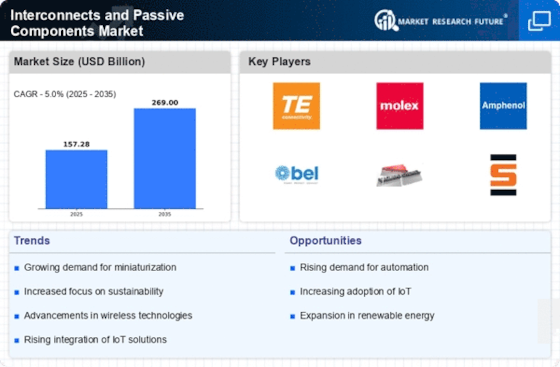
As per Market Research Future analysis, the Interconnects and Passive Components Market was estimated at 157.28 USD Billion in 2024. The Interconnects and Passive Components industry is projected to grow from 165.14 USD Billion in 2025 to 269.0 USD Billion by 2035, exhibiting a compound annual growth rate (CAGR) of 5.0% during the forecast period 2025 - 2035

Key Market Trends & Highlights

The Interconnects and Passive Components Market is poised for robust growth driven by technological advancements and increasing demand across various sectors.

  • North America remains the largest market for interconnects, driven by a strong consumer electronics sector. Asia-Pacific is the fastest-growing region, fueled by rapid advancements in telecommunications infrastructure. Interconnects dominate the market, while passive components are experiencing the fastest growth due to miniaturization trends. Rising demand for consumer electronics and the expansion of telecommunications infrastructure are key drivers propelling market growth.

Market Size & Forecast

2024 Market Size 157.28 (USD Billion)
2035 Market Size 269.0 (USD Billion)
CAGR (2025 - 2035) 5.0%
Largest Regional Market Share in 2024 Asia Pacific

Major Players

TE Connectivity (US), Molex (US), Amphenol (US), Bel Fuse (US), Yazaki (JP), Samtec (US), Phoenix Contact (DE), Würth Elektronik (DE), AVX Corporation (US), KEMET Corporation (US)

Market Trends

The Interconnects and Passive Components Market is currently experiencing a dynamic evolution, driven by advancements in technology and increasing demand across various sectors. The proliferation of electronic devices, coupled with the growing emphasis on miniaturization, has led to a heightened need for efficient interconnect solutions and passive components. This market encompasses a wide array of products, including connectors, capacitors, resistors, and inductors, which are integral to the functionality of electronic systems. As industries such as telecommunications, automotive, and consumer electronics continue to expand, the market is poised for substantial growth. Furthermore, the ongoing shift towards renewable energy sources and electric vehicles is likely to create new opportunities for innovation within this sector. In addition to technological advancements, the Interconnects and Passive Components Market is influenced by evolving consumer preferences and regulatory standards. Manufacturers are increasingly focusing on developing sustainable and environmentally friendly products to meet the demands of eco-conscious consumers. This trend is further supported by government initiatives aimed at promoting energy efficiency and reducing electronic waste. As a result, companies are investing in research and development to create components that not only enhance performance but also align with sustainability goals. Overall, the market appears to be on a trajectory of growth, characterized by innovation, sustainability, and adaptability to changing market conditions.

Technological Advancements

The Interconnects and Passive Components Market is witnessing rapid technological advancements that enhance product performance and reliability. Innovations in materials and manufacturing processes are enabling the development of components that can operate at higher frequencies and temperatures, thereby meeting the demands of modern electronic applications.

Sustainability Initiatives

There is a growing emphasis on sustainability within the Interconnects and Passive Components Market. Manufacturers are increasingly adopting eco-friendly practices and materials, driven by consumer demand for greener products and regulatory pressures aimed at reducing environmental impact.

Miniaturization Trends

The trend towards miniaturization is significantly shaping the Interconnects and Passive Components Market. As electronic devices become smaller and more compact, the need for smaller, more efficient components is becoming paramount, prompting innovation in design and manufacturing techniques.

Interconnects and Passive Components Market Market Drivers

Growth in Automotive Electronics

The Interconnects and Passive Components Market is poised for growth due to the increasing integration of electronics in the automotive sector. As vehicles become more technologically advanced, the demand for reliable interconnects and passive components intensifies. In 2025, the automotive electronics market is projected to reach approximately 400 billion USD, reflecting a significant shift towards electric and autonomous vehicles. These vehicles require sophisticated interconnect solutions to manage complex electronic systems, including infotainment, safety, and navigation. Passive components, such as inductors and capacitors, are essential for ensuring the functionality and efficiency of these systems. Consequently, the automotive industry's transition towards electrification and automation is likely to bolster the demand for interconnects and passive components, thereby enhancing the overall growth of the Interconnects and Passive Components Market.

Focus on Renewable Energy Solutions

The Interconnects and Passive Components Market is witnessing a shift towards renewable energy solutions, driven by global sustainability initiatives. As countries strive to reduce carbon emissions, investments in renewable energy sources, such as solar and wind, are on the rise. In 2025, the renewable energy sector is projected to exceed 2 trillion USD, creating a substantial demand for interconnects and passive components that can support these technologies. Efficient interconnect solutions are essential for connecting renewable energy systems to the grid, while passive components play a vital role in energy storage and conversion. This focus on sustainability not only enhances the performance of renewable energy systems but also propels the growth of the Interconnects and Passive Components Market, as manufacturers adapt to meet the evolving needs of this sector.

Emergence of Internet of Things (IoT)

The Interconnects and Passive Components Market is significantly impacted by the emergence of the Internet of Things (IoT). As more devices become interconnected, the demand for efficient interconnect solutions and passive components is expected to rise. In 2025, the IoT market is anticipated to surpass 1 trillion USD, driven by applications across various sectors, including healthcare, agriculture, and smart cities. This proliferation of connected devices necessitates robust interconnects that can handle vast amounts of data while maintaining energy efficiency. Passive components, such as sensors and transceivers, are critical in facilitating communication between devices. As industries increasingly adopt IoT technologies, the Interconnects and Passive Components Market is likely to experience substantial growth, reflecting the need for innovative solutions that support this interconnected ecosystem.

Rising Demand for Consumer Electronics

The Interconnects and Passive Components Market experiences a notable surge in demand driven by the proliferation of consumer electronics. As households increasingly adopt smart devices, the need for efficient interconnects and passive components becomes paramount. In 2025, the consumer electronics sector is projected to reach a valuation of approximately 1 trillion USD, indicating a robust growth trajectory. This growth necessitates advanced interconnect solutions that can support high-speed data transfer and energy efficiency. Consequently, manufacturers are compelled to innovate and enhance their product offerings to meet the evolving requirements of this dynamic market. The integration of passive components, such as capacitors and resistors, plays a crucial role in ensuring the reliability and performance of these devices, thereby further propelling the Interconnects and Passive Components Market.

Expansion of Telecommunications Infrastructure

The Interconnects and Passive Components Market is significantly influenced by the ongoing expansion of telecommunications infrastructure. With the increasing demand for high-speed internet and mobile connectivity, investments in telecommunications are on the rise. In 2025, the telecommunications sector is expected to witness an investment exceeding 300 billion USD, primarily aimed at enhancing network capabilities. This expansion necessitates the deployment of advanced interconnect solutions that can facilitate seamless communication and data transfer. Passive components, such as connectors and filters, are integral to the infrastructure, ensuring signal integrity and minimizing losses. As telecommunications companies strive to meet consumer expectations for faster and more reliable services, the demand for high-quality interconnects and passive components is likely to escalate, thereby driving growth in the Interconnects and Passive Components Market.

Market Segment Insights

By Product Type: Interconnects (Largest) vs. Passive Components (Fastest-Growing)

The Interconnects and Passive Components Market reflects a diverse landscape with significant share attributed to Interconnects, which stands as the largest segment. This segment plays a crucial role in enabling connectivity in various electronic applications. Meanwhile, Passive Components are emerging rapidly, capturing increased attention due to their essential functions in circuit design and energy efficiency. This interplay of dominance and growth underscores the shifting dynamics within the market. Growth trends indicate a robust preference for smaller, more efficient devices driving the demand for Passive Components. Technological innovations and miniaturization efforts are propelling this segment forward, appealing to industries such as consumer electronics and telecommunications. Additionally, the shift towards renewable energy sources fosters enhanced opportunities for both segments, creating a promising outlook within the Interconnects and Passive Components Market.

Interconnects: Dominant vs. Passive Components: Emerging

Interconnects hold the dominant position in the market due to their critical role in ensuring seamless communication between various electronic components and systems. This segment encompasses connectors, cables, and other devices essential for signal and power transmission. As systems become more complex, the demand for reliable and efficient interconnection solutions continues to surge. Conversely, Passive Components, including resistors, capacitors, and inductors, are seen as emerging due to their integral part in modern electronic devices. With a focus on energy efficiency, these components facilitate miniaturization without compromising performance. Their growing adoption in industrial and consumer applications reflects a broader trend towards smarter, more integrated electronic solutions, positioning them as key players in the evolving market.

By Technology: Optical Interconnects (Largest) vs. Wireless Interconnects (Fastest-Growing)

In the Interconnects and Passive Components Market, the distribution of market share among segment values reveals that Optical Interconnects dominate due to their high bandwidth capabilities and efficiency in data transmission. Following closely, Wireless Interconnects are rapidly gaining traction as the demand for mobile connectivity surges. Other segments, like High-Speed Connectors and 5G Telecom Infrastructure, also contribute significantly to the overall landscape, reflecting the diversity within technology preferences among consumers and industries. The growth trends are being fueled by the increased adoption of high-speed internet, the expansion of telecommunication networks, and the continuous push towards automation and smart devices. With the rise of IoT devices, Smart Electromechanical Systems and MEMS-based Components are becoming integral in providing innovative solutions. Additionally, Surface Mount Technology components are becoming more prevalent, driven by miniaturization and demand for reliable interconnects in compact electronic devices.

Optical Interconnects (Dominant) vs. Wireless Interconnects (Emerging)

Optical Interconnects showcase a dominant position in the market due to their unmatched speed and transmission capabilities, effectively meeting the burgeoning demands of data centers and telecommunications. Their predominant use in long-distance and high-volume data transmission applications establishes them as a cornerstone technology. On the other hand, Wireless Interconnects are emerging rapidly, driven by the global shift towards mobile technology and increased demand for seamless connectivity. Innovations in this space, including advancements in 5G technology and next-generation wireless protocols, are enabling faster communication and greater network efficiency. As such, while Optical Interconnects hold strong market share, Wireless Interconnects are positioned to capture significant growth opportunities in the evolving digital landscape.

By End User: Automotive (Largest) vs. Consumer Electronics (Fastest-Growing)

In the Interconnects and Passive Components Market, the automotive sector holds the largest share due to the increasing integration of electronics in vehicles, driving demand for reliable interconnects and passive components. Major manufacturers are focusing on developing specialized components to meet the rigorous demands of automotive applications, propelling this segment's prominence. On the other hand, the consumer electronics segment is witnessing rapid growth, fueled by innovation and increasing consumer demand for advanced electronic devices. Trends such as miniaturization and smart technology integration are factors driving the expansion of this segment in the market.

Consumer Electronics: Automotive (Dominant) vs. Telecommunications (Emerging)

The automotive sector is dominant in the Interconnects and Passive Components Market, characterized by its critical reliance on high-performance components for various applications, including power management, connectivity, and safety features. This sector benefits from stringent quality and reliability standards, prompting manufacturers to invest in advanced materials and technologies. Conversely, the telecommunications sector, while emerging, is rapidly evolving with the deployment of 5G technology and increased demand for data transmission capabilities. This emerging segment is expanding as companies adapt to the need for enhanced connectivity solutions, thus positioning itself as a growing market player.

Get more detailed insights about Interconnects and Passive Components Market Research Report – Forecast Till 2035

Regional Insights

North America : Innovation and Demand Surge

North America is the largest market for interconnects and passive components, holding approximately 40% of the global market share. The region's growth is driven by advancements in technology, particularly in telecommunications and automotive sectors. Regulatory support for innovation and sustainability initiatives further catalyzes demand, with a focus on energy-efficient solutions and smart technologies. The United States dominates this market, with key players like TE Connectivity, Molex, and Amphenol leading the charge. The competitive landscape is characterized by continuous innovation and strategic partnerships. Canada also plays a significant role, contributing to the market with its growing electronics sector. The presence of major manufacturers ensures a robust supply chain and fosters a dynamic market environment.

Europe : Regulatory Framework and Growth

Europe is witnessing significant growth in the interconnects and passive components market, accounting for approximately 30% of the global share. The region benefits from stringent regulations promoting energy efficiency and sustainability, which drive demand for advanced interconnect solutions. The European Union's Green Deal and various national initiatives are pivotal in shaping market dynamics, encouraging innovation and investment in green technologies. Germany and France are the leading countries in this market, with a strong presence of key players like Phoenix Contact and Würth Elektronik. The competitive landscape is marked by a focus on R&D and collaboration among manufacturers to meet evolving consumer needs. The region's emphasis on high-quality standards and technological advancements positions it as a critical player in the global market.

Asia-Pacific : Rapid Growth and Expansion

Asia-Pacific is rapidly emerging as a powerhouse in the interconnects and passive components market, holding around 25% of the global market share. The region's growth is fueled by increasing demand for consumer electronics, automotive applications, and industrial automation. Countries like China and Japan are at the forefront, supported by favorable government policies and investments in technology infrastructure. China is the largest market in the region, with significant contributions from local manufacturers and global players like Yazaki and Samtec. The competitive landscape is characterized by a mix of established companies and startups, fostering innovation and cost-effective solutions. The region's focus on expanding its manufacturing capabilities further enhances its position in the global market.

Middle East and Africa : Emerging Markets and Opportunities

The Middle East and Africa region is gradually emerging in the interconnects and passive components market, holding about 5% of the global share. The growth is driven by increasing investments in infrastructure, telecommunications, and renewable energy projects. Countries like South Africa and the UAE are leading the charge, supported by government initiatives aimed at diversifying economies and enhancing technological capabilities. The competitive landscape is still developing, with a mix of local and international players entering the market. The presence of key manufacturers is growing, and partnerships are being formed to leverage opportunities in various sectors. As the region continues to invest in technology and infrastructure, its market potential is expected to expand significantly.

Key Players and Competitive Insights

The Interconnects and Passive Components Market is currently characterized by a dynamic competitive landscape, driven by technological advancements and increasing demand across various sectors, including automotive, telecommunications, and consumer electronics. Major players such as TE Connectivity (US), Molex (US), and Amphenol (US) are strategically positioned to leverage innovation and expand their market presence. TE Connectivity (US) focuses on enhancing its product portfolio through continuous research and development, while Molex (US) emphasizes strategic partnerships to bolster its supply chain capabilities. Amphenol (US) is actively pursuing mergers and acquisitions to diversify its offerings, thereby shaping a competitive environment that is increasingly reliant on technological differentiation and operational efficiency.Key business tactics within this market include localizing manufacturing and optimizing supply chains to enhance responsiveness to customer needs. The competitive structure appears moderately fragmented, with several key players exerting influence over market dynamics. This fragmentation allows for niche players to thrive, while larger companies consolidate their positions through strategic initiatives. The collective influence of these key players fosters a competitive atmosphere where innovation and customer-centric solutions are paramount.

In August TE Connectivity (US) announced the launch of a new line of environmentally friendly connectors aimed at the electric vehicle market. This strategic move not only aligns with the growing trend towards sustainability but also positions the company as a leader in providing solutions for the rapidly evolving electric vehicle sector. By focusing on eco-friendly products, TE Connectivity (US) is likely to enhance its competitive edge and appeal to environmentally conscious consumers.

In September Molex (US) unveiled a partnership with a leading semiconductor manufacturer to develop advanced interconnect solutions for 5G applications. This collaboration is significant as it underscores Molex's commitment to innovation in high-speed connectivity, which is crucial for the expanding 5G infrastructure. The partnership may enhance Molex's technological capabilities and market reach, allowing it to capitalize on the burgeoning demand for 5G solutions.

In July Amphenol (US) completed the acquisition of a European-based passive components manufacturer, which is expected to strengthen its product offerings and expand its footprint in the European market. This acquisition reflects Amphenol's strategy to diversify its portfolio and enhance its competitive positioning in the passive components segment. By integrating new technologies and expertise, Amphenol (US) is likely to improve its operational efficiencies and customer service.

As of October current competitive trends in the Interconnects and Passive Components Market are increasingly defined by digitalization, sustainability, and the integration of artificial intelligence. Strategic alliances are becoming more prevalent, as companies seek to combine resources and expertise to drive innovation. The competitive differentiation is shifting from traditional price-based competition to a focus on technological advancements, supply chain reliability, and sustainable practices. This evolution suggests that companies that prioritize innovation and adaptability will likely emerge as leaders in this rapidly changing market.

Key Companies in the Interconnects and Passive Components Market include

Industry Developments

February 2025: Amphenol Corporation (NYSE: APH) announced it had completed the acquisition of CommScope’s (NASDAQ: COMM) Outdoor Wireless Networks (OWN) and Distributed Antenna Systems (DAS) businesses.

March 2023: HIROSE Electric Co., Ltd. (Headquarters: Japan), a manufacturer specializing in connectors, and SnapEDA (Headquarters: San Francisco, USA), the internet's first search engine for electronic design, have partnered to release more than 1,000 ready-to use symbols and footprints for a variety of Hirose’s PCB mountable connectors.

September 2022: Molex, a global electronics leader and connectivity innovator, today announced it is expanding its existing manufacturing operations in Hanoi to include a new 16,000 square meter facility. The company expects the expansion will support over 200 new jobs in advanced high-tech manufacturing.

December 2021: Vishay Intertechnology, Inc., (NYSE: VSH), one of the world's largest manufacturers of discrete semiconductors and passive electronic components, announced that it has signed a definitive purchase agreement to acquire substantially all of the assets and certain liabilities of Barry Industries for $21 million, subject to working capital and net cash adjustments at closing.

Future Outlook

Interconnects and Passive Components Market Future Outlook

The Interconnects and Passive Components Market is projected to grow at a 5.0% CAGR from 2025 to 2035, driven by technological advancements and increasing demand for connectivity solutions.

New opportunities lie in:

  • Development of high-frequency RF interconnects for 5G applications.</p><p>Expansion into renewable energy sectors with specialized passive components.</p><p>Integration of IoT solutions in interconnect systems for smart devices.

By 2035, the market is expected to achieve robust growth, reflecting evolving technological demands.

Market Segmentation

Interconnects and Passive Components Market End User Outlook

  • Automotive
  • Consumer Electronics
  • Telecommunications
  • Industrial Equipment & Manufacturing
  • Medical Devices & Healthcare
  • Aerospace & Defense
  • IT & Data Centers
  • Power Generation & Distribution
  • Robotics
  • Energy & Utilities

Interconnects and Passive Components Market Technology Outlook

  • Optical Interconnects
  • Wireless Interconnects
  • High-Speed Connectors (USB
  • HDMI
  • etc.)
  • 5G and Telecom Infrastructure
  • Surface Mount Technology (SMT) Components
  • MEMS-based Components (Micro Electromechanical Systems)
  • Smart Electromechanical Systems (IoT-enabled)
  • Microactuators & Robotics Integration

Interconnects and Passive Components Market Product Type Outlook

  • Interconnects
  • Passive Components
  • Electromechanical Components (Emech)

Report Scope

MARKET SIZE 2024 157.28(USD Billion)
MARKET SIZE 2025 165.14(USD Billion)
MARKET SIZE 2035 269.0(USD Billion)
COMPOUND ANNUAL GROWTH RATE (CAGR) 5.0% (2025 - 2035)
REPORT COVERAGE Revenue Forecast, Competitive Landscape, Growth Factors, and Trends
BASE YEAR 2024
Market Forecast Period 2025 - 2035
Historical Data 2019 - 2024
Market Forecast Units USD Billion
Key Companies Profiled TE Connectivity (US), Molex (US), Amphenol (US), Bel Fuse (US), Yazaki (JP), Samtec (US), Phoenix Contact (DE), Würth Elektronik (DE), AVX Corporation (US), KEMET Corporation (US)
Segments Covered Product Type, Technology, End User
Key Market Opportunities Integration of advanced materials enhances performance in the Interconnects and Passive Components Market.
Key Market Dynamics Technological advancements drive demand for innovative interconnects and passive components across various industries.
Countries Covered North America, Europe, APAC, South America, MEA

FAQs

What is the projected market valuation for the Interconnects and Passive Components Market in 2035?

<p>The projected market valuation for the Interconnects and Passive Components Market in 2035 is 269.0 USD Billion.</p>

What was the overall market valuation for the Interconnects and Passive Components Market in 2024?

<p>The overall market valuation for the Interconnects and Passive Components Market in 2024 was 157.28 USD Billion.</p>

What is the expected CAGR for the Interconnects and Passive Components Market during the forecast period 2025 - 2035?

<p>The expected CAGR for the Interconnects and Passive Components Market during the forecast period 2025 - 2035 is 5.0%.</p>

Which product type segment had the highest valuation in 2024?

<p>In 2024, the Passive Components segment had the highest valuation at 60.0 USD Billion.</p>

What are the projected valuations for Optical Interconnects by 2035?

<p>The projected valuation for Optical Interconnects by 2035 is 27.0 USD Billion.</p>

Which key player is based in the United States and specializes in interconnects?

TE Connectivity, based in the United States, is a key player specializing in interconnects.

What is the projected valuation for Wireless Interconnects in 2035?

The projected valuation for Wireless Interconnects in 2035 is 35.0 USD Billion.

Which end-user segment is expected to grow the most by 2035?

The Consumer Electronics end-user segment is expected to grow the most, with a projected valuation of 50.0 USD Billion by 2035.

What was the valuation of High-Speed Connectors in 2024?

The valuation of High-Speed Connectors in 2024 was 25.0 USD Billion.

How does the projected growth of the Interconnects and Passive Components Market compare to the 2024 valuation?

The market is expected to grow from 157.28 USD Billion in 2024 to 269.0 USD Billion by 2035, indicating substantial growth.

  1. SECTION I: EXECUTIVE SUMMARY AND KEY HIGHLIGHTS
    1. | 1.1 EXECUTIVE SUMMARY
    2. | | 1.1.1 Market Overview
    3. | | 1.1.2 Key Findings
    4. | | 1.1.3 Market Segmentation
    5. | | 1.1.4 Competitive Landscape
    6. | | 1.1.5 Challenges and Opportunities
    7. | | 1.1.6 Future Outlook
  2. SECTION II: SCOPING, METHODOLOGY AND MARKET STRUCTURE
    1. | 2.1 MARKET INTRODUCTION
    2. | | 2.1.1 Definition
    3. | | 2.1.2 Scope of the study
    4. | | | 2.1.2.1 Research Objective
    5. | | | 2.1.2.2 Assumption
    6. | | | 2.1.2.3 Limitations
    7. | 2.2 RESEARCH METHODOLOGY
    8. | | 2.2.1 Overview
    9. | | 2.2.2 Data Mining
    10. | | 2.2.3 Secondary Research
    11. | | 2.2.4 Primary Research
    12. | | | 2.2.4.1 Primary Interviews and Information Gathering Process
    13. | | | 2.2.4.2 Breakdown of Primary Respondents
    14. | | 2.2.5 Forecasting Model
    15. | | 2.2.6 Market Size Estimation
    16. | | | 2.2.6.1 Bottom-Up Approach
    17. | | | 2.2.6.2 Top-Down Approach
    18. | | 2.2.7 Data Triangulation
    19. | | 2.2.8 Validation
  3. SECTION III: QUALITATIVE ANALYSIS
    1. | 3.1 MARKET DYNAMICS
    2. | | 3.1.1 Overview
    3. | | 3.1.2 Drivers
    4. | | 3.1.3 Restraints
    5. | | 3.1.4 Opportunities
    6. | 3.2 MARKET FACTOR ANALYSIS
    7. | | 3.2.1 Value chain Analysis
    8. | | 3.2.2 Porter's Five Forces Analysis
    9. | | | 3.2.2.1 Bargaining Power of Suppliers
    10. | | | 3.2.2.2 Bargaining Power of Buyers
    11. | | | 3.2.2.3 Threat of New Entrants
    12. | | | 3.2.2.4 Threat of Substitutes
    13. | | | 3.2.2.5 Intensity of Rivalry
    14. | | 3.2.3 COVID-19 Impact Analysis
    15. | | | 3.2.3.1 Market Impact Analysis
    16. | | | 3.2.3.2 Regional Impact
    17. | | | 3.2.3.3 Opportunity and Threat Analysis
  4. SECTION IV: QUANTITATIVE ANALYSIS
    1. | 4.1 Semiconductor & Electronics, BY Product Type (USD Billion)
    2. | | 4.1.1 Interconnects
    3. | | 4.1.2 Passive Components
    4. | | 4.1.3 Electromechanical Components (Emech)
    5. | 4.2 Semiconductor & Electronics, BY Technology (USD Billion)
    6. | | 4.2.1 Optical Interconnects
    7. | | 4.2.2 Wireless Interconnects
    8. | | 4.2.3 High-Speed Connectors (USB, HDMI, etc.)
    9. | | 4.2.4 5G and Telecom Infrastructure
    10. | | 4.2.5 Surface Mount Technology (SMT) Components
    11. | | 4.2.6 MEMS-based Components (Micro Electromechanical Systems)
    12. | | 4.2.7 Smart Electromechanical Systems (IoT-enabled)
    13. | | 4.2.8 Microactuators & Robotics Integration
    14. | 4.3 Semiconductor & Electronics, BY End User (USD Billion)
    15. | | 4.3.1 Automotive
    16. | | 4.3.2 Consumer Electronics
    17. | | 4.3.3 Telecommunications
    18. | | 4.3.4 Industrial Equipment & Manufacturing
    19. | | 4.3.5 Medical Devices & Healthcare
    20. | | 4.3.6 Aerospace & Defense
    21. | | 4.3.7 IT & Data Centers
    22. | | 4.3.8 Power Generation & Distribution
    23. | | 4.3.9 Robotics
    24. | | 4.3.10 Energy & Utilities
    25. | 4.4 Semiconductor & Electronics, BY Region (USD Billion)
    26. | | 4.4.1 North America
    27. | | | 4.4.1.1 US
    28. | | | 4.4.1.2 Canada
    29. | | 4.4.2 Europe
    30. | | | 4.4.2.1 Germany
    31. | | | 4.4.2.2 UK
    32. | | | 4.4.2.3 France
    33. | | | 4.4.2.4 Russia
    34. | | | 4.4.2.5 Italy
    35. | | | 4.4.2.6 Spain
    36. | | | 4.4.2.7 Rest of Europe
    37. | | 4.4.3 APAC
    38. | | | 4.4.3.1 China
    39. | | | 4.4.3.2 India
    40. | | | 4.4.3.3 Japan
    41. | | | 4.4.3.4 South Korea
    42. | | | 4.4.3.5 Malaysia
    43. | | | 4.4.3.6 Thailand
    44. | | | 4.4.3.7 Indonesia
    45. | | | 4.4.3.8 Rest of APAC
    46. | | 4.4.4 South America
    47. | | | 4.4.4.1 Brazil
    48. | | | 4.4.4.2 Mexico
    49. | | | 4.4.4.3 Argentina
    50. | | | 4.4.4.4 Rest of South America
    51. | | 4.4.5 MEA
    52. | | | 4.4.5.1 GCC Countries
    53. | | | 4.4.5.2 South Africa
    54. | | | 4.4.5.3 Rest of MEA
  5. SECTION V: COMPETITIVE ANALYSIS
    1. | 5.1 Competitive Landscape
    2. | | 5.1.1 Overview
    3. | | 5.1.2 Competitive Analysis
    4. | | 5.1.3 Market share Analysis
    5. | | 5.1.4 Major Growth Strategy in the Semiconductor & Electronics
    6. | | 5.1.5 Competitive Benchmarking
    7. | | 5.1.6 Leading Players in Terms of Number of Developments in the Semiconductor & Electronics
    8. | | 5.1.7 Key developments and growth strategies
    9. | | | 5.1.7.1 New Product Launch/Service Deployment
    10. | | | 5.1.7.2 Merger & Acquisitions
    11. | | | 5.1.7.3 Joint Ventures
    12. | | 5.1.8 Major Players Financial Matrix
    13. | | | 5.1.8.1 Sales and Operating Income
    14. | | | 5.1.8.2 Major Players R&D Expenditure. 2023
    15. | 5.2 Company Profiles
    16. | | 5.2.1 TE Connectivity (US)
    17. | | | 5.2.1.1 Financial Overview
    18. | | | 5.2.1.2 Products Offered
    19. | | | 5.2.1.3 Key Developments
    20. | | | 5.2.1.4 SWOT Analysis
    21. | | | 5.2.1.5 Key Strategies
    22. | | 5.2.2 Molex (US)
    23. | | | 5.2.2.1 Financial Overview
    24. | | | 5.2.2.2 Products Offered
    25. | | | 5.2.2.3 Key Developments
    26. | | | 5.2.2.4 SWOT Analysis
    27. | | | 5.2.2.5 Key Strategies
    28. | | 5.2.3 Amphenol (US)
    29. | | | 5.2.3.1 Financial Overview
    30. | | | 5.2.3.2 Products Offered
    31. | | | 5.2.3.3 Key Developments
    32. | | | 5.2.3.4 SWOT Analysis
    33. | | | 5.2.3.5 Key Strategies
    34. | | 5.2.4 Bel Fuse (US)
    35. | | | 5.2.4.1 Financial Overview
    36. | | | 5.2.4.2 Products Offered
    37. | | | 5.2.4.3 Key Developments
    38. | | | 5.2.4.4 SWOT Analysis
    39. | | | 5.2.4.5 Key Strategies
    40. | | 5.2.5 Yazaki (JP)
    41. | | | 5.2.5.1 Financial Overview
    42. | | | 5.2.5.2 Products Offered
    43. | | | 5.2.5.3 Key Developments
    44. | | | 5.2.5.4 SWOT Analysis
    45. | | | 5.2.5.5 Key Strategies
    46. | | 5.2.6 Samtec (US)
    47. | | | 5.2.6.1 Financial Overview
    48. | | | 5.2.6.2 Products Offered
    49. | | | 5.2.6.3 Key Developments
    50. | | | 5.2.6.4 SWOT Analysis
    51. | | | 5.2.6.5 Key Strategies
    52. | | 5.2.7 Phoenix Contact (DE)
    53. | | | 5.2.7.1 Financial Overview
    54. | | | 5.2.7.2 Products Offered
    55. | | | 5.2.7.3 Key Developments
    56. | | | 5.2.7.4 SWOT Analysis
    57. | | | 5.2.7.5 Key Strategies
    58. | | 5.2.8 Würth Elektronik (DE)
    59. | | | 5.2.8.1 Financial Overview
    60. | | | 5.2.8.2 Products Offered
    61. | | | 5.2.8.3 Key Developments
    62. | | | 5.2.8.4 SWOT Analysis
    63. | | | 5.2.8.5 Key Strategies
    64. | | 5.2.9 AVX Corporation (US)
    65. | | | 5.2.9.1 Financial Overview
    66. | | | 5.2.9.2 Products Offered
    67. | | | 5.2.9.3 Key Developments
    68. | | | 5.2.9.4 SWOT Analysis
    69. | | | 5.2.9.5 Key Strategies
    70. | | 5.2.10 KEMET Corporation (US)
    71. | | | 5.2.10.1 Financial Overview
    72. | | | 5.2.10.2 Products Offered
    73. | | | 5.2.10.3 Key Developments
    74. | | | 5.2.10.4 SWOT Analysis
    75. | | | 5.2.10.5 Key Strategies
    76. | 5.3 Appendix
    77. | | 5.3.1 References
    78. | | 5.3.2 Related Reports
  6. LIST OF FIGURES
    1. | 6.1 MARKET SYNOPSIS
    2. | 6.2 NORTH AMERICA MARKET ANALYSIS
    3. | 6.3 US MARKET ANALYSIS BY PRODUCT TYPE
    4. | 6.4 US MARKET ANALYSIS BY TECHNOLOGY
    5. | 6.5 US MARKET ANALYSIS BY END USER
    6. | 6.6 CANADA MARKET ANALYSIS BY PRODUCT TYPE
    7. | 6.7 CANADA MARKET ANALYSIS BY TECHNOLOGY
    8. | 6.8 CANADA MARKET ANALYSIS BY END USER
    9. | 6.9 EUROPE MARKET ANALYSIS
    10. | 6.10 GERMANY MARKET ANALYSIS BY PRODUCT TYPE
    11. | 6.11 GERMANY MARKET ANALYSIS BY TECHNOLOGY
    12. | 6.12 GERMANY MARKET ANALYSIS BY END USER
    13. | 6.13 UK MARKET ANALYSIS BY PRODUCT TYPE
    14. | 6.14 UK MARKET ANALYSIS BY TECHNOLOGY
    15. | 6.15 UK MARKET ANALYSIS BY END USER
    16. | 6.16 FRANCE MARKET ANALYSIS BY PRODUCT TYPE
    17. | 6.17 FRANCE MARKET ANALYSIS BY TECHNOLOGY
    18. | 6.18 FRANCE MARKET ANALYSIS BY END USER
    19. | 6.19 RUSSIA MARKET ANALYSIS BY PRODUCT TYPE
    20. | 6.20 RUSSIA MARKET ANALYSIS BY TECHNOLOGY
    21. | 6.21 RUSSIA MARKET ANALYSIS BY END USER
    22. | 6.22 ITALY MARKET ANALYSIS BY PRODUCT TYPE
    23. | 6.23 ITALY MARKET ANALYSIS BY TECHNOLOGY
    24. | 6.24 ITALY MARKET ANALYSIS BY END USER
    25. | 6.25 SPAIN MARKET ANALYSIS BY PRODUCT TYPE
    26. | 6.26 SPAIN MARKET ANALYSIS BY TECHNOLOGY
    27. | 6.27 SPAIN MARKET ANALYSIS BY END USER
    28. | 6.28 REST OF EUROPE MARKET ANALYSIS BY PRODUCT TYPE
    29. | 6.29 REST OF EUROPE MARKET ANALYSIS BY TECHNOLOGY
    30. | 6.30 REST OF EUROPE MARKET ANALYSIS BY END USER
    31. | 6.31 APAC MARKET ANALYSIS
    32. | 6.32 CHINA MARKET ANALYSIS BY PRODUCT TYPE
    33. | 6.33 CHINA MARKET ANALYSIS BY TECHNOLOGY
    34. | 6.34 CHINA MARKET ANALYSIS BY END USER
    35. | 6.35 INDIA MARKET ANALYSIS BY PRODUCT TYPE
    36. | 6.36 INDIA MARKET ANALYSIS BY TECHNOLOGY
    37. | 6.37 INDIA MARKET ANALYSIS BY END USER
    38. | 6.38 JAPAN MARKET ANALYSIS BY PRODUCT TYPE
    39. | 6.39 JAPAN MARKET ANALYSIS BY TECHNOLOGY
    40. | 6.40 JAPAN MARKET ANALYSIS BY END USER
    41. | 6.41 SOUTH KOREA MARKET ANALYSIS BY PRODUCT TYPE
    42. | 6.42 SOUTH KOREA MARKET ANALYSIS BY TECHNOLOGY
    43. | 6.43 SOUTH KOREA MARKET ANALYSIS BY END USER
    44. | 6.44 MALAYSIA MARKET ANALYSIS BY PRODUCT TYPE
    45. | 6.45 MALAYSIA MARKET ANALYSIS BY TECHNOLOGY
    46. | 6.46 MALAYSIA MARKET ANALYSIS BY END USER
    47. | 6.47 THAILAND MARKET ANALYSIS BY PRODUCT TYPE
    48. | 6.48 THAILAND MARKET ANALYSIS BY TECHNOLOGY
    49. | 6.49 THAILAND MARKET ANALYSIS BY END USER
    50. | 6.50 INDONESIA MARKET ANALYSIS BY PRODUCT TYPE
    51. | 6.51 INDONESIA MARKET ANALYSIS BY TECHNOLOGY
    52. | 6.52 INDONESIA MARKET ANALYSIS BY END USER
    53. | 6.53 REST OF APAC MARKET ANALYSIS BY PRODUCT TYPE
    54. | 6.54 REST OF APAC MARKET ANALYSIS BY TECHNOLOGY
    55. | 6.55 REST OF APAC MARKET ANALYSIS BY END USER
    56. | 6.56 SOUTH AMERICA MARKET ANALYSIS
    57. | 6.57 BRAZIL MARKET ANALYSIS BY PRODUCT TYPE
    58. | 6.58 BRAZIL MARKET ANALYSIS BY TECHNOLOGY
    59. | 6.59 BRAZIL MARKET ANALYSIS BY END USER
    60. | 6.60 MEXICO MARKET ANALYSIS BY PRODUCT TYPE
    61. | 6.61 MEXICO MARKET ANALYSIS BY TECHNOLOGY
    62. | 6.62 MEXICO MARKET ANALYSIS BY END USER
    63. | 6.63 ARGENTINA MARKET ANALYSIS BY PRODUCT TYPE
    64. | 6.64 ARGENTINA MARKET ANALYSIS BY TECHNOLOGY
    65. | 6.65 ARGENTINA MARKET ANALYSIS BY END USER
    66. | 6.66 REST OF SOUTH AMERICA MARKET ANALYSIS BY PRODUCT TYPE
    67. | 6.67 REST OF SOUTH AMERICA MARKET ANALYSIS BY TECHNOLOGY
    68. | 6.68 REST OF SOUTH AMERICA MARKET ANALYSIS BY END USER
    69. | 6.69 MEA MARKET ANALYSIS
    70. | 6.70 GCC COUNTRIES MARKET ANALYSIS BY PRODUCT TYPE
    71. | 6.71 GCC COUNTRIES MARKET ANALYSIS BY TECHNOLOGY
    72. | 6.72 GCC COUNTRIES MARKET ANALYSIS BY END USER
    73. | 6.73 SOUTH AFRICA MARKET ANALYSIS BY PRODUCT TYPE
    74. | 6.74 SOUTH AFRICA MARKET ANALYSIS BY TECHNOLOGY
    75. | 6.75 SOUTH AFRICA MARKET ANALYSIS BY END USER
    76. | 6.76 REST OF MEA MARKET ANALYSIS BY PRODUCT TYPE
    77. | 6.77 REST OF MEA MARKET ANALYSIS BY TECHNOLOGY
    78. | 6.78 REST OF MEA MARKET ANALYSIS BY END USER
    79. | 6.79 KEY BUYING CRITERIA OF SEMICONDUCTOR & ELECTRONICS
    80. | 6.80 RESEARCH PROCESS OF MRFR
    81. | 6.81 DRO ANALYSIS OF SEMICONDUCTOR & ELECTRONICS
    82. | 6.82 DRIVERS IMPACT ANALYSIS: SEMICONDUCTOR & ELECTRONICS
    83. | 6.83 RESTRAINTS IMPACT ANALYSIS: SEMICONDUCTOR & ELECTRONICS
    84. | 6.84 SUPPLY / VALUE CHAIN: SEMICONDUCTOR & ELECTRONICS
    85. | 6.85 SEMICONDUCTOR & ELECTRONICS, BY PRODUCT TYPE, 2024 (% SHARE)
    86. | 6.86 SEMICONDUCTOR & ELECTRONICS, BY PRODUCT TYPE, 2024 TO 2035 (USD Billion)
    87. | 6.87 SEMICONDUCTOR & ELECTRONICS, BY TECHNOLOGY, 2024 (% SHARE)
    88. | 6.88 SEMICONDUCTOR & ELECTRONICS, BY TECHNOLOGY, 2024 TO 2035 (USD Billion)
    89. | 6.89 SEMICONDUCTOR & ELECTRONICS, BY END USER, 2024 (% SHARE)
    90. | 6.90 SEMICONDUCTOR & ELECTRONICS, BY END USER, 2024 TO 2035 (USD Billion)
    91. | 6.91 BENCHMARKING OF MAJOR COMPETITORS
  7. LIST OF TABLES
    1. | 7.1 LIST OF ASSUMPTIONS
    2. | | 7.1.1
    3. | 7.2 North America MARKET SIZE ESTIMATES; FORECAST
    4. | | 7.2.1 BY PRODUCT TYPE, 2025-2035 (USD Billion)
    5. | | 7.2.2 BY TECHNOLOGY, 2025-2035 (USD Billion)
    6. | | 7.2.3 BY END USER, 2025-2035 (USD Billion)
    7. | 7.3 US MARKET SIZE ESTIMATES; FORECAST
    8. | | 7.3.1 BY PRODUCT TYPE, 2025-2035 (USD Billion)
    9. | | 7.3.2 BY TECHNOLOGY, 2025-2035 (USD Billion)
    10. | | 7.3.3 BY END USER, 2025-2035 (USD Billion)
    11. | 7.4 Canada MARKET SIZE ESTIMATES; FORECAST
    12. | | 7.4.1 BY PRODUCT TYPE, 2025-2035 (USD Billion)
    13. | | 7.4.2 BY TECHNOLOGY, 2025-2035 (USD Billion)
    14. | | 7.4.3 BY END USER, 2025-2035 (USD Billion)
    15. | 7.5 Europe MARKET SIZE ESTIMATES; FORECAST
    16. | | 7.5.1 BY PRODUCT TYPE, 2025-2035 (USD Billion)
    17. | | 7.5.2 BY TECHNOLOGY, 2025-2035 (USD Billion)
    18. | | 7.5.3 BY END USER, 2025-2035 (USD Billion)
    19. | 7.6 Germany MARKET SIZE ESTIMATES; FORECAST
    20. | | 7.6.1 BY PRODUCT TYPE, 2025-2035 (USD Billion)
    21. | | 7.6.2 BY TECHNOLOGY, 2025-2035 (USD Billion)
    22. | | 7.6.3 BY END USER, 2025-2035 (USD Billion)
    23. | 7.7 UK MARKET SIZE ESTIMATES; FORECAST
    24. | | 7.7.1 BY PRODUCT TYPE, 2025-2035 (USD Billion)
    25. | | 7.7.2 BY TECHNOLOGY, 2025-2035 (USD Billion)
    26. | | 7.7.3 BY END USER, 2025-2035 (USD Billion)
    27. | 7.8 France MARKET SIZE ESTIMATES; FORECAST
    28. | | 7.8.1 BY PRODUCT TYPE, 2025-2035 (USD Billion)
    29. | | 7.8.2 BY TECHNOLOGY, 2025-2035 (USD Billion)
    30. | | 7.8.3 BY END USER, 2025-2035 (USD Billion)
    31. | 7.9 Russia MARKET SIZE ESTIMATES; FORECAST
    32. | | 7.9.1 BY PRODUCT TYPE, 2025-2035 (USD Billion)
    33. | | 7.9.2 BY TECHNOLOGY, 2025-2035 (USD Billion)
    34. | | 7.9.3 BY END USER, 2025-2035 (USD Billion)
    35. | 7.10 Italy MARKET SIZE ESTIMATES; FORECAST
    36. | | 7.10.1 BY PRODUCT TYPE, 2025-2035 (USD Billion)
    37. | | 7.10.2 BY TECHNOLOGY, 2025-2035 (USD Billion)
    38. | | 7.10.3 BY END USER, 2025-2035 (USD Billion)
    39. | 7.11 Spain MARKET SIZE ESTIMATES; FORECAST
    40. | | 7.11.1 BY PRODUCT TYPE, 2025-2035 (USD Billion)
    41. | | 7.11.2 BY TECHNOLOGY, 2025-2035 (USD Billion)
    42. | | 7.11.3 BY END USER, 2025-2035 (USD Billion)
    43. | 7.12 Rest of Europe MARKET SIZE ESTIMATES; FORECAST
    44. | | 7.12.1 BY PRODUCT TYPE, 2025-2035 (USD Billion)
    45. | | 7.12.2 BY TECHNOLOGY, 2025-2035 (USD Billion)
    46. | | 7.12.3 BY END USER, 2025-2035 (USD Billion)
    47. | 7.13 APAC MARKET SIZE ESTIMATES; FORECAST
    48. | | 7.13.1 BY PRODUCT TYPE, 2025-2035 (USD Billion)
    49. | | 7.13.2 BY TECHNOLOGY, 2025-2035 (USD Billion)
    50. | | 7.13.3 BY END USER, 2025-2035 (USD Billion)
    51. | 7.14 China MARKET SIZE ESTIMATES; FORECAST
    52. | | 7.14.1 BY PRODUCT TYPE, 2025-2035 (USD Billion)
    53. | | 7.14.2 BY TECHNOLOGY, 2025-2035 (USD Billion)
    54. | | 7.14.3 BY END USER, 2025-2035 (USD Billion)
    55. | 7.15 India MARKET SIZE ESTIMATES; FORECAST
    56. | | 7.15.1 BY PRODUCT TYPE, 2025-2035 (USD Billion)
    57. | | 7.15.2 BY TECHNOLOGY, 2025-2035 (USD Billion)
    58. | | 7.15.3 BY END USER, 2025-2035 (USD Billion)
    59. | 7.16 Japan MARKET SIZE ESTIMATES; FORECAST
    60. | | 7.16.1 BY PRODUCT TYPE, 2025-2035 (USD Billion)
    61. | | 7.16.2 BY TECHNOLOGY, 2025-2035 (USD Billion)
    62. | | 7.16.3 BY END USER, 2025-2035 (USD Billion)
    63. | 7.17 South Korea MARKET SIZE ESTIMATES; FORECAST
    64. | | 7.17.1 BY PRODUCT TYPE, 2025-2035 (USD Billion)
    65. | | 7.17.2 BY TECHNOLOGY, 2025-2035 (USD Billion)
    66. | | 7.17.3 BY END USER, 2025-2035 (USD Billion)
    67. | 7.18 Malaysia MARKET SIZE ESTIMATES; FORECAST
    68. | | 7.18.1 BY PRODUCT TYPE, 2025-2035 (USD Billion)
    69. | | 7.18.2 BY TECHNOLOGY, 2025-2035 (USD Billion)
    70. | | 7.18.3 BY END USER, 2025-2035 (USD Billion)
    71. | 7.19 Thailand MARKET SIZE ESTIMATES; FORECAST
    72. | | 7.19.1 BY PRODUCT TYPE, 2025-2035 (USD Billion)
    73. | | 7.19.2 BY TECHNOLOGY, 2025-2035 (USD Billion)
    74. | | 7.19.3 BY END USER, 2025-2035 (USD Billion)
    75. | 7.20 Indonesia MARKET SIZE ESTIMATES; FORECAST
    76. | | 7.20.1 BY PRODUCT TYPE, 2025-2035 (USD Billion)
    77. | | 7.20.2 BY TECHNOLOGY, 2025-2035 (USD Billion)
    78. | | 7.20.3 BY END USER, 2025-2035 (USD Billion)
    79. | 7.21 Rest of APAC MARKET SIZE ESTIMATES; FORECAST
    80. | | 7.21.1 BY PRODUCT TYPE, 2025-2035 (USD Billion)
    81. | | 7.21.2 BY TECHNOLOGY, 2025-2035 (USD Billion)
    82. | | 7.21.3 BY END USER, 2025-2035 (USD Billion)
    83. | 7.22 South America MARKET SIZE ESTIMATES; FORECAST
    84. | | 7.22.1 BY PRODUCT TYPE, 2025-2035 (USD Billion)
    85. | | 7.22.2 BY TECHNOLOGY, 2025-2035 (USD Billion)
    86. | | 7.22.3 BY END USER, 2025-2035 (USD Billion)
    87. | 7.23 Brazil MARKET SIZE ESTIMATES; FORECAST
    88. | | 7.23.1 BY PRODUCT TYPE, 2025-2035 (USD Billion)
    89. | | 7.23.2 BY TECHNOLOGY, 2025-2035 (USD Billion)
    90. | | 7.23.3 BY END USER, 2025-2035 (USD Billion)
    91. | 7.24 Mexico MARKET SIZE ESTIMATES; FORECAST
    92. | | 7.24.1 BY PRODUCT TYPE, 2025-2035 (USD Billion)
    93. | | 7.24.2 BY TECHNOLOGY, 2025-2035 (USD Billion)
    94. | | 7.24.3 BY END USER, 2025-2035 (USD Billion)
    95. | 7.25 Argentina MARKET SIZE ESTIMATES; FORECAST
    96. | | 7.25.1 BY PRODUCT TYPE, 2025-2035 (USD Billion)
    97. | | 7.25.2 BY TECHNOLOGY, 2025-2035 (USD Billion)
    98. | | 7.25.3 BY END USER, 2025-2035 (USD Billion)
    99. | 7.26 Rest of South America MARKET SIZE ESTIMATES; FORECAST
    100. | | 7.26.1 BY PRODUCT TYPE, 2025-2035 (USD Billion)
    101. | | 7.26.2 BY TECHNOLOGY, 2025-2035 (USD Billion)
    102. | | 7.26.3 BY END USER, 2025-2035 (USD Billion)
    103. | 7.27 MEA MARKET SIZE ESTIMATES; FORECAST
    104. | | 7.27.1 BY PRODUCT TYPE, 2025-2035 (USD Billion)
    105. | | 7.27.2 BY TECHNOLOGY, 2025-2035 (USD Billion)
    106. | | 7.27.3 BY END USER, 2025-2035 (USD Billion)
    107. | 7.28 GCC Countries MARKET SIZE ESTIMATES; FORECAST
    108. | | 7.28.1 BY PRODUCT TYPE, 2025-2035 (USD Billion)
    109. | | 7.28.2 BY TECHNOLOGY, 2025-2035 (USD Billion)
    110. | | 7.28.3 BY END USER, 2025-2035 (USD Billion)
    111. | 7.29 South Africa MARKET SIZE ESTIMATES; FORECAST
    112. | | 7.29.1 BY PRODUCT TYPE, 2025-2035 (USD Billion)
    113. | | 7.29.2 BY TECHNOLOGY, 2025-2035 (USD Billion)
    114. | | 7.29.3 BY END USER, 2025-2035 (USD Billion)
    115. | 7.30 Rest of MEA MARKET SIZE ESTIMATES; FORECAST
    116. | | 7.30.1 BY PRODUCT TYPE, 2025-2035 (USD Billion)
    117. | | 7.30.2 BY TECHNOLOGY, 2025-2035 (USD Billion)
    118. | | 7.30.3 BY END USER, 2025-2035 (USD Billion)
    119. | 7.31 PRODUCT LAUNCH/PRODUCT DEVELOPMENT/APPROVAL
    120. | | 7.31.1
    121. | 7.32 ACQUISITION/PARTNERSHIP
    122. | | 7.32.1

Semiconductor & Electronics Market Segmentation

Semiconductor & Electronics By Product Type (USD Billion, 2025-2035)

  • Interconnects
  • Passive Components
  • Electromechanical Components (Emech)

Semiconductor & Electronics By Technology (USD Billion, 2025-2035)

  • Optical Interconnects
  • Wireless Interconnects
  • High-Speed Connectors (USB, HDMI, etc.)
  • 5G and Telecom Infrastructure
  • Surface Mount Technology (SMT) Components
  • MEMS-based Components (Micro Electromechanical Systems)
  • Smart Electromechanical Systems (IoT-enabled)
  • Microactuators & Robotics Integration

Semiconductor & Electronics By End User (USD Billion, 2025-2035)

  • Automotive
  • Consumer Electronics
  • Telecommunications
  • Industrial Equipment & Manufacturing
  • Medical Devices & Healthcare
  • Aerospace & Defense
  • IT & Data Centers
  • Power Generation & Distribution
  • Robotics
  • Energy & Utilities
Infographic

Free Sample Request

Kindly complete the form below to receive a free sample of this Report

Get Free Sample

Customer Strories

Compare Licence

×
Features License Type
Single User Multiuser License Enterprise User
Price $4,950 $5,950 $7,250
Maximum User Access Limit 1 User Upto 10 Users Unrestricted Access Throughout the Organization
Free Customization
Direct Access to Analyst
Deliverable Format
Platform Access
Discount on Next Purchase 10% 15% 15%
Printable Versions