×
Request Free Sample ×

Kindly complete the form below to receive a free sample of this Report

* Please use a valid business email

Leading companies partner with us for data-driven Insights

clients tt-cursor
Hero Background
English
Chinese
French
Japanese
Korean
German
Spanish

Integrated Operating Room Management Systems Market Analysis

ID: MRFR/HC/5441-CR
160 Pages
Rahul Gotadki
December 2018

Integrated Operating Room Management Systems Market Trends, Growth and Size Analysis by Device (Operating Tables Types, Operating Room Lights, Intraoperative Diagnostic Devices, Operating Room Communication Systems), Surgical Application (Therapeutics Application, Diagnostics Imaging Application), Type (Operating Room and Procedure Scheduling System, Recording and Documentation System, Instrument Tracking System, Audio and Video Management System, Operating Room Inventory Management System, Anesthesia Information Management), and Region - Gr... read more

Share:
Download PDF ×

We do not share your information with anyone. However, we may send you emails based on your report interest from time to time. You may contact us at any time to opt-out.

Integrated Operating Room Management Systems Market Infographic
×
Integrated Operating Room Management Systems Market Infographic Full View
Purchase Options

Market Analysis

In-depth Analysis of Integrated Operating Room Management Systems Market Industry Landscape

The integrated operating room management system market is experiencing a significant surge in demand and growth, driven by various market dynamics. This market encompasses sophisticated technological solutions designed to streamline and optimize the workflow within operating rooms, facilitating better patient care and improved efficiency for healthcare providers. One key factor fueling the growth of this market is the increasing adoption of minimally invasive surgical procedures. These procedures require advanced equipment and technology to ensure precision and effectiveness, creating a substantial market opportunity for integrated operating room management systems.

Moreover, the rising prevalence of chronic diseases and the subsequent surge in surgical procedures worldwide are contributing to the expansion of this market. With the growing burden of diseases such as cardiovascular disorders, cancer, and orthopedic conditions, healthcare facilities are under pressure to enhance their surgical capabilities. Integrated operating room management systems offer features such as real-time monitoring, data integration, and advanced imaging capabilities, which are crucial for performing complex surgical procedures safely and efficiently.

Furthermore, advancements in technology, particularly in the fields of robotics, artificial intelligence, and digital imaging, are driving innovation within the integrated operating room management system market. Manufacturers are continually developing new and improved systems with enhanced functionalities to meet the evolving needs of healthcare providers. These advancements not only improve the precision and outcomes of surgical procedures but also contribute to cost savings and resource optimization for hospitals and clinics.

Additionally, the emphasis on patient safety and quality of care is a significant factor shaping the market dynamics of integrated operating room management systems. Healthcare facilities are increasingly investing in advanced technology to minimize the risk of errors during surgical procedures and improve patient outcomes. Integrated systems that enable seamless communication between surgical teams, integration of medical devices, and access to patient data in real time are becoming indispensable tools for achieving these objectives.

Moreover, the global trend towards digitization and the adoption of electronic health records (EHRs) are driving the demand for integrated operating room management systems. These systems enable healthcare providers to integrate patient data from various sources, including EHRs, imaging systems, and medical devices, into a centralized platform. This integration enhances workflow efficiency, reduces documentation errors, and improves overall patient care coordination.

On the other hand, challenges such as the high cost of implementation and the complexity of integrating diverse medical devices and systems pose significant barriers to market growth. Healthcare facilities, particularly in emerging economies, may face budget constraints and technical challenges when adopting integrated operating room management systems. Additionally, concerns related to data security and interoperability issues between different vendors' systems can hinder the widespread adoption of these solutions.

Nevertheless, with the increasing recognition of the benefits offered by integrated operating room management systems, market players are focusing on addressing these challenges through innovation and collaboration. Strategic partnerships between technology providers, healthcare institutions, and regulatory bodies are driving the development of standards and best practices for interoperability and data security. Moreover, advancements in cloud computing and software-as-a-service (SaaS) models are making integrated operating room management systems more accessible and affordable for a wider range of healthcare providers.

Author
Rahul Gotadki
Assistant Manager

He holds an experience of about 7+ years in Market Research and Business Consulting, working under the spectrum of Life Sciences and Healthcare domains. Rahul conceptualizes and implements a scalable business strategy and provides strategic leadership to the clients. His expertise lies in market estimation, competitive intelligence, pipeline analysis, customer assessment, etc. In addition to the above, his other responsibility includes strategic tracking of high growth markets & advising clients on the potential areas of focus they could direct their business initiatives

Leave a Comment

FAQs

At what CAGR is the integrated operating room management systems market projected to grow during the forecast period?

Integrated operating room management systems market projected to grow at a 10.9% CAGR between 2023-2032.

What will be the value of the integrated operating room management systems market during the forecast period?

Integrated operating room management systems market is predicted to touch USD 5.21 billion by 2032.

Which region is expected to lead the integrated operating room management systems market?

The Americas is expected to lead the integrated operating room management systems market.

Which surgical application will lead the integrated operating room management systems market?

The therapeutics segment will lead the integrated operating room management systems market.

What are the factors that may limit the integrated operating room management systems market growth?

High cost and risk factors may limit the integrated operating room management systems market growth.

Market Summary

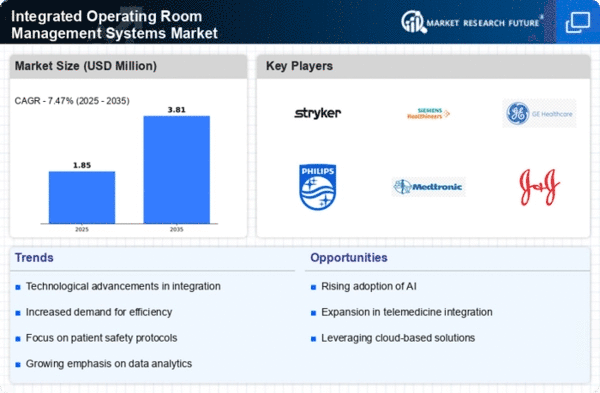
As per MRFR analysis, the Integrated Operating Room Management Systems Market was estimated at 1.72 USD Million in 2024. The Integrated Operating Room Management Systems industry is projected to grow from 1.87 USD Million in 2025 to 3.81 USD Million by 2035, exhibiting a compound annual growth rate (CAGR) of 7.47 during the forecast period 2025 - 2035.

Key Market Trends & Highlights

The Integrated Operating Room Management Systems Market is experiencing robust growth driven by technological advancements and a focus on efficiency.

  • Technological advancements are reshaping the Integrated Operating Room Management Systems Market, particularly in North America, which remains the largest market.
  • The demand for enhanced patient safety is increasingly influencing system designs, especially in specialty clinics, which are the fastest-growing segment.
  • Rising efficiency demands are propelling the growth of surgical workflow management solutions, the largest segment in the market.
  • Technological integration and regulatory compliance are key drivers, as hospitals seek to improve surgical outcomes and cost efficiency.

Market Size & Forecast

2024 Market Size 1.72 (USD Million)
2035 Market Size 3.81 (USD Million)
CAGR (2025 - 2035) 7.47%
Largest Regional Market Share in 2024 North America

Major Players

Stryker (US), Siemens Healthineers (DE), GE Healthcare (US), Philips (NL), Medtronic (IE), Johnson & Johnson (US), Olympus Corporation (JP), Getinge (SE), B. Braun Melsungen AG (DE)

Market Trends

The Integrated Operating Room Management Systems Market is currently experiencing a transformative phase, driven by advancements in technology and the increasing demand for efficiency in surgical environments. These systems integrate various components, including scheduling, inventory management, and real-time data analytics, to streamline operations within operating rooms. As healthcare facilities strive to enhance patient outcomes and optimize resource utilization, the adoption of these integrated solutions appears to be gaining momentum. Furthermore, the emphasis on patient safety and the need for compliance with regulatory standards are likely to propel the market forward, as hospitals seek to implement systems that ensure high-quality care. In addition, the growing trend towards minimally invasive surgeries and the rising complexity of surgical procedures necessitate sophisticated management systems that can adapt to evolving needs. The integration of artificial intelligence and machine learning into these platforms may further enhance decision-making processes, allowing for more precise surgical planning and execution. As the healthcare landscape continues to evolve, the Integrated Operating Room Management Systems Market is poised for substantial growth, reflecting the ongoing commitment to improving surgical efficiency and patient care.

Technological Advancements

The integration of cutting-edge technologies, such as artificial intelligence and machine learning, is reshaping the landscape of the Integrated Operating Room Management Systems Market. These innovations facilitate enhanced data analysis and decision-making, potentially leading to improved surgical outcomes and operational efficiency.

Focus on Patient Safety

There is an increasing emphasis on patient safety within healthcare settings, which is driving the demand for integrated management systems. These solutions help ensure compliance with regulatory standards and enhance the overall quality of care provided to patients during surgical procedures.

Rising Demand for Efficiency

Healthcare facilities are increasingly seeking ways to optimize their operations, leading to a growing interest in integrated management systems. By streamlining scheduling, inventory management, and communication, these systems may significantly improve the efficiency of surgical environments.

Integrated Operating Room Management Systems Market Market Drivers

Rising Demand for Surgical Efficiency

The Global Integrated Operating Room Management System Industry experiences a notable increase in demand for surgical efficiency. Hospitals and surgical centers are increasingly adopting integrated systems to streamline operations, reduce delays, and enhance patient outcomes. This trend is driven by the need to optimize resource utilization and minimize surgical errors. As of 2024, the market is valued at 5.79 USD Billion, reflecting a growing recognition of the importance of efficient surgical workflows. The integration of advanced technologies such as real-time data analytics and automated scheduling further supports this demand, positioning the industry for substantial growth.

Market Segment Insights

By Application: Surgical Workflow Management (Largest) vs. Communication Management (Fastest-Growing)

In the Integrated Operating Room Management Systems Market, Surgical Workflow Management emerges as the largest segment, commanding a significant share of the market. This segment encompasses vital processes such as scheduling, instrumentation management, and team coordination, essential for the efficient operation of surgical suites. Communication Management, while smaller in size, is rapidly gaining traction among healthcare providers as the need for seamless information exchange between medical staff becomes increasingly critical. As hospitals and surgical centers adopt advanced technologies to enhance operational efficiency, the demand for effective Resource Management and Data Management solutions continues to grow. Factors such as the rise of minimally invasive surgeries and an increasing focus on patient-centric care drive the trend for Communication Management. Together, these segments will shape the future landscape of integrated operating room management systems.

Resource Management (Dominant) vs. Data Management (Emerging)

Resource Management plays a dominant role by ensuring optimal allocation and utilization of surgical resources, including staff, equipment, and operating rooms. This segment focuses on maximizing the efficiency and productivity of surgical teams and minimizing delays and cancellations. Conversely, Data Management is an emerging segment that emphasizes the importance of data analytics and information systems in improving decision-making and operational insights within the surgical environment. As healthcare providers recognize the value of data-driven strategies, Data Management is increasingly being integrated into overall operating room management systems. Together, both segments complement each other by balancing operational efficiency with data intelligence, paving the way for innovative solutions that enhance overall surgical performance.

By End Use: Hospitals (Largest) vs. Specialty Clinics (Fastest-Growing)

In the Integrated Operating Room Management Systems Market, hospitals hold the largest share, benefiting from their extensive patient volumes and sophisticated surgical needs. They invest significantly in technology to improve operational efficiency and patient outcomes, leading to widespread adoption of integrated management systems. On the other hand, ambulatory surgical centers are experiencing rapid growth as they become preferred for minimally invasive procedures, driving the demand for integrated solutions in a cost-effective setting.

Hospitals (Dominant) vs. Specialty Clinics (Emerging)

Hospitals represent the dominant segment in the Integrated Operating Room Management Systems Market, characterized by their resource-intensive environments and diverse surgical services. They require robust management systems to coordinate complex workflows, enhance communication, and manage patient data effectively. Conversely, specialty clinics are the emerging segment, thriving on their ability to offer specialized surgical services in focused settings. Their growth is fueled by an increasing preference for outpatient procedures, presenting a unique opportunity for tailored integrated systems designed to streamline operations while maintaining high-quality patient care.

By Component: Software (Largest) vs. Services (Fastest-Growing)

The Integrated Operating Room Management Systems Market is comprised of three primary components: software, hardware, and services. Among these, software holds the largest market share, driven by the increasing need for efficient management solutions in surgical settings. The software segment is crucial as it helps streamline operations, improve patient outcomes, and reduce costs. In contrast, the services segment is witnessing rapid growth, attributed to the rising demand for after-sales support, regular maintenance, and training associated with advanced operating room technologies. The growth trends in this sector are largely influenced by technological advancements, such as the integration of AI and machine learning, which enhance the functionality of operating room management systems. Additionally, the push for digital transformation in healthcare, aiming to improve operational efficiency and patient care, fuels the demand for software solutions. Services are emerging rapidly as healthcare providers seek comprehensive support for the implementation and ongoing management of these sophisticated systems. The emphasis on patient safety and outcomes reinforces the growth of both segments, establishing a dynamic and competitive landscape in the integrated operating room management systems market.

Software: Dominant vs. Services: Emerging

In the Integrated Operating Room Management Systems Market, software is a dominant component known for its critical role in enhancing operational efficiency within surgical environments. It encompasses various applications including scheduling, workflow management, and data analysis, which enable healthcare facilities to optimize their performance. The software not only minimizes human error and administrative burden but also integrates with existing systems to provide seamless functionality. On the other hand, the services component is emerging rapidly, driven by the increasing complexity of operating room technologies and the need for continuous support. Services range from consultation and installation to training personnel and maintenance, ensuring that healthcare organizations can fully leverage their investments in advanced management systems. This shift highlights the necessity for healthcare providers to balance both software and services for optimal operational performance.

By Deployment Type: Cloud-Based (Largest) vs. On-Premise (Fastest-Growing)

The Integrated Operating Room Management Systems Market is witnessing a significant divide in adoption between On-Premise and Cloud-Based deployment types. Cloud-Based systems currently dominate the landscape, favored for their scalability, ease of access, and reduced initial investment costs. Its share continues to expand as healthcare facilities increasingly migrate towards digital solutions that ensure better connectivity and data management. In contrast, On-Premise systems, while comprising a smaller segment, are rapidly growing as healthcare institutions prioritize security and control over sensitive patient data, hence driving interest in their deployment.

Deployment Type: Cloud-Based (Dominant) vs. On-Premise (Emerging)

Cloud-Based Integrated Operating Room Management Systems are characterized by their flexibility and accessibility, enabling healthcare providers to manage operations remotely and in real time. This deployment type offers advantages such as lower operational costs, automatic updates, and easier integration with other digital tools. Alternatively, On-Premise systems are recognized for their enhanced data security and customization capabilities, making them appealing to institutions with strict compliance and regulatory demands. Both deployment types are shaping the future of integrated operating room management, each catering to different priorities within healthcare organizations, thereby creating a balanced market landscape.

Get more detailed insights about Integrated Operating Room Management Systems Market Research Report - Forecast to 2035

Regional Insights

Asia-Pacific : Rapid Growth in Healthcare Sector

The Asia-Pacific region is witnessing rapid growth in the Integrated Operating Room Management Systems market, valued at $0.3 billion. Factors such as increasing healthcare expenditure, a growing aging population, and rising surgical procedures are driving demand. Governments are also investing in healthcare infrastructure, which supports the adoption of advanced technologies. Regulatory frameworks are evolving to facilitate the integration of digital solutions in operating rooms, enhancing overall efficiency and patient outcomes. Countries like Japan, China, and India are leading the charge in this market. Japan's advanced healthcare system and China's expanding healthcare infrastructure create a competitive landscape ripe for innovation. Key players such as Olympus Corporation and Medtronic are focusing on expanding their presence in this region, ensuring that Asia-Pacific becomes a significant contributor to The Integrated Operating Room Management Systems.

Middle East and Africa : Emerging Market with Challenges

The Middle East and Africa region, with a market size of $0.06 billion, is gradually emerging in the Integrated Operating Room Management Systems sector. The growth is primarily driven by increasing investments in healthcare infrastructure and a rising demand for advanced surgical solutions. However, regulatory challenges and varying healthcare standards across countries pose significant hurdles. Governments are beginning to recognize the importance of integrated systems in improving surgical outcomes, which is expected to drive future growth. Countries like the UAE and South Africa are leading the market, with a focus on enhancing healthcare delivery systems. The presence of key players is still developing, but companies are increasingly looking to invest in this region. The competitive landscape is characterized by a mix of local and international players, aiming to address the unique challenges of the market. "The healthcare sector in the Middle East is evolving, with a focus on integrating advanced technologies to improve patient care," World Health Organization report.

Key Players and Competitive Insights

The Integrated Operating Room Management Systems Market is characterized by a dynamic competitive landscape, driven by technological advancements and the increasing demand for efficiency in surgical environments. Key players such as Stryker (US), Siemens Healthineers (DE), and GE Healthcare (US) are at the forefront, each adopting distinct strategies to enhance their market positioning. Stryker (US) focuses on innovation through the development of advanced surgical instruments and integration of AI technologies, while Siemens Healthineers (DE) emphasizes digital transformation and data analytics to improve surgical outcomes. GE Healthcare (US) is leveraging partnerships with healthcare providers to expand its reach and enhance service delivery, collectively shaping a competitive environment that prioritizes technological integration and operational efficiency.In terms of business tactics, companies are increasingly localizing manufacturing to reduce costs and optimize supply chains. The market appears moderately fragmented, with several players vying for market share, yet the influence of major companies remains substantial. This competitive structure allows for a diverse range of offerings, catering to various surgical needs and preferences across different regions.

In November Stryker (US) announced the launch of its latest integrated operating room solution, which incorporates advanced imaging and robotic assistance, aimed at enhancing surgical precision. This strategic move is likely to solidify Stryker's position as a leader in the market, as it addresses the growing demand for minimally invasive procedures and improved patient outcomes. The integration of such technologies may also set a new standard for operational efficiency in surgical settings.

In October Siemens Healthineers (DE) unveiled a partnership with a leading hospital network to implement its digital operating room solutions. This collaboration is expected to enhance real-time data sharing and analytics, thereby improving surgical workflows. The strategic importance of this partnership lies in its potential to create a more interconnected healthcare ecosystem, which could lead to better patient management and resource allocation.

In September GE Healthcare (US) expanded its portfolio by acquiring a startup specializing in AI-driven surgical planning tools. This acquisition is indicative of GE's commitment to integrating cutting-edge technology into its offerings, which may enhance its competitive edge. By incorporating AI into surgical planning, GE Healthcare (US) aims to streamline preoperative processes, ultimately improving surgical outcomes and patient safety.

As of December current trends in the Integrated Operating Room Management Systems Market include a strong emphasis on digitalization, sustainability, and AI integration. Strategic alliances are increasingly shaping the competitive landscape, as companies recognize the value of collaboration in driving innovation. The shift from price-based competition to a focus on technological advancement and supply chain reliability is evident, suggesting that future competitive differentiation will hinge on the ability to innovate and adapt to evolving market demands.

Key Companies in the Integrated Operating Room Management Systems Market include

Industry Developments

However, the operating room management system assists to reduce surgical times develops coordination between healthcare providers and develops patient security. On the basis of uses, the market is classified into general surgery, orthopedic surgery, neurosurgery, thoracic surgery, cardiovascular surgery, and other uses. In 2019 the general surgery section consider the largest share of the integrated operating room management system market. Elements such as the rising cases of breast cancer, liver cancer, colorectal cancer, GI disorder, and endocrine disorder as well as the increasing number of general surgical procedures carried out worldwide are boosting the growth of the general surgery section.

Based on end-users, the OR market is divided into ambulatory, hospitals, surgery centers, and clinics. In 2019, the hospital section was considered for the widest share of the market. The large share of this section can be ascribed to the increasing emphasis on timely disease management.

Intended Audience:

    • Medical devices companies
    • Healthcare service providers
    • Research Organizations
    • Market research and consulting firms
    • Venture capitalists and investors

Future Outlook

Integrated Operating Room Management Systems Market Future Outlook

The Integrated Operating Room Management Systems Market is projected to grow at a 7.47% CAGR from 2024 to 2035, driven by technological advancements, increasing surgical procedures, and demand for operational efficiency.

New opportunities lie in:

  • Development of AI-driven surgical workflow optimization tools.
  • Integration of telemedicine capabilities for remote surgical consultations.
  • Expansion of customizable modular OR management solutions for diverse healthcare settings.

By 2035, the market is expected to achieve substantial growth, reflecting evolving healthcare demands and technological integration.

Market Segmentation

Integrated Operating Room Management Systems Market End Use Outlook

  • Hospitals
  • Ambulatory Surgical Centers
  • Specialty Clinics

Integrated Operating Room Management Systems Market Component Outlook

  • Software
  • Hardware
  • Services

Integrated Operating Room Management Systems Market Application Outlook

  • Surgical Workflow Management
  • Resource Management
  • Data Management
  • Communication Management

Integrated Operating Room Management Systems Market Deployment Type Outlook

  • On-Premise
  • Cloud-Based

Report Scope

MARKET SIZE 20241.72(USD Million)
MARKET SIZE 20251.87(USD Million)
MARKET SIZE 20353.81(USD Million)
COMPOUND ANNUAL GROWTH RATE (CAGR)7.47% (2025 - 2035)
REPORT COVERAGERevenue Forecast, Competitive Landscape, Growth Factors, and Trends
BASE YEAR2024
Market Forecast Period2025 - 2035
Historical Data2019 - 2024
Market Forecast UnitsUSD Million
Key Companies ProfiledStryker (US), Siemens Healthineers (DE), GE Healthcare (US), Philips (NL), Medtronic (IE), Johnson & Johnson (US), Olympus Corporation (JP), Getinge (SE), B. Braun Melsungen AG (DE)
Segments CoveredApplication, End Use, Component, Deployment Type
Key Market OpportunitiesIntegration of artificial intelligence and data analytics enhances efficiency in the Integrated Operating Room Management Systems Market.
Key Market DynamicsRising demand for efficiency drives technological advancements in Integrated Operating Room Management Systems, enhancing surgical workflows.
Countries CoveredNorth America, Europe, APAC, South America, MEA

FAQs

At what CAGR is the integrated operating room management systems market projected to grow during the forecast period?

Integrated operating room management systems market projected to grow at a 10.9% CAGR between 2023-2032.

What will be the value of the integrated operating room management systems market during the forecast period?

Integrated operating room management systems market is predicted to touch USD 5.21 billion by 2032.

Which region is expected to lead the integrated operating room management systems market?

The Americas is expected to lead the integrated operating room management systems market.

Which surgical application will lead the integrated operating room management systems market?

The therapeutics segment will lead the integrated operating room management systems market.

What are the factors that may limit the integrated operating room management systems market growth?

High cost and risk factors may limit the integrated operating room management systems market growth.

  1. SECTION I: EXECUTIVE SUMMARY AND KEY HIGHLIGHTS
    1. | 1.1 EXECUTIVE SUMMARY
  2. SECTION II: SCOPING, METHODOLOGY AND MARKET STRUCTURE
    1. | 2.1 MARKET INTRODUCTION
    2. | 2.2 RESEARCH METHODOLOGY
  3. SECTION III: QUALITATIVE ANALYSIS
    1. | 3.1 MARKET DYNAMICS
    2. | 3.2 MARKET FACTOR ANALYSIS
  4. SECTION IV: QUANTITATIVE ANALYSIS
    1. | 4.1 Healthcare, BY Application (USD Million)
    2. | 4.2 Healthcare, BY End Use (USD Million)
    3. | 4.3 Healthcare, BY Component (USD Million)
    4. | 4.4 Healthcare, BY Deployment Type (USD Million)
    5. | 4.5 Healthcare, BY Region (USD Million)
  5. SECTION V: COMPETITIVE ANALYSIS
    1. | 5.1 Competitive Landscape
    2. | 5.2 Company Profiles
    3. | 5.3 Appendix

Integrated Operating Room Management Systems Market Segmentation

Market Segmentation Overview

  • Detailed segmentation data will be available in the full report
  • Comprehensive analysis by multiple parameters
  • Regional and country-level breakdowns
  • Market size forecasts by segment
Infographic

Free Sample Request

Kindly complete the form below to receive a free sample of this Report

Get Free Sample

Customer Strories

Compare Licence

×
Features License Type
Single User Multiuser License Enterprise User
Price $4,950 $5,950 $7,250
Maximum User Access Limit 1 User Upto 10 Users Unrestricted Access Throughout the Organization
Free Customization
Direct Access to Analyst
Deliverable Format
Platform Access
Discount on Next Purchase 10% 15% 15%
Printable Versions