×
Hero Background
English
Chinese
French
Japanese
Korean
German
Spanish

Inorganic Cosmetics Pigments Market Size

ID: MRFR/CnM/9050-CR
449 Pages
Anshula Mandaokar
April 2021

Inorganic Cosmetics Pigments Market Research Report Information by Type (Titanium Dioxide, Iron Oxide, Chromium Oxide, Mica, Zinc Oxide, Ultramarines, and Others), Application (Facial make-up, Lip products, Eye make-up, Nail products, Hair color products, and Others), and Region - Forecast till 2035

Share:
Download PDF ×

We do not share your information with anyone. However, we may send you emails based on your report interest from time to time. You may contact us at any time to opt-out.

Inorganic Cosmetics Pigments Market Infographic
Purchase Options

Inorganic Cosmetics Pigments Size

Inorganic Cosmetics Pigments Market Growth Projections and Opportunities

The Inorganic Cosmetics Pigments Market is expected to register a CAGR of 6.8% to reach around USD 7,200 million by the end of 2027.

Cosmetics Industry Demand: The primary driver of the inorganic cosmetics pigments market is the demand from the cosmetics industry, where pigments are used in various cosmetic products such as makeup, skincare, haircare, and personal care products. Inorganic pigments provide vibrant and long-lasting colors, enhancing the visual appeal and performance of cosmetic formulations. The cosmetics industry's continuous product innovation and evolving consumer trends drive market demand for a wide range of inorganic pigments used in cosmetic applications.

Color Stability and Performance: Inorganic pigments offer superior color stability, lightfastness, and chemical resistance compared to organic pigments, making them ideal for use in cosmetic formulations. Inorganic pigments provide consistent color performance and withstand exposure to light, heat, and chemicals, ensuring the durability and longevity of cosmetic products. The demand for inorganic cosmetics pigments is driven by their superior color performance and reliability in cosmetic applications.

Regulatory Compliance and Safety Standards: Regulatory compliance and safety standards governing the use of pigments in cosmetics influence market dynamics. Cosmetic manufacturers need to comply with regulatory requirements and safety standards regarding the use of inorganic pigments in cosmetic formulations to ensure product safety, consumer health, and regulatory compliance. Inorganic cosmetics pigments suppliers and manufacturers need to adhere to regulatory standards and safety regulations to meet market demand and ensure product compliance.

Technological Advancements in Pigment Production: Technological advancements in pigment production processes drive innovation in the inorganic cosmetics pigments market. Manufacturers invest in research and development to enhance pigment synthesis, purification, and dispersion techniques, improving product quality, color consistency, and performance in cosmetic formulations. Advanced pigment production technologies enable the development of a wide range of inorganic pigments with diverse colors, particle sizes, and surface treatments, catering to the evolving needs of cosmetic manufacturers and consumers.

Consumer Preferences for Natural and Mineral-Based Products: Consumer preferences for natural and mineral-based cosmetic products drive market demand for inorganic cosmetics pigments derived from mineral sources such as titanium dioxide, iron oxides, and zinc oxide. Natural and mineral-based pigments are perceived as safer alternatives to synthetic pigments and align with consumer preferences for clean, natural, and environmentally friendly cosmetic products. The demand for inorganic cosmetics pigments derived from natural and mineral sources is driven by consumer awareness of ingredient transparency, sustainability, and health-consciousness.

Market Competition and Product Differentiation: The inorganic cosmetics pigments market is characterized by intense competition among key players, driving product differentiation, innovation, and market consolidation efforts. Established pigment manufacturers leverage mergers, acquisitions, and strategic partnerships to strengthen their market presence, expand product portfolios, and enhance competitive positioning. Market players need to differentiate their products based on color range, performance characteristics, and formulation compatibility to gain a competitive edge in the inorganic cosmetics pigments market.

Global Economic Trends and Market Volatility: Global economic trends, market volatility, currency fluctuations, and geopolitical factors impact market dynamics and investment decisions in the inorganic cosmetics pigments industry. Market players need to monitor and adapt to changing economic conditions and market uncertainties to mitigate risks and capitalize on emerging opportunities.

Brand Marketing and Consumer Trends: Brand marketing strategies and consumer trends influence market demand for inorganic cosmetics pigments. Cosmetic manufacturers develop products with trendy colors, innovative formulations, and unique packaging to attract consumers and differentiate their brands in the competitive cosmetics market. The demand for inorganic cosmetics pigments is driven by consumer preferences for trendy colors, versatile formulations, and high-performance cosmetic products that meet their individual needs and lifestyle preferences.
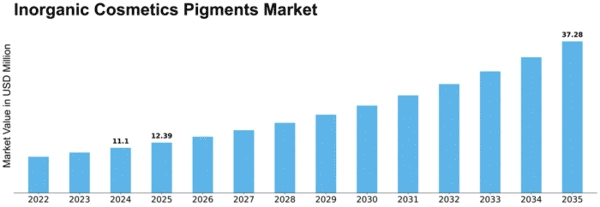
Inorganic Cosmetics Pigments Market Size Graph
Author
Anshula Mandaokar
Team Lead - Research

Anshula Mandaokar holds an academic degree in Chemical Engineering and has been contributing to the field for more than 5 years. She has expertise in Market Research and Business Consulting and serves as a Team Lead for a reputed Market Research firm under the Chemicals and Materials domain spectrum. She has worked on multiple projects, generating explicit results in a quick turnaround time. Her understanding of data interpretation justifies her role as a leader.

Leave a Comment

FAQs

At what CAGR is the Inorganic Cosmetics Pigments Market predicted to grow during the forecast period?

Inorganic Cosmetics Pigments Market is predicted to grow at 6.8% through forecast period of 2025-2035.

What is the forecast period of Inorganic Cosmetics Pigments Market research report?

The forecast period for Inorganic Cosmetics Pigments Market research report is 2025-2035

Which region will lead the global Inorganic Cosmetics Pigments Market?

Global Inorganic Cosmetics Pigments Market is dominated by APAC region.

Market Summary

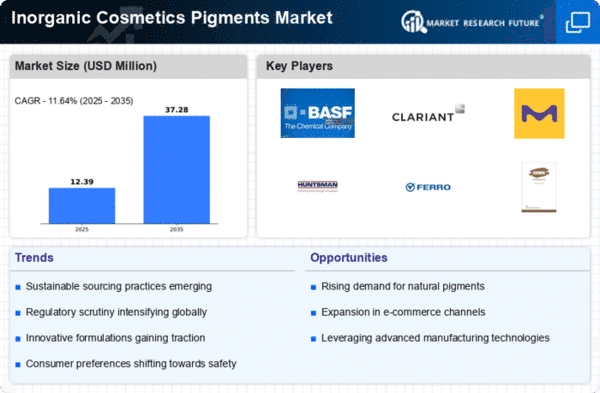
As per MRFR analysis, the Inorganic Cosmetics Pigments Market Size was estimated at 11.1 USD Million in 2024. The Inorganic Cosmetics Pigments industry is projected to grow from 12.39 USD Million in 2025 to 37.28 USD Million by 2035, exhibiting a compound annual growth rate (CAGR) of 11.64 during the forecast period 2025 - 2035.

Key Market Trends & Highlights

The Inorganic Cosmetics Pigments Market is experiencing a dynamic shift towards sustainability and innovation.

  • The market is increasingly driven by a focus on sustainability and regulatory compliance, particularly in North America.
  • Technological advancements in pigment formulations are enhancing product performance in the makeup segment, which remains the largest.
  • Asia-Pacific is emerging as the fastest-growing region, with a notable rise in demand for skincare products.
  • Rising demand for natural and organic products, along with regulatory support for safe ingredients, are key drivers propelling market growth.

Market Size & Forecast

2024 Market Size 11.1 (USD Million)
2035 Market Size 37.28 (USD Million)
CAGR (2025 - 2035) 11.64%
Largest Regional Market Share in 2024 North America

Major Players

<p>BASF SE (DE), Clariant AG (CH), Huntsman Corporation (US), Kremer Pigments GmbH & Co. KG (DE), Merck KGaA (DE), Toyal America Inc. (US), DIC Corporation (JP), Ferro Corporation (US), Sun Chemical Corporation (US), Heubach GmbH (DE)</p>

Market Trends

The Inorganic Cosmetics Pigments Market is currently experiencing a notable evolution, driven by a growing consumer preference for natural and sustainable products. This shift appears to be influencing manufacturers to explore innovative formulations that incorporate inorganic pigments, which are often perceived as safer and more environmentally friendly compared to their organic counterparts. The demand for vibrant colors and long-lasting effects in cosmetics is prompting brands to invest in research and development, thereby enhancing the overall quality and performance of their offerings. Furthermore, the increasing awareness regarding the potential harmful effects of certain synthetic pigments is likely steering consumers towards inorganic options, which are generally regarded as non-toxic and hypoallergenic. In addition, regulatory frameworks are becoming more stringent, compelling companies to adhere to safety standards that favor the use of inorganic pigments. This trend suggests that the Inorganic Cosmetics Pigments Market may continue to expand as brands align their product lines with consumer expectations and regulatory requirements. The rise of e-commerce platforms is also facilitating greater accessibility to a diverse range of cosmetic products, allowing consumers to make informed choices based on ingredient transparency. As the market evolves, it seems poised for further growth, driven by innovation, sustainability, and consumer education.

Sustainability Focus

The emphasis on sustainability is reshaping the Inorganic Cosmetics Pigments Market, as consumers increasingly seek products that align with their environmental values. Brands are responding by sourcing pigments that are not only effective but also eco-friendly, thereby enhancing their market appeal.

Regulatory Compliance

Stricter regulations regarding cosmetic ingredients are influencing the Inorganic Cosmetics Pigments Market. Companies are adapting to these changes by ensuring their products meet safety standards, which may lead to a preference for inorganic pigments known for their safety and stability.

Technological Advancements

Innovations in pigment formulation and application techniques are driving growth within the Inorganic Cosmetics Pigments Market. Enhanced manufacturing processes are enabling the development of pigments that offer improved color performance and durability, catering to evolving consumer demands.

Inorganic Cosmetics Pigments Market Market Drivers

Expansion of E-commerce Platforms

The rise of e-commerce platforms is reshaping the Global Inorganic Cosmetics Pigments Market Industry by providing consumers with greater access to a variety of cosmetic products. Online retailing allows brands to reach a global audience, facilitating the introduction of innovative products that feature inorganic pigments. This trend is particularly relevant as consumers increasingly prefer the convenience of online shopping. The expansion of e-commerce is expected to contribute to the market's growth trajectory, as it enables brands to showcase their offerings effectively and cater to diverse consumer needs.

Rising Demand for Natural Products

The Global Inorganic Cosmetics Pigments Market Industry experiences a notable increase in demand for natural and organic cosmetics. Consumers are increasingly seeking products that are free from synthetic chemicals, which drives manufacturers to incorporate inorganic pigments that are perceived as safer and more environmentally friendly. This trend is reflected in the market's projected growth, with an estimated value of 3500 USD Million in 2024. As awareness of ingredient safety rises, the industry is likely to adapt by enhancing product formulations, thereby expanding the market for inorganic pigments.

Regulatory Support for Safe Cosmetics

The Global Inorganic Cosmetics Pigments Market Industry benefits from increasing regulatory support aimed at ensuring the safety of cosmetic products. Governments worldwide are implementing stricter regulations regarding the use of pigments in cosmetics, which, while challenging, also encourages manufacturers to invest in high-quality inorganic pigments that comply with safety standards. This regulatory landscape not only fosters consumer trust but also drives market growth. The industry's adaptation to these regulations is likely to contribute to a compound annual growth rate of 4.19% from 2025 to 2035, reflecting a robust commitment to safety and quality.

Growing Awareness of Sustainable Practices

Sustainability is becoming a pivotal factor in the Global Inorganic Cosmetics Pigments Market Industry. As consumers become more environmentally conscious, there is a growing preference for products that utilize sustainable sourcing and production methods. Inorganic pigments, often derived from natural minerals, align with this trend, as they can be produced with lower environmental impact compared to synthetic alternatives. This shift towards sustainability is expected to drive market growth, as brands that prioritize eco-friendly practices are likely to attract a larger consumer base, further enhancing the industry's value.

Technological Advancements in Pigment Production

Innovations in the production processes of inorganic pigments are significantly influencing the Global Inorganic Cosmetics Pigments Market Industry. Advanced manufacturing techniques, such as nanotechnology and improved synthesis methods, enhance the quality and performance of pigments. These advancements not only improve color vibrancy and stability but also reduce production costs. As a result, the market is expected to grow, reaching approximately 5500 USD Million by 2035. The integration of technology in pigment production may also lead to the development of new shades and formulations, catering to diverse consumer preferences.

Market Segment Insights

By Application: Makeup (Largest) vs. Skincare (Fastest-Growing)

<p>In the Inorganic Cosmetics Pigments Market, the application segment reveals a diverse distribution of market share across various categories, with makeup being the most significant contributor. Makeup applications, including foundations, eyeshadows, and lip products, command the largest share due to their widespread consumer adoption and preference for vibrant, long-lasting colors. Following makeup, skincare is rapidly gaining traction as consumers increasingly seek products that emphasize natural pigmentation and enhanced skin benefits, reflecting the evolving trends in beauty formulations.</p>

<p>Makeup: Dominant vs. Skincare: Emerging</p>

<p>The makeup segment, with its extensive range of products, remains dominant in the Inorganic Cosmetics Pigments Market, driven by consumer demands for high-quality coloring and finish. Makeup products utilize inorganic pigments for their stability and efficacy, catering to diverse consumer preferences for bold shades and natural looks. In contrast, the skincare segment is emerging, capitalizing on trends that prioritize skin health and aesthetic appeal, utilizing pigments that offer additional benefits such as UV protection and anti-aging properties. This shift towards skincare indicates a growing awareness of ingredient safety and the desire for multifunctional products, ultimately expanding the market dynamics.</p>

By End Use: Cosmetics (Largest) vs. Personal Care (Fastest-Growing)

<p>In the Inorganic Cosmetics Pigments Market, the distribution of market share among various end-use segments highlights the dominance of the cosmetics sector, which significantly leads in consumption. Personal care follows closely, presenting a notable share, indicating consumer preference for vibrant and long-lasting pigments in daily use products. Pharmaceuticals, food and beverage, and industrial applications are relatively smaller segments, yet contribute to the overall diversity of the market, underscoring the versatility of inorganic pigments across various sectors.</p>

<p>Cosmetics: Leading (Dominant) vs. Personal Care (Emerging)</p>

<p>Cosmetics represents the dominant segment within the Inorganic Cosmetics Pigments Market, characterized by its extensive application in products such as makeup and skincare, which demand high-quality pigments for color and stability. This segment is fueled by continuous innovation and a consistent consumer base that seeks diverse pigmentation options. Conversely, Personal Care is emerging rapidly, driven by an increasing demand for natural and safe ingredients in products like lotions and shampoos. As consumers become more conscious of product ingredients, the personal care segment is adapting quickly, leading to an expanded use of inorganic pigments that meet safety standards while enhancing aesthetic appeal.</p>

By Formulation Type: Powder (Largest) vs. Liquid (Fastest-Growing)

<p>In the Inorganic Cosmetics Pigments Market, the formulation type segment showcases significant diversity, with Powder dominating due to its versatility and widespread application in various cosmetic products. This segment is a favorite among consumers and manufacturers alike, attributed to its long-lasting properties and ease of use in formulation. Following Powder, Liquid formulation types are gaining traction due to their convenience and the growing demand for fluid cosmetics, making them a key player in market dynamics. The growth trends within the formulation type segment are heavily influenced by changing consumer preferences and advancements in cosmetic formulations. The rising inclination towards natural and organic products has led to innovations in Liquid formulations, which are perceived as more skin-friendly. Moreover, the Gel and Cream types are witnessing an increase as consumers seek multi-functional attributes in their cosmetics, indicating a vibrant and competitive landscape in the formulation segment.</p>

<p>Powder (Dominant) vs. Gel (Emerging)</p>

<p>The Powder formulation type stands as the dominant player in the Inorganic Cosmetics Pigments Market, known for its superb application versatility, ranging from foundations to eyeshadows. Its strong market position is bolstered by consumer preference for products that offer longevity and a matte finish. On the other hand, the Gel formulation is emerging rapidly, appealing particularly to younger demographics who favor lightweight, breathable options. Gel products are increasingly favored for their hydrating properties and ease of application, marking a notable shift toward formulations that enhance user experience. With this shift, the demand for innovative Gel products is expected to surge, showcasing their potential to reshape consumer preferences in the near future.</p>

By Color Type: Red (Largest) vs. Yellow (Fastest-Growing)

<p>In the Inorganic Cosmetics Pigments Market, the color type segment showcases a diverse distribution among its primary categories: Red, Yellow, Blue, Green, and Black. Currently, Red pigments hold the largest market share due to their widespread applications in various cosmetic products, especially in lipsticks and blushes. Yellow pigments, on the other hand, are gaining momentum with a notable share as they are increasingly used in formulations for skin products, highlighting a shift in consumer preferences toward vibrant and diverse color options.</p>

<p>Red (Dominant) vs. Yellow (Emerging)</p>

<p>Red pigments dominate the Inorganic Cosmetics Pigments Market, characterized by their strong visual impact and versatility in various cosmetic applications. Typically derived from iron oxide, these pigments offer excellent opacity and stability, making them ideal for products ranging from makeup to skincare. Conversely, Yellow pigments, often derived from earth minerals, are emerging as key players in the market due to their ability to brighten formulations and cater to changing beauty trends. The growing demand for bold colors in cosmetics has propelled Yellow pigments into the spotlight, making them a crucial focus for manufacturers aiming to differentiate their product offerings.</p>

By Regulatory Compliance: FDA Approved (Largest) vs. EU Cosmetics Regulation (Fastest-Growing)

<p>The Regulatory Compliance segment in the Inorganic Cosmetics Pigments Market is marked by significant diversity in its components, primarily driven by consumer health concerns and environmental awareness. The FDA Approved pigments dominate this segment, representing a substantial portion of the market, reflecting consumer trust and safety perceptions. In contrast, the EU Cosmetics Regulation, while smaller, is gaining traction, fueled by stringent safety requirements and a shift toward transparency in cosmetics products.</p>

<p>FDA Approved (Dominant) vs. EU Cosmetics Regulation (Emerging)</p>

<p>FDA Approved pigments hold a dominant position in the Inorganic Cosmetics Pigments Market due to their established standards and consumer trust. These pigments meet rigorous safety assessments, ensuring they are non-toxic and suitable for application in cosmetic products. Conversely, EU Cosmetics Regulation represents an emerging trend as manufacturers adapt to an increasingly stringent regulatory landscape in Europe. This regulation emphasizes ingredient safety, labeling transparency, and environmental impact, driving innovation and compliance among cosmetic brands aiming to capture the European market.</p>

Get more detailed insights about Inorganic Cosmetics Pigments Market Research Report - Forecast till 2035

Regional Insights

North America : Market Leader in Pigments

North America continues to lead the Inorganic Cosmetics Pigments Market, holding a significant market share of 5.55 in 2024. The region's growth is driven by increasing consumer demand for natural and safe cosmetic products, alongside stringent regulations promoting the use of non-toxic ingredients. The rise in awareness regarding the harmful effects of synthetic pigments further fuels this trend, making inorganic pigments a preferred choice for manufacturers. The competitive landscape in North America is robust, with key players such as BASF SE, Huntsman Corporation, and Clariant AG dominating the market. The U.S. stands out as the largest market, supported by a strong manufacturing base and innovative product development. Companies are increasingly investing in R&D to enhance product offerings, ensuring compliance with regulatory standards while meeting consumer preferences for sustainability and safety.

Europe : Regulatory-Driven Market Growth

Europe's Inorganic Cosmetics Pigments Market is characterized by a market size of 3.33, driven by stringent regulations and a strong emphasis on sustainability. The European Union's REACH regulations promote the use of safe and environmentally friendly pigments, encouraging manufacturers to innovate and adapt. This regulatory framework not only enhances consumer safety but also boosts demand for inorganic pigments, which are perceived as safer alternatives to synthetic options. Leading countries in this region include Germany, France, and the UK, where major players like Merck KGaA and Kremer Pigments GmbH & Co. KG are actively engaged in the market. The competitive landscape is marked by a focus on product quality and compliance with environmental standards. Companies are investing in sustainable practices, aligning with consumer preferences for eco-friendly products, thus driving market growth in Europe.

Asia-Pacific : Emerging Market Potential

The Asia-Pacific region, with a market size of 2.22, is witnessing significant growth in the Inorganic Cosmetics Pigments Market. This growth is fueled by rising disposable incomes, increasing urbanization, and a growing awareness of cosmetic safety among consumers. Countries like China and India are leading this trend, with a surge in demand for high-quality cosmetic products that utilize inorganic pigments, which are perceived as safer and more sustainable alternatives. The competitive landscape in Asia-Pacific is evolving, with both local and international players vying for market share. Key companies such as DIC Corporation and Toyal America Inc. are expanding their presence in the region. The market is characterized by a mix of established brands and emerging players, all focusing on innovation and compliance with local regulations to capture the growing consumer base seeking safe and effective cosmetic solutions.

Middle East and Africa : Untapped Market Opportunities

The Middle East and Africa region currently shows a market size of 0.0 in the Inorganic Cosmetics Pigments Market, indicating significant untapped potential. The growth in this region is expected to be driven by increasing consumer awareness regarding cosmetic safety and the rising demand for natural products. As the beauty and personal care industry expands, there is a growing interest in inorganic pigments, which are seen as safer alternatives to synthetic options. Countries like South Africa and the UAE are emerging as key players in the cosmetics market, with local manufacturers beginning to explore the use of inorganic pigments. The competitive landscape is still developing, with opportunities for both local and international companies to establish a foothold. As regulations evolve and consumer preferences shift towards safer products, the market is poised for growth in the coming years.

Key Players and Competitive Insights

The Inorganic Cosmetics Pigments Market is characterized by a dynamic competitive landscape, driven by increasing consumer demand for vibrant and long-lasting cosmetic products. Key players are actively engaging in strategies that emphasize innovation, sustainability, and regional expansion. For instance, BASF SE (Germany) has been focusing on enhancing its product portfolio through the development of eco-friendly pigments, which aligns with the growing trend towards sustainable beauty products. Similarly, Clariant AG (Switzerland) has positioned itself as a leader in specialty chemicals, leveraging its expertise to create innovative pigment solutions that cater to diverse cosmetic applications. These strategic initiatives collectively shape a competitive environment that is increasingly focused on meeting consumer expectations for quality and sustainability.

In terms of business tactics, companies are localizing manufacturing to reduce lead times and optimize supply chains. This approach is particularly relevant in a moderately fragmented market where agility can provide a competitive edge. The collective influence of key players, such as Huntsman Corporation (US) and Merck KGaA (Germany), further contributes to the market's structure, as they continuously adapt to changing consumer preferences and regulatory landscapes.

In November 2025, Huntsman Corporation (US) announced the launch of a new line of inorganic pigments designed specifically for the cosmetics industry, emphasizing their commitment to innovation and sustainability. This strategic move is significant as it not only expands their product offerings but also positions them to capture a larger market share in the growing demand for eco-friendly cosmetic solutions. The introduction of these pigments is likely to enhance their competitive positioning in a market that increasingly values sustainability.

In October 2025, Merck KGaA (Germany) unveiled a partnership with a leading cosmetic brand to develop a new range of color cosmetics utilizing their advanced inorganic pigments. This collaboration highlights the importance of strategic alliances in driving innovation and meeting consumer demands for high-performance products. By leveraging their technological expertise, Merck KGaA is poised to strengthen its market presence and enhance its reputation as a key player in the cosmetics sector.

In December 2025, Clariant AG (Switzerland) reported a significant investment in expanding its production capabilities for inorganic pigments in Asia. This strategic expansion is indicative of the company's focus on regional growth and its commitment to meeting the rising demand for high-quality pigments in emerging markets. Such investments are likely to bolster Clariant's competitive advantage and enable it to respond more effectively to local market needs.

As of December 2025, current competitive trends in the Inorganic Cosmetics Pigments Market are increasingly defined by digitalization, sustainability, and the integration of advanced technologies such as AI. Strategic alliances are playing a crucial role in shaping the landscape, as companies collaborate to enhance product offerings and streamline operations. Looking ahead, competitive differentiation is expected to evolve, with a notable shift from price-based competition towards innovation, technology, and supply chain reliability. This transition underscores the importance of adaptability and forward-thinking strategies in maintaining a competitive edge in a rapidly changing market.

Key Companies in the Inorganic Cosmetics Pigments Market market include

Industry Developments

Future Outlook

Inorganic Cosmetics Pigments Market Future Outlook

<p>The Inorganic Cosmetics Pigments Market is projected to grow at 11.64% CAGR from 2024 to 2035, driven by increasing demand for natural and sustainable cosmetic products.</p>

New opportunities lie in:

  • <p>Expansion into emerging markets with tailored product lines</p>
  • <p>Development of eco-friendly packaging solutions for pigments</p>
  • <p>Investment in R&D for innovative pigment formulations</p>

<p>By 2035, the market is expected to achieve robust growth, solidifying its position in the cosmetics industry.</p>

Market Segmentation

Inorganic Cosmetics Pigments Market End Use Outlook

  • Personal Care
  • Cosmetics
  • Pharmaceuticals
  • Food and Beverage
  • Industrial

Inorganic Cosmetics Pigments Market Color Type Outlook

  • Red
  • Yellow
  • Blue
  • Green
  • Black

Inorganic Cosmetics Pigments Market Application Outlook

  • Makeup
  • Skincare
  • Haircare
  • Nail Care
  • Fragrance

Inorganic Cosmetics Pigments Market Formulation Type Outlook

  • Powder
  • Liquid
  • Gel
  • Cream
  • Emulsion

Inorganic Cosmetics Pigments Market Regulatory Compliance Outlook

  • FDA Approved
  • EU Cosmetics Regulation
  • ISO Standards
  • REACH Compliance
  • Non-Toxic

Report Scope

MARKET SIZE 202411.1(USD Million)
MARKET SIZE 202512.39(USD Million)
MARKET SIZE 203537.28(USD Million)
COMPOUND ANNUAL GROWTH RATE (CAGR)11.64% (2024 - 2035)
REPORT COVERAGERevenue Forecast, Competitive Landscape, Growth Factors, and Trends
BASE YEAR2024
Market Forecast Period2025 - 2035
Historical Data2019 - 2024
Market Forecast UnitsUSD Million
Key Companies ProfiledBASF SE (DE), Clariant AG (CH), Huntsman Corporation (US), Kremer Pigments GmbH & Co. KG (DE), Merck KGaA (DE), Toyal America Inc. (US), DIC Corporation (JP), Ferro Corporation (US), Sun Chemical Corporation (US), Heubach GmbH (DE)
Segments CoveredApplication, End Use, Formulation Type, Color Type, Regulatory Compliance
Key Market OpportunitiesGrowing demand for natural and sustainable pigments in the Inorganic Cosmetics Pigments Market presents significant opportunities.
Key Market DynamicsRising consumer demand for natural formulations drives innovation in inorganic cosmetics pigments and regulatory compliance.
Countries CoveredNorth America, Europe, APAC, South America, MEA

FAQs

At what CAGR is the Inorganic Cosmetics Pigments Market predicted to grow during the forecast period?

Inorganic Cosmetics Pigments Market is predicted to grow at 6.8% through forecast period of 2025-2035.

What is the forecast period of Inorganic Cosmetics Pigments Market research report?

The forecast period for Inorganic Cosmetics Pigments Market research report is 2025-2035

Which region will lead the global Inorganic Cosmetics Pigments Market?

Global Inorganic Cosmetics Pigments Market is dominated by APAC region.

  1. EXECUTIVE SUMMARY 19
    1. MARKET ATTRACTIVENESS ANALYSIS 21
      1. GLOBAL INORGANIC COSMETIC PIGMENTS
  2. MARKET, BY TYPE 22
  3. GLOBAL INORGANIC COSMETIC PIGMENTS MARKET, BY APPLICATION
  4. GLOBAL INORGANIC COSMETIC PIGMENTS MARKET, BY REGION 24
  5. MARKET INTRODUCTION 25
    1. DEFINITION 25
    2. SCOPE
    3. OF THE STUDY 25
    4. MARKET STRUCTURE 25
  6. RESEARCH METHODOLOGY 26
    1. RESEARCH PROCESS 26
    2. PRIMARY RESEARCH
    3. SECONDARY RESEARCH 28
    4. MARKET SIZE ESTIMATION 28
    5. TOP-DOWN AND BOTTOM-UP APPROACH
    6. FORECAST MODEL 30
    7. LIST OF ASSUMPTIONS 31
  7. MARKET DYNAMICS 32
    1. INTRODUCTION
      1. WIDESPREAD USE OF INORGANIC PIGMENTS IN COSMETIC PRODUCTS 33
      2. GROWING
      3. DRIVERS IMPACT
    2. DRIVERS 33
    3. PERSONAL CARE & COSMETICS INDUSTRY IN ASIA-PACIFIC AND EUROPE 34
    4. ANALYSIS 35
    5. RESTRAINT 36
      1. STRINGENT GOVERNMENT REGULATIONS ON MINING ACTIVITIES 36
      2. RESTRAINT
    6. IMPACT ANALYSIS 36
    7. OPPORTUNITY 37
      1. PROJECTED RISE IN DEMAND FOR THE PRODUCT IN THE EMERGING
    8. ECONOMIES IN
    9. THE MIDDLE EAST AND LATIN AMERICA 37
  8. MARKET FACTOR ANALYSIS 38
    1. SUPPLY
      1. RAW MATERIALS 39
      2. INORGANIC COSMETIC PIGMENT PRODUCERS 39
      3. DISTRIBUTION
      4. END USE 40
    2. CHAIN ANALYSIS 38
    3. CHROMIUM OXIDE 39
    4. CHANNELS 40
    5. PORTER’S FIVE FORCES MODEL 41
      1. THREAT OF NEW ENTRANTS 42
      2. BARGAINING
      3. THREAT OF SUBSTITUTES 42
      4. BARGAINING POWER OF BUYERS 42
      5. INTENSITY
    6. POWER OF SUPPLIERS 42
    7. OF RIVALRY 43
    8. PRICING OVERVIEW 43
    9. IMPACT OF COVID-19 OUTBREAK ON GLOBAL INORGANIC COSMETIC PIGMENTS
      1. OVERVIEW OF SUPPLY SCENARIO 44
      2. MAJOR GOVERNMENT
    10. MARKET 44
    11. IMPACT ON INORGANIC COSMETIC PIGMENTS MANUFACTURERS 44
    12. IMPACT ON DEMAND FORM INORGANIC COSMETIC PIGMENTS FROM END-USE 45
    13. POLICIES TO COUNTER THE IMPACT OF COVID-19 45
    14. MONETARY AND MACRO-FINANCIAL 45
    15. MONETARY AND MACRO-FINANCIAL 46
    16. INDIA 48
  9. GLOBAL INORGANIC COSMETIC PIGMENTS
  10. MARKET, BY TYPE 49
    1. OVERVIEW 49
      1. INORGANIC COSMETIC PIGMENTS: MARKET ESTIMATES & FORECAST
      2. INORGANIC COSMETIC PIGMENTS: MARKET ESTIMATES & FORECAST
    2. BY TYPE, 2018–2027 50
    3. BY TYPE, 2018–2027 51
    4. TITANIUM DIOXIDE 52
      1. TITANIUM DIOXIDE: MARKET ESTIMATES & FORECAST BY REGION,
    5. IRON OXIDE 54
      1. IRON OXIDE: MARKET ESTIMATES & FORECAST BY REGION, 2018–2027
      2. CHROMIUM OXIDE: MARKET ESTIMATES & FORECAST BY REGION,
    6. CHROMIUM OXIDE 56
    7. MICA 58
      1. MICA: MARKET ESTIMATES & FORECAST BY REGION, 2018–2027
      2. ZINC OXIDE: MARKET ESTIMATES & FORECAST BY REGION, 2018–2027
      3. ULTRAMARINES: MARKET ESTIMATES & FORECAST BY REGION,
    8. ZINC OXIDE 59
    9. ULTRAMARINES 60
    10. OTHERS 61
      1. OTHERS: MARKET ESTIMATES & FORECAST BY REGION, 2018–2027
  11. GLOBAL INORGANIC COSMETIC PIGMENTS MARKET, BY APPLICATION 63
    1. OVERVIEW 63
      1. INORGANIC COSMETIC PIGMENTS: MARKET
      2. INORGANIC COSMETIC PIGMENTS: MARKET
    2. ESTIMATES & FORECAST BY APPLICATION, 2018–2027 64
    3. ESTIMATES & FORECAST BY APPLICATION, 2018–2027 65
    4. FACIAL MAKE-UP 66
      1. FACIAL MAKE-UP:
    5. MARKET ESTIMATES & FORECAST BY REGION, 2018–2027 66
    6. LIP PRODUCTS
    7. LIP PRODUCTS: MARKET ESTIMATES & FORECAST BY REGION, 2018–2027 67
    8. EYE
      1. EYE MAKE-UP: MARKET ESTIMATES & FORECAST BY REGION, 2018–2027
      2. NAIL PRODUCTS: MARKET ESTIMATES & FORECAST BY REGION,
    9. MAKE-UP 68
    10. NAIL PRODUCTS 69
    11. HAIR COLOR PRODUCTS 71
      1. HAIR COLOR PRODUCTS: MARKET ESTIMATES
    12. & FORECAST BY REGION, 2018–2027 71
    13. OTHERS 72
      1. OTHERS: MARKET ESTIMATES &
    14. FORECAST BY REGION, 2018–2027 72
  12. GLOBAL INORGANIC COSMETIC PIGMENTS MARKET, BY REGION 74
    1. OVERVIEW
      1. US 82
      2. CANADA 84
    2. NORTH AMERICA 78
    3. EUROPE 86
      1. GERMANY 90
      2. UK 92
      3. RUSSIA 94
      4. FRANCE 96
      5. SPAIN 98
      6. ITALY 100
      7. POLAND 102
      8. REST OF EUROPE 104
    4. ASIA-PACIFIC 106
      1. CHINA 110
      2. JAPAN
      3. INDIA 114
      4. SOUTH KOREA 116
      5. AUSTRALIA & NEW ZEALAND 118
      6. INDONESIA 121
      7. THAILAND 123
      8. REST
    5. OF ASIA-PACIFIC 125
    6. LATIN AMERICA 127
      1. BRAZIL 131
      2. MEXICO 133
      3. ARGENTINA 135
      4. REST OF LATIN AMERICA 137
    7. MIDDLE EAST & AFRICA 139
      1. GCC
      2. TURKEY 145
      3. ISRAEL 147
      4. SOUTH AFRICA 149
      5. REST OF MIDDLE EAST & AFRICA 151
    8. COUNTRIES 143
  13. COMPETITIVE LANDSCAPE 154
    1. INTRODUCTION
    2. MARKET STRATEGY ANALYSIS 154
    3. KEY DEVELOPMENTS & GROWTH STRATEGIES 154
    4. COMPETITIVE
    5. BENCHMARKING 156
  14. COMPANY PROFILES 157
    1. SUDARSHAN CHEMICAL INDUSTRIES LIMITED 157
      1. COMPANY OVERVIEW
      2. FINANCIAL OVERVIEW 157
      3. PRODUCTS OFFERED 158
      4. KEY DEVELOPMENTS 158
      5. SWOT
      6. KEY STRATEGIES 159
    2. ANALYSIS 159
    3. KOLORTEK CO., LTD 160
      1. COMPANY OVERVIEW 160
      2. FINANCIAL
      3. PRODUCTS OFFERED 160
      4. KEY DEVELOPMENT 161
      5. SWOT ANALYSIS 162
      6. KEY STRATEGIES
    4. OVERVIEW 160
    5. SUN CHEMICAL CORPORATION 163
      1. COMPANY OVERVIEW 163
      2. FINANCIAL OVERVIEW 163
      3. PRODUCTS
      4. KEY DEVELOPMENTS 164
      5. SWOT ANALYSIS 165
      6. KEY STRATEGIES 165
    6. OFFERED 164
    7. MERCK
      1. COMPANY OVERVIEW 166
      2. FINANCIAL OVERVIEW 167
      3. PRODUCTS OFFERED 168
      4. KEY
      5. SWOT ANALYSIS 169
      6. KEY STRATEGIES 169
    8. KGAA 166
    9. DEVELOPMENTS 168
    10. SENSIENT
      1. COMPANY OVERVIEW 170
      2. FINANCIAL OVERVIEW 171
      3. PRODUCTS
      4. KEY DEVELOPMENTS 172
      5. SWOT ANALYSIS 173
      6. KEY STRATEGIES 173
    11. COSMETIC TECHNOLOGIES 170
    12. OFFERED 172
    13. KOBO
      1. COMPANY OVERVIEW 174
      2. FINANCIAL OVERVIEW 174
      3. PRODUCTS
      4. KEY DEVELOPMENTS 174
      5. SWOT ANALYSIS 175
      6. KEY STRATEGIES 175
    14. PRODUCTS INC. 174
    15. OFFERED 174
    16. GEOTECH
      1. COMPANY OVERVIEW 176
      2. FINANCIAL OVERVIEW 176
      3. PRODUCTS
      4. KEY DEVELOPMENTS 176
      5. SWOT ANALYSIS 177
      6. KEY STRATEGIES 177
    17. INTERNATIONAL B.V. 176
    18. OFFERED 176
    19. LANXESS
      1. COMPANY OVERVIEW 178
      2. FINANCIAL OVERVIEW 179
      3. PRODUCTS OFFERED 179
      4. KEY
      5. SWOT ANALYSIS 180
      6. KEY STRATEGIES 181
    20. AG 178
    21. DEVELOPMENTS 180
    22. ECKART
      1. COMPANY OVERVIEW 182
      2. FINANCIAL OVERVIEW 183
      3. PRODUCTS
      4. KEY DEVELOPMENTS 184
      5. SWOT ANALYSIS 184
      6. KEY STRATEGIES 184
    23. (DIVISION OF ATLANTA) 182
    24. OFFERED 183
    25. THE
      1. COMPANY OVERVIEW 185
      2. FINANCIAL OVERVIEW 186
      3. KEY DEVELOPMENTS 187
      4. SWOT ANALYSIS 188
    26. CHEMOURS COMPANY 185
    27. PRODUCTS OFFERED 187
    28. KEY STRATEGIES 188
    29. DCL CORPORATION 189
      1. COMPANY OVERVIEW 189
      2. PRODUCTS OFFERED 189
      3. KEY DEVELOPMENTS 189
      4. KEY STRATEGIES 190
    30. FINANCIAL OVERVIEW 189
    31. SWOT ANALYSIS 190
  15. APPENDIX 191
    1. REFERENCES 191
    2. RELATED REPORTS
  16. LIST OF TABLES
  17. LIST OF ASSUMPTIONS 31
  18. PRICING OVERVIEW, BY REGION,
  19. INORGANIC COSMETIC PIGMENTS MARKET ESTIMATES & FORECAST,
    1. BY TYPE, 2018–2027 (USD MILLION) 50
  20. INORGANIC COSMETIC PIGMENTS
  21. MARKET ESTIMATES & FORECAST, BY TYPE, 2018–2027 (KILOTONS) 51
    1. TABLE 5
  22. TITANIUM DIOXIDE MARKET ESTIMATES & FORECAST, BY REGION, 2018–2027 (USD
    1. MILLION) 52
  23. TITANIUM DIOXIDE MARKET ESTIMATES & FORECAST, BY REGION, 2018–2027
    1. (KILOTONS) 53
  24. IRON OXIDE MARKET ESTIMATES & FORECAST, BY REGION, 2018–2027
    1. (USD MILLION) 54
  25. IRON OXIDE MARKET ESTIMATES & FORECAST, BY REGION,
  26. CHROMIUM OXIDE MARKET ESTIMATES & FORECAST, BY REGION,
  27. CHROMIUM OXIDE MARKET ESTIMATES & FORECAST, BY REGION,
  28. MICA MARKET ESTIMATES & FORECAST, BY REGION, 2018–2027
    1. (USD MILLION) 58
  29. MICA MARKET ESTIMATES & FORECAST, BY REGION, 2018–2027
    1. (KILOTONS) 58
  30. ZINC OXIDE MARKET ESTIMATES & FORECAST, BY REGION, 2018–2027
    1. (USD MILLION) 59
  31. ZINC OXIDE MARKET ESTIMATES & FORECAST, BY REGION,
  32. ULTRAMARINES MARKET ESTIMATES & FORECAST, BY REGION,
  33. ULTRAMARINES MARKET ESTIMATES & FORECAST, BY REGION,
  34. OTHERS MARKET ESTIMATES & FORECAST, BY REGION, 2018–2027
    1. (USD MILLION) 61
  35. OTHERS MARKET ESTIMATES & FORECAST, BY REGION, 2018–2027
    1. (KILOTONS) 62
  36. INORGANIC COSMETIC PIGMENTS MARKET ESTIMATES & FORECAST, BY APPLICATION,
  37. INORGANIC COSMETIC PIGMENTS MARKET ESTIMATES & FORECAST,
    1. BY APPLICATION, 2018–2027 (KILOTONS) 65
  38. FACIAL MAKE-UP MARKET ESTIMATES
    1. & FORECAST, BY REGION, 2018–2027 (USD MILLION) 66
  39. FACIAL MAKE-UP MARKET ESTIMATES
    1. & FORECAST, BY REGION, 2018–2027 (KILOTONS) 67
  40. LIP PRODUCTS MARKET ESTIMATES
    1. & FORECAST, BY REGION, 2018–2027 (USD MILLION) 67
  41. LIP PRODUCTS MARKET ESTIMATES
    1. & FORECAST, BY REGION, 2018–2027 (KILOTONS) 68
  42. EYE MAKE-UP MARKET ESTIMATES
    1. & FORECAST, BY REGION, 2018–2027 (USD MILLION) 68
  43. EYE MAKE-UP MARKET ESTIMATES
    1. & FORECAST, BY REGION, 2018–2027 (KILOTONS) 69
  44. NAIL PRODUCTS MARKET ESTIMATES
    1. & FORECAST, BY REGION, 2018–2027 (USD MILLION) 69
  45. NAIL PRODUCTS MARKET ESTIMATES
    1. & FORECAST, BY REGION, 2018–2027 (KILOTONS) 70
  46. HAIR COLOR PRODUCTS MARKET
    1. ESTIMATES & FORECAST, BY REGION, 2018–2027 (USD MILLION) 71
    2. TABLE 30
  47. HAIR COLOR PRODUCTS MARKET ESTIMATES & FORECAST, BY REGION, 2018–2027
    1. (KILOTONS) 72
  48. OTHERS MARKET ESTIMATES & FORECAST, BY REGION, 2018–2027
    1. (USD MILLION) 72
  49. OTHERS MARKET ESTIMATES & FORECAST, BY REGION, 2018–2027
    1. (KILOTONS) 73
  50. GLOBAL INORGANIC COSMETIC PIGMENTS MARKET, BY REGION, 2018–2027
    1. (USD MILLION) 76
  51. GLOBAL INORGANIC COSMETIC PIGMENTS MARKET, BY REGION,
  52. NORTH AMERICA: INORGANIC COSMETIC PIGMENTS MARKET, BY
    1. COUNTRY, 2018–2027 (USD MILLION) 78
  53. NORTH AMERICA: INORGANIC COSMETIC
  54. PIGMENTS MARKET, BY COUNTRY, 2018–2027 (KILOTONS) 79
  55. NORTH AMERICA: INORGANIC COSMETIC
  56. PIGMENTS MARKET, BY TYPE, 2018–2027 (USD MILLION) 79
  57. NORTH AMERICA: INORGANIC COSMETIC
  58. PIGMENTS MARKET, BY TYPE, 2018&ndash

Inorganic Cosmetics Pigments Market Segmentation

Market Segmentation Overview

  • Detailed segmentation data will be available in the full report
  • Comprehensive analysis by multiple parameters
  • Regional and country-level breakdowns
  • Market size forecasts by segment
Infographic

Free Sample Request

Kindly complete the form below to receive a free sample of this Report

Get Free Sample

Customer Strories

Compare Licence

×
Features License Type
Single User Multiuser License Enterprise User
Price $4,950 $5,950 $7,250
Maximum User Access Limit 1 User Upto 10 Users Unrestricted Access Throughout the Organization
Free Customization
Direct Access to Analyst
Deliverable Format
Platform Access
Discount on Next Purchase 10% 15% 15%
Printable Versions