Request Free Sample ×

Kindly complete the form below to receive a free sample of this Report

* Please use a valid business email

Leading companies partner with us for data-driven Insights

clients tt-cursor
Hero Background
English
Chinese
French
Japanese
Korean
German
Spanish

Infrared Search Track System Market Size

ID: MRFR/AD/8668-HCR
174 Pages
Abbas Raut
April 2026

Infrared Search Track (IRST) System Market Size, Share, Industry Trend & Analysis Research Report Information By Component (Scanning Head, Processing Control Electronics and Display), Platform (Land, Maritime, Airborne and Space), End User (Civil and Defense) and Region (North America, Europe, Asia-Pacific, Middle East Africa and Latin America) - Forecast till 2035

Share:
Download PDF ×

We do not share your information with anyone. However, we may send you emails based on your report interest from time to time. You may contact us at any time to opt-out.

Infrared Search Track System Market Infographic
Purchase Options

Infrared Search Track System Size

Infrared Search Track System Market Growth Projections and Opportunities

The Infrared Search and Track (IRST) System Market operates in a dynamic space driven by technological advancements, military modernization initiatives and evolving threats. One factor that drives the market dynamics is the continuous advancement in infrared sensor technology. As the capabilities of infrared sensors improve, there is increased demand for advanced IRST systems. The market dynamics are characterized by constant innovation, with manufacturers seeking to develop IRST systems that have improved detection, tracking and target identification features due to the need for military forces to keep track of emerging threats.

Geopolitical factors play a huge role in shaping the IRST System Market dynamics. Depending on specific strategic priorities and threats faced by individual nations, as well as different security challenges experienced all over the world during their respective modernizations such demands for IRST changes. Such markets offer solutions that take into account unique operational requirements and regional security challenges posed to armed forces globally by emerging geopolitical situations. Geopolitical factors drive adaptability in IRST design and functionalities with diverse requirements among various countries.

The ever-changing nature of warfare strategies as well as the changing landscape of modern warfare has a great impact on the IRST System Market. Military organizations opt for IRST systems capable of detecting aircrafts, drones, missiles et cetera at an early stage accurately. The market dynamics involve development of IRST systems with enhanced range, sensitivity and multiple-target tracking ability. Versatility becomes pivotal to demand due to complex changeability in military operations.

Technological convergence is one of the chief factors influencing the market dynamics within Infrared Search and Track (IRST) Systems Market: Integration between other types of sensors along with communication systems improves overall efficiency when it comes down to working together with other components like developing or tactical information dissemination facilities through existing networks which can contribute towards comprehensively aware battlespace situational reports.

Interoperability and collaboration among sensor systems are essential factors shaping the IRST System Market dynamics: To form a synergistic and integrated defense architecture, military forces need IRST systems that work in tandem with other sensors, such as radar and electronic warfare systems. Market forces drive the development of interoperable IRST solutions enabling efficient collaboration across different components of a military’s sensor network.

Another key consideration shaping the IRST System Market is the demand for lightweight and compact IRST systems: As military platforms aim at being agile and adaptable, weight and size become essential considerations for the performance of IRST systems. The market dynamics incorporate advanced materials and miniaturization technologies thus making it possible to integrate the IRST systems into various platforms without compromising their overall performance or adding excessive weights.

The dynamics of the IRST System Market are significantly influenced by global arms trade as well as defense budgets: The purchase of more sophisticated sensor systems by countries and allocation of resources for modernizing militaries determine the nature of demands for such products. Budgetary fluctuations in defense budgets lead to changes in market dynamics among manufacturers of IRST who have to respond differently depending on financial capabilities or strategic priorities varying from one country to another. The demand for its system is closely tied up with worldwide trends concerning defense spending along with procurement preferences towards sensor acquisitions by countries worldwide.

Regulatory frameworks and ethical considerations have a tremendous impact on the dynamics of the IRST System Market. These entail adherence to worldwide policies on arms trade, maintaining ethics throughout manufacturing processes, and ensuring that sensor systems are used within lawful limits. Responsible production and trading practices in the market dynamics is how this happens, which are aligned with global norms and regulations so as to meet legal and ethical standards for IRST system’s production and sale.”

Infrared Search Track System Market Size Graph
Author
Author Profile
Abbas Raut
Research Analyst

Abbas Raut is a Senior Research Analyst with 5+ years of experience delivering data-driven insights and strategic recommendations across the Automotive and Aerospace & Defense sectors. He specializes in emerging technologies, industry value chains, and global market dynamics shaping the future of mobility and defense. In automotive, Abbas has led studies on EVs, charging stations, BMS, superchargers, and more, guiding stakeholders through electrification and regulatory shifts. In Aerospace & Defense, he has analyzed markets for military electronics, drones, radars, and electronic warfare solutions, supporting procurement and investment strategies. With expertise in market sizing, forecasting, benchmarking, and technology adoption, Abbas is known for transforming complex datasets into actionable insights that drive strategy, innovation, and growth.

Leave a Comment

FAQs

What is the projected market valuation of the Infrared Search Track System Market by 2035?

<p>The Infrared Search Track System Market is projected to reach a valuation of 6600.0 USD Million by 2035.</p>

What was the market valuation of the Infrared Search Track System Market in 2024?

<p>In 2024, the market valuation of the Infrared Search Track System Market was 3400.0 USD Million.</p>

What is the expected CAGR for the Infrared Search Track System Market during the forecast period 2025 - 2035?

<p>The expected CAGR for the Infrared Search Track System Market during the forecast period 2025 - 2035 is 6.25%.</p>

Which companies are considered key players in the Infrared Search Track System Market?

<p>Key players in the Infrared Search Track System Market include Northrop Grumman, Raytheon Technologies, Thales Group, and Leonardo S.p.A.</p>

What are the projected valuations for the Military application segment by 2035?

The Military application segment is projected to reach valuations of 2100.0 USD Million by 2035.

How does the Thermal Imaging technology segment perform in terms of market valuation?

The Thermal Imaging technology segment is expected to grow to 2400.0 USD Million by 2035.

What is the anticipated market size for the Defense end-use segment by 2035?

The Defense end-use segment is anticipated to reach a market size of 2640.0 USD Million by 2035.

What are the projected valuations for the Airborne platform segment by 2035?

The Airborne platform segment is projected to achieve valuations of 2400.0 USD Million by 2035.

What is the expected growth for the Sensors component segment by 2035?

The Sensors component segment is expected to grow to 1700.0 USD Million by 2035.

How does the Civilian application segment compare in valuation to the Search and Rescue segment by 2035?

By 2035, the Civilian application segment is projected to reach 1300.0 USD Million, while the Search and Rescue segment is expected to reach 1100.0 USD Million.

Market Summary

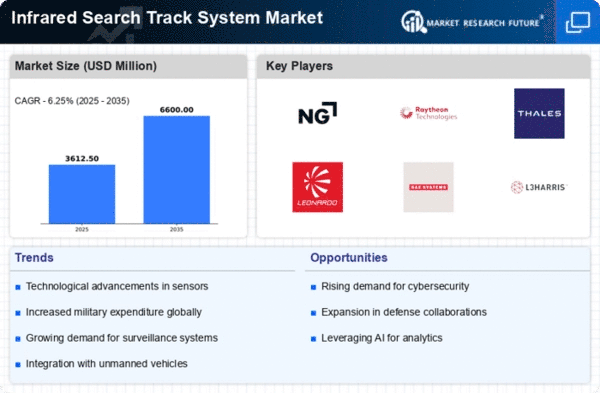
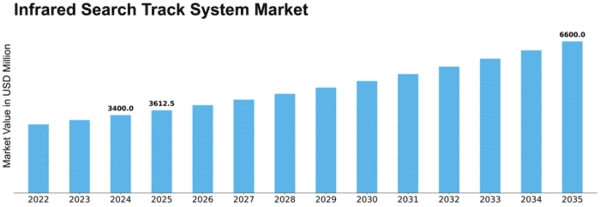
As per MRFR analysis, the Infrared Search Track System Market Size was estimated at 3400.0 USD Million in 2024. The Infrared Search Track System industry is projected to grow from 3600.0 in 2025 to 6600.0 by 2035, exhibiting a compound annual growth rate (CAGR) of 6.25% during the forecast period 2025 - 2035.

Key Market Trends & Highlights

The Infrared Search Track System Market is poised for substantial growth driven by technological advancements and increased defense spending.

  • North America remains the largest market for infrared search track systems, primarily due to its robust defense budget.
  • The Asia-Pacific region is emerging as the fastest-growing market, fueled by rising military expenditures and modernization efforts.
  • The military segment dominates the market, while the civilian segment is experiencing rapid growth due to expanding applications in non-defense areas.
  • Key market drivers include the rising demand for surveillance systems and an increased focus on military modernization, which are shaping the industry's trajectory.

Market Size & Forecast

2024 Market Size 3400.0 (USD Million)
2035 Market Size 6600.0 (USD Million)
CAGR (2025 - 2035) 6.25%
Largest Regional Market Share in 2024 North America

Major Players

Northrop Grumman (US), Raytheon Technologies (US), Thales Group (FR), Leonardo S.p.A. (IT), BAE Systems (GB), L3Harris Technologies (US), Elbit Systems (IL), Hensoldt (DE), Rheinmetall AG (DE)

Market Trends

border security

Infrared Search Track System Market Market Drivers

Geopolitical Tensions

Geopolitical tensions across various regions are significantly influencing the Global Infrared Search & Track (IRST) System Market Industry. Heightened security concerns and regional conflicts prompt nations to bolster their defense capabilities, particularly in surveillance and reconnaissance. Countries in Eastern Europe and the Asia-Pacific region are increasingly investing in IRST systems to counter perceived threats. This strategic focus on enhancing military readiness is expected to drive market growth, as nations seek to acquire advanced technologies that provide a tactical edge. The ongoing geopolitical landscape suggests a sustained demand for IRST systems in the coming years.

Rising Defense Budgets

The Global Infrared Search & Track (IRST) System Market Industry is experiencing growth driven by increasing defense budgets across various nations. Countries are prioritizing advanced surveillance and tracking systems to enhance their military capabilities. For instance, the United States has allocated substantial funds for modernizing its defense systems, which includes investments in IRST technologies. This trend is mirrored in nations such as India and China, which are also ramping up their military expenditures. The anticipated market value of the Global Infrared Search & Track (IRST) System Market is projected to reach 5.02 USD Billion in 2024, indicating a robust demand for these systems.

Market Growth Projections

The Global Infrared Search & Track (IRST) System Market Industry is projected to experience substantial growth over the next decade. With a market value expected to reach 5.02 USD Billion in 2024 and 9.23 USD Billion by 2035, the industry is poised for a robust expansion. The anticipated compound annual growth rate of 5.69% from 2025 to 2035 reflects the increasing investments in advanced military technologies and the growing demand for enhanced surveillance capabilities. This growth is indicative of the broader trends in defense spending and technological innovation, positioning the IRST market as a critical component of future military strategies.

Technological Advancements

Technological advancements play a pivotal role in shaping the Global Infrared Search & Track (IRST) System Market Industry. Innovations in sensor technology, data processing, and integration capabilities are enhancing the effectiveness of IRST systems. For example, the development of advanced infrared sensors allows for improved target detection and tracking in diverse environments. These advancements not only increase operational efficiency but also reduce the likelihood of detection by adversaries. As a result, the market is expected to grow significantly, with projections indicating a value of 9.23 USD Billion by 2035, reflecting the ongoing evolution of military technologies.

Growing Demand for Airborne Systems

The Global Infrared Search & Track (IRST) System Market Industry is witnessing a surge in demand for airborne systems, particularly in military aviation. The need for enhanced situational awareness and threat detection in aerial operations is driving this trend. Modern fighter jets and unmanned aerial vehicles are increasingly equipped with IRST systems to improve their combat effectiveness. For instance, the integration of IRST capabilities in platforms such as the F-35 Lightning II has demonstrated the strategic advantages of these systems. This growing emphasis on airborne applications is likely to contribute to a compound annual growth rate of 5.69% from 2025 to 2035.

Increased Focus on Asymmetric Warfare

The Global Infrared Search & Track (IRST) System Market Industry is also shaped by an increased focus on asymmetric warfare tactics. As military engagements evolve, there is a growing recognition of the need for advanced surveillance systems that can operate effectively in unconventional combat scenarios. IRST systems provide critical capabilities for detecting and tracking low-observable targets, which are often employed in asymmetric warfare. This shift in military strategy is likely to drive demand for IRST technologies, as armed forces seek to enhance their operational effectiveness against non-traditional threats. The market's growth trajectory appears promising as these systems become integral to modern military operations.

Market Segment Insights

By Application: Military (Largest) vs. Search and Rescue (Fastest-Growing)

<p>The Infrared Search Track System Market showcases a diverse distribution among its applications, notably the Military sector holding the largest share. This sector's robust investment in advanced surveillance and reconnaissance capabilities highlights its critical role in national security. Other segments such as Civilian and Surveillance follow in market share, utilized for various security and monitoring applications, while Firefighting and Search and Rescue contribute significantly to niche markets, enhancing operational efficacy in emergency situations.</p>

<p>Military (Dominant) vs. Search and Rescue (Emerging)</p>

<p>The Military application segment remains dominant in the Infrared Search Track System Market, driven by advancements in defense technologies and increased threats that necessitate superior surveillance capabilities. Military forces leverage these systems for target tracking and reconnaissance, thus elevating their importance in modern warfare. On the other hand, Search and Rescue is an emerging segment, rapidly gaining traction due to increasing incidences of natural disasters and the consequent need for effective rescue operations. This segment is characterized by innovative solutions tailored for real-time response, making it a focal point for technological advancements and growing investment to enhance efficiency in lifesaving missions.</p>

By Technology: Thermal Imaging (Largest) vs. Near-Infrared (Fastest-Growing)

<p>In the Infrared Search Track System Market, Thermal Imaging leads significantly in market share, reflecting its widespread application and established technology. It is utilized in various sectors including military, surveillance, and search and rescue operations, making it a vital tool for professionals in critical environments. Near-Infrared follows as a noteworthy segment, appealing to specific applications needing precise detection and analysis, indicating a growing interest in its capabilities in contexts like agriculture and industrial monitoring.</p>

<p>Technology: Thermal Imaging (Dominant) vs. Near-Infrared (Emerging)</p>

<p>Thermal Imaging technology remains the dominant player within the Infrared Search Track System Market due to its robust performance in detecting heat signatures across various environmental conditions. Its applications span military and defense, emergency response, and even commercial sectors, ensuring its stability in market demand. In contrast, Near-Infrared technology emerges as a vital player, gaining popularity for its accuracy in specific applications such as agricultural monitoring and environmental analysis. The emerging nature of Near-Infrared highlights its potential for commercial growth, driven by advancements in sensor technology and increasing adoption across different industries.</p>

By End Use: Defense (Largest) vs. Aerospace (Fastest-Growing)

<p>The Infrared Search Track System Market showcases a diverse range of end uses, with the Defense sector commanding the largest share. This segment leverages advanced infrared technology for surveillance and targeting applications, therefore securing a significant portion of market demand. Following closely is the Aerospace sector, which has seen an increasing adoption of infrared tracking systems for both civil and military aviation, reflecting its growing importance in the market.</p>

<p>Defense: Dominant vs. Aerospace: Emerging</p>

<p>The Defense segment is characterized by its established presence and robust demand for infrared search and track systems used in military operations, enhancing situational awareness and targeting efficacy. In contrast, the Aerospace sector emerges as a rapidly growing segment, driven by innovations in aviation technology and increasing investments in unmanned aerial systems. Though currently smaller in market share, the Aerospace segment is gaining momentum as more aircraft integrate advanced infrared tracking systems, highlighting its potential for future growth in applications such as collision avoidance and reconnaissance.</p>

By Component: Sensors (Largest) vs. Cameras (Fastest-Growing)

<p>In the Infrared Search Track System Market, the 'Component' segment showcases a diverse distribution among its key components: Sensors, Cameras, Software, and Optics. Sensors hold the largest market share due to their essential role in detecting infrared radiation and enhancing situational awareness. Cameras follow closely, and their increasing integration with advanced technologies fuels the segment's growth. Meanwhile, Software and Optics, while smaller, contribute significantly to the overall functionality and performance of these systems.</p>

<p>Sensors (Dominant) vs. Cameras (Emerging)</p>

<p>Sensors are currently the dominant component in the Infrared Search Track System Market, leveraging advanced technology for accurate detection and tracking. They are widely utilized in various applications, including military and civilian aerospace, marking their critical importance in system effectiveness. Cameras, classified as an emerging component, have seen rapid advancements, leading to improved imaging capabilities and integration with AI for enhanced object recognition. This growth trajectory reflects an increased demand for higher-quality imaging systems and a shift toward more sophisticated surveillance technologies. As the industry evolves, both components are expected to play pivotal roles in shaping future innovations.</p>

By Platform: Ground-Based (Largest) vs. Airborne (Fastest-Growing)

<p>In the Infrared Search Track System Market, the platform segment is prominently shaped by the Ground-Based systems, which command the largest share due to their versatility and extensive application across various defense sectors. Ground-Based platforms are essential for surveillance and reconnaissance missions, contributing significantly to national defense strategies. Meanwhile, Airborne systems are gaining traction, rapidly growing in market share as technological advancements enhance their capabilities and operational effectiveness. This trend signifies a shift towards more dynamic and responsive platforms in aerial operations. The growth in the Infrared Search Track System's platform segment is largely driven by the increasing demand for enhanced surveillance and tracking capabilities. As global security challenges escalate, military and defense agencies are prioritizing investments in Airborne systems that offer improved efficacy in threat detection from an aerial perspective. Additionally, innovations in sensor technology, alongside rising geopolitical tensions, further propel the adoption of these systems, with Airborne platforms expected to witness the fastest growth in the coming years.</p>

<p>Ground-Based (Dominant) vs. Space-Based (Emerging)</p>

<p>Ground-Based platforms in the Infrared Search Track System Market are recognized for their reliability and critical role in various defense and intelligence applications, making them the dominant player in this segment. They are primarily utilized for continuous monitoring and advanced tracking capabilities on land, providing comprehensive situational awareness. In contrast, Space-Based systems are emerging steadily, driven by advancements in satellite technology and the increasing necessity for global surveillance. Although currently less prevalent, they offer unique advantages such as wide-area coverage and the ability to monitor remote locations. As nations prioritize improving their surveillance capabilities, the integration of Space-Based platforms into defense strategies is becoming more crucial, highlighting their potential in future operations.</p>

Get more detailed insights about Infrared Search & Track (IRST) System Market Research Report - Global Forecast till 2035

Regional Insights

North America : Market Leader in Technology

North America continues to lead the Infrared Search Track System market, holding a significant share of 1700.0M in 2024. The region's growth is driven by increasing defense budgets, technological advancements, and a focus on modernizing military capabilities. Regulatory support from government initiatives further catalyzes demand, ensuring that North America remains at the forefront of innovation in defense technologies. The competitive landscape is characterized by major players such as Northrop Grumman, Raytheon Technologies, and L3Harris Technologies, which are pivotal in shaping market dynamics. The U.S. is the primary contributor, leveraging its advanced R&D capabilities and strong defense contracts. This robust ecosystem fosters collaboration among key stakeholders, enhancing the region's market position.

Europe : Emerging Defense Innovations

Europe's Infrared Search Track System market is projected to reach 900.0M by 2025, driven by increasing defense expenditures and a focus on enhancing border security. The region is witnessing a surge in demand for advanced surveillance systems, supported by regulatory frameworks aimed at strengthening national security. Collaborative defense initiatives among EU nations further bolster market growth, ensuring a unified approach to defense technology advancements. Leading countries such as France, Germany, and the UK are at the forefront of this market, with key players like Thales Group and BAE Systems driving innovation. The competitive landscape is marked by strategic partnerships and joint ventures, enhancing technological capabilities. As Europe invests in modernization, the presence of established firms ensures a robust supply chain and innovation pipeline.

Asia-Pacific : Rapidly Growing Defense Sector

The Asia-Pacific region is witnessing significant growth in the Infrared Search Track System market, projected to reach 600.0M by 2025. This growth is fueled by rising defense budgets, geopolitical tensions, and a focus on enhancing military capabilities. Countries in this region are increasingly investing in advanced technologies to modernize their defense systems, supported by government initiatives aimed at strengthening national security. Key players in this market include Elbit Systems and Hensoldt, with countries like India, Japan, and Australia leading the charge. The competitive landscape is characterized by a mix of local and international firms, fostering innovation and collaboration. As the region continues to expand its defense capabilities, the demand for advanced infrared systems is expected to rise significantly, positioning Asia-Pacific as a critical player in the global market.

Middle East and Africa : Strategic Defense Investments

The Middle East and Africa region is emerging as a significant market for Infrared Search Track Systems, with a projected size of 200.0M by 2025. The growth is driven by increasing security concerns, regional conflicts, and a focus on modernizing military capabilities. Governments are prioritizing defense spending, supported by international partnerships and collaborations aimed at enhancing regional security frameworks. Countries like the UAE and Saudi Arabia are leading the charge, with investments in advanced defense technologies. The competitive landscape features both local and international players, including Rheinmetall AG, which are crucial in meeting the growing demand for sophisticated surveillance systems. As the region continues to evolve, the emphasis on security solutions will drive further market expansion.

Key Players and Competitive Insights

The Infrared Search Track System Market is characterized by a dynamic competitive landscape, driven by technological advancements and increasing defense budgets across various nations. Key players such as Northrop Grumman (US), Raytheon Technologies (US), and Thales Group (FR) are at the forefront, each adopting distinct strategies to enhance their market positioning. Northrop Grumman (US) emphasizes innovation in sensor technology, while Raytheon Technologies (US) focuses on strategic partnerships to bolster its product offerings. Thales Group (FR) is actively pursuing regional expansion, particularly in Asia-Pacific, to tap into emerging markets. Collectively, these strategies contribute to a competitive environment that is increasingly focused on technological superiority and market responsiveness.In terms of business tactics, companies are localizing manufacturing to reduce costs and enhance supply chain efficiency. The market structure appears moderately fragmented, with several players vying for market share. However, the influence of major companies is substantial, as they set industry standards and drive technological advancements. This competitive structure fosters an environment where innovation is paramount, and companies are compelled to continuously adapt to maintain their competitive edge.

In November Raytheon Technologies (US) announced a collaboration with a leading AI firm to integrate advanced machine learning algorithms into its infrared tracking systems. This strategic move is likely to enhance the accuracy and responsiveness of their systems, positioning Raytheon as a leader in the integration of AI within defense technologies. Such advancements may not only improve operational efficiency but also provide a competitive advantage in securing government contracts.

In October Thales Group (FR) unveiled a new line of infrared search and track systems designed specifically for naval applications. This launch is indicative of Thales's commitment to diversifying its product portfolio and addressing the unique needs of maritime defense. By focusing on specialized applications, Thales may strengthen its market presence and appeal to a broader range of defense clients.

In September Northrop Grumman (US) completed the acquisition of a smaller tech firm specializing in infrared sensor technology. This acquisition is expected to enhance Northrop Grumman's capabilities in developing next-generation tracking systems, thereby reinforcing its competitive position. The integration of new technologies could lead to innovative solutions that meet the evolving demands of military operations.

As of December the competitive trends in the Infrared Search Track System Market are increasingly defined by digitalization, sustainability, and the integration of AI technologies. Strategic alliances are becoming more prevalent, as companies recognize the need to collaborate to leverage complementary strengths. Looking ahead, competitive differentiation is likely to shift from price-based strategies to a focus on innovation, technological advancements, and supply chain reliability. This evolution suggests that companies must prioritize research and development to stay ahead in a rapidly changing market.

Key Companies in the Infrared Search Track System Market include

Industry Developments

Swedish Defense and Aerospace Company (Saab) will release the new E-Series Gripen Fighter Jets to the Czech Air Force as a lease for the C/D Series is expiring soon.

India’s new super fighter Tejas Mk-2 has become one of the top 4 Light Combat Aircraft worldwide along with ‘IDOL’ Saab Gripen.

According to recent reports, the Air Force is demanding up to 400 advanced fighter trainers aircraft to train the pilots.

Report Overview

The overview of the Infrared Search & Track (IRST) System Market Analysis report states that the market has shown a consistent growth rate since recent years, and it will continue its growth consistency in the upcoming years to reach a good CAGR. The various segments of the market are accelerating the growth of the  Market through its services worldwide. The key drivers in different geographical regions are boosting the regional market, helping the Industry Outlook emerge in the global competition.

Key Industrial Segments

By Component

    • Scanning Head
    • Processing & Control Electronics 
    • Display

By Platform

    • Land
    • Maritime
    • Airborne
    • Space

By End-User

    • Civil
    • Defense

Future Outlook

Infrared Search Track System Market Future Outlook

The <a href="https://www.marketresearchfuture.com/reports/infrared-search-track-system-market-10146" target="_blank">infrared search track system</a> Market is projected to grow at a 6.25% CAGR from 2025 to 2035, driven by advancements in military technology and increasing defense budgets.

New opportunities lie in:

  • Integration of AI for enhanced target recognition capabilities.
  • Development of compact, portable infrared systems for tactical applications.
  • Expansion into commercial sectors such as search and rescue operations.

By 2035, the market is expected to solidify its position as a leader in advanced surveillance technologies.

Market Segmentation

Infrared Search Track System Market End Use Outlook

  • Defense
  • Aerospace
  • Maritime
  • Emergency Services
  • Research Institutions

Infrared Search Track System Market Technology Outlook

  • Thermal Imaging
  • Multispectral Imaging
  • Laser Systems
  • Signal Processing
  • Data Fusion

Infrared Search Track System Market Application Outlook

  • Military
  • Civilian
  • Search and Rescue
  • Surveillance
  • Firefighting

Report Scope

MARKET SIZE 2024 3400.0(USD Million)
MARKET SIZE 2025 3600.0(USD Million)
MARKET SIZE 2035 6600.0(USD Million)
COMPOUND ANNUAL GROWTH RATE (CAGR) 6.25% (2025 - 2035)
REPORT COVERAGE Revenue Forecast, Competitive Landscape, Growth Factors, and Trends
BASE YEAR 2024
Market Forecast Period 2025 - 2035
Historical Data 2019 - 2024
Market Forecast Units USD Million
Key Companies Profiled Northrop Grumman (US), Raytheon Technologies (US), Thales Group (FR), Leonardo S.p.A. (IT), BAE Systems (GB), L3Harris Technologies (US), Elbit Systems (IL), Hensoldt (DE), Rheinmetall AG (DE)
Segments Covered Application, Technology, End Use
Key Market Opportunities Advancements in sensor technology enhance capabilities in the Infrared Search Track System Market.
Key Market Dynamics Technological advancements and increasing defense budgets drive growth in the Infrared Search Track System market.
Countries Covered North America, Europe, APAC, South America, MEA

FAQs

What is the projected market valuation of the Infrared Search Track System Market by 2035?

<p>The Infrared Search Track System Market is projected to reach a valuation of 6600.0 USD Million by 2035.</p>

What was the market valuation of the Infrared Search Track System Market in 2024?

<p>In 2024, the market valuation of the Infrared Search Track System Market was 3400.0 USD Million.</p>

What is the expected CAGR for the Infrared Search Track System Market during the forecast period 2025 - 2035?

<p>The expected CAGR for the Infrared Search Track System Market during the forecast period 2025 - 2035 is 6.25%.</p>

Which companies are considered key players in the Infrared Search Track System Market?

<p>Key players in the Infrared Search Track System Market include Northrop Grumman, Raytheon Technologies, Thales Group, and Leonardo S.p.A.</p>

What are the projected valuations for the Military application segment by 2035?

The Military application segment is projected to reach valuations of 2100.0 USD Million by 2035.

How does the Thermal Imaging technology segment perform in terms of market valuation?

The Thermal Imaging technology segment is expected to grow to 2400.0 USD Million by 2035.

What is the anticipated market size for the Defense end-use segment by 2035?

The Defense end-use segment is anticipated to reach a market size of 2640.0 USD Million by 2035.

What are the projected valuations for the Airborne platform segment by 2035?

The Airborne platform segment is projected to achieve valuations of 2400.0 USD Million by 2035.

What is the expected growth for the Sensors component segment by 2035?

The Sensors component segment is expected to grow to 1700.0 USD Million by 2035.

How does the Civilian application segment compare in valuation to the Search and Rescue segment by 2035?

By 2035, the Civilian application segment is projected to reach 1300.0 USD Million, while the Search and Rescue segment is expected to reach 1100.0 USD Million.

  1. SECTION I: EXECUTIVE SUMMARY AND KEY HIGHLIGHTS
    1. | 1.1 EXECUTIVE SUMMARY
    2. | | 1.1.1 Market Overview
    3. | | 1.1.2 Key Findings
    4. | | 1.1.3 Market Segmentation
    5. | | 1.1.4 Competitive Landscape
    6. | | 1.1.5 Challenges and Opportunities
    7. | | 1.1.6 Future Outlook
  2. SECTION II: SCOPING, METHODOLOGY AND MARKET STRUCTURE
    1. | 2.1 MARKET INTRODUCTION
    2. | | 2.1.1 Definition
    3. | | 2.1.2 Scope of the study
    4. | | | 2.1.2.1 Research Objective
    5. | | | 2.1.2.2 Assumption
    6. | | | 2.1.2.3 Limitations
    7. | 2.2 RESEARCH METHODOLOGY
    8. | | 2.2.1 Overview
    9. | | 2.2.2 Data Mining
    10. | | 2.2.3 Secondary Research
    11. | | 2.2.4 Primary Research
    12. | | | 2.2.4.1 Primary Interviews and Information Gathering Process
    13. | | | 2.2.4.2 Breakdown of Primary Respondents
    14. | | 2.2.5 Forecasting Model
    15. | | 2.2.6 Market Size Estimation
    16. | | | 2.2.6.1 Bottom-Up Approach
    17. | | | 2.2.6.2 Top-Down Approach
    18. | | 2.2.7 Data Triangulation
    19. | | 2.2.8 Validation
  3. SECTION III: QUALITATIVE ANALYSIS
    1. | 3.1 MARKET DYNAMICS
    2. | | 3.1.1 Overview
    3. | | 3.1.2 Drivers
    4. | | 3.1.3 Restraints
    5. | | 3.1.4 Opportunities
    6. | 3.2 MARKET FACTOR ANALYSIS
    7. | | 3.2.1 Value chain Analysis
    8. | | 3.2.2 Porter's Five Forces Analysis
    9. | | | 3.2.2.1 Bargaining Power of Suppliers
    10. | | | 3.2.2.2 Bargaining Power of Buyers
    11. | | | 3.2.2.3 Threat of New Entrants
    12. | | | 3.2.2.4 Threat of Substitutes
    13. | | | 3.2.2.5 Intensity of Rivalry
    14. | | 3.2.3 COVID-19 Impact Analysis
    15. | | | 3.2.3.1 Market Impact Analysis
    16. | | | 3.2.3.2 Regional Impact
    17. | | | 3.2.3.3 Opportunity and Threat Analysis
  4. SECTION IV: QUANTITATIVE ANALYSIS
    1. | 4.1 Aerospace & Defense, BY Application (USD Million)
    2. | | 4.1.1 Military
    3. | | 4.1.2 Civilian
    4. | | 4.1.3 Search and Rescue
    5. | | 4.1.4 Surveillance
    6. | | 4.1.5 Firefighting
    7. | 4.2 Aerospace & Defense, BY Technology (USD Million)
    8. | | 4.2.1 Thermal Imaging
    9. | | 4.2.2 Near-Infrared
    10. | | 4.2.3 Mid-Infrared
    11. | | 4.2.4 Long-Wave Infrared
    12. | 4.3 Aerospace & Defense, BY End Use (USD Million)
    13. | | 4.3.1 Defense
    14. | | 4.3.2 Aerospace
    15. | | 4.3.3 Public Safety
    16. | | 4.3.4 Automotive
    17. | 4.4 Aerospace & Defense, BY Component (USD Million)
    18. | | 4.4.1 Sensors
    19. | | 4.4.2 Cameras
    20. | | 4.4.3 Software
    21. | | 4.4.4 Optics
    22. | 4.5 Aerospace & Defense, BY Platform (USD Million)
    23. | | 4.5.1 Ground-Based
    24. | | 4.5.2 Airborne
    25. | | 4.5.3 Naval
    26. | | 4.5.4 Space-Based
    27. | 4.6 Aerospace & Defense, BY Region (USD Million)
    28. | | 4.6.1 North America
    29. | | | 4.6.1.1 US
    30. | | | 4.6.1.2 Canada
    31. | | 4.6.2 Europe
    32. | | | 4.6.2.1 Germany
    33. | | | 4.6.2.2 UK
    34. | | | 4.6.2.3 France
    35. | | | 4.6.2.4 Russia
    36. | | | 4.6.2.5 Italy
    37. | | | 4.6.2.6 Spain
    38. | | | 4.6.2.7 Rest of Europe
    39. | | 4.6.3 APAC
    40. | | | 4.6.3.1 China
    41. | | | 4.6.3.2 India
    42. | | | 4.6.3.3 Japan
    43. | | | 4.6.3.4 South Korea
    44. | | | 4.6.3.5 Malaysia
    45. | | | 4.6.3.6 Thailand
    46. | | | 4.6.3.7 Indonesia
    47. | | | 4.6.3.8 Rest of APAC
    48. | | 4.6.4 South America
    49. | | | 4.6.4.1 Brazil
    50. | | | 4.6.4.2 Mexico
    51. | | | 4.6.4.3 Argentina
    52. | | | 4.6.4.4 Rest of South America
    53. | | 4.6.5 MEA
    54. | | | 4.6.5.1 GCC Countries
    55. | | | 4.6.5.2 South Africa
    56. | | | 4.6.5.3 Rest of MEA
  5. SECTION V: COMPETITIVE ANALYSIS
    1. | 5.1 Competitive Landscape
    2. | | 5.1.1 Overview
    3. | | 5.1.2 Competitive Analysis
    4. | | 5.1.3 Market share Analysis
    5. | | 5.1.4 Major Growth Strategy in the Aerospace & Defense
    6. | | 5.1.5 Competitive Benchmarking
    7. | | 5.1.6 Leading Players in Terms of Number of Developments in the Aerospace & Defense
    8. | | 5.1.7 Key developments and growth strategies
    9. | | | 5.1.7.1 New Product Launch/Service Deployment
    10. | | | 5.1.7.2 Merger & Acquisitions
    11. | | | 5.1.7.3 Joint Ventures
    12. | | 5.1.8 Major Players Financial Matrix
    13. | | | 5.1.8.1 Sales and Operating Income
    14. | | | 5.1.8.2 Major Players R&D Expenditure. 2023
    15. | 5.2 Company Profiles
    16. | | 5.2.1 Northrop Grumman (US)
    17. | | | 5.2.1.1 Financial Overview
    18. | | | 5.2.1.2 Products Offered
    19. | | | 5.2.1.3 Key Developments
    20. | | | 5.2.1.4 SWOT Analysis
    21. | | | 5.2.1.5 Key Strategies
    22. | | 5.2.2 Raytheon Technologies (US)
    23. | | | 5.2.2.1 Financial Overview
    24. | | | 5.2.2.2 Products Offered
    25. | | | 5.2.2.3 Key Developments
    26. | | | 5.2.2.4 SWOT Analysis
    27. | | | 5.2.2.5 Key Strategies
    28. | | 5.2.3 Thales Group (FR)
    29. | | | 5.2.3.1 Financial Overview
    30. | | | 5.2.3.2 Products Offered
    31. | | | 5.2.3.3 Key Developments
    32. | | | 5.2.3.4 SWOT Analysis
    33. | | | 5.2.3.5 Key Strategies
    34. | | 5.2.4 Leonardo S.p.A. (IT)
    35. | | | 5.2.4.1 Financial Overview
    36. | | | 5.2.4.2 Products Offered
    37. | | | 5.2.4.3 Key Developments
    38. | | | 5.2.4.4 SWOT Analysis
    39. | | | 5.2.4.5 Key Strategies
    40. | | 5.2.5 BAE Systems (GB)
    41. | | | 5.2.5.1 Financial Overview
    42. | | | 5.2.5.2 Products Offered
    43. | | | 5.2.5.3 Key Developments
    44. | | | 5.2.5.4 SWOT Analysis
    45. | | | 5.2.5.5 Key Strategies
    46. | | 5.2.6 L3Harris Technologies (US)
    47. | | | 5.2.6.1 Financial Overview
    48. | | | 5.2.6.2 Products Offered
    49. | | | 5.2.6.3 Key Developments
    50. | | | 5.2.6.4 SWOT Analysis
    51. | | | 5.2.6.5 Key Strategies
    52. | | 5.2.7 Elbit Systems (IL)
    53. | | | 5.2.7.1 Financial Overview
    54. | | | 5.2.7.2 Products Offered
    55. | | | 5.2.7.3 Key Developments
    56. | | | 5.2.7.4 SWOT Analysis
    57. | | | 5.2.7.5 Key Strategies
    58. | | 5.2.8 Hensoldt (DE)
    59. | | | 5.2.8.1 Financial Overview
    60. | | | 5.2.8.2 Products Offered
    61. | | | 5.2.8.3 Key Developments
    62. | | | 5.2.8.4 SWOT Analysis
    63. | | | 5.2.8.5 Key Strategies
    64. | | 5.2.9 Rheinmetall AG (DE)
    65. | | | 5.2.9.1 Financial Overview
    66. | | | 5.2.9.2 Products Offered
    67. | | | 5.2.9.3 Key Developments
    68. | | | 5.2.9.4 SWOT Analysis
    69. | | | 5.2.9.5 Key Strategies
    70. | 5.3 Appendix
    71. | | 5.3.1 References
    72. | | 5.3.2 Related Reports
  6. LIST OF FIGURES
    1. | 6.1 MARKET SYNOPSIS
    2. | 6.2 NORTH AMERICA MARKET ANALYSIS
    3. | 6.3 US MARKET ANALYSIS BY APPLICATION
    4. | 6.4 US MARKET ANALYSIS BY TECHNOLOGY
    5. | 6.5 US MARKET ANALYSIS BY END USE
    6. | 6.6 US MARKET ANALYSIS BY COMPONENT
    7. | 6.7 US MARKET ANALYSIS BY PLATFORM
    8. | 6.8 CANADA MARKET ANALYSIS BY APPLICATION
    9. | 6.9 CANADA MARKET ANALYSIS BY TECHNOLOGY
    10. | 6.10 CANADA MARKET ANALYSIS BY END USE
    11. | 6.11 CANADA MARKET ANALYSIS BY COMPONENT
    12. | 6.12 CANADA MARKET ANALYSIS BY PLATFORM
    13. | 6.13 EUROPE MARKET ANALYSIS
    14. | 6.14 GERMANY MARKET ANALYSIS BY APPLICATION
    15. | 6.15 GERMANY MARKET ANALYSIS BY TECHNOLOGY
    16. | 6.16 GERMANY MARKET ANALYSIS BY END USE
    17. | 6.17 GERMANY MARKET ANALYSIS BY COMPONENT
    18. | 6.18 GERMANY MARKET ANALYSIS BY PLATFORM
    19. | 6.19 UK MARKET ANALYSIS BY APPLICATION
    20. | 6.20 UK MARKET ANALYSIS BY TECHNOLOGY
    21. | 6.21 UK MARKET ANALYSIS BY END USE
    22. | 6.22 UK MARKET ANALYSIS BY COMPONENT
    23. | 6.23 UK MARKET ANALYSIS BY PLATFORM
    24. | 6.24 FRANCE MARKET ANALYSIS BY APPLICATION
    25. | 6.25 FRANCE MARKET ANALYSIS BY TECHNOLOGY
    26. | 6.26 FRANCE MARKET ANALYSIS BY END USE
    27. | 6.27 FRANCE MARKET ANALYSIS BY COMPONENT
    28. | 6.28 FRANCE MARKET ANALYSIS BY PLATFORM
    29. | 6.29 RUSSIA MARKET ANALYSIS BY APPLICATION
    30. | 6.30 RUSSIA MARKET ANALYSIS BY TECHNOLOGY
    31. | 6.31 RUSSIA MARKET ANALYSIS BY END USE
    32. | 6.32 RUSSIA MARKET ANALYSIS BY COMPONENT
    33. | 6.33 RUSSIA MARKET ANALYSIS BY PLATFORM
    34. | 6.34 ITALY MARKET ANALYSIS BY APPLICATION
    35. | 6.35 ITALY MARKET ANALYSIS BY TECHNOLOGY
    36. | 6.36 ITALY MARKET ANALYSIS BY END USE
    37. | 6.37 ITALY MARKET ANALYSIS BY COMPONENT
    38. | 6.38 ITALY MARKET ANALYSIS BY PLATFORM
    39. | 6.39 SPAIN MARKET ANALYSIS BY APPLICATION
    40. | 6.40 SPAIN MARKET ANALYSIS BY TECHNOLOGY
    41. | 6.41 SPAIN MARKET ANALYSIS BY END USE
    42. | 6.42 SPAIN MARKET ANALYSIS BY COMPONENT
    43. | 6.43 SPAIN MARKET ANALYSIS BY PLATFORM
    44. | 6.44 REST OF EUROPE MARKET ANALYSIS BY APPLICATION
    45. | 6.45 REST OF EUROPE MARKET ANALYSIS BY TECHNOLOGY
    46. | 6.46 REST OF EUROPE MARKET ANALYSIS BY END USE
    47. | 6.47 REST OF EUROPE MARKET ANALYSIS BY COMPONENT
    48. | 6.48 REST OF EUROPE MARKET ANALYSIS BY PLATFORM
    49. | 6.49 APAC MARKET ANALYSIS
    50. | 6.50 CHINA MARKET ANALYSIS BY APPLICATION
    51. | 6.51 CHINA MARKET ANALYSIS BY TECHNOLOGY
    52. | 6.52 CHINA MARKET ANALYSIS BY END USE
    53. | 6.53 CHINA MARKET ANALYSIS BY COMPONENT
    54. | 6.54 CHINA MARKET ANALYSIS BY PLATFORM
    55. | 6.55 INDIA MARKET ANALYSIS BY APPLICATION
    56. | 6.56 INDIA MARKET ANALYSIS BY TECHNOLOGY
    57. | 6.57 INDIA MARKET ANALYSIS BY END USE
    58. | 6.58 INDIA MARKET ANALYSIS BY COMPONENT
    59. | 6.59 INDIA MARKET ANALYSIS BY PLATFORM
    60. | 6.60 JAPAN MARKET ANALYSIS BY APPLICATION
    61. | 6.61 JAPAN MARKET ANALYSIS BY TECHNOLOGY
    62. | 6.62 JAPAN MARKET ANALYSIS BY END USE
    63. | 6.63 JAPAN MARKET ANALYSIS BY COMPONENT
    64. | 6.64 JAPAN MARKET ANALYSIS BY PLATFORM
    65. | 6.65 SOUTH KOREA MARKET ANALYSIS BY APPLICATION
    66. | 6.66 SOUTH KOREA MARKET ANALYSIS BY TECHNOLOGY
    67. | 6.67 SOUTH KOREA MARKET ANALYSIS BY END USE
    68. | 6.68 SOUTH KOREA MARKET ANALYSIS BY COMPONENT
    69. | 6.69 SOUTH KOREA MARKET ANALYSIS BY PLATFORM
    70. | 6.70 MALAYSIA MARKET ANALYSIS BY APPLICATION
    71. | 6.71 MALAYSIA MARKET ANALYSIS BY TECHNOLOGY
    72. | 6.72 MALAYSIA MARKET ANALYSIS BY END USE
    73. | 6.73 MALAYSIA MARKET ANALYSIS BY COMPONENT
    74. | 6.74 MALAYSIA MARKET ANALYSIS BY PLATFORM
    75. | 6.75 THAILAND MARKET ANALYSIS BY APPLICATION
    76. | 6.76 THAILAND MARKET ANALYSIS BY TECHNOLOGY
    77. | 6.77 THAILAND MARKET ANALYSIS BY END USE
    78. | 6.78 THAILAND MARKET ANALYSIS BY COMPONENT
    79. | 6.79 THAILAND MARKET ANALYSIS BY PLATFORM
    80. | 6.80 INDONESIA MARKET ANALYSIS BY APPLICATION
    81. | 6.81 INDONESIA MARKET ANALYSIS BY TECHNOLOGY
    82. | 6.82 INDONESIA MARKET ANALYSIS BY END USE
    83. | 6.83 INDONESIA MARKET ANALYSIS BY COMPONENT
    84. | 6.84 INDONESIA MARKET ANALYSIS BY PLATFORM
    85. | 6.85 REST OF APAC MARKET ANALYSIS BY APPLICATION
    86. | 6.86 REST OF APAC MARKET ANALYSIS BY TECHNOLOGY
    87. | 6.87 REST OF APAC MARKET ANALYSIS BY END USE
    88. | 6.88 REST OF APAC MARKET ANALYSIS BY COMPONENT
    89. | 6.89 REST OF APAC MARKET ANALYSIS BY PLATFORM
    90. | 6.90 SOUTH AMERICA MARKET ANALYSIS
    91. | 6.91 BRAZIL MARKET ANALYSIS BY APPLICATION
    92. | 6.92 BRAZIL MARKET ANALYSIS BY TECHNOLOGY
    93. | 6.93 BRAZIL MARKET ANALYSIS BY END USE
    94. | 6.94 BRAZIL MARKET ANALYSIS BY COMPONENT
    95. | 6.95 BRAZIL MARKET ANALYSIS BY PLATFORM
    96. | 6.96 MEXICO MARKET ANALYSIS BY APPLICATION
    97. | 6.97 MEXICO MARKET ANALYSIS BY TECHNOLOGY
    98. | 6.98 MEXICO MARKET ANALYSIS BY END USE
    99. | 6.99 MEXICO MARKET ANALYSIS BY COMPONENT
    100. | 6.100 MEXICO MARKET ANALYSIS BY PLATFORM
    101. | 6.101 ARGENTINA MARKET ANALYSIS BY APPLICATION
    102. | 6.102 ARGENTINA MARKET ANALYSIS BY TECHNOLOGY
    103. | 6.103 ARGENTINA MARKET ANALYSIS BY END USE
    104. | 6.104 ARGENTINA MARKET ANALYSIS BY COMPONENT
    105. | 6.105 ARGENTINA MARKET ANALYSIS BY PLATFORM
    106. | 6.106 REST OF SOUTH AMERICA MARKET ANALYSIS BY APPLICATION
    107. | 6.107 REST OF SOUTH AMERICA MARKET ANALYSIS BY TECHNOLOGY
    108. | 6.108 REST OF SOUTH AMERICA MARKET ANALYSIS BY END USE
    109. | 6.109 REST OF SOUTH AMERICA MARKET ANALYSIS BY COMPONENT
    110. | 6.110 REST OF SOUTH AMERICA MARKET ANALYSIS BY PLATFORM
    111. | 6.111 MEA MARKET ANALYSIS
    112. | 6.112 GCC COUNTRIES MARKET ANALYSIS BY APPLICATION
    113. | 6.113 GCC COUNTRIES MARKET ANALYSIS BY TECHNOLOGY
    114. | 6.114 GCC COUNTRIES MARKET ANALYSIS BY END USE
    115. | 6.115 GCC COUNTRIES MARKET ANALYSIS BY COMPONENT
    116. | 6.116 GCC COUNTRIES MARKET ANALYSIS BY PLATFORM
    117. | 6.117 SOUTH AFRICA MARKET ANALYSIS BY APPLICATION
    118. | 6.118 SOUTH AFRICA MARKET ANALYSIS BY TECHNOLOGY
    119. | 6.119 SOUTH AFRICA MARKET ANALYSIS BY END USE
    120. | 6.120 SOUTH AFRICA MARKET ANALYSIS BY COMPONENT
    121. | 6.121 SOUTH AFRICA MARKET ANALYSIS BY PLATFORM
    122. | 6.122 REST OF MEA MARKET ANALYSIS BY APPLICATION
    123. | 6.123 REST OF MEA MARKET ANALYSIS BY TECHNOLOGY
    124. | 6.124 REST OF MEA MARKET ANALYSIS BY END USE
    125. | 6.125 REST OF MEA MARKET ANALYSIS BY COMPONENT
    126. | 6.126 REST OF MEA MARKET ANALYSIS BY PLATFORM
    127. | 6.127 KEY BUYING CRITERIA OF AEROSPACE & DEFENSE
    128. | 6.128 RESEARCH PROCESS OF MRFR
    129. | 6.129 DRO ANALYSIS OF AEROSPACE & DEFENSE
    130. | 6.130 DRIVERS IMPACT ANALYSIS: AEROSPACE & DEFENSE
    131. | 6.131 RESTRAINTS IMPACT ANALYSIS: AEROSPACE & DEFENSE
    132. | 6.132 SUPPLY / VALUE CHAIN: AEROSPACE & DEFENSE
    133. | 6.133 AEROSPACE & DEFENSE, BY APPLICATION, 2024 (% SHARE)
    134. | 6.134 AEROSPACE & DEFENSE, BY APPLICATION, 2024 TO 2035 (USD Million)
    135. | 6.135 AEROSPACE & DEFENSE, BY TECHNOLOGY, 2024 (% SHARE)
    136. | 6.136 AEROSPACE & DEFENSE, BY TECHNOLOGY, 2024 TO 2035 (USD Million)
    137. | 6.137 AEROSPACE & DEFENSE, BY END USE, 2024 (% SHARE)
    138. | 6.138 AEROSPACE & DEFENSE, BY END USE, 2024 TO 2035 (USD Million)
    139. | 6.139 AEROSPACE & DEFENSE, BY COMPONENT, 2024 (% SHARE)
    140. | 6.140 AEROSPACE & DEFENSE, BY COMPONENT, 2024 TO 2035 (USD Million)
    141. | 6.141 AEROSPACE & DEFENSE, BY PLATFORM, 2024 (% SHARE)
    142. | 6.142 AEROSPACE & DEFENSE, BY PLATFORM, 2024 TO 2035 (USD Million)
    143. | 6.143 BENCHMARKING OF MAJOR COMPETITORS
  7. LIST OF TABLES
    1. | 7.1 LIST OF ASSUMPTIONS
    2. | | 7.1.1
    3. | 7.2 North America MARKET SIZE ESTIMATES; FORECAST
    4. | | 7.2.1 BY APPLICATION, 2025-2035 (USD Million)
    5. | | 7.2.2 BY TECHNOLOGY, 2025-2035 (USD Million)
    6. | | 7.2.3 BY END USE, 2025-2035 (USD Million)
    7. | | 7.2.4 BY COMPONENT, 2025-2035 (USD Million)
    8. | | 7.2.5 BY PLATFORM, 2025-2035 (USD Million)
    9. | 7.3 US MARKET SIZE ESTIMATES; FORECAST
    10. | | 7.3.1 BY APPLICATION, 2025-2035 (USD Million)
    11. | | 7.3.2 BY TECHNOLOGY, 2025-2035 (USD Million)
    12. | | 7.3.3 BY END USE, 2025-2035 (USD Million)
    13. | | 7.3.4 BY COMPONENT, 2025-2035 (USD Million)
    14. | | 7.3.5 BY PLATFORM, 2025-2035 (USD Million)
    15. | 7.4 Canada MARKET SIZE ESTIMATES; FORECAST
    16. | | 7.4.1 BY APPLICATION, 2025-2035 (USD Million)
    17. | | 7.4.2 BY TECHNOLOGY, 2025-2035 (USD Million)
    18. | | 7.4.3 BY END USE, 2025-2035 (USD Million)
    19. | | 7.4.4 BY COMPONENT, 2025-2035 (USD Million)
    20. | | 7.4.5 BY PLATFORM, 2025-2035 (USD Million)
    21. | 7.5 Europe MARKET SIZE ESTIMATES; FORECAST
    22. | | 7.5.1 BY APPLICATION, 2025-2035 (USD Million)
    23. | | 7.5.2 BY TECHNOLOGY, 2025-2035 (USD Million)
    24. | | 7.5.3 BY END USE, 2025-2035 (USD Million)
    25. | | 7.5.4 BY COMPONENT, 2025-2035 (USD Million)
    26. | | 7.5.5 BY PLATFORM, 2025-2035 (USD Million)
    27. | 7.6 Germany MARKET SIZE ESTIMATES; FORECAST
    28. | | 7.6.1 BY APPLICATION, 2025-2035 (USD Million)
    29. | | 7.6.2 BY TECHNOLOGY, 2025-2035 (USD Million)
    30. | | 7.6.3 BY END USE, 2025-2035 (USD Million)
    31. | | 7.6.4 BY COMPONENT, 2025-2035 (USD Million)
    32. | | 7.6.5 BY PLATFORM, 2025-2035 (USD Million)
    33. | 7.7 UK MARKET SIZE ESTIMATES; FORECAST
    34. | | 7.7.1 BY APPLICATION, 2025-2035 (USD Million)
    35. | | 7.7.2 BY TECHNOLOGY, 2025-2035 (USD Million)
    36. | | 7.7.3 BY END USE, 2025-2035 (USD Million)
    37. | | 7.7.4 BY COMPONENT, 2025-2035 (USD Million)
    38. | | 7.7.5 BY PLATFORM, 2025-2035 (USD Million)
    39. | 7.8 France MARKET SIZE ESTIMATES; FORECAST
    40. | | 7.8.1 BY APPLICATION, 2025-2035 (USD Million)
    41. | | 7.8.2 BY TECHNOLOGY, 2025-2035 (USD Million)
    42. | | 7.8.3 BY END USE, 2025-2035 (USD Million)
    43. | | 7.8.4 BY COMPONENT, 2025-2035 (USD Million)
    44. | | 7.8.5 BY PLATFORM, 2025-2035 (USD Million)
    45. | 7.9 Russia MARKET SIZE ESTIMATES; FORECAST
    46. | | 7.9.1 BY APPLICATION, 2025-2035 (USD Million)
    47. | | 7.9.2 BY TECHNOLOGY, 2025-2035 (USD Million)
    48. | | 7.9.3 BY END USE, 2025-2035 (USD Million)
    49. | | 7.9.4 BY COMPONENT, 2025-2035 (USD Million)
    50. | | 7.9.5 BY PLATFORM, 2025-2035 (USD Million)
    51. | 7.10 Italy MARKET SIZE ESTIMATES; FORECAST
    52. | | 7.10.1 BY APPLICATION, 2025-2035 (USD Million)
    53. | | 7.10.2 BY TECHNOLOGY, 2025-2035 (USD Million)
    54. | | 7.10.3 BY END USE, 2025-2035 (USD Million)
    55. | | 7.10.4 BY COMPONENT, 2025-2035 (USD Million)
    56. | | 7.10.5 BY PLATFORM, 2025-2035 (USD Million)
    57. | 7.11 Spain MARKET SIZE ESTIMATES; FORECAST
    58. | | 7.11.1 BY APPLICATION, 2025-2035 (USD Million)
    59. | | 7.11.2 BY TECHNOLOGY, 2025-2035 (USD Million)
    60. | | 7.11.3 BY END USE, 2025-2035 (USD Million)
    61. | | 7.11.4 BY COMPONENT, 2025-2035 (USD Million)
    62. | | 7.11.5 BY PLATFORM, 2025-2035 (USD Million)
    63. | 7.12 Rest of Europe MARKET SIZE ESTIMATES; FORECAST
    64. | | 7.12.1 BY APPLICATION, 2025-2035 (USD Million)
    65. | | 7.12.2 BY TECHNOLOGY, 2025-2035 (USD Million)
    66. | | 7.12.3 BY END USE, 2025-2035 (USD Million)
    67. | | 7.12.4 BY COMPONENT, 2025-2035 (USD Million)
    68. | | 7.12.5 BY PLATFORM, 2025-2035 (USD Million)
    69. | 7.13 APAC MARKET SIZE ESTIMATES; FORECAST
    70. | | 7.13.1 BY APPLICATION, 2025-2035 (USD Million)
    71. | | 7.13.2 BY TECHNOLOGY, 2025-2035 (USD Million)
    72. | | 7.13.3 BY END USE, 2025-2035 (USD Million)
    73. | | 7.13.4 BY COMPONENT, 2025-2035 (USD Million)
    74. | | 7.13.5 BY PLATFORM, 2025-2035 (USD Million)
    75. | 7.14 China MARKET SIZE ESTIMATES; FORECAST
    76. | | 7.14.1 BY APPLICATION, 2025-2035 (USD Million)
    77. | | 7.14.2 BY TECHNOLOGY, 2025-2035 (USD Million)
    78. | | 7.14.3 BY END USE, 2025-2035 (USD Million)
    79. | | 7.14.4 BY COMPONENT, 2025-2035 (USD Million)
    80. | | 7.14.5 BY PLATFORM, 2025-2035 (USD Million)
    81. | 7.15 India MARKET SIZE ESTIMATES; FORECAST
    82. | | 7.15.1 BY APPLICATION, 2025-2035 (USD Million)
    83. | | 7.15.2 BY TECHNOLOGY, 2025-2035 (USD Million)
    84. | | 7.15.3 BY END USE, 2025-2035 (USD Million)
    85. | | 7.15.4 BY COMPONENT, 2025-2035 (USD Million)
    86. | | 7.15.5 BY PLATFORM, 2025-2035 (USD Million)
    87. | 7.16 Japan MARKET SIZE ESTIMATES; FORECAST
    88. | | 7.16.1 BY APPLICATION, 2025-2035 (USD Million)
    89. | | 7.16.2 BY TECHNOLOGY, 2025-2035 (USD Million)
    90. | | 7.16.3 BY END USE, 2025-2035 (USD Million)
    91. | | 7.16.4 BY COMPONENT, 2025-2035 (USD Million)
    92. | | 7.16.5 BY PLATFORM, 2025-2035 (USD Million)
    93. | 7.17 South Korea MARKET SIZE ESTIMATES; FORECAST
    94. | | 7.17.1 BY APPLICATION, 2025-2035 (USD Million)
    95. | | 7.17.2 BY TECHNOLOGY, 2025-2035 (USD Million)
    96. | | 7.17.3 BY END USE, 2025-2035 (USD Million)
    97. | | 7.17.4 BY COMPONENT, 2025-2035 (USD Million)
    98. | | 7.17.5 BY PLATFORM, 2025-2035 (USD Million)
    99. | 7.18 Malaysia MARKET SIZE ESTIMATES; FORECAST
    100. | | 7.18.1 BY APPLICATION, 2025-2035 (USD Million)
    101. | | 7.18.2 BY TECHNOLOGY, 2025-2035 (USD Million)
    102. | | 7.18.3 BY END USE, 2025-2035 (USD Million)
    103. | | 7.18.4 BY COMPONENT, 2025-2035 (USD Million)
    104. | | 7.18.5 BY PLATFORM, 2025-2035 (USD Million)
    105. | 7.19 Thailand MARKET SIZE ESTIMATES; FORECAST
    106. | | 7.19.1 BY APPLICATION, 2025-2035 (USD Million)
    107. | | 7.19.2 BY TECHNOLOGY, 2025-2035 (USD Million)
    108. | | 7.19.3 BY END USE, 2025-2035 (USD Million)
    109. | | 7.19.4 BY COMPONENT, 2025-2035 (USD Million)
    110. | | 7.19.5 BY PLATFORM, 2025-2035 (USD Million)
    111. | 7.20 Indonesia MARKET SIZE ESTIMATES; FORECAST
    112. | | 7.20.1 BY APPLICATION, 2025-2035 (USD Million)
    113. | | 7.20.2 BY TECHNOLOGY, 2025-2035 (USD Million)
    114. | | 7.20.3 BY END USE, 2025-2035 (USD Million)
    115. | | 7.20.4 BY COMPONENT, 2025-2035 (USD Million)
    116. | | 7.20.5 BY PLATFORM, 2025-2035 (USD Million)
    117. | 7.21 Rest of APAC MARKET SIZE ESTIMATES; FORECAST
    118. | | 7.21.1 BY APPLICATION, 2025-2035 (USD Million)
    119. | | 7.21.2 BY TECHNOLOGY, 2025-2035 (USD Million)
    120. | | 7.21.3 BY END USE, 2025-2035 (USD Million)
    121. | | 7.21.4 BY COMPONENT, 2025-2035 (USD Million)
    122. | | 7.21.5 BY PLATFORM, 2025-2035 (USD Million)
    123. | 7.22 South America MARKET SIZE ESTIMATES; FORECAST
    124. | | 7.22.1 BY APPLICATION, 2025-2035 (USD Million)
    125. | | 7.22.2 BY TECHNOLOGY, 2025-2035 (USD Million)
    126. | | 7.22.3 BY END USE, 2025-2035 (USD Million)
    127. | | 7.22.4 BY COMPONENT, 2025-2035 (USD Million)
    128. | | 7.22.5 BY PLATFORM, 2025-2035 (USD Million)
    129. | 7.23 Brazil MARKET SIZE ESTIMATES; FORECAST
    130. | | 7.23.1 BY APPLICATION, 2025-2035 (USD Million)
    131. | | 7.23.2 BY TECHNOLOGY, 2025-2035 (USD Million)
    132. | | 7.23.3 BY END USE, 2025-2035 (USD Million)
    133. | | 7.23.4 BY COMPONENT, 2025-2035 (USD Million)
    134. | | 7.23.5 BY PLATFORM, 2025-2035 (USD Million)
    135. | 7.24 Mexico MARKET SIZE ESTIMATES; FORECAST
    136. | | 7.24.1 BY APPLICATION, 2025-2035 (USD Million)
    137. | | 7.24.2 BY TECHNOLOGY, 2025-2035 (USD Million)
    138. | | 7.24.3 BY END USE, 2025-2035 (USD Million)
    139. | | 7.24.4 BY COMPONENT, 2025-2035 (USD Million)
    140. | | 7.24.5 BY PLATFORM, 2025-2035 (USD Million)
    141. | 7.25 Argentina MARKET SIZE ESTIMATES; FORECAST
    142. | | 7.25.1 BY APPLICATION, 2025-2035 (USD Million)
    143. | | 7.25.2 BY TECHNOLOGY, 2025-2035 (USD Million)
    144. | | 7.25.3 BY END USE, 2025-2035 (USD Million)
    145. | | 7.25.4 BY COMPONENT, 2025-2035 (USD Million)
    146. | | 7.25.5 BY PLATFORM, 2025-2035 (USD Million)
    147. | 7.26 Rest of South America MARKET SIZE ESTIMATES; FORECAST
    148. | | 7.26.1 BY APPLICATION, 2025-2035 (USD Million)
    149. | | 7.26.2 BY TECHNOLOGY, 2025-2035 (USD Million)
    150. | | 7.26.3 BY END USE, 2025-2035 (USD Million)
    151. | | 7.26.4 BY COMPONENT, 2025-2035 (USD Million)
    152. | | 7.26.5 BY PLATFORM, 2025-2035 (USD Million)
    153. | 7.27 MEA MARKET SIZE ESTIMATES; FORECAST
    154. | | 7.27.1 BY APPLICATION, 2025-2035 (USD Million)
    155. | | 7.27.2 BY TECHNOLOGY, 2025-2035 (USD Million)
    156. | | 7.27.3 BY END USE, 2025-2035 (USD Million)
    157. | | 7.27.4 BY COMPONENT, 2025-2035 (USD Million)
    158. | | 7.27.5 BY PLATFORM, 2025-2035 (USD Million)
    159. | 7.28 GCC Countries MARKET SIZE ESTIMATES; FORECAST
    160. | | 7.28.1 BY APPLICATION, 2025-2035 (USD Million)
    161. | | 7.28.2 BY TECHNOLOGY, 2025-2035 (USD Million)
    162. | | 7.28.3 BY END USE, 2025-2035 (USD Million)
    163. | | 7.28.4 BY COMPONENT, 2025-2035 (USD Million)
    164. | | 7.28.5 BY PLATFORM, 2025-2035 (USD Million)
    165. | 7.29 South Africa MARKET SIZE ESTIMATES; FORECAST
    166. | | 7.29.1 BY APPLICATION, 2025-2035 (USD Million)
    167. | | 7.29.2 BY TECHNOLOGY, 2025-2035 (USD Million)
    168. | | 7.29.3 BY END USE, 2025-2035 (USD Million)
    169. | | 7.29.4 BY COMPONENT, 2025-2035 (USD Million)
    170. | | 7.29.5 BY PLATFORM, 2025-2035 (USD Million)
    171. | 7.30 Rest of MEA MARKET SIZE ESTIMATES; FORECAST
    172. | | 7.30.1 BY APPLICATION, 2025-2035 (USD Million)
    173. | | 7.30.2 BY TECHNOLOGY, 2025-2035 (USD Million)
    174. | | 7.30.3 BY END USE, 2025-2035 (USD Million)
    175. | | 7.30.4 BY COMPONENT, 2025-2035 (USD Million)
    176. | | 7.30.5 BY PLATFORM, 2025-2035 (USD Million)
    177. | 7.31 PRODUCT LAUNCH/PRODUCT DEVELOPMENT/APPROVAL
    178. | | 7.31.1
    179. | 7.32 ACQUISITION/PARTNERSHIP
    180. | | 7.32.1

Aerospace & Defense Market Segmentation

Aerospace & Defense By Application (USD Million, 2025-2035)

  • Military
  • Civilian
  • Search and Rescue
  • Surveillance
  • Firefighting

Aerospace & Defense By Technology (USD Million, 2025-2035)

  • Thermal Imaging
  • Near-Infrared
  • Mid-Infrared
  • Long-Wave Infrared

Aerospace & Defense By End Use (USD Million, 2025-2035)

  • Defense
  • Aerospace
  • Public Safety
  • Automotive

Aerospace & Defense By Component (USD Million, 2025-2035)

  • Sensors
  • Cameras
  • Software
  • Optics

Aerospace & Defense By Platform (USD Million, 2025-2035)

  • Ground-Based
  • Airborne
  • Naval
  • Space-Based
Infographic

Free Sample Request

Kindly complete the form below to receive a free sample of this Report

Get Free Sample

Customer Strories

Compare Licence

×
Features License Type
Single User Multiuser License Enterprise User
Price $4,950 $5,950 $7,250
Maximum User Access Limit 1 User Upto 10 Users Unrestricted Access Throughout the Organization
Free Customization
Direct Access to Analyst
Deliverable Format
Platform Access
Discount on Next Purchase 10% 15% 15%
Printable Versions
%>