×
Request Free Sample ×

Kindly complete the form below to receive a free sample of this Report

* Please use a valid business email

Leading companies partner with us for data-driven Insights

clients tt-cursor
Hero Background
English
Chinese
French
Japanese
Korean
German
Spanish

Inflight Shopping Market Size

ID: MRFR/AD/6800-HCR
168 Pages
Sejal Akre
October 2025

Inflight Shopping Market Size, Share, Industry Trend & Analysis Research Report Information By Aircraft Class (First Class, Business Class, Premium Economy Class, and Economy Class), By Carrier Type (Full- Service and Low-Cost), By Shopping Type (Travel Essentials, Accessories, Beauty and Care, Children, and Others), And By Region (North America, Europe, Asia-Pacific, And Rest Of The World) –Market Size, Share, Industry Trend & Analysis Forecast Till 2035

Share:
Download PDF ×

We do not share your information with anyone. However, we may send you emails based on your report interest from time to time. You may contact us at any time to opt-out.

Inflight Shopping Market Infographic
×
Inflight Shopping Market Infographic Full View
Purchase Options

Inflight Shopping Size

Inflight Shopping Market Growth Projections and Opportunities

The inflight shopping market presents a unique intersection of retail and travel, shaped by various market factors. One significant driver is the changing consumer landscape, where passengers increasingly seek a seamless and personalized shopping experience during their flights. Airlines have recognized this trend and are leveraging inflight shopping as a revenue-generating opportunity. With the evolution of technology, airlines can offer passengers digital platforms and catalogs, allowing them to browse and purchase products during their journey, thereby enhancing the overall travel experience.

Airline partnerships and collaborations with retail brands play a pivotal role in influencing the inflight shopping market. Airlines often collaborate with well-known brands to curate an enticing selection of products for passengers. These partnerships not only contribute to the diversity of available products but also enhance the perceived value of inflight shopping. Strategic collaborations can lead to exclusive offerings, promotions, and limited-edition items, creating a sense of urgency and excitement among passengers to make purchases while onboard.

The in-flight shopping market is significantly impacted by the global tourism and travel industry. As air travel continues to grow and more people embark on international journeys, the potential customer base for inflight shopping expands. Airlines strategically position themselves to tap into this market by tailoring their inflight shopping offerings to appeal to diverse passenger demographics. Additionally, the economic prosperity of regions and countries contributes to the willingness of passengers to engage in discretionary spending, further influencing the success of inflight shopping initiatives.

The adoption of e-commerce trends is a transformative factor in the inflight shopping market. Airlines are increasingly embracing digital platforms, enabling passengers to browse, select, and purchase products through their personal devices. The convenience of mobile shopping during flights aligns with broader consumer expectations for seamless digital experiences. Airlines that invest in user-friendly, secure, and efficient inflight shopping platforms are better positioned to capture the attention of passengers and drive sales, reflecting the broader shift toward digital retail solutions.

Inflight shopping experiences are also shaped by regulatory considerations and safety protocols. Airlines must adhere to aviation regulations and safety guidelines, ensuring that the inflight shopping process does not compromise passenger safety or disrupt the normal operation of the aircraft. Striking a balance between providing a convenient shopping experience and maintaining safety standards is essential for the sustained success of inflight shopping programs.

Market competition is a driving force in the inflight shopping industry, with airlines vying to offer unique and attractive shopping experiences to passengers. The differentiation lies not only in the selection of products but also in the presentation, pricing strategies, and overall customer engagement. Airlines that understand the preferences of their target audience and tailor their inflight shopping offerings accordingly are more likely to succeed in a competitive market where passenger loyalty and satisfaction are paramount.

Economic factors, including consumer spending patterns and discretionary income, influence the success of inflight shopping initiatives. During periods of economic growth and increased consumer confidence, passengers may be more inclined to make discretionary purchases onboard. Conversely, economic downturns may impact passenger spending habits, necessitating strategic adjustments in pricing, promotions, and product offerings to maintain the appeal of inflight shopping.
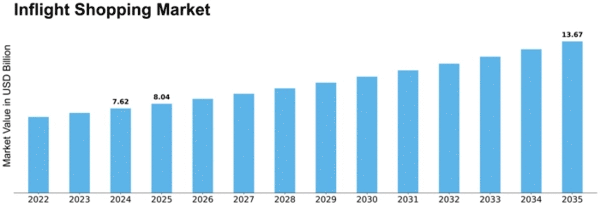

Inflight Shopping Market Size Graph
Author
Sejal Akre
Senior Research Analyst

She has over 5 years of rich experience, in market research and consulting providing valuable market insights to client. Hands on expertise in management consulting, and extensive knowledge in domain including ICT, Automotive & Transportation and Aerospace & Defense. She is skilled in Go-to market strategy, industry analysis, market sizing, in depth company profiling, competitive intelligence & benchmarking and value chain amongst others.

Leave a Comment

FAQs

How much is the inflight shopping market?

The inflight shopping market size was valued at USD 7.3 Billion in 2023.

What is the growth rate of the inflight shopping market?

The market is projected to grow at a CAGR of 5.5% during the forecast period, 2025-2034.

Which region held the largest market share in the inflight shopping market?

North America had the largest share of the market.

Who are the key players in the inflight shopping market?

The key players in the market are Inmarsat plc (UK), Lufthansa (Germany), AirAsia Group (Malaysia), The Emirates Group (UAE), Swiss International Air Lines AG (Switzerland), Thomas Cook Airlines Ltd. (UK), Singapore Airlines Limited (Singapore), and EasyJet Airline Company Limited (UK).

Which carrier type led the inflight shopping market?

The full-service carrier type category dominated the market in 2023.

Which aircraft class had the largest market share in the Inflight shopping market?

The first class aircraft had the largest share of the market.

Market Summary

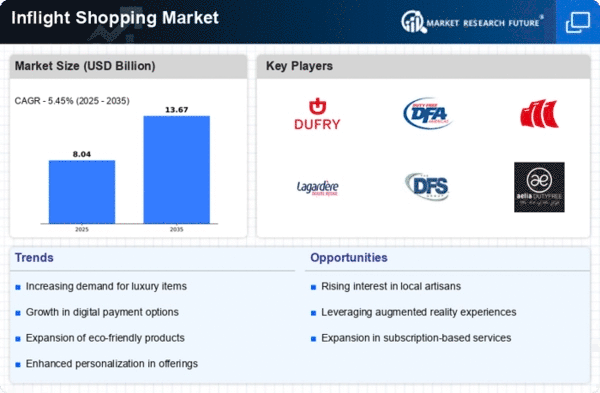
As per Market Research Future analysis, the Inflight Shopping Market Size was estimated at 7.62 USD Billion in 2024. The Inflight Shopping industry is projected to grow from 8.04 USD Billion in 2025 to 13.67 USD Billion by 2035, exhibiting a compound annual growth rate (CAGR) of 5.45% during the forecast period 2025 - 2035

Key Market Trends & Highlights

The inflight shopping market is evolving towards enhanced personalization and sustainability, driven by technological advancements and diverse offerings.

  • Personalization of offerings is becoming increasingly prevalent, catering to the unique preferences of passengers.
  • The integration of digital platforms is transforming the shopping experience, particularly in North America, the largest market.
  • Sustainability initiatives are gaining traction, especially among family travelers in the Asia-Pacific region, the fastest-growing market.
  • Enhanced passenger experience and partnerships with luxury brands are key drivers propelling growth in the cosmetics segment.

Market Size & Forecast

2024 Market Size 7.62 (USD Billion)
2035 Market Size 13.67 (USD Billion)
CAGR (2025 - 2035) 5.45%
Largest Regional Market Share in 2024 North America

Major Players

Dufry AG (CH), Duty Free Americas (US), Heinemann Duty Free (DE), Lagardère Travel Retail (FR), DFS Group (HK), Aelia Duty Free (FR), Travel Retail Norway (NO), King Power International (TH), Inflight Retail (US)

Market Trends

The Inflight Shopping Market is currently experiencing a transformation driven by evolving consumer preferences and advancements in technology. Airlines are increasingly recognizing the potential of inflight retail as a means to enhance passenger experience and generate additional revenue. This market appears to be shifting towards a more personalized approach, where tailored offerings and curated selections are becoming the norm. Furthermore, the integration of digital platforms is facilitating a seamless shopping experience, allowing passengers to browse and purchase items conveniently during their flights. In addition to technological advancements, sustainability is emerging as a key consideration within the Inflight Shopping Market. Airlines are exploring eco-friendly products and practices, reflecting a growing awareness of environmental issues among consumers. This trend suggests that the market may continue to evolve in response to changing values, with a focus on responsible consumption. Overall, the Inflight Shopping Market seems poised for growth, driven by innovation and a commitment to enhancing the passenger journey.

Personalization of Offerings

The Inflight Shopping Market is increasingly focusing on personalized experiences for passengers. Airlines are utilizing data analytics to understand customer preferences, enabling them to curate product selections that resonate with individual travelers. This trend suggests a shift from generic offerings to tailored experiences, enhancing customer satisfaction and loyalty.

Integration of Digital Platforms

Digital technology is playing a pivotal role in the evolution of the Inflight Shopping Market. Airlines are adopting mobile applications and online platforms that allow passengers to browse and purchase items before, during, and after flights. This integration not only streamlines the shopping process but also enhances the overall travel experience.

Sustainability Initiatives

Sustainability is becoming a prominent theme within the Inflight Shopping Market. Airlines are increasingly prioritizing eco-friendly products and practices, responding to consumer demand for responsible consumption. This trend indicates a potential shift towards more sustainable offerings, aligning with broader environmental goals.

Inflight Shopping Market Market Drivers

Strategic Partnerships

Strategic partnerships between airlines and retail brands significantly influence the Global Inflight Shopping Industry. Collaborations with well-known brands allow airlines to offer exclusive products that cannot be found elsewhere, creating a unique selling proposition. These partnerships often lead to co-branded marketing campaigns that enhance visibility and attract more passengers to inflight shopping. As the industry anticipates growth, such alliances are likely to become increasingly important, potentially contributing to the market's projected growth to 13.7 USD Billion by 2035.

Rising Passenger Demand

The Global Inflight Shopping Industry experiences a notable surge in passenger demand, driven by the increasing number of air travelers. In 2024, the market is projected to reach 7.62 USD Billion, reflecting a growing appetite for onboard shopping experiences. Airlines are responding by enhancing their inflight retail offerings, which include luxury goods, electronics, and unique local products. This trend suggests that as more individuals travel, the potential for inflight shopping revenue expands, indicating a robust growth trajectory for the industry.

Diverse Product Offerings

The Global Inflight Shopping Industry benefits from a diverse range of product offerings that cater to various passenger preferences. Airlines are expanding their catalogs to include not only traditional duty-free items but also exclusive collaborations with luxury brands and local artisans. This variety appeals to a broader audience, enhancing the overall inflight shopping experience. As the market evolves, the inclusion of sustainable and ethically sourced products may also attract environmentally conscious consumers, further driving sales and engagement in the industry.

Market Growth Projections

The Global Inflight Shopping Industry is poised for substantial growth, with projections indicating a market size of 7.62 USD Billion in 2024 and an expected increase to 13.7 USD Billion by 2035. This growth trajectory suggests a compound annual growth rate (CAGR) of 5.46% from 2025 to 2035. Such figures reflect the increasing integration of inflight shopping into the overall travel experience, as airlines recognize the potential for additional revenue streams. The upward trend in market size underscores the importance of strategic planning and innovation within the industry.

Technological Advancements

Technological innovations play a pivotal role in shaping the Global Inflight Shopping Industry. The integration of mobile applications and digital payment systems enhances the shopping experience for passengers. Airlines are increasingly adopting contactless payment methods, which streamline transactions and improve customer satisfaction. Furthermore, augmented reality and virtual shopping experiences are emerging trends that could redefine inflight retail. These advancements not only facilitate a seamless shopping experience but also potentially increase sales, as they cater to tech-savvy travelers who seek convenience and efficiency.

Evolving Consumer Preferences

Evolving consumer preferences are reshaping the Global Inflight Shopping Industry. Passengers are increasingly seeking personalized and unique shopping experiences that reflect their individual tastes. This shift prompts airlines to tailor their inflight retail strategies to meet these demands, potentially incorporating local products and limited-edition items. As consumer behavior continues to evolve, airlines that adapt their offerings to align with these preferences may see enhanced customer loyalty and increased sales. The anticipated CAGR of 5.46% from 2025 to 2035 indicates a promising future for the industry.

Market Segment Insights

By Product Type: Cosmetics (Largest) vs. Electronics (Fastest-Growing)

In the inflight shopping market, the segment distribution reveals that cosmetics hold the largest market share, making them the preferred choice among passengers. Features like luxury packaging and brand prestige contribute to their appeal, allowing these products to thrive even in a highly competitive environment. On the other hand, electronics are gaining momentum, capturing an increasing portion of sales as travelers look for functional and trendy gadgets during flights.

Cosmetics: Dominant vs. Electronics: Emerging

Cosmetics are the dominant category in inflight shopping, primarily due to their broad demographic appeal and the perceived value they offer in enhancing personal care during travel. Passengers are willing to splurge on reputable brands, seeing these products as an essential indulgence. In contrast, electronics have emerged as a fast-growing segment, driven by advancements in technology and an increasing number of travel gadgets. Travelers are increasingly seeking portable chargers, headphones, and other gadgets that enhance the travel experience, indicating a shift in consumer preferences towards personal convenience and entertainment.

By Customer Demographics: Business Travelers (Largest) vs. Family Travelers (Fastest-Growing)

In the Inflight Shopping Market, the distribution among customer demographics is notably diverse. Business Travelers hold the largest share, characterized by their higher disposable incomes and willingness to spend on premium products. This segment significantly influences product offerings, as airlines tailor their inflight shopping experiences to cater to this group's preferences. Meanwhile, Family Travelers are emerging as a key demographic, accounting for a growing segment of inflight shoppers as airlines recognize the potential of family-oriented products and experiences.

Business Travelers: Dominant vs. Family Travelers: Emerging

Business Travelers are a dominant segment in the Inflight Shopping Market due to their propensity to purchase high-end products and services, driven by their travel habits and professional lifestyle. They favor convenience, quality, and luxury, gravitating towards premium offerings that enhance their travel experience. In contrast, Family Travelers represent an emerging segment, showing a rapid increase in participation in inflight shopping. Their purchases often include family-centric products such as toys, gadgets, and snacks, indicating a shift towards more targeted marketing strategies. Airlines are increasingly focusing on this demographic by offering bundles and discounts aimed at families, recognizing their growing significance in driving sales.

By Purchase Motivation: Convenience (Largest) vs. Impulse Buying (Fastest-Growing)

In the inflight shopping market, 'Convenience' emerges as the largest purchase motivation segment. Most passengers prioritize convenience due to the limited shopping time experienced during flights, leading to the substantial market share of this segment. Following closely is 'Gifting', as travelers often look for unique presents to bring back. The 'Luxury' segment also holds significant appeal among passengers, particularly those flying on premium airlines, who seek high-end products during their journey. On the other hand, 'Impulse Buying' has gained momentum, with travelers making spontaneous purchases fueled by mood and in-flight marketing strategies, capturing a growing part of the market.

Convenience: Dominant vs. Impulse Buying: Emerging

Convenience in inflight shopping is characterized by quick access to a curated selection of products that cater to essential needs, as well as easy payment procedures that facilitate smooth transactions. Passengers are drawn to items that enhance their travel experience without complicating their journey. In contrast, 'Impulse Buying' represents an emerging trend where passengers make unplanned purchases influenced by onboard advertising and the immediate availability of products. This segment thrives on the emotional triggers that arise during flight, where passengers may feel more relaxed and inclined to treat themselves. The intersection of these two motivations reveals a dynamic market landscape, where convenience meets the spontaneous desire for unexpected treats.

By Sales Channel: In-Flight Catalogs (Largest) vs. Mobile Applications (Fastest-Growing)

The inflight shopping market exhibits a diverse sales channel landscape, with in-flight catalogs commanding the most significant market share. This traditional method remains a favorite among passengers, providing a tactile and convenient way to browse products, thus enhancing the onboard shopping experience. Onboard sales representatives follow closely, offering personalized assistance and recommendations, while web platforms and mobile applications are carving out their respective niches. Although these channels represent a smaller portion of the market, their integration with technology is transforming passenger interactions with inflight retail offerings.

In-Flight Catalogs (Dominant) vs. Mobile Applications (Emerging)

In-flight catalogs have long been the cornerstone of inflight shopping, delivering an engaging assortment of products directly to passengers during flights. Their dominance stems from the convenience and familiarity that travelers have with browsing a physical catalog while relaxing in their seats. Conversely, mobile applications are an emerging force, particularly favored by tech-savvy travelers seeking a seamless shopping experience. These applications not only streamline purchases but also provide real-time updates on product availability and promotions, aligning perfectly with the growing trend towards digital interactivity. As airlines continue to innovate their digital offerings, mobile applications are expected to gain further traction, complementing the traditional catalog experience.

By Payment Method: Credit Card (Largest) vs. Mobile Payment (Fastest-Growing)

In the inflight shopping market, the payment method segment exhibits a varied distribution among several options. Credit cards dominate this segment due to their widespread acceptance and convenience. They provide a seamless transaction experience for passengers, contributing significantly to inflight sales. In contrast, mobile payments are gaining traction, particularly among tech-savvy travelers who prefer digital transactions over physical currencies. This shift is indicative of changing consumer preferences, especially in the wake of increasing smartphone usage onboard. Growth trends in the payment methods for inflight shopping are driven by technological advancements and evolving consumer behavior. The rise of mobile wallets and contactless payment solutions has positioned mobile payments as the fastest-growing segment. Airlines are increasingly adopting these technologies to cater to evolving passenger preferences, facilitating quicker and more secure transactions. With a focus on improving passenger experience and operational efficiency, we can expect mobile payment options to expand in inflight retail services.

Credit Card (Dominant) vs. Loyalty Points (Emerging)

The dominant position of credit cards in the inflight shopping market is supported by their widespread acceptance and user familiarity. Passengers prefer this method due to its convenience, as they can easily make purchases without the need for cash. In contrast, loyalty points are emerging as a noteworthy alternative; they appeal to frequent flyers who accumulate points through their airlines or credit cards. Loyalty points incentivize purchases, enabling passengers to redeem them for goods or services during flights. This segment is gaining traction as airlines increasingly promote loyalty programs, creating a mutually beneficial relationship between airlines and passengers. As these programs evolve, we can expect loyalty points to enhance consumer engagement and drive repeat purchases in inflight shopping.

Get more detailed insights about Inflight Shopping Market Research Report - Forecast till 2035

Regional Insights

North America : Market Leader in Inflight Shopping

North America is poised to maintain its leadership in the inflight shopping market, holding a significant market share of $3.81B in 2025. Key growth drivers include a robust travel industry, increasing disposable incomes, and a growing preference for luxury goods among travelers. Regulatory support for duty-free shopping and streamlined customs processes further enhance market dynamics, making it an attractive region for both consumers and retailers. The competitive landscape is characterized by major players such as Duty Free Americas and Inflight Retail, alongside international brands like Dufry AG and Heinemann Duty Free. The U.S. and Canada are the leading countries, benefiting from high passenger volumes and a strong presence of airlines that prioritize inflight shopping experiences. This region's market is expected to continue evolving with innovative retail strategies and enhanced customer engagement.

Europe : Diverse Market with Growth Potential

Europe's inflight shopping market is valued at $2.29B, driven by a diverse consumer base and a strong emphasis on luxury and branded goods. The region benefits from a high volume of international travelers and a growing trend towards personalized shopping experiences. Regulatory frameworks supporting duty-free shopping across EU countries further stimulate market growth, making it a key player in the global landscape. Leading countries such as Germany, France, and the UK dominate the market, with key players like Heinemann Duty Free and Lagardère Travel Retail leading the charge. The competitive landscape is marked by innovation in product offerings and customer engagement strategies, ensuring that Europe remains a vital hub for inflight shopping. The region's adaptability to changing consumer preferences positions it well for future growth.

Asia-Pacific : Rapid Growth in Emerging Markets

The Asia-Pacific inflight shopping market, valued at $1.3B, is experiencing rapid growth fueled by increasing air travel and a burgeoning middle class. Countries like China and India are leading this growth, with rising disposable incomes and a growing appetite for luxury goods. Regulatory support for duty-free shopping is also enhancing market dynamics, making it an attractive region for both consumers and retailers. The competitive landscape features key players such as DFS Group and King Power International, who are capitalizing on the region's expanding travel market. The presence of international airlines and a focus on enhancing the inflight shopping experience are driving innovation. As the region continues to develop, it is expected to play a crucial role in shaping the future of inflight retail.

Middle East and Africa : Emerging Market with Unique Challenges

The inflight shopping market in the Middle East and Africa is valued at $0.22B, representing a nascent but promising segment. Growth is driven by increasing air travel, particularly in the Gulf region, and a rising interest in luxury goods among travelers. Regulatory frameworks are evolving to support duty-free shopping, which is crucial for market expansion in this region. Leading countries include the UAE and South Africa, where key players like Travel Retail Norway are establishing a foothold. The competitive landscape is characterized by a mix of local and international brands, focusing on enhancing the inflight shopping experience. As the region continues to develop its travel infrastructure, it presents unique opportunities for growth in the inflight shopping market.

Key Players and Competitive Insights

The inflight shopping market is characterized by a dynamic competitive landscape, driven by evolving consumer preferences and technological advancements. Key players such as Dufry AG (CH), Duty Free Americas (US), and Lagardère Travel Retail (FR) are at the forefront, each adopting distinct strategies to enhance their market presence. Dufry AG (CH) has focused on expanding its digital offerings, integrating e-commerce solutions to cater to the growing demand for online shopping experiences among travelers. Meanwhile, Duty Free Americas (US) has emphasized regional expansion, particularly in North America, to capitalize on the increasing passenger traffic. Lagardère Travel Retail (FR) appears to be concentrating on sustainability initiatives, aligning its product offerings with eco-friendly practices, which resonates with the environmentally conscious consumer base.The market structure is moderately fragmented, with several players vying for market share. Key business tactics include localizing manufacturing and optimizing supply chains to enhance efficiency and reduce costs. This competitive environment is shaped by the collective influence of these major companies, which are increasingly collaborating with airlines to create tailored inflight shopping experiences that cater to specific passenger demographics.

In November Dufry AG (CH) announced a strategic partnership with a leading airline to launch a new inflight shopping app, allowing passengers to browse and purchase products before their flight. This move is significant as it not only enhances customer engagement but also positions Dufry AG (CH) as a pioneer in integrating technology into the inflight shopping experience, potentially increasing sales and customer satisfaction.

In October Duty Free Americas (US) unveiled a new line of exclusive products in collaboration with luxury brands, aimed at attracting high-spending travelers. This strategic initiative is likely to bolster its market position by offering unique products that cannot be found elsewhere, thereby enhancing the overall inflight shopping experience and driving revenue growth.

In September Lagardère Travel Retail (FR) launched a comprehensive sustainability program, committing to reduce plastic usage in its product packaging by 50% by 2027. This initiative not only aligns with global sustainability trends but also positions Lagardère as a responsible retailer, appealing to a growing segment of eco-conscious consumers who prioritize sustainable practices in their purchasing decisions.

As of December the inflight shopping market is witnessing a shift towards digitalization, with companies increasingly leveraging technology to enhance customer experiences. The integration of AI and data analytics is becoming prevalent, allowing for personalized marketing strategies that cater to individual preferences. Strategic alliances among key players are shaping the competitive landscape, fostering innovation and collaboration. Looking ahead, competitive differentiation is likely to evolve from traditional price-based competition to a focus on innovation, technology integration, and supply chain reliability, as companies strive to meet the changing demands of the modern traveler.

Key Companies in the Inflight Shopping Market include

Industry Developments

For Instance, March 2023 Dubai Future Foundation and the Emirates Group signed a landmark cooperation to establish the Emirates Centre of Excellence for Aviation Robotics (ECEAR). ForsaTEK, the Group's innovation forum, was the setting for signing the agreement. For Instance, February 2023 The business partnership between Vietnam Airlines and Singapore Airlines (SIA) has been formalized by signing of a Memorandum of Understanding (MoU). The carriers will initially explore opportunities for codeshare arrangements to facilitate better connectivity between Vietnam and Singapore.


Future Outlook

Inflight Shopping Market Future Outlook

The Inflight Shopping Market is projected to grow at a 5.45% CAGR from 2025 to 2035, driven by enhanced digital platforms, evolving consumer preferences, and strategic partnerships.

New opportunities lie in:

  • Integration of augmented reality shopping experiences
  • Development of exclusive in-flight product lines
  • Implementation of personalized marketing strategies based on passenger data

By 2035, the market is expected to achieve robust growth and innovation.

Market Segmentation

Inflight Shopping Market Product Type Outlook

  • Cosmetics
  • Fashion Accessories
  • Electronics
  • Gourmet Food
  • Travel Essentials

Inflight Shopping Market Sales Channel Outlook

  • In-Flight Catalogs
  • Onboard Sales Representatives
  • Mobile Applications
  • Web Platforms

Inflight Shopping Market Payment Method Outlook

  • Credit Card
  • Mobile Payment
  • Cash
  • Loyalty Points

Inflight Shopping Market Purchase Motivation Outlook

  • Convenience
  • Luxury
  • Gifting
  • Souvenir
  • Impulse Buying

Inflight Shopping Market Customer Demographics Outlook

  • Business Travelers
  • Leisure Travelers
  • Family Travelers
  • Frequent Flyers
  • Occasional Flyers

Report Scope

MARKET SIZE 20247.62(USD Billion)
MARKET SIZE 20258.04(USD Billion)
MARKET SIZE 203513.67(USD Billion)
COMPOUND ANNUAL GROWTH RATE (CAGR)5.45% (2025 - 2035)
REPORT COVERAGERevenue Forecast, Competitive Landscape, Growth Factors, and Trends
BASE YEAR2024
Market Forecast Period2025 - 2035
Historical Data2019 - 2024
Market Forecast UnitsUSD Billion
Key Companies ProfiledDufry AG (CH), Duty Free Americas (US), Heinemann Duty Free (DE), Lagardère Travel Retail (FR), DFS Group (HK), Aelia Duty Free (FR), Travel Retail Norway (NO), King Power International (TH), Inflight Retail (US)
Segments CoveredProduct Type, Customer Demographics, Purchase Motivation, Sales Channel, Payment Method
Key Market OpportunitiesIntegration of digital payment solutions enhances consumer engagement in the Inflight Shopping Market.
Key Market DynamicsEvolving consumer preferences drive innovation in inflight shopping, enhancing product offerings and digital engagement strategies.
Countries CoveredNorth America, Europe, APAC, South America, MEA

FAQs

How much is the inflight shopping market?

The inflight shopping market size was valued at USD 7.3 Billion in 2023.

What is the growth rate of the inflight shopping market?

The market is projected to grow at a CAGR of 5.5% during the forecast period, 2025-2034.

Which region held the largest market share in the inflight shopping market?

North America had the largest share of the market.

Who are the key players in the inflight shopping market?

The key players in the market are Inmarsat plc (UK), Lufthansa (Germany), AirAsia Group (Malaysia), The Emirates Group (UAE), Swiss International Air Lines AG (Switzerland), Thomas Cook Airlines Ltd. (UK), Singapore Airlines Limited (Singapore), and EasyJet Airline Company Limited (UK).

Which carrier type led the inflight shopping market?

The full-service carrier type category dominated the market in 2023.

Which aircraft class had the largest market share in the Inflight shopping market?

The first class aircraft had the largest share of the market.

  1. SECTION I: EXECUTIVE SUMMARY AND KEY HIGHLIGHTS
    1. | 1.1 EXECUTIVE SUMMARY
    2. | 1.1.1 Market Overview
    3. | 1.1.2 Key Findings
    4. | 1.1.3 Market Segmentation
    5. | 1.1.4 Competitive Landscape
    6. | 1.1.5 Challenges and Opportunities
    7. | 1.1.6 Future Outlook
  2. SECTION II: SCOPING, METHODOLOGY AND MARKET STRUCTURE
    1. | 2.1 MARKET INTRODUCTION
    2. | 2.1.1 Definition
    3. | 2.1.2 Scope of the study
    4. |-- 2.1.2.1 Research Objective
    5. |-- 2.1.2.2 Assumption
    6. |-- 2.1.2.3 Limitations
    7. | 2.2 RESEARCH METHODOLOGY
    8. | 2.2.1 Overview
    9. | 2.2.2 Data Mining
    10. | 2.2.3 Secondary Research
    11. | 2.2.4 Primary Research
    12. |-- 2.2.4.1 Primary Interviews and Information Gathering Process
    13. |-- 2.2.4.2 Breakdown of Primary Respondents
    14. | 2.2.5 Forecasting Model
    15. | 2.2.6 Market Size Estimation
    16. |-- 2.2.6.1 Bottom-Up Approach
    17. |-- 2.2.6.2 Top-Down Approach
    18. | 2.2.7 Data Triangulation
    19. | 2.2.8 Validation
  3. SECTION III: QUALITATIVE ANALYSIS
    1. | 3.1 MARKET DYNAMICS
    2. | 3.1.1 Overview
    3. | 3.1.2 Drivers
    4. | 3.1.3 Restraints
    5. | 3.1.4 Opportunities
    6. | 3.2 MARKET FACTOR ANALYSIS
    7. | 3.2.1 Value chain Analysis
    8. | 3.2.2 Porter's Five Forces Analysis
    9. |-- 3.2.2.1 Bargaining Power of Suppliers
    10. |-- 3.2.2.2 Bargaining Power of Buyers
    11. |-- 3.2.2.3 Threat of New Entrants
    12. |-- 3.2.2.4 Threat of Substitutes
    13. |-- 3.2.2.5 Intensity of Rivalry
    14. | 3.2.3 COVID-19 Impact Analysis
    15. |-- 3.2.3.1 Market Impact Analysis
    16. |-- 3.2.3.2 Regional Impact
    17. |-- 3.2.3.3 Opportunity and Threat Analysis
  4. SECTION IV: QUANTITATIVE ANALYSIS
    1. | 4.1 Aerospace & Defense, BY Product Type (USD Billion)
    2. | 4.1.1 Cosmetics
    3. | 4.1.2 Fashion Accessories
    4. | 4.1.3 Electronics
    5. | 4.1.4 Gourmet Food
    6. | 4.1.5 Travel Essentials
    7. | 4.2 Aerospace & Defense, BY Customer Demographics (USD Billion)
    8. | 4.2.1 Business Travelers
    9. | 4.2.2 Leisure Travelers
    10. | 4.2.3 Family Travelers
    11. | 4.2.4 Frequent Flyers
    12. | 4.2.5 Occasional Flyers
    13. | 4.3 Aerospace & Defense, BY Purchase Motivation (USD Billion)
    14. | 4.3.1 Convenience
    15. | 4.3.2 Luxury
    16. | 4.3.3 Gifting
    17. | 4.3.4 Souvenir
    18. | 4.3.5 Impulse Buying
    19. | 4.4 Aerospace & Defense, BY Sales Channel (USD Billion)
    20. | 4.4.1 In-Flight Catalogs
    21. | 4.4.2 Onboard Sales Representatives
    22. | 4.4.3 Mobile Applications
    23. | 4.4.4 Web Platforms
    24. | 4.5 Aerospace & Defense, BY Payment Method (USD Billion)
    25. | 4.5.1 Credit Card
    26. | 4.5.2 Mobile Payment
    27. | 4.5.3 Cash
    28. | 4.5.4 Loyalty Points
    29. | 4.6 Aerospace & Defense, BY Region (USD Billion)
    30. | 4.6.1 North America
    31. |-- 4.6.1.1 US
    32. |-- 4.6.1.2 Canada
    33. | 4.6.2 Europe
    34. |-- 4.6.2.1 Germany
    35. |-- 4.6.2.2 UK
    36. |-- 4.6.2.3 France
    37. |-- 4.6.2.4 Russia
    38. |-- 4.6.2.5 Italy
    39. |-- 4.6.2.6 Spain
    40. |-- 4.6.2.7 Rest of Europe
    41. | 4.6.3 APAC
    42. |-- 4.6.3.1 China
    43. |-- 4.6.3.2 India
    44. |-- 4.6.3.3 Japan
    45. |-- 4.6.3.4 South Korea
    46. |-- 4.6.3.5 Malaysia
    47. |-- 4.6.3.6 Thailand
    48. |-- 4.6.3.7 Indonesia
    49. |-- 4.6.3.8 Rest of APAC
    50. | 4.6.4 South America
    51. |-- 4.6.4.1 Brazil
    52. |-- 4.6.4.2 Mexico
    53. |-- 4.6.4.3 Argentina
    54. |-- 4.6.4.4 Rest of South America
    55. | 4.6.5 MEA
    56. |-- 4.6.5.1 GCC Countries
    57. |-- 4.6.5.2 South Africa
    58. |-- 4.6.5.3 Rest of MEA
  5. SECTION V: COMPETITIVE ANALYSIS
    1. | 5.1 Competitive Landscape
    2. | 5.1.1 Overview
    3. | 5.1.2 Competitive Analysis
    4. | 5.1.3 Market share Analysis
    5. | 5.1.4 Major Growth Strategy in the Aerospace & Defense
    6. | 5.1.5 Competitive Benchmarking
    7. | 5.1.6 Leading Players in Terms of Number of Developments in the Aerospace & Defense
    8. | 5.1.7 Key developments and growth strategies
    9. |-- 5.1.7.1 New Product Launch/Service Deployment
    10. |-- 5.1.7.2 Merger & Acquisitions
    11. |-- 5.1.7.3 Joint Ventures
    12. | 5.1.8 Major Players Financial Matrix
    13. |-- 5.1.8.1 Sales and Operating Income
    14. |-- 5.1.8.2 Major Players R&D Expenditure. 2023
    15. | 5.2 Company Profiles
    16. | 5.2.1 Dufry AG (CH)
    17. |-- 5.2.1.1 Financial Overview
    18. |-- 5.2.1.2 Products Offered
    19. |-- 5.2.1.3 Key Developments
    20. |-- 5.2.1.4 SWOT Analysis
    21. |-- 5.2.1.5 Key Strategies
    22. | 5.2.2 Duty Free Americas (US)
    23. |-- 5.2.2.1 Financial Overview
    24. |-- 5.2.2.2 Products Offered
    25. |-- 5.2.2.3 Key Developments
    26. |-- 5.2.2.4 SWOT Analysis
    27. |-- 5.2.2.5 Key Strategies
    28. | 5.2.3 Heinemann Duty Free (DE)
    29. |-- 5.2.3.1 Financial Overview
    30. |-- 5.2.3.2 Products Offered
    31. |-- 5.2.3.3 Key Developments
    32. |-- 5.2.3.4 SWOT Analysis
    33. |-- 5.2.3.5 Key Strategies
    34. | 5.2.4 Lagardère Travel Retail (FR)
    35. |-- 5.2.4.1 Financial Overview
    36. |-- 5.2.4.2 Products Offered
    37. |-- 5.2.4.3 Key Developments
    38. |-- 5.2.4.4 SWOT Analysis
    39. |-- 5.2.4.5 Key Strategies
    40. | 5.2.5 DFS Group (HK)
    41. |-- 5.2.5.1 Financial Overview
    42. |-- 5.2.5.2 Products Offered
    43. |-- 5.2.5.3 Key Developments
    44. |-- 5.2.5.4 SWOT Analysis
    45. |-- 5.2.5.5 Key Strategies
    46. | 5.2.6 Aelia Duty Free (FR)
    47. |-- 5.2.6.1 Financial Overview
    48. |-- 5.2.6.2 Products Offered
    49. |-- 5.2.6.3 Key Developments
    50. |-- 5.2.6.4 SWOT Analysis
    51. |-- 5.2.6.5 Key Strategies
    52. | 5.2.7 Travel Retail Norway (NO)
    53. |-- 5.2.7.1 Financial Overview
    54. |-- 5.2.7.2 Products Offered
    55. |-- 5.2.7.3 Key Developments
    56. |-- 5.2.7.4 SWOT Analysis
    57. |-- 5.2.7.5 Key Strategies
    58. | 5.2.8 King Power International (TH)
    59. |-- 5.2.8.1 Financial Overview
    60. |-- 5.2.8.2 Products Offered
    61. |-- 5.2.8.3 Key Developments
    62. |-- 5.2.8.4 SWOT Analysis
    63. |-- 5.2.8.5 Key Strategies
    64. | 5.2.9 Inflight Retail (US)
    65. |-- 5.2.9.1 Financial Overview
    66. |-- 5.2.9.2 Products Offered
    67. |-- 5.2.9.3 Key Developments
    68. |-- 5.2.9.4 SWOT Analysis
    69. |-- 5.2.9.5 Key Strategies
    70. | 5.3 Appendix
    71. | 5.3.1 References
    72. | 5.3.2 Related Reports

Aerospace & Defense Market Segmentation

Aerospace & Defense By Product Type (USD Billion, 2025-2035)

  • Cosmetics
  • Fashion Accessories
  • Electronics
  • Gourmet Food
  • Travel Essentials

Aerospace & Defense By Customer Demographics (USD Billion, 2025-2035)

  • Business Travelers
  • Leisure Travelers
  • Family Travelers
  • Frequent Flyers
  • Occasional Flyers

Aerospace & Defense By Purchase Motivation (USD Billion, 2025-2035)

  • Convenience
  • Luxury
  • Gifting
  • Souvenir
  • Impulse Buying

Aerospace & Defense By Sales Channel (USD Billion, 2025-2035)

  • In-Flight Catalogs
  • Onboard Sales Representatives
  • Mobile Applications
  • Web Platforms

Aerospace & Defense By Payment Method (USD Billion, 2025-2035)

  • Credit Card
  • Mobile Payment
  • Cash
  • Loyalty Points
Infographic

Free Sample Request

Kindly complete the form below to receive a free sample of this Report

Get Free Sample

Customer Strories

Compare Licence

×
Features License Type
Single User Multiuser License Enterprise User
Price $4,950 $5,950 $7,250
Maximum User Access Limit 1 User Upto 10 Users Unrestricted Access Throughout the Organization
Free Customization
Direct Access to Analyst
Deliverable Format
Platform Access
Discount on Next Purchase 10% 15% 15%
Printable Versions