×
Request Free Sample ×

Kindly complete the form below to receive a free sample of this Report

* Please use a valid business email

Leading companies partner with us for data-driven Insights

clients tt-cursor
Hero Background
English
Chinese
French
Japanese
Korean
German
Spanish

Infertility Market Share

ID: MRFR/LS/4687-HCR
100 Pages
Rahul Gotadki
October 2025

Infertility Market Research Report By Treatment Type (Assisted Reproductive Technology, Hormone Therapy, Surgery, Fertility Preservation), By End User (Hospitals, Fertility Clinics, Home Care Settings), By Gender (Female, Male), By Cause of Infertility (Ovulatory Disorders, Uterine or Cervical Abnormalities, Tubal Factors, Male Factor Infertility) and By Regional (North America, Europe, South America, Asia Pacific, Middle East and Africa) - Growth & Industry Forecast 2025 To 2035

Share:
Download PDF ×

We do not share your information with anyone. However, we may send you emails based on your report interest from time to time. You may contact us at any time to opt-out.

Infertility Market Infographic
×
Infertility Market Infographic Full View
Purchase Options

Market Share

Infertility Market Share Analysis

The Infertility Market is witnessing dynamic strategies for market share positioning as it addresses a crucial element of reproductive health. With an emphasis on offering solutions to couples having trouble conceiving, businesses in this industry deliberately navigate the competitive landscape to increase their market position. Businesses are aggressively entering new international markets. This entails setting up fertility facilities, forming alliances with medical professionals, and guaranteeing that infertility treatments are accessible in various areas. The different needs of couples looking for reproductive treatments around the world are met by global expansion. Businesses are concentrating on tailored medicine since they understand how different every infertility issue is. More efficient and patient-centered reproductive treatments are made possible by customized treatment programs based on genetic variables, lifestyle factors, and unique patient profiles. Innovation is essential, especially when it comes to preserving fertility. Businesses are spending money on research to advance sperm and egg-freezing technology, giving people the choice to freeze their fertility for future family planning. Businesses are funding patient and healthcare professional education programs. Raising knowledge about the reasons for infertility, accessible therapies, and the emotional aspects of fertility journeys is facilitated by educational campaigns, counseling services, and training programs. Embracing the digital transformation, companies are integrating fertility services with telehealth options. Remote consultations, virtual monitoring, and telemedicine platforms increase accessibility and convenience in fertility care, especially for patients in remote areas. Companies are incorporating sustainability features into their infertility treatment programs. This includes eco-friendly clinic practices, responsible waste management, and efforts to reduce the environmental impact of fertility treatment procedures. Companies that recognize the impact of male factors in infertility are creating solutions that center on the reproductive health of men. This covers developments in male fertility therapies, sperm analysis, and the treatment of disorders that impact male fertility. Innovations in reproductive health are the subject of ongoing research. Businesses are spending money on research to investigate cutting-edge technology like artificial intelligence for predicting fertility, improvements in embryo selection, and creative methods to increase the success rates of infertility treatments. Businesses are looking into integrating their services with genetic counseling. Giving couples undergoing assisted reproductive procedures thorough genetic information on potential dangers and conditions related to fertility treatments helps them make educated decisions.


Author
Rahul Gotadki
Assistant Manager

He holds an experience of about 7+ years in Market Research and Business Consulting, working under the spectrum of Life Sciences and Healthcare domains. Rahul conceptualizes and implements a scalable business strategy and provides strategic leadership to the clients. His expertise lies in market estimation, competitive intelligence, pipeline analysis, customer assessment, etc. In addition to the above, his other responsibility includes strategic tracking of high growth markets & advising clients on the potential areas of focus they could direct their business initiatives

Leave a Comment

FAQs

What is the projected growth of the Infertility market?

The Infertility market is the expected increase in total market value of 7.67 USD billion over a defined forecast period 2025–2035. It is driven by factors such as demand trends, technological advances, regulatory changes, and geographic expansion.

What is the size of the Infertility market?

Infertility market size was valued at approximately 2.04 billion USD in 2024. This figure will reach 7.67 billion USD covering all regions (America, Europe, Asia, MEA and ROW), focusing its segments / services / distribution channels till 2035.

What is the CAGR of the Infertility market?

Infertility market is expected to grow at a CAGR of 12.82% between 2025 and 2035.

How much will the Infertility market be worth by 2035?

Infertility market is expected to be worth of 7.67 billion USD, reflecting growth driven by usage, technology and global demands by the end of 2035.

How will the Infertility market perform over the next 10 years?

Over the next 10 years the Infertility market is expected to shift from usd billion 2.04 to 7.67 billion USD, led by adoption of advanced tech, demographic trends, regulatory approvals, with potential headwinds from 2025 to 2035.

What is the expected market valuation for the Global Infertility Market by 2035?

By 2035, the Global Infertility Market is anticipated to reach a valuation of 30.5 USD Billion.

Which region is expected to have the largest market share in the Global Infertility Market in 2024?

North America is anticipated to hold the largest market share, valued at 7.52 USD Billion in 2024.

What will be the market size for Assisted Reproductive Technology by 2035?

The market size for Assisted Reproductive Technology is expected to reach 12.8 USD Billion by 2035.

Which key players are involved in the Global Infertility Market?

Major players include Ferring Pharmaceuticals, Boston IVF, OvaScience, and Thermo Fisher Scientific.

How is the European market for infertility expected to evolve by 2035?

The European market for infertility is projected to grow to 8.0 USD Billion by 2035.

Market Summary

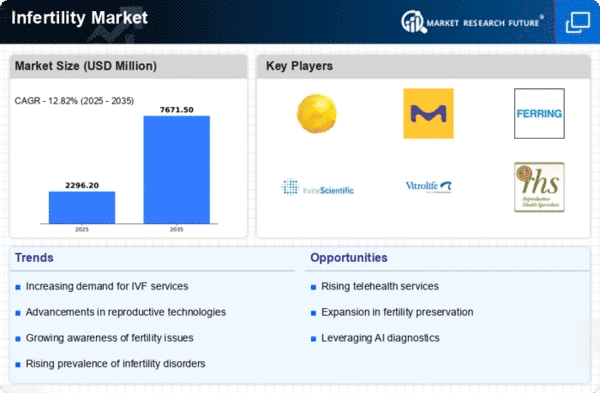
As per MRFR analysis, the Infertility Market Size was estimated at 2035.28 USD Million in 2024. The Infertility industry is projected to grow from 2296.2 in 2025 to 7671.5 by 2035, exhibiting a compound annual growth rate (CAGR) of 12.82 during the forecast period 2025 - 2035.

Key Market Trends & Highlights

The infertility market is experiencing dynamic growth driven by technological advancements and changing societal norms.

  • Technological advancements in treatment are revolutionizing the infertility market, particularly in North America.
  • Increased awareness and education regarding reproductive health are fostering a more informed patient base in the Asia-Pacific region.
  • The shift in societal norms is leading to changing family planning trends, impacting both female and male factor infertility segments.
  • Rising infertility rates and advancements in reproductive technologies are key drivers propelling market growth.

Market Size & Forecast

2024 Market Size 2035.28 (USD Million)
2035 Market Size 7671.5 (USD Million)
CAGR (2025 - 2035) 12.82%
Largest Regional Market Share in 2024 North America

Major Players

CooperSurgical (US), Merck KGaA (DE), Ferring Pharmaceuticals (CH), Irvine Scientific (US), Vitrolife (SE), Reproductive Health Specialists (US), OvaScience (US), Genea (AU), IVF Technologies (US)

Market Trends

The Infertility Market is currently experiencing a notable evolution, driven by a confluence of factors that include advancements in medical technology, increasing awareness of reproductive health, and shifting societal norms regarding family planning. As individuals and couples seek solutions to infertility challenges, the demand for innovative treatments and services is on the rise. This market encompasses a wide array of offerings, from assisted reproductive technologies to fertility preservation methods, reflecting a growing recognition of the complexities surrounding conception. Furthermore, the integration of telemedicine and digital health solutions is reshaping how patients access care, making it more convenient and accessible than ever before. In addition to technological advancements, the Infertility Market is influenced by changing demographics and lifestyle choices. Factors such as delayed parenthood, increased prevalence of reproductive disorders, and the rising incidence of lifestyle-related infertility are contributing to a heightened focus on fertility solutions. As a result, stakeholders within this market, including healthcare providers, pharmaceutical companies, and research institutions, are actively exploring new avenues for growth and innovation. The future landscape of the Infertility Market appears promising, with ongoing research and development efforts likely to yield novel therapies and improved patient outcomes.

Technological Advancements in Treatment

The Infertility Market is witnessing a surge in technological innovations that enhance treatment efficacy. Techniques such as in vitro fertilization and genetic screening are becoming more refined, leading to higher success rates. Additionally, the emergence of artificial intelligence in diagnostics and personalized treatment plans is revolutionizing patient care.

Increased Awareness and Education

There is a growing emphasis on education regarding reproductive health, which is fostering a more informed public. Campaigns aimed at destigmatizing infertility are encouraging individuals to seek help sooner. This trend is likely to drive demand for fertility services and support networks.

Shift in Societal Norms

Societal attitudes towards family planning are evolving, with more individuals choosing to delay parenthood for various reasons. This shift is contributing to an increase in infertility cases, thereby expanding the market for fertility treatments. As societal acceptance grows, so does the willingness to explore assisted reproductive options.

Infertility Market Market Drivers

Market Growth Projections

The Global Infertility Market Industry is projected to experience substantial growth in the coming years. By 2024, the market is anticipated to reach 19.7 USD Billion, with further expansion expected to 30.5 USD Billion by 2035. This growth trajectory indicates a compound annual growth rate (CAGR) of 4.03% from 2025 to 2035. Such projections highlight the increasing demand for infertility treatments and services, driven by factors such as rising infertility rates, technological advancements, and greater awareness. As the market evolves, stakeholders are likely to explore new opportunities for innovation and investment, positioning themselves to meet the needs of a growing patient population.

Rising Prevalence of Infertility

The Global Infertility Market Industry is witnessing a notable increase in infertility rates, attributed to various factors such as delayed childbearing and lifestyle changes. According to recent data, approximately 15% of couples globally experience infertility issues. This rising prevalence is driving demand for fertility treatments and services, contributing to the market's projected growth. By 2024, the market is expected to reach 19.7 USD Billion, reflecting a growing awareness and acceptance of assisted reproductive technologies. As more individuals seek solutions for infertility, the industry is likely to expand, fostering innovation in treatment options and enhancing patient access.

Government Initiatives and Support

Government policies and initiatives play a crucial role in shaping the Global Infertility Market Industry. Many countries are implementing programs to support infertility treatments, including funding for research and subsidies for patients. For example, some nations offer financial assistance for IVF procedures, making them more accessible to a broader population. These initiatives not only alleviate the financial burden on couples but also encourage the development of advanced fertility clinics and services. As governments recognize the importance of addressing infertility, the market is likely to benefit from increased investment and support, further driving growth in the coming years.

Demographic Shifts and Lifestyle Changes

Demographic changes, including an aging population and evolving lifestyle choices, are significantly impacting the Global Infertility Market Industry. As individuals prioritize education and career advancement, many are delaying family planning, which can lead to increased infertility rates. Additionally, lifestyle factors such as obesity, smoking, and stress are contributing to fertility challenges. These shifts necessitate a greater demand for fertility solutions, as couples seek to overcome the biological limitations associated with age and lifestyle. The market's growth is expected to reflect these demographic trends, with a notable increase in service utilization as awareness of fertility issues rises.

Technological Advancements in Fertility Treatments

Innovations in reproductive technologies are significantly influencing the Global Infertility Market Industry. Techniques such as in vitro fertilization (IVF), intracytoplasmic sperm injection (ICSI), and preimplantation genetic testing (PGT) are becoming increasingly sophisticated. These advancements not only improve success rates but also enhance patient experiences. For instance, the introduction of artificial intelligence in embryo selection has shown promising results in optimizing outcomes. As these technologies evolve, they are expected to attract more patients, thereby propelling the market forward. The anticipated growth trajectory suggests that by 2035, the market could reach 30.5 USD Billion, underscoring the importance of continuous innovation.

Increasing Awareness and Acceptance of Fertility Treatments

The Global Infertility Market Industry is experiencing a shift in societal attitudes towards fertility treatments. Increased awareness campaigns and educational initiatives are helping to destigmatize infertility and promote available treatment options. As a result, more individuals and couples are seeking assistance, leading to a rise in demand for fertility services. This trend is particularly evident in urban areas where access to information is more prevalent. The growing acceptance of assisted reproductive technologies is expected to contribute to a compound annual growth rate (CAGR) of 4.03% from 2025 to 2035, indicating a robust market expansion driven by informed consumer choices.

Market Segment Insights

By Treatment Type: In Vitro Fertilization (Largest) vs. Intracytoplasmic Sperm Injection (Fastest-Growing)

In the infertility market's treatment type segment, In Vitro Fertilization (IVF) holds the largest share, reflecting its established effectiveness and widespread acceptance among patients. On the other hand, Intracytoplasmic Sperm Injection (ICSI) is the fastest-growing treatment option, gaining traction due to advancements in male infertility solutions and its ability to improve fertilization rates with severe sperm issues. Ovulation Induction and Artificial Insemination follow but are comparatively smaller in terms of market penetration. Furthermore, the growth trends in this segment are influenced by various factors, including an increasing prevalence of infertility, rising awareness about reproductive health, and technological advancements in fertility treatments. The growing acceptance of ART (Assisted Reproductive Technology) contributes significantly to the expansion of treatments like ICSI. Moreover, changes in lifestyle and environmental factors are also driving the demand for effective infertility solutions in today's society.

IVF (Dominant) vs. ICSI (Emerging)

In Vitro Fertilization (IVF) is a dominant treatment in the infertility market due to its long-standing application and proven success rates, making it a go-to option for couples facing fertility issues. The treatment involves the careful retrieval of eggs and sperm, followed by the creation of embryos in a laboratory setting, which are then implanted in the uterus, giving hopeful parents a significant chance of conception. Meanwhile, Intracytoplasmic Sperm Injection (ICSI) serves as an emerging treatment, particularly beneficial for male infertility cases. This technique involves injecting a single sperm directly into an egg, making it a vital choice for couples who struggle with sperm viability or motility. As ICSI continues to innovate and expand its applications, it is quickly becoming a critical component in the comprehensive approach to infertility treatments.

By Cause of Infertility: Female Factor Infertility (Largest) vs. Male Factor Infertility (Fastest-Growing)

The infertility market exhibits a diverse distribution of causes, with female factor infertility holding the largest share. This segment encompasses a variety of issues, including ovulatory disorders, age-related decline in fertility, and structural problems within the reproductive system. On the other hand, male factor infertility, which includes problems such as low sperm count and motility, is rapidly rising as a significant concern, reflecting changing lifestyle factors and increased awareness surrounding male reproductive health.

Female Factor Infertility (Dominant) vs. Male Factor Infertility (Emerging)

Female factor infertility is characterized by its multifaceted nature, encompassing hormonal imbalances, age-related fertility decline, and anatomical issues. This segment remains dominant in the infertility market due to heightened public awareness and a growing number of women seeking fertility treatments. Conversely, male factor infertility is emerging as a critical concern, driven by lifestyle choices such as obesity, smoking, and environmental exposures. As societal norms evolve, more men are undergoing fertility assessments, leading to greater demand for treatments and contributing to its rapidly growing status in the overall infertility landscape.

By Age Group: 25 to 34 (Largest) vs. 35 to 44 (Fastest-Growing)

The age group of 25 to 34 holds the largest share in the infertility market, as this demographic is typically when individuals and couples are more actively seeking fertility treatments. The prevalence of infertility issues, combined with increased awareness and access to treatments, has led to a significant concentration of market demand among this age group. In contrast, the 35 to 44 age group is witnessing rapid growth, as more individuals are delaying parenthood for various reasons and subsequently facing fertility challenges, making this segment increasingly prominent in the market.

25 to 34 (Dominant) vs. 35 to 44 (Emerging)

The 25 to 34 age group is characterized by a proactive approach towards family planning, leading to its dominance in the infertility market. Often, individuals in this bracket are more open to seeking help and exploring options such as IVF or fertility preservation. Meanwhile, the 35 to 44 age group is emerging rapidly due to demographic shifts and late marriages, which have increased their vulnerability to infertility. This segment often includes women facing age-related fertility decline, compelling a significant portion to seek treatments, thus boosting overall market growth and the demand for innovative reproductive technologies.

By Technology: Assisted Reproductive Technology (Largest) vs. Surgical Procedures (Fastest-Growing)

In the Infertility Market, Assisted Reproductive Technology (ART) holds the largest share, reflecting its prevalence and acceptance in infertility treatments. The segment encompasses various techniques including in vitro fertilization (IVF) and intracytoplasmic sperm injection (ICSI), contributing significantly to the overall market dynamics. Meanwhile, Surgical Procedures are gaining traction, supported by advancements in minimally invasive techniques and improved surgical outcomes that are making them more accessible to patients seeking infertility solutions.

Technology: Assisted Reproductive Technology (Dominant) vs. Surgical Procedures (Emerging)

Assisted Reproductive Technology (ART) is the dominant force in the Infertility Market, primarily due to its established efficacy and broad range of applications in treating infertility challenges. Techniques such as IVF have become mainstream, supported by extensive clinical research and successful outcomes. In contrast, Surgical Procedures have emerged as a vital option for specific infertility cases, particularly for issues like endometriosis, fibroids, and anatomical abnormalities. The growing preference for less invasive surgical options, alongside advancements in technologies like laparoscopy, is driving an upward trend in this segment. This dynamic landscape illustrates the diverse approaches to treating infertility, catering to varying patient needs.

By Patient Demographics: Couples (Largest) vs. Single Women (Fastest-Growing)

In the infertility market, couples represent the largest segment, as they traditionally seek assisted reproductive technologies to conceive. They are extensively engaged in various treatment options, including IVF and IUI, leading to a strong market presence. On the other hand, the segment of single women is emerging rapidly as a significant demographic. With changing societal norms and increased access to fertility treatments, this group is increasingly seeking options to conceive independently, thereby reshaping the market landscape.

Couples (Dominant) vs. Single Women (Emerging)

Couples, often consisting of heterosexual partnerships, make up the dominant demographic in the infertility market. This segment generally consists of couples facing challenges in conceiving naturally, driving demand for various fertility services and treatments. In contrast, single women are becoming an emerging segment, driven by progressive social changes and individual choices regarding parenthood. As these women pursue motherhood later in life or choose alternative paths for family building, they are increasingly accessing fertility preservation services and treatments, which is indicative of their growing influence in the infertility market.

Get more detailed insights about Infertility Market Research Report – Forecast to 2035

Regional Insights

North America : Leading Market for Infertility Solutions

North America is poised to maintain its leadership in the infertility market, holding a significant share of 1010.0 million in 2025. Key growth drivers include increasing awareness of infertility issues, advancements in reproductive technologies, and supportive government policies. The rising prevalence of infertility, coupled with a growing demand for assisted reproductive technologies (ART), is expected to further boost market growth in this region. Regulatory frameworks are also evolving to support innovative treatments and ensure patient safety. The competitive landscape in North America is robust, featuring key players such as CooperSurgical, Merck KGaA, and Irvine Scientific. The U.S. is the leading country, accounting for the majority of the market share, driven by high healthcare expenditure and advanced medical infrastructure. The presence of numerous fertility clinics and research institutions enhances the region's capability to innovate and provide cutting-edge solutions. This competitive environment fosters collaboration and investment in new technologies, ensuring continued growth in the infertility sector.

Europe : Emerging Hub for Fertility Innovations

Europe's infertility market is projected to reach 680.0 million by 2025, driven by increasing infertility rates and a growing acceptance of ART. Factors such as favorable regulations, enhanced healthcare access, and rising public awareness are pivotal in shaping market dynamics. The European Union's initiatives to standardize ART practices and improve patient access to treatments are expected to further stimulate market growth. Additionally, the integration of advanced technologies in fertility treatments is enhancing success rates, attracting more patients. Leading countries in this region include Germany, France, and the UK, which are home to several prominent fertility clinics and research institutions. Key players like Merck KGaA and Ferring Pharmaceuticals are actively involved in developing innovative solutions. The competitive landscape is characterized by collaborations between healthcare providers and technology firms, aiming to enhance treatment efficacy and patient outcomes. This synergy is crucial for maintaining Europe's position as a leader in the infertility market.

Asia-Pacific : Rapidly Growing Fertility Market

The Asia-Pacific infertility market is expected to grow significantly, reaching 300.0 million by 2025. This growth is driven by increasing awareness of infertility issues, rising disposable incomes, and advancements in reproductive technologies. Countries like China and India are witnessing a surge in demand for ART, fueled by changing societal norms and a growing middle class. Additionally, supportive government policies and investments in healthcare infrastructure are enhancing access to fertility treatments across the region. China and India are the leading countries in this market, with a growing number of fertility clinics and healthcare providers. The competitive landscape is evolving, with both local and international players, such as Genea and Vitrolife, expanding their presence. The increasing collaboration between healthcare providers and technology firms is fostering innovation in treatment options, ensuring that the Asia-Pacific region remains a key player in The Infertility.

Middle East and Africa : Emerging Market with Growth Potential

The Middle East and Africa infertility market is projected to reach 45.28 million by 2025, driven by increasing awareness of infertility and the growing acceptance of ART. Factors such as rising healthcare expenditure and improvements in medical infrastructure are contributing to market growth. Additionally, cultural shifts towards seeking medical assistance for infertility are encouraging more individuals to pursue treatment options. Regulatory bodies are also beginning to establish guidelines to ensure the safety and efficacy of fertility treatments. Countries like South Africa and the UAE are leading the market, with a growing number of fertility clinics and healthcare providers. The competitive landscape is characterized by both local and international players, with a focus on providing affordable and accessible infertility solutions. Key players are investing in technology and partnerships to enhance treatment options, positioning the region for future growth in the infertility market.

Key Players and Competitive Insights

The Infertility Market is characterized by a dynamic competitive landscape, driven by increasing awareness of reproductive health and advancements in assisted reproductive technologies (ART). Key players such as CooperSurgical (US), Merck KGaA (DE), and Ferring Pharmaceuticals (CH) are strategically positioned to leverage innovation and expand their market presence. CooperSurgical (US) focuses on enhancing its product portfolio through acquisitions and partnerships, while Merck KGaA (DE) emphasizes research and development to introduce cutting-edge solutions. Ferring Pharmaceuticals (CH) is actively pursuing global expansion, particularly in emerging markets, thereby shaping the competitive environment through diverse operational strategies.The market structure appears moderately fragmented, with several players vying for market share. Key business tactics include localizing manufacturing to reduce costs and optimize supply chains, which enhances operational efficiency. The collective influence of these major companies fosters a competitive atmosphere where innovation and strategic partnerships are paramount for success.

In November CooperSurgical (US) announced a strategic partnership with a leading biotechnology firm to co-develop a novel fertility treatment. This collaboration is expected to enhance CooperSurgical's product offerings and strengthen its position in the market. The strategic importance of this partnership lies in its potential to accelerate the development of innovative therapies, thereby addressing the growing demand for effective infertility solutions.

In October Merck KGaA (DE) launched a new digital platform aimed at improving patient engagement and education regarding fertility treatments. This initiative reflects the company's commitment to digital transformation and positions it as a leader in providing comprehensive support to patients. The strategic significance of this move is underscored by the increasing reliance on digital tools in healthcare, which may enhance patient outcomes and satisfaction.

In September Ferring Pharmaceuticals (CH) expanded its manufacturing capabilities in Asia to meet the rising demand for its fertility medications. This expansion not only demonstrates Ferring's commitment to regional growth but also highlights the importance of supply chain optimization in maintaining product availability. The strategic relevance of this development is evident in its potential to enhance Ferring's competitive edge in a rapidly evolving market.

As of December current trends in the Infertility Market indicate a pronounced shift towards digitalization, sustainability, and the integration of artificial intelligence (AI) in treatment protocols. Strategic alliances are increasingly shaping the landscape, enabling companies to pool resources and expertise. Looking ahead, competitive differentiation is likely to evolve from traditional price-based competition to a focus on innovation, technological advancements, and supply chain reliability, underscoring the importance of agility in responding to market demands.

Key Companies in the Infertility Market include

Industry Developments

The Global Infertility Market has seen notable developments recently, driven by advancements in reproductive technologies and increased awareness surrounding infertility issues. Companies such as Ferring Pharmaceuticals, Boston IVF, and Merck KGaA have been actively involved in launching innovative fertility treatments. 

For instance, in July 2023, Ferring Pharmaceuticals introduced a new product aimed at enhancing fertility efficiency, which is anticipated to improve patient outcomes. Significant mergers and acquisitions also characterize the market; Cook Medical acquired MediCorp in August 2023, aiming to expand its portfolio in reproductive health technologies, with major implications for collaboration and innovation in the sector. Furthermore, the valuation of companies like IVF Technologies and Vitrolife has surged due to rising demand for assisted reproductive technologies, reflecting a broader trend of increasing allocations towards Research and Development in this area. 

Over the last couple of years, a substantial shift towards telemedicine in fertility consultations has transformed patient access and care, indicating evolving consumer preferences in the Global Infertility Market landscape. As awareness grows and technology advances, the market is poised for sustained growth in the upcoming years.

Future Outlook

Infertility Market Future Outlook

The Infertility Market is projected to grow at a 12.82% CAGR from 2025 to 2035, driven by technological advancements, increasing awareness, and rising infertility rates.

New opportunities lie in:

  • Expansion of telehealth services for remote consultations
  • Development of personalized fertility treatment plans
  • Investment in AI-driven diagnostic tools for infertility assessment

By 2035, the Infertility Market is expected to be robust, reflecting substantial growth and innovation.

Market Segmentation

Infertility Market Age Group Outlook

  • Under 25
  • 25 to 34
  • 35 to 44
  • 45 and Above

Infertility Market Technology Outlook

  • Assisted Reproductive Technology
  • Surgical Procedures
  • Pharmaceuticals
  • Genetic Testing

Infertility Market Treatment Type Outlook

  • In Vitro Fertilization
  • Intracytoplasmic Sperm Injection
  • Ovulation Induction
  • Artificial Insemination

Infertility Market Cause of Infertility Outlook

  • Male Factor Infertility
  • Female Factor Infertility
  • Unexplained Infertility
  • Combined Infertility

Infertility Market Patient Demographics Outlook

  • Single Women
  • Couples
  • Same-Sex Couples
  • Older Adults

Report Scope

MARKET SIZE 20242035.28(USD Million)
MARKET SIZE 20252296.2(USD Million)
MARKET SIZE 20357671.5(USD Million)
COMPOUND ANNUAL GROWTH RATE (CAGR)12.82% (2025 - 2035)
REPORT COVERAGERevenue Forecast, Competitive Landscape, Growth Factors, and Trends
BASE YEAR2024
Market Forecast Period2025 - 2035
Historical Data2019 - 2024
Market Forecast UnitsUSD Million
Key Companies ProfiledCooperSurgical (US), Merck KGaA (DE), Ferring Pharmaceuticals (CH), Irvine Scientific (US), Vitrolife (SE), Reproductive Health Specialists (US), OvaScience (US), Genea (AU), IVF Technologies (US)
Segments CoveredTreatment Type, Cause of Infertility, Age Group, Technology, Patient Demographics
Key Market OpportunitiesAdvancements in personalized reproductive technologies enhance success rates in the Infertility Market.
Key Market DynamicsRising demand for assisted reproductive technologies drives innovation and competition among infertility treatment providers.
Countries CoveredNorth America, Europe, APAC, South America, MEA

FAQs

What is the projected growth of the Infertility market?

The Infertility market is the expected increase in total market value of 7.67 USD billion over a defined forecast period 2025–2035. It is driven by factors such as demand trends, technological advances, regulatory changes, and geographic expansion.

What is the size of the Infertility market?

Infertility market size was valued at approximately 2.04 billion USD in 2024. This figure will reach 7.67 billion USD covering all regions (America, Europe, Asia, MEA and ROW), focusing its segments / services / distribution channels till 2035.

What is the CAGR of the Infertility market?

Infertility market is expected to grow at a CAGR of 12.82% between 2025 and 2035.

How much will the Infertility market be worth by 2035?

Infertility market is expected to be worth of 7.67 billion USD, reflecting growth driven by usage, technology and global demands by the end of 2035.

How will the Infertility market perform over the next 10 years?

Over the next 10 years the Infertility market is expected to shift from usd billion 2.04 to 7.67 billion USD, led by adoption of advanced tech, demographic trends, regulatory approvals, with potential headwinds from 2025 to 2035.

What is the expected market valuation for the Global Infertility Market by 2035?

By 2035, the Global Infertility Market is anticipated to reach a valuation of 30.5 USD Billion.

Which region is expected to have the largest market share in the Global Infertility Market in 2024?

North America is anticipated to hold the largest market share, valued at 7.52 USD Billion in 2024.

What will be the market size for Assisted Reproductive Technology by 2035?

The market size for Assisted Reproductive Technology is expected to reach 12.8 USD Billion by 2035.

Which key players are involved in the Global Infertility Market?

Major players include Ferring Pharmaceuticals, Boston IVF, OvaScience, and Thermo Fisher Scientific.

How is the European market for infertility expected to evolve by 2035?

The European market for infertility is projected to grow to 8.0 USD Billion by 2035.

  1. SECTION I: EXECUTIVE SUMMARY AND KEY HIGHLIGHTS
    1. | 1.1 EXECUTIVE SUMMARY
    2. | 1.1.1 Market Overview
    3. | 1.1.2 Key Findings
    4. | 1.1.3 Market Segmentation
    5. | 1.1.4 Competitive Landscape
    6. | 1.1.5 Challenges and Opportunities
    7. | 1.1.6 Future Outlook
  2. SECTION II: SCOPING, METHODOLOGY AND MARKET STRUCTURE
    1. | 2.1 MARKET INTRODUCTION
    2. | 2.1.1 Definition
    3. | 2.1.2 Scope of the study
    4. |-- 2.1.2.1 Research Objective
    5. |-- 2.1.2.2 Assumption
    6. |-- 2.1.2.3 Limitations
    7. | 2.2 RESEARCH METHODOLOGY
    8. | 2.2.1 Overview
    9. | 2.2.2 Data Mining
    10. | 2.2.3 Secondary Research
    11. | 2.2.4 Primary Research
    12. |-- 2.2.4.1 Primary Interviews and Information Gathering Process
    13. |-- 2.2.4.2 Breakdown of Primary Respondents
    14. | 2.2.5 Forecasting Model
    15. | 2.2.6 Market Size Estimation
    16. |-- 2.2.6.1 Bottom-Up Approach
    17. |-- 2.2.6.2 Top-Down Approach
    18. | 2.2.7 Data Triangulation
    19. | 2.2.8 Validation
  3. SECTION III: QUALITATIVE ANALYSIS
    1. | 3.1 MARKET DYNAMICS
    2. | 3.1.1 Overview
    3. | 3.1.2 Drivers
    4. | 3.1.3 Restraints
    5. | 3.1.4 Opportunities
    6. | 3.2 MARKET FACTOR ANALYSIS
    7. | 3.2.1 Value chain Analysis
    8. | 3.2.2 Porter's Five Forces Analysis
    9. |-- 3.2.2.1 Bargaining Power of Suppliers
    10. |-- 3.2.2.2 Bargaining Power of Buyers
    11. |-- 3.2.2.3 Threat of New Entrants
    12. |-- 3.2.2.4 Threat of Substitutes
    13. |-- 3.2.2.5 Intensity of Rivalry
    14. | 3.2.3 COVID-19 Impact Analysis
    15. |-- 3.2.3.1 Market Impact Analysis
    16. |-- 3.2.3.2 Regional Impact
    17. |-- 3.2.3.3 Opportunity and Threat Analysis
  4. SECTION IV: QUANTITATIVE ANALYSIS
    1. | 4.1 Healthcare, BY Treatment Type (USD Million)
    2. | 4.1.1 In Vitro Fertilization
    3. | 4.1.2 Intracytoplasmic Sperm Injection
    4. | 4.1.3 Ovulation Induction
    5. | 4.1.4 Artificial Insemination
    6. | 4.2 Healthcare, BY Cause of Infertility (USD Million)
    7. | 4.2.1 Male Factor Infertility
    8. | 4.2.2 Female Factor Infertility
    9. | 4.2.3 Unexplained Infertility
    10. | 4.2.4 Combined Infertility
    11. | 4.3 Healthcare, BY Age Group (USD Million)
    12. | 4.3.1 Under 25
    13. | 4.3.2 25 to 34
    14. | 4.3.3 35 to 44
    15. | 4.3.4 45 and Above
    16. | 4.4 Healthcare, BY Technology (USD Million)
    17. | 4.4.1 Assisted Reproductive Technology
    18. | 4.4.2 Surgical Procedures
    19. | 4.4.3 Pharmaceuticals
    20. | 4.4.4 Genetic Testing
    21. | 4.5 Healthcare, BY Patient Demographics (USD Million)
    22. | 4.5.1 Single Women
    23. | 4.5.2 Couples
    24. | 4.5.3 Same-Sex Couples
    25. | 4.5.4 Older Adults
    26. | 4.6 Healthcare, BY Region (USD Million)
    27. | 4.6.1 North America
    28. |-- 4.6.1.1 US
    29. |-- 4.6.1.2 Canada
    30. | 4.6.2 Europe
    31. |-- 4.6.2.1 Germany
    32. |-- 4.6.2.2 UK
    33. |-- 4.6.2.3 France
    34. |-- 4.6.2.4 Russia
    35. |-- 4.6.2.5 Italy
    36. |-- 4.6.2.6 Spain
    37. |-- 4.6.2.7 Rest of Europe
    38. | 4.6.3 APAC
    39. |-- 4.6.3.1 China
    40. |-- 4.6.3.2 India
    41. |-- 4.6.3.3 Japan
    42. |-- 4.6.3.4 South Korea
    43. |-- 4.6.3.5 Malaysia
    44. |-- 4.6.3.6 Thailand
    45. |-- 4.6.3.7 Indonesia
    46. |-- 4.6.3.8 Rest of APAC
    47. | 4.6.4 South America
    48. |-- 4.6.4.1 Brazil
    49. |-- 4.6.4.2 Mexico
    50. |-- 4.6.4.3 Argentina
    51. |-- 4.6.4.4 Rest of South America
    52. | 4.6.5 MEA
    53. |-- 4.6.5.1 GCC Countries
    54. |-- 4.6.5.2 South Africa
    55. |-- 4.6.5.3 Rest of MEA
  5. SECTION V: COMPETITIVE ANALYSIS
    1. | 5.1 Competitive Landscape
    2. | 5.1.1 Overview
    3. | 5.1.2 Competitive Analysis
    4. | 5.1.3 Market share Analysis
    5. | 5.1.4 Major Growth Strategy in the Healthcare
    6. | 5.1.5 Competitive Benchmarking
    7. | 5.1.6 Leading Players in Terms of Number of Developments in the Healthcare
    8. | 5.1.7 Key developments and growth strategies
    9. |-- 5.1.7.1 New Product Launch/Service Deployment
    10. |-- 5.1.7.2 Merger & Acquisitions
    11. |-- 5.1.7.3 Joint Ventures
    12. | 5.1.8 Major Players Financial Matrix
    13. |-- 5.1.8.1 Sales and Operating Income
    14. |-- 5.1.8.2 Major Players R&D Expenditure. 2023
    15. | 5.2 Company Profiles
    16. | 5.2.1 CooperSurgical (US)
    17. |-- 5.2.1.1 Financial Overview
    18. |-- 5.2.1.2 Products Offered
    19. |-- 5.2.1.3 Key Developments
    20. |-- 5.2.1.4 SWOT Analysis
    21. |-- 5.2.1.5 Key Strategies
    22. | 5.2.2 Merck KGaA (DE)
    23. |-- 5.2.2.1 Financial Overview
    24. |-- 5.2.2.2 Products Offered
    25. |-- 5.2.2.3 Key Developments
    26. |-- 5.2.2.4 SWOT Analysis
    27. |-- 5.2.2.5 Key Strategies
    28. | 5.2.3 Ferring Pharmaceuticals (CH)
    29. |-- 5.2.3.1 Financial Overview
    30. |-- 5.2.3.2 Products Offered
    31. |-- 5.2.3.3 Key Developments
    32. |-- 5.2.3.4 SWOT Analysis
    33. |-- 5.2.3.5 Key Strategies
    34. | 5.2.4 Irvine Scientific (US)
    35. |-- 5.2.4.1 Financial Overview
    36. |-- 5.2.4.2 Products Offered
    37. |-- 5.2.4.3 Key Developments
    38. |-- 5.2.4.4 SWOT Analysis
    39. |-- 5.2.4.5 Key Strategies
    40. | 5.2.5 Vitrolife (SE)
    41. |-- 5.2.5.1 Financial Overview
    42. |-- 5.2.5.2 Products Offered
    43. |-- 5.2.5.3 Key Developments
    44. |-- 5.2.5.4 SWOT Analysis
    45. |-- 5.2.5.5 Key Strategies
    46. | 5.2.6 Reproductive Health Specialists (US)
    47. |-- 5.2.6.1 Financial Overview
    48. |-- 5.2.6.2 Products Offered
    49. |-- 5.2.6.3 Key Developments
    50. |-- 5.2.6.4 SWOT Analysis
    51. |-- 5.2.6.5 Key Strategies
    52. | 5.2.7 OvaScience (US)
    53. |-- 5.2.7.1 Financial Overview
    54. |-- 5.2.7.2 Products Offered
    55. |-- 5.2.7.3 Key Developments
    56. |-- 5.2.7.4 SWOT Analysis
    57. |-- 5.2.7.5 Key Strategies
    58. | 5.2.8 Genea (AU)
    59. |-- 5.2.8.1 Financial Overview
    60. |-- 5.2.8.2 Products Offered
    61. |-- 5.2.8.3 Key Developments
    62. |-- 5.2.8.4 SWOT Analysis
    63. |-- 5.2.8.5 Key Strategies
    64. | 5.2.9 IVF Technologies (US)
    65. |-- 5.2.9.1 Financial Overview
    66. |-- 5.2.9.2 Products Offered
    67. |-- 5.2.9.3 Key Developments
    68. |-- 5.2.9.4 SWOT Analysis
    69. |-- 5.2.9.5 Key Strategies
    70. | 5.3 Appendix
    71. | 5.3.1 References
    72. | 5.3.2 Related Reports

Healthcare Market Segmentation

Healthcare By Treatment Type (USD Million, 2025-2035)

  • In Vitro Fertilization
  • Intracytoplasmic Sperm Injection
  • Ovulation Induction
  • Artificial Insemination

Healthcare By Cause of Infertility (USD Million, 2025-2035)

  • Male Factor Infertility
  • Female Factor Infertility
  • Unexplained Infertility
  • Combined Infertility

Healthcare By Age Group (USD Million, 2025-2035)

  • Under 25
  • 25 to 34
  • 35 to 44
  • 45 and Above

Healthcare By Technology (USD Million, 2025-2035)

  • Assisted Reproductive Technology
  • Surgical Procedures
  • Pharmaceuticals
  • Genetic Testing

Healthcare By Patient Demographics (USD Million, 2025-2035)

  • Single Women
  • Couples
  • Same-Sex Couples
  • Older Adults
Infographic

Free Sample Request

Kindly complete the form below to receive a free sample of this Report

Get Free Sample

Customer Strories

Compare Licence

×
Features License Type
Single User Multiuser License Enterprise User
Price $4,950 $5,950 $7,250
Maximum User Access Limit 1 User Upto 10 Users Unrestricted Access Throughout the Organization
Free Customization
Direct Access to Analyst
Deliverable Format
Platform Access
Discount on Next Purchase 10% 15% 15%
Printable Versions