×
Hero Background
English
Chinese
French
Japanese
Korean
German
Spanish

Infertility Market Analysis

ID: MRFR/LS/4687-HCR
100 Pages
Rahul Gotadki
October 2025

Infertility Market Research Report By Treatment Type (Assisted Reproductive Technology, Hormone Therapy, Surgery, Fertility Preservation), By End User (Hospitals, Fertility Clinics, Home Care Settings), By Gender (Female, Male), By Cause of Infertility (Ovulatory Disorders, Uterine or Cervical Abnormalities, Tubal Factors, Male Factor Infertility) and By Regional (North America, Europe, South America, Asia Pacific, Middle East and Africa)- Forecast to 2035

Share:
Download PDF ×

We do not share your information with anyone. However, we may send you emails based on your report interest from time to time. You may contact us at any time to opt-out.

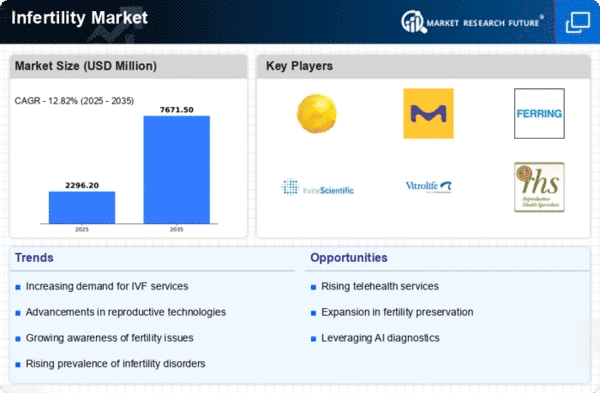
Infertility Market Infographic
Purchase Options

Market Analysis

In-depth Analysis of Infertility Market Industry Landscape

The growth of interventional cardiology centers is associated with an increased need for coronary stents. The creation of specialized facilities with cutting-edge medical equipment and knowledgeable staff members makes cardiac interventions—including the implantation of stents—more accessible to a wider range of patients. Imaging technology is included in the need for coronary stents. The effectiveness of coronary treatments is increased by intravascular imaging techniques, including intravascular ultrasound (IVUS) and optical coherence tomography (OCT), which help with accurate stent placement, optimal stent apposition, and general procedural guidance. The accessibility of stent treatments to patients is significantly influenced by the availability of reimbursement, which also shapes the cardiovascular care industry's market dynamics and economic factors. The influence of lifestyle-related variables on infertility is what defines the industry. The rising rate of infertility is a result of sedentary lives, stress, exposure to the environment, and poor dietary habits. This has an impact on market dynamics and has led to the creation of focused interventions to address lifestyle-related reproductive issues. The state of reproductive health in aging populations has a major impact on market dynamics. Advanced maternal and paternal age contribute to infertility as people put off having children, which affects market trends by requiring fertility therapies that are specifically designed to address the special difficulties associated with age-related fertility decrease. The combination of genetic and molecular diagnostics in evaluating infertility shapes the market. Advances in male reproductive health assessments, sperm quality analysis, and male-centric fertility interventions impact market trends by recognizing and addressing the role of male factors in infertility. Providing psychological and emotional support services is a defining feature of the market. Understanding the psychological toll that infertility takes, counseling and support services have an impact on market dynamics by improving the comprehensive approach to fertility care and attending to the mental health of people and couples receiving reproductive treatments. The demand for greater access to reproductive therapies and the issue of global health disparities have a big impact on market dynamics. A shift towards natural and holistic approaches to fertility characterizes the market dynamics. Integrative therapies, lifestyle modifications, and complementary medicine impact market trends by offering individuals alternative paths to fertility enhancement, complementing conventional treatments.


Author
Rahul Gotadki
Assistant Manager

He holds an experience of about 7+ years in Market Research and Business Consulting, working under the spectrum of Life Sciences and Healthcare domains. Rahul conceptualizes and implements a scalable business strategy and provides strategic leadership to the clients. His expertise lies in market estimation, competitive intelligence, pipeline analysis, customer assessment, etc. In addition to the above, his other responsibility includes strategic tracking of high growth markets & advising clients on the potential areas of focus they could direct their business initiatives

Leave a Comment

FAQs

What is the projected growth of the Infertility market?

The Infertility market is the expected increase in total market value of 7.67 USD billion over a defined forecast period 2025–2035. It is driven by factors such as demand trends, technological advances, regulatory changes, and geographic expansion.

What is the size of the Infertility market?

Infertility market size was valued at approximately 2.04 billion USD in 2024. This figure will reach 7.67 billion USD covering all regions (America, Europe, Asia, MEA and ROW), focusing its segments / services / distribution channels till 2035.

What is the CAGR of the Infertility market?

Infertility market is expected to grow at a CAGR of 12.82% between 2025 and 2035.

How much will the Infertility market be worth by 2035?

Infertility market is expected to be worth of 7.67 billion USD, reflecting growth driven by usage, technology and global demands by the end of 2035.

How will the Infertility market perform over the next 10 years?

Over the next 10 years the Infertility market is expected to shift from usd billion 2.04 to 7.67 billion USD, led by adoption of advanced tech, demographic trends, regulatory approvals, with potential headwinds from 2025 to 2035.

What is the expected market valuation for the Global Infertility Market by 2035?

By 2035, the Global Infertility Market is anticipated to reach a valuation of 30.5 USD Billion.

Which region is expected to have the largest market share in the Global Infertility Market in 2024?

North America is anticipated to hold the largest market share, valued at 7.52 USD Billion in 2024.

What will be the market size for Assisted Reproductive Technology by 2035?

The market size for Assisted Reproductive Technology is expected to reach 12.8 USD Billion by 2035.

Which key players are involved in the Global Infertility Market?

Major players include Ferring Pharmaceuticals, Boston IVF, OvaScience, and Thermo Fisher Scientific.

How is the European market for infertility expected to evolve by 2035?

The European market for infertility is projected to grow to 8.0 USD Billion by 2035.

Market Summary

As per MRFR analysis, the Infertility Market Size was estimated at 2035.28 USD Million in 2024. The Infertility industry is projected to grow from 2296.2 in 2025 to 7671.5 by 2035, exhibiting a compound annual growth rate (CAGR) of 12.82 during the forecast period 2025 - 2035.

Key Market Trends & Highlights

The infertility market is experiencing dynamic growth driven by technological advancements and changing societal attitudes.

  • Technological advancements in treatment are revolutionizing the infertility market, particularly in North America, which remains the largest market.
  • Increased awareness and education about infertility are fostering a more open dialogue, especially in the Asia-Pacific region, the fastest-growing market.
  • Changing demographics and family planning trends are influencing the demand for In Vitro Fertilization, the largest segment in the market.
  • The rising incidence of infertility and advancements in reproductive technologies are key drivers propelling growth in both Female Factor Infertility, the largest segment, and the rapidly growing Male Factor Infertility segment.

Market Size & Forecast

2024 Market Size 2035.28 (USD Million)
2035 Market Size 7671.5 (USD Million)
CAGR (2025 - 2035) 12.82%
Largest Regional Market Share in 2024 North America

Major Players

<p>CooperSurgical (US), Merck KGaA (DE), Ferring Pharmaceuticals (CH), Irvine Scientific (US), Vitrolife (SE), Reproductive Health Technologies (US), OvaScience (US), Genea Limited (AU), HRC Fertility (US)</p>

Market Trends

The Infertility Market is currently experiencing a notable transformation, driven by a confluence of factors that include advancements in medical technology, increasing awareness of reproductive health, and evolving societal norms regarding family planning. As individuals and couples seek solutions to infertility challenges, the demand for innovative treatments and services is on the rise. This market encompasses a wide array of offerings, from assisted reproductive technologies to fertility preservation methods, reflecting a growing recognition of the importance of reproductive health in overall well-being. Furthermore, the integration of telemedicine and digital health solutions is reshaping how patients access care, making it more convenient and accessible than ever before. In addition to technological advancements, the Infertility Market is influenced by shifting demographics and changing attitudes towards parenthood. Younger generations are increasingly prioritizing career development and personal fulfillment, often delaying family planning until later in life. This trend has led to a heightened awareness of fertility issues and a greater willingness to explore various treatment options. As a result, the market is poised for continued growth, with stakeholders focusing on enhancing patient experiences and expanding access to care. Overall, the Infertility Market appears to be evolving rapidly, reflecting broader societal changes and advancements in healthcare delivery.

Technological Advancements in Treatment

The Infertility Market is witnessing a surge in technological innovations that enhance treatment efficacy. Techniques such as in vitro fertilization and genetic screening are becoming more refined, leading to improved success rates. Additionally, the emergence of artificial intelligence in diagnostics and treatment planning is streamlining processes, potentially increasing patient satisfaction and outcomes.

Increased Awareness and Education

There is a growing emphasis on education surrounding reproductive health, which is influencing the Infertility Market. Campaigns aimed at raising awareness about infertility issues are becoming more prevalent, encouraging individuals to seek help sooner. This shift in perception is likely to drive demand for fertility services and support networks.

Changing Demographics and Family Planning Trends

Demographic shifts are significantly impacting the Infertility Market. As societal norms evolve, more individuals are choosing to delay parenthood for various reasons, including career aspirations and personal development. This trend is leading to an increased focus on fertility preservation options, as individuals seek to maintain their reproductive health for future family planning.

Infertility Market Market Drivers

Market Growth Projections

The Global Infertility Market Industry is projected to experience substantial growth in the coming years. By 2024, the market is anticipated to reach 19.7 USD Billion, with further expansion expected to 30.5 USD Billion by 2035. This growth trajectory indicates a compound annual growth rate (CAGR) of 4.03% from 2025 to 2035. Such projections highlight the increasing demand for infertility treatments and services, driven by factors such as rising infertility rates, technological advancements, and greater awareness. As the market evolves, stakeholders are likely to explore new opportunities for innovation and investment, positioning themselves to meet the needs of a growing patient population.

Rising Prevalence of Infertility

The Global Infertility Market Industry is witnessing a notable increase in infertility rates, attributed to various factors such as delayed childbearing and lifestyle changes. According to recent data, approximately 15% of couples globally experience infertility issues. This rising prevalence is driving demand for fertility treatments and services, contributing to the market's projected growth. By 2024, the market is expected to reach 19.7 USD Billion, reflecting a growing awareness and acceptance of assisted reproductive technologies. As more individuals seek solutions for infertility, the industry is likely to expand, fostering innovation in treatment options and enhancing patient access.

Government Initiatives and Support

Government policies and initiatives play a crucial role in shaping the Global Infertility Market Industry. Many countries are implementing programs to support infertility treatments, including funding for research and subsidies for patients. For example, some nations offer financial assistance for IVF procedures, making them more accessible to a broader population. These initiatives not only alleviate the financial burden on couples but also encourage the development of advanced fertility clinics and services. As governments recognize the importance of addressing infertility, the market is likely to benefit from increased investment and support, further driving growth in the coming years.

Demographic Shifts and Lifestyle Changes

Demographic changes, including an aging population and evolving lifestyle choices, are significantly impacting the Global Infertility Market Industry. As individuals prioritize education and career advancement, many are delaying family planning, which can lead to increased infertility rates. Additionally, lifestyle factors such as obesity, smoking, and stress are contributing to fertility challenges. These shifts necessitate a greater demand for fertility solutions, as couples seek to overcome the biological limitations associated with age and lifestyle. The market's growth is expected to reflect these demographic trends, with a notable increase in service utilization as awareness of fertility issues rises.

Technological Advancements in Fertility Treatments

Innovations in reproductive technologies are significantly influencing the Global Infertility Market Industry. Techniques such as in vitro fertilization (IVF), intracytoplasmic sperm injection (ICSI), and preimplantation genetic testing (PGT) are becoming increasingly sophisticated. These advancements not only improve success rates but also enhance patient experiences. For instance, the introduction of artificial intelligence in embryo selection has shown promising results in optimizing outcomes. As these technologies evolve, they are expected to attract more patients, thereby propelling the market forward. The anticipated growth trajectory suggests that by 2035, the market could reach 30.5 USD Billion, underscoring the importance of continuous innovation.

Increasing Awareness and Acceptance of Fertility Treatments

The Global Infertility Market Industry is experiencing a shift in societal attitudes towards fertility treatments. Increased awareness campaigns and educational initiatives are helping to destigmatize infertility and promote available treatment options. As a result, more individuals and couples are seeking assistance, leading to a rise in demand for fertility services. This trend is particularly evident in urban areas where access to information is more prevalent. The growing acceptance of assisted reproductive technologies is expected to contribute to a compound annual growth rate (CAGR) of 4.03% from 2025 to 2035, indicating a robust market expansion driven by informed consumer choices.

Market Segment Insights

By Treatment Type: In Vitro Fertilization (Largest) vs. Intracytoplasmic Sperm Injection (Fastest-Growing)

<p>The treatment landscape of the infertility market is prominently shaped by various techniques, with In Vitro Fertilization (IVF) holding the largest share due to its broad acceptance among fertility clinics and patients. IVF remains a cornerstone for addressing infertility issues faced by couples, leveraging advanced reproductive technologies. Close behind, Intracytoplasmic Sperm Injection (ICSI) is gaining traction, widely utilized in cases of male factor infertility. This segment showcases a competitive balance among diverse treatment options, reflecting the growing demand for effective and innovative solutions.</p>

<p>In Vitro Fertilization (Dominant) vs. Artificial Insemination (Emerging)</p>

<p>In Vitro Fertilization (IVF) stands as the dominant treatment modality within the infertility market, revered for its high success rates and comprehensive protocols that cater to a variety of infertility issues. Its extensive application in clinical settings, coupled with ongoing technological advancements, solidifies its position as a first-line treatment. Conversely, Artificial Insemination emerges as a viable, less invasive alternative that appeals to many couples grappling with fertility challenges. With minimal procedural risks and growing public awareness, Artificial Insemination is witnessing increased adoption, making it an increasingly relevant option for those looking to conceive.</p>

By Cause of Infertility: Female Factor Infertility (Largest) vs. Male Factor Infertility (Fastest-Growing)

<p>In the infertility market, Female Factor Infertility remains the largest segment, capturing significant market share due to increasing awareness and diagnosis capabilities. Male Factor Infertility, while smaller in share, is emerging as the fastest-growing category as more men seek treatment and awareness around male reproductive health enhances. Combined Infertility and Unexplained Infertility present substantial segments as well, but they generally follow the trends set by male and female factors in terms of growth and diagnosis.</p>

<p>Female Factor Infertility (Dominant) vs. Male Factor Infertility (Emerging)</p>

<p>Female Factor Infertility is characterized by conditions such as ovulatory disorders, age-related decline in fertility, and uterine abnormalities, positioning it as the dominant force in the infertility market. The rise in reproductive health screenings and advancements in assisted reproductive technologies have significantly bolstered its presence. Conversely, Male Factor Infertility, often attributed to issues like low sperm count or motility, is seeing rapid growth. Increasing acceptance and advocacy regarding male fertility health is transforming perceptions and driving demand for treatments, thus establishing it as an emerging segment. Both segments highlight the necessity for comprehensive fertility solutions.</p>

By Age Group: 25 to 34 (Largest) vs. 35 to 44 (Fastest-Growing)

<p>In the infertility market, the age group 25 to 34 holds the largest market share, primarily due to higher fertility rates and increased awareness of reproductive health in younger couples. This demographic often seeks interventions for infertility sooner, driving demand for various treatment options and services. Conversely, the age group 35 to 44 has emerged as the fastest-growing segment, reflecting changing societal norms where individuals are delaying childbirth. This group presents distinct challenges and opportunities, including a higher prevalence of infertility issues that necessitate advanced medical solutions. Growth trends in the infertility market are heavily influenced by factors like lifestyle changes, delayed marriages, and increased participation of women in the workforce. The rising awareness about infertility among older age groups is prompting more individuals to seek medical consultations and treatments. Moreover, advancements in reproductive technologies and treatment options tailored for older women are further contributing to the growth in this demographic, positioning it as a critically important area within the infertility market.</p>

<p>25 to 34 (Dominant) vs. 35 to 44 (Emerging)</p>

<p>The age group 25 to 34 stands as the dominant segment in the infertility market, characterized by younger couples who are proactive about their reproductive health. This demographic is typically more open to seeking fertility treatments and exploring options like In Vitro Fertilization (IVF). They often leverage advancements in reproductive technology and benefit from a broader range of options available to them. In contrast, the 35 to 44 age group is an emerging segment that faces distinct challenges. This population experiences a higher rate of infertility due to age-related factors affecting fertility. Consequently, they often require specialized treatment approaches, placing importance on customized healthcare solutions and support that address their specific needs. The disparity between these age groups highlights the evolving landscape of the infertility market.</p>

By Assisted Reproductive Technology: Cryopreservation (Largest) vs. Preimplantation Genetic Testing (Fastest-Growing)

<p>The Assisted Reproductive Technology segment within the infertility market showcases a diverse range of options, with Cryopreservation being the largest contributor. This method holds significant market share due to its extensive use in various fertility treatments, allowing for the preservation of eggs, sperm, and embryos, which is crucial for individuals and couples seeking assisted reproductive options. In contrast, Preimplantation Genetic Testing, while currently smaller in market share, is gaining traction due to rising consumer awareness and advancements in genetic screening technologies, providing critical insights into embryo viability, thereby enhancing the success rates of IVF procedures. The growth trends in this segment highlight a strong shift towards innovative and personalized reproductive solutions. The increasing incidence of infertility issues, coupled with advancements in medical technology and increasing investments in fertility clinics, are propelling the demand for both Cryopreservation and Preimplantation Genetic Testing. The latter's rapid adoption reflects a growing desire for genetic reassurance among prospective parents, indicating a promising outlook for continued expansion in the future.</p>

<p>Cryopreservation (Dominant) vs. Sperm Donation (Emerging)</p>

<p>Cryopreservation stands out as the dominant method within the Assisted Reproductive Technology segment due to its ability to preserve reproductive cells and embryos for future use, making it a cornerstone of fertility preservation strategies. This technique is especially beneficial for individuals facing medical treatments that may impair reproductive capabilities or for those who wish to delay parenthood. Conversely, Sperm Donation is emerging as a crucial alternative for many individuals and couples dealing with male infertility issues or those opting for single-parenthood. The increasing acceptance of sperm donation as a viable reproductive choice marks a significant societal shift and highlights a broader trend towards utilizing diverse reproductive technologies to accommodate varying reproductive needs.</p>

By Healthcare Setting: Fertility Clinics (Largest) vs. Telemedicine (Fastest-Growing)

<p>The infertility market within healthcare settings is primarily dominated by fertility clinics, which cater specifically to individuals seeking assisted reproductive technologies. These clinics hold a significant share due to their specialized services, personalized patient care, and advanced treatment options. In contrast, hospitals also play a critical role, providing a wide range of healthcare services that include infertility treatments, yet they often lack the dedicated focus of specialized clinics. Home care solutions and telemedicine are emerging segments, gaining traction as they offer convenience and innovative alternatives to traditional treatment methods.</p>

<p>Fertility Clinics (Dominant) vs. Telemedicine (Emerging)</p>

<p>Fertility clinics stand as the dominant force in the infertility market, offering tailored services that meet the unique needs of patients seeking fertility assistance. These clinics are equipped with cutting-edge technology and a team of specialists committed to helping individuals achieve pregnancy through various methods, such as in vitro fertilization (IVF) and intrauterine insemination (IUI). On the other hand, telemedicine is emerging rapidly as a supplementary option, providing patients access to fertility consultations and treatment plans from the comfort of their homes. This growth is driven by technological advancements and increasing patient demand for flexible healthcare solutions, allowing for a more comprehensive approach to treatment.</p>

Get more detailed insights about Infertility Market Research Report – Forecast to 2035

Regional Insights

North America : Leading Market for Infertility Solutions

North America is poised to maintain its leadership in the infertility market, holding a significant share of 1010.0 million in 2025. The region's growth is driven by increasing awareness of infertility issues, advancements in reproductive technologies, and supportive regulatory frameworks. The demand for assisted reproductive technologies (ART) is on the rise, fueled by changing societal norms and a growing number of fertility clinics. The competitive landscape is robust, with key players like CooperSurgical, Merck KGaA, and Irvine Scientific leading the charge. The U.S. is the primary market, supported by a high prevalence of infertility and a well-established healthcare infrastructure. The presence of innovative companies and ongoing research initiatives further enhance the region's market position, ensuring continued growth and development in infertility solutions.

Europe : Emerging Hub for Fertility Innovations

Europe's infertility market is projected to reach 680.0 million by 2025, driven by increasing investments in reproductive health and a growing acceptance of ART. Regulatory bodies are actively promoting fertility treatments, which has led to a surge in demand. The region benefits from a diverse healthcare landscape, with various countries implementing supportive policies to enhance access to fertility services. Leading countries such as Germany, France, and the UK are at the forefront of this market, with a strong presence of key players like Merck KGaA and Ferring Pharmaceuticals. The competitive environment is characterized by innovation and collaboration among healthcare providers, ensuring that patients have access to the latest treatments. As the market evolves, Europe is set to become a significant player in the global infertility landscape.

Asia-Pacific : Rapidly Growing Fertility Market

The Asia-Pacific infertility market is expected to grow significantly, reaching 300.0 million by 2025. This growth is driven by rising awareness of infertility issues, increasing disposable incomes, and a shift towards urbanization. Countries in this region are witnessing a growing acceptance of ART, supported by favorable government policies and initiatives aimed at improving reproductive health. Key players like Genea Limited and OvaScience are making strides in this market, particularly in countries like Australia and Japan. The competitive landscape is evolving, with local and international companies vying for market share. As the region continues to develop its healthcare infrastructure, the demand for infertility treatments is anticipated to rise, positioning Asia-Pacific as a vital market in the global context.

Middle East and Africa : Emerging Market with Growth Potential

The Middle East and Africa (MEA) infertility market is projected to reach 45.28 million by 2025, driven by increasing awareness and a growing number of fertility clinics. The region is witnessing a gradual shift towards accepting ART, supported by government initiatives aimed at enhancing reproductive health services. The demand for infertility treatments is on the rise, particularly in urban areas where healthcare access is improving. Countries like South Africa and the UAE are leading the market, with a growing presence of key players such as HRC Fertility. The competitive landscape is characterized by a mix of local and international providers, all striving to meet the increasing demand for fertility solutions. As the MEA region continues to develop, it holds significant potential for growth in the infertility market.

Key Players and Competitive Insights

The Infertility Market is characterized by a dynamic competitive landscape, driven by increasing awareness of reproductive health and advancements in assisted reproductive technologies (ART). Key players such as CooperSurgical (US), Merck KGaA (DE), and Ferring Pharmaceuticals (CH) are strategically positioned to leverage innovation and expand their market presence. CooperSurgical (US) focuses on enhancing its product portfolio through strategic acquisitions, while Merck KGaA (DE) emphasizes research and development to introduce cutting-edge solutions. Ferring Pharmaceuticals (CH) is actively pursuing partnerships to enhance its global reach, thereby shaping a competitive environment that is increasingly collaborative and innovation-driven.

The market structure appears moderately fragmented, with several players vying for market share through localized manufacturing and optimized supply chains. This fragmentation allows for a diverse range of products and services, catering to various consumer needs. The collective influence of these key players fosters a competitive atmosphere where innovation and operational efficiency are paramount, enabling them to respond swiftly to market demands and consumer preferences.

In November 2025, Merck KGaA (DE) announced a groundbreaking partnership with a leading biotechnology firm to develop next-generation fertility treatments. This collaboration is poised to enhance Merck's capabilities in gene editing technologies, potentially revolutionizing the treatment landscape for infertility. The strategic importance of this partnership lies in its potential to position Merck at the forefront of innovative solutions, thereby attracting a broader customer base and reinforcing its competitive edge.

In October 2025, Ferring Pharmaceuticals (CH) launched a new digital platform aimed at providing personalized fertility solutions to patients. This initiative reflects Ferring's commitment to integrating technology into its offerings, enhancing patient engagement and satisfaction. The strategic significance of this digital transformation is evident, as it not only streamlines patient access to information but also aligns with the growing trend of telehealth in reproductive medicine.

In September 2025, CooperSurgical (US) completed the acquisition of a prominent fertility clinic network, significantly expanding its operational footprint in North America. This acquisition is strategically vital as it allows CooperSurgical to integrate clinical services with its product offerings, creating a comprehensive ecosystem for fertility care. Such vertical integration may enhance customer loyalty and provide a competitive advantage in a crowded marketplace.

As of December 2025, the Infertility Market is witnessing trends such as digitalization, sustainability, and the integration of artificial intelligence (AI) into treatment protocols. Strategic alliances are increasingly shaping the competitive landscape, enabling companies to pool resources and expertise. Looking ahead, competitive differentiation is likely to evolve from traditional price-based competition to a focus on innovation, technological advancements, and supply chain reliability. This shift underscores the importance of agility and responsiveness in meeting the evolving needs of consumers in the infertility sector.

Key Companies in the Infertility Market market include

Industry Developments

The Global Infertility Market has seen notable developments recently, driven by advancements in reproductive technologies and increased awareness surrounding infertility issues. Companies such as Ferring Pharmaceuticals, Boston IVF, and Merck KGaA have been actively involved in launching innovative fertility treatments. 

For instance, in July 2023, Ferring Pharmaceuticals introduced a new product aimed at enhancing fertility efficiency, which is anticipated to improve patient outcomes. Significant mergers and acquisitions also characterize the market; Cook Medical acquired MediCorp in August 2023, aiming to expand its portfolio in reproductive health technologies, with major implications for collaboration and innovation in the sector. Furthermore, the valuation of companies like IVF Technologies and Vitrolife has surged due to rising demand for assisted reproductive technologies, reflecting a broader trend of increasing allocations towards Research and Development in this area. 

Over the last couple of years, a substantial shift towards telemedicine in fertility consultations has transformed patient access and care, indicating evolving consumer preferences in the Global Infertility Market landscape. As awareness grows and technology advances, the market is poised for sustained growth in the upcoming years.

Future Outlook

Infertility Market Future Outlook

<p>The Infertility Market is projected to grow at a 12.82% CAGR from 2024 to 2035, driven by technological advancements, increasing awareness, and rising infertility rates.</p>

New opportunities lie in:

  • <p>Development of AI-driven fertility assessment tools</p>
  • <p>Expansion of telehealth services for fertility consultations</p>
  • <p>Investment in personalized fertility treatment plans</p>

<p>By 2035, the Infertility Market is expected to be robust, reflecting substantial growth and innovation.</p>

Market Segmentation

Infertility Market Age Group Outlook

  • Under 25
  • 25 to 34
  • 35 to 44
  • 45 and Above

Infertility Market Treatment Type Outlook

  • In Vitro Fertilization
  • Intracytoplasmic Sperm Injection
  • Artificial Insemination
  • Ovulation Induction

Infertility Market Healthcare Setting Outlook

  • Fertility Clinics
  • Hospitals
  • Home Care
  • Telemedicine

Infertility Market Cause of Infertility Outlook

  • Male Factor Infertility
  • Female Factor Infertility
  • Unexplained Infertility
  • Combined Infertility

Infertility Market Assisted Reproductive Technology Outlook

  • Cryopreservation
  • Preimplantation Genetic Testing
  • Sperm Donation
  • Egg Donation

Report Scope

MARKET SIZE 20242035.28(USD Million)
MARKET SIZE 20252296.2(USD Million)
MARKET SIZE 20357671.5(USD Million)
COMPOUND ANNUAL GROWTH RATE (CAGR)12.82% (2024 - 2035)
REPORT COVERAGERevenue Forecast, Competitive Landscape, Growth Factors, and Trends
BASE YEAR2024
Market Forecast Period2025 - 2035
Historical Data2019 - 2024
Market Forecast UnitsUSD Million
Key Companies ProfiledCooperSurgical (US), Merck KGaA (DE), Ferring Pharmaceuticals (CH), Irvine Scientific (US), Vitrolife (SE), Reproductive Health Technologies (US), OvaScience (US), Genea Limited (AU), HRC Fertility (US)
Segments CoveredTreatment Type, Cause of Infertility, Age Group, Assisted Reproductive Technology, Healthcare Setting
Key Market OpportunitiesAdvancements in personalized reproductive technologies enhance treatment efficacy in the Infertility Market.
Key Market DynamicsRising demand for assisted reproductive technologies drives innovation and competition among infertility treatment providers.
Countries CoveredNorth America, Europe, APAC, South America, MEA

FAQs

What is the projected growth of the Infertility market?

The Infertility market is the expected increase in total market value of 7.67 USD billion over a defined forecast period 2025–2035. It is driven by factors such as demand trends, technological advances, regulatory changes, and geographic expansion.

What is the size of the Infertility market?

Infertility market size was valued at approximately 2.04 billion USD in 2024. This figure will reach 7.67 billion USD covering all regions (America, Europe, Asia, MEA and ROW), focusing its segments / services / distribution channels till 2035.

What is the CAGR of the Infertility market?

Infertility market is expected to grow at a CAGR of 12.82% between 2025 and 2035.

How much will the Infertility market be worth by 2035?

Infertility market is expected to be worth of 7.67 billion USD, reflecting growth driven by usage, technology and global demands by the end of 2035.

How will the Infertility market perform over the next 10 years?

Over the next 10 years the Infertility market is expected to shift from usd billion 2.04 to 7.67 billion USD, led by adoption of advanced tech, demographic trends, regulatory approvals, with potential headwinds from 2025 to 2035.

What is the expected market valuation for the Global Infertility Market by 2035?

By 2035, the Global Infertility Market is anticipated to reach a valuation of 30.5 USD Billion.

Which region is expected to have the largest market share in the Global Infertility Market in 2024?

North America is anticipated to hold the largest market share, valued at 7.52 USD Billion in 2024.

What will be the market size for Assisted Reproductive Technology by 2035?

The market size for Assisted Reproductive Technology is expected to reach 12.8 USD Billion by 2035.

Which key players are involved in the Global Infertility Market?

Major players include Ferring Pharmaceuticals, Boston IVF, OvaScience, and Thermo Fisher Scientific.

How is the European market for infertility expected to evolve by 2035?

The European market for infertility is projected to grow to 8.0 USD Billion by 2035.

  1. EXECUTIVE SUMMARY
    1. Market Overview
    2. Key Findings
    3. Market Segmentation
    4. Competitive Landscape
    5. Challenges and Opportunities
    6. Future Outlook
  2. MARKET INTRODUCTION
    1. Definition
    2. Scope of the study
    3. Research Objective
    4. Assumption
    5. Limitations
  3. RESEARCH METHODOLOGY
    1. Overview
    2. Data Mining
    3. Secondary Research
    4. Primary Research
    5. Primary Interviews and Information Gathering Process
    6. Breakdown of Primary Respondents
    7. Forecasting Model
    8. Market Size Estimation
    9. Bottom-Up Approach
    10. Top-Down Approach
    11. Data Triangulation
    12. Validation
  4. MARKET DYNAMICS
    1. Overview
    2. Drivers
    3. Restraints
    4. Opportunities
  5. MARKET FACTOR ANALYSIS
    1. Value chain Analysis
    2. Porter's Five Forces Analysis
    3. Bargaining Power of Suppliers
    4. Bargaining Power of Buyers
    5. Threat of New Entrants
    6. Threat of Substitutes
    7. Intensity of Rivalry
    8. COVID-19 Impact Analysis
    9. Market Impact Analysis
    10. Regional Impact
    11. Opportunity and Threat Analysis
  6. Infertility Market, BY Treatment Type (USD Billion)
    1. Assisted Reproductive Technology
    2. Hormone Therapy
    3. Surgery
    4. Fertility Preservation
  7. Infertility Market, BY End User (USD Billion)
    1. Hospitals
    2. Fertility Clinics
    3. Home Care Settings
  8. Infertility Market, BY Gender (USD Billion)
    1. Female
    2. Male
  9. Infertility Market, BY Cause of Infertility (USD Billion)
    1. Ovulatory Disorders
    2. Uterine or Cervical Abnormalities
    3. Tubal Factors
    4. Male Factor Infertility
  10. Infertility Market, BY Regional (USD Billion)
    1. North America
    2. US
    3. Canada
    4. Europe
    5. Germany
    6. UK
    7. France
    8. Russia
    9. Italy
    10. Spain
    11. Rest of Europe
    12. APAC
    13. China
    14. India
    15. Japan
    16. South Korea
    17. Malaysia
    18. Thailand
    19. Indonesia
    20. Rest of APAC
    21. South America
    22. Brazil
    23. Mexico
    24. Argentina
    25. Rest of South America
    26. MEA
    27. GCC Countries
    28. South Africa
    29. Rest of MEA
    30. Competitive Landscape
    31. Overview
    32. Competitive Analysis
    33. Market share Analysis
    34. Major Growth Strategy in the Infertility Market
    35. Competitive Benchmarking
    36. Leading Players in Terms of Number of Developments in the Infertility Market
    37. Key developments and growth strategies
    38. New Product Launch/Service Deployment
    39. Merger & Acquisitions
    40. Joint Ventures
    41. Major Players Financial Matrix
    42. Sales and Operating Income
    43. Major Players R&D Expenditure. 2023
    44. Company Profiles
    45. Ferring Pharmaceuticals
    46. Financial Overview
    47. Products Offered
    48. Key Developments
    49. SWOT Analysis
    50. Key Strategies
    51. Boston IVF
    52. Financial Overview
    53. Products Offered
    54. Key Developments
    55. SWOT Analysis
    56. Key Strategies
    57. OvaScience
    58. Financial Overview
    59. Products Offered
    60. Key Developments
    61. SWOT Analysis
    62. Key Strategies
    63. Thermo Fisher Scientific
    64. Financial Overview
    65. Products Offered
    66. Key Developments
    67. SWOT Analysis
    68. Key Strategies
    69. Cook Medical
    70. Financial Overview
    71. Products Offered
    72. Key Developments
    73. SWOT Analysis
    74. Key Strategies
    75. IVF Technologies
    76. Financial Overview
    77. Products Offered
    78. Key Developments
    79. SWOT Analysis
    80. Key Strategies
    81. CryoBank
    82. Financial Overview
    83. Products Offered
    84. Key Developments
    85. SWOT Analysis
    86. Key Strategies
    87. Merck KGaA
    88. Financial Overview
    89. Products Offered
    90. Key Developments
    91. SWOT Analysis
    92. Key Strategies
    93. MediCorp
    94. Financial Overview
    95. Products Offered
    96. Key Developments
    97. SWOT Analysis
    98. Key Strategies
    99. Vitrolife
    100. Financial Overview
    101. Products Offered
    102. Key Developments
    103. SWOT Analysis
    104. Key Strategies
    105. Genea Limited
    106. Financial Overview
    107. Products Offered
    108. Key Developments
    109. SWOT Analysis
    110. Key Strategies
    111. CooperSurgical
    112. Financial Overview
    113. Products Offered
    114. Key Developments
    115. SWOT Analysis
    116. Key Strategies
    117. ReproTech
    118. Financial Overview
    119. Products Offered
    120. Key Developments
    121. SWOT Analysis
    122. Key Strategies
    123. Irvine Scientific
    124. Financial Overview
    125. Products Offered
    126. Key Developments
    127. SWOT Analysis
    128. Key Strategies
    129. Eugin Group
    130. Financial Overview
    131. Products Offered
    132. Key Developments
    133. SWOT Analysis
    134. Key Strategies
    135. Appendix
    136. References
    137. Related Reports
    138. LIST Of tables
  11. LIST OF ASSUMPTIONS
  12. North America Infertility Market SIZE ESTIMATES & FORECAST, BY TREATMENT TYPE, 2019-2035 (USD Billions)
  13. North America Infertility Market SIZE ESTIMATES & FORECAST, BY END USER, 2019-2035 (USD Billions)
  14. North America Infertility Market SIZE ESTIMATES & FORECAST, BY GENDER, 2019-2035 (USD Billions)
  15. North America Infertility Market SIZE ESTIMATES & FORECAST, BY CAUSE OF INFERTILITY, 2019-2035 (USD Billions)
  16. North America Infertility Market SIZE ESTIMATES & FORECAST, BY REGIONAL, 2019-2035 (USD Billions)
  17. US Infertility Market SIZE ESTIMATES & FORECAST, BY TREATMENT TYPE, 2019-2035 (USD Billions)
  18. US Infertility Market SIZE ESTIMATES & FORECAST, BY END USER, 2019-2035 (USD Billions)
  19. US Infertility Market SIZE ESTIMATES & FORECAST, BY GENDER, 2019-2035 (USD Billions)
  20. US Infertility Market SIZE ESTIMATES & FORECAST, BY CAUSE OF INFERTILITY, 2019-2035 (USD Billions)
  21. US Infertility Market SIZE ESTIMATES & FORECAST, BY REGIONAL, 2019-2035 (USD Billions)
  22. Canada Infertility Market SIZE ESTIMATES & FORECAST, BY TREATMENT TYPE, 2019-2035 (USD Billions)
  23. Canada Infertility Market SIZE ESTIMATES & FORECAST, BY END USER, 2019-2035 (USD Billions)
  24. Canada Infertility Market SIZE ESTIMATES & FORECAST, BY GENDER, 2019-2035 (USD Billions)
  25. Canada Infertility Market SIZE ESTIMATES & FORECAST, BY CAUSE OF INFERTILITY, 2019-2035 (USD Billions)
  26. Canada Infertility Market SIZE ESTIMATES & FORECAST, BY REGIONAL, 2019-2035 (USD Billions)
  27. Europe Infertility Market SIZE ESTIMATES & FORECAST, BY TREATMENT TYPE, 2019-2035 (USD Billions)
  28. Europe Infertility Market SIZE ESTIMATES & FORECAST, BY END USER, 2019-2035 (USD Billions)
  29. Europe Infertility Market SIZE ESTIMATES & FORECAST, BY GENDER, 2019-2035 (USD Billions)
  30. Europe Infertility Market SIZE ESTIMATES & FORECAST, BY CAUSE OF INFERTILITY, 2019-2035 (USD Billions)
  31. Europe Infertility Market SIZE ESTIMATES & FORECAST, BY REGIONAL, 2019-2035 (USD Billions)
  32. Germany Infertility Market SIZE ESTIMATES & FORECAST, BY TREATMENT TYPE, 2019-2035 (USD Billions)
  33. Germany Infertility Market SIZE ESTIMATES & FORECAST, BY END USER, 2019-2035 (USD Billions)
  34. Germany Infertility Market SIZE ESTIMATES & FORECAST, BY GENDER, 2019-2035 (USD Billions)
  35. Germany Infertility Market SIZE ESTIMATES & FORECAST, BY CAUSE OF INFERTILITY, 2019-2035 (USD Billions)
  36. Germany Infertility Market SIZE ESTIMATES & FORECAST, BY REGIONAL, 2019-2035 (USD Billions)
  37. UK Infertility Market SIZE ESTIMATES & FORECAST, BY TREATMENT TYPE, 2019-2035 (USD Billions)
  38. UK Infertility Market SIZE ESTIMATES & FORECAST, BY END USER, 2019-2035 (USD Billions)
  39. UK Infertility Market SIZE ESTIMATES & FORECAST, BY GENDER, 2019-2035 (USD Billions)
  40. UK Infertility Market SIZE ESTIMATES & FORECAST, BY CAUSE OF INFERTILITY, 2019-2035 (USD Billions)
  41. UK Infertility Market SIZE ESTIMATES & FORECAST, BY REGIONAL, 2019-2035 (USD Billions)
  42. France Infertility Market SIZE ESTIMATES & FORECAST, BY TREATMENT TYPE, 2019-2035 (USD Billions)
  43. France Infertility Market SIZE ESTIMATES & FORECAST, BY END USER, 2019-2035 (USD Billions)
  44. France Infertility Market SIZE ESTIMATES & FORECAST, BY GENDER, 2019-2035 (USD Billions)
  45. France Infertility Market SIZE ESTIMATES & FORECAST, BY CAUSE OF INFERTILITY, 2019-2035 (USD Billions)
  46. France Infertility Market SIZE ESTIMATES & FORECAST, BY REGIONAL, 2019-2035 (USD Billions)
  47. Russia Infertility Market SIZE ESTIMATES & FORECAST, BY TREATMENT TYPE, 2019-2035 (USD Billions)
  48. Russia Infertility Market SIZE ESTIMATES & FORECAST, BY END USER, 2019-2035 (USD Billions)
  49. Russia Infertility Market SIZE ESTIMATES & FORECAST, BY GENDER, 2019-2035 (USD Billions)
  50. Russia Infertility Market SIZE ESTIMATES & FORECAST, BY CAUSE OF INFERTILITY, 2019-2035 (USD Billions)
  51. Russia Infertility Market SIZE ESTIMATES & FORECAST, BY REGIONAL, 2019-2035 (USD Billions)
  52. Italy Infertility Market SIZE ESTIMATES & FORECAST, BY TREATMENT TYPE, 2019-2035 (USD Billions)
  53. Italy Infertility Market SIZE ESTIMATES & FORECAST, BY END USER, 2019-2035 (USD Billions)
  54. Italy Infertility Market SIZE ESTIMATES & FORECAST, BY GENDER, 2019-2035 (USD Billions)
  55. Italy Infertility Market SIZE ESTIMATES & FORECAST, BY CAUSE OF INFERTILITY, 2019-2035 (USD Billions)
  56. Italy Infertility Market SIZE ESTIMATES & FORECAST, BY REGIONAL, 2019-2035 (USD Billions)
  57. Spain Infertility Market SIZE ESTIMATES & FORECAST, BY TREATMENT TYPE, 2019-2035 (USD Billions)
  58. Spain Infertility Market SIZE ESTIMATES & FORECAST, BY END USER, 2019-2035 (USD Billions)
  59. Spain Infertility Market SIZE ESTIMATES & FORECAST, BY GENDER, 2019-2035 (USD Billions)
  60. Spain Infertility Market SIZE ESTIMATES & FORECAST, BY CAUSE OF INFERTILITY, 2019-2035 (USD Billions)
  61. Spain Infertility Market SIZE ESTIMATES & FORECAST, BY REGIONAL, 2019-2035 (USD Billions)
  62. Rest of Europe Infertility Market SIZE ESTIMATES & FORECAST, BY TREATMENT TYPE, 2019-2035 (USD Billions)
  63. Rest of Europe Infertility Market SIZE ESTIMATES & FORECAST, BY END USER, 2019-2035 (USD Billions)
  64. Rest of Europe Infertility Market SIZE ESTIMATES & FORECAST, BY GENDER, 2019-2035 (USD Billions)
  65. Rest of Europe Infertility Market SIZE ESTIMATES & FORECAST, BY CAUSE OF INFERTILITY, 2019-2035 (USD Billions)
  66. Rest of Europe Infertility Market SIZE ESTIMATES & FORECAST, BY REGIONAL, 2019-2035 (USD Billions)
  67. APAC Infertility Market SIZE ESTIMATES & FORECAST, BY TREATMENT TYPE, 2019-2035 (USD Billions)
  68. APAC Infertility Market SIZE ESTIMATES & FORECAST, BY END USER, 2019-2035 (USD Billions)
  69. APAC Infertility Market SIZE ESTIMATES & FORECAST, BY GENDER, 2019-2035 (USD Billions)
  70. APAC Infertility Market SIZE ESTIMATES & FORECAST, BY CAUSE OF INFERTILITY, 2019-2035 (USD Billions)
  71. APAC Infertility Market SIZE ESTIMATES & FORECAST, BY REGIONAL, 2019-2035 (USD Billions)
  72. China Infertility Market SIZE ESTIMATES & FORECAST, BY TREATMENT TYPE, 2019-2035 (USD Billions)
  73. China Infertility Market SIZE ESTIMATES & FORECAST, BY END USER, 2019-2035 (USD Billions)
  74. China Infertility Market SIZE ESTIMATES & FORECAST, BY GENDER, 2019-2035 (USD Billions)
  75. China Infertility Market SIZE ESTIMATES & FORECAST, BY CAUSE OF INFERTILITY, 2019-2035 (USD Billions)
  76. China Infertility Market SIZE ESTIMATES & FORECAST, BY REGIONAL, 2019-2035 (USD Billions)
  77. India Infertility Market SIZE ESTIMATES & FORECAST, BY TREATMENT TYPE, 2019-2035 (USD Billions)
  78. India Infertility Market SIZE ESTIMATES & FORECAST, BY END USER, 2019-2035 (USD Billions)
  79. India Infertility Market SIZE ESTIMATES & FORECAST, BY GENDER, 2019-2035 (USD Billions)
  80. India Infertility Market SIZE ESTIMATES & FORECAST, BY CAUSE OF INFERTILITY, 2019-2035 (USD Billions)
  81. India Infertility Market SIZE ESTIMATES & FORECAST, BY REGIONAL, 2019-2035 (USD Billions)
  82. Japan Infertility Market SIZE ESTIMATES & FORECAST, BY TREATMENT TYPE, 2019-2035 (USD Billions)
  83. Japan Infertility Market SIZE ESTIMATES & FORECAST, BY END USER, 2019-2035 (USD Billions)
  84. Japan Infertility Market SIZE ESTIMATES & FORECAST, BY GENDER, 2019-2035 (USD Billions)
  85. Japan Infertility Market SIZE ESTIMATES & FORECAST, BY CAUSE OF INFERTILITY, 2019-2035 (USD Billions)
  86. Japan Infertility Market SIZE ESTIMATES & FORECAST, BY REGIONAL, 2019-2035 (USD Billions)
  87. South Korea Infertility Market SIZE ESTIMATES & FORECAST, BY TREATMENT TYPE, 2019-2035 (USD Billions)
  88. South Korea Infertility Market SIZE ESTIMATES & FORECAST, BY END USER, 2019-2035 (USD Billions)
  89. South Korea Infertility Market SIZE ESTIMATES & FORECAST, BY GENDER, 2019-2035 (USD Billions)
  90. South Korea Infertility Market SIZE ESTIMATES & FORECAST, BY CAUSE OF INFERTILITY, 2019-2035 (USD Billions)
  91. South Korea Infertility Market SIZE ESTIMATES & FORECAST, BY REGIONAL, 2019-2035 (USD Billions)
  92. Malaysia Infertility Market SIZE ESTIMATES & FORECAST, BY TREATMENT TYPE, 2019-2035 (USD Billions)
  93. Malaysia Infertility Market SIZE ESTIMATES & FORECAST, BY END USER, 2019-2035 (USD Billions)
  94. Malaysia Infertility Market SIZE ESTIMATES & FORECAST, BY GENDER, 2019-2035 (USD Billions)
  95. Malaysia Infertility Market SIZE ESTIMATES & FORECAST, BY CAUSE OF INFERTILITY, 2019-2035 (USD Billions)
  96. Malaysia Infertility Market SIZE ESTIMATES & FORECAST, BY REGIONAL, 2019-2035 (USD Billions)
  97. Thailand Infertility Market SIZE ESTIMATES & FORECAST, BY TREATMENT TYPE, 2019-2035 (USD Billions)
  98. Thailand Infertility Market SIZE ESTIMATES & FORECAST, BY END USER, 2019-2035 (USD Billions)
  99. Thailand Infertility Market SIZE ESTIMATES & FORECAST, BY GENDER, 2019-2035 (USD Billions)
  100. Thailand Infertility Market SIZE ESTIMATES & FORECAST, BY CAUSE OF INFERTILITY, 2019-2035 (USD Billions)
  101. Thailand Infertility Market SIZE ESTIMATES & FORECAST, BY REGIONAL, 2019-2035 (USD Billions)
  102. Indonesia Infertility Market SIZE ESTIMATES & FORECAST, BY TREATMENT TYPE, 2019-2035 (USD Billions)
  103. Indonesia Infertility Market SIZE ESTIMATES & FORECAST, BY END USER, 2019-2035 (USD Billions)
  104. Indonesia Infertility Market SIZE ESTIMATES & FORECAST, BY GENDER, 2019-2035 (USD Billions)
  105. Indonesia Infertility Market SIZE ESTIMATES & FORECAST, BY CAUSE OF INFERTILITY, 2019-2035 (USD Billions)
  106. Indonesia Infertility Market SIZE ESTIMATES & FORECAST, BY REGIONAL, 2019-2035 (USD Billions)
  107. Rest of APAC Infertility Market SIZE ESTIMATES & FORECAST, BY TREATMENT TYPE, 2019-2035 (USD Billions)
  108. Rest of APAC Infertility Market SIZE ESTIMATES & FORECAST, BY END USER, 2019-2035 (USD Billions)
  109. Rest of APAC Infertility Market SIZE ESTIMATES & FORECAST, BY GENDER, 2019-2035 (USD Billions)
  110. Rest of APAC Infertility Market SIZE ESTIMATES & FORECAST, BY CAUSE OF INFERTILITY, 2019-2035 (USD Billions)
  111. Rest of APAC Infertility Market SIZE ESTIMATES & FORECAST, BY REGIONAL, 2019-2035 (USD Billions)
  112. South America Infertility Market SIZE ESTIMATES & FORECAST, BY TREATMENT TYPE, 2019-2035 (USD Billions)
  113. South America Infertility Market SIZE ESTIMATES & FORECAST, BY END USER, 2019-2035 (USD Billions)
  114. South America Infertility Market SIZE ESTIMATES & FORECAST, BY GENDER, 2019-2035 (USD Billions)
  115. South America Infertility Market SIZE ESTIMATES & FORECAST, BY CAUSE OF INFERTILITY, 2019-2035 (USD Billions)
  116. South America Infertility Market SIZE ESTIMATES & FORECAST, BY REGIONAL, 2019-2035 (USD Billions)
  117. Brazil Infertility Market SIZE ESTIMATES & FORECAST, BY TREATMENT TYPE, 2019-2035 (USD Billions)
  118. Brazil Infertility Market SIZE ESTIMATES & FORECAST, BY END USER, 2019-2035 (USD Billions)
  119. Brazil Infertility Market SIZE ESTIMATES & FORECAST, BY GENDER, 2019-2035 (USD Billions)
  120. Brazil Infertility Market SIZE ESTIMATES & FORECAST, BY CAUSE OF INFERTILITY, 2019-2035 (USD Billions)
  121. Brazil Infertility Market SIZE ESTIMATES & FORECAST, BY REGIONAL, 2019-2035 (USD Billions)
  122. Mexico Infertility Market SIZE ESTIMATES & FORECAST, BY TREATMENT TYPE, 2019-2035 (USD Billions)
  123. Mexico Infertility Market SIZE ESTIMATES & FORECAST, BY END USER, 2019-2035 (USD Billions)
  124. Mexico Infertility Market SIZE ESTIMATES & FORECAST, BY GENDER, 2019-2035 (USD Billions)
  125. Mexico Infertility Market SIZE ESTIMATES & FORECAST, BY CAUSE OF INFERTILITY, 2019-2035 (USD Billions)
  126. Mexico Infertility Market SIZE ESTIMATES & FORECAST, BY REGIONAL, 2019-2035 (USD Billions)
  127. Argentina Infertility Market SIZE ESTIMATES & FORECAST, BY TREATMENT TYPE, 2019-2035 (USD Billions)
  128. Argentina Infertility Market SIZE ESTIMATES & FORECAST, BY END USER, 2019-2035 (USD Billions)
  129. Argentina Infertility Market SIZE ESTIMATES & FORECAST, BY GENDER, 2019-2035 (USD Billions)
  130. Argentina Infertility Market SIZE ESTIMATES & FORECAST, BY CAUSE OF INFERTILITY, 2019-2035 (USD Billions)
  131. Argentina Infertility Market SIZE ESTIMATES & FORECAST, BY REGIONAL, 2019-2035 (USD Billions)
  132. Rest of South America Infertility Market SIZE ESTIMATES & FORECAST, BY TREATMENT TYPE, 2019-2035 (USD Billions)
  133. Rest of South America Infertility Market SIZE ESTIMATES & FORECAST, BY END USER, 2019-2035 (USD Billions)
  134. Rest of South America Infertility Market SIZE ESTIMATES & FORECAST, BY GENDER, 2019-2035 (USD Billions)
  135. Rest of South America Infertility Market SIZE ESTIMATES & FORECAST, BY CAUSE OF INFERTILITY, 2019-2035 (USD Billions)
  136. Rest of South America Infertility Market SIZE ESTIMATES & FORECAST, BY REGIONAL, 2019-2035 (USD Billions)
  137. MEA Infertility Market SIZE ESTIMATES & FORECAST, BY TREATMENT TYPE, 2019-2035 (USD Billions)
  138. MEA Infertility Market SIZE ESTIMATES & FORECAST, BY END USER, 2019-2035 (USD Billions)
  139. MEA Infertility Market SIZE ESTIMATES & FORECAST, BY GENDER, 2019-2035 (USD Billions)
  140. MEA Infertility Market SIZE ESTIMATES & FORECAST, BY CAUSE OF INFERTILITY, 2019-2035 (USD Billions)
  141. MEA Infertility Market SIZE ESTIMATES & FORECAST, BY REGIONAL, 2019-2035 (USD Billions)
  142. GCC Countries Infertility Market SIZE ESTIMATES & FORECAST, BY TREATMENT TYPE, 2019-2035 (USD Billions)
  143. GCC Countries Infertility Market SIZE ESTIMATES & FORECAST, BY END USER, 2019-2035 (USD Billions)
  144. GCC Countries Infertility Market SIZE ESTIMATES & FORECAST, BY GENDER, 2019-2035 (USD Billions)
  145. GCC Countries Infertility Market SIZE ESTIMATES & FORECAST, BY CAUSE OF INFERTILITY, 2019-2035 (USD Billions)
  146. GCC Countries Infertility Market SIZE ESTIMATES & FORECAST, BY REGIONAL, 2019-2035 (USD Billions)
  147. South Africa Infertility Market SIZE ESTIMATES & FORECAST, BY TREATMENT TYPE, 2019-2035 (USD Billions)
  148. South Africa Infertility Market SIZE ESTIMATES & FORECAST, BY END USER, 2019-2035 (USD Billions)
  149. South Africa Infertility Market SIZE ESTIMATES & FORECAST, BY GENDER, 2019-2035 (USD Billions)
  150. South Africa Infertility Market SIZE ESTIMATES & FORECAST, BY CAUSE OF INFERTILITY, 2019-2035 (USD Billions)
  151. South Africa Infertility Market SIZE ESTIMATES & FORECAST, BY REGIONAL, 2019-2035 (USD Billions)
  152. Rest of MEA Infertility Market SIZE ESTIMATES & FORECAST, BY TREATMENT TYPE, 2019-2035 (USD Billions)
  153. Rest of MEA Infertility Market SIZE ESTIMATES & FORECAST, BY END USER, 2019-2035 (USD Billions)
  154. Rest of MEA Infertility Market SIZE ESTIMATES & FORECAST, BY GENDER, 2019-2035 (USD Billions)
  155. Rest of MEA Infertility Market SIZE ESTIMATES & FORECAST, BY CAUSE OF INFERTILITY, 2019-2035 (USD Billions)
  156. Rest of MEA Infertility Market SIZE ESTIMATES & FORECAST, BY REGIONAL, 2019-2035 (USD Billions)
    1. PRODUCT LAUNCH/PRODUCT DEVELOPMENT/APPROVAL
    2. ACQUISITION/PARTNERSHIP
    3. LIST Of figures
  157. MARKET SYNOPSIS
  158. NORTH AMERICA INFERTILITY MARKET ANALYSIS
    1. US INFERTILITY MARKET ANALYSIS BY TREATMENT TYPE
    2. US INFERTILITY MARKET ANALYSIS BY END USER
    3. US INFERTILITY MARKET ANALYSIS BY GENDER
    4. US INFERTILITY MARKET ANALYSIS BY CAUSE OF INFERTILITY
    5. US INFERTILITY MARKET ANALYSIS BY REGIONAL
    6. CANADA INFERTILITY MARKET ANALYSIS BY TREATMENT TYPE
    7. CANADA INFERTILITY MARKET ANALYSIS BY END USER
    8. CANADA INFERTILITY MARKET ANALYSIS BY GENDER
    9. CANADA INFERTILITY MARKET ANALYSIS BY CAUSE OF INFERTILITY
    10. CANADA INFERTILITY MARKET ANALYSIS BY REGIONAL
  159. EUROPE INFERTILITY MARKET ANALYSIS
    1. GERMANY INFERTILITY MARKET ANALYSIS BY TREATMENT TYPE
    2. GERMANY INFERTILITY MARKET ANALYSIS BY END USER
    3. GERMANY INFERTILITY MARKET ANALYSIS BY GENDER
    4. GERMANY INFERTILITY MARKET ANALYSIS BY CAUSE OF INFERTILITY
    5. GERMANY INFERTILITY MARKET ANALYSIS BY REGIONAL
    6. UK INFERTILITY MARKET ANALYSIS BY TREATMENT TYPE
    7. UK INFERTILITY MARKET ANALYSIS BY END USER
    8. UK INFERTILITY MARKET ANALYSIS BY GENDER
    9. UK INFERTILITY MARKET ANALYSIS BY CAUSE OF INFERTILITY
    10. UK INFERTILITY MARKET ANALYSIS BY REGIONAL
    11. FRANCE INFERTILITY MARKET ANALYSIS BY TREATMENT TYPE
    12. FRANCE INFERTILITY MARKET ANALYSIS BY END USER
    13. FRANCE INFERTILITY MARKET ANALYSIS BY GENDER
    14. FRANCE INFERTILITY MARKET ANALYSIS BY CAUSE OF INFERTILITY
    15. FRANCE INFERTILITY MARKET ANALYSIS BY REGIONAL
    16. RUSSIA INFERTILITY MARKET ANALYSIS BY TREATMENT TYPE
    17. RUSSIA INFERTILITY MARKET ANALYSIS BY END USER
    18. RUSSIA INFERTILITY MARKET ANALYSIS BY GENDER
    19. RUSSIA INFERTILITY MARKET ANALYSIS BY CAUSE OF INFERTILITY
    20. RUSSIA INFERTILITY MARKET ANALYSIS BY REGIONAL
    21. ITALY INFERTILITY MARKET ANALYSIS BY TREATMENT TYPE
    22. ITALY INFERTILITY MARKET ANALYSIS BY END USER
    23. ITALY INFERTILITY MARKET ANALYSIS BY GENDER
    24. ITALY INFERTILITY MARKET ANALYSIS BY CAUSE OF INFERTILITY
    25. ITALY INFERTILITY MARKET ANALYSIS BY REGIONAL
    26. SPAIN INFERTILITY MARKET ANALYSIS BY TREATMENT TYPE
    27. SPAIN INFERTILITY MARKET ANALYSIS BY END USER
    28. SPAIN INFERTILITY MARKET ANALYSIS BY GENDER
    29. SPAIN INFERTILITY MARKET ANALYSIS BY CAUSE OF INFERTILITY
    30. SPAIN INFERTILITY MARKET ANALYSIS BY REGIONAL
    31. REST OF EUROPE INFERTILITY MARKET ANALYSIS BY TREATMENT TYPE
    32. REST OF EUROPE INFERTILITY MARKET ANALYSIS BY END USER
    33. REST OF EUROPE INFERTILITY MARKET ANALYSIS BY GENDER
    34. REST OF EUROPE INFERTILITY MARKET ANALYSIS BY CAUSE OF INFERTILITY
    35. REST OF EUROPE INFERTILITY MARKET ANALYSIS BY REGIONAL
  160. APAC INFERTILITY MARKET ANALYSIS
    1. CHINA INFERTILITY MARKET ANALYSIS BY TREATMENT TYPE
    2. CHINA INFERTILITY MARKET ANALYSIS BY END USER
    3. CHINA INFERTILITY MARKET ANALYSIS BY GENDER
    4. CHINA INFERTILITY MARKET ANALYSIS BY CAUSE OF INFERTILITY
    5. CHINA INFERTILITY MARKET ANALYSIS BY REGIONAL
    6. INDIA INFERTILITY MARKET ANALYSIS BY TREATMENT TYPE
    7. INDIA INFERTILITY MARKET ANALYSIS BY END USER
    8. INDIA INFERTILITY MARKET ANALYSIS BY GENDER
    9. INDIA INFERTILITY MARKET ANALYSIS BY CAUSE OF INFERTILITY
    10. INDIA INFERTILITY MARKET ANALYSIS BY REGIONAL
    11. JAPAN INFERTILITY MARKET ANALYSIS BY TREATMENT TYPE
    12. JAPAN INFERTILITY MARKET ANALYSIS BY END USER
    13. JAPAN INFERTILITY MARKET ANALYSIS BY GENDER
    14. JAPAN INFERTILITY MARKET ANALYSIS BY CAUSE OF INFERTILITY
    15. JAPAN INFERTILITY MARKET ANALYSIS BY REGIONAL
    16. SOUTH KOREA INFERTILITY MARKET ANALYSIS BY TREATMENT TYPE
    17. SOUTH KOREA INFERTILITY MARKET ANALYSIS BY END USER
    18. SOUTH KOREA INFERTILITY MARKET ANALYSIS BY GENDER
    19. SOUTH KOREA INFERTILITY MARKET ANALYSIS BY CAUSE OF INFERTILITY
    20. SOUTH KOREA INFERTILITY MARKET ANALYSIS BY REGIONAL
    21. MALAYSIA INFERTILITY MARKET ANALYSIS BY TREATMENT TYPE
    22. MALAYSIA INFERTILITY MARKET ANALYSIS BY END USER
    23. MALAYSIA INFERTILITY MARKET ANALYSIS BY GENDER
    24. MALAYSIA INFERTILITY MARKET ANALYSIS BY CAUSE OF INFERTILITY
    25. MALAYSIA INFERTILITY MARKET ANALYSIS BY REGIONAL
    26. THAILAND INFERTILITY MARKET ANALYSIS BY TREATMENT TYPE
    27. THAILAND INFERTILITY MARKET ANALYSIS BY END USER
    28. THAILAND INFERTILITY MARKET ANALYSIS BY GENDER
    29. THAILAND INFERTILITY MARKET ANALYSIS BY CAUSE OF INFERTILITY
    30. THAILAND INFERTILITY MARKET ANALYSIS BY REGIONAL
    31. INDONESIA INFERTILITY MARKET ANALYSIS BY TREATMENT TYPE
    32. INDONESIA INFERTILITY MARKET ANALYSIS BY END USER
    33. INDONESIA INFERTILITY MARKET ANALYSIS BY GENDER
    34. INDONESIA INFERTILITY MARKET ANALYSIS BY CAUSE OF INFERTILITY
    35. INDONESIA INFERTILITY MARKET ANALYSIS BY REGIONAL
    36. REST OF APAC INFERTILITY MARKET ANALYSIS BY TREATMENT TYPE
    37. REST OF APAC INFERTILITY MARKET ANALYSIS BY END USER
    38. REST OF APAC INFERTILITY MARKET ANALYSIS BY GENDER
    39. REST OF APAC INFERTILITY MARKET ANALYSIS BY CAUSE OF INFERTILITY
    40. REST OF APAC INFERTILITY MARKET ANALYSIS BY REGIONAL
  161. SOUTH AMERICA INFERTILITY MARKET ANALYSIS
    1. BRAZIL INFERTILITY MARKET ANALYSIS BY TREATMENT TYPE
    2. BRAZIL INFERTILITY MARKET ANALYSIS BY END USER
    3. BRAZIL INFERTILITY MARKET ANALYSIS BY GENDER
    4. BRAZIL INFERTILITY MARKET ANALYSIS BY CAUSE OF INFERTILITY
    5. BRAZIL INFERTILITY MARKET ANALYSIS BY REGIONAL
    6. MEXICO INFERTILITY MARKET ANALYSIS BY TREATMENT TYPE
    7. MEXICO INFERTILITY MARKET ANALYSIS BY END USER
    8. MEXICO INFERTILITY MARKET ANALYSIS BY GENDER
    9. MEXICO INFERTILITY MARKET ANALYSIS BY CAUSE OF INFERTILITY
    10. MEXICO INFERTILITY MARKET ANALYSIS BY REGIONAL
    11. ARGENTINA INFERTILITY MARKET ANALYSIS BY TREATMENT TYPE
    12. ARGENTINA INFERTILITY MARKET ANALYSIS BY END USER
    13. ARGENTINA INFERTILITY MARKET ANALYSIS BY GENDER
    14. ARGENTINA INFERTILITY MARKET ANALYSIS BY CAUSE OF INFERTILITY
    15. ARGENTINA INFERTILITY MARKET ANALYSIS BY REGIONAL
    16. REST OF SOUTH AMERICA INFERTILITY MARKET ANALYSIS BY TREATMENT TYPE
    17. REST OF SOUTH AMERICA INFERTILITY MARKET ANALYSIS BY END USER
    18. REST OF SOUTH AMERICA INFERTILITY MARKET ANALYSIS BY GENDER
    19. REST OF SOUTH AMERICA INFERTILITY MARKET ANALYSIS BY CAUSE OF INFERTILITY
    20. REST OF SOUTH AMERICA INFERTILITY MARKET ANALYSIS BY REGIONAL
  162. MEA INFERTILITY MARKET ANALYSIS
    1. GCC COUNTRIES INFERTILITY MARKET ANALYSIS BY TREATMENT TYPE
    2. GCC COUNTRIES INFERTILITY MARKET ANALYSIS BY END USER
    3. GCC COUNTRIES INFERTILITY MARKET ANALYSIS BY GENDER
    4. GCC COUNTRIES INFERTILITY MARKET ANALYSIS BY CAUSE OF INFERTILITY
    5. GCC COUNTRIES INFERTILITY MARKET ANALYSIS BY REGIONAL
    6. SOUTH AFRICA INFERTILITY MARKET ANALYSIS BY TREATMENT TYPE
    7. SOUTH AFRICA INFERTILITY MARKET ANALYSIS BY END USER
    8. SOUTH AFRICA INFERTILITY MARKET ANALYSIS BY GENDER
    9. SOUTH AFRICA INFERTILITY MARKET ANALYSIS BY CAUSE OF INFERTILITY
    10. SOUTH AFRICA INFERTILITY MARKET ANALYSIS BY REGIONAL
    11. REST OF MEA INFERTILITY MARKET ANALYSIS BY TREATMENT TYPE
    12. REST OF MEA INFERTILITY MARKET ANALYSIS BY END USER
    13. REST OF MEA INFERTILITY MARKET ANALYSIS BY GENDER
    14. REST OF MEA INFERTILITY MARKET ANALYSIS BY CAUSE OF INFERTILITY
    15. REST OF MEA INFERTILITY MARKET ANALYSIS BY REGIONAL
  163. KEY BUYING CRITERIA OF INFERTILITY MARKET
    1. RESEARCH PROCESS OF MRFR
  164. DRO ANALYSIS OF INFERTILITY MARKET
    1. DRIVERS IMPACT ANALYSIS: INFERTILITY MARKET
    2. RESTRAINTS IMPACT ANALYSIS: INFERTILITY MARKET
    3. SUPPLY / VALUE CHAIN: INFERTILITY MARKET
  165. INFERTILITY MARKET, BY TREATMENT TYPE, 2025 (% SHARE)
  166. INFERTILITY MARKET, BY TREATMENT TYPE, 2019 TO 2035 (USD Billions)
  167. INFERTILITY MARKET, BY END USER, 2025 (% SHARE)
  168. INFERTILITY MARKET, BY END USER, 2019 TO 2035 (USD Billions)
  169. INFERTILITY MARKET, BY GENDER, 2025 (% SHARE)
  170. INFERTILITY MARKET, BY GENDER, 2019 TO 2035 (USD Billions)
  171. INFERTILITY MARKET, BY CAUSE OF INFERTILITY, 2025 (% SHARE)
  172. INFERTILITY MARKET, BY CAUSE OF INFERTILITY, 2019 TO 2035 (USD Billions)
  173. INFERTILITY MARKET, BY REGIONAL, 2025 (% SHARE)
  174. INFERTILITY MARKET, BY REGIONAL, 2019 TO 2035 (USD Billions)
    1. BENCHMARKING OF MAJOR COMPETITORS

Infertility Market Segmentation

Infertility Market By Treatment Type (USD Billion, 2019-2035)

Assisted Reproductive Technology

Hormone Therapy

Surgery

Fertility Preservation

Infertility Market By End User (USD Billion, 2019-2035)

Hospitals

Fertility Clinics

Home Care Settings

Infertility Market By Gender (USD Billion, 2019-2035)

Female

Male

Infertility Market By Cause of Infertility (USD Billion, 2019-2035)

Ovulatory Disorders

Uterine or Cervical Abnormalities

Tubal Factors

Male Factor Infertility

Infertility Market By Regional (USD Billion, 2019-2035)

North America

Europe

South America

Asia Pacific

Middle East and Africa

Infertility Market Regional Outlook (USD Billion, 2019-2035)

North America Outlook (USD Billion, 2019-2035)

North America Infertility Market by Treatment Type

Assisted Reproductive Technology

Hormone Therapy

Surgery

Fertility Preservation

North America Infertility Market by End User Type

Hospitals

Fertility Clinics

Home Care Settings

North America Infertility Market by Gender Type

Female

Male

North America Infertility Market by Cause of Infertility Type

Ovulatory Disorders

Uterine or Cervical Abnormalities

Tubal Factors

Male Factor Infertility

North America Infertility Market by Regional Type

US

Canada

US Outlook (USD Billion, 2019-2035)

US Infertility Market by Treatment Type

Assisted Reproductive Technology

Hormone Therapy

Surgery

Fertility Preservation

US Infertility Market by End User Type

Hospitals

Fertility Clinics

Home Care Settings

US Infertility Market by Gender Type

Female

Male

US Infertility Market by Cause of Infertility Type

Ovulatory Disorders

Uterine or Cervical Abnormalities

Tubal Factors

Male Factor Infertility

CANADA Outlook (USD Billion, 2019-2035)

CANADA Infertility Market by Treatment Type

Assisted Reproductive Technology

Hormone Therapy

Surgery

Fertility Preservation

CANADA Infertility Market by End User Type

Hospitals

Fertility Clinics

Home Care Settings

CANADA Infertility Market by Gender Type

Female

Male

CANADA Infertility Market by Cause of Infertility Type

Ovulatory Disorders

Uterine or Cervical Abnormalities

Tubal Factors

Male Factor Infertility

Europe Outlook (USD Billion, 2019-2035)

Europe Infertility Market by Treatment Type

Assisted Reproductive Technology

Hormone Therapy

Surgery

Fertility Preservation

Europe Infertility Market by End User Type

Hospitals

Fertility Clinics

Home Care Settings

Europe Infertility Market by Gender Type

Female

Male

Europe Infertility Market by Cause of Infertility Type

Ovulatory Disorders

Uterine or Cervical Abnormalities

Tubal Factors

Male Factor Infertility

Europe Infertility Market by Regional Type

Germany

UK

France

Russia

Italy

Spain

Rest of Europe

GERMANY Outlook (USD Billion, 2019-2035)

GERMANY Infertility Market by Treatment Type

Assisted Reproductive Technology

Hormone Therapy

Surgery

Fertility Preservation

GERMANY Infertility Market by End User Type

Hospitals

Fertility Clinics

Home Care Settings

GERMANY Infertility Market by Gender Type

Female

Male

GERMANY Infertility Market by Cause of Infertility Type

Ovulatory Disorders

Uterine or Cervical Abnormalities

Tubal Factors

Male Factor Infertility

UK Outlook (USD Billion, 2019-2035)

UK Infertility Market by Treatment Type

Assisted Reproductive Technology

Hormone Therapy

Surgery

Fertility Preservation

UK Infertility Market by End User Type

Hospitals

Fertility Clinics

Home Care Settings

UK Infertility Market by Gender Type

Female

Male

UK Infertility Market by Cause of Infertility Type

Ovulatory Disorders

Uterine or Cervical Abnormalities

Tubal Factors

Male Factor Infertility

FRANCE Outlook (USD Billion, 2019-2035)

FRANCE Infertility Market by Treatment Type

Assisted Reproductive Technology

Hormone Therapy

Surgery

Fertility Preservation

FRANCE Infertility Market by End User Type

Hospitals

Fertility Clinics

Home Care Settings

FRANCE Infertility Market by Gender Type

Female

Male

FRANCE Infertility Market by Cause of Infertility Type

Ovulatory Disorders

Uterine or Cervical Abnormalities

Tubal Factors

Male Factor Infertility

RUSSIA Outlook (USD Billion, 2019-2035)

RUSSIA Infertility Market by Treatment Type

Assisted Reproductive Technology

Hormone Therapy

Surgery

Fertility Preservation

RUSSIA Infertility Market by End User Type

Hospitals

Fertility Clinics

Home Care Settings

RUSSIA Infertility Market by Gender Type

Female

Male

RUSSIA Infertility Market by Cause of Infertility Type

Ovulatory Disorders

Uterine or Cervical Abnormalities

Tubal Factors

Male Factor Infertility

ITALY Outlook (USD Billion, 2019-2035)

ITALY Infertility Market by Treatment Type

Assisted Reproductive Technology

Hormone Therapy

Surgery

Fertility Preservation

ITALY Infertility Market by End User Type

Hospitals

Fertility Clinics

Home Care Settings

ITALY Infertility Market by Gender Type

Female

Male

ITALY Infertility Market by Cause of Infertility Type

Ovulatory Disorders

Uterine or Cervical Abnormalities

Tubal Factors

Male Factor Infertility

SPAIN Outlook (USD Billion, 2019-2035)

SPAIN Infertility Market by Treatment Type

Assisted Reproductive Technology

Hormone Therapy

Surgery

Fertility Preservation

SPAIN Infertility Market by End User Type

Hospitals

Fertility Clinics

Home Care Settings

SPAIN Infertility Market by Gender Type

Female

Male

SPAIN Infertility Market by Cause of Infertility Type

Ovulatory Disorders

Uterine or Cervical Abnormalities

Tubal Factors

Male Factor Infertility

REST OF EUROPE Outlook (USD Billion, 2019-2035)

REST OF EUROPE Infertility Market by Treatment Type

Assisted Reproductive Technology

Hormone Therapy

Surgery

Fertility Preservation

REST OF EUROPE Infertility Market by End User Type

Hospitals

Fertility Clinics

Home Care Settings

REST OF EUROPE Infertility Market by Gender Type

Female

Male

REST OF EUROPE Infertility Market by Cause of Infertility Type

Ovulatory Disorders

Uterine or Cervical Abnormalities

Tubal Factors

Male Factor Infertility

APAC Outlook (USD Billion, 2019-2035)

APAC Infertility Market by Treatment Type

Assisted Reproductive Technology

Hormone Therapy

Surgery

Fertility Preservation

APAC Infertility Market by End User Type

Hospitals

Fertility Clinics

Home Care Settings

APAC Infertility Market by Gender Type

Female

Male

APAC Infertility Market by Cause of Infertility Type

Ovulatory Disorders

Uterine or Cervical Abnormalities

Tubal Factors

Male Factor Infertility

APAC Infertility Market by Regional Type

China

India

Japan

South Korea

Malaysia

Thailand

Indonesia

Rest of APAC

CHINA Outlook (USD Billion, 2019-2035)

CHINA Infertility Market by Treatment Type

Assisted Reproductive Technology

Hormone Therapy

Surgery

Fertility Preservation

CHINA Infertility Market by End User Type

Hospitals

Fertility Clinics

Home Care Settings

CHINA Infertility Market by Gender Type

Female

Male

CHINA Infertility Market by Cause of Infertility Type

Ovulatory Disorders

Uterine or Cervical Abnormalities

Tubal Factors

Male Factor Infertility

INDIA Outlook (USD Billion, 2019-2035)

INDIA Infertility Market by Treatment Type

Assisted Reproductive Technology

Hormone Therapy

Surgery

Fertility Preservation

INDIA Infertility Market by End User Type

Hospitals

Fertility Clinics

Home Care Settings

INDIA Infertility Market by Gender Type

Female

Male

INDIA Infertility Market by Cause of Infertility Type

Ovulatory Disorders

Uterine or Cervical Abnormalities

Tubal Factors

Male Factor Infertility

JAPAN Outlook (USD Billion, 2019-2035)

JAPAN Infertility Market by Treatment Type

Assisted Reproductive Technology

Hormone Therapy

Surgery

Fertility Preservation

JAPAN Infertility Market by End User Type

Hospitals

Fertility Clinics

Home Care Settings

JAPAN Infertility Market by Gender Type

Female

Male

JAPAN Infertility Market by Cause of Infertility Type

Ovulatory Disorders

Uterine or Cervical Abnormalities

Tubal Factors

Male Factor Infertility

SOUTH KOREA Outlook (USD Billion, 2019-2035)

SOUTH KOREA Infertility Market by Treatment Type

Assisted Reproductive Technology

Hormone Therapy

Surgery

Fertility Preservation

SOUTH KOREA Infertility Market by End User Type

Hospitals

Fertility Clinics

Home Care Settings

SOUTH KOREA Infertility Market by Gender Type

Female

Male

SOUTH KOREA Infertility Market by Cause of Infertility Type

Ovulatory Disorders

Uterine or Cervical Abnormalities

Tubal Factors

Male Factor Infertility

MALAYSIA Outlook (USD Billion, 2019-2035)

MALAYSIA Infertility Market by Treatment Type

Assisted Reproductive Technology

Hormone Therapy

Surgery

Fertility Preservation

MALAYSIA Infertility Market by End User Type

Hospitals

Fertility Clinics

Home Care Settings

MALAYSIA Infertility Market by Gender Type

Female

Male

MALAYSIA Infertility Market by Cause of Infertility Type

Ovulatory Disorders

Uterine or Cervical Abnormalities

Tubal Factors

Male Factor Infertility

THAILAND Outlook (USD Billion, 2019-2035)

THAILAND Infertility Market by Treatment Type

Assisted Reproductive Technology

Hormone Therapy

Surgery

Fertility Preservation

THAILAND Infertility Market by End User Type

Hospitals

Fertility Clinics

Home Care Settings

THAILAND Infertility Market by Gender Type

Female

Male

THAILAND Infertility Market by Cause of Infertility Type

Ovulatory Disorders

Uterine or Cervical Abnormalities

Tubal Factors

Male Factor Infertility

INDONESIA Outlook (USD Billion, 2019-2035)

INDONESIA Infertility Market by Treatment Type

Assisted Reproductive Technology

Hormone Therapy

Surgery

Fertility Preservation

INDONESIA Infertility Market by End User Type

Hospitals

Fertility Clinics

Home Care Settings

INDONESIA Infertility Market by Gender Type

Female

Male

INDONESIA Infertility Market by Cause of Infertility Type

Ovulatory Disorders

Uterine or Cervical Abnormalities

Tubal Factors

Male Factor Infertility

REST OF APAC Outlook (USD Billion, 2019-2035)

REST OF APAC Infertility Market by Treatment Type

Assisted Reproductive Technology

Hormone Therapy

Surgery

Fertility Preservation

REST OF APAC Infertility Market by End User Type

Hospitals

Fertility Clinics

Home Care Settings

REST OF APAC Infertility Market by Gender Type

Female

Male

REST OF APAC Infertility Market by Cause of Infertility Type

Ovulatory Disorders

Uterine or Cervical Abnormalities

Tubal Factors

Male Factor Infertility

South America Outlook (USD Billion, 2019-2035)

South America Infertility Market by Treatment Type

Assisted Reproductive Technology

Hormone Therapy

Surgery

Fertility Preservation

South America Infertility Market by End User Type

Hospitals

Fertility Clinics

Home Care Settings

South America Infertility Market by Gender Type

Female

Male

South America Infertility Market by Cause of Infertility Type

Ovulatory Disorders

Uterine or Cervical Abnormalities

Tubal Factors

Male Factor Infertility

South America Infertility Market by Regional Type

Brazil

Mexico

Argentina

Rest of South America

BRAZIL Outlook (USD Billion, 2019-2035)

BRAZIL Infertility Market by Treatment Type

Assisted Reproductive Technology

Hormone Therapy

Surgery

Fertility Preservation

BRAZIL Infertility Market by End User Type

Hospitals

Fertility Clinics

Home Care Settings

BRAZIL Infertility Market by Gender Type

Female

Male

BRAZIL Infertility Market by Cause of Infertility Type

Ovulatory Disorders

Uterine or Cervical Abnormalities

Tubal Factors

Male Factor Infertility

MEXICO Outlook (USD Billion, 2019-2035)

MEXICO Infertility Market by Treatment Type

Assisted Reproductive Technology

Hormone Therapy

Surgery

Fertility Preservation

MEXICO Infertility Market by End User Type

Hospitals

Fertility Clinics

Home Care Settings

MEXICO Infertility Market by Gender Type

Female

Male

MEXICO Infertility Market by Cause of Infertility Type

Ovulatory Disorders

Uterine or Cervical Abnormalities

Tubal Factors

Male Factor Infertility

ARGENTINA Outlook (USD Billion, 2019-2035)

ARGENTINA Infertility Market by Treatment Type

Assisted Reproductive Technology

Hormone Therapy

Surgery

Fertility Preservation

ARGENTINA Infertility Market by End User Type

Hospitals

Fertility Clinics

Home Care Settings

ARGENTINA Infertility Market by Gender Type

Female

Male

ARGENTINA Infertility Market by Cause of Infertility Type

Ovulatory Disorders

Uterine or Cervical Abnormalities

Tubal Factors

Male Factor Infertility

REST OF SOUTH AMERICA Outlook (USD Billion, 2019-2035)

REST OF SOUTH AMERICA Infertility Market by Treatment Type

Assisted Reproductive Technology

Hormone Therapy

Surgery

Fertility Preservation

REST OF SOUTH AMERICA Infertility Market by End User Type

Hospitals

Fertility Clinics

Home Care Settings

REST OF SOUTH AMERICA Infertility Market by Gender Type

Female

Male

REST OF SOUTH AMERICA Infertility Market by Cause of Infertility Type

Ovulatory Disorders

Uterine or Cervical Abnormalities

Tubal Factors

Male Factor Infertility

MEA Outlook (USD Billion, 2019-2035)

MEA Infertility Market by Treatment Type

Assisted Reproductive Technology

Hormone Therapy

Surgery

Fertility Preservation

MEA Infertility Market by End User Type

Hospitals

Fertility Clinics

Home Care Settings

MEA Infertility Market by Gender Type

Female

Male

MEA Infertility Market by Cause of Infertility Type

Ovulatory Disorders

Uterine or Cervical Abnormalities

Tubal Factors

Male Factor Infertility

MEA Infertility Market by Regional Type

GCC Countries

South Africa

Rest of MEA

GCC COUNTRIES Outlook (USD Billion, 2019-2035)

GCC COUNTRIES Infertility Market by Treatment Type

Assisted Reproductive Technology

Hormone Therapy

Surgery

Fertility Preservation

GCC COUNTRIES Infertility Market by End User Type

Hospitals

Fertility Clinics

Home Care Settings

GCC COUNTRIES Infertility Market by Gender Type

Female

Male

GCC COUNTRIES Infertility Market by Cause of Infertility Type

Ovulatory Disorders

Uterine or Cervical Abnormalities

Tubal Factors

Male Factor Infertility

SOUTH AFRICA Outlook (USD Billion, 2019-2035)

SOUTH AFRICA Infertility Market by Treatment Type

Assisted Reproductive Technology

Hormone Therapy

Surgery

Fertility Preservation

SOUTH AFRICA Infertility Market by End User Type

Hospitals

Fertility Clinics

Home Care Settings

SOUTH AFRICA Infertility Market by Gender Type

Female

Male

SOUTH AFRICA Infertility Market by Cause of Infertility Type

Ovulatory Disorders

Uterine or Cervical Abnormalities

Tubal Factors

Male Factor Infertility

REST OF MEA Outlook (USD Billion, 2019-2035)

REST OF MEA Infertility Market by Treatment Type

Assisted Reproductive Technology

Hormone Therapy

Surgery

Fertility Preservation

REST OF MEA Infertility Market by End User Type

Hospitals

Fertility Clinics

Home Care Settings

REST OF MEA Infertility Market by Gender Type

Female

Male

REST OF MEA Infertility Market by Cause of Infertility Type

Ovulatory Disorders

Uterine or Cervical Abnormalities

Tubal Factors

Male Factor Infertility


Infographic

Free Sample Request

Kindly complete the form below to receive a free sample of this Report

Get Free Sample

Customer Strories

Compare Licence

×
Features License Type
Single User Multiuser License Enterprise User
Price $4,950 $5,950 $7,250
Maximum User Access Limit 1 User Upto 10 Users Unrestricted Access Throughout the Organization
Free Customization
Direct Access to Analyst
Deliverable Format
Platform Access
Discount on Next Purchase 10% 15% 15%
Printable Versions