
Request Free Sample ×

Kindly complete the form below to receive a free sample of this Report

* Please use a valid business email

Leading companies partner with us for data-driven Insights

clients tt-cursor
Hero Background
English
Chinese
French
Japanese
Korean
German
Spanish

Industrial Mainboards Market Analysis

ID: MRFR/SEM/10372-HCR
128 Pages
Aarti Dhapte
March 2026

Industrial Mainboards Market Size, Share and Research Report By Type (ATX, Mini ITX, Micro ATX, Nano ITX, Pico ITX, and COM Express), By Application (Building Automation, Manufacturing, Military Application, Security and Surveillance, Factory Automation, Transportation, Automotive industry, Medical, and Gaming), By Component (CPU, GPU, Chipset, Memory), By Sales Channel (OEM and Aftermarket), and By Region (North America, Europe, Asia-Pacific, and Rest Of The World) – Industry Forecast Till 2035

Share:
Download PDF ×

We do not share your information with anyone. However, we may send you emails based on your report interest from time to time. You may contact us at any time to opt-out.

Industrial Mainboards Market Infographic
Purchase Options

Market Analysis

In-depth Analysis of Industrial Mainboards Market Industry Landscape

The Industrial Mainboards Market is characterized by a set of dynamic market dynamics that continually shape its trajectory. One of the key dynamics is the rapid pace of technological advancement. As industries evolve, the demand for more sophisticated and high-performance industrial mainboards increases. Manufacturers must stay abreast of emerging technologies, such as faster processors, improved connectivity options, and enhanced durability, to meet the ever-changing needs of industrial applications. This constant innovation creates a dynamic landscape, driving manufacturers to adapt and upgrade their offerings to stay competitive in the market.

Economic factors also play a significant role in the market dynamics of industrial mainboards. The overall economic climate, both globally and regionally, influences the level of investment in industrial infrastructure. During periods of economic growth, industries tend to allocate more resources for upgrading their equipment, leading to increased demand for industrial mainboards. Conversely, economic downturns may result in reduced capital expenditure and a slowdown in the market. Understanding and navigating these economic fluctuations are essential for businesses operating in the industrial mainboards sector.

Market dynamics are also shaped by regulatory factors. Governments around the world establish regulations and standards to ensure the safety, compatibility, and sustainability of industrial equipment, including mainboards. Manufacturers must continuously adapt their products to comply with these regulations, influencing the design and development processes. Staying abreast of changing regulatory landscapes is crucial for navigating the complexities of the industrial mainboards market.

Globalization has a profound impact on the dynamics of the industrial mainboards market. The interconnected nature of the global economy means that events in one part of the world can have ripple effects on the entire market. Supply chain disruptions, geopolitical tensions, and trade policies can impact the availability and pricing of industrial mainboards. Manufacturers must develop strategies to navigate these global dynamics, ensuring resilience and adaptability in their supply chains and operations.

Competition is a fundamental dynamic that drives the industrial mainboards market. The entry of new players and the continuous innovation from existing ones intensify competition. This competition stimulates advancements in technology, product features, and cost-effectiveness. Manufacturers strive to differentiate their products, offer competitive pricing, and provide superior customer service to gain an edge in the market. The constant push for excellence in a competitive environment contributes to the overall dynamism of the industrial mainboards sector.

Industry 4.0 and the Internet of Things (IoT) are transformative dynamics shaping the industrial mainboards market. As industries embrace smart technologies and connectivity, the demand for industrial mainboards capable of supporting these advanced applications grows. The ability to integrate with IoT devices, facilitate data exchange, and support real-time processing becomes a critical factor for manufacturers in this evolving landscape. Adapting to the requirements of Industry 4.0 is essential for companies seeking to remain relevant in the market.

Environmental sustainability is an increasingly important dynamic in the industrial mainboards market. With growing awareness of environmental issues, industries are seeking eco-friendly solutions, including industrial mainboards with lower energy consumption and reduced environmental impact. Manufacturers that prioritize sustainability in their product development and production processes can gain a competitive advantage in the market, responding to the evolving preferences of environmentally-conscious consumers and businesses.


Author
Author Profile
Aarti Dhapte
AVP - Research

A consulting professional focused on helping businesses navigate complex markets through structured research and strategic insights. I partner with clients to solve high-impact business problems across market entry strategy, competitive intelligence, and opportunity assessment. Over the course of my experience, I have led and contributed to 100+ market research and consulting engagements, delivering insights across multiple industries and geographies, and supporting strategic decisions linked to $500M+ market opportunities. My core expertise lies in building robust market sizing, forecasting, and commercial models (top-down and bottom-up), alongside deep-dive competitive and industry analysis. I have played a key role in shaping go-to-market strategies, investment cases, and growth roadmaps, enabling clients to make confident, data-backed decisions in dynamic markets.

Leave a Comment

FAQs

What is the projected market valuation for the Industrial Mainboards Market in 2035?

<p>The projected market valuation for the Industrial Mainboards Market in 2035 is 3.383 USD Billion.</p>

What was the market valuation for the Industrial Mainboards Market in 2024?

<p>The overall market valuation for the Industrial Mainboards Market was 1.8 USD Billion in 2024.</p>

What is the expected CAGR for the Industrial Mainboards Market from 2025 to 2035?

<p>The expected CAGR for the Industrial Mainboards Market during the forecast period 2025 - 2035 is 5.9%.</p>

Which companies are considered key players in the Industrial Mainboards Market?

<p>Key players in the Industrial Mainboards Market include Advantech, ASRock Industrial, Axiomtek, Kontron, and others.</p>

What are the main application segments for Industrial Mainboards?

<p>Main application segments for Industrial Mainboards include manufacturing, building automation, military applications, and factory automation.</p>

How did the ATX segment perform in terms of market valuation in 2024?

<p>The ATX segment was valued at 0.72 USD Billion in 2024 and is projected to reach 1.25 USD Billion.</p>

What is the market valuation for the OEM sales channel in 2024?

The OEM sales channel was valued at 1.08 USD Billion in 2024 and is expected to grow significantly.

What is the projected valuation for the mini ITX segment by 2035?

The mini ITX segment is projected to reach 0.65 USD Billion by 2035.

Which component segment is expected to show substantial growth in the Industrial Mainboards Market?

The chipset component segment is expected to grow from 0.54 USD Billion in 2024 to 1.01 USD Billion by 2035.

What is the anticipated market size for the security and surveillance application by 2035?

The anticipated market size for the security and surveillance application is projected to reach 0.4 USD Billion by 2035.

Market Summary

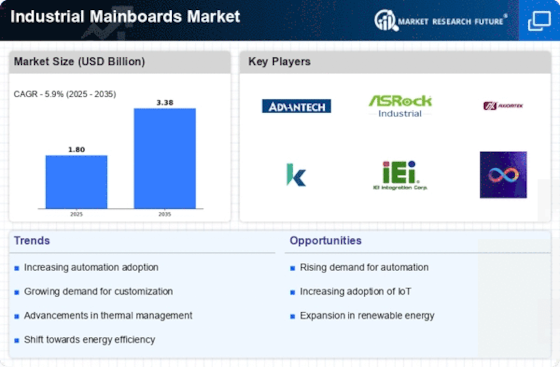
As per Market Research Future analysis, the Industrial Mainboards Market Size was estimated at 1.8 USD Billion in 2024. The Industrial Mainboards industry is projected to grow from 1.907 USD Billion in 2025 to 3.383 USD Billion by 2035, exhibiting a compound annual growth rate (CAGR) of 5.9% during the forecast period 2025 - 2035

Key Market Trends & Highlights

The Industrial Mainboards Market is experiencing a dynamic shift towards advanced technologies and sustainable practices.

  • The market is witnessing a trend towards the miniaturization of components, enhancing efficiency and space utilization. Integration of IoT technologies is becoming increasingly prevalent, driving connectivity and smart functionalities in industrial applications. North America remains the largest market, while Asia-Pacific is emerging as the fastest-growing region, reflecting diverse industrial needs. Rising demand for automation and advancements in computing power are key drivers propelling growth in the ATX and Building Automation segments.

Market Size & Forecast

2024 Market Size 1.8 (USD Billion)
2035 Market Size 3.383 (USD Billion)
CAGR (2025 - 2035) 5.9%
Largest Regional Market Share in 2024 North America

Major Players

Advantech (TW), ASRock Industrial (TW), Axiomtek (TW), Kontron (DE), IEI Integration Corp (TW), DFI (TW), Nexcom (TW), RuggedCom (CA), MSI (TW)

Market Trends

The Industrial Mainboards Market is currently experiencing a dynamic evolution, driven by advancements in technology and increasing demand across various sectors. As industries continue to automate and integrate sophisticated systems, the need for reliable and efficient mainboards becomes paramount. This market appears to be influenced by the growing trend of miniaturization, where smaller, more powerful components are favored. Additionally, the rise of the Internet of Things (IoT) is likely to propel the adoption of industrial mainboards, as interconnected devices require robust processing capabilities to function effectively. Furthermore, sustainability concerns are prompting manufacturers to explore eco-friendly materials and energy-efficient designs, which may reshape product offerings in the near future. In the present landscape, the Industrial Mainboards Market seems to be characterized by a competitive environment, with numerous players striving to innovate and capture market share. The emphasis on customization is becoming increasingly apparent, as businesses seek tailored solutions that meet specific operational needs. This trend indicates a shift towards more collaborative relationships between manufacturers and end-users, fostering a deeper understanding of requirements and preferences. As the market continues to evolve, it is essential for stakeholders to remain agile and responsive to emerging trends, ensuring they can adapt to the changing demands of the industrial sector.

Miniaturization of Components

The trend towards miniaturization in the Industrial Mainboards Market suggests a growing preference for smaller, yet more powerful components. This shift allows for enhanced efficiency and performance in various applications, catering to the needs of modern industries.

Integration of IoT Technologies

The increasing integration of Internet of Things technologies within the Industrial Mainboards Market indicates a significant transformation. As industries adopt interconnected systems, the demand for mainboards that support seamless communication and data processing is likely to rise.

Focus on Sustainability

A notable trend in the Industrial Mainboards Market is the heightened focus on sustainability. Manufacturers are exploring eco-friendly materials and energy-efficient designs, reflecting a commitment to reducing environmental impact while meeting industry demands.

Industrial Mainboards Market Market Drivers

Rising Demand for Automation

The Industrial Mainboards Market is experiencing a notable surge in demand for automation across various sectors. Industries such as manufacturing, logistics, and energy are increasingly adopting automated solutions to enhance efficiency and reduce operational costs. According to recent data, the automation market is projected to grow at a compound annual growth rate of approximately 9% over the next five years. This trend is likely to drive the demand for advanced industrial mainboards, which serve as the backbone for automation systems. As companies seek to optimize their processes, the integration of sophisticated mainboards becomes essential, thereby propelling the growth of the Industrial Mainboards Market.

Advancements in Computing Power

The Industrial Mainboards Market is significantly influenced by advancements in computing power. With the rapid evolution of technology, there is a growing need for high-performance mainboards that can support complex applications and data processing. The introduction of multi-core processors and enhanced graphics capabilities has transformed the landscape, allowing for more efficient operations in industrial settings. Market data indicates that the demand for high-performance computing solutions is expected to increase by 15% annually. This trend suggests that manufacturers of industrial mainboards must innovate continuously to meet the rising expectations of their clients, thereby fostering growth within the Industrial Mainboards Market.

Increased Focus on Edge Computing

The Industrial Mainboards Market is witnessing a shift towards edge computing, driven by the need for real-time data processing and analysis. As industries increasingly rely on data-driven decision-making, the demand for mainboards capable of supporting edge computing solutions is on the rise. This trend is particularly evident in sectors such as manufacturing and transportation, where timely data insights can lead to significant operational improvements. Reports indicate that the edge computing market is anticipated to grow by over 20% in the coming years. Consequently, the Industrial Mainboards Market must adapt to this paradigm shift, ensuring that their products are equipped to handle the demands of edge computing.

Growing Adoption of Smart Manufacturing

The Industrial Mainboards Market is benefiting from the growing adoption of smart manufacturing practices. As industries embrace the concept of Industry 4.0, there is an increasing need for mainboards that can facilitate connectivity and interoperability among various devices and systems. Smart manufacturing relies heavily on data exchange and real-time monitoring, which necessitates the use of advanced industrial mainboards. Market analysis suggests that the smart manufacturing sector is projected to expand at a rate of 10% annually. This growth is likely to create new opportunities for manufacturers of industrial mainboards, as they strive to provide solutions that meet the evolving needs of the market.

Emergence of Industry-Specific Solutions

The Industrial Mainboards Market is experiencing a trend towards the development of industry-specific solutions. As different sectors have unique requirements, there is a growing demand for customized mainboards that cater to specific applications. This trend is particularly pronounced in industries such as healthcare, automotive, and telecommunications, where specialized functionalities are essential. Market data indicates that the customization segment is expected to grow by 12% over the next few years. This shift towards tailored solutions presents both challenges and opportunities for manufacturers in the Industrial Mainboards Market, as they must balance standardization with the need for specialized features.

Market Segment Insights

By Type: ATX (Largest) vs. mini ITX (Fastest-Growing)

In the Industrial Mainboards Market, the ATX segment holds the largest share, being favored for its larger size and robust expansion capabilities that accommodate more advanced technology. Meanwhile, the mini ITX segment has emerged as the fastest-growing, appealing to compact applications in various industries and catering to the rising demand for space-efficient industrial solutions. This has fueled interest and investment in mini ITX boards across multiple sectors. The growth trends in the Industrial Mainboards Market are directly influenced by technological advancements and the need for higher efficiency. ATX boards remain a staple for applications requiring extensive connectivity and power, while mini ITX boards are gaining traction due to their adaptability and increasing use in IoT devices and automation. As industries shift towards more compact solutions, these trends are likely to accelerate further, shaping the future landscape of the market.

ATX (Dominant) vs. mini ITX (Emerging)

The ATX segment is characterized by its larger form factor, which allows for greater processing power and expanded connectivity options. This makes ATX boards ideal for demanding industrial applications where performance is paramount. In contrast, the mini ITX segment is emerging due to its space-saving design, catering to sectors that require compact but powerful solutions. Manufacturers are increasingly focusing on mini ITX for automation and embedded systems, as it supports modern technologies while meeting the growing demand for smaller, efficient industrial machines. This duality in size and performance between ATX and mini ITX illustrates a significant shift in market preferences, balancing traditional power with the need for compact designs.

By Application: Building Automation (Largest) vs. Medical (Fastest-Growing)

In the Industrial Mainboards Market, the application segment displays a diverse range of sectors with varying shares. <a href="https://www.marketresearchfuture.com/reports/europe-building-automation-system-market-13929">Building automation</a> has established itself as the largest segment, driven by the rise in smart buildings and energy-efficient systems that enhance operational efficiency. Following closely are sectors such as manufacturing and factory automation, which continue to benefit from technological advancements. Military applications, security and surveillance, and transportation also contribute significantly, reflecting their critical roles in national defense and public safety. The growth trends indicate that while building automation holds a substantial market share, the medical application is recognized as the fastest-growing segment. This surge is attributed to the increasing incorporation of advanced technologies in healthcare settings, including telemedicine and remote monitoring systems. The ongoing digital transformation and the demand for automation across various sectors further bolster the expansion of these application areas, positioning them as key drivers in the Industrial Mainboards Market.

Building Automation (Dominant) vs. Medical (Emerging)

Building automation is characterized by its integration of advanced control systems that optimize energy consumption, enhance security, and improve occupant comfort. This segment consistently dominates the market by enabling seamless management of HVAC, lighting, and security systems in commercial and residential buildings. On the other hand, the medical application segment is emerging rapidly, leveraging innovations in digital health and telemedicine. Medical mainboards are specifically designed to meet rigorous standards for reliability and precision, playing a pivotal role in life-saving equipment and medical devices. As healthcare providers increasingly adopt automation solutions to improve patient outcomes, the medical application is poised for significant growth, driven by technological advancements and rising demand for integrated health solutions.

By Component: CPU (Largest) vs. GPU (Fastest-Growing)

The Industrial Mainboards Market showcases a significant distribution among its key components, with CPUs leading the market due to their critical role in processing capabilities and efficiency. The GPU segment, while smaller, is gaining momentum, driven by the rising demand for enhanced graphical performance in industrial applications such as automation and real-time monitoring. In terms of growth trends, the industrial sector is increasingly adopting advanced GPU technologies, which enhances the performance of industrial applications, thereby driving demand. Additionally, CPUs continue to evolve, with a focus on energy efficiency and processing power, which is pivotal in a sector where reliability and performance are paramount. This growth is further supported by ongoing advancements in semiconductor technologies and increasing automation across various industries.

CPU (Dominant) vs. GPU (Emerging)

The CPU segment in the Industrial Mainboards Market is characterized by its dominant presence, primarily due to its essential function in executing instructions and managing tasks efficiently. CPUs are critical for processing large volumes of data, particularly in environments where precision and speed are crucial. As industries evolve, the focus on energy-efficient and high-performance CPUs continues to rise, enabling companies to enhance their operational capabilities. In contrast, the GPU segment is considered emerging, driven by a growing need for superior graphical processing in applications such as deep learning, simulation, and real-time data visualization. GPUs are increasingly being integrated into industrial systems to support complex algorithms and enhance productivity, marking a notable shift in how industrial processes leverage computational power.

By Sales Channel: OEM (Largest) vs. Aftermarket (Fastest-Growing)

In the Industrial Mainboards Market, the sales channel segment is primarily divided between OEM and aftermarket. The OEM segment commands a significant share of the market, driven by original equipment manufacturers who provide comprehensive solutions tailored to various industry needs. This segment is crucial for maintaining standards and ensuring compatibility, making it a preferred choice for many industries seeking reliability and durability in their operations. Conversely, the aftermarket segment is emerging as the fastest-growing in the market, fueled by an increasing demand for replacement parts and upgrades. As industries evolve, the need for custom solutions and enhanced functionalities drives the aftermarket sector. Factors such as technological advancements and the growing trend of retrofitting old equipment further contribute to this rapid growth, highlighting a shift in purchasing preferences among end-users.

Sales Channels: OEM (Dominant) vs. Aftermarket (Emerging)

In the Industrial Mainboards Market, the OEM segment remains dominant, providing bespoke products that meet stringent industry specifications. OEMs are recognized for their reliability and quality assurance, ensuring seamless integration into existing systems. They play a crucial role in sectors like manufacturing and automation, where performance and longevity are paramount. On the other hand, the aftermarket segment represents an emerging opportunity characterized by diverse offerings that cater to a broader range of customer needs. This segment includes enhancements, accessories, and modifications that allow businesses to tailor their solutions. With the rise of technological advancements and an increase in equipment longevity, the aftermarket provides a competitive advantage by allowing users to upgrade their existing systems while minimizing downtime and maximizing productivity.

Get more detailed insights about Industrial Mainboards Market Research Report—Global Forecast till 2035

Regional Insights

North America : Technological Innovation Leader

North America is witnessing robust growth in the Industrial Mainboards Market, driven by advancements in automation and IoT technologies. The region holds approximately 40% of the global market share, making it the largest market. Regulatory support for smart manufacturing and increased investments in infrastructure are key growth catalysts. The demand for high-performance computing solutions in various industries further fuels this growth. The United States and Canada are the leading countries in this region, with a competitive landscape featuring major players like Advantech, RuggedCom, and MSI. The presence of established technology firms and a strong focus on R&D contribute to a dynamic market environment. As industries increasingly adopt automation, the demand for reliable and efficient industrial mainboards continues to rise, positioning North America as a pivotal player in the global market.

Europe : Diverse Market with Regulations

Europe's Industrial Mainboards Market is characterized by a diverse landscape and strong regulatory frameworks that promote innovation. The region accounts for approximately 30% of the global market share, making it the second-largest market. Key drivers include the push for Industry 4.0, sustainability initiatives, and the integration of AI in manufacturing processes. European regulations encourage the adoption of advanced technologies, enhancing market growth. Germany, France, and the UK are the leading countries in this region, with a competitive environment featuring companies like Kontron and ASRock Industrial. The presence of numerous SMEs alongside established players fosters innovation and competition. As industries adapt to new technologies, the demand for specialized industrial mainboards is expected to rise, further solidifying Europe's position in the global market.

Asia-Pacific : Emerging Market with High Demand

Asia-Pacific is emerging as a significant player in the Industrial Mainboards Market, driven by rapid industrialization and increasing demand for automation. The region holds around 25% of the global market share, with countries like China and Japan leading the charge. The growth is supported by government initiatives aimed at enhancing manufacturing capabilities and the adoption of smart technologies across various sectors. China is the largest market in the region, followed by Japan and South Korea, with a competitive landscape featuring key players like Advantech and Axiomtek. The presence of a robust manufacturing base and a growing focus on R&D contribute to the region's dynamic market environment. As industries continue to evolve, the demand for advanced industrial mainboards is expected to surge, positioning Asia-Pacific as a critical market in the global landscape.

Middle East and Africa : Resource-Rich with Growth Potential

The Middle East and Africa region is witnessing a gradual expansion in the Industrial Mainboards Market, driven by increasing investments in infrastructure and technology. The region holds approximately 5% of the global market share, with significant growth potential. Key drivers include government initiatives to diversify economies and enhance industrial capabilities, particularly in the Gulf Cooperation Council (GCC) countries. Countries like the UAE and South Africa are leading the market, with a competitive landscape that includes both local and international players. The presence of emerging technology firms and a focus on smart city projects contribute to the region's growth. As industries seek to modernize and improve efficiency, the demand for industrial mainboards is expected to rise, highlighting the region's potential in the global market.

Key Players and Competitive Insights

Leading market players are investing heavily in research and development in order to expand their product lines, which will help the Industrial Mainboards Market, grow even more. Market participants are also undertaking a variety of strategic activities to expand their global footprint, with important market developments including new product launches, contractual agreements, mergers and acquisitions, higher investments, and collaboration with other organizations. To expand and survive in a more competitive and rising market climate, Industrial Mainboards Industry must offer cost-effective items.
Manufacturing locally to minimize operational costs is one of the key business tactics used by manufacturers in the global Industrial Mainboards Industry to benefit clients and increase the market sector. In recent years, the Industrial Mainboards Industry has offered some of the most significant advantages to medicine. Major players in the Industrial Mainboards Market, including Advantech, Kontron, Beckhoff Automation, Avalue Technology, ADLINK Technology, Arbor, ASRock, Asus, Axiomtek, BCM, COMMELL, Corvalent, DFI, EVOC, Fujitsu, Habey USA, IEI Integration, NEXCOM, Portwell, and Texas Instruments, are attempting to increase market demand by investing in research and development operations.
Open automation systems built on programmable controller technology are offered by Beckhoff Automation and are designed to be applied in a wide range of various applications. The company provides a variety of products, including industrial programmable controllers, I/O and Fieldbus components, drive technologies, and automation industrial mainboards, giving customers access to parts that may be seamlessly integrated into a control system.
Components for embedded computer, communications, transportation, test and measurement, industrial, and automation applications are produced by Taiwan-based Adlink Technology Inc. Motherboards, blades, chassis, modules, smart touch computers, displays, and test and measurement tools are all part of the company's extensive product line. With offices in the Americas, Singapore, China, Japan, Korea, and Germany as well as design and technology hubs there, Adlink has activities throughout the world.

Key Companies in the Industrial Mainboards Market include

Industry Developments

April 2023: The new Intel Atom Embedded Industrial motherboards, EMX-EHLP, featuring Intel Celeron/Atom SoC BGA Processor (Elkhart Lake Platform 4.512W), were introduced by Avalue Technology, a leading provider of industrial PC solutions globally.

Future Outlook

Industrial Mainboards Market Future Outlook

The Industrial Mainboards Market is projected to grow at a 5.9% CAGR from 2025 to 2035, driven by advancements in automation, IoT integration, and demand for energy-efficient solutions.

New opportunities lie in:

  • Development of AI-driven predictive maintenance systems
  • Expansion into emerging markets with tailored solutions
  • Integration of advanced cybersecurity features in mainboards

By 2035, the market is expected to achieve robust growth, positioning itself as a leader in industrial technology.

Market Segmentation

Industrial Mainboards Market Type Outlook

  • ATX
  • mini ITX
  • micro ATX
  • nano ITX
  • pico ITX
  • COM express

Industrial Mainboards Market Component Outlook

  • CPU
  • GPU
  • chipset
  • memory

Industrial Mainboards Market Application Outlook

  • building automation
  • manufacturing
  • military application
  • security and surveillance
  • factory automation
  • transportation
  • automotive industry
  • medical
  • gaming

Industrial Mainboards Market Sales Channel Outlook

  • OEM
  • aftermarket

Report Scope

MARKET SIZE 2024 1.8(USD Billion)
MARKET SIZE 2025 1.907(USD Billion)
MARKET SIZE 2035 3.383(USD Billion)
COMPOUND ANNUAL GROWTH RATE (CAGR) 5.9% (2025 - 2035)
REPORT COVERAGE Revenue Forecast, Competitive Landscape, Growth Factors, and Trends
BASE YEAR 2024
Market Forecast Period 2025 - 2035
Historical Data 2019 - 2024
Market Forecast Units USD Billion
Key Companies Profiled Advantech (TW), ASRock Industrial (TW), Axiomtek (TW), Kontron (DE), IEI Integration Corp (TW), DFI (TW), Nexcom (TW), RuggedCom (CA), MSI (TW)
Segments Covered Type, Application, Component, Sales Channel, Region
Key Market Opportunities Integration of advanced automation technologies drives growth in the Industrial Mainboards Market.
Key Market Dynamics Technological advancements drive demand for industrial mainboards, enhancing automation and efficiency across various sectors.
Countries Covered North America, Europe, APAC, South America, MEA

FAQs

What is the projected market valuation for the Industrial Mainboards Market in 2035?

<p>The projected market valuation for the Industrial Mainboards Market in 2035 is 3.383 USD Billion.</p>

What was the market valuation for the Industrial Mainboards Market in 2024?

<p>The overall market valuation for the Industrial Mainboards Market was 1.8 USD Billion in 2024.</p>

What is the expected CAGR for the Industrial Mainboards Market from 2025 to 2035?

<p>The expected CAGR for the Industrial Mainboards Market during the forecast period 2025 - 2035 is 5.9%.</p>

Which companies are considered key players in the Industrial Mainboards Market?

<p>Key players in the Industrial Mainboards Market include Advantech, ASRock Industrial, Axiomtek, Kontron, and others.</p>

What are the main application segments for Industrial Mainboards?

<p>Main application segments for Industrial Mainboards include manufacturing, building automation, military applications, and factory automation.</p>

How did the ATX segment perform in terms of market valuation in 2024?

<p>The ATX segment was valued at 0.72 USD Billion in 2024 and is projected to reach 1.25 USD Billion.</p>

What is the market valuation for the OEM sales channel in 2024?

The OEM sales channel was valued at 1.08 USD Billion in 2024 and is expected to grow significantly.

What is the projected valuation for the mini ITX segment by 2035?

The mini ITX segment is projected to reach 0.65 USD Billion by 2035.

Which component segment is expected to show substantial growth in the Industrial Mainboards Market?

The chipset component segment is expected to grow from 0.54 USD Billion in 2024 to 1.01 USD Billion by 2035.

What is the anticipated market size for the security and surveillance application by 2035?

The anticipated market size for the security and surveillance application is projected to reach 0.4 USD Billion by 2035.

  1. SECTION I: EXECUTIVE SUMMARY AND KEY HIGHLIGHTS
    1. | 1.1 EXECUTIVE SUMMARY
    2. | | 1.1.1 Market Overview
    3. | | 1.1.2 Key Findings
    4. | | 1.1.3 Market Segmentation
    5. | | 1.1.4 Competitive Landscape
    6. | | 1.1.5 Challenges and Opportunities
    7. | | 1.1.6 Future Outlook
  2. SECTION II: SCOPING, METHODOLOGY AND MARKET STRUCTURE
    1. | 2.1 MARKET INTRODUCTION
    2. | | 2.1.1 Definition
    3. | | 2.1.2 Scope of the study
    4. | | | 2.1.2.1 Research Objective
    5. | | | 2.1.2.2 Assumption
    6. | | | 2.1.2.3 Limitations
    7. | 2.2 RESEARCH METHODOLOGY
    8. | | 2.2.1 Overview
    9. | | 2.2.2 Data Mining
    10. | | 2.2.3 Secondary Research
    11. | | 2.2.4 Primary Research
    12. | | | 2.2.4.1 Primary Interviews and Information Gathering Process
    13. | | | 2.2.4.2 Breakdown of Primary Respondents
    14. | | 2.2.5 Forecasting Model
    15. | | 2.2.6 Market Size Estimation
    16. | | | 2.2.6.1 Bottom-Up Approach
    17. | | | 2.2.6.2 Top-Down Approach
    18. | | 2.2.7 Data Triangulation
    19. | | 2.2.8 Validation
  3. SECTION III: QUALITATIVE ANALYSIS
    1. | 3.1 MARKET DYNAMICS
    2. | | 3.1.1 Overview
    3. | | 3.1.2 Drivers
    4. | | 3.1.3 Restraints
    5. | | 3.1.4 Opportunities
    6. | 3.2 MARKET FACTOR ANALYSIS
    7. | | 3.2.1 Value chain Analysis
    8. | | 3.2.2 Porter's Five Forces Analysis
    9. | | | 3.2.2.1 Bargaining Power of Suppliers
    10. | | | 3.2.2.2 Bargaining Power of Buyers
    11. | | | 3.2.2.3 Threat of New Entrants
    12. | | | 3.2.2.4 Threat of Substitutes
    13. | | | 3.2.2.5 Intensity of Rivalry
    14. | | 3.2.3 COVID-19 Impact Analysis
    15. | | | 3.2.3.1 Market Impact Analysis
    16. | | | 3.2.3.2 Regional Impact
    17. | | | 3.2.3.3 Opportunity and Threat Analysis
  4. SECTION IV: QUANTITATIVE ANALYSIS
    1. | 4.1 Semiconductor & Electronics, BY Type (USD Billion)
    2. | | 4.1.1 ATX
    3. | | 4.1.2 mini ITX
    4. | | 4.1.3 micro ATX
    5. | | 4.1.4 nano ITX
    6. | | 4.1.5 pico ITX
    7. | | 4.1.6 COM express
    8. | 4.2 Semiconductor & Electronics, BY Application (USD Billion)
    9. | | 4.2.1 building automation
    10. | | 4.2.2 manufacturing
    11. | | 4.2.3 military application
    12. | | 4.2.4 security and surveillance
    13. | | 4.2.5 factory automation
    14. | | 4.2.6 transportation
    15. | | 4.2.7 automotive industry
    16. | | 4.2.8 medical
    17. | | 4.2.9 gaming
    18. | 4.3 Semiconductor & Electronics, BY Component (USD Billion)
    19. | | 4.3.1 CPU
    20. | | 4.3.2 GPU
    21. | | 4.3.3 chipset
    22. | | 4.3.4 memory
    23. | 4.4 Semiconductor & Electronics, BY Sales Channel (USD Billion)
    24. | | 4.4.1 OEM
    25. | | 4.4.2 aftermarket
    26. | 4.5 Semiconductor & Electronics, BY Region (USD Billion)
    27. | | 4.5.1 North America
    28. | | | 4.5.1.1 US
    29. | | | 4.5.1.2 Canada
    30. | | 4.5.2 Europe
    31. | | | 4.5.2.1 Germany
    32. | | | 4.5.2.2 UK
    33. | | | 4.5.2.3 France
    34. | | | 4.5.2.4 Russia
    35. | | | 4.5.2.5 Italy
    36. | | | 4.5.2.6 Spain
    37. | | | 4.5.2.7 Rest of Europe
    38. | | 4.5.3 APAC
    39. | | | 4.5.3.1 China
    40. | | | 4.5.3.2 India
    41. | | | 4.5.3.3 Japan
    42. | | | 4.5.3.4 South Korea
    43. | | | 4.5.3.5 Malaysia
    44. | | | 4.5.3.6 Thailand
    45. | | | 4.5.3.7 Indonesia
    46. | | | 4.5.3.8 Rest of APAC
    47. | | 4.5.4 South America
    48. | | | 4.5.4.1 Brazil
    49. | | | 4.5.4.2 Mexico
    50. | | | 4.5.4.3 Argentina
    51. | | | 4.5.4.4 Rest of South America
    52. | | 4.5.5 MEA
    53. | | | 4.5.5.1 GCC Countries
    54. | | | 4.5.5.2 South Africa
    55. | | | 4.5.5.3 Rest of MEA
  5. SECTION V: COMPETITIVE ANALYSIS
    1. | 5.1 Competitive Landscape
    2. | | 5.1.1 Overview
    3. | | 5.1.2 Competitive Analysis
    4. | | 5.1.3 Market share Analysis
    5. | | 5.1.4 Major Growth Strategy in the Semiconductor & Electronics
    6. | | 5.1.5 Competitive Benchmarking
    7. | | 5.1.6 Leading Players in Terms of Number of Developments in the Semiconductor & Electronics
    8. | | 5.1.7 Key developments and growth strategies
    9. | | | 5.1.7.1 New Product Launch/Service Deployment
    10. | | | 5.1.7.2 Merger & Acquisitions
    11. | | | 5.1.7.3 Joint Ventures
    12. | | 5.1.8 Major Players Financial Matrix
    13. | | | 5.1.8.1 Sales and Operating Income
    14. | | | 5.1.8.2 Major Players R&D Expenditure. 2023
    15. | 5.2 Company Profiles
    16. | | 5.2.1 Advantech (TW)
    17. | | | 5.2.1.1 Financial Overview
    18. | | | 5.2.1.2 Products Offered
    19. | | | 5.2.1.3 Key Developments
    20. | | | 5.2.1.4 SWOT Analysis
    21. | | | 5.2.1.5 Key Strategies
    22. | | 5.2.2 ASRock Industrial (TW)
    23. | | | 5.2.2.1 Financial Overview
    24. | | | 5.2.2.2 Products Offered
    25. | | | 5.2.2.3 Key Developments
    26. | | | 5.2.2.4 SWOT Analysis
    27. | | | 5.2.2.5 Key Strategies
    28. | | 5.2.3 Axiomtek (TW)
    29. | | | 5.2.3.1 Financial Overview
    30. | | | 5.2.3.2 Products Offered
    31. | | | 5.2.3.3 Key Developments
    32. | | | 5.2.3.4 SWOT Analysis
    33. | | | 5.2.3.5 Key Strategies
    34. | | 5.2.4 Kontron (DE)
    35. | | | 5.2.4.1 Financial Overview
    36. | | | 5.2.4.2 Products Offered
    37. | | | 5.2.4.3 Key Developments
    38. | | | 5.2.4.4 SWOT Analysis
    39. | | | 5.2.4.5 Key Strategies
    40. | | 5.2.5 IEI Integration Corp (TW)
    41. | | | 5.2.5.1 Financial Overview
    42. | | | 5.2.5.2 Products Offered
    43. | | | 5.2.5.3 Key Developments
    44. | | | 5.2.5.4 SWOT Analysis
    45. | | | 5.2.5.5 Key Strategies
    46. | | 5.2.6 DFI (TW)
    47. | | | 5.2.6.1 Financial Overview
    48. | | | 5.2.6.2 Products Offered
    49. | | | 5.2.6.3 Key Developments
    50. | | | 5.2.6.4 SWOT Analysis
    51. | | | 5.2.6.5 Key Strategies
    52. | | 5.2.7 Nexcom (TW)
    53. | | | 5.2.7.1 Financial Overview
    54. | | | 5.2.7.2 Products Offered
    55. | | | 5.2.7.3 Key Developments
    56. | | | 5.2.7.4 SWOT Analysis
    57. | | | 5.2.7.5 Key Strategies
    58. | | 5.2.8 RuggedCom (CA)
    59. | | | 5.2.8.1 Financial Overview
    60. | | | 5.2.8.2 Products Offered
    61. | | | 5.2.8.3 Key Developments
    62. | | | 5.2.8.4 SWOT Analysis
    63. | | | 5.2.8.5 Key Strategies
    64. | | 5.2.9 MSI (TW)
    65. | | | 5.2.9.1 Financial Overview
    66. | | | 5.2.9.2 Products Offered
    67. | | | 5.2.9.3 Key Developments
    68. | | | 5.2.9.4 SWOT Analysis
    69. | | | 5.2.9.5 Key Strategies
    70. | 5.3 Appendix
    71. | | 5.3.1 References
    72. | | 5.3.2 Related Reports
  6. LIST OF FIGURES
    1. | 6.1 MARKET SYNOPSIS
    2. | 6.2 NORTH AMERICA MARKET ANALYSIS
    3. | 6.3 US MARKET ANALYSIS BY TYPE
    4. | 6.4 US MARKET ANALYSIS BY APPLICATION
    5. | 6.5 US MARKET ANALYSIS BY COMPONENT
    6. | 6.6 US MARKET ANALYSIS BY SALES CHANNEL
    7. | 6.7 CANADA MARKET ANALYSIS BY TYPE
    8. | 6.8 CANADA MARKET ANALYSIS BY APPLICATION
    9. | 6.9 CANADA MARKET ANALYSIS BY COMPONENT
    10. | 6.10 CANADA MARKET ANALYSIS BY SALES CHANNEL
    11. | 6.11 EUROPE MARKET ANALYSIS
    12. | 6.12 GERMANY MARKET ANALYSIS BY TYPE
    13. | 6.13 GERMANY MARKET ANALYSIS BY APPLICATION
    14. | 6.14 GERMANY MARKET ANALYSIS BY COMPONENT
    15. | 6.15 GERMANY MARKET ANALYSIS BY SALES CHANNEL
    16. | 6.16 UK MARKET ANALYSIS BY TYPE
    17. | 6.17 UK MARKET ANALYSIS BY APPLICATION
    18. | 6.18 UK MARKET ANALYSIS BY COMPONENT
    19. | 6.19 UK MARKET ANALYSIS BY SALES CHANNEL
    20. | 6.20 FRANCE MARKET ANALYSIS BY TYPE
    21. | 6.21 FRANCE MARKET ANALYSIS BY APPLICATION
    22. | 6.22 FRANCE MARKET ANALYSIS BY COMPONENT
    23. | 6.23 FRANCE MARKET ANALYSIS BY SALES CHANNEL
    24. | 6.24 RUSSIA MARKET ANALYSIS BY TYPE
    25. | 6.25 RUSSIA MARKET ANALYSIS BY APPLICATION
    26. | 6.26 RUSSIA MARKET ANALYSIS BY COMPONENT
    27. | 6.27 RUSSIA MARKET ANALYSIS BY SALES CHANNEL
    28. | 6.28 ITALY MARKET ANALYSIS BY TYPE
    29. | 6.29 ITALY MARKET ANALYSIS BY APPLICATION
    30. | 6.30 ITALY MARKET ANALYSIS BY COMPONENT
    31. | 6.31 ITALY MARKET ANALYSIS BY SALES CHANNEL
    32. | 6.32 SPAIN MARKET ANALYSIS BY TYPE
    33. | 6.33 SPAIN MARKET ANALYSIS BY APPLICATION
    34. | 6.34 SPAIN MARKET ANALYSIS BY COMPONENT
    35. | 6.35 SPAIN MARKET ANALYSIS BY SALES CHANNEL
    36. | 6.36 REST OF EUROPE MARKET ANALYSIS BY TYPE
    37. | 6.37 REST OF EUROPE MARKET ANALYSIS BY APPLICATION
    38. | 6.38 REST OF EUROPE MARKET ANALYSIS BY COMPONENT
    39. | 6.39 REST OF EUROPE MARKET ANALYSIS BY SALES CHANNEL
    40. | 6.40 APAC MARKET ANALYSIS
    41. | 6.41 CHINA MARKET ANALYSIS BY TYPE
    42. | 6.42 CHINA MARKET ANALYSIS BY APPLICATION
    43. | 6.43 CHINA MARKET ANALYSIS BY COMPONENT
    44. | 6.44 CHINA MARKET ANALYSIS BY SALES CHANNEL
    45. | 6.45 INDIA MARKET ANALYSIS BY TYPE
    46. | 6.46 INDIA MARKET ANALYSIS BY APPLICATION
    47. | 6.47 INDIA MARKET ANALYSIS BY COMPONENT
    48. | 6.48 INDIA MARKET ANALYSIS BY SALES CHANNEL
    49. | 6.49 JAPAN MARKET ANALYSIS BY TYPE
    50. | 6.50 JAPAN MARKET ANALYSIS BY APPLICATION
    51. | 6.51 JAPAN MARKET ANALYSIS BY COMPONENT
    52. | 6.52 JAPAN MARKET ANALYSIS BY SALES CHANNEL
    53. | 6.53 SOUTH KOREA MARKET ANALYSIS BY TYPE
    54. | 6.54 SOUTH KOREA MARKET ANALYSIS BY APPLICATION
    55. | 6.55 SOUTH KOREA MARKET ANALYSIS BY COMPONENT
    56. | 6.56 SOUTH KOREA MARKET ANALYSIS BY SALES CHANNEL
    57. | 6.57 MALAYSIA MARKET ANALYSIS BY TYPE
    58. | 6.58 MALAYSIA MARKET ANALYSIS BY APPLICATION
    59. | 6.59 MALAYSIA MARKET ANALYSIS BY COMPONENT
    60. | 6.60 MALAYSIA MARKET ANALYSIS BY SALES CHANNEL
    61. | 6.61 THAILAND MARKET ANALYSIS BY TYPE
    62. | 6.62 THAILAND MARKET ANALYSIS BY APPLICATION
    63. | 6.63 THAILAND MARKET ANALYSIS BY COMPONENT
    64. | 6.64 THAILAND MARKET ANALYSIS BY SALES CHANNEL
    65. | 6.65 INDONESIA MARKET ANALYSIS BY TYPE
    66. | 6.66 INDONESIA MARKET ANALYSIS BY APPLICATION
    67. | 6.67 INDONESIA MARKET ANALYSIS BY COMPONENT
    68. | 6.68 INDONESIA MARKET ANALYSIS BY SALES CHANNEL
    69. | 6.69 REST OF APAC MARKET ANALYSIS BY TYPE
    70. | 6.70 REST OF APAC MARKET ANALYSIS BY APPLICATION
    71. | 6.71 REST OF APAC MARKET ANALYSIS BY COMPONENT
    72. | 6.72 REST OF APAC MARKET ANALYSIS BY SALES CHANNEL
    73. | 6.73 SOUTH AMERICA MARKET ANALYSIS
    74. | 6.74 BRAZIL MARKET ANALYSIS BY TYPE
    75. | 6.75 BRAZIL MARKET ANALYSIS BY APPLICATION
    76. | 6.76 BRAZIL MARKET ANALYSIS BY COMPONENT
    77. | 6.77 BRAZIL MARKET ANALYSIS BY SALES CHANNEL
    78. | 6.78 MEXICO MARKET ANALYSIS BY TYPE
    79. | 6.79 MEXICO MARKET ANALYSIS BY APPLICATION
    80. | 6.80 MEXICO MARKET ANALYSIS BY COMPONENT
    81. | 6.81 MEXICO MARKET ANALYSIS BY SALES CHANNEL
    82. | 6.82 ARGENTINA MARKET ANALYSIS BY TYPE
    83. | 6.83 ARGENTINA MARKET ANALYSIS BY APPLICATION
    84. | 6.84 ARGENTINA MARKET ANALYSIS BY COMPONENT
    85. | 6.85 ARGENTINA MARKET ANALYSIS BY SALES CHANNEL
    86. | 6.86 REST OF SOUTH AMERICA MARKET ANALYSIS BY TYPE
    87. | 6.87 REST OF SOUTH AMERICA MARKET ANALYSIS BY APPLICATION
    88. | 6.88 REST OF SOUTH AMERICA MARKET ANALYSIS BY COMPONENT
    89. | 6.89 REST OF SOUTH AMERICA MARKET ANALYSIS BY SALES CHANNEL
    90. | 6.90 MEA MARKET ANALYSIS
    91. | 6.91 GCC COUNTRIES MARKET ANALYSIS BY TYPE
    92. | 6.92 GCC COUNTRIES MARKET ANALYSIS BY APPLICATION
    93. | 6.93 GCC COUNTRIES MARKET ANALYSIS BY COMPONENT
    94. | 6.94 GCC COUNTRIES MARKET ANALYSIS BY SALES CHANNEL
    95. | 6.95 SOUTH AFRICA MARKET ANALYSIS BY TYPE
    96. | 6.96 SOUTH AFRICA MARKET ANALYSIS BY APPLICATION
    97. | 6.97 SOUTH AFRICA MARKET ANALYSIS BY COMPONENT
    98. | 6.98 SOUTH AFRICA MARKET ANALYSIS BY SALES CHANNEL
    99. | 6.99 REST OF MEA MARKET ANALYSIS BY TYPE
    100. | 6.100 REST OF MEA MARKET ANALYSIS BY APPLICATION
    101. | 6.101 REST OF MEA MARKET ANALYSIS BY COMPONENT
    102. | 6.102 REST OF MEA MARKET ANALYSIS BY SALES CHANNEL
    103. | 6.103 KEY BUYING CRITERIA OF SEMICONDUCTOR & ELECTRONICS
    104. | 6.104 RESEARCH PROCESS OF MRFR
    105. | 6.105 DRO ANALYSIS OF SEMICONDUCTOR & ELECTRONICS
    106. | 6.106 DRIVERS IMPACT ANALYSIS: SEMICONDUCTOR & ELECTRONICS
    107. | 6.107 RESTRAINTS IMPACT ANALYSIS: SEMICONDUCTOR & ELECTRONICS
    108. | 6.108 SUPPLY / VALUE CHAIN: SEMICONDUCTOR & ELECTRONICS
    109. | 6.109 SEMICONDUCTOR & ELECTRONICS, BY TYPE, 2024 (% SHARE)
    110. | 6.110 SEMICONDUCTOR & ELECTRONICS, BY TYPE, 2024 TO 2035 (USD Billion)
    111. | 6.111 SEMICONDUCTOR & ELECTRONICS, BY APPLICATION, 2024 (% SHARE)
    112. | 6.112 SEMICONDUCTOR & ELECTRONICS, BY APPLICATION, 2024 TO 2035 (USD Billion)
    113. | 6.113 SEMICONDUCTOR & ELECTRONICS, BY COMPONENT, 2024 (% SHARE)
    114. | 6.114 SEMICONDUCTOR & ELECTRONICS, BY COMPONENT, 2024 TO 2035 (USD Billion)
    115. | 6.115 SEMICONDUCTOR & ELECTRONICS, BY SALES CHANNEL, 2024 (% SHARE)
    116. | 6.116 SEMICONDUCTOR & ELECTRONICS, BY SALES CHANNEL, 2024 TO 2035 (USD Billion)
    117. | 6.117 BENCHMARKING OF MAJOR COMPETITORS
  7. LIST OF TABLES
    1. | 7.1 LIST OF ASSUMPTIONS
    2. | | 7.1.1
    3. | 7.2 North America MARKET SIZE ESTIMATES; FORECAST
    4. | | 7.2.1 BY TYPE, 2025-2035 (USD Billion)
    5. | | 7.2.2 BY APPLICATION, 2025-2035 (USD Billion)
    6. | | 7.2.3 BY COMPONENT, 2025-2035 (USD Billion)
    7. | | 7.2.4 BY SALES CHANNEL, 2025-2035 (USD Billion)
    8. | 7.3 US MARKET SIZE ESTIMATES; FORECAST
    9. | | 7.3.1 BY TYPE, 2025-2035 (USD Billion)
    10. | | 7.3.2 BY APPLICATION, 2025-2035 (USD Billion)
    11. | | 7.3.3 BY COMPONENT, 2025-2035 (USD Billion)
    12. | | 7.3.4 BY SALES CHANNEL, 2025-2035 (USD Billion)
    13. | 7.4 Canada MARKET SIZE ESTIMATES; FORECAST
    14. | | 7.4.1 BY TYPE, 2025-2035 (USD Billion)
    15. | | 7.4.2 BY APPLICATION, 2025-2035 (USD Billion)
    16. | | 7.4.3 BY COMPONENT, 2025-2035 (USD Billion)
    17. | | 7.4.4 BY SALES CHANNEL, 2025-2035 (USD Billion)
    18. | 7.5 Europe MARKET SIZE ESTIMATES; FORECAST
    19. | | 7.5.1 BY TYPE, 2025-2035 (USD Billion)
    20. | | 7.5.2 BY APPLICATION, 2025-2035 (USD Billion)
    21. | | 7.5.3 BY COMPONENT, 2025-2035 (USD Billion)
    22. | | 7.5.4 BY SALES CHANNEL, 2025-2035 (USD Billion)
    23. | 7.6 Germany MARKET SIZE ESTIMATES; FORECAST
    24. | | 7.6.1 BY TYPE, 2025-2035 (USD Billion)
    25. | | 7.6.2 BY APPLICATION, 2025-2035 (USD Billion)
    26. | | 7.6.3 BY COMPONENT, 2025-2035 (USD Billion)
    27. | | 7.6.4 BY SALES CHANNEL, 2025-2035 (USD Billion)
    28. | 7.7 UK MARKET SIZE ESTIMATES; FORECAST
    29. | | 7.7.1 BY TYPE, 2025-2035 (USD Billion)
    30. | | 7.7.2 BY APPLICATION, 2025-2035 (USD Billion)
    31. | | 7.7.3 BY COMPONENT, 2025-2035 (USD Billion)
    32. | | 7.7.4 BY SALES CHANNEL, 2025-2035 (USD Billion)
    33. | 7.8 France MARKET SIZE ESTIMATES; FORECAST
    34. | | 7.8.1 BY TYPE, 2025-2035 (USD Billion)
    35. | | 7.8.2 BY APPLICATION, 2025-2035 (USD Billion)
    36. | | 7.8.3 BY COMPONENT, 2025-2035 (USD Billion)
    37. | | 7.8.4 BY SALES CHANNEL, 2025-2035 (USD Billion)
    38. | 7.9 Russia MARKET SIZE ESTIMATES; FORECAST
    39. | | 7.9.1 BY TYPE, 2025-2035 (USD Billion)
    40. | | 7.9.2 BY APPLICATION, 2025-2035 (USD Billion)
    41. | | 7.9.3 BY COMPONENT, 2025-2035 (USD Billion)
    42. | | 7.9.4 BY SALES CHANNEL, 2025-2035 (USD Billion)
    43. | 7.10 Italy MARKET SIZE ESTIMATES; FORECAST
    44. | | 7.10.1 BY TYPE, 2025-2035 (USD Billion)
    45. | | 7.10.2 BY APPLICATION, 2025-2035 (USD Billion)
    46. | | 7.10.3 BY COMPONENT, 2025-2035 (USD Billion)
    47. | | 7.10.4 BY SALES CHANNEL, 2025-2035 (USD Billion)
    48. | 7.11 Spain MARKET SIZE ESTIMATES; FORECAST
    49. | | 7.11.1 BY TYPE, 2025-2035 (USD Billion)
    50. | | 7.11.2 BY APPLICATION, 2025-2035 (USD Billion)
    51. | | 7.11.3 BY COMPONENT, 2025-2035 (USD Billion)
    52. | | 7.11.4 BY SALES CHANNEL, 2025-2035 (USD Billion)
    53. | 7.12 Rest of Europe MARKET SIZE ESTIMATES; FORECAST
    54. | | 7.12.1 BY TYPE, 2025-2035 (USD Billion)
    55. | | 7.12.2 BY APPLICATION, 2025-2035 (USD Billion)
    56. | | 7.12.3 BY COMPONENT, 2025-2035 (USD Billion)
    57. | | 7.12.4 BY SALES CHANNEL, 2025-2035 (USD Billion)
    58. | 7.13 APAC MARKET SIZE ESTIMATES; FORECAST
    59. | | 7.13.1 BY TYPE, 2025-2035 (USD Billion)
    60. | | 7.13.2 BY APPLICATION, 2025-2035 (USD Billion)
    61. | | 7.13.3 BY COMPONENT, 2025-2035 (USD Billion)
    62. | | 7.13.4 BY SALES CHANNEL, 2025-2035 (USD Billion)
    63. | 7.14 China MARKET SIZE ESTIMATES; FORECAST
    64. | | 7.14.1 BY TYPE, 2025-2035 (USD Billion)
    65. | | 7.14.2 BY APPLICATION, 2025-2035 (USD Billion)
    66. | | 7.14.3 BY COMPONENT, 2025-2035 (USD Billion)
    67. | | 7.14.4 BY SALES CHANNEL, 2025-2035 (USD Billion)
    68. | 7.15 India MARKET SIZE ESTIMATES; FORECAST
    69. | | 7.15.1 BY TYPE, 2025-2035 (USD Billion)
    70. | | 7.15.2 BY APPLICATION, 2025-2035 (USD Billion)
    71. | | 7.15.3 BY COMPONENT, 2025-2035 (USD Billion)
    72. | | 7.15.4 BY SALES CHANNEL, 2025-2035 (USD Billion)
    73. | 7.16 Japan MARKET SIZE ESTIMATES; FORECAST
    74. | | 7.16.1 BY TYPE, 2025-2035 (USD Billion)
    75. | | 7.16.2 BY APPLICATION, 2025-2035 (USD Billion)
    76. | | 7.16.3 BY COMPONENT, 2025-2035 (USD Billion)
    77. | | 7.16.4 BY SALES CHANNEL, 2025-2035 (USD Billion)
    78. | 7.17 South Korea MARKET SIZE ESTIMATES; FORECAST
    79. | | 7.17.1 BY TYPE, 2025-2035 (USD Billion)
    80. | | 7.17.2 BY APPLICATION, 2025-2035 (USD Billion)
    81. | | 7.17.3 BY COMPONENT, 2025-2035 (USD Billion)
    82. | | 7.17.4 BY SALES CHANNEL, 2025-2035 (USD Billion)
    83. | 7.18 Malaysia MARKET SIZE ESTIMATES; FORECAST
    84. | | 7.18.1 BY TYPE, 2025-2035 (USD Billion)
    85. | | 7.18.2 BY APPLICATION, 2025-2035 (USD Billion)
    86. | | 7.18.3 BY COMPONENT, 2025-2035 (USD Billion)
    87. | | 7.18.4 BY SALES CHANNEL, 2025-2035 (USD Billion)
    88. | 7.19 Thailand MARKET SIZE ESTIMATES; FORECAST
    89. | | 7.19.1 BY TYPE, 2025-2035 (USD Billion)
    90. | | 7.19.2 BY APPLICATION, 2025-2035 (USD Billion)
    91. | | 7.19.3 BY COMPONENT, 2025-2035 (USD Billion)
    92. | | 7.19.4 BY SALES CHANNEL, 2025-2035 (USD Billion)
    93. | 7.20 Indonesia MARKET SIZE ESTIMATES; FORECAST
    94. | | 7.20.1 BY TYPE, 2025-2035 (USD Billion)
    95. | | 7.20.2 BY APPLICATION, 2025-2035 (USD Billion)
    96. | | 7.20.3 BY COMPONENT, 2025-2035 (USD Billion)
    97. | | 7.20.4 BY SALES CHANNEL, 2025-2035 (USD Billion)
    98. | 7.21 Rest of APAC MARKET SIZE ESTIMATES; FORECAST
    99. | | 7.21.1 BY TYPE, 2025-2035 (USD Billion)
    100. | | 7.21.2 BY APPLICATION, 2025-2035 (USD Billion)
    101. | | 7.21.3 BY COMPONENT, 2025-2035 (USD Billion)
    102. | | 7.21.4 BY SALES CHANNEL, 2025-2035 (USD Billion)
    103. | 7.22 South America MARKET SIZE ESTIMATES; FORECAST
    104. | | 7.22.1 BY TYPE, 2025-2035 (USD Billion)
    105. | | 7.22.2 BY APPLICATION, 2025-2035 (USD Billion)
    106. | | 7.22.3 BY COMPONENT, 2025-2035 (USD Billion)
    107. | | 7.22.4 BY SALES CHANNEL, 2025-2035 (USD Billion)
    108. | 7.23 Brazil MARKET SIZE ESTIMATES; FORECAST
    109. | | 7.23.1 BY TYPE, 2025-2035 (USD Billion)
    110. | | 7.23.2 BY APPLICATION, 2025-2035 (USD Billion)
    111. | | 7.23.3 BY COMPONENT, 2025-2035 (USD Billion)
    112. | | 7.23.4 BY SALES CHANNEL, 2025-2035 (USD Billion)
    113. | 7.24 Mexico MARKET SIZE ESTIMATES; FORECAST
    114. | | 7.24.1 BY TYPE, 2025-2035 (USD Billion)
    115. | | 7.24.2 BY APPLICATION, 2025-2035 (USD Billion)
    116. | | 7.24.3 BY COMPONENT, 2025-2035 (USD Billion)
    117. | | 7.24.4 BY SALES CHANNEL, 2025-2035 (USD Billion)
    118. | 7.25 Argentina MARKET SIZE ESTIMATES; FORECAST
    119. | | 7.25.1 BY TYPE, 2025-2035 (USD Billion)
    120. | | 7.25.2 BY APPLICATION, 2025-2035 (USD Billion)
    121. | | 7.25.3 BY COMPONENT, 2025-2035 (USD Billion)
    122. | | 7.25.4 BY SALES CHANNEL, 2025-2035 (USD Billion)
    123. | 7.26 Rest of South America MARKET SIZE ESTIMATES; FORECAST
    124. | | 7.26.1 BY TYPE, 2025-2035 (USD Billion)
    125. | | 7.26.2 BY APPLICATION, 2025-2035 (USD Billion)
    126. | | 7.26.3 BY COMPONENT, 2025-2035 (USD Billion)
    127. | | 7.26.4 BY SALES CHANNEL, 2025-2035 (USD Billion)
    128. | 7.27 MEA MARKET SIZE ESTIMATES; FORECAST
    129. | | 7.27.1 BY TYPE, 2025-2035 (USD Billion)
    130. | | 7.27.2 BY APPLICATION, 2025-2035 (USD Billion)
    131. | | 7.27.3 BY COMPONENT, 2025-2035 (USD Billion)
    132. | | 7.27.4 BY SALES CHANNEL, 2025-2035 (USD Billion)
    133. | 7.28 GCC Countries MARKET SIZE ESTIMATES; FORECAST
    134. | | 7.28.1 BY TYPE, 2025-2035 (USD Billion)
    135. | | 7.28.2 BY APPLICATION, 2025-2035 (USD Billion)
    136. | | 7.28.3 BY COMPONENT, 2025-2035 (USD Billion)
    137. | | 7.28.4 BY SALES CHANNEL, 2025-2035 (USD Billion)
    138. | 7.29 South Africa MARKET SIZE ESTIMATES; FORECAST
    139. | | 7.29.1 BY TYPE, 2025-2035 (USD Billion)
    140. | | 7.29.2 BY APPLICATION, 2025-2035 (USD Billion)
    141. | | 7.29.3 BY COMPONENT, 2025-2035 (USD Billion)
    142. | | 7.29.4 BY SALES CHANNEL, 2025-2035 (USD Billion)
    143. | 7.30 Rest of MEA MARKET SIZE ESTIMATES; FORECAST
    144. | | 7.30.1 BY TYPE, 2025-2035 (USD Billion)
    145. | | 7.30.2 BY APPLICATION, 2025-2035 (USD Billion)
    146. | | 7.30.3 BY COMPONENT, 2025-2035 (USD Billion)
    147. | | 7.30.4 BY SALES CHANNEL, 2025-2035 (USD Billion)
    148. | 7.31 PRODUCT LAUNCH/PRODUCT DEVELOPMENT/APPROVAL
    149. | | 7.31.1
    150. | 7.32 ACQUISITION/PARTNERSHIP
    151. | | 7.32.1

Semiconductor & Electronics Market Segmentation

Semiconductor & Electronics By Type (USD Billion, 2025-2035)

  • ATX
  • mini ITX
  • micro ATX
  • nano ITX
  • pico ITX
  • COM express

Semiconductor & Electronics By Application (USD Billion, 2025-2035)

  • building automation
  • manufacturing
  • military application
  • security and surveillance
  • factory automation
  • transportation
  • automotive industry
  • medical
  • gaming

Semiconductor & Electronics By Component (USD Billion, 2025-2035)

  • CPU
  • GPU
  • chipset
  • memory

Semiconductor & Electronics By Sales Channel (USD Billion, 2025-2035)

  • OEM
  • aftermarket
Infographic

Free Sample Request

Kindly complete the form below to receive a free sample of this Report

Get Free Sample

Customer Strories

Compare Licence

×
Features License Type
Single User Multiuser License Enterprise User
Price $4,950 $5,950 $7,250
Maximum User Access Limit 1 User Upto 10 Users Unrestricted Access Throughout the Organization
Free Customization
Direct Access to Analyst
Deliverable Format
Platform Access
Discount on Next Purchase 10% 15% 15%
Printable Versions