×
Request Free Sample ×

Kindly complete the form below to receive a free sample of this Report

* Please use a valid business email

Leading companies partner with us for data-driven Insights

clients tt-cursor
Hero Background
English
Chinese
French
Japanese
Korean
German
Spanish

Industrial Endoscope Market Trends

ID: MRFR/SEM/9542-CR
110 Pages
Ankit Gupta
November 2022

Industrial Endoscope Market Size, Share and Research Report By Industry Vertical (Energy & Power, Automotive & Transportation, Manufacturing, Aerospace & Defense, Construction & Infrastructure, and Others), and Region (North America, Europe, Asia-Pacific, Middle East & Africa, and South America)—Forecast till 2035

Share:
Download PDF ×

We do not share your information with anyone. However, we may send you emails based on your report interest from time to time. You may contact us at any time to opt-out.

Industrial Endoscope Market Infographic
×
Industrial Endoscope Market Infographic Full View
Purchase Options

Market Trends

Key Emerging Trends in the Industrial Endoscope Market

The industrial endoscope market is witnessing noteworthy trends that reflect advancements in technology, safety measures, and diverse applications across industries. These trends underscore the evolving landscape of industrial inspections and the growing importance of endoscopic tools in ensuring the integrity and reliability of critical systems.

One prominent trend in the industrial endoscope market is the continuous evolution of camera technology. High-definition cameras with enhanced image quality and increased pixel resolution have become standard features in modern industrial endoscopes. This trend not only facilitates clearer and more detailed inspections but also enables inspectors to identify potential issues with greater accuracy. The integration of advanced camera technology empowers inspectors to capture precise images, leading to more informed decision-making in maintenance and repair processes.

Another notable trend is the miniaturization of industrial endoscopes. As technology advances, endoscopic devices are becoming more compact and portable, allowing for easier maneuverability in confined spaces. The miniaturization trend aligns with the increasing demand for versatility in industrial inspections, enabling inspectors to access complex structures and systems with greater ease. This trend is particularly beneficial in industries such as aerospace, automotive, and manufacturing, where intricate components and tight spaces are common.

Wireless connectivity has emerged as a key trend in the industrial endoscope market. Many modern endoscopic devices now feature wireless capabilities, enabling real-time streaming of inspection footage to external devices such as smartphones or tablets. This wireless connectivity not only enhances flexibility during inspections but also promotes collaboration among inspection teams. Inspectors can share live footage with colleagues or supervisors, fostering more efficient decision-making processes.

Artificial intelligence (AI) integration is gaining momentum as a significant trend in industrial endoscope technology. AI algorithms are increasingly being incorporated into endoscopic systems to assist inspectors in analyzing captured images and identifying potential anomalies. This trend enhances the efficiency of inspections by automating certain aspects of the analysis process, allowing inspectors to focus on more complex decision-making tasks. AI-driven industrial endoscopes contribute to a faster and more accurate identification of issues, leading to proactive maintenance measures.

Furthermore, advancements in materials used in industrial endoscope construction are contributing to increased durability and resilience. The integration of robust materials ensures that endoscopes can withstand harsh environmental conditions and repetitive usage without compromising performance. This trend is particularly relevant in industries where inspections occur in challenging environments, such as oil and gas, petrochemicals, and construction.

The trend of enhanced software functionalities is also shaping the industrial endoscope market. Modern endoscopic systems often come equipped with sophisticated software that provides features such as image enhancement, measurement tools, and documentation capabilities. These software enhancements not only improve the overall inspection process but also contribute to comprehensive and accurate reporting. The integration of user-friendly software interfaces ensures that inspectors can navigate through inspection data efficiently.

Lastly, increased awareness of the importance of preventive maintenance is driving the adoption of industrial endoscopes across various industries. Companies are recognizing the value of regular inspections in identifying potential issues before they escalate, leading to unplanned downtime or critical failures. This trend aligns with a shift toward a proactive approach to maintenance, emphasizing the role of industrial endoscopes in predictive and preventive strategies.

The industrial endoscope market is witnessing transformative trends driven by technological advancements, increased emphasis on safety, and a broader understanding of the benefits of proactive maintenance. These trends collectively contribute to the market's evolution, ensuring that industrial endoscopes remain indispensable tools in maintaining the integrity and reliability of critical infrastructure across diverse industries.

Author
Ankit Gupta
Senior Research Analyst

Ankit Gupta is an analyst in market research industry in ICT and SEMI industry. With post-graduation in "Telecom and Marketing Management" and graduation in "Electronics and Telecommunication" vertical he is well versed with recent development in ICT industry as a whole. Having worked on more than 150+ reports including consultation for fortune 500 companies such as Microsoft and Rio Tinto in identifying solutions with respect to business problems his opinions are inclined towards mixture of technical and managerial aspects.

Leave a Comment

FAQs

What is the growth scope of the market?

The global Industrial Endoscope Market has been growing rapidly from the past few decades. It is expected to exhibit a CAGR of 6.7% during the forecast period.

Who are the key competitors in this market?

OLYMPUS CORPORATION, SKF GROUP, PCE INSTRUMENTS, SHENZHEN YATEKS CO., LTD, TELEDYNE TECHNOLOGIES INC., BAKER HUGHES COMPANY, STS CORPORATION, INNOVIEW GMBH, IT CONCEPTS GMBH, and KARL STORZ NDTEC GMBH are expected to be the major competition in the Industrial Endoscope Market during the projected period.

Which product segment is driving the market?

The Energy & Power segment is expected to drive the market during the forecasted period.

Which region is guiding the achievement of the market?

The North America region is expected to be the largest market for Industrial Endoscope Market during the forecast period.

What can limit the expansion of the global market?

Serviceability of components and visual details of inspection areas may slow the growth of the Industrial Endoscope Market during the forecast period.

Market Summary

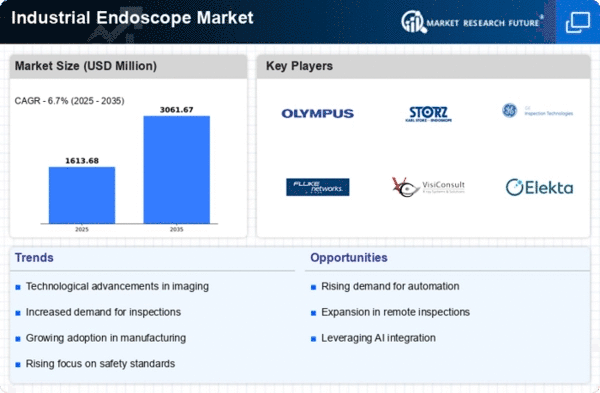
As per MRFR analysis, the Industrial Endoscope Market Size was estimated at 1512.35 USD Million in 2024. The Industrial Endoscope industry is projected to grow from 1600.71 USD Million in 2025 to 3061.67 USD Million by 2035, exhibiting a compound annual growth rate (CAGR) of 6.7 during the forecast period 2025 - 2035.

Key Market Trends & Highlights

The Industrial Endoscope Market is poised for substantial growth driven by technological advancements and increasing demand for preventive maintenance.

  • North America remains the largest market for industrial endoscopes, driven by robust demand across various sectors. The Asia-Pacific region is emerging as the fastest-growing market, fueled by rapid industrialization and technological adoption. The automotive segment continues to dominate the market, while the aerospace segment is witnessing the fastest growth due to heightened safety standards. Technological advancements in inspection tools and a rising focus on safety and compliance are key drivers propelling market expansion.

Market Size & Forecast

2024 Market Size 1512.35 (USD Million)
2035 Market Size 3061.67 (USD Million)
CAGR (2025 - 2035) 6.7%
Largest Regional Market Share in 2024 North America

Major Players

<p>Olympus Corporation (JP), Karl Storz (DE), GE Inspection Technologies (US), Fluke Corporation (US), VisiConsult (DE), Elekta (SE), YXLON International (DE), SENKO Co., Ltd. (JP), Rohde &amp; Schwarz (DE)</p>

Market Trends

The Industrial Endoscope Market is currently experiencing a notable transformation, driven by advancements in technology and increasing demand for inspection solutions across various industries. The integration of high-definition imaging and flexible designs has enhanced the capabilities of industrial endoscopes, allowing for more efficient inspections in hard-to-reach areas. This evolution appears to be fostering a greater reliance on these tools for maintenance and quality assurance, particularly in sectors such as manufacturing, aerospace, and automotive. Furthermore, the growing emphasis on preventive maintenance strategies suggests that organizations are increasingly recognizing the value of early detection of potential issues, which could lead to reduced downtime and cost savings. In addition, the Industrial Endoscope Market seems to be influenced by the rising trend of automation and digitalization within industrial processes. As companies seek to optimize operations, the demand for advanced inspection technologies is likely to grow. The ability to integrate endoscopes with digital platforms for real-time data analysis and reporting may further enhance their appeal. Overall, the market appears poised for continued growth, driven by technological innovations and an increasing focus on operational efficiency across various sectors.

Technological Advancements

Recent innovations in imaging technology and materials have significantly improved the performance of industrial endoscopes. Enhanced resolution and durability allow for more precise inspections, making these tools indispensable in various applications.

Growing Demand for Preventive Maintenance

As industries increasingly adopt preventive maintenance practices, the need for reliable inspection tools rises. Industrial endoscopes facilitate early detection of issues, potentially reducing repair costs and minimizing operational disruptions.

Integration with Digital Solutions

The trend towards digitalization in industrial settings is leading to the integration of endoscopes with advanced software solutions. This integration enables real-time data analysis, enhancing decision-making processes and operational efficiency.

Industrial Endoscope Market Market Drivers

Market Growth Projections

The Global Industrial Endoscope Market Industry is projected to experience substantial growth over the coming years. With a market value expected to reach 1500 USD Million in 2024 and potentially expanding to 3500 USD Million by 2035, the industry is poised for significant development. The compound annual growth rate of 8.01% from 2025 to 2035 indicates a robust demand for industrial endoscopes across various sectors. This growth is driven by technological advancements, increasing awareness of inspection technologies, and the necessity for compliance with safety standards.

Technological Advancements

The Global Industrial Endoscope Market Industry is experiencing rapid technological advancements that enhance inspection capabilities. Innovations such as high-definition imaging, flexible articulation, and wireless connectivity are transforming the way inspections are conducted. For instance, the introduction of 4K resolution endoscopes allows for clearer visuals, enabling technicians to identify issues with greater precision. These advancements not only improve efficiency but also reduce downtime in various industrial sectors. As a result, the market is projected to reach 1500 USD Million in 2024, reflecting a growing demand for sophisticated inspection tools.

Expansion of End-User Industries

The Global Industrial Endoscope Market Industry is benefiting from the expansion of end-user industries such as aerospace, automotive, and energy. These sectors increasingly rely on endoscopes for internal inspections of complex machinery and components. For instance, in aerospace, endoscopes are utilized to inspect turbine engines, ensuring safety and compliance with stringent regulations. As these industries continue to grow, the demand for reliable inspection tools is expected to rise, further propelling the market. The integration of industrial endoscopes into standard operating procedures is likely to enhance operational efficiency and safety.

Rising Demand for Preventive Maintenance

Preventive maintenance is becoming increasingly critical across industries, driving growth in the Global Industrial Endoscope Market Industry. Companies are recognizing the importance of regular inspections to avoid costly downtimes and repairs. For example, in the manufacturing sector, routine checks using industrial endoscopes can identify wear and tear before they lead to equipment failure. This proactive approach is expected to contribute to the market's expansion, with projections indicating a growth to 3500 USD Million by 2035. The emphasis on maintenance strategies is likely to sustain a compound annual growth rate of 8.01% from 2025 to 2035.

Regulatory Compliance and Safety Standards

Stringent regulatory compliance and safety standards are pivotal drivers of the Global Industrial Endoscope Market Industry. Industries such as oil and gas, pharmaceuticals, and food processing are subject to rigorous inspections to meet safety and quality regulations. The use of industrial endoscopes facilitates compliance by enabling thorough internal inspections without disassembly. This capability not only ensures adherence to regulations but also enhances product quality and safety. As regulatory frameworks evolve, the demand for advanced inspection technologies is expected to grow, reinforcing the market's trajectory.

Growing Awareness of Inspection Technologies

There is a growing awareness of the benefits of inspection technologies within various industries, which is positively influencing the Global Industrial Endoscope Market Industry. Companies are increasingly recognizing that utilizing industrial endoscopes can lead to cost savings, improved safety, and enhanced operational efficiency. Educational initiatives and industry conferences are promoting the advantages of these technologies, leading to wider adoption. As awareness continues to spread, the market is likely to see increased investments in inspection tools, contributing to its overall growth.

Market Segment Insights

By Application: Automotive (Largest) vs. Aerospace (Fastest-Growing)

<p>In the Industrial Endoscope Market, the application segment is primarily dominated by the automotive sector, which holds a significant market share due to the industry's stringent quality control requirements. This sector's increasing adoption of advanced inspection technologies aligns with the need for enhanced safety and precision manufacturing in the automotive sector. Following the automotive sector, aerospace represents a rapidly growing application for industrial endoscopes, driven by the rising demand for thorough inspections and maintenance in aviation.</p>

<p>Aerospace: Advanced Inspection (Dominant) vs. Energy: Renewable Sources (Emerging)</p>

<p>The aerospace sector stands out as a dominant application within the Industrial Endoscope Market, characterized by its stringent regulatory standards and the necessity for regular maintenance checks. Endoscopes in this domain are crucial for inspecting engine components and airframes, ensuring compliance with safety protocols. Conversely, the energy sector, particularly focused on renewable sources, is emerging as a significant player, propelled by the global shift towards sustainable energy solutions. These industrial endoscopes are increasingly employed for inspecting wind turbine blades and solar panel installations, marking a shift in technology utilization as industries aim for efficiency and sustainability.</p>

By End Use: Quality Control (Largest) vs. Inspection (Fastest-Growing)

<p>Within the Industrial Endoscope Market, the 'End Use' segment is primarily driven by Quality Control, which holds the largest market share among other values such as Maintenance, Research and Development, Inspection, and Repair. Quality Control is crucial in ensuring products meet industry standards, leading many companies to invest heavily in this area. Other notable segments are Inspection and Maintenance, which collectively contribute to the market but do not match the predominance of Quality Control.</p>

<p>Quality Control (Dominant) vs. Inspection (Emerging)</p>

<p>Quality Control is a dominant force in the Industrial Endoscope Market, valued for its ability to minimize defects and enhance production efficiency. Companies prioritize this segment for its proven effectiveness in maintaining high standards through thorough inspections using advanced endoscopic technology. In contrast, the Inspection segment is emerging rapidly, driven by increasing regulations and the need for safety compliance in various industries. This segment's growth is fueled by technological advancements in endoscopic equipment that offer improved imaging and versatility, making it a focal point for organizations seeking to modernize their inspections.</p>

By Type: Rigid Endoscope (Largest) vs. Flexible Endoscope (Fastest-Growing)

<p>In the Industrial Endoscope Market, the segment for Rigid Endoscopes currently holds the largest market share among the various types. This can be attributed to their ability to provide high-quality imaging and precision in inspections for sectors such as manufacturing and aviation. Flexible Endoscopes, while having a smaller market share compared to rigid counterparts, are rapidly gaining traction due to their versatility and ease of use in hard-to-reach areas.</p>

<p>Endoscopes: Rigid (Dominant) vs. Flexible (Emerging)</p>

<p>Rigid Endoscopes are widely recognized for their sturdy design, which offers superior imaging capabilities and durability under harsh conditions, making them a choice tool in heavy industries like oil and gas. Conversely, Flexible Endoscopes are emerging as a popular option due to their adaptability, allowing operators to navigate complex geometries and confined spaces effectively. This unique feature drives the growing adoption in sectors such as automotive and HVAC, appealing to industries that require innovative inspection solutions.</p>

By Technology: Optical Technology (Largest) vs. Digital Technology (Fastest-Growing)

<p>The Industrial Endoscope Market showcases a diverse range of technologies, where Optical Technology emerges as the largest segment due to its established use in various industrial applications. Following closely, Digital Technology has made significant strides, catering to industries requiring superior imaging quality and real-time data analysis. Wireless Technology, Ultrapsonic Technology, and Infrared Technology contribute a smaller share but are vital for niche applications that demand specific capabilities, enhancing the market's competitive landscape. As industries evolve, the demand for advanced inspection solutions drives the growth of these segments. Digital Technology is witnessing the fastest growth, driven by advancements in imaging technology and an increasing need for non-destructive testing. The integration of Wireless Technology is fostering greater efficiency in inspections, while Ultrasonic and Infrared Technologies are being adopted for specialized applications, propelling innovation across the Industrial Endoscope Market.</p>

<p>Optical Technology: Dominant vs. Digital Technology: Emerging</p>

<p>Optical Technology remains the dominant force in the Industrial Endoscope Market, revered for its proven effectiveness in inspecting a range of materials and structures. This segment utilizes high-quality lenses and illumination techniques to provide clear and detailed images, ideal for complex industrial inspections. In contrast, Digital Technology is emerging as a key player, offering superior image resolution and real-time data processing capabilities. As industries focus on precision and efficiency, Digital Technology's adaptability to various environments becomes crucial. Moreover, the digital shift in industrial processes, coupled with an increasing emphasis on automation, enhances the appeal of Digital Technologies, indicating a dynamic shift in preference towards higher accuracy and efficiency in inspections.</p>

By Material: Stainless Steel (Largest) vs. Plastic (Fastest-Growing)

<p>In the Industrial Endoscope Market, the material segment is characterized by a diverse range of options, particularly stainless steel and plastic. Stainless steel holds a significant share due to its durability and resistance to harsh environments, making it a preferred choice among users. On the other hand, plastic is gaining traction with its lightweight and cost-effective solutions, appealing to sectors looking for affordability alongside performance. The remainder of the market is occupied by ceramic, glass, and composite materials, which cater to specific applications requiring unique properties. Growth trends in the material segment are driven by advancements in manufacturing technologies and the increasing demand for flexible, efficient inspection solutions. As endoscopes are increasingly used in various industrial applications, the versatility of materials allows manufacturers to tailor products to meet evolving customer needs. The trend toward lightweight materials is expected to elevate plastic's market presence, while stainless steel remains resilient due to its unparalleled strength and longevity.</p>

<p>Stainless Steel (Dominant) vs. Plastic (Emerging)</p>

<p>Stainless steel is recognized as the dominant material in the Industrial Endoscope Market due to its outstanding characteristics like corrosion resistance, durability, and the ability to withstand high temperatures, making it ideal for rigorous industrial environments. This material is favored in industries where reliability and longevity are critical, such as manufacturing and construction. Conversely, plastic is emerging as a competitive alternative, particularly in applications where weight and cost are primary considerations. Its flexibility and versatility enable manufacturers to produce lightweight endoscopes that are easier to handle, catering to a growing demand for portable inspection tools. The increasing awareness of the benefits of plastic in diverse applications suggests a rising acceptance and potential market growth for this segment.</p>

Get more detailed insights about Industrial Endoscope Market Research Report—Global Forecast till 2035

Regional Insights

North America : Market Leader in Innovation

North America is poised to maintain its leadership in the Industrial Endoscope Market, holding a significant market share of $756.18M in 2024. The region's growth is driven by increasing demand for advanced inspection technologies across various industries, including aerospace, automotive, and manufacturing. Regulatory support for safety standards and technological advancements further catalyze market expansion, ensuring compliance and enhancing operational efficiency. The United States stands as the primary contributor to this market, with key players like GE Inspection Technologies and Fluke Corporation leading the charge. The competitive landscape is characterized by continuous innovation and strategic partnerships among major companies, including Olympus Corporation and Karl Storz. This dynamic environment fosters a robust ecosystem for industrial endoscopes, ensuring that North America remains at the forefront of technological advancements.

Europe : Emerging Market with Growth Potential

Europe is witnessing a growing interest in the Industrial Endoscope Market, with a market size of €392.1M projected for 2025. The region's growth is fueled by stringent regulations regarding safety and quality in manufacturing processes, driving demand for advanced inspection solutions. Countries like Germany and France are leading this trend, supported by government initiatives aimed at enhancing industrial efficiency and safety standards. Germany is a key player in this market, hosting major companies such as Karl Storz and YXLON International. The competitive landscape is marked by innovation and collaboration among industry leaders, which is essential for meeting the evolving needs of various sectors. The European market is expected to continue expanding as companies increasingly adopt industrial endoscopes to comply with regulatory requirements and improve operational performance.

Asia-Pacific : Rapidly Growing Industrial Sector

Asia-Pacific is emerging as a significant player in the Industrial Endoscope Market, with a projected market size of $292.07M by 2025. The region's growth is driven by rapid industrialization and increasing investments in manufacturing technologies. Countries like Japan and China are at the forefront, with a rising demand for high-quality inspection tools to enhance production efficiency and safety standards. Japan, home to key players like Olympus Corporation and SENKO Co., Ltd., is leading the charge in technological advancements. The competitive landscape is characterized by a mix of established companies and new entrants, fostering innovation and driving market growth. As industries in Asia-Pacific continue to evolve, the adoption of industrial endoscopes is expected to rise significantly, aligning with global quality standards.

Middle East and Africa : Emerging Market with Untapped Potential

The Middle East and Africa region is gradually emerging in the Industrial Endoscope Market, with a market size of $72.0M anticipated by 2025. The growth is primarily driven by increasing investments in infrastructure and industrial projects, alongside a growing awareness of the importance of quality control in manufacturing processes. Countries like the UAE and South Africa are leading this trend, supported by government initiatives aimed at enhancing industrial capabilities. The competitive landscape in this region is still developing, with opportunities for both local and international players to establish a foothold. As industries expand and modernize, the demand for advanced inspection technologies, including industrial endoscopes, is expected to rise, presenting significant growth opportunities for market participants.

Key Players and Competitive Insights

The Industrial Endoscope Market is characterized by a dynamic competitive landscape, driven by technological advancements and increasing demand for inspection solutions across various industries. Key players such as Olympus Corporation (JP), Karl Storz (DE), and GE Inspection Technologies (US) are at the forefront, each adopting distinct strategies to enhance their market presence. Olympus Corporation (JP) focuses on innovation, particularly in developing high-resolution imaging technologies, which positions it as a leader in providing advanced inspection solutions. Meanwhile, Karl Storz (DE) emphasizes strategic partnerships, collaborating with various industrial sectors to expand its product offerings and enhance customer engagement. GE Inspection Technologies (US) is actively pursuing digital transformation initiatives, integrating AI and machine learning into its inspection processes, thereby improving efficiency and accuracy in inspections.

The market structure appears moderately fragmented, with several players competing for market share. Key business tactics include localizing manufacturing to reduce costs and optimize supply chains, which is crucial in maintaining competitive pricing. The collective influence of these major players shapes the market dynamics, as they continuously innovate and adapt to changing customer needs, thereby fostering a competitive environment that encourages technological advancements.

In November 2025, Olympus Corporation (JP) launched a new line of industrial endoscopes featuring enhanced imaging capabilities and user-friendly interfaces. This strategic move is likely to strengthen its market position by addressing the growing demand for high-quality inspection tools in sectors such as aerospace and automotive. The introduction of these advanced products may also attract new customers seeking cutting-edge technology for their inspection needs.

In October 2025, Karl Storz (DE) announced a partnership with a leading aerospace manufacturer to develop customized endoscopic solutions tailored to specific inspection requirements. This collaboration underscores the company's commitment to innovation and customer-centric solutions, potentially leading to increased market penetration and enhanced brand loyalty. Such partnerships may also facilitate knowledge exchange, driving further advancements in endoscopic technology.

In September 2025, GE Inspection Technologies (US) unveiled a new AI-driven software platform designed to enhance the analysis of inspection data collected by its endoscopes. This development signifies a strategic pivot towards integrating digital solutions into traditional inspection processes, which could improve operational efficiency and provide clients with actionable insights. The incorporation of AI may also set a new standard in the industry, compelling competitors to follow suit.

As of December 2025, current competitive trends in the Industrial Endoscope Market are heavily influenced by digitalization, sustainability, and AI integration. Strategic alliances are increasingly shaping the landscape, as companies recognize the value of collaboration in driving innovation. The competitive differentiation is likely to evolve from traditional price-based competition to a focus on technological advancements, reliability in supply chains, and the ability to offer tailored solutions. This shift suggests that companies prioritizing innovation and customer-centric strategies will be better positioned to thrive in the evolving market.

Key Companies in the Industrial Endoscope Market include

Industry Developments

  • Q2 2024: Olympus launches ETD washer-disinfector series to improve endoscope reprocessing outcomes Olympus introduced its new ETD washer-disinfector series, designed to enhance disinfection outcomes for endoscopes while supporting sustainability and operational efficiency. The launch strengthens Olympus’s position in the endoscope reprocessing market.
  • Q2 2024: STERIS launches Reliance Endoscope Reprocessors with advanced automation and compliance features STERIS announced the launch of its Reliance Endoscope Reprocessors, which offer advanced automation and compliance features to align with evolving healthcare standards for endoscope reprocessing.
  • Q2 2024: Getinge introduces GSS Steam Sterilizers and ED-FLOW AERs with smart technologies for endoscope reprocessing Getinge launched its GSS Steam Sterilizers and ED-FLOW Automated Endoscope Reprocessors, integrating smart technologies to enhance workflow and traceability in endoscope reprocessing.
  • Q2 2024: Ecolab expands infection prevention portfolio with new high-performance endoscope reprocessing solutions Ecolab announced the expansion of its infection prevention portfolio, introducing new high-performance solutions for endoscope reprocessing that leverage its chemistry expertise.

Future Outlook

Industrial Endoscope Market Future Outlook

<p>The Industrial Endoscope Market is projected to grow at a 6.7% CAGR from 2024 to 2035, driven by technological advancements, increasing demand for inspection solutions, and expanding industrial applications.</p>

New opportunities lie in:

  • <p>Development of AI-integrated inspection systems for enhanced accuracy.</p>
  • <p>Expansion into emerging markets with tailored product offerings.</p>
  • <p>Partnerships with maintenance service providers for bundled solutions.</p>

<p>By 2035, the market is expected to achieve robust growth, solidifying its position as a critical inspection tool.</p>

Market Segmentation

Industrial Endoscope Market Type Outlook

  • Rigid Endoscope
  • Flexible Endoscope
  • Video Endoscope
  • Borescope
  • Articulating Endoscope

Industrial Endoscope Market End Use Outlook

  • Quality Control
  • Maintenance
  • Research and Development
  • Inspection
  • Repair

Industrial Endoscope Market Material Outlook

  • Stainless Steel
  • Plastic
  • Ceramic
  • Glass
  • Composite

Industrial Endoscope Market Technology Outlook

  • Optical Technology
  • Digital Technology
  • Wireless Technology
  • Ultrasonic Technology
  • Infrared Technology

Industrial Endoscope Market Application Outlook

  • Automotive
  • Aerospace
  • Manufacturing
  • Energy
  • Electronics

Report Scope

MARKET SIZE 2024 1512.35(USD Million)
MARKET SIZE 2025 1600.71(USD Million)
MARKET SIZE 2035 3061.67(USD Million)
COMPOUND ANNUAL GROWTH RATE (CAGR) 6.7% (2024 - 2035)
REPORT COVERAGE Revenue Forecast, Competitive Landscape, Growth Factors, and Trends
BASE YEAR 2024
Market Forecast Period 2025 - 2035
Historical Data 2019 - 2024
Market Forecast Units USD Million
Key Companies Profiled Olympus Corporation (JP), Karl Storz (DE), GE Inspection Technologies (US), Fluke Corporation (US), VisiConsult (DE), Elekta (SE), YXLON International (DE), SENKO Co., Ltd. (JP), Rohde & Schwarz (DE)
Segments Covered Application, End Use, Type, Technology, Material
Key Market Opportunities Integration of advanced imaging technologies enhances inspection capabilities in the Industrial Endoscope Market.
Key Market Dynamics Technological advancements drive demand for industrial endoscopes, enhancing inspection capabilities across various sectors.
Countries Covered North America, Europe, APAC, South America, MEA

FAQs

What is the growth scope of the market?

The global Industrial Endoscope Market has been growing rapidly from the past few decades. It is expected to exhibit a CAGR of 6.7% during the forecast period.

Who are the key competitors in this market?

OLYMPUS CORPORATION, SKF GROUP, PCE INSTRUMENTS, SHENZHEN YATEKS CO., LTD, TELEDYNE TECHNOLOGIES INC., BAKER HUGHES COMPANY, STS CORPORATION, INNOVIEW GMBH, IT CONCEPTS GMBH, and KARL STORZ NDTEC GMBH are expected to be the major competition in the Industrial Endoscope Market during the projected period.

Which product segment is driving the market?

The Energy &amp; Power segment is expected to drive the market during the forecasted period.

Which region is guiding the achievement of the market?

The North America region is expected to be the largest market for Industrial Endoscope Market during the forecast period.

What can limit the expansion of the global market?

Serviceability of components and visual details of inspection areas may slow the growth of the Industrial Endoscope Market during the forecast period.

  1. SECTION I: EXECUTIVE SUMMARY AND KEY HIGHLIGHTS
    1. | 1.1 EXECUTIVE SUMMARY
  2. SECTION II: SCOPING, METHODOLOGY AND MARKET STRUCTURE
    1. | 2.1 MARKET INTRODUCTION
    2. | 2.2 RESEARCH METHODOLOGY
  3. SECTION III: QUALITATIVE ANALYSIS
    1. | 3.1 MARKET DYNAMICS
    2. | 3.2 MARKET FACTOR ANALYSIS
  4. SECTION IV: QUANTITATIVE ANALYSIS
    1. | 4.1 Semiconductor & Electronics, BY Application (USD Million)
    2. | 4.2 Semiconductor & Electronics, BY End Use (USD Million)
    3. | 4.3 Semiconductor & Electronics, BY Type (USD Million)
    4. | 4.4 Semiconductor & Electronics, BY Technology (USD Million)
    5. | 4.5 Semiconductor & Electronics, BY Material (USD Million)
    6. | 4.6 Semiconductor & Electronics, BY Region (USD Million)
  5. SECTION V: COMPETITIVE ANALYSIS
    1. | 5.1 Competitive Landscape
    2. | 5.2 Company Profiles
    3. | 5.3 Appendix

Industrial Endoscope Market Segmentation

Market Segmentation Overview

  • Detailed segmentation data will be available in the full report
  • Comprehensive analysis by multiple parameters
  • Regional and country-level breakdowns
  • Market size forecasts by segment
Infographic

Free Sample Request

Kindly complete the form below to receive a free sample of this Report

Get Free Sample

Customer Strories

Compare Licence

×
Features License Type
Single User Multiuser License Enterprise User
Price $4,950 $5,950 $7,250
Maximum User Access Limit 1 User Upto 10 Users Unrestricted Access Throughout the Organization
Free Customization
Direct Access to Analyst
Deliverable Format
Platform Access
Discount on Next Purchase 10% 15% 15%
Printable Versions