×
Request Free Sample ×

Kindly complete the form below to receive a free sample of this Report

* Please use a valid business email

Leading companies partner with us for data-driven Insights

clients tt-cursor
Hero Background
English
Chinese
French
Japanese
Korean
German
Spanish

Industrial Controllers Market Size

ID: MRFR/SEM/7172-CR
128 Pages
Ankit Gupta
March 2024

Industrial Controllers Market Size, Share and Research Report By Type (Programmable Logic Controllers (PLC), Distributed Control Systems (DCS), Supervisory Control and Data Acquisition (Scada), and Programmable Automation Controllers (PAC)), By Control (On-Off Control, Open Loop Control, Closed-Loop Control and Feed-Forward Control), By Application (Automotive, Manufacturing, Oil & Gas, Energy & Utilities, Water & Wastewater, Food Processing & Beverage, Aerospace & Aviation, and Others) And By Region (North America, Europ... read more

Share:
Download PDF ×

We do not share your information with anyone. However, we may send you emails based on your report interest from time to time. You may contact us at any time to opt-out.

Industrial Controllers Market Infographic
Purchase Options

Industrial Controllers Size

Industrial Controllers Market Growth Projections and Opportunities

The Industrial Controllers Market is significantly influenced by a variety of factors that collectively drive its growth and evolution. One key driver is the increasing emphasis on industrial automation and the adoption of Industry 4.0 principles. As manufacturing processes become more sophisticated and interconnected, the demand for efficient control systems and automation solutions rises. Industrial controllers, serving as the central intelligence in automated systems, play a pivotal role in optimizing production, enhancing efficiency, and facilitating real-time decision-making.

Technological advancements are fundamental to the continuous development of the Industrial Controllers Market. The evolution of programmable logic controllers (PLCs), distributed control systems (DCS), and programmable automation controllers (PACs) contributes to improved functionalities, connectivity, and integration capabilities. These advancements enable seamless communication between various components in industrial networks, fostering interoperability and enabling a more flexible and responsive manufacturing environment.

The ongoing trend of digital transformation and the Industrial Internet of Things (IIoT) significantly impact the Industrial Controllers Market. The integration of sensors, actuators, and smart devices into industrial processes generates vast amounts of data. Industrial controllers, equipped with advanced communication protocols and data processing capabilities, serve as the backbone for collecting, analyzing, and leveraging this data for predictive maintenance, process optimization, and overall operational efficiency.

The manufacturing sector's increasing focus on energy efficiency and sustainability is another driving factor for the Industrial Controllers Market. Industrial controllers contribute to optimizing energy consumption in manufacturing processes by regulating equipment operation and ensuring optimal resource utilization. The ability to monitor and control energy usage aligns with global sustainability goals and regulatory initiatives, driving the adoption of energy-efficient industrial control solutions.

The demand for safety and compliance in industrial operations influences the Industrial Controllers Market. Stringent safety standards and regulations in industries such as chemicals, pharmaceuticals, and oil and gas necessitate the implementation of robust safety control systems. Industrial controllers with integrated safety features, such as safety PLCs and safety-rated PACs, provide the necessary functionality to meet safety requirements and protect both personnel and assets.

The aerospace and automotive industries contribute significantly to the Industrial Controllers Market. In these industries, precision control and high-speed data processing are essential for manufacturing complex components and ensuring product quality. Industrial controllers play a crucial role in robotics, machine control, and overall process automation in these sectors, supporting advanced manufacturing practices and maintaining competitiveness.

Market dynamics are also influenced by the geographical expansion of manufacturing activities. The growth of emerging economies and the establishment of new manufacturing facilities contribute to increased demand for industrial controllers. As industries in regions such as Asia-Pacific expand and modernize, the need for advanced control systems becomes more pronounced, driving market growth.

Market competition and the presence of key players contribute to the dynamism of the Industrial Controllers Market. Established automation and control system manufacturers, as well as new entrants, actively invest in research and development to introduce innovative industrial controller solutions. Collaborations, partnerships, and acquisitions are common strategies employed by market players to enhance their product portfolios and gain a competitive edge. This competitive landscape fosters continuous innovation and ensures that industrial controllers remain at the forefront of technological advancements.
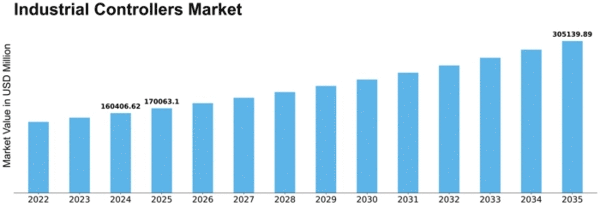
Industrial Controllers Market Size Graph
Author
Ankit Gupta
Senior Research Analyst

Ankit Gupta is an analyst in market research industry in ICT and SEMI industry. With post-graduation in "Telecom and Marketing Management" and graduation in "Electronics and Telecommunication" vertical he is well versed with recent development in ICT industry as a whole. Having worked on more than 150+ reports including consultation for fortune 500 companies such as Microsoft and Rio Tinto in identifying solutions with respect to business problems his opinions are inclined towards mixture of technical and managerial aspects.

Leave a Comment

FAQs

How much is the Industrial Controllers market?

The Industrial Controllers Market size is expected to be valued at USD 160406.62 billion in 2024.

What is the growth rate of the Industrial Controllers market?

The global market is projected to grow at a CAGR of 6.02% during the forecast period, 2025 to 2035.

Which region held the largest market share in the Industrial Controllers market?

Asia-Pacific had the largest share of the global market.

Who are the key players in the Industrial Controllers market?

The key players in the market are National Instruments Corporation, Ascon Tecnologic, Siemens Ag, Mitsubishi Electric, General Electric, Omron Corporation, Red Lion Controls (spectris plc), B&R Industrial, Automation Gmbh (ABB Ltd), Schneider Electric, Abb Limited, Honeywell International Inc., Rockwell Automation, Emerson Electric Corporation, Yokogawa Electric Corporation, Kawasaki Heavy Industries, Ltd.

Which Type led the Industrial Controllers market?

The Distributed Control Systems (DCS) category dominated the market in 2022.

Market Summary

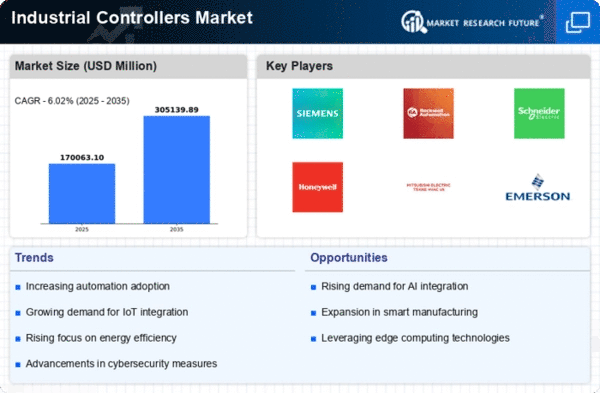
As per MRFR analysis, the Industrial Controllers Market Size was estimated at 160406.62 USD Million in 2024. The Industrial Controllers industry is projected to grow from 170063.49 USD Million in 2025 to 305139.89 USD Million by 2035, exhibiting a compound annual growth rate (CAGR) of 6.02 during the forecast period 2025 - 2035.

Key Market Trends & Highlights

The Industrial Controllers Market is experiencing robust growth driven by technological advancements and increasing automation demands.

  • The integration of IoT technologies is transforming operational efficiencies across various industries. Energy efficiency remains a focal point as companies seek to reduce operational costs and environmental impact. Predictive maintenance adoption is on the rise, enhancing equipment reliability and minimizing downtime. Rising demand for automation and technological advancements in control systems are key drivers propelling growth in North America and Asia-Pacific, particularly in the process automation and utilities segments.

Market Size & Forecast

2024 Market Size 160406.62 (USD Million)
2035 Market Size 305139.89 (USD Million)
CAGR (2025 - 2035) 6.02%
Largest Regional Market Share in 2024 North America

Major Players

Siemens (DE), Rockwell Automation (US), Schneider Electric (FR), Honeywell (US), Mitsubishi Electric (JP), Emerson Electric (US), ABB (CH), General Electric (US), Bosch Rexroth (DE)

Market Trends

The Industrial Controllers Market is currently experiencing a transformative phase, driven by advancements in automation and the increasing demand for efficient manufacturing processes. As industries strive for enhanced productivity, the integration of sophisticated control systems has become paramount. These systems not only facilitate real-time monitoring but also enable predictive maintenance, thereby reducing downtime and operational costs. Furthermore, the growing emphasis on sustainability and energy efficiency is prompting manufacturers to adopt innovative control solutions that optimize resource utilization. This shift towards smart manufacturing is reshaping the landscape of the Industrial Controllers Market, as companies seek to leverage technology for competitive advantage. In addition, the rise of the Internet of Things (IoT) is significantly influencing the Industrial Controllers Market. The interconnectivity of devices allows for seamless data exchange, enhancing decision-making processes and operational efficiency. As organizations increasingly adopt IoT-enabled controllers, the demand for advanced analytics and data-driven insights is likely to surge. This trend suggests a future where industrial operations are not only automated but also intelligently managed, paving the way for a new era of manufacturing excellence. Overall, the Industrial Controllers Market appears poised for substantial growth, driven by technological innovation and evolving industry needs.

Integration of IoT Technologies

The incorporation of Internet of Things (IoT) technologies into industrial controllers is becoming increasingly prevalent. This trend facilitates enhanced connectivity and data exchange among devices, leading to improved operational efficiency and real-time monitoring capabilities. As industries embrace IoT, the demand for smart controllers that can seamlessly integrate with existing systems is likely to rise.

Focus on Energy Efficiency

There is a growing emphasis on energy efficiency within the Industrial Controllers Market. Manufacturers are increasingly seeking solutions that not only optimize performance but also minimize energy consumption. This trend reflects a broader commitment to sustainability and cost reduction, as companies aim to align their operations with environmental standards.

Adoption of Predictive Maintenance

The shift towards predictive maintenance is gaining traction in the Industrial Controllers Market. By utilizing advanced analytics and real-time data, organizations can anticipate equipment failures before they occur. This proactive approach not only enhances reliability but also reduces maintenance costs, making it an attractive option for manufacturers aiming to improve operational efficiency.

Industrial Controllers Market Market Drivers

Regulatory Compliance

Regulatory compliance is a crucial factor influencing the Global Industrial Controllers Market Industry. Governments worldwide are implementing stringent regulations to ensure safety, quality, and environmental protection in industrial operations. Compliance with these regulations necessitates the adoption of advanced control systems that can monitor and report on various operational parameters. For instance, industries must adhere to standards set by organizations such as the International Organization for Standardization. This regulatory landscape drives the demand for sophisticated industrial controllers, as companies seek to avoid penalties and enhance their operational integrity.

Emerging Markets Growth

The Global Industrial Controllers Market Industry is poised for growth, particularly in emerging markets. Countries in Asia-Pacific and Latin America are witnessing rapid industrialization, leading to increased investments in manufacturing and infrastructure. This growth presents opportunities for industrial controllers, as businesses in these regions seek to modernize their operations. For example, the expansion of manufacturing hubs in India and Brazil is driving demand for advanced control systems. As these markets develop, the Global Industrial Controllers Market is expected to benefit from increased adoption of automation technologies, further propelling its growth trajectory.

Focus on Energy Efficiency

Energy efficiency has emerged as a pivotal driver in the Global Industrial Controllers Market Industry. Companies are increasingly prioritizing sustainable practices to reduce operational costs and minimize environmental impact. Advanced industrial controllers enable precise monitoring and control of energy consumption, leading to significant savings. For example, industries that implement energy-efficient control systems can reduce energy usage by up to 30%. This focus on sustainability not only aligns with global environmental goals but also enhances the competitiveness of businesses in the market, contributing to a projected CAGR of 6.02% from 2025 to 2035.

Technological Advancements

The Global Industrial Controllers Market Industry is experiencing a surge in demand driven by rapid technological advancements. Innovations in automation, artificial intelligence, and the Internet of Things are reshaping industrial processes. For instance, the integration of smart sensors and advanced control algorithms enhances operational efficiency and reduces downtime. This trend is evident as industries increasingly adopt these technologies to optimize production. As a result, the market is projected to reach 160.4 USD Billion in 2024, reflecting a growing reliance on sophisticated control systems to meet the demands of modern manufacturing.

Rising Demand for Automation

The Global Industrial Controllers Market Industry is significantly influenced by the rising demand for automation across various sectors. Industries such as manufacturing, oil and gas, and pharmaceuticals are increasingly automating their processes to improve productivity and reduce labor costs. This shift is evident in the growing adoption of programmable logic controllers and distributed control systems. As companies seek to enhance operational efficiency, the market is expected to grow substantially, with projections indicating a value of 305.1 USD Billion by 2035. This trend underscores the critical role of industrial controllers in facilitating seamless automation.

Market Segment Insights

By Application: Process Automation (Largest) vs. Manufacturing Automation (Fastest-Growing)

The Industrial Controllers Market features diverse applications, with Process Automation emerging as the largest segment. This segment dominates market share due to its extensive adoption across various industries, including oil and gas, chemicals, and pharmaceuticals. Manufacturing Automation follows closely and is marked as the fastest-growing segment, driven by the increasing need for efficiency and productivity in manufacturing processes. Building Automation, Energy Management, and Transportation Management also contribute to the market, but to a lesser extent, reflecting a balanced preference across application areas. Growth trends in the Industrial Controllers Market are significantly influenced by technological advancements and the push for digital transformation in industrial processes. The adoption of IoT and smart technologies propels process automation initiatives, while Industry 4.0 principles fuel manufacturing automation growth. Additionally, increasing environmental regulations are driving energy management applications as industries strive for sustainability. Consequently, these dynamics afford a robust growth outlook for the sector in the coming years.

Manufacturing Automation (Dominant) vs. Building Automation (Emerging)

Manufacturing Automation is currently seen as a dominant force in the Industrial Controllers Market, reflecting its critical role in enhancing operational efficiency and productivity. The rapid adoption of robotics and automated systems in production lines underpins this dominance. In contrast, Building Automation is considered an emerging segment, garnering interest for its potential to optimize energy use and improve occupant comfort through smart systems. This segment is gaining traction amidst rising concerns for sustainability and energy efficiency. As buildings increasingly incorporate intelligent control systems, the Building Automation segment is poised for considerable growth, driven by urbanization and technological advancements in smart infrastructure.

By End Use Industry: Oil and Gas (Largest) vs. Utilities (Fastest-Growing)

The Industrial Controllers Market showcases a significant segmentation by end-use industries, with the Oil and Gas sector holding a substantial share. Manufacturing is another key player, demonstrating consistent contributions to market growth. Automotive and Aerospace have also made notable impacts, yet they lag behind Oil and Gas in terms of market presence. Utilities, while currently smaller in share, exhibit promising potential for growth, indicating a shift in demand dynamics in various industrial sectors. Growth trends indicate that the Oil and Gas sector remains a dominant force due to ongoing investments in technology and infrastructure upgrades. Meanwhile, the Utilities sector is rapidly gaining traction, driven by the need for <a href="https://www.marketresearchfuture.com/reports/smart-grid-sensors-market-5427">smart grid</a> solutions and renewable energy initiatives. The increasing adoption of automation and IoT technologies across industries further fuels the demand for industrial controllers, paving the way for significant advancements and innovations in this market segment.

Oil and Gas: Dominant vs. Utilities: Emerging

The Oil and Gas sector is characterized by its robust infrastructure and sophisticated automation systems that have been integral in enhancing operational efficiency. As a dominant player in the Industrial Controllers Market, it benefits from ongoing investments in safety, monitoring, and control technologies, reflecting the industry's commitment to maximizing production while minimizing risks. Conversely, the Utilities sector is emerging rapidly, capitalizing on the global shift towards sustainable energy solutions. This sector is increasingly adopting advanced industrial controllers to optimize resource management and integrate renewable energy sources. The convergence of innovation in smart technologies, alongside regulatory mandates for efficient energy use, positions Utilities as a key segment poised for future growth, indicating a transformative landscape in energy production and distribution.

By Controller Type: Programmable Logic Controller (Largest) vs. Distributed Control System (Fastest-Growing)

The Industrial Controllers Market shows a diverse distribution across several controller types, with Programmable Logic Controllers (PLCs) leading the segment due to their robust adaptability and widespread applications across various industries. They dominate with significant market share, largely attributed to their reliability and ease of integration into existing systems. Following PLCs, Distributed Control Systems (DCS) are gaining momentum, particularly in process-intensive sectors like oil and gas, where real-time monitoring and control are paramount. Their growth indicates a shift towards more complex systems requiring tighter integration and management. Growth trends within the controller type segment indicate a strong inclination towards automation and systematic control solutions. Factors driving this trend include the accelerating adoption of Industry 4.0 practices, which call for enhanced operational efficiency and data-driven decision-making. Moreover, with advancements in the Internet of Things (IoT) and smart manufacturing technologies, Distributed Control Systems are poised to capture a larger share of the market, supporting seamless connectivity and data exchange. This shift reflects a broader demand for integrated solutions that enhance monitoring and control across various manufacturing environments.

Programmable Logic Controller (Dominant) vs. Motion Controller (Emerging)

Programmable Logic Controllers (PLCs) remain the dominant player in the Industrial Controllers Market due to their versatility and suitability for a wide range of applications, from simple machine control to complex automation systems. Their ability to handle various input and output configurations while ensuring operational efficiency makes them indispensable in modern manufacturing. On the other hand, Motion Controllers are emerging as a significant segment, particularly in robotics and precision motion applications. Their recent advancements in motion control technology, including integration with IoT for enhanced precision and feedback systems, point to a growing market niche catering to sophisticated automation needs. While PLCs focus on general control, Motion Controllers are tailored for specific tasks that necessitate high-speed, accurate movements, positioning them as a critical component in future industrial automation solutions.

By Technology: Digital Control (Largest) vs. Networked Control (Fastest-Growing)

The Industrial Controllers Market showcases a dynamic distribution of technologies, with Digital Control leading the segment. This technology has established a substantial market presence due to its ease of integration and reliability for various industrial systems. Analog Control remains significant, yet its slow growth compared to more modern alternatives has positioned it lower in market share. Hybrid Control and Wireless Control are also present, contributing to the diverse technology landscape in this market. Growth trends indicate that Digital Control will continue to be a dominant technology, driven by the increasing adoption of automation and Industry 4.0 practices. However, Networked Control is emerging rapidly, appealing to industries seeking enhanced connectivity and interoperability in their processes. As manufacturers focus on digital transformation, the demand for Networked Control is expected to climb significantly, reshaping the competitive landscape of the market.

Technology: Digital Control (Dominant) vs. Networked Control (Emerging)

Digital Control is the cornerstone of modern industrial automation, characterized by its precision and versatility in controlling machinery and processes. Manufacturers favor this technology for its digital interfaces and compatibility with various programmable logic controllers (PLCs). On the other hand, Networked Control is gaining traction as it enables seamless communication between devices and systems, promoting real-time data exchange and operational efficiency. This emerging technology is crucial for industries transitioning to more interconnected systems, responding to the growing need for remote monitoring and control capabilities. As Digital Control remains dominant, Networked Control’s emergence signals a pivotal shift towards integrated industrial ecosystems.

By Component Type: Input Devices (Largest) vs. Software (Fastest-Growing)

The Industrial Controllers Market is witnessing a diverse market share distribution across various component types. Input Devices hold the largest share, driven by their critical role in data acquisition and process control. However, Software is emerging rapidly, thanks to increasing automation and the need for advanced data analytics in industrial processes. Communication Interfaces and Output Devices also contribute significantly, reflecting the interconnected nature of modern industrial systems.

Input Devices (Dominant) vs. Software (Emerging)

Input Devices are known for their essential function in providing operators with the means to interact with industrial systems. They include sensors, buttons, and switches that are integral to monitoring and control processes. In contrast, Software is gaining momentum as industries seek smarter solutions for data analysis, machine learning, and system integration. The advent of <a href="https://www.marketresearchfuture.com/reports/industry-4-0-market-2375">Industry 4.0</a> and IoT integration is transforming Software from a supplementary role to a core element, enabling businesses to enhance efficiency and decision-making capabilities. This shift highlights a significant trend in the market, where Software is not only becoming essential but is also fostering innovation and growth.

Get more detailed insights about Industrial Controllers Market Research Report - Global Forecast till 2035

Regional Insights

North America : Market Leader in Innovation

North America continues to lead the Industrial Controllers market, holding a significant share of 64,000.0. The region's growth is driven by advancements in automation technologies, increasing demand for smart manufacturing, and supportive government regulations promoting industrial efficiency. The push for sustainability and energy efficiency further catalyzes market expansion, with industries increasingly adopting advanced control systems to optimize operations. The United States stands as the primary market, with key players like Rockwell Automation, Honeywell, and Emerson Electric driving innovation. The competitive landscape is characterized by a focus on R&D and strategic partnerships, enhancing product offerings. As industries transition towards Industry 4.0, the presence of major corporations such as Siemens and General Electric solidifies North America's position as a hub for industrial control solutions.

Europe : Emerging Market with Potential

Europe's Industrial Controllers market is poised for growth, with a market size of 40,000.0. The region benefits from stringent regulations aimed at enhancing industrial safety and efficiency, driving demand for advanced control systems. The European Union's commitment to reducing carbon emissions and promoting sustainable practices further fuels the adoption of innovative technologies in manufacturing processes. Germany and France are leading countries in this sector, with significant contributions from companies like Siemens and Schneider Electric. The competitive landscape is marked by a blend of established players and emerging startups focusing on smart technologies. As industries embrace digital transformation, Europe is expected to witness a surge in demand for industrial controllers, positioning itself as a key player in the global market.

Asia-Pacific : Rapid Growth and Adoption

The Asia-Pacific region is experiencing rapid growth in the Industrial Controllers market, with a size of 48,000.0. This growth is driven by increasing industrialization, urbanization, and the rising demand for automation across various sectors. Governments in countries like China and India are investing heavily in infrastructure and manufacturing, creating a favorable environment for the adoption of advanced control systems. China is the dominant player in this market, supported by major companies such as Mitsubishi Electric and ABB. The competitive landscape is evolving, with local manufacturers emerging alongside global giants. As the region continues to embrace smart manufacturing and IoT technologies, the demand for industrial controllers is expected to rise significantly, making Asia-Pacific a critical market for future growth.

Middle East and Africa : Emerging Market Opportunities

The Middle East and Africa region presents a nascent but promising market for Industrial Controllers, with a size of 4,806.62. The growth is primarily driven by increasing investments in industrial infrastructure and a shift towards automation in various sectors. Governments are recognizing the importance of modernizing their industrial base, which is fostering demand for advanced control systems to enhance operational efficiency. Countries like South Africa and the UAE are leading the way in adopting industrial automation technologies. The competitive landscape is characterized by a mix of local and international players, with companies like Honeywell and Siemens establishing a presence. As the region continues to develop its industrial capabilities, the demand for industrial controllers is expected to grow, presenting significant opportunities for market players.

Key Players and Competitive Insights

The Industrial Controllers Market is currently characterized by a dynamic competitive landscape, driven by technological advancements and increasing demand for automation across various sectors. Key players such as Siemens (DE), Rockwell Automation (US), and Schneider Electric (FR) are strategically positioned to leverage innovation and digital transformation. Siemens (DE) focuses on integrating AI and IoT into its product offerings, enhancing operational efficiency and connectivity. Rockwell Automation (US) emphasizes partnerships with tech firms to bolster its software capabilities, while Schneider Electric (FR) is committed to sustainability, aiming to reduce carbon footprints through energy-efficient solutions. Collectively, these strategies foster a competitive environment that prioritizes technological prowess and sustainability.
In terms of business tactics, companies are increasingly localizing manufacturing to mitigate supply chain disruptions and optimize logistics. The market structure appears moderately fragmented, with several players vying for market share, yet the influence of major companies remains substantial. This competitive structure allows for a diverse range of products and services, catering to various industrial needs while fostering innovation through competition.
In November 2025, Siemens (DE) announced the launch of its new digital twin technology, which aims to enhance the design and operational efficiency of industrial controllers. This strategic move is significant as it positions Siemens at the forefront of digital transformation, enabling clients to simulate and optimize processes before implementation, thereby reducing costs and time-to-market.
In October 2025, Rockwell Automation (US) expanded its partnership with a leading AI firm to integrate advanced analytics into its control systems. This collaboration is pivotal, as it enhances Rockwell's offerings by providing clients with predictive maintenance capabilities, ultimately improving operational reliability and reducing downtime.
In September 2025, Schneider Electric (FR) launched a new initiative focused on circular economy principles, aiming to recycle and repurpose industrial controllers at the end of their lifecycle. This initiative not only aligns with global sustainability goals but also positions Schneider as a leader in environmentally responsible manufacturing practices, appealing to increasingly eco-conscious consumers.
As of December 2025, the competitive trends in the Industrial Controllers Market are heavily influenced by digitalization, sustainability, and AI integration. Strategic alliances are becoming more prevalent, as companies recognize the need to collaborate to enhance their technological capabilities. Looking ahead, competitive differentiation is likely to evolve from traditional price-based competition to a focus on innovation, technology integration, and supply chain reliability. This shift underscores the importance of adaptability and forward-thinking strategies in maintaining a competitive edge in an ever-evolving market.

Key Companies in the Industrial Controllers Market include

Industry Developments

  • In January 2023, B&R Industrial Automation Gmbh launched the X2X+ backplane bus as an option, increasing the performance of the X20 system by a factor of four. And because all existing X20 I/O modules are already compatible with X2X+, all it takes to build more powerful machines are bus modules.
  • In November 2022, Rockwell Automation enhanced the Allen‑Bradley Micro850 and Micro870 2080-Lx0E controllers using the latest Connected Components Workbench software from Rockwell Automation. The improved 2080-Lx0E controllers offer greater connectivity and design efficiency through the new Class 1 implicit messaging capability with up to eight EtherNet/IP devices support.

Future Outlook

Industrial Controllers Market Future Outlook

The Industrial Controllers Market is projected to grow at a 6.02% CAGR from 2025 to 2035, driven by automation, IoT integration, and demand for energy efficiency.

New opportunities lie in:

  • Development of AI-driven predictive maintenance solutions
  • Expansion into renewable energy sector control systems
  • Integration of advanced cybersecurity features in controllers

By 2035, the market is expected to be robust, driven by innovation and strategic advancements.

Market Segmentation

Industrial Controllers Market Technology Outlook

  • Analog Control
  • Digital Control
  • Hybrid Control
  • Networked Control
  • Wireless Control

Industrial Controllers Market Application Outlook

  • Process Automation
  • Manufacturing Automation
  • Building Automation
  • Energy Management
  • Transportation Management

Industrial Controllers Market Component Type Outlook

  • Input Devices
  • Output Devices
  • Communication Interfaces
  • Power Supply Units
  • Software

Industrial Controllers Market Controller Type Outlook

  • Programmable Logic Controller
  • Distributed Control System
  • Supervisory Control and Data Acquisition
  • Embedded Controller
  • Motion Controller

Industrial Controllers Market End Use Industry Outlook

  • Oil and Gas
  • Manufacturing
  • Automotive
  • Aerospace
  • Utilities

Report Scope

MARKET SIZE 2024 160406.62(USD Million)
MARKET SIZE 2025 170063.49(USD Million)
MARKET SIZE 2035 305139.89(USD Million)
COMPOUND ANNUAL GROWTH RATE (CAGR) 6.02% (2025 - 2035)
REPORT COVERAGE Revenue Forecast, Competitive Landscape, Growth Factors, and Trends
BASE YEAR 2024
Market Forecast Period 2025 - 2035
Historical Data 2019 - 2024
Market Forecast Units USD Million
Key Companies Profiled Siemens (DE), Rockwell Automation (US), Schneider Electric (FR), Honeywell (US), Mitsubishi Electric (JP), Emerson Electric (US), ABB (CH), General Electric (US), Bosch Rexroth (DE)
Segments Covered Application, End Use Industry, Controller Type, Technology, Component Type
Key Market Opportunities Integration of advanced automation technologies enhances efficiency in the Industrial Controllers Market.
Key Market Dynamics Technological advancements drive innovation in industrial controllers, enhancing automation and efficiency across various sectors.
Countries Covered North America, Europe, APAC, South America, MEA

FAQs

How much is the Industrial Controllers market?

The Industrial Controllers Market size is expected to be valued at USD 160406.62 billion in 2024.

What is the growth rate of the Industrial Controllers market?

The global market is projected to grow at a CAGR of 6.02% during the forecast period, 2025 to 2035.

Which region held the largest market share in the Industrial Controllers market?

Asia-Pacific had the largest share of the global market.

Who are the key players in the Industrial Controllers market?

The key players in the market are National Instruments Corporation, Ascon Tecnologic, Siemens Ag, Mitsubishi Electric, General Electric, Omron Corporation, Red Lion Controls (spectris plc), B&amp;R Industrial, Automation Gmbh (ABB Ltd), Schneider Electric, Abb Limited, Honeywell International Inc., Rockwell Automation, Emerson Electric Corporation, Yokogawa Electric Corporation, Kawasaki Heavy Industries, Ltd.

Which Type led the Industrial Controllers market?

The Distributed Control Systems (DCS) category dominated the market in 2022.

  1. SECTION I: EXECUTIVE SUMMARY AND KEY HIGHLIGHTS
    1. | 1.1 EXECUTIVE SUMMARY
    2. | 1.1.1 Market Overview
    3. | 1.1.2 Key Findings
    4. | 1.1.3 Market Segmentation
    5. | 1.1.4 Competitive Landscape
    6. | 1.1.5 Challenges and Opportunities
    7. | 1.1.6 Future Outlook
  2. SECTION II: SCOPING, METHODOLOGY AND MARKET STRUCTURE
    1. | 2.1 MARKET INTRODUCTION
    2. | 2.1.1 Definition
    3. | 2.1.2 Scope of the study
    4. |-- 2.1.2.1 Research Objective
    5. |-- 2.1.2.2 Assumption
    6. |-- 2.1.2.3 Limitations
    7. | 2.2 RESEARCH METHODOLOGY
    8. | 2.2.1 Overview
    9. | 2.2.2 Data Mining
    10. | 2.2.3 Secondary Research
    11. | 2.2.4 Primary Research
    12. |-- 2.2.4.1 Primary Interviews and Information Gathering Process
    13. |-- 2.2.4.2 Breakdown of Primary Respondents
    14. | 2.2.5 Forecasting Model
    15. | 2.2.6 Market Size Estimation
    16. |-- 2.2.6.1 Bottom-Up Approach
    17. |-- 2.2.6.2 Top-Down Approach
    18. | 2.2.7 Data Triangulation
    19. | 2.2.8 Validation
  3. SECTION III: QUALITATIVE ANALYSIS
    1. | 3.1 MARKET DYNAMICS
    2. | 3.1.1 Overview
    3. | 3.1.2 Drivers
    4. | 3.1.3 Restraints
    5. | 3.1.4 Opportunities
    6. | 3.2 MARKET FACTOR ANALYSIS
    7. | 3.2.1 Value chain Analysis
    8. | 3.2.2 Porter's Five Forces Analysis
    9. |-- 3.2.2.1 Bargaining Power of Suppliers
    10. |-- 3.2.2.2 Bargaining Power of Buyers
    11. |-- 3.2.2.3 Threat of New Entrants
    12. |-- 3.2.2.4 Threat of Substitutes
    13. |-- 3.2.2.5 Intensity of Rivalry
    14. | 3.2.3 COVID-19 Impact Analysis
    15. |-- 3.2.3.1 Market Impact Analysis
    16. |-- 3.2.3.2 Regional Impact
    17. |-- 3.2.3.3 Opportunity and Threat Analysis
  4. SECTION IV: QUANTITATIVE ANALYSIS
    1. | 4.1 Semiconductor & Electronics, BY Application (USD Million)
    2. | 4.1.1 Process Automation
    3. | 4.1.2 Manufacturing Automation
    4. | 4.1.3 Building Automation
    5. | 4.1.4 Energy Management
    6. | 4.1.5 Transportation Management
    7. | 4.2 Semiconductor & Electronics, BY End Use Industry (USD Million)
    8. | 4.2.1 Oil and Gas
    9. | 4.2.2 Manufacturing
    10. | 4.2.3 Automotive
    11. | 4.2.4 Aerospace
    12. | 4.2.5 Utilities
    13. | 4.3 Semiconductor & Electronics, BY Controller Type (USD Million)
    14. | 4.3.1 Programmable Logic Controller
    15. | 4.3.2 Distributed Control System
    16. | 4.3.3 Supervisory Control and Data Acquisition
    17. | 4.3.4 Embedded Controller
    18. | 4.3.5 Motion Controller
    19. | 4.4 Semiconductor & Electronics, BY Technology (USD Million)
    20. | 4.4.1 Analog Control
    21. | 4.4.2 Digital Control
    22. | 4.4.3 Hybrid Control
    23. | 4.4.4 Networked Control
    24. | 4.4.5 Wireless Control
    25. | 4.5 Semiconductor & Electronics, BY Component Type (USD Million)
    26. | 4.5.1 Input Devices
    27. | 4.5.2 Output Devices
    28. | 4.5.3 Communication Interfaces
    29. | 4.5.4 Power Supply Units
    30. | 4.5.5 Software
    31. | 4.6 Semiconductor & Electronics, BY Region (USD Million)
    32. | 4.6.1 North America
    33. |-- 4.6.1.1 US
    34. |-- 4.6.1.2 Canada
    35. | 4.6.2 Europe
    36. |-- 4.6.2.1 Germany
    37. |-- 4.6.2.2 UK
    38. |-- 4.6.2.3 France
    39. |-- 4.6.2.4 Russia
    40. |-- 4.6.2.5 Italy
    41. |-- 4.6.2.6 Spain
    42. |-- 4.6.2.7 Rest of Europe
    43. | 4.6.3 APAC
    44. |-- 4.6.3.1 China
    45. |-- 4.6.3.2 India
    46. |-- 4.6.3.3 Japan
    47. |-- 4.6.3.4 South Korea
    48. |-- 4.6.3.5 Malaysia
    49. |-- 4.6.3.6 Thailand
    50. |-- 4.6.3.7 Indonesia
    51. |-- 4.6.3.8 Rest of APAC
    52. | 4.6.4 South America
    53. |-- 4.6.4.1 Brazil
    54. |-- 4.6.4.2 Mexico
    55. |-- 4.6.4.3 Argentina
    56. |-- 4.6.4.4 Rest of South America
    57. | 4.6.5 MEA
    58. |-- 4.6.5.1 GCC Countries
    59. |-- 4.6.5.2 South Africa
    60. |-- 4.6.5.3 Rest of MEA
  5. SECTION V: COMPETITIVE ANALYSIS
    1. | 5.1 Competitive Landscape
    2. | 5.1.1 Overview
    3. | 5.1.2 Competitive Analysis
    4. | 5.1.3 Market share Analysis
    5. | 5.1.4 Major Growth Strategy in the Semiconductor & Electronics
    6. | 5.1.5 Competitive Benchmarking
    7. | 5.1.6 Leading Players in Terms of Number of Developments in the Semiconductor & Electronics
    8. | 5.1.7 Key developments and growth strategies
    9. |-- 5.1.7.1 New Product Launch/Service Deployment
    10. |-- 5.1.7.2 Merger & Acquisitions
    11. |-- 5.1.7.3 Joint Ventures
    12. | 5.1.8 Major Players Financial Matrix
    13. |-- 5.1.8.1 Sales and Operating Income
    14. |-- 5.1.8.2 Major Players R&D Expenditure. 2023
    15. | 5.2 Company Profiles
    16. | 5.2.1 Siemens (DE)
    17. |-- 5.2.1.1 Financial Overview
    18. |-- 5.2.1.2 Products Offered
    19. |-- 5.2.1.3 Key Developments
    20. |-- 5.2.1.4 SWOT Analysis
    21. |-- 5.2.1.5 Key Strategies
    22. | 5.2.2 Rockwell Automation (US)
    23. |-- 5.2.2.1 Financial Overview
    24. |-- 5.2.2.2 Products Offered
    25. |-- 5.2.2.3 Key Developments
    26. |-- 5.2.2.4 SWOT Analysis
    27. |-- 5.2.2.5 Key Strategies
    28. | 5.2.3 Schneider Electric (FR)
    29. |-- 5.2.3.1 Financial Overview
    30. |-- 5.2.3.2 Products Offered
    31. |-- 5.2.3.3 Key Developments
    32. |-- 5.2.3.4 SWOT Analysis
    33. |-- 5.2.3.5 Key Strategies
    34. | 5.2.4 Honeywell (US)
    35. |-- 5.2.4.1 Financial Overview
    36. |-- 5.2.4.2 Products Offered
    37. |-- 5.2.4.3 Key Developments
    38. |-- 5.2.4.4 SWOT Analysis
    39. |-- 5.2.4.5 Key Strategies
    40. | 5.2.5 Mitsubishi Electric (JP)
    41. |-- 5.2.5.1 Financial Overview
    42. |-- 5.2.5.2 Products Offered
    43. |-- 5.2.5.3 Key Developments
    44. |-- 5.2.5.4 SWOT Analysis
    45. |-- 5.2.5.5 Key Strategies
    46. | 5.2.6 Emerson Electric (US)
    47. |-- 5.2.6.1 Financial Overview
    48. |-- 5.2.6.2 Products Offered
    49. |-- 5.2.6.3 Key Developments
    50. |-- 5.2.6.4 SWOT Analysis
    51. |-- 5.2.6.5 Key Strategies
    52. | 5.2.7 ABB (CH)
    53. |-- 5.2.7.1 Financial Overview
    54. |-- 5.2.7.2 Products Offered
    55. |-- 5.2.7.3 Key Developments
    56. |-- 5.2.7.4 SWOT Analysis
    57. |-- 5.2.7.5 Key Strategies
    58. | 5.2.8 General Electric (US)
    59. |-- 5.2.8.1 Financial Overview
    60. |-- 5.2.8.2 Products Offered
    61. |-- 5.2.8.3 Key Developments
    62. |-- 5.2.8.4 SWOT Analysis
    63. |-- 5.2.8.5 Key Strategies
    64. | 5.2.9 Bosch Rexroth (DE)
    65. |-- 5.2.9.1 Financial Overview
    66. |-- 5.2.9.2 Products Offered
    67. |-- 5.2.9.3 Key Developments
    68. |-- 5.2.9.4 SWOT Analysis
    69. |-- 5.2.9.5 Key Strategies
    70. | 5.3 Appendix
    71. | 5.3.1 References
    72. | 5.3.2 Related Reports

Semiconductor & Electronics Market Segmentation

Semiconductor & Electronics By Application (USD Million, 2025-2035)

  • Process Automation
  • Manufacturing Automation
  • Building Automation
  • Energy Management
  • Transportation Management

Semiconductor & Electronics By End Use Industry (USD Million, 2025-2035)

  • Oil and Gas
  • Manufacturing
  • Automotive
  • Aerospace
  • Utilities

Semiconductor & Electronics By Controller Type (USD Million, 2025-2035)

  • Programmable Logic Controller
  • Distributed Control System
  • Supervisory Control and Data Acquisition
  • Embedded Controller
  • Motion Controller

Semiconductor & Electronics By Technology (USD Million, 2025-2035)

  • Analog Control
  • Digital Control
  • Hybrid Control
  • Networked Control
  • Wireless Control

Semiconductor & Electronics By Component Type (USD Million, 2025-2035)

  • Input Devices
  • Output Devices
  • Communication Interfaces
  • Power Supply Units
  • Software
Infographic

Free Sample Request

Kindly complete the form below to receive a free sample of this Report

Get Free Sample

Customer Strories

Compare Licence

×
Features License Type
Single User Multiuser License Enterprise User
Price $4,950 $5,950 $7,250
Maximum User Access Limit 1 User Upto 10 Users Unrestricted Access Throughout the Organization
Free Customization
Direct Access to Analyst
Deliverable Format
Platform Access
Discount on Next Purchase 10% 15% 15%
Printable Versions