Request Free Sample ×

Kindly complete the form below to receive a free sample of this Report

* Please use a valid business email

Leading companies partner with us for data-driven Insights

clients tt-cursor
Hero Background
English
Chinese
French
Japanese
Korean
German
Spanish

Industrial Bulk Packaging Market Trends

ID: MRFR/PCM/10775-HCR
111 Pages
Snehal Singh
Last Updated: April 06, 2026

Industrial Bulk Packaging Market Research Report Information By Application (Chemical & Pharmaceutical, Building & Construction, Food & Beverage, Oil & Lubricant, Agriculture & Horticulture and Others), By Technology (Flexible Bulk Containers, Rigid Bulk Containers, Flex Tanks and Bulk Container Liners), By Industry Vertical (Chemical & Petrochemical, Oil & Gas, Energy & Power, Automotive, Food & Beverage, Healthcare and Others), And By Region (North America, Europe, Asia-Pacific, And Rest Of The World) –Market Forecast Till 2035.

Share:
Download PDF ×

We do not share your information with anyone. However, we may send you emails based on your report interest from time to time. You may contact us at any time to opt-out.

Industrial Bulk Packaging Market Infographic
Purchase Options

Market Trends

Key Emerging Trends in the Industrial Bulk Packaging Market

The industrial bulk packaging sales are primarily driven by the increase in industrial and trade activity worldwide. Bulk packaging solutions that are both economical and effective are in greater demand as industries grow and participate in international trade and the transportation of goods in bulk. This pattern is especially noticeable in the manufacturing, agricultural, and chemical industries. FIBCs are becoming more and more popular in industries including construction, chemicals, and agriculture because of their low cost, simplicity of handling, and smaller environmental impact. These roomy, pliable bags work well with a variety of bulk materials and are highly adaptable. Industrial bulk packaging is changing because of technological breakthroughs. The bulk packaging solutions have been enhanced by new materials, production techniques, and design advances. These developments raise the bar for safety when moving and storing large items. The packaging specifications for industrial bulk items are being influenced by the rapidly expanding e-commerce sector. Industrial product sales are growing online, necessitating a requirement for packaging options that protect products throughout transit and make handling and storage simple. Advancement in bulk packaging designed for e-commerce logistics is being driven by this trend. Industrial bulk packaging is becoming into a platform for branding and personalization rather than just being practical. Manufacturers provide businesses with bespoke packaging options that enable them to include handling guidelines, product details, and branding components on large-scale packaging. This tendency is particularly pertinent to businesses where brand awareness and exposure are important. Safety and adherence to legal requirements are critical in the market for industrial bulk packaging. Packaging solutions that adhere to international safety rules are given priority in industries that handle dangerous substances or sensitive items. There is a great demand for packaging that guarantees the security and integrity of bulk commodities during storage and transit. Producers are attempting to create packaging options that combine performance and economy in just the right amounts. Due to demand from a variety of industries around the world, the industrial bulk packaging marketplace is expanding internationally. The market for effective bulk packaging solutions is growing in both advanced and emerging countries as businesses realize how crucial they are to streamlining their supply chains.


Author
Author Profile
Snehal Singh
Manager - Research

High acumen in analyzing complex macro & micro markets with more than 6 years of work experience in the field of market research. By implementing her analytical skills in forecasting and estimation into market research reports, she has expertise in Packaging, Construction, and Equipment domains. She handles a team size of 20-25 resources and ensures smooth running of the projects, associated marketing activities, and client servicing.

Leave a Comment

FAQs

What is the projected market valuation of The Global Industrial Bulk Packaging by 2035?

<p>The projected market valuation for The Global Industrial Bulk Packaging is 109.57 USD Billion by 2035.</p>

What was the market valuation of The Global Industrial Bulk Packaging in 2024?

<p>The overall market valuation was 66.1 USD Billion in 2024.</p>

What is the expected CAGR for The Global Industrial Bulk Packaging during the forecast period 2025 - 2035?

<p>The expected CAGR for The Global Industrial Bulk Packaging during the forecast period 2025 - 2035 is 4.7%.</p>

Which application segment is projected to have the highest valuation in The Global Industrial Bulk Packaging?

<p>The Food & Beverage application segment is projected to have the highest valuation, increasing from 18.0 to 30.0 USD Billion.</p>

What are the key players in The Global Industrial Bulk Packaging?

<p>Key players in the market include Sappi Limited, Mondi Group, International Paper Company, and WestRock Company.</p>

How does the valuation of Flexible Bulk Containers compare to Rigid Bulk Containers in 2025?

<p>In 2025, the valuation of Flexible Bulk Containers is expected to range from 20.0 to 32.0 USD Billion, while Rigid Bulk Containers is projected to range from 18.0 to 28.0 USD Billion.</p>

What is the projected growth for the Agriculture & Horticulture segment by 2035?

The Agriculture &amp; Horticulture segment is projected to grow from 9.0 to 15.0 USD Billion by 2035.

Which industry vertical is expected to show significant growth in The Global Industrial Bulk Packaging?

The Food &amp; Beverage industry vertical is expected to show significant growth, with a valuation projected to rise from 15.0 to 25.0 USD Billion.

What is the expected valuation range for Bulk Container Liners by 2035?

The expected valuation range for Bulk Container Liners is projected to increase from 16.1 to 31.57 USD Billion by 2035.

How does the Oil & Lubricant segment's valuation change from 2024 to 2035?

The Oil &amp; Lubricant segment's valuation is expected to increase from 8.0 to 12.0 USD Billion by 2035.

Market Summary

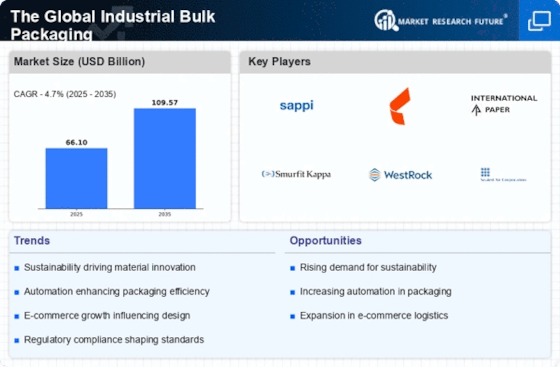
As per Market Research Future analysis, The Global Industrial Bulk Packaging Market was estimated at 66.1 USD Billion in 2024. The market is projected to grow from 69.21 USD Billion in 2025 to 109.57 USD Billion by 2035, exhibiting a compound annual growth rate (CAGR) of 4.7% during the forecast period 2025 - 2035

Key Market Trends & Highlights

The Global Industrial Bulk Packaging Market is poised for substantial growth driven by sustainability and technological advancements.

  • North America remains the largest market for industrial bulk packaging, driven by robust demand across various sectors. The Asia-Pacific region is emerging as the fastest-growing market, fueled by rapid industrialization and urbanization. The Food and Beverage segment continues to dominate the market, while the Chemical and Pharmaceutical segment is witnessing the fastest growth. Rising demand for efficient packaging solutions and a focus on sustainability are key drivers propelling market expansion.

Market Size & Forecast

2024 Market Size 66.1 (USD Billion)
2035 Market Size 109.57 (USD Billion)
CAGR (2025 - 2035) 4.7%
Largest Regional Market Share in 2024 North America

Major Players

Sappi Limited (ZA), Mondi Group (GB), International Paper Company (US), Smurfit Kappa Group (IE), WestRock Company (US), Sealed Air Corporation (US), Amcor plc (AU), DS Smith plc (GB), Novolex Holdings, LLC (US)

Market Trends

The Global Industrial Bulk Packaging Market is currently experiencing a transformative phase, driven by evolving consumer preferences and advancements in packaging technology. Companies are increasingly focusing on sustainability, which has led to a rise in the adoption of eco-friendly materials and practices. This shift not only addresses environmental concerns but also aligns with the growing demand for responsible sourcing and production methods. Furthermore, the market is witnessing innovations in design and functionality, enhancing the efficiency of bulk packaging solutions. As industries seek to optimize their supply chains, the emphasis on reducing waste and improving logistics is becoming paramount. In addition to sustainability, The Global Industrial Bulk Packaging Market is influenced by the expansion of e-commerce and globalization. The need for robust packaging solutions that can withstand the rigors of transportation and storage is more critical than ever. Companies are exploring various materials and formats to meet these challenges, ensuring that products remain intact and secure throughout their journey. The integration of smart technologies into packaging is also gaining traction, offering enhanced tracking and monitoring capabilities. Overall, the market appears poised for growth, with a focus on innovation and sustainability shaping its future trajectory.

Sustainability Initiatives

The emphasis on eco-friendly materials and practices is reshaping The Global Industrial Bulk Packaging Market. Companies are increasingly adopting sustainable solutions to meet consumer demand for environmentally responsible products. This trend reflects a broader commitment to reducing carbon footprints and promoting circular economy principles.

Technological Advancements

Innovations in packaging technology are driving efficiency and functionality within The Global Industrial Bulk Packaging Market. Enhanced designs and materials are being developed to improve durability and reduce waste, allowing companies to optimize their supply chains and meet evolving market demands.

E-commerce Growth

The rise of e-commerce is significantly impacting The Global Industrial Bulk Packaging Market. As online shopping continues to expand, the need for resilient packaging solutions that can endure transportation challenges is becoming increasingly important. This trend is prompting companies to explore new materials and formats to ensure product safety.

Industrial Bulk Packaging Market Market Drivers

Global Trade and Economic Growth

The dynamics of The Global Industrial Bulk Packaging Industry. As international trade continues to expand, the demand for bulk packaging solutions that can efficiently transport goods across borders is increasing. Economic growth in emerging markets is particularly influential, as rising disposable incomes lead to higher consumption of packaged goods. Recent data suggests that global trade volumes are projected to increase by 4% annually, which will likely boost the demand for bulk packaging solutions. This growth presents opportunities for manufacturers to innovate and adapt their offerings to meet the needs of a diverse and expanding market, ultimately contributing to the overall growth of the bulk packaging sector.

Expansion of E-commerce and Online Retail

The rapid expansion of e-commerce and online retail is reshaping the landscape of The Global Industrial Bulk Packaging Industry. As more consumers turn to online shopping, the demand for bulk packaging solutions that can accommodate larger quantities of products is increasing. Retailers are recognizing the need for packaging that not only protects products during transit but also enhances the unboxing experience for customers. This shift is particularly relevant in sectors such as consumer goods and electronics, where bulk packaging can facilitate efficient distribution. Market data suggests that the e-commerce sector is expected to grow by over 20% annually, further driving the need for innovative bulk packaging solutions that cater to this evolving consumer behavior.

Rising Demand for Efficient Packaging Solutions

The increasing need for efficient packaging solutions is a primary driver in The Global Industrial Bulk Packaging Industry. Companies are seeking ways to optimize their supply chains and reduce costs, leading to a surge in demand for bulk packaging options. This trend is particularly evident in sectors such as food and beverage, chemicals, and pharmaceuticals, where bulk packaging can significantly lower transportation and storage expenses. According to recent data, the market for bulk packaging is projected to grow at a compound annual growth rate of approximately 5.2% over the next few years. This growth is indicative of a broader shift towards more sustainable and cost-effective packaging solutions, as businesses aim to enhance their operational efficiency while minimizing environmental impact.

Technological Innovations in Packaging Solutions

Technological advancements are playing a pivotal role in shaping The Global Industrial Bulk Packaging Industry. Innovations such as automation, smart packaging, and advanced materials are enhancing the efficiency and functionality of bulk packaging solutions. For instance, the integration of IoT technology allows for real-time tracking of shipments, improving supply chain transparency and reducing losses. Additionally, advancements in materials science are leading to the development of lighter and more durable packaging options. Market analysis indicates that the adoption of smart packaging solutions is expected to grow by 15% annually, reflecting the industry's commitment to leveraging technology for improved performance and customer satisfaction. This trend underscores the importance of staying ahead in a competitive market.

Focus on Sustainability and Eco-friendly Practices

Sustainability has emerged as a crucial driver in The Global Industrial Bulk Packaging Industry. Companies are increasingly adopting eco-friendly practices, leading to a demand for sustainable packaging materials. This trend is fueled by consumer preferences for environmentally responsible products and regulatory pressures aimed at reducing plastic waste. As a result, manufacturers are exploring biodegradable and recyclable materials for bulk packaging. Recent statistics indicate that the market for sustainable packaging is anticipated to reach USD 500 billion by 2027, reflecting a significant shift towards greener alternatives. This focus on sustainability not only aligns with corporate social responsibility goals but also enhances brand reputation, making it a vital consideration for businesses in the bulk packaging sector.

Market Segment Insights

By Application: Food & Beverage (Largest) vs. Chemical & Pharmaceutical (Fastest-Growing)

In The Global Industrial Bulk Packaging Market, the application segments are primarily divided into Food &amp; Beverage, Chemical &amp; Pharmaceutical, Building &amp; <a href="https://www.marketresearchfuture.com/reports/construction-market-16065">Construction</a>, Oil &amp; Lubricant, Agriculture &amp; Horticulture, and Others. Food &amp; Beverage represents the largest share, driven by the ongoing demand for packaged goods and convenience in product delivery. Following closely, the Chemical &amp; Pharmaceutical segment shows robust market share, highlighting the critical need for safety and compliance in packaging for sensitive products.

Food &amp; Beverage (Dominant) vs. Chemical &amp; Pharmaceutical (Emerging)

The Food &amp; Beverage segment in The Global Industrial Bulk Packaging Market remains dominant, characterized by its diverse packaging needs that cater to perishables and processed food. This segment requires innovative and sustainable packaging solutions to preserve freshness and reduce waste. Conversely, the Chemical &amp; Pharmaceutical segment is emerging rapidly, propelled by stringent regulations and the need for <a href="https://www.marketresearchfuture.com/reports/protective-packaging-market-1320">protective packaging</a> for hazardous materials. Both categories are driven by end-user demand for quality, safety, and efficiency in storage and transportation, highlighting their essential roles in the market.

By Technology: Flexible Bulk Containers (Largest) vs. Rigid Bulk Containers (Fastest-Growing)

In The Global Industrial Bulk Packaging Market, Flexible Bulk Containers hold the largest share, primarily due to their versatility and ease of transport. They are favored for packing granules, powders, and various other products, making them highly sought after in industries such as food, chemicals, and pharmaceuticals. Rigid Bulk Containers, while smaller in market share, have been rapidly gaining traction as more industries recognize their strength and durability for storing heavier products. As businesses strive to enhance safety and performance in packaging, the market distribution reflects a healthy competition between these two segment values. The growth of Flexible Bulk Containers is fueled by increasing demand for lightweight and cost-effective packaging solutions. However, Rigid Bulk Containers are experiencing the fastest growth due to a shift towards sustainable materials and reusable packaging. This change is particularly driven by stringent regulations regarding environmental impact, pushing manufacturers to adopt more robust and eco-friendly solutions. As businesses look to optimize supply chain efficiency, both segments are expected to continue evolving, adapting to market trends.

Technology: Flexible Bulk Containers (Dominant) vs. Rigid Bulk Containers (Emerging)

Flexible Bulk Containers are recognized as the dominant force in the packaging segment, offering remarkable adaptability for various materials and use cases. Their lightweight nature significantly reduces transportation costs, appealing to companies aiming for operational efficiency. On the other hand, Rigid Bulk Containers, while still emerging in terms of market reach, are increasingly being chosen for their strength and ability to withstand harsher conditions. This segment's growth is attributed to the rising need for secure packaging solutions, especially in sectors like chemicals and agriculture. As environmental sustainability gains prominence, both flexible and rigid containers are being innovated to meet industry demands, showcasing resilience and responsiveness to consumer needs.

By Industry Vertical: Food & Beverage (Largest) vs. Healthcare (Fastest-Growing)

In The Global Industrial Bulk Packaging Market, the distribution of market share among various industry verticals reveals that Food &amp; Beverage holds the largest portion, driven by continuous consumer demand and the need for efficient packaging solutions. Chemicals &amp; Petrochemicals and Oil &amp; Gas also contribute significantly to the market, given their essential nature in various industries. Energy &amp; Power, Automotive, and Healthcare represent a smaller yet important share, reflecting their evolving packaging requirements.

Food &amp; Beverage: Established vs. Healthcare: Emerging

The Food &amp; Beverage sector is regarded as a dominant player in The Global Industrial Bulk Packaging Market, characterized by its high demand for bulk packaging solutions that ensure product safety and longevity. This segment relies heavily on packaging formats that can withstand logistical challenges while preserving quality. Conversely, Healthcare stands as an emerging segment within the market, driven by innovations in packaging technology and increasing regulatory requirements. As healthcare products require stringent packaging standards, this sector is evolving rapidly, paving the way for advanced bulk packaging solutions that prioritize sterility and safety. This divergence between established practices in Food &amp; Beverage and the fast-paced developments in Healthcare reflects the dynamic nature of the market.

Get more detailed insights about Industrial Bulk Packaging Market Research Report - Global Forecast till 2035

Regional Insights

By region, the study provides the market insights into North America, Europe, Asia-Pacific and Rest of the World. The North American industrial bulk packaging market area will dominate this market. The growth in the chemical and pharmaceutical industries' demand is a factor in the expansion. The region's tight rules controlling the safe transportation and storage of hazardous items are another factor driving the demand for industrial bulk packaging in the area. In addition, as demand for eco-friendly packaging solutions rises, the market in North America is growing.

Further, the major countries studied in the market report are The US, Canada, German, France, the UK, Italy, Spain, China, Japan, India, Australia, South Korea, and Brazil.

Europe industrial bulk packaging market accounts for the second-largest market share. The region's growth is being driven by an increase in packaged goods demand from the food and beverage sectors. The region's expanding inclination toward packaged food and drink products is what's driving the market for industrial bulk packaging. Additionally, due to the growing need for environmentally friendly and sustainable packaging choices, the market in Europe is growing. Further, the German industrial bulk packaging market held the largest market share, and the UK industrial bulk packaging market was the fastest growing market in the European region

The Asia-Pacific Industrial Bulk Packaging Market is expected to grow at the fastest CAGR from 2023 to 2032. The growth of the region's economy is a result of increased demand from industries including agriculture, the production of food and beverages, and chemicals. In countries like China and India, where urbanization and population growth are on the rise, packaged goods demand is being driven by these factors, along with industrial bulk packaging need. Moreover, China’s industrial bulk packaging market held the largest market share, and the Indian industrial bulk packaging market was the fastest growing market in the Asia-Pacific region.

Key Players and Competitive Insights

Leading market players are investing heavily in research and development in order to expand their product lines, which will help the industrial bulk packaging market, grow even more. Market participants are also undertaking a variety of strategic activities to expand their footprint, with important market developments including new product launches, contractual agreements, mergers and acquisitions, higher investments, and collaboration with other organizations. To expand and survive in a more competitive and rising market climate, industrial bulk packaging industry must offer cost-effective items.
Manufacturing locally to minimize operational costs is one of the key business tactics used by manufacturers in the industrial bulk packaging industry to benefit clients and increase the market sector. In recent years, the industrial bulk packaging industry has offered some of the most significant advantages to medicine. Major players in the industrial bulk packaging market are attempting to increase market demand by investing in research and development operations includes My Flexitank Industries Sdn Bhd, Greif, Inc., Shandong Anthente New Materials Technology Co. Ltd,, International Paper Company, Büscherhoff Spezialverpackung GmbH & Co.
KG, Bulk Lift International, Inc., Bemis Company, Inc., Environmental Packaging Technologies, Inc., Hoover Ferguson Group, and Schuetz GmbH & Co. KGaA.
The Bemis Company, Inc. was a leading producer of pressure-sensitive materials as well as flexible packaging goods (including self-venting cook-in-bag packaging, retort packaging for shelf-stable items, vacuum packaging for meat products, and puncture-resistant, sterile medical packaging). The corporation was based in Neenah, Wisconsin, in the United States. Its branches were dispersed over 12 different countries, and its packaging films and adhesives were offered for sale everywhere.
Schuetz GmbH & Co. KGaA designs and makes metal and plastic goods. The company provides systems for industrial services, energy, and packaging. In addition to coils, plates, and split bars, Schuetz also offers steel and plastic drums, underfloor heating systems, and harvesting systems. International clients are served by Schuetz. The SCHÜTZ group's competency center is located at its headquarters in Selters, Westerwald. Not only do the new items start here, but all the machines and production facilities are also developed and built on-site for the production of goods all over the world.

Key Companies in the Industrial Bulk Packaging Market include

Industry Developments

November 2020: Heavyweight products now come in lightweight, recyclable packaging thanks to Sonoco. Businesses benefit from reduced storage requirements and item protection.

April 2020: To grow their intermediate bulk container business in North America, Grief, a producer of industrial bulk packaging solutions, purchased certain stock in Centurion Container LLC. And this small transaction let Centurion Container LLC acquire the technologies that Grief possesses as well as notoriety.

In March 2024, Gravis is excited to introduce its new name and brand identity after successfully merging six prominent companies to become the largest supplier of engineered bulk transportation packaging solutions in North America. Gravis utilizes its extensive knowledge and experience in product and supply chain management gained from its previous businesses, including Bulk Lift International, Bagwell Supply, Norwood Paper, BulkSak, JumboBag, and Powertex. This expertise allows Gravis to develop tailored solutions and provide exceptional service to its customers in the food & beverage, agriculture, chemicals, pharmaceutical, and materials sectors.

Gravis' team of packaging and application engineers collaborate directly with customer teams to provide the most effective packaging solutions. These solutions enhance the efficiency of customers' manufacturing and transportation processes, resulting in the lowest possible cost. Gravis has a network of 18 production and warehouse facilities in North America, as well as a global manufacturing network. They continuously invest in supply chain visibility and have a sales force that is well-known nationally and regionally. With these resources, Gravis is able to meet the service needs of both Fortune 500 companies and small enterprises, even if they have high demands.

Future Outlook

Industrial Bulk Packaging Market Future Outlook

The Global Industrial Bulk Packaging Market is projected to grow at a 4.7% CAGR from 2025 to 2035, driven by increasing demand for sustainable packaging solutions and efficiency in logistics.

New opportunities lie in:

  • Development of biodegradable bulk packaging materials
  • Integration of IoT for real-time inventory management
  • Expansion into emerging markets with tailored packaging solutions

By 2035, the market is expected to achieve robust growth, driven by innovation and sustainability.

Market Segmentation

Industrial Bulk Packaging Market Technology Outlook

  • Flexible Bulk Containers
  • Rigid Bulk Containers
  • Flex Tanks
  • Bulk Container Liners

Industrial Bulk Packaging Market Application Outlook

  • Chemical & Pharmaceutical
  • Building & Construction
  • Food & Beverage
  • Oil & Lubricant
  • Agriculture & Horticulture
  • Others

Industrial Bulk Packaging Market Industry Vertical Outlook

  • Chemical & Petrochemical
  • Oil & Gas
  • Energy & Power
  • Automotive
  • Food & Beverage
  • Healthcare
  • Others

Report Scope

MARKET SIZE 2024 66.1(USD Billion)
MARKET SIZE 2025 69.21(USD Billion)
MARKET SIZE 2035 109.57(USD Billion)
COMPOUND ANNUAL GROWTH RATE (CAGR) 4.7% (2025 - 2035)
REPORT COVERAGE Revenue Forecast, Competitive Landscape, Growth Factors, and Trends
BASE YEAR 2024
Market Forecast Period 2025 - 2035
Historical Data 2019 - 2024
Market Forecast Units USD Billion
Key Companies Profiled Sappi Limited (ZA), Mondi Group (GB), International Paper Company (US), Smurfit Kappa Group (IE), WestRock Company (US), Sealed Air Corporation (US), Amcor plc (AU), DS Smith plc (GB), Novolex Holdings, LLC (US)
Segments Covered Application, Technology, Industry Vertical, Region
Key Market Opportunities Adoption of sustainable materials drives innovation in The Global Industrial Bulk Packaging.
Key Market Dynamics Rising demand for sustainable packaging solutions drives innovation and competition in the industrial bulk packaging sector.
Countries Covered North America, Europe, APAC, South America, MEA

FAQs

What is the projected market valuation of The Global Industrial Bulk Packaging by 2035?

<p>The projected market valuation for The Global Industrial Bulk Packaging is 109.57 USD Billion by 2035.</p>

What was the market valuation of The Global Industrial Bulk Packaging in 2024?

<p>The overall market valuation was 66.1 USD Billion in 2024.</p>

What is the expected CAGR for The Global Industrial Bulk Packaging during the forecast period 2025 - 2035?

<p>The expected CAGR for The Global Industrial Bulk Packaging during the forecast period 2025 - 2035 is 4.7%.</p>

Which application segment is projected to have the highest valuation in The Global Industrial Bulk Packaging?

<p>The Food & Beverage application segment is projected to have the highest valuation, increasing from 18.0 to 30.0 USD Billion.</p>

What are the key players in The Global Industrial Bulk Packaging?

<p>Key players in the market include Sappi Limited, Mondi Group, International Paper Company, and WestRock Company.</p>

How does the valuation of Flexible Bulk Containers compare to Rigid Bulk Containers in 2025?

<p>In 2025, the valuation of Flexible Bulk Containers is expected to range from 20.0 to 32.0 USD Billion, while Rigid Bulk Containers is projected to range from 18.0 to 28.0 USD Billion.</p>

What is the projected growth for the Agriculture & Horticulture segment by 2035?

The Agriculture &amp; Horticulture segment is projected to grow from 9.0 to 15.0 USD Billion by 2035.

Which industry vertical is expected to show significant growth in The Global Industrial Bulk Packaging?

The Food &amp; Beverage industry vertical is expected to show significant growth, with a valuation projected to rise from 15.0 to 25.0 USD Billion.

What is the expected valuation range for Bulk Container Liners by 2035?

The expected valuation range for Bulk Container Liners is projected to increase from 16.1 to 31.57 USD Billion by 2035.

How does the Oil & Lubricant segment's valuation change from 2024 to 2035?

The Oil &amp; Lubricant segment's valuation is expected to increase from 8.0 to 12.0 USD Billion by 2035.

  1. SECTION I: EXECUTIVE SUMMARY AND KEY HIGHLIGHTS
    1. | 1.1 EXECUTIVE SUMMARY
    2. | | 1.1.1 Market Overview
    3. | | 1.1.2 Key Findings
    4. | | 1.1.3 Market Segmentation
    5. | | 1.1.4 Competitive Landscape
    6. | | 1.1.5 Challenges and Opportunities
    7. | | 1.1.6 Future Outlook
  2. SECTION II: SCOPING, METHODOLOGY AND MARKET STRUCTURE
    1. | 2.1 MARKET INTRODUCTION
    2. | | 2.1.1 Definition
    3. | | 2.1.2 Scope of the study
    4. | | | 2.1.2.1 Research Objective
    5. | | | 2.1.2.2 Assumption
    6. | | | 2.1.2.3 Limitations
    7. | 2.2 RESEARCH METHODOLOGY
    8. | | 2.2.1 Overview
    9. | | 2.2.2 Data Mining
    10. | | 2.2.3 Secondary Research
    11. | | 2.2.4 Primary Research
    12. | | | 2.2.4.1 Primary Interviews and Information Gathering Process
    13. | | | 2.2.4.2 Breakdown of Primary Respondents
    14. | | 2.2.5 Forecasting Model
    15. | | 2.2.6 Market Size Estimation
    16. | | | 2.2.6.1 Bottom-Up Approach
    17. | | | 2.2.6.2 Top-Down Approach
    18. | | 2.2.7 Data Triangulation
    19. | | 2.2.8 Validation
  3. SECTION III: QUALITATIVE ANALYSIS
    1. | 3.1 MARKET DYNAMICS
    2. | | 3.1.1 Overview
    3. | | 3.1.2 Drivers
    4. | | 3.1.3 Restraints
    5. | | 3.1.4 Opportunities
    6. | 3.2 MARKET FACTOR ANALYSIS
    7. | | 3.2.1 Value chain Analysis
    8. | | 3.2.2 Porter's Five Forces Analysis
    9. | | | 3.2.2.1 Bargaining Power of Suppliers
    10. | | | 3.2.2.2 Bargaining Power of Buyers
    11. | | | 3.2.2.3 Threat of New Entrants
    12. | | | 3.2.2.4 Threat of Substitutes
    13. | | | 3.2.2.5 Intensity of Rivalry
    14. | | 3.2.3 COVID-19 Impact Analysis
    15. | | | 3.2.3.1 Market Impact Analysis
    16. | | | 3.2.3.2 Regional Impact
    17. | | | 3.2.3.3 Opportunity and Threat Analysis
  4. SECTION IV: QUANTITATIVE ANALYSIS
    1. | 4.1 Packaging & Transport, BY Application (USD Billion)
    2. | | 4.1.1 Chemical & Pharmaceutical
    3. | | 4.1.2 Building & Construction
    4. | | 4.1.3 Food & Beverage
    5. | | 4.1.4 Oil & Lubricant
    6. | | 4.1.5 Agriculture & Horticulture
    7. | | 4.1.6 Others
    8. | 4.2 Packaging & Transport, BY Technology (USD Billion)
    9. | | 4.2.1 Flexible Bulk Containers
    10. | | 4.2.2 Rigid Bulk Containers
    11. | | 4.2.3 Flex Tanks
    12. | | 4.2.4 Bulk Container Liners
    13. | 4.3 Packaging & Transport, BY Industry Vertical (USD Billion)
    14. | | 4.3.1 Chemical & Petrochemical
    15. | | 4.3.2 Oil & Gas
    16. | | 4.3.3 Energy & Power
    17. | | 4.3.4 Automotive
    18. | | 4.3.5 Food & Beverage
    19. | | 4.3.6 Healthcare
    20. | | 4.3.7 Others
    21. | 4.4 Packaging & Transport, BY Region (USD Billion)
    22. | | 4.4.1 North America
    23. | | | 4.4.1.1 US
    24. | | | 4.4.1.2 Canada
    25. | | 4.4.2 Europe
    26. | | | 4.4.2.1 Germany
    27. | | | 4.4.2.2 UK
    28. | | | 4.4.2.3 France
    29. | | | 4.4.2.4 Russia
    30. | | | 4.4.2.5 Italy
    31. | | | 4.4.2.6 Spain
    32. | | | 4.4.2.7 Rest of Europe
    33. | | 4.4.3 APAC
    34. | | | 4.4.3.1 China
    35. | | | 4.4.3.2 India
    36. | | | 4.4.3.3 Japan
    37. | | | 4.4.3.4 South Korea
    38. | | | 4.4.3.5 Malaysia
    39. | | | 4.4.3.6 Thailand
    40. | | | 4.4.3.7 Indonesia
    41. | | | 4.4.3.8 Rest of APAC
    42. | | 4.4.4 South America
    43. | | | 4.4.4.1 Brazil
    44. | | | 4.4.4.2 Mexico
    45. | | | 4.4.4.3 Argentina
    46. | | | 4.4.4.4 Rest of South America
    47. | | 4.4.5 MEA
    48. | | | 4.4.5.1 GCC Countries
    49. | | | 4.4.5.2 South Africa
    50. | | | 4.4.5.3 Rest of MEA
  5. SECTION V: COMPETITIVE ANALYSIS
    1. | 5.1 Competitive Landscape
    2. | | 5.1.1 Overview
    3. | | 5.1.2 Competitive Analysis
    4. | | 5.1.3 Market share Analysis
    5. | | 5.1.4 Major Growth Strategy in the Packaging & Transport
    6. | | 5.1.5 Competitive Benchmarking
    7. | | 5.1.6 Leading Players in Terms of Number of Developments in the Packaging & Transport
    8. | | 5.1.7 Key developments and growth strategies
    9. | | | 5.1.7.1 New Product Launch/Service Deployment
    10. | | | 5.1.7.2 Merger & Acquisitions
    11. | | | 5.1.7.3 Joint Ventures
    12. | | 5.1.8 Major Players Financial Matrix
    13. | | | 5.1.8.1 Sales and Operating Income
    14. | | | 5.1.8.2 Major Players R&D Expenditure. 2023
    15. | 5.2 Company Profiles
    16. | | 5.2.1 Sappi Limited (ZA)
    17. | | | 5.2.1.1 Financial Overview
    18. | | | 5.2.1.2 Products Offered
    19. | | | 5.2.1.3 Key Developments
    20. | | | 5.2.1.4 SWOT Analysis
    21. | | | 5.2.1.5 Key Strategies
    22. | | 5.2.2 Mondi Group (GB)
    23. | | | 5.2.2.1 Financial Overview
    24. | | | 5.2.2.2 Products Offered
    25. | | | 5.2.2.3 Key Developments
    26. | | | 5.2.2.4 SWOT Analysis
    27. | | | 5.2.2.5 Key Strategies
    28. | | 5.2.3 International Paper Company (US)
    29. | | | 5.2.3.1 Financial Overview
    30. | | | 5.2.3.2 Products Offered
    31. | | | 5.2.3.3 Key Developments
    32. | | | 5.2.3.4 SWOT Analysis
    33. | | | 5.2.3.5 Key Strategies
    34. | | 5.2.4 Smurfit Kappa Group (IE)
    35. | | | 5.2.4.1 Financial Overview
    36. | | | 5.2.4.2 Products Offered
    37. | | | 5.2.4.3 Key Developments
    38. | | | 5.2.4.4 SWOT Analysis
    39. | | | 5.2.4.5 Key Strategies
    40. | | 5.2.5 WestRock Company (US)
    41. | | | 5.2.5.1 Financial Overview
    42. | | | 5.2.5.2 Products Offered
    43. | | | 5.2.5.3 Key Developments
    44. | | | 5.2.5.4 SWOT Analysis
    45. | | | 5.2.5.5 Key Strategies
    46. | | 5.2.6 Sealed Air Corporation (US)
    47. | | | 5.2.6.1 Financial Overview
    48. | | | 5.2.6.2 Products Offered
    49. | | | 5.2.6.3 Key Developments
    50. | | | 5.2.6.4 SWOT Analysis
    51. | | | 5.2.6.5 Key Strategies
    52. | | 5.2.7 Amcor plc (AU)
    53. | | | 5.2.7.1 Financial Overview
    54. | | | 5.2.7.2 Products Offered
    55. | | | 5.2.7.3 Key Developments
    56. | | | 5.2.7.4 SWOT Analysis
    57. | | | 5.2.7.5 Key Strategies
    58. | | 5.2.8 DS Smith plc (GB)
    59. | | | 5.2.8.1 Financial Overview
    60. | | | 5.2.8.2 Products Offered
    61. | | | 5.2.8.3 Key Developments
    62. | | | 5.2.8.4 SWOT Analysis
    63. | | | 5.2.8.5 Key Strategies
    64. | | 5.2.9 Novolex Holdings, LLC (US)
    65. | | | 5.2.9.1 Financial Overview
    66. | | | 5.2.9.2 Products Offered
    67. | | | 5.2.9.3 Key Developments
    68. | | | 5.2.9.4 SWOT Analysis
    69. | | | 5.2.9.5 Key Strategies
    70. | 5.3 Appendix
    71. | | 5.3.1 References
    72. | | 5.3.2 Related Reports
  6. LIST OF FIGURES
    1. | 6.1 MARKET SYNOPSIS
    2. | 6.2 NORTH AMERICA MARKET ANALYSIS
    3. | 6.3 US MARKET ANALYSIS BY APPLICATION
    4. | 6.4 US MARKET ANALYSIS BY TECHNOLOGY
    5. | 6.5 US MARKET ANALYSIS BY INDUSTRY VERTICAL
    6. | 6.6 CANADA MARKET ANALYSIS BY APPLICATION
    7. | 6.7 CANADA MARKET ANALYSIS BY TECHNOLOGY
    8. | 6.8 CANADA MARKET ANALYSIS BY INDUSTRY VERTICAL
    9. | 6.9 EUROPE MARKET ANALYSIS
    10. | 6.10 GERMANY MARKET ANALYSIS BY APPLICATION
    11. | 6.11 GERMANY MARKET ANALYSIS BY TECHNOLOGY
    12. | 6.12 GERMANY MARKET ANALYSIS BY INDUSTRY VERTICAL
    13. | 6.13 UK MARKET ANALYSIS BY APPLICATION
    14. | 6.14 UK MARKET ANALYSIS BY TECHNOLOGY
    15. | 6.15 UK MARKET ANALYSIS BY INDUSTRY VERTICAL
    16. | 6.16 FRANCE MARKET ANALYSIS BY APPLICATION
    17. | 6.17 FRANCE MARKET ANALYSIS BY TECHNOLOGY
    18. | 6.18 FRANCE MARKET ANALYSIS BY INDUSTRY VERTICAL
    19. | 6.19 RUSSIA MARKET ANALYSIS BY APPLICATION
    20. | 6.20 RUSSIA MARKET ANALYSIS BY TECHNOLOGY
    21. | 6.21 RUSSIA MARKET ANALYSIS BY INDUSTRY VERTICAL
    22. | 6.22 ITALY MARKET ANALYSIS BY APPLICATION
    23. | 6.23 ITALY MARKET ANALYSIS BY TECHNOLOGY
    24. | 6.24 ITALY MARKET ANALYSIS BY INDUSTRY VERTICAL
    25. | 6.25 SPAIN MARKET ANALYSIS BY APPLICATION
    26. | 6.26 SPAIN MARKET ANALYSIS BY TECHNOLOGY
    27. | 6.27 SPAIN MARKET ANALYSIS BY INDUSTRY VERTICAL
    28. | 6.28 REST OF EUROPE MARKET ANALYSIS BY APPLICATION
    29. | 6.29 REST OF EUROPE MARKET ANALYSIS BY TECHNOLOGY
    30. | 6.30 REST OF EUROPE MARKET ANALYSIS BY INDUSTRY VERTICAL
    31. | 6.31 APAC MARKET ANALYSIS
    32. | 6.32 CHINA MARKET ANALYSIS BY APPLICATION
    33. | 6.33 CHINA MARKET ANALYSIS BY TECHNOLOGY
    34. | 6.34 CHINA MARKET ANALYSIS BY INDUSTRY VERTICAL
    35. | 6.35 INDIA MARKET ANALYSIS BY APPLICATION
    36. | 6.36 INDIA MARKET ANALYSIS BY TECHNOLOGY
    37. | 6.37 INDIA MARKET ANALYSIS BY INDUSTRY VERTICAL
    38. | 6.38 JAPAN MARKET ANALYSIS BY APPLICATION
    39. | 6.39 JAPAN MARKET ANALYSIS BY TECHNOLOGY
    40. | 6.40 JAPAN MARKET ANALYSIS BY INDUSTRY VERTICAL
    41. | 6.41 SOUTH KOREA MARKET ANALYSIS BY APPLICATION
    42. | 6.42 SOUTH KOREA MARKET ANALYSIS BY TECHNOLOGY
    43. | 6.43 SOUTH KOREA MARKET ANALYSIS BY INDUSTRY VERTICAL
    44. | 6.44 MALAYSIA MARKET ANALYSIS BY APPLICATION
    45. | 6.45 MALAYSIA MARKET ANALYSIS BY TECHNOLOGY
    46. | 6.46 MALAYSIA MARKET ANALYSIS BY INDUSTRY VERTICAL
    47. | 6.47 THAILAND MARKET ANALYSIS BY APPLICATION
    48. | 6.48 THAILAND MARKET ANALYSIS BY TECHNOLOGY
    49. | 6.49 THAILAND MARKET ANALYSIS BY INDUSTRY VERTICAL
    50. | 6.50 INDONESIA MARKET ANALYSIS BY APPLICATION
    51. | 6.51 INDONESIA MARKET ANALYSIS BY TECHNOLOGY
    52. | 6.52 INDONESIA MARKET ANALYSIS BY INDUSTRY VERTICAL
    53. | 6.53 REST OF APAC MARKET ANALYSIS BY APPLICATION
    54. | 6.54 REST OF APAC MARKET ANALYSIS BY TECHNOLOGY
    55. | 6.55 REST OF APAC MARKET ANALYSIS BY INDUSTRY VERTICAL
    56. | 6.56 SOUTH AMERICA MARKET ANALYSIS
    57. | 6.57 BRAZIL MARKET ANALYSIS BY APPLICATION
    58. | 6.58 BRAZIL MARKET ANALYSIS BY TECHNOLOGY
    59. | 6.59 BRAZIL MARKET ANALYSIS BY INDUSTRY VERTICAL
    60. | 6.60 MEXICO MARKET ANALYSIS BY APPLICATION
    61. | 6.61 MEXICO MARKET ANALYSIS BY TECHNOLOGY
    62. | 6.62 MEXICO MARKET ANALYSIS BY INDUSTRY VERTICAL
    63. | 6.63 ARGENTINA MARKET ANALYSIS BY APPLICATION
    64. | 6.64 ARGENTINA MARKET ANALYSIS BY TECHNOLOGY
    65. | 6.65 ARGENTINA MARKET ANALYSIS BY INDUSTRY VERTICAL
    66. | 6.66 REST OF SOUTH AMERICA MARKET ANALYSIS BY APPLICATION
    67. | 6.67 REST OF SOUTH AMERICA MARKET ANALYSIS BY TECHNOLOGY
    68. | 6.68 REST OF SOUTH AMERICA MARKET ANALYSIS BY INDUSTRY VERTICAL
    69. | 6.69 MEA MARKET ANALYSIS
    70. | 6.70 GCC COUNTRIES MARKET ANALYSIS BY APPLICATION
    71. | 6.71 GCC COUNTRIES MARKET ANALYSIS BY TECHNOLOGY
    72. | 6.72 GCC COUNTRIES MARKET ANALYSIS BY INDUSTRY VERTICAL
    73. | 6.73 SOUTH AFRICA MARKET ANALYSIS BY APPLICATION
    74. | 6.74 SOUTH AFRICA MARKET ANALYSIS BY TECHNOLOGY
    75. | 6.75 SOUTH AFRICA MARKET ANALYSIS BY INDUSTRY VERTICAL
    76. | 6.76 REST OF MEA MARKET ANALYSIS BY APPLICATION
    77. | 6.77 REST OF MEA MARKET ANALYSIS BY TECHNOLOGY
    78. | 6.78 REST OF MEA MARKET ANALYSIS BY INDUSTRY VERTICAL
    79. | 6.79 KEY BUYING CRITERIA OF PACKAGING & TRANSPORT
    80. | 6.80 RESEARCH PROCESS OF MRFR
    81. | 6.81 DRO ANALYSIS OF PACKAGING & TRANSPORT
    82. | 6.82 DRIVERS IMPACT ANALYSIS: PACKAGING & TRANSPORT
    83. | 6.83 RESTRAINTS IMPACT ANALYSIS: PACKAGING & TRANSPORT
    84. | 6.84 SUPPLY / VALUE CHAIN: PACKAGING & TRANSPORT
    85. | 6.85 PACKAGING & TRANSPORT, BY APPLICATION, 2024 (% SHARE)
    86. | 6.86 PACKAGING & TRANSPORT, BY APPLICATION, 2024 TO 2035 (USD Billion)
    87. | 6.87 PACKAGING & TRANSPORT, BY TECHNOLOGY, 2024 (% SHARE)
    88. | 6.88 PACKAGING & TRANSPORT, BY TECHNOLOGY, 2024 TO 2035 (USD Billion)
    89. | 6.89 PACKAGING & TRANSPORT, BY INDUSTRY VERTICAL, 2024 (% SHARE)
    90. | 6.90 PACKAGING & TRANSPORT, BY INDUSTRY VERTICAL, 2024 TO 2035 (USD Billion)
    91. | 6.91 BENCHMARKING OF MAJOR COMPETITORS
  7. LIST OF TABLES
    1. | 7.1 LIST OF ASSUMPTIONS
    2. | | 7.1.1
    3. | 7.2 North America MARKET SIZE ESTIMATES; FORECAST
    4. | | 7.2.1 BY APPLICATION, 2025-2035 (USD Billion)
    5. | | 7.2.2 BY TECHNOLOGY, 2025-2035 (USD Billion)
    6. | | 7.2.3 BY INDUSTRY VERTICAL, 2025-2035 (USD Billion)
    7. | 7.3 US MARKET SIZE ESTIMATES; FORECAST
    8. | | 7.3.1 BY APPLICATION, 2025-2035 (USD Billion)
    9. | | 7.3.2 BY TECHNOLOGY, 2025-2035 (USD Billion)
    10. | | 7.3.3 BY INDUSTRY VERTICAL, 2025-2035 (USD Billion)
    11. | 7.4 Canada MARKET SIZE ESTIMATES; FORECAST
    12. | | 7.4.1 BY APPLICATION, 2025-2035 (USD Billion)
    13. | | 7.4.2 BY TECHNOLOGY, 2025-2035 (USD Billion)
    14. | | 7.4.3 BY INDUSTRY VERTICAL, 2025-2035 (USD Billion)
    15. | 7.5 Europe MARKET SIZE ESTIMATES; FORECAST
    16. | | 7.5.1 BY APPLICATION, 2025-2035 (USD Billion)
    17. | | 7.5.2 BY TECHNOLOGY, 2025-2035 (USD Billion)
    18. | | 7.5.3 BY INDUSTRY VERTICAL, 2025-2035 (USD Billion)
    19. | 7.6 Germany MARKET SIZE ESTIMATES; FORECAST
    20. | | 7.6.1 BY APPLICATION, 2025-2035 (USD Billion)
    21. | | 7.6.2 BY TECHNOLOGY, 2025-2035 (USD Billion)
    22. | | 7.6.3 BY INDUSTRY VERTICAL, 2025-2035 (USD Billion)
    23. | 7.7 UK MARKET SIZE ESTIMATES; FORECAST
    24. | | 7.7.1 BY APPLICATION, 2025-2035 (USD Billion)
    25. | | 7.7.2 BY TECHNOLOGY, 2025-2035 (USD Billion)
    26. | | 7.7.3 BY INDUSTRY VERTICAL, 2025-2035 (USD Billion)
    27. | 7.8 France MARKET SIZE ESTIMATES; FORECAST
    28. | | 7.8.1 BY APPLICATION, 2025-2035 (USD Billion)
    29. | | 7.8.2 BY TECHNOLOGY, 2025-2035 (USD Billion)
    30. | | 7.8.3 BY INDUSTRY VERTICAL, 2025-2035 (USD Billion)
    31. | 7.9 Russia MARKET SIZE ESTIMATES; FORECAST
    32. | | 7.9.1 BY APPLICATION, 2025-2035 (USD Billion)
    33. | | 7.9.2 BY TECHNOLOGY, 2025-2035 (USD Billion)
    34. | | 7.9.3 BY INDUSTRY VERTICAL, 2025-2035 (USD Billion)
    35. | 7.10 Italy MARKET SIZE ESTIMATES; FORECAST
    36. | | 7.10.1 BY APPLICATION, 2025-2035 (USD Billion)
    37. | | 7.10.2 BY TECHNOLOGY, 2025-2035 (USD Billion)
    38. | | 7.10.3 BY INDUSTRY VERTICAL, 2025-2035 (USD Billion)
    39. | 7.11 Spain MARKET SIZE ESTIMATES; FORECAST
    40. | | 7.11.1 BY APPLICATION, 2025-2035 (USD Billion)
    41. | | 7.11.2 BY TECHNOLOGY, 2025-2035 (USD Billion)
    42. | | 7.11.3 BY INDUSTRY VERTICAL, 2025-2035 (USD Billion)
    43. | 7.12 Rest of Europe MARKET SIZE ESTIMATES; FORECAST
    44. | | 7.12.1 BY APPLICATION, 2025-2035 (USD Billion)
    45. | | 7.12.2 BY TECHNOLOGY, 2025-2035 (USD Billion)
    46. | | 7.12.3 BY INDUSTRY VERTICAL, 2025-2035 (USD Billion)
    47. | 7.13 APAC MARKET SIZE ESTIMATES; FORECAST
    48. | | 7.13.1 BY APPLICATION, 2025-2035 (USD Billion)
    49. | | 7.13.2 BY TECHNOLOGY, 2025-2035 (USD Billion)
    50. | | 7.13.3 BY INDUSTRY VERTICAL, 2025-2035 (USD Billion)
    51. | 7.14 China MARKET SIZE ESTIMATES; FORECAST
    52. | | 7.14.1 BY APPLICATION, 2025-2035 (USD Billion)
    53. | | 7.14.2 BY TECHNOLOGY, 2025-2035 (USD Billion)
    54. | | 7.14.3 BY INDUSTRY VERTICAL, 2025-2035 (USD Billion)
    55. | 7.15 India MARKET SIZE ESTIMATES; FORECAST
    56. | | 7.15.1 BY APPLICATION, 2025-2035 (USD Billion)
    57. | | 7.15.2 BY TECHNOLOGY, 2025-2035 (USD Billion)
    58. | | 7.15.3 BY INDUSTRY VERTICAL, 2025-2035 (USD Billion)
    59. | 7.16 Japan MARKET SIZE ESTIMATES; FORECAST
    60. | | 7.16.1 BY APPLICATION, 2025-2035 (USD Billion)
    61. | | 7.16.2 BY TECHNOLOGY, 2025-2035 (USD Billion)
    62. | | 7.16.3 BY INDUSTRY VERTICAL, 2025-2035 (USD Billion)
    63. | 7.17 South Korea MARKET SIZE ESTIMATES; FORECAST
    64. | | 7.17.1 BY APPLICATION, 2025-2035 (USD Billion)
    65. | | 7.17.2 BY TECHNOLOGY, 2025-2035 (USD Billion)
    66. | | 7.17.3 BY INDUSTRY VERTICAL, 2025-2035 (USD Billion)
    67. | 7.18 Malaysia MARKET SIZE ESTIMATES; FORECAST
    68. | | 7.18.1 BY APPLICATION, 2025-2035 (USD Billion)
    69. | | 7.18.2 BY TECHNOLOGY, 2025-2035 (USD Billion)
    70. | | 7.18.3 BY INDUSTRY VERTICAL, 2025-2035 (USD Billion)
    71. | 7.19 Thailand MARKET SIZE ESTIMATES; FORECAST
    72. | | 7.19.1 BY APPLICATION, 2025-2035 (USD Billion)
    73. | | 7.19.2 BY TECHNOLOGY, 2025-2035 (USD Billion)
    74. | | 7.19.3 BY INDUSTRY VERTICAL, 2025-2035 (USD Billion)
    75. | 7.20 Indonesia MARKET SIZE ESTIMATES; FORECAST
    76. | | 7.20.1 BY APPLICATION, 2025-2035 (USD Billion)
    77. | | 7.20.2 BY TECHNOLOGY, 2025-2035 (USD Billion)
    78. | | 7.20.3 BY INDUSTRY VERTICAL, 2025-2035 (USD Billion)
    79. | 7.21 Rest of APAC MARKET SIZE ESTIMATES; FORECAST
    80. | | 7.21.1 BY APPLICATION, 2025-2035 (USD Billion)
    81. | | 7.21.2 BY TECHNOLOGY, 2025-2035 (USD Billion)
    82. | | 7.21.3 BY INDUSTRY VERTICAL, 2025-2035 (USD Billion)
    83. | 7.22 South America MARKET SIZE ESTIMATES; FORECAST
    84. | | 7.22.1 BY APPLICATION, 2025-2035 (USD Billion)
    85. | | 7.22.2 BY TECHNOLOGY, 2025-2035 (USD Billion)
    86. | | 7.22.3 BY INDUSTRY VERTICAL, 2025-2035 (USD Billion)
    87. | 7.23 Brazil MARKET SIZE ESTIMATES; FORECAST
    88. | | 7.23.1 BY APPLICATION, 2025-2035 (USD Billion)
    89. | | 7.23.2 BY TECHNOLOGY, 2025-2035 (USD Billion)
    90. | | 7.23.3 BY INDUSTRY VERTICAL, 2025-2035 (USD Billion)
    91. | 7.24 Mexico MARKET SIZE ESTIMATES; FORECAST
    92. | | 7.24.1 BY APPLICATION, 2025-2035 (USD Billion)
    93. | | 7.24.2 BY TECHNOLOGY, 2025-2035 (USD Billion)
    94. | | 7.24.3 BY INDUSTRY VERTICAL, 2025-2035 (USD Billion)
    95. | 7.25 Argentina MARKET SIZE ESTIMATES; FORECAST
    96. | | 7.25.1 BY APPLICATION, 2025-2035 (USD Billion)
    97. | | 7.25.2 BY TECHNOLOGY, 2025-2035 (USD Billion)
    98. | | 7.25.3 BY INDUSTRY VERTICAL, 2025-2035 (USD Billion)
    99. | 7.26 Rest of South America MARKET SIZE ESTIMATES; FORECAST
    100. | | 7.26.1 BY APPLICATION, 2025-2035 (USD Billion)
    101. | | 7.26.2 BY TECHNOLOGY, 2025-2035 (USD Billion)
    102. | | 7.26.3 BY INDUSTRY VERTICAL, 2025-2035 (USD Billion)
    103. | 7.27 MEA MARKET SIZE ESTIMATES; FORECAST
    104. | | 7.27.1 BY APPLICATION, 2025-2035 (USD Billion)
    105. | | 7.27.2 BY TECHNOLOGY, 2025-2035 (USD Billion)
    106. | | 7.27.3 BY INDUSTRY VERTICAL, 2025-2035 (USD Billion)
    107. | 7.28 GCC Countries MARKET SIZE ESTIMATES; FORECAST
    108. | | 7.28.1 BY APPLICATION, 2025-2035 (USD Billion)
    109. | | 7.28.2 BY TECHNOLOGY, 2025-2035 (USD Billion)
    110. | | 7.28.3 BY INDUSTRY VERTICAL, 2025-2035 (USD Billion)
    111. | 7.29 South Africa MARKET SIZE ESTIMATES; FORECAST
    112. | | 7.29.1 BY APPLICATION, 2025-2035 (USD Billion)
    113. | | 7.29.2 BY TECHNOLOGY, 2025-2035 (USD Billion)
    114. | | 7.29.3 BY INDUSTRY VERTICAL, 2025-2035 (USD Billion)
    115. | 7.30 Rest of MEA MARKET SIZE ESTIMATES; FORECAST
    116. | | 7.30.1 BY APPLICATION, 2025-2035 (USD Billion)
    117. | | 7.30.2 BY TECHNOLOGY, 2025-2035 (USD Billion)
    118. | | 7.30.3 BY INDUSTRY VERTICAL, 2025-2035 (USD Billion)
    119. | 7.31 PRODUCT LAUNCH/PRODUCT DEVELOPMENT/APPROVAL
    120. | | 7.31.1
    121. | 7.32 ACQUISITION/PARTNERSHIP
    122. | | 7.32.1

Packaging & Transport Market Segmentation

Packaging & Transport By Application (USD Billion, 2025-2035)

  • Chemical & Pharmaceutical
  • Building & Construction
  • Food & Beverage
  • Oil & Lubricant
  • Agriculture & Horticulture
  • Others

Packaging & Transport By Technology (USD Billion, 2025-2035)

  • Flexible Bulk Containers
  • Rigid Bulk Containers
  • Flex Tanks
  • Bulk Container Liners

Packaging & Transport By Industry Vertical (USD Billion, 2025-2035)

  • Chemical & Petrochemical
  • Oil & Gas
  • Energy & Power
  • Automotive
  • Food & Beverage
  • Healthcare
  • Others
Infographic

Free Sample Request

Kindly complete the form below to receive a free sample of this Report

Get Free Sample

Customer Strories

Compare Licence

×
Features License Type
Single User Multiuser License Enterprise User
Price $4,950 $5,950 $7,250
Maximum User Access Limit 1 User Upto 10 Users Unrestricted Access Throughout the Organization
Free Customization
Direct Access to Analyst
Deliverable Format
Platform Access
Discount on Next Purchase 10% 15% 15%
Printable Versions