×
Request Free Sample ×

Kindly complete the form below to receive a free sample of this Report

* Please use a valid business email

Leading companies partner with us for data-driven Insights

clients tt-cursor
Hero Background

Inductive Lvdt Sensor Market

ID: MRFR/SEM/41030-HCR
200 Pages
Garvit Vyas
October 2025

Inductive and LVDT Sensor Market Research Report By Type (Inductive Sensors, LVDT Sensors, Capacitive Sensors, Photoelectric Sensors), By Application (Industrial Automation, Aerospace Defense, Automotive, Healthcare, Robotics), By End Use (Manufacturing, Research Development, Quality Control, Process Automation), By Technology (Analog Sensors, Digital Sensors) and By Regional (North America, Europe, South America, Asia Pacific, Middle East and Africa) - Forecast to 2035

Share:
Download PDF ×

We do not share your information with anyone. However, we may send you emails based on your report interest from time to time. You may contact us at any time to opt-out.

Inductive Lvdt Sensor Market Infographic
Purchase Options

Inductive Lvdt Sensor Market Summary

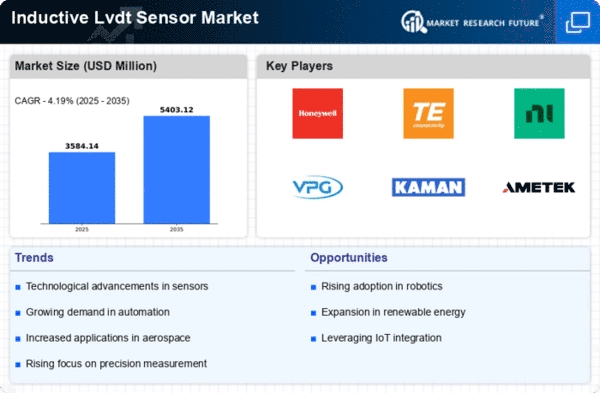
As per MRFR analysis, the As per MRFR analysis, the Inductive LVDT Sensor Market Size was estimated at 3440.0 USD Million in 2024. Size was estimated at 3440.0 USD Million in 2024. The Inductive Lvdt Sensor industry is projected to grow from 3584.14 in 2025 to 5403.12 by 2035, exhibiting a compound annual growth rate (CAGR) of 4.19 during the forecast period 2025 - 2035.

Key Market Trends & Highlights

The Inductive LVDT Sensor Market is poised for substantial growth driven by technological advancements and increasing automation demands.

  • North America remains the largest market for inductive LVDT sensors, primarily due to its robust industrial base.
  • The Asia-Pacific region is emerging as the fastest-growing market, fueled by rapid industrialization and technological adoption.
  • The industrial automation segment dominates the market, while the medical devices segment is witnessing the highest growth rate.
  • Technological advancements in sensing technology and the increasing adoption in industrial automation are key drivers propelling market expansion.

Market Size & Forecast

2024 Market Size 3440.0 (USD Million)
2035 Market Size 5403.12 (USD Million)
CAGR (2025 - 2035) 4.19%

Major Players

Honeywell (US), TE Connectivity (US), National Instruments (US), Vishay Precision Group (US), Kaman (US), Ametek (US), Micro-Epsilon (DE), Renishaw (GB), Siemens (DE)

Inductive Lvdt Sensor Market Trends

The The Inductive LVDT Sensor Market is currently experiencing a notable evolution, driven by advancements in technology and increasing demand across various sectors. is currently experiencing a notable evolution, driven by advancements in technology and increasing demand across various sectors. These sensors, known for their precision and reliability, are being integrated into applications ranging from aerospace to industrial automation. The growing emphasis on automation and the need for accurate measurements in manufacturing processes appear to be propelling the market forward. Furthermore, the trend towards smart technologies and the Internet of Things (IoT) is likely to enhance the adoption of inductive LVDT sensors, as they provide essential data for monitoring and control systems. In addition, the Inductive Lvdt Sensor Market seems to be influenced by the rising focus on energy efficiency and sustainability. Industries are increasingly seeking solutions that not only improve operational efficiency but also reduce environmental impact. This shift may lead to innovations in sensor design and functionality, catering to the evolving needs of end-users. As the market continues to expand, it is essential for stakeholders to remain attuned to technological advancements and changing consumer preferences, which could shape the future landscape of the Inductive Lvdt Sensor Market.

Technological Advancements

Recent innovations in sensor technology are enhancing the performance and capabilities of inductive LVDT sensors. These advancements may include improved materials, miniaturization, and integration with digital systems, which could lead to more accurate and reliable measurements.

Growing Demand in Automation

The increasing trend towards automation in various industries is driving the demand for inductive LVDT sensors. As companies seek to optimize processes and improve efficiency, these sensors are becoming essential components in automated systems.

Focus on Sustainability

There is a rising emphasis on sustainability within the Inductive Lvdt Sensor Market. Manufacturers are likely to develop sensors that not only meet performance standards but also contribute to energy efficiency and reduced environmental impact.

Inductive Lvdt Sensor Market Drivers

Rising Demand for Automation

The Global Inductive and LVDT Sensor Market Industry experiences a notable surge in demand due to the increasing adoption of automation across various sectors. Industries such as manufacturing, automotive, and aerospace are integrating advanced sensor technologies to enhance operational efficiency and precision. For instance, the automotive sector is leveraging inductive sensors for contactless position sensing, which is crucial for modern vehicle systems. This trend is expected to contribute to the market's growth, with projections indicating a market value of 3.44 USD Billion in 2024, reflecting a robust shift towards automated solutions.

Market Segment Insights

By Application: Industrial Automation (Largest) vs. Medical Devices (Fastest-Growing)

In the Inductive Lvdt Sensor Market, the 'By Application' segment showcases a strong distribution of market share among various sectors. Industrial automation holds significant dominance, primarily driven by its extensive adoption in manufacturing processes. The aerospace and automotive sectors also maintain robust stakes, utilizing these sensors for precision measurement and control. Meanwhile, emerging applications in medical devices are beginning to carve out a noteworthy position, indicating a shift in market dynamics.

Automation: Industrial Automation (Dominant) vs. Medical Devices (Emerging)

Industrial automation is currently the dominant force in the Inductive Lvdt Sensor Market, leveraging the technology to enhance efficiency and accuracy in production environments. With increasing demands for automation in manufacturing, these sensors play a critical role in servo control, feedback systems, and quality assurance. On the other hand, the medical devices sector is emerging rapidly, incorporating inductive LVDT sensors for precise measurement in various medical applications, including diagnostic equipment and surgical instruments. This growing trend is fueled by advancements in healthcare technology and the need for reliable, high-precision instrumentation, positioning medical devices as a vital area for future growth.

By End Use: Manufacturing (Largest) vs. Quality Control (Fastest-Growing)

In the Inductive LVDT Sensor Market, the end use segment is diverse, encompassing Manufacturing, Research and Development, Quality Control, and Process Control. Manufacturing holds the largest share, driven by its essential application in various industrial processes, ensuring precision and reliability. Research and Development follows as a crucial segment, utilizing sensors for innovations and product testing, while Quality Control and Process Control rely on LVDTs for maintaining standards and optimizing processes, respectively.

Research and Development (Emerging) vs. Process Control (Dominant)

Research and Development is emerging in the Inductive LVDT Sensor Market, with an increasing focus on innovation in sensor technology and applications. Companies invest significantly in R&D to enhance sensor capabilities, leading to smarter, more efficient solutions. Meanwhile, Process Control remains a dominant force, where LVDTs are integral in automating processes and ensuring product quality. Both segments play vital roles; R&D drives future innovations while Process Control secures existing systems, highlighting their importance in the market.

By Technology: Analog (Largest) vs. Wireless (Fastest-Growing)

In the Inductive LVDT Sensor Market, the technology segment is primarily divided into four categories: Analog, Digital, Wireless, and Hybrid. Among these, Analog sensors continue to hold the largest market share due to their proven reliability and cost-effectiveness in various applications. Digital sensors are also significant but cater to specific needs requiring higher precision and data processing capabilities, while Hybrid technology, combining features from both Analog and Digital, is gaining traction among users seeking the best of both worlds. However, Wireless LVDT Sensors are emerging as the fastest-growing segment, driven by advancements in wireless technology and demand for remote sensing applications. The increasing need for flexibility and reduction in cabling costs has fostered a rising preference for Wireless solutions, particularly in industrial automation and measurement applications. As more sectors adopt this technology, the growth trajectory of Wireless sensors is expected to accelerate significantly over the coming years.

Technology: Analog (Dominant) vs. Wireless (Emerging)

The Analog segment remains the dominant technology in the Inductive LVDT Sensor Market, favored for its simplicity, durability, and established track record. These sensors provide continuous signal output, making them ideal for various industrial applications where real-time measurement is critical. On the other hand, Wireless technology is identified as an emerging force within the sector, appealing particularly to industries seeking to minimize installation complexity and costs associated with traditional cabling. Wireless LVDT Sensors enhance mobility and data collection in hard-to-reach areas, thus expanding their adoption. As industries increasingly transition towards automation and IoT, the Wireless segment is positioned to experience rapid growth, driven by the need for connectivity and data accessibility.

By Form Factor: Compact (Largest) vs. Custom (Fastest-Growing)

In the Inductive LVDT Sensor Market, the Compact form factor holds the largest market share, appealing to industries requiring space-saving solutions without compromising performance. This segment's dominance stems from its versatility and ability to cater to applications in sectors like robotics and automation. On the other hand, the Custom form factor is rapidly emerging, reflecting a growing trend towards tailored sensing solutions that meet specific operational requirements across diverse industries.

Compact (Dominant) vs. Custom (Emerging)

The Compact form factor is favored for its efficiency and adaptability, making it the top choice in numerous applications where space constraints are a concern. It provides optimal performance in tight environments, offering reliability and usability. Conversely, the Custom form factor has gained traction as industries increasingly seek specialized sensors tailored to particular needs. Its ability to offer bespoke solutions enhances user satisfaction and operational efficiency, driving its rapid growth in the market as more players opt for customized offerings to fit their unique application scenarios.

By Material: Stainless Steel (Largest) vs. Aluminum (Fastest-Growing)

In the Inductive Lvdt Sensor Market, Stainless Steel has emerged as the largest material segment, primarily due to its superior durability and resistance to environmental factors. It is widely used in industrial applications, providing robust and reliable performance, which accounts for its significant share. Aluminum, while smaller in market share, has shown rapid adoption, particularly in lightweight sensor applications, with manufacturers increasingly favoring it for post-2024 devices due to its lower cost and sufficient performance characteristics. The growth trends in this segment are largely driven by advancements in technology and increasing demand for precision measurements in various industries. The automotive and aerospace sectors are particularly influencing aluminum's growth, as they seek to minimize weight without compromising on performance. Moreover, the push for cost-effective solutions has prompted manufacturers to invest in more innovative material solutions, positioning aluminum as a significant contender for market share moving forward.

Stainless Steel (Dominant) vs. Plastic (Emerging)

Stainless Steel remains the dominant material in the Inductive Lvdt Sensor Market, valued for its mechanical strength and resistance to corrosive environments, making it ideal for harsh industrial settings. It is well-suited for applications requiring high accuracy and reliability, such as monitoring systems in heavy machinery. On the other hand, Plastic is emerging as a viable alternative due to its lightweight nature and cost-effectiveness. Manufacturers are increasingly turning to plastic materials for sensors intended for consumer electronics and applications requiring less stringent environmental durability. The versatility of plastic allows for a reduction in production costs, making it attractive for new market segments and fostering innovation in design, paving the way for its growth potential in the coming years.

Get more detailed insights about Inductive Lvdt Sensor Market

Regional Insights

North America : Market Leader in Innovation

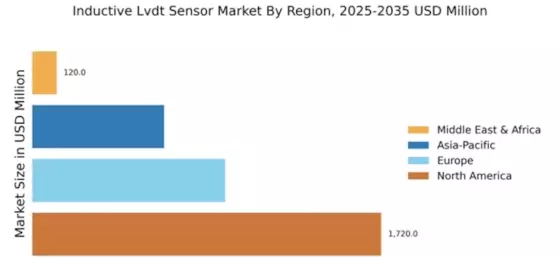
North America is poised to maintain its leadership in the Inductive Lvdt Sensor market, holding a significant share of 1720.0 million in 2024. The region's growth is driven by advancements in automation, aerospace, and defense sectors, alongside increasing demand for precision measurement technologies. Regulatory support for innovation and safety standards further catalyzes market expansion, ensuring compliance and fostering consumer trust. The competitive landscape is robust, with key players like Honeywell, TE Connectivity, and National Instruments leading the charge. The U.S. remains the dominant country, leveraging its technological prowess and investment in R&D. The presence of established companies and a strong supply chain network enhances market dynamics, positioning North America as a hub for Inductive Lvdt Sensor development and deployment.

Europe : Emerging Market with Growth Potential

Europe, with a market size of 900.0 million, is witnessing a surge in demand for Inductive Lvdt Sensors, driven by the automotive and industrial automation sectors. The region's focus on sustainability and energy efficiency is prompting investments in advanced sensor technologies. Regulatory frameworks, such as the EU's Ecodesign Directive, are encouraging innovation and compliance, further boosting market growth. Leading countries like Germany, France, and the UK are at the forefront of this expansion, supported by key players such as Siemens and Micro-Epsilon. The competitive landscape is characterized by a mix of established firms and innovative startups, fostering a dynamic environment for technological advancements. The European market is expected to continue its upward trajectory, driven by increasing applications across various industries.

Asia-Pacific : Rapid Growth in Emerging Economies

Asia-Pacific is emerging as a significant player in the Inductive Lvdt Sensor market, with a size of 680.0 million. The region's rapid industrialization, coupled with increasing investments in automation and smart manufacturing, is driving demand for advanced sensor technologies. Government initiatives aimed at enhancing manufacturing capabilities and technological adoption are further propelling market growth. Countries like China, Japan, and India are leading the charge, with a growing presence of key players such as Vishay Precision Group and Kaman. The competitive landscape is evolving, with both local and international companies vying for market share. As the region continues to embrace technological advancements, the Inductive Lvdt Sensor market is expected to flourish, supported by a robust manufacturing base and increasing consumer demand.

Middle East and Africa : Emerging Market with Untapped Potential

The Middle East and Africa (MEA) region, with a market size of 140.0 million, presents significant growth opportunities in the Inductive Lvdt Sensor market. The region's increasing focus on industrialization and infrastructure development is driving demand for precision measurement technologies. Government initiatives aimed at diversifying economies and enhancing technological capabilities are key growth catalysts. Countries like South Africa and the UAE are leading the market, supported by investments in various sectors, including oil and gas, manufacturing, and renewable energy. The competitive landscape is gradually evolving, with both local and international players entering the market. As MEA continues to develop its industrial base, the Inductive Lvdt Sensor market is expected to expand, driven by rising demand for automation and efficiency.

Key Players and Competitive Insights

The Inductive Lvdt Sensor Market is currently characterized by a dynamic competitive landscape, driven by technological advancements and increasing demand across various sectors, including aerospace, automotive, and industrial automation. Key players such as Honeywell (US), TE Connectivity (US), and National Instruments (US) are strategically positioned to leverage their extensive portfolios and innovative capabilities. Honeywell (US) focuses on enhancing its product offerings through continuous research and development, while TE Connectivity (US) emphasizes partnerships to expand its market reach. National Instruments (US) appears to be concentrating on integrating advanced software solutions with its sensor technologies, thereby enhancing operational efficiency and data analytics capabilities. Collectively, these strategies contribute to a competitive environment that is increasingly focused on innovation and technological integration.

In terms of business tactics, companies are localizing manufacturing to reduce lead times and optimize supply chains, which is particularly crucial in a market that is moderately fragmented. This localization strategy not only enhances responsiveness to customer needs but also mitigates risks associated with global supply chain disruptions. The competitive structure of the market indicates that while a few players dominate, there remains ample opportunity for smaller firms to carve out niches through specialized offerings and innovative solutions.

In November 2025, Honeywell (US) announced the launch of a new line of inductive LVDT sensors designed specifically for harsh environments, which is expected to enhance their market share in the aerospace sector. This strategic move underscores Honeywell's commitment to innovation and its ability to meet the evolving needs of customers in demanding applications. The introduction of these sensors is likely to strengthen their competitive position by addressing specific industry challenges.

In October 2025, TE Connectivity (US) expanded its manufacturing capabilities in Europe by investing €10 million in a new facility aimed at increasing production capacity for inductive sensors. This expansion not only reflects TE Connectivity's commitment to meeting growing demand but also positions the company to better serve its European customer base. Such investments are indicative of a broader trend where companies are enhancing their operational capabilities to maintain competitive advantages.

In September 2025, National Instruments (US) entered into a strategic partnership with a leading software firm to develop integrated solutions that combine sensor data with advanced analytics. This collaboration is poised to enhance the functionality of their inductive LVDT sensors, allowing for more sophisticated data interpretation and real-time monitoring. The partnership signifies a shift towards more integrated solutions in the market, aligning with the increasing demand for smart technologies.

As of December 2025, the competitive trends in the Inductive Lvdt Sensor Market are heavily influenced by digitalization, sustainability, and the integration of artificial intelligence (AI). Companies are increasingly forming strategic alliances to enhance their technological capabilities and market presence. The current landscape suggests a shift from traditional price-based competition towards a focus on innovation, technology, and supply chain reliability. As the market evolves, differentiation will likely hinge on the ability to deliver advanced, integrated solutions that meet the complex demands of modern industries.

Key Companies in the Inductive Lvdt Sensor Market market include

Industry Developments

Recent news developments in the Inductive and LVDT Sensor Market indicate a positive trend for many key players. Companies like Renishaw and Parker Hannifin have been investing in RD to enhance sensor precision and expand applications in automation and industrial processes. Siemens has been focusing on integrating advanced AI technologies into their sensor systems to improve efficiency and reliability. Kaman Corporation and Omron are also actively developing innovative sensor solutions aimed at the automotive and aerospace sectors.

Additionally, significant mergers and acquisitions have been reported, notably as Analog Devices has strengthened its portfolio through the acquisition of smaller tech firms, which is expected to enhance its market presence. Honeywell continues to expand its offerings by merging technologies from various acquisitions, ensuring a competitive edge in the market. The overall growth in market valuation for these companies, driven by increased adoption of automation and Industry 4.0 processes, is positively impacting the Inductive and LVDT Sensor Market, evidencing a robust demand across diverse applications.

As industries rapidly evolve, this market is set for substantial growth, reinforcing the need for innovation among key players such as Baumer, TE Connectivity, and Vishay Intertechnology.

Future Outlook

Inductive Lvdt Sensor Market Future Outlook

The Inductive LVDT Sensor Market is projected to grow at a 4.19% CAGR from 2024 to 2035, driven by advancements in automation, increased demand for precision measurement, and expanding industrial applications.

New opportunities lie in:

  • Development of smart sensor networks for real-time monitoring.
  • Integration of LVDT sensors in autonomous vehicles for enhanced navigation.
  • Expansion into renewable energy sectors for performance optimization.

By 2035, the Inductive LVDT Sensor Market is expected to achieve robust growth and innovation.

Market Segmentation

Inductive Lvdt Sensor Market End Use Outlook

  • Manufacturing
  • Research and Development
  • Quality Control
  • Process Control

Inductive Lvdt Sensor Market Material Outlook

  • Stainless Steel
  • Aluminum
  • Plastic
  • Ceramic

Inductive Lvdt Sensor Market Technology Outlook

  • Analog
  • Digital
  • Wireless
  • Hybrid

Inductive Lvdt Sensor Market Application Outlook

  • Industrial Automation
  • Aerospace
  • Automotive
  • Medical Devices
  • Robotics

Inductive Lvdt Sensor Market Form Factor Outlook

  • Compact
  • Standard
  • Custom

Report Scope

MARKET SIZE 20243440.0(USD Million)
MARKET SIZE 20253584.14(USD Million)
MARKET SIZE 20355403.12(USD Million)
COMPOUND ANNUAL GROWTH RATE (CAGR)4.19% (2024 - 2035)
REPORT COVERAGERevenue Forecast, Competitive Landscape, Growth Factors, and Trends
BASE YEAR2024
Market Forecast Period2025 - 2035
Historical Data2019 - 2024
Market Forecast UnitsUSD Million
Key Companies ProfiledHoneywell (US), TE Connectivity (US), National Instruments (US), Vishay Precision Group (US), Kaman (US), Ametek (US), Micro-Epsilon (DE), Renishaw (GB), Siemens (DE)
Segments CoveredApplication, End Use, Technology, Form Factor, Material
Key Market OpportunitiesIntegration of advanced automation technologies enhances demand in the Inductive Lvdt Sensor Market.
Key Market DynamicsRising demand for precision measurement in industrial applications drives growth in the Inductive Linear Variable Differential Transformer sensor market.
Countries CoveredNorth America, Europe, APAC, South America, MEA

Leave a Comment

FAQs

What is the expected market size of the Global Inductive and LVDT Sensor Market in 2024?

The Global Inductive and LVDT Sensor Market is expected to be valued at 3.44 USD Billion in 2024.

What will be the market value of the Global Inductive and LVDT Sensor Market by 2035?

By 2035, the Global Inductive and LVDT Sensor Market is projected to reach 5.4 USD Billion.

What is the expected CAGR of the Global Inductive and LVDT Sensor Market during the forecast period from 2025 to 2035?

The market is expected to grow at a CAGR of 4.19% from 2025 to 2035.

Which region is expected to have the largest market share in the Global Inductive and LVDT Sensor Market by 2035?

North America is anticipated to dominate the market with a value of 2.02 USD Billion by 2035.

What will be the market size for Inductive Sensors in the Global Inductive and LVDT Sensor Market by 2035?

Inductive Sensors are expected to reach a market size of 2.11 USD Billion by 2035.

What is the expected market value for LVDT Sensors in 2024?

The market for LVDT Sensors is valued at 0.85 USD Billion in 2024.

Who are the key players in the Global Inductive and LVDT Sensor Market?

Major players include Renishaw, Parker Hannifin, Siemens, and Omron among others.

What market value is projected for Capacitive Sensors in the Global Inductive and LVDT Sensor Market by 2035?

The market for Capacitive Sensors is expected to reach 0.85 USD Billion by 2035.

What are the expected regional market values for Europe in 2024 and 2035?

Europe is expected to be valued at 1.0 USD Billion in 2024 and 1.45 USD Billion by 2035.

How is the market for Photoelectric Sensors expected to grow from 2024 to 2035?

The market for Photoelectric Sensors is projected to grow from 0.66 USD Billion in 2024 to 1.06 USD Billion by 2035.

Download Free Sample

Kindly complete the form below to receive a free sample of this Report

Compare Licence

×
Features License Type
Single User Multiuser License Enterprise User
Price $4,950 $5,950 $7,250
Maximum User Access Limit 1 User Upto 10 Users Unrestricted Access Throughout the Organization
Free Customization
Direct Access to Analyst
Deliverable Format
Platform Access
Discount on Next Purchase 10% 15% 15%
Printable Versions