×
Request Free Sample ×

Kindly complete the form below to receive a free sample of this Report

* Please use a valid business email

Leading companies partner with us for data-driven Insights

clients tt-cursor
Hero Background
English
Chinese
French
Japanese
Korean
German
Spanish

India Geothermal Energy Market Trends

ID: MRFR/EnP/12439-HCR
128 Pages
Garvit Vyas
October 2025

India Geothermal Energy Market Research Report Information By Application (Power Generation, Residential and Commercial Heating & Cooling), By Temperature (Low Temperature, Medium Temperature and High Temperature), By Technology (Binary & Flash Cycle Plant, Dry Steam Plant, Ground Source Heat Pumps, and Direct Systems) –Market Forecast Till 2035

Share:
Download PDF ×

We do not share your information with anyone. However, we may send you emails based on your report interest from time to time. You may contact us at any time to opt-out.

India Geothermal Energy Market Infographic
Purchase Options

Market Trends

Key Emerging Trends in the India Geothermal Energy Market

The Indian geothermal energy market has been witnessing notable trends in recent years, reflecting a growing interest in sustainable and clean energy sources. Geothermal energy, derived from the Earth's heat, is gaining traction as a viable alternative in India's diverse energy landscape. One prominent trend is the increasing recognition of geothermal energy's potential to contribute to the country's renewable energy goals. With India's commitment to achieving 40% of its total energy capacity from renewable sources by 2030, the geothermal sector has become a focal point for investors and policymakers alike.

Government initiatives and policies play a crucial role in shaping the market trends of India's geothermal energy sector. The Indian government has been actively promoting renewable energy through various programs, incentives, and regulatory frameworks. This includes the introduction of financial incentives, subsidies, and favorable tariffs for geothermal projects. Such support creates a conducive environment for both domestic and international investors, fostering the growth of the geothermal energy market in the country.

Moreover, technological advancements have played a pivotal role in driving market trends within the Indian geothermal energy sector. Innovations in drilling techniques, reservoir management, and power generation technologies have improved the efficiency and feasibility of harnessing geothermal energy. As these technologies become more accessible and cost-effective, they contribute to the overall growth and competitiveness of geothermal projects in India.

The exploration and identification of potential geothermal sites have become another crucial aspect of market trends in India. Ongoing geological surveys and studies are helping to pinpoint regions with high geothermal potential. The states of Himachal Pradesh, Jammu and Kashmir, and the northwestern regions of the country have shown promise as suitable locations for geothermal projects. This increased understanding of geothermal resources aids project developers and investors in making informed decisions, reducing risks associated with exploration and drilling activities.

Collaborations and partnerships are emerging as a significant trend in the Indian geothermal energy market. International collaborations bring in expertise, technology transfer, and financial support to accelerate the development of geothermal projects. Knowledge-sharing initiatives and joint ventures between Indian and foreign entities enhance the overall capacity of the geothermal sector and foster a global perspective in addressing the challenges and opportunities associated with geothermal energy.

The rising awareness and acceptance of geothermal energy as a sustainable and reliable power source among both the public and private sectors contribute to market trends in India. As the environmental and economic benefits of geothermal energy become more apparent, there is a shift in perception towards its potential to complement traditional energy sources. This changing mindset is reflected in increased investments, research activities, and public discourse surrounding geothermal energy, ultimately driving its market growth.

The market trends of the geothermal energy sector in India showcase a promising trajectory. With government support, technological advancements, exploration efforts, collaborative initiatives, and growing awareness, the geothermal energy market is poised for significant expansion. As India strives to achieve its renewable energy targets, geothermal energy is expected to play a pivotal role in diversifying the country's energy mix and contributing to a more sustainable and environmentally friendly future.

Author
Garvit Vyas
Analyst

Explore the profile of Garvit Vyas, one of our esteemed authors at Market Research Future, and access their expert research contributions in the field of market research and industry analysis

Leave a Comment

FAQs

What is the current valuation of the India geothermal energy market?

As of 2024, the market valuation was 0.401 USD Billion.

What is the projected market size for the India geothermal energy market by 2035?

The market is projected to reach 0.838 USD Billion by 2035.

What is the expected CAGR for the India geothermal energy market during the forecast period?

The expected CAGR for the market from 2025 to 2035 is 6.92%.

Which companies are the key players in the India geothermal energy market?

Key players include Geothermal Power India, Tata Power, Indian Oil Corporation, and Reliance Power.

What are the main applications of geothermal energy in India?

Main applications include electricity generation, direct use applications, geothermal heat pumps, and enhanced geothermal systems.

How much revenue is generated from electricity generation in the geothermal sector?

Electricity generation revenue was 0.2 USD Billion in 2024 and is expected to grow to 0.42 USD Billion by 2035.

Market Summary

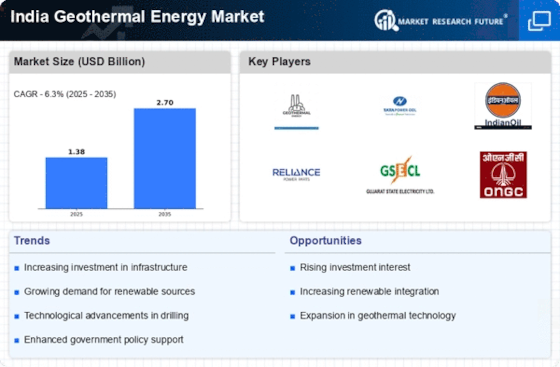
As per analysis, the India geothermal energy market is projected to grow from USD 0.432 Billion in 2025 to USD 0.838 Billion by 2035, exhibiting a compound annual growth rate (CAGR) of 6.92% during the forecast period (2025 - 2035).

Key Market Trends & Highlights

The India geothermal energy market is poised for substantial growth driven by technological advancements and increasing investment.

  • Investment in geothermal projects is rising, indicating a robust market outlook.
  • Electricity generation remains the largest segment, while geothermal heat pumps are the fastest-growing segment.
  • Flash steam power plants dominate the market, whereas binary cycle power plants are experiencing rapid growth.
  • Rising demand for renewable energy and government initiatives are key drivers propelling market expansion.

Market Size & Forecast

2024 Market Size 0.401 (USD Billion)
2035 Market Size 0.838 (USD Billion)
CAGR (2025 - 2035) 6.92%

Major Players

<p>Geothermal Power India (IN), Tata Power (IN), Indian Oil Corporation (IN), Reliance Power (IN), Gujarat State Electricity Corporation (IN), ONGC (IN), Adani Green Energy (IN), JSW Energy (IN), Larsen & Toubro (IN)</p>

Market Trends

The india geothermal energy market is currently experiencing a phase of gradual evolution, characterized by an increasing recognition of geothermal resources as a viable alternative energy source. This shift appears to be driven by a combination of factors, including the need for sustainable energy solutions and the government's commitment to enhancing energy security. The potential for geothermal energy in India is substantial, particularly in regions with volcanic activity and hot springs, which may serve as ideal sites for harnessing this renewable resource. Furthermore, the integration of geothermal energy into the national energy mix could contribute to reducing greenhouse gas emissions, aligning with India's broader environmental goals. In recent years, there has been a noticeable increase in research and development initiatives aimed at exploring and utilizing geothermal resources. This trend suggests a growing interest among stakeholders, including government bodies and private enterprises, in investing in geothermal projects. Additionally, the establishment of supportive policies and regulatory frameworks may further stimulate growth in The India Geothermal Energy Market. As the country continues to seek innovative solutions to meet its energy demands, geothermal energy could play a pivotal role in achieving a sustainable and resilient energy future.

Rising Investment in Geothermal Projects

There appears to be a growing trend of investment in geothermal energy projects across India. This influx of capital is likely driven by both public and private sectors, aiming to explore and develop geothermal resources. The government's initiatives to promote renewable energy may further encourage financial backing for these projects.

Technological Advancements

Technological innovations in geothermal energy extraction and utilization seem to be gaining traction within the india geothermal energy market. Enhanced drilling techniques and improved resource assessment methods may lead to more efficient and cost-effective geothermal energy production, potentially attracting more stakeholders.

Policy Support and Regulatory Frameworks

The establishment of supportive policies and regulatory frameworks appears to be a crucial trend influencing the india geothermal energy market. Government initiatives aimed at promoting renewable energy sources may create a conducive environment for geothermal development, encouraging investments and facilitating project implementation.

India Geothermal Energy Market Market Drivers

Rising Demand for Renewable Energy

The increasing demand for renewable energy sources in India is a pivotal driver for the India Geothermal Energy Market. As the country aims to achieve its target of 500 GW of renewable energy capacity by 2030, geothermal energy presents a viable option. The National Electricity Plan indicates that geothermal energy could contribute significantly to this target, given its potential to provide baseload power. Furthermore, the growing awareness of climate change and the need for sustainable energy solutions are propelling investments in geothermal projects. This trend is likely to continue as both government and private sectors recognize the importance of diversifying energy sources to ensure energy security and reduce carbon emissions.

Growing Interest from Private Sector

The increasing interest from the private sector is a notable driver for the india geothermal energy market. As the energy landscape evolves, private companies are recognizing the potential of geothermal energy as a viable investment opportunity. Several private firms have begun exploring geothermal resources in India, driven by the prospect of long-term returns and the growing demand for renewable energy. Collaborations between public and private entities are also emerging, facilitating knowledge transfer and resource sharing. This trend is expected to foster innovation and accelerate the development of geothermal projects, ultimately contributing to the expansion of the geothermal energy market in India.

Government Initiatives and Incentives

Government initiatives play a crucial role in shaping the India Geothermal Energy Market. The Indian government has introduced various policies aimed at promoting renewable energy, including geothermal energy. The Ministry of New and Renewable Energy (MNRE) has established a framework that encourages investment in geothermal projects through financial incentives and subsidies. For instance, the Geothermal Energy Development Program aims to facilitate exploration and development of geothermal resources. Additionally, the government has set ambitious targets for renewable energy, which include geothermal energy as a key component. These initiatives are expected to stimulate growth in the geothermal sector, attracting both domestic and international investors.

Environmental Sustainability and Climate Goals

The emphasis on environmental sustainability is a driving force behind the India Geothermal Energy Market. As India grapples with the impacts of climate change, there is a growing recognition of the need for cleaner energy sources. Geothermal energy, being a low-emission power source, aligns well with India's climate goals. The government has committed to reducing the carbon intensity of its economy and increasing the share of non-fossil fuel-based energy sources. This commitment is likely to spur investments in geothermal energy projects, as stakeholders seek to align with national and international climate agreements. The potential for geothermal energy to provide a stable and sustainable energy supply further enhances its appeal in the context of environmental sustainability.

Technological Innovations in Geothermal Energy

Technological advancements are significantly influencing the India Geothermal Energy Market. Innovations in drilling techniques and enhanced geothermal systems (EGS) have the potential to unlock previously inaccessible geothermal resources. The adoption of advanced technologies can lead to more efficient energy extraction and lower operational costs. For example, the implementation of binary cycle power plants has been gaining traction, allowing for the utilization of lower temperature geothermal resources. As these technologies continue to evolve, they are likely to enhance the feasibility and attractiveness of geothermal energy projects in India, thereby contributing to the overall growth of the market.

Market Segment Insights

By Application: Electricity Generation (Largest) vs. Geothermal Heat Pumps (Fastest-Growing)

<p>In the India geothermal energy market, the application segment is primarily driven by electricity generation, which holds the largest market share. Electricity generation from geothermal sources not only capitalizes on India's rich geothermal resources but also benefits from supportive government policies promoting renewable energy. Other applications such as direct use applications and geothermal heat pumps follow but at a comparatively smaller scale. Direct use applications are harnessed in various industries, including agriculture and aquaculture, thus contributing steadily to the segment's overall profile. The growth trends in the application segment showcase an increasing interest in sustainable energy solutions. Geothermal heat pumps, in particular, are becoming the fastest-growing aspect of the segment as they offer efficient temperature regulation with low environmental impact. The rising awareness of climate change and the need for energy efficiency in residential and commercial sectors further boost this growth, indicating a shift towards more innovative and responsible energy use.</p>

<p>Electricity Generation (Dominant) vs. Geothermal Heat Pumps (Emerging)</p>

<p>Electricity generation remains the dominant application in the Indian geothermal energy market, due to its established technology and significant resource potential. This segment benefits from large-scale projects and robust infrastructure that facilitates effective energy production. On the other hand, geothermal heat pumps are emerging as a viable alternative due to their versatility and efficiency in heating and cooling applications. As they become more popular among consumers and builders, especially in urban areas, the integration of these systems into residential and commercial buildings is expected to rise. The transition towards heat pumps signifies a growing trend of adopting cleaner, more efficient technology, aligning with India's renewable energy goals.</p>

By Technology: Flash Steam Power Plants (Largest) vs. Binary Cycle Power Plants (Fastest-Growing)

<p>In the India geothermal energy market, flash steam power plants currently hold the largest share, thanks to their established technology and efficient electricity generation capabilities. This segment is followed by binary cycle power plants, which are gaining traction due to advancements in technology and increasing interest in utilizing lower-temperature geothermal resources. Dry steam power plants and geothermal heat pump technology, while important, represent smaller portions of the market, highlighting the dominance of flash steam systems in India's geothermal landscape.</p>

<p>Technology: Flash Steam Power Plants (Dominant) vs. Binary Cycle Power Plants (Emerging)</p>

<p>Flash steam power plants play a pivotal role in India's geothermal energy sector, leveraging high-temperature geothermal resources to efficiently convert steam into electricity. Their reliable performance and established infrastructure contribute to their dominant market position. On the other hand, binary cycle power plants are emerging as a faster-growing segment, utilizing low- to medium-temperature geothermal resources effectively. This technology not only minimizes environmental impact but also expands the potential for geothermal energy utilization across diverse regions in India, making it a significant focus for future development.</p>

By End Use: Residential (Largest) vs. Industrial (Fastest-Growing)

<p>In the India geothermal energy market, the end use segment showcases a diverse distribution across various applications. The residential sector holds the largest share, reflecting the growing interest in sustainable home heating solutions. Meanwhile, commercial and agricultural segments contribute positively but at a lesser extent. Industrial use, on the other hand, is emerging with substantial adoption rates, highlighting its importance in meeting energy demands through cleaner sources. The growth trends in this segment reveal a shift towards renewable energy sources, with residential applications being driven by governmental incentives and an increase in eco-conscious consumers. The industrial sector is gaining momentum due to regulatory pressures to reduce carbon emissions, combined with significant investments in geothermal technologies, propelling it towards becoming the fastest-growing segment in the market.</p>

<p>Residential (Dominant) vs. Industrial (Emerging)</p>

<p>The residential sector in India's geothermal energy market remains dominant due to its extensive adoption for heating purposes, driven by an increase in energy efficiency awareness and government policies promoting renewable energy usage. Homeowners are leaning towards geothermal heat pumps, appreciating their long-term cost savings and environmental benefits. In contrast, the industrial segment is emerging as a critical player, particularly in manufacturing and processing industries, where there is a strong push for sustainable energy solutions. Industries are increasingly investing in geothermal systems to not only comply with regulations but to gain a competitive edge through lower operating costs and enhanced sustainability profiles. This creates a dynamic landscape where residential solutions widely utilized contrast with the innovative industrial applications making significant strides.</p>

Get more detailed insights about India Geothermal Energy Market Research Report – Forecast till 2035

Regional Insights

North America : Innovation and Investment Hub

North America is witnessing a significant surge in geothermal energy investments, driven by increasing demand for renewable energy and supportive regulatory frameworks. The United States leads this market, holding approximately 70% of the North American geothermal capacity, followed by Canada with around 20%. The region's commitment to reducing carbon emissions and enhancing energy security is propelling growth in geothermal projects, supported by federal incentives and state-level initiatives. The competitive landscape in North America is characterized by established players such as Ormat Technologies and Calpine Corporation, alongside emerging companies focusing on innovative geothermal technologies. The presence of strong research institutions and government support fosters a conducive environment for advancements in geothermal energy. As the market evolves, collaboration between public and private sectors is expected to enhance the region's geothermal capacity further.

Europe : Sustainable Energy Transition Leader

Europe is at the forefront of the geothermal energy market, driven by ambitious climate goals and a strong regulatory framework. Countries like Iceland and Italy are the largest contributors, with Iceland holding about 40% of the European geothermal capacity, while Italy accounts for approximately 30%. The European Union's Green Deal and various national policies are catalyzing investments in geothermal projects, aiming to reduce reliance on fossil fuels and enhance energy independence. Leading countries in Europe are actively investing in geothermal technologies, with significant contributions from companies like Enel Green Power and Reykjavik Energy. The competitive landscape is marked by a mix of established firms and innovative startups focusing on enhanced geothermal systems. The region's commitment to sustainability and energy diversification is expected to drive further growth in the geothermal sector, positioning Europe as a global leader in renewable energy.

Asia-Pacific : Emerging Market Potential

The Asia-Pacific region is emerging as a significant player in the geothermal energy market, driven by increasing energy demands and a shift towards sustainable energy sources. Indonesia and the Philippines are the largest markets, collectively holding around 80% of the region's geothermal capacity. Government initiatives and international partnerships are fostering investments in geothermal projects, aiming to enhance energy security and reduce greenhouse gas emissions across the region. Countries like Japan and New Zealand are also making strides in geothermal energy, with a focus on innovative technologies and sustainable practices. The competitive landscape features key players such as Pertamina Geothermal Energy and Energy Development Corporation, which are leading the charge in developing geothermal resources. As the region continues to explore its geothermal potential, collaboration among governments, private sectors, and research institutions will be crucial for unlocking new opportunities.

Middle East and Africa : Resource-Rich Frontier

The Middle East and Africa region is gradually recognizing the potential of geothermal energy as a viable renewable resource. Countries like Kenya and Ethiopia are leading the way, with Kenya holding approximately 50% of the region's geothermal capacity. The growing need for energy diversification and sustainable solutions is driving interest in geothermal projects, supported by international funding and partnerships aimed at enhancing energy access and reliability in the region. The competitive landscape is evolving, with key players such as KenGen and the Ethiopian Electric Power Company spearheading geothermal development initiatives. As the region seeks to harness its geothermal resources, collaboration with international organizations and investment in technology will be essential for overcoming challenges and maximizing the potential of geothermal energy.

Key Players and Competitive Insights

The geothermal energy market in India is currently characterized by a competitive landscape that is gradually evolving, driven by increasing energy demands and a growing emphasis on sustainable energy solutions. Key players such as ONGC (India), Tata Power (India), and Adani Green Energy (India) are actively positioning themselves to capitalize on these trends. ONGC (India) has been focusing on enhancing its geothermal exploration capabilities, while Tata Power (India) is investing in innovative technologies to improve efficiency in energy production. Adani Green Energy (India) appears to be pursuing aggressive expansion strategies, potentially reshaping the competitive dynamics within the market.

The business tactics employed by these companies reflect a concerted effort to optimize operations and enhance market presence. The market structure seems moderately fragmented, with several players vying for dominance. Localizing manufacturing and optimizing supply chains are common strategies among these firms, which collectively influence the competitive environment by fostering innovation and operational efficiency.

In December 2025, ONGC (India) announced a partnership with a leading technology firm to develop advanced geothermal drilling techniques. This strategic move is likely to enhance ONGC's operational efficiency and reduce costs, positioning the company favorably in a market that increasingly values technological innovation. The collaboration may also facilitate the exploration of previously untapped geothermal resources, thereby expanding ONGC's portfolio.

In November 2025, Tata Power (India) launched a pilot project aimed at integrating AI-driven analytics into its geothermal operations. This initiative is expected to optimize resource management and improve predictive maintenance, which could lead to significant cost savings and enhanced reliability in energy production. The adoption of AI technologies may serve as a competitive differentiator, allowing Tata Power to respond more effectively to market demands.

In October 2025, Adani Green Energy (India) secured a substantial investment from a global renewable energy fund to accelerate its geothermal projects. This influx of capital is anticipated to bolster Adani's capacity to scale operations and innovate within the geothermal sector. The investment underscores the growing confidence in geothermal energy as a viable alternative, potentially attracting further investments and partnerships in the future.

As of January 2026, the competitive trends within the geothermal energy market are increasingly defined by digitalization, sustainability, and the integration of advanced technologies. Strategic alliances are becoming more prevalent, as companies recognize the value of collaboration in driving innovation and enhancing operational capabilities. The shift from price-based competition to a focus on technological advancement and supply chain reliability is likely to shape the future landscape of the market, emphasizing the importance of differentiation through innovation.

Key Companies in the India Geothermal Energy Market include

Industry Developments

July 2022:Ormat propounded the commercial operation of the Casa Diablo-IV (CD4) 30 MW geothermal power plant. The CD4 facility provides 7 MW of geothermal power to Community Choice Aggregators, Silicon Valley Clean Energy, and Central Coast Community Energy, each under a 10-year power purchase agreement (PPA). In Addition, the facility provides 16 MW of geothermal power to the Southern California Public Power Authority under a 25-year agreement.

Future Outlook

India Geothermal Energy Market Future Outlook

The India geothermal energy market is poised for growth at 6.92% CAGR from 2025 to 2035, driven by technological advancements, government support, and increasing energy demands.

New opportunities lie in:

  • Development of enhanced geothermal systems for urban areas.
  • Investment in geothermal heat pumps for residential applications.
  • Partnerships with local governments for geothermal district heating projects.

By 2035, the market is expected to be robust, driven by innovative solutions and strategic partnerships.

Market Segmentation

India Geothermal Energy Market End Use Outlook

  • Residential
  • Commercial
  • Industrial
  • Agricultural

India Geothermal Energy Market Technology Outlook

  • Binary Cycle Power Plants
  • Flash Steam Power Plants
  • Dry Steam Power Plants
  • Geothermal Heat Pump Technology

India Geothermal Energy Market Application Outlook

  • Electricity Generation
  • Direct Use Applications
  • Geothermal Heat Pumps
  • Enhanced Geothermal Systems

Report Scope

MARKET SIZE 20240.401(USD Billion)
MARKET SIZE 20250.432(USD Billion)
MARKET SIZE 20350.838(USD Billion)
COMPOUND ANNUAL GROWTH RATE (CAGR)6.92% (2024 - 2035)
REPORT COVERAGERevenue Forecast, Competitive Landscape, Growth Factors, and Trends
BASE YEAR2024
Market Forecast Period2025 - 2035
Historical Data2019 - 2024
Market Forecast UnitsUSD Billion
Key Companies ProfiledGeothermal Power India (IN), Tata Power (IN), Indian Oil Corporation (IN), Reliance Power (IN), Gujarat State Electricity Corporation (IN), ONGC (IN), Adani Green Energy (IN), JSW Energy (IN), Larsen & Toubro (IN)
Segments CoveredApplication, Technology, End Use
Key Market OpportunitiesExpansion of geothermal energy projects driven by supportive government policies and increasing energy demand.
Key Market DynamicsEmerging regulatory frameworks and technological advancements are driving growth in India's geothermal energy sector.
Countries CoveredIndia

FAQs

What is the current valuation of the India geothermal energy market?

As of 2024, the market valuation was 0.401 USD Billion.

What is the projected market size for the India geothermal energy market by 2035?

The market is projected to reach 0.838 USD Billion by 2035.

What is the expected CAGR for the India geothermal energy market during the forecast period?

The expected CAGR for the market from 2025 to 2035 is 6.92%.

Which companies are the key players in the India geothermal energy market?

Key players include Geothermal Power India, Tata Power, Indian Oil Corporation, and Reliance Power.

What are the main applications of geothermal energy in India?

Main applications include electricity generation, direct use applications, geothermal heat pumps, and enhanced geothermal systems.

How much revenue is generated from electricity generation in the geothermal sector?

Electricity generation revenue was 0.2 USD Billion in 2024 and is expected to grow to 0.42 USD Billion by 2035.

  1. SECTION I: EXECUTIVE SUMMARY AND KEY HIGHLIGHTS
    1. EXECUTIVE SUMMARY
      1. Market Overview
      2. Key Findings
      3. Market Segmentation
      4. Competitive Landscape
      5. Challenges and Opportunities
      6. Future Outlook 2
  2. SECTION II: SCOPING, METHODOLOGY AND MARKET STRUCTURE
    1. MARKET INTRODUCTION
      1. Definition
      2. Scope of the study
    2. RESEARCH METHODOLOGY
      1. Overview
      2. Data Mining
      3. Secondary Research
      4. Primary Research
      5. Forecasting Model
      6. Market Size Estimation
      7. Data Triangulation
      8. Validation 3
  3. SECTION III: QUALITATIVE ANALYSIS
    1. MARKET DYNAMICS
      1. Overview
      2. Drivers
      3. Restraints
      4. Opportunities
    2. MARKET FACTOR ANALYSIS
      1. Value chain Analysis
      2. Porter's Five Forces Analysis
      3. COVID-19 Impact Analysis
  4. SECTION IV: QUANTITATIVE ANALYSIS
    1. Energy & Power, BY Application (USD Billion)
      1. Power Generation
      2. Residential
      3. Commercial Heating & Cooling
    2. Energy & Power, BY Technology (USD Billion)
      1. Binary Cycle Plants
      2. Flash Steam Plants
      3. Dry Steam Plants
      4. Ground Source Heat Pumps
      5. Direct Systems
    3. Energy & Power, BY Temperature (USD Billion)
      1. Low Temperature
      2. Medium Temperature
      3. High Temperature
    4. Energy & Power, BY Region (USD Billion)
      1. North America
      2. Europe
      3. APAC
      4. South America
      5. MEA
  5. SECTION V: COMPETITIVE ANALYSIS
    1. Competitive Landscape
      1. Overview
      2. Competitive Analysis
      3. Market share Analysis
      4. Major Growth Strategy in the Energy & Power
      5. Competitive Benchmarking
      6. Leading Players in Terms of Number of Developments in the Energy & Power
      7. Key developments and growth strategies
      8. Major Players Financial Matrix
    2. Company Profiles
      1. Geothermal Energy Corporation (IN)
      2. Tata Power (IN)
      3. Indian Oil Corporation (IN)
      4. Reliance Power (IN)
      5. Gujarat State Electricity Corporation (IN)
      6. ONGC (IN)
      7. Adani Green Energy (IN)
      8. JSW Energy (IN)
      9. Larsen & Toubro (IN)
    3. Appendix
      1. References
      2. Related Reports 6 LIST OF FIGURES
    4. MARKET SYNOPSIS
    5. NORTH AMERICA MARKET ANALYSIS
    6. US MARKET ANALYSIS BY APPLICATION
    7. US MARKET ANALYSIS BY TECHNOLOGY
    8. US MARKET ANALYSIS BY TEMPERATURE
    9. CANADA MARKET ANALYSIS BY APPLICATION
    10. CANADA MARKET ANALYSIS BY TECHNOLOGY
    11. CANADA MARKET ANALYSIS BY TEMPERATURE
    12. EUROPE MARKET ANALYSIS
    13. GERMANY MARKET ANALYSIS BY APPLICATION
    14. GERMANY MARKET ANALYSIS BY TECHNOLOGY
    15. GERMANY MARKET ANALYSIS BY TEMPERATURE
    16. UK MARKET ANALYSIS BY APPLICATION
    17. UK MARKET ANALYSIS BY TECHNOLOGY
    18. UK MARKET ANALYSIS BY TEMPERATURE
    19. FRANCE MARKET ANALYSIS BY APPLICATION
    20. FRANCE MARKET ANALYSIS BY TECHNOLOGY
    21. FRANCE MARKET ANALYSIS BY TEMPERATURE
    22. RUSSIA MARKET ANALYSIS BY APPLICATION
    23. RUSSIA MARKET ANALYSIS BY TECHNOLOGY
    24. RUSSIA MARKET ANALYSIS BY TEMPERATURE
    25. ITALY MARKET ANALYSIS BY APPLICATION
    26. ITALY MARKET ANALYSIS BY TECHNOLOGY
    27. ITALY MARKET ANALYSIS BY TEMPERATURE
    28. SPAIN MARKET ANALYSIS BY APPLICATION
    29. SPAIN MARKET ANALYSIS BY TECHNOLOGY
    30. SPAIN MARKET ANALYSIS BY TEMPERATURE
    31. REST OF EUROPE MARKET ANALYSIS BY APPLICATION
    32. REST OF EUROPE MARKET ANALYSIS BY TECHNOLOGY
    33. REST OF EUROPE MARKET ANALYSIS BY TEMPERATURE
    34. APAC MARKET ANALYSIS
    35. CHINA MARKET ANALYSIS BY APPLICATION
    36. CHINA MARKET ANALYSIS BY TECHNOLOGY
    37. CHINA MARKET ANALYSIS BY TEMPERATURE
    38. INDIA MARKET ANALYSIS BY APPLICATION
    39. INDIA MARKET ANALYSIS BY TECHNOLOGY
    40. INDIA MARKET ANALYSIS BY TEMPERATURE
    41. JAPAN MARKET ANALYSIS BY APPLICATION
    42. JAPAN MARKET ANALYSIS BY TECHNOLOGY
    43. JAPAN MARKET ANALYSIS BY TEMPERATURE
    44. SOUTH KOREA MARKET ANALYSIS BY APPLICATION
    45. SOUTH KOREA MARKET ANALYSIS BY TECHNOLOGY
    46. SOUTH KOREA MARKET ANALYSIS BY TEMPERATURE
    47. MALAYSIA MARKET ANALYSIS BY APPLICATION
    48. MALAYSIA MARKET ANALYSIS BY TECHNOLOGY
    49. MALAYSIA MARKET ANALYSIS BY TEMPERATURE
    50. THAILAND MARKET ANALYSIS BY APPLICATION
    51. THAILAND MARKET ANALYSIS BY TECHNOLOGY
    52. THAILAND MARKET ANALYSIS BY TEMPERATURE
    53. INDONESIA MARKET ANALYSIS BY APPLICATION
    54. INDONESIA MARKET ANALYSIS BY TECHNOLOGY
    55. INDONESIA MARKET ANALYSIS BY TEMPERATURE
    56. REST OF APAC MARKET ANALYSIS BY APPLICATION
    57. REST OF APAC MARKET ANALYSIS BY TECHNOLOGY
    58. REST OF APAC MARKET ANALYSIS BY TEMPERATURE
    59. SOUTH AMERICA MARKET ANALYSIS
    60. BRAZIL MARKET ANALYSIS BY APPLICATION
    61. BRAZIL MARKET ANALYSIS BY TECHNOLOGY
    62. BRAZIL MARKET ANALYSIS BY TEMPERATURE
    63. MEXICO MARKET ANALYSIS BY APPLICATION
    64. MEXICO MARKET ANALYSIS BY TECHNOLOGY
    65. MEXICO MARKET ANALYSIS BY TEMPERATURE
    66. ARGENTINA MARKET ANALYSIS BY APPLICATION
    67. ARGENTINA MARKET ANALYSIS BY TECHNOLOGY
    68. ARGENTINA MARKET ANALYSIS BY TEMPERATURE
    69. REST OF SOUTH AMERICA MARKET ANALYSIS BY APPLICATION
    70. REST OF SOUTH AMERICA MARKET ANALYSIS BY TECHNOLOGY
    71. REST OF SOUTH AMERICA MARKET ANALYSIS BY TEMPERATURE
    72. MEA MARKET ANALYSIS
    73. GCC COUNTRIES MARKET ANALYSIS BY APPLICATION
    74. GCC COUNTRIES MARKET ANALYSIS BY TECHNOLOGY
    75. GCC COUNTRIES MARKET ANALYSIS BY TEMPERATURE
    76. SOUTH AFRICA MARKET ANALYSIS BY APPLICATION
    77. SOUTH AFRICA MARKET ANALYSIS BY TECHNOLOGY
    78. SOUTH AFRICA MARKET ANALYSIS BY TEMPERATURE
    79. REST OF MEA MARKET ANALYSIS BY APPLICATION
    80. REST OF MEA MARKET ANALYSIS BY TECHNOLOGY
    81. REST OF MEA MARKET ANALYSIS BY TEMPERATURE
    82. KEY BUYING CRITERIA OF ENERGY & POWER
    83. RESEARCH PROCESS OF MRFR
    84. DRO ANALYSIS OF ENERGY & POWER
    85. DRIVERS IMPACT ANALYSIS: ENERGY & POWER
    86. RESTRAINTS IMPACT ANALYSIS: ENERGY & POWER
    87. SUPPLY / VALUE CHAIN: ENERGY & POWER
    88. ENERGY & POWER, BY APPLICATION, 2024 (% SHARE)
    89. ENERGY & POWER, BY APPLICATION, 2024 TO 2035 (USD Billion)
    90. ENERGY & POWER, BY TECHNOLOGY, 2024 (% SHARE)
    91. ENERGY & POWER, BY TECHNOLOGY, 2024 TO 2035 (USD Billion)
    92. ENERGY & POWER, BY TEMPERATURE, 2024 (% SHARE)
    93. ENERGY & POWER, BY TEMPERATURE, 2024 TO 2035 (USD Billion)
    94. BENCHMARKING OF MAJOR COMPETITORS 7 LIST OF TABLES
    95. LIST OF ASSUMPTIONS
    96. North America MARKET SIZE ESTIMATES; FORECAST
      1. BY APPLICATION, 2025-2035 (USD Billion)
      2. BY TECHNOLOGY, 2025-2035 (USD Billion)
      3. BY TEMPERATURE, 2025-2035 (USD Billion)
    97. US MARKET SIZE ESTIMATES; FORECAST
      1. BY APPLICATION, 2025-2035 (USD Billion)
      2. BY TECHNOLOGY, 2025-2035 (USD Billion)
      3. BY TEMPERATURE, 2025-2035 (USD Billion)
    98. Canada MARKET SIZE ESTIMATES; FORECAST
      1. BY APPLICATION, 2025-2035 (USD Billion)
      2. BY TECHNOLOGY, 2025-2035 (USD Billion)
      3. BY TEMPERATURE, 2025-2035 (USD Billion)
    99. Europe MARKET SIZE ESTIMATES; FORECAST
      1. BY APPLICATION, 2025-2035 (USD Billion)
      2. BY TECHNOLOGY, 2025-2035 (USD Billion)
      3. BY TEMPERATURE, 2025-2035 (USD Billion)
    100. Germany MARKET SIZE ESTIMATES; FORECAST
      1. BY APPLICATION, 2025-2035 (USD Billion)
      2. BY TECHNOLOGY, 2025-2035 (USD Billion)
      3. BY TEMPERATURE, 2025-2035 (USD Billion)
    101. UK MARKET SIZE ESTIMATES; FORECAST
      1. BY APPLICATION, 2025-2035 (USD Billion)
      2. BY TECHNOLOGY, 2025-2035 (USD Billion)
      3. BY TEMPERATURE, 2025-2035 (USD Billion)
    102. France MARKET SIZE ESTIMATES; FORECAST
      1. BY APPLICATION, 2025-2035 (USD Billion)
      2. BY TECHNOLOGY, 2025-2035 (USD Billion)
      3. BY TEMPERATURE, 2025-2035 (USD Billion)
    103. Russia MARKET SIZE ESTIMATES; FORECAST
      1. BY APPLICATION, 2025-2035 (USD Billion)
      2. BY TECHNOLOGY, 2025-2035 (USD Billion)
      3. BY TEMPERATURE, 2025-2035 (USD Billion)
    104. Italy MARKET SIZE ESTIMATES; FORECAST
      1. BY APPLICATION, 2025-2035 (USD Billion)
      2. BY TECHNOLOGY, 2025-2035 (USD Billion)
      3. BY TEMPERATURE, 2025-2035 (USD Billion)
    105. Spain MARKET SIZE ESTIMATES; FORECAST
      1. BY APPLICATION, 2025-2035 (USD Billion)
      2. BY TECHNOLOGY, 2025-2035 (USD Billion)
      3. BY TEMPERATURE, 2025-2035 (USD Billion)
    106. Rest of Europe MARKET SIZE ESTIMATES; FORECAST
      1. BY APPLICATION, 2025-2035 (USD Billion)
      2. BY TECHNOLOGY, 2025-2035 (USD Billion)
      3. BY TEMPERATURE, 2025-2035 (USD Billion)
    107. APAC MARKET SIZE ESTIMATES; FORECAST
      1. BY APPLICATION, 2025-2035 (USD Billion)
      2. BY TECHNOLOGY, 2025-2035 (USD Billion)
      3. BY TEMPERATURE, 2025-2035 (USD Billion)
    108. China MARKET SIZE ESTIMATES; FORECAST
      1. BY APPLICATION, 2025-2035 (USD Billion)
      2. BY TECHNOLOGY, 2025-2035 (USD Billion)
      3. BY TEMPERATURE, 2025-2035 (USD Billion)
    109. India MARKET SIZE ESTIMATES; FORECAST
      1. BY APPLICATION, 2025-2035 (USD Billion)
      2. BY TECHNOLOGY, 2025-2035 (USD Billion)
      3. BY TEMPERATURE, 2025-2035 (USD Billion)
    110. Japan MARKET SIZE ESTIMATES; FORECAST
      1. BY APPLICATION, 2025-2035 (USD Billion)
      2. BY TECHNOLOGY, 2025-2035 (USD Billion)
      3. BY TEMPERATURE, 2025-2035 (USD Billion)
    111. South Korea MARKET SIZE ESTIMATES; FORECAST
      1. BY APPLICATION, 2025-2035 (USD Billion)
      2. BY TECHNOLOGY, 2025-2035 (USD Billion)
      3. BY TEMPERATURE, 2025-2035 (USD Billion)
    112. Malaysia MARKET SIZE ESTIMATES; FORECAST
      1. BY APPLICATION, 2025-2035 (USD Billion)
      2. BY TECHNOLOGY, 2025-2035 (USD Billion)
      3. BY TEMPERATURE, 2025-2035 (USD Billion)
    113. Thailand MARKET SIZE ESTIMATES; FORECAST
      1. BY APPLICATION, 2025-2035 (USD Billion)
      2. BY TECHNOLOGY, 2025-2035 (USD Billion)
      3. BY TEMPERATURE, 2025-2035 (USD Billion)
    114. Indonesia MARKET SIZE ESTIMATES; FORECAST
      1. BY APPLICATION, 2025-2035 (USD Billion)
      2. BY TECHNOLOGY, 2025-2035 (USD Billion)
      3. BY TEMPERATURE, 2025-2035 (USD Billion)
    115. Rest of APAC MARKET SIZE ESTIMATES; FORECAST
      1. BY APPLICATION, 2025-2035 (USD Billion)
      2. BY TECHNOLOGY, 2025-2035 (USD Billion)
      3. BY TEMPERATURE, 2025-2035 (USD Billion)
    116. South America MARKET SIZE ESTIMATES; FORECAST
      1. BY APPLICATION, 2025-2035 (USD Billion)
      2. BY TECHNOLOGY, 2025-2035 (USD Billion)
      3. BY TEMPERATURE, 2025-2035 (USD Billion)
    117. Brazil MARKET SIZE ESTIMATES; FORECAST
      1. BY APPLICATION, 2025-2035 (USD Billion)
      2. BY TECHNOLOGY, 2025-2035 (USD Billion)
      3. BY TEMPERATURE, 2025-2035 (USD Billion)
    118. Mexico MARKET SIZE ESTIMATES; FORECAST
      1. BY APPLICATION, 2025-2035 (USD Billion)
      2. BY TECHNOLOGY, 2025-2035 (USD Billion)
      3. BY TEMPERATURE, 2025-2035 (USD Billion)
    119. Argentina MARKET SIZE ESTIMATES; FORECAST
      1. BY APPLICATION, 2025-2035 (USD Billion)
      2. BY TECHNOLOGY, 2025-2035 (USD Billion)
      3. BY TEMPERATURE, 2025-2035 (USD Billion)
    120. Rest of South America MARKET SIZE ESTIMATES; FORECAST
      1. BY APPLICATION, 2025-2035 (USD Billion)
      2. BY TECHNOLOGY, 2025-2035 (USD Billion)
      3. BY TEMPERATURE, 2025-2035 (USD Billion)
    121. MEA MARKET SIZE ESTIMATES; FORECAST
      1. BY APPLICATION, 2025-2035 (USD Billion)
      2. BY TECHNOLOGY, 2025-2035 (USD Billion)
      3. BY TEMPERATURE, 2025-2035 (USD Billion)
    122. GCC Countries MARKET SIZE ESTIMATES; FORECAST
      1. BY APPLICATION, 2025-2035 (USD Billion)
      2. BY TECHNOLOGY, 2025-2035 (USD Billion)
      3. BY TEMPERATURE, 2025-2035 (USD Billion)
    123. South Africa MARKET SIZE ESTIMATES; FORECAST
      1. BY APPLICATION, 2025-2035 (USD Billion)
      2. BY TECHNOLOGY, 2025-2035 (USD Billion)
      3. BY TEMPERATURE, 2025-2035 (USD Billion)
    124. Rest of MEA MARKET SIZE ESTIMATES; FORECAST
      1. BY APPLICATION, 2025-2035 (USD Billion)
      2. BY TECHNOLOGY, 2025-2035 (USD Billion)
      3. BY TEMPERATURE, 2025-2035 (USD Billion)
    125. PRODUCT LAUNCH/PRODUCT DEVELOPMENT/APPROVAL
    126. ACQUISITION/PARTNERSHIP

India Geothermal Energy Market Segmentation

Market Segmentation Overview

  • Detailed segmentation data will be available in the full report
  • Comprehensive analysis by multiple parameters
  • Regional and country-level breakdowns
  • Market size forecasts by segment
Infographic

Free Sample Request

Kindly complete the form below to receive a free sample of this Report

Get Free Sample

Customer Strories

Compare Licence

×
Features License Type
Single User Multiuser License Enterprise User
Price $4,950 $5,950 $7,250
Maximum User Access Limit 1 User Upto 10 Users Unrestricted Access Throughout the Organization
Free Customization
Direct Access to Analyst
Deliverable Format
Platform Access
Discount on Next Purchase 10% 15% 15%
Printable Versions