


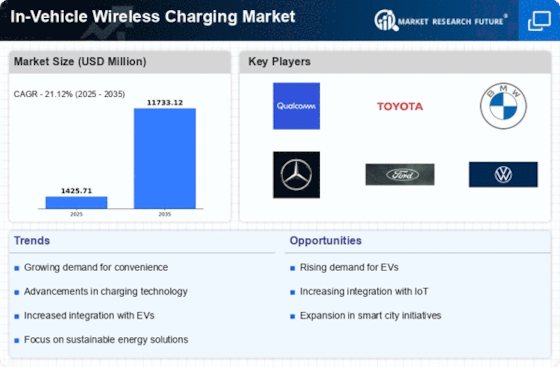
Market Share
Introduction: Navigating the Future of In-Vehicle Wireless Charging
In-car wireless charging is experiencing a period of unprecedented competition, with the technology being rapidly adopted, the regulatory framework evolving, and consumers’ increased expectations of seamless connection and convenience. The key players—OEMs, IT system integrators, and charging station suppliers—are vying for leadership, offering enhanced solutions, such as AI-based analytics and IoT integration, to improve the customer experience and operational efficiency. Meanwhile, new entrants—especially in the fields of green charging and biometrics—are reshaping the market, forcing the incumbents to adapt. Strategically, the focus is on integrating wireless charging into EVs and smart city initiatives. Opportunities abound for those who can capitalize on the technological and regulatory momentum to align their offerings with the future demands of connected mobility.
Competitive Positioning
Full-Suite Integrators
These vendors offer comprehensive solutions that integrate various technologies for in-vehicle wireless charging.
| Vendor | Competitive Edge | Solution Focus | Regional Focus |
|---|---|---|---|
| Samsung Electronics Co., Ltd | Strong brand and extensive R&D | Wireless charging technology | Global |
| Qualcomm Technologies, Inc. | Leading in wireless power transfer standards | Charger and receiver technology | Global |
| Apple Inc. | Innovative design and ecosystem integration | Wireless charging solutions | Global |
Specialized Technology Vendors
These companies focus on niche technologies and innovations within the wireless charging space.
| Vendor | Competitive Edge | Solution Focus | Regional Focus |
|---|---|---|---|
| Powermat Technologies Ltd. | Pioneering wireless charging solutions | Inductive charging technology | North America, Europe |
| Mojo Mobility, Inc. | Dynamic wireless charging capabilities | Advanced wireless power solutions | North America |
| ZENS | Focus on consumer-friendly designs | Wireless charging pads and systems | Europe |
Infrastructure & Equipment Providers
These vendors supply the necessary infrastructure and equipment for implementing wireless charging solutions in vehicles.
| Vendor | Competitive Edge | Solution Focus | Regional Focus |
|---|---|---|---|
| Hella KGaA Hueck & Co | Expertise in automotive components | Automotive charging infrastructure | Europe, Asia |
| Infineon Technologies AG | Strong semiconductor technology | Power management solutions | Global |
| PowerSquare | Innovative charging technology for vehicles | Wireless charging solutions | Global |
| Aircharge | Focus on user-friendly charging solutions | Wireless charging systems | Europe, North America |
Emerging Players & Regional Champions
- Witricity (USA): Specializes in resonant inductive charging technology, recently partnered with major automotive manufacturers for pilot programs, challenging established vendors by offering more efficient and flexible charging solutions.
- ENERGOUS CORPORATION (U.S.A.): focuses on the WattUp wireless charging system. It has recently been contracted by a major automobile manufacturer to build its technology into electric vehicles. The system complements existing charging systems by allowing wireless charging from a distance.
- PowerMat Technologies (Israel): Offers innovative wireless charging pads and systems, recently implemented solutions in several electric vehicle models, positioning itself as a challenger to traditional charging methods by enhancing user convenience.
- Continental AG (Germany): Integrates wireless charging into vehicle chassis, has recently entered into development with vehicle manufacturers to create the next generation of wireless charging solutions, complements the established suppliers by enhancing the overall vehicle technology.
Regional Trends: - In 2023, the North American and European in-vehicle wireless charging market is expected to grow significantly, driven by the growing popularity of electric vehicles and the convenience of consumers. The trend of technology specialization is to increase the share of resonant inductive charging and wireless charging, and the emerging players are mainly based on the establishment of a partnership with car manufacturers.
Collaborations & M&A Movements
- Qualcomm and BMW announced a partnership to integrate advanced wireless charging technology into future electric vehicle models, aiming to enhance user convenience and accelerate EV adoption.
- Toyota acquired a minority stake in a wireless charging startup, aiming to leverage innovative charging solutions to strengthen its position in the growing electric vehicle market.
- Volkswagen and WiTricity entered into a collaboration to develop and standardize wireless charging systems for their electric vehicle lineup, enhancing competitive positioning in the EV sector.
Competitive Summary Table
| Capability | Leading Players | Remarks |
|---|---|---|
| Efficiency in Charging | Qualcomm, WiTricity | Its high efficiency and low energy losses have been demonstrated in various automotive alliances. With its resonant magnetic induction technology, WiTricity has established a strong presence, enabling the charging of many different vehicle models. |
| Integration with Vehicle Systems | Tesla, BMW | Tesla's vehicles feature integrated wireless charging solutions that enhance user experience, while BMW has incorporated wireless charging in its luxury models, showcasing a commitment to innovation and user convenience. |
| Safety Features | Panasonic, Continental | Panasonic's wireless chargers are equipped with an advanced foreign-object detection mechanism, ensuring the safety of the users. In the same way, Continental's wireless charging systems have strict safety regulations, and they are confident in the use of wireless charging. |
| User Experience and Design | Apple, Samsung | Apple’s sleek design and simple user-interfaces set the standard for wireless charging. Samsung, on the other hand, emphasizes the aesthetics of wireless charging, appealing to consumers who are savvy with technology. |
| Sustainability Initiatives | Ford, Volkswagen | In accordance with its overall environmental goals, Ford is seeking to use sustainable materials in its wireless charging systems. It has also vowed to reduce the carbon footprint of its production processes, including its wireless charging technology. |
Conclusion: Navigating Competitive Terrain in 2023
The in-vehicle wireless charging market will be characterized by a high degree of competition and a high degree of fragmentation. Several large and small players, including both traditional car manufacturers and technology companies, will compete for a share of the market. The market is characterized by a high degree of demand in North America and Europe, driven by a high degree of convenience and a higher demand for sustainable products. Strategically, the vendors will strategically position themselves by deploying advanced capabilities such as artificial intelligence for enhanced usability, automation for operational efficiency, and a strong focus on the environment to meet regulatory standards. Strategically, it will be a key success factor to be able to adapt quickly to changing customer needs and technological developments. Strategically, the decision-makers will need to put these capabilities in order to ensure long-term success and a competitive advantage in the dynamic market.





















Leave a Comment