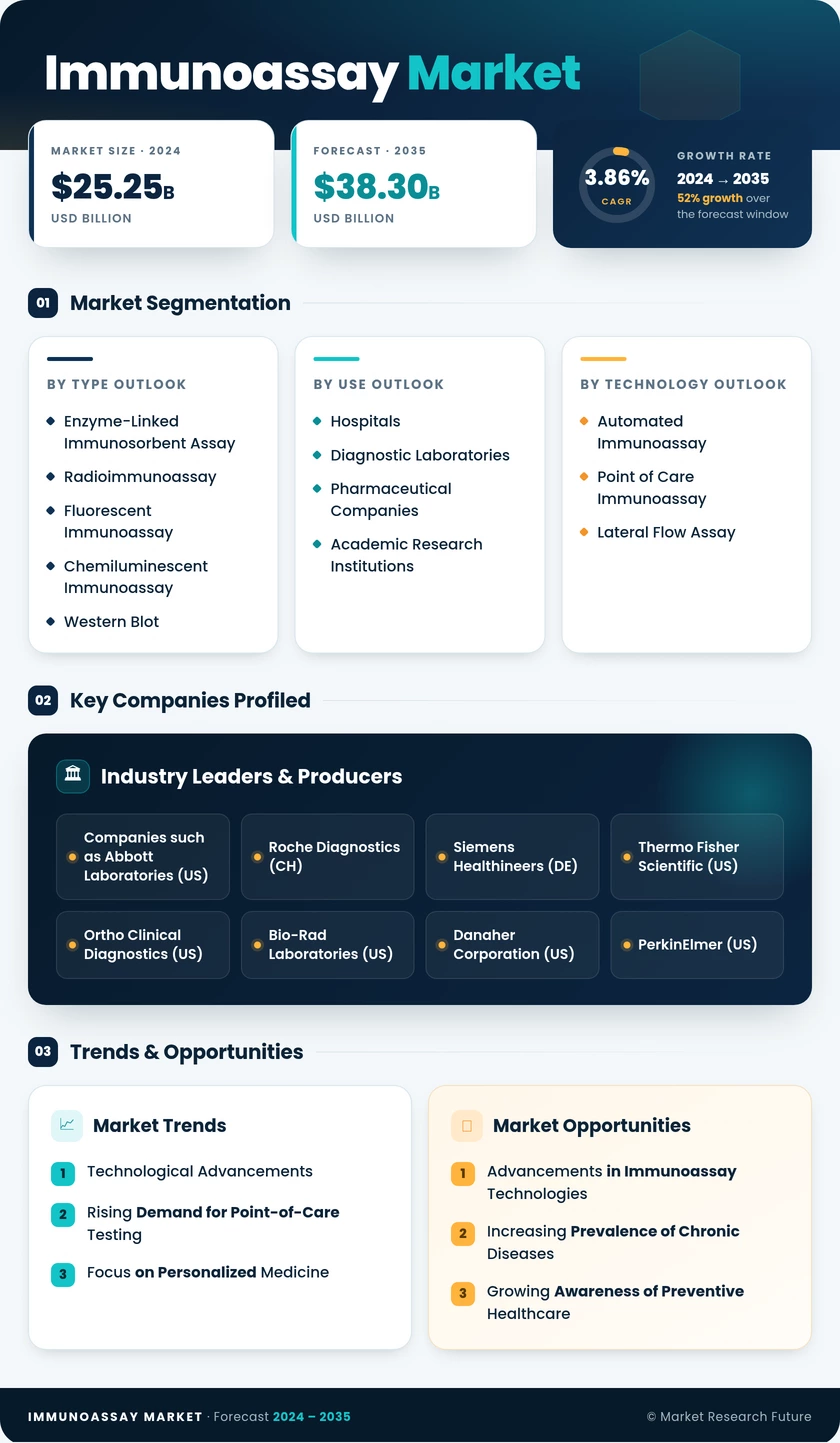
Segmentation Quick Reference
| Dimension | Sub-Segments | Dominant Segment | Fastest Growing Segment |
| By Products & Services | Reagents & Kits; Analyzers & Instruments; Software & Services | Reagents & Kits (59.32% share, 2025) | Analyzers & Instruments (5.63% CAGR) |
| By Technology | ELISA; CLIA; Rapid Tests; Western Blot; ELISPOT; Radioimmunoassay; Other Technologies | ELISA (51.03% share, 2025) | CLIA (5.70% CAGR) |
| By Application | Infectious Diseases; Oncology; Endocrinology; Cardiology; Autoimmune Disorders; Bone & Mineral Disorders; Toxicology & Therapeutic Drug Monitoring; Other Applications | Infectious Diseases (32.62% share, 2025) | Oncology (5.80% CAGR) |
| By Specimen Type | Blood & Serum; Urine; Saliva; Cerebrospinal Fluid; Other Specimen Types | Blood & Serum (47.12% share, 2025) | Saliva (5.52% CAGR) |
| By End User | Hospitals; Clinical Laboratories; Blood Banks; Academic & Research Institutes; Point-of-Care & Home-Care Settings | Hospitals (33.50% share, 2025) | Point-of-Care & Home-Care Settings (5.82% CAGR) |
Market Segmentation Overview
By Products & Services
| Sub-Segment | Key Trend |
| Reagents & Kits | Universal chemistries and bulk packaging support lean-laboratory inventory models |
| Analyzers & Instruments | Random-access track consolidation with predictive maintenance scheduling |
| Software & Services | Middleware and connectivity unbundled into separately priced service tiers |
Reagents and kits lead this dimension at 59.32% of 2025 revenue because closed-system validation ties every placed analyzer to a specific consumable stream that laboratories cannot substitute without revalidation. Analyzers and instruments grow fastest at 5.63% CAGR as hospital and reference laboratories replace ageing benches with consolidated tracks that run chemistry and immunodiagnostics on one sample path. Software and services is the structural wildcard: connectivity that vendors once gave away is now sold, and its margin profile is far better than reagent manufacturing.
By Technology
| Sub-Segment | Key Trend |
| ELISA | Retains cost leadership for research and high-volume screening panels |
| CLIA | Sensitivity and dynamic range advantages drive central-laboratory displacement |
| Rapid Tests | Lateral-flow formats expand in waived and community testing sites |
| Western Blot | Confined to confirmatory workflows with automated blot processing |
| ELISPOT | Cellular immune monitoring for vaccine and cell-therapy development |
| Radioimmunoassay | Declining as isotope handling and disposal costs mount |
| Other Technologies | Single-molecule and multiplex bead formats entering clinical validation |
ELISA holds 51.03% share on the strength of standardised protocols and the lowest consumable cost per result, which is why academic and community laboratories keep it for cytokine, endocrine, and autoimmune panels. Chemiluminescence grows fastest at 5.70% CAGR because therapeutic drug monitoring and tumor-marker quantification operate near ELISA's sensitivity ceiling, and because closed CLIA systems fit the automation architecture laboratories are buying anyway. Radioimmunoassay is the clear loser here, surviving only in a handful of specialty endocrine assays where no validated non-isotopic substitute exists.
By Application
| Sub-Segment | Key Trend |
| Infectious Diseases | Donor-funded and mandate-driven screening sustains volume floor |
| Oncology | Companion diagnostics convert single tests into recurring monitoring |
| Endocrinology | Thyroid and fertility panels supply low-variance base load |
| Cardiology | High-sensitivity troponin restructures emergency rule-out pathways |
| Autoimmune Disorders | Autoantibody panel breadth expands with rheumatology guidelines |
| Bone & Mineral Disorders | Osteoporosis screening rises with population ageing |
| Toxicology & Therapeutic Drug Monitoring | Immunosuppressant and biologic dosing management |
| Other Applications | Allergy, neurology, and prenatal screening menus |
Infectious diseases dominate at 32.62% of 2025 revenue because surveillance mandates and multilateral procurement guarantee volume regardless of individual physician ordering behaviour. Oncology grows fastest at 5.80% CAGR as checkpoint-inhibitor and targeted-therapy protocols require quarterly biomarker reassessment rather than one-time diagnosis. Cardiology is the underrated mover within this dimension: high-sensitivity troponin turned a confirmatory assay into a serial rule-out test, multiplying measurements per emergency presentation.
By Specimen Type
| Sub-Segment | Key Trend |
| Blood & Serum | Dried-blood-spot cards extend reach into cold-chain-limited settings |
| Urine | Toxicology and fertility testing sustain non-invasive volume |
| Saliva | Microfluidic devices validated at sub-200 µL sample volumes |
| Cerebrospinal Fluid | Comparator standard for plasma neurodegeneration marker validation |
| Other Specimen Types | Swab, stool, and tissue-derived formats for targeted panels |
Blood and serum lead at 47.12% share because reference intervals, analyte stability data, and automated platform handling are all optimised around that matrix. Saliva grows fastest at 5.52% CAGR since it removes phlebotomy from the workflow, which matters disproportionately for pediatric, geriatric, telehealth, and employer-screening collection where venipuncture is the actual barrier to compliance. Cerebrospinal fluid stays small in revenue terms yet carries outsized strategic weight, because plasma neurology markers must demonstrate concordance against CSF results to earn clinical acceptance.
By End User
| Sub-Segment | Key Trend |
| Hospitals | Bundled payment models push chemistry-immunoassay track consolidation |
| Clinical Laboratories | Consolidation concentrates purchasing leverage and menu breadth |
| Blood Banks | Mandatory transfusion-transmissible infection screening protocols |
| Academic & Research Institutes | Translational biomarker discovery and multiplex panel adoption |
| Point-of-Care & Home-Care Settings | Waived cartridge readers reach central-laboratory precision |
Hospitals hold 33.50% of 2025 revenue because inpatient sepsis, cardiac, and endocrine decisions cannot wait for send-out turnaround, forcing on-site capability irrespective of unit economics. Point-of-care and home-care settings grow fastest at 5.82% CAGR as CLIA-waived readers close the analytical performance gap and reimbursement parity extends to physician-office and retail sites. Clinical laboratories occupy the squeezed middle: they retain menu-breadth economics but face volume leakage at both ends as hospitals insource urgent testing and near-patient devices absorb routine screening.


 Noah Malgeri
Co-Founder

 Peter Groot koerkamp
Account and Business Manager

 Younghwan Choi
Senior Retail Manager

 Mark Irwin
Management Consultant

 Akif Moroglu
Strategy & Business Development Director

 Guilherme Gomes Martins
Product Management Director

 Joseph Aguayo
Sales Operations & Pricing Manager

 La Terria Dodd
Program Support Specialist

 Rob Kooiker
Group Product Manager HVAC & Fire Protection GMA