
Request Free Sample ×

Kindly complete the form below to receive a free sample of this Report

* Please use a valid business email

Leading companies partner with us for data-driven Insights

clients tt-cursor
Hero Background
English
Chinese
French
Japanese
Korean
German
Spanish

Immersive Technology Market Share

ID: MRFR/ICT/10606-HCR
128 Pages
Apoorva Priyadarshi
April 2026

Immersive Technology Market Research Report Information By Component (Hardware (Head-Mounted Display, Gesture Tracking Devices, Projectors & Display Walls, Software/Platform, Services (Professional and Managed)), Technology (Mixed Reality, Virtual Reality, Augmented Reality), Application (Training & Learning, Emergency Services, Product Development and Sales & Marketing), Industry (Healthcare, Retail & eCommerce, Education, Construction, Media & Entertainment, Gaming, Manufacturing, Aerospace & Defense) By Regions-Forecast Till 2035.

Share:
Download PDF ×

We do not share your information with anyone. However, we may send you emails based on your report interest from time to time. You may contact us at any time to opt-out.

Immersive Technology Market Infographic
Purchase Options

Market Share

Immersive Technology Market Share Analysis

In the Immersive Technology sector, VR and AR are becoming more popular in gaming and entertainment. VR gaming immerses players in virtual worlds and is interactive. In mobile games, AR overlays the real environment.

VR and AR are creating virtual learning environments that engage students in challenging subjects. Immersive technology is also used for medical training, industrial and construction safety training, and tourist and hospitality virtual tours. To increase learning outcomes and training effectiveness, immersive and interactive experiences are driving this trend.

Healthcare is demanding more immersive technologies. VR and AR help manage pain, rehab, and mental wellness. VR can simulate therapeutic sessions or divert patients from discomfort. Overlaying digital information on the patient's real-time perspective helps surgeons. Technology is changing healthcare and expanding patient treatment options.

Immersive technologies are also growing in retail and e-commerce. Augmented reality lets buyers digitally try on clothes, picture furniture arrangement in their houses, and see how things might appear in their surroundings. VR stores let users browse merchandise and make educated purchases. This trend aims to connect online and physical purchasing, customize and streamline experiences, and boost consumer happiness.

Additionally, immersive technologies are being used in corporate applications. To create dynamic and memorable brand experiences, marketers and advertisers use immersive technology. The promise for increased productivity, cost savings, and consumer engagement via immersive technology drives this trend.

Increased attempts are being made to make Immersive Technology more accessible and user-friendly. Making VR and AR gadgets cheaper and lighter improves comfort and usefulness. Software developers create simple interfaces and apps that need little technical knowledge. To expand immersive technology usage across populations and sectors, this trend is driven.

Integration of immersive technologies with other new technologies is also expanding. VR + AI can build smarter, more interactive virtual experiences. AR-IoT integration can provide smart augmented reality experiences in home automation and industrial maintenance. Utilizing technology synergies to create more immersive and engaging experiences drives this trend.


Author
Author Profile
Apoorva Priyadarshi
Research Analyst

With 4+ years of experience in Market Intelligence and Strategic Research, Apoorv specializes in ICT, Semiconductor, and BFSI markets. Combining strong analytical capabilities with a deep understanding of technology-driven industries, he focuses on delivering data-driven insights that support strategic decision-making. With a background in technology and business research, Apoorv has contributed to numerous global market studies, competitive landscape analyses, and opportunity assessments across sectors such as semiconductors, digital banking, cybersecurity, and telecommunications.

Leave a Comment

FAQs

What is the current valuation of the immersive technology market as of 2024?

<p>The immersive technology market was valued at 44.5 USD Billion in 2024.</p>

What is the projected market size for immersive technology by 2035?

<p>The market is projected to reach 139.6 USD Billion by 2035.</p>

What is the expected CAGR for the immersive technology market from 2025 to 2035?

<p>The expected CAGR for the immersive technology market during the forecast period 2025 - 2035 is 10.95%.</p>

Which companies are considered key players in the immersive technology market?

<p>Key players include Meta Platforms, Microsoft, Apple, Google, NVIDIA, Sony, HTC, Samsung, Unity Technologies, and Epic Games.</p>

What are the main application segments of the immersive technology market?

<p>The main application segments include Virtual Reality, Augmented Reality, Mixed Reality, Simulation, and Training.</p>

How does the gaming sector perform within the immersive technology market?

<p>The gaming sector is projected to grow from 10.0 to 30.0 USD Billion during the forecast period.</p>

What is the expected growth of the healthcare segment in the immersive technology market?

<p>The healthcare segment is anticipated to expand from 8.0 to 25.0 USD Billion by 2035.</p>

What are the key technology segments in the immersive technology market?

<p>Key technology segments include Hardware, Software, Content Creation, Distribution Platforms, and User Interface.</p>

How does the retail sector contribute to the immersive technology market?

<p>The retail sector is expected to grow from 10.0 to 35.0 USD Billion during the forecast period.</p>

What is the projected growth for the mixed reality segment in the immersive technology market?

<p>The mixed reality segment is projected to grow from 8.0 to 25.0 USD Billion by 2035.</p>

Market Summary

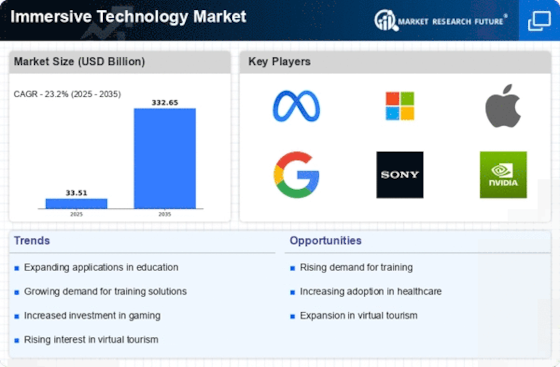
As per Market Research Future analysis, the Immersive Technology Market was estimated at 33.51 USD Billion in 2024. The Immersive Technology industry is projected to grow from 41.29 USD Billion in 2025 to 332.65 USD Billion by 2035, exhibiting a compound annual growth rate (CAGR) of 23.2% during the forecast period 2025 - 2035

Key Market Trends & Highlights

The Immersive Technology Market is experiencing robust growth driven by diverse applications across various sectors.

  • The North American region remains the largest market for immersive technology, showcasing a strong demand across multiple industries. Asia-Pacific is emerging as the fastest-growing region, with increasing investments in immersive solutions for education and training. The hardware segment continues to dominate the market, while software and platform solutions are witnessing rapid growth due to evolving user needs. Key market drivers include the rising demand for enhanced user experiences and advancements in hardware and software technologies, particularly in virtual reality applications.

Market Size & Forecast

2024 Market Size 33.51 (USD Billion)
2035 Market Size 332.65 (USD Billion)
CAGR (2025 - 2035) 23.2%
Largest Regional Market Share in 2024 North America

Major Players

Meta Platforms (US), Microsoft (US), Apple (US), Google (US), Sony (JP), NVIDIA (US), HTC (TW), Samsung (KR), Unity Technologies (US), Epic Games (US)

Market Trends

The Immersive Technology Market is currently experiencing a dynamic evolution, characterized by the integration of advanced technologies such as virtual reality, augmented reality, and mixed reality. This market appears to be driven by a growing demand for immersive experiences across various sectors, including entertainment, education, and healthcare. Companies are increasingly investing in innovative solutions that enhance user engagement and provide realistic simulations. As a result, the landscape is becoming more competitive, with numerous players striving to differentiate their offerings through unique applications and enhanced user interfaces. The expanding immersive technologies market reflects how organizations are prioritizing digital environments that enable advanced visualization, simulation, and interactive engagement across industries. Innovation in immersive 3D technology is accelerating the adoption of next-generation visualization platforms capable of delivering highly realistic and interactive digital environments.

The convergence of artificial intelligence with real time immersive systems is enabling adaptive environments that respond dynamically to user behavior and contextual inputs. Educational institutions are increasingly deploying immersive applications that simulate real-world scenarios, enhancing experiential learning outcomes. Growth within the immersive technology in healthcare market highlights how VR and AR are reshaping surgical training, therapy, and patient engagement models. Software platforms developed by immersive experience companies are becoming critical enablers of scalable content ecosystems that support enterprise deployment.

Moreover, the Immersive Technology Market seems to be influenced by the rapid advancements in hardware and software capabilities. Emerging technologies, such as artificial intelligence and machine learning, are likely to play a pivotal role in shaping future developments. The potential for immersive experiences to transform traditional practices in training, marketing, and social interaction indicates a promising trajectory for growth. Stakeholders are advised to remain vigilant and adaptable to the evolving trends, as the market continues to expand and diversify, presenting both opportunities and challenges for participants. Strategic investments by leading AR VR companies are intensifying competition as firms expand capabilities in hardware, software, and integrated platforms. Several of the largest virtual reality companies continue to shape industry standards through aggressive R&D and platform innovation.

Collaboration among the biggest VR companies is accelerating interoperability across immersive ecosystems. North America remains a hub for many of the biggest virtual reality companies, driving technological breakthroughs and commercialization. Emerging opportunities within the immersive analytics market are enabling organizations to interpret complex datasets through interactive visualization. This trajectory reflects broader technology market analysis, where immersive platforms are transitioning from niche innovation to mainstream enterprise infrastructure. Industry leaders in virtual reality are focusing on ecosystem integration to deliver scalable enterprise-grade immersive solutions.

Increased Adoption in Education

The Immersive Technology Market is witnessing a notable rise in the application of immersive technologies within educational settings. Institutions are leveraging virtual and augmented reality to create engaging learning environments that enhance student comprehension and retention. This trend suggests a shift towards experiential learning, where students can interact with content in a more meaningful way.

Expansion in Healthcare Applications

Healthcare is emerging as a significant sector for the Immersive Technology Market, with applications ranging from surgical simulations to patient rehabilitation. The use of immersive technologies in medical training and therapy appears to improve outcomes and patient experiences. This trend indicates a growing recognition of the benefits that immersive solutions can provide in complex healthcare scenarios.

Integration with Artificial Intelligence

The convergence of immersive technologies with artificial intelligence is becoming increasingly prevalent. This integration may enhance user experiences by providing personalized content and adaptive learning environments. The potential for AI to analyze user interactions and tailor immersive experiences suggests a future where technology becomes more intuitive and responsive to individual needs.

Immersive Technology Market Market Drivers

Increased Focus on Remote Collaboration

The shift towards remote work has catalyzed a heightened focus on remote collaboration tools within the Immersive Technology Market. Organizations are increasingly adopting immersive technologies to facilitate virtual meetings and collaborative projects, aiming to replicate the in-person experience. Tools that incorporate augmented and virtual reality enable teams to interact in shared virtual spaces, fostering creativity and productivity. This trend is particularly relevant in sectors such as architecture and design, where visualizing projects in 3D can significantly enhance collaboration. As businesses recognize the benefits of immersive collaboration, investment in these technologies is likely to escalate, indicating a transformative impact on workplace dynamics within the Immersive Technology Market.

Rising Demand for Enhanced User Experiences

The Immersive Technology Market experiences a notable surge in demand for enhanced user experiences across various sectors. As consumers increasingly seek engaging and interactive content, businesses are compelled to adopt immersive technologies such as virtual reality and augmented reality. This trend is particularly evident in the entertainment and gaming sectors, where immersive experiences are becoming a standard expectation. According to recent data, the immersive technology market is projected to reach a valuation of approximately 300 billion dollars by 2025, driven by the need for innovative user engagement strategies. Companies are investing heavily in immersive solutions to differentiate themselves in a competitive landscape, indicating a robust growth trajectory for the Immersive Technology Market.

Emerging Applications in Retail and Marketing

The Immersive Technology Market is experiencing a burgeoning interest in applications within retail and marketing. Retailers are increasingly utilizing augmented reality to enhance the shopping experience, allowing customers to visualize products in their own environments before making a purchase. This innovative approach not only improves customer engagement but also drives sales conversions. Data suggests that immersive marketing strategies can lead to a 70% increase in customer retention rates. As brands seek to create memorable experiences that resonate with consumers, the adoption of immersive technologies in marketing campaigns is expected to rise. This trend indicates a promising avenue for growth within the Immersive Technology Market, as businesses strive to leverage technology to connect with their audiences more effectively.

Growing Investment in Training and Simulation

The Immersive Technology Market is witnessing a significant increase in investment directed towards training and simulation applications. Industries such as aviation, military, and healthcare are leveraging immersive technologies to create realistic training environments that enhance skill acquisition and retention. For instance, simulations using virtual reality allow trainees to practice complex procedures in a risk-free setting, leading to improved performance outcomes. Reports indicate that the market for training and simulation using immersive technologies is expected to grow substantially, with estimates suggesting a compound annual growth rate of over 30% in the coming years. This trend underscores the potential of immersive technology to revolutionize traditional training methodologies, thereby driving growth in the Immersive Technology Market.

Advancements in Hardware and Software Technologies

Technological advancements play a pivotal role in shaping the Immersive Technology Market. Innovations in hardware, such as more powerful graphics processing units and lightweight headsets, enhance the overall user experience. Concurrently, software developments, including improved rendering techniques and user interface designs, contribute to more immersive environments. The proliferation of 5G technology further facilitates seamless connectivity, enabling real-time interactions in virtual spaces. As these technologies evolve, they lower barriers to entry for businesses looking to implement immersive solutions. This trend suggests a promising future for the Immersive Technology Market, as enhanced capabilities attract a broader range of applications across sectors, from education to real estate.

Market Segment Insights

By Application: Virtual Reality (Largest) vs. Augmented Reality (Fastest-Growing)

<p>The immersive technology market exhibits a diverse application landscape, with Virtual Reality (VR) holding the largest share among the various segment values. This can be attributed to its significant utilization in gaming and entertainment, providing users with fully immersive experiences. Meanwhile, Augmented Reality (AR) is rapidly gaining momentum, driven by its increasing adoption across industries like retail, healthcare, and education, which enhances user engagement and interaction by blending digital content with the real world. As the market evolves, both Virtual Reality and Augmented Reality are poised for substantial growth. The demand for VR is fueled by advancements in hardware and an expanding consumer base, while AR is benefitting from innovations in smartphone technology and wearables. Additionally, Mixed Reality (MR) is also emerging as a key player, combining the best of both VR and AR to create interactive environments that are increasingly being used for professional training and simulations. These trends reflect a shift towards more integrated and dynamic experiences in the immersive technology market.</p>

<p>Application: Virtual Reality (Dominant) vs. Training (Emerging)</p>

<p>Virtual Reality is recognized as the dominant application in the immersive technology market, primarily due to its extensive use in gaming, entertainment, and therapeutic applications. VR provides users with compelling and life-like experiences that transport them to different environments, making it valuable in sectors such as real estate for virtual tours and in health for exposure therapy. On the other hand, Training is emerging as a significant segment, leveraging immersive simulations to create realistic training scenarios for sectors like military, aviation, and healthcare. By providing a safe environment for skill development, training applications are rapidly gaining traction, especially as organizations recognize the cost-effective benefits of simulation-based learning. This dynamic is fostering a new era of experiential learning, merging practical skills with immersive experiences.</p>

By End Use: Gaming (Largest) vs. Healthcare (Fastest-Growing)

<p>The immersive technology market showcases a competitive landscape where various segments have carved out their niches. Gaming is currently the largest segment, capturing significant market share through the growing adoption of virtual reality (VR) and augmented reality (AR) experiences. Consumers are increasingly drawn to innovative gaming solutions that enhance their interactive experience, leading to the dominance of this sector. Meanwhile, healthcare is rapidly catching up due to its immense potential and applications in areas such as surgical simulations, therapy, and training programs, indicating a promising shift in market dynamics.</p>

<p>Gaming: Dominant vs. Healthcare: Emerging</p>

<p>Gaming remains a dominant force in the immersive technology landscape, characterized by a rich blend of innovation and consumer engagement. This sector leverages advancements in VR and AR to deliver unparalleled user experiences, drawing in large audiences and continuously expanding its offerings. On the other hand, the healthcare segment is emergent, harnessing immersive technology for critical applications such as medical training, rehabilitation, and patient treatment protocols. Health practitioners are increasingly adopting these technologies to improve outcomes, making healthcare a rapidly evolving focus area that showcases significant growth potential in the market.</p>

By Technology: Hardware (Largest) vs. Software (Fastest-Growing)

<p>The immersive technology market is segmented into various components, namely hardware, software, content creation, distribution platforms, and user interfaces. Currently, hardware stands as the largest segment due to the ongoing demand for high-performance devices such as VR headsets and AR glasses. In contrast, software solutions are gaining traction, catering to diverse needs ranging from gaming to educational applications, capitalizing on the increasing integration of immersive experiences across industries.</p>

<p>Technology: Hardware (Dominant) vs. Software (Emerging)</p>

<p>Hardware is the dominant segment in the immersive technology market, with established players focusing on advanced technologies, including sensors, visual displays, and computation power to enhance user experiences. This segment not only benefits from continuous innovation but also serves as the backbone for software applications that depend on solid hardware foundations. Conversely, software, identified as an emerging segment, is rapidly evolving with applications that immerse users in various environments. Its growth is driven by increasing demand for tailored content, user interactivity, and seamless integration with hardware, reinforcing the symbiotic relationship between hardware and software in the immersive technology landscape.</p>

By Industry: Healthcare (Largest) vs. Gaming (Fastest-Growing)

The Immersive Technology Market exhibits diverse segmentation, with Healthcare leading in terms of market share due to its substantial investments in virtual reality (VR) and augmented reality (AR) applications for patient care and training. Following closely are sectors like Retail &amp; eCommerce and Education, which leverage immersive technologies to enhance user engagement and learning experiences. Other significant sectors include Media &amp; Entertainment and Construction, integrated with immersive solutions to provide innovative customer experiences and project simulations. The growth trends within the Immersive Technology Market are strongly driven by advancements in technology and increasing adoption across various sectors. Healthcare continues to drive significant developments with the use of AR/VR for medical training and patient rehabilitation. Meanwhile, Gaming is emerging as the fastest-growing segment, invigorated by the relentless demand for more immersive gaming experiences, appealing to younger audiences and driving innovations in hardware and software integration.

Healthcare: VR Training (Dominant) vs. Gaming (Emerging)

In the Immersive Technology Market, Healthcare remains a dominant force through the integration of VR training programs which enhance the professional development of medical practitioners. These programs utilize realistic simulations to improve decision-making and surgical skills, establishing a new standard in medical education. Conversely, the gaming sector is rapidly emerging, characterized by a surge in demand for enhanced user experiences. As developers continue to innovate, harnessing the latest immersive technologies, gaming presents extensive opportunities for growth and creativity. This segment is witnessing a convergence of technologies including VR, AR, and mixed reality (MR), fostering unique gameplay experiences that captivate audiences, reinforcing its position as a key player in the immersive landscape.

Get more detailed insights about Immersive Technology Market Research Report – Forecast till 2035

Regional Insights

North America : Innovation and Leadership Hub

North America is the largest market for immersive technology, holding approximately 45% of the global share. The region's growth is driven by rapid advancements in technology, increasing investments in AR/VR applications, and a strong consumer base. Regulatory support from government initiatives aimed at fostering innovation further catalyzes market expansion. The demand for immersive experiences in sectors like gaming, education, and healthcare is also on the rise, contributing to this growth. The United States leads the North American market, with significant contributions from Canada. Major players such as Meta Platforms, Microsoft, and Apple are headquartered here, driving competition and innovation. The presence of tech giants and startups alike fosters a vibrant ecosystem for immersive technology development. As companies invest heavily in R&D, the competitive landscape is expected to evolve rapidly, enhancing the region's market position.

Europe : Emerging Market with Potential

Europe is witnessing a significant rise in the immersive technology market, holding around 30% of the global share. The region benefits from strong regulatory frameworks that promote digital innovation and technology adoption. Countries like Germany and the UK are at the forefront, driving demand through investments in education, training, and entertainment sectors. The European Union's initiatives to support digital transformation further enhance market growth prospects. Leading countries in Europe include Germany, the UK, and France, where companies are increasingly adopting immersive technologies for various applications. The competitive landscape features both established firms and innovative startups, creating a dynamic environment. Key players like Sony and HTC are actively involved in the market, contributing to advancements in AR and VR technologies. The region's focus on sustainability and ethical technology use also shapes its market dynamics.

Asia-Pacific : Rapid Growth and Adoption

Asia-Pacific is rapidly emerging as a powerhouse in the immersive technology market, accounting for approximately 20% of the global share. The region's growth is fueled by increasing smartphone penetration, a young population, and rising disposable incomes. Countries like China and Japan are leading the charge, with government initiatives supporting technological advancements and innovation in AR/VR applications across various sectors, including gaming and education. China is the largest market in the region, followed by Japan and South Korea. The competitive landscape is characterized by a mix of local and international players, with companies like Samsung and HTC making significant contributions. The presence of a robust manufacturing base and a growing startup ecosystem further enhances the region's market potential. As consumer demand for immersive experiences continues to rise, the Asia-Pacific market is poised for substantial growth in the coming years.

Middle East and Africa : Emerging Market with Opportunities

The Middle East and Africa region is gradually emerging in the immersive technology market, holding about 5% of the global share. The growth is driven by increasing investments in technology infrastructure and a growing interest in digital transformation across various sectors. Countries like the UAE and South Africa are leading the way, with government initiatives aimed at fostering innovation and attracting foreign investment in technology sectors. The competitive landscape in this region is still developing, with a mix of local startups and international players entering the market. The presence of key players like NVIDIA and emerging tech companies is enhancing the region's capabilities in AR and VR technologies. As awareness and demand for immersive experiences grow, the Middle East and Africa are expected to see significant advancements in this market, supported by favorable regulatory environments and investment opportunities.

Key Players and Competitive Insights

Leading market players are investing heavily in research and development in order to expand their product lines, which will help the Immersive Technology Market, grow even more. Market participants are also undertaking a variety of strategic activities to expand their global footprint, with important market developments including new product launches, contractual agreements, mergers and acquisitions, higher investments, and collaboration with other organizations. To expand and survive in a more competitive and rising market climate, Immersive Technology industry must offer cost-effective items. Manufacturing locally to minimize operational costs is one of the key business tactics used by manufacturers in the global Immersive Technology industry to benefit clients and increase the market sector. In recent years, the Immersive Technology industry has offered some of the most significant advantages to medicine. Major players in the Immersive Technology Market, including Acer Inc., Atheer, Inc., AVEVA Group PLC, Barco NV, Blippar Ltd., Carl Zeiss AG, CM Labs Simulations Inc., EON Reality, Inc., FAAC Incorporated, Google, LLC, HCL Technologies Limited, Honeywell International, Inc., HTC Corporation, Immersive Media Company, Immersive Technologies Pty Limited, Lockheed Martin Corporation, Magic Leap, Inc., NCTech Limited, Oculus (Facebook Technologies, LLC.), Samsung Group, Sony Corporation, Unity Software Inc., Varjo Technologies Oy, VI-grade GmbH, Zeality Inc. and others, are attempting to increase market demand by investing in research and development operations. Acer Inc. (Acer) is a corporation that develops, designs, markets, and sells information technology (IT) products. Personal computers, projectors, tablet PCs, smartphones, wearable technology, smart devices, LCD displays, servers, and ICT equipment are all part of the company's product line. Acer sells goods under the brand names Acer, Gateway, Predator, Concept D, Planet9, and Packard Bell. Additionally, it engaged in e-commerce, the distribution of IT products, and the use of virtual reality headsets, digital billboards, cloud services, mobile devices, new energy devices, and real estate services. Africa, the Middle East, Europe, the Asia-Pacific region, and the Americas all have activities for the corporation. The main office of Acer is in Taipei, Taiwan. A part of Schneider Electric SE, AVEVA Group Plc (AVEVA) provides engineering software solutions. The company offers corporate solutions, design, engineering, software, plant and marine catalog information, and ship building and design management systems. It also provides consultation, integration, and lifecycle management services. Engineering projects in the fields of mining, metals, infrastructure, life sciences, food and beverage, consumer packaged products, oil and gas, energy, marine, chemical, and manufacturing can all profit from the technology provided by AVEVA. The business sells its products under the AVEVA NET brand. AVEVA's headquarters are in the UK's Cambridge shire region.

Key Companies in the Immersive Technology Market include

Industry Developments

EON Reality announced its collaboration with Elixir Traders Limited, a company involved in the wholesale activity of household goods, to infuse Extended Reality (XR) technology into different sectors of the U.K. market on October 2023. This incorporation would not only help improve operating procedures but also move industries forward into data-driven decisions and immersive interactions.

Meta Quest 3 was launched by Meta in June 2023. It is said to have more powerful performance, higher resolution, innovative meta-reality technology, and greater comfort for its customers.

Ultraleap Limited (Leap Motion, Inc.), in May 2023, introduced the Leap Motion Controller 2, a second-generation hand-tracking camera that allows users to interact with digital information in 3D using their own hands. Thus, this camera is compatible across all platforms and complementary hardware such as PCs, holographic displays, VR, and AR.

In January 2022, Sony Group unveiled exclusive games with PSVR2 as part of a product launch event for the next virtual world device called the Metaverse. The new technology has deeper engagement features, including haptic feedback incorporated into the headsets along with improved visual clarity, which could be one of those entry points that are highly accepted by companies like Epic Games Incorporated into multiverse services.

Acer introduced SpatialLabs in May 2021, a series of apps that take a digital world and make it tell stories through organic means while providing stereoscopic three-dimensional experiences. Slash visuals and screen-sensing technologies power spatial labs. Even without special glasses, creators can view their projects in real-time and also at 360 ° because there is information floating right in front of the display.

Harmony announced VisualLive’s acquisition—an efficient innovative solution facilitating cutting costs related to architectural features, tech, and infrastructure for interactive virtual collaborative efforts—in March 2021, thus enabling multiple firms globally to achieve multiple types of planning & management solutions for 3D media.

Honeywell Industrial, Inc. purchased a majority share in Fiplex Telecommunication, Incorporated, in March 2021. Through this acquisition, Honeywell Worldwide, Inc. will be able to provide a broader range of connection & communication products.

Future Outlook

Immersive Technology Market Future Outlook

The Immersive Technology Market is projected to grow at a 23.2% CAGR from 2025 to 2035, driven by advancements in hardware, software, and increasing demand for virtual experiences.

New opportunities lie in:

  • <p>Development of immersive training platforms for corporate sectors. Integration of AR in retail for enhanced customer engagement. Creation of virtual tourism experiences leveraging immersive storytelling.</p>

By 2035, the Immersive Technology Market is expected to be a pivotal industry, reshaping various sectors globally.

Market Segmentation

Immersive Technology Market Industry Outlook

  • Healthcare
  • Retail & eCommerce
  • Education
  • Construction
  • Media & Entertainment
  • Gaming
  • Manufacturing
  • Aerospace & Defense
  • Others (Automotive
  • Energy
  • etc.)

Immersive Technology Market Component Outlook

  • Hardware
  • Software/Platform
  • Services

Immersive Technology Market Technology Outlook

  • Mixed Reality (MR)
  • Virtual Reality (VR)
  • Augmented Reality (AR)
  • 360 Film

Immersive Technology Market Application Outlook

  • Training & Learning
  • Emergency Services
  • Product Development
  • Sales & Marketing

Report Scope

MARKET SIZE 2024 33.51(USD Billion)
MARKET SIZE 2025 41.29(USD Billion)
MARKET SIZE 2035 332.65(USD Billion)
COMPOUND ANNUAL GROWTH RATE (CAGR) 23.2% (2025 - 2035)
REPORT COVERAGE Revenue Forecast, Competitive Landscape, Growth Factors, and Trends
BASE YEAR 2024
Market Forecast Period 2025 - 2035
Historical Data 2019 - 2024
Market Forecast Units USD Billion
Key Companies Profiled Meta Platforms (US), Microsoft (US), Apple (US), Google (US), Sony (JP), NVIDIA (US), HTC (TW), Samsung (KR), Unity Technologies (US), Epic Games (US)
Segments Covered Component, Regions-Forecast Till 2035.
Key Market Opportunities Integration of artificial intelligence enhances user experiences in the Immersive Technology Market.
Key Market Dynamics Rising consumer demand for immersive experiences drives innovation and competition in the immersive technology market.
Countries Covered North America, Europe, APAC, South America, MEA

FAQs

What is the current valuation of the immersive technology market as of 2024?

<p>The immersive technology market was valued at 44.5 USD Billion in 2024.</p>

What is the projected market size for immersive technology by 2035?

<p>The market is projected to reach 139.6 USD Billion by 2035.</p>

What is the expected CAGR for the immersive technology market from 2025 to 2035?

<p>The expected CAGR for the immersive technology market during the forecast period 2025 - 2035 is 10.95%.</p>

Which companies are considered key players in the immersive technology market?

<p>Key players include Meta Platforms, Microsoft, Apple, Google, NVIDIA, Sony, HTC, Samsung, Unity Technologies, and Epic Games.</p>

What are the main application segments of the immersive technology market?

<p>The main application segments include Virtual Reality, Augmented Reality, Mixed Reality, Simulation, and Training.</p>

How does the gaming sector perform within the immersive technology market?

<p>The gaming sector is projected to grow from 10.0 to 30.0 USD Billion during the forecast period.</p>

What is the expected growth of the healthcare segment in the immersive technology market?

<p>The healthcare segment is anticipated to expand from 8.0 to 25.0 USD Billion by 2035.</p>

What are the key technology segments in the immersive technology market?

<p>Key technology segments include Hardware, Software, Content Creation, Distribution Platforms, and User Interface.</p>

How does the retail sector contribute to the immersive technology market?

<p>The retail sector is expected to grow from 10.0 to 35.0 USD Billion during the forecast period.</p>

What is the projected growth for the mixed reality segment in the immersive technology market?

<p>The mixed reality segment is projected to grow from 8.0 to 25.0 USD Billion by 2035.</p>

  1. SECTION I: EXECUTIVE SUMMARY AND KEY HIGHLIGHTS
    1. | 1.1 EXECUTIVE SUMMARY
    2. | | 1.1.1 Market Overview
    3. | | 1.1.2 Key Findings
    4. | | 1.1.3 Market Segmentation
    5. | | 1.1.4 Competitive Landscape
    6. | | 1.1.5 Challenges and Opportunities
    7. | | 1.1.6 Future Outlook
  2. SECTION II: SCOPING, METHODOLOGY AND MARKET STRUCTURE
    1. | 2.1 MARKET INTRODUCTION
    2. | | 2.1.1 Definition
    3. | | 2.1.2 Scope of the study
    4. | | | 2.1.2.1 Research Objective
    5. | | | 2.1.2.2 Assumption
    6. | | | 2.1.2.3 Limitations
    7. | 2.2 RESEARCH METHODOLOGY
    8. | | 2.2.1 Overview
    9. | | 2.2.2 Data Mining
    10. | | 2.2.3 Secondary Research
    11. | | 2.2.4 Primary Research
    12. | | | 2.2.4.1 Primary Interviews and Information Gathering Process
    13. | | | 2.2.4.2 Breakdown of Primary Respondents
    14. | | 2.2.5 Forecasting Model
    15. | | 2.2.6 Market Size Estimation
    16. | | | 2.2.6.1 Bottom-Up Approach
    17. | | | 2.2.6.2 Top-Down Approach
    18. | | 2.2.7 Data Triangulation
    19. | | 2.2.8 Validation
  3. SECTION III: QUALITATIVE ANALYSIS
    1. | 3.1 MARKET DYNAMICS
    2. | | 3.1.1 Overview
    3. | | 3.1.2 Drivers
    4. | | 3.1.3 Restraints
    5. | | 3.1.4 Opportunities
    6. | 3.2 MARKET FACTOR ANALYSIS
    7. | | 3.2.1 Value chain Analysis
    8. | | 3.2.2 Porter's Five Forces Analysis
    9. | | | 3.2.2.1 Bargaining Power of Suppliers
    10. | | | 3.2.2.2 Bargaining Power of Buyers
    11. | | | 3.2.2.3 Threat of New Entrants
    12. | | | 3.2.2.4 Threat of Substitutes
    13. | | | 3.2.2.5 Intensity of Rivalry
    14. | | 3.2.3 COVID-19 Impact Analysis
    15. | | | 3.2.3.1 Market Impact Analysis
    16. | | | 3.2.3.2 Regional Impact
    17. | | | 3.2.3.3 Opportunity and Threat Analysis
  4. SECTION IV: QUANTITATIVE ANALYSIS
    1. | 4.1 Information and Communications Technology, BY Application (USD Billion)
    2. | | 4.1.1 Virtual Reality
    3. | | 4.1.2 Augmented Reality
    4. | | 4.1.3 Mixed Reality
    5. | | 4.1.4 Simulation
    6. | | 4.1.5 Training
    7. | 4.2 Information and Communications Technology, BY End Use (USD Billion)
    8. | | 4.2.1 Gaming
    9. | | 4.2.2 Healthcare
    10. | | 4.2.3 Education
    11. | | 4.2.4 Retail
    12. | | 4.2.5 Real Estate
    13. | 4.3 Information and Communications Technology, BY Technology (USD Billion)
    14. | | 4.3.1 Hardware
    15. | | 4.3.2 Software
    16. | | 4.3.3 Content Creation
    17. | | 4.3.4 Distribution Platforms
    18. | | 4.3.5 User Interface
    19. | 4.4 Information and Communications Technology, BY Region (USD Billion)
    20. | | 4.4.1 North America
    21. | | | 4.4.1.1 US
    22. | | | 4.4.1.2 Canada
    23. | | 4.4.2 Europe
    24. | | | 4.4.2.1 Germany
    25. | | | 4.4.2.2 UK
    26. | | | 4.4.2.3 France
    27. | | | 4.4.2.4 Russia
    28. | | | 4.4.2.5 Italy
    29. | | | 4.4.2.6 Spain
    30. | | | 4.4.2.7 Rest of Europe
    31. | | 4.4.3 APAC
    32. | | | 4.4.3.1 China
    33. | | | 4.4.3.2 India
    34. | | | 4.4.3.3 Japan
    35. | | | 4.4.3.4 South Korea
    36. | | | 4.4.3.5 Malaysia
    37. | | | 4.4.3.6 Thailand
    38. | | | 4.4.3.7 Indonesia
    39. | | | 4.4.3.8 Rest of APAC
    40. | | 4.4.4 South America
    41. | | | 4.4.4.1 Brazil
    42. | | | 4.4.4.2 Mexico
    43. | | | 4.4.4.3 Argentina
    44. | | | 4.4.4.4 Rest of South America
    45. | | 4.4.5 MEA
    46. | | | 4.4.5.1 GCC Countries
    47. | | | 4.4.5.2 South Africa
    48. | | | 4.4.5.3 Rest of MEA
  5. SECTION V: COMPETITIVE ANALYSIS
    1. | 5.1 Competitive Landscape
    2. | | 5.1.1 Overview
    3. | | 5.1.2 Competitive Analysis
    4. | | 5.1.3 Market share Analysis
    5. | | 5.1.4 Major Growth Strategy in the Information and Communications Technology
    6. | | 5.1.5 Competitive Benchmarking
    7. | | 5.1.6 Leading Players in Terms of Number of Developments in the Information and Communications Technology
    8. | | 5.1.7 Key developments and growth strategies
    9. | | | 5.1.7.1 New Product Launch/Service Deployment
    10. | | | 5.1.7.2 Merger & Acquisitions
    11. | | | 5.1.7.3 Joint Ventures
    12. | | 5.1.8 Major Players Financial Matrix
    13. | | | 5.1.8.1 Sales and Operating Income
    14. | | | 5.1.8.2 Major Players R&D Expenditure. 2023
    15. | 5.2 Company Profiles
    16. | | 5.2.1 Meta Platforms (US)
    17. | | | 5.2.1.1 Financial Overview
    18. | | | 5.2.1.2 Products Offered
    19. | | | 5.2.1.3 Key Developments
    20. | | | 5.2.1.4 SWOT Analysis
    21. | | | 5.2.1.5 Key Strategies
    22. | | 5.2.2 Microsoft (US)
    23. | | | 5.2.2.1 Financial Overview
    24. | | | 5.2.2.2 Products Offered
    25. | | | 5.2.2.3 Key Developments
    26. | | | 5.2.2.4 SWOT Analysis
    27. | | | 5.2.2.5 Key Strategies
    28. | | 5.2.3 Apple (US)
    29. | | | 5.2.3.1 Financial Overview
    30. | | | 5.2.3.2 Products Offered
    31. | | | 5.2.3.3 Key Developments
    32. | | | 5.2.3.4 SWOT Analysis
    33. | | | 5.2.3.5 Key Strategies
    34. | | 5.2.4 Google (US)
    35. | | | 5.2.4.1 Financial Overview
    36. | | | 5.2.4.2 Products Offered
    37. | | | 5.2.4.3 Key Developments
    38. | | | 5.2.4.4 SWOT Analysis
    39. | | | 5.2.4.5 Key Strategies
    40. | | 5.2.5 NVIDIA (US)
    41. | | | 5.2.5.1 Financial Overview
    42. | | | 5.2.5.2 Products Offered
    43. | | | 5.2.5.3 Key Developments
    44. | | | 5.2.5.4 SWOT Analysis
    45. | | | 5.2.5.5 Key Strategies
    46. | | 5.2.6 Sony (JP)
    47. | | | 5.2.6.1 Financial Overview
    48. | | | 5.2.6.2 Products Offered
    49. | | | 5.2.6.3 Key Developments
    50. | | | 5.2.6.4 SWOT Analysis
    51. | | | 5.2.6.5 Key Strategies
    52. | | 5.2.7 HTC (TW)
    53. | | | 5.2.7.1 Financial Overview
    54. | | | 5.2.7.2 Products Offered
    55. | | | 5.2.7.3 Key Developments
    56. | | | 5.2.7.4 SWOT Analysis
    57. | | | 5.2.7.5 Key Strategies
    58. | | 5.2.8 Samsung (KR)
    59. | | | 5.2.8.1 Financial Overview
    60. | | | 5.2.8.2 Products Offered
    61. | | | 5.2.8.3 Key Developments
    62. | | | 5.2.8.4 SWOT Analysis
    63. | | | 5.2.8.5 Key Strategies
    64. | | 5.2.9 Unity Technologies (US)
    65. | | | 5.2.9.1 Financial Overview
    66. | | | 5.2.9.2 Products Offered
    67. | | | 5.2.9.3 Key Developments
    68. | | | 5.2.9.4 SWOT Analysis
    69. | | | 5.2.9.5 Key Strategies
    70. | | 5.2.10 Epic Games (US)
    71. | | | 5.2.10.1 Financial Overview
    72. | | | 5.2.10.2 Products Offered
    73. | | | 5.2.10.3 Key Developments
    74. | | | 5.2.10.4 SWOT Analysis
    75. | | | 5.2.10.5 Key Strategies
    76. | 5.3 Appendix
    77. | | 5.3.1 References
    78. | | 5.3.2 Related Reports
  6. LIST OF FIGURES
    1. | 6.1 MARKET SYNOPSIS
    2. | 6.2 NORTH AMERICA MARKET ANALYSIS
    3. | 6.3 US MARKET ANALYSIS BY APPLICATION
    4. | 6.4 US MARKET ANALYSIS BY END USE
    5. | 6.5 US MARKET ANALYSIS BY TECHNOLOGY
    6. | 6.6 CANADA MARKET ANALYSIS BY APPLICATION
    7. | 6.7 CANADA MARKET ANALYSIS BY END USE
    8. | 6.8 CANADA MARKET ANALYSIS BY TECHNOLOGY
    9. | 6.9 EUROPE MARKET ANALYSIS
    10. | 6.10 GERMANY MARKET ANALYSIS BY APPLICATION
    11. | 6.11 GERMANY MARKET ANALYSIS BY END USE
    12. | 6.12 GERMANY MARKET ANALYSIS BY TECHNOLOGY
    13. | 6.13 UK MARKET ANALYSIS BY APPLICATION
    14. | 6.14 UK MARKET ANALYSIS BY END USE
    15. | 6.15 UK MARKET ANALYSIS BY TECHNOLOGY
    16. | 6.16 FRANCE MARKET ANALYSIS BY APPLICATION
    17. | 6.17 FRANCE MARKET ANALYSIS BY END USE
    18. | 6.18 FRANCE MARKET ANALYSIS BY TECHNOLOGY
    19. | 6.19 RUSSIA MARKET ANALYSIS BY APPLICATION
    20. | 6.20 RUSSIA MARKET ANALYSIS BY END USE
    21. | 6.21 RUSSIA MARKET ANALYSIS BY TECHNOLOGY
    22. | 6.22 ITALY MARKET ANALYSIS BY APPLICATION
    23. | 6.23 ITALY MARKET ANALYSIS BY END USE
    24. | 6.24 ITALY MARKET ANALYSIS BY TECHNOLOGY
    25. | 6.25 SPAIN MARKET ANALYSIS BY APPLICATION
    26. | 6.26 SPAIN MARKET ANALYSIS BY END USE
    27. | 6.27 SPAIN MARKET ANALYSIS BY TECHNOLOGY
    28. | 6.28 REST OF EUROPE MARKET ANALYSIS BY APPLICATION
    29. | 6.29 REST OF EUROPE MARKET ANALYSIS BY END USE
    30. | 6.30 REST OF EUROPE MARKET ANALYSIS BY TECHNOLOGY
    31. | 6.31 APAC MARKET ANALYSIS
    32. | 6.32 CHINA MARKET ANALYSIS BY APPLICATION
    33. | 6.33 CHINA MARKET ANALYSIS BY END USE
    34. | 6.34 CHINA MARKET ANALYSIS BY TECHNOLOGY
    35. | 6.35 INDIA MARKET ANALYSIS BY APPLICATION
    36. | 6.36 INDIA MARKET ANALYSIS BY END USE
    37. | 6.37 INDIA MARKET ANALYSIS BY TECHNOLOGY
    38. | 6.38 JAPAN MARKET ANALYSIS BY APPLICATION
    39. | 6.39 JAPAN MARKET ANALYSIS BY END USE
    40. | 6.40 JAPAN MARKET ANALYSIS BY TECHNOLOGY
    41. | 6.41 SOUTH KOREA MARKET ANALYSIS BY APPLICATION
    42. | 6.42 SOUTH KOREA MARKET ANALYSIS BY END USE
    43. | 6.43 SOUTH KOREA MARKET ANALYSIS BY TECHNOLOGY
    44. | 6.44 MALAYSIA MARKET ANALYSIS BY APPLICATION
    45. | 6.45 MALAYSIA MARKET ANALYSIS BY END USE
    46. | 6.46 MALAYSIA MARKET ANALYSIS BY TECHNOLOGY
    47. | 6.47 THAILAND MARKET ANALYSIS BY APPLICATION
    48. | 6.48 THAILAND MARKET ANALYSIS BY END USE
    49. | 6.49 THAILAND MARKET ANALYSIS BY TECHNOLOGY
    50. | 6.50 INDONESIA MARKET ANALYSIS BY APPLICATION
    51. | 6.51 INDONESIA MARKET ANALYSIS BY END USE
    52. | 6.52 INDONESIA MARKET ANALYSIS BY TECHNOLOGY
    53. | 6.53 REST OF APAC MARKET ANALYSIS BY APPLICATION
    54. | 6.54 REST OF APAC MARKET ANALYSIS BY END USE
    55. | 6.55 REST OF APAC MARKET ANALYSIS BY TECHNOLOGY
    56. | 6.56 SOUTH AMERICA MARKET ANALYSIS
    57. | 6.57 BRAZIL MARKET ANALYSIS BY APPLICATION
    58. | 6.58 BRAZIL MARKET ANALYSIS BY END USE
    59. | 6.59 BRAZIL MARKET ANALYSIS BY TECHNOLOGY
    60. | 6.60 MEXICO MARKET ANALYSIS BY APPLICATION
    61. | 6.61 MEXICO MARKET ANALYSIS BY END USE
    62. | 6.62 MEXICO MARKET ANALYSIS BY TECHNOLOGY
    63. | 6.63 ARGENTINA MARKET ANALYSIS BY APPLICATION
    64. | 6.64 ARGENTINA MARKET ANALYSIS BY END USE
    65. | 6.65 ARGENTINA MARKET ANALYSIS BY TECHNOLOGY
    66. | 6.66 REST OF SOUTH AMERICA MARKET ANALYSIS BY APPLICATION
    67. | 6.67 REST OF SOUTH AMERICA MARKET ANALYSIS BY END USE
    68. | 6.68 REST OF SOUTH AMERICA MARKET ANALYSIS BY TECHNOLOGY
    69. | 6.69 MEA MARKET ANALYSIS
    70. | 6.70 GCC COUNTRIES MARKET ANALYSIS BY APPLICATION
    71. | 6.71 GCC COUNTRIES MARKET ANALYSIS BY END USE
    72. | 6.72 GCC COUNTRIES MARKET ANALYSIS BY TECHNOLOGY
    73. | 6.73 SOUTH AFRICA MARKET ANALYSIS BY APPLICATION
    74. | 6.74 SOUTH AFRICA MARKET ANALYSIS BY END USE
    75. | 6.75 SOUTH AFRICA MARKET ANALYSIS BY TECHNOLOGY
    76. | 6.76 REST OF MEA MARKET ANALYSIS BY APPLICATION
    77. | 6.77 REST OF MEA MARKET ANALYSIS BY END USE
    78. | 6.78 REST OF MEA MARKET ANALYSIS BY TECHNOLOGY
    79. | 6.79 KEY BUYING CRITERIA OF INFORMATION AND COMMUNICATIONS TECHNOLOGY
    80. | 6.80 RESEARCH PROCESS OF MRFR
    81. | 6.81 DRO ANALYSIS OF INFORMATION AND COMMUNICATIONS TECHNOLOGY
    82. | 6.82 DRIVERS IMPACT ANALYSIS: INFORMATION AND COMMUNICATIONS TECHNOLOGY
    83. | 6.83 RESTRAINTS IMPACT ANALYSIS: INFORMATION AND COMMUNICATIONS TECHNOLOGY
    84. | 6.84 SUPPLY / VALUE CHAIN: INFORMATION AND COMMUNICATIONS TECHNOLOGY
    85. | 6.85 INFORMATION AND COMMUNICATIONS TECHNOLOGY, BY APPLICATION, 2024 (% SHARE)
    86. | 6.86 INFORMATION AND COMMUNICATIONS TECHNOLOGY, BY APPLICATION, 2024 TO 2035 (USD Billion)
    87. | 6.87 INFORMATION AND COMMUNICATIONS TECHNOLOGY, BY END USE, 2024 (% SHARE)
    88. | 6.88 INFORMATION AND COMMUNICATIONS TECHNOLOGY, BY END USE, 2024 TO 2035 (USD Billion)
    89. | 6.89 INFORMATION AND COMMUNICATIONS TECHNOLOGY, BY TECHNOLOGY, 2024 (% SHARE)
    90. | 6.90 INFORMATION AND COMMUNICATIONS TECHNOLOGY, BY TECHNOLOGY, 2024 TO 2035 (USD Billion)
    91. | 6.91 BENCHMARKING OF MAJOR COMPETITORS
  7. LIST OF TABLES
    1. | 7.1 LIST OF ASSUMPTIONS
    2. | | 7.1.1
    3. | 7.2 North America MARKET SIZE ESTIMATES; FORECAST
    4. | | 7.2.1 BY APPLICATION, 2025-2035 (USD Billion)
    5. | | 7.2.2 BY END USE, 2025-2035 (USD Billion)
    6. | | 7.2.3 BY TECHNOLOGY, 2025-2035 (USD Billion)
    7. | 7.3 US MARKET SIZE ESTIMATES; FORECAST
    8. | | 7.3.1 BY APPLICATION, 2025-2035 (USD Billion)
    9. | | 7.3.2 BY END USE, 2025-2035 (USD Billion)
    10. | | 7.3.3 BY TECHNOLOGY, 2025-2035 (USD Billion)
    11. | 7.4 Canada MARKET SIZE ESTIMATES; FORECAST
    12. | | 7.4.1 BY APPLICATION, 2025-2035 (USD Billion)
    13. | | 7.4.2 BY END USE, 2025-2035 (USD Billion)
    14. | | 7.4.3 BY TECHNOLOGY, 2025-2035 (USD Billion)
    15. | 7.5 Europe MARKET SIZE ESTIMATES; FORECAST
    16. | | 7.5.1 BY APPLICATION, 2025-2035 (USD Billion)
    17. | | 7.5.2 BY END USE, 2025-2035 (USD Billion)
    18. | | 7.5.3 BY TECHNOLOGY, 2025-2035 (USD Billion)
    19. | 7.6 Germany MARKET SIZE ESTIMATES; FORECAST
    20. | | 7.6.1 BY APPLICATION, 2025-2035 (USD Billion)
    21. | | 7.6.2 BY END USE, 2025-2035 (USD Billion)
    22. | | 7.6.3 BY TECHNOLOGY, 2025-2035 (USD Billion)
    23. | 7.7 UK MARKET SIZE ESTIMATES; FORECAST
    24. | | 7.7.1 BY APPLICATION, 2025-2035 (USD Billion)
    25. | | 7.7.2 BY END USE, 2025-2035 (USD Billion)
    26. | | 7.7.3 BY TECHNOLOGY, 2025-2035 (USD Billion)
    27. | 7.8 France MARKET SIZE ESTIMATES; FORECAST
    28. | | 7.8.1 BY APPLICATION, 2025-2035 (USD Billion)
    29. | | 7.8.2 BY END USE, 2025-2035 (USD Billion)
    30. | | 7.8.3 BY TECHNOLOGY, 2025-2035 (USD Billion)
    31. | 7.9 Russia MARKET SIZE ESTIMATES; FORECAST
    32. | | 7.9.1 BY APPLICATION, 2025-2035 (USD Billion)
    33. | | 7.9.2 BY END USE, 2025-2035 (USD Billion)
    34. | | 7.9.3 BY TECHNOLOGY, 2025-2035 (USD Billion)
    35. | 7.10 Italy MARKET SIZE ESTIMATES; FORECAST
    36. | | 7.10.1 BY APPLICATION, 2025-2035 (USD Billion)
    37. | | 7.10.2 BY END USE, 2025-2035 (USD Billion)
    38. | | 7.10.3 BY TECHNOLOGY, 2025-2035 (USD Billion)
    39. | 7.11 Spain MARKET SIZE ESTIMATES; FORECAST
    40. | | 7.11.1 BY APPLICATION, 2025-2035 (USD Billion)
    41. | | 7.11.2 BY END USE, 2025-2035 (USD Billion)
    42. | | 7.11.3 BY TECHNOLOGY, 2025-2035 (USD Billion)
    43. | 7.12 Rest of Europe MARKET SIZE ESTIMATES; FORECAST
    44. | | 7.12.1 BY APPLICATION, 2025-2035 (USD Billion)
    45. | | 7.12.2 BY END USE, 2025-2035 (USD Billion)
    46. | | 7.12.3 BY TECHNOLOGY, 2025-2035 (USD Billion)
    47. | 7.13 APAC MARKET SIZE ESTIMATES; FORECAST
    48. | | 7.13.1 BY APPLICATION, 2025-2035 (USD Billion)
    49. | | 7.13.2 BY END USE, 2025-2035 (USD Billion)
    50. | | 7.13.3 BY TECHNOLOGY, 2025-2035 (USD Billion)
    51. | 7.14 China MARKET SIZE ESTIMATES; FORECAST
    52. | | 7.14.1 BY APPLICATION, 2025-2035 (USD Billion)
    53. | | 7.14.2 BY END USE, 2025-2035 (USD Billion)
    54. | | 7.14.3 BY TECHNOLOGY, 2025-2035 (USD Billion)
    55. | 7.15 India MARKET SIZE ESTIMATES; FORECAST
    56. | | 7.15.1 BY APPLICATION, 2025-2035 (USD Billion)
    57. | | 7.15.2 BY END USE, 2025-2035 (USD Billion)
    58. | | 7.15.3 BY TECHNOLOGY, 2025-2035 (USD Billion)
    59. | 7.16 Japan MARKET SIZE ESTIMATES; FORECAST
    60. | | 7.16.1 BY APPLICATION, 2025-2035 (USD Billion)
    61. | | 7.16.2 BY END USE, 2025-2035 (USD Billion)
    62. | | 7.16.3 BY TECHNOLOGY, 2025-2035 (USD Billion)
    63. | 7.17 South Korea MARKET SIZE ESTIMATES; FORECAST
    64. | | 7.17.1 BY APPLICATION, 2025-2035 (USD Billion)
    65. | | 7.17.2 BY END USE, 2025-2035 (USD Billion)
    66. | | 7.17.3 BY TECHNOLOGY, 2025-2035 (USD Billion)
    67. | 7.18 Malaysia MARKET SIZE ESTIMATES; FORECAST
    68. | | 7.18.1 BY APPLICATION, 2025-2035 (USD Billion)
    69. | | 7.18.2 BY END USE, 2025-2035 (USD Billion)
    70. | | 7.18.3 BY TECHNOLOGY, 2025-2035 (USD Billion)
    71. | 7.19 Thailand MARKET SIZE ESTIMATES; FORECAST
    72. | | 7.19.1 BY APPLICATION, 2025-2035 (USD Billion)
    73. | | 7.19.2 BY END USE, 2025-2035 (USD Billion)
    74. | | 7.19.3 BY TECHNOLOGY, 2025-2035 (USD Billion)
    75. | 7.20 Indonesia MARKET SIZE ESTIMATES; FORECAST
    76. | | 7.20.1 BY APPLICATION, 2025-2035 (USD Billion)
    77. | | 7.20.2 BY END USE, 2025-2035 (USD Billion)
    78. | | 7.20.3 BY TECHNOLOGY, 2025-2035 (USD Billion)
    79. | 7.21 Rest of APAC MARKET SIZE ESTIMATES; FORECAST
    80. | | 7.21.1 BY APPLICATION, 2025-2035 (USD Billion)
    81. | | 7.21.2 BY END USE, 2025-2035 (USD Billion)
    82. | | 7.21.3 BY TECHNOLOGY, 2025-2035 (USD Billion)
    83. | 7.22 South America MARKET SIZE ESTIMATES; FORECAST
    84. | | 7.22.1 BY APPLICATION, 2025-2035 (USD Billion)
    85. | | 7.22.2 BY END USE, 2025-2035 (USD Billion)
    86. | | 7.22.3 BY TECHNOLOGY, 2025-2035 (USD Billion)
    87. | 7.23 Brazil MARKET SIZE ESTIMATES; FORECAST
    88. | | 7.23.1 BY APPLICATION, 2025-2035 (USD Billion)
    89. | | 7.23.2 BY END USE, 2025-2035 (USD Billion)
    90. | | 7.23.3 BY TECHNOLOGY, 2025-2035 (USD Billion)
    91. | 7.24 Mexico MARKET SIZE ESTIMATES; FORECAST
    92. | | 7.24.1 BY APPLICATION, 2025-2035 (USD Billion)
    93. | | 7.24.2 BY END USE, 2025-2035 (USD Billion)
    94. | | 7.24.3 BY TECHNOLOGY, 2025-2035 (USD Billion)
    95. | 7.25 Argentina MARKET SIZE ESTIMATES; FORECAST
    96. | | 7.25.1 BY APPLICATION, 2025-2035 (USD Billion)
    97. | | 7.25.2 BY END USE, 2025-2035 (USD Billion)
    98. | | 7.25.3 BY TECHNOLOGY, 2025-2035 (USD Billion)
    99. | 7.26 Rest of South America MARKET SIZE ESTIMATES; FORECAST
    100. | | 7.26.1 BY APPLICATION, 2025-2035 (USD Billion)
    101. | | 7.26.2 BY END USE, 2025-2035 (USD Billion)
    102. | | 7.26.3 BY TECHNOLOGY, 2025-2035 (USD Billion)
    103. | 7.27 MEA MARKET SIZE ESTIMATES; FORECAST
    104. | | 7.27.1 BY APPLICATION, 2025-2035 (USD Billion)
    105. | | 7.27.2 BY END USE, 2025-2035 (USD Billion)
    106. | | 7.27.3 BY TECHNOLOGY, 2025-2035 (USD Billion)
    107. | 7.28 GCC Countries MARKET SIZE ESTIMATES; FORECAST
    108. | | 7.28.1 BY APPLICATION, 2025-2035 (USD Billion)
    109. | | 7.28.2 BY END USE, 2025-2035 (USD Billion)
    110. | | 7.28.3 BY TECHNOLOGY, 2025-2035 (USD Billion)
    111. | 7.29 South Africa MARKET SIZE ESTIMATES; FORECAST
    112. | | 7.29.1 BY APPLICATION, 2025-2035 (USD Billion)
    113. | | 7.29.2 BY END USE, 2025-2035 (USD Billion)
    114. | | 7.29.3 BY TECHNOLOGY, 2025-2035 (USD Billion)
    115. | 7.30 Rest of MEA MARKET SIZE ESTIMATES; FORECAST
    116. | | 7.30.1 BY APPLICATION, 2025-2035 (USD Billion)
    117. | | 7.30.2 BY END USE, 2025-2035 (USD Billion)
    118. | | 7.30.3 BY TECHNOLOGY, 2025-2035 (USD Billion)
    119. | 7.31 PRODUCT LAUNCH/PRODUCT DEVELOPMENT/APPROVAL
    120. | | 7.31.1
    121. | 7.32 ACQUISITION/PARTNERSHIP
    122. | | 7.32.1

Information and Communications Technology Market Segmentation

Information and Communications Technology By Application (USD Billion, 2025-2035)

  • Virtual Reality
  • Augmented Reality
  • Mixed Reality
  • Simulation
  • Training

Information and Communications Technology By End Use (USD Billion, 2025-2035)

  • Gaming
  • Healthcare
  • Education
  • Retail
  • Real Estate

Information and Communications Technology By Technology (USD Billion, 2025-2035)

  • Hardware
  • Software
  • Content Creation
  • Distribution Platforms
  • User Interface
Infographic

Free Sample Request

Kindly complete the form below to receive a free sample of this Report

Get Free Sample

Customer Strories

Compare Licence

×
Features License Type
Single User Multiuser License Enterprise User
Price $4,950 $5,950 $7,250
Maximum User Access Limit 1 User Upto 10 Users Unrestricted Access Throughout the Organization
Free Customization
Direct Access to Analyst
Deliverable Format
Platform Access
Discount on Next Purchase 10% 15% 15%
Printable Versions
%>