
×
Hero Background
English
Chinese
French
Japanese
Korean
German
Spanish

Hyperautomation in Security Market Share

ID: MRFR/ICT/10706-HCR
215 Pages
Shubham Munde
October 2025

Hyperautomation in Security Market Research Report Information By Offering (Solutions, Services {Professional Services, Security Consulting Services, Integration & Deployment Services}, Managed Security Services), By Technology (Artificial Intelligence (AI), Machine Learning (ML), Robotic Process Automation (RPA), Process Analytics, Ingestion Engines, and Others), By Region (North America, Europe, Asia-Pacific, Middle East and Africa and South America) - Forecast Till 2035

Share:
Download PDF ×

We do not share your information with anyone. However, we may send you emails based on your report interest from time to time. You may contact us at any time to opt-out.

Hyperautomation in Security Market Infographic
Purchase Options

Market Share

Hyperautomation in Security Market Share Analysis

Hyperautomation, which blends sophisticated automation technology with security procedures to improve threat detection, response, and cybersecurity resilience, is changing the security market. AI and ML in security operations are a major trend in security hyperautomation. These technologies allow security systems to analyze massive volumes of data in real time, find patterns, and spot abnormalities that may suggest security vulnerabilities. Hyperautomation with AI and ML improves threat detection, helping enterprises stay ahead of developing cyberthreats.

Automating incident response and vulnerability management is another trend. Hyperautomation lets security teams focus on more complicated and strategic responsibilities by automating repetitive security operations. Rapid detection and mitigation of security issues using automated incident response systems reduces response times and cyber dangers. This trend improves operational efficiency and security scalability in the face of escalating cybersecurity threats.

Security orchestration, automation, and response (SOAR) technologies are integrated during security market hyperautomation. SOAR platforms simplify incident response using security tools and technology. SOAR platform automation processes may examine security alarms, analyze threat data, and coordinate responses. This development improves security operations, allowing firms to quickly respond to cyber attacks and manage risks.

The market is also seeing RPA integration in security operations. RPA automates rule-based and repetitive processes including log analysis, compliance checks, and security audits. These processes may be automated to increase accuracy, eliminate human error, and maintain security and regulatory compliance. The security industry's focus on balancing human knowledge and machine efficiency in cybersecurity concerns is reflected in RPA integration.

Additionally, security hyperautomation is meeting threat intelligence automation needs. Organizations use automation to acquire, evaluate, and share threat intelligence in real time. Security teams may proactively improve their security by receiving automated threat intelligence feeds regarding the newest cyber threats, vulnerabilities, and attack methods. Cybersecurity is dynamic, thus timely threat intelligence is essential for defensive measures.


Author
Shubham Munde
Research Analyst Level II

With a technical background in information technology & semiconductors, Shubham has 4.5+ years of experience in market research and analytics with the tasks of data mining, analysis, and project execution. He is the POC for our clients, for their consulting projects running under the ICT/Semiconductor domain. Shubham holds a Bachelor’s in Information and Technology and a Master of Business Administration (MBA). Shubham has executed over 150 research projects for our clients under the brand name Market Research Future in the last 2 years. His core skill is building the research respondent relation for gathering the primary information from industry and market estimation for niche markets. He is having expertise in conducting secondary & primary research, market estimations, market projections, competitive analysis, analysing current market trends and market dynamics, deep-dive analysis on market scenarios, consumer behaviour, technological impact analysis, consulting, analytics, etc. He has worked on fortune 500 companies' syndicate and consulting projects along with several government projects. He has worked on the projects of top tech brands such as IBM, Google, Microsoft, AWS, Meta, Oracle, Cisco Systems, Samsung, Accenture, VMware, Schneider Electric, Dell, HP, Ericsson, and so many others. He has worked on Metaverse, Web 3.0, Zero-Trust security, cyber-security, blockchain, quantum computing, robotics, 5G technology, High-Performance computing, data centers, AI, automation, IT equipment, sensors, semiconductors, consumer electronics and so many tech domain projects.

Leave a Comment

FAQs

What is the current market valuation of the Hyperautomation in Security Market?

The market valuation of the Hyperautomation in Security Market was 45.8 USD Billion in 2024.

What is the projected market size for the Hyperautomation in Security Market by 2035?

The projected market size for the Hyperautomation in Security Market is 299.64 USD Billion by 2035.

What is the expected CAGR for the Hyperautomation in Security Market during the forecast period?

The expected CAGR for the Hyperautomation in Security Market during the forecast period 2025 - 2035 is 18.62%.

Which companies are considered key players in the Hyperautomation in Security Market?

Key players in the Hyperautomation in Security Market include UiPath, Automation Anywhere, Blue Prism, Pega Systems, Kofax, IBM, Microsoft, ServiceNow, and Appian.

Market Summary

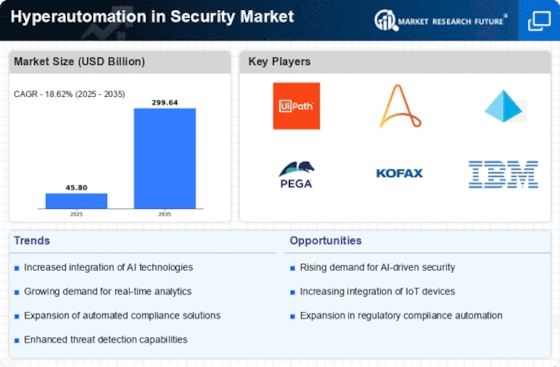
As per MRFR analysis, the Hyperautomation in Security Market Size was estimated at 45.8 USD Billion in 2024. The Hyperautomation in Security industry is projected to grow from 54.33 USD Billion in 2025 to 299.64 USD Billion by 2035, exhibiting a compound annual growth rate (CAGR) of 18.62 during the forecast period 2025 - 2035.

Key Market Trends & Highlights

The Hyperautomation in Security Market is experiencing robust growth driven by technological advancements and increasing security demands.

  • The integration of AI and Machine Learning is transforming security protocols, enhancing threat detection and response capabilities.
  • North America remains the largest market, while the Asia-Pacific region is emerging as the fastest-growing area for hyperautomation in security.
  • Solutions represent the largest segment, whereas Services are witnessing the fastest growth due to evolving customer needs.
  • Rising cybersecurity threats and a focus on compliance and regulatory standards are key drivers propelling market expansion.

Market Size & Forecast

2024 Market Size 45.8 (USD Billion)
2035 Market Size 299.64 (USD Billion)
CAGR (2025 - 2035) 18.62%
Largest Regional Market Share in 2024 North America

Major Players

<p>UiPath (US), Automation Anywhere (US), Blue Prism (GB), Pega Systems (US), Kofax (US), IBM (US), Microsoft (US), ServiceNow (US), Appian (US)</p>

Market Trends

The Hyperautomation in Security Market is currently experiencing a transformative phase, driven by the increasing complexity of security threats and the need for organizations to enhance their operational efficiency. This market encompasses a range of technologies, including artificial intelligence, machine learning, and robotic process automation, which collectively aim to streamline security processes and improve response times. As organizations face a growing array of cyber threats, the integration of hyperautomation solutions appears to be a strategic response to mitigate risks and bolster security frameworks. Furthermore, the emphasis on compliance and regulatory requirements is propelling the adoption of hyperautomation tools, as businesses seek to ensure adherence to evolving standards while optimizing their security operations. In addition, the market is witnessing a shift towards more adaptive and intelligent security systems. These systems leverage advanced analytics and real-time data processing to identify vulnerabilities and respond proactively to potential threats. The convergence of various technologies within the Hyperautomation in Security Market suggests a future where security measures are not only reactive but also predictive, allowing organizations to stay ahead of potential breaches. As the landscape continues to evolve, stakeholders must remain vigilant and adaptable, recognizing that the integration of hyperautomation is not merely a trend but a fundamental shift in how security is approached and managed across industries.

Integration of AI and Machine Learning

The incorporation of artificial intelligence and machine learning technologies is reshaping the Hyperautomation in Security Market. These tools enable organizations to analyze vast amounts of data, identify patterns, and predict potential security threats. By automating routine tasks, businesses can focus on more strategic initiatives, enhancing overall security posture.

Focus on Compliance and Regulatory Standards

As regulatory frameworks become increasingly stringent, organizations are prioritizing compliance within the Hyperautomation in Security Market. Hyperautomation solutions facilitate adherence to these standards by automating reporting and monitoring processes, thereby reducing the risk of non-compliance and associated penalties.

Shift Towards Predictive Security Measures

The trend towards predictive security measures is gaining traction within the Hyperautomation in Security Market. By utilizing advanced analytics and real-time data, organizations can anticipate threats before they materialize. This proactive approach not only enhances security but also optimizes resource allocation and response strategies.

Hyperautomation in Security Market Market Drivers

Rising Cybersecurity Threats

The escalating frequency and sophistication of cyber threats serve as a critical driver for the Hyperautomation in Security Market. Organizations are increasingly recognizing the need for robust security measures to protect sensitive data and maintain operational integrity. Reports indicate that cyberattacks have surged, with a notable increase in ransomware incidents and data breaches. This alarming trend compels businesses to invest in hyperautomation solutions that can provide real-time monitoring and automated responses to potential threats. The market is expected to respond to this urgency, with a projected increase in investments in automated security systems. As organizations strive to safeguard their assets, the demand for hyperautomation technologies that can adapt to emerging threats is likely to grow, further propelling the market forward.

Integration of Advanced Technologies

The integration of advanced technologies such as artificial intelligence and machine learning is a pivotal driver in the Hyperautomation in Security Market. These technologies enhance the ability to analyze vast amounts of data in real-time, allowing for quicker threat detection and response. As organizations increasingly adopt these technologies, the market is projected to grow significantly, with estimates suggesting a compound annual growth rate of over 25% in the coming years. This integration not only streamlines security operations but also reduces human error, thereby improving overall security posture. Furthermore, the ability to automate repetitive tasks allows security personnel to focus on more complex issues, thereby enhancing operational efficiency. The demand for such advanced solutions is likely to continue rising as cyber threats evolve and become more sophisticated.

Increased Demand for Real-Time Analytics

The growing demand for real-time analytics is a prominent driver in the Hyperautomation in Security Market. Organizations are increasingly recognizing the importance of immediate insights into security threats and vulnerabilities. Real-time analytics enable security teams to respond swiftly to incidents, thereby minimizing potential damage. The market is witnessing a surge in the adoption of hyperautomation solutions that incorporate advanced analytics capabilities, allowing for proactive threat detection and response. Industry forecasts indicate that the market for real-time analytics in security is expected to grow significantly, driven by the need for timely decision-making in an increasingly complex threat landscape. As organizations prioritize agility and responsiveness in their security operations, the demand for hyperautomation technologies that facilitate real-time insights is likely to expand.

Cost Efficiency and Resource Optimization

Cost efficiency and resource optimization are emerging as vital drivers in the Hyperautomation in Security Market. Organizations are increasingly seeking ways to reduce operational costs while enhancing security measures. Hyperautomation technologies enable businesses to automate routine security tasks, thereby freeing up valuable human resources for more strategic initiatives. This shift not only leads to cost savings but also improves the overall effectiveness of security operations. Market analyses suggest that companies implementing hyperautomation solutions can achieve up to a 30% reduction in operational costs. As organizations strive to balance budget constraints with the need for robust security, the adoption of hyperautomation technologies is likely to accelerate, driving market growth. The potential for improved resource allocation and enhanced security outcomes positions hyperautomation as a key component in modern security strategies.

Focus on Compliance and Regulatory Standards

The emphasis on compliance with regulatory standards is a significant driver in the Hyperautomation in Security Market. Organizations are under increasing pressure to adhere to various regulations, such as GDPR and HIPAA, which mandate stringent data protection measures. Non-compliance can result in severe penalties, prompting businesses to seek automated solutions that ensure compliance while minimizing operational disruptions. The market for hyperautomation in security is expected to expand as companies invest in technologies that facilitate compliance monitoring and reporting. This trend is likely to be reinforced by the growing awareness of data privacy issues among consumers, which further incentivizes organizations to adopt automated compliance solutions. As regulatory landscapes evolve, the demand for hyperautomation technologies that can adapt to these changes is anticipated to increase.

Market Segment Insights

By Offering: Solutions (Largest) vs. Services (Fastest-Growing)

<p>The Hyperautomation in Security Market is diversifying across various offering segments, including Solutions, Services, Professional Services, Security Consulting Services, Integration & Deployment Services, and Managed Security Services. Among these, Solutions stands out as the largest contributor, capturing a significant share of the market. On the other hand, Services, particularly Managed Security Services, are emerging rapidly, gaining traction due to the increasing demand for comprehensive security measures across industries.</p>

<p>Solutions (Dominant) vs. Managed Security Services (Emerging)</p>

<p>Solutions are at the forefront of the Hyperautomation in Security Market, characterized by their robust features that offer organizations advanced capabilities to automate security measures effectively. As the dominant offering, Solutions not only enhance productivity but also ensure a higher degree of security compliance and risk management. Conversely, Managed Security Services are on the rise as an emerging segment, appealing to businesses that seek specialized expertise to handle critical security operations. These services provide flexibility and scalability, allowing organizations to adapt to evolving threats while focusing on their core activities.</p>

By Technology: Artificial Intelligence (AI) (Largest) vs. Robotic Process Automation (RPA) (Fastest-Growing)

<p>In the Hyperautomation in Security Market, the technology segment is dominated by Artificial Intelligence (AI), which represents the largest share due to its wide applicability in security systems. Machine Learning (ML) and Robotic Process Automation (RPA) are also significant, contributing to an overall trend towards automation. While AI leads in market presence, RPA is gaining traction rapidly as organizations seek efficient ways to streamline operations and improve security processes. Growth dynamics in this segment reflect increased adoption of AI and ML solutions, which offer advanced threat detection and response capabilities. RPA is emerging as a key player, driven by the demand for automation in repetitive security tasks. The focus on integrating these technologies ensures a comprehensive security posture for organizations, facilitating faster and more effective resolutions of security issues.</p>

<p>Technology: AI (Dominant) vs. RPA (Emerging)</p>

<p>Artificial Intelligence (AI) stands as the dominant technology in the Hyperautomation in Security Market, offering unparalleled capabilities in predictive analytics and real-time threat detection. This technology enhances security systems by providing insights derived from vast datasets, thereby improving decision-making processes. On the other hand, Robotic Process Automation (RPA) is positioned as an emerging player, known for its potential to transform mundane security operations through automation of repetitive tasks. The synergy between AI and RPA is becoming increasingly important, with businesses harnessing both to achieve substantial operational efficiencies and a more proactive approach to security challenges. This dynamic interplay between dominant and emerging technologies is propelling innovation and shaping the future of security management.</p>

By Deployment: Cloud (Largest) vs. Hybrid (Fastest-Growing)

<p>In the Hyperautomation in Security Market, cloud deployment holds the largest market share, driven by its scalability and cost-effectiveness. Organizations are increasingly opting for cloud solutions to enhance their security processes due to the flexibility and accessibility cloud platforms provide. On the other hand, hybrid deployment models are gaining traction, merging the benefits of both on-premise and cloud systems, thus catering to diverse organizational needs. As companies look for solutions that can seamlessly integrate multiple environments, the hybrid model is quickly becoming a preferred choice. The growth trends in this segment are significantly influenced by the digital transformation journey organizations are undertaking. With the rise in cyber threats, there is an escalating need for sophisticated security solutions that can be easily deployed and managed across various environments. Moreover, advancements in automation technologies and AI are propelling the demand for hybrid solutions, as businesses seek to enhance their security posture while maintaining operational efficiency.</p>

<p>Cloud (Dominant) vs. Hybrid (Emerging)</p>

<p>Cloud deployment is a dominant force in the Hyperautomation in Security Market, allowing organizations to leverage advanced security tools without the substantial infrastructure investment associated with on-premise solutions. Its inherent scalability and ability to adapt to fluctuating demands enhance its appeal among businesses looking for efficient and agile security measures. Conversely, hybrid deployment is emerging as an innovative solution that combines the strengths of both cloud and on-premise models. This approach addresses the complex security needs of organizations that require robust, scalable solutions while still needing to manage sensitive data internally. As data privacy regulations become stricter, the hybrid model allows businesses to maintain control over their data while benefiting from the cloud's flexibility.</p>

By Organization Size: SMEs (Largest) vs. Large Enterprises (Fastest-Growing)

<p>In the Hyperautomation in Security Market, the share distribution highlights that Small and Medium Enterprises (SMEs) represent the largest segment, contributing significantly to the overall adoption of hyperautomation technologies. SMEs are increasingly realizing the benefits of hyperautomation in enhancing their security posture, leading to a substantial share of the market. Meanwhile, Large Enterprises are rapidly growing in this space, leveraging their resources to adopt advanced hyperautomation solutions that cater to complex security needs, thereby capturing an emerging market share.</p>

<p>SMEs (Dominant) vs. Large Enterprises (Emerging)</p>

<p>SMEs are often seen as the dominant force in the Hyperautomation in Security Market due to their agility and adaptability in implementing innovative solutions. These organizations typically require cost-effective security measures that enable scalability without compromising efficiency. On the other hand, Large Enterprises are emerging as key players as they invest in sophisticated hyperautomation technologies. This segment is characterized by robust resources and the ability to harness extensive data analytics, making them poised to tackle complex security challenges. Their focus on integrating hyperautomation into existing workflows positions them to accelerate growth and innovation in security protocols.</p>

By Application: Identity Access Management (IAM) (Largest) vs. Continuous Vulnerability Management (Fastest-Growing)

<p>The Hyperautomation in Security Market showcases a diverse application segment with Identity Access Management (IAM) leading in market share, establishing it as the largest segment within the domain. Other significant contributors include Cloud Security Posture Management (CSPM) and Application Security Operations. However, Continuous Vulnerability Management is garnering attention as the fastest-growing application, driven by escalating cybersecurity threats and the need for robust security protocols. This dynamic distribution indicates that while IAM is well-established, emerging applications are rapidly adapting to evolving security challenges. As organizations increasingly prioritize security and compliance, the demand for advanced solutions, particularly in threat detection and response, is growing. Continuous Vulnerability Management stands out due to its ability to adapt to real-time threat landscapes, enhancing organizational resilience. Additionally, sectors like Email Security Management and Document Security Systems are experiencing renewed focus, reflecting the broader trend of hyperautomation streamlining security operations to improve efficiency and mitigate risks effectively.</p>

<p>Identity Access Management (IAM) (Dominant) vs. Continuous Vulnerability Management (Emerging)</p>

<p>Identity Access Management (IAM) plays a crucial role in the Hyperautomation in Security Market by enabling organizations to manage user identities and access permissions effectively. As the dominant application, IAM solutions are essential for maintaining control over who can access sensitive information, thereby reducing risks associated with data breaches. The market for IAM is characterized by the integration of advanced technologies such as AI and machine learning, which enhance authentication processes and user experience. In contrast, Continuous Vulnerability Management has emerged as a vital component of modern cybersecurity strategies, addressing the growing complexity of IT environments. As organizations face an increasing volume of vulnerabilities, this approach employs automated tools for regular assessments and remediation efforts, ensuring ongoing protection against potential threats. The rapid adoption of cloud services and remote work initiatives further accelerates the demand for these solutions, solidifying their standing in the hyperautomation landscape.</p>

By Industry Vertical: BFSI (Largest) vs. Healthcare (Fastest-Growing)

<p>In the Hyperautomation in Security Market, the industry verticals are diverse, with the Banking, Financial Services, and Insurance (BFSI) sector holding the largest share. This sector benefits from stringent compliance regulations and a constant need for enhanced security solutions, propelling its dominance. In comparison, the healthcare sector is rapidly catching up, driven by increasing digitalization, the rise of telehealth, and the need for secure patient data management. As organizations strive to innovate and increase efficiency, the urgency for hyperautomation in healthcare solutions continues to accelerate. Analysis shows that both BFSI and healthcare are strong pillars in this market, but differing growth trajectories are evident. BFSI’s growth is predominantly linked to regulatory compliance and risk management, whereas healthcare is evolving through technology adoption and patient-centric approaches. Additionally, sectors such as manufacturing and logistics are emerging as vital players in hyperautomation, highlighting the broad applicability of these technologies in enhancing operational efficiency and security across various industries.</p>

<p>BFSI (Dominant) vs. Healthcare (Emerging)</p>

<p>The BFSI sector remains the dominant force in the Hyperautomation in Security Market due to its critical need for robust security protocols and automated compliance processes. Financial institutions face immense pressure to protect sensitive data against cyber threats, making hyperautomation essential for real-time threat detection and response. Meanwhile, the healthcare sector is rapidly emerging, with digital transformation reshaping patient care and data management. This vertical prioritizes secure infrastructures, especially with the rise of electronic health records and telehealth services, emphasizing the importance of security automation to safeguard patient privacy. As both sectors evolve, their strategies and technologies will play pivotal roles in shaping the future landscape of the hyperautomation market.</p>

Get more detailed insights about Hyperautomation in Security Market Research Report - Global Forecast till 2035

Regional Insights

North America : Innovation and Leadership Hub

North America is the largest market for hyperautomation in security, holding approximately 45% of the global market share. The region's growth is driven by increasing cybersecurity threats, regulatory compliance requirements, and a strong focus on digital transformation. The U.S. government has implemented various initiatives to enhance cybersecurity, further fueling demand for hyperautomation solutions. The competitive landscape is robust, with key players like UiPath, Automation Anywhere, and IBM leading the charge. The U.S. is the primary contributor, followed by Canada, which is also witnessing significant investments in automation technologies. The presence of major tech firms and a skilled workforce positions North America as a leader in hyperautomation security solutions.

Europe : Emerging Regulatory Frameworks

Europe is the second-largest market for hyperautomation in security, accounting for around 30% of the global market share. The region's growth is significantly influenced by stringent data protection regulations such as GDPR, which compel organizations to adopt advanced security measures. Additionally, the increasing frequency of cyberattacks has heightened the demand for automated security solutions across various sectors. Leading countries in this region include Germany, the UK, and France, where companies are rapidly adopting hyperautomation technologies. The competitive landscape features key players like Blue Prism and Pega Systems, which are well-positioned to meet the growing demand. The European market is characterized by a strong emphasis on compliance and security, driving innovation in hyperautomation solutions.

Asia-Pacific : Rapid Adoption and Growth

Asia-Pacific is witnessing rapid growth in the hyperautomation in security market, holding approximately 20% of the global market share. The region's growth is driven by increasing digitalization, a surge in cyber threats, and government initiatives promoting automation technologies. Countries like China and India are at the forefront, with significant investments in cybersecurity infrastructure and automation solutions. The competitive landscape is evolving, with local players emerging alongside global giants like Microsoft and ServiceNow. The demand for hyperautomation is particularly strong in sectors such as finance and healthcare, where security is paramount. As organizations in Asia-Pacific continue to embrace digital transformation, the hyperautomation market is expected to expand significantly in the coming years.

Middle East and Africa : Untapped Potential and Growth

The Middle East and Africa region is gradually emerging in the hyperautomation in security market, currently holding about 5% of the global market share. The growth is driven by increasing awareness of cybersecurity threats and the need for efficient security solutions. Governments in the region are beginning to recognize the importance of digital transformation, leading to investments in automation technologies. Leading countries include the UAE and South Africa, where there is a growing focus on enhancing cybersecurity measures. The competitive landscape is still developing, with both local and international players vying for market share. As the region continues to invest in technology and infrastructure, the hyperautomation market is poised for significant growth in the near future.

Key Players and Competitive Insights

The Hyperautomation in Security Market is a highly competitive industry, as numerous companies offer wide variety of services. The market is characterized by the presence of established and large Hyperautomation in Security Market companies, as well as many smaller and emerging players. These companies are focused on developing innovative technologies and processes to improve efficiency, reduce costs, and enhance the quality of services for customers across the world.

The competition in the Hyperautomation in Security Market is driven by various factors, including pricing, quality, delivery time, and the ability to offer customized solutions to customers. Moreover, partnerships and collaborations with other players in the industry, such as OEMs and suppliers, are crucial for companies to remain competitive in the market. Mergers and acquisitions are also common in the Hyperautomation in Security Market, as companies seek to expand their reach and capabilities. Additionally, companies are investing heavily in research and development to develop new deployments and technologies that can improve the market share.

Key Companies in the Hyperautomation in Security Market market include

Industry Developments

July 2022 saw Wipro PARI acquiring Hochrainer, a German automation technology company. This acquisition helped Wipro to expand its footprint in Europe and enhance its global leadership position. Also, the acquisition will enable Hochrainer to develop and obtain access to advanced technology resources as well as future technologies.

June 2022 – Low-code automation and integration player Tray.io has announced new capabilities that are aimed at speeding up enterprise hyper-automation implementations. Tray.io provides end-to-end connectivity for all user profiles through the Connector Builder, making it possible for low-code developers to build reusable connectors quickly and on-demand in a visual manner. Moreover, a new Connectivity API experience for developers simplifies combining hundreds of underlying endpoints into just three API calls.

May 2022 – Visa, a worldwide digital payments player, and Phrasee, specializing in brand language optimization, have agreed on a European exclusive deal. It is a three-year agreement that is part of Visa’s investment strategy involving their customers, such as leading B2B financial services companies in Europe. Through its reseller program, Phrasee makes visa clients available with advanced machine learning and natural language generation capabilities.

September 2022 witnessed the launch of e.IQ 5.0 – Nile Edition enhances platform features for building automated business applications at scale. These include process orchestration, data & event processing, AI/ML, enterprise connectors, and front-end application development under an easy-to-use interface with no coding or low code involved. The release also introduces a taxonomy builder for multi-level taxonomy management across business domains; it continues expanding the hyper-automation enablement platform’s unified data experience offer started from release 4.0, which is how it makes data actionable at run-time to power simple decision automation.

September 2022 - UiPath Business Automation Platform partner OutSystems has joined forces with high-performance low-code provider OutSystems to leverage both companies’ strengths. Consequently, they will be able to help their customers automate the most critical business processes and applications intelligently and securely, which will save them hours of tedious work, increase their productivity, and revolutionize their application experience.

Hyperautomation in Security Market - Market Segmentation

Hyperautomation in Security Market - Offering Outlook

    • Solutions
    • Services
    • Professional Services
    • Security Consulting Services
    • Integration & Deployment Services
    • Managed Security Services

Hyperautomation in Security Market - Technology Outlook

    • Artificial Intelligence (AI)
    • Machine Learning (ML)
    • Robotic Process Automation (RPA)
    • Process Analytics
    • Ingestion Engines
    • Others

Hyperautomation in Security Market - Deployment Outlook

    • On Premise
    • Cloud
    • Hybrid

Hyperautomation in Security Market - Organization Size Outlook

    • SMEs
    • Large Enterprises

Hyperautomation in Security Market - Application Outlook

    • Identity Access Management (IAM)
    • Application Security Operations
    • Continuous Vulnerability Management
    • Cloud Security Posture Management (CSPM)
    • Threat Hunting (XDR, EDR, and SIEM Response)
    • Email Security Management
    • Chatbots
    • Abnormal System Behaviour Detection
    • Transaction Fraud Detection
    • Document Security System
    • Others

Hyperautomation in Security Market - Industry Vertical Outlook

    • BFSI
    • Healthcare
    • Manufacturing
    • Legal
    • Government
    • Logistics
    • IT & Telecommunication
    • Retail & E-Commerce
    • Others

Hyperautomation in Security Market - Regional Outlook

    • North America
      • US
      • Canada
      • Mexico
    • Europe
      • Germany
      • France
      • UK
      • Italy
      • Spain
      • Rest of Europe
    • Asia-Pacific
      • China
      • Japan
      • India
      • South Korea
      • Australia
      • Rest of Asia-Pacific
    • Middle East & Africa
      • Saudi Arabia
      • UAE
      • South Africa
      • Rest of the Middle East & Africa
    • South America
      • Brazil
      • Argentina
      • Chile
      • Rest of South America

Future Outlook

Hyperautomation in Security Market Future Outlook

<p>The Hyperautomation in Security Market is projected to grow at an 18.62% CAGR from 2024 to 2035, driven by advancements in AI, machine learning, and increasing cybersecurity threats.</p>

New opportunities lie in:

  • <p>Integration of AI-driven threat detection systems</p>
  • <p>Development of automated compliance management tools</p>
  • <p>Expansion of cloud-based security automation solutions</p>

<p>By 2035, the market is expected to be robust, driven by innovative automation solutions.</p>

Market Segmentation

Hyperautomation in Security Market Offering Outlook

  • Solutions
  • Services
  • Professional Services
  • Security Consulting Services
  • Integration & Deployment Services
  • Managed Security Services

Hyperautomation in Security Market Deployment Outlook

  • On Premise
  • Cloud
  • Hybrid

Hyperautomation in Security Market Technology Outlook

  • Artificial Intelligence (AI)
  • Machine Learning (ML)
  • Robotic Process Automation (RPA)
  • Process Analytics
  • Ingestion Engines
  • Others

Hyperautomation in Security Market Application Outlook

  • Identity Access Management (IAM)
  • Application Security Operations
  • Continuous Vulnerability Management
  • Cloud Security Posture Management (CSPM)
  • Threat Hunting (XDR, EDR, and SIEM Response)
  • Email Security Management
  • Chatbots
  • Abnormal System Behavior Detection
  • Transaction Fraud Detection
  • Document Security System
  • Others

Hyperautomation in Security Market Industry Vertical Outlook

  • BFSI
  • Healthcare
  • Manufacturing
  • Legal
  • Government
  • Logistics
  • IT & Telecommunication
  • Retail & E-Commerce
  • Others

Hyperautomation in Security Market Organization Size Outlook

  • SMEs
  • Large Enterprises

Report Scope

MARKET SIZE 202445.8(USD Billion)
MARKET SIZE 202554.33(USD Billion)
MARKET SIZE 2035299.64(USD Billion)
COMPOUND ANNUAL GROWTH RATE (CAGR)18.62% (2024 - 2035)
REPORT COVERAGERevenue Forecast, Competitive Landscape, Growth Factors, and Trends
BASE YEAR2024
Market Forecast Period2025 - 2035
Historical Data2019 - 2024
Market Forecast UnitsUSD Billion
Key Companies ProfiledMarket analysis in progress
Segments CoveredMarket segmentation analysis in progress
Key Market OpportunitiesIntegration of artificial intelligence and machine learning enhances threat detection in the Hyperautomation in Security Market.
Key Market DynamicsRising demand for automated security solutions drives innovation and competition among technology providers in the hyperautomation sector.
Countries CoveredNorth America, Europe, APAC, South America, MEA

FAQs

What is the current market valuation of the Hyperautomation in Security Market?

The market valuation of the Hyperautomation in Security Market was 45.8 USD Billion in 2024.

What is the projected market size for the Hyperautomation in Security Market by 2035?

The projected market size for the Hyperautomation in Security Market is 299.64 USD Billion by 2035.

What is the expected CAGR for the Hyperautomation in Security Market during the forecast period?

The expected CAGR for the Hyperautomation in Security Market during the forecast period 2025 - 2035 is 18.62%.

Which companies are considered key players in the Hyperautomation in Security Market?

Key players in the Hyperautomation in Security Market include UiPath, Automation Anywhere, Blue Prism, Pega Systems, Kofax, IBM, Microsoft, ServiceNow, and Appian.

  1. SECTION I: EXECUTIVE SUMMARY AND KEY HIGHLIGHTS
    1. EXECUTIVE SUMMARY
      1. Market Overview
      2. Key Findings
      3. Market Segmentation
      4. Competitive Landscape
      5. Challenges and Opportunities
      6. Future Outlook
  2. SECTION II: SCOPING, METHODOLOGY AND MARKET STRUCTURE
    1. MARKET INTRODUCTION
      1. Definition
      2. Scope of the study
    2. RESEARCH METHODOLOGY
      1. Overview
      2. Data Mining
      3. Secondary Research
      4. Primary Research
      5. Forecasting Model
      6. Market Size Estimation
      7. Data Triangulation
      8. Validation
  3. SECTION III: QUALITATIVE ANALYSIS
    1. MARKET DYNAMICS
      1. Overview
      2. Drivers
      3. Restraints
      4. Opportunities
    2. MARKET FACTOR ANALYSIS
      1. Value chain Analysis
      2. Porter's Five Forces Analysis
      3. COVID-19 Impact Analysis
  4. SECTION IV: QUANTITATIVE ANALYSIS
    1. Information and Communications Technology, BY Offering (USD Billion)
      1. Solutions
      2. Services
      3. Professional Services
      4. Security Consulting Services
      5. Integration & Deployment Services
      6. Managed Security Services
    2. Information and Communications Technology, BY Technology (USD Billion)
      1. Artificial Intelligence (AI)
      2. Machine Learning (ML)
      3. Robotic Process Automation (RPA)
      4. Process Analytics
      5. Ingestion Engines
      6. Others
    3. Information and Communications Technology, BY Deployment (USD Billion)
      1. On Premise
      2. Cloud
      3. Hybrid
    4. Information and Communications Technology, BY Organization Size (USD Billion)
      1. SMEs
      2. Large Enterprises
    5. Information and Communications Technology, BY Application (USD Billion)
      1. Identity Access Management (IAM)
      2. Application Security Operations
      3. Continuous Vulnerability Management
      4. Cloud Security Posture Management (CSPM)
      5. Threat Hunting (XDR, EDR, and SIEM Response)
      6. Email Security Management
      7. Chatbots
      8. Abnormal System Behavior Detection
      9. Transaction Fraud Detection
      10. Document Security System
      11. Others
    6. Information and Communications Technology, BY Industry Vertical (USD Billion)
      1. BFSI
      2. Healthcare
      3. Manufacturing
      4. Legal
      5. Government
      6. Logistics
      7. IT & Telecommunication
      8. Retail & E-Commerce
      9. Others
    7. Information and Communications Technology, BY Region (USD Billion)
      1. North America
      2. Europe
      3. APAC
      4. South America
      5. MEA
  5. SECTION V: COMPETITIVE ANALYSIS
    1. Competitive Landscape
      1. Overview
      2. Competitive Analysis
      3. Market share Analysis
      4. Major Growth Strategy in the Information and Communications Technology
      5. Competitive Benchmarking
      6. Leading Players in Terms of Number of Developments in the Information and Communications Technology
      7. Key developments and growth strategies
      8. Major Players Financial Matrix
    2. Company Profiles
      1. UiPath (US)
      2. Automation Anywhere (US)
      3. Blue Prism (GB)
      4. Pega Systems (US)
      5. Kofax (US)
      6. IBM (US)
      7. Microsoft (US)
      8. ServiceNow (US)
      9. Appian (US)
    3. Appendix
      1. References
      2. Related Reports
  6. LIST OF FIGURES
    1. MARKET SYNOPSIS
    2. NORTH AMERICA MARKET ANALYSIS
    3. US MARKET ANALYSIS BY OFFERING
    4. US MARKET ANALYSIS BY TECHNOLOGY
    5. US MARKET ANALYSIS BY DEPLOYMENT
    6. US MARKET ANALYSIS BY ORGANIZATION SIZE
    7. US MARKET ANALYSIS BY APPLICATION
    8. US MARKET ANALYSIS BY INDUSTRY VERTICAL
    9. CANADA MARKET ANALYSIS BY OFFERING
    10. CANADA MARKET ANALYSIS BY TECHNOLOGY
    11. CANADA MARKET ANALYSIS BY DEPLOYMENT
    12. CANADA MARKET ANALYSIS BY ORGANIZATION SIZE
    13. CANADA MARKET ANALYSIS BY APPLICATION
    14. CANADA MARKET ANALYSIS BY INDUSTRY VERTICAL
    15. EUROPE MARKET ANALYSIS
    16. GERMANY MARKET ANALYSIS BY OFFERING
    17. GERMANY MARKET ANALYSIS BY TECHNOLOGY
    18. GERMANY MARKET ANALYSIS BY DEPLOYMENT
    19. GERMANY MARKET ANALYSIS BY ORGANIZATION SIZE
    20. GERMANY MARKET ANALYSIS BY APPLICATION
    21. GERMANY MARKET ANALYSIS BY INDUSTRY VERTICAL
    22. UK MARKET ANALYSIS BY OFFERING
    23. UK MARKET ANALYSIS BY TECHNOLOGY
    24. UK MARKET ANALYSIS BY DEPLOYMENT
    25. UK MARKET ANALYSIS BY ORGANIZATION SIZE
    26. UK MARKET ANALYSIS BY APPLICATION
    27. UK MARKET ANALYSIS BY INDUSTRY VERTICAL
    28. FRANCE MARKET ANALYSIS BY OFFERING
    29. FRANCE MARKET ANALYSIS BY TECHNOLOGY
    30. FRANCE MARKET ANALYSIS BY DEPLOYMENT
    31. FRANCE MARKET ANALYSIS BY ORGANIZATION SIZE
    32. FRANCE MARKET ANALYSIS BY APPLICATION
    33. FRANCE MARKET ANALYSIS BY INDUSTRY VERTICAL
    34. RUSSIA MARKET ANALYSIS BY OFFERING
    35. RUSSIA MARKET ANALYSIS BY TECHNOLOGY
    36. RUSSIA MARKET ANALYSIS BY DEPLOYMENT
    37. RUSSIA MARKET ANALYSIS BY ORGANIZATION SIZE
    38. RUSSIA MARKET ANALYSIS BY APPLICATION
    39. RUSSIA MARKET ANALYSIS BY INDUSTRY VERTICAL
    40. ITALY MARKET ANALYSIS BY OFFERING
    41. ITALY MARKET ANALYSIS BY TECHNOLOGY
    42. ITALY MARKET ANALYSIS BY DEPLOYMENT
    43. ITALY MARKET ANALYSIS BY ORGANIZATION SIZE
    44. ITALY MARKET ANALYSIS BY APPLICATION
    45. ITALY MARKET ANALYSIS BY INDUSTRY VERTICAL
    46. SPAIN MARKET ANALYSIS BY OFFERING
    47. SPAIN MARKET ANALYSIS BY TECHNOLOGY
    48. SPAIN MARKET ANALYSIS BY DEPLOYMENT
    49. SPAIN MARKET ANALYSIS BY ORGANIZATION SIZE
    50. SPAIN MARKET ANALYSIS BY APPLICATION
    51. SPAIN MARKET ANALYSIS BY INDUSTRY VERTICAL
    52. REST OF EUROPE MARKET ANALYSIS BY OFFERING
    53. REST OF EUROPE MARKET ANALYSIS BY TECHNOLOGY
    54. REST OF EUROPE MARKET ANALYSIS BY DEPLOYMENT
    55. REST OF EUROPE MARKET ANALYSIS BY ORGANIZATION SIZE
    56. REST OF EUROPE MARKET ANALYSIS BY APPLICATION
    57. REST OF EUROPE MARKET ANALYSIS BY INDUSTRY VERTICAL
    58. APAC MARKET ANALYSIS
    59. CHINA MARKET ANALYSIS BY OFFERING
    60. CHINA MARKET ANALYSIS BY TECHNOLOGY
    61. CHINA MARKET ANALYSIS BY DEPLOYMENT
    62. CHINA MARKET ANALYSIS BY ORGANIZATION SIZE
    63. CHINA MARKET ANALYSIS BY APPLICATION
    64. CHINA MARKET ANALYSIS BY INDUSTRY VERTICAL
    65. INDIA MARKET ANALYSIS BY OFFERING
    66. INDIA MARKET ANALYSIS BY TECHNOLOGY
    67. INDIA MARKET ANALYSIS BY DEPLOYMENT
    68. INDIA MARKET ANALYSIS BY ORGANIZATION SIZE
    69. INDIA MARKET ANALYSIS BY APPLICATION
    70. INDIA MARKET ANALYSIS BY INDUSTRY VERTICAL
    71. JAPAN MARKET ANALYSIS BY OFFERING
    72. JAPAN MARKET ANALYSIS BY TECHNOLOGY
    73. JAPAN MARKET ANALYSIS BY DEPLOYMENT
    74. JAPAN MARKET ANALYSIS BY ORGANIZATION SIZE
    75. JAPAN MARKET ANALYSIS BY APPLICATION
    76. JAPAN MARKET ANALYSIS BY INDUSTRY VERTICAL
    77. SOUTH KOREA MARKET ANALYSIS BY OFFERING
    78. SOUTH KOREA MARKET ANALYSIS BY TECHNOLOGY
    79. SOUTH KOREA MARKET ANALYSIS BY DEPLOYMENT
    80. SOUTH KOREA MARKET ANALYSIS BY ORGANIZATION SIZE
    81. SOUTH KOREA MARKET ANALYSIS BY APPLICATION
    82. SOUTH KOREA MARKET ANALYSIS BY INDUSTRY VERTICAL
    83. MALAYSIA MARKET ANALYSIS BY OFFERING
    84. MALAYSIA MARKET ANALYSIS BY TECHNOLOGY
    85. MALAYSIA MARKET ANALYSIS BY DEPLOYMENT
    86. MALAYSIA MARKET ANALYSIS BY ORGANIZATION SIZE
    87. MALAYSIA MARKET ANALYSIS BY APPLICATION
    88. MALAYSIA MARKET ANALYSIS BY INDUSTRY VERTICAL
    89. THAILAND MARKET ANALYSIS BY OFFERING
    90. THAILAND MARKET ANALYSIS BY TECHNOLOGY
    91. THAILAND MARKET ANALYSIS BY DEPLOYMENT
    92. THAILAND MARKET ANALYSIS BY ORGANIZATION SIZE
    93. THAILAND MARKET ANALYSIS BY APPLICATION
    94. THAILAND MARKET ANALYSIS BY INDUSTRY VERTICAL
    95. INDONESIA MARKET ANALYSIS BY OFFERING
    96. INDONESIA MARKET ANALYSIS BY TECHNOLOGY
    97. INDONESIA MARKET ANALYSIS BY DEPLOYMENT
    98. INDONESIA MARKET ANALYSIS BY ORGANIZATION SIZE
    99. INDONESIA MARKET ANALYSIS BY APPLICATION
    100. INDONESIA MARKET ANALYSIS BY INDUSTRY VERTICAL
    101. REST OF APAC MARKET ANALYSIS BY OFFERING
    102. REST OF APAC MARKET ANALYSIS BY TECHNOLOGY
    103. REST OF APAC MARKET ANALYSIS BY DEPLOYMENT
    104. REST OF APAC MARKET ANALYSIS BY ORGANIZATION SIZE
    105. REST OF APAC MARKET ANALYSIS BY APPLICATION
    106. REST OF APAC MARKET ANALYSIS BY INDUSTRY VERTICAL
    107. SOUTH AMERICA MARKET ANALYSIS
    108. BRAZIL MARKET ANALYSIS BY OFFERING
    109. BRAZIL MARKET ANALYSIS BY TECHNOLOGY
    110. BRAZIL MARKET ANALYSIS BY DEPLOYMENT
    111. BRAZIL MARKET ANALYSIS BY ORGANIZATION SIZE
    112. BRAZIL MARKET ANALYSIS BY APPLICATION
    113. BRAZIL MARKET ANALYSIS BY INDUSTRY VERTICAL
    114. MEXICO MARKET ANALYSIS BY OFFERING
    115. MEXICO MARKET ANALYSIS BY TECHNOLOGY
    116. MEXICO MARKET ANALYSIS BY DEPLOYMENT
    117. MEXICO MARKET ANALYSIS BY ORGANIZATION SIZE
    118. MEXICO MARKET ANALYSIS BY APPLICATION
    119. MEXICO MARKET ANALYSIS BY INDUSTRY VERTICAL
    120. ARGENTINA MARKET ANALYSIS BY OFFERING
    121. ARGENTINA MARKET ANALYSIS BY TECHNOLOGY
    122. ARGENTINA MARKET ANALYSIS BY DEPLOYMENT
    123. ARGENTINA MARKET ANALYSIS BY ORGANIZATION SIZE
    124. ARGENTINA MARKET ANALYSIS BY APPLICATION
    125. ARGENTINA MARKET ANALYSIS BY INDUSTRY VERTICAL
    126. REST OF SOUTH AMERICA MARKET ANALYSIS BY OFFERING
    127. REST OF SOUTH AMERICA MARKET ANALYSIS BY TECHNOLOGY
    128. REST OF SOUTH AMERICA MARKET ANALYSIS BY DEPLOYMENT
    129. REST OF SOUTH AMERICA MARKET ANALYSIS BY ORGANIZATION SIZE
    130. REST OF SOUTH AMERICA MARKET ANALYSIS BY APPLICATION
    131. REST OF SOUTH AMERICA MARKET ANALYSIS BY INDUSTRY VERTICAL
    132. MEA MARKET ANALYSIS
    133. GCC COUNTRIES MARKET ANALYSIS BY OFFERING
    134. GCC COUNTRIES MARKET ANALYSIS BY TECHNOLOGY
    135. GCC COUNTRIES MARKET ANALYSIS BY DEPLOYMENT
    136. GCC COUNTRIES MARKET ANALYSIS BY ORGANIZATION SIZE
    137. GCC COUNTRIES MARKET ANALYSIS BY APPLICATION
    138. GCC COUNTRIES MARKET ANALYSIS BY INDUSTRY VERTICAL
    139. SOUTH AFRICA MARKET ANALYSIS BY OFFERING
    140. SOUTH AFRICA MARKET ANALYSIS BY TECHNOLOGY
    141. SOUTH AFRICA MARKET ANALYSIS BY DEPLOYMENT
    142. SOUTH AFRICA MARKET ANALYSIS BY ORGANIZATION SIZE
    143. SOUTH AFRICA MARKET ANALYSIS BY APPLICATION
    144. SOUTH AFRICA MARKET ANALYSIS BY INDUSTRY VERTICAL
    145. REST OF MEA MARKET ANALYSIS BY OFFERING
    146. REST OF MEA MARKET ANALYSIS BY TECHNOLOGY
    147. REST OF MEA MARKET ANALYSIS BY DEPLOYMENT
    148. REST OF MEA MARKET ANALYSIS BY ORGANIZATION SIZE
    149. REST OF MEA MARKET ANALYSIS BY APPLICATION
    150. REST OF MEA MARKET ANALYSIS BY INDUSTRY VERTICAL
    151. KEY BUYING CRITERIA OF INFORMATION AND COMMUNICATIONS TECHNOLOGY
    152. RESEARCH PROCESS OF MRFR
    153. DRO ANALYSIS OF INFORMATION AND COMMUNICATIONS TECHNOLOGY
    154. DRIVERS IMPACT ANALYSIS: INFORMATION AND COMMUNICATIONS TECHNOLOGY
    155. RESTRAINTS IMPACT ANALYSIS: INFORMATION AND COMMUNICATIONS TECHNOLOGY
    156. SUPPLY / VALUE CHAIN: INFORMATION AND COMMUNICATIONS TECHNOLOGY
    157. INFORMATION AND COMMUNICATIONS TECHNOLOGY, BY OFFERING, 2024 (% SHARE)
    158. INFORMATION AND COMMUNICATIONS TECHNOLOGY, BY OFFERING, 2024 TO 2035 (USD Billion)
    159. INFORMATION AND COMMUNICATIONS TECHNOLOGY, BY TECHNOLOGY, 2024 (% SHARE)
    160. INFORMATION AND COMMUNICATIONS TECHNOLOGY, BY TECHNOLOGY, 2024 TO 2035 (USD Billion)
    161. INFORMATION AND COMMUNICATIONS TECHNOLOGY, BY DEPLOYMENT, 2024 (% SHARE)
    162. INFORMATION AND COMMUNICATIONS TECHNOLOGY, BY DEPLOYMENT, 2024 TO 2035 (USD Billion)
    163. INFORMATION AND COMMUNICATIONS TECHNOLOGY, BY ORGANIZATION SIZE, 2024 (% SHARE)
    164. INFORMATION AND COMMUNICATIONS TECHNOLOGY, BY ORGANIZATION SIZE, 2024 TO 2035 (USD Billion)
    165. INFORMATION AND COMMUNICATIONS TECHNOLOGY, BY APPLICATION, 2024 (% SHARE)
    166. INFORMATION AND COMMUNICATIONS TECHNOLOGY, BY APPLICATION, 2024 TO 2035 (USD Billion)
    167. INFORMATION AND COMMUNICATIONS TECHNOLOGY, BY INDUSTRY VERTICAL, 2024 (% SHARE)
    168. INFORMATION AND COMMUNICATIONS TECHNOLOGY, BY INDUSTRY VERTICAL, 2024 TO 2035 (USD Billion)
    169. BENCHMARKING OF MAJOR COMPETITORS
  7. LIST OF TABLES
    1. LIST OF ASSUMPTIONS
    2. North America MARKET SIZE ESTIMATES; FORECAST
      1. BY OFFERING, 2025-2035 (USD Billion)
      2. BY TECHNOLOGY, 2025-2035 (USD Billion)
      3. BY DEPLOYMENT, 2025-2035 (USD Billion)
      4. BY ORGANIZATION SIZE, 2025-2035 (USD Billion)
      5. BY APPLICATION, 2025-2035 (USD Billion)
      6. BY INDUSTRY VERTICAL, 2025-2035 (USD Billion)
    3. US MARKET SIZE ESTIMATES; FORECAST
      1. BY OFFERING, 2025-2035 (USD Billion)
      2. BY TECHNOLOGY, 2025-2035 (USD Billion)
      3. BY DEPLOYMENT, 2025-2035 (USD Billion)
      4. BY ORGANIZATION SIZE, 2025-2035 (USD Billion)
      5. BY APPLICATION, 2025-2035 (USD Billion)
      6. BY INDUSTRY VERTICAL, 2025-2035 (USD Billion)
    4. Canada MARKET SIZE ESTIMATES; FORECAST
      1. BY OFFERING, 2025-2035 (USD Billion)
      2. BY TECHNOLOGY, 2025-2035 (USD Billion)
      3. BY DEPLOYMENT, 2025-2035 (USD Billion)
      4. BY ORGANIZATION SIZE, 2025-2035 (USD Billion)
      5. BY APPLICATION, 2025-2035 (USD Billion)
      6. BY INDUSTRY VERTICAL, 2025-2035 (USD Billion)
    5. Europe MARKET SIZE ESTIMATES; FORECAST
      1. BY OFFERING, 2025-2035 (USD Billion)
      2. BY TECHNOLOGY, 2025-2035 (USD Billion)
      3. BY DEPLOYMENT, 2025-2035 (USD Billion)
      4. BY ORGANIZATION SIZE, 2025-2035 (USD Billion)
      5. BY APPLICATION, 2025-2035 (USD Billion)
      6. BY INDUSTRY VERTICAL, 2025-2035 (USD Billion)
    6. Germany MARKET SIZE ESTIMATES; FORECAST
      1. BY OFFERING, 2025-2035 (USD Billion)
      2. BY TECHNOLOGY, 2025-2035 (USD Billion)
      3. BY DEPLOYMENT, 2025-2035 (USD Billion)
      4. BY ORGANIZATION SIZE, 2025-2035 (USD Billion)
      5. BY APPLICATION, 2025-2035 (USD Billion)
      6. BY INDUSTRY VERTICAL, 2025-2035 (USD Billion)
    7. UK MARKET SIZE ESTIMATES; FORECAST
      1. BY OFFERING, 2025-2035 (USD Billion)
      2. BY TECHNOLOGY, 2025-2035 (USD Billion)
      3. BY DEPLOYMENT, 2025-2035 (USD Billion)
      4. BY ORGANIZATION SIZE, 2025-2035 (USD Billion)
      5. BY APPLICATION, 2025-2035 (USD Billion)
      6. BY INDUSTRY VERTICAL, 2025-2035 (USD Billion)
    8. France MARKET SIZE ESTIMATES; FORECAST
      1. BY OFFERING, 2025-2035 (USD Billion)
      2. BY TECHNOLOGY, 2025-2035 (USD Billion)
      3. BY DEPLOYMENT, 2025-2035 (USD Billion)
      4. BY ORGANIZATION SIZE, 2025-2035 (USD Billion)
      5. BY APPLICATION, 2025-2035 (USD Billion)
      6. BY INDUSTRY VERTICAL, 2025-2035 (USD Billion)
    9. Russia MARKET SIZE ESTIMATES; FORECAST
      1. BY OFFERING, 2025-2035 (USD Billion)
      2. BY TECHNOLOGY, 2025-2035 (USD Billion)
      3. BY DEPLOYMENT, 2025-2035 (USD Billion)
      4. BY ORGANIZATION SIZE, 2025-2035 (USD Billion)
      5. BY APPLICATION, 2025-2035 (USD Billion)
      6. BY INDUSTRY VERTICAL, 2025-2035 (USD Billion)
    10. Italy MARKET SIZE ESTIMATES; FORECAST
      1. BY OFFERING, 2025-2035 (USD Billion)
      2. BY TECHNOLOGY, 2025-2035 (USD Billion)
      3. BY DEPLOYMENT, 2025-2035 (USD Billion)
      4. BY ORGANIZATION SIZE, 2025-2035 (USD Billion)
      5. BY APPLICATION, 2025-2035 (USD Billion)
      6. BY INDUSTRY VERTICAL, 2025-2035 (USD Billion)
    11. Spain MARKET SIZE ESTIMATES; FORECAST
      1. BY OFFERING, 2025-2035 (USD Billion)
      2. BY TECHNOLOGY, 2025-2035 (USD Billion)
      3. BY DEPLOYMENT, 2025-2035 (USD Billion)
      4. BY ORGANIZATION SIZE, 2025-2035 (USD Billion)
      5. BY APPLICATION, 2025-2035 (USD Billion)
      6. BY INDUSTRY VERTICAL, 2025-2035 (USD Billion)
    12. Rest of Europe MARKET SIZE ESTIMATES; FORECAST
      1. BY OFFERING, 2025-2035 (USD Billion)
      2. BY TECHNOLOGY, 2025-2035 (USD Billion)
      3. BY DEPLOYMENT, 2025-2035 (USD Billion)
      4. BY ORGANIZATION SIZE, 2025-2035 (USD Billion)
      5. BY APPLICATION, 2025-2035 (USD Billion)
      6. BY INDUSTRY VERTICAL, 2025-2035 (USD Billion)
    13. APAC MARKET SIZE ESTIMATES; FORECAST
      1. BY OFFERING, 2025-2035 (USD Billion)
      2. BY TECHNOLOGY, 2025-2035 (USD Billion)
      3. BY DEPLOYMENT, 2025-2035 (USD Billion)
      4. BY ORGANIZATION SIZE, 2025-2035 (USD Billion)
      5. BY APPLICATION, 2025-2035 (USD Billion)
      6. BY INDUSTRY VERTICAL, 2025-2035 (USD Billion)
    14. China MARKET SIZE ESTIMATES; FORECAST
      1. BY OFFERING, 2025-2035 (USD Billion)
      2. BY TECHNOLOGY, 2025-2035 (USD Billion)
      3. BY DEPLOYMENT, 2025-2035 (USD Billion)
      4. BY ORGANIZATION SIZE, 2025-2035 (USD Billion)
      5. BY APPLICATION, 2025-2035 (USD Billion)
      6. BY INDUSTRY VERTICAL, 2025-2035 (USD Billion)
    15. India MARKET SIZE ESTIMATES; FORECAST
      1. BY OFFERING, 2025-2035 (USD Billion)
      2. BY TECHNOLOGY, 2025-2035 (USD Billion)
      3. BY DEPLOYMENT, 2025-2035 (USD Billion)
      4. BY ORGANIZATION SIZE, 2025-2035 (USD Billion)
      5. BY APPLICATION, 2025-2035 (USD Billion)
      6. BY INDUSTRY VERTICAL, 2025-2035 (USD Billion)
    16. Japan MARKET SIZE ESTIMATES; FORECAST
      1. BY OFFERING, 2025-2035 (USD Billion)
      2. BY TECHNOLOGY, 2025-2035 (USD Billion)
      3. BY DEPLOYMENT, 2025-2035 (USD Billion)
      4. BY ORGANIZATION SIZE, 2025-2035 (USD Billion)
      5. BY APPLICATION, 2025-2035 (USD Billion)
      6. BY INDUSTRY VERTICAL, 2025-2035 (USD Billion)
    17. South Korea MARKET SIZE ESTIMATES; FORECAST
      1. BY OFFERING, 2025-2035 (USD Billion)
      2. BY TECHNOLOGY, 2025-2035 (USD Billion)
      3. BY DEPLOYMENT, 2025-2035 (USD Billion)
      4. BY ORGANIZATION SIZE, 2025-2035 (USD Billion)
      5. BY APPLICATION, 2025-2035 (USD Billion)
      6. BY INDUSTRY VERTICAL, 2025-2035 (USD Billion)
    18. Malaysia MARKET SIZE ESTIMATES; FORECAST
      1. BY OFFERING, 2025-2035 (USD Billion)
      2. BY TECHNOLOGY, 2025-2035 (USD Billion)
      3. BY DEPLOYMENT, 2025-2035 (USD Billion)
      4. BY ORGANIZATION SIZE, 2025-2035 (USD Billion)
      5. BY APPLICATION, 2025-2035 (USD Billion)
      6. BY INDUSTRY VERTICAL, 2025-2035 (USD Billion)
    19. Thailand MARKET SIZE ESTIMATES; FORECAST
      1. BY OFFERING, 2025-2035 (USD Billion)
      2. BY TECHNOLOGY, 2025-2035 (USD Billion)
      3. BY DEPLOYMENT, 2025-2035 (USD Billion)
      4. BY ORGANIZATION SIZE, 2025-2035 (USD Billion)
      5. BY APPLICATION, 2025-2035 (USD Billion)
      6. BY INDUSTRY VERTICAL, 2025-2035 (USD Billion)
    20. Indonesia MARKET SIZE ESTIMATES; FORECAST
      1. BY OFFERING, 2025-2035 (USD Billion)
      2. BY TECHNOLOGY, 2025-2035 (USD Billion)
      3. BY DEPLOYMENT, 2025-2035 (USD Billion)
      4. BY ORGANIZATION SIZE, 2025-2035 (USD Billion)
      5. BY APPLICATION, 2025-2035 (USD Billion)
      6. BY INDUSTRY VERTICAL, 2025-2035 (USD Billion)
    21. Rest of APAC MARKET SIZE ESTIMATES; FORECAST
      1. BY OFFERING, 2025-2035 (USD Billion)
      2. BY TECHNOLOGY, 2025-2035 (USD Billion)
      3. BY DEPLOYMENT, 2025-2035 (USD Billion)
      4. BY ORGANIZATION SIZE, 2025-2035 (USD Billion)
      5. BY APPLICATION, 2025-2035 (USD Billion)
      6. BY INDUSTRY VERTICAL, 2025-2035 (USD Billion)
    22. South America MARKET SIZE ESTIMATES; FORECAST
      1. BY OFFERING, 2025-2035 (USD Billion)
      2. BY TECHNOLOGY, 2025-2035 (USD Billion)
      3. BY DEPLOYMENT, 2025-2035 (USD Billion)
      4. BY ORGANIZATION SIZE, 2025-2035 (USD Billion)
      5. BY APPLICATION, 2025-2035 (USD Billion)
      6. BY INDUSTRY VERTICAL, 2025-2035 (USD Billion)
    23. Brazil MARKET SIZE ESTIMATES; FORECAST
      1. BY OFFERING, 2025-2035 (USD Billion)
      2. BY TECHNOLOGY, 2025-2035 (USD Billion)
      3. BY DEPLOYMENT, 2025-2035 (USD Billion)
      4. BY ORGANIZATION SIZE, 2025-2035 (USD Billion)
      5. BY APPLICATION, 2025-2035 (USD Billion)
      6. BY INDUSTRY VERTICAL, 2025-2035 (USD Billion)
    24. Mexico MARKET SIZE ESTIMATES; FORECAST
      1. BY OFFERING, 2025-2035 (USD Billion)
      2. BY TECHNOLOGY, 2025-2035 (USD Billion)
      3. BY DEPLOYMENT, 2025-2035 (USD Billion)
      4. BY ORGANIZATION SIZE, 2025-2035 (USD Billion)
      5. BY APPLICATION, 2025-2035 (USD Billion)
      6. BY INDUSTRY VERTICAL, 2025-2035 (USD Billion)
    25. Argentina MARKET SIZE ESTIMATES; FORECAST
      1. BY OFFERING, 2025-2035 (USD Billion)
      2. BY TECHNOLOGY, 2025-2035 (USD Billion)
      3. BY DEPLOYMENT, 2025-2035 (USD Billion)
      4. BY ORGANIZATION SIZE, 2025-2035 (USD Billion)
      5. BY APPLICATION, 2025-2035 (USD Billion)
      6. BY INDUSTRY VERTICAL, 2025-2035 (USD Billion)
    26. Rest of South America MARKET SIZE ESTIMATES; FORECAST
      1. BY OFFERING, 2025-2035 (USD Billion)
      2. BY TECHNOLOGY, 2025-2035 (USD Billion)
      3. BY DEPLOYMENT, 2025-2035 (USD Billion)
      4. BY ORGANIZATION SIZE, 2025-2035 (USD Billion)
      5. BY APPLICATION, 2025-2035 (USD Billion)
      6. BY INDUSTRY VERTICAL, 2025-2035 (USD Billion)
    27. MEA MARKET SIZE ESTIMATES; FORECAST
      1. BY OFFERING, 2025-2035 (USD Billion)
      2. BY TECHNOLOGY, 2025-2035 (USD Billion)
      3. BY DEPLOYMENT, 2025-2035 (USD Billion)
      4. BY ORGANIZATION SIZE, 2025-2035 (USD Billion)
      5. BY APPLICATION, 2025-2035 (USD Billion)
      6. BY INDUSTRY VERTICAL, 2025-2035 (USD Billion)
    28. GCC Countries MARKET SIZE ESTIMATES; FORECAST
      1. BY OFFERING, 2025-2035 (USD Billion)
      2. BY TECHNOLOGY, 2025-2035 (USD Billion)
      3. BY DEPLOYMENT, 2025-2035 (USD Billion)
      4. BY ORGANIZATION SIZE, 2025-2035 (USD Billion)
      5. BY APPLICATION, 2025-2035 (USD Billion)
      6. BY INDUSTRY VERTICAL, 2025-2035 (USD Billion)
    29. South Africa MARKET SIZE ESTIMATES; FORECAST
      1. BY OFFERING, 2025-2035 (USD Billion)
      2. BY TECHNOLOGY, 2025-2035 (USD Billion)
      3. BY DEPLOYMENT, 2025-2035 (USD Billion)
      4. BY ORGANIZATION SIZE, 2025-2035 (USD Billion)
      5. BY APPLICATION, 2025-2035 (USD Billion)
      6. BY INDUSTRY VERTICAL, 2025-2035 (USD Billion)
    30. Rest of MEA MARKET SIZE ESTIMATES; FORECAST
      1. BY OFFERING, 2025-2035 (USD Billion)
      2. BY TECHNOLOGY, 2025-2035 (USD Billion)
      3. BY DEPLOYMENT, 2025-2035 (USD Billion)
      4. BY ORGANIZATION SIZE, 2025-2035 (USD Billion)
      5. BY APPLICATION, 2025-2035 (USD Billion)
      6. BY INDUSTRY VERTICAL, 2025-2035 (USD Billion)
    31. PRODUCT LAUNCH/PRODUCT DEVELOPMENT/APPROVAL
    32. ACQUISITION/PARTNERSHIP

Hyperautomation in Security Market Segmentation

Market Segmentation Overview

  • Detailed segmentation data will be available in the full report
  • Comprehensive analysis by multiple parameters
  • Regional and country-level breakdowns
  • Market size forecasts by segment
Infographic

Free Sample Request

Kindly complete the form below to receive a free sample of this Report

Get Free Sample

Customer Strories

Compare Licence

×
Features License Type
Single User Multiuser License Enterprise User
Price $4,950 $5,950 $7,250
Maximum User Access Limit 1 User Upto 10 Users Unrestricted Access Throughout the Organization
Free Customization
Direct Access to Analyst
Deliverable Format
Platform Access
Discount on Next Purchase 10% 15% 15%
Printable Versions