Request Free Sample ×

Kindly complete the form below to receive a free sample of this Report

* Please use a valid business email

Leading companies partner with us for data-driven Insights

clients tt-cursor
Hero Background
English
Chinese
French
Japanese
Korean
German
Spanish

Hypercar Market Trends

ID: MRFR/AT/6473-HCR
100 Pages
Shubham Munde
April 2026

Hypercar Market Research Report By Engine Type (Internal Combustion Engine, Hybrid Engine, Electric Engine), By Body Type (Coupe, Convertible, Roadster, Sedan), By Power Output (Up to 800 HP, 801-1000 HP, 1001-1200 HP, Above 1200 HP), By Price Range (Under $1 million, $1 million - $3 million, Above $3 million) and By Regional (North America, Europe, South America, Asia Pacific, Middle East and Africa) - Trends & Industry Forecast to 2035

Share:
Download PDF ×

We do not share your information with anyone. However, we may send you emails based on your report interest from time to time. You may contact us at any time to opt-out.

Hyper Car Market Infographic
Purchase Options

Market Trends

Key Emerging Trends in the Hyper Car Market

Recently, there has been a noticeable surge in consumer interest in hyper cars, fueled by advances in innovation, growing consumer preferences for high-end automobiles, and an increasing emphasis on manageability. One trend that stands out is how electric and cross-breed vehicle improvements are combined with the global movement for greener and cleaner modes of mobility. In addition, the industry is witnessing a surge in collaborations and alliances between traditional auto behemoths and cutting-edge innovation groups. The goal of this partnership is to combine the two domains of expertise to create hyper cars that are not just fast but also intelligent and connected. As a result, hyper cars are evolving into sophisticated, contemporary automobiles with cutting-edge features like autonomous driving capabilities, sophisticated driver-assistance systems, and constant availability, rather than just being potent machines. Producers are taking advantage of selectivity by providing tailored options to meet the astute preferences of individuals with substantial net worth. Limited production runs and innovative design elements enhance the allure of owning a hyper car, turning these cars extremely flimsy focal centers for elites. This pattern also serves as a marketing strategy, creating an impression of extraordinary quality and reputation that propels demand in a market where beauty is often equated with restriction. Manufacturers are looking at eco-friendly choices for the construction of hyper cars as natural awareness becomes an increasingly important factor in consumer navigation. With carbon fiber components that are lightweight and recycled materials that are employed, the company is trying to find a balance between superior performance and reduced environmental impact. This manageable pattern caters specifically to a growing segment of consumers that prioritize making eco-conscious selections and aligns with global environmental goals. The industry for hyper cars is being shaped by the integration of electric and hybrid advancements, clever highlights, limited edition contributions, and sustainable practices. To stay ahead in this competitive market for higher execution cars, manufacturers should adapt to shifts in customer inclinations and administrative situations.


Author
Author Profile
Shubham Munde
Team Lead - Research

Shubham brings over 7 years of expertise in Market Intelligence and Strategic Consulting, with a strong focus on the Automotive, Aerospace, and Defense sectors. Backed by a solid foundation in semiconductors, electronics, and software, he has successfully delivered high-impact syndicated and custom research on a global scale. His core strengths include market sizing, forecasting, competitive intelligence, consumer insights, and supply chain mapping. Widely recognized for developing scalable growth strategies, Shubham empowers clients to navigate complex markets and achieve a lasting competitive edge. Trusted by start-ups and Fortune 500 companies alike, he consistently converts challenges into strategic opportunities that drive sustainable growth.

Leave a Comment

FAQs

What is the current valuation of the Hypercar Market?

<p>The Hypercar Market was valued at 54.69 USD Billion in 2024.</p>

What is the projected market size for the Hypercar Market by 2035?

<p>The Hypercar Market is projected to reach 156.07 USD Billion by 2035.</p>

What is the expected CAGR for the Hypercar Market during the forecast period?

<p>The expected CAGR for the Hypercar Market from 2025 to 2035 is 10.0%.</p>

Which engine type segment has the highest valuation in the Hypercar Market?

<p>The Internal Combustion Engine segment had a valuation range of 20.0 to 50.0 USD Billion.</p>

How does the price range segment perform in the Hypercar Market?

<p>The price range segment shows a valuation from 10.0 to 30.0 USD Billion for vehicles under $1 million.</p>

What are the leading companies in the Hypercar Market?

<p>Key players in the Hypercar Market include Bugatti, Ferrari, McLaren, and Lamborghini.</p>

What is the valuation range for the Hybrid Engine segment?

<p>The Hybrid Engine segment had a valuation range of 15.0 to 40.0 USD Billion.</p>

Which body type segment is expected to perform best in the Hypercar Market?

<p>The Coupe body type segment had a valuation range of 21.87 to 61.83 USD Billion.</p>

What is the valuation range for hypercars with a power output of 1001-1200 HP?

<p>The valuation range for hypercars with a power output of 1001-1200 HP was 20.0 to 50.0 USD Billion.</p>

How does the market for hypercars priced above $3 million compare to others?

<p>The segment for hypercars priced above $3 million had a valuation range of 19.69 to 56.07 USD Billion.</p>

Market Summary

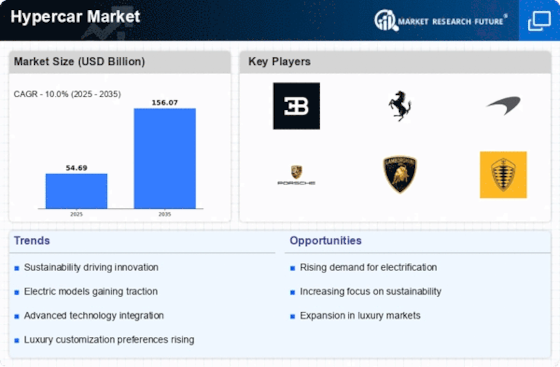
As per Market Research Future analysis, the Hypercar Market Size was estimated at 54.69 USD Billion in 2024. The Hypercar industry is projected to grow from 60.16 USD Billion in 2025 to 156.07 USD Billion by 2035, exhibiting a compound annual growth rate (CAGR) of 10% during the forecast period 2025 - 2035.

Key Market Trends & Highlights

The Hypercar Market is currently experiencing a dynamic shift towards sustainability and customization, driven by technological advancements and luxury consumer demand.

  • The market is witnessing a pronounced focus on sustainability, with manufacturers increasingly adopting eco-friendly practices. Customization trends are gaining traction, allowing consumers to personalize their hypercars to an unprecedented degree. North America remains the largest market, while the Asia-Pacific region is emerging as the fastest-growing segment in hypercar sales. Technological advancements and luxury consumer demand are key drivers propelling the growth of both internal combustion engine and electric engine segments.

Market Size & Forecast

2024 Market Size 54.69 (USD Billion)
2035 Market Size 156.07 (USD Billion)
CAGR (2025 - 2035) 10.0%
Largest Regional Market Share in 2024 North America

Major Players

Bugatti (FR), Ferrari (IT), McLaren (GB), Porsche (DE), Lamborghini (IT), Koenigsegg (SE), Pagani (IT), Aston Martin (GB), Lotus (GB)

Market Trends

The Hypercar Market is currently experiencing a dynamic evolution, characterized by rapid advancements in technology and shifting consumer preferences. Manufacturers are increasingly focusing on integrating cutting-edge features such as hybrid powertrains and advanced aerodynamics, which not only enhance performance but also address environmental concerns. This trend reflects a broader movement towards sustainability within the automotive sector, as consumers become more conscious of their carbon footprint. Additionally, the demand for bespoke and personalized vehicles is on the rise, with buyers seeking unique designs and tailored experiences that set their hypercars apart from conventional offerings.

Moreover, the Hypercar Market is witnessing a surge in interest from emerging economies, where affluent consumers are eager to invest in high-performance electric vehicles. This expansion into new geographical territories presents both opportunities and challenges for manufacturers, as they navigate varying regulatory landscapes and consumer expectations. The interplay between innovation, luxury, and sustainability is likely to shape the future trajectory of this market, as stakeholders strive to balance performance with responsible practices. As the industry progresses, it appears that the High-Performance Car Market will continue to attract attention from enthusiasts and collectors alike, driven by a blend of technological prowess and artistic expression.

Sustainability Focus

The Hypercar Market is increasingly prioritizing sustainability, with manufacturers exploring hybrid and electric powertrains. This shift not only enhances performance but also aligns with growing environmental awareness among consumers.

Customization Trends

There is a notable rise in demand for personalized hypercars, as buyers seek unique designs and tailored features. This trend reflects a desire for exclusivity and individuality in high-performance vehicles.

Emerging Market Growth

The Hyper Sports Car Industry is expanding into emerging economies, where affluent consumers are showing interest in luxury performance vehicles. This growth presents opportunities for manufacturers to tap into new customer bases.

Hyper Car Market Market Drivers

Luxury Consumer Demand

The Hypercar Market is significantly influenced by the rising demand for luxury vehicles among affluent consumers. As wealth distribution continues to evolve, a growing number of individuals are seeking exclusive and high-performance automobiles that offer both status and unparalleled driving experiences. This trend is particularly evident in emerging markets, where the number of high-net-worth individuals is increasing. According to recent data, the luxury car segment is expected to expand by 20% in the next few years, with hypercars representing a substantial portion of this growth. The allure of bespoke features and limited-edition models further fuels consumer interest, making the High-Performance Car Market a focal point for luxury automotive brands.

Environmental Regulations

The Hypercar Market is also shaped by stringent environmental regulations aimed at reducing carbon emissions and promoting sustainability. Governments worldwide are implementing policies that encourage the development of low-emission vehicles, which has prompted hypercar manufacturers to innovate in terms of eco-friendly technologies. The shift towards hybrid and electric hypercars is a direct response to these regulations, as companies strive to meet compliance while maintaining performance standards. As a result, the Ultra-Luxury Sports Car Market is likely to see an increase in models that utilize alternative fuels and advanced battery systems, appealing to environmentally conscious consumers and aligning with global sustainability goals.

Technological Advancements

The Hypercar Market is experiencing a surge in technological advancements, particularly in electric and hybrid powertrains. Manufacturers are increasingly investing in research and development to enhance performance, efficiency, and sustainability. For instance, the integration of advanced aerodynamics and lightweight materials has led to significant improvements in speed and handling. The market is projected to grow at a compound annual growth rate of approximately 15% over the next five years, driven by innovations in battery technology and regenerative braking systems. These advancements not only appeal to performance enthusiasts but also align with the growing consumer demand for environmentally friendly vehicles. As a result, the High-End Performance Vehicle Market is likely to witness a shift towards more sustainable yet high-performance options.

Performance and Speed Enthusiasm

The Hypercar Market thrives on the enthusiasm for performance and speed among automotive aficionados. Enthusiasts are increasingly drawn to vehicles that not only boast impressive horsepower but also deliver exceptional handling and driving dynamics. The demand for hypercars that can achieve 0-60 mph in under three seconds is indicative of this trend. Recent market analysis suggests that hypercars are becoming more accessible, with several manufacturers introducing models at varying price points, thereby expanding their consumer base. This enthusiasm for high-performance vehicles is likely to sustain the growth trajectory of the Hyper Sports Car Industry, as manufacturers continue to push the boundaries of engineering and design.

Investment in Research and Development

Investment in research and development is a critical driver for the Hypercar Market, as manufacturers seek to enhance vehicle performance and integrate cutting-edge technologies. Companies are allocating substantial resources to explore new materials, aerodynamics, and powertrain innovations. This focus on R&D is essential for maintaining competitive advantage in a rapidly evolving market. Recent statistics indicate that leading hypercar manufacturers are increasing their R&D budgets by an average of 10% annually, reflecting the industry's commitment to innovation. As a result, the Hypercar Market is poised for continuous evolution, with new models featuring advanced technologies that cater to the demands of performance-oriented consumers.

Market Segment Insights

By Engine Type: Internal Combustion Engine (Largest) vs. Electric Engine (Fastest-Growing)

The Hyper Car Market is currently dominated by the <a href="https://www.marketresearchfuture.com/reports/internal-combustion-engine-market-28193">Internal Combustion Engine (ICE)</a>, which holds the largest share in the segment. This segment has been favored due to its long-standing performance and the established technology that appeals to enthusiasts seeking power and speed. In contrast, the Electric Engine segment is rapidly gaining traction, driven by increasing environmental awareness and technological advancements in battery technology that enhance the performance of electric hypercars.

Internal Combustion Engine: Performance (Dominant) vs. Electric Engine: Sustainability (Emerging)

The Internal Combustion Engine segment remains dominant in the Hypercar market, characterized by its remarkable performance, sound, and driving experience that are quintessential to hypercar enthusiasts. It offers superior power outputs and is backed by decades of evolution in engine technology, catering to those who prioritize speed and agility. On the other hand, the Electric <a href="https://www.marketresearchfuture.com/reports/engine-market-24300">Engine </a>segment is emerging swiftly, appealing to a new wave of consumers who are increasingly eco-conscious. The impressive torque delivery and instant acceleration of electric hypercars emphasize sustainability without compromising performance. As manufacturers navigate this transition, we can expect a blend of both worlds as they aim to achieve optimal performance while reducing environmental impact.

By Body Type: Coupe (Largest) vs. Convertible (Fastest-Growing)

The Body Type segment within the Hypercars Market showcases distinct preferences among consumers, with coupes holding the largest market share. This dominance is attributed to their sleek designs and performance-focused features that appeal to hypercar enthusiasts. Conversely, convertibles are gaining traction as they offer an exhilarating open-air driving experience, attracting a new demographic of buyers. This shift indicates a diversification in consumer tastes, as more individuals seek unique driving pleasures in their hypercar choices.

Coupe: Dominant vs. Convertible: Emerging

Coupes are currently the dominant body type in the Hypercar Market, characterized by their aerodynamic shapes and performance capabilities. They tend to appeal to traditional hypercar buyers who prioritize speed and handling. On the other hand, convertibles represent the emerging trend, garnering increased interest for their combination of luxury and the thrill of driving with the top down. As more brands innovate in this segment, providing advanced features and unique designs, convertibles are poised to capture more attention and market share from the established coupe segment, influencing future buying trends.

By Power Output: Up to 800 HP (Largest) vs. Above 1200 HP (Fastest-Growing)

The Hypercar Market exhibits a diverse distribution of power outputs with segment values ranging from up to 800 HP to above 1200 HP. The segment 'Up to 800 HP' holds the largest share, appealing to enthusiasts looking for high-performance while maintaining manageable driving dynamics. This segment continues to attract a wide customer base as manufacturers focus on delivering impressive technology that enhances driving experiences without overwhelming power. Conversely, the 'Above 1200 HP' segment is rapidly expanding, driven by technological advancements and the pursuit of extreme performance, attracting buyers who seek unparalleled speed and acceleration in their hypercars.

Up to 800 HP (Dominant) vs. Above 1200 HP (Emerging)

The 'Up to 800 HP' segment remains dominant within the Hypercar Market, primarily attracting performance seekers who prefer a balance between power and drivability. This category includes various models that incorporate cutting-edge technology and engineering excellence, optimizing power delivery and enhancing the overall driving experience. In contrast, the 'Above 1200 HP' segment is emerging as a fierce competitor, fueled by innovations in <a href="https://www.marketresearchfuture.com/reports/hybrid-electric-vehicle-market-35347">hybrid and electric</a> powertrains that unleash an unprecedented level of performance. These hypercars are designed for a niche audience that craves the ultimate in speed and cutting-edge technology, positioning themselves as the epitome of automotive prowess and luxury.

By Price Range: Under $1 million (Largest) vs. $1 million - $3 million (Fastest-Growing)

In the hypercar market, the distribution of sales across different price ranges reveals distinct preferences among consumers. The 'Under $1 million' segment represents the largest proportion of the market, appealing to a broader audience seeking luxury combined with performance. This segment's accessibility plays a crucial role in its dominance, attracting first-time buyers and those who consider hypercars as a milestone purchase. Meanwhile, the '$1 million - $3 million' segment, while smaller, is rapidly gaining traction, showcasing an increasing interest from affluent consumers looking for exclusivity and sophisticated technology in their hypercars.

Price Range: Under $1 Million (Dominant) vs. $1 Million - $3 Million (Emerging)

The 'Under $1 million' segment is characterized by a variety of models that blend high performance with a touch of luxury, making them highly desirable for consumers. Brands in this range focus on delivering exceptional speed and innovative design while maintaining a competitive pricing structure. Conversely, the '$1 million - $3 million' segment features hypercars that offer advanced technologies and bespoke features, catering to a clientele that prioritizes individuality and prestige. This emerging segment is driven by consumers' desire for unique driving experiences, compelling manufacturers to introduce limited-edition models that emphasize customization and craftsmanship.

Get more detailed insights about Hypercar Market Research Report - Global Forecast till 2035

Regional Insights

The Regional segmentation of the Hypercar Market reveals significant diversity and growth potential across various regions. In 2024, North America holds a majority share with a valuation of 6.05 USD Billion, expected to rise to 12.3 USD Billion by 2035, reflecting a robust market growth fueled by high disposable incomes and a strong automotive culture. Europe follows, valued at 4.8 USD Billion in 2024, growing to 9.9 USD Billion in 2035, with key contributions from luxury automotive manufacturers and a growing interest in sustainable technologies.

Asia Pacific, valued at 2.5 USD Billion in 2024 and projected to reach 5.5 USD Billion by 2035, is rapidly emerging due to the rising affluence and interest in automotive performance. South America, while smaller, shows potential with a value of 1.05 USD Billion in 2024, doubling to 2.1 USD Billion by 2035, driven by an increasing appetite for luxury vehicles. The Middle East and Africa, with a valuation of 0.18 USD Billion in 2024, reflects niche market dynamics for hypercars, expected to slightly increase to 0.2 USD Billion by 2035.

Overall, the Hypercar Market statistics illustrate stronger growth trends in established regions, particularly North America and Europe, which dominate due to their advanced automotive industries and consumer bases eager for high-performance vehicles.

Key Players and Competitive Insights

The Hyper Cars Market is characterized by fierce competition among a select group of high-performance automotive manufacturers focused on pushing the boundaries of technology, design, and engineering to create vehicles that offer unrivaled speed and luxury. This segment of the automotive industry is marked by extremely limited production runs, which generate significant consumer interest and cultivate an exclusive brand image. With advancements in electric powertrains and hybrid technologies, various companies are innovating not just in performance but also in terms of sustainability.
Additionally, the High-End Performance Vehicle Market benefits from a well-heeled demographic of customers who prioritize performance, prestige, and impeccable craftsmanship, resulting in aggressive pricing and marketing strategies from manufacturers competing for market share. The presence of luxury brands and their legacy in motorsports further enriches the competitive landscape, as these companies leverage their engineering prowess and brand equity to captivate affluent consumers globally.
McLaren has cemented its status within the Hypercar Market by crafting some of the most revered performance vehicles in the industry. Renowned for their engineering excellence, McLaren’s product lineup includes a variety of highly coveted models, each showcasing cutting-edge technology and a unique design philosophy rooted in aerodynamics. The company has a robust global presence thanks to its strategic distribution channels and engagement with high-profile automotive events that enhance brand visibility. McLaren's strengths lie in its commitment to lightweight construction and high-performance engineering, leveraging its experience in Formula 1 racing to influence its consumer vehicles.
The company's ongoing investment in hybrid technologies exemplifies its resolve to stay ahead of industry trends and cater to rising consumer demand for eco-friendly performance. Additionally, McLaren has made notable advancements in mergers and partnerships that bolster its technological capabilities, positioning itself well for future innovations in the hypercar segment, thus ensuring a competitive edge in the evolving automotive landscape.
In August 2025, a major Chinese vacuum cleaner brand announced plans to build the world’s fastest hypercar, marking a surprising entry into the high-performance EV market. The company aims to challenge established supercar manufacturers through advanced battery and aerodynamic technologies. This move reflects China’s growing ambition in premium EV engineering.
In August 2025, Dreame — known for its 200,000 RPM vacuum motors — announced plans to build an electric hypercar, aiming to challenge the Bugatti Veyron. The company plans to leverage its high-speed motor technology to deliver extreme performance. This marks a surprising and bold entry into the hypercar market.

Key Companies in the Hyper Car Market include

Industry Developments

  • Q2 2024: Bugatti unveils new Tourbillon hybrid hypercar, marking brand’s electrification push Bugatti launched the Tourbillon, a new hybrid hypercar combining a V16 engine with electric motors, signaling the brand’s transition toward electrified high-performance vehicles.
  • Q2 2024: Rimac opens new R&D facility in Croatia to accelerate electric hypercar development Rimac Automobili inaugurated a state-of-the-art research and development center in Croatia, aimed at advancing its electric hypercar technology and expanding production capacity.
  • Q2 2024: Lotus delivers first Evija electric hypercars to customers Lotus began customer deliveries of its Evija, the company’s first all-electric hypercar, marking a milestone in its electrification strategy.
  • Q3 2024: Ferrari appoints Benedetto Vigna as CEO to lead next-gen hypercar strategy Ferrari named Benedetto Vigna as CEO, tasking him with driving innovation and overseeing the launch of new hybrid and electric hypercars.
  • Q3 2024: Koenigsegg announces partnership with CATL for advanced battery systems in future hypercars Koenigsegg entered a strategic partnership with battery giant CATL to co-develop high-performance battery packs for upcoming electric and hybrid hypercar models.
  • Q4 2024: Aston Martin secures $200M funding round to support Valhalla hypercar production Aston Martin raised $200 million in new funding to accelerate the production and delivery of its Valhalla hybrid hypercar.
  • Q4 2024: McLaren launches Solus GT track-only hypercar, limited to 25 units McLaren introduced the Solus GT, a track-exclusive hypercar with a naturally aspirated V10 engine, limited to just 25 units worldwide.
  • Q1 2025: Rimac secures major contract to supply electric drivetrains for new Porsche hypercar Rimac signed a contract to provide electric drivetrain technology for Porsche’s upcoming hypercar, strengthening their technical partnership.
  • Q1 2025: Zenvo Automotive announces new manufacturing facility in Denmark for Aurora hypercar Zenvo Automotive opened a new production facility in Denmark dedicated to manufacturing its Aurora V12 hybrid hypercar.
  • Q2 2025: Mercedes-Benz launches AMG One hypercars with Formula 1 hybrid technology Mercedes-Benz officially launched the AMG One, a hypercar featuring hybrid powertrain technology derived from its Formula 1 program.
  • Q2 2025: Pagani unveils Utopia Roadster, expanding its hypercar lineup Pagani introduced the Utopia Roadster, a new open-top hypercar, further diversifying its portfolio of ultra-luxury performance vehicles.
  • Q2 2025: Rimac Nevera sets new world record for fastest production electric hypercar Rimac announced that its Nevera electric hypercar broke the world record for fastest production EV, achieving unprecedented acceleration and top speed benchmarks.

Future Outlook

Hyper Car Market Future Outlook

The global hypercar market is projected to grow at a 10.0% CAGR from 2025 to 2035, driven by technological advancements, increasing consumer demand, and sustainability initiatives.

New opportunities lie in:

  • Development of electric hypercars with advanced battery technology.
  • Expansion into emerging markets with tailored luxury offerings.
  • Partnerships with tech firms for enhanced vehicle connectivity and automation.

By 2035, the Hypercar Market is expected to solidify its position as a leader in luxury automotive innovation.

Market Segmentation

Hypercar Market Body Type Outlook

  • Coupe
  • Convertible
  • Roadster
  • Sedan

Hypercar Market Engine Type Outlook

  • Internal Combustion Engine
  • Hybrid Engine
  • Electric Engine

Hypercar Market Price Range Outlook

  • Under $1 million
  • $1 million - $3 million
  • Above $3 million

Hypercar Market Power Output Outlook

  • Up to 800 HP
  • 801-1000 HP
  • 1001-1200 HP
  • Above 1200 HP

Report Scope

MARKET SIZE 2024 54.69(USD Billion)
MARKET SIZE 2025 60.16(USD Billion)
MARKET SIZE 2035 156.07(USD Billion)
COMPOUND ANNUAL GROWTH RATE (CAGR) 10.0% (2025 - 2035)
REPORT COVERAGE Revenue Forecast, Competitive Landscape, Growth Factors, and Trends
BASE YEAR 2024
Market Forecast Period 2025 - 2035
Historical Data 2019 - 2024
Market Forecast Units USD Billion
Key Companies Profiled Bugatti (FR), Ferrari (IT), McLaren (GB), Porsche (DE), Lamborghini (IT), Koenigsegg (SE), Pagani (IT), Aston Martin (GB), Lotus (GB)
Segments Covered Engine Type, Body Type, Power Output, Price Range, Regional
Key Market Opportunities Integration of advanced electric powertrains and sustainable materials in the Hypercar Market.
Key Market Dynamics Technological advancements and stringent regulations drive innovation and competition in the hypercar market.
Countries Covered North America, Europe, APAC, South America, MEA

FAQs

What is the current valuation of the Hypercar Market?

<p>The Hypercar Market was valued at 54.69 USD Billion in 2024.</p>

What is the projected market size for the Hypercar Market by 2035?

<p>The Hypercar Market is projected to reach 156.07 USD Billion by 2035.</p>

What is the expected CAGR for the Hypercar Market during the forecast period?

<p>The expected CAGR for the Hypercar Market from 2025 to 2035 is 10.0%.</p>

Which engine type segment has the highest valuation in the Hypercar Market?

<p>The Internal Combustion Engine segment had a valuation range of 20.0 to 50.0 USD Billion.</p>

How does the price range segment perform in the Hypercar Market?

<p>The price range segment shows a valuation from 10.0 to 30.0 USD Billion for vehicles under $1 million.</p>

What are the leading companies in the Hypercar Market?

<p>Key players in the Hypercar Market include Bugatti, Ferrari, McLaren, and Lamborghini.</p>

What is the valuation range for the Hybrid Engine segment?

<p>The Hybrid Engine segment had a valuation range of 15.0 to 40.0 USD Billion.</p>

Which body type segment is expected to perform best in the Hypercar Market?

<p>The Coupe body type segment had a valuation range of 21.87 to 61.83 USD Billion.</p>

What is the valuation range for hypercars with a power output of 1001-1200 HP?

<p>The valuation range for hypercars with a power output of 1001-1200 HP was 20.0 to 50.0 USD Billion.</p>

How does the market for hypercars priced above $3 million compare to others?

<p>The segment for hypercars priced above $3 million had a valuation range of 19.69 to 56.07 USD Billion.</p>

  1. SECTION I: EXECUTIVE SUMMARY AND KEY HIGHLIGHTS
    1. | 1.1 EXECUTIVE SUMMARY
    2. | | 1.1.1 Market Overview
    3. | | 1.1.2 Key Findings
    4. | | 1.1.3 Market Segmentation
    5. | | 1.1.4 Competitive Landscape
    6. | | 1.1.5 Challenges and Opportunities
    7. | | 1.1.6 Future Outlook
  2. SECTION II: SCOPING, METHODOLOGY AND MARKET STRUCTURE
    1. | 2.1 MARKET INTRODUCTION
    2. | | 2.1.1 Definition
    3. | | 2.1.2 Scope of the study
    4. | | | 2.1.2.1 Research Objective
    5. | | | 2.1.2.2 Assumption
    6. | | | 2.1.2.3 Limitations
    7. | 2.2 RESEARCH METHODOLOGY
    8. | | 2.2.1 Overview
    9. | | 2.2.2 Data Mining
    10. | | 2.2.3 Secondary Research
    11. | | 2.2.4 Primary Research
    12. | | | 2.2.4.1 Primary Interviews and Information Gathering Process
    13. | | | 2.2.4.2 Breakdown of Primary Respondents
    14. | | 2.2.5 Forecasting Model
    15. | | 2.2.6 Market Size Estimation
    16. | | | 2.2.6.1 Bottom-Up Approach
    17. | | | 2.2.6.2 Top-Down Approach
    18. | | 2.2.7 Data Triangulation
    19. | | 2.2.8 Validation
  3. SECTION III: QUALITATIVE ANALYSIS
    1. | 3.1 MARKET DYNAMICS
    2. | | 3.1.1 Overview
    3. | | 3.1.2 Drivers
    4. | | 3.1.3 Restraints
    5. | | 3.1.4 Opportunities
    6. | 3.2 MARKET FACTOR ANALYSIS
    7. | | 3.2.1 Value chain Analysis
    8. | | 3.2.2 Porter's Five Forces Analysis
    9. | | | 3.2.2.1 Bargaining Power of Suppliers
    10. | | | 3.2.2.2 Bargaining Power of Buyers
    11. | | | 3.2.2.3 Threat of New Entrants
    12. | | | 3.2.2.4 Threat of Substitutes
    13. | | | 3.2.2.5 Intensity of Rivalry
    14. | | 3.2.3 COVID-19 Impact Analysis
    15. | | | 3.2.3.1 Market Impact Analysis
    16. | | | 3.2.3.2 Regional Impact
    17. | | | 3.2.3.3 Opportunity and Threat Analysis
  4. SECTION IV: QUANTITATIVE ANALYSIS
    1. | 4.1 Automobile, BY Engine Type (USD Billion)
    2. | | 4.1.1 Internal Combustion Engine
    3. | | 4.1.2 Hybrid Engine
    4. | | 4.1.3 Electric Engine
    5. | 4.2 Automobile, BY Body Type (USD Billion)
    6. | | 4.2.1 Coupe
    7. | | 4.2.2 Convertible
    8. | | 4.2.3 Roadster
    9. | | 4.2.4 Sedan
    10. | 4.3 Automobile, BY Power Output (USD Billion)
    11. | | 4.3.1 Up to 800 HP
    12. | | 4.3.2 801-1000 HP
    13. | | 4.3.3 1001-1200 HP
    14. | | 4.3.4 Above 1200 HP
    15. | 4.4 Automobile, BY Price Range (USD Billion)
    16. | | 4.4.1 Under $1 million
    17. | | 4.4.2 $1 million - $3 million
    18. | | 4.4.3 Above $3 million
    19. | 4.5 Automobile, BY Region (USD Billion)
    20. | | 4.5.1 North America
    21. | | | 4.5.1.1 US
    22. | | | 4.5.1.2 Canada
    23. | | 4.5.2 Europe
    24. | | | 4.5.2.1 Germany
    25. | | | 4.5.2.2 UK
    26. | | | 4.5.2.3 France
    27. | | | 4.5.2.4 Russia
    28. | | | 4.5.2.5 Italy
    29. | | | 4.5.2.6 Spain
    30. | | | 4.5.2.7 Rest of Europe
    31. | | 4.5.3 APAC
    32. | | | 4.5.3.1 China
    33. | | | 4.5.3.2 India
    34. | | | 4.5.3.3 Japan
    35. | | | 4.5.3.4 South Korea
    36. | | | 4.5.3.5 Malaysia
    37. | | | 4.5.3.6 Thailand
    38. | | | 4.5.3.7 Indonesia
    39. | | | 4.5.3.8 Rest of APAC
    40. | | 4.5.4 South America
    41. | | | 4.5.4.1 Brazil
    42. | | | 4.5.4.2 Mexico
    43. | | | 4.5.4.3 Argentina
    44. | | | 4.5.4.4 Rest of South America
    45. | | 4.5.5 MEA
    46. | | | 4.5.5.1 GCC Countries
    47. | | | 4.5.5.2 South Africa
    48. | | | 4.5.5.3 Rest of MEA
  5. SECTION V: COMPETITIVE ANALYSIS
    1. | 5.1 Competitive Landscape
    2. | | 5.1.1 Overview
    3. | | 5.1.2 Competitive Analysis
    4. | | 5.1.3 Market share Analysis
    5. | | 5.1.4 Major Growth Strategy in the Automobile
    6. | | 5.1.5 Competitive Benchmarking
    7. | | 5.1.6 Leading Players in Terms of Number of Developments in the Automobile
    8. | | 5.1.7 Key developments and growth strategies
    9. | | | 5.1.7.1 New Product Launch/Service Deployment
    10. | | | 5.1.7.2 Merger & Acquisitions
    11. | | | 5.1.7.3 Joint Ventures
    12. | | 5.1.8 Major Players Financial Matrix
    13. | | | 5.1.8.1 Sales and Operating Income
    14. | | | 5.1.8.2 Major Players R&D Expenditure. 2023
    15. | 5.2 Company Profiles
    16. | | 5.2.1 Bugatti (FR)
    17. | | | 5.2.1.1 Financial Overview
    18. | | | 5.2.1.2 Products Offered
    19. | | | 5.2.1.3 Key Developments
    20. | | | 5.2.1.4 SWOT Analysis
    21. | | | 5.2.1.5 Key Strategies
    22. | | 5.2.2 Ferrari (IT)
    23. | | | 5.2.2.1 Financial Overview
    24. | | | 5.2.2.2 Products Offered
    25. | | | 5.2.2.3 Key Developments
    26. | | | 5.2.2.4 SWOT Analysis
    27. | | | 5.2.2.5 Key Strategies
    28. | | 5.2.3 McLaren (GB)
    29. | | | 5.2.3.1 Financial Overview
    30. | | | 5.2.3.2 Products Offered
    31. | | | 5.2.3.3 Key Developments
    32. | | | 5.2.3.4 SWOT Analysis
    33. | | | 5.2.3.5 Key Strategies
    34. | | 5.2.4 Porsche (DE)
    35. | | | 5.2.4.1 Financial Overview
    36. | | | 5.2.4.2 Products Offered
    37. | | | 5.2.4.3 Key Developments
    38. | | | 5.2.4.4 SWOT Analysis
    39. | | | 5.2.4.5 Key Strategies
    40. | | 5.2.5 Lamborghini (IT)
    41. | | | 5.2.5.1 Financial Overview
    42. | | | 5.2.5.2 Products Offered
    43. | | | 5.2.5.3 Key Developments
    44. | | | 5.2.5.4 SWOT Analysis
    45. | | | 5.2.5.5 Key Strategies
    46. | | 5.2.6 Koenigsegg (SE)
    47. | | | 5.2.6.1 Financial Overview
    48. | | | 5.2.6.2 Products Offered
    49. | | | 5.2.6.3 Key Developments
    50. | | | 5.2.6.4 SWOT Analysis
    51. | | | 5.2.6.5 Key Strategies
    52. | | 5.2.7 Pagani (IT)
    53. | | | 5.2.7.1 Financial Overview
    54. | | | 5.2.7.2 Products Offered
    55. | | | 5.2.7.3 Key Developments
    56. | | | 5.2.7.4 SWOT Analysis
    57. | | | 5.2.7.5 Key Strategies
    58. | | 5.2.8 Aston Martin (GB)
    59. | | | 5.2.8.1 Financial Overview
    60. | | | 5.2.8.2 Products Offered
    61. | | | 5.2.8.3 Key Developments
    62. | | | 5.2.8.4 SWOT Analysis
    63. | | | 5.2.8.5 Key Strategies
    64. | | 5.2.9 Lotus (GB)
    65. | | | 5.2.9.1 Financial Overview
    66. | | | 5.2.9.2 Products Offered
    67. | | | 5.2.9.3 Key Developments
    68. | | | 5.2.9.4 SWOT Analysis
    69. | | | 5.2.9.5 Key Strategies
    70. | 5.3 Appendix
    71. | | 5.3.1 References
    72. | | 5.3.2 Related Reports
  6. LIST OF FIGURES
    1. | 6.1 MARKET SYNOPSIS
    2. | 6.2 NORTH AMERICA MARKET ANALYSIS
    3. | 6.3 US MARKET ANALYSIS BY ENGINE TYPE
    4. | 6.4 US MARKET ANALYSIS BY BODY TYPE
    5. | 6.5 US MARKET ANALYSIS BY POWER OUTPUT
    6. | 6.6 US MARKET ANALYSIS BY PRICE RANGE
    7. | 6.7 CANADA MARKET ANALYSIS BY ENGINE TYPE
    8. | 6.8 CANADA MARKET ANALYSIS BY BODY TYPE
    9. | 6.9 CANADA MARKET ANALYSIS BY POWER OUTPUT
    10. | 6.10 CANADA MARKET ANALYSIS BY PRICE RANGE
    11. | 6.11 EUROPE MARKET ANALYSIS
    12. | 6.12 GERMANY MARKET ANALYSIS BY ENGINE TYPE
    13. | 6.13 GERMANY MARKET ANALYSIS BY BODY TYPE
    14. | 6.14 GERMANY MARKET ANALYSIS BY POWER OUTPUT
    15. | 6.15 GERMANY MARKET ANALYSIS BY PRICE RANGE
    16. | 6.16 UK MARKET ANALYSIS BY ENGINE TYPE
    17. | 6.17 UK MARKET ANALYSIS BY BODY TYPE
    18. | 6.18 UK MARKET ANALYSIS BY POWER OUTPUT
    19. | 6.19 UK MARKET ANALYSIS BY PRICE RANGE
    20. | 6.20 FRANCE MARKET ANALYSIS BY ENGINE TYPE
    21. | 6.21 FRANCE MARKET ANALYSIS BY BODY TYPE
    22. | 6.22 FRANCE MARKET ANALYSIS BY POWER OUTPUT
    23. | 6.23 FRANCE MARKET ANALYSIS BY PRICE RANGE
    24. | 6.24 RUSSIA MARKET ANALYSIS BY ENGINE TYPE
    25. | 6.25 RUSSIA MARKET ANALYSIS BY BODY TYPE
    26. | 6.26 RUSSIA MARKET ANALYSIS BY POWER OUTPUT
    27. | 6.27 RUSSIA MARKET ANALYSIS BY PRICE RANGE
    28. | 6.28 ITALY MARKET ANALYSIS BY ENGINE TYPE
    29. | 6.29 ITALY MARKET ANALYSIS BY BODY TYPE
    30. | 6.30 ITALY MARKET ANALYSIS BY POWER OUTPUT
    31. | 6.31 ITALY MARKET ANALYSIS BY PRICE RANGE
    32. | 6.32 SPAIN MARKET ANALYSIS BY ENGINE TYPE
    33. | 6.33 SPAIN MARKET ANALYSIS BY BODY TYPE
    34. | 6.34 SPAIN MARKET ANALYSIS BY POWER OUTPUT
    35. | 6.35 SPAIN MARKET ANALYSIS BY PRICE RANGE
    36. | 6.36 REST OF EUROPE MARKET ANALYSIS BY ENGINE TYPE
    37. | 6.37 REST OF EUROPE MARKET ANALYSIS BY BODY TYPE
    38. | 6.38 REST OF EUROPE MARKET ANALYSIS BY POWER OUTPUT
    39. | 6.39 REST OF EUROPE MARKET ANALYSIS BY PRICE RANGE
    40. | 6.40 APAC MARKET ANALYSIS
    41. | 6.41 CHINA MARKET ANALYSIS BY ENGINE TYPE
    42. | 6.42 CHINA MARKET ANALYSIS BY BODY TYPE
    43. | 6.43 CHINA MARKET ANALYSIS BY POWER OUTPUT
    44. | 6.44 CHINA MARKET ANALYSIS BY PRICE RANGE
    45. | 6.45 INDIA MARKET ANALYSIS BY ENGINE TYPE
    46. | 6.46 INDIA MARKET ANALYSIS BY BODY TYPE
    47. | 6.47 INDIA MARKET ANALYSIS BY POWER OUTPUT
    48. | 6.48 INDIA MARKET ANALYSIS BY PRICE RANGE
    49. | 6.49 JAPAN MARKET ANALYSIS BY ENGINE TYPE
    50. | 6.50 JAPAN MARKET ANALYSIS BY BODY TYPE
    51. | 6.51 JAPAN MARKET ANALYSIS BY POWER OUTPUT
    52. | 6.52 JAPAN MARKET ANALYSIS BY PRICE RANGE
    53. | 6.53 SOUTH KOREA MARKET ANALYSIS BY ENGINE TYPE
    54. | 6.54 SOUTH KOREA MARKET ANALYSIS BY BODY TYPE
    55. | 6.55 SOUTH KOREA MARKET ANALYSIS BY POWER OUTPUT
    56. | 6.56 SOUTH KOREA MARKET ANALYSIS BY PRICE RANGE
    57. | 6.57 MALAYSIA MARKET ANALYSIS BY ENGINE TYPE
    58. | 6.58 MALAYSIA MARKET ANALYSIS BY BODY TYPE
    59. | 6.59 MALAYSIA MARKET ANALYSIS BY POWER OUTPUT
    60. | 6.60 MALAYSIA MARKET ANALYSIS BY PRICE RANGE
    61. | 6.61 THAILAND MARKET ANALYSIS BY ENGINE TYPE
    62. | 6.62 THAILAND MARKET ANALYSIS BY BODY TYPE
    63. | 6.63 THAILAND MARKET ANALYSIS BY POWER OUTPUT
    64. | 6.64 THAILAND MARKET ANALYSIS BY PRICE RANGE
    65. | 6.65 INDONESIA MARKET ANALYSIS BY ENGINE TYPE
    66. | 6.66 INDONESIA MARKET ANALYSIS BY BODY TYPE
    67. | 6.67 INDONESIA MARKET ANALYSIS BY POWER OUTPUT
    68. | 6.68 INDONESIA MARKET ANALYSIS BY PRICE RANGE
    69. | 6.69 REST OF APAC MARKET ANALYSIS BY ENGINE TYPE
    70. | 6.70 REST OF APAC MARKET ANALYSIS BY BODY TYPE
    71. | 6.71 REST OF APAC MARKET ANALYSIS BY POWER OUTPUT
    72. | 6.72 REST OF APAC MARKET ANALYSIS BY PRICE RANGE
    73. | 6.73 SOUTH AMERICA MARKET ANALYSIS
    74. | 6.74 BRAZIL MARKET ANALYSIS BY ENGINE TYPE
    75. | 6.75 BRAZIL MARKET ANALYSIS BY BODY TYPE
    76. | 6.76 BRAZIL MARKET ANALYSIS BY POWER OUTPUT
    77. | 6.77 BRAZIL MARKET ANALYSIS BY PRICE RANGE
    78. | 6.78 MEXICO MARKET ANALYSIS BY ENGINE TYPE
    79. | 6.79 MEXICO MARKET ANALYSIS BY BODY TYPE
    80. | 6.80 MEXICO MARKET ANALYSIS BY POWER OUTPUT
    81. | 6.81 MEXICO MARKET ANALYSIS BY PRICE RANGE
    82. | 6.82 ARGENTINA MARKET ANALYSIS BY ENGINE TYPE
    83. | 6.83 ARGENTINA MARKET ANALYSIS BY BODY TYPE
    84. | 6.84 ARGENTINA MARKET ANALYSIS BY POWER OUTPUT
    85. | 6.85 ARGENTINA MARKET ANALYSIS BY PRICE RANGE
    86. | 6.86 REST OF SOUTH AMERICA MARKET ANALYSIS BY ENGINE TYPE
    87. | 6.87 REST OF SOUTH AMERICA MARKET ANALYSIS BY BODY TYPE
    88. | 6.88 REST OF SOUTH AMERICA MARKET ANALYSIS BY POWER OUTPUT
    89. | 6.89 REST OF SOUTH AMERICA MARKET ANALYSIS BY PRICE RANGE
    90. | 6.90 MEA MARKET ANALYSIS
    91. | 6.91 GCC COUNTRIES MARKET ANALYSIS BY ENGINE TYPE
    92. | 6.92 GCC COUNTRIES MARKET ANALYSIS BY BODY TYPE
    93. | 6.93 GCC COUNTRIES MARKET ANALYSIS BY POWER OUTPUT
    94. | 6.94 GCC COUNTRIES MARKET ANALYSIS BY PRICE RANGE
    95. | 6.95 SOUTH AFRICA MARKET ANALYSIS BY ENGINE TYPE
    96. | 6.96 SOUTH AFRICA MARKET ANALYSIS BY BODY TYPE
    97. | 6.97 SOUTH AFRICA MARKET ANALYSIS BY POWER OUTPUT
    98. | 6.98 SOUTH AFRICA MARKET ANALYSIS BY PRICE RANGE
    99. | 6.99 REST OF MEA MARKET ANALYSIS BY ENGINE TYPE
    100. | 6.100 REST OF MEA MARKET ANALYSIS BY BODY TYPE
    101. | 6.101 REST OF MEA MARKET ANALYSIS BY POWER OUTPUT
    102. | 6.102 REST OF MEA MARKET ANALYSIS BY PRICE RANGE
    103. | 6.103 KEY BUYING CRITERIA OF AUTOMOBILE
    104. | 6.104 RESEARCH PROCESS OF MRFR
    105. | 6.105 DRO ANALYSIS OF AUTOMOBILE
    106. | 6.106 DRIVERS IMPACT ANALYSIS: AUTOMOBILE
    107. | 6.107 RESTRAINTS IMPACT ANALYSIS: AUTOMOBILE
    108. | 6.108 SUPPLY / VALUE CHAIN: AUTOMOBILE
    109. | 6.109 AUTOMOBILE, BY ENGINE TYPE, 2024 (% SHARE)
    110. | 6.110 AUTOMOBILE, BY ENGINE TYPE, 2024 TO 2035 (USD Billion)
    111. | 6.111 AUTOMOBILE, BY BODY TYPE, 2024 (% SHARE)
    112. | 6.112 AUTOMOBILE, BY BODY TYPE, 2024 TO 2035 (USD Billion)
    113. | 6.113 AUTOMOBILE, BY POWER OUTPUT, 2024 (% SHARE)
    114. | 6.114 AUTOMOBILE, BY POWER OUTPUT, 2024 TO 2035 (USD Billion)
    115. | 6.115 AUTOMOBILE, BY PRICE RANGE, 2024 (% SHARE)
    116. | 6.116 AUTOMOBILE, BY PRICE RANGE, 2024 TO 2035 (USD Billion)
    117. | 6.117 BENCHMARKING OF MAJOR COMPETITORS
  7. LIST OF TABLES
    1. | 7.1 LIST OF ASSUMPTIONS
    2. | | 7.1.1
    3. | 7.2 North America MARKET SIZE ESTIMATES; FORECAST
    4. | | 7.2.1 BY ENGINE TYPE, 2025-2035 (USD Billion)
    5. | | 7.2.2 BY BODY TYPE, 2025-2035 (USD Billion)
    6. | | 7.2.3 BY POWER OUTPUT, 2025-2035 (USD Billion)
    7. | | 7.2.4 BY PRICE RANGE, 2025-2035 (USD Billion)
    8. | 7.3 US MARKET SIZE ESTIMATES; FORECAST
    9. | | 7.3.1 BY ENGINE TYPE, 2025-2035 (USD Billion)
    10. | | 7.3.2 BY BODY TYPE, 2025-2035 (USD Billion)
    11. | | 7.3.3 BY POWER OUTPUT, 2025-2035 (USD Billion)
    12. | | 7.3.4 BY PRICE RANGE, 2025-2035 (USD Billion)
    13. | 7.4 Canada MARKET SIZE ESTIMATES; FORECAST
    14. | | 7.4.1 BY ENGINE TYPE, 2025-2035 (USD Billion)
    15. | | 7.4.2 BY BODY TYPE, 2025-2035 (USD Billion)
    16. | | 7.4.3 BY POWER OUTPUT, 2025-2035 (USD Billion)
    17. | | 7.4.4 BY PRICE RANGE, 2025-2035 (USD Billion)
    18. | 7.5 Europe MARKET SIZE ESTIMATES; FORECAST
    19. | | 7.5.1 BY ENGINE TYPE, 2025-2035 (USD Billion)
    20. | | 7.5.2 BY BODY TYPE, 2025-2035 (USD Billion)
    21. | | 7.5.3 BY POWER OUTPUT, 2025-2035 (USD Billion)
    22. | | 7.5.4 BY PRICE RANGE, 2025-2035 (USD Billion)
    23. | 7.6 Germany MARKET SIZE ESTIMATES; FORECAST
    24. | | 7.6.1 BY ENGINE TYPE, 2025-2035 (USD Billion)
    25. | | 7.6.2 BY BODY TYPE, 2025-2035 (USD Billion)
    26. | | 7.6.3 BY POWER OUTPUT, 2025-2035 (USD Billion)
    27. | | 7.6.4 BY PRICE RANGE, 2025-2035 (USD Billion)
    28. | 7.7 UK MARKET SIZE ESTIMATES; FORECAST
    29. | | 7.7.1 BY ENGINE TYPE, 2025-2035 (USD Billion)
    30. | | 7.7.2 BY BODY TYPE, 2025-2035 (USD Billion)
    31. | | 7.7.3 BY POWER OUTPUT, 2025-2035 (USD Billion)
    32. | | 7.7.4 BY PRICE RANGE, 2025-2035 (USD Billion)
    33. | 7.8 France MARKET SIZE ESTIMATES; FORECAST
    34. | | 7.8.1 BY ENGINE TYPE, 2025-2035 (USD Billion)
    35. | | 7.8.2 BY BODY TYPE, 2025-2035 (USD Billion)
    36. | | 7.8.3 BY POWER OUTPUT, 2025-2035 (USD Billion)
    37. | | 7.8.4 BY PRICE RANGE, 2025-2035 (USD Billion)
    38. | 7.9 Russia MARKET SIZE ESTIMATES; FORECAST
    39. | | 7.9.1 BY ENGINE TYPE, 2025-2035 (USD Billion)
    40. | | 7.9.2 BY BODY TYPE, 2025-2035 (USD Billion)
    41. | | 7.9.3 BY POWER OUTPUT, 2025-2035 (USD Billion)
    42. | | 7.9.4 BY PRICE RANGE, 2025-2035 (USD Billion)
    43. | 7.10 Italy MARKET SIZE ESTIMATES; FORECAST
    44. | | 7.10.1 BY ENGINE TYPE, 2025-2035 (USD Billion)
    45. | | 7.10.2 BY BODY TYPE, 2025-2035 (USD Billion)
    46. | | 7.10.3 BY POWER OUTPUT, 2025-2035 (USD Billion)
    47. | | 7.10.4 BY PRICE RANGE, 2025-2035 (USD Billion)
    48. | 7.11 Spain MARKET SIZE ESTIMATES; FORECAST
    49. | | 7.11.1 BY ENGINE TYPE, 2025-2035 (USD Billion)
    50. | | 7.11.2 BY BODY TYPE, 2025-2035 (USD Billion)
    51. | | 7.11.3 BY POWER OUTPUT, 2025-2035 (USD Billion)
    52. | | 7.11.4 BY PRICE RANGE, 2025-2035 (USD Billion)
    53. | 7.12 Rest of Europe MARKET SIZE ESTIMATES; FORECAST
    54. | | 7.12.1 BY ENGINE TYPE, 2025-2035 (USD Billion)
    55. | | 7.12.2 BY BODY TYPE, 2025-2035 (USD Billion)
    56. | | 7.12.3 BY POWER OUTPUT, 2025-2035 (USD Billion)
    57. | | 7.12.4 BY PRICE RANGE, 2025-2035 (USD Billion)
    58. | 7.13 APAC MARKET SIZE ESTIMATES; FORECAST
    59. | | 7.13.1 BY ENGINE TYPE, 2025-2035 (USD Billion)
    60. | | 7.13.2 BY BODY TYPE, 2025-2035 (USD Billion)
    61. | | 7.13.3 BY POWER OUTPUT, 2025-2035 (USD Billion)
    62. | | 7.13.4 BY PRICE RANGE, 2025-2035 (USD Billion)
    63. | 7.14 China MARKET SIZE ESTIMATES; FORECAST
    64. | | 7.14.1 BY ENGINE TYPE, 2025-2035 (USD Billion)
    65. | | 7.14.2 BY BODY TYPE, 2025-2035 (USD Billion)
    66. | | 7.14.3 BY POWER OUTPUT, 2025-2035 (USD Billion)
    67. | | 7.14.4 BY PRICE RANGE, 2025-2035 (USD Billion)
    68. | 7.15 India MARKET SIZE ESTIMATES; FORECAST
    69. | | 7.15.1 BY ENGINE TYPE, 2025-2035 (USD Billion)
    70. | | 7.15.2 BY BODY TYPE, 2025-2035 (USD Billion)
    71. | | 7.15.3 BY POWER OUTPUT, 2025-2035 (USD Billion)
    72. | | 7.15.4 BY PRICE RANGE, 2025-2035 (USD Billion)
    73. | 7.16 Japan MARKET SIZE ESTIMATES; FORECAST
    74. | | 7.16.1 BY ENGINE TYPE, 2025-2035 (USD Billion)
    75. | | 7.16.2 BY BODY TYPE, 2025-2035 (USD Billion)
    76. | | 7.16.3 BY POWER OUTPUT, 2025-2035 (USD Billion)
    77. | | 7.16.4 BY PRICE RANGE, 2025-2035 (USD Billion)
    78. | 7.17 South Korea MARKET SIZE ESTIMATES; FORECAST
    79. | | 7.17.1 BY ENGINE TYPE, 2025-2035 (USD Billion)
    80. | | 7.17.2 BY BODY TYPE, 2025-2035 (USD Billion)
    81. | | 7.17.3 BY POWER OUTPUT, 2025-2035 (USD Billion)
    82. | | 7.17.4 BY PRICE RANGE, 2025-2035 (USD Billion)
    83. | 7.18 Malaysia MARKET SIZE ESTIMATES; FORECAST
    84. | | 7.18.1 BY ENGINE TYPE, 2025-2035 (USD Billion)
    85. | | 7.18.2 BY BODY TYPE, 2025-2035 (USD Billion)
    86. | | 7.18.3 BY POWER OUTPUT, 2025-2035 (USD Billion)
    87. | | 7.18.4 BY PRICE RANGE, 2025-2035 (USD Billion)
    88. | 7.19 Thailand MARKET SIZE ESTIMATES; FORECAST
    89. | | 7.19.1 BY ENGINE TYPE, 2025-2035 (USD Billion)
    90. | | 7.19.2 BY BODY TYPE, 2025-2035 (USD Billion)
    91. | | 7.19.3 BY POWER OUTPUT, 2025-2035 (USD Billion)
    92. | | 7.19.4 BY PRICE RANGE, 2025-2035 (USD Billion)
    93. | 7.20 Indonesia MARKET SIZE ESTIMATES; FORECAST
    94. | | 7.20.1 BY ENGINE TYPE, 2025-2035 (USD Billion)
    95. | | 7.20.2 BY BODY TYPE, 2025-2035 (USD Billion)
    96. | | 7.20.3 BY POWER OUTPUT, 2025-2035 (USD Billion)
    97. | | 7.20.4 BY PRICE RANGE, 2025-2035 (USD Billion)
    98. | 7.21 Rest of APAC MARKET SIZE ESTIMATES; FORECAST
    99. | | 7.21.1 BY ENGINE TYPE, 2025-2035 (USD Billion)
    100. | | 7.21.2 BY BODY TYPE, 2025-2035 (USD Billion)
    101. | | 7.21.3 BY POWER OUTPUT, 2025-2035 (USD Billion)
    102. | | 7.21.4 BY PRICE RANGE, 2025-2035 (USD Billion)
    103. | 7.22 South America MARKET SIZE ESTIMATES; FORECAST
    104. | | 7.22.1 BY ENGINE TYPE, 2025-2035 (USD Billion)
    105. | | 7.22.2 BY BODY TYPE, 2025-2035 (USD Billion)
    106. | | 7.22.3 BY POWER OUTPUT, 2025-2035 (USD Billion)
    107. | | 7.22.4 BY PRICE RANGE, 2025-2035 (USD Billion)
    108. | 7.23 Brazil MARKET SIZE ESTIMATES; FORECAST
    109. | | 7.23.1 BY ENGINE TYPE, 2025-2035 (USD Billion)
    110. | | 7.23.2 BY BODY TYPE, 2025-2035 (USD Billion)
    111. | | 7.23.3 BY POWER OUTPUT, 2025-2035 (USD Billion)
    112. | | 7.23.4 BY PRICE RANGE, 2025-2035 (USD Billion)
    113. | 7.24 Mexico MARKET SIZE ESTIMATES; FORECAST
    114. | | 7.24.1 BY ENGINE TYPE, 2025-2035 (USD Billion)
    115. | | 7.24.2 BY BODY TYPE, 2025-2035 (USD Billion)
    116. | | 7.24.3 BY POWER OUTPUT, 2025-2035 (USD Billion)
    117. | | 7.24.4 BY PRICE RANGE, 2025-2035 (USD Billion)
    118. | 7.25 Argentina MARKET SIZE ESTIMATES; FORECAST
    119. | | 7.25.1 BY ENGINE TYPE, 2025-2035 (USD Billion)
    120. | | 7.25.2 BY BODY TYPE, 2025-2035 (USD Billion)
    121. | | 7.25.3 BY POWER OUTPUT, 2025-2035 (USD Billion)
    122. | | 7.25.4 BY PRICE RANGE, 2025-2035 (USD Billion)
    123. | 7.26 Rest of South America MARKET SIZE ESTIMATES; FORECAST
    124. | | 7.26.1 BY ENGINE TYPE, 2025-2035 (USD Billion)
    125. | | 7.26.2 BY BODY TYPE, 2025-2035 (USD Billion)
    126. | | 7.26.3 BY POWER OUTPUT, 2025-2035 (USD Billion)
    127. | | 7.26.4 BY PRICE RANGE, 2025-2035 (USD Billion)
    128. | 7.27 MEA MARKET SIZE ESTIMATES; FORECAST
    129. | | 7.27.1 BY ENGINE TYPE, 2025-2035 (USD Billion)
    130. | | 7.27.2 BY BODY TYPE, 2025-2035 (USD Billion)
    131. | | 7.27.3 BY POWER OUTPUT, 2025-2035 (USD Billion)
    132. | | 7.27.4 BY PRICE RANGE, 2025-2035 (USD Billion)
    133. | 7.28 GCC Countries MARKET SIZE ESTIMATES; FORECAST
    134. | | 7.28.1 BY ENGINE TYPE, 2025-2035 (USD Billion)
    135. | | 7.28.2 BY BODY TYPE, 2025-2035 (USD Billion)
    136. | | 7.28.3 BY POWER OUTPUT, 2025-2035 (USD Billion)
    137. | | 7.28.4 BY PRICE RANGE, 2025-2035 (USD Billion)
    138. | 7.29 South Africa MARKET SIZE ESTIMATES; FORECAST
    139. | | 7.29.1 BY ENGINE TYPE, 2025-2035 (USD Billion)
    140. | | 7.29.2 BY BODY TYPE, 2025-2035 (USD Billion)
    141. | | 7.29.3 BY POWER OUTPUT, 2025-2035 (USD Billion)
    142. | | 7.29.4 BY PRICE RANGE, 2025-2035 (USD Billion)
    143. | 7.30 Rest of MEA MARKET SIZE ESTIMATES; FORECAST
    144. | | 7.30.1 BY ENGINE TYPE, 2025-2035 (USD Billion)
    145. | | 7.30.2 BY BODY TYPE, 2025-2035 (USD Billion)
    146. | | 7.30.3 BY POWER OUTPUT, 2025-2035 (USD Billion)
    147. | | 7.30.4 BY PRICE RANGE, 2025-2035 (USD Billion)
    148. | 7.31 PRODUCT LAUNCH/PRODUCT DEVELOPMENT/APPROVAL
    149. | | 7.31.1
    150. | 7.32 ACQUISITION/PARTNERSHIP
    151. | | 7.32.1

Automobile Market Segmentation

Automobile By Engine Type (USD Billion, 2025-2035)

  • Internal Combustion Engine
  • Hybrid Engine
  • Electric Engine

Automobile By Body Type (USD Billion, 2025-2035)

  • Coupe
  • Convertible
  • Roadster
  • Sedan

Automobile By Power Output (USD Billion, 2025-2035)

  • Up to 800 HP
  • 801-1000 HP
  • 1001-1200 HP
  • Above 1200 HP

Automobile By Price Range (USD Billion, 2025-2035)

  • Under $1 million
  • $1 million - $3 million
  • Above $3 million
Infographic

Free Sample Request

Kindly complete the form below to receive a free sample of this Report

Get Free Sample

Customer Strories

Compare Licence

×
Features License Type
Single User Multiuser License Enterprise User
Price $4,950 $5,950 $7,250
Maximum User Access Limit 1 User Upto 10 Users Unrestricted Access Throughout the Organization
Free Customization
Direct Access to Analyst
Deliverable Format
Platform Access
Discount on Next Purchase 10% 15% 15%
Printable Versions
%>