Hypercar Market (2026 - 2035)

Hypercar Market Research Report By Propulsion Type (ICE, Hybrid, Battery Electric), By End Use (Private, Racing), By Vehicle Type (Coupe, Convertible, Roadster), By Engine Capacity (Compact, Mid-Size, Full-Size) - Forecast to 2035
ID: MRFR/AT/6473-HCR 100 Pages Shubham Munde, Sejal Akre Last Updated: October 17, 2026
Hypercar Market
Market Size
Forecast Period2026-2035
CAGR (2026-2035)17.27%
2025 Market SizeUSD 21.47 Billion
2035 Market SizeUSD 106.46 Billion
Key Players
Ferrari N.V.
Automobili Lamborghini
McLaren Automotive
Bugatti Rimac
Porsche AG
Aston Martin Lagonda
Opportunities
  • New Buyers in the Gulf and South Asia
  • Connected Ownership and Data-Driven Services
  • Synthetic Fuels for Collectible Engines

Hypercar Market Summary

The global Hypercar Market was valued at USD 21.47 billion in 2025 and is projected to reach USD 25.38 billion in 2026, then expand to USD 106.46 billion by 2035 at a CAGR of 17.27% over 2026–2035. Two catalysts anchor that path. The world's ultra-high-net-worth population rose 4.4% in 2024 to roughly 2.34 million people [1], widening the pool of buyers who can commit seven-figure deposits. Meanwhile, the FIA Hypercar class has pulled nine manufacturers onto the World Endurance Championship grid [5], tying road-car launches directly to racing programmes.

"We're rebuilding powertrains from scratch. Naturally aspirated and twin-turbo V8 and V12 engines are being replaced by hybrid systems with smaller combustion units and axle motors and 800-volt battery-electric platforms. Ferrari established an e-building in Maranello (EUR 200 million) in 2024 to assemble hybrid and electric drivetrains in-house [3]. The Euro 7 Regulation (EU) 2024/1257 enforces stricter particle and durability requirements for each new type approval [2]. For ultra-high-performance cars, electrification is no longer a compliance cost but a lap-time weapon.


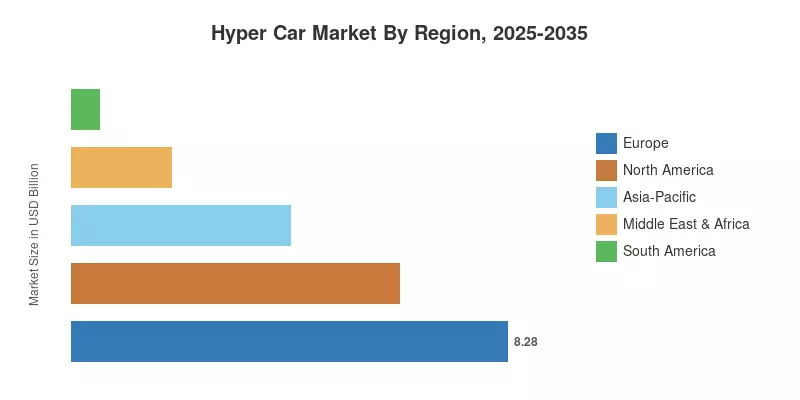
Europe has the highest share at 38.57% in 2025, supported by manufacturing clusters in Italy, Germany, Britain and Croatia. Asia-Pacific is the fastest-expanding area with a CAGR of 19.38%, led by first-generation wealth in China, India and Southeast Asia. North America is the second at USD 6.23 billion, backed by excellent auction liquidity and broad collector networks. There will be a bias toward buyers who did not exist as a category 10 years ago in the next decade’s growth.


Key Report Takeaways

• By Propulsion Type

  • ICE powertrains held 61.94% of Hypercar Market revenue in 2025, sustained by collector demand for signature engine character
  • Battery Electric models are advancing at a 19.30% CAGR through 2035
  • Hybrid configurations generated USD 5.80 billion in 2025

• By End Use

  • Private ownership captured 87.96% of revenue in 2025
  • Racing applications are forecast to grow at a 19.32% CAGR

• By Vehicle Type

  • Coupe body styles led the Hypercar Market with a 75.16% share in 2025
  • Roadster variants post the fastest growth at a 19.39% CAGR

• By Engine Capacity

  • Full-Size engines accounted for 88.04% of 2025 revenue
  • Compact engines are expanding at a 19.36% CAGR as hybrid boost lifts specific output

• By Region

  • Europe commanded a 38.57% share in 2025
  • Asia-Pacific is the fastest-growing region at a 19.38% CAGR
  • North America was valued at USD 6.23 billion in 2025

Market Size and Forecast (2021–2035)

Estimates for the Hypercar Market are a mixture of manufacturer delivery disclosures, yearly reports from listed OEMs such as Ferrari, Porsche and Aston Martin [3][8], registration data, auction records and primary interviews with dealers and allocation managers. Historical values were reconciled to unit shipments times confirmed transaction prices, then forecasted by demand-side wealth indicators[1][22] and published production schedules.
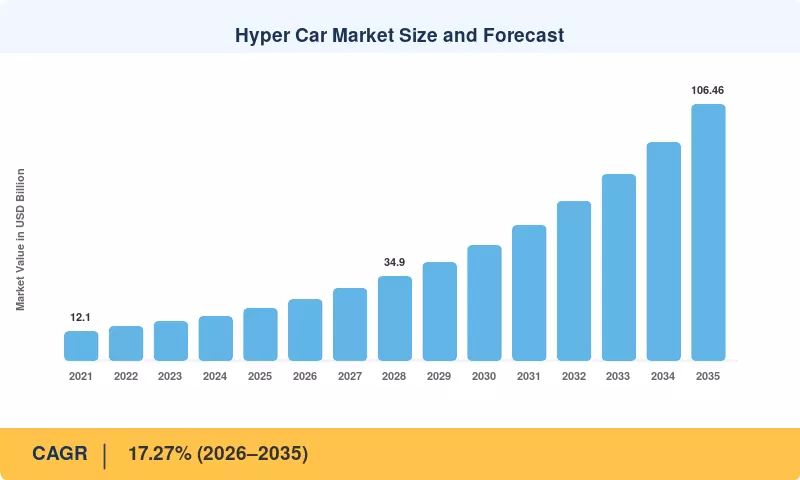
Hyper Car Market Size and Forecast
Our Impact

Enabled $4.3B Revenue Impact for Fortune 500 and Leading Multinationals

Partnering with 2000+ Global Organizations Each Year

30K+ Citations by Top-Tier Firms in the Industry

Driver Impact Analysis

Driver ~% Impact on CAGR Geographic Relevance Impact Timeline
Ultra-high-net-worth wealth creation +3.1% Asia-Pacific, Middle East Long-term (≥4 yr)
Electrified performance powertrains +2.6% Global Medium-term (2–4 yr)
Endurance racing homologation links +1.8% Europe, North America Medium-term (2–4 yr)
Scarcity-led collector appreciation +1.6% North America, Europe Short-term (≤2 yr)
Lightweight composites and digital design +1.2% Global Long-term (≥4 yr)
Bespoke personalization programmes +0.9% Global Short-term (≤2 yr)


Ultra-High-Net-Worth Wealth Creation

Buyer supply sets the ceiling for this category, and that ceiling keeps rising. Knight Frank counted about 2.34 million individuals with net assets above USD 30 million in 2024, a 4.4% annual gain [1], with Asia and the Gulf contributing a growing share of new entrants. Capgemini's World Wealth Report 2025 likewise recorded expanding high-net-worth populations across major regions [22]. Every new cohort lengthens waiting lists, letting manufacturers raise prices on successive models without softening allocation demand.

Electrified Performance Powertrains

Hybridization now defines flagship performance. Ferrari's F80 combines a 3.0-litre V6 with electric motors for 1,200 cv of system output [3], and Bugatti's Tourbillon pairs a naturally aspirated V16 with three motors for 1,800 PS . Rimac's Nevera R pushes battery-electric output beyond 2,000 hp [17]. Electric torque fill improves acceleration and lap times while letting brands meet Euro 7 durability requirements [2], turning compliance spending into a selling point.

Endurance Racing Homologation Links

Racing has become a product-development engine again. The 2024 FIA World Endurance Championship Hypercar class fielded entries from nine manufacturers [5], and Ferrari's 499P won Le Mans in 2023 [24], 2024 and 2025. Regulations that allow road-relevant hybrid systems let OEMs amortize powertrain research across racing and road programmes. Track-only derivatives priced above USD 3 million extend revenue from the same engineering base.

Scarcity-Led Collector Appreciation

Production caps convert vehicles into appreciating assets. Ferrari limited the F80 to 799 units [3], and McLaren capped the W1 at 399 [6], with allocations reportedly committed before public unveiling. Ferrari reported 13,752 total shipments in 2024 alongside an order book stretching into 2026 [3]. Strong auction results for earlier limited models reinforce buyer confidence that new commitments will hold or gain value.

Lightweight Composites and Digital Design

Material and design advances shorten development cycles and lower the barrier for smaller brands. McLaren's W1 uses an aerospace-grade carbon monocoque to hold dry weight near 1,400 kg [6], while Koenigsegg's Gemera HV8 integrates a compact hybrid V8 into a four-seat carbon structure [18]. Additive manufacturing and simulation-driven aerodynamics cut prototype iterations by months, letting newer entrants reach low-volume production with less capital.

Bespoke Personalization Programmes

Personalization lifts average transaction values without adding production volume. Lamborghini's Ad Personam and Porsche's Exclusive Manufaktur programmes offer paint, trim and carbon packages that can add 10–15% to list price [7][8]. Customers commissioning one-off specifications commit earlier and accept longer lead times. Bespoke divisions also generate repeat engagement, strengthening a brand's ability to select buyers for future limited runs.

Restraints Impact Analysis

Restraint percentages are directional estimates of downward pressure on the Hypercar Market CAGR. Like the driver figures, they are not additive and indicate relative severity rather than precise subtraction from headline growth.

Restraint ~% Impact on CAGR Geographic Relevance Impact Timeline
Titanium and carbon fibre supply fragility −1.4% Global Medium-term (2–4 yr)
Cash intensity of low-volume production −1.1% Europe, North America Long-term (≥4 yr)
Emissions compliance costs −0.9% Europe Medium-term (2–4 yr)
Ultra-fast charging gaps −0.8% Global Long-term (≥4 yr)
Tariffs and luxury taxation −0.7% China, United States Short-term (≤2 yr)


Titanium and Carbon Fibre Supply Fragility

Aerospace-grade titanium and carbon fibre compete with defence and commercial aviation orders. The US Geological Survey reports heavy import reliance for titanium sponge following the end of domestic production , and sanctions on Russian suppliers have tightened availability. Hypercar builders, ordering small batches, sit at the back of supplier queues, which can delay deliveries by quarters and inflate component costs.

Cash Intensity of Low-Volume Production

Developing a clean-sheet flagship can cost several hundred million dollars, recovered across a few hundred units. Aston Martin reported a pre-tax loss of roughly GBP 289 million for 2024 , and McLaren's automotive business moved under CYVN Holdings ownership after repeated recapitalizations [23]. Weak balance sheets limit how many programmes smaller brands can fund simultaneously.

Emissions Compliance Costs

Euro 7 extends emission durability and adds brake-particle limits [2], while Regulation (EU) 2023/851 sets a 100% CO2 reduction target for new cars from 2035 [12]. Small-volume derogations offer partial relief, but manufacturers still face testing, certification and powertrain redesign costs spread over very few units, raising per-vehicle compliance burden.

Ultra-Fast Charging Gaps

Public charging points exceeded five million worldwide in 2024, according to the IEA [11], yet only a small fraction deliver more than 350 kW. Battery-electric hypercars capable of 800-volt charging rarely find matching infrastructure on touring routes, which limits their appeal as grand-touring vehicles and confines many to track and short-distance use.

Tariffs and Luxury Taxation

China lowered its luxury car consumption-tax threshold to RMB 900,000 in July 2025, applying a 10% surcharge to more imported models . The United States imposed Section 232 tariffs on imported vehicles in 2025 [14], later adjusted for EU-built cars under a trade framework. European-built flagships absorb these costs or pass them on, testing price tolerance in two major demand centres.

Hypercar Market Opportunities

New Buyers in the Gulf and South Asia

Saudi Arabia's Vision 2030 Quality of Life Program is funding motorsport venues, including the Qiddiya speed park and the Jeddah Corniche circuit [21], creating local demand for track-capable machines. India's growing billionaire base is drawing dedicated showrooms in Mumbai and Delhi. Brands that build regional delivery, servicing and climate-specific specifications early can capture first-generation loyalty.

Connected Ownership and Data-Driven Services

Telemetry from hypercars has value beyond diagnostics. Manufacturers can sell subscription track coaching, lap-data analytics, remote performance calibration and digital provenance records that verify ownership history and service events. Factory-managed track programmes, where cars are stored and maintained by the OEM, create recurring revenue and strengthen residual values for the Hypercar Market.

Synthetic Fuels for Collectible Engines

Regulation (EU) 2023/851 leaves room for vehicles running exclusively on CO2-neutral fuels [12], and Porsche's investment in the HIF Haru Oni e-fuel pilot plant in Chile demonstrates early production [16]. E-fuel supply agreements bundled with combustion flagships could protect the long-term usability of engine-led models and support resale prices.

Customer Racing and Track-Only Derivatives

Track-only variants built from Le Mans Hypercar technology, such as Ferrari's 499P Modificata and Aston Martin's Valkyrie AMR Pro, command prices above road versions while avoiding homologation costs. Expanding customer racing series and gentleman-driver programmes monetizes engineering already funded by works teams.

Hypercar Market Future Outlook

The Electrification Supercycle

Global electric car sales exceeded 17 million in 2024, per the IEA [11], and BloombergNEF expects continued pack-cost declines through the decade [15]. Electric hypercar technology will benefit from silicon-carbide inverters, higher-density cells and 800-volt-plus architectures. By the early 2030s, most new flagships will carry at least partial electrification, with pure battery-electric models gaining share in China and the Nordics.

AI-Driven Design and Digital Twins

Generative design and machine-learning aerodynamics are compressing development timelines from five years toward three. Digital twins let engineers validate chassis, cooling and crash structures before physical prototypes, cutting costs for low-volume programmes. Smaller entrants gain the most, since software-led workflows offset limited test facilities and narrow the gap with established OEMs.

Sustainability Reporting and Material Traceability

The EU Battery Regulation (EU) 2023/1542 introduces carbon-footprint declarations and recycled-content requirements for traction batteries [19]. Manufacturers will need traceable supply chains for cells, carbon fibre and titanium. Recycled carbon fibre, natural-fibre composites and low-carbon aluminium will move from marketing features to procurement requirements over the forecast period.

Platform Economics and Owner Communities

OEMs are building closed ecosystems around ownership: invitation-only events, factory track days, digital provenance and preferred access to future models. These communities raise switching costs and give brands pricing power across product generations. Mercedes-Benz's AMG ONE programme [20] and Ferrari's client-racing series show how owner networks turn single purchases into multi-decade relationships.

Regional Market Share Analysis

Region Metric (One per Row) Primary Investment Themes
North America USD 6.23 B (2025) Collector auctions, track clubs, BEV flagships
Europe Share: 38.57% OEM clusters, hybrid R&D, Euro 7 compliance
Asia-Pacific CAGR: 19.38% First-generation wealth, new dealer networks
South America Share: 2.52% Niche collectors, import-duty constraints
Middle East & Africa USD 1.89 B (2025) Motorsport venues, Gulf allocations
Total USD 21.47 B (2025) —

Regional demand in the Hypercar Market follows wealth concentration, local racing culture and import policy. Europe hosts most manufacturing, while growth momentum is shifting east and south.


North America

Country Metric (One per Row) Key Driver
US Share of region: 86.4% Auction liquidity, collector concentration
Canada USD 0.52 B (2025) Private track communities
Mexico CAGR: 14.8% Emerging luxury dealerships


The United States anchors the regional Hypercar Market through deep collector networks, concours events at Pebble Beach and Amelia Island, and auction houses that set global price benchmarks. Section 232 tariffs introduced in 2025 [14] raised landed costs for European flagships, yet allocation demand held firm because buyers committed deposits years earlier. Canada's demand clusters in Toronto and Vancouver, while Mexico benefits from expanding authorized dealer presence in Monterrey and Mexico City.

Europe

Country Metric (One per Row) Key Driver
Germany USD 2.07 B (2025) Porsche and Mercedes-AMG engineering base
UK Share of region: 18.6% McLaren, Aston Martin, London buyers
France CAGR: 15.2% Bugatti heritage, Le Mans proximity
Italy USD 1.12 B (2025) Ferrari, Lamborghini, Pagani clusters
Spain Share of region: 4.1% Coastal collector demand
Nordic Countries CAGR: 16.4% Koenigsegg, BEV adoption
Russia Share of region: 2.3% Sanctions limit official supply
Rest of Europe USD 1.36 B (2025) Switzerland, Monaco wealth hubs


Europe combines the densest manufacturing base with mature buyers. Italy's Motor Valley, Germany's engineering centres and the UK's motorsport corridor supply most global volume, while Monaco and Switzerland concentrate ownership. Euro 7 [2] and the 2035 CO2 target [12] are pushing every European OEM toward hybrid and electric flagships, making the region the testbed for compliance-ready performance.

Asia-Pacific

Country Metric (One per Row) Key Driver
China Share of region: 41.2% Young entrepreneur buyers, BEV familiarity
India CAGR: 22.8% Billionaire growth, new showrooms
Japan USD 0.78 B (2025) Established collector culture
South Korea Share of region: 7.8% Chaebol-linked wealth
ASEAN CAGR: 20.4% Singapore, Thailand, Malaysia hubs
Rest of Asia-Pacific USD 0.63 B (2025) Australia, Taiwan demand


Asia-Pacific is the growth frontier of the Hypercar Market. China's buyers are younger and more comfortable with electric drivetrains, though the 2025 luxury-tax adjustment adds cost at the top end. India's expanding billionaire population supports dedicated brand boutiques, and Singapore serves as a regional delivery and storage hub for Southeast Asian collectors.

South America

Country Metric (One per Row) Key Driver
Brazil Share of region: 58.4% São Paulo collector base
Argentina USD 0.07 B (2025) Limited imports, currency volatility
Rest of South America CAGR: 13.9% Chile, Colombia wealth growth


South America remains a niche region. Brazil's high import duties push buyers toward grey imports or overseas ownership, while Argentina's currency controls restrict official deliveries. Chile's stable economy and Colombia's expanding wealth base offer modest upside as brands extend authorized service networks.

Middle East & Africa

Country Metric (One per Row) Key Driver
Saudi Arabia CAGR: 19.1% Vision 2030 motorsport venues
UAE Share of region: 46.8% Dubai and Abu Dhabi allocations
South Africa USD 0.14 B (2025) Johannesburg and Cape Town collectors
Egypt Share of region: 2.9% Small high-net-worth base
Rest of MEA USD 0.34 B (2025) Qatar, Kuwait, Bahrain buyers


The Gulf has become a priority allocation zone. Dubai's tax environment and dealer density make the UAE the regional anchor, while Saudi Arabia's investment in circuits and events [21] is building a new owner base. Abu Dhabi's CYVN Holdings now owns McLaren's automotive business [23], tying the region to manufacturing as well as demand.

Hyper Car Market By Region, 2025-2035

Hypercar Market Segmentation

Segmentation of the Hypercar Market follows four dimensions: propulsion type, end use, vehicle type and engine capacity. Each table discloses one metric per segment.

By Propulsion Type

Segment Metric (One per Row) Primary Demand Driver
ICE Share: 61.94% Collector demand for engine character
Hybrid USD 5.80 B (2025) Lap-time gains with emissions compliance
Battery Electric CAGR: 19.30% Instant torque, 800-volt platforms


Within the Hypercar Market, ICE models still lead revenue because collectors prize the sound and heritage of V8, V12 and W16 engines. Hybrid systems are the bridge, adding electric torque fill that improves acceleration while satisfying Euro 7 rules [2]. Battery Electric models such as the Rimac Nevera R [17] grow fastest, though charging gaps and residual-value uncertainty moderate near-term uptake. Expect hybrid share to widen steadily as combustion-only launches thin out after 2030.

By End Use

Segment Metric (One per Row) Primary Demand Driver
Private Share: 87.96% Scarcity, provenance, investment value
Racing CAGR: 19.32% Le Mans Hypercar rules, customer series


Private buyers dominate the Hypercar Market, valuing exclusivity, provenance and long-term appreciation. Manufacturers reinforce that behaviour by capping runs below 1,000 units and prioritizing loyal clients. Racing grows faster because FIA Hypercar regulations [5] encourage road-relevant technology, and track-only derivatives open a premium channel for clients who want competition machinery without homologation limits. Customer racing series also generate parts and service revenue.

By Vehicle Type

Segment Metric (One per Row) Primary Demand Driver
Coupe Share: 75.16% Torsional rigidity, aerodynamic efficiency
Convertible USD 3.12 B (2025) Grand-touring versatility
Roadster CAGR: 19.39% Open-air experience, warm-climate buyers


Coupe designs lead the Hypercar Market because fixed roofs deliver the stiffness and downforce needed above 350 km/h. Convertible models offer retractable-roof flexibility for grand touring, appealing to buyers who use cars on public roads. Roadster variants grow fastest as Gulf and Californian buyers seek open-air drama, and carbon tubs now limit the weight penalty of roof deletion to tens of kilograms.

By Engine Capacity

Segment Metric (One per Row) Primary Demand Driver
Compact CAGR: 19.36% Hybrid boost, emissions downsizing
Mid-Size USD 1.73 B (2025) Twin-turbo V6 hybrid platforms
Full-Size Share: 88.04% V8, V12 and V16 flagship heritage


Full-Size engines above 2,500 cc define the Hypercar Market today, from Bugatti's V16 to Lamborghini's V12 [7]. Mid-Size units in the 1,500–2,500 cc band serve hybrid platforms that rely on turbocharging and motors for output. Compact engines below 1,500 cc grow fastest as Euro 7 real-driving tests favour smaller swept volumes, with electric assist replacing displacement as the performance lever.

Competitive Benchmarking

The Hypercar Market is moderately concentrated with an estimated Herfindahl-Hirschman Index of 1,000-1,300. The top five manufacturers account for an estimated 55-65% of income, topped by Ferrari, Lamborghini, McLaren, Bugatti Rimac and Porsche. As for the long tail, it’s still fragmenting. Boutique builders such as Koenigsegg, Pagani and Czinger compete on extreme exclusivity, not volume.

Company Est. Revenue Share Range Key Offerings for Hypercar Market Strategic Positioning
Ferrari N.V. ~17–21% F80, SF90 XX, 499P Modificata Hybrid leadership, Le Mans halo
Automobili Lamborghini ~12–15% Revuelto, limited V12 specials V12 hybrid, personalization
McLaren Automotive ~9–12% W1, Senna, Elva Lightweight carbon, Gulf ownership
Bugatti Rimac ~8–11% Tourbillon, Nevera R Ultra-luxury V16 hybrid and BEV
Porsche AG ~7–10% 918 successor programme, GT specials Racing-derived engineering, e-fuels
Aston Martin Lagonda ~5–7% Valkyrie, Valhalla F1-linked aero, WEC entry
Mercedes-AMG ~4–6% AMG ONE F1 hybrid powertrain transfer
Koenigsegg Automotive ~3–5% Jesko, Gemera HV8 In-house powertrains, record runs
Pagani Automobili ~2–4% Utopia, Utopia Roadster Artisanal craft, manual gearboxes
Czinger Vehicles ~1–2% 21C Additive manufacturing
Hennessey Performance ~1–2% Venom F5 American top-speed specialist


Recent News & Developments

  • Automobili Lamborghini (March 2023): Unveiled the Revuelto, its first V12 plug-in hybrid flagship, signalling that electrification would not displace the brand's signature engine [7]
  • Ferrari (June 2023): The 499P won the 24 Hours of Le Mans on Ferrari's return to top-class endurance racing, strengthening the technology halo for hybrid road cars [24]
  • Koenigsegg (August 2023): Announced the Gemera HV8 with a twin-turbo V8 hybrid, replacing the planned three-cylinder setup after customer demand [18]
  • European Union (April 2024): Adopted the Euro 7 Regulation, adding brake-particle and durability requirements affecting every new hypercar type approval [2]
  • Bugatti Rimac (June 2024): Revealed the Tourbillon, a 1,800 PS V16 hybrid limited to 250 units, replacing the Chiron line
  • Ferrari (October 2024): Launched the F80, a 1,200 cv hybrid limited to 799 units, Ferrari's most powerful road car [3]
  • McLaren Automotive (October 2024): Revealed the W1 with a 1,275 PS hybrid V8, limited to 399 units [6]
  • CYVN Holdings and McLaren Group (December 2024): Agreed to bring McLaren Automotive under Abu Dhabi-based ownership, reinforcing Gulf influence on the sector [23]

Hypercar Market Report Scope

Parameter Details
Market Scope Global Hypercar Market by Propulsion Type, End Use, Vehicle Type, Engine Capacity and Region
Study Period 2021–2035 (Historical: 2021–2024; Base Year: 2025; Forecast: 2026–2035)
CAGR 17.27% (2026–2035)
Market Size Checkpoints USD 21.47 B (2025); USD 25.38 B (2026); USD 48.00 B (2030); USD 106.46 B (2035)
Fastest Growing Segments Battery Electric, Racing, Roadster, Compact, Asia-Pacific
Companies Profiled Ferrari, Lamborghini, McLaren, Bugatti Rimac, Porsche, Aston Martin, Mercedes-AMG, Koenigsegg, Pagani, Czinger, Hennessey
Valuation Currency USD Billion
CAGR Driver Disclaimer Driver and restraint impacts are directional and not additive to headline CAGR.

FAQs

How does the Hypercar Market respond to economic downturns?
Multi-year order books cushion demand in the Hypercar Market because allocations and deposits are committed well before delivery. Ferrari's order book already extended into 2026 at the end of 2024 [3].
What should first-time buyers check before securing an allocation?
Purchase history with the brand matters most, since manufacturers prioritise existing clients for limited builds. Buyers should also confirm homologation for their country, because some limited runs are not certified everywhere.
Do hybrid hypercars hold value better than battery-electric models?
Hybrids with signature engines currently achieve firmer resale prices. Battery degradation concerns weigh on electric residuals, a gap the Hypercar Market expects to narrow as certified battery-health reports become standard [11].
How do synthetic fuels affect long-term combustion ownership?
EU rules leave room for vehicles running only on CO2-neutral fuels after 2035, protecting collectible engines [12]. E-fuel output remains small, so that prices will stay well above conventional fuel for years [16].
Which ownership models are emerging in the Hypercar Market beyond outright purchase?
Factory-managed track programmes and fractional syndicates are expanding. They widen the buyer pool in the Hypercar Market without breaking production caps.
How does motorsport homologation influence road-car pricing?
Road cars sharing technology with Le Mans Hypercar entries carry a credibility premium. Ferrari's consecutive Le Mans wins strengthened that halo for the F80 [3][24].
Why are running costs important for Hypercar Market buyers?
Agreed-value insurance, enclosed transport and factory-only servicing create high recurring costs. Annual premiums commonly run 1–2% of vehicle value, so buyers should budget beyond the purchase price.
Author
Author Author Profile Shubham Munde LinkedIn Team Lead - Research
Shubham brings over 7 years of expertise in Market Intelligence and Strategic Consulting, with a strong focus on the Automotive, Aerospace, and Defense sectors. Backed by a solid foundation in semiconductors, electronics, and software, he has successfully delivered high-impact syndicated and custom research on a global scale. His core strengths include market sizing, forecasting, competitive intelligence, consumer insights, and supply chain mapping. Widely recognized for developing scalable growth strategies, Shubham empowers clients to navigate complex markets and achieve a lasting competitive edge. Trusted by start-ups and Fortune 500 companies alike, he consistently converts challenges into strategic opportunities that drive sustainable growth.
Co-Author Co-Author Profile Sejal Akre LinkedIn Senior Research Analyst
She has over 5 years of rich experience, in market research and consulting providing valuable market insights to client. Hands on expertise in management consulting, and extensive knowledge in domain including ICT, Automotive & Transportation and Aerospace & Defense. She is skilled in Go-to market strategy, industry analysis, market sizing, in depth company profiling, competitive intelligence & benchmarking and value chain amongst others.
Download Free Sample

Kindly complete the form below to receive a free sample of this Report

Download PDF ×

We do not share your information with anyone. However, we may send you emails based on your report interest from time to time. You may contact us at any time to opt-out.


















