×
Request Free Sample ×

Kindly complete the form below to receive a free sample of this Report

* Please use a valid business email

Leading companies partner with us for data-driven Insights

clients tt-cursor
Hero Background
English
Chinese
French
Japanese
Korean
German
Spanish

Hydrogenated Styrene Block Copolymers Market Trends

ID: MRFR/CnM/2763-HCR
140 Pages
Chitranshi Jaiswal
October 2025

Hydrogenated Styrene Block Copolymers Market by Type (Styrene Ethylene Propylene Styrene (SEPS), Styrene Ethylene Butylene Styrene (SEBS)) by Application (Coating, Films, Adhesives, Sealants, and Others), by End Use Industry (Construction, Automotive, Footwear, Chemicals, Healthcare and Others), and by Region till 2030

Share:
Download PDF ×

We do not share your information with anyone. However, we may send you emails based on your report interest from time to time. You may contact us at any time to opt-out.

Hydrogenated Styrene Block Copolymers Market Infographic
Purchase Options

Market Trends

Key Emerging Trends in the Hydrogenated Styrene Block Copolymers Market

The Hydrogenated Styrene Block Copolymers (HSBC) market is currently witnessing significant trends that reflect the ongoing dynamism in the polymer/plastic industries. In various sectors there have been shifts in demand and applications for Thermoplastic elastomers known as HSBCs.

One notable trend is increased use of these copolymers in automotive industry. They are used for numerous car parts like seals, gaskets and weather-stripping because they possess excellent elastic properties plus resistance towards chemicals & UV radiation which makes them durable among other reasons this replacement will reduce cost which means better fuel efficiency and durability.

Furthermore; there has been an upsurge of demand for HSBCs by medical/ healthcare markets today. Biocompatible materials having flexibility and resistance against methods of sterilization are typically needed in making devices used by medics such as tubing, gaskets together with seals hence leading to utilization of copolymer substances herein which continue expanding into vital areas due to the advanced medical devices being developed by healthcare industry.

The HSBC market is also witnessing innovations in formulation to cater for specific industry needs. Manufacturers are spending on research and development so as to come up with HSBCs that have tailored properties such as higher tensile strengths, improved heat resistance and optimized processability. This trend is driven by the need for versatile copolymers solving the diverse problems of different industries.

In terms of technological advancements, the HSBC market is experiencing innovations in production methods to enhance efficiency and reduce environmental impact. Advanced polymerization techniques, sustainable sourcing of raw materials and development of HSBCs having improved performance characteristics are some of what manufacturers are looking at. This trend coincides with a wider push toward green chemistry and sustainability in polymer manufacturing in general.

Author
Chitranshi Jaiswal
Research Analyst Level I

In her 3 years of experience in the market research field, she has handled critical cross-domain projects. She has an in-depth knowledge of market estimation & analysis, problem-solving, primary as well as secondary research, and team management.She holds an engineering degree and is an MBA professional from a well-known university, capable of evaluating the market and competitive conditions. An exceptional strategist with excellent communication skills and a passion for delivering cutting-edge & practical insights for the market. Proficient in multi-tasking, and can successfully deal with competing demands, while maintaining complete confidentiality. Generated business through active client and project development, networking, and high-quality responses. Her knowledge and skills have helped in making solid business decisions, securing funding from investors, and avoiding business failures.

Leave a Comment

FAQs

What is hydrogenated styrene block copolymers and its major applications?

Hydrogenated styrene block copolymers (HSBC) are highly engineered polymeric materials that find wide applications in coatings, films, adhesives, and sealants.

What are major end-use industries of hydrogenated styrene block copolymers?

Construction, automotive, footwear, chemicals, and healthcare are major end-use industries of hydrogenated styrene block copolymers.

What are the major tailwinds pushing the growth of the global hydrogenated styrene block copolymers market?

Increasing demand from across the end-user industries, Rising disposable income.

Which region holds the largest share in the global hydrogenated styrene block copolymers market?

Asia Pacific holds the largest share in the global hydrogenated styrene block copolymers market, followed by North America and Europe, respectively.

Who are the top players in the global hydrogenated styrene block copolymers market?

China Petrochemical Corporation (China), Kraton Corporation (Japan), LYC GROUP (Taiwan), The Hexpol group of companies (UK), Grupo Dynasol (US), and Teknor Apex (US), are some of the major players operating in the hydrogenated styrene block copolymers market.

Market Summary

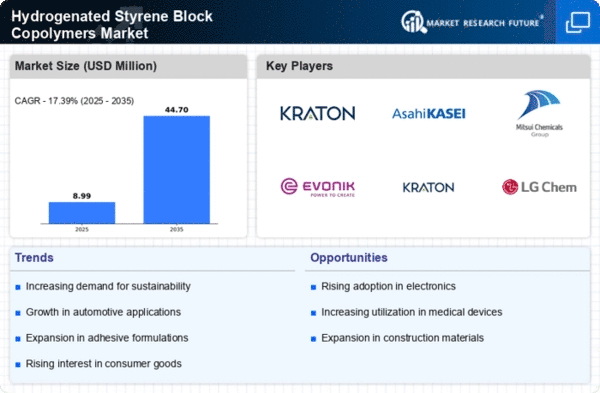
As per MRFR analysis, the Hydrogenated Styrene Block Copolymers Market Size was estimated at 7.66 USD Million in 2024. The Hydrogenated Styrene Block Copolymers industry is projected to grow from 8.99 in 2025 to 44.7 by 2035, exhibiting a compound annual growth rate (CAGR) of 17.39 during the forecast period 2025 - 2035.

Key Market Trends & Highlights

The Hydrogenated Styrene Block Copolymers Market is poised for robust growth driven by sustainability and technological advancements.

  • The market is witnessing a pronounced shift towards sustainability, influencing product development and consumer preferences.
  • North America remains the largest market, while Asia-Pacific is emerging as the fastest-growing region, reflecting diverse regional demands.
  • In the adhesives segment, hydrogenated styrene block copolymers dominate, whereas the sealants segment is experiencing rapid growth.
  • Key market drivers include sustainability initiatives and technological innovations, which are shaping the future landscape of applications.

Market Size & Forecast

2024 Market Size 7.66 (USD Million)
2035 Market Size 44.7 (USD Million)
CAGR (2025 - 2035) 17.39%
Largest Regional Market Share in 2024 North America

Major Players

Kraton Corporation (US), Asahi Kasei Corporation (JP), Mitsui Chemicals, Inc. (JP), Evonik Industries AG (DE), Kraton Polymers (US), LG Chem Ltd. (KR), BASF SE (DE), TotalEnergies SE (FR), SABIC (SA)

Market Trends

The Hydrogenated Styrene Block Copolymers Market is currently experiencing a notable evolution, driven by various factors that influence its growth trajectory. This market encompasses a range of applications, including adhesives, sealants, and coatings, which are increasingly favored for their superior performance characteristics. The versatility of hydrogenated styrene block copolymers, combined with their ability to enhance product durability and flexibility, positions them as a preferred choice across multiple industries. Furthermore, the ongoing advancements in polymer technology appear to be fostering innovation, leading to the development of new formulations that cater to specific customer needs. In addition to technological advancements, the Hydrogenated Styrene Block Copolymers Market is also shaped by shifting consumer preferences towards sustainable and eco-friendly materials. As industries strive to reduce their environmental impact, the demand for materials that offer both performance and sustainability is likely to rise. This trend suggests a growing inclination towards products that not only meet functional requirements but also align with broader environmental goals. Consequently, the market is poised for continued growth, as stakeholders adapt to these evolving dynamics and seek to capitalize on emerging opportunities.

Sustainability Focus

The Hydrogenated Styrene Block Copolymers Market is increasingly influenced by a shift towards sustainable practices. Manufacturers are exploring eco-friendly alternatives and formulations that minimize environmental impact, responding to consumer demand for greener products. This trend indicates a potential for growth in applications that prioritize sustainability.

Technological Advancements

Ongoing innovations in polymer technology are shaping the Hydrogenated Styrene Block Copolymers Market. New formulations and processing techniques are being developed, enhancing the performance characteristics of these materials. This trend suggests that advancements may lead to broader applications and increased market penetration.

Diverse Applications

The versatility of hydrogenated styrene block copolymers is driving their adoption across various sectors. From adhesives to coatings, the range of applications continues to expand, reflecting the material's adaptability. This trend indicates a robust potential for market growth as industries seek high-performance solutions.

Hydrogenated Styrene Block Copolymers Market Market Drivers

Market Growth Projections

The Global Hydrogenated Styrene Block Copolymers Market Industry is projected to experience substantial growth over the next decade. With a market value anticipated to reach 2500 USD Million by 2024 and potentially doubling to 5000 USD Million by 2035, the industry is poised for a robust expansion. The compound annual growth rate of 6.5% from 2025 to 2035 indicates a strong upward trajectory, driven by increasing applications across various sectors, including automotive, consumer goods, and construction. This growth reflects the rising demand for high-performance materials that meet the evolving needs of industries and consumers alike.

Growth in Consumer Goods Sector

The Global Hydrogenated Styrene Block Copolymers Market Industry is also benefiting from the expanding consumer goods sector. These copolymers are favored for their versatility and ability to enhance product performance in various applications, including adhesives, sealants, and coatings. As consumer preferences shift towards high-quality and durable products, manufacturers are increasingly incorporating hydrogenated styrene block copolymers into their offerings. This trend is expected to drive market growth, with projections indicating a market value of around 5000 USD Million by 2035, reflecting a robust compound annual growth rate of 6.5% from 2025 to 2035.

Advancements in Polymer Technology

Technological advancements in polymer science are playing a pivotal role in the Global Hydrogenated Styrene Block Copolymers Market Industry. Innovations in production techniques and formulations are enhancing the properties of these materials, making them more appealing for various applications. For instance, improved processing methods are enabling manufacturers to produce copolymers with tailored characteristics, such as enhanced thermal stability and chemical resistance. This evolution in technology not only broadens the application scope but also supports the anticipated market growth, as industries seek high-performance materials to meet stringent regulatory standards and consumer demands.

Sustainability Trends in Manufacturing

The Global Hydrogenated Styrene Block Copolymers Market Industry is increasingly influenced by sustainability trends in manufacturing. As industries strive to reduce their environmental footprint, there is a growing emphasis on using eco-friendly materials. Hydrogenated styrene block copolymers, which can be produced with lower emissions and energy consumption, are gaining traction as a sustainable alternative. This shift aligns with global initiatives aimed at promoting greener production practices. Consequently, manufacturers are likely to invest in these materials, further propelling market growth and contributing to a more sustainable future in various sectors.

Rising Demand in Automotive Applications

The Global Hydrogenated Styrene Block Copolymers Market Industry is experiencing a surge in demand, particularly within the automotive sector. These materials are increasingly utilized for their excellent elasticity and durability, making them ideal for automotive parts such as bumpers and interior components. The automotive industry is projected to contribute significantly to the market, with estimates suggesting that by 2024, the market could reach approximately 2500 USD Million. This trend indicates a growing preference for lightweight and high-performance materials, which hydrogenated styrene block copolymers provide, thereby enhancing vehicle efficiency and performance.

Regulatory Support for Advanced Materials

Regulatory frameworks supporting the use of advanced materials are contributing to the growth of the Global Hydrogenated Styrene Block Copolymers Market Industry. Governments worldwide are implementing policies that encourage the adoption of innovative materials in various applications, particularly in construction and automotive sectors. These regulations often focus on enhancing product safety and performance while minimizing environmental impact. As a result, manufacturers are more inclined to utilize hydrogenated styrene block copolymers, which comply with these regulations, thereby fostering market expansion and ensuring that products meet the evolving standards set by regulatory bodies.


Market Segment Insights

By Application: Adhesives (Largest) vs. Sealants (Fastest-Growing)

In the Hydrogenated Styrene Block Copolymers Market, the application segment is dominated by adhesives, which hold the largest market share, attributed to their widespread use in various industrial and consumer applications. Sealants are emerging strongly, capturing the attention of manufacturers and consumers alike due to their enhanced performance characteristics, such as flexibility and durability, making them suitable for diverse applications including construction and automotive sectors.

Adhesives (Dominant) vs. Sealants (Emerging)

Adhesives play a dominant role in the Hydrogenated Styrene Block Copolymers Market, primarily due to their critical function in creating strong bonds in packaging, automotive, and consumer goods. Their versatility, coupled with an ability to adhere to a variety of surfaces, ensures their continued preference among end-users. On the other hand, sealants are gaining traction as an emerging segment, fueled by the increasing demand for durable and weather-resistant solutions in construction and automotive industries. This drive for performance enhancement lends sealants a competitive edge, positioning them for robust growth in the coming years.

By End Use: Automotive (Largest) vs. Medical Devices (Fastest-Growing)

The Hydrogenated Styrene Block Copolymers (HSBC) market is characterized by diverse end uses, with the automotive sector accounting for the largest market share. This is driven by the increasing integration of eco-friendly materials in automotive applications and the enhanced performance properties offered by HSBC in various components. Following closely are the consumer goods and electronics sectors, which also exhibit significant usage of these polymers, particularly for products requiring flexibility and durability. In the current market landscape, the medical devices end use category is recognized as the fastest-growing segment, fueled by the rising demand for advanced healthcare solutions. Increasing investments in medical technology and innovations have further accelerated the growth of HSBC in medical applications. Alongside, the construction sector remains stable in its use but is witnessing growth in specialized applications, creating opportunities for market expansion across multiple industries.

Automotive: Dominant vs. Medical Devices: Emerging

In the Hydrogenated Styrene Block Copolymers market, the automotive segment is the dominant force, capitalizing on the demand for lightweight and durable materials that enhance vehicle performance and fuel efficiency. Automotive applications such as interior components, exterior trims, and under-the-hood parts benefit remarkably from the unique properties of HSBC, including their thermal stability and resistance to environmental factors. Conversely, the medical devices segment is becoming increasingly relevant, showing strong growth potential due to the rising need for high-quality, safe, and flexible materials in healthcare applications. Medical devices manufacturers are now leveraging HSBC for items like syringes, tubing, and flexible devices where biocompatibility and safety are critical, thus making it a promising area for future expansion.

By Formulation Type: Styrene-Ethylene-Butylene-Styrene (Largest) vs. Styrene-Isoprene-Styrene (Fastest-Growing)

In the Hydrogenated Styrene Block Copolymers market, the segment values showcase diverse applications and preferences among users. Styrene-Ethylene-Butylene-Styrene (SEBS) continues to hold the largest market share, driven by its superior flexibility and impact resistance, making it ideal for various applications including adhesives, coatings, and sealants. Alongside SEBS, Styrene-Isoprene-Styrene (SIS) is increasingly becoming prominent, with its growing use in medical and consumer goods due to its unique properties that support high-performance applications.

Styrene-Ethylene-Butylene-Styrene (Dominant) vs. Styrene-Isoprene-Styrene (Emerging)

Styrene-Ethylene-Butylene-Styrene (SEBS) is recognized for its exceptional chemical resistance and rubber-like elasticity, positioning it as the dominant formulation in the Hydrogenated Styrene Block Copolymers market. Its versatility is evident across industries such as automotive, construction, and healthcare, where durability and resilience are essential. In contrast, Styrene-Isoprene-Styrene (SIS) is emerging rapidly, particularly in lightweight applications where flexibility and cost-effectiveness are critical. Its growth is spurred by increasing demand from sectors seeking innovative materials for packaging and consumer products, thereby contributing to its status as the fastest-growing segment.

By Processing Technique: Injection Molding (Largest) vs. Extrusion (Fastest-Growing)

In the Hydrogenated Styrene Block Copolymers Market, Injection Molding commands the largest share due to its widespread application across various industries, including automotive and consumer goods. This segment benefits from its ability to produce complex shapes and high precision, which is crucial for product performance and aesthetic value. Following closely, Extrusion has emerged as a viable contender, capturing increased attention especially in the production of films and sheets, and is recognized for its efficiency in continuous production processes.

Processing Techniques: Injection Molding (Dominant) vs. Extrusion (Emerging)

Injection Molding stands as the dominant processing technique in the Hydrogenated Styrene Block Copolymers Market, primarily due to its efficiency in creating intricate geometries while maintaining dimensional accuracy. This technique is favored for producing items such as toys, in automotive applications, and in packaging due to its versatility and cost-effectiveness. On the other hand, Extrusion is marked as an emerging technique, resonating with manufacturers seeking innovative solutions. It enables continuous production at a lower cost, making it ideal for creating films and sheets with varying thicknesses. As industries aim for faster production times and reduced waste, Extrusion is rapidly gaining traction, indicating a shift in preference towards this processing method.

By Physical Properties: Hardness (Largest) vs. Elasticity (Fastest-Growing)

In the Hydrogenated Styrene Block Copolymers Market, the distribution of market share among the physical properties exhibits notable trends. Hardness stands out as the largest segment, reflecting the demand for materials that offer superior hardness properties essential for industrial applications. Conversely, elasticity is recognized as the fastest-growing segment, driven by the increasing requirements for flexible materials in a variety of consumer products, indicating a shift towards versatile material properties.

Hardness: (Dominant) vs. Elasticity (Emerging)

Hardness remains the dominant characteristic in the Hydrogenated Styrene Block Copolymers Market, providing key advantages for applications in the automotive and construction sectors where durability is paramount. This property ensures long-lasting performance under stress and impact. Elasticity, on the other hand, is emerging rapidly due to its adaptability in consumer goods, contributing to innovative designs and functionality. As manufacturers seek materials that improve usability and comfort, elasticity's growth reflects the trend towards more flexible and user-friendly products.

Get more detailed insights about Hydrogenated Styrene Block Copolymers Market Research Report- Forecast to 2035

Regional Insights

North America : Market Leader in Innovation

North America is poised to maintain its leadership in the Hydrogenated Styrene Block Copolymers market, holding a significant market share of 3.83 in 2024. The region's growth is driven by increasing demand in automotive, construction, and consumer goods sectors, alongside favorable regulatory frameworks promoting sustainable materials. The push for eco-friendly products is further catalyzing market expansion, with companies investing in R&D to innovate and meet evolving consumer preferences. The competitive landscape in North America is robust, featuring key players such as Kraton Corporation and BASF SE. The U.S. stands out as the leading country, supported by a strong manufacturing base and technological advancements. The presence of major corporations fosters a dynamic market environment, encouraging collaboration and strategic partnerships. As the region continues to innovate, it is expected to attract further investments, solidifying its position in the global market.

Europe : Emerging Market with Growth Potential

Europe is witnessing a growing interest in Hydrogenated Styrene Block Copolymers, with a market size of 2.3 in 2024. The region's growth is fueled by stringent regulations aimed at reducing environmental impact, alongside increasing demand for high-performance materials in various applications. The European Union's commitment to sustainability is driving innovation and investment in this sector, making it a focal point for manufacturers looking to comply with new standards. Leading countries in Europe include Germany, France, and the UK, where major players like Evonik Industries AG and TotalEnergies SE are actively expanding their operations. The competitive landscape is characterized by a mix of established companies and emerging startups, fostering innovation and collaboration. As the market evolves, Europe is expected to play a crucial role in shaping the future of Hydrogenated Styrene Block Copolymers, aligning with global sustainability goals.

Asia-Pacific : Rapidly Growing Market Segment

The Asia-Pacific region is emerging as a significant player in the Hydrogenated Styrene Block Copolymers market, with a market size of 1.2 in 2024. The growth is driven by increasing industrialization, urbanization, and rising demand for advanced materials in automotive and electronics sectors. Governments in the region are also implementing policies to support the development of sustainable materials, further enhancing market prospects. Key countries such as Japan and South Korea are at the forefront, with companies like Asahi Kasei Corporation and LG Chem Ltd. leading the charge. The competitive landscape is marked by a mix of local and international players, creating a dynamic environment for innovation. As the region continues to grow, it is expected to attract significant investments, contributing to the overall expansion of the Hydrogenated Styrene Block Copolymers market.

Middle East and Africa : Emerging Market with Challenges

The Middle East and Africa (MEA) region is gradually developing its Hydrogenated Styrene Block Copolymers market, currently valued at 0.33 in 2024. The growth is primarily driven by increasing industrial activities and a rising demand for high-performance materials in construction and automotive sectors. However, challenges such as limited infrastructure and regulatory hurdles may impede faster growth. Governments are beginning to recognize the potential of this market, leading to initiatives aimed at fostering development. Countries like South Africa and the UAE are emerging as key players in the region, with local companies exploring opportunities in the Hydrogenated Styrene sector. The competitive landscape is still in its infancy, but the presence of international players is expected to stimulate growth. As the region invests in infrastructure and regulatory frameworks, it may unlock significant potential for the Hydrogenated Styrene Block Copolymers market.

Key Players and Competitive Insights

The Hydrogenated Styrene Block Copolymers Market is currently characterized by a dynamic competitive landscape, driven by innovation, sustainability, and strategic partnerships. Key players such as Kraton Corporation (US), Asahi Kasei Corporation (JP), and BASF SE (DE) are actively shaping the market through their distinct operational focuses. Kraton Corporation (US) emphasizes innovation in product development, particularly in bio-based materials, which aligns with the growing demand for sustainable solutions. Meanwhile, Asahi Kasei Corporation (JP) is enhancing its market presence through strategic acquisitions, thereby expanding its product portfolio and technological capabilities. BASF SE (DE) is focusing on digital transformation initiatives to optimize its supply chain and improve operational efficiency, which collectively influences the competitive environment by fostering a culture of continuous improvement and responsiveness to market needs.The business tactics employed by these companies include localizing manufacturing and optimizing supply chains to enhance responsiveness to regional demands. The market structure appears moderately fragmented, with several players vying for market share. However, the collective influence of major companies like Kraton Corporation (US) and BASF SE (DE) suggests a trend towards consolidation, as these firms leverage their resources to gain competitive advantages.

In November Kraton Corporation (US) announced a strategic partnership with a leading automotive manufacturer to develop advanced materials for electric vehicle applications. This collaboration is significant as it positions Kraton at the forefront of the growing electric vehicle market, potentially increasing its market share and reinforcing its commitment to sustainability. The partnership is likely to enhance Kraton's innovation capabilities, allowing it to deliver tailored solutions that meet the evolving needs of the automotive sector.

In October Asahi Kasei Corporation (JP) completed the acquisition of a specialty polymer manufacturer, which is expected to bolster its production capacity and expand its technological expertise. This move is indicative of Asahi Kasei's strategy to enhance its competitive positioning by diversifying its product offerings and improving its market reach. The acquisition may also facilitate the development of new applications for hydrogenated styrene block copolymers, thereby driving growth in emerging markets.

In September BASF SE (DE) launched a new line of hydrogenated styrene block copolymers designed for high-performance applications in the packaging industry. This product introduction reflects BASF's commitment to innovation and sustainability, as the new materials are designed to be more environmentally friendly while maintaining superior performance characteristics. The launch is likely to strengthen BASF's market position and attract customers seeking sustainable alternatives in their packaging solutions.

As of December the competitive trends in the Hydrogenated Styrene Block Copolymers Market are increasingly defined by digitalization, sustainability, and the integration of advanced technologies such as AI. Strategic alliances are becoming more prevalent, as companies recognize the need to collaborate to enhance their innovation capabilities and market responsiveness. The competitive differentiation is expected to evolve from traditional price-based competition towards a focus on innovation, technology, and supply chain reliability, suggesting a transformative shift in how companies position themselves in the market.

Key Companies in the Hydrogenated Styrene Block Copolymers Market include

Industry Developments

Future Outlook

Hydrogenated Styrene Block Copolymers Market Future Outlook

The Hydrogenated Styrene Block Copolymers Market is projected to grow at a 17.39% CAGR from 2025 to 2035, driven by increasing demand in automotive and consumer goods sectors.

New opportunities lie in:

  • Development of bio-based hydrogenated styrene block copolymers for sustainable applications.
  • Expansion into emerging markets with tailored product offerings.
  • Investment in advanced manufacturing technologies to enhance production efficiency.

By 2035, the market is expected to achieve robust growth, solidifying its position as a key player in polymer applications.

Market Segmentation

Hydrogenated Styrene Block Copolymers Market End Use Outlook

  • Automotive
  • Construction
  • Consumer Goods
  • Medical Devices
  • Electronics

Hydrogenated Styrene Block Copolymers Market Application Outlook

  • Adhesives
  • Sealants
  • Coatings
  • Thermoplastic Elastomers
  • Compounding

Hydrogenated Styrene Block Copolymers Market Formulation Type Outlook

  • Styrene-Ethylene-Butylene-Styrene
  • Styrene-Isoprene-Styrene
  • Styrene-Butadiene-Styrene
  • Styrene-Ethylene-Styrene
  • Styrene-Butylene-Styrene

Hydrogenated Styrene Block Copolymers Market Physical Properties Outlook

  • Hardness
  • Elasticity
  • Thermal Stability
  • Chemical Resistance
  • Transparency

Hydrogenated Styrene Block Copolymers Market Processing Technique Outlook

  • Injection Molding
  • Extrusion
  • Blow Molding
  • Thermoforming
  • Calendering

Report Scope

MARKET SIZE 20247.66(USD Million)
MARKET SIZE 20258.99(USD Million)
MARKET SIZE 203544.7(USD Million)
COMPOUND ANNUAL GROWTH RATE (CAGR)17.39% (2025 - 2035)
REPORT COVERAGERevenue Forecast, Competitive Landscape, Growth Factors, and Trends
BASE YEAR2024
Market Forecast Period2025 - 2035
Historical Data2019 - 2024
Market Forecast UnitsUSD Million
Key Companies ProfiledKraton Corporation (US), Asahi Kasei Corporation (JP), Mitsui Chemicals, Inc. (JP), Evonik Industries AG (DE), Kraton Polymers (US), LG Chem Ltd. (KR), BASF SE (DE), TotalEnergies SE (FR), SABIC (SA)
Segments CoveredApplication, End Use, Formulation Type, Processing Technique, Physical Properties
Key Market OpportunitiesGrowing demand for sustainable materials drives innovation in the Hydrogenated Styrene Block Copolymers Market.
Key Market DynamicsRising demand for eco-friendly materials drives innovation and competition in the Hydrogenated Styrene Block Copolymers market.
Countries CoveredNorth America, Europe, APAC, South America, MEA

FAQs

What is hydrogenated styrene block copolymers and its major applications?

Hydrogenated styrene block copolymers (HSBC) are highly engineered polymeric materials that find wide applications in coatings, films, adhesives, and sealants.

What are major end-use industries of hydrogenated styrene block copolymers?

Construction, automotive, footwear, chemicals, and healthcare are major end-use industries of hydrogenated styrene block copolymers.

What are the major tailwinds pushing the growth of the global hydrogenated styrene block copolymers market?

Increasing demand from across the end-user industries, Rising disposable income.

Which region holds the largest share in the global hydrogenated styrene block copolymers market?

Asia Pacific holds the largest share in the global hydrogenated styrene block copolymers market, followed by North America and Europe, respectively.

Who are the top players in the global hydrogenated styrene block copolymers market?

China Petrochemical Corporation (China), Kraton Corporation (Japan), LYC GROUP (Taiwan), The Hexpol group of companies (UK), Grupo Dynasol (US), and Teknor Apex (US), are some of the major players operating in the hydrogenated styrene block copolymers market.

  1. SECTION I: EXECUTIVE SUMMARY AND KEY HIGHLIGHTS
    1. | 1.1 EXECUTIVE SUMMARY
    2. | 1.1.1 Market Overview
    3. | 1.1.2 Key Findings
    4. | 1.1.3 Market Segmentation
    5. | 1.1.4 Competitive Landscape
    6. | 1.1.5 Challenges and Opportunities
    7. | 1.1.6 Future Outlook
  2. SECTION II: SCOPING, METHODOLOGY AND MARKET STRUCTURE
    1. | 2.1 MARKET INTRODUCTION
    2. | 2.1.1 Definition
    3. | 2.1.2 Scope of the study
    4. |-- 2.1.2.1 Research Objective
    5. |-- 2.1.2.2 Assumption
    6. |-- 2.1.2.3 Limitations
    7. | 2.2 RESEARCH METHODOLOGY
    8. | 2.2.1 Overview
    9. | 2.2.2 Data Mining
    10. | 2.2.3 Secondary Research
    11. | 2.2.4 Primary Research
    12. |-- 2.2.4.1 Primary Interviews and Information Gathering Process
    13. |-- 2.2.4.2 Breakdown of Primary Respondents
    14. | 2.2.5 Forecasting Model
    15. | 2.2.6 Market Size Estimation
    16. |-- 2.2.6.1 Bottom-Up Approach
    17. |-- 2.2.6.2 Top-Down Approach
    18. | 2.2.7 Data Triangulation
    19. | 2.2.8 Validation
  3. SECTION III: QUALITATIVE ANALYSIS
    1. | 3.1 MARKET DYNAMICS
    2. | 3.1.1 Overview
    3. | 3.1.2 Drivers
    4. | 3.1.3 Restraints
    5. | 3.1.4 Opportunities
    6. | 3.2 MARKET FACTOR ANALYSIS
    7. | 3.2.1 Value chain Analysis
    8. | 3.2.2 Porter's Five Forces Analysis
    9. |-- 3.2.2.1 Bargaining Power of Suppliers
    10. |-- 3.2.2.2 Bargaining Power of Buyers
    11. |-- 3.2.2.3 Threat of New Entrants
    12. |-- 3.2.2.4 Threat of Substitutes
    13. |-- 3.2.2.5 Intensity of Rivalry
    14. | 3.2.3 COVID-19 Impact Analysis
    15. |-- 3.2.3.1 Market Impact Analysis
    16. |-- 3.2.3.2 Regional Impact
    17. |-- 3.2.3.3 Opportunity and Threat Analysis
  4. SECTION IV: QUANTITATIVE ANALYSIS
    1. | 4.1 Chemicals and Materials, BY Application (USD Million)
    2. | 4.1.1 Adhesives
    3. | 4.1.2 Sealants
    4. | 4.1.3 Coatings
    5. | 4.1.4 Thermoplastic Elastomers
    6. | 4.1.5 Compounding
    7. | 4.2 Chemicals and Materials, BY End Use (USD Million)
    8. | 4.2.1 Automotive
    9. | 4.2.2 Construction
    10. | 4.2.3 Consumer Goods
    11. | 4.2.4 Medical Devices
    12. | 4.2.5 Electronics
    13. | 4.3 Chemicals and Materials, BY Formulation Type (USD Million)
    14. | 4.3.1 Styrene-Ethylene-Butylene-Styrene
    15. | 4.3.2 Styrene-Isoprene-Styrene
    16. | 4.3.3 Styrene-Butadiene-Styrene
    17. | 4.3.4 Styrene-Ethylene-Styrene
    18. | 4.3.5 Styrene-Butylene-Styrene
    19. | 4.4 Chemicals and Materials, BY Processing Technique (USD Million)
    20. | 4.4.1 Injection Molding
    21. | 4.4.2 Extrusion
    22. | 4.4.3 Blow Molding
    23. | 4.4.4 Thermoforming
    24. | 4.4.5 Calendering
    25. | 4.5 Chemicals and Materials, BY Physical Properties (USD Million)
    26. | 4.5.1 Hardness
    27. | 4.5.2 Elasticity
    28. | 4.5.3 Thermal Stability
    29. | 4.5.4 Chemical Resistance
    30. | 4.5.5 Transparency
    31. | 4.6 Chemicals and Materials, BY Region (USD Million)
    32. | 4.6.1 North America
    33. |-- 4.6.1.1 US
    34. |-- 4.6.1.2 Canada
    35. | 4.6.2 Europe
    36. |-- 4.6.2.1 Germany
    37. |-- 4.6.2.2 UK
    38. |-- 4.6.2.3 France
    39. |-- 4.6.2.4 Russia
    40. |-- 4.6.2.5 Italy
    41. |-- 4.6.2.6 Spain
    42. |-- 4.6.2.7 Rest of Europe
    43. | 4.6.3 APAC
    44. |-- 4.6.3.1 China
    45. |-- 4.6.3.2 India
    46. |-- 4.6.3.3 Japan
    47. |-- 4.6.3.4 South Korea
    48. |-- 4.6.3.5 Malaysia
    49. |-- 4.6.3.6 Thailand
    50. |-- 4.6.3.7 Indonesia
    51. |-- 4.6.3.8 Rest of APAC
    52. | 4.6.4 South America
    53. |-- 4.6.4.1 Brazil
    54. |-- 4.6.4.2 Mexico
    55. |-- 4.6.4.3 Argentina
    56. |-- 4.6.4.4 Rest of South America
    57. | 4.6.5 MEA
    58. |-- 4.6.5.1 GCC Countries
    59. |-- 4.6.5.2 South Africa
    60. |-- 4.6.5.3 Rest of MEA
  5. SECTION V: COMPETITIVE ANALYSIS
    1. | 5.1 Competitive Landscape
    2. | 5.1.1 Overview
    3. | 5.1.2 Competitive Analysis
    4. | 5.1.3 Market share Analysis
    5. | 5.1.4 Major Growth Strategy in the Chemicals and Materials
    6. | 5.1.5 Competitive Benchmarking
    7. | 5.1.6 Leading Players in Terms of Number of Developments in the Chemicals and Materials
    8. | 5.1.7 Key developments and growth strategies
    9. |-- 5.1.7.1 New Product Launch/Service Deployment
    10. |-- 5.1.7.2 Merger & Acquisitions
    11. |-- 5.1.7.3 Joint Ventures
    12. | 5.1.8 Major Players Financial Matrix
    13. |-- 5.1.8.1 Sales and Operating Income
    14. |-- 5.1.8.2 Major Players R&D Expenditure. 2023
    15. | 5.2 Company Profiles
    16. | 5.2.1 Kraton Corporation (US)
    17. |-- 5.2.1.1 Financial Overview
    18. |-- 5.2.1.2 Products Offered
    19. |-- 5.2.1.3 Key Developments
    20. |-- 5.2.1.4 SWOT Analysis
    21. |-- 5.2.1.5 Key Strategies
    22. | 5.2.2 Asahi Kasei Corporation (JP)
    23. |-- 5.2.2.1 Financial Overview
    24. |-- 5.2.2.2 Products Offered
    25. |-- 5.2.2.3 Key Developments
    26. |-- 5.2.2.4 SWOT Analysis
    27. |-- 5.2.2.5 Key Strategies
    28. | 5.2.3 Mitsui Chemicals, Inc. (JP)
    29. |-- 5.2.3.1 Financial Overview
    30. |-- 5.2.3.2 Products Offered
    31. |-- 5.2.3.3 Key Developments
    32. |-- 5.2.3.4 SWOT Analysis
    33. |-- 5.2.3.5 Key Strategies
    34. | 5.2.4 Evonik Industries AG (DE)
    35. |-- 5.2.4.1 Financial Overview
    36. |-- 5.2.4.2 Products Offered
    37. |-- 5.2.4.3 Key Developments
    38. |-- 5.2.4.4 SWOT Analysis
    39. |-- 5.2.4.5 Key Strategies
    40. | 5.2.5 Kraton Polymers (US)
    41. |-- 5.2.5.1 Financial Overview
    42. |-- 5.2.5.2 Products Offered
    43. |-- 5.2.5.3 Key Developments
    44. |-- 5.2.5.4 SWOT Analysis
    45. |-- 5.2.5.5 Key Strategies
    46. | 5.2.6 LG Chem Ltd. (KR)
    47. |-- 5.2.6.1 Financial Overview
    48. |-- 5.2.6.2 Products Offered
    49. |-- 5.2.6.3 Key Developments
    50. |-- 5.2.6.4 SWOT Analysis
    51. |-- 5.2.6.5 Key Strategies
    52. | 5.2.7 BASF SE (DE)
    53. |-- 5.2.7.1 Financial Overview
    54. |-- 5.2.7.2 Products Offered
    55. |-- 5.2.7.3 Key Developments
    56. |-- 5.2.7.4 SWOT Analysis
    57. |-- 5.2.7.5 Key Strategies
    58. | 5.2.8 TotalEnergies SE (FR)
    59. |-- 5.2.8.1 Financial Overview
    60. |-- 5.2.8.2 Products Offered
    61. |-- 5.2.8.3 Key Developments
    62. |-- 5.2.8.4 SWOT Analysis
    63. |-- 5.2.8.5 Key Strategies
    64. | 5.2.9 SABIC (SA)
    65. |-- 5.2.9.1 Financial Overview
    66. |-- 5.2.9.2 Products Offered
    67. |-- 5.2.9.3 Key Developments
    68. |-- 5.2.9.4 SWOT Analysis
    69. |-- 5.2.9.5 Key Strategies
    70. | 5.3 Appendix
    71. | 5.3.1 References
    72. | 5.3.2 Related Reports

Chemicals and Materials Market Segmentation

Chemicals and Materials By Application (USD Million, 2025-2035)

  • Adhesives
  • Sealants
  • Coatings
  • Thermoplastic Elastomers
  • Compounding

Chemicals and Materials By End Use (USD Million, 2025-2035)

  • Automotive
  • Construction
  • Consumer Goods
  • Medical Devices
  • Electronics

Chemicals and Materials By Formulation Type (USD Million, 2025-2035)

  • Styrene-Ethylene-Butylene-Styrene
  • Styrene-Isoprene-Styrene
  • Styrene-Butadiene-Styrene
  • Styrene-Ethylene-Styrene
  • Styrene-Butylene-Styrene

Chemicals and Materials By Processing Technique (USD Million, 2025-2035)

  • Injection Molding
  • Extrusion
  • Blow Molding
  • Thermoforming
  • Calendering

Chemicals and Materials By Physical Properties (USD Million, 2025-2035)

  • Hardness
  • Elasticity
  • Thermal Stability
  • Chemical Resistance
  • Transparency
Infographic

Free Sample Request

Kindly complete the form below to receive a free sample of this Report

Get Free Sample

Customer Strories

Compare Licence

×
Features License Type
Single User Multiuser License Enterprise User
Price $4,950 $5,950 $7,250
Maximum User Access Limit 1 User Upto 10 Users Unrestricted Access Throughout the Organization
Free Customization
Direct Access to Analyst
Deliverable Format
Platform Access
Discount on Next Purchase 10% 15% 15%
Printable Versions