×
  • Cat-intel
  • MedIntelliX
  • Resources
  • About Us
  • Hero Background
    English
    Chinese
    French
    Japanese
    Korean
    German
    Spanish

    Hydraulic Fluid Market Analysis

    ID: MRFR/CnM/2531-CR
    197 Pages
    Chitranshi Jaiswal
    June 2023

    Hydraulic Fluid Market Research Report Information by Base Oil (Mineral Oil, Synthetic Oil), By Application (OEM, Mining Equipment), And by Region (North America, Europe, Asia-Pacific, And Rest of The World) – Market Forecast Till 2035

    Share:
    Download PDF ×

    We do not share your information with anyone. However, we may send you emails based on your report interest from time to time. You may contact us at any time to opt-out.

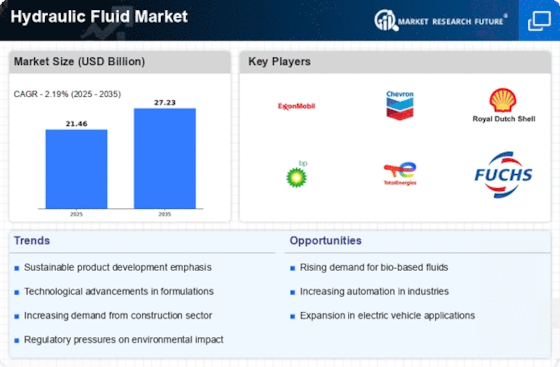
    Hydraulic Fluid Market Infographic
    Purchase Options

    Market Analysis

    In-depth Analysis of Hydraulic Fluid Market Industry Landscape

    The hydraulic fluid market operates within a dynamic landscape influenced by various factors. At its core, this market revolves around the demand for hydraulic fluids, essential in powering hydraulic machinery across industries. The dynamics of this market are shaped by several key elements, including technological advancements, regulatory standards, industry trends, and economic factors.

    For years, manufacturers have been improving hydraulic fluid to increase Eco-durability, safety, and efficiency. Only a few manufacturers produce high-quality hydraulic fluids, and if you need some, you need to research the manufacturer to make sure you get the best product on the market. Finding the balance between performance and price is critical, and by combining both, you will end up with the best solution for your needs. Market growth is driven by industrial growth in Africa, Asia-Pacific, and the Middle East, along with increased process automation in most industries.

    Technological advancements play a significant role in shaping the hydraulic fluid market. Innovations in hydraulic systems and machinery drive the demand for more efficient and specialized fluids. Manufacturers continually develop new formulations to meet the evolving needs of modern hydraulic equipment. These advancements often focus on improving fluid performance, durability, and environmental sustainability, driving market dynamics through innovation and competition.

    Regulatory standards also heavily impact the hydraulic fluid market. Governments worldwide impose regulations concerning environmental protection, workplace safety, and product quality. Compliance with these standards influences product development, production processes, and market access. Manufacturers must navigate a complex regulatory landscape, ensuring their products meet or exceed requirements while remaining competitive in the market.

    Industry trends reflect shifting preferences and priorities within various sectors that rely on hydraulic machinery. For example, increasing emphasis on renewable energy drives demand for hydraulic fluids suitable for use in hydraulic systems powering wind turbines and solar panels. Similarly, the automotive industry's focus on electric vehicles influences the demand for specialized hydraulic fluids used in braking and steering systems. Market players must stay abreast of these trends to capitalize on emerging opportunities and stay competitive.

    Economic factors such as GDP growth, industrial output, and infrastructure development also influence the hydraulic fluid market. Economic downturns can lead to reduced industrial activity and capital expenditure, affecting demand for hydraulic machinery and fluids. Conversely, periods of economic expansion typically stimulate investment in infrastructure projects and industrial automation, driving demand for hydraulic fluids. Fluctuations in commodity prices, exchange rates, and labor costs further shape market dynamics, influencing pricing strategies and supply chain management.

    Market dynamics in the hydraulic fluid industry are also influenced by factors such as supply chain disruptions, geopolitical events, and natural disasters. Disruptions in the supply chain, whether due to transportation issues, raw material shortages, or geopolitical tensions, can impact production and distribution, leading to market volatility. Natural disasters such as hurricanes, earthquakes, or floods can disrupt manufacturing facilities and infrastructure, affecting both supply and demand for hydraulic fluids.

    Furthermore, consumer preferences and environmental consciousness play an increasingly significant role in shaping market dynamics. There is growing demand for environmentally friendly hydraulic fluids with biodegradable and non-toxic properties. As sustainability becomes a key consideration for businesses and consumers alike, manufacturers are under pressure to develop eco-friendly alternatives and reduce the environmental impact of hydraulic fluid production and usage.

    Author
    Chitranshi Jaiswal
    Research Analyst Level I

    In her 3 years of experience in the market research field, she has handled critical cross-domain projects. She has an in-depth knowledge of market estimation & analysis, problem-solving, primary as well as secondary research, and team management.She holds an engineering degree and is an MBA professional from a well-known university, capable of evaluating the market and competitive conditions. An exceptional strategist with excellent communication skills and a passion for delivering cutting-edge & practical insights for the market. Proficient in multi-tasking, and can successfully deal with competing demands, while maintaining complete confidentiality. Generated business through active client and project development, networking, and high-quality responses. Her knowledge and skills have helped in making solid business decisions, securing funding from investors, and avoiding business failures.

    Leave a Comment

    FAQs

    How much is the Hydraulic Fluid market?

    The Hydraulic Fluid market size was valued at USD 20.75 Billion in 2022.

    What is the growth rate of the Hydraulic Fluid market?

    The Hydraulic Fluidmarket is projected to grow at a CAGR of 2.19% during the forecast period, 2025-2035.

    Which region held the largest market share in the Hydraulic Fluid market?

    Asia Pacific had the largest share of the Hydraulic Fluid market.

    Who are the key players in the Hydraulic Fluid market?

    The key players in the Hydraulic Fluid market are Idemitsu Kosan Co. Ltd. (Japan), and Royal Dutch Shell Plc. (Netherlands), Fuchs Petrolub AG. (Germany), ExxonMobil Corporation. (USA), Sinopec Limited. (China), LUKOIL. (Russia), Chevron Corporation. (USA), PetroChina Company Limited. (China), BP p.l.c. (United Kingdom) and Total S.A. (France).

    Which Base oil led the Hydraulic Fluid market?

    The Mineral oil categories dominated the Hydraulic Fluid market in 2023.

    Which Application led the Hydraulic Fluid market?

    The OEM had the largest share in the market for Hydraulic Fluid.

    Market Summary

    As per MRFR analysis, the Hydraulic Fluid Market Size was estimated at 21.46 USD Billion in 2024. The Hydraulic Fluid industry is projected to grow from 21.93 USD Billion in 2025 to 27.23 USD Billion by 2035, exhibiting a compound annual growth rate (CAGR) of 2.19 during the forecast period 2025 - 2035.

    Key Market Trends & Highlights

    The Hydraulic Fluid Market is experiencing a dynamic shift towards sustainability and technological innovation.

    • North America remains the largest market for hydraulic fluids, driven by robust industrial activities and infrastructure development.
    • The Asia-Pacific region is emerging as the fastest-growing market, fueled by rapid urbanization and industrialization.
    • Mineral oil continues to dominate the market, while synthetic oil is gaining traction due to its superior performance and environmental benefits.
    • Key market drivers include the rising demand in the construction sector and increased adoption of renewable energy, which are shaping the industry's future.

    Market Size & Forecast

    2024 Market Size 21.46 (USD Billion)
    2035 Market Size 27.23 (USD Billion)
    CAGR (2025 - 2035) 2.19%
    Largest Regional Market Share in 2024 Asia Pacific

    Major Players

    <p>ExxonMobil (US), Chevron (US), Royal Dutch Shell (GB), BP (GB), TotalEnergies (FR), Fuchs Petrolub (DE), Castrol (GB), Valvoline (US), Petro-Canada (CA)</p>

    Market Trends

    The Hydraulic Fluid Market is currently experiencing a dynamic evolution, driven by various factors that influence its growth trajectory. The increasing demand for efficient machinery across industries such as construction, agriculture, and manufacturing appears to be a primary catalyst. As companies strive for enhanced productivity and reduced operational costs, the adoption of advanced hydraulic fluids that offer superior performance characteristics is likely to rise. Furthermore, environmental regulations are pushing manufacturers to develop eco-friendly alternatives, which may reshape product offerings in the market. This shift towards sustainability could lead to innovations in formulation and application, potentially attracting a broader customer base. In addition, the ongoing advancements in technology are facilitating the development of hydraulic systems that require specialized fluids. These innovations may enhance the overall efficiency and reliability of hydraulic systems, thereby increasing the demand for high-quality hydraulic fluids. The market landscape seems to be increasingly competitive, with numerous players striving to differentiate their products through unique formulations and enhanced performance. As the Hydraulic Fluid Market continues to evolve, stakeholders must remain vigilant to emerging trends and adapt their strategies accordingly to maintain a competitive edge.

    Sustainability Initiatives

    The Hydraulic Fluid Market is witnessing a notable shift towards sustainability, as manufacturers increasingly focus on developing environmentally friendly products. This trend is driven by stringent regulations and growing consumer awareness regarding ecological impacts. Companies are exploring bio-based and biodegradable hydraulic fluids, which may reduce environmental footprints and appeal to eco-conscious customers.

    Technological Advancements

    Technological progress is significantly influencing the Hydraulic Fluid Market, with innovations in fluid formulations and hydraulic systems. Enhanced performance characteristics, such as improved viscosity and thermal stability, are becoming essential for modern applications. These advancements may lead to increased efficiency and reliability, prompting industries to adopt advanced hydraulic fluids.

    Customization and Specialization

    The demand for customized hydraulic fluids is on the rise, as various industries seek solutions tailored to specific operational needs. This trend indicates a shift from generic products to specialized formulations that cater to unique applications. Manufacturers are likely to invest in research and development to create bespoke hydraulic fluids that enhance performance and meet diverse requirements.

    Hydraulic Fluid Market Market Drivers

    Expansion of Automotive Sector

    The expansion of the automotive sector is a key driver for the Hydraulic Fluid Market. As vehicle manufacturers increasingly incorporate hydraulic systems for braking, steering, and suspension, the demand for hydraulic fluids is likely to rise. In 2025, the automotive industry is projected to grow at a rate of 4 percent, which will directly impact the consumption of hydraulic fluids. This growth is further fueled by the increasing production of electric and hybrid vehicles, which often utilize advanced hydraulic systems. Consequently, the Hydraulic Fluid Market is poised for growth as automotive manufacturers seek high-quality hydraulic fluids to enhance vehicle performance and safety.

    Rising Demand in Construction Sector

    The Hydraulic Fluid Market experiences a notable surge in demand driven by the construction sector. As infrastructure projects expand, the need for hydraulic systems in construction machinery increases. In 2025, the construction industry is projected to grow at a rate of approximately 5.5 percent annually, which directly correlates with the rising consumption of hydraulic fluids. These fluids are essential for the efficient operation of excavators, cranes, and other heavy machinery. Consequently, manufacturers are focusing on producing high-performance hydraulic fluids that can withstand extreme conditions, thereby enhancing machinery efficiency and longevity. This trend indicates a robust growth trajectory for the Hydraulic Fluid Market, as construction activities continue to proliferate across various regions.

    Increased Adoption of Renewable Energy

    The Hydraulic Fluid Market is witnessing a shift due to the increased adoption of renewable energy sources. Wind and solar energy projects often utilize hydraulic systems for various applications, including turbine operation and solar panel adjustments. As countries invest in renewable energy infrastructure, the demand for hydraulic fluids tailored for these applications is likely to rise. In 2025, the renewable energy sector is expected to expand significantly, potentially increasing the market for hydraulic fluids by an estimated 10 percent. This growth reflects a broader trend towards sustainability and efficiency, positioning the Hydraulic Fluid Market favorably in the context of global energy transitions.

    Technological Innovations in Fluid Formulation

    Technological innovations play a crucial role in shaping the Hydraulic Fluid Market. Advances in fluid formulation, such as the development of bio-based and synthetic hydraulic fluids, are gaining traction. These innovations not only enhance performance but also address environmental concerns associated with traditional fluids. In 2025, the market for bio-based hydraulic fluids is anticipated to grow by approximately 15 percent, driven by regulatory pressures and consumer preferences for sustainable products. This shift towards innovative formulations indicates a transformative phase for the Hydraulic Fluid Market, as manufacturers strive to meet evolving standards and customer expectations.

    Regulatory Compliance and Environmental Standards

    The Hydraulic Fluid Market is significantly influenced by regulatory compliance and environmental standards. Governments worldwide are implementing stringent regulations regarding the use and disposal of hydraulic fluids, pushing manufacturers to develop eco-friendly alternatives. In 2025, compliance with these regulations is expected to drive a shift towards biodegradable and less toxic hydraulic fluids, potentially increasing their market share by 20 percent. This trend not only reflects a growing awareness of environmental issues but also presents opportunities for companies to innovate and differentiate their products in the Hydraulic Fluid Market.

    Market Segment Insights

    By Base Oil: Mineral Oil (Largest) vs. Synthetic Oil (Fastest-Growing)

    <p>In the Hydraulic Fluid Market, the base oil segment is primarily driven by Mineral Oil, which holds the largest market share due to its widespread applicability and cost-effectiveness. Mineral Oil is traditionally used in hydraulic systems for its reliability and performance. In contrast, the Synthetic Oil segment is rapidly gaining traction as industries shift towards more advanced solutions that provide enhanced performance and environmental benefits. Synthetic Oils are preferred for high-performance applications, particularly in extreme temperature conditions, contributing to their growing market presence.</p>

    <p>Mineral Oil (Dominant) vs. Bio-based Oil (Emerging)</p>

    <p>Mineral Oil is the dominant player in the hydraulic fluid segment, prized for its excellent lubrication properties and economic advantage. Its extensive use in various industrial applications makes it a staple in the market. Meanwhile, Bio-based Oil is emerging as a significant alternative, driven by increasing environmental regulations and a growing focus on sustainable practices. Bio-based Oils offer eco-friendly benefits and are increasingly preferred by companies aiming to lower their carbon footprints. The contrast between these two oils highlights the industry's transition from traditional to more sustainable solutions.</p>

    By Application: OEM (Largest) vs. Mining Equipment (Fastest-Growing)

    <p>The Hydraulic Fluid Market exhibits a diverse application landscape, where OEM (Original Equipment Manufacturer) applications hold the largest market share. This category illustrates the extensive use of hydraulic fluids in various manufactured machinery, which underlines its significance across multiple industries. Additionally, segments like Mining Equipment and Construction Equipment follow closely, showcasing the critical role hydraulic fluids play in powering heavy machinery and equipment required for such operations.</p>

    <p>Mining Equipment: OEM (Dominant) vs. Construction Equipment (Emerging)</p>

    <p>In the Hydraulic Fluid Market, OEM applications are considered dominant due to their widespread utilization in machinery production and maintenance. They provide essential lubrication and operational efficiency, imperative for sustaining equipment functionality. On the other hand, the Construction Equipment segment is emerging as a significant player, driven by increasing infrastructure developments worldwide. As construction activities ramp up, the demand for hydraulic fluids in construction equipment is anticipated to rise, highlighting its evolving role in meeting performance and reliability standards while adapting to more stringent environmental regulations.</p>

    Get more detailed insights about Hydraulic Fluid Market Research Report - Global Forecast till 2035

    Regional Insights

    By region, the study provides market insights into North America, Europe, Asia-Pacific, and the Rest of the World. The Asia-Pacific region is likely to lead the hydraulic fluids market during the projected period. This tendency might be ascribed to the region's growing industrial sector, opening up new investment prospects. In 2019, new building projects in Japan occupied 127.55 million square meters. Residential and commercial development in India has increased as the country's service industry has grown.

    According to the Ministry of Housing and Urban Affairs, the Indian government announced an investment of around USD 27.54 billion for the building of 100 cities under the Smart Cities initiative.

    The Chinese aerospace sector is one of the country's main industries, and the government is significantly investing in expanding local manufacturing capabilities. Furthermore, over the next 20 years, Chinese airlines expect to acquire around 7,690 new aircraft valued at approximately USD 1.2 trillion. In recent years, Asia-Pacific has dominated vehicle production. However, the decrease in the region's car sector has severely impacted the market. With a manufacturing volume of 25.75 million vehicles, China is the world's largest automaker.

    Key Players and Competitive Insights

    Major market players are spending a lot of money on R&D to increase their product lines, which will help the Hydraulic Fluid market grow even more. Market participants are also taking a range of strategic initiatives to grow their worldwide footprint, with key market developments such as new product launches, contractual agreements, mergers and acquisitions, increased investments, and collaboration with other organizations. Competitors in the Hydraulic Fluid industry must offer cost-effective items to expand and survive in an increasingly competitive and rising market environment.

    The major market players are investing a lot of money in R&D to expand their product lines, which will spur further market growth for Hydraulic Fluid. With significant market development like new product releases, contractual agreements, mergers and acquisitions, increased investments, and collaboration with other organizations, market participants are also undertaking various strategic activities to expand their presence. To grow and thrive in a market climate that is becoming more competitive and growing, competitors in the Hydraulic Fluid industry must offer affordable products.

    Manufacturing locally to cut operating costs is one of the main business tactics manufacturers use in the Hydraulic Fluid industry to benefit customers and expand the market sector. The Low-Profile Additives market has recently given medicine some of the most important advantages. Major Hydraulic Fluid market players, including Idemitsu Kosan Co. Ltd, Royal Dutch Shell Plc., Fuchs Petrolub AG., and others, are attempting to increase market demand by funding R&D initiatives. Idemitsu Kosan is a company that owns and operates oil platforms and refineries that produce and sell oil and petroleum products. It offers lubricants, petrochemicals, resource development,

    , electronic materials, agri-bio, research, and development services. Also, Royal Dutch Shell is a group of energy and petrochemical companies. Its operations are divided into businesses: Upstream, Integrated Gas and Renewables and Energy Solutions (formerly New Energies), and Downstream. The Upstream division manages the exploration and extraction of crude oil, natural gas, and natural gas liquids. It also markets and transports oil and gas and operates the related delivery infrastructure. In 2024, Castrol introduced Transaqua SP-HC, a new hydraulic control fluid in its Transaqua line.

    The fluid has been designed to be used as a control fluid in subsea production control systems, providing comprehensive subsea production system protection. Castrol Transaqua SP-HC is appropriate for Electro-Hydraulic Multiplex (EH-Mux) or direct hydraulic control systems in high-pressure, deep-water gas projects above 20,000 psi (1379 bar), where entrained gas may contaminate control lines, increasing the risk of hydrate formation. The device is intended for use in all production and workover control systems, including downhole Subsurface Safety Valve (SSSV) and intelligent well completions.

    Key Companies in the Hydraulic Fluid Market market include

    Industry Developments

    • Q3 2024: TotalEnergies Acquires Tecoil to Expand Re-Refined Base Oil Production TotalEnergies announced the acquisition of Tecoil, a company specializing in re-refined base oils used in hydraulic fluids, processing 50,000 tons annually at its Hamina, Finland facilities. This move strengthens TotalEnergies' position in sustainable hydraulic fluid production.[2]
    • Q2 2024: Danfoss Power Solutions President Discusses Mobile Hydraulics Market Outlook Eric Alström, President of Danfoss Power Solutions, provided insights on the mobile hydraulics sector, highlighting expectations for renewed growth in 2025 as interest rates decrease and machinery demand improves.[4]
    • Q2 2025: Hydraulic and Pneumatic Shipments Decline in February 2025 NFPA reported a 3% month-over-month and 14% year-over-year decline in total fluid power shipments, including hydraulic fluids, in February 2025, reflecting ongoing market challenges.[5]

    Future Outlook

    Hydraulic Fluid Market Future Outlook

    <p>The Hydraulic Fluid Market is projected to grow at a 2.19% CAGR from 2024 to 2035, driven by industrial automation, eco-friendly formulations, and infrastructure development.</p>

    New opportunities lie in:

    • <p>Development of biodegradable hydraulic fluids for eco-conscious industries.</p>
    • <p>Expansion of hydraulic fluid recycling programs to reduce waste.</p>
    • <p>Integration of IoT technology for real-time fluid monitoring and management.</p>

    <p>By 2035, the Hydraulic Fluid Market is expected to achieve robust growth, driven by innovation and sustainability.</p>

    Market Segmentation

    Hydraulic Fluid Market Base Oil Outlook

    • Mineral Oil
    • Synthetic Oil
    • Semi-synthetic Oil
    • Bio-based Oil

    Hydraulic Fluid Market Application Outlook

    • OEM
    • Mining Equipment
    • Construction Equipment
    • Transportation
    • Others

    Report Scope

    MARKET SIZE 202421.46(USD Billion)
    MARKET SIZE 202521.93(USD Billion)
    MARKET SIZE 203527.23(USD Billion)
    COMPOUND ANNUAL GROWTH RATE (CAGR)2.19% (2024 - 2035)
    REPORT COVERAGERevenue Forecast, Competitive Landscape, Growth Factors, and Trends
    BASE YEAR2024
    Market Forecast Period2025 - 2035
    Historical Data2019 - 2024
    Market Forecast UnitsUSD Billion
    Key Companies ProfiledMarket analysis in progress
    Segments CoveredMarket segmentation analysis in progress
    Key Market OpportunitiesAdoption of bio-based hydraulic fluids driven by sustainability regulations and consumer demand.
    Key Market DynamicsRising demand for bio-based hydraulic fluids driven by environmental regulations and sustainability initiatives across various industries.
    Countries CoveredNorth America, Europe, APAC, South America, MEA

    FAQs

    How much is the Hydraulic Fluid market?

    The Hydraulic Fluid market size was valued at USD 20.75 Billion in 2022.

    What is the growth rate of the Hydraulic Fluid market?

    The Hydraulic Fluidmarket is projected to grow at a CAGR of 2.19% during the forecast period, 2025-2035.

    Which region held the largest market share in the Hydraulic Fluid market?

    Asia Pacific had the largest share of the Hydraulic Fluid market.

    Who are the key players in the Hydraulic Fluid market?

    The key players in the Hydraulic Fluid market are Idemitsu Kosan Co. Ltd. (Japan), and Royal Dutch Shell Plc. (Netherlands), Fuchs Petrolub AG. (Germany), ExxonMobil Corporation. (USA), Sinopec Limited. (China), LUKOIL. (Russia), Chevron Corporation. (USA), PetroChina Company Limited. (China), BP p.l.c. (United Kingdom) and Total S.A. (France).

    Which Base oil led the Hydraulic Fluid market?

    The Mineral oil categories dominated the Hydraulic Fluid market in 2023.

    Which Application led the Hydraulic Fluid market?

    The OEM had the largest share in the market for Hydraulic Fluid.

    1. SECTION I: EXECUTIVE SUMMARY AND KEY HIGHLIGHTS
      1. | 1.1 EXECUTIVE SUMMARY
      2. | | 1.1.1 Market Overview
      3. | | 1.1.2 Key Findings
      4. | | 1.1.3 Market Segmentation
      5. | | 1.1.4 Competitive Landscape
      6. | | 1.1.5 Challenges and Opportunities
      7. | | 1.1.6 Future Outlook
    2. SECTION II: SCOPING, METHODOLOGY AND MARKET STRUCTURE
      1. | 2.1 MARKET INTRODUCTION
      2. | | 2.1.1 Definition
      3. | | 2.1.2 Scope of the study
      4. | | | 2.1.2.1 Research Objective
      5. | | | 2.1.2.2 Assumption
      6. | | | 2.1.2.3 Limitations
      7. | 2.2 RESEARCH METHODOLOGY
      8. | | 2.2.1 Overview
      9. | | 2.2.2 Data Mining
      10. | | 2.2.3 Secondary Research
      11. | | 2.2.4 Primary Research
      12. | | | 2.2.4.1 Primary Interviews and Information Gathering Process
      13. | | | 2.2.4.2 Breakdown of Primary Respondents
      14. | | 2.2.5 Forecasting Model
      15. | | 2.2.6 Market Size Estimation
      16. | | | 2.2.6.1 Bottom-Up Approach
      17. | | | 2.2.6.2 Top-Down Approach
      18. | | 2.2.7 Data Triangulation
      19. | | 2.2.8 Validation
    3. SECTION III: QUALITATIVE ANALYSIS
      1. | 3.1 MARKET DYNAMICS
      2. | | 3.1.1 Overview
      3. | | 3.1.2 Drivers
      4. | | 3.1.3 Restraints
      5. | | 3.1.4 Opportunities
      6. | 3.2 MARKET FACTOR ANALYSIS
      7. | | 3.2.1 Value chain Analysis
      8. | | 3.2.2 Porter's Five Forces Analysis
      9. | | | 3.2.2.1 Bargaining Power of Suppliers
      10. | | | 3.2.2.2 Bargaining Power of Buyers
      11. | | | 3.2.2.3 Threat of New Entrants
      12. | | | 3.2.2.4 Threat of Substitutes
      13. | | | 3.2.2.5 Intensity of Rivalry
      14. | | 3.2.3 COVID-19 Impact Analysis
      15. | | | 3.2.3.1 Market Impact Analysis
      16. | | | 3.2.3.2 Regional Impact
      17. | | | 3.2.3.3 Opportunity and Threat Analysis
    4. SECTION IV: QUANTITATIVE ANALYSIS
      1. | 4.1 Chemicals and Materials, BY Base Oil (USD Billion)
      2. | | 4.1.1 Mineral Oil
      3. | | 4.1.2 Synthetic Oil
      4. | | 4.1.3 Semi-synthetic Oil
      5. | | 4.1.4 Bio-based Oil
      6. | 4.2 Chemicals and Materials, BY Application (USD Billion)
      7. | | 4.2.1 OEM
      8. | | 4.2.2 Mining Equipment
      9. | | 4.2.3 Construction Equipment
      10. | | 4.2.4 Transportation
      11. | | 4.2.5 Others
      12. | 4.3 Chemicals and Materials, BY Region (USD Billion)
      13. | | 4.3.1 North America
      14. | | | 4.3.1.1 US
      15. | | | 4.3.1.2 Canada
      16. | | 4.3.2 Europe
      17. | | | 4.3.2.1 Germany
      18. | | | 4.3.2.2 UK
      19. | | | 4.3.2.3 France
      20. | | | 4.3.2.4 Russia
      21. | | | 4.3.2.5 Italy
      22. | | | 4.3.2.6 Spain
      23. | | | 4.3.2.7 Rest of Europe
      24. | | 4.3.3 APAC
      25. | | | 4.3.3.1 China
      26. | | | 4.3.3.2 India
      27. | | | 4.3.3.3 Japan
      28. | | | 4.3.3.4 South Korea
      29. | | | 4.3.3.5 Malaysia
      30. | | | 4.3.3.6 Thailand
      31. | | | 4.3.3.7 Indonesia
      32. | | | 4.3.3.8 Rest of APAC
      33. | | 4.3.4 South America
      34. | | | 4.3.4.1 Brazil
      35. | | | 4.3.4.2 Mexico
      36. | | | 4.3.4.3 Argentina
      37. | | | 4.3.4.4 Rest of South America
      38. | | 4.3.5 MEA
      39. | | | 4.3.5.1 GCC Countries
      40. | | | 4.3.5.2 South Africa
      41. | | | 4.3.5.3 Rest of MEA
    5. SECTION V: COMPETITIVE ANALYSIS
      1. | 5.1 Competitive Landscape
      2. | | 5.1.1 Overview
      3. | | 5.1.2 Competitive Analysis
      4. | | 5.1.3 Market share Analysis
      5. | | 5.1.4 Major Growth Strategy in the Chemicals and Materials
      6. | | 5.1.5 Competitive Benchmarking
      7. | | 5.1.6 Leading Players in Terms of Number of Developments in the Chemicals and Materials
      8. | | 5.1.7 Key developments and growth strategies
      9. | | | 5.1.7.1 New Product Launch/Service Deployment
      10. | | | 5.1.7.2 Merger & Acquisitions
      11. | | | 5.1.7.3 Joint Ventures
      12. | | 5.1.8 Major Players Financial Matrix
      13. | | | 5.1.8.1 Sales and Operating Income
      14. | | | 5.1.8.2 Major Players R&D Expenditure. 2023
      15. | 5.2 Company Profiles
      16. | | 5.2.1 ExxonMobil (US)
      17. | | | 5.2.1.1 Financial Overview
      18. | | | 5.2.1.2 Products Offered
      19. | | | 5.2.1.3 Key Developments
      20. | | | 5.2.1.4 SWOT Analysis
      21. | | | 5.2.1.5 Key Strategies
      22. | | 5.2.2 Chevron (US)
      23. | | | 5.2.2.1 Financial Overview
      24. | | | 5.2.2.2 Products Offered
      25. | | | 5.2.2.3 Key Developments
      26. | | | 5.2.2.4 SWOT Analysis
      27. | | | 5.2.2.5 Key Strategies
      28. | | 5.2.3 Royal Dutch Shell (GB)
      29. | | | 5.2.3.1 Financial Overview
      30. | | | 5.2.3.2 Products Offered
      31. | | | 5.2.3.3 Key Developments
      32. | | | 5.2.3.4 SWOT Analysis
      33. | | | 5.2.3.5 Key Strategies
      34. | | 5.2.4 BP (GB)
      35. | | | 5.2.4.1 Financial Overview
      36. | | | 5.2.4.2 Products Offered
      37. | | | 5.2.4.3 Key Developments
      38. | | | 5.2.4.4 SWOT Analysis
      39. | | | 5.2.4.5 Key Strategies
      40. | | 5.2.5 TotalEnergies (FR)
      41. | | | 5.2.5.1 Financial Overview
      42. | | | 5.2.5.2 Products Offered
      43. | | | 5.2.5.3 Key Developments
      44. | | | 5.2.5.4 SWOT Analysis
      45. | | | 5.2.5.5 Key Strategies
      46. | | 5.2.6 Fuchs Petrolub (DE)
      47. | | | 5.2.6.1 Financial Overview
      48. | | | 5.2.6.2 Products Offered
      49. | | | 5.2.6.3 Key Developments
      50. | | | 5.2.6.4 SWOT Analysis
      51. | | | 5.2.6.5 Key Strategies
      52. | | 5.2.7 Castrol (GB)
      53. | | | 5.2.7.1 Financial Overview
      54. | | | 5.2.7.2 Products Offered
      55. | | | 5.2.7.3 Key Developments
      56. | | | 5.2.7.4 SWOT Analysis
      57. | | | 5.2.7.5 Key Strategies
      58. | | 5.2.8 Valvoline (US)
      59. | | | 5.2.8.1 Financial Overview
      60. | | | 5.2.8.2 Products Offered
      61. | | | 5.2.8.3 Key Developments
      62. | | | 5.2.8.4 SWOT Analysis
      63. | | | 5.2.8.5 Key Strategies
      64. | | 5.2.9 Petro-Canada (CA)
      65. | | | 5.2.9.1 Financial Overview
      66. | | | 5.2.9.2 Products Offered
      67. | | | 5.2.9.3 Key Developments
      68. | | | 5.2.9.4 SWOT Analysis
      69. | | | 5.2.9.5 Key Strategies
      70. | 5.3 Appendix
      71. | | 5.3.1 References
      72. | | 5.3.2 Related Reports
    6. LIST OF FIGURES
      1. | 6.1 MARKET SYNOPSIS
      2. | 6.2 NORTH AMERICA MARKET ANALYSIS
      3. | 6.3 US MARKET ANALYSIS BY BASE OIL
      4. | 6.4 US MARKET ANALYSIS BY APPLICATION
      5. | 6.5 CANADA MARKET ANALYSIS BY BASE OIL
      6. | 6.6 CANADA MARKET ANALYSIS BY APPLICATION
      7. | 6.7 EUROPE MARKET ANALYSIS
      8. | 6.8 GERMANY MARKET ANALYSIS BY BASE OIL
      9. | 6.9 GERMANY MARKET ANALYSIS BY APPLICATION
      10. | 6.10 UK MARKET ANALYSIS BY BASE OIL
      11. | 6.11 UK MARKET ANALYSIS BY APPLICATION
      12. | 6.12 FRANCE MARKET ANALYSIS BY BASE OIL
      13. | 6.13 FRANCE MARKET ANALYSIS BY APPLICATION
      14. | 6.14 RUSSIA MARKET ANALYSIS BY BASE OIL
      15. | 6.15 RUSSIA MARKET ANALYSIS BY APPLICATION
      16. | 6.16 ITALY MARKET ANALYSIS BY BASE OIL
      17. | 6.17 ITALY MARKET ANALYSIS BY APPLICATION
      18. | 6.18 SPAIN MARKET ANALYSIS BY BASE OIL
      19. | 6.19 SPAIN MARKET ANALYSIS BY APPLICATION
      20. | 6.20 REST OF EUROPE MARKET ANALYSIS BY BASE OIL
      21. | 6.21 REST OF EUROPE MARKET ANALYSIS BY APPLICATION
      22. | 6.22 APAC MARKET ANALYSIS
      23. | 6.23 CHINA MARKET ANALYSIS BY BASE OIL
      24. | 6.24 CHINA MARKET ANALYSIS BY APPLICATION
      25. | 6.25 INDIA MARKET ANALYSIS BY BASE OIL
      26. | 6.26 INDIA MARKET ANALYSIS BY APPLICATION
      27. | 6.27 JAPAN MARKET ANALYSIS BY BASE OIL
      28. | 6.28 JAPAN MARKET ANALYSIS BY APPLICATION
      29. | 6.29 SOUTH KOREA MARKET ANALYSIS BY BASE OIL
      30. | 6.30 SOUTH KOREA MARKET ANALYSIS BY APPLICATION
      31. | 6.31 MALAYSIA MARKET ANALYSIS BY BASE OIL
      32. | 6.32 MALAYSIA MARKET ANALYSIS BY APPLICATION
      33. | 6.33 THAILAND MARKET ANALYSIS BY BASE OIL
      34. | 6.34 THAILAND MARKET ANALYSIS BY APPLICATION
      35. | 6.35 INDONESIA MARKET ANALYSIS BY BASE OIL
      36. | 6.36 INDONESIA MARKET ANALYSIS BY APPLICATION
      37. | 6.37 REST OF APAC MARKET ANALYSIS BY BASE OIL
      38. | 6.38 REST OF APAC MARKET ANALYSIS BY APPLICATION
      39. | 6.39 SOUTH AMERICA MARKET ANALYSIS
      40. | 6.40 BRAZIL MARKET ANALYSIS BY BASE OIL
      41. | 6.41 BRAZIL MARKET ANALYSIS BY APPLICATION
      42. | 6.42 MEXICO MARKET ANALYSIS BY BASE OIL
      43. | 6.43 MEXICO MARKET ANALYSIS BY APPLICATION
      44. | 6.44 ARGENTINA MARKET ANALYSIS BY BASE OIL
      45. | 6.45 ARGENTINA MARKET ANALYSIS BY APPLICATION
      46. | 6.46 REST OF SOUTH AMERICA MARKET ANALYSIS BY BASE OIL
      47. | 6.47 REST OF SOUTH AMERICA MARKET ANALYSIS BY APPLICATION
      48. | 6.48 MEA MARKET ANALYSIS
      49. | 6.49 GCC COUNTRIES MARKET ANALYSIS BY BASE OIL
      50. | 6.50 GCC COUNTRIES MARKET ANALYSIS BY APPLICATION
      51. | 6.51 SOUTH AFRICA MARKET ANALYSIS BY BASE OIL
      52. | 6.52 SOUTH AFRICA MARKET ANALYSIS BY APPLICATION
      53. | 6.53 REST OF MEA MARKET ANALYSIS BY BASE OIL
      54. | 6.54 REST OF MEA MARKET ANALYSIS BY APPLICATION
      55. | 6.55 KEY BUYING CRITERIA OF CHEMICALS AND MATERIALS
      56. | 6.56 RESEARCH PROCESS OF MRFR
      57. | 6.57 DRO ANALYSIS OF CHEMICALS AND MATERIALS
      58. | 6.58 DRIVERS IMPACT ANALYSIS: CHEMICALS AND MATERIALS
      59. | 6.59 RESTRAINTS IMPACT ANALYSIS: CHEMICALS AND MATERIALS
      60. | 6.60 SUPPLY / VALUE CHAIN: CHEMICALS AND MATERIALS
      61. | 6.61 CHEMICALS AND MATERIALS, BY BASE OIL, 2024 (% SHARE)
      62. | 6.62 CHEMICALS AND MATERIALS, BY BASE OIL, 2024 TO 2035 (USD Billion)
      63. | 6.63 CHEMICALS AND MATERIALS, BY APPLICATION, 2024 (% SHARE)
      64. | 6.64 CHEMICALS AND MATERIALS, BY APPLICATION, 2024 TO 2035 (USD Billion)
      65. | 6.65 BENCHMARKING OF MAJOR COMPETITORS
    7. LIST OF TABLES
      1. | 7.1 LIST OF ASSUMPTIONS
      2. | | 7.1.1
      3. | 7.2 North America MARKET SIZE ESTIMATES; FORECAST
      4. | | 7.2.1 BY BASE OIL, 2025-2035 (USD Billion)
      5. | | 7.2.2 BY APPLICATION, 2025-2035 (USD Billion)
      6. | 7.3 US MARKET SIZE ESTIMATES; FORECAST
      7. | | 7.3.1 BY BASE OIL, 2025-2035 (USD Billion)
      8. | | 7.3.2 BY APPLICATION, 2025-2035 (USD Billion)
      9. | 7.4 Canada MARKET SIZE ESTIMATES; FORECAST
      10. | | 7.4.1 BY BASE OIL, 2025-2035 (USD Billion)
      11. | | 7.4.2 BY APPLICATION, 2025-2035 (USD Billion)
      12. | 7.5 Europe MARKET SIZE ESTIMATES; FORECAST
      13. | | 7.5.1 BY BASE OIL, 2025-2035 (USD Billion)
      14. | | 7.5.2 BY APPLICATION, 2025-2035 (USD Billion)
      15. | 7.6 Germany MARKET SIZE ESTIMATES; FORECAST
      16. | | 7.6.1 BY BASE OIL, 2025-2035 (USD Billion)
      17. | | 7.6.2 BY APPLICATION, 2025-2035 (USD Billion)
      18. | 7.7 UK MARKET SIZE ESTIMATES; FORECAST
      19. | | 7.7.1 BY BASE OIL, 2025-2035 (USD Billion)
      20. | | 7.7.2 BY APPLICATION, 2025-2035 (USD Billion)
      21. | 7.8 France MARKET SIZE ESTIMATES; FORECAST
      22. | | 7.8.1 BY BASE OIL, 2025-2035 (USD Billion)
      23. | | 7.8.2 BY APPLICATION, 2025-2035 (USD Billion)
      24. | 7.9 Russia MARKET SIZE ESTIMATES; FORECAST
      25. | | 7.9.1 BY BASE OIL, 2025-2035 (USD Billion)
      26. | | 7.9.2 BY APPLICATION, 2025-2035 (USD Billion)
      27. | 7.10 Italy MARKET SIZE ESTIMATES; FORECAST
      28. | | 7.10.1 BY BASE OIL, 2025-2035 (USD Billion)
      29. | | 7.10.2 BY APPLICATION, 2025-2035 (USD Billion)
      30. | 7.11 Spain MARKET SIZE ESTIMATES; FORECAST
      31. | | 7.11.1 BY BASE OIL, 2025-2035 (USD Billion)
      32. | | 7.11.2 BY APPLICATION, 2025-2035 (USD Billion)
      33. | 7.12 Rest of Europe MARKET SIZE ESTIMATES; FORECAST
      34. | | 7.12.1 BY BASE OIL, 2025-2035 (USD Billion)
      35. | | 7.12.2 BY APPLICATION, 2025-2035 (USD Billion)
      36. | 7.13 APAC MARKET SIZE ESTIMATES; FORECAST
      37. | | 7.13.1 BY BASE OIL, 2025-2035 (USD Billion)
      38. | | 7.13.2 BY APPLICATION, 2025-2035 (USD Billion)
      39. | 7.14 China MARKET SIZE ESTIMATES; FORECAST
      40. | | 7.14.1 BY BASE OIL, 2025-2035 (USD Billion)
      41. | | 7.14.2 BY APPLICATION, 2025-2035 (USD Billion)
      42. | 7.15 India MARKET SIZE ESTIMATES; FORECAST
      43. | | 7.15.1 BY BASE OIL, 2025-2035 (USD Billion)
      44. | | 7.15.2 BY APPLICATION, 2025-2035 (USD Billion)
      45. | 7.16 Japan MARKET SIZE ESTIMATES; FORECAST
      46. | | 7.16.1 BY BASE OIL, 2025-2035 (USD Billion)
      47. | | 7.16.2 BY APPLICATION, 2025-2035 (USD Billion)
      48. | 7.17 South Korea MARKET SIZE ESTIMATES; FORECAST
      49. | | 7.17.1 BY BASE OIL, 2025-2035 (USD Billion)
      50. | | 7.17.2 BY APPLICATION, 2025-2035 (USD Billion)
      51. | 7.18 Malaysia MARKET SIZE ESTIMATES; FORECAST
      52. | | 7.18.1 BY BASE OIL, 2025-2035 (USD Billion)
      53. | | 7.18.2 BY APPLICATION, 2025-2035 (USD Billion)
      54. | 7.19 Thailand MARKET SIZE ESTIMATES; FORECAST
      55. | | 7.19.1 BY BASE OIL, 2025-2035 (USD Billion)
      56. | | 7.19.2 BY APPLICATION, 2025-2035 (USD Billion)
      57. | 7.20 Indonesia MARKET SIZE ESTIMATES; FORECAST
      58. | | 7.20.1 BY BASE OIL, 2025-2035 (USD Billion)
      59. | | 7.20.2 BY APPLICATION, 2025-2035 (USD Billion)
      60. | 7.21 Rest of APAC MARKET SIZE ESTIMATES; FORECAST
      61. | | 7.21.1 BY BASE OIL, 2025-2035 (USD Billion)
      62. | | 7.21.2 BY APPLICATION, 2025-2035 (USD Billion)
      63. | 7.22 South America MARKET SIZE ESTIMATES; FORECAST
      64. | | 7.22.1 BY BASE OIL, 2025-2035 (USD Billion)
      65. | | 7.22.2 BY APPLICATION, 2025-2035 (USD Billion)
      66. | 7.23 Brazil MARKET SIZE ESTIMATES; FORECAST
      67. | | 7.23.1 BY BASE OIL, 2025-2035 (USD Billion)
      68. | | 7.23.2 BY APPLICATION, 2025-2035 (USD Billion)
      69. | 7.24 Mexico MARKET SIZE ESTIMATES; FORECAST
      70. | | 7.24.1 BY BASE OIL, 2025-2035 (USD Billion)
      71. | | 7.24.2 BY APPLICATION, 2025-2035 (USD Billion)
      72. | 7.25 Argentina MARKET SIZE ESTIMATES; FORECAST
      73. | | 7.25.1 BY BASE OIL, 2025-2035 (USD Billion)
      74. | | 7.25.2 BY APPLICATION, 2025-2035 (USD Billion)
      75. | 7.26 Rest of South America MARKET SIZE ESTIMATES; FORECAST
      76. | | 7.26.1 BY BASE OIL, 2025-2035 (USD Billion)
      77. | | 7.26.2 BY APPLICATION, 2025-2035 (USD Billion)
      78. | 7.27 MEA MARKET SIZE ESTIMATES; FORECAST
      79. | | 7.27.1 BY BASE OIL, 2025-2035 (USD Billion)
      80. | | 7.27.2 BY APPLICATION, 2025-2035 (USD Billion)
      81. | 7.28 GCC Countries MARKET SIZE ESTIMATES; FORECAST
      82. | | 7.28.1 BY BASE OIL, 2025-2035 (USD Billion)
      83. | | 7.28.2 BY APPLICATION, 2025-2035 (USD Billion)
      84. | 7.29 South Africa MARKET SIZE ESTIMATES; FORECAST
      85. | | 7.29.1 BY BASE OIL, 2025-2035 (USD Billion)
      86. | | 7.29.2 BY APPLICATION, 2025-2035 (USD Billion)
      87. | 7.30 Rest of MEA MARKET SIZE ESTIMATES; FORECAST
      88. | | 7.30.1 BY BASE OIL, 2025-2035 (USD Billion)
      89. | | 7.30.2 BY APPLICATION, 2025-2035 (USD Billion)
      90. | 7.31 PRODUCT LAUNCH/PRODUCT DEVELOPMENT/APPROVAL
      91. | | 7.31.1
      92. | 7.32 ACQUISITION/PARTNERSHIP
      93. | | 7.32.1

    Hydraulic Fluid Base Oil Outlook (USD Billion, 2018-2030)

    • Mineral Oil
    • Synthetic Oil
    • Semi-synthetic Oil
    • Others

    Hydraulic Fluid Application Outlook (USD Billion, 2018-2030)

    • OEM
    • Mining Equipment
    • Construction Equipment
    • Transportation
    • Others

    Hydraulic Fluid Regional Outlook (USD Billion, 2018-2030)

    • North America Outlook (USD Billion, 2018-2030)

      • North America Hydraulic Fluid by Base Oil
        • Mineral Oil
        • Synthetic Oil
        • Semi-synthetic Oil
        • Others
      • North America Hydraulic Fluid by Application

        • OEM
        • Mining Equipment
        • Construction Equipment
        • Transportation
        • Others
      • US Outlook (USD Billion, 2018-2030)

      • US Hydraulic Fluid by Base Oil
        • Mineral Oil
        • Synthetic Oil
        • Semi-synthetic Oil
        • Others
      • US Hydraulic Fluid by Application

        • OEM
        • Mining Equipment
        • Construction Equipment
        • Transportation
        • Others
      • CANADA Outlook (USD Billion, 2018-2030)

      • CANADA Hydraulic Fluid by Base Oil
        • Mineral Oil
        • Synthetic Oil
        • Semi-synthetic Oil
        • Others
      • CANADA Hydraulic Fluid by Application

        • OEM
        • Mining Equipment
        • Construction Equipment
        • Transportation
        • Others
    • Europe Outlook (USD Billion, 2018-2030)

      • Europe Hydraulic Fluid by Base Oil
        • Mineral Oil
        • Synthetic Oil
        • Semi-synthetic Oil
        • Others
      • Europe Hydraulic Fluid by Application

        • OEM
        • Mining Equipment
        • Construction Equipment
        • Transportation
        • Others
      • Germany Outlook (USD Billion, 2018-2030)

      • Germany Hydraulic Fluid by Base Oil
        • Mineral Oil
        • Synthetic Oil
        • Semi-synthetic Oil
        • Others
      • Germany Hydraulic Fluid by Application

        • OEM
        • Mining Equipment
        • Construction Equipment
        • Transportation
        • Others
      • France Outlook (USD Billion, 2018-2030)

      • France Hydraulic Fluid by Base Oil
        • Mineral Oil
        • Synthetic Oil
        • Semi-synthetic Oil
        • Others
      • France Hydraulic Fluid by Application

        • OEM
        • Mining Equipment
        • Construction Equipment
        • Transportation
        • Others
      • UK Outlook (USD Billion, 2018-2030)

      • UK Hydraulic Fluid by Base Oil
        • Mineral Oil
        • Synthetic Oil
        • Semi-synthetic Oil
        • Others
      • UK Hydraulic Fluid by Application

        • OEM
        • Mining Equipment
        • Construction Equipment
        • Transportation
        • Others
      • ITALY Outlook (USD Billion, 2018-2030)

      • ITALY Hydraulic Fluid by Base Oil
        • Mineral Oil
        • Synthetic Oil
        • Semi-synthetic Oil
        • Others
      • ITALY Hydraulic Fluid by Application

        • OEM
        • Mining Equipment
        • Construction Equipment
        • Transportation
        • Others
      • SPAIN Outlook (USD Billion, 2018-2030)

      • Spain Hydraulic Fluid by Base Oil
        • Mineral Oil
        • Synthetic Oil
        • Semi-synthetic Oil
        • Others
      • Spain Hydraulic Fluid by Application

        • OEM
        • Mining Equipment
        • Construction Equipment
        • Transportation
        • Others
      • Rest Of Europe Outlook (USD Billion, 2018-2030)

      • REST OF EUROPE Hydraulic Fluid by Base Oil
        • Mineral Oil
        • Synthetic Oil
        • Semi-synthetic Oil
        • Others
      • REST OF EUROPE Hydraulic Fluid by Application

        • OEM
        • Mining Equipment
        • Construction Equipment
        • Transportation
        • Others
    • Asia-Pacific Outlook (USD Billion, 2018-2030)

      • Asia-Pacific Hydraulic Fluid by Base Oil
        • Mineral Oil
        • Synthetic Oil
        • Semi-synthetic Oil
        • Others
      • Asia-Pacific Hydraulic Fluid by Application

        • OEM
        • Mining Equipment
        • Construction Equipment
        • Transportation
        • Others
      • China Outlook (USD Billion, 2018-2030)

      • China Hydraulic Fluid by Base Oil
        • Mineral Oil
        • Synthetic Oil
        • Semi-synthetic Oil
        • Others
      • China Hydraulic Fluid by Application

        • OEM
        • Mining Equipment
        • Construction Equipment
        • Transportation
        • Others
      • Japan Outlook (USD Billion, 2018-2030)

      • Japan Hydraulic Fluid by Base Oil
        • Mineral Oil
        • Synthetic Oil
        • Semi-synthetic Oil
        • Others
      • Japan Hydraulic Fluid by Application

        • OEM
        • Mining Equipment
        • Construction Equipment
        • Transportation
        • Others
      • India Outlook (USD Billion, 2018-2030)

      • India Hydraulic Fluid by Base Oil
        • Mineral Oil
        • Synthetic Oil
        • Semi-synthetic Oil
        • Others
      • India Hydraulic Fluid by Application

        • OEM
        • Mining Equipment
        • Construction Equipment
        • Transportation
        • Others
      • Australia Outlook (USD Billion, 2018-2030)

      • Australia Hydraulic Fluid by Base Oil
        • Mineral Oil
        • Synthetic Oil
        • Semi-synthetic Oil
        • Others
      • Australia Hydraulic Fluid by Application

        • OEM
        • Mining Equipment
        • Construction Equipment
        • Transportation
        • Others
      • Rest of Asia-Pacific Outlook (USD Billion, 2018-2030)

      • Rest of Asia-Pacific Low-Profile Additives by Base Oil
        • Mineral Oil
        • Synthetic Oil
        • Semi-synthetic Oil
        • Others
      • Rest of Asia-Pacific Low-Profile Additives by Application

        • OEM
        • Mining Equipment
        • Construction Equipment
        • Transportation
        • Others
    • Rest of the World Outlook (USD Billion, 2018-2030)

      • Rest of the World Hydraulic Fluid by Base Oil
        • Mineral Oil
        • Synthetic Oil
        • Semi-synthetic Oil
        • Others
      • Rest of the World Hydraulic Fluid by Application

        • OEM
        • Mining Equipment
        • Construction Equipment
        • Transportation
        • Others
      • Middle East Outlook (USD Billion, 2018-2030)

      • Middle East Hydraulic Fluid by Base Oil
        • Mineral Oil
        • Synthetic Oil
        • Semi-synthetic Oil
        • Others
      • Middle East Hydraulic Fluid by Application

        • OEM
        • Mining Equipment
        • Construction Equipment
        • Transportation
        • Others
      • Africa Outlook (USD Billion, 2018-2030)

      • Africa Hydraulic Fluid by Base Oil
        • Mineral Oil
        • Synthetic Oil
        • Semi-synthetic Oil
        • Others
      • Africa Hydraulic Fluid by Application

        • OEM
        • Mining Equipment
        • Construction Equipment
        • Transportation
        • Others
      • Latin America Outlook (USD Billion, 2018-2030)

      • Latin America Hydraulic Fluid by Base Oil
        • Mineral Oil
        • Synthetic Oil
        • Semi-synthetic Oil
        • Others
      • Latin America Hydraulic Fluid by Application

        • OEM
        • Mining Equipment
        • Construction Equipment
        • Transportation
        • Others
    Infographic

    Free Sample Request

    Kindly complete the form below to receive a free sample of this Report

    Get Free Sample

    Customer Strories

    “I am very pleased with how market segments have been defined in a relevant way for my purposes (such as "Portable Freezers & refrigerators" and "last-mile"). In general the report is well structured. Thanks very much for your efforts.”

    Victoria Milne

    Founder
    Case Study
    Chemicals and Materials

    Compare Licence

    ×
    Features License Type
    Single User Multiuser License Enterprise User
    Price $4,950 $5,950 $7,250
    Maximum User Access Limit 1 User Upto 10 Users Unrestricted Access Throughout the Organization
    Free Customization
    Direct Access to Analyst
    Deliverable Format
    Platform Access
    Discount on Next Purchase 10% 15% 15%
    Printable Versions