×
Hero Background
English
Chinese
French
Japanese
Korean
German
Spanish

Hydraulic Excavator Market Size

ID: MRFR/PCM/10048-HCR
128 Pages
Snehal Singh
October 2025

Hydraulic Excavator Market Research Report Information By Type (Crawler, Mini and Wheeled), By Power Rating (0-300 HP, 301-500 HP and Above 501 HP), End User (Contractors, Rental Providers and Others) And By Region (North America, Europe, Asia-Pacific, And Rest Of The World) –Market Forecast Till 2035

Share:
Download PDF ×

We do not share your information with anyone. However, we may send you emails based on your report interest from time to time. You may contact us at any time to opt-out.

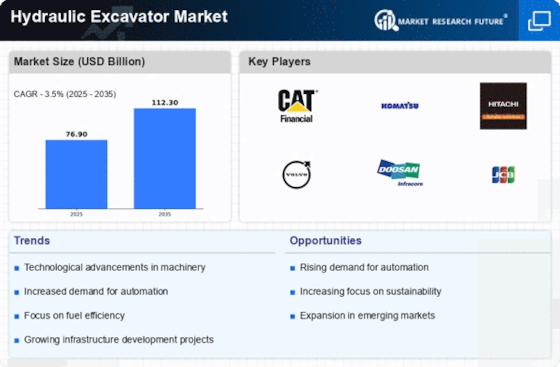
Hydraulic Excavator Market Infographic
Purchase Options

Hydraulic Excavator Size

Hydraulic Excavator Market Growth Projections and Opportunities

The Hydraulic Excavator Market is influenced by a multitude of factors that collectively shape its growth and dynamics. One of the primary drivers is the booming construction and mining industries globally, which demand efficient and versatile earthmoving equipment. Hydraulic excavators, known for their high productivity, precision, and adaptability to various job sites, have become indispensable in heavy construction, infrastructure development, and mining projects. The increasing need for urbanization and infrastructure upgrades fuels the demand for hydraulic excavators, as these machines play a crucial role in excavating, grading, and material handling tasks.

Technological advancements in hydraulic excavator design and functionality significantly contribute to market dynamics. Continuous research and development efforts focus on improving fuel efficiency, operator comfort, and environmental sustainability. Innovations in hydraulic systems, control technologies, and telematics enhance the performance and overall efficiency of hydraulic excavators, making them more appealing to end-users. Advancements such as hybrid and electric excavators also address environmental concerns and align with the industry's push towards sustainable construction equipment.

Infrastructure development, urbanization trends, and government investments play a pivotal role in driving the Hydraulic Excavator Market. Rapid urbanization and infrastructure projects, especially in emerging economies, lead to increased demand for excavation and construction equipment. Government initiatives, such as infrastructure development plans and investments in public works, contribute to the growth of the hydraulic excavator market. Large-scale projects, including the construction of highways, airports, and residential complexes, boost the demand for these versatile machines.

Global economic conditions and construction activity levels significantly impact the Hydraulic Excavator Market. Economic growth and stability influence construction and infrastructure spending, directly affecting the demand for hydraulic excavators. Market conditions, including interest rates, access to financing, and economic policies, play a crucial role in determining the buying patterns of construction companies and contractors. Economic fluctuations can impact the purchasing decisions and investment plans of end-users in the construction and mining sectors.

Environmental considerations and emission regulations shape the hydraulic excavator market. Stricter emission standards and environmental regulations drive manufacturers to develop cleaner and more fuel-efficient excavators. The industry's commitment to reducing carbon footprints and adopting environmentally friendly technologies, such as advanced engine designs and emission control systems, aligns with global sustainability goals and influences purchasing decisions.

Market competition and industry collaborations are notable factors shaping the Hydraulic Excavator Market. The market features a competitive landscape with key players continually innovating to gain a competitive edge. Collaboration within the industry supply chain, including partnerships between excavator manufacturers, component suppliers, and technology providers, contributes to the development of advanced features, efficient designs, and improvements in excavator performance. Partnerships also foster advancements in safety features and operator assistance technologies.

Challenges related to high initial costs, maintenance requirements, and the impact of economic downturns are factors that the hydraulic excavator industry addresses. The upfront investment for hydraulic excavators can be substantial, posing a challenge for smaller contractors and businesses. However, the long-term efficiency, productivity gains, and durability of these machines often justify the initial costs. Maintenance requirements are another consideration, and the industry continually works on developing machines with reduced downtime and simplified maintenance procedures. Economic downturns and market uncertainties can impact the purchasing decisions of construction companies, influencing the overall demand for hydraulic excavators.
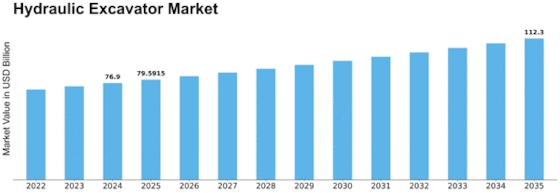

Hydraulic Excavator Market Size Graph
Author
Snehal Singh
Assistant Manager - Research

High acumen in analyzing complex macro & micro markets with more than 6 years of work experience in the field of market research. By implementing her analytical skills in forecasting and estimation into market research reports, she has expertise in Packaging, Construction, and Equipment domains. She handles a team size of 20-25 resources and ensures smooth running of the projects, associated marketing activities, and client servicing.

Leave a Comment

FAQs

What is the current valuation of the Hydraulic Excavator Market as of 2024?

The Hydraulic Excavator Market was valued at 76.9 USD Billion in 2024.

What is the projected market valuation for the Hydraulic Excavator Market in 2035?

The market is projected to reach a valuation of 112.3 USD Billion by 2035.

What is the expected CAGR for the Hydraulic Excavator Market during the forecast period 2025 - 2035?

The expected CAGR for the Hydraulic Excavator Market during the forecast period 2025 - 2035 is 3.5%.

Which type of hydraulic excavators is expected to have the highest market valuation?

Crawler excavators are expected to have the highest market valuation, projected between 30.0 and 45.0 USD Billion.

How do the power ratings of hydraulic excavators segment the market?

The market segments by power rating include 0-300 HP, projected at 30.0 to 45.0 USD Billion, and above 501 HP, estimated at 21.9 to 32.3 USD Billion.

Who are the key players in the Hydraulic Excavator Market?

Key players in the market include Caterpillar, Komatsu, Hitachi Construction Machinery, and Volvo Construction Equipment, among others.

Market Summary

As per MRFR analysis, the Hydraulic Excavator Market was estimated at 76.9 USD Billion in 2024. The Hydraulic Excavator industry is projected to grow from 79.6 USD Billion in 2025 to 112.3 USD Billion by 2035, exhibiting a compound annual growth rate (CAGR) of 3.5 during the forecast period 2025 - 2035.

Key Market Trends & Highlights

The Hydraulic Excavator Market is poised for growth driven by technological advancements and increasing infrastructure development.

  • Technological advancements are enhancing the efficiency and capabilities of hydraulic excavators, particularly in North America.
  • Sustainability initiatives are becoming increasingly important, influencing design and operational practices across the industry.
  • Infrastructure development is a key focus in both North America and Asia-Pacific, driving demand for hydraulic excavators.
  • Rising construction activities and a focus on sustainability and emission regulations are major drivers propelling market growth.

Market Size & Forecast

2024 Market Size 76.9 (USD Billion)
2035 Market Size 112.3 (USD Billion)
CAGR (2025 - 2035) 3.5%
Largest Regional Market Share in 2024 North America

Major Players

<p>Caterpillar (US), Komatsu (JP), Hitachi Construction Machinery (JP), Volvo Construction Equipment (SE), Doosan Infracore (KR), JCB (GB), CASE Construction Equipment (US), Liebherr (DE), SANY (CN), XCMG (CN)</p>

Market Trends

The Hydraulic Excavator Market is currently experiencing a dynamic phase characterized by evolving technologies and shifting consumer preferences. The integration of advanced features such as telematics and automation is reshaping operational efficiencies, thereby enhancing productivity across various sectors. Additionally, the growing emphasis on sustainability is prompting manufacturers to innovate eco-friendly models that reduce emissions and fuel consumption. This trend aligns with global efforts to mitigate environmental impacts, suggesting a potential shift in market dynamics as stakeholders prioritize greener solutions. Moreover, the demand for hydraulic excavators is likely to be influenced by infrastructure development initiatives worldwide. As urbanization accelerates, the need for robust machinery to support construction and excavation activities becomes increasingly apparent. This scenario indicates a promising outlook for the Hydraulic Excavator Market, as investments in infrastructure are expected to drive growth. Furthermore, the competitive landscape is evolving, with new entrants and established players alike striving to capture market share through strategic partnerships and technological advancements. Overall, the Hydraulic Excavator Market appears poised for continued expansion, driven by innovation and a focus on sustainability.

Technological Advancements

The Hydraulic Excavator Market is witnessing a surge in technological innovations, particularly in automation and telematics. These advancements enhance operational efficiency and enable real-time monitoring of equipment performance, which may lead to reduced downtime and improved productivity.

Sustainability Initiatives

There is a growing trend towards sustainability within the Hydraulic Excavator Market, as manufacturers increasingly focus on developing eco-friendly models. This shift is driven by regulatory pressures and consumer demand for machines that minimize environmental impact.

Infrastructure Development

The ongoing The Hydraulic Excavator Market. As nations invest in construction projects, the demand for reliable and efficient excavation equipment is expected to rise, creating opportunities for market growth.

Hydraulic Excavator Market Market Drivers

Technological Innovations

Technological advancements are significantly influencing the Hydraulic Excavator Market, as manufacturers are increasingly integrating innovative features into their equipment. The introduction of telematics, automation, and advanced hydraulic systems is enhancing the efficiency and productivity of hydraulic excavators. For instance, the incorporation of GPS technology allows for precise excavation and grading, reducing operational costs and time. Additionally, the market is witnessing a shift towards electric and hybrid excavators, which are more environmentally friendly and cost-effective in the long run. As these technologies continue to evolve, they are likely to attract more customers, thereby driving growth in the hydraulic excavator market. The emphasis on smart machinery is expected to reshape the competitive landscape, compelling manufacturers to invest in research and development.

Rising Construction Activities

The Hydraulic Excavator Market is experiencing a surge in demand due to increasing construction activities across various sectors. Urbanization and population growth are driving the need for residential and commercial buildings, which in turn necessitates the use of hydraulic excavators for earthmoving and site preparation. According to recent data, the construction sector is projected to grow at a compound annual growth rate of approximately 5.5% over the next few years. This growth is likely to bolster the hydraulic excavator market, as these machines are essential for efficient and effective construction operations. Furthermore, government investments in infrastructure projects are expected to further enhance the demand for hydraulic excavators, as they play a crucial role in executing large-scale construction tasks.

Rising Demand in Mining Sector

The Hydraulic Excavator Market is benefiting from the rising demand in the mining sector, where these machines are essential for various operations. As mineral extraction activities expand, the need for efficient and powerful excavators becomes increasingly critical. The mining industry is projected to grow at a steady pace, driven by the demand for minerals and metals in various applications, including construction and technology. Hydraulic excavators are particularly favored for their ability to handle heavy loads and operate in challenging terrains. Recent statistics suggest that the mining sector's growth could lead to a significant increase in hydraulic excavator sales, as companies seek to enhance productivity and reduce operational costs. This trend indicates a promising outlook for the hydraulic excavator market.

Infrastructure Development Initiatives

The Hydraulic Excavator Market is poised for growth due to ongoing infrastructure development initiatives worldwide. Governments are increasingly prioritizing infrastructure projects, such as roads, bridges, and public transportation systems, to stimulate economic growth and improve connectivity. This trend is reflected in various national budgets, which allocate substantial funds for infrastructure enhancement. For example, recent reports indicate that infrastructure spending is expected to reach trillions of dollars over the next decade. Such investments are likely to create a robust demand for hydraulic excavators, as they are indispensable for excavation, grading, and site preparation tasks. The focus on sustainable infrastructure development may also lead to the adoption of advanced hydraulic excavators that meet environmental standards.

Focus on Sustainability and Emission Regulations

The Hydraulic Excavator Market is undergoing a transformation as manufacturers respond to increasing focus on sustainability and stringent emission regulations. Governments and regulatory bodies are implementing policies aimed at reducing carbon footprints and promoting environmentally friendly practices. As a result, there is a growing demand for hydraulic excavators that comply with these regulations, such as those equipped with low-emission engines and energy-efficient technologies. This shift is prompting manufacturers to innovate and develop machines that not only meet performance standards but also adhere to environmental guidelines. The emphasis on sustainability is likely to drive the growth of the hydraulic excavator market, as companies seek to align their operations with global sustainability goals.

Market Segment Insights

By Type: Crawler (Largest) vs. Mini (Fastest-Growing)

<p>In the Hydraulic Excavator Market, the Crawler segment holds the largest share, driven by its versatility and robustness in various construction and earthmoving applications. Crawler excavators are known for their stability and ability to work on uneven terrains, making them a preferred choice for many contractors. Mini excavators, while smaller, are gaining traction due to their compact size and agility, allowing them to navigate tight spaces in urban environments. As construction projects evolve, the demand for these machines is expected to grow across various sectors. The growth trends highlight a shift towards mini excavators as urbanization accelerates and the need for equipment in confined spaces increases. Additionally, advancements in technology are making mini excavators more efficient and appealing to contractors looking for flexibility. The rise of eco-friendly equipment is also influencing the market, with electric mini excavators emerging as a viable option, further boosting their demand in the coming years.</p>

<p>Crawler (Dominant) vs. Mini (Emerging)</p>

<p>Crawler excavators are characterized by their tracked design, which enhances stability and weight distribution, making them ideal for heavy-duty tasks such as digging, lifting, and loading in diverse terrains. They dominate the market due to their ability to handle large volumes of material and perform effectively in both urban and rural projects. On the other hand, mini excavators, often referred to as compact excavators, are gaining popularity for small-scale tasks, especially in urban settings where space is limited. Their lightweight and maneuverable nature allow them to operate where larger machines cannot, positioning them as an emerging option in the hydraulic excavator market. As demand for more efficient and versatile machinery grows, the mini excavator segment is expected to expand significantly.</p>

By Power Rating: 0-300 HP (Largest) vs. Above 501 HP (Fastest-Growing)

<p>The Hydraulic Excavator Market is primarily divided into three power rating segments: 0-300 HP, 301-500 HP, and above 501 HP. Among these, the 0-300 HP segment holds a substantial share, appealing to small to medium-sized construction and landscaping projects due to its efficiency and versatility. Meanwhile, the above 501 HP segmentation is gaining traction, catering to heavy-duty applications in industries like mining and large-scale infrastructure development, which are increasingly turning to powerful machines for enhanced productivity.</p>

<p>0-300 HP (Dominant) vs. Above 501 HP (Emerging)</p>

<p>The 0-300 HP hydraulic excavators dominate the market, primarily appealing to sectors requiring precision and compact size, such as residential construction and landscaping. These machines are praised for their fuel efficiency and ease of operation, making them a preferred choice for smaller projects. In contrast, the above 501 HP segment is emerging rapidly, driven by increasing infrastructure projects and demand for higher power machinery in construction and mining. These excavators are characterized by their robustness and capability to handle larger workloads, making them attractive to enterprises focused on heavy operations and maximizing output.</p>

By End User: Contractors (Largest) vs. Rental Providers (Fastest-Growing)

<p>In the Hydraulic Excavator Market, the end-user distribution is predominantly led by contractors, who account for a significant share of the overall market. This segment includes construction, demolition, and mining contractors, capitalizing on the versatility and efficiency of hydraulic excavators. Meanwhile, rental providers represent a growing segment, driven by the increasing preference for rental equipment among contractors and businesses that seek cost-effective solutions without the burden of ownership. The growth trends in this market are primarily fueled by urbanization and infrastructure development, particularly in emerging economies. Contractors are increasingly investing in hydraulic excavators to meet the demand for new construction and renovation projects. Simultaneously, rental providers are expanding their fleets to cater to fluctuating market demands and offering flexible rental terms that appeal to users looking for short-term solutions, making this segment the fastest-growing in the hydraulic excavator market.</p>

<p>Contractors (Dominant) vs. Rental Providers (Emerging)</p>

<p>Contractors play a dominant role in the Hydraulic Excavator Market, driven by their need for reliable and efficient machinery to handle a variety of construction tasks. This segment encompasses a wide range of industries, including residential and commercial construction, where excavators are essential for excavation, grading, and material handling. Their strong market position is supported by continuous investments in innovative technologies and advanced machinery that enhance productivity and reduce operational downtime. On the other hand, rental providers have emerged as a flexible alternative for contractors who prefer not to invest heavily in machinery. This segment is characterized by a diverse range of equipment offerings, competitive pricing, and the ability to quickly adapt to changing project requirements, positioning them as a key player in accommodating short-term project needs.</p>

Get more detailed insights about Hydraulic Excavator Market Research Report - Global Forecast to 2035

Regional Insights

North America : Construction Powerhouse

North America is witnessing robust growth in the hydraulic excavator market, driven by increased infrastructure investments and urbanization. The U.S. holds the largest market share at approximately 65%, followed by Canada at around 20%. Regulatory support for infrastructure projects and green initiatives further catalyze demand, making this region a key player in the global market. The competitive landscape is dominated by major players such as Caterpillar, CASE Construction Equipment, and Volvo Construction Equipment. These companies leverage advanced technologies and sustainable practices to enhance their offerings. The presence of established manufacturers and a growing rental market are also significant factors contributing to the region's market dynamics.

Europe : Innovation and Sustainability

Europe is emerging as a significant market for hydraulic excavators, driven by stringent environmental regulations and a focus on sustainable construction practices. Germany and France are the largest markets, holding approximately 30% and 25% market shares, respectively. The European Union's Green Deal and investment in renewable energy projects are key drivers of growth in this sector. Leading countries in this region are Germany, France, and the UK, with major players like Liebherr and JCB leading the competitive landscape. The emphasis on innovation, particularly in electric and hybrid excavators, is reshaping market dynamics. The presence of established manufacturers and a strong focus on R&D further enhance the region's competitive edge.

Asia-Pacific : Emerging Market Potential

Asia-Pacific is rapidly becoming a powerhouse in the hydraulic excavator market, driven by urbanization and infrastructure development. China is the largest market, accounting for approximately 50% of the regional share, followed by India at around 15%. Government initiatives to boost infrastructure spending and urban development are significant growth drivers in this region. Key players in this market include SANY and XCMG, which are expanding their presence through innovative products and competitive pricing. The competitive landscape is characterized by a mix of local and international manufacturers, with a strong focus on technology and efficiency. The growing demand for rental services is also shaping market dynamics in this region.

Middle East and Africa : Resource-Rich Opportunities

The Middle East and Africa region is witnessing a surge in demand for hydraulic excavators, driven by infrastructure projects and resource extraction activities. The UAE and South Africa are the largest markets, holding approximately 30% and 25% market shares, respectively. Government investments in infrastructure and urban development are key catalysts for market growth in this region. Leading players include Doosan Infracore and Hitachi Construction Machinery, which are focusing on expanding their market presence through strategic partnerships and innovative solutions. The competitive landscape is evolving, with increasing participation from local manufacturers and a growing emphasis on sustainability and efficiency in construction practices.

Key Players and Competitive Insights

The Hydraulic Excavator Market is currently characterized by a dynamic competitive landscape, driven by technological advancements, increasing infrastructure investments, and a growing emphasis on sustainability. Major players such as Caterpillar (US), Komatsu (JP), and Hitachi Construction Machinery (JP) are at the forefront, each adopting distinct strategies to enhance their market positioning. Caterpillar (US) focuses on innovation through the integration of advanced technologies in their excavators, while Komatsu (JP) emphasizes regional expansion and partnerships to bolster its global footprint. Hitachi Construction Machinery (JP) appears to be concentrating on digital transformation, leveraging data analytics to optimize equipment performance and customer service. Collectively, these strategies contribute to a competitive environment that is increasingly shaped by technological prowess and strategic collaborations.

In terms of business tactics, companies are localizing manufacturing to reduce costs and enhance supply chain efficiency. This approach is particularly evident in the moderately fragmented structure of the market, where key players exert considerable influence. The collective actions of these companies indicate a trend towards optimizing operations and enhancing customer engagement, which is crucial in a market that is both competitive and evolving.

In August 2025, Caterpillar (US) announced a strategic partnership with a leading technology firm to develop AI-driven excavator systems aimed at improving operational efficiency. This move is significant as it not only reinforces Caterpillar's commitment to innovation but also positions the company to leverage AI capabilities in enhancing machine performance and reducing operational costs for customers. Such advancements are likely to set new benchmarks in the industry, compelling competitors to adapt swiftly.

Similarly, in July 2025, Komatsu (JP) unveiled a new line of eco-friendly excavators designed to meet stringent emissions regulations. This initiative underscores Komatsu's focus on sustainability, aligning with global trends towards greener construction practices. By prioritizing environmentally friendly solutions, Komatsu is not only addressing regulatory demands but also appealing to a growing segment of environmentally conscious consumers, thereby enhancing its competitive edge.

In September 2025, Hitachi Construction Machinery (JP) launched a digital platform that integrates IoT technology into its excavators, allowing for real-time monitoring and predictive maintenance. This strategic move is indicative of the increasing importance of digitalization in the construction equipment sector. By providing customers with enhanced operational insights, Hitachi is likely to improve customer satisfaction and loyalty, which are critical in a competitive market.

As of October 2025, the Hydraulic Excavator Market is witnessing a shift towards digitalization, sustainability, and AI integration, which are defining current competitive trends. Strategic alliances are becoming increasingly vital, as companies seek to combine their strengths to innovate and meet evolving customer demands. Looking ahead, competitive differentiation is expected to evolve from traditional price-based competition to a focus on innovation, technological advancements, and supply chain reliability, suggesting a transformative phase for the industry.

Key Companies in the Hydraulic Excavator Market market include

Industry Developments

  • Q2 2024: Komatsu launches new PC210LCi-11 hydraulic excavator with intelligent Machine Control 2.0 Komatsu announced the launch of its PC210LCi-11 hydraulic excavator featuring the latest Machine Control 2.0 technology, designed to improve precision and productivity for construction and infrastructure projects.
  • Q2 2024: Hitachi Construction Machinery opens new hydraulic excavator assembly plant in Brazil Hitachi Construction Machinery inaugurated a new manufacturing facility in Brazil dedicated to hydraulic excavator assembly, aiming to strengthen its presence in the South American market and meet growing regional demand.
  • Q2 2024: Caterpillar unveils next-generation 350 hydraulic excavator for global markets Caterpillar introduced its next-generation 350 hydraulic excavator, featuring enhanced fuel efficiency and advanced digital connectivity, targeting large-scale construction and mining operations worldwide.
  • Q2 2024: CNH Industrial announces partnership with Bosch Rexroth for advanced hydraulic systems in excavators CNH Industrial entered a strategic partnership with Bosch Rexroth to integrate advanced hydraulic systems into its excavator lineup, aiming to improve operational efficiency and reduce environmental impact.
  • Q3 2024: Volvo CE launches EC500E Hybrid hydraulic excavator in Europe Volvo Construction Equipment launched the EC500E Hybrid hydraulic excavator in the European market, featuring hybrid technology to reduce fuel consumption and emissions for urban construction projects.
  • Q3 2024: Doosan Bobcat opens new R&D center for hydraulic excavator innovation in South Korea Doosan Bobcat opened a new research and development center in South Korea focused on hydraulic excavator technology, aiming to accelerate innovation and product development for global markets.
  • Q3 2024: JCB secures $120 million contract to supply hydraulic excavators for India’s national highway projects JCB won a $120 million contract to supply hydraulic excavators for major national highway construction projects in India, supporting the country's infrastructure expansion plans.
  • Q4 2024: SANY Heavy Industry announces $200 million investment in new hydraulic excavator plant in Indonesia SANY Heavy Industry revealed plans to invest $200 million in building a new hydraulic excavator manufacturing facility in Indonesia, aiming to boost production capacity and serve Southeast Asian markets.
  • Q4 2024: John Deere launches 470 P-Tier hydraulic excavator for North American market John Deere introduced the 470 P-Tier hydraulic excavator, designed for heavy-duty construction and mining applications, with improved powertrain and operator comfort features.
  • Q1 2025: Hyundai Construction Equipment acquires Italian hydraulic excavator manufacturer Sampierana Hyundai Construction Equipment completed the acquisition of Sampierana, an Italian hydraulic excavator manufacturer, expanding its product portfolio and European market reach.
  • Q1 2025: Liebherr wins contract to supply hydraulic excavators for Australian mining project Liebherr secured a contract to deliver hydraulic excavators for a major mining project in Australia, strengthening its position in the mining equipment sector.
  • Q2 2025: Komatsu announces $150 million expansion of hydraulic excavator production facility in Japan Komatsu announced a $150 million investment to expand its hydraulic excavator production facility in Japan, aiming to meet rising global demand and enhance manufacturing efficiency.

Future Outlook

Hydraulic Excavator Market Future Outlook

<p>The Hydraulic Excavator Market is projected to grow at a 3.5% CAGR from 2024 to 2035, driven by infrastructure development, technological advancements, and increased demand for efficient machinery.</p>

New opportunities lie in:

  • <p>Integration of AI-driven predictive maintenance solutions</p>
  • <p>Expansion into emerging markets with tailored financing options</p>
  • <p>Development of eco-friendly hydraulic systems to meet regulatory demands</p>

<p>By 2035, the market is expected to achieve robust growth, positioning itself as a leader in construction equipment.</p>

Market Segmentation

Hydraulic Excavator Market Type Outlook

  • Crawler
  • Mini
  • Wheeled

Hydraulic Excavator Market End User Outlook

  • Contractors
  • Rental Providers
  • Others

Hydraulic Excavator Market Power Rating Outlook

  • 0-300 HP
  • 301-500 HP
  • Above 501 HP

Report Scope

MARKET SIZE 202476.9(USD Billion)
MARKET SIZE 202579.6(USD Billion)
MARKET SIZE 2035112.3(USD Billion)
COMPOUND ANNUAL GROWTH RATE (CAGR)3.5% (2024 - 2035)
REPORT COVERAGERevenue Forecast, Competitive Landscape, Growth Factors, and Trends
BASE YEAR2024
Market Forecast Period2025 - 2035
Historical Data2019 - 2024
Market Forecast UnitsUSD Billion
Key Companies ProfiledMarket analysis in progress
Segments CoveredMarket segmentation analysis in progress
Key Market OpportunitiesIntegration of advanced automation and telematics in the Hydraulic Excavator Market enhances operational efficiency and safety.
Key Market DynamicsTechnological advancements in hydraulic systems drive efficiency and performance improvements in the hydraulic excavator market.
Countries CoveredNorth America, Europe, APAC, South America, MEA

FAQs

What is the current valuation of the Hydraulic Excavator Market as of 2024?

The Hydraulic Excavator Market was valued at 76.9 USD Billion in 2024.

What is the projected market valuation for the Hydraulic Excavator Market in 2035?

The market is projected to reach a valuation of 112.3 USD Billion by 2035.

What is the expected CAGR for the Hydraulic Excavator Market during the forecast period 2025 - 2035?

The expected CAGR for the Hydraulic Excavator Market during the forecast period 2025 - 2035 is 3.5%.

Which type of hydraulic excavators is expected to have the highest market valuation?

Crawler excavators are expected to have the highest market valuation, projected between 30.0 and 45.0 USD Billion.

How do the power ratings of hydraulic excavators segment the market?

The market segments by power rating include 0-300 HP, projected at 30.0 to 45.0 USD Billion, and above 501 HP, estimated at 21.9 to 32.3 USD Billion.

Who are the key players in the Hydraulic Excavator Market?

Key players in the market include Caterpillar, Komatsu, Hitachi Construction Machinery, and Volvo Construction Equipment, among others.

  1. SECTION I: EXECUTIVE SUMMARY AND KEY HIGHLIGHTS
    1. EXECUTIVE SUMMARY
      1. Market Overview
      2. Key Findings
      3. Market Segmentation
      4. Competitive Landscape
      5. Challenges and Opportunities
      6. Future Outlook
  2. SECTION II: SCOPING, METHODOLOGY AND MARKET STRUCTURE
    1. MARKET INTRODUCTION
      1. Definition
      2. Scope of the study
    2. RESEARCH METHODOLOGY
      1. Overview
      2. Data Mining
      3. Secondary Research
      4. Primary Research
      5. Forecasting Model
      6. Market Size Estimation
      7. Data Triangulation
      8. Validation
  3. SECTION III: QUALITATIVE ANALYSIS
    1. MARKET DYNAMICS
      1. Overview
      2. Drivers
      3. Restraints
      4. Opportunities
    2. MARKET FACTOR ANALYSIS
      1. Value chain Analysis
      2. Porter's Five Forces Analysis
      3. COVID-19 Impact Analysis
  4. SECTION IV: QUANTITATIVE ANALYSIS
    1. Packaging & Transport, BY Type (USD Billion)
      1. Crawler
      2. Mini
      3. Wheeled
    2. Packaging & Transport, BY Power Rating (USD Billion)
      1. 0-300 HP
      2. 301-500 HP
      3. Above 501 HP
    3. Packaging & Transport, BY End User (USD Billion)
      1. Contractors
      2. Rental Providers
      3. Others
    4. Packaging & Transport, BY Region (USD Billion)
      1. North America
      2. Europe
      3. APAC
      4. South America
      5. MEA
  5. SECTION V: COMPETITIVE ANALYSIS
    1. Competitive Landscape
      1. Overview
      2. Competitive Analysis
      3. Market share Analysis
      4. Major Growth Strategy in the Packaging & Transport
      5. Competitive Benchmarking
      6. Leading Players in Terms of Number of Developments in the Packaging & Transport
      7. Key developments and growth strategies
      8. Major Players Financial Matrix
    2. Company Profiles
      1. Caterpillar (US)
      2. Komatsu (JP)
      3. Hitachi Construction Machinery (JP)
      4. Volvo Construction Equipment (SE)
      5. Doosan Infracore (KR)
      6. JCB (GB)
      7. CASE Construction Equipment (US)
      8. Liebherr (DE)
      9. SANY (CN)
      10. XCMG (CN)
    3. Appendix
      1. References
      2. Related Reports
  6. LIST OF FIGURES
    1. MARKET SYNOPSIS
    2. NORTH AMERICA MARKET ANALYSIS
    3. US MARKET ANALYSIS BY TYPE
    4. US MARKET ANALYSIS BY POWER RATING
    5. US MARKET ANALYSIS BY END USER
    6. CANADA MARKET ANALYSIS BY TYPE
    7. CANADA MARKET ANALYSIS BY POWER RATING
    8. CANADA MARKET ANALYSIS BY END USER
    9. EUROPE MARKET ANALYSIS
    10. GERMANY MARKET ANALYSIS BY TYPE
    11. GERMANY MARKET ANALYSIS BY POWER RATING
    12. GERMANY MARKET ANALYSIS BY END USER
    13. UK MARKET ANALYSIS BY TYPE
    14. UK MARKET ANALYSIS BY POWER RATING
    15. UK MARKET ANALYSIS BY END USER
    16. FRANCE MARKET ANALYSIS BY TYPE
    17. FRANCE MARKET ANALYSIS BY POWER RATING
    18. FRANCE MARKET ANALYSIS BY END USER
    19. RUSSIA MARKET ANALYSIS BY TYPE
    20. RUSSIA MARKET ANALYSIS BY POWER RATING
    21. RUSSIA MARKET ANALYSIS BY END USER
    22. ITALY MARKET ANALYSIS BY TYPE
    23. ITALY MARKET ANALYSIS BY POWER RATING
    24. ITALY MARKET ANALYSIS BY END USER
    25. SPAIN MARKET ANALYSIS BY TYPE
    26. SPAIN MARKET ANALYSIS BY POWER RATING
    27. SPAIN MARKET ANALYSIS BY END USER
    28. REST OF EUROPE MARKET ANALYSIS BY TYPE
    29. REST OF EUROPE MARKET ANALYSIS BY POWER RATING
    30. REST OF EUROPE MARKET ANALYSIS BY END USER
    31. APAC MARKET ANALYSIS
    32. CHINA MARKET ANALYSIS BY TYPE
    33. CHINA MARKET ANALYSIS BY POWER RATING
    34. CHINA MARKET ANALYSIS BY END USER
    35. INDIA MARKET ANALYSIS BY TYPE
    36. INDIA MARKET ANALYSIS BY POWER RATING
    37. INDIA MARKET ANALYSIS BY END USER
    38. JAPAN MARKET ANALYSIS BY TYPE
    39. JAPAN MARKET ANALYSIS BY POWER RATING
    40. JAPAN MARKET ANALYSIS BY END USER
    41. SOUTH KOREA MARKET ANALYSIS BY TYPE
    42. SOUTH KOREA MARKET ANALYSIS BY POWER RATING
    43. SOUTH KOREA MARKET ANALYSIS BY END USER
    44. MALAYSIA MARKET ANALYSIS BY TYPE
    45. MALAYSIA MARKET ANALYSIS BY POWER RATING
    46. MALAYSIA MARKET ANALYSIS BY END USER
    47. THAILAND MARKET ANALYSIS BY TYPE
    48. THAILAND MARKET ANALYSIS BY POWER RATING
    49. THAILAND MARKET ANALYSIS BY END USER
    50. INDONESIA MARKET ANALYSIS BY TYPE
    51. INDONESIA MARKET ANALYSIS BY POWER RATING
    52. INDONESIA MARKET ANALYSIS BY END USER
    53. REST OF APAC MARKET ANALYSIS BY TYPE
    54. REST OF APAC MARKET ANALYSIS BY POWER RATING
    55. REST OF APAC MARKET ANALYSIS BY END USER
    56. SOUTH AMERICA MARKET ANALYSIS
    57. BRAZIL MARKET ANALYSIS BY TYPE
    58. BRAZIL MARKET ANALYSIS BY POWER RATING
    59. BRAZIL MARKET ANALYSIS BY END USER
    60. MEXICO MARKET ANALYSIS BY TYPE
    61. MEXICO MARKET ANALYSIS BY POWER RATING
    62. MEXICO MARKET ANALYSIS BY END USER
    63. ARGENTINA MARKET ANALYSIS BY TYPE
    64. ARGENTINA MARKET ANALYSIS BY POWER RATING
    65. ARGENTINA MARKET ANALYSIS BY END USER
    66. REST OF SOUTH AMERICA MARKET ANALYSIS BY TYPE
    67. REST OF SOUTH AMERICA MARKET ANALYSIS BY POWER RATING
    68. REST OF SOUTH AMERICA MARKET ANALYSIS BY END USER
    69. MEA MARKET ANALYSIS
    70. GCC COUNTRIES MARKET ANALYSIS BY TYPE
    71. GCC COUNTRIES MARKET ANALYSIS BY POWER RATING
    72. GCC COUNTRIES MARKET ANALYSIS BY END USER
    73. SOUTH AFRICA MARKET ANALYSIS BY TYPE
    74. SOUTH AFRICA MARKET ANALYSIS BY POWER RATING
    75. SOUTH AFRICA MARKET ANALYSIS BY END USER
    76. REST OF MEA MARKET ANALYSIS BY TYPE
    77. REST OF MEA MARKET ANALYSIS BY POWER RATING
    78. REST OF MEA MARKET ANALYSIS BY END USER
    79. KEY BUYING CRITERIA OF PACKAGING & TRANSPORT
    80. RESEARCH PROCESS OF MRFR
    81. DRO ANALYSIS OF PACKAGING & TRANSPORT
    82. DRIVERS IMPACT ANALYSIS: PACKAGING & TRANSPORT
    83. RESTRAINTS IMPACT ANALYSIS: PACKAGING & TRANSPORT
    84. SUPPLY / VALUE CHAIN: PACKAGING & TRANSPORT
    85. PACKAGING & TRANSPORT, BY TYPE, 2024 (% SHARE)
    86. PACKAGING & TRANSPORT, BY TYPE, 2024 TO 2035 (USD Billion)
    87. PACKAGING & TRANSPORT, BY POWER RATING, 2024 (% SHARE)
    88. PACKAGING & TRANSPORT, BY POWER RATING, 2024 TO 2035 (USD Billion)
    89. PACKAGING & TRANSPORT, BY END USER, 2024 (% SHARE)
    90. PACKAGING & TRANSPORT, BY END USER, 2024 TO 2035 (USD Billion)
    91. BENCHMARKING OF MAJOR COMPETITORS
  7. LIST OF TABLES
    1. LIST OF ASSUMPTIONS
    2. North America MARKET SIZE ESTIMATES; FORECAST
      1. BY TYPE, 2025-2035 (USD Billion)
      2. BY POWER RATING, 2025-2035 (USD Billion)
      3. BY END USER, 2025-2035 (USD Billion)
    3. US MARKET SIZE ESTIMATES; FORECAST
      1. BY TYPE, 2025-2035 (USD Billion)
      2. BY POWER RATING, 2025-2035 (USD Billion)
      3. BY END USER, 2025-2035 (USD Billion)
    4. Canada MARKET SIZE ESTIMATES; FORECAST
      1. BY TYPE, 2025-2035 (USD Billion)
      2. BY POWER RATING, 2025-2035 (USD Billion)
      3. BY END USER, 2025-2035 (USD Billion)
    5. Europe MARKET SIZE ESTIMATES; FORECAST
      1. BY TYPE, 2025-2035 (USD Billion)
      2. BY POWER RATING, 2025-2035 (USD Billion)
      3. BY END USER, 2025-2035 (USD Billion)
    6. Germany MARKET SIZE ESTIMATES; FORECAST
      1. BY TYPE, 2025-2035 (USD Billion)
      2. BY POWER RATING, 2025-2035 (USD Billion)
      3. BY END USER, 2025-2035 (USD Billion)
    7. UK MARKET SIZE ESTIMATES; FORECAST
      1. BY TYPE, 2025-2035 (USD Billion)
      2. BY POWER RATING, 2025-2035 (USD Billion)
      3. BY END USER, 2025-2035 (USD Billion)
    8. France MARKET SIZE ESTIMATES; FORECAST
      1. BY TYPE, 2025-2035 (USD Billion)
      2. BY POWER RATING, 2025-2035 (USD Billion)
      3. BY END USER, 2025-2035 (USD Billion)
    9. Russia MARKET SIZE ESTIMATES; FORECAST
      1. BY TYPE, 2025-2035 (USD Billion)
      2. BY POWER RATING, 2025-2035 (USD Billion)
      3. BY END USER, 2025-2035 (USD Billion)
    10. Italy MARKET SIZE ESTIMATES; FORECAST
      1. BY TYPE, 2025-2035 (USD Billion)
      2. BY POWER RATING, 2025-2035 (USD Billion)
      3. BY END USER, 2025-2035 (USD Billion)
    11. Spain MARKET SIZE ESTIMATES; FORECAST
      1. BY TYPE, 2025-2035 (USD Billion)
      2. BY POWER RATING, 2025-2035 (USD Billion)
      3. BY END USER, 2025-2035 (USD Billion)
    12. Rest of Europe MARKET SIZE ESTIMATES; FORECAST
      1. BY TYPE, 2025-2035 (USD Billion)
      2. BY POWER RATING, 2025-2035 (USD Billion)
      3. BY END USER, 2025-2035 (USD Billion)
    13. APAC MARKET SIZE ESTIMATES; FORECAST
      1. BY TYPE, 2025-2035 (USD Billion)
      2. BY POWER RATING, 2025-2035 (USD Billion)
      3. BY END USER, 2025-2035 (USD Billion)
    14. China MARKET SIZE ESTIMATES; FORECAST
      1. BY TYPE, 2025-2035 (USD Billion)
      2. BY POWER RATING, 2025-2035 (USD Billion)
      3. BY END USER, 2025-2035 (USD Billion)
    15. India MARKET SIZE ESTIMATES; FORECAST
      1. BY TYPE, 2025-2035 (USD Billion)
      2. BY POWER RATING, 2025-2035 (USD Billion)
      3. BY END USER, 2025-2035 (USD Billion)
    16. Japan MARKET SIZE ESTIMATES; FORECAST
      1. BY TYPE, 2025-2035 (USD Billion)
      2. BY POWER RATING, 2025-2035 (USD Billion)
      3. BY END USER, 2025-2035 (USD Billion)
    17. South Korea MARKET SIZE ESTIMATES; FORECAST
      1. BY TYPE, 2025-2035 (USD Billion)
      2. BY POWER RATING, 2025-2035 (USD Billion)
      3. BY END USER, 2025-2035 (USD Billion)
    18. Malaysia MARKET SIZE ESTIMATES; FORECAST
      1. BY TYPE, 2025-2035 (USD Billion)
      2. BY POWER RATING, 2025-2035 (USD Billion)
      3. BY END USER, 2025-2035 (USD Billion)
    19. Thailand MARKET SIZE ESTIMATES; FORECAST
      1. BY TYPE, 2025-2035 (USD Billion)
      2. BY POWER RATING, 2025-2035 (USD Billion)
      3. BY END USER, 2025-2035 (USD Billion)
    20. Indonesia MARKET SIZE ESTIMATES; FORECAST
      1. BY TYPE, 2025-2035 (USD Billion)
      2. BY POWER RATING, 2025-2035 (USD Billion)
      3. BY END USER, 2025-2035 (USD Billion)
    21. Rest of APAC MARKET SIZE ESTIMATES; FORECAST
      1. BY TYPE, 2025-2035 (USD Billion)
      2. BY POWER RATING, 2025-2035 (USD Billion)
      3. BY END USER, 2025-2035 (USD Billion)
    22. South America MARKET SIZE ESTIMATES; FORECAST
      1. BY TYPE, 2025-2035 (USD Billion)
      2. BY POWER RATING, 2025-2035 (USD Billion)
      3. BY END USER, 2025-2035 (USD Billion)
    23. Brazil MARKET SIZE ESTIMATES; FORECAST
      1. BY TYPE, 2025-2035 (USD Billion)
      2. BY POWER RATING, 2025-2035 (USD Billion)
      3. BY END USER, 2025-2035 (USD Billion)
    24. Mexico MARKET SIZE ESTIMATES; FORECAST
      1. BY TYPE, 2025-2035 (USD Billion)
      2. BY POWER RATING, 2025-2035 (USD Billion)
      3. BY END USER, 2025-2035 (USD Billion)
    25. Argentina MARKET SIZE ESTIMATES; FORECAST
      1. BY TYPE, 2025-2035 (USD Billion)
      2. BY POWER RATING, 2025-2035 (USD Billion)
      3. BY END USER, 2025-2035 (USD Billion)
    26. Rest of South America MARKET SIZE ESTIMATES; FORECAST
      1. BY TYPE, 2025-2035 (USD Billion)
      2. BY POWER RATING, 2025-2035 (USD Billion)
      3. BY END USER, 2025-2035 (USD Billion)
    27. MEA MARKET SIZE ESTIMATES; FORECAST
      1. BY TYPE, 2025-2035 (USD Billion)
      2. BY POWER RATING, 2025-2035 (USD Billion)
      3. BY END USER, 2025-2035 (USD Billion)
    28. GCC Countries MARKET SIZE ESTIMATES; FORECAST
      1. BY TYPE, 2025-2035 (USD Billion)
      2. BY POWER RATING, 2025-2035 (USD Billion)
      3. BY END USER, 2025-2035 (USD Billion)
    29. South Africa MARKET SIZE ESTIMATES; FORECAST
      1. BY TYPE, 2025-2035 (USD Billion)
      2. BY POWER RATING, 2025-2035 (USD Billion)
      3. BY END USER, 2025-2035 (USD Billion)
    30. Rest of MEA MARKET SIZE ESTIMATES; FORECAST
      1. BY TYPE, 2025-2035 (USD Billion)
      2. BY POWER RATING, 2025-2035 (USD Billion)
      3. BY END USER, 2025-2035 (USD Billion)
    31. PRODUCT LAUNCH/PRODUCT DEVELOPMENT/APPROVAL
    32. ACQUISITION/PARTNERSHIP


Hydraulic Excavator Market Segmentation

Hydraulic Excavator Type Outlook (USD Billion, 2018-2032)

  • Crawler
  • Mini
  • Wheeled

Hydraulic Excavator Power Rating Outlook (USD Billion, 2018-2032)

  • 0-300 HP
  • 301-500 HP
  • Above 501 HP

Hydraulic Excavator End User Outlook (USD Billion, 2018-2032)

  • Contractors
  • Rental Providers
  • Others

Hydraulic Excavator Regional Outlook (USD Billion, 2018-2032)

  • North America Outlook (USD Billion, 2018-2032)

    • North America Hydraulic Excavator by Type
      • Crawler
      • Mini
      • Wheeled
    • North America Hydraulic Excavator Power Rating

      • 0-300 HP
      • 301-500 HP
      • Above 501 HP
    • North America Hydraulic Excavator End User

      • Contractors
      • Rental Providers
      • Others
    • US Outlook (USD Billion, 2018-2032)

    • US Hydraulic Excavator by Type
      • Crawler
      • Mini
      • Wheeled
    • US Hydraulic Excavator Power Rating

      • 0-300 HP
      • 301-500 HP
      • Above 501 HP
    • US Hydraulic Excavator End User

      • Contractors
      • Rental Providers
      • Others
    • CANADA Outlook (USD Billion, 2018-2032)

    • CANADA Hydraulic Excavator by Type
      • Crawler
      • Mini
      • Wheeled
    • CANADA Hydraulic Excavator Power Rating

      • 0-300 HP
      • 301-500 HP
      • Above 501 HP
    • CANADA Hydraulic Excavator End User

      • Contractors
      • Rental Providers
      • Others
  • Europe Outlook (USD Billion, 2018-2032)

    • Europe Hydraulic Excavator by Type
      • Crawler
      • Mini
      • Wheeled
    • Europe Hydraulic Excavator Power Rating

      • 0-300 HP
      • 301-500 HP
      • Above 501 HP
    • Europe Hydraulic Excavator End User

      • Contractors
      • Rental Providers
      • Others
    • Germany Outlook (USD Billion, 2018-2032)

    • Germany Hydraulic Excavator by Type
      • Crawler
      • Mini
      • Wheeled
    • Germany Hydraulic Excavator Power Rating

      • 0-300 HP
      • 301-500 HP
      • Above 501 HP
    • Germany Hydraulic Excavator End User

      • Contractors
      • Rental Providers
      • Others
    • France Outlook (USD Billion, 2018-2032)

    • France Hydraulic Excavator by Type
      • Crawler
      • Mini
      • Wheeled
    • France Hydraulic Excavator Power Rating

      • 0-300 HP
      • 301-500 HP
      • Above 501 HP
    • France Hydraulic Excavator End User

      • Contractors
      • Rental Providers
      • Others
    • UK Outlook (USD Billion, 2018-2032)

    • UK Hydraulic Excavator by Type
      • Crawler
      • Mini
      • Wheeled
    • UK Hydraulic Excavator Power Rating

      • 0-300 HP
      • 301-500 HP
      • Above 501 HP
    • UK Hydraulic Excavator End User

      • Contractors
      • Rental Providers
      • Others
    • ITALY Outlook (USD Billion, 2018-2032)

    • ITALY Hydraulic Excavator by Type
      • Crawler
      • Mini
      • Wheeled
    • ITALY Hydraulic Excavator Power Rating

      • 0-300 HP
      • 301-500 HP
      • Above 501 HP
    • ITALY Hydraulic Excavator End User

      • Contractors
      • Rental Providers
      • Others
    • SPAIN Outlook (USD Billion, 2018-2032)

    • Spain Hydraulic Excavator by Type
      • Crawler
      • Mini
      • Wheeled
    • Spain Hydraulic Excavator Power Rating

      • 0-300 HP
      • 301-500 HP
      • Above 501 HP
    • Spain Hydraulic Excavator End User

      • Contractors
      • Rental Providers
      • Others
    • Rest Of Europe Outlook (USD Billion, 2018-2032)

    • Rest Of Europe Hydraulic Excavator by Type
      • Crawler
      • Mini
      • Wheeled
    • REST OF EUROPE Hydraulic Excavator Power Rating

      • 0-300 HP
      • 301-500 HP
      • Above 501 HP
    • REST OF EUROPE Hydraulic Excavator End User

      • Contractors
      • Rental Providers
      • Others
  • Asia-Pacific Outlook (USD Billion, 2018-2032)

    • Asia-Pacific Hydraulic Excavator by Type
      • Crawler
      • Mini
      • Wheeled
    • Asia-Pacific Hydraulic Excavator Power Rating

      • 0-300 HP
      • 301-500 HP
      • Above 501 HP
    • Asia-Pacific Hydraulic Excavator End User

      • Contractors
      • Rental Providers
      • Others
    • China Outlook (USD Billion, 2018-2032)

    • China Hydraulic Excavator by Type
      • Crawler
      • Mini
      • Wheeled
    • China Hydraulic Excavator Power Rating

      • 0-300 HP
      • 301-500 HP
      • Above 501 HP
    • China Hydraulic Excavator End User

      • Contractors
      • Rental Providers
      • Others
    • Japan Outlook (USD Billion, 2018-2032)

    • Japan Hydraulic Excavator by Type
      • Crawler
      • Mini
      • Wheeled
    • Japan Hydraulic Excavator Power Rating

      • 0-300 HP
      • 301-500 HP
      • Above 501 HP
    • Japan Hydraulic Excavator End User

      • Contractors
      • Rental Providers
      • Others
    • India Outlook (USD Billion, 2018-2032)

    • India Hydraulic Excavator by Type
      • Crawler
      • Mini
      • Wheeled
    • India Hydraulic Excavator Power Rating

      • 0-300 HP
      • 301-500 HP
      • Above 501 HP
    • India Hydraulic Excavator End User

      • Contractors
      • Rental Providers
      • Others
    • Australia Outlook (USD Billion, 2018-2032)

    • Australia Hydraulic Excavator by Type
      • Crawler
      • Mini
      • Wheeled
    • Australia Hydraulic Excavator Power Rating

      • 0-300 HP
      • 301-500 HP
      • Above 501 HP
    • Australia Hydraulic Excavator End User

      • Contractors
      • Rental Providers
      • Others
    • Rest of Asia-Pacific Outlook (USD Billion, 2018-2032)

    • Rest of Asia-Pacific Hydraulic Excavator by Type
      • Crawler
      • Mini
      • Wheeled
    • Rest of Asia-Pacific Hydraulic Excavator Power Rating

      • 0-300 HP
      • 301-500 HP
      • Above 501 HP
    • Rest of Asia-Pacific Hydraulic Excavator End User

      • Contractors
      • Rental Providers
      • Others
  • Rest of the World Outlook (USD Billion, 2018-2032)

    • Rest of the World Hydraulic Excavator by Type
      • Crawler
      • Mini
      • Wheeled
    • Rest of the World Hydraulic Excavator Power Rating

      • 0-300 HP
      • 301-500 HP
      • Above 501 HP
    • Rest of the World Hydraulic Excavator End User

      • Contractors
      • Rental Providers
      • Others
    • Middle East Outlook (USD Billion, 2018-2032)

    • Middle East Hydraulic Excavator by Type
      • Crawler
      • Mini
      • Wheeled
    • Middle East Hydraulic Excavator Power Rating

      • 0-300 HP
      • 301-500 HP
      • Above 501 HP
    • Middle East Hydraulic Excavator End User

      • Contractors
      • Rental Providers
      • Others
    • Africa Outlook (USD Billion, 2018-2032)

    • Africa Hydraulic Excavator by Type
      • Crawler
      • Mini
      • Wheeled
    • Africa Hydraulic Excavator Power Rating

      • 0-300 HP
      • 301-500 HP
      • Above 501 HP
    • Africa Hydraulic Excavator End User

      • Contractors
      • Rental Providers
      • Others
    • Latin America Outlook (USD Billion, 2018-2032)

    • Latin America Hydraulic Excavator by Type
      • Crawler
      • Mini
      • Wheeled
    • Latin America Hydraulic Excavator Power Rating

      • 0-300 HP
      • 301-500 HP
      • Above 501 HP
    • Latin America Hydraulic Excavator End User

      • Contractors
      • Rental Providers
      • Others
Infographic

Free Sample Request

Kindly complete the form below to receive a free sample of this Report

Get Free Sample

Customer Strories

Compare Licence

×
Features License Type
Single User Multiuser License Enterprise User
Price $4,950 $5,950 $7,250
Maximum User Access Limit 1 User Upto 10 Users Unrestricted Access Throughout the Organization
Free Customization
Direct Access to Analyst
Deliverable Format
Platform Access
Discount on Next Purchase 10% 15% 15%
Printable Versions