×
Request Free Sample ×

Kindly complete the form below to receive a free sample of this Report

* Please use a valid business email

Leading companies partner with us for data-driven Insights

clients tt-cursor
Hero Background
English
Chinese
French
Japanese
Korean
German
Spanish

Hybrid Ultracapacitor HUC Market Trends

ID: MRFR/SEM/11101-HCR
128 Pages
Aarti Dhapte
February 2026

Hybrid Ultracapacitor (HUC) Market Size, Share and Research Report By Product Type (Button Type, Winding Type, and Others), By Application (Electric Vehicle, Industrial Equipment, Aerospace, Consumer Electronics, and Others), And By Region (North America, Europe, Asia-Pacific, And Rest Of The World) –Industry Forecast Till 2035

Share:
Download PDF ×

We do not share your information with anyone. However, we may send you emails based on your report interest from time to time. You may contact us at any time to opt-out.

Hybrid Ultracapacitor HUC Market Infographic
Purchase Options

Market Trends

Key Emerging Trends in the Hybrid Ultracapacitor HUC Market

The Hybrid Ultracapacitor (HUC) market is witnessing several notable market trends that are shaping the trajectory of the industry. One prominent trend is the increasing integration of HUCs in electric vehicles (EVs). As the automotive industry undergoes a significant shift towards electrification, HUCs are gaining traction due to their ability to rapidly charge and discharge, addressing the energy storage requirements of electric vehicles. This trend is fueled by the growing awareness of environmental sustainability and the need for energy-efficient transportation solutions.

Another noteworthy market trend is the emphasis on enhancing energy density and performance in HUC technology. Continuous research and development efforts are directed towards increasing the energy storage capacity of hybrid ultracapacitors while maintaining their rapid charging and discharging characteristics. This trend is driven by the demand for energy storage solutions with higher power density, making HUCs more versatile and applicable in a broader range of industries, from consumer electronics to renewable energy projects.

The rise of smart grids and the need for grid stability are contributing to the adoption of HUCs in energy storage applications. HUCs can provide rapid bursts of energy, making them suitable for addressing fluctuations in power demand and ensuring stable grid operations. This trend aligns with the global push towards renewable energy sources and the incorporation of energy storage solutions to balance the intermittent nature of renewable power generation.

In response to the demand for sustainable solutions, another trend in the HUC market is the exploration of eco-friendly materials and manufacturing processes. Companies are increasingly focusing on developing HUCs using materials that are less harmful to the environment, and they are implementing manufacturing practices that reduce the overall carbon footprint. This eco-conscious trend reflects the growing importance of environmental considerations in product development and consumer choices.

Market trends in the HUC industry are also influenced by the increasing use of ultracapacitors in conjunction with traditional batteries. This combination, often referred to as hybrid energy storage systems, capitalizes on the strengths of both technologies. While batteries offer high energy density, HUCs contribute by providing rapid bursts of power. This trend is prevalent in applications where a balance between energy density and high power performance is critical, such as in electric vehicles and renewable energy installations.

The Internet of Things (IoT) is contributing to market trends in the HUC sector, as IoT devices demand compact and efficient energy storage solutions. HUCs, with their small size, quick response times, and long cycle life, align well with the requirements of IoT applications. This trend is expected to grow as the number of connected devices continues to rise, creating a demand for energy storage solutions that can meet the specific needs of IoT ecosystems.

Market trends are also shaped by the increased focus on improving the cost-effectiveness of HUCs. As the industry matures, manufacturers are working towards achieving economies of scale and optimizing production processes to make hybrid ultracapacitors more competitive in terms of cost. This trend is crucial for the widespread adoption of HUCs across various industries, especially in price-sensitive markets.


Author
Aarti Dhapte
Team Lead - Research

She holds an experience of about 6+ years in Market Research and Business Consulting, working under the spectrum of Information Communication Technology, Telecommunications and Semiconductor domains. Aarti conceptualizes and implements a scalable business strategy and provides strategic leadership to the clients. Her expertise lies in market estimation, competitive intelligence, pipeline analysis, customer assessment, etc.

Leave a Comment

FAQs

What is the projected market valuation of the Hybrid Ultracapacitor (HUC) Market by 2035?

<p>The projected market valuation for the Hybrid Ultracapacitor (HUC) Market by 2035 is 2405.03 USD Million.</p>

What was the market valuation of the Hybrid Ultracapacitor (HUC) Market in 2024?

<p>The overall market valuation of the Hybrid Ultracapacitor (HUC) Market in 2024 was 614.79 USD Million.</p>

What is the expected CAGR for the Hybrid Ultracapacitor (HUC) Market during the forecast period 2025 - 2035?

<p>The expected CAGR for the Hybrid Ultracapacitor (HUC) Market during the forecast period 2025 - 2035 is 13.2%.</p>

Which companies are considered key players in the Hybrid Ultracapacitor (HUC) Market?

<p>Key players in the Hybrid Ultracapacitor (HUC) Market include Maxwell Technologies, Nesscap Energy, Skeleton Technologies, and Panasonic Corporation.</p>

What are the main product types in the Hybrid Ultracapacitor (HUC) Market?

<p>The main product types in the Hybrid Ultracapacitor (HUC) Market include Button Type, Winding Type, and Others.</p>

What was the market value for the Winding Type segment in 2024?

<p>The market value for the Winding Type segment in 2024 was 245.92 USD Million.</p>

How does the Electric Vehicle application segment perform in the Hybrid Ultracapacitor (HUC) Market?

The Electric Vehicle application segment had a market value of 184.79 USD Million in 2024.

What is the projected market value for the Aerospace application segment by 2035?

The projected market value for the Aerospace application segment by 2035 is expected to reach 244.0 USD Million.

What is the market value for the Others segment in the Product Type category?

The market value for the Others segment in the Product Type category was 245.91 USD Million in 2024.

What applications are driving growth in the Hybrid Ultracapacitor (HUC) Market?

Applications driving growth in the Hybrid Ultracapacitor (HUC) Market include Electric Vehicles, Industrial Equipment, and Consumer Electronics.

Market Summary

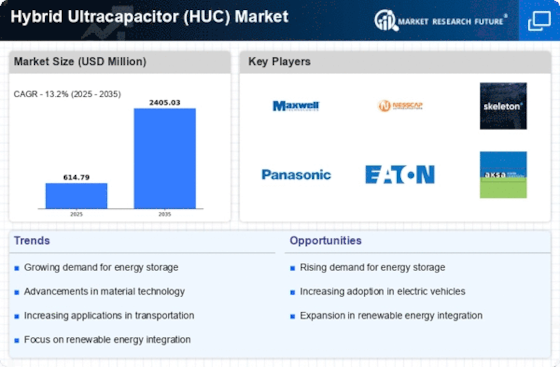
As per Market Research Future analysis, the Hybrid Ultracapacitor (HUC) Market Size was estimated at 614.79 USD Million in 2024. The Hybrid Ultracapacitor industry is projected to grow from USD 695.95 Million in 2025 to USD 2405.03 Million by 2035, exhibiting a compound annual growth rate (CAGR) of 13.2% during the forecast period 2025 - 2035

Key Market Trends & Highlights

The Hybrid Ultracapacitor market is poised for substantial growth driven by technological advancements and increasing energy storage demands.

  • North America remains the largest market for Hybrid Ultracapacitors, driven by robust demand in electric vehicles and grid energy storage. The Asia-Pacific region is emerging as the fastest-growing market, fueled by rapid industrialization and a shift towards renewable energy solutions. The Button Type segment continues to dominate the market, while the Winding Type segment is experiencing the fastest growth due to its efficiency in energy storage applications. Key market drivers include the increasing adoption of electric vehicles and the growing need for grid energy storage, which are shaping the future of Hybrid Ultracapacitors.

Market Size & Forecast

2024 Market Size 614.79 (USD Million)
2035 Market Size 2405.03 (USD Million)
CAGR (2025 - 2035) 13.2%
Largest Regional Market Share in 2024 North America

Major Players

Maxwell Technologies (US), Nesscap Energy (CA), Skeleton Technologies (EE), Panasonic Corporation (JP), Eaton Corporation (IE), Aksa Power Generation (TR), Ioxus (US), CAP-XX (AU), Yunasko (RU)

Market Trends

The Hybrid Ultracapacitor (HUC) Market is currently experiencing a notable evolution, driven by the increasing demand for energy storage solutions across various sectors. This market appears to be influenced by the growing emphasis on renewable energy sources and the need for efficient energy management systems. As industries seek to enhance their operational efficiency, the integration of HUC technology into electric vehicles, renewable energy systems, and consumer electronics is becoming more prevalent. The unique characteristics of hybrid ultracapacitors, such as their rapid charge and discharge capabilities, are likely to play a crucial role in shaping future applications. Moreover, the Hybrid Ultracapacitor (HUC) Market seems to be benefiting from advancements in materials science and engineering, which may lead to improved performance and cost-effectiveness. Research and development efforts are focused on enhancing the energy density and lifespan of these devices, potentially making them more attractive to manufacturers and consumers alike. As the global push for sustainability continues, the HUC market is poised for growth, with innovations likely to drive further adoption in various applications, including grid energy storage and backup power systems.

Rising Demand for Energy Storage Solutions

The Hybrid Ultracapacitor (HUC) Market is witnessing an increase in demand for energy storage solutions, particularly in sectors such as transportation and renewable energy. This trend indicates a shift towards more sustainable energy practices, as industries seek to optimize energy usage and reduce carbon footprints.

Technological Advancements in Materials

Innovations in materials science are contributing to the development of more efficient hybrid ultracapacitors. These advancements may enhance energy density and lifespan, making HUCs more appealing for various applications, including electric vehicles and grid storage.

Integration with Renewable Energy Systems

The integration of hybrid ultracapacitors with renewable energy systems is becoming more common. This trend suggests a growing recognition of the role that HUCs can play in stabilizing energy supply and improving the efficiency of solar and wind energy systems.

Hybrid Ultracapacitor HUC Market Market Drivers

Growing Need for Grid Energy Storage

The increasing need for grid energy storage solutions is significantly influencing the Hybrid Ultracapacitor (HUC) Market. As renewable energy sources like wind and solar become more prevalent, the demand for efficient energy storage systems to balance supply and demand is critical. HUCs can store excess energy generated during peak production times and release it during periods of high demand. This capability is essential for stabilizing the grid and ensuring a reliable energy supply. Market analysis indicates that the energy storage market is expected to reach USD 200 billion by 2026, with HUCs playing a crucial role in this transformation. Their ability to provide quick bursts of energy makes them particularly suitable for grid applications.

Advancements in Hybrid Energy Systems

Technological advancements in hybrid energy systems are propelling the Hybrid Ultracapacitor (HUC) Market forward. Innovations in energy management systems and control algorithms are enhancing the efficiency and performance of HUCs. These advancements allow for better integration of HUCs with traditional batteries, optimizing energy usage and extending the lifespan of both components. The market for hybrid energy systems is anticipated to grow significantly, with projections suggesting a CAGR of around 15% over the next five years. This growth is likely to be driven by the increasing need for reliable and efficient energy storage solutions across various sectors, including automotive, industrial, and renewable energy.

Increasing Adoption of Electric Vehicles

The rising adoption of electric vehicles (EVs) is a pivotal driver for the Hybrid Ultracapacitor (HUC) Market. As governments and consumers alike prioritize sustainable transportation, the demand for efficient energy storage solutions has surged. HUCs offer rapid charging capabilities and high power density, making them ideal for EV applications. According to recent data, the EV market is projected to grow at a compound annual growth rate (CAGR) of over 20% in the coming years. This growth is likely to propel the HUC market, as manufacturers seek to enhance vehicle performance and extend battery life. Furthermore, the integration of HUCs in hybrid systems can improve energy efficiency, thereby attracting more investments in this sector.

Enhanced Performance in Consumer Electronics

The demand for enhanced performance in consumer electronics is driving growth in the Hybrid Ultracapacitor (HUC) Market. As electronic devices become more sophisticated, the need for efficient energy storage solutions that can support high power demands is critical. HUCs provide a unique advantage by offering rapid charge and discharge capabilities, which are essential for devices such as smartphones, laptops, and wearables. The consumer electronics market is projected to grow at a CAGR of approximately 10% over the next few years, further increasing the demand for advanced energy storage solutions. This trend suggests that manufacturers will increasingly turn to HUCs to improve device performance and user experience.

Rising Focus on Sustainable Energy Solutions

The rising focus on sustainable energy solutions is a key driver for the Hybrid Ultracapacitor (HUC) Market. As environmental concerns escalate, industries are seeking alternatives to traditional energy storage methods that are more eco-friendly. HUCs, with their ability to charge and discharge rapidly, present a sustainable option for energy storage. They are often made from environmentally friendly materials, which aligns with the global shift towards sustainability. Market trends indicate that the demand for sustainable energy solutions is expected to increase, with investments in clean technologies projected to reach USD 1 trillion by 2030. This trend is likely to bolster the HUC market as companies strive to meet regulatory requirements and consumer expectations.

Market Segment Insights

By Product Type: Button Type (Largest) vs. Winding Type (Fastest-Growing)

In the Hybrid Ultracapacitor (HUC) Market, the product type segment is primarily dominated by Button Type ultracapacitors, which hold the largest market share. Their widespread adoption in applications like consumer electronics and automotive energy storage systems highlights their commercial viability. Winding Type ultracapacitors, while not as dominant, have been gaining traction due to their compact design and superior performance in high-power applications. This has led to increased interest and investment in their development and production.

Winding Type (Emerging) vs. Button Type (Dominant)

Button Type ultracapacitors are characterized by their extensive use in consumer devices due to their reliability and ease of integration. Their dominant position stems from established manufacturing processes and extensive application. In contrast, Winding Type ultracapacitors, classified as emerging, are increasingly favored for high-performance needs in renewable energy and electric vehicles. Their design enables higher energy density and efficiency, making them a compelling choice for next-generation applications. This shift towards Winding Type is fueled by the ongoing quest for enhanced energy solutions in a sustainable market.

By Application: Electric Vehicle (Largest) vs. Consumer Electronics (Fastest-Growing)

In the Hybrid Ultracapacitor (HUC) Market, the application segment reveals significant diversity with key players spread across various industries. The Electric Vehicle (EV) sector currently holds the largest share, driven by the increasing demand for energy-efficient transportation solutions. Following closely are Industrial Equipment and Aerospace applications, which also highlight a robust presence in market distribution, although at a lesser scale than EVs. Meanwhile, Consumer Electronics has emerged as a notable contender, capturing attention due to its rapid adoption of advanced energy storage solutions, which propels it further into the spotlight. Growth trends within the application segment of the HUC market are largely influenced by technological advancements and changing consumer preferences. The surge in electric vehicles is primarily attributed to a global shift towards sustainable energy and the need for effective power management in transport. Conversely, the Consumer Electronics sector is witnessing the fastest growth, largely driven by innovations in portable devices that require efficient and compact energy solutions. Collectively, these trends emphasize a dynamic and evolving landscape within the HUC market, highlighting varying rates of growth across different applications.

Electric Vehicle: Dominant vs. Consumer Electronics: Emerging

The Electric Vehicle application represents the dominant segment within the Hybrid Ultracapacitor (HUC) Market, characterized by its reliance on advanced energy storage technologies to enhance vehicle performance and efficiency. As global automobile manufacturers pivot towards electrification, the demand for HUCs is escalating, driven by their ability to deliver rapid energy bursts necessary for acceleration and energy recovery during braking. In contrast, Consumer Electronics exemplifies the emerging category, rapidly gaining traction as manufacturers seek to integrate energy-dense and lightweight storage solutions in their devices. HUCs are increasingly being utilized in gadgets like smartphones and wearable technology due to their favorable charge-discharge characteristics. The shift in consumer behavior towards compact and efficient electronics solidifies the growing importance of this segment, positioning it as a vital player in the future of the HUC market.

Get more detailed insights about Hybrid Ultracapacitor (HUC) Market Research Report—Global Forecast till 2035

Regional Insights

North America : Innovation and Demand Surge

North America is the largest market for Hybrid Ultracapacitors (HUC), holding approximately 45% of the global market share. The region's growth is driven by increasing demand for energy storage solutions in electric vehicles and renewable energy applications. Regulatory support for clean energy initiatives further catalyzes market expansion, with significant investments in research and development. The United States and Canada are the leading countries in this market, with major players like Maxwell Technologies and Ioxus headquartered in the region. The competitive landscape is characterized by innovation and strategic partnerships among key players, enhancing product offerings and market reach. The presence of advanced manufacturing facilities and a strong focus on sustainability are pivotal in maintaining North America's market leadership.

Europe : Sustainable Energy Focus

Europe is the second-largest market for Hybrid Ultracapacitors, accounting for around 30% of the global market share. The region's growth is propelled by stringent environmental regulations and a strong commitment to reducing carbon emissions. Initiatives like the European Green Deal are fostering investments in energy-efficient technologies, including HUCs, to support the transition to sustainable energy sources. Leading countries in Europe include Germany, France, and the UK, where companies like Skeleton Technologies and Eaton Corporation are making significant strides. The competitive landscape is marked by innovation and collaboration among industry players, focusing on enhancing energy density and reducing costs. The presence of robust research institutions further supports the development of advanced HUC technologies.

Asia-Pacific : Rapid Growth and Adoption

Asia-Pacific is witnessing rapid growth in the Hybrid Ultracapacitor market, holding approximately 20% of the global market share. The region's expansion is driven by increasing investments in electric vehicles and renewable energy projects, particularly in countries like China and Japan. Government incentives and policies aimed at promoting clean energy technologies are further boosting market demand. China and Japan are the leading countries in this region, with significant contributions from companies like Panasonic Corporation. The competitive landscape is evolving, with both established players and new entrants focusing on innovation and cost reduction. The growing emphasis on energy storage solutions in various sectors, including transportation and industrial applications, is expected to drive further growth in the HUC market.

Middle East and Africa : Emerging Market Potential

The Middle East and Africa region is emerging as a potential market for Hybrid Ultracapacitors, currently holding about 5% of the global market share. The growth is primarily driven by increasing energy demands and the need for efficient energy storage solutions in the face of rapid urbanization. Governments are beginning to recognize the importance of renewable energy, leading to supportive policies that encourage the adoption of HUC technologies. Countries like South Africa and the UAE are at the forefront of this market, with investments in renewable energy projects. The competitive landscape is still developing, with opportunities for both local and international players to establish a presence. As the region continues to invest in infrastructure and energy efficiency, the demand for Hybrid Ultracapacitors is expected to rise significantly.

Key Players and Competitive Insights

Leading market players are investing significantly in R&D to develop innovative polishing techniques and materials that enhance the quality and efficiency of Hybrid Ultracapacitor (HUC). Market participants are adopting different strategic activities for market developments including vertical Integration, new product launches, diversification of product portfolio, mergers and acquisitions, higher investments, and collaboration with other organizations. To grow and sustain in a more competitive and rising market climate, Hybrid Ultracapacitor (HUC) industry must offer cost-effective Solutions.
Manufacturing locally can minimize operational costs hence this move have been adopted by manufacturers in the global Hybrid Ultracapacitor (HUC) industry to benefit clients and increase the market share. In recent years, the Hybrid Ultracapacitor (HUC) industry has offered some of the most significant advantages to Consumers.
Major players in the Hybrid Ultracapacitor (HUC) market, including Maxwell Technologies, Rubycon, Nippon Chemi-Con, Skeleton Technologies, Eaton, Nichicon, KORCHIP, Yunasko, Nantong Jianghai Capacitor Co., Ltd., Ningbo CRRC New ENERGY Technology Co., Ltd., Hunan AIHUA Group Co., Ltd., Sieyuan Electric Co., Ltd., Xiamen Faratronic Co.,Ltd., GMCC Electronic Technology Wuxi Co., Ltd., Fengbin Electronic Technology Co., Ltd., China Aviation Lithium Battery (Luoyang) Co., Ltd., Shanghai Aowei Technology Development Co.,Ltd., and others, are attempting to gain a competitive edge by investing in product development to increase their product portfolio and cater to diverse consumer needs.
Maxwell Technologies, now part of Tesla, was a leading company in the energy storage and power delivery solutions industry. Specializing in ultracapacitor technology, Maxwell Technologies developed and manufactured energy storage devices known for their high power density, rapid charge and discharge capabilities, and long operational life. Their ultracapacitors found applications in a wide range of industries, including automotive, renewable energy, industrial automation, and aerospace. Maxwell Technologies was at the forefront of innovation, continuously improving ultracapacitor technology to meet the increasing demand for efficient and sustainable energy solutions.
The acquisition by Tesla in 2019 signified the electric vehicle giant's commitment to enhancing energy storage solutions for its EVs and renewable energy projects.
Rubycon is a renowned Japanese company specializing in the production of high-quality aluminum electrolytic capacitors. Founded in 1952, Rubycon has established itself as a leading manufacturer of capacitors used in various electronic and electrical applications. The company is known for its commitment to producing capacitors that offer superior performance, reliability, and durability, meeting the diverse needs of industries like consumer electronics, automotive, telecommunications, and industrial automation. Rubycon's extensive product range includes electrolytic capacitors, polymer capacitors, and aluminum electrolytic capacitors, making them a trusted choice for businesses seeking robust and dependable electronic components.
With a strong focus on quality and innovation, Rubycon continues to be a key player in the global capacitor market.

Key Companies in the Hybrid Ultracapacitor HUC Market include

Industry Developments

November 2022: Morand, a Swiss technology start-up, has introduced Morand eTechnology, a solution capable of recharging a city car in just 72 seconds. This innovative hybrid system melds the strengths of ultracapacitors and chemical batteries to produce a robust and exceptionally rapid energy pack that can be conveniently recharged within seconds.

Future Outlook

Hybrid Ultracapacitor HUC Market Future Outlook

The Hybrid Ultracapacitor market is projected to grow at a 13.2% CAGR from 2025 to 2035, driven by advancements in energy storage technologies and increasing demand for efficient power solutions.

New opportunities lie in:

  • Development of hybrid energy storage systems for renewable integration.
  • Expansion into electric vehicle charging infrastructure solutions.
  • Partnerships with grid operators for energy management systems.

By 2035, the Hybrid Ultracapacitor market is expected to be robust, driven by innovation and strategic partnerships.

Market Segmentation

Hybrid Ultracapacitor HUC Market Application Outlook

  • Electric Vehicle
  • Industrial Equipment
  • Aerospace
  • Consumer Electronics
  • Others

Hybrid Ultracapacitor HUC Market Product Type Outlook

  • Button Type
  • Winding Type
  • Others

Report Scope

MARKET SIZE 2024 614.79(USD Million)
MARKET SIZE 2025 695.95(USD Million)
MARKET SIZE 2035 2405.03(USD Million)
COMPOUND ANNUAL GROWTH RATE (CAGR) 13.2% (2025 - 2035)
REPORT COVERAGE Revenue Forecast, Competitive Landscape, Growth Factors, and Trends
BASE YEAR 2024
Market Forecast Period 2025 - 2035
Historical Data 2019 - 2024
Market Forecast Units USD Million
Key Companies Profiled Maxwell Technologies (US), Nesscap Energy (CA), Skeleton Technologies (EE), Panasonic Corporation (JP), Eaton Corporation (IE), Aksa Power Generation (TR), Ioxus (US), CAP-XX (AU), Yunasko (RU)
Segments Covered Product Type, Application, Region
Key Market Opportunities Growing demand for energy storage solutions in electric vehicles drives Hybrid Ultracapacitor (HUC) Market expansion.
Key Market Dynamics Rising demand for energy storage solutions drives innovation and competition in the Hybrid Ultracapacitor market.
Countries Covered North America, Europe, APAC, South America, MEA

FAQs

What is the projected market valuation of the Hybrid Ultracapacitor (HUC) Market by 2035?

<p>The projected market valuation for the Hybrid Ultracapacitor (HUC) Market by 2035 is 2405.03 USD Million.</p>

What was the market valuation of the Hybrid Ultracapacitor (HUC) Market in 2024?

<p>The overall market valuation of the Hybrid Ultracapacitor (HUC) Market in 2024 was 614.79 USD Million.</p>

What is the expected CAGR for the Hybrid Ultracapacitor (HUC) Market during the forecast period 2025 - 2035?

<p>The expected CAGR for the Hybrid Ultracapacitor (HUC) Market during the forecast period 2025 - 2035 is 13.2%.</p>

Which companies are considered key players in the Hybrid Ultracapacitor (HUC) Market?

<p>Key players in the Hybrid Ultracapacitor (HUC) Market include Maxwell Technologies, Nesscap Energy, Skeleton Technologies, and Panasonic Corporation.</p>

What are the main product types in the Hybrid Ultracapacitor (HUC) Market?

<p>The main product types in the Hybrid Ultracapacitor (HUC) Market include Button Type, Winding Type, and Others.</p>

What was the market value for the Winding Type segment in 2024?

<p>The market value for the Winding Type segment in 2024 was 245.92 USD Million.</p>

How does the Electric Vehicle application segment perform in the Hybrid Ultracapacitor (HUC) Market?

The Electric Vehicle application segment had a market value of 184.79 USD Million in 2024.

What is the projected market value for the Aerospace application segment by 2035?

The projected market value for the Aerospace application segment by 2035 is expected to reach 244.0 USD Million.

What is the market value for the Others segment in the Product Type category?

The market value for the Others segment in the Product Type category was 245.91 USD Million in 2024.

What applications are driving growth in the Hybrid Ultracapacitor (HUC) Market?

Applications driving growth in the Hybrid Ultracapacitor (HUC) Market include Electric Vehicles, Industrial Equipment, and Consumer Electronics.

  1. SECTION I: EXECUTIVE SUMMARY AND KEY HIGHLIGHTS
    1. | 1.1 EXECUTIVE SUMMARY
    2. | | 1.1.1 Market Overview
    3. | | 1.1.2 Key Findings
    4. | | 1.1.3 Market Segmentation
    5. | | 1.1.4 Competitive Landscape
    6. | | 1.1.5 Challenges and Opportunities
    7. | | 1.1.6 Future Outlook
  2. SECTION II: SCOPING, METHODOLOGY AND MARKET STRUCTURE
    1. | 2.1 MARKET INTRODUCTION
    2. | | 2.1.1 Definition
    3. | | 2.1.2 Scope of the study
    4. | | | 2.1.2.1 Research Objective
    5. | | | 2.1.2.2 Assumption
    6. | | | 2.1.2.3 Limitations
    7. | 2.2 RESEARCH METHODOLOGY
    8. | | 2.2.1 Overview
    9. | | 2.2.2 Data Mining
    10. | | 2.2.3 Secondary Research
    11. | | 2.2.4 Primary Research
    12. | | | 2.2.4.1 Primary Interviews and Information Gathering Process
    13. | | | 2.2.4.2 Breakdown of Primary Respondents
    14. | | 2.2.5 Forecasting Model
    15. | | 2.2.6 Market Size Estimation
    16. | | | 2.2.6.1 Bottom-Up Approach
    17. | | | 2.2.6.2 Top-Down Approach
    18. | | 2.2.7 Data Triangulation
    19. | | 2.2.8 Validation
  3. SECTION III: QUALITATIVE ANALYSIS
    1. | 3.1 MARKET DYNAMICS
    2. | | 3.1.1 Overview
    3. | | 3.1.2 Drivers
    4. | | 3.1.3 Restraints
    5. | | 3.1.4 Opportunities
    6. | 3.2 MARKET FACTOR ANALYSIS
    7. | | 3.2.1 Value chain Analysis
    8. | | 3.2.2 Porter's Five Forces Analysis
    9. | | | 3.2.2.1 Bargaining Power of Suppliers
    10. | | | 3.2.2.2 Bargaining Power of Buyers
    11. | | | 3.2.2.3 Threat of New Entrants
    12. | | | 3.2.2.4 Threat of Substitutes
    13. | | | 3.2.2.5 Intensity of Rivalry
    14. | | 3.2.3 COVID-19 Impact Analysis
    15. | | | 3.2.3.1 Market Impact Analysis
    16. | | | 3.2.3.2 Regional Impact
    17. | | | 3.2.3.3 Opportunity and Threat Analysis
  4. SECTION IV: QUANTITATIVE ANALYSIS
    1. | 4.1 Semiconductor & Electronics, BY Product Type (USD Million)
    2. | | 4.1.1 Button Type
    3. | | 4.1.2 Winding Type
    4. | | 4.1.3 Others
    5. | 4.2 Semiconductor & Electronics, BY Application (USD Million)
    6. | | 4.2.1 Electric Vehicle
    7. | | 4.2.2 Industrial Equipment
    8. | | 4.2.3 Aerospace
    9. | | 4.2.4 Consumer Electronics
    10. | | 4.2.5 Others
    11. | 4.3 Semiconductor & Electronics, BY Region (USD Million)
    12. | | 4.3.1 North America
    13. | | | 4.3.1.1 US
    14. | | | 4.3.1.2 Canada
    15. | | 4.3.2 Europe
    16. | | | 4.3.2.1 Germany
    17. | | | 4.3.2.2 UK
    18. | | | 4.3.2.3 France
    19. | | | 4.3.2.4 Russia
    20. | | | 4.3.2.5 Italy
    21. | | | 4.3.2.6 Spain
    22. | | | 4.3.2.7 Rest of Europe
    23. | | 4.3.3 APAC
    24. | | | 4.3.3.1 China
    25. | | | 4.3.3.2 India
    26. | | | 4.3.3.3 Japan
    27. | | | 4.3.3.4 South Korea
    28. | | | 4.3.3.5 Malaysia
    29. | | | 4.3.3.6 Thailand
    30. | | | 4.3.3.7 Indonesia
    31. | | | 4.3.3.8 Rest of APAC
    32. | | 4.3.4 South America
    33. | | | 4.3.4.1 Brazil
    34. | | | 4.3.4.2 Mexico
    35. | | | 4.3.4.3 Argentina
    36. | | | 4.3.4.4 Rest of South America
    37. | | 4.3.5 MEA
    38. | | | 4.3.5.1 GCC Countries
    39. | | | 4.3.5.2 South Africa
    40. | | | 4.3.5.3 Rest of MEA
  5. SECTION V: COMPETITIVE ANALYSIS
    1. | 5.1 Competitive Landscape
    2. | | 5.1.1 Overview
    3. | | 5.1.2 Competitive Analysis
    4. | | 5.1.3 Market share Analysis
    5. | | 5.1.4 Major Growth Strategy in the Semiconductor & Electronics
    6. | | 5.1.5 Competitive Benchmarking
    7. | | 5.1.6 Leading Players in Terms of Number of Developments in the Semiconductor & Electronics
    8. | | 5.1.7 Key developments and growth strategies
    9. | | | 5.1.7.1 New Product Launch/Service Deployment
    10. | | | 5.1.7.2 Merger & Acquisitions
    11. | | | 5.1.7.3 Joint Ventures
    12. | | 5.1.8 Major Players Financial Matrix
    13. | | | 5.1.8.1 Sales and Operating Income
    14. | | | 5.1.8.2 Major Players R&D Expenditure. 2023
    15. | 5.2 Company Profiles
    16. | | 5.2.1 Maxwell Technologies (US)
    17. | | | 5.2.1.1 Financial Overview
    18. | | | 5.2.1.2 Products Offered
    19. | | | 5.2.1.3 Key Developments
    20. | | | 5.2.1.4 SWOT Analysis
    21. | | | 5.2.1.5 Key Strategies
    22. | | 5.2.2 Nesscap Energy (CA)
    23. | | | 5.2.2.1 Financial Overview
    24. | | | 5.2.2.2 Products Offered
    25. | | | 5.2.2.3 Key Developments
    26. | | | 5.2.2.4 SWOT Analysis
    27. | | | 5.2.2.5 Key Strategies
    28. | | 5.2.3 Skeleton Technologies (EE)
    29. | | | 5.2.3.1 Financial Overview
    30. | | | 5.2.3.2 Products Offered
    31. | | | 5.2.3.3 Key Developments
    32. | | | 5.2.3.4 SWOT Analysis
    33. | | | 5.2.3.5 Key Strategies
    34. | | 5.2.4 Panasonic Corporation (JP)
    35. | | | 5.2.4.1 Financial Overview
    36. | | | 5.2.4.2 Products Offered
    37. | | | 5.2.4.3 Key Developments
    38. | | | 5.2.4.4 SWOT Analysis
    39. | | | 5.2.4.5 Key Strategies
    40. | | 5.2.5 Eaton Corporation (IE)
    41. | | | 5.2.5.1 Financial Overview
    42. | | | 5.2.5.2 Products Offered
    43. | | | 5.2.5.3 Key Developments
    44. | | | 5.2.5.4 SWOT Analysis
    45. | | | 5.2.5.5 Key Strategies
    46. | | 5.2.6 Aksa Power Generation (TR)
    47. | | | 5.2.6.1 Financial Overview
    48. | | | 5.2.6.2 Products Offered
    49. | | | 5.2.6.3 Key Developments
    50. | | | 5.2.6.4 SWOT Analysis
    51. | | | 5.2.6.5 Key Strategies
    52. | | 5.2.7 Ioxus (US)
    53. | | | 5.2.7.1 Financial Overview
    54. | | | 5.2.7.2 Products Offered
    55. | | | 5.2.7.3 Key Developments
    56. | | | 5.2.7.4 SWOT Analysis
    57. | | | 5.2.7.5 Key Strategies
    58. | | 5.2.8 CAP-XX (AU)
    59. | | | 5.2.8.1 Financial Overview
    60. | | | 5.2.8.2 Products Offered
    61. | | | 5.2.8.3 Key Developments
    62. | | | 5.2.8.4 SWOT Analysis
    63. | | | 5.2.8.5 Key Strategies
    64. | | 5.2.9 Yunasko (RU)
    65. | | | 5.2.9.1 Financial Overview
    66. | | | 5.2.9.2 Products Offered
    67. | | | 5.2.9.3 Key Developments
    68. | | | 5.2.9.4 SWOT Analysis
    69. | | | 5.2.9.5 Key Strategies
    70. | 5.3 Appendix
    71. | | 5.3.1 References
    72. | | 5.3.2 Related Reports
  6. LIST OF FIGURES
    1. | 6.1 MARKET SYNOPSIS
    2. | 6.2 NORTH AMERICA MARKET ANALYSIS
    3. | 6.3 US MARKET ANALYSIS BY PRODUCT TYPE
    4. | 6.4 US MARKET ANALYSIS BY APPLICATION
    5. | 6.5 CANADA MARKET ANALYSIS BY PRODUCT TYPE
    6. | 6.6 CANADA MARKET ANALYSIS BY APPLICATION
    7. | 6.7 EUROPE MARKET ANALYSIS
    8. | 6.8 GERMANY MARKET ANALYSIS BY PRODUCT TYPE
    9. | 6.9 GERMANY MARKET ANALYSIS BY APPLICATION
    10. | 6.10 UK MARKET ANALYSIS BY PRODUCT TYPE
    11. | 6.11 UK MARKET ANALYSIS BY APPLICATION
    12. | 6.12 FRANCE MARKET ANALYSIS BY PRODUCT TYPE
    13. | 6.13 FRANCE MARKET ANALYSIS BY APPLICATION
    14. | 6.14 RUSSIA MARKET ANALYSIS BY PRODUCT TYPE
    15. | 6.15 RUSSIA MARKET ANALYSIS BY APPLICATION
    16. | 6.16 ITALY MARKET ANALYSIS BY PRODUCT TYPE
    17. | 6.17 ITALY MARKET ANALYSIS BY APPLICATION
    18. | 6.18 SPAIN MARKET ANALYSIS BY PRODUCT TYPE
    19. | 6.19 SPAIN MARKET ANALYSIS BY APPLICATION
    20. | 6.20 REST OF EUROPE MARKET ANALYSIS BY PRODUCT TYPE
    21. | 6.21 REST OF EUROPE MARKET ANALYSIS BY APPLICATION
    22. | 6.22 APAC MARKET ANALYSIS
    23. | 6.23 CHINA MARKET ANALYSIS BY PRODUCT TYPE
    24. | 6.24 CHINA MARKET ANALYSIS BY APPLICATION
    25. | 6.25 INDIA MARKET ANALYSIS BY PRODUCT TYPE
    26. | 6.26 INDIA MARKET ANALYSIS BY APPLICATION
    27. | 6.27 JAPAN MARKET ANALYSIS BY PRODUCT TYPE
    28. | 6.28 JAPAN MARKET ANALYSIS BY APPLICATION
    29. | 6.29 SOUTH KOREA MARKET ANALYSIS BY PRODUCT TYPE
    30. | 6.30 SOUTH KOREA MARKET ANALYSIS BY APPLICATION
    31. | 6.31 MALAYSIA MARKET ANALYSIS BY PRODUCT TYPE
    32. | 6.32 MALAYSIA MARKET ANALYSIS BY APPLICATION
    33. | 6.33 THAILAND MARKET ANALYSIS BY PRODUCT TYPE
    34. | 6.34 THAILAND MARKET ANALYSIS BY APPLICATION
    35. | 6.35 INDONESIA MARKET ANALYSIS BY PRODUCT TYPE
    36. | 6.36 INDONESIA MARKET ANALYSIS BY APPLICATION
    37. | 6.37 REST OF APAC MARKET ANALYSIS BY PRODUCT TYPE
    38. | 6.38 REST OF APAC MARKET ANALYSIS BY APPLICATION
    39. | 6.39 SOUTH AMERICA MARKET ANALYSIS
    40. | 6.40 BRAZIL MARKET ANALYSIS BY PRODUCT TYPE
    41. | 6.41 BRAZIL MARKET ANALYSIS BY APPLICATION
    42. | 6.42 MEXICO MARKET ANALYSIS BY PRODUCT TYPE
    43. | 6.43 MEXICO MARKET ANALYSIS BY APPLICATION
    44. | 6.44 ARGENTINA MARKET ANALYSIS BY PRODUCT TYPE
    45. | 6.45 ARGENTINA MARKET ANALYSIS BY APPLICATION
    46. | 6.46 REST OF SOUTH AMERICA MARKET ANALYSIS BY PRODUCT TYPE
    47. | 6.47 REST OF SOUTH AMERICA MARKET ANALYSIS BY APPLICATION
    48. | 6.48 MEA MARKET ANALYSIS
    49. | 6.49 GCC COUNTRIES MARKET ANALYSIS BY PRODUCT TYPE
    50. | 6.50 GCC COUNTRIES MARKET ANALYSIS BY APPLICATION
    51. | 6.51 SOUTH AFRICA MARKET ANALYSIS BY PRODUCT TYPE
    52. | 6.52 SOUTH AFRICA MARKET ANALYSIS BY APPLICATION
    53. | 6.53 REST OF MEA MARKET ANALYSIS BY PRODUCT TYPE
    54. | 6.54 REST OF MEA MARKET ANALYSIS BY APPLICATION
    55. | 6.55 KEY BUYING CRITERIA OF SEMICONDUCTOR & ELECTRONICS
    56. | 6.56 RESEARCH PROCESS OF MRFR
    57. | 6.57 DRO ANALYSIS OF SEMICONDUCTOR & ELECTRONICS
    58. | 6.58 DRIVERS IMPACT ANALYSIS: SEMICONDUCTOR & ELECTRONICS
    59. | 6.59 RESTRAINTS IMPACT ANALYSIS: SEMICONDUCTOR & ELECTRONICS
    60. | 6.60 SUPPLY / VALUE CHAIN: SEMICONDUCTOR & ELECTRONICS
    61. | 6.61 SEMICONDUCTOR & ELECTRONICS, BY PRODUCT TYPE, 2024 (% SHARE)
    62. | 6.62 SEMICONDUCTOR & ELECTRONICS, BY PRODUCT TYPE, 2024 TO 2035 (USD Million)
    63. | 6.63 SEMICONDUCTOR & ELECTRONICS, BY APPLICATION, 2024 (% SHARE)
    64. | 6.64 SEMICONDUCTOR & ELECTRONICS, BY APPLICATION, 2024 TO 2035 (USD Million)
    65. | 6.65 BENCHMARKING OF MAJOR COMPETITORS
  7. LIST OF TABLES
    1. | 7.1 LIST OF ASSUMPTIONS
    2. | | 7.1.1
    3. | 7.2 North America MARKET SIZE ESTIMATES; FORECAST
    4. | | 7.2.1 BY PRODUCT TYPE, 2025-2035 (USD Million)
    5. | | 7.2.2 BY APPLICATION, 2025-2035 (USD Million)
    6. | 7.3 US MARKET SIZE ESTIMATES; FORECAST
    7. | | 7.3.1 BY PRODUCT TYPE, 2025-2035 (USD Million)
    8. | | 7.3.2 BY APPLICATION, 2025-2035 (USD Million)
    9. | 7.4 Canada MARKET SIZE ESTIMATES; FORECAST
    10. | | 7.4.1 BY PRODUCT TYPE, 2025-2035 (USD Million)
    11. | | 7.4.2 BY APPLICATION, 2025-2035 (USD Million)
    12. | 7.5 Europe MARKET SIZE ESTIMATES; FORECAST
    13. | | 7.5.1 BY PRODUCT TYPE, 2025-2035 (USD Million)
    14. | | 7.5.2 BY APPLICATION, 2025-2035 (USD Million)
    15. | 7.6 Germany MARKET SIZE ESTIMATES; FORECAST
    16. | | 7.6.1 BY PRODUCT TYPE, 2025-2035 (USD Million)
    17. | | 7.6.2 BY APPLICATION, 2025-2035 (USD Million)
    18. | 7.7 UK MARKET SIZE ESTIMATES; FORECAST
    19. | | 7.7.1 BY PRODUCT TYPE, 2025-2035 (USD Million)
    20. | | 7.7.2 BY APPLICATION, 2025-2035 (USD Million)
    21. | 7.8 France MARKET SIZE ESTIMATES; FORECAST
    22. | | 7.8.1 BY PRODUCT TYPE, 2025-2035 (USD Million)
    23. | | 7.8.2 BY APPLICATION, 2025-2035 (USD Million)
    24. | 7.9 Russia MARKET SIZE ESTIMATES; FORECAST
    25. | | 7.9.1 BY PRODUCT TYPE, 2025-2035 (USD Million)
    26. | | 7.9.2 BY APPLICATION, 2025-2035 (USD Million)
    27. | 7.10 Italy MARKET SIZE ESTIMATES; FORECAST
    28. | | 7.10.1 BY PRODUCT TYPE, 2025-2035 (USD Million)
    29. | | 7.10.2 BY APPLICATION, 2025-2035 (USD Million)
    30. | 7.11 Spain MARKET SIZE ESTIMATES; FORECAST
    31. | | 7.11.1 BY PRODUCT TYPE, 2025-2035 (USD Million)
    32. | | 7.11.2 BY APPLICATION, 2025-2035 (USD Million)
    33. | 7.12 Rest of Europe MARKET SIZE ESTIMATES; FORECAST
    34. | | 7.12.1 BY PRODUCT TYPE, 2025-2035 (USD Million)
    35. | | 7.12.2 BY APPLICATION, 2025-2035 (USD Million)
    36. | 7.13 APAC MARKET SIZE ESTIMATES; FORECAST
    37. | | 7.13.1 BY PRODUCT TYPE, 2025-2035 (USD Million)
    38. | | 7.13.2 BY APPLICATION, 2025-2035 (USD Million)
    39. | 7.14 China MARKET SIZE ESTIMATES; FORECAST
    40. | | 7.14.1 BY PRODUCT TYPE, 2025-2035 (USD Million)
    41. | | 7.14.2 BY APPLICATION, 2025-2035 (USD Million)
    42. | 7.15 India MARKET SIZE ESTIMATES; FORECAST
    43. | | 7.15.1 BY PRODUCT TYPE, 2025-2035 (USD Million)
    44. | | 7.15.2 BY APPLICATION, 2025-2035 (USD Million)
    45. | 7.16 Japan MARKET SIZE ESTIMATES; FORECAST
    46. | | 7.16.1 BY PRODUCT TYPE, 2025-2035 (USD Million)
    47. | | 7.16.2 BY APPLICATION, 2025-2035 (USD Million)
    48. | 7.17 South Korea MARKET SIZE ESTIMATES; FORECAST
    49. | | 7.17.1 BY PRODUCT TYPE, 2025-2035 (USD Million)
    50. | | 7.17.2 BY APPLICATION, 2025-2035 (USD Million)
    51. | 7.18 Malaysia MARKET SIZE ESTIMATES; FORECAST
    52. | | 7.18.1 BY PRODUCT TYPE, 2025-2035 (USD Million)
    53. | | 7.18.2 BY APPLICATION, 2025-2035 (USD Million)
    54. | 7.19 Thailand MARKET SIZE ESTIMATES; FORECAST
    55. | | 7.19.1 BY PRODUCT TYPE, 2025-2035 (USD Million)
    56. | | 7.19.2 BY APPLICATION, 2025-2035 (USD Million)
    57. | 7.20 Indonesia MARKET SIZE ESTIMATES; FORECAST
    58. | | 7.20.1 BY PRODUCT TYPE, 2025-2035 (USD Million)
    59. | | 7.20.2 BY APPLICATION, 2025-2035 (USD Million)
    60. | 7.21 Rest of APAC MARKET SIZE ESTIMATES; FORECAST
    61. | | 7.21.1 BY PRODUCT TYPE, 2025-2035 (USD Million)
    62. | | 7.21.2 BY APPLICATION, 2025-2035 (USD Million)
    63. | 7.22 South America MARKET SIZE ESTIMATES; FORECAST
    64. | | 7.22.1 BY PRODUCT TYPE, 2025-2035 (USD Million)
    65. | | 7.22.2 BY APPLICATION, 2025-2035 (USD Million)
    66. | 7.23 Brazil MARKET SIZE ESTIMATES; FORECAST
    67. | | 7.23.1 BY PRODUCT TYPE, 2025-2035 (USD Million)
    68. | | 7.23.2 BY APPLICATION, 2025-2035 (USD Million)
    69. | 7.24 Mexico MARKET SIZE ESTIMATES; FORECAST
    70. | | 7.24.1 BY PRODUCT TYPE, 2025-2035 (USD Million)
    71. | | 7.24.2 BY APPLICATION, 2025-2035 (USD Million)
    72. | 7.25 Argentina MARKET SIZE ESTIMATES; FORECAST
    73. | | 7.25.1 BY PRODUCT TYPE, 2025-2035 (USD Million)
    74. | | 7.25.2 BY APPLICATION, 2025-2035 (USD Million)
    75. | 7.26 Rest of South America MARKET SIZE ESTIMATES; FORECAST
    76. | | 7.26.1 BY PRODUCT TYPE, 2025-2035 (USD Million)
    77. | | 7.26.2 BY APPLICATION, 2025-2035 (USD Million)
    78. | 7.27 MEA MARKET SIZE ESTIMATES; FORECAST
    79. | | 7.27.1 BY PRODUCT TYPE, 2025-2035 (USD Million)
    80. | | 7.27.2 BY APPLICATION, 2025-2035 (USD Million)
    81. | 7.28 GCC Countries MARKET SIZE ESTIMATES; FORECAST
    82. | | 7.28.1 BY PRODUCT TYPE, 2025-2035 (USD Million)
    83. | | 7.28.2 BY APPLICATION, 2025-2035 (USD Million)
    84. | 7.29 South Africa MARKET SIZE ESTIMATES; FORECAST
    85. | | 7.29.1 BY PRODUCT TYPE, 2025-2035 (USD Million)
    86. | | 7.29.2 BY APPLICATION, 2025-2035 (USD Million)
    87. | 7.30 Rest of MEA MARKET SIZE ESTIMATES; FORECAST
    88. | | 7.30.1 BY PRODUCT TYPE, 2025-2035 (USD Million)
    89. | | 7.30.2 BY APPLICATION, 2025-2035 (USD Million)
    90. | 7.31 PRODUCT LAUNCH/PRODUCT DEVELOPMENT/APPROVAL
    91. | | 7.31.1
    92. | 7.32 ACQUISITION/PARTNERSHIP
    93. | | 7.32.1

Semiconductor & Electronics Market Segmentation

Semiconductor & Electronics By Product Type (USD Million, 2025-2035)

  • Button Type
  • Winding Type
  • Others

Semiconductor & Electronics By Application (USD Million, 2025-2035)

  • Electric Vehicle
  • Industrial Equipment
  • Aerospace
  • Consumer Electronics
  • Others
Infographic

Free Sample Request

Kindly complete the form below to receive a free sample of this Report

Get Free Sample

Customer Strories

Compare Licence

×
Features License Type
Single User Multiuser License Enterprise User
Price $4,950 $5,950 $7,250
Maximum User Access Limit 1 User Upto 10 Users Unrestricted Access Throughout the Organization
Free Customization
Direct Access to Analyst
Deliverable Format
Platform Access
Discount on Next Purchase 10% 15% 15%
Printable Versions