
×
Hero Background
English
Chinese
French
Japanese
Korean
German
Spanish

HVAC motors Market Size

ID: MRFR/EnP/6270-HCR
111 Pages
Priya Nagrale
October 2025

HVAC Motors Market Research Report By Application (Heating, Ventilation, Air Conditioning, Refrigeration), By Type (AC Motors, DC Motors, Universal Motors), By End Use (Residential, Commercial, Industrial), By Power Rating (Less than 1 HP, 1-5 HP, 5-10 HP, Above 10 HP) and By Regional (North America, Europe, South America, Asia Pacific, Middle East and Africa) - Forecast to 2035

Share:
Download PDF ×

We do not share your information with anyone. However, we may send you emails based on your report interest from time to time. You may contact us at any time to opt-out.

HVAC motors Market Infographic
Purchase Options

Hvac Motors Size

HVAC motors Market Growth Projections and Opportunities

The HVAC (Heating, Ventilation, and Air Conditioning) motors market is influenced by various market factors that play a crucial role in shaping its dynamics. One significant factor is the growing demand for energy-efficient solutions in the HVAC industry. As the emphasis on sustainability and energy conservation increases, there is a heightened need for motors that contribute to overall system efficiency. This has led to a surge in the adoption of high-efficiency HVAC motors, driven by stringent energy efficiency regulations and a growing awareness of environmental concerns.

Technological advancements also play a pivotal role in shaping the HVAC motors market. The integration of smart technologies, such as IoT (Internet of Things) and AI (Artificial Intelligence), has led to the development of intelligent and connected HVAC systems. This shift towards smart HVAC solutions requires motors that can seamlessly integrate with these technologies, providing enhanced control, monitoring, and automation capabilities. As a result, manufacturers in the HVAC motors market are investing in research and development to stay abreast of technological innovations and meet the evolving demands of the industry.

Furthermore, the construction industry's growth significantly influences the HVAC motors market. The demand for HVAC systems is closely tied to construction activities, including residential, commercial, and industrial projects. As urbanization and industrialization continue to rise globally, the construction of new buildings and infrastructure fuels the demand for HVAC motors. Additionally, retrofitting and renovation projects contribute to the market growth as existing buildings upgrade their HVAC systems to meet modern energy efficiency standards.

Economic factors, such as GDP growth and disposable income levels, also impact the HVAC motors market. Economic prosperity often correlates with increased construction activities and higher spending on infrastructure, positively influencing the demand for HVAC systems and, consequently, HVAC motors. Conversely, economic downturns can lead to a slowdown in construction projects and a decrease in HVAC system installations, affecting the market adversely.

The regulatory landscape is another crucial factor shaping the HVAC motors market. Governments worldwide are implementing and strengthening energy efficiency standards and environmental regulations to address climate change concerns. Compliance with these regulations is imperative for HVAC motor manufacturers to ensure market access and meet the expectations of environmentally conscious consumers. The adoption of energy efficiency labeling and certification programs further influences consumer choices and drives the market towards more sustainable and efficient HVAC motor solutions.

Globalization and international trade dynamics also impact the HVAC motors market. The interconnectedness of economies allows manufacturers to explore new markets and tap into regions with emerging opportunities. However, it also exposes the industry to challenges such as geopolitical tensions, trade barriers, and fluctuating currency exchange rates, which can affect production costs and pricing strategies.

The HVAC motors market is shaped by a complex interplay of factors, including the growing demand for energy efficiency, technological advancements, construction industry trends, economic conditions, regulatory frameworks, and global trade dynamics. Stakeholders in the HVAC motors industry need to adapt to these market factors strategically to capitalize on opportunities and navigate challenges in this dynamic and evolving market.
HVAC motors Market Size Graph
Author
Priya Nagrale
Senior Research Analyst

With an experience of over five years in market research industry (Chemicals & Materials domain), I gather and analyze market data from diverse sources to produce results, which are then presented back to a client. Also, provide recommendations based on the findings. As a Senior Research Analyst, I perform quality checks (QC) for market estimations, QC for reports, and handle queries and work extensively on client customizations. Also, handle the responsibilities of client proposals, report planning, report finalization, and execution

Leave a Comment

FAQs

What is the projected market valuation of the HVAC Motors Market by 2035?

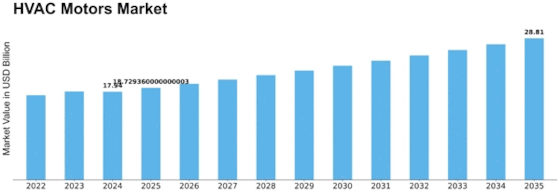
The HVAC Motors Market is projected to reach a valuation of 28.81 USD Billion by 2035.

What was the market valuation of the HVAC Motors Market in 2024?

In 2024, the HVAC Motors Market was valued at 17.94 USD Billion.

What is the expected CAGR for the HVAC Motors Market during the forecast period 2025 - 2035?

The expected CAGR for the HVAC Motors Market during the forecast period 2025 - 2035 is 4.4%.

Which companies are considered key players in the HVAC Motors Market?

Key players in the HVAC Motors Market include Johnson Controls, Carrier Global, Trane Technologies, Siemens, Emerson Electric, Mitsubishi Electric, LG Electronics, Daikin Industries, and Bosch.

What are the projected valuations for the HVAC Motors Market segments in 2035?

By 2035, the projected valuations for HVAC Motors segments include Heating at 7.5 USD Billion, Ventilation at 6.0 USD Billion, Air Conditioning at 8.0 USD Billion, and Refrigeration at 7.31 USD Billion.

How do AC Motors and DC Motors compare in terms of market valuation?

In 2035, AC Motors are projected to reach 11.25 USD Billion, while DC Motors are expected to reach 8.25 USD Billion.

What is the anticipated market size for the residential end-use segment by 2035?

The residential end-use segment is anticipated to reach a market size of 9.5 USD Billion by 2035.

What are the projected valuations for HVAC Motors based on power rating in 2035?

In 2035, HVAC Motors are projected to be valued at 4.19 USD Billion for less than 1 HP, 10.56 USD Billion for 1-5 HP, 6.93 USD Billion for 5-10 HP, and 7.13 USD Billion for above 10 HP.

What is the expected growth trend for the industrial end-use segment in the HVAC Motors Market?

The industrial end-use segment is expected to grow to 11.31 USD Billion by 2035, indicating a robust demand.

How does the HVAC Motors Market's growth compare across different applications?

The HVAC Motors Market's growth across applications shows Heating at 7.5 USD Billion, Ventilation at 6.0 USD Billion, Air Conditioning at 8.0 USD Billion, and Refrigeration at 7.31 USD Billion by 2035.

Market Summary

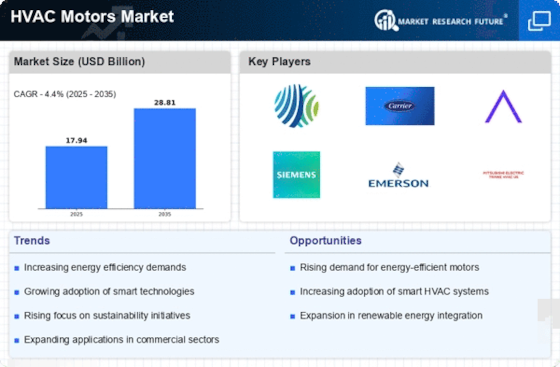
As per MRFR analysis, the HVAC Motors Market Size was estimated at 17.94 USD Billion in 2024. The HVAC Motors industry is projected to grow from 18.73 USD Billion in 2025 to 28.81 USD Billion by 2035, exhibiting a compound annual growth rate (CAGR) of 4.4 during the forecast period 2025 - 2035.

Key Market Trends & Highlights

The HVAC Motors Market is experiencing a transformative shift towards energy efficiency and smart technology integration.

  • North America remains the largest market for HVAC motors Market, driven by increasing energy efficiency regulations. The Asia-Pacific region is the fastest-growing market, reflecting a surge in construction activities and urbanization. Air conditioning motors dominate the market, while DC motors are witnessing rapid growth due to technological advancements. Key market drivers include rising demand for energy-efficient solutions and regulatory support for sustainable practices.

Market Size & Forecast

2024 Market Size 17.94 (USD Billion)
2035 Market Size 28.81 (USD Billion)
CAGR (2025 - 2035) 4.4%
Largest Regional Market Share in 2024 North America

Major Players

<p><a href="https://www.johnsoncontrols.com/hvac-equipment/air-handling-units">Johnson Controls</a> (US), Carrier Global (US), Trane Technologies (IE), Siemens (DE), Emerson Electric (US), Mitsubishi Electric (JP), LG Electronics (KR), Daikin Industries (JP), <a href="https://us.bosch-press.com/pressportal/us/en/press-release-28096.html">Bosch </a>(DE)</p>

Market Trends

The HVAC Motors Market is currently experiencing a dynamic evolution, driven by various factors that influence both demand and supply. The increasing emphasis on energy efficiency and sustainability is prompting manufacturers to innovate and develop advanced motor technologies. This shift is not merely a response to regulatory pressures but also reflects a broader societal trend towards reducing carbon footprints. As consumers become more environmentally conscious, the HVAC Motors Market is likely to see a surge in demand for products that align with these values. Furthermore, the integration of smart technologies into HVAC systems is reshaping the landscape, as automation and connectivity become essential features in modern applications. In addition to technological advancements, the HVAC Motors Market is also influenced by changing consumer preferences and economic conditions. The growing trend towards residential automation and smart homes is creating new opportunities for HVAC motor manufacturers. As more households adopt intelligent systems, the need for efficient and reliable motors becomes paramount. Moreover, the global push for renewable energy sources is likely to impact the HVAC sector, as companies seek to align their products with sustainable practices. Overall, the HVAC Motors Market appears poised for growth, with a focus on innovation, efficiency, and adaptability to emerging trends.

Energy Efficiency Focus

The HVAC Motors Market is increasingly prioritizing energy efficiency, driven by both regulatory requirements and consumer demand. Manufacturers are developing motors that consume less power while maintaining performance, which not only reduces operational costs but also aligns with global sustainability goals.

Integration of Smart Technologies

The incorporation of smart technologies into HVAC systems is transforming the HVAC Motors Market. As automation and connectivity become standard features, motors are being designed to work seamlessly with advanced control systems, enhancing user experience and operational efficiency.

Shift Towards Renewable Energy

The HVAC Motors Market is witnessing a shift towards renewable energy sources, as companies aim to align their products with sustainable practices. This trend is likely to drive innovation in motor design, focusing on compatibility with green technologies and energy-efficient solutions.

HVAC motors Market Market Drivers

Increased Construction Activities

The HVAC Motors Market is benefiting from increased construction activities across various sectors, including residential, commercial, and industrial. As urbanization continues to rise, the demand for new buildings equipped with modern HVAC systems is escalating. Data indicates that the construction sector is projected to grow at a compound annual growth rate of approximately 5% over the next few years. This growth is expected to drive the demand for HVAC systems, consequently boosting the need for efficient motors. As a result, manufacturers are focusing on producing motors that cater to the specific requirements of new construction projects, thereby enhancing their market presence in the HVAC Motors Market.

Growing Awareness of Indoor Air Quality

The growing awareness of indoor air quality is emerging as a crucial driver in the HVAC Motors Market. As individuals become more conscious of the health implications associated with poor air quality, there is an increasing demand for HVAC systems that can effectively filter and circulate air. This trend is particularly evident in commercial spaces, where regulations regarding air quality are becoming more stringent. Consequently, manufacturers are focusing on developing motors that enhance the performance of air filtration systems, thereby improving overall indoor air quality. This heightened focus on health and safety is likely to sustain growth in the HVAC Motors Market.

Technological Advancements in Motor Design

Technological advancements are playing a pivotal role in shaping the HVAC Motors Market. Innovations such as brushless DC motors and variable speed drives are enhancing the performance and efficiency of HVAC systems. These advanced motor designs offer improved reliability, reduced maintenance costs, and better energy management. For instance, the integration of variable speed technology allows motors to adjust their speed based on real-time demand, leading to significant energy savings. As these technologies become more prevalent, they are likely to attract investments and foster competition among manufacturers, further propelling the HVAC Motors Market.

Regulatory Support for Sustainable Practices

Regulatory support for sustainable practices is significantly influencing the HVAC Motors Market. Governments worldwide are implementing stringent regulations aimed at promoting energy efficiency and reducing greenhouse gas emissions. These regulations often mandate the use of energy-efficient motors in HVAC systems, creating a favorable environment for manufacturers. For example, initiatives such as tax incentives for energy-efficient upgrades are encouraging businesses to invest in modern HVAC solutions. This regulatory landscape not only drives demand for HVAC motors Market but also compels manufacturers to innovate and comply with evolving standards, thereby shaping the future of the HVAC Motors Market.

Rising Demand for Energy-Efficient Solutions

The HVAC Motors Market is experiencing a notable surge in demand for energy-efficient solutions. As consumers and businesses alike become increasingly aware of energy consumption and its associated costs, the preference for energy-efficient HVAC systems has intensified. According to recent data, energy-efficient motors can reduce energy consumption by up to 30% compared to traditional models. This shift not only lowers operational costs but also aligns with regulatory mandates aimed at reducing carbon footprints. Consequently, manufacturers are compelled to innovate and develop advanced motor technologies that meet these energy efficiency standards, thereby driving growth in the HVAC Motors Market.

Market Segment Insights

HVAC Motors Market Application Insights 

<p>The Global HVAC Motors Market is poised for notable growth within the Application segment, showcasing a comprehensive valuation of 27.02 USD Billion in 2023, with expectations to reach 34.6 USD Billion by 2032. Market statistics reveal that the Heating application holds a valuation of 6.75 USD Billion, displaying a significant incline to 8.67 USD Billion by 2032, highlighting its importance in both residential and industrial settings for efficient temperature control and energy savings. The Ventilation sector, valued at 5.4 USD Billion in 2023, will also witness growth to 6.89 USD Billion by 2032.</p>

<p>This segment is crucial for maintaining indoor air quality and energy efficiency, reflecting an increasing concern for health and sustainability among consumers. Air Conditioning, dominating the market with a value of 10.25 USD Billion in 2023 and expected to grow to 12.98 USD Billion by 2032, is a primary focus area due to rising global temperatures and the growing demand for comfort cooling solutions in hot climates.</p>

<p>Lastly, the Refrigeration segment, valued at 4.62 USD Billion in 2023 and anticipated to increase to 5.46 USD Billion by 2032, remains significant for preserving food and other perishables, underlining the critical role HVAC motors Market play in the food supply chain and cold storage industry.</p>

HVAC Motors Market Type Insights 

<p>The Global HVAC Motors Market is experiencing steady growth, with a valuation of 27.02 billion USD in 2023. The market encompasses various types of motors, primarily categorized into AC Motors, DC Motors, and Universal Motors, each playing a critical role in HVAC systems. AC Motors dominate the market due to their efficiency and widespread use in commercial and residential applications. These motors are essential for driving large systems as they operate effectively with high torque. DC Motors, known for their superior control and efficiency, are gaining traction due to advancements in electronic control systems, making them suitable for energy-efficient applications.</p>

<p>Meanwhile, Universal Motors find significance due to their versatility, as they can operate on both <a href="https://www.marketresearchfuture.com/reports/ac-dc-power-supply-adapter-market-11892">AC and DC power</a>. This flexibility makes them ideal for specific HVAC applications. Overall, the Global HVAC Motors Market segmentation highlights the need for diverse motor types to cater to varying application requirements, showcasing the growth driven by advancements in technology and a rising focus on energy efficiency.</p>

HVAC Motors Market End Use Insights

<p>The Global HVAC Motors Market, valued at 27.02 billion USD in 2023, showcases diverse applications across various end-use categories including Residential, Commercial, and Industrial sectors. The Residential sector plays a crucial role, driven by ongoing construction activities and increased demand for energy-efficient solutions among homeowners. The Commercial sector also holds significant weight, as businesses prioritize effective climate control systems to boost operational efficiency and employee comfort. Meanwhile, the Industrial segment is characterized by its reliance on HVAC systems for temperature regulation, enhancing productivity in factories and warehouses.</p>

<p>The growing trend towards automation and smart technologies further propels the adoption of HVAC motors Market across these segments, driving market growth. However, challenges like fluctuating raw material costs and rising environmental regulations may impact on the overall dynamics. Still, opportunities abound in the form of innovative product developments aimed at sustainability and energy efficiency, indicating a bright future for the Global HVAC Motors Market revenue over the coming years. These trends illustrate the intricate Global HVAC Motors Market segmentation, emphasizing the vital roles each sector plays in driving overall market performance and statistics.</p>

HVAC Motors Market Power Rating Insights 

<p>The Global HVAC Motors Market has established a comprehensive framework around the Power Rating segment, which plays a crucial role in determining the efficiency and applicability of motors within various HVAC systems. In 2023, the overall market was valued at 27.02 billion USD, reflecting strong demand and innovation in the HVAC motors Market sector. The distribution of power ratings reveals that motors with power ratings of Less than 1 HP dominate applications in residential settings, offering energy efficiency for smaller systems. Meanwhile, the 1-5 HP range is significant for light commercial purposes, balancing power, and performance effectively.</p>

<p>Motors rated between 5-10 HP find substantial applications in larger HVAC systems, where higher capacity is essential for operation efficiency. Finally, the Above 10 HP category plays a pivotal role in industrial applications and large commercial settings, reflecting a growing trend toward automation and high-capacity systems. As market data indicates a steady growth trajectory, key drivers such as the push for energy-efficient systems and governmental regulations aimed at reducing carbon emissions underscore the importance of this segment in the overall landscape of the Global HVAC Motors Market industry.</p>

<p>With market growth shaped by these dynamics, HVAC Motors with varying power ratings will continue to adapt to changing needs and technologies, ensuring robustness in the market segmentation of Global HVAC Motors Market statistics.</p>

Get more detailed insights about HVAC Motors Market Research Report - Global Forecast till 2035

Regional Insights

North America : Market Leader in HVAC Motors

North America is the largest market for HVAC motors Market, holding approximately 40% of the global share. The region's growth is driven by increasing demand for energy-efficient systems, stringent regulations on energy consumption, and a robust construction sector. The U.S. and Canada are the primary contributors, with a growing focus on smart technologies and automation in HVAC systems. Regulatory initiatives, such as the Energy Policy Act, further catalyze market expansion. The competitive landscape in North America is characterized by the presence of major players like Johnson Controls, Carrier Global, and Trane Technologies. These companies are investing heavily in R&D to innovate and enhance product efficiency. The market is also witnessing a trend towards the integration of IoT technologies, which is reshaping HVAC solutions. The focus on sustainability and reducing carbon footprints is driving manufacturers to develop advanced motor technologies that meet evolving consumer demands.

Europe : Innovative HVAC Solutions Hub

Europe is the second-largest market for HVAC motors Market, accounting for approximately 30% of the global market share. The region's growth is propelled by stringent environmental regulations, a strong emphasis on energy efficiency, and increasing investments in renewable energy sources. Countries like Germany and France are leading the charge, with initiatives aimed at reducing greenhouse gas emissions and promoting sustainable building practices. The EU's Green Deal is a significant regulatory catalyst for market growth. Leading countries in Europe include Germany, France, and the UK, where key players like Siemens and Bosch are actively innovating. The competitive landscape is marked by a shift towards smart HVAC solutions, integrating advanced technologies such as AI and IoT. This trend is enhancing operational efficiency and user experience. The presence of established manufacturers and a growing number of startups focused on sustainability are shaping the future of the HVAC motors Market in Europe.

Asia-Pacific : Emerging Market with High Demand

Asia-Pacific is witnessing rapid growth in the HVAC motors Market, holding approximately 25% of the global share. The region's expansion is driven by urbanization, rising disposable incomes, and increasing demand for energy-efficient HVAC systems. Countries like China and India are at the forefront, with significant investments in infrastructure and smart city projects. Government initiatives promoting energy efficiency and sustainability are further boosting market growth. China is the largest market in the region, followed by India and Japan, where key players like Mitsubishi Electric and Daikin Industries are prominent. The competitive landscape is evolving, with local manufacturers emerging alongside established global brands. The focus on innovation and technology integration is reshaping the market, as companies strive to meet the growing demand for advanced HVAC solutions that cater to both residential and commercial sectors.

Middle East and Africa : Resource-Rich HVAC Market

The Middle East and Africa region is gradually emerging in the HVAC motors Market, holding about 5% of the global share. The growth is primarily driven by ongoing infrastructure projects, urbanization, and a rising demand for energy-efficient solutions. Countries like the UAE and South Africa are leading the market, with significant investments in commercial and residential developments. Government initiatives aimed at enhancing energy efficiency are also contributing to market growth. In the competitive landscape, key players such as LG Electronics and Emerson Electric are establishing a strong presence. The market is characterized by a mix of international and local manufacturers, focusing on innovative solutions tailored to the region's unique climate challenges. The increasing adoption of smart technologies in HVAC systems is expected to further drive growth in this region, as stakeholders seek to optimize energy consumption and improve system performance.

Key Players and Competitive Insights

The HVAC Motors Market is currently characterized by a dynamic competitive landscape, driven by increasing demand for energy-efficient solutions and advancements in technology. Major players such as Johnson Controls (US), Carrier Global (US), and Trane Technologies (IE) are strategically positioning themselves through innovation and regional expansion. Johnson Controls (US) focuses on integrating smart technologies into their HVAC systems, enhancing energy efficiency and user experience. Carrier Global (US) emphasizes sustainability, aiming to reduce carbon footprints through advanced motor technologies. Trane Technologies (IE) is actively pursuing partnerships to enhance its product offerings, particularly in the realm of smart HVAC solutions, thereby shaping a competitive environment that prioritizes technological advancement and sustainability.

Key business tactics within the HVAC Motors Market include localizing manufacturing and optimizing supply chains to enhance responsiveness to regional demands. The market structure appears moderately fragmented, with several key players exerting influence over various segments. This fragmentation allows for niche players to thrive, while larger companies leverage their scale to optimize production and distribution, thereby enhancing their competitive edge.

In August 2025, Siemens (DE) announced a strategic partnership with a leading renewable energy firm to develop integrated HVAC solutions that utilize sustainable energy sources. This move is significant as it aligns Siemens with the growing trend towards sustainability, potentially positioning the company as a leader in eco-friendly HVAC technologies. The partnership may also enhance Siemens' product portfolio, allowing it to cater to a broader market segment that prioritizes environmental responsibility.

In September 2025, Emerson Electric (US) launched a new line of smart HVAC motors designed to optimize energy consumption in commercial buildings. This initiative reflects Emerson's commitment to innovation and energy efficiency, suggesting a strategic pivot towards smart technologies that could redefine operational standards in the HVAC sector. The introduction of these motors may not only enhance Emerson's market share but also set new benchmarks for energy performance in HVAC systems.

In July 2025, Mitsubishi Electric (JP) expanded its manufacturing capabilities in Southeast Asia, aiming to meet the rising demand for HVAC solutions in emerging markets. This expansion is indicative of Mitsubishi's strategy to localize production, thereby reducing lead times and enhancing supply chain efficiency. Such moves are likely to strengthen Mitsubishi's competitive position in the region, allowing it to respond more effectively to local market needs.

As of October 2025, the HVAC Motors Market is witnessing trends that emphasize digitalization, sustainability, and the integration of artificial intelligence. Strategic alliances are increasingly shaping the competitive landscape, enabling companies to pool resources and expertise to innovate more rapidly. The shift from price-based competition to a focus on technological innovation and supply chain reliability is becoming evident, suggesting that future competitive differentiation will hinge on the ability to deliver advanced, sustainable solutions that meet evolving consumer expectations.

Key Companies in the HVAC motors Market market include

Industry Developments

Recent developments in the Global HVAC Motors Market indicate significant advancements and trends shaping the industry. Companies like Panasonic and Siemens are innovating new energy-efficient motors aligned with global sustainability goals, contributing to reduced energy consumption in HVAC systems. Lennox International and Emerson Electric are also enhancing product lines to meet rising consumer demand for smart home technologies, integrating IoT solutions into their HVAC systems for increased efficiency and user control.

Current affairs include a surge in demand for HVAC systems driven by ongoing construction activities and the rise of smart cities, boosting the market valuation for many companies such as ABB and Honeywell.

A notable event is Nidec Corporation's acquisition of a key component manufacturer, which is expected to strengthen its market position and expand its product offerings in HVAC motors Market. Additionally, Regal Beloit Corporation is experiencing growth through increased investments in research and development aimed at creating more eco-friendly HVAC solutions. The market is evolving rapidly as established firms collaborate and innovate to adapt to changing consumer preferences and regulatory frameworks, indicating a dynamic landscape for HVAC motors Market on a global scale.

Future Outlook

HVAC motors Market Future Outlook

<p>The HVAC Motors Market is projected to grow at a 4.4% CAGR from 2024 to 2035, driven by energy efficiency regulations, technological advancements, and increasing demand for smart HVAC systems.</p>

New opportunities lie in:

  • <p>Development of energy-efficient motor technologies for compliance with regulations.</p>
  • <p>Expansion into emerging markets with tailored HVAC solutions.</p>
  • <p>Integration of IoT capabilities in HVAC motors Market for enhanced performance monitoring.</p>

<p>By 2035, the HVAC Motors Market is expected to achieve robust growth, driven by innovation and strategic market positioning.</p>

Market Segmentation

HVAC motors Market Type Outlook

  • AC Motors
  • DC Motors
  • Universal Motors

HVAC motors Market End Use Outlook

  • Residential
  • Commercial
  • Industrial

HVAC motors Market Application Outlook

  • Heating
  • Ventilation
  • Air Conditioning
  • Refrigeration

HVAC motors Market Power Rating Outlook

  • Less than 1 HP
  • 1-5 HP
  • 5-10 HP
  • Above 10 HP

Report Scope

MARKET SIZE 2024 17.94(USD Billion)
MARKET SIZE 2025 18.73(USD Billion)
MARKET SIZE 2035 28.81(USD Billion)
COMPOUND ANNUAL GROWTH RATE (CAGR) 4.4% (2024 - 2035)
REPORT COVERAGE Revenue Forecast, Competitive Landscape, Growth Factors, and Trends
BASE YEAR 2024
Market Forecast Period 2025 - 2035
Historical Data 2019 - 2024
Market Forecast Units USD Billion
Key Companies Profiled Market analysis in progress
Segments Covered Market segmentation analysis in progress
Key Market Opportunities Integration of energy-efficient technologies in HVAC Motors Market drives demand for sustainable solutions.
Key Market Dynamics Rising demand for energy-efficient HVAC motors drives innovation and competition among manufacturers in the market.
Countries Covered North America, Europe, APAC, South America, MEA

FAQs

What is the projected market valuation of the HVAC Motors Market by 2035?

The HVAC Motors Market is projected to reach a valuation of 28.81 USD Billion by 2035.

What was the market valuation of the HVAC Motors Market in 2024?

In 2024, the HVAC Motors Market was valued at 17.94 USD Billion.

What is the expected CAGR for the HVAC Motors Market during the forecast period 2025 - 2035?

The expected CAGR for the HVAC Motors Market during the forecast period 2025 - 2035 is 4.4%.

Which companies are considered key players in the HVAC Motors Market?

Key players in the HVAC Motors Market include Johnson Controls, Carrier Global, Trane Technologies, Siemens, Emerson Electric, Mitsubishi Electric, LG Electronics, Daikin Industries, and Bosch.

What are the projected valuations for the HVAC Motors Market segments in 2035?

By 2035, the projected valuations for HVAC Motors segments include Heating at 7.5 USD Billion, Ventilation at 6.0 USD Billion, Air Conditioning at 8.0 USD Billion, and Refrigeration at 7.31 USD Billion.

How do AC Motors and DC Motors compare in terms of market valuation?

In 2035, AC Motors are projected to reach 11.25 USD Billion, while DC Motors are expected to reach 8.25 USD Billion.

What is the anticipated market size for the residential end-use segment by 2035?

The residential end-use segment is anticipated to reach a market size of 9.5 USD Billion by 2035.

What are the projected valuations for HVAC Motors based on power rating in 2035?

In 2035, HVAC Motors are projected to be valued at 4.19 USD Billion for less than 1 HP, 10.56 USD Billion for 1-5 HP, 6.93 USD Billion for 5-10 HP, and 7.13 USD Billion for above 10 HP.

What is the expected growth trend for the industrial end-use segment in the HVAC Motors Market?

The industrial end-use segment is expected to grow to 11.31 USD Billion by 2035, indicating a robust demand.

How does the HVAC Motors Market's growth compare across different applications?

The HVAC Motors Market's growth across applications shows Heating at 7.5 USD Billion, Ventilation at 6.0 USD Billion, Air Conditioning at 8.0 USD Billion, and Refrigeration at 7.31 USD Billion by 2035.

  1. SECTION I: EXECUTIVE SUMMARY AND KEY HIGHLIGHTS
    1. EXECUTIVE SUMMARY
      1. Market Overview
      2. Key Findings
      3. Market Segmentation
      4. Competitive Landscape
      5. Challenges and Opportunities
      6. Future Outlook 2
  2. SECTION II: SCOPING, METHODOLOGY AND MARKET STRUCTURE
    1. MARKET INTRODUCTION
      1. Definition
      2. Scope of the study
    2. RESEARCH METHODOLOGY
      1. Overview
      2. Data Mining
      3. Secondary Research
      4. Primary Research
      5. Forecasting Model
      6. Market Size Estimation
      7. Data Triangulation
      8. Validation 3
  3. SECTION III: QUALITATIVE ANALYSIS
    1. MARKET DYNAMICS
      1. Overview
      2. Drivers
      3. Restraints
      4. Opportunities
    2. MARKET FACTOR ANALYSIS
      1. Value chain Analysis
      2. Porter's Five Forces Analysis
      3. COVID-19 Impact Analysis
  4. SECTION IV: QUANTITATIVE ANALYSIS
    1. Energy & Power, BY Application (USD Billion)
      1. Heating
      2. Ventilation
      3. Air Conditioning
      4. Refrigeration
    2. Energy & Power, BY Type (USD Billion)
      1. AC Motors
      2. DC Motors
      3. Universal Motors
    3. Energy & Power, BY End Use (USD Billion)
      1. Residential
      2. Commercial
      3. Industrial
    4. Energy & Power, BY Power Rating (USD Billion)
      1. Less than 1 HP
      2. 1-5 HP
      3. 5-10 HP
      4. Above 10 HP
    5. Energy & Power, BY Region (USD Billion)
      1. North America
      2. Europe
      3. APAC
      4. South America
      5. MEA
  5. SECTION V: COMPETITIVE ANALYSIS
    1. Competitive Landscape
      1. Overview
      2. Competitive Analysis
      3. Market share Analysis
      4. Major Growth Strategy in the Energy & Power
      5. Competitive Benchmarking
      6. Leading Players in Terms of Number of Developments in the Energy & Power
      7. Key developments and growth strategies
      8. Major Players Financial Matrix
    2. Company Profiles
      1. Johnson Controls (US)
      2. Carrier Global (US)
      3. Trane Technologies (IE)
      4. Siemens (DE)
      5. Emerson Electric (US)
      6. Mitsubishi Electric (JP)
      7. LG Electronics (KR)
      8. Daikin Industries (JP)
      9. Bosch (DE)
    3. Appendix
      1. References
      2. Related Reports 6 LIST OF FIGURES
    4. MARKET SYNOPSIS
    5. NORTH AMERICA MARKET ANALYSIS
    6. US MARKET ANALYSIS BY APPLICATION
    7. US MARKET ANALYSIS BY TYPE
    8. US MARKET ANALYSIS BY END USE
    9. US MARKET ANALYSIS BY POWER RATING
    10. CANADA MARKET ANALYSIS BY APPLICATION
    11. CANADA MARKET ANALYSIS BY TYPE
    12. CANADA MARKET ANALYSIS BY END USE
    13. CANADA MARKET ANALYSIS BY POWER RATING
    14. EUROPE MARKET ANALYSIS
    15. GERMANY MARKET ANALYSIS BY APPLICATION
    16. GERMANY MARKET ANALYSIS BY TYPE
    17. GERMANY MARKET ANALYSIS BY END USE
    18. GERMANY MARKET ANALYSIS BY POWER RATING
    19. UK MARKET ANALYSIS BY APPLICATION
    20. UK MARKET ANALYSIS BY TYPE
    21. UK MARKET ANALYSIS BY END USE
    22. UK MARKET ANALYSIS BY POWER RATING
    23. FRANCE MARKET ANALYSIS BY APPLICATION
    24. FRANCE MARKET ANALYSIS BY TYPE
    25. FRANCE MARKET ANALYSIS BY END USE
    26. FRANCE MARKET ANALYSIS BY POWER RATING
    27. RUSSIA MARKET ANALYSIS BY APPLICATION
    28. RUSSIA MARKET ANALYSIS BY TYPE
    29. RUSSIA MARKET ANALYSIS BY END USE
    30. RUSSIA MARKET ANALYSIS BY POWER RATING
    31. ITALY MARKET ANALYSIS BY APPLICATION
    32. ITALY MARKET ANALYSIS BY TYPE
    33. ITALY MARKET ANALYSIS BY END USE
    34. ITALY MARKET ANALYSIS BY POWER RATING
    35. SPAIN MARKET ANALYSIS BY APPLICATION
    36. SPAIN MARKET ANALYSIS BY TYPE
    37. SPAIN MARKET ANALYSIS BY END USE
    38. SPAIN MARKET ANALYSIS BY POWER RATING
    39. REST OF EUROPE MARKET ANALYSIS BY APPLICATION
    40. REST OF EUROPE MARKET ANALYSIS BY TYPE
    41. REST OF EUROPE MARKET ANALYSIS BY END USE
    42. REST OF EUROPE MARKET ANALYSIS BY POWER RATING
    43. APAC MARKET ANALYSIS
    44. CHINA MARKET ANALYSIS BY APPLICATION
    45. CHINA MARKET ANALYSIS BY TYPE
    46. CHINA MARKET ANALYSIS BY END USE
    47. CHINA MARKET ANALYSIS BY POWER RATING
    48. INDIA MARKET ANALYSIS BY APPLICATION
    49. INDIA MARKET ANALYSIS BY TYPE
    50. INDIA MARKET ANALYSIS BY END USE
    51. INDIA MARKET ANALYSIS BY POWER RATING
    52. JAPAN MARKET ANALYSIS BY APPLICATION
    53. JAPAN MARKET ANALYSIS BY TYPE
    54. JAPAN MARKET ANALYSIS BY END USE
    55. JAPAN MARKET ANALYSIS BY POWER RATING
    56. SOUTH KOREA MARKET ANALYSIS BY APPLICATION
    57. SOUTH KOREA MARKET ANALYSIS BY TYPE
    58. SOUTH KOREA MARKET ANALYSIS BY END USE
    59. SOUTH KOREA MARKET ANALYSIS BY POWER RATING
    60. MALAYSIA MARKET ANALYSIS BY APPLICATION
    61. MALAYSIA MARKET ANALYSIS BY TYPE
    62. MALAYSIA MARKET ANALYSIS BY END USE
    63. MALAYSIA MARKET ANALYSIS BY POWER RATING
    64. THAILAND MARKET ANALYSIS BY APPLICATION
    65. THAILAND MARKET ANALYSIS BY TYPE
    66. THAILAND MARKET ANALYSIS BY END USE
    67. THAILAND MARKET ANALYSIS BY POWER RATING
    68. INDONESIA MARKET ANALYSIS BY APPLICATION
    69. INDONESIA MARKET ANALYSIS BY TYPE
    70. INDONESIA MARKET ANALYSIS BY END USE
    71. INDONESIA MARKET ANALYSIS BY POWER RATING
    72. REST OF APAC MARKET ANALYSIS BY APPLICATION
    73. REST OF APAC MARKET ANALYSIS BY TYPE
    74. REST OF APAC MARKET ANALYSIS BY END USE
    75. REST OF APAC MARKET ANALYSIS BY POWER RATING
    76. SOUTH AMERICA MARKET ANALYSIS
    77. BRAZIL MARKET ANALYSIS BY APPLICATION
    78. BRAZIL MARKET ANALYSIS BY TYPE
    79. BRAZIL MARKET ANALYSIS BY END USE
    80. BRAZIL MARKET ANALYSIS BY POWER RATING
    81. MEXICO MARKET ANALYSIS BY APPLICATION
    82. MEXICO MARKET ANALYSIS BY TYPE
    83. MEXICO MARKET ANALYSIS BY END USE
    84. MEXICO MARKET ANALYSIS BY POWER RATING
    85. ARGENTINA MARKET ANALYSIS BY APPLICATION
    86. ARGENTINA MARKET ANALYSIS BY TYPE
    87. ARGENTINA MARKET ANALYSIS BY END USE
    88. ARGENTINA MARKET ANALYSIS BY POWER RATING
    89. REST OF SOUTH AMERICA MARKET ANALYSIS BY APPLICATION
    90. REST OF SOUTH AMERICA MARKET ANALYSIS BY TYPE
    91. REST OF SOUTH AMERICA MARKET ANALYSIS BY END USE
    92. REST OF SOUTH AMERICA MARKET ANALYSIS BY POWER RATING
    93. MEA MARKET ANALYSIS
    94. GCC COUNTRIES MARKET ANALYSIS BY APPLICATION
    95. GCC COUNTRIES MARKET ANALYSIS BY TYPE
    96. GCC COUNTRIES MARKET ANALYSIS BY END USE
    97. GCC COUNTRIES MARKET ANALYSIS BY POWER RATING
    98. SOUTH AFRICA MARKET ANALYSIS BY APPLICATION
    99. SOUTH AFRICA MARKET ANALYSIS BY TYPE
    100. SOUTH AFRICA MARKET ANALYSIS BY END USE
    101. SOUTH AFRICA MARKET ANALYSIS BY POWER RATING
    102. REST OF MEA MARKET ANALYSIS BY APPLICATION
    103. REST OF MEA MARKET ANALYSIS BY TYPE
    104. REST OF MEA MARKET ANALYSIS BY END USE
    105. REST OF MEA MARKET ANALYSIS BY POWER RATING
    106. KEY BUYING CRITERIA OF ENERGY & POWER
    107. RESEARCH PROCESS OF MRFR
    108. DRO ANALYSIS OF ENERGY & POWER
    109. DRIVERS IMPACT ANALYSIS: ENERGY & POWER
    110. RESTRAINTS IMPACT ANALYSIS: ENERGY & POWER
    111. SUPPLY / VALUE CHAIN: ENERGY & POWER
    112. ENERGY & POWER, BY APPLICATION, 2024 (% SHARE)
    113. ENERGY & POWER, BY APPLICATION, 2024 TO 2035 (USD Billion)
    114. ENERGY & POWER, BY TYPE, 2024 (% SHARE)
    115. ENERGY & POWER, BY TYPE, 2024 TO 2035 (USD Billion)
    116. ENERGY & POWER, BY END USE, 2024 (% SHARE)
    117. ENERGY & POWER, BY END USE, 2024 TO 2035 (USD Billion)
    118. ENERGY & POWER, BY POWER RATING, 2024 (% SHARE)
    119. ENERGY & POWER, BY POWER RATING, 2024 TO 2035 (USD Billion)
    120. BENCHMARKING OF MAJOR COMPETITORS 7 LIST OF TABLES
    121. LIST OF ASSUMPTIONS
    122. North America MARKET SIZE ESTIMATES; FORECAST
      1. BY APPLICATION, 2025-2035 (USD Billion)
      2. BY TYPE, 2025-2035 (USD Billion)
      3. BY END USE, 2025-2035 (USD Billion)
      4. BY POWER RATING, 2025-2035 (USD Billion)
    123. US MARKET SIZE ESTIMATES; FORECAST
      1. BY APPLICATION, 2025-2035 (USD Billion)
      2. BY TYPE, 2025-2035 (USD Billion)
      3. BY END USE, 2025-2035 (USD Billion)
      4. BY POWER RATING, 2025-2035 (USD Billion)
    124. Canada MARKET SIZE ESTIMATES; FORECAST
      1. BY APPLICATION, 2025-2035 (USD Billion)
      2. BY TYPE, 2025-2035 (USD Billion)
      3. BY END USE, 2025-2035 (USD Billion)
      4. BY POWER RATING, 2025-2035 (USD Billion)
    125. Europe MARKET SIZE ESTIMATES; FORECAST
      1. BY APPLICATION, 2025-2035 (USD Billion)
      2. BY TYPE, 2025-2035 (USD Billion)
      3. BY END USE, 2025-2035 (USD Billion)
      4. BY POWER RATING, 2025-2035 (USD Billion)
    126. Germany MARKET SIZE ESTIMATES; FORECAST
      1. BY APPLICATION, 2025-2035 (USD Billion)
      2. BY TYPE, 2025-2035 (USD Billion)
      3. BY END USE, 2025-2035 (USD Billion)
      4. BY POWER RATING, 2025-2035 (USD Billion)
    127. UK MARKET SIZE ESTIMATES; FORECAST
      1. BY APPLICATION, 2025-2035 (USD Billion)
      2. BY TYPE, 2025-2035 (USD Billion)
      3. BY END USE, 2025-2035 (USD Billion)
      4. BY POWER RATING, 2025-2035 (USD Billion)
    128. France MARKET SIZE ESTIMATES; FORECAST
      1. BY APPLICATION, 2025-2035 (USD Billion)
      2. BY TYPE, 2025-2035 (USD Billion)
      3. BY END USE, 2025-2035 (USD Billion)
      4. BY POWER RATING, 2025-2035 (USD Billion)
    129. Russia MARKET SIZE ESTIMATES; FORECAST
      1. BY APPLICATION, 2025-2035 (USD Billion)
      2. BY TYPE, 2025-2035 (USD Billion)
      3. BY END USE, 2025-2035 (USD Billion)
      4. BY POWER RATING, 2025-2035 (USD Billion)
    130. Italy MARKET SIZE ESTIMATES; FORECAST
      1. BY APPLICATION, 2025-2035 (USD Billion)
      2. BY TYPE, 2025-2035 (USD Billion)
      3. BY END USE, 2025-2035 (USD Billion)
      4. BY POWER RATING, 2025-2035 (USD Billion)
    131. Spain MARKET SIZE ESTIMATES; FORECAST
      1. BY APPLICATION, 2025-2035 (USD Billion)
      2. BY TYPE, 2025-2035 (USD Billion)
      3. BY END USE, 2025-2035 (USD Billion)
      4. BY POWER RATING, 2025-2035 (USD Billion)
    132. Rest of Europe MARKET SIZE ESTIMATES; FORECAST
      1. BY APPLICATION, 2025-2035 (USD Billion)
      2. BY TYPE, 2025-2035 (USD Billion)
      3. BY END USE, 2025-2035 (USD Billion)
      4. BY POWER RATING, 2025-2035 (USD Billion)
    133. APAC MARKET SIZE ESTIMATES; FORECAST
      1. BY APPLICATION, 2025-2035 (USD Billion)
      2. BY TYPE, 2025-2035 (USD Billion)
      3. BY END USE, 2025-2035 (USD Billion)
      4. BY POWER RATING, 2025-2035 (USD Billion)
    134. China MARKET SIZE ESTIMATES; FORECAST
      1. BY APPLICATION, 2025-2035 (USD Billion)
      2. BY TYPE, 2025-2035 (USD Billion)
      3. BY END USE, 2025-2035 (USD Billion)
      4. BY POWER RATING, 2025-2035 (USD Billion)
    135. India MARKET SIZE ESTIMATES; FORECAST
      1. BY APPLICATION, 2025-2035 (USD Billion)
      2. BY TYPE, 2025-2035 (USD Billion)
      3. BY END USE, 2025-2035 (USD Billion)
      4. BY POWER RATING, 2025-2035 (USD Billion)
    136. Japan MARKET SIZE ESTIMATES; FORECAST
      1. BY APPLICATION, 2025-2035 (USD Billion)
      2. BY TYPE, 2025-2035 (USD Billion)
      3. BY END USE, 2025-2035 (USD Billion)
      4. BY POWER RATING, 2025-2035 (USD Billion)
    137. South Korea MARKET SIZE ESTIMATES; FORECAST
      1. BY APPLICATION, 2025-2035 (USD Billion)
      2. BY TYPE, 2025-2035 (USD Billion)
      3. BY END USE, 2025-2035 (USD Billion)
      4. BY POWER RATING, 2025-2035 (USD Billion)
    138. Malaysia MARKET SIZE ESTIMATES; FORECAST
      1. BY APPLICATION, 2025-2035 (USD Billion)
      2. BY TYPE, 2025-2035 (USD Billion)
      3. BY END USE, 2025-2035 (USD Billion)
      4. BY POWER RATING, 2025-2035 (USD Billion)
    139. Thailand MARKET SIZE ESTIMATES; FORECAST
      1. BY APPLICATION, 2025-2035 (USD Billion)
      2. BY TYPE, 2025-2035 (USD Billion)
      3. BY END USE, 2025-2035 (USD Billion)
      4. BY POWER RATING, 2025-2035 (USD Billion)
    140. Indonesia MARKET SIZE ESTIMATES; FORECAST
      1. BY APPLICATION, 2025-2035 (USD Billion)
      2. BY TYPE, 2025-2035 (USD Billion)
      3. BY END USE, 2025-2035 (USD Billion)
      4. BY POWER RATING, 2025-2035 (USD Billion)
    141. Rest of APAC MARKET SIZE ESTIMATES; FORECAST
      1. BY APPLICATION, 2025-2035 (USD Billion)
      2. BY TYPE, 2025-2035 (USD Billion)
      3. BY END USE, 2025-2035 (USD Billion)
      4. BY POWER RATING, 2025-2035 (USD Billion)
    142. South America MARKET SIZE ESTIMATES; FORECAST
      1. BY APPLICATION, 2025-2035 (USD Billion)
      2. BY TYPE, 2025-2035 (USD Billion)
      3. BY END USE, 2025-2035 (USD Billion)
      4. BY POWER RATING, 2025-2035 (USD Billion)
    143. Brazil MARKET SIZE ESTIMATES; FORECAST
      1. BY APPLICATION, 2025-2035 (USD Billion)
      2. BY TYPE, 2025-2035 (USD Billion)
      3. BY END USE, 2025-2035 (USD Billion)
      4. BY POWER RATING, 2025-2035 (USD Billion)
    144. Mexico MARKET SIZE ESTIMATES; FORECAST
      1. BY APPLICATION, 2025-2035 (USD Billion)
      2. BY TYPE, 2025-2035 (USD Billion)
      3. BY END USE, 2025-2035 (USD Billion)
      4. BY POWER RATING, 2025-2035 (USD Billion)
    145. Argentina MARKET SIZE ESTIMATES; FORECAST
      1. BY APPLICATION, 2025-2035 (USD Billion)
      2. BY TYPE, 2025-2035 (USD Billion)
      3. BY END USE, 2025-2035 (USD Billion)
      4. BY POWER RATING, 2025-2035 (USD Billion)
    146. Rest of South America MARKET SIZE ESTIMATES; FORECAST
      1. BY APPLICATION, 2025-2035 (USD Billion)
      2. BY TYPE, 2025-2035 (USD Billion)
      3. BY END USE, 2025-2035 (USD Billion)
      4. BY POWER RATING, 2025-2035 (USD Billion)
    147. MEA MARKET SIZE ESTIMATES; FORECAST
      1. BY APPLICATION, 2025-2035 (USD Billion)
      2. BY TYPE, 2025-2035 (USD Billion)
      3. BY END USE, 2025-2035 (USD Billion)
      4. BY POWER RATING, 2025-2035 (USD Billion)
    148. GCC Countries MARKET SIZE ESTIMATES; FORECAST
      1. BY APPLICATION, 2025-2035 (USD Billion)
      2. BY TYPE, 2025-2035 (USD Billion)
      3. BY END USE, 2025-2035 (USD Billion)
      4. BY POWER RATING, 2025-2035 (USD Billion)
    149. South Africa MARKET SIZE ESTIMATES; FORECAST
      1. BY APPLICATION, 2025-2035 (USD Billion)
      2. BY TYPE, 2025-2035 (USD Billion)
      3. BY END USE, 2025-2035 (USD Billion)
      4. BY POWER RATING, 2025-2035 (USD Billion)
    150. Rest of MEA MARKET SIZE ESTIMATES; FORECAST
      1. BY APPLICATION, 2025-2035 (USD Billion)
      2. BY TYPE, 2025-2035 (USD Billion)
      3. BY END USE, 2025-2035 (USD Billion)
      4. BY POWER RATING, 2025-2035 (USD Billion)
    151. PRODUCT LAUNCH/PRODUCT DEVELOPMENT/APPROVAL
    152. ACQUISITION/PARTNERSHIP

HVAC Motors Market Segmentation

HVAC Motors Market By Application (USD Billion, 2019-2032)

Heating

Ventilation

Air Conditioning

Refrigeration

HVAC Motors Market By Type (USD Billion, 2019-2032)

AC Motors

DC Motors

Universal Motors

HVAC Motors Market By End Use (USD Billion, 2019-2032)

Residential

Commercial

Industrial

HVAC Motors Market By Power Rating (USD Billion, 2019-2032)

Less than 1 HP

1-5 HP

5-10 HP

Above 10 HP

HVAC Motors Market By Regional (USD Billion, 2019-2032)

North America

Europe

South America

Asia Pacific

Middle East and Africa

HVAC Motors Market Regional Outlook (USD Billion, 2019-2032)

North America Outlook (USD Billion, 2019-2032)

North America HVAC Motors Market by Application Type

Heating

Ventilation

Air Conditioning

Refrigeration

North America HVAC Motors Market by Type

AC Motors

DC Motors

Universal Motors

North America HVAC Motors Market by End Use Type

Residential

Commercial

Industrial

North America HVAC Motors Market by Power Rating Type

Less than 1 HP

1-5 HP

5-10 HP

Above 10 HP

North America HVAC Motors Market by Regional Type

US

Canada

US Outlook (USD Billion, 2019-2032)

US HVAC Motors Market by Application Type

Heating

Ventilation

Air Conditioning

Refrigeration

US HVAC Motors Market by Type

AC Motors

DC Motors

Universal Motors

US HVAC Motors Market by End Use Type

Residential

Commercial

Industrial

US HVAC Motors Market by Power Rating Type

Less than 1 HP

1-5 HP

5-10 HP

Above 10 HP

CANADA Outlook (USD Billion, 2019-2032)

CANADA HVAC Motors Market by Application Type

Heating

Ventilation

Air Conditioning

Refrigeration

CANADA HVAC Motors Market by Type

AC Motors

DC Motors

Universal Motors

CANADA HVAC Motors Market by End Use Type

Residential

Commercial

Industrial

CANADA HVAC Motors Market by Power Rating Type

Less than 1 HP

1-5 HP

5-10 HP

Above 10 HP

Europe Outlook (USD Billion, 2019-2032)

Europe HVAC Motors Market by Application Type

Heating

Ventilation

Air Conditioning

Refrigeration

Europe HVAC Motors Market by Type

AC Motors

DC Motors

Universal Motors

Europe HVAC Motors Market by End Use Type

Residential

Commercial

Industrial

Europe HVAC Motors Market by Power Rating Type

Less than 1 HP

1-5 HP

5-10 HP

Above 10 HP

Europe HVAC Motors Market by Regional Type

Germany

UK

France

Russia

Italy

Spain

Rest of Europe

GERMANY Outlook (USD Billion, 2019-2032)

GERMANY HVAC Motors Market by Application Type

Heating

Ventilation

Air Conditioning

Refrigeration

GERMANY HVAC Motors Market by Type

AC Motors

DC Motors

Universal Motors

GERMANY HVAC Motors Market by End Use Type

Residential

Commercial

Industrial

GERMANY HVAC Motors Market by Power Rating Type

Less than 1 HP

1-5 HP

5-10 HP

Above 10 HP

UK Outlook (USD Billion, 2019-2032)

UK HVAC Motors Market by Application Type

Heating

Ventilation

Air Conditioning

Refrigeration

UK HVAC Motors Market by Type

AC Motors

DC Motors

Universal Motors

UK HVAC Motors Market by End Use Type

Residential

Commercial

Industrial

UK HVAC Motors Market by Power Rating Type

Less than 1 HP

1-5 HP

5-10 HP

Above 10 HP

FRANCE Outlook (USD Billion, 2019-2032)

FRANCE HVAC Motors Market by Application Type

Heating

Ventilation

Air Conditioning

Refrigeration

FRANCE HVAC Motors Market by Type

AC Motors

DC Motors

Universal Motors

FRANCE HVAC Motors Market by End Use Type

Residential

Commercial

Industrial

FRANCE HVAC Motors Market by Power Rating Type

Less than 1 HP

1-5 HP

5-10 HP

Above 10 HP

RUSSIA Outlook (USD Billion, 2019-2032)

RUSSIA HVAC Motors Market by Application Type

Heating

Ventilation

Air Conditioning

Refrigeration

RUSSIA HVAC Motors Market by Type

AC Motors

DC Motors

Universal Motors

RUSSIA HVAC Motors Market by End Use Type

Residential

Commercial

Industrial

RUSSIA HVAC Motors Market by Power Rating Type

Less than 1 HP

1-5 HP

5-10 HP

Above 10 HP

ITALY Outlook (USD Billion, 2019-2032)

ITALY HVAC Motors Market by Application Type

Heating

Ventilation

Air Conditioning

Refrigeration

ITALY HVAC Motors Market by Type

AC Motors

DC Motors

Universal Motors

ITALY HVAC Motors Market by End Use Type

Residential

Commercial

Industrial

ITALY HVAC Motors Market by Power Rating Type

Less than 1 HP

1-5 HP

5-10 HP

Above 10 HP

SPAIN Outlook (USD Billion, 2019-2032)

SPAIN HVAC Motors Market by Application Type

Heating

Ventilation

Air Conditioning

Refrigeration

SPAIN HVAC Motors Market by Type

AC Motors

DC Motors

Universal Motors

SPAIN HVAC Motors Market by End Use Type

Residential

Commercial

Industrial

SPAIN HVAC Motors Market by Power Rating Type

Less than 1 HP

1-5 HP

5-10 HP

Above 10 HP

REST OF EUROPE Outlook (USD Billion, 2019-2032)

REST OF EUROPE HVAC Motors Market by Application Type

Heating

Ventilation

Air Conditioning

Refrigeration

REST OF EUROPE HVAC Motors Market by Type

AC Motors

DC Motors

Universal Motors

REST OF EUROPE HVAC Motors Market by End Use Type

Residential

Commercial

Industrial

REST OF EUROPE HVAC Motors Market by Power Rating Type

Less than 1 HP

1-5 HP

5-10 HP

Above 10 HP

APAC Outlook (USD Billion, 2019-2032)

APAC HVAC Motors Market by Application Type

Heating

Ventilation

Air Conditioning

Refrigeration

APAC HVAC Motors Market by Type

AC Motors

DC Motors

Universal Motors

APAC HVAC Motors Market by End Use Type

Residential

Commercial

Industrial

APAC HVAC Motors Market by Power Rating Type

Less than 1 HP

1-5 HP

5-10 HP

Above 10 HP

APAC HVAC Motors Market by Regional Type

China

India

Japan

South Korea

Malaysia

Thailand

Indonesia

Rest of APAC

CHINA Outlook (USD Billion, 2019-2032)

CHINA HVAC Motors Market by Application Type

Heating

Ventilation

Air Conditioning

Refrigeration

CHINA HVAC Motors Market by Type

AC Motors

DC Motors

Universal Motors

CHINA HVAC Motors Market by End Use Type

Residential

Commercial

Industrial

CHINA HVAC Motors Market by Power Rating Type

Less than 1 HP

1-5 HP

5-10 HP

Above 10 HP

INDIA Outlook (USD Billion, 2019-2032)

INDIA HVAC Motors Market by Application Type

Heating

Ventilation

Air Conditioning

Refrigeration

INDIA HVAC Motors Market by Type

AC Motors

DC Motors

Universal Motors

INDIA HVAC Motors Market by End Use Type

Residential

Commercial

Industrial

INDIA HVAC Motors Market by Power Rating Type

Less than 1 HP

1-5 HP

5-10 HP

Above 10 HP

JAPAN Outlook (USD Billion, 2019-2032)

JAPAN HVAC Motors Market by Application Type

Heating

Ventilation

Air Conditioning

Refrigeration

JAPAN HVAC Motors Market by Type

AC Motors

DC Motors

Universal Motors

JAPAN HVAC Motors Market by End Use Type

Residential

Commercial

Industrial

JAPAN HVAC Motors Market by Power Rating Type

Less than 1 HP

1-5 HP

5-10 HP

Above 10 HP

SOUTH KOREA Outlook (USD Billion, 2019-2032)

SOUTH KOREA HVAC Motors Market by Application Type

Heating

Ventilation

Air Conditioning

Refrigeration

SOUTH KOREA HVAC Motors Market by Type

AC Motors

DC Motors

Universal Motors

SOUTH KOREA HVAC Motors Market by End Use Type

Residential

Commercial

Industrial

SOUTH KOREA HVAC Motors Market by Power Rating Type

Less than 1 HP

1-5 HP

5-10 HP

Above 10 HP

MALAYSIA Outlook (USD Billion, 2019-2032)

MALAYSIA HVAC Motors Market by Application Type

Heating

Ventilation

Air Conditioning

Refrigeration

MALAYSIA HVAC Motors Market by Type

AC Motors

DC Motors

Universal Motors

MALAYSIA HVAC Motors Market by End Use Type

Residential

Commercial

Industrial

MALAYSIA HVAC Motors Market by Power Rating Type

Less than 1 HP

1-5 HP

5-10 HP

Above 10 HP

THAILAND Outlook (USD Billion, 2019-2032)

THAILAND HVAC Motors Market by Application Type

Heating

Ventilation

Air Conditioning

Refrigeration

THAILAND HVAC Motors Market by Type

AC Motors

DC Motors

Universal Motors

THAILAND HVAC Motors Market by End Use Type

Residential

Commercial

Industrial

THAILAND HVAC Motors Market by Power Rating Type

Less than 1 HP

1-5 HP

5-10 HP

Above 10 HP

INDONESIA Outlook (USD Billion, 2019-2032)

INDONESIA HVAC Motors Market by Application Type

Heating

Ventilation

Air Conditioning

Refrigeration

INDONESIA HVAC Motors Market by Type

AC Motors

DC Motors

Universal Motors

INDONESIA HVAC Motors Market by End Use Type

Residential

Commercial

Industrial

INDONESIA HVAC Motors Market by Power Rating Type

Less than 1 HP

1-5 HP

5-10 HP

Above 10 HP

REST OF APAC Outlook (USD Billion, 2019-2032)

REST OF APAC HVAC Motors Market by Application Type

Heating

Ventilation

Air Conditioning

Refrigeration

REST OF APAC HVAC Motors Market by Type

AC Motors

DC Motors

Universal Motors

REST OF APAC HVAC Motors Market by End Use Type

Residential

Commercial

Industrial

REST OF APAC HVAC Motors Market by Power Rating Type

Less than 1 HP

1-5 HP

5-10 HP

Above 10 HP

South America Outlook (USD Billion, 2019-2032)

South America HVAC Motors Market by Application Type

Heating

Ventilation

Air Conditioning

Refrigeration

South America HVAC Motors Market by Type

AC Motors

DC Motors

Universal Motors

South America HVAC Motors Market by End Use Type

Residential

Commercial

Industrial

South America HVAC Motors Market by Power Rating Type

Less than 1 HP

1-5 HP

5-10 HP

Above 10 HP

South America HVAC Motors Market by Regional Type

Brazil

Mexico

Argentina

Rest of South America

BRAZIL Outlook (USD Billion, 2019-2032)

BRAZIL HVAC Motors Market by Application Type

Heating

Ventilation

Air Conditioning

Refrigeration

BRAZIL HVAC Motors Market by Type

AC Motors

DC Motors

Universal Motors

BRAZIL HVAC Motors Market by End Use Type

Residential

Commercial

Industrial

BRAZIL HVAC Motors Market by Power Rating Type

Less than 1 HP

1-5 HP

5-10 HP

Above 10 HP

MEXICO Outlook (USD Billion, 2019-2032)

MEXICO HVAC Motors Market by Application Type

Heating

Ventilation

Air Conditioning

Refrigeration

MEXICO HVAC Motors Market by Type

AC Motors

DC Motors

Universal Motors

MEXICO HVAC Motors Market by End Use Type

Residential

Commercial

Industrial

MEXICO HVAC Motors Market by Power Rating Type

Less than 1 HP

1-5 HP

5-10 HP

Above 10 HP

ARGENTINA Outlook (USD Billion, 2019-2032)

ARGENTINA HVAC Motors Market by Application Type

Heating

Ventilation

Air Conditioning

Refrigeration

ARGENTINA HVAC Motors Market by Type

AC Motors

DC Motors

Universal Motors

ARGENTINA HVAC Motors Market by End Use Type

Residential

Commercial

Industrial

ARGENTINA HVAC Motors Market by Power Rating Type

Less than 1 HP

1-5 HP

5-10 HP

Above 10 HP

REST OF SOUTH AMERICA Outlook (USD Billion, 2019-2032)

REST OF SOUTH AMERICA HVAC Motors Market by Application Type

Heating

Ventilation

Air Conditioning

Refrigeration

REST OF SOUTH AMERICA HVAC Motors Market by Type

AC Motors

DC Motors

Universal Motors

REST OF SOUTH AMERICA HVAC Motors Market by End Use Type

Residential

Commercial

Industrial

REST OF SOUTH AMERICA HVAC Motors Market by Power Rating Type

Less than 1 HP

1-5 HP

5-10 HP

Above 10 HP

MEA Outlook (USD Billion, 2019-2032)

MEA HVAC Motors Market by Application Type

Heating

Ventilation

Air Conditioning

Refrigeration

MEA HVAC Motors Market by Type

AC Motors

DC Motors

Universal Motors

MEA HVAC Motors Market by End Use Type

Residential

Commercial

Industrial

MEA HVAC Motors Market by Power Rating Type

Less than 1 HP

1-5 HP

5-10 HP

Above 10 HP

MEA HVAC Motors Market by Regional Type

GCC Countries

South Africa

Rest of MEA

GCC COUNTRIES Outlook (USD Billion, 2019-2032)

GCC COUNTRIES HVAC Motors Market by Application Type

Heating

Ventilation

Air Conditioning

Refrigeration

GCC COUNTRIES HVAC Motors Market by Type

AC Motors

DC Motors

Universal Motors

GCC COUNTRIES HVAC Motors Market by End Use Type

Residential

Commercial

Industrial

GCC COUNTRIES HVAC Motors Market by Power Rating Type

Less than 1 HP

1-5 HP

5-10 HP

Above 10 HP

SOUTH AFRICA Outlook (USD Billion, 2019-2032)

SOUTH AFRICA HVAC Motors Market by Application Type

Heating

Ventilation

Air Conditioning

Refrigeration

SOUTH AFRICA HVAC Motors Market by Type

AC Motors

DC Motors

Universal Motors

SOUTH AFRICA HVAC Motors Market by End Use Type

Residential

Commercial

Industrial

SOUTH AFRICA HVAC Motors Market by Power Rating Type

Less than 1 HP

1-5 HP

5-10 HP

Above 10 HP

REST OF MEA Outlook (USD Billion, 2019-2032)

REST OF MEA HVAC Motors Market by Application Type

Heating

Ventilation

Air Conditioning

Refrigeration

REST OF MEA HVAC Motors Market by Type

AC Motors

DC Motors

Universal Motors

REST OF MEA HVAC Motors Market by End Use Type

Residential

Commercial

Industrial

REST OF MEA HVAC Motors Market by Power Rating Type

Less than 1 HP

1-5 HP

5-10 HP

Above 10 HP

Infographic

Free Sample Request

Kindly complete the form below to receive a free sample of this Report

Get Free Sample

Customer Strories

Compare Licence

×
Features License Type
Single User Multiuser License Enterprise User
Price $4,950 $5,950 $7,250
Maximum User Access Limit 1 User Upto 10 Users Unrestricted Access Throughout the Organization
Free Customization
Direct Access to Analyst
Deliverable Format
Platform Access
Discount on Next Purchase 10% 15% 15%
Printable Versions