Request Free Sample ×

Kindly complete the form below to receive a free sample of this Report

* Please use a valid business email

Leading companies partner with us for data-driven Insights

clients tt-cursor
Hero Background
English
Chinese
French
Japanese
Korean
German
Spanish

Huntington’s Disease Treatment Market Size

ID: MRFR/Pharma/5466-HCR
90 Pages
Rahul Gotadki
Last Updated: April 06, 2026

Huntington's Disease Treatment Market Research Report: Size, Share, Trend Analysis By Drug Type (Antipsychotics, Antidepressants, Mood Stabilizers, Neurologics, Genetic Therapies), By Administration Route (Oral, Intravenous, Subcutaneous, Topical), By End Users (Hospitals, Clinics, Homecare Settings, Research Centers), By Therapeutic Area (Psychiatric Disorders, Neurological Disorders, Genetic Disorders) and By Regional (North America, Europe, South America, Asia Pacific, Middle East and Africa) - Growth Outlook & Industry Forecast 2025 To 2035

Share:
Download PDF ×

We do not share your information with anyone. However, we may send you emails based on your report interest from time to time. You may contact us at any time to opt-out.

Huntington’s Disease Treatment Market Infographic
Purchase Options

Huntington S Disease Treatment Size

Huntington’s Disease Treatment Market Growth Projections and Opportunities

The size of Huntington’s Disease Treatment Market is anticipated to reach USD 2.9 Billion by 2027 at a CAGR of 17.7% over the forecast period 2023-2032. The growth and dynamics of the market for Huntington's disease treatment are determined by a range of factors. In this context, one key driver is the fact that Huntington's disease, an inherited and rare neurodegenerative disorder characterized by gradual loss of ability to walk or speak coupled with dementia symptoms is common in people who are affected by it. As medical science has not yet found any cure for Huntington’s Disease, there is now increasing demand for therapeutic interventions that will reduce symptoms and improve the quality of life for sufferers from this tragic affliction including symptomatic management, physiotherapy, palliative care as well as research medications aimed at various aspects of the complex pathophysiology involved with this syndrome. Technological advancements play a pivotal role in shaping the disease treatment market for Huntington's disease. Innovations in neuroscience research, gene therapy and neuroprotection have enabled the development of more targeted disease-modifying therapies. Furthermore, advanced molecular and genetic technologies have yielded valuable insights into the genetic basis underpinning this illness paving the way for personalized medicine approaches based on a patient's own biology. Regulatory considerations are crucial in influencing the market dynamics of Huntington's disease treatments. This includes strict regulations and approvals being necessary to ensure safety and efficacy of such treatments by manufacturers. In addition to establishing credibility for huntington's therapeutics only compliance with regulatory requirements also instills confidence among doctors as well as patients fueling market growth thereof. They affect economic factors such as health care spending levels and funding available for orphan diseases when considering integrating modern methods such as those used to treat HD into normal medical practices such as reimbursement policies or coverage affecting their financial feasibility The availability & affordability of these drugs depends on economic considerations relating either directly (as seen e.g. in the case of the US) or indirectly (due to unique local circumstances such as infrastructure limitations) to their accessibility by patients as well as take-up among health professionals that is still low because of high cost and other challenges associated with orphan disease management mainly in developing countries. This has led to market fragmentation across different regions where various barriers need to be surmounted in managing Huntington’s disease. Here, prevalence levels for HD, demographics and health care delivery systems differ from one country or region which have a bearing on what types of treatment are needed most urgently. In order to meet the needs of specific markets, manufacturers often design strategies that help them navigate through regulatory requirements applicable to each market. Competitive dynamics play a role in fostering innovation and market expansion in the Huntington's disease treatment segment. Key pharmaceutical companies, academic research institutions, and advocacy groups drive drug development and commercialization strategies. Collaboration between these parties stimulates new forms of care, improved therapeutic approaches, better drug formulations thus making it possible for healthcare providers who treat Huntington’s Disease an array choices at their disposal.

Subsequently, continuous improvement of technology due to research and development activities supports market evolution in Huntington’s disease treatment space. This is reflected by ongoing attempts at finding agents capable of changing the course of HD while also improving its symptomatology through better therapies including targets for novel treatments offered by this industry sector today. Research-driven innovations help create solutions that are more responsive both to emerging trends among healthcare providers involved primarily with treating HD but also adapt over time based specifically upon evolving patients’ expectations concerning more effective handling options available within their reach.
Huntington’s Disease Treatment Market Size Graph
Author
Author Profile
Rahul Gotadki
Research Manager

He holds an experience of about 9+ years in Market Research and Business Consulting, working under the spectrum of Life Sciences and Healthcare domains. Rahul conceptualizes and implements a scalable business strategy and provides strategic leadership to the clients. His expertise lies in market estimation, competitive intelligence, pipeline analysis, customer assessment, etc.

Leave a Comment

FAQs

What is the projected market valuation for the Huntington's Disease Treatment Market in 2035?

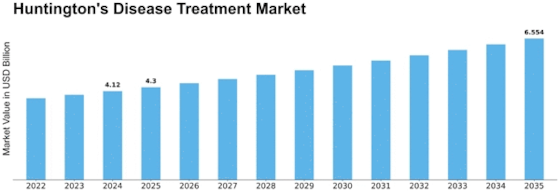
<p>The projected market valuation for the Huntington's Disease Treatment Market in 2035 is 6.554 USD Billion.</p>

What was the market valuation for the Huntington's Disease Treatment Market in 2024?

<p>The overall market valuation for the Huntington's Disease Treatment Market was 4.12 USD Billion in 2024.</p>

What is the expected CAGR for the Huntington's Disease Treatment Market from 2025 to 2035?

<p>The expected CAGR for the Huntington's Disease Treatment Market during the forecast period 2025 - 2035 is 4.31%.</p>

Which companies are considered key players in the Huntington's Disease Treatment Market?

<p>Key players in the Huntington's Disease Treatment Market include Roche, Novartis, Teva Pharmaceuticals, Pfizer, Bristol-Myers Squibb, Eli Lilly and Company, Biogen, Amgen, and Sarepta Therapeutics.</p>

What are the projected revenues for antipsychotics in the Huntington's Disease Treatment Market by 2035?

<p>The projected revenue for antipsychotics in the Huntington's Disease Treatment Market is expected to reach 1.25 USD Billion by 2035.</p>

How much is the market for genetic therapies in the Huntington's Disease Treatment Market expected to grow by 2035?

<p>The market for genetic therapies is projected to grow to 0.8 USD Billion by 2035.</p>

What is the anticipated revenue for hospitals as end users in the Huntington's Disease Treatment Market by 2035?

<p>The anticipated revenue for hospitals as end users in the Huntington's Disease Treatment Market is expected to be 1.92 USD Billion by 2035.</p>

What is the expected revenue for neurological disorders in the Huntington's Disease Treatment Market by 2035?

<p>The expected revenue for neurological disorders in the Huntington's Disease Treatment Market is projected to reach 3.5 USD Billion by 2035.</p>

What are the projected revenues for intravenous administration routes in the Huntington's Disease Treatment Market by 2035?

<p>The projected revenue for intravenous administration routes in the Huntington's Disease Treatment Market is expected to be 1.5 USD Billion by 2035.</p>

What is the expected revenue for homecare settings in the Huntington's Disease Treatment Market by 2035?

<p>The expected revenue for homecare settings in the Huntington's Disease Treatment Market is projected to reach 1.05 USD Billion by 2035.</p>

Market Summary

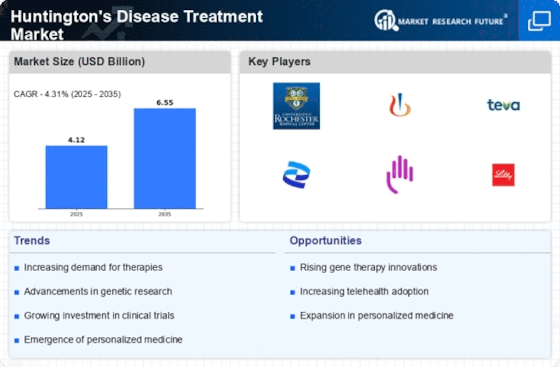
As per Market Research Future analysis, the Huntington's Disease Treatment Market was estimated at 4.12 USD Billion in 2024. The Huntington's Disease Treatment industry is projected to grow from 4.298 USD Billion in 2025 to 6.554 USD Billion by 2035, exhibiting a compound annual growth rate (CAGR) of 4.31% during the forecast period 2025 - 2035

Key Market Trends & Highlights

The Huntington's Disease Treatment Market is experiencing dynamic growth driven by innovative therapies and increasing patient needs.

  • Advancements in gene therapy are reshaping treatment paradigms, particularly in North America, which remains the largest market. The personalized medicine approach is gaining traction, especially in the Asia-Pacific region, recognized as the fastest-growing market. Integration of digital health technologies is enhancing patient engagement and monitoring across various treatment segments. The increasing prevalence of Huntington's Disease and advancements in research and development are key drivers propelling market expansion.

Market Size & Forecast

2024 Market Size 4.12 (USD Billion)
2035 Market Size 6.554 (USD Billion)
CAGR (2025 - 2035) 4.31%
Largest Regional Market Share in 2024 North America

Major Players

<a href="https://www.roche.com/stories/huntingtons-disease">Roche (CH)</a>, Novartis (CH), Teva Pharmaceuticals (IL), Pfizer (US), Bristol-Myers Squibb (US), Eli Lilly and Company (US), Biogen (US), Amgen (US), <a href="https://investorrelations.sarepta.com/news-releases/news-release-details/sarepta-therapeutics-announces-third-quarter-2025-financial">Sarepta Therapeutics </a>(US)

Market Trends

The Huntington's Disease Treatment Market is currently experiencing a dynamic evolution, driven by advancements in therapeutic approaches and a growing understanding of the disease's underlying mechanisms. Recent developments in gene therapy and neuroprotective agents appear to be at the forefront of this transformation, potentially offering new avenues for treatment. Furthermore, the increasing prevalence of Huntington's disease is prompting heightened research efforts, which may lead to innovative solutions that address the unmet needs of patients. As the market progresses, collaboration among pharmaceutical companies, research institutions, and patient advocacy groups seems essential to foster the development of effective therapies. In addition, the Huntington's Disease Treatment Market is witnessing a shift towards personalized medicine, where treatments are tailored to individual genetic profiles. This trend suggests a more targeted approach, which could enhance treatment efficacy and minimize adverse effects. Moreover, the integration of digital health technologies, such as telemedicine and mobile health applications, is likely to improve patient engagement and monitoring. Overall, the market appears poised for significant growth, driven by scientific advancements and a commitment to improving the quality of life for those affected by Huntington's disease.

Advancements in Gene Therapy

Recent innovations in gene therapy are emerging as a promising frontier in the Huntington's Disease Treatment Market. These therapies aim to address the root causes of the disease by targeting specific genetic mutations, potentially altering the disease's progression. As research continues, the efficacy and safety of these treatments may lead to a paradigm shift in how Huntington's disease is managed.

Personalized Medicine Approach

The trend towards personalized medicine is gaining traction within the Huntington's Disease Treatment Market. This approach focuses on customizing treatment plans based on individual genetic and phenotypic characteristics. By tailoring therapies to the unique needs of patients, there is potential for improved outcomes and reduced side effects, enhancing overall treatment effectiveness.

Integration of Digital Health Technologies

The incorporation of digital health technologies is transforming patient care in the Huntington's Disease Treatment Market. Tools such as telemedicine and mobile health applications are facilitating better communication between patients and healthcare providers. This trend may lead to improved patient monitoring, adherence to treatment regimens, and enhanced overall management of the disease.

Huntington’s Disease Treatment Market Market Drivers

Rising Awareness and Advocacy Efforts

The increasing awareness and advocacy efforts surrounding Huntington's Disease are significantly impacting the Huntington's Disease Treatment Market. Organizations dedicated to raising awareness about the disease are playing a vital role in educating the public and healthcare professionals. This heightened awareness is leading to earlier diagnosis and intervention, which can improve patient outcomes. Furthermore, advocacy groups are pushing for increased funding for research and better access to treatments, thereby influencing policy changes. As more individuals become informed about Huntington's Disease, the demand for effective treatments is likely to grow, driving the market forward. The Huntington's Disease Treatment Market must capitalize on this momentum to enhance its offerings and meet the evolving needs of patients.

Advancements in Research and Development

Ongoing advancements in research and development are significantly influencing the Huntington's Disease Treatment Market. Innovative approaches, such as gene editing and novel pharmacological agents, are being explored to address the underlying genetic causes of the disease. Recent studies have indicated that targeted therapies may slow disease progression, which could transform treatment paradigms. The investment in R&D has surged, with funding from both public and private sectors aimed at discovering new therapeutic avenues. This influx of research not only enhances the understanding of Huntington's but also fosters the development of more effective treatment options. As a result, the Huntington's Disease Treatment Market is poised for substantial growth driven by these scientific breakthroughs.

Growing Demand for Supportive Care Services

The increasing recognition of the need for comprehensive care in managing Huntington's Disease is driving the Huntington's Disease Treatment Market. Supportive care services, including physical therapy, occupational therapy, and psychological support, are becoming integral components of treatment plans. As the disease progresses, patients often require multidisciplinary care to address various symptoms and improve their quality of life. The demand for these services is expected to rise, leading to an expansion of the market. Additionally, healthcare providers are increasingly focusing on holistic approaches that encompass both medical and supportive care, which may enhance patient outcomes. This trend indicates a shift towards more comprehensive treatment strategies within the Huntington's Disease Treatment Market.

Regulatory Support for Innovative Therapies

Regulatory bodies are increasingly supportive of innovative therapies for Huntington's Disease, which is a crucial driver for the Huntington's Disease Treatment Market. Initiatives aimed at expediting the approval process for breakthrough therapies are being implemented, allowing for faster access to potentially life-altering treatments. The designation of orphan drug status for certain therapies has also encouraged pharmaceutical companies to invest in Huntington's research. This regulatory environment fosters innovation and encourages the development of new treatment modalities. As a result, the Huntington's Disease Treatment Market is likely to witness a surge in new product launches and therapeutic options, ultimately benefiting patients and healthcare providers alike.

Increasing Prevalence of Huntington's Disease

The rising incidence of Huntington's Disease is a pivotal driver for the Huntington's Disease Treatment Market. As the population ages, the prevalence of neurodegenerative disorders, including Huntington's, is expected to increase. Current estimates suggest that approximately 3 to 7 per 100,000 individuals are affected by this condition, with a higher incidence in certain populations. This growing patient base necessitates the development and availability of effective treatment options, thereby propelling market growth. Furthermore, as awareness about the disease improves, more individuals are likely to seek diagnosis and treatment, further expanding the market. The Huntington's Disease Treatment Market must adapt to these demographic changes to meet the increasing demand for therapies.

Market Segment Insights

By Type: Neurologics (Largest) vs. Genetic Therapies (Fastest-Growing)

In the Huntington's Disease Treatment Market, the distribution of market share among the various treatment types is indicative of the diverse needs of patients. Neurologics dominate the market due to their established efficacy in managing symptoms associated with Huntington's Disease. They are often the first line of treatment, leading to a significant share when compared to other categories such as antipsychotics and antidepressants. Genetic therapies, while still emerging, are gaining traction as a promising avenue for targeting the root causes of the disease, contributing to their rapid growth in the current market landscape. Growth trends within this segment show a marked shift toward personalized medicine and innovative treatment options. The rise of genetic therapies is particularly noteworthy, fueled by advancements in genetic research and increased investment in biotechnology. On the other hand, neurologics remain a steadfast choice for treatment, as they provide immediate symptom relief. The ongoing development of new anti-Huntington compounds is expected to enhance the effectiveness and appeal of these therapies, solidifying their market position while paving the way for genetic therapies to expand their influence in the coming years.

Neurologics: Dominant vs. Genetic Therapies: Emerging

Neurologics represent the dominant force in the Huntington's Disease Treatment Market, owing to their long-standing reputation for managing both cognitive and motor symptoms. This category has established a strong foothold among healthcare providers and patients alike due to its familiarity and proven effectiveness. Commonly prescribed options include antipsychotic medications that combat behavioral symptoms and other neurologic agents that help with movement disorders. In contrast, genetic therapies are emerging as a revolutionary approach, leveraging cutting-edge science to target the genetic basis of huntington's disease. This innovative branch of treatment is still in its infancy but is rapidly gaining attention and funding, showing great potential for long-term efficacy and disease modification. As research progresses, genetic therapies are expected to redefine treatment paradigms, providing hope for greater therapeutic outcomes.

By Administration Route: Oral (Largest) vs. Intravenous (Fastest-Growing)

In the Huntington's Disease Treatment Market, the administration route segment is crucial, emphasizing various methods such as Oral, Intravenous, Subcutaneous, and Topical. Currently, the Oral administration route holds a significant market share, being preferred for its ease of use and convenience among patients. Intravenous administration, while smaller in comparison, is recognized for its efficacy in delivering medication directly into the bloodstream, thus gaining traction among healthcare providers.

Administration: Oral (Dominant) vs. Intravenous (Emerging)

Oral administration is the dominant route in the Huntington's Disease Treatment Market, appreciated for its patient-friendly approach, allowing individuals to manage their treatment regimens with minimal supervision. This method promotes adherence and allows for better quality of life as it aligns with the daily routines of patients. In contrast, Intravenous administration is emerging due to its rapid action and higher bioavailability, making it suitable for patients requiring immediate therapeutic effects. The trend towards personalization in treatment is also propelling the growth of Intravenous methods, as they can be tailored to meet specific patient needs, enhancing overall treatment outcomes.

By End User: Hospitals (Largest) vs. Clinics (Fastest-Growing)

In the Huntington's Disease treatment market, hospitals currently dominate the end-user segment, accounting for a significant portion of the market share. They provide a comprehensive range of services and specialized care for patients, thus ensuring that they address both the medical and psychological needs of individuals suffering from Huntington's Disease. Clinics follow closely, catering to outpatient services and offering consultations specifically tailored to manage the disease, which makes them increasingly relevant in today's healthcare landscape. As awareness of Huntington's Disease increases among healthcare providers and patients, the clinic segment is poised for rapid growth. Emerging treatments and innovations are being adopted more quickly in clinical settings, while hospitals continue to expand their capabilities by incorporating multidisciplinary approaches to care. This trend is driven by the increasing prevalence of the disease and the demand for specialized treatment facilities, propelling clinics into the spotlight as a vital component of the healthcare system.

Hospitals (Dominant) vs. Clinics (Emerging)

Hospitals are recognized as the dominant end-users in the Huntington's Disease treatment market due to their ability to provide extensive inpatient care and support from a range of specialists. They have established infrastructure and resources, offering comprehensive diagnostic and therapeutic services. Clinics, on the other hand, are emerging as pivotal players by facilitating early intervention and ongoing management of the disease with a focus on outpatient care. The growth of telemedicine and personalized treatment plans in clinics enhances accessibility and patient adherence to treatment protocols. As research continues to unfold, clinics are becoming essential for cost-effective and efficient management of Huntington's Disease, thereby complementing the traditional hospital model and responding to the evolving needs of patients.

By Therapeutic Area: Neurological Disorders (Largest) vs. Genetic Disorders (Fastest-Growing)

In the Huntington's Disease Treatment Market, the segment distribution reveals that Neurological Disorders account for the largest share, dominating treatment protocols and emphasizing the significance of neurological interventions. This segment's substantial market presence reflects the critical nature of addressing the symptomatic and progression-related aspects of Huntington's Disease. On the other hand, Genetic Disorders, while smaller in immediate market share, are emerging as a rapidly advancing segment due to increasing research and targeted therapies that focus on the genetic underpinnings of the disease.

Neurological Disorders: Dominant vs. Genetic Disorders: Emerging

Neurological Disorders occupy a central role in the Huntington's Disease Treatment Market, characterized by a robust portfolio of treatment options that include symptomatic management and innovative therapies targeting motor and cognitive impairments. This segment is fortified by advancing research into neuroprotective agents and disease-modifying treatments, driven by the urgent need for effective interventions. In contrast, Genetic Disorders are gaining traction as the fastest-growing segment, propelled by heightened interest in <a href="https://www.marketresearchfuture.com/reports/gene-therapy-market-8399">gene therapy</a> approaches and precision medicine. Companies are increasingly investing in genetic research, reflecting a pivot towards tailored treatments that tackle the root causes of Huntington's Disease, positioning Genetic Disorders as a key area for future development.

Get more detailed insights about Huntington’s Disease Treatment Market Research Report - Forecast till 2035

Regional Insights

The Huntington's Disease Treatment Market shows a significant regional diversity in terms of revenue generation and growth potential. In 2023, North America leads the market with a valuation of 1.556 USD Billion, highlighting its majority holding in the industry. The prevalence of Huntington's Disease, traumatic brain injury, and advanced healthcare infrastructure contribute to this dominance. Europe follows with a revenue of 0.958 USD Billion, reflecting a significant focus on research and development in this region. The APAC market, valued at 0.638 USD Billion, is witnessing growth due to increasing awareness and healthcare improvements.

South America and MEA both hold a valuation of 0.399 USD Billion in 2023, which indicates emerging opportunities but also suggests a need for more robust healthcare initiatives. The Huntington's Disease Treatment Market data showcases the strong potential for growth across all regions, with North America sustaining its leading position due to a higher prevalence of the disease and innovative treatment options available. Each region presents unique challenges and opportunities, shaping the overall market statistics and influencing future market trends.

Key Players and Competitive Insights

The Huntington's Disease Treatment Market has witnessed significant developments owing to the rising incidence of the disorder and the growing awareness regarding its treatment options among healthcare professionals and patients. Competitively, this market is characterized by the presence of a mix of pharmaceutical giants and smaller biotechnology firms. The landscape is marked by innovation, as companies are focused on developing novel therapies and precision medicine approaches to improve patient outcomes. Moreover, strategic collaborations, mergers, and acquisitions are increasingly common as companies aim to expand their product offerings and market reach.
The competitive insights reveal that players in this market are leveraging their research capabilities and advanced technologies to formulate effective treatments that can significantly alter the disease's progression.BristolMyers Squibb has established a pronounced presence in the Huntington's Disease Treatment Market through its robust pipeline and commitment to research and development. The company is recognized for its strength in immunological and neuroscience therapeutic areas, contributing to a diversified portfolio that includes therapies focused on neurological disorders.
BristolMyers Squibb differentiates itself through its strategic partnerships with academic institutions and research organizations, enhancing its capabilities in clinical trials and accelerating the development of new treatments.
The company’s focus on innovative therapies, combined with a strong reputation in healthcare, positions it well to capture a significant share of the Huntington's Disease Treatment Market, thereby reinforcing its competitive edge.Sanofi is another key player in the Huntington's Disease Treatment Market, known for its dedication to advancing therapies that address unmet medical needs. With a footprint and a strong emphasis on research, Sanofi’s strengths lie in its established relationships with healthcare providers and deep understanding of patient needs.
The company has made substantial investments in developing targeted therapies aimed at the root causes of Huntington's disease, showcasing its commitment to enhancing patient quality of life. Sanofi's integrated approach, which includes patient engagement and support programs, allows the company to effectively connect with patients and healthcare practitioners, thus bolstering its position in the competitive landscape of Huntington's Disease treatment. Its ongoing efforts to innovate and address the complexities of the disease will further enhance its relevance in this specialized market.

Key Companies in the Huntington’s Disease Treatment Market include

Industry Developments

Recent developments in the Huntington's Disease Treatment Market indicate a surge in research and investment aimed at innovative therapies. Companies such as Bristol-Myers Squibb and Roche are advancing their clinical trials for potential therapeutic solutions, focusing on gene therapies and neuroprotective agents. Eli Lilly and Company and UniQure are exploring promising avenues for treatment, with ongoing studies aimed at gene silencing technologies. The Huntington's Disease Society of America continues to advocate for awareness and research funding, amplifying the conversation surrounding the disease.

Additionally, mergers and acquisitions have seen activity, particularly in the engagements involving companies like Teva Pharmaceutical Industries and Novartis, which are enhancing their portfolios in rare disease management. The overall market valuation for the Huntington's Disease treatment sector is projected to grow significantly due to increased governmental support and private sector initiatives. This growth is fostering competition among key players, such as Amgen and Pfizer, as they strive to develop effective interventions for this challenging condition, ultimately aiming to address unmet medical needs and improve patient outcomes. 

Future Outlook

Huntington’s Disease Treatment Market Future Outlook

The Huntington's Disease Treatment Market is projected to grow at a 4.31% CAGR from 2025 to 2035, driven by advancements in gene therapy, increased awareness, and improved diagnostic tools.

New opportunities lie in:

  • Development of personalized gene therapies targeting specific genetic mutations.
  • Expansion of <a href="https://www.marketresearchfuture.com/reports/telehealth-market-900">telehealth</a> services for remote patient monitoring and consultations.
  • Investment in AI-driven drug discovery platforms to expedite treatment development.

By 2035, the market is expected to achieve substantial growth, reflecting advancements in treatment and patient care.

Market Segmentation

Huntington’s Disease Treatment Market Type Outlook

  • Antipsychotics
  • Antidepressants
  • Mood Stabilizers
  • Neurologics
  • Genetic Therapies

Huntington’s Disease Treatment Market End User Outlook

  • Hospitals
  • Clinics
  • Homecare Settings
  • Research Centers

Huntington’s Disease Treatment Market Therapeutic Area Outlook

  • Genetic Disorders
  • Neurological Disorders
  • Psychiatric Disorders

Huntington’s Disease Treatment Market Administration Route Outlook

  • Oral
  • Intravenous
  • Subcutaneous
  • Topical

Report Scope

MARKET SIZE 2024 4.12(USD Billion)
MARKET SIZE 2025 4.298(USD Billion)
MARKET SIZE 2035 6.554(USD Billion)
COMPOUND ANNUAL GROWTH RATE (CAGR) 4.31% (2025 - 2035)
REPORT COVERAGE Revenue Forecast, Competitive Landscape, Growth Factors, and Trends
BASE YEAR 2024
Market Forecast Period 2025 - 2035
Historical Data 2019 - 2024
Market Forecast Units USD Billion
Key Companies Profiled Roche (CH), Novartis (CH), Teva Pharmaceuticals (IL), Pfizer (US), Bristol-Myers Squibb (US), Eli Lilly and Company (US), Biogen (US), Amgen (US), Sarepta Therapeutics (US)
Segments Covered Drug Type, Administration Route, End Users, Therapeutic Area, Regional
Key Market Opportunities Advancements in gene therapy and personalized medicine present new avenues in the Huntington's Disease Treatment Market.
Key Market Dynamics Rising demand for innovative therapies drives competition and investment in Huntington's Disease treatment development.
Countries Covered North America, Europe, APAC, South America, MEA

FAQs

What is the projected market valuation for the Huntington's Disease Treatment Market in 2035?

<p>The projected market valuation for the Huntington's Disease Treatment Market in 2035 is 6.554 USD Billion.</p>

What was the market valuation for the Huntington's Disease Treatment Market in 2024?

<p>The overall market valuation for the Huntington's Disease Treatment Market was 4.12 USD Billion in 2024.</p>

What is the expected CAGR for the Huntington's Disease Treatment Market from 2025 to 2035?

<p>The expected CAGR for the Huntington's Disease Treatment Market during the forecast period 2025 - 2035 is 4.31%.</p>

Which companies are considered key players in the Huntington's Disease Treatment Market?

<p>Key players in the Huntington's Disease Treatment Market include Roche, Novartis, Teva Pharmaceuticals, Pfizer, Bristol-Myers Squibb, Eli Lilly and Company, Biogen, Amgen, and Sarepta Therapeutics.</p>

What are the projected revenues for antipsychotics in the Huntington's Disease Treatment Market by 2035?

<p>The projected revenue for antipsychotics in the Huntington's Disease Treatment Market is expected to reach 1.25 USD Billion by 2035.</p>

How much is the market for genetic therapies in the Huntington's Disease Treatment Market expected to grow by 2035?

<p>The market for genetic therapies is projected to grow to 0.8 USD Billion by 2035.</p>

What is the anticipated revenue for hospitals as end users in the Huntington's Disease Treatment Market by 2035?

<p>The anticipated revenue for hospitals as end users in the Huntington's Disease Treatment Market is expected to be 1.92 USD Billion by 2035.</p>

What is the expected revenue for neurological disorders in the Huntington's Disease Treatment Market by 2035?

<p>The expected revenue for neurological disorders in the Huntington's Disease Treatment Market is projected to reach 3.5 USD Billion by 2035.</p>

What are the projected revenues for intravenous administration routes in the Huntington's Disease Treatment Market by 2035?

<p>The projected revenue for intravenous administration routes in the Huntington's Disease Treatment Market is expected to be 1.5 USD Billion by 2035.</p>

What is the expected revenue for homecare settings in the Huntington's Disease Treatment Market by 2035?

<p>The expected revenue for homecare settings in the Huntington's Disease Treatment Market is projected to reach 1.05 USD Billion by 2035.</p>

  1. SECTION I: EXECUTIVE SUMMARY AND KEY HIGHLIGHTS
    1. | 1.1 EXECUTIVE SUMMARY
    2. | | 1.1.1 Market Overview
    3. | | 1.1.2 Key Findings
    4. | | 1.1.3 Market Segmentation
    5. | | 1.1.4 Competitive Landscape
    6. | | 1.1.5 Challenges and Opportunities
    7. | | 1.1.6 Future Outlook
  2. SECTION II: SCOPING, METHODOLOGY AND MARKET STRUCTURE
    1. | 2.1 MARKET INTRODUCTION
    2. | | 2.1.1 Definition
    3. | | 2.1.2 Scope of the study
    4. | | | 2.1.2.1 Research Objective
    5. | | | 2.1.2.2 Assumption
    6. | | | 2.1.2.3 Limitations
    7. | 2.2 RESEARCH METHODOLOGY
    8. | | 2.2.1 Overview
    9. | | 2.2.2 Data Mining
    10. | | 2.2.3 Secondary Research
    11. | | 2.2.4 Primary Research
    12. | | | 2.2.4.1 Primary Interviews and Information Gathering Process
    13. | | | 2.2.4.2 Breakdown of Primary Respondents
    14. | | 2.2.5 Forecasting Model
    15. | | 2.2.6 Market Size Estimation
    16. | | | 2.2.6.1 Bottom-Up Approach
    17. | | | 2.2.6.2 Top-Down Approach
    18. | | 2.2.7 Data Triangulation
    19. | | 2.2.8 Validation
  3. SECTION III: QUALITATIVE ANALYSIS
    1. | 3.1 MARKET DYNAMICS
    2. | | 3.1.1 Overview
    3. | | 3.1.2 Drivers
    4. | | 3.1.3 Restraints
    5. | | 3.1.4 Opportunities
    6. | 3.2 MARKET FACTOR ANALYSIS
    7. | | 3.2.1 Value chain Analysis
    8. | | 3.2.2 Porter's Five Forces Analysis
    9. | | | 3.2.2.1 Bargaining Power of Suppliers
    10. | | | 3.2.2.2 Bargaining Power of Buyers
    11. | | | 3.2.2.3 Threat of New Entrants
    12. | | | 3.2.2.4 Threat of Substitutes
    13. | | | 3.2.2.5 Intensity of Rivalry
    14. | | 3.2.3 COVID-19 Impact Analysis
    15. | | | 3.2.3.1 Market Impact Analysis
    16. | | | 3.2.3.2 Regional Impact
    17. | | | 3.2.3.3 Opportunity and Threat Analysis
  4. SECTION IV: QUANTITATIVE ANALYSIS
    1. | 4.1 Healthcare, BY Type (USD Billion)
    2. | | 4.1.1 Antipsychotics
    3. | | 4.1.2 Antidepressants
    4. | | 4.1.3 Mood Stabilizers
    5. | | 4.1.4 Neurologics
    6. | | 4.1.5 Genetic Therapies
    7. | 4.2 Healthcare, BY Administration Route (USD Billion)
    8. | | 4.2.1 Oral
    9. | | 4.2.2 Intravenous
    10. | | 4.2.3 Subcutaneous
    11. | | 4.2.4 Topical
    12. | 4.3 Healthcare, BY End User (USD Billion)
    13. | | 4.3.1 Hospitals
    14. | | 4.3.2 Clinics
    15. | | 4.3.3 Homecare Settings
    16. | | 4.3.4 Research Centers
    17. | 4.4 Healthcare, BY Therapeutic Area (USD Billion)
    18. | | 4.4.1 Genetic Disorders
    19. | | 4.4.2 Neurological Disorders
    20. | | 4.4.3 Psychiatric Disorders
    21. | 4.5 Healthcare, BY Region (USD Billion)
    22. | | 4.5.1 North America
    23. | | | 4.5.1.1 US
    24. | | | 4.5.1.2 Canada
    25. | | 4.5.2 Europe
    26. | | | 4.5.2.1 Germany
    27. | | | 4.5.2.2 UK
    28. | | | 4.5.2.3 France
    29. | | | 4.5.2.4 Russia
    30. | | | 4.5.2.5 Italy
    31. | | | 4.5.2.6 Spain
    32. | | | 4.5.2.7 Rest of Europe
    33. | | 4.5.3 APAC
    34. | | | 4.5.3.1 China
    35. | | | 4.5.3.2 India
    36. | | | 4.5.3.3 Japan
    37. | | | 4.5.3.4 South Korea
    38. | | | 4.5.3.5 Malaysia
    39. | | | 4.5.3.6 Thailand
    40. | | | 4.5.3.7 Indonesia
    41. | | | 4.5.3.8 Rest of APAC
    42. | | 4.5.4 South America
    43. | | | 4.5.4.1 Brazil
    44. | | | 4.5.4.2 Mexico
    45. | | | 4.5.4.3 Argentina
    46. | | | 4.5.4.4 Rest of South America
    47. | | 4.5.5 MEA
    48. | | | 4.5.5.1 GCC Countries
    49. | | | 4.5.5.2 South Africa
    50. | | | 4.5.5.3 Rest of MEA
  5. SECTION V: COMPETITIVE ANALYSIS
    1. | 5.1 Competitive Landscape
    2. | | 5.1.1 Overview
    3. | | 5.1.2 Competitive Analysis
    4. | | 5.1.3 Market share Analysis
    5. | | 5.1.4 Major Growth Strategy in the Healthcare
    6. | | 5.1.5 Competitive Benchmarking
    7. | | 5.1.6 Leading Players in Terms of Number of Developments in the Healthcare
    8. | | 5.1.7 Key developments and growth strategies
    9. | | | 5.1.7.1 New Product Launch/Service Deployment
    10. | | | 5.1.7.2 Merger & Acquisitions
    11. | | | 5.1.7.3 Joint Ventures
    12. | | 5.1.8 Major Players Financial Matrix
    13. | | | 5.1.8.1 Sales and Operating Income
    14. | | | 5.1.8.2 Major Players R&D Expenditure. 2023
    15. | 5.2 Company Profiles
    16. | | 5.2.1 Roche (CH)
    17. | | | 5.2.1.1 Financial Overview
    18. | | | 5.2.1.2 Products Offered
    19. | | | 5.2.1.3 Key Developments
    20. | | | 5.2.1.4 SWOT Analysis
    21. | | | 5.2.1.5 Key Strategies
    22. | | 5.2.2 Novartis (CH)
    23. | | | 5.2.2.1 Financial Overview
    24. | | | 5.2.2.2 Products Offered
    25. | | | 5.2.2.3 Key Developments
    26. | | | 5.2.2.4 SWOT Analysis
    27. | | | 5.2.2.5 Key Strategies
    28. | | 5.2.3 Teva Pharmaceuticals (IL)
    29. | | | 5.2.3.1 Financial Overview
    30. | | | 5.2.3.2 Products Offered
    31. | | | 5.2.3.3 Key Developments
    32. | | | 5.2.3.4 SWOT Analysis
    33. | | | 5.2.3.5 Key Strategies
    34. | | 5.2.4 Pfizer (US)
    35. | | | 5.2.4.1 Financial Overview
    36. | | | 5.2.4.2 Products Offered
    37. | | | 5.2.4.3 Key Developments
    38. | | | 5.2.4.4 SWOT Analysis
    39. | | | 5.2.4.5 Key Strategies
    40. | | 5.2.5 Bristol-Myers Squibb (US)
    41. | | | 5.2.5.1 Financial Overview
    42. | | | 5.2.5.2 Products Offered
    43. | | | 5.2.5.3 Key Developments
    44. | | | 5.2.5.4 SWOT Analysis
    45. | | | 5.2.5.5 Key Strategies
    46. | | 5.2.6 Eli Lilly and Company (US)
    47. | | | 5.2.6.1 Financial Overview
    48. | | | 5.2.6.2 Products Offered
    49. | | | 5.2.6.3 Key Developments
    50. | | | 5.2.6.4 SWOT Analysis
    51. | | | 5.2.6.5 Key Strategies
    52. | | 5.2.7 Biogen (US)
    53. | | | 5.2.7.1 Financial Overview
    54. | | | 5.2.7.2 Products Offered
    55. | | | 5.2.7.3 Key Developments
    56. | | | 5.2.7.4 SWOT Analysis
    57. | | | 5.2.7.5 Key Strategies
    58. | | 5.2.8 Amgen (US)
    59. | | | 5.2.8.1 Financial Overview
    60. | | | 5.2.8.2 Products Offered
    61. | | | 5.2.8.3 Key Developments
    62. | | | 5.2.8.4 SWOT Analysis
    63. | | | 5.2.8.5 Key Strategies
    64. | | 5.2.9 Sarepta Therapeutics (US)
    65. | | | 5.2.9.1 Financial Overview
    66. | | | 5.2.9.2 Products Offered
    67. | | | 5.2.9.3 Key Developments
    68. | | | 5.2.9.4 SWOT Analysis
    69. | | | 5.2.9.5 Key Strategies
    70. | 5.3 Appendix
    71. | | 5.3.1 References
    72. | | 5.3.2 Related Reports
  6. LIST OF FIGURES
    1. | 6.1 MARKET SYNOPSIS
    2. | 6.2 NORTH AMERICA MARKET ANALYSIS
    3. | 6.3 US MARKET ANALYSIS BY TYPE
    4. | 6.4 US MARKET ANALYSIS BY ADMINISTRATION ROUTE
    5. | 6.5 US MARKET ANALYSIS BY END USER
    6. | 6.6 US MARKET ANALYSIS BY THERAPEUTIC AREA
    7. | 6.7 CANADA MARKET ANALYSIS BY TYPE
    8. | 6.8 CANADA MARKET ANALYSIS BY ADMINISTRATION ROUTE
    9. | 6.9 CANADA MARKET ANALYSIS BY END USER
    10. | 6.10 CANADA MARKET ANALYSIS BY THERAPEUTIC AREA
    11. | 6.11 EUROPE MARKET ANALYSIS
    12. | 6.12 GERMANY MARKET ANALYSIS BY TYPE
    13. | 6.13 GERMANY MARKET ANALYSIS BY ADMINISTRATION ROUTE
    14. | 6.14 GERMANY MARKET ANALYSIS BY END USER
    15. | 6.15 GERMANY MARKET ANALYSIS BY THERAPEUTIC AREA
    16. | 6.16 UK MARKET ANALYSIS BY TYPE
    17. | 6.17 UK MARKET ANALYSIS BY ADMINISTRATION ROUTE
    18. | 6.18 UK MARKET ANALYSIS BY END USER
    19. | 6.19 UK MARKET ANALYSIS BY THERAPEUTIC AREA
    20. | 6.20 FRANCE MARKET ANALYSIS BY TYPE
    21. | 6.21 FRANCE MARKET ANALYSIS BY ADMINISTRATION ROUTE
    22. | 6.22 FRANCE MARKET ANALYSIS BY END USER
    23. | 6.23 FRANCE MARKET ANALYSIS BY THERAPEUTIC AREA
    24. | 6.24 RUSSIA MARKET ANALYSIS BY TYPE
    25. | 6.25 RUSSIA MARKET ANALYSIS BY ADMINISTRATION ROUTE
    26. | 6.26 RUSSIA MARKET ANALYSIS BY END USER
    27. | 6.27 RUSSIA MARKET ANALYSIS BY THERAPEUTIC AREA
    28. | 6.28 ITALY MARKET ANALYSIS BY TYPE
    29. | 6.29 ITALY MARKET ANALYSIS BY ADMINISTRATION ROUTE
    30. | 6.30 ITALY MARKET ANALYSIS BY END USER
    31. | 6.31 ITALY MARKET ANALYSIS BY THERAPEUTIC AREA
    32. | 6.32 SPAIN MARKET ANALYSIS BY TYPE
    33. | 6.33 SPAIN MARKET ANALYSIS BY ADMINISTRATION ROUTE
    34. | 6.34 SPAIN MARKET ANALYSIS BY END USER
    35. | 6.35 SPAIN MARKET ANALYSIS BY THERAPEUTIC AREA
    36. | 6.36 REST OF EUROPE MARKET ANALYSIS BY TYPE
    37. | 6.37 REST OF EUROPE MARKET ANALYSIS BY ADMINISTRATION ROUTE
    38. | 6.38 REST OF EUROPE MARKET ANALYSIS BY END USER
    39. | 6.39 REST OF EUROPE MARKET ANALYSIS BY THERAPEUTIC AREA
    40. | 6.40 APAC MARKET ANALYSIS
    41. | 6.41 CHINA MARKET ANALYSIS BY TYPE
    42. | 6.42 CHINA MARKET ANALYSIS BY ADMINISTRATION ROUTE
    43. | 6.43 CHINA MARKET ANALYSIS BY END USER
    44. | 6.44 CHINA MARKET ANALYSIS BY THERAPEUTIC AREA
    45. | 6.45 INDIA MARKET ANALYSIS BY TYPE
    46. | 6.46 INDIA MARKET ANALYSIS BY ADMINISTRATION ROUTE
    47. | 6.47 INDIA MARKET ANALYSIS BY END USER
    48. | 6.48 INDIA MARKET ANALYSIS BY THERAPEUTIC AREA
    49. | 6.49 JAPAN MARKET ANALYSIS BY TYPE
    50. | 6.50 JAPAN MARKET ANALYSIS BY ADMINISTRATION ROUTE
    51. | 6.51 JAPAN MARKET ANALYSIS BY END USER
    52. | 6.52 JAPAN MARKET ANALYSIS BY THERAPEUTIC AREA
    53. | 6.53 SOUTH KOREA MARKET ANALYSIS BY TYPE
    54. | 6.54 SOUTH KOREA MARKET ANALYSIS BY ADMINISTRATION ROUTE
    55. | 6.55 SOUTH KOREA MARKET ANALYSIS BY END USER
    56. | 6.56 SOUTH KOREA MARKET ANALYSIS BY THERAPEUTIC AREA
    57. | 6.57 MALAYSIA MARKET ANALYSIS BY TYPE
    58. | 6.58 MALAYSIA MARKET ANALYSIS BY ADMINISTRATION ROUTE
    59. | 6.59 MALAYSIA MARKET ANALYSIS BY END USER
    60. | 6.60 MALAYSIA MARKET ANALYSIS BY THERAPEUTIC AREA
    61. | 6.61 THAILAND MARKET ANALYSIS BY TYPE
    62. | 6.62 THAILAND MARKET ANALYSIS BY ADMINISTRATION ROUTE
    63. | 6.63 THAILAND MARKET ANALYSIS BY END USER
    64. | 6.64 THAILAND MARKET ANALYSIS BY THERAPEUTIC AREA
    65. | 6.65 INDONESIA MARKET ANALYSIS BY TYPE
    66. | 6.66 INDONESIA MARKET ANALYSIS BY ADMINISTRATION ROUTE
    67. | 6.67 INDONESIA MARKET ANALYSIS BY END USER
    68. | 6.68 INDONESIA MARKET ANALYSIS BY THERAPEUTIC AREA
    69. | 6.69 REST OF APAC MARKET ANALYSIS BY TYPE
    70. | 6.70 REST OF APAC MARKET ANALYSIS BY ADMINISTRATION ROUTE
    71. | 6.71 REST OF APAC MARKET ANALYSIS BY END USER
    72. | 6.72 REST OF APAC MARKET ANALYSIS BY THERAPEUTIC AREA
    73. | 6.73 SOUTH AMERICA MARKET ANALYSIS
    74. | 6.74 BRAZIL MARKET ANALYSIS BY TYPE
    75. | 6.75 BRAZIL MARKET ANALYSIS BY ADMINISTRATION ROUTE
    76. | 6.76 BRAZIL MARKET ANALYSIS BY END USER
    77. | 6.77 BRAZIL MARKET ANALYSIS BY THERAPEUTIC AREA
    78. | 6.78 MEXICO MARKET ANALYSIS BY TYPE
    79. | 6.79 MEXICO MARKET ANALYSIS BY ADMINISTRATION ROUTE
    80. | 6.80 MEXICO MARKET ANALYSIS BY END USER
    81. | 6.81 MEXICO MARKET ANALYSIS BY THERAPEUTIC AREA
    82. | 6.82 ARGENTINA MARKET ANALYSIS BY TYPE
    83. | 6.83 ARGENTINA MARKET ANALYSIS BY ADMINISTRATION ROUTE
    84. | 6.84 ARGENTINA MARKET ANALYSIS BY END USER
    85. | 6.85 ARGENTINA MARKET ANALYSIS BY THERAPEUTIC AREA
    86. | 6.86 REST OF SOUTH AMERICA MARKET ANALYSIS BY TYPE
    87. | 6.87 REST OF SOUTH AMERICA MARKET ANALYSIS BY ADMINISTRATION ROUTE
    88. | 6.88 REST OF SOUTH AMERICA MARKET ANALYSIS BY END USER
    89. | 6.89 REST OF SOUTH AMERICA MARKET ANALYSIS BY THERAPEUTIC AREA
    90. | 6.90 MEA MARKET ANALYSIS
    91. | 6.91 GCC COUNTRIES MARKET ANALYSIS BY TYPE
    92. | 6.92 GCC COUNTRIES MARKET ANALYSIS BY ADMINISTRATION ROUTE
    93. | 6.93 GCC COUNTRIES MARKET ANALYSIS BY END USER
    94. | 6.94 GCC COUNTRIES MARKET ANALYSIS BY THERAPEUTIC AREA
    95. | 6.95 SOUTH AFRICA MARKET ANALYSIS BY TYPE
    96. | 6.96 SOUTH AFRICA MARKET ANALYSIS BY ADMINISTRATION ROUTE
    97. | 6.97 SOUTH AFRICA MARKET ANALYSIS BY END USER
    98. | 6.98 SOUTH AFRICA MARKET ANALYSIS BY THERAPEUTIC AREA
    99. | 6.99 REST OF MEA MARKET ANALYSIS BY TYPE
    100. | 6.100 REST OF MEA MARKET ANALYSIS BY ADMINISTRATION ROUTE
    101. | 6.101 REST OF MEA MARKET ANALYSIS BY END USER
    102. | 6.102 REST OF MEA MARKET ANALYSIS BY THERAPEUTIC AREA
    103. | 6.103 KEY BUYING CRITERIA OF HEALTHCARE
    104. | 6.104 RESEARCH PROCESS OF MRFR
    105. | 6.105 DRO ANALYSIS OF HEALTHCARE
    106. | 6.106 DRIVERS IMPACT ANALYSIS: HEALTHCARE
    107. | 6.107 RESTRAINTS IMPACT ANALYSIS: HEALTHCARE
    108. | 6.108 SUPPLY / VALUE CHAIN: HEALTHCARE
    109. | 6.109 HEALTHCARE, BY TYPE, 2024 (% SHARE)
    110. | 6.110 HEALTHCARE, BY TYPE, 2024 TO 2035 (USD Billion)
    111. | 6.111 HEALTHCARE, BY ADMINISTRATION ROUTE, 2024 (% SHARE)
    112. | 6.112 HEALTHCARE, BY ADMINISTRATION ROUTE, 2024 TO 2035 (USD Billion)
    113. | 6.113 HEALTHCARE, BY END USER, 2024 (% SHARE)
    114. | 6.114 HEALTHCARE, BY END USER, 2024 TO 2035 (USD Billion)
    115. | 6.115 HEALTHCARE, BY THERAPEUTIC AREA, 2024 (% SHARE)
    116. | 6.116 HEALTHCARE, BY THERAPEUTIC AREA, 2024 TO 2035 (USD Billion)
    117. | 6.117 BENCHMARKING OF MAJOR COMPETITORS
  7. LIST OF TABLES
    1. | 7.1 LIST OF ASSUMPTIONS
    2. | | 7.1.1
    3. | 7.2 North America MARKET SIZE ESTIMATES; FORECAST
    4. | | 7.2.1 BY TYPE, 2025-2035 (USD Billion)
    5. | | 7.2.2 BY ADMINISTRATION ROUTE, 2025-2035 (USD Billion)
    6. | | 7.2.3 BY END USER, 2025-2035 (USD Billion)
    7. | | 7.2.4 BY THERAPEUTIC AREA, 2025-2035 (USD Billion)
    8. | 7.3 US MARKET SIZE ESTIMATES; FORECAST
    9. | | 7.3.1 BY TYPE, 2025-2035 (USD Billion)
    10. | | 7.3.2 BY ADMINISTRATION ROUTE, 2025-2035 (USD Billion)
    11. | | 7.3.3 BY END USER, 2025-2035 (USD Billion)
    12. | | 7.3.4 BY THERAPEUTIC AREA, 2025-2035 (USD Billion)
    13. | 7.4 Canada MARKET SIZE ESTIMATES; FORECAST
    14. | | 7.4.1 BY TYPE, 2025-2035 (USD Billion)
    15. | | 7.4.2 BY ADMINISTRATION ROUTE, 2025-2035 (USD Billion)
    16. | | 7.4.3 BY END USER, 2025-2035 (USD Billion)
    17. | | 7.4.4 BY THERAPEUTIC AREA, 2025-2035 (USD Billion)
    18. | 7.5 Europe MARKET SIZE ESTIMATES; FORECAST
    19. | | 7.5.1 BY TYPE, 2025-2035 (USD Billion)
    20. | | 7.5.2 BY ADMINISTRATION ROUTE, 2025-2035 (USD Billion)
    21. | | 7.5.3 BY END USER, 2025-2035 (USD Billion)
    22. | | 7.5.4 BY THERAPEUTIC AREA, 2025-2035 (USD Billion)
    23. | 7.6 Germany MARKET SIZE ESTIMATES; FORECAST
    24. | | 7.6.1 BY TYPE, 2025-2035 (USD Billion)
    25. | | 7.6.2 BY ADMINISTRATION ROUTE, 2025-2035 (USD Billion)
    26. | | 7.6.3 BY END USER, 2025-2035 (USD Billion)
    27. | | 7.6.4 BY THERAPEUTIC AREA, 2025-2035 (USD Billion)
    28. | 7.7 UK MARKET SIZE ESTIMATES; FORECAST
    29. | | 7.7.1 BY TYPE, 2025-2035 (USD Billion)
    30. | | 7.7.2 BY ADMINISTRATION ROUTE, 2025-2035 (USD Billion)
    31. | | 7.7.3 BY END USER, 2025-2035 (USD Billion)
    32. | | 7.7.4 BY THERAPEUTIC AREA, 2025-2035 (USD Billion)
    33. | 7.8 France MARKET SIZE ESTIMATES; FORECAST
    34. | | 7.8.1 BY TYPE, 2025-2035 (USD Billion)
    35. | | 7.8.2 BY ADMINISTRATION ROUTE, 2025-2035 (USD Billion)
    36. | | 7.8.3 BY END USER, 2025-2035 (USD Billion)
    37. | | 7.8.4 BY THERAPEUTIC AREA, 2025-2035 (USD Billion)
    38. | 7.9 Russia MARKET SIZE ESTIMATES; FORECAST
    39. | | 7.9.1 BY TYPE, 2025-2035 (USD Billion)
    40. | | 7.9.2 BY ADMINISTRATION ROUTE, 2025-2035 (USD Billion)
    41. | | 7.9.3 BY END USER, 2025-2035 (USD Billion)
    42. | | 7.9.4 BY THERAPEUTIC AREA, 2025-2035 (USD Billion)
    43. | 7.10 Italy MARKET SIZE ESTIMATES; FORECAST
    44. | | 7.10.1 BY TYPE, 2025-2035 (USD Billion)
    45. | | 7.10.2 BY ADMINISTRATION ROUTE, 2025-2035 (USD Billion)
    46. | | 7.10.3 BY END USER, 2025-2035 (USD Billion)
    47. | | 7.10.4 BY THERAPEUTIC AREA, 2025-2035 (USD Billion)
    48. | 7.11 Spain MARKET SIZE ESTIMATES; FORECAST
    49. | | 7.11.1 BY TYPE, 2025-2035 (USD Billion)
    50. | | 7.11.2 BY ADMINISTRATION ROUTE, 2025-2035 (USD Billion)
    51. | | 7.11.3 BY END USER, 2025-2035 (USD Billion)
    52. | | 7.11.4 BY THERAPEUTIC AREA, 2025-2035 (USD Billion)
    53. | 7.12 Rest of Europe MARKET SIZE ESTIMATES; FORECAST
    54. | | 7.12.1 BY TYPE, 2025-2035 (USD Billion)
    55. | | 7.12.2 BY ADMINISTRATION ROUTE, 2025-2035 (USD Billion)
    56. | | 7.12.3 BY END USER, 2025-2035 (USD Billion)
    57. | | 7.12.4 BY THERAPEUTIC AREA, 2025-2035 (USD Billion)
    58. | 7.13 APAC MARKET SIZE ESTIMATES; FORECAST
    59. | | 7.13.1 BY TYPE, 2025-2035 (USD Billion)
    60. | | 7.13.2 BY ADMINISTRATION ROUTE, 2025-2035 (USD Billion)
    61. | | 7.13.3 BY END USER, 2025-2035 (USD Billion)
    62. | | 7.13.4 BY THERAPEUTIC AREA, 2025-2035 (USD Billion)
    63. | 7.14 China MARKET SIZE ESTIMATES; FORECAST
    64. | | 7.14.1 BY TYPE, 2025-2035 (USD Billion)
    65. | | 7.14.2 BY ADMINISTRATION ROUTE, 2025-2035 (USD Billion)
    66. | | 7.14.3 BY END USER, 2025-2035 (USD Billion)
    67. | | 7.14.4 BY THERAPEUTIC AREA, 2025-2035 (USD Billion)
    68. | 7.15 India MARKET SIZE ESTIMATES; FORECAST
    69. | | 7.15.1 BY TYPE, 2025-2035 (USD Billion)
    70. | | 7.15.2 BY ADMINISTRATION ROUTE, 2025-2035 (USD Billion)
    71. | | 7.15.3 BY END USER, 2025-2035 (USD Billion)
    72. | | 7.15.4 BY THERAPEUTIC AREA, 2025-2035 (USD Billion)
    73. | 7.16 Japan MARKET SIZE ESTIMATES; FORECAST
    74. | | 7.16.1 BY TYPE, 2025-2035 (USD Billion)
    75. | | 7.16.2 BY ADMINISTRATION ROUTE, 2025-2035 (USD Billion)
    76. | | 7.16.3 BY END USER, 2025-2035 (USD Billion)
    77. | | 7.16.4 BY THERAPEUTIC AREA, 2025-2035 (USD Billion)
    78. | 7.17 South Korea MARKET SIZE ESTIMATES; FORECAST
    79. | | 7.17.1 BY TYPE, 2025-2035 (USD Billion)
    80. | | 7.17.2 BY ADMINISTRATION ROUTE, 2025-2035 (USD Billion)
    81. | | 7.17.3 BY END USER, 2025-2035 (USD Billion)
    82. | | 7.17.4 BY THERAPEUTIC AREA, 2025-2035 (USD Billion)
    83. | 7.18 Malaysia MARKET SIZE ESTIMATES; FORECAST
    84. | | 7.18.1 BY TYPE, 2025-2035 (USD Billion)
    85. | | 7.18.2 BY ADMINISTRATION ROUTE, 2025-2035 (USD Billion)
    86. | | 7.18.3 BY END USER, 2025-2035 (USD Billion)
    87. | | 7.18.4 BY THERAPEUTIC AREA, 2025-2035 (USD Billion)
    88. | 7.19 Thailand MARKET SIZE ESTIMATES; FORECAST
    89. | | 7.19.1 BY TYPE, 2025-2035 (USD Billion)
    90. | | 7.19.2 BY ADMINISTRATION ROUTE, 2025-2035 (USD Billion)
    91. | | 7.19.3 BY END USER, 2025-2035 (USD Billion)
    92. | | 7.19.4 BY THERAPEUTIC AREA, 2025-2035 (USD Billion)
    93. | 7.20 Indonesia MARKET SIZE ESTIMATES; FORECAST
    94. | | 7.20.1 BY TYPE, 2025-2035 (USD Billion)
    95. | | 7.20.2 BY ADMINISTRATION ROUTE, 2025-2035 (USD Billion)
    96. | | 7.20.3 BY END USER, 2025-2035 (USD Billion)
    97. | | 7.20.4 BY THERAPEUTIC AREA, 2025-2035 (USD Billion)
    98. | 7.21 Rest of APAC MARKET SIZE ESTIMATES; FORECAST
    99. | | 7.21.1 BY TYPE, 2025-2035 (USD Billion)
    100. | | 7.21.2 BY ADMINISTRATION ROUTE, 2025-2035 (USD Billion)
    101. | | 7.21.3 BY END USER, 2025-2035 (USD Billion)
    102. | | 7.21.4 BY THERAPEUTIC AREA, 2025-2035 (USD Billion)
    103. | 7.22 South America MARKET SIZE ESTIMATES; FORECAST
    104. | | 7.22.1 BY TYPE, 2025-2035 (USD Billion)
    105. | | 7.22.2 BY ADMINISTRATION ROUTE, 2025-2035 (USD Billion)
    106. | | 7.22.3 BY END USER, 2025-2035 (USD Billion)
    107. | | 7.22.4 BY THERAPEUTIC AREA, 2025-2035 (USD Billion)
    108. | 7.23 Brazil MARKET SIZE ESTIMATES; FORECAST
    109. | | 7.23.1 BY TYPE, 2025-2035 (USD Billion)
    110. | | 7.23.2 BY ADMINISTRATION ROUTE, 2025-2035 (USD Billion)
    111. | | 7.23.3 BY END USER, 2025-2035 (USD Billion)
    112. | | 7.23.4 BY THERAPEUTIC AREA, 2025-2035 (USD Billion)
    113. | 7.24 Mexico MARKET SIZE ESTIMATES; FORECAST
    114. | | 7.24.1 BY TYPE, 2025-2035 (USD Billion)
    115. | | 7.24.2 BY ADMINISTRATION ROUTE, 2025-2035 (USD Billion)
    116. | | 7.24.3 BY END USER, 2025-2035 (USD Billion)
    117. | | 7.24.4 BY THERAPEUTIC AREA, 2025-2035 (USD Billion)
    118. | 7.25 Argentina MARKET SIZE ESTIMATES; FORECAST
    119. | | 7.25.1 BY TYPE, 2025-2035 (USD Billion)
    120. | | 7.25.2 BY ADMINISTRATION ROUTE, 2025-2035 (USD Billion)
    121. | | 7.25.3 BY END USER, 2025-2035 (USD Billion)
    122. | | 7.25.4 BY THERAPEUTIC AREA, 2025-2035 (USD Billion)
    123. | 7.26 Rest of South America MARKET SIZE ESTIMATES; FORECAST
    124. | | 7.26.1 BY TYPE, 2025-2035 (USD Billion)
    125. | | 7.26.2 BY ADMINISTRATION ROUTE, 2025-2035 (USD Billion)
    126. | | 7.26.3 BY END USER, 2025-2035 (USD Billion)
    127. | | 7.26.4 BY THERAPEUTIC AREA, 2025-2035 (USD Billion)
    128. | 7.27 MEA MARKET SIZE ESTIMATES; FORECAST
    129. | | 7.27.1 BY TYPE, 2025-2035 (USD Billion)
    130. | | 7.27.2 BY ADMINISTRATION ROUTE, 2025-2035 (USD Billion)
    131. | | 7.27.3 BY END USER, 2025-2035 (USD Billion)
    132. | | 7.27.4 BY THERAPEUTIC AREA, 2025-2035 (USD Billion)
    133. | 7.28 GCC Countries MARKET SIZE ESTIMATES; FORECAST
    134. | | 7.28.1 BY TYPE, 2025-2035 (USD Billion)
    135. | | 7.28.2 BY ADMINISTRATION ROUTE, 2025-2035 (USD Billion)
    136. | | 7.28.3 BY END USER, 2025-2035 (USD Billion)
    137. | | 7.28.4 BY THERAPEUTIC AREA, 2025-2035 (USD Billion)
    138. | 7.29 South Africa MARKET SIZE ESTIMATES; FORECAST
    139. | | 7.29.1 BY TYPE, 2025-2035 (USD Billion)
    140. | | 7.29.2 BY ADMINISTRATION ROUTE, 2025-2035 (USD Billion)
    141. | | 7.29.3 BY END USER, 2025-2035 (USD Billion)
    142. | | 7.29.4 BY THERAPEUTIC AREA, 2025-2035 (USD Billion)
    143. | 7.30 Rest of MEA MARKET SIZE ESTIMATES; FORECAST
    144. | | 7.30.1 BY TYPE, 2025-2035 (USD Billion)
    145. | | 7.30.2 BY ADMINISTRATION ROUTE, 2025-2035 (USD Billion)
    146. | | 7.30.3 BY END USER, 2025-2035 (USD Billion)
    147. | | 7.30.4 BY THERAPEUTIC AREA, 2025-2035 (USD Billion)
    148. | 7.31 PRODUCT LAUNCH/PRODUCT DEVELOPMENT/APPROVAL
    149. | | 7.31.1
    150. | 7.32 ACQUISITION/PARTNERSHIP
    151. | | 7.32.1

Healthcare Market Segmentation

Healthcare By Type (USD Billion, 2025-2035)

  • Antipsychotics
  • Antidepressants
  • Mood Stabilizers
  • Neurologics
  • Genetic Therapies

Healthcare By Administration Route (USD Billion, 2025-2035)

  • Oral
  • Intravenous
  • Subcutaneous
  • Topical

Healthcare By End User (USD Billion, 2025-2035)

  • Hospitals
  • Clinics
  • Homecare Settings
  • Research Centers

Healthcare By Therapeutic Area (USD Billion, 2025-2035)

  • Genetic Disorders
  • Neurological Disorders
  • Psychiatric Disorders
Infographic

Free Sample Request

Kindly complete the form below to receive a free sample of this Report

Get Free Sample

Customer Strories

Compare Licence

×
Features License Type
Single User Multiuser License Enterprise User
Price $4,950 $5,950 $7,250
Maximum User Access Limit 1 User Upto 10 Users Unrestricted Access Throughout the Organization
Free Customization
Direct Access to Analyst
Deliverable Format
Platform Access
Discount on Next Purchase 10% 15% 15%
Printable Versions