
Request Free Sample ×

Kindly complete the form below to receive a free sample of this Report

* Please use a valid business email

Leading companies partner with us for data-driven Insights

clients tt-cursor
Hero Background
English
Chinese
French
Japanese
Korean
German
Spanish

Human Centric Lightings Market Analysis

ID: MRFR/SEM/0556-HCR
200 Pages
Aarti Dhapte
April 2026

Global Human Centric Lighting Market Size, Share and Research Report By Application (Residential Lighting, Commercial Lighting, Healthcare Lighting, Retail Lighting, Educational Lighting), By Technology (LED Technology, Smart Lighting Technology, Tunable White Technology, Daylight Harvesting Technology), By End Use (Homes, Offices, Hospitals, Shops, Schools), By Control Type (Manual Control, Remote Control, Smartphone Control, Voice Control), and By Regional (North America, Europe, South America, Asia Pacific, Middle East and Africa) - Industry Forecast Till 2035

Share:
Download PDF ×

We do not share your information with anyone. However, we may send you emails based on your report interest from time to time. You may contact us at any time to opt-out.

Human Centric Lightings Market Infographic
Purchase Options

Market Analysis

In-depth Analysis of Human Centric Lightings Market Industry Landscape

The market dynamics of Human Centric Lighting (HCL) have witnessed a vast boom and transformation in recent years, driven by the increasing recognition of the impact of lights on human well-being. HCL is a lighting fixture solution designed to decorate people's overall fitness and performance by mimicking natural mild patterns. One key motive force for the marketplace is the development of knowledge of the importance of circadian rhythms and their effect on human health. As humans spend extra time indoors, there is a rising demand for light solutions that can reflect the dynamic qualities of herbal mild, selling better sleep, mood, and productivity. Government projects and guidelines have also contributed to the growth of the HCL marketplace. As recognition of the environmental impact of traditional light resources increases, there is a worldwide push in the direction of power-efficient and sustainable lighting answers. Many countries have applied guidelines favoring the adoption of LED lights, which is a key component of HCL structures. Additionally, diverse building requirements and certifications emphasize the significance of incorporating human-centric light designs in business and residential areas, similarly driving the marketplace boom. The business zone has emerged as a prime adopter of HCL solutions. Businesses are spotting the capacity advantages of creating lighting environments that enhance workers' well-being and overall performance. HCL is being integrated into office spaces, healthcare centers, and academic establishments to create dynamic lighting fixture scenarios that help awareness, relaxation, and typical occupant pleasure. Healthcare enterprises, specifically, have witnessed a surge in the adoption of HCL to enhance affected person results and create recovery environments. While the market for HCL is increasing, challenges persist. Cost remains a sizeable factor hindering full-size adoption, mainly in residential applications. The preliminary funding in HCL structures, such as smart controls and LED furniture, may be higher compared to conventional lighting solutions. However, as generation advances and economies of scale come into play, the charges are predicted to lower, making HCL more reachable to a broader purchaser base.


Author
Author Profile
Aarti Dhapte
AVP - Research

A consulting professional focused on helping businesses navigate complex markets through structured research and strategic insights. I partner with clients to solve high-impact business problems across market entry strategy, competitive intelligence, and opportunity assessment. Over the course of my experience, I have led and contributed to 100+ market research and consulting engagements, delivering insights across multiple industries and geographies, and supporting strategic decisions linked to $500M+ market opportunities. My core expertise lies in building robust market sizing, forecasting, and commercial models (top-down and bottom-up), alongside deep-dive competitive and industry analysis. I have played a key role in shaping go-to-market strategies, investment cases, and growth roadmaps, enabling clients to make confident, data-backed decisions in dynamic markets.

Leave a Comment

FAQs

What is the current valuation of the Human Centric Lighting Market?

<p>The Human Centric Lighting Market was valued at 2.136 USD Billion in 2024.</p>

What is the projected market size for the Human Centric Lighting Market by 2035?

<p>The market is projected to reach 34.52 USD Billion by 2035.</p>

What is the expected CAGR for the Human Centric Lighting Market during the forecast period?

<p>The expected CAGR for the market from 2025 to 2035 is 28.78%.</p>

Which segments are leading in the Human Centric Lighting Market?

<p>Residential Lighting and Commercial Lighting are leading segments, valued at 0.64 and 0.5 USD Billion respectively in 2024.</p>

How does LED technology contribute to the Human Centric Lighting Market?

<p>LED Technology accounted for 0.854 USD Billion in 2024 and is projected to grow significantly.</p>

What role do key players like Signify and Osram play in the market?

<p>Key players such as Signify and Osram are instrumental in driving innovation and market growth.</p>

What are the different control types available in the Human Centric Lighting Market?

<p>Control types include Manual Control, Remote Control, Smartphone Control, and Voice Control, with Voice Control valued at 0.855 USD Billion in 2024.</p>

What is the valuation of the Healthcare Lighting segment in 2024?

<p>The Healthcare Lighting segment was valued at 0.396 USD Billion in 2024.</p>

How does the retail lighting segment perform in the market?

<p>Retail Lighting was valued at 0.3 USD Billion in 2024, indicating its role in the overall market.</p>

What is the significance of smart lighting technology in the market?

<p>Smart Lighting Technology was valued at 0.427 USD Billion in 2024 and is expected to grow as consumer demand increases.</p>

Market Summary

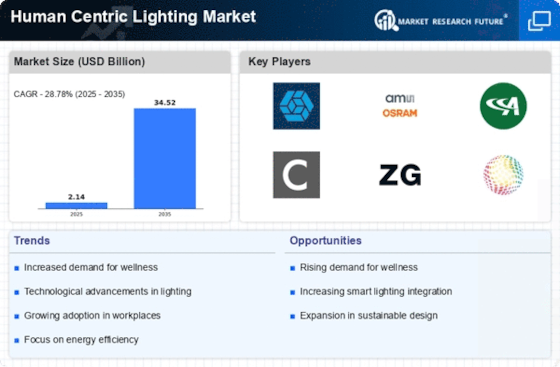
As per Market Research Future analysis, the Human Centric Lighting Market Size was estimated at 2.136 USD Billion in 2024. The Human Centric Lighting industry is projected to grow from 2.751 USD Billion in 2025 to 34.52 USD Billion by 2035, exhibiting a compound annual growth rate (CAGR) of 28.78% during the forecast period 2025 - 2035

Key Market Trends & Highlights

The Human Centric Lighting Market is poised for substantial growth driven by technological advancements and a focus on health and sustainability.

  • The integration of smart technologies is transforming the Human Centric Lighting landscape, particularly in North America. A growing emphasis on health and well-being is propelling demand for healthcare lighting solutions in the Asia-Pacific region. Sustainability and energy efficiency remain pivotal, with LED technology leading the market while smart lighting technology experiences rapid growth. Key drivers include the integration of IoT in lighting systems and regulatory support for energy efficiency, enhancing both residential and healthcare segments.

Market Size & Forecast

2024 Market Size 2.136 (USD Billion)
2035 Market Size 34.52 (USD Billion)
CAGR (2025 - 2035) 28.78%
Largest Regional Market Share in 2024 Europe

Major Players

Signify (NL), Osram (DE), Acuity Brands (US), Cree (US), Zumtobel Group (AT), Trilux (DE), Fagerhult (SE), Lutron Electronics (US), GE Current (US)

Market Trends

The Human Centric Lighting Market is currently experiencing a notable evolution, driven by an increasing awareness of the impact of lighting on human well-being and productivity. This market encompasses a range of technologies and solutions designed to optimize lighting conditions in various environments, including residential, commercial, and healthcare settings. As organizations and individuals alike recognize the importance of aligning lighting with natural circadian rhythms, the demand for innovative lighting solutions continues to grow. Furthermore, advancements in smart lighting technologies are facilitating the integration of human-centric principles into everyday lighting applications, enhancing user experience and satisfaction. In addition to technological advancements, the Human Centric Lighting Market is influenced by a shift towards sustainability and energy efficiency. Stakeholders are increasingly prioritizing eco-friendly solutions that not only improve health outcomes but also reduce energy consumption. This trend is likely to shape product development and market strategies in the coming years. As the market matures, collaboration among manufacturers, designers, and researchers appears essential to drive innovation and address the diverse needs of consumers. Overall, the Human Centric Lighting Market is poised for continued growth, reflecting a broader societal shift towards health-conscious and environmentally responsible living.

Integration of Smart Technologies

The Human Centric Lighting Market is witnessing a surge in the integration of smart technologies, which enhance the adaptability of LED lighting systems. These innovations allow users to customize lighting conditions based on personal preferences and activities, thereby promoting well-being and productivity. As smart home devices become more prevalent, the demand for lighting solutions that seamlessly integrate with these systems is likely to increase.

Focus on Health and Well-being

There is a growing emphasis on health and well-being within the Human Centric Lighting Market. Research suggests that lighting can significantly influence mood, sleep quality, and overall health. Consequently, manufacturers are developing products that cater to these needs, creating environments that support mental and physical health. This trend indicates a shift towards more thoughtful design in lighting solutions.

Sustainability and Energy Efficiency

Sustainability is becoming a central theme in the Human Centric Lighting Market. Stakeholders are increasingly seeking energy-efficient solutions that minimize environmental impact. This trend is driving innovation in product design and materials, as companies strive to create lighting systems that not only enhance human experience but also contribute to a more sustainable future.

Human Centric Lightings Market Market Drivers

Regulatory Support for Energy Efficiency

Regulatory frameworks promoting energy efficiency are emerging as a crucial driver in the Human Centric Lighting Market. Governments worldwide are implementing stringent energy efficiency standards and incentives for adopting advanced lighting technologies. For example, energy-efficient lighting solutions are often eligible for rebates and tax credits, encouraging businesses and consumers to transition to human centric lighting systems. The market for energy-efficient lighting is anticipated to grow at a compound annual growth rate of around 8% through the next few years. This regulatory support not only fosters innovation in lighting technologies but also enhances the appeal of human centric lighting solutions that prioritize energy savings and sustainability.

Rising Awareness of Environmental Impact

The rising awareness of environmental impact is increasingly shaping consumer preferences within the Human Centric Lighting Market. As sustainability becomes a priority for individuals and organizations alike, there is a growing demand for lighting solutions that minimize ecological footprints. Human centric lighting systems that utilize energy-efficient technologies and sustainable materials are gaining traction. Market Research Future indicates that consumers are willing to pay a premium for products that are environmentally friendly, suggesting a shift in purchasing behavior. This trend not only reflects a broader societal movement towards sustainability but also indicates a potential for growth in the human centric lighting market as manufacturers respond to these evolving consumer expectations.

Emphasis on Mental Health and Productivity

The growing emphasis on mental health and productivity in various environments, including workplaces and educational institutions, significantly influences the Human Centric Lighting Market. Research indicates that appropriate lighting can enhance mood, reduce stress, and improve overall well-being. For instance, studies have shown that exposure to natural light can increase productivity by up to 20%. As organizations strive to create healthier environments, the demand for human centric lighting solutions that mimic natural light patterns is expected to rise. This trend not only aligns with the increasing awareness of mental health issues but also suggests a potential market expansion as more entities invest in lighting systems that support employee and student well-being.

Integration of IoT in Human Centric Lighting

The integration of Internet of Things (IoT) technology into the Human Centric Lighting Market appears to be a pivotal driver. IoT-enabled lighting systems facilitate real-time monitoring and control, allowing users to adjust lighting conditions based on their preferences and needs. This adaptability not only enhances user experience but also promotes energy efficiency. According to recent estimates, the IoT in lighting market is projected to reach a value of approximately 30 billion by 2026, indicating a robust growth trajectory. As more consumers and businesses recognize the benefits of smart lighting solutions, the demand for human centric lighting systems that incorporate IoT technology is likely to increase, thereby propelling the market forward.

Technological Advancements in Lighting Solutions

Technological advancements in lighting solutions are driving the evolution of the Human Centric Lighting Market. Innovations such as LED technology, tunable white lighting, and advanced control systems are enhancing the functionality and efficiency of lighting products. The LED segment alone is projected to account for a significant share of the lighting market, with estimates suggesting it could reach over 60 billion by 2025. These advancements enable the creation of lighting systems that can adjust color temperature and intensity, aligning with human circadian rhythms. As consumers become more aware of the benefits of these technologies, the demand for human centric lighting solutions that leverage such innovations is likely to grow, further propelling market dynamics.

Market Segment Insights

By Application: Residential Lighting (Largest) vs. Healthcare Lighting (Fastest-Growing)

In the Human Centric Lighting Market, applications are segmented primarily into Residential Lighting, Commercial Lighting, Healthcare Lighting, Retail Lighting, and Educational Lighting. Among these segments, Residential Lighting holds the largest share, fueled by the growing consumer preference for smart, health-centric homes that enhance well-being through optimal lighting. Meanwhile, Healthcare Lighting is emerging rapidly, driven by advancements in technology aimed at improving patient outcomes and staff efficiency in healthcare facilities. These segments demonstrate distinct characteristics that cater to their respective markets.

Residential Lighting (Dominant) vs. Healthcare Lighting (Emerging)

Residential Lighting is characterized by its broad appeal among consumers who prioritize comfort, mood enhancement, and energy efficiency in their homes. As smart home technology advances, the integration of human-centric lighting solutions becomes increasingly essential, allowing homeowners to tailor their environments to specific needs. Conversely, Healthcare Lighting is gaining traction as an emerging segment, focusing on environments where lighting can significantly affect health and healing. Its design aims to create spaces that support patient recovery, improve staff productivity, and reduce energy costs. This segment’s growth is driven by innovations in lighting that align closely with the healthcare industry's evolving requirements.

By Technology: LED Technology (Largest) vs. Smart Lighting Technology (Fastest-Growing)

In the Human Centric Lighting Market, LED Technology holds the largest market share, driven by its energy efficiency and long lifespan, making it a preferred choice among consumers and manufacturers alike. Meanwhile, Smart Lighting Technology is rapidly gaining attention, appealing to tech-savvy users seeking automation and customization in their lighting solutions. Together, these technologies make up a significant portion of the market, indicating a shift towards more advanced lighting systems.

Technology: LED (Dominant) vs. Smart Lighting (Emerging)

LED Technology is characterized by its durability, energy efficiency, and low heat emission, making it a dominant force in the Human Centric Lighting Market. This technology enhances well-being by providing consistent lighting quality. On the other hand, Smart Lighting Technology is emerging as a powerful contender, integrating advanced features such as app controls, voice activation, and adaptability to users' circadian rhythms. As more consumers seek personalized experiences, Smart Lighting Technology is positioned to revolutionize the way we interact with our environments.

By End Use: Homes (Largest) vs. Offices (Fastest-Growing)

In the Human Centric Lighting Market, the end use segment comprises five primary applications: Homes, Offices, Hospitals, Shops, and Schools. Currently, Homes account for the largest market share, owing to the rising awareness of the benefits of natural light in enhancing well-being and productivity. Offices represent the fastest-growing end-use sector, as businesses increasingly prioritize employee wellness through lighting solutions that mimic natural daylight.

Homes: Dominant vs. Offices: Emerging

The Homes segment dominates the Human Centric Lighting Market, driven by the increasing adoption of smart lighting solutions that enhance comfort and energy efficiency. This segment benefits from a heightened consumer focus on health and wellness, with homeowners investing in designs that use lighting to create more inviting environments. Conversely, the Offices segment is emerging rapidly as organizations recognize that quality lighting can significantly improve employee productivity and satisfaction. The trend toward flexible working spaces and open office designs further accelerates the demand for innovative lighting systems that adapt to the needs of workers.

By Control Type: Smartphone Control (Largest) vs. Voice Control (Fastest-Growing)

The Human Centric Lighting Market shows a varied distribution among different control types, with Smartphone Control leading the segment. Its adoption is driven by the rising prevalence of smart devices, making it the preferred choice for many consumers. Following closely are Remote Control and Manual Control, which still hold a significant share due to their simplicity and ease of use. Voice Control emerges as a newer entrant, capturing attention for its innovative interface and hands-free convenience. As the market evolves, growth trends indicate a strong inclination towards Voice Control, reflecting consumer demand for greater automation and integration with smart home systems. This segment is expanding rapidly, with advances in voice recognition technology and enhanced user experiences driving adoption. The shift towards more intuitive control options is reshaping the marketplace, as consumers seek innovative solutions to enhance their lighting environments.

Smartphone Control (Dominant) vs. Voice Control (Emerging)

Smartphone Control has emerged as the dominant force in the Human Centric Lighting Market, attributed to its integration with various smart home ecosystems and user-friendly applications. Consumers appreciate the convenience of controlling lighting from their mobile devices, making it a pivotal feature for modern households. Smartphone Control seamlessly combines functionality with personalization, allowing users to customize their lighting according to their preferences. Conversely, Voice Control is quickly establishing itself as an emerging player, driven by its unique appeal for automation and hands-free usage. As more consumers adopt smart speakers and voice assistants, the demand for Voice Control will continue to escalate. Its ability to provide a user-friendly interface and integration with other smart technologies positions it as a vital segment for future growth, catering to tech-savvy consumers eager to embrace the newest advancements in lighting solutions.

Get more detailed insights about Human Centric Lightings Market Research Report - Forecast To 2035

Regional Insights

The Global Human Centric Lighting Market revenue was segmented regionally, illustrating significant differentiation in market value across various areas. In 2024, North America was valued at 2.65 USD billion, positioning it as a key player in the market, with an expected growth to 5.0 USD billion by 2035, underscoring its major role in adopting advanced lighting solutions for improving well-being.

Europe led the segment with a valuation of 3.0 USD billion in 2024 and is projected to reach 6.0 USD billion by 2035, driven by stringent regulations on energy efficiency and sustainable practices. Meanwhile, Asia Pacific held a 1.75 USD billion market valuation in 2024, growing to approximately 3.5 USD billion in 2035, representing a significant opportunity driven by increasing urbanization and industrial growth.

The South American and Middle East and Africa markets remained smaller, at 0.5 USD billion and 0.31 USD billion in 2024, respectively, but they are expected to grow steadily, reflecting rising awareness and demand for innovative lighting solutions that promote health and productivity.

This diversification in the Global Human Centric Lighting Market segmentation highlights different growth trajectories, opportunities, and challenges across regions, influenced by local market dynamics and consumer behavior.

Key Players and Competitive Insights

The Global Human Centric Lighting Market is characterized by a dynamic interplay of technological advancements, consumer demands, and evolving industry standards. As awareness of the importance of lighting in enhancing well-being and productivity increases, several players are actively engaging in innovation and strategic partnerships to gain a competitive edge.The market is projected to grow steadily, driven by several factors including the rise of smart homes, increased investment in sustainable technologies, and growing health-conscious consumer behavior. Companies are focusing on developing energy-efficient and adaptive lighting solutions that not only cater to aesthetic requirements but also foster biological and psychological benefits for users.With a range of offerings from traditional lighting to smart and dynamic systems, firms in this sector are realizing the importance of designing products that emphasize well-being and human experience, which is pivotal in capturing market share.Legrand has established itself as a formidable presence in the Global human-centric lighting Market through its commitment to innovation and sustainability. The company's strengths lie in its extensive product portfolio that integrates advanced technology, which promotes energy efficiency and user-centric design.Legrand's offerings are not only aesthetically pleasing but are also functional, serving the needs of various segments, including residential, commercial, and institutional. The company's global distribution network ensures that its human-centric products reach diverse markets efficiently, while its focus on R&D allows it to stay ahead of trends and meet the evolving demands of consumers.Legrand's initiatives in promoting green buildings and smart environments further enhance its competitive positioning in this growing market.Cree is another notable player in the Global Human Centric Lighting Market, renowned for its cutting-edge LED technology and commitment to developing genuinely transformative lighting solutions. The company emphasizes products that promote visual comfort and well-being while simultaneously addressing energy consumption and output efficiency.Cree's strengths include a robust portfolio that features adaptive lighting systems capable of adjusting to the natural light conditions and users’ activities. The company has actively pursued mergers and acquisitions to enhance its technological capabilities and market reach, thereby strengthening its position in the global arena.With innovations in smart lighting solutions, Cree aims to shape the future of Human Centric Lighting, fostering an environment that enhances productivity and quality of life. Its keen focus on sustainability and technological integration firmly establishes Cree as a key player in crafting lighting solutions that resonate with modern consumer values.

Key Companies in the Human Centric Lightings Market include

Industry Developments

With 1,700 licensees under its EnabLED program, Signify achieved a significant milestone in May 2025, speeding up the global deployment of human-centric lighting technology. At Orgatec 2024 in October 2024, Agile workplace partner Secto Design and Signify worked together to install human-centric luminaires in high-end office interiors, demonstrating the use of natural materials and circadian-supportive lighting.

Cree introduced a new line of connected lighting in February 2024. It is specifically made for HCL applications, can be controlled with a smartphone, and supports dynamic, adjustable white settings.

Thanks to its cutting-edge human-centric fixtures and IoT-enabled controls, Acuity Brands (which acquired Zumtobel Group in early 2023) was recognized as a top performer in the 2025 Smart Lighting Vendor Evaluation in June 2025. Philips Dynalite held its inaugural Partner Awards in December 2024, showcasing 22 projects that showcased scalability and human-centric design in lighting control systems.

In July 2025, the integration of AI and wellness standards in workplaces and hospitals is driving the growth of the worldwide human-centric lighting market, which reached USD 2.27 billion in 2024 and is expected to reach USD 8.73 billion by 2030.

Future Outlook

Human Centric Lightings Market Future Outlook

The Human Centric Lighting Market is projected to grow at a 28.78% CAGR from 2025 to 2035, driven by increasing awareness of health benefits and technological advancements.

New opportunities lie in:

  • Development of<a href="https://www.marketresearchfuture.com/reports/smart-lighting-market-991"> smart lighting</a> systems for residential applications.</p><p>Integration of circadian rhythm lighting in commercial spaces.</p><p>Expansion of energy-efficient lighting solutions in healthcare facilities.

By 2035, the market is expected to be robust, driven by innovation and diverse applications.

Market Segmentation

Human Centric Lightings Market End Use Outlook

  • Homes
  • Offices
  • Hospitals
  • Shops
  • Schools

Human Centric Lightings Market Technology Outlook

  • LED Technology
  • Smart Lighting Technology
  • Tunable White Technology
  • Daylight Harvesting Technology

Human Centric Lightings Market Application Outlook

  • Residential Lighting
  • Commercial Lighting
  • Healthcare Lighting
  • Retail Lighting
  • Educational Lighting

Human Centric Lightings Market Control Type Outlook

  • Manual Control
  • Remote Control
  • Smartphone Control
  • Voice Control

Report Scope

MARKET SIZE 2024 2.136(USD Billion)
MARKET SIZE 2025 2.751(USD Billion)
MARKET SIZE 2035 34.52(USD Billion)
COMPOUND ANNUAL GROWTH RATE (CAGR) 28.78% (2025 - 2035)
REPORT COVERAGE Revenue Forecast, Competitive Landscape, Growth Factors, and Trends
BASE YEAR 2024
Market Forecast Period 2025 - 2035
Historical Data 2019 - 2024
Market Forecast Units USD Billion
Key Companies Profiled Signify (NL), Osram (DE), Acuity Brands (US), Cree (US), Zumtobel Group (AT), Trilux (DE), Fagerhult (SE), Lutron Electronics (US), GE Current (US)
Segments Covered Application, Technology, End Use, Control Type, Regional
Key Market Opportunities Integration of smart technologies enhances user experience in the Human Centric Lighting Market.
Key Market Dynamics Rising consumer awareness drives demand for Human Centric Lighting, influencing design and technology innovations.
Countries Covered North America, Europe, APAC, South America, MEA

FAQs

What is the current valuation of the Human Centric Lighting Market?

<p>The Human Centric Lighting Market was valued at 2.136 USD Billion in 2024.</p>

What is the projected market size for the Human Centric Lighting Market by 2035?

<p>The market is projected to reach 34.52 USD Billion by 2035.</p>

What is the expected CAGR for the Human Centric Lighting Market during the forecast period?

<p>The expected CAGR for the market from 2025 to 2035 is 28.78%.</p>

Which segments are leading in the Human Centric Lighting Market?

<p>Residential Lighting and Commercial Lighting are leading segments, valued at 0.64 and 0.5 USD Billion respectively in 2024.</p>

How does LED technology contribute to the Human Centric Lighting Market?

<p>LED Technology accounted for 0.854 USD Billion in 2024 and is projected to grow significantly.</p>

What role do key players like Signify and Osram play in the market?

<p>Key players such as Signify and Osram are instrumental in driving innovation and market growth.</p>

What are the different control types available in the Human Centric Lighting Market?

<p>Control types include Manual Control, Remote Control, Smartphone Control, and Voice Control, with Voice Control valued at 0.855 USD Billion in 2024.</p>

What is the valuation of the Healthcare Lighting segment in 2024?

<p>The Healthcare Lighting segment was valued at 0.396 USD Billion in 2024.</p>

How does the retail lighting segment perform in the market?

<p>Retail Lighting was valued at 0.3 USD Billion in 2024, indicating its role in the overall market.</p>

What is the significance of smart lighting technology in the market?

<p>Smart Lighting Technology was valued at 0.427 USD Billion in 2024 and is expected to grow as consumer demand increases.</p>

  1. SECTION I: EXECUTIVE SUMMARY AND KEY HIGHLIGHTS
    1. | 1.1 EXECUTIVE SUMMARY
    2. | | 1.1.1 Market Overview
    3. | | 1.1.2 Key Findings
    4. | | 1.1.3 Market Segmentation
    5. | | 1.1.4 Competitive Landscape
    6. | | 1.1.5 Challenges and Opportunities
    7. | | 1.1.6 Future Outlook
  2. SECTION II: SCOPING, METHODOLOGY AND MARKET STRUCTURE
    1. | 2.1 MARKET INTRODUCTION
    2. | | 2.1.1 Definition
    3. | | 2.1.2 Scope of the study
    4. | | | 2.1.2.1 Research Objective
    5. | | | 2.1.2.2 Assumption
    6. | | | 2.1.2.3 Limitations
    7. | 2.2 RESEARCH METHODOLOGY
    8. | | 2.2.1 Overview
    9. | | 2.2.2 Data Mining
    10. | | 2.2.3 Secondary Research
    11. | | 2.2.4 Primary Research
    12. | | | 2.2.4.1 Primary Interviews and Information Gathering Process
    13. | | | 2.2.4.2 Breakdown of Primary Respondents
    14. | | 2.2.5 Forecasting Model
    15. | | 2.2.6 Market Size Estimation
    16. | | | 2.2.6.1 Bottom-Up Approach
    17. | | | 2.2.6.2 Top-Down Approach
    18. | | 2.2.7 Data Triangulation
    19. | | 2.2.8 Validation
  3. SECTION III: QUALITATIVE ANALYSIS
    1. | 3.1 MARKET DYNAMICS
    2. | | 3.1.1 Overview
    3. | | 3.1.2 Drivers
    4. | | 3.1.3 Restraints
    5. | | 3.1.4 Opportunities
    6. | 3.2 MARKET FACTOR ANALYSIS
    7. | | 3.2.1 Value chain Analysis
    8. | | 3.2.2 Porter's Five Forces Analysis
    9. | | | 3.2.2.1 Bargaining Power of Suppliers
    10. | | | 3.2.2.2 Bargaining Power of Buyers
    11. | | | 3.2.2.3 Threat of New Entrants
    12. | | | 3.2.2.4 Threat of Substitutes
    13. | | | 3.2.2.5 Intensity of Rivalry
    14. | | 3.2.3 COVID-19 Impact Analysis
    15. | | | 3.2.3.1 Market Impact Analysis
    16. | | | 3.2.3.2 Regional Impact
    17. | | | 3.2.3.3 Opportunity and Threat Analysis
  4. SECTION IV: QUANTITATIVE ANALYSIS
    1. | 4.1 Semiconductor & Electronics, BY Application (USD Billion)
    2. | | 4.1.1 Residential Lighting
    3. | | 4.1.2 Commercial Lighting
    4. | | 4.1.3 Healthcare Lighting
    5. | | 4.1.4 Retail Lighting
    6. | | 4.1.5 Educational Lighting
    7. | 4.2 Semiconductor & Electronics, BY Technology (USD Billion)
    8. | | 4.2.1 LED Technology
    9. | | 4.2.2 Smart Lighting Technology
    10. | | 4.2.3 Tunable White Technology
    11. | | 4.2.4 Daylight Harvesting Technology
    12. | 4.3 Semiconductor & Electronics, BY End Use (USD Billion)
    13. | | 4.3.1 Homes
    14. | | 4.3.2 Offices
    15. | | 4.3.3 Hospitals
    16. | | 4.3.4 Shops
    17. | | 4.3.5 Schools
    18. | 4.4 Semiconductor & Electronics, BY Control Type (USD Billion)
    19. | | 4.4.1 Manual Control
    20. | | 4.4.2 Remote Control
    21. | | 4.4.3 Smartphone Control
    22. | | 4.4.4 Voice Control
    23. | 4.5 Semiconductor & Electronics, BY Region (USD Billion)
    24. | | 4.5.1 North America
    25. | | | 4.5.1.1 US
    26. | | | 4.5.1.2 Canada
    27. | | 4.5.2 Europe
    28. | | | 4.5.2.1 Germany
    29. | | | 4.5.2.2 UK
    30. | | | 4.5.2.3 France
    31. | | | 4.5.2.4 Russia
    32. | | | 4.5.2.5 Italy
    33. | | | 4.5.2.6 Spain
    34. | | | 4.5.2.7 Rest of Europe
    35. | | 4.5.3 APAC
    36. | | | 4.5.3.1 China
    37. | | | 4.5.3.2 India
    38. | | | 4.5.3.3 Japan
    39. | | | 4.5.3.4 South Korea
    40. | | | 4.5.3.5 Malaysia
    41. | | | 4.5.3.6 Thailand
    42. | | | 4.5.3.7 Indonesia
    43. | | | 4.5.3.8 Rest of APAC
    44. | | 4.5.4 South America
    45. | | | 4.5.4.1 Brazil
    46. | | | 4.5.4.2 Mexico
    47. | | | 4.5.4.3 Argentina
    48. | | | 4.5.4.4 Rest of South America
    49. | | 4.5.5 MEA
    50. | | | 4.5.5.1 GCC Countries
    51. | | | 4.5.5.2 South Africa
    52. | | | 4.5.5.3 Rest of MEA
  5. SECTION V: COMPETITIVE ANALYSIS
    1. | 5.1 Competitive Landscape
    2. | | 5.1.1 Overview
    3. | | 5.1.2 Competitive Analysis
    4. | | 5.1.3 Market share Analysis
    5. | | 5.1.4 Major Growth Strategy in the Semiconductor & Electronics
    6. | | 5.1.5 Competitive Benchmarking
    7. | | 5.1.6 Leading Players in Terms of Number of Developments in the Semiconductor & Electronics
    8. | | 5.1.7 Key developments and growth strategies
    9. | | | 5.1.7.1 New Product Launch/Service Deployment
    10. | | | 5.1.7.2 Merger & Acquisitions
    11. | | | 5.1.7.3 Joint Ventures
    12. | | 5.1.8 Major Players Financial Matrix
    13. | | | 5.1.8.1 Sales and Operating Income
    14. | | | 5.1.8.2 Major Players R&D Expenditure. 2023
    15. | 5.2 Company Profiles
    16. | | 5.2.1 Signify (NL)
    17. | | | 5.2.1.1 Financial Overview
    18. | | | 5.2.1.2 Products Offered
    19. | | | 5.2.1.3 Key Developments
    20. | | | 5.2.1.4 SWOT Analysis
    21. | | | 5.2.1.5 Key Strategies
    22. | | 5.2.2 Osram (DE)
    23. | | | 5.2.2.1 Financial Overview
    24. | | | 5.2.2.2 Products Offered
    25. | | | 5.2.2.3 Key Developments
    26. | | | 5.2.2.4 SWOT Analysis
    27. | | | 5.2.2.5 Key Strategies
    28. | | 5.2.3 Acuity Brands (US)
    29. | | | 5.2.3.1 Financial Overview
    30. | | | 5.2.3.2 Products Offered
    31. | | | 5.2.3.3 Key Developments
    32. | | | 5.2.3.4 SWOT Analysis
    33. | | | 5.2.3.5 Key Strategies
    34. | | 5.2.4 Cree (US)
    35. | | | 5.2.4.1 Financial Overview
    36. | | | 5.2.4.2 Products Offered
    37. | | | 5.2.4.3 Key Developments
    38. | | | 5.2.4.4 SWOT Analysis
    39. | | | 5.2.4.5 Key Strategies
    40. | | 5.2.5 Zumtobel Group (AT)
    41. | | | 5.2.5.1 Financial Overview
    42. | | | 5.2.5.2 Products Offered
    43. | | | 5.2.5.3 Key Developments
    44. | | | 5.2.5.4 SWOT Analysis
    45. | | | 5.2.5.5 Key Strategies
    46. | | 5.2.6 Trilux (DE)
    47. | | | 5.2.6.1 Financial Overview
    48. | | | 5.2.6.2 Products Offered
    49. | | | 5.2.6.3 Key Developments
    50. | | | 5.2.6.4 SWOT Analysis
    51. | | | 5.2.6.5 Key Strategies
    52. | | 5.2.7 Fagerhult (SE)
    53. | | | 5.2.7.1 Financial Overview
    54. | | | 5.2.7.2 Products Offered
    55. | | | 5.2.7.3 Key Developments
    56. | | | 5.2.7.4 SWOT Analysis
    57. | | | 5.2.7.5 Key Strategies
    58. | | 5.2.8 Lutron Electronics (US)
    59. | | | 5.2.8.1 Financial Overview
    60. | | | 5.2.8.2 Products Offered
    61. | | | 5.2.8.3 Key Developments
    62. | | | 5.2.8.4 SWOT Analysis
    63. | | | 5.2.8.5 Key Strategies
    64. | | 5.2.9 GE Current (US)
    65. | | | 5.2.9.1 Financial Overview
    66. | | | 5.2.9.2 Products Offered
    67. | | | 5.2.9.3 Key Developments
    68. | | | 5.2.9.4 SWOT Analysis
    69. | | | 5.2.9.5 Key Strategies
    70. | 5.3 Appendix
    71. | | 5.3.1 References
    72. | | 5.3.2 Related Reports
  6. LIST OF FIGURES
    1. | 6.1 MARKET SYNOPSIS
    2. | 6.2 NORTH AMERICA MARKET ANALYSIS
    3. | 6.3 US MARKET ANALYSIS BY APPLICATION
    4. | 6.4 US MARKET ANALYSIS BY TECHNOLOGY
    5. | 6.5 US MARKET ANALYSIS BY END USE
    6. | 6.6 US MARKET ANALYSIS BY CONTROL TYPE
    7. | 6.7 CANADA MARKET ANALYSIS BY APPLICATION
    8. | 6.8 CANADA MARKET ANALYSIS BY TECHNOLOGY
    9. | 6.9 CANADA MARKET ANALYSIS BY END USE
    10. | 6.10 CANADA MARKET ANALYSIS BY CONTROL TYPE
    11. | 6.11 EUROPE MARKET ANALYSIS
    12. | 6.12 GERMANY MARKET ANALYSIS BY APPLICATION
    13. | 6.13 GERMANY MARKET ANALYSIS BY TECHNOLOGY
    14. | 6.14 GERMANY MARKET ANALYSIS BY END USE
    15. | 6.15 GERMANY MARKET ANALYSIS BY CONTROL TYPE
    16. | 6.16 UK MARKET ANALYSIS BY APPLICATION
    17. | 6.17 UK MARKET ANALYSIS BY TECHNOLOGY
    18. | 6.18 UK MARKET ANALYSIS BY END USE
    19. | 6.19 UK MARKET ANALYSIS BY CONTROL TYPE
    20. | 6.20 FRANCE MARKET ANALYSIS BY APPLICATION
    21. | 6.21 FRANCE MARKET ANALYSIS BY TECHNOLOGY
    22. | 6.22 FRANCE MARKET ANALYSIS BY END USE
    23. | 6.23 FRANCE MARKET ANALYSIS BY CONTROL TYPE
    24. | 6.24 RUSSIA MARKET ANALYSIS BY APPLICATION
    25. | 6.25 RUSSIA MARKET ANALYSIS BY TECHNOLOGY
    26. | 6.26 RUSSIA MARKET ANALYSIS BY END USE
    27. | 6.27 RUSSIA MARKET ANALYSIS BY CONTROL TYPE
    28. | 6.28 ITALY MARKET ANALYSIS BY APPLICATION
    29. | 6.29 ITALY MARKET ANALYSIS BY TECHNOLOGY
    30. | 6.30 ITALY MARKET ANALYSIS BY END USE
    31. | 6.31 ITALY MARKET ANALYSIS BY CONTROL TYPE
    32. | 6.32 SPAIN MARKET ANALYSIS BY APPLICATION
    33. | 6.33 SPAIN MARKET ANALYSIS BY TECHNOLOGY
    34. | 6.34 SPAIN MARKET ANALYSIS BY END USE
    35. | 6.35 SPAIN MARKET ANALYSIS BY CONTROL TYPE
    36. | 6.36 REST OF EUROPE MARKET ANALYSIS BY APPLICATION
    37. | 6.37 REST OF EUROPE MARKET ANALYSIS BY TECHNOLOGY
    38. | 6.38 REST OF EUROPE MARKET ANALYSIS BY END USE
    39. | 6.39 REST OF EUROPE MARKET ANALYSIS BY CONTROL TYPE
    40. | 6.40 APAC MARKET ANALYSIS
    41. | 6.41 CHINA MARKET ANALYSIS BY APPLICATION
    42. | 6.42 CHINA MARKET ANALYSIS BY TECHNOLOGY
    43. | 6.43 CHINA MARKET ANALYSIS BY END USE
    44. | 6.44 CHINA MARKET ANALYSIS BY CONTROL TYPE
    45. | 6.45 INDIA MARKET ANALYSIS BY APPLICATION
    46. | 6.46 INDIA MARKET ANALYSIS BY TECHNOLOGY
    47. | 6.47 INDIA MARKET ANALYSIS BY END USE
    48. | 6.48 INDIA MARKET ANALYSIS BY CONTROL TYPE
    49. | 6.49 JAPAN MARKET ANALYSIS BY APPLICATION
    50. | 6.50 JAPAN MARKET ANALYSIS BY TECHNOLOGY
    51. | 6.51 JAPAN MARKET ANALYSIS BY END USE
    52. | 6.52 JAPAN MARKET ANALYSIS BY CONTROL TYPE
    53. | 6.53 SOUTH KOREA MARKET ANALYSIS BY APPLICATION
    54. | 6.54 SOUTH KOREA MARKET ANALYSIS BY TECHNOLOGY
    55. | 6.55 SOUTH KOREA MARKET ANALYSIS BY END USE
    56. | 6.56 SOUTH KOREA MARKET ANALYSIS BY CONTROL TYPE
    57. | 6.57 MALAYSIA MARKET ANALYSIS BY APPLICATION
    58. | 6.58 MALAYSIA MARKET ANALYSIS BY TECHNOLOGY
    59. | 6.59 MALAYSIA MARKET ANALYSIS BY END USE
    60. | 6.60 MALAYSIA MARKET ANALYSIS BY CONTROL TYPE
    61. | 6.61 THAILAND MARKET ANALYSIS BY APPLICATION
    62. | 6.62 THAILAND MARKET ANALYSIS BY TECHNOLOGY
    63. | 6.63 THAILAND MARKET ANALYSIS BY END USE
    64. | 6.64 THAILAND MARKET ANALYSIS BY CONTROL TYPE
    65. | 6.65 INDONESIA MARKET ANALYSIS BY APPLICATION
    66. | 6.66 INDONESIA MARKET ANALYSIS BY TECHNOLOGY
    67. | 6.67 INDONESIA MARKET ANALYSIS BY END USE
    68. | 6.68 INDONESIA MARKET ANALYSIS BY CONTROL TYPE
    69. | 6.69 REST OF APAC MARKET ANALYSIS BY APPLICATION
    70. | 6.70 REST OF APAC MARKET ANALYSIS BY TECHNOLOGY
    71. | 6.71 REST OF APAC MARKET ANALYSIS BY END USE
    72. | 6.72 REST OF APAC MARKET ANALYSIS BY CONTROL TYPE
    73. | 6.73 SOUTH AMERICA MARKET ANALYSIS
    74. | 6.74 BRAZIL MARKET ANALYSIS BY APPLICATION
    75. | 6.75 BRAZIL MARKET ANALYSIS BY TECHNOLOGY
    76. | 6.76 BRAZIL MARKET ANALYSIS BY END USE
    77. | 6.77 BRAZIL MARKET ANALYSIS BY CONTROL TYPE
    78. | 6.78 MEXICO MARKET ANALYSIS BY APPLICATION
    79. | 6.79 MEXICO MARKET ANALYSIS BY TECHNOLOGY
    80. | 6.80 MEXICO MARKET ANALYSIS BY END USE
    81. | 6.81 MEXICO MARKET ANALYSIS BY CONTROL TYPE
    82. | 6.82 ARGENTINA MARKET ANALYSIS BY APPLICATION
    83. | 6.83 ARGENTINA MARKET ANALYSIS BY TECHNOLOGY
    84. | 6.84 ARGENTINA MARKET ANALYSIS BY END USE
    85. | 6.85 ARGENTINA MARKET ANALYSIS BY CONTROL TYPE
    86. | 6.86 REST OF SOUTH AMERICA MARKET ANALYSIS BY APPLICATION
    87. | 6.87 REST OF SOUTH AMERICA MARKET ANALYSIS BY TECHNOLOGY
    88. | 6.88 REST OF SOUTH AMERICA MARKET ANALYSIS BY END USE
    89. | 6.89 REST OF SOUTH AMERICA MARKET ANALYSIS BY CONTROL TYPE
    90. | 6.90 MEA MARKET ANALYSIS
    91. | 6.91 GCC COUNTRIES MARKET ANALYSIS BY APPLICATION
    92. | 6.92 GCC COUNTRIES MARKET ANALYSIS BY TECHNOLOGY
    93. | 6.93 GCC COUNTRIES MARKET ANALYSIS BY END USE
    94. | 6.94 GCC COUNTRIES MARKET ANALYSIS BY CONTROL TYPE
    95. | 6.95 SOUTH AFRICA MARKET ANALYSIS BY APPLICATION
    96. | 6.96 SOUTH AFRICA MARKET ANALYSIS BY TECHNOLOGY
    97. | 6.97 SOUTH AFRICA MARKET ANALYSIS BY END USE
    98. | 6.98 SOUTH AFRICA MARKET ANALYSIS BY CONTROL TYPE
    99. | 6.99 REST OF MEA MARKET ANALYSIS BY APPLICATION
    100. | 6.100 REST OF MEA MARKET ANALYSIS BY TECHNOLOGY
    101. | 6.101 REST OF MEA MARKET ANALYSIS BY END USE
    102. | 6.102 REST OF MEA MARKET ANALYSIS BY CONTROL TYPE
    103. | 6.103 KEY BUYING CRITERIA OF SEMICONDUCTOR & ELECTRONICS
    104. | 6.104 RESEARCH PROCESS OF MRFR
    105. | 6.105 DRO ANALYSIS OF SEMICONDUCTOR & ELECTRONICS
    106. | 6.106 DRIVERS IMPACT ANALYSIS: SEMICONDUCTOR & ELECTRONICS
    107. | 6.107 RESTRAINTS IMPACT ANALYSIS: SEMICONDUCTOR & ELECTRONICS
    108. | 6.108 SUPPLY / VALUE CHAIN: SEMICONDUCTOR & ELECTRONICS
    109. | 6.109 SEMICONDUCTOR & ELECTRONICS, BY APPLICATION, 2024 (% SHARE)
    110. | 6.110 SEMICONDUCTOR & ELECTRONICS, BY APPLICATION, 2024 TO 2035 (USD Billion)
    111. | 6.111 SEMICONDUCTOR & ELECTRONICS, BY TECHNOLOGY, 2024 (% SHARE)
    112. | 6.112 SEMICONDUCTOR & ELECTRONICS, BY TECHNOLOGY, 2024 TO 2035 (USD Billion)
    113. | 6.113 SEMICONDUCTOR & ELECTRONICS, BY END USE, 2024 (% SHARE)
    114. | 6.114 SEMICONDUCTOR & ELECTRONICS, BY END USE, 2024 TO 2035 (USD Billion)
    115. | 6.115 SEMICONDUCTOR & ELECTRONICS, BY CONTROL TYPE, 2024 (% SHARE)
    116. | 6.116 SEMICONDUCTOR & ELECTRONICS, BY CONTROL TYPE, 2024 TO 2035 (USD Billion)
    117. | 6.117 BENCHMARKING OF MAJOR COMPETITORS
  7. LIST OF TABLES
    1. | 7.1 LIST OF ASSUMPTIONS
    2. | | 7.1.1
    3. | 7.2 North America MARKET SIZE ESTIMATES; FORECAST
    4. | | 7.2.1 BY APPLICATION, 2025-2035 (USD Billion)
    5. | | 7.2.2 BY TECHNOLOGY, 2025-2035 (USD Billion)
    6. | | 7.2.3 BY END USE, 2025-2035 (USD Billion)
    7. | | 7.2.4 BY CONTROL TYPE, 2025-2035 (USD Billion)
    8. | 7.3 US MARKET SIZE ESTIMATES; FORECAST
    9. | | 7.3.1 BY APPLICATION, 2025-2035 (USD Billion)
    10. | | 7.3.2 BY TECHNOLOGY, 2025-2035 (USD Billion)
    11. | | 7.3.3 BY END USE, 2025-2035 (USD Billion)
    12. | | 7.3.4 BY CONTROL TYPE, 2025-2035 (USD Billion)
    13. | 7.4 Canada MARKET SIZE ESTIMATES; FORECAST
    14. | | 7.4.1 BY APPLICATION, 2025-2035 (USD Billion)
    15. | | 7.4.2 BY TECHNOLOGY, 2025-2035 (USD Billion)
    16. | | 7.4.3 BY END USE, 2025-2035 (USD Billion)
    17. | | 7.4.4 BY CONTROL TYPE, 2025-2035 (USD Billion)
    18. | 7.5 Europe MARKET SIZE ESTIMATES; FORECAST
    19. | | 7.5.1 BY APPLICATION, 2025-2035 (USD Billion)
    20. | | 7.5.2 BY TECHNOLOGY, 2025-2035 (USD Billion)
    21. | | 7.5.3 BY END USE, 2025-2035 (USD Billion)
    22. | | 7.5.4 BY CONTROL TYPE, 2025-2035 (USD Billion)
    23. | 7.6 Germany MARKET SIZE ESTIMATES; FORECAST
    24. | | 7.6.1 BY APPLICATION, 2025-2035 (USD Billion)
    25. | | 7.6.2 BY TECHNOLOGY, 2025-2035 (USD Billion)
    26. | | 7.6.3 BY END USE, 2025-2035 (USD Billion)
    27. | | 7.6.4 BY CONTROL TYPE, 2025-2035 (USD Billion)
    28. | 7.7 UK MARKET SIZE ESTIMATES; FORECAST
    29. | | 7.7.1 BY APPLICATION, 2025-2035 (USD Billion)
    30. | | 7.7.2 BY TECHNOLOGY, 2025-2035 (USD Billion)
    31. | | 7.7.3 BY END USE, 2025-2035 (USD Billion)
    32. | | 7.7.4 BY CONTROL TYPE, 2025-2035 (USD Billion)
    33. | 7.8 France MARKET SIZE ESTIMATES; FORECAST
    34. | | 7.8.1 BY APPLICATION, 2025-2035 (USD Billion)
    35. | | 7.8.2 BY TECHNOLOGY, 2025-2035 (USD Billion)
    36. | | 7.8.3 BY END USE, 2025-2035 (USD Billion)
    37. | | 7.8.4 BY CONTROL TYPE, 2025-2035 (USD Billion)
    38. | 7.9 Russia MARKET SIZE ESTIMATES; FORECAST
    39. | | 7.9.1 BY APPLICATION, 2025-2035 (USD Billion)
    40. | | 7.9.2 BY TECHNOLOGY, 2025-2035 (USD Billion)
    41. | | 7.9.3 BY END USE, 2025-2035 (USD Billion)
    42. | | 7.9.4 BY CONTROL TYPE, 2025-2035 (USD Billion)
    43. | 7.10 Italy MARKET SIZE ESTIMATES; FORECAST
    44. | | 7.10.1 BY APPLICATION, 2025-2035 (USD Billion)
    45. | | 7.10.2 BY TECHNOLOGY, 2025-2035 (USD Billion)
    46. | | 7.10.3 BY END USE, 2025-2035 (USD Billion)
    47. | | 7.10.4 BY CONTROL TYPE, 2025-2035 (USD Billion)
    48. | 7.11 Spain MARKET SIZE ESTIMATES; FORECAST
    49. | | 7.11.1 BY APPLICATION, 2025-2035 (USD Billion)
    50. | | 7.11.2 BY TECHNOLOGY, 2025-2035 (USD Billion)
    51. | | 7.11.3 BY END USE, 2025-2035 (USD Billion)
    52. | | 7.11.4 BY CONTROL TYPE, 2025-2035 (USD Billion)
    53. | 7.12 Rest of Europe MARKET SIZE ESTIMATES; FORECAST
    54. | | 7.12.1 BY APPLICATION, 2025-2035 (USD Billion)
    55. | | 7.12.2 BY TECHNOLOGY, 2025-2035 (USD Billion)
    56. | | 7.12.3 BY END USE, 2025-2035 (USD Billion)
    57. | | 7.12.4 BY CONTROL TYPE, 2025-2035 (USD Billion)
    58. | 7.13 APAC MARKET SIZE ESTIMATES; FORECAST
    59. | | 7.13.1 BY APPLICATION, 2025-2035 (USD Billion)
    60. | | 7.13.2 BY TECHNOLOGY, 2025-2035 (USD Billion)
    61. | | 7.13.3 BY END USE, 2025-2035 (USD Billion)
    62. | | 7.13.4 BY CONTROL TYPE, 2025-2035 (USD Billion)
    63. | 7.14 China MARKET SIZE ESTIMATES; FORECAST
    64. | | 7.14.1 BY APPLICATION, 2025-2035 (USD Billion)
    65. | | 7.14.2 BY TECHNOLOGY, 2025-2035 (USD Billion)
    66. | | 7.14.3 BY END USE, 2025-2035 (USD Billion)
    67. | | 7.14.4 BY CONTROL TYPE, 2025-2035 (USD Billion)
    68. | 7.15 India MARKET SIZE ESTIMATES; FORECAST
    69. | | 7.15.1 BY APPLICATION, 2025-2035 (USD Billion)
    70. | | 7.15.2 BY TECHNOLOGY, 2025-2035 (USD Billion)
    71. | | 7.15.3 BY END USE, 2025-2035 (USD Billion)
    72. | | 7.15.4 BY CONTROL TYPE, 2025-2035 (USD Billion)
    73. | 7.16 Japan MARKET SIZE ESTIMATES; FORECAST
    74. | | 7.16.1 BY APPLICATION, 2025-2035 (USD Billion)
    75. | | 7.16.2 BY TECHNOLOGY, 2025-2035 (USD Billion)
    76. | | 7.16.3 BY END USE, 2025-2035 (USD Billion)
    77. | | 7.16.4 BY CONTROL TYPE, 2025-2035 (USD Billion)
    78. | 7.17 South Korea MARKET SIZE ESTIMATES; FORECAST
    79. | | 7.17.1 BY APPLICATION, 2025-2035 (USD Billion)
    80. | | 7.17.2 BY TECHNOLOGY, 2025-2035 (USD Billion)
    81. | | 7.17.3 BY END USE, 2025-2035 (USD Billion)
    82. | | 7.17.4 BY CONTROL TYPE, 2025-2035 (USD Billion)
    83. | 7.18 Malaysia MARKET SIZE ESTIMATES; FORECAST
    84. | | 7.18.1 BY APPLICATION, 2025-2035 (USD Billion)
    85. | | 7.18.2 BY TECHNOLOGY, 2025-2035 (USD Billion)
    86. | | 7.18.3 BY END USE, 2025-2035 (USD Billion)
    87. | | 7.18.4 BY CONTROL TYPE, 2025-2035 (USD Billion)
    88. | 7.19 Thailand MARKET SIZE ESTIMATES; FORECAST
    89. | | 7.19.1 BY APPLICATION, 2025-2035 (USD Billion)
    90. | | 7.19.2 BY TECHNOLOGY, 2025-2035 (USD Billion)
    91. | | 7.19.3 BY END USE, 2025-2035 (USD Billion)
    92. | | 7.19.4 BY CONTROL TYPE, 2025-2035 (USD Billion)
    93. | 7.20 Indonesia MARKET SIZE ESTIMATES; FORECAST
    94. | | 7.20.1 BY APPLICATION, 2025-2035 (USD Billion)
    95. | | 7.20.2 BY TECHNOLOGY, 2025-2035 (USD Billion)
    96. | | 7.20.3 BY END USE, 2025-2035 (USD Billion)
    97. | | 7.20.4 BY CONTROL TYPE, 2025-2035 (USD Billion)
    98. | 7.21 Rest of APAC MARKET SIZE ESTIMATES; FORECAST
    99. | | 7.21.1 BY APPLICATION, 2025-2035 (USD Billion)
    100. | | 7.21.2 BY TECHNOLOGY, 2025-2035 (USD Billion)
    101. | | 7.21.3 BY END USE, 2025-2035 (USD Billion)
    102. | | 7.21.4 BY CONTROL TYPE, 2025-2035 (USD Billion)
    103. | 7.22 South America MARKET SIZE ESTIMATES; FORECAST
    104. | | 7.22.1 BY APPLICATION, 2025-2035 (USD Billion)
    105. | | 7.22.2 BY TECHNOLOGY, 2025-2035 (USD Billion)
    106. | | 7.22.3 BY END USE, 2025-2035 (USD Billion)
    107. | | 7.22.4 BY CONTROL TYPE, 2025-2035 (USD Billion)
    108. | 7.23 Brazil MARKET SIZE ESTIMATES; FORECAST
    109. | | 7.23.1 BY APPLICATION, 2025-2035 (USD Billion)
    110. | | 7.23.2 BY TECHNOLOGY, 2025-2035 (USD Billion)
    111. | | 7.23.3 BY END USE, 2025-2035 (USD Billion)
    112. | | 7.23.4 BY CONTROL TYPE, 2025-2035 (USD Billion)
    113. | 7.24 Mexico MARKET SIZE ESTIMATES; FORECAST
    114. | | 7.24.1 BY APPLICATION, 2025-2035 (USD Billion)
    115. | | 7.24.2 BY TECHNOLOGY, 2025-2035 (USD Billion)
    116. | | 7.24.3 BY END USE, 2025-2035 (USD Billion)
    117. | | 7.24.4 BY CONTROL TYPE, 2025-2035 (USD Billion)
    118. | 7.25 Argentina MARKET SIZE ESTIMATES; FORECAST
    119. | | 7.25.1 BY APPLICATION, 2025-2035 (USD Billion)
    120. | | 7.25.2 BY TECHNOLOGY, 2025-2035 (USD Billion)
    121. | | 7.25.3 BY END USE, 2025-2035 (USD Billion)
    122. | | 7.25.4 BY CONTROL TYPE, 2025-2035 (USD Billion)
    123. | 7.26 Rest of South America MARKET SIZE ESTIMATES; FORECAST
    124. | | 7.26.1 BY APPLICATION, 2025-2035 (USD Billion)
    125. | | 7.26.2 BY TECHNOLOGY, 2025-2035 (USD Billion)
    126. | | 7.26.3 BY END USE, 2025-2035 (USD Billion)
    127. | | 7.26.4 BY CONTROL TYPE, 2025-2035 (USD Billion)
    128. | 7.27 MEA MARKET SIZE ESTIMATES; FORECAST
    129. | | 7.27.1 BY APPLICATION, 2025-2035 (USD Billion)
    130. | | 7.27.2 BY TECHNOLOGY, 2025-2035 (USD Billion)
    131. | | 7.27.3 BY END USE, 2025-2035 (USD Billion)
    132. | | 7.27.4 BY CONTROL TYPE, 2025-2035 (USD Billion)
    133. | 7.28 GCC Countries MARKET SIZE ESTIMATES; FORECAST
    134. | | 7.28.1 BY APPLICATION, 2025-2035 (USD Billion)
    135. | | 7.28.2 BY TECHNOLOGY, 2025-2035 (USD Billion)
    136. | | 7.28.3 BY END USE, 2025-2035 (USD Billion)
    137. | | 7.28.4 BY CONTROL TYPE, 2025-2035 (USD Billion)
    138. | 7.29 South Africa MARKET SIZE ESTIMATES; FORECAST
    139. | | 7.29.1 BY APPLICATION, 2025-2035 (USD Billion)
    140. | | 7.29.2 BY TECHNOLOGY, 2025-2035 (USD Billion)
    141. | | 7.29.3 BY END USE, 2025-2035 (USD Billion)
    142. | | 7.29.4 BY CONTROL TYPE, 2025-2035 (USD Billion)
    143. | 7.30 Rest of MEA MARKET SIZE ESTIMATES; FORECAST
    144. | | 7.30.1 BY APPLICATION, 2025-2035 (USD Billion)
    145. | | 7.30.2 BY TECHNOLOGY, 2025-2035 (USD Billion)
    146. | | 7.30.3 BY END USE, 2025-2035 (USD Billion)
    147. | | 7.30.4 BY CONTROL TYPE, 2025-2035 (USD Billion)
    148. | 7.31 PRODUCT LAUNCH/PRODUCT DEVELOPMENT/APPROVAL
    149. | | 7.31.1
    150. | 7.32 ACQUISITION/PARTNERSHIP
    151. | | 7.32.1

Semiconductor & Electronics Market Segmentation

Semiconductor & Electronics By Application (USD Billion, 2025-2035)

  • Residential Lighting
  • Commercial Lighting
  • Healthcare Lighting
  • Retail Lighting
  • Educational Lighting

Semiconductor & Electronics By Technology (USD Billion, 2025-2035)

  • LED Technology
  • Smart Lighting Technology
  • Tunable White Technology
  • Daylight Harvesting Technology

Semiconductor & Electronics By End Use (USD Billion, 2025-2035)

  • Homes
  • Offices
  • Hospitals
  • Shops
  • Schools

Semiconductor & Electronics By Control Type (USD Billion, 2025-2035)

  • Manual Control
  • Remote Control
  • Smartphone Control
  • Voice Control
Infographic

Free Sample Request

Kindly complete the form below to receive a free sample of this Report

Get Free Sample

Customer Strories

Compare Licence

×
Features License Type
Single User Multiuser License Enterprise User
Price $4,950 $5,950 $7,250
Maximum User Access Limit 1 User Upto 10 Users Unrestricted Access Throughout the Organization
Free Customization
Direct Access to Analyst
Deliverable Format
Platform Access
Discount on Next Purchase 10% 15% 15%
Printable Versions