Request Free Sample ×

Kindly complete the form below to receive a free sample of this Report

* Please use a valid business email

Leading companies partner with us for data-driven Insights

clients tt-cursor
Hero Background

Hot Runner Market

ID: MRFR/PCM/28328-CR
111 Pages
Snehal Singh
Last Updated: May 15, 2026

Hot Runner Market Research Report Information by Type (Open Gate System, Valve Gate System), By Component (Manifold, Nozzle, Gate Type or Hot Tip, Temperature Controller, Hot Runner Controller, Heaters, Insulators, Others (Connectors, Cables, Sensors)), By Heating Type or Technology (Internal Heating Systems, External Heating Systems, Hybrid Heating), By Mold Type (Single-Cavity Mold Hot Runners, Multi-Cavity Mold Hot Runners), By Application Or End Use Industry (Automotive, Packaging, Consumer Goods, Medical, Electrical and Electronics, Construction / Building Materials, Thin-Wall Injection Molding, Technical / Industrial Components), By Material Processed (Thermoplastics, Elastomers, Specialty Polymers, High-Temperature Plastics), By Design/ Configuration (Standard Hot Runner Systems, Customized Hot Runner Systems, Stack Mold Hot Runner Systems, Two-Plate Mold Hot Runner Systems, Three-Plate Mold Hot Runner Systems), By Gate Type (Thermal Gate, Valve Gate, Open Gate, Edge Gate, Sprue Gate, Flush Gate), By Sales Channel (Direct Sales, Distribution Partners, OEM (Injection Molding Machine Manufacturers), System Integrators)By Region (North America, Europe, Asia Pacific, South America, Middle East & Africa) - Forecast to 2035

Share:
Download PDF ×

We do not share your information with anyone. However, we may send you emails based on your report interest from time to time. You may contact us at any time to opt-out.

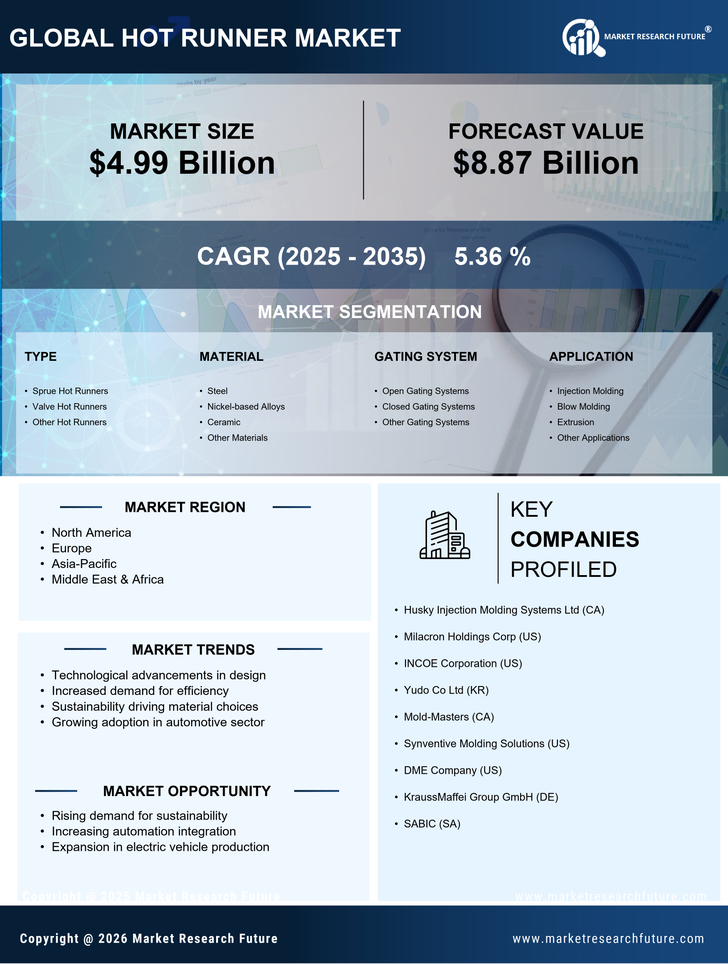
Hot Runner Market Infographic
Purchase Options
  1. 1 Executive Summary
  2. 2 MARKET INTRODUCTION
    1. 2.1 DEFINITION
    2. 2.2 SCOPE OF THE STUDY
    3. 2.3 Research Objective
    4. 2.4 MARKET STRUCTURE
  3. 3 Research Methodology
    1. 3.1 Overview
    2. 3.2 DATA flow
      1. 3.2.1 Data Mining Process
    3. 3.3 Purchased Database:
    4. 3.4 Secondary Sources:
      1. 3.4.1 Secondary Research data flow:
    5. 3.5 Primary Research:
      1. 3.5.1 Primary Research DATA FLOW:
      2. 3.5.2 Primary Research: Number of Interviews conducted
      3. 3.5.3 Primary Research: Regional Coverage
    6. 3.6 Approaches for market size estimation:
      1. 3.6.1 Consumption & Net Trade Approach
      2. 3.6.2 Revenue Analysis Approach
    7. 3.7 Data forecasting
      1. 3.7.1 Data forecasting Technique
    8. 3.8 Data modeling
      1. 3.8.1 microeconomic factor analysis:
      2. 3.8.2 Data modeling:
    9. 3.9 Teams and Analyst Contribution
  4. 4 MARKET DYNAMICS
    1. 4.1 Introduction
    2. 4.2 Drivers
      1. 4.2.1 Rising Demand for Plastic Parts Across Multiple Industries
      2. 4.2.2 Incrsing Demand for High-Volume Manufacturing and Automation
      3. 4.2.3 Superior Quality, Consistency & Design Flexibility
    3. 4.3 restraints
      1. 4.3.1 Complex Maintenance and Technical Expertise Requirements
      2. 4.3.2 Material Limitations and Sensitivity
      3. 4.3.3 High Initial Investment and Tooling Cost
    4. 4.4 oppurtunities
      1. 4.4.1 Rising Demand in Automotive and Electric Vehicle (EV) Industry
      2. 4.4.2 Growth in Medical and Healthcare Applications
      3. 4.4.3 Expansion in Packaging Industry
    5. 4.5 challanges
      1. 4.5.1 Integration Challenges with Automation
      2. 4.5.2 Longer Lead Times for Mold Design and Production
      3. 4.5.1 Complex Maintenance and Technical Expertise Requirements
  5. 5 Market Factor Analysis
    1. 5.1 Supply/Value Chain Analysis
      1. 5.1.1 Participants
        1. 5.1.1.1 Raw Material Suppliers
        2. 5.1.1.2 Component Manufacturing
        3. 5.1.1.3 Hot Runner System Producers / Mold Technology Companies
        4. 5.1.1.4 OEMs (Injection Molding Machine Manufacturers)
        5. 5.1.1.5 System Integrators & Distributors
        6. 5.1.1.6 End-Use Industries / Injection Molders
        7. 5.1.1.7 After-Sales Service Providers
      2. 5.1.2 value perlocation across chain
      3. 5.1.3 integration level
      4. 5.1.4 key issues addressed
    2. 5.2 Porter’s Five Forces Model
      1. 5.2.1 THREAT OF new entrants
      2. 5.2.2 Bargaining Power of Suppliers
      3. 5.2.3 BARGAINING POWER OF buyers
      4. 5.2.4 Threat of Substitutes
      5. 5.2.5 Industry Rivalry
    3. 5.3 technological advancements
    4. 5.4 adjacent market analysis
    5. 5.5 regulatory framework
      1. 5.5.1 Government Policies
      2. 5.5.2 Environmental Consideration
    6. 5.6 R & D Update
      1. 5.6.1 Current Scenario
      2. 5.6.2 Future Roadmap
      3. 5.6.3 Challenges
      4. 5.6.4 Novel Applications
      5. 5.6.5 Key Developments
    7. 5.7 pestal analysis
      1. 5.7.1 Political factors
      2. 5.7.2 Economic factors
      3. 5.7.3 Social Factors
      4. 5.7.4 Technological Factors
      5. 5.7.5 Environmental Factors
      6. 5.7.6 Legal factors
  6. 6 GLOBAL HOT RUNNER MARKET, BY Type
    1. 6.1 OVERVIEW
    2. 6.2 Open Gate System
    3. 6.3 Valve Gate System
  7. 7 GLOBAL HOT RUNNER MARKET, BY Component
    1. 7.1 OVERVIEW
    2. 7.2 Manifold
    3. 7.3 Nozzle
      1. 7.3.1 Hot Tip Nozzle
      2. 7.3.2 Valve Gate Nozzle
      3. 7.3.3 Edge Gate Nozzle
    4. 7.4 Gate Type or Hot Tip
    5. 7.5 Temperature Controller
    6. 7.6 Hot Runner Controller
    7. 7.7 Heaters
    8. 7.8 Insulators
    9. 7.9 Others (Connectors, Cables, Sensors)
  8. 8 GLOBAL HOT RUNNER MARKET, BY Heating Type Or Technology
    1. 8.1 OVERVIEW
    2. 8.2 Internal Heating Systems
    3. 8.3 External Heating Systems
    4. 8.4 On- Hybrid Heating
  9. 9 GLOBAL HOT RUNNER MARKET, BY Mold Type
    1. 9.1 OVERVIEW
    2. 9.2 Single-Cavity Mold Hot Runners
    3. 9.3 Multi-Cavity Mold Hot Runners
  10. 10 GLOBAL HOT RUNNER MARKET, BY Application or End-use Industry
    1. 10.1 OVERVIEW
    2. 10.2 Automotive
      1. 10.2.1 Interior Components
      2. 10.2.2 Exterior Parts
      3. 10.2.3 Under-hood Components
    3. 10.3 Packaging
      1. 10.3.1 Food and Beverage Packaging
      2. 10.3.2 Pharmaceutical Packaging
      3. 10.3.3 Cosmetic Packaging
      4. 10.3.4 Caps and Closures
    4. 10.4 Consumer Goods
      1. 10.4.1 Electronics Housing
      2. 10.4.2 Household Appliances
    5. 10.5 Medical
      1. 10.5.1 Syringes
      2. 10.5.2 Vials
      3. 10.5.3 Diagnostic Devices
      4. 10.5.4 Medical Consumables
    6. The diagnostic devices segment of the medical hot runner market includes plastic components used in laboratory and point-of-care diagnostic equipment, such as test cartridges, microfluidic chips, sample holders, and housings for analytical instruments. These parts demand extremely high precision, tight tolerances, and defect-free surfaces, as even minor imperfections can compromise test accuracy, fluid flow, or sample containment. Production often involves multi-cavity molds for small, intricate components, requiring hot runner systems that ensure uniform melt flow, precise temperature control, and zero-dead-space injection. Valve-gate and edge-gate systems are commonly used to achieve consistent part quality while minimizing shear stress on sensitive polymers. Materials include medical-grade PP, COC, COP, and specialty thermoplastics, which require stable thermal management to prevent degradation and maintain biocompatibility. Cleanroom compatibility is essential, as production must meet ISO Class 7–8, GMP, and FDA/EMA standards to avoid contamination. The growing adoption of automation and smart manufacturing, including real-time temperature monitoring, cavity sensors, and predictive maintenance, supports repeatable quality, reduces downtime, and increases throughput. Overall, the diagnostic devices segment requires precision-engineered, cleanroom-ready, material-optimized, and smart-enabled hot runner solutions capable of producing high-volume, defect-free components critical to medical testing and diagnostics.
    7. The diagnostic devices segment in the medical hot runner market is driven by the growing demand for high-precision, defect-free plastic components used in laboratory and point-of-care testing equipment, including microfluidic chips, test cartridges, and analytical instrument housings. Manufacturers prioritize valve-gate and edge-gate hot runner systems to achieve uniform melt flow, precise gate control, and zero-dead-space injection, ensuring tight tolerances, smooth surfaces, and reliable part performance. Materials such as medical-grade PP, COC, COP, and specialty thermoplastics require thermally stable, material-specific hot runner designs to prevent degradation and maintain biocompatibility. Multi-cavity molds and high-speed production necessitate optimized thermal balancing and process automation, while cleanroom compatibility and adherence to ISO Class 7–8, GMP, and FDA/EMA standards are critical to prevent contamination. The integration of IoT-enabled monitoring, real-time temperature and cavity sensors, and predictive maintenance enhances repeatability, reduces downtime, and maximizes throughput. Strategically, suppliers should focus on delivering precision-engineered, cleanroom-ready, and smart-enabled hot runner solutions capable of supporting large-scale, high-quality production of diagnostic device components, positioning themselves as reliable partners for medical and laboratory equipment manufacturers.
    8. The medical consumables segment in the hot runner market encompasses single-use plastic components such as IV connectors, pipette tips, catheters, sample tubes, and other disposable items used in hospitals, laboratories, and clinics. These products require high-volume, precision molding with stringent dimensional accuracy, smooth surfaces, and consistent material properties to ensure patient safety, reliability, and compliance with medical regulations. Production typically involves multi-cavity molds for small, intricate components, demanding hot runner systems that provide uniform melt flow, precise temperature control, and zero-dead-space injection. Valve-gate and hot-tip systems are often employed to achieve optimal gate quality, reduce flash, and minimize shear stress on sensitive polymers. Materials commonly used include medical-grade polypropylene (PP), TPE, COC, COP, and other biocompatible plastics, which require thermally stable, material-optimized hot runner designs to prevent degradation. Cleanroom compatibility is essential, with production adhering to ISO Class 7–8, GMP, and FDA/EMA standards to avoid contamination. Smart manufacturing technologies, such as real-time temperature monitoring, cavity sensors, and predictive maintenance, are increasingly integrated to ensure repeatable quality, reduce downtime, and maximize throughput. Overall, the segment demands high-precision, cleanroom-ready, material-optimized, and digitally enabled hot runner solutions capable of supporting large-scale, defect-free production of critical medical consumables.
    9. The medical consumables segment of the hot runner market is driven by the increasing demand for high-volume, precision-molded, single-use medical components such as IV connectors, pipette tips, catheters, and sample tubes. Manufacturers require multi-cavity molds combined with valve-gate or hot-tip hot runner systems to achieve uniform melt flow, precise temperature control, and zero-dead-space injection, ensuring dimensional accuracy, smooth surfaces, and defect-free output. Materials such as medical-grade polypropylene (PP), TPE, COC, and COP demand thermally stable, material-specific hot runner designs that prevent degradation while maintaining biocompatibility and sterilizability. Cleanroom compatibility is essential, with compliance to ISO Class 7–8, GMP, and FDA/EMA standards to avoid contamination. Integration of smart manufacturing technologies, including real-time temperature and cavity monitoring, predictive maintenance, and automated process control, enhances repeatability, reduces downtime, and maximizes throughput. Strategically, suppliers should focus on delivering precision-engineered, cleanroom-ready, and IoT-enabled hot runner solutions that support large-scale, high-speed, and defect-free production of medical consumables, establishing themselves as reliable partners in the growing medical and laboratory sector.
    10. 10.6 Electrical and Electronics
    11. 10.7 Construction / Building Materials
    12. 10.8 Thin-Wall Injection Molding
    13. 10.9 Technical / Industrial Components
  11. 11 GLOBAL HOT RUNNER MARKET, BY Material Processed
    1. 11.1 OVERVIEW
    2. 11.2 Thermoplastics
      1. 11.2.1 Polypropylene (PP)
      2. 11.2.2 Polyethylene (PE)
      3. 11.2.3 Polystyrene (PS)
      4. 11.2.4 ABS
      5. 11.2.5 Polycarbonate (PC)
      6. 11.2.6 Nylon (PA)
      7. 11.2.7 Engineering Plastics
    3. 11.3 Elastomers
    4. 11.4 Specialty Polymers
    5. 11.5 High-Temperature Plastics
  12. 12 GLOBAL HOT RUNNER MARKET, BY Design / Configuration
    1. 12.1 OVERVIEW
    2. 12.2 Standard Hot Runner Systems
    3. 12.3 Customized Hot Runner Systems
    4. 12.4 Stack Mold Hot Runner Systems
    5. 12.5 Two-Plate Mold Hot Runner Systems
    6. 12.6 Three-Plate Mold Hot Runner Systems
  13. 13 GLOBAL HOT RUNNER MARKET, BY Gate Type
    1. 13.1 OVERVIEW
    2. 13.2 Thermal Gate
    3. 13.3 Valve Gate
    4. 13.4 Open Gate
    5. 13.5 Edge Gate
    6. 13.6 Sprue Gate
    7. 13.7 Flush Gate
  14. 14 GLOBAL HOT RUNNER MARKET, BY Sales Channel
    1. 14.1 OVERVIEW
    2. 14.2 Direct Sales
    3. 14.3 Distribution Partners
    4. 14.4 OEM (Injection Molding Machine Manufacturers)
    5. 14.5 System Integrators
  15. 15 Global HOT RUNNER Market, BY Region
    1. 15.1 OVERVIEW
      1. 15.1.1 GLOBAL HOT RUNNER MARKET, by region, 2019-2035
    2. 15.2 North America
    3. 15.3 South America
    4. 15.4 Europe
    5. 15.5 Asia Pacific
    6. 15.6 Middle East & Africa
  16. 16 Competitive Landscape
    1. 16.1 Introduction
    2. 16.2 market share analysis, 2024
    3. 16.3 competitor dashboard
    4. 16.4 KEY DEVELOPMENTS & GROWTH STRATEGIES
      1. 16.4.1 Product Launch
      2. 16.4.2 expansion
      3. 16.4.3 acquisition/ merger
  17. 17 Company Profiles
    1. 17.1 Husky Technologies
      1. 17.1.1 COMPANY OVERVIEW
      2. 17.1.2 FINANCIAL OVERVIEW
      3. 17.1.3 PRODUCTS OFFERED
      4. 17.1.4 KEY DEVELOPMENTS
      5. 17.1.5 SWOT ANALYSIS
      6. 17.1.6 KEY STRATEGIES
    2. 17.2 INCOE Corporation
      1. 17.2.1 COMPANY OVERVIEW
      2. 17.2.2 FINANCIAL OVERVIEW
      3. 17.2.3 PRODUCTS OFFERED
      4. 17.2.4 KEY DEVELOPMENTS
      5. 17.2.5 SWOT ANALYSIS
      6. 17.2.6 KEY STRATEGIES
    3. 17.3 Hillenbrand, Inc.
      1. 17.3.1 COMPANY OVERVIEW
      2. 17.3.2 FINANCIAL OVERVIEW
      3. 17.3.3 PRODUCTS OFFERED
      4. 17.3.4 KEY DEVELOPMENTS
      5. 17.3.5 SWOT ANALYSIS
      6. 17.3.6 KEY STRATEGIES
    4. 17.4 Barnes Group Inc.
      1. 17.4.1 COMPANY OVERVIEW
      2. 17.4.2 FINANCIAL OVERVIEW
      3. 17.4.3 PRODUCTS OFFERED
      4. 17.4.4 KEY DEVELOPMENTS
      5. 17.4.5 SWOT ANALYSIS
      6. 17.4.6 KEY STRATEGIES
    5. 17.5 GÜNTHER Heisskanaltechnik GmbH
      1. 17.5.1 COMPANY OVERVIEW
      2. 17.5.2 FINANCIAL OVERVIEW
      3. 17.5.3 PRODUCTS OFFERED
      4. 17.5.4 KEY DEVELOPMENTS
      5. 17.5.5 SWOT ANALYSIS
      6. 17.5.6 KEY STRATEGIES
    6. 17.6 HASCO Hasenclever GmbH + Co KG
      1. 17.6.1 COMPANY OVERVIEW
      2. 17.6.2 FINANCIAL OVERVIEW
      3. 17.6.3 PRODUCTS OFFERED
      4. 17.6.4 KEY DEVELOPMENTS
      5. 17.6.5 SWOT ANALYSIS
      6. 17.6.6 KEY STRATEGIES
    7. 17.7 SEIKI CORPORATION
      1. 17.7.1 COMPANY OVERVIEW
      2. 17.7.2 FINANCIAL OVERVIEW
      3. 17.7.3 PRODUCTS OFFERED
      4. 17.7.4 KEY DEVELOPMENTS
      5. 17.7.5 SWOT ANALYSIS
      6. 17.7.6 KEY STRATEGIES
    8. 17.8 Meusburger Georg GmbH & Co KG
      1. 17.8.1 COMPANY OVERVIEW
      2. 17.8.2 FINANCIAL OVERVIEW
      3. 17.8.3 PRODUCTS OFFERED
      4. 17.8.4 KEY DEVELOPMENTS
      5. 17.8.5 SWOT ANALYSIS
      6. 17.8.6 KEY STRATEGIES
    9. 17.9 Polyshot Corporation, Inc.
      1. 17.9.1 COMPANY OVERVIEW
      2. 17.9.2 FINANCIAL OVERVIEW
      3. 17.9.3 PRODUCTS OFFERED
      4. 17.9.4 KEY DEVELOPMENTS
      5. 17.9.5 SWOT ANALYSIS
      6. 17.9.6 KEY STRATEGIES
    10. 17.10 Polimold Industrial S/A.
      1. 17.10.1 COMPANY OVERVIEW
      2. 17.10.2 FINANCIAL OVERVIEW
      3. 17.10.3 PRODUCTS OFFERED
      4. 17.10.4 KEY DEVELOPMENTS
      5. 17.10.5 SWOT ANALYSIS
      6. 17.10.6 KEY STRATEGIES

Hot Runner Market Segmentation

Market Segmentation Overview

  • Detailed segmentation data will be available in the full report
  • Comprehensive analysis by multiple parameters
  • Regional and country-level breakdowns
  • Market size forecasts by segment

Compare Licence

×
Features License Type
Single User Multiuser License Enterprise User
Price $4,950 $ $7,250
Maximum User Access Limit 1 User Upto 10 Users Unrestricted Access Throughout the Organization
Free Customization
Direct Access to Analyst
Deliverable Format
Platform Access
Discount on Next Purchase 10% 15% 15%
Printable Versions