Request Free Sample ×

Kindly complete the form below to receive a free sample of this Report

* Please use a valid business email

Leading companies partner with us for data-driven Insights

clients tt-cursor
Hero Background
English
Chinese
French
Japanese
Korean
German
Spanish

Home Automation System Market Size

ID: MRFR/SEM/4624-HCR
100 Pages
Ankit Gupta
April 2026

Home Automation System Market Size, Share and Research Report By Protocol & Technology (Network and wireless), By Product (Lighting, Security &Access Control, HVAC and Entertainment Control), By Software & Algorithm (Behavioural and Proactive)), And By Region (North America, Europe, Asia-Pacific, And Rest of The World) – Industry Forecast Till 2035

Share:
Download PDF ×

We do not share your information with anyone. However, we may send you emails based on your report interest from time to time. You may contact us at any time to opt-out.

Home Automation System Market Infographic
Purchase Options

Home Automation System Size

Home Automation System Market Growth Projections and Opportunities

The Home Automation System market is overall molded by different elements that impact its development and market elements. One essential driver is the rising buyer interest for accommodation, energy proficiency, and upgraded security in private settings. Home automation systems offer homeowners the capacity to control and screen different parts of their homes, like lighting, heating, security, and entertainment, through smart gadgets. This request is especially clear as buyers look for incorporated arrangements that improve on daily errands and add to a more agreeable and secure living climate. The rising consciousness of energy preservation and sustainability is another huge element adding to the development of the home automation system market. Home automation systems empower clients to upgrade energy utilization by controlling warming, ventilation, and lighting systems based on residence and inclinations. Smart indoor regulators, lighting controls, and energy observing arrangements engage homeowners to pursue informed choices, lessen energy waste, and lower utility expenses. The accentuation on eco-accommodating and energy-effective homes lines up with the reception of home automation systems as an indispensable piece of present day residing. Also, the developing pattern of smart homes and the longing for coordinated ecosystems impact market elements. Homeowners look for secure arrangements that flawlessly interface various gadgets and systems, making a bound together smart home insight. Home automation systems, fit for incorporating different innovations like smart lighting, surveillance cameras, smart locks, and voice colleagues, meet the advancing assumptions for customers for far reaching and interconnected home arrangements. The rising significance of home security and reconnaissance is driving the reception of home automation systems. Smart security systems, including cameras, doorbell cameras, and smart locks, offer homeowners improved control and perceivability over their home's security. The capacity to screen and get alarms remotely adds to the allure of home automation systems as a necessary part of current home safety efforts.

Home Automation System Market Size Graph
Author
Author Profile
Ankit Gupta
Team Lead - Research

Ankit Gupta is a seasoned market intelligence and strategic research professional with over six plus years of experience in the ICT and Semiconductor industries. With academic roots in Telecom, Marketing, and Electronics, he blends technical insight with business strategy. Ankit has led 200+ projects, including work for Fortune 500 clients like Microsoft and Rio Tinto, covering market sizing, tech forecasting, and go-to-market strategies. Known for bridging engineering and enterprise decision-making, his insights support growth, innovation, and investment planning across diverse technology markets.

Leave a Comment

FAQs

What is the projected market valuation for the Home Automation System Market in 2035?

<p>The projected market valuation for the Home Automation System Market in 2035 is 112847.45 USD Million.</p>

What was the overall market valuation for the Home Automation System Market in 2024?

<p>The overall market valuation for the Home Automation System Market in 2024 was 70865.9 USD Million.</p>

What is the expected CAGR for the Home Automation System Market during the forecast period 2025 - 2035?

<p>The expected CAGR for the Home Automation System Market during the forecast period 2025 - 2035 is 4.32%.</p>

Which companies are considered key players in the Home Automation System Market?

<p>Key players in the Home Automation System Market include Amazon, Google, Apple, Samsung, Philips, Honeywell, Lutron, Schneider Electric, and Bosch.</p>

What segment of the Home Automation System Market had the highest valuation in 2024?

<p>In 2024, the segment of Security and Surveillance had the highest valuation at 17604.73 USD Million.</p>

How does the valuation of the Residential segment compare to the Commercial segment in 2024?

<p>In 2024, the Residential segment was valued at 42500.0 USD Million, significantly higher than the Commercial segment, which was valued at 20000.0 USD Million.</p>

What is the projected valuation for the Smart Security Systems product type in 2035?

The projected valuation for the Smart Security Systems product type in 2035 is 35000.0 USD Million.

What technology segment is expected to dominate the Home Automation System Market by 2035?

By 2035, the Wireless Technology segment is expected to dominate the Home Automation System Market, with a projected valuation of 55000.0 USD Million.

What are the projected values for Installation Services in 2035?

The projected value for Installation Services in 2035 is 32000.0 USD Million.

Which service type is anticipated to experience the most growth from 2025 to 2035?

The Maintenance Services segment is anticipated to experience the most growth, with a projected valuation of 24000.0 USD Million by 2035.

Market Summary

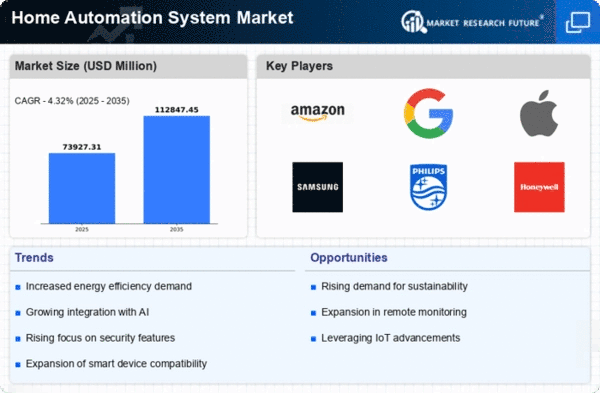
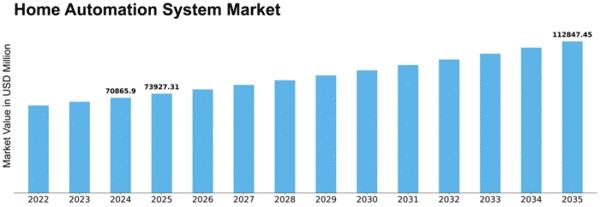
As per MRFR analysis, the Home Automation System Market Size was estimated at 70865.9 USD Million in 2024. The Home Automation System industry is projected to grow from 73927.48 USD Million in 2025 to 112847.45 USD Million by 2035, exhibiting a compound annual growth rate (CAGR) of 4.32% during the forecast period 2025 - 2035.

Key Market Trends & Highlights

The Home Automation System Market is experiencing robust growth driven by technological advancements and increasing consumer demand.

  • The integration of Artificial Intelligence is transforming home automation systems, enhancing user experience and functionality. Energy efficiency remains a focal point, as consumers increasingly seek solutions that reduce energy consumption and costs. North America leads the market, while the Asia-Pacific region is emerging as the fastest-growing area for home automation technologies. Rising demand for smart homes and advancements in IoT technology are key drivers propelling the market forward, particularly in the residential and security segments.

Market Size & Forecast

2024 Market Size 70865.9 (USD Million)
2035 Market Size 112847.45 (USD Million)
CAGR (2025 - 2035) 4.32%
Largest Regional Market Share in 2024 North America

Major Players

Amazon (US), Google (US), Apple (US), Samsung (KR), Philips (NL), Honeywell (US), Lutron (US), ADT (US), Legrand (FR)

Market Trends

The Home Automation System Market is currently experiencing a transformative phase, characterized by rapid technological advancements and increasing consumer interest. This market encompasses a wide array of devices and systems designed to enhance the convenience, security, and energy efficiency of residential environments. As smart technologies become more integrated into daily life, homeowners are increasingly seeking solutions that offer seamless control over various aspects of their living spaces. The proliferation of Internet of Things (IoT) devices has further fueled this trend, enabling interconnected systems that can be managed remotely, thus appealing to a tech-savvy demographic. The home automation system market is experiencing steady growth, driven by increasing consumer adoption of smart home technologies and connected living solutions.

Moreover, the growing emphasis on sustainability and energy conservation is shaping consumer preferences within the Home Automation System Market. Homeowners are more inclined to invest in systems that not only provide comfort but also contribute to reducing energy consumption. This shift towards eco-friendly solutions is likely to drive innovation and competition among manufacturers, as they strive to meet the evolving demands of environmentally conscious consumers. As the market continues to evolve, it appears poised for substantial growth, driven by advancements in technology and changing consumer behaviors. Key home automation system market trends include integration of AI-enabled voice assistants, centralized control platforms, and increased adoption of smart lighting, security, and climate control solutions.

Integration of Artificial Intelligence

The incorporation of artificial intelligence into home automation systems is becoming increasingly prevalent. AI enhances the functionality of smart devices, allowing for predictive analytics and personalized user experiences. This trend suggests that systems will become more intuitive, adapting to individual preferences and routines.

Focus on Energy Efficiency

As concerns about home security rise, there is a noticeable shift towards integrating advanced security features within home automation systems. This trend indicates that consumers are prioritizing systems that offer real-time monitoring, remote access, and automated alerts, thereby enhancing the safety of their residences. Expansion of the global home automation system market is supported by advancements in IoT, wireless connectivity, and growing demand for energy-efficient and secure residential systems.

Enhanced Security Features

The demand for advanced security features within home automation systems is on the rise. Homeowners are seeking solutions that offer real-time monitoring, remote access, and automated alerts. This trend indicates a growing awareness of the importance of home security in the context of smart living.

Home Automation System Market Market Drivers

Market Growth Projections

The Global Home Automation System Market Industry is poised for substantial growth, with projections indicating a market value of 70.9 USD Billion in 2024 and an anticipated increase to 112.2 USD Billion by 2035. This growth trajectory suggests a robust demand for home automation solutions driven by various factors, including technological advancements and changing consumer preferences. The market is expected to experience a compound annual growth rate (CAGR) of 4.27% from 2025 to 2035, reflecting the increasing integration of smart technologies in residential settings. These projections underscore the potential for innovation and expansion within the home automation sector, indicating a promising future for industry stakeholders.

Consumer Awareness and Adoption

Consumer awareness regarding the benefits of home automation systems significantly impacts the Global Home Automation System Market Industry. As information about smart home technologies becomes more accessible, consumers are increasingly inclined to adopt these systems. Educational campaigns and marketing efforts by manufacturers highlight the advantages of automation, such as convenience, energy savings, and enhanced security. This growing awareness is reflected in the rising sales of smart home devices, indicating a shift in consumer behavior. As more households embrace automation, the market is poised for growth, suggesting that consumer education will continue to play a pivotal role in shaping industry trends.

Increased Focus on Home Security

The Global Home Automation System Market Industry is significantly influenced by the heightened focus on home security. Consumers are increasingly concerned about safety, leading to a surge in demand for smart security systems. These systems often include features such as surveillance cameras, motion detectors, and smart locks, which can be monitored remotely via smartphones. The convenience of managing home security from anywhere enhances consumer appeal. As crime rates fluctuate globally, the desire for enhanced security measures appears to drive market growth. This trend is likely to contribute to the overall market expansion, with a projected CAGR of 4.27% from 2025 to 2035, indicating sustained interest in home security solutions.

Technological Advancements in IoT

Technological advancements in the Internet of Things (IoT) significantly drive the Global Home Automation System Market Industry. The integration of IoT technology enables seamless communication between devices, enhancing user experience and functionality. Smart home devices, such as security cameras, smart locks, and voice assistants, are increasingly interconnected, allowing for remote monitoring and control. This interconnectedness not only improves convenience but also enhances security and efficiency. As IoT technology continues to evolve, the market is expected to expand, with projections indicating a growth to 112.2 USD Billion by 2035. The potential for innovation in home automation systems remains vast, suggesting a dynamic future for the industry.

Rising Demand for Energy Efficiency

The Global Home Automation System Market Industry experiences a notable surge in demand for energy-efficient solutions. Homeowners increasingly seek systems that optimize energy consumption, thereby reducing utility bills and environmental impact. For instance, smart thermostats and automated lighting systems allow users to manage energy use effectively. This trend aligns with the broader global initiative to combat climate change, as energy-efficient homes contribute to lower carbon footprints. The market is projected to reach 70.9 USD Billion in 2024, reflecting a growing awareness of sustainability among consumers. As energy costs rise, the adoption of home automation systems that enhance energy efficiency is likely to accelerate.

Growing Urbanization and Smart Cities

Urbanization plays a crucial role in shaping the Global Home Automation System Market Industry. As more individuals move to urban areas, the demand for smart homes and automation solutions increases. Urban environments often face challenges such as congestion and energy inefficiency, prompting the development of smart city initiatives. Home automation systems are integral to these initiatives, as they promote energy conservation and enhance living standards. The integration of smart technologies in urban planning suggests a future where homes are equipped with advanced automation systems. This trend is likely to drive market growth, aligning with the global shift towards sustainable urban living and smart city development.


Market Segment Insights

By Application: Lighting Control (Largest) vs. Security and Surveillance (Fastest-Growing)

The Home Automation System Market showcases a diverse application segment, with <a href="https://www.marketresearchfuture.com/reports/lighting-control-system-market-3822">Lighting Control</a> holding the largest market share. This segment is increasingly popular among consumers due to its ability to enhance energy efficiency and provide convenience through smart lighting solutions. In contrast, Security and Surveillance is emerging as the fastest-growing segment, driven by heightened concerns around home security and the increasing adoption of smart cameras and alarm systems in residential settings. As consumers seek more integrated solutions, the segments of Heating and Cooling Control, Home Entertainment, and Smart Appliances also contribute to the market's dynamism. While they hold significant shares, their growth rates are moderated compared to the rapid expansion seen in Security and Surveillance. The ongoing trend towards energy-efficient heating and cooling systems, along with a growing interest in automated home entertainment solutions, indicates a robust future for these applications as well.

Lighting Control (Dominant) vs. Security and Surveillance (Emerging)

Lighting Control systems have solidified their position as the dominant application in the Home Automation System Market due to their broad appeal and practical benefits. These systems not only enhance aesthetic appeal and convenience but also significantly reduce energy costs, attracting both new homeowners and those upgrading their existing setups. As technology advances, capabilities such as voice control and remote access have further fueled their popularity. On the other hand, Security and Surveillance systems are witnessing rapid growth as more consumers prioritize safety in an increasingly digital world. The emergence of advanced features like motion detection, real-time monitoring, and smart integration with other home systems make this application not just essential but an attractive investment for households aiming to bolster their security.

By End Use: Residential (Largest) vs. Commercial (Fastest-Growing)

The Home Automation System Market demonstrates a diverse distribution among its end-use segments, with the Residential segment holding the largest share. This segment benefits from the increasing consumer demand for smart home technologies, as homeowners seek convenience, security, and energy efficiency. In contrast, the Commercial sector, fueled by advancements in IoT and growing investments in smart buildings, is emerging rapidly as businesses recognize the benefits of automating their environments to enhance operational efficiency and cost savings. With a surge in technology adoption and smart devices, the growth trends for these segments are promising. The Residential segment is driven by increasing disposable incomes and a growing awareness of energy-efficient systems. Meanwhile, the Commercial segment is harnessing the latest trends in workplace automation and sustainability initiatives, making it attractive for businesses looking to modernize their operations and improve their workspace environments.

Residential (Dominant) vs. Healthcare (Emerging)

The Residential segment dominates the Home Automation System Market, characterized by a strong consumer preference for integrated smart technologies that enhance comfort and security at home. This includes smart lighting, thermostats, and security systems that are popular among homeowners seeking convenience and energy efficiency. In contrast, the Healthcare segment is emerging, driven by the need for improved patient monitoring and operational efficiency in medical facilities. Innovations in telehealth, remote patient monitoring, and automated clinical workflows are increasingly being integrated into healthcare settings, responding to the evolving needs of patients and healthcare providers alike. The ongoing digital transformation in healthcare and the focus on patient-centric solutions position this segment as a key area for growth and investment.

By Technology: Wireless Technology (Largest) vs. Wired Technology (Fastest-Growing)

<p>The Home Automation System Market reveals a distinct distribution of market share among the technology segments, with Wireless Technology currently holding the largest share. This segment has gained popularity due to its ease of installation and flexibility, making it a preferred choice for consumers seeking modern home automation solutions. In contrast, Wired Technology, while smaller in market share, is experiencing significant growth as it offers more stability and security, appealing to a segment of consumers requiring robust solutions for their home automation needs.</p>

<p>Technology: Wireless (Dominant) vs. Wired (Emerging)</p>

<p>Wireless Technology stands out as the dominant force in the Home Automation System Market, characterized by ease of use, cost-effectiveness, and seamless integration with smartphones and smart devices. It allows users to control their home systems remotely, creating convenience and comfort. On the other hand, Wired Technology is considered an emerging segment, rapidly gaining traction due to its reliability and enhanced security features. While it may involve higher upfront installation costs, many homeowners are recognizing the long-term benefits. Hybrid Technology is another competitor in this space, but its market presence remains less significant compared to the agility of wireless solutions.</p>

By Product Type: Smart Security Systems (Largest) vs. Smart Lighting (Fastest-Growing)

<p>The Home Automation System Market is significantly characterized by its product segmentation, where Smart Security Systems hold the largest market share, appealing to consumers focused on safety and surveillance. In contrast, Smart Lighting, rapidly gaining traction, is becoming increasingly popular due to its energy efficiency and convenience, reflecting shifting consumer behaviors toward integrated home solutions.</p>

<p>Smart Security Systems (Dominant) vs. Smart Lighting (Emerging)</p>

<p>Smart Security Systems are designed to provide comprehensive protection for residential and commercial properties, leveraging advanced technologies such as motion detection, smart cameras, and remote monitoring. They are favored for their reliability and peace of mind they offer homeowners. On the other hand, Smart Lighting is emerging as a front-runner in innovation, allowing users to control lighting through apps or voice commands, often contributing to energy savings and personalization. Both segments signify pivotal shifts in the Home Automation System Market, driven by consumer demands for safety and sustainability.</p>

By Service Type: Installation Services (Largest) vs. Maintenance Services (Fastest-Growing)

<p>The service type segment in the home automation system market is primarily dominated by installation services, offering a crucial entry point for consumers looking to upgrade their homes with smart technologies. Installation services ensure that systems are successfully integrated and configured, leading to increased market share. On the other hand, maintenance services are gaining traction rapidly due to the growing number of installed systems, as homeowners seek ongoing support to manage and optimize their smart devices effectively.</p>

<p>Installation Services (Dominant) vs. Maintenance Services (Emerging)</p>

<p>Installation services play a pivotal role in the home automation system market by providing essential support during the transition to smart home technologies. These services are required to set up sophisticated systems, which explains their dominance in this segment. Meanwhile, maintenance services are emerging as a critical necessity, ensuring that systems remain functional and up to date. As the complexity of home automation systems increases, the demand for routine checks, updates, and repairs grows. Thus, while installation services continue to lead, maintenance services are becoming increasingly integral to consumer satisfaction and system longevity.</p>

Get more detailed insights about Home Automation System Market Research Report – Forecast to 2035

Regional Insights

North America : Market Leader in Automation

North America continues to lead the Home Automation System market, holding a significant share of 35400.0. The growth is driven by increasing consumer demand for smart home technologies, enhanced connectivity, and energy efficiency. Regulatory support for energy-saving initiatives further propels market expansion, as consumers seek integrated solutions that offer convenience and sustainability. The competitive landscape is robust, with key players like Amazon, Google, and Apple dominating the market. The U.S. remains the largest contributor, supported by a strong infrastructure for technology adoption. Companies are investing heavily in R&D to innovate and enhance user experience, ensuring a dynamic market environment.

Europe : Emerging Smart Home Hub

Europe's Home Automation System market is projected to reach 22000.0, driven by rising consumer awareness and government initiatives promoting smart technologies. The region is witnessing a shift towards energy-efficient solutions, supported by regulations aimed at reducing carbon footprints. This regulatory environment fosters innovation and investment in smart home technologies, enhancing market growth. Leading countries like Germany, the UK, and France are at the forefront of this transformation, with a competitive landscape featuring major players such as Philips and Legrand. The presence of established brands and a growing number of startups contribute to a vibrant market, ensuring diverse offerings for consumers.

Asia-Pacific : Rapid Growth in Automation

The Asia-Pacific Home Automation System market is expanding rapidly, with a market size of 10000.0. This growth is fueled by increasing urbanization, rising disposable incomes, and a growing interest in smart home technologies. Governments in the region are also promoting smart city initiatives, which further drive demand for home automation solutions, enhancing connectivity and convenience for consumers. Countries like China, Japan, and India are leading the charge, with a competitive landscape that includes both local and international players. Companies such as Samsung are investing in innovative solutions tailored to regional preferences, ensuring a diverse range of products that cater to the evolving needs of consumers.

Middle East and Africa : Emerging Market Potential

The Middle East and Africa (MEA) Home Automation System market, valued at 3465.9, is on the cusp of significant growth. Factors such as increasing urbanization, a young population, and rising disposable incomes are driving demand for smart home technologies. Additionally, government initiatives aimed at enhancing infrastructure and promoting energy efficiency are creating a favorable environment for market expansion. Countries like the UAE and South Africa are leading the market, with a competitive landscape that includes both global and local players. Companies are focusing on innovative solutions that cater to the unique needs of the region, ensuring a diverse range of offerings that appeal to consumers seeking modern home automation solutions.

Key Players and Competitive Insights

The Home Automation System Market is currently characterized by a dynamic competitive landscape, driven by rapid technological advancements and increasing consumer demand for smart home solutions. Key players such as Amazon (US), Google (US), and Apple (US) are at the forefront, leveraging their extensive ecosystems to enhance user experience and drive adoption. Amazon (US) focuses on integrating its Alexa platform with a wide array of third-party devices, thereby fostering a robust ecosystem that encourages consumer loyalty. Meanwhile, Google (US) emphasizes AI-driven innovations, particularly through its Nest product line, which aims to provide seamless connectivity and automation. Apple (US), on the other hand, positions itself as a premium brand, prioritizing privacy and security in its HomeKit framework, which appeals to a segment of consumers increasingly concerned about data protection. The competitive structure of the market appears moderately fragmented, with a mix of established players and emerging startups. Companies are adopting various business tactics, such as localizing manufacturing to reduce costs and enhance supply chain efficiency. This strategy not only mitigates risks associated with The Home Automation System demands. The collective influence of these key players shapes the market dynamics, as they continuously innovate and adapt to changing consumer preferences. In November 2025, Amazon (US) announced the launch of its new line of smart home devices that integrate advanced AI capabilities, enhancing user interaction and automation. This strategic move is significant as it positions Amazon to capture a larger share of the market by offering products that not only meet but anticipate consumer needs, thereby reinforcing its competitive edge. The integration of AI into everyday devices could potentially redefine user experiences, making them more intuitive and responsive. In October 2025, Google (US) unveiled a partnership with several home security companies to enhance the functionality of its Nest products. This collaboration aims to create a more comprehensive smart home ecosystem, allowing users to manage security and automation from a single interface. The strategic importance of this partnership lies in its potential to attract a broader customer base, as it addresses the growing demand for integrated security solutions within the smart home framework. In September 2025, Apple (US) expanded its HomeKit compatibility to include a wider range of third-party devices, signaling a shift towards greater interoperability in the smart home space. This move is crucial as it not only enhances the appeal of Apple’s ecosystem but also positions the company as a leader in promoting a more connected and user-friendly smart home environment. By fostering collaboration with other manufacturers, Apple is likely to strengthen its market position and drive further adoption of its HomeKit platform. As of December 2025, current trends in the Home Automation System Market indicate a strong emphasis on digitalization, sustainability, and AI integration. Strategic alliances among key players are increasingly shaping the competitive landscape, as companies recognize the value of collaboration in driving innovation. Looking ahead, competitive differentiation is expected to evolve, with a notable shift from price-based competition to a focus on technological innovation and supply chain reliability. This transition suggests that companies that prioritize R&D and strategic partnerships will likely emerge as leaders in the market.

Key Companies in the Home Automation System Market include

Industry Developments

  • Q2 2024: Crestron Unveils New Home OS 4 for Smart Home Automation Crestron announced the launch of Home OS 4, its latest operating system for home automation, introducing enhanced user interface features and expanded device compatibility for smart homes.
  • Q2 2024: Leviton Launches Decora Smart Wi-Fi 2nd Gen Scene Controller Switch Leviton introduced a new Decora Smart Wi-Fi 2nd Gen Scene Controller Switch, expanding its home automation product line with a device that allows users to control multiple smart home scenes from a single switch.
  • Q2 2024: Alarm.com Acquires Noonlight to Expand Smart Home Security Automation Alarm.com completed the acquisition of Noonlight, a connected safety platform, to enhance its smart home automation and emergency response capabilities.
  • Q2 2024: Smart home startup Level Home raises $71M Series C to expand product line Level Home, a smart lock and home automation company, secured $71 million in Series C funding to accelerate development of new products and expand its market presence.
  • Q2 2024: Apple unveils new HomePod with enhanced automation features Apple launched a new version of its HomePod smart speaker, featuring improved home automation integration and support for Matter, the smart home connectivity standard.
  • Q3 2024: Johnson Controls and Latch Announce Strategic Partnership to Advance Smart Building Automation Johnson Controls and Latch formed a strategic partnership to integrate Latch’s smart access solutions with Johnson Controls’ building automation systems, targeting residential and multifamily properties.
  • Q3 2024: Resideo Technologies Appoints Jay Geldmacher as President and CEO Resideo Technologies, a provider of home automation and security solutions, announced the appointment of Jay Geldmacher as its new President and Chief Executive Officer.
  • Q3 2024: Vivint Smart Home Launches New AI-Powered Security Automation Platform Vivint Smart Home introduced an AI-powered platform designed to automate home security responses and integrate with a broader range of smart home devices.
  • Q3 2024: Schneider Electric Opens New Smart Home Innovation Center in Singapore Schneider Electric inaugurated a new Smart Home Innovation Center in Singapore to showcase and develop advanced home automation technologies for the Asia-Pacific market.
  • Q4 2024: Amazon launches upgraded Alexa with expanded home automation capabilities Amazon released an upgraded version of Alexa, featuring enhanced home automation controls and deeper integration with third-party smart home devices.
  • Q1 2025: Siemens and ABB Announce Collaboration on Interoperable Smart Home Solutions Siemens and ABB announced a collaboration to develop interoperable smart home automation solutions, aiming to improve device compatibility and user experience.
  • Q2 2025: Honeywell Launches Next-Gen Home Automation Platform with Energy Management Focus Honeywell introduced a new home automation platform that emphasizes energy management, allowing homeowners to optimize energy usage through advanced automation features.

Future Outlook

Home Automation System Market Future Outlook

The Home Automation System Market is projected to grow at a 4.32% CAGR from 2025 to 2035, driven by technological advancements, increased consumer demand, and energy efficiency initiatives.

New opportunities lie in:

  • <p>Integration of AI-driven predictive maintenance solutions Expansion into emerging markets with tailored product offerings Development of subscription-based smart home services for recurring revenue</p>

By 2035, the market is expected to be robust, reflecting substantial growth and innovation.

Market Segmentation

Home Automation System Market End Use Outlook

  • Residential
  • Commercial
  • Industrial
  • Healthcare

Home Automation System Market Component Outlook

  • Sensors
  • Controllers
  • Actuators
  • User Interfaces

Home Automation System Market Technology Outlook

  • Wireless Technology
  • Wired Technology
  • Cloud-Based Technology
  • Hybrid Technology

Home Automation System Market Application Outlook

  • Lighting Control
  • Security and Surveillance
  • Heating and Cooling Control
  • Home Entertainment
  • Smart Appliances

Home Automation System Market System Type Outlook

  • Standalone Systems
  • Integrated Systems
  • Centralized Systems
  • Distributed Systems

Report Scope

MARKET SIZE 2024 70865.9(USD Million)
MARKET SIZE 2025 73927.48(USD Million)
MARKET SIZE 2035 112847.45(USD Million)
COMPOUND ANNUAL GROWTH RATE (CAGR) 4.32% (2025 - 2035)
REPORT COVERAGE Revenue Forecast, Competitive Landscape, Growth Factors, and Trends
BASE YEAR 2024
Market Forecast Period 2025 - 2035
Historical Data 2019 - 2024
Market Forecast Units USD Million
Key Companies Profiled Amazon (US), Google (US), Apple (US), Samsung (KR), Philips (NL), Honeywell (US), Lutron (US), ADT (US), Legrand (FR)
Segments Covered Application, End Use, Technology, Component, System Type
Key Market Opportunities Integration of artificial intelligence enhances user experience in the Home Automation System Market.
Key Market Dynamics Rising consumer demand for energy efficiency drives innovation and competition in the home automation system market.
Countries Covered North America, Europe, APAC, South America, MEA

FAQs

What is the projected market valuation for the Home Automation System Market in 2035?

<p>The projected market valuation for the Home Automation System Market in 2035 is 112847.45 USD Million.</p>

What was the overall market valuation for the Home Automation System Market in 2024?

<p>The overall market valuation for the Home Automation System Market in 2024 was 70865.9 USD Million.</p>

What is the expected CAGR for the Home Automation System Market during the forecast period 2025 - 2035?

<p>The expected CAGR for the Home Automation System Market during the forecast period 2025 - 2035 is 4.32%.</p>

Which companies are considered key players in the Home Automation System Market?

<p>Key players in the Home Automation System Market include Amazon, Google, Apple, Samsung, Philips, Honeywell, Lutron, Schneider Electric, and Bosch.</p>

What segment of the Home Automation System Market had the highest valuation in 2024?

<p>In 2024, the segment of Security and Surveillance had the highest valuation at 17604.73 USD Million.</p>

How does the valuation of the Residential segment compare to the Commercial segment in 2024?

<p>In 2024, the Residential segment was valued at 42500.0 USD Million, significantly higher than the Commercial segment, which was valued at 20000.0 USD Million.</p>

What is the projected valuation for the Smart Security Systems product type in 2035?

The projected valuation for the Smart Security Systems product type in 2035 is 35000.0 USD Million.

What technology segment is expected to dominate the Home Automation System Market by 2035?

By 2035, the Wireless Technology segment is expected to dominate the Home Automation System Market, with a projected valuation of 55000.0 USD Million.

What are the projected values for Installation Services in 2035?

The projected value for Installation Services in 2035 is 32000.0 USD Million.

Which service type is anticipated to experience the most growth from 2025 to 2035?

The Maintenance Services segment is anticipated to experience the most growth, with a projected valuation of 24000.0 USD Million by 2035.

  1. SECTION I: EXECUTIVE SUMMARY AND KEY HIGHLIGHTS
    1. | 1.1 EXECUTIVE SUMMARY
    2. | | 1.1.1 Market Overview
    3. | | 1.1.2 Key Findings
    4. | | 1.1.3 Market Segmentation
    5. | | 1.1.4 Competitive Landscape
    6. | | 1.1.5 Challenges and Opportunities
    7. | | 1.1.6 Future Outlook
  2. SECTION II: SCOPING, METHODOLOGY AND MARKET STRUCTURE
    1. | 2.1 MARKET INTRODUCTION
    2. | | 2.1.1 Definition
    3. | | 2.1.2 Scope of the study
    4. | | | 2.1.2.1 Research Objective
    5. | | | 2.1.2.2 Assumption
    6. | | | 2.1.2.3 Limitations
    7. | 2.2 RESEARCH METHODOLOGY
    8. | | 2.2.1 Overview
    9. | | 2.2.2 Data Mining
    10. | | 2.2.3 Secondary Research
    11. | | 2.2.4 Primary Research
    12. | | | 2.2.4.1 Primary Interviews and Information Gathering Process
    13. | | | 2.2.4.2 Breakdown of Primary Respondents
    14. | | 2.2.5 Forecasting Model
    15. | | 2.2.6 Market Size Estimation
    16. | | | 2.2.6.1 Bottom-Up Approach
    17. | | | 2.2.6.2 Top-Down Approach
    18. | | 2.2.7 Data Triangulation
    19. | | 2.2.8 Validation
  3. SECTION III: QUALITATIVE ANALYSIS
    1. | 3.1 MARKET DYNAMICS
    2. | | 3.1.1 Overview
    3. | | 3.1.2 Drivers
    4. | | 3.1.3 Restraints
    5. | | 3.1.4 Opportunities
    6. | 3.2 MARKET FACTOR ANALYSIS
    7. | | 3.2.1 Value chain Analysis
    8. | | 3.2.2 Porter's Five Forces Analysis
    9. | | | 3.2.2.1 Bargaining Power of Suppliers
    10. | | | 3.2.2.2 Bargaining Power of Buyers
    11. | | | 3.2.2.3 Threat of New Entrants
    12. | | | 3.2.2.4 Threat of Substitutes
    13. | | | 3.2.2.5 Intensity of Rivalry
    14. | | 3.2.3 COVID-19 Impact Analysis
    15. | | | 3.2.3.1 Market Impact Analysis
    16. | | | 3.2.3.2 Regional Impact
    17. | | | 3.2.3.3 Opportunity and Threat Analysis
  4. SECTION IV: QUANTITATIVE ANALYSIS
    1. | 4.1 Semiconductor & Electronics, BY Application (USD Million)
    2. | | 4.1.1 Lighting Control
    3. | | 4.1.2 Security and Surveillance
    4. | | 4.1.3 Heating and Cooling
    5. | | 4.1.4 Home Entertainment
    6. | | 4.1.5 Smart Appliances
    7. | 4.2 Semiconductor & Electronics, BY End Use (USD Million)
    8. | | 4.2.1 Residential
    9. | | 4.2.2 Commercial
    10. | | 4.2.3 Industrial
    11. | 4.3 Semiconductor & Electronics, BY Technology (USD Million)
    12. | | 4.3.1 Wired Technology
    13. | | 4.3.2 Wireless Technology
    14. | | 4.3.3 Hybrid Technology
    15. | 4.4 Semiconductor & Electronics, BY Product Type (USD Million)
    16. | | 4.4.1 Smart Lighting
    17. | | 4.4.2 Smart Security Systems
    18. | | 4.4.3 Smart Thermostats
    19. | | 4.4.4 Smart Home Hubs
    20. | 4.5 Semiconductor & Electronics, BY Service Type (USD Million)
    21. | | 4.5.1 Installation Services
    22. | | 4.5.2 Maintenance Services
    23. | | 4.5.3 Consultation Services
    24. | 4.6 Semiconductor & Electronics, BY Region (USD Million)
    25. | | 4.6.1 North America
    26. | | | 4.6.1.1 US
    27. | | | 4.6.1.2 Canada
    28. | | 4.6.2 Europe
    29. | | | 4.6.2.1 Germany
    30. | | | 4.6.2.2 UK
    31. | | | 4.6.2.3 France
    32. | | | 4.6.2.4 Russia
    33. | | | 4.6.2.5 Italy
    34. | | | 4.6.2.6 Spain
    35. | | | 4.6.2.7 Rest of Europe
    36. | | 4.6.3 APAC
    37. | | | 4.6.3.1 China
    38. | | | 4.6.3.2 India
    39. | | | 4.6.3.3 Japan
    40. | | | 4.6.3.4 South Korea
    41. | | | 4.6.3.5 Malaysia
    42. | | | 4.6.3.6 Thailand
    43. | | | 4.6.3.7 Indonesia
    44. | | | 4.6.3.8 Rest of APAC
    45. | | 4.6.4 South America
    46. | | | 4.6.4.1 Brazil
    47. | | | 4.6.4.2 Mexico
    48. | | | 4.6.4.3 Argentina
    49. | | | 4.6.4.4 Rest of South America
    50. | | 4.6.5 MEA
    51. | | | 4.6.5.1 GCC Countries
    52. | | | 4.6.5.2 South Africa
    53. | | | 4.6.5.3 Rest of MEA
  5. SECTION V: COMPETITIVE ANALYSIS
    1. | 5.1 Competitive Landscape
    2. | | 5.1.1 Overview
    3. | | 5.1.2 Competitive Analysis
    4. | | 5.1.3 Market share Analysis
    5. | | 5.1.4 Major Growth Strategy in the Semiconductor & Electronics
    6. | | 5.1.5 Competitive Benchmarking
    7. | | 5.1.6 Leading Players in Terms of Number of Developments in the Semiconductor & Electronics
    8. | | 5.1.7 Key developments and growth strategies
    9. | | | 5.1.7.1 New Product Launch/Service Deployment
    10. | | | 5.1.7.2 Merger & Acquisitions
    11. | | | 5.1.7.3 Joint Ventures
    12. | | 5.1.8 Major Players Financial Matrix
    13. | | | 5.1.8.1 Sales and Operating Income
    14. | | | 5.1.8.2 Major Players R&D Expenditure. 2023
    15. | 5.2 Company Profiles
    16. | | 5.2.1 Amazon (US)
    17. | | | 5.2.1.1 Financial Overview
    18. | | | 5.2.1.2 Products Offered
    19. | | | 5.2.1.3 Key Developments
    20. | | | 5.2.1.4 SWOT Analysis
    21. | | | 5.2.1.5 Key Strategies
    22. | | 5.2.2 Google (US)
    23. | | | 5.2.2.1 Financial Overview
    24. | | | 5.2.2.2 Products Offered
    25. | | | 5.2.2.3 Key Developments
    26. | | | 5.2.2.4 SWOT Analysis
    27. | | | 5.2.2.5 Key Strategies
    28. | | 5.2.3 Apple (US)
    29. | | | 5.2.3.1 Financial Overview
    30. | | | 5.2.3.2 Products Offered
    31. | | | 5.2.3.3 Key Developments
    32. | | | 5.2.3.4 SWOT Analysis
    33. | | | 5.2.3.5 Key Strategies
    34. | | 5.2.4 Samsung (KR)
    35. | | | 5.2.4.1 Financial Overview
    36. | | | 5.2.4.2 Products Offered
    37. | | | 5.2.4.3 Key Developments
    38. | | | 5.2.4.4 SWOT Analysis
    39. | | | 5.2.4.5 Key Strategies
    40. | | 5.2.5 Philips (NL)
    41. | | | 5.2.5.1 Financial Overview
    42. | | | 5.2.5.2 Products Offered
    43. | | | 5.2.5.3 Key Developments
    44. | | | 5.2.5.4 SWOT Analysis
    45. | | | 5.2.5.5 Key Strategies
    46. | | 5.2.6 Honeywell (US)
    47. | | | 5.2.6.1 Financial Overview
    48. | | | 5.2.6.2 Products Offered
    49. | | | 5.2.6.3 Key Developments
    50. | | | 5.2.6.4 SWOT Analysis
    51. | | | 5.2.6.5 Key Strategies
    52. | | 5.2.7 Lutron (US)
    53. | | | 5.2.7.1 Financial Overview
    54. | | | 5.2.7.2 Products Offered
    55. | | | 5.2.7.3 Key Developments
    56. | | | 5.2.7.4 SWOT Analysis
    57. | | | 5.2.7.5 Key Strategies
    58. | | 5.2.8 Schneider Electric (FR)
    59. | | | 5.2.8.1 Financial Overview
    60. | | | 5.2.8.2 Products Offered
    61. | | | 5.2.8.3 Key Developments
    62. | | | 5.2.8.4 SWOT Analysis
    63. | | | 5.2.8.5 Key Strategies
    64. | | 5.2.9 Bosch (DE)
    65. | | | 5.2.9.1 Financial Overview
    66. | | | 5.2.9.2 Products Offered
    67. | | | 5.2.9.3 Key Developments
    68. | | | 5.2.9.4 SWOT Analysis
    69. | | | 5.2.9.5 Key Strategies
    70. | 5.3 Appendix
    71. | | 5.3.1 References
    72. | | 5.3.2 Related Reports
  6. LIST OF FIGURES
    1. | 6.1 MARKET SYNOPSIS
    2. | 6.2 NORTH AMERICA MARKET ANALYSIS
    3. | 6.3 US MARKET ANALYSIS BY APPLICATION
    4. | 6.4 US MARKET ANALYSIS BY END USE
    5. | 6.5 US MARKET ANALYSIS BY TECHNOLOGY
    6. | 6.6 US MARKET ANALYSIS BY PRODUCT TYPE
    7. | 6.7 US MARKET ANALYSIS BY SERVICE TYPE
    8. | 6.8 CANADA MARKET ANALYSIS BY APPLICATION
    9. | 6.9 CANADA MARKET ANALYSIS BY END USE
    10. | 6.10 CANADA MARKET ANALYSIS BY TECHNOLOGY
    11. | 6.11 CANADA MARKET ANALYSIS BY PRODUCT TYPE
    12. | 6.12 CANADA MARKET ANALYSIS BY SERVICE TYPE
    13. | 6.13 EUROPE MARKET ANALYSIS
    14. | 6.14 GERMANY MARKET ANALYSIS BY APPLICATION
    15. | 6.15 GERMANY MARKET ANALYSIS BY END USE
    16. | 6.16 GERMANY MARKET ANALYSIS BY TECHNOLOGY
    17. | 6.17 GERMANY MARKET ANALYSIS BY PRODUCT TYPE
    18. | 6.18 GERMANY MARKET ANALYSIS BY SERVICE TYPE
    19. | 6.19 UK MARKET ANALYSIS BY APPLICATION
    20. | 6.20 UK MARKET ANALYSIS BY END USE
    21. | 6.21 UK MARKET ANALYSIS BY TECHNOLOGY
    22. | 6.22 UK MARKET ANALYSIS BY PRODUCT TYPE
    23. | 6.23 UK MARKET ANALYSIS BY SERVICE TYPE
    24. | 6.24 FRANCE MARKET ANALYSIS BY APPLICATION
    25. | 6.25 FRANCE MARKET ANALYSIS BY END USE
    26. | 6.26 FRANCE MARKET ANALYSIS BY TECHNOLOGY
    27. | 6.27 FRANCE MARKET ANALYSIS BY PRODUCT TYPE
    28. | 6.28 FRANCE MARKET ANALYSIS BY SERVICE TYPE
    29. | 6.29 RUSSIA MARKET ANALYSIS BY APPLICATION
    30. | 6.30 RUSSIA MARKET ANALYSIS BY END USE
    31. | 6.31 RUSSIA MARKET ANALYSIS BY TECHNOLOGY
    32. | 6.32 RUSSIA MARKET ANALYSIS BY PRODUCT TYPE
    33. | 6.33 RUSSIA MARKET ANALYSIS BY SERVICE TYPE
    34. | 6.34 ITALY MARKET ANALYSIS BY APPLICATION
    35. | 6.35 ITALY MARKET ANALYSIS BY END USE
    36. | 6.36 ITALY MARKET ANALYSIS BY TECHNOLOGY
    37. | 6.37 ITALY MARKET ANALYSIS BY PRODUCT TYPE
    38. | 6.38 ITALY MARKET ANALYSIS BY SERVICE TYPE
    39. | 6.39 SPAIN MARKET ANALYSIS BY APPLICATION
    40. | 6.40 SPAIN MARKET ANALYSIS BY END USE
    41. | 6.41 SPAIN MARKET ANALYSIS BY TECHNOLOGY
    42. | 6.42 SPAIN MARKET ANALYSIS BY PRODUCT TYPE
    43. | 6.43 SPAIN MARKET ANALYSIS BY SERVICE TYPE
    44. | 6.44 REST OF EUROPE MARKET ANALYSIS BY APPLICATION
    45. | 6.45 REST OF EUROPE MARKET ANALYSIS BY END USE
    46. | 6.46 REST OF EUROPE MARKET ANALYSIS BY TECHNOLOGY
    47. | 6.47 REST OF EUROPE MARKET ANALYSIS BY PRODUCT TYPE
    48. | 6.48 REST OF EUROPE MARKET ANALYSIS BY SERVICE TYPE
    49. | 6.49 APAC MARKET ANALYSIS
    50. | 6.50 CHINA MARKET ANALYSIS BY APPLICATION
    51. | 6.51 CHINA MARKET ANALYSIS BY END USE
    52. | 6.52 CHINA MARKET ANALYSIS BY TECHNOLOGY
    53. | 6.53 CHINA MARKET ANALYSIS BY PRODUCT TYPE
    54. | 6.54 CHINA MARKET ANALYSIS BY SERVICE TYPE
    55. | 6.55 INDIA MARKET ANALYSIS BY APPLICATION
    56. | 6.56 INDIA MARKET ANALYSIS BY END USE
    57. | 6.57 INDIA MARKET ANALYSIS BY TECHNOLOGY
    58. | 6.58 INDIA MARKET ANALYSIS BY PRODUCT TYPE
    59. | 6.59 INDIA MARKET ANALYSIS BY SERVICE TYPE
    60. | 6.60 JAPAN MARKET ANALYSIS BY APPLICATION
    61. | 6.61 JAPAN MARKET ANALYSIS BY END USE
    62. | 6.62 JAPAN MARKET ANALYSIS BY TECHNOLOGY
    63. | 6.63 JAPAN MARKET ANALYSIS BY PRODUCT TYPE
    64. | 6.64 JAPAN MARKET ANALYSIS BY SERVICE TYPE
    65. | 6.65 SOUTH KOREA MARKET ANALYSIS BY APPLICATION
    66. | 6.66 SOUTH KOREA MARKET ANALYSIS BY END USE
    67. | 6.67 SOUTH KOREA MARKET ANALYSIS BY TECHNOLOGY
    68. | 6.68 SOUTH KOREA MARKET ANALYSIS BY PRODUCT TYPE
    69. | 6.69 SOUTH KOREA MARKET ANALYSIS BY SERVICE TYPE
    70. | 6.70 MALAYSIA MARKET ANALYSIS BY APPLICATION
    71. | 6.71 MALAYSIA MARKET ANALYSIS BY END USE
    72. | 6.72 MALAYSIA MARKET ANALYSIS BY TECHNOLOGY
    73. | 6.73 MALAYSIA MARKET ANALYSIS BY PRODUCT TYPE
    74. | 6.74 MALAYSIA MARKET ANALYSIS BY SERVICE TYPE
    75. | 6.75 THAILAND MARKET ANALYSIS BY APPLICATION
    76. | 6.76 THAILAND MARKET ANALYSIS BY END USE
    77. | 6.77 THAILAND MARKET ANALYSIS BY TECHNOLOGY
    78. | 6.78 THAILAND MARKET ANALYSIS BY PRODUCT TYPE
    79. | 6.79 THAILAND MARKET ANALYSIS BY SERVICE TYPE
    80. | 6.80 INDONESIA MARKET ANALYSIS BY APPLICATION
    81. | 6.81 INDONESIA MARKET ANALYSIS BY END USE
    82. | 6.82 INDONESIA MARKET ANALYSIS BY TECHNOLOGY
    83. | 6.83 INDONESIA MARKET ANALYSIS BY PRODUCT TYPE
    84. | 6.84 INDONESIA MARKET ANALYSIS BY SERVICE TYPE
    85. | 6.85 REST OF APAC MARKET ANALYSIS BY APPLICATION
    86. | 6.86 REST OF APAC MARKET ANALYSIS BY END USE
    87. | 6.87 REST OF APAC MARKET ANALYSIS BY TECHNOLOGY
    88. | 6.88 REST OF APAC MARKET ANALYSIS BY PRODUCT TYPE
    89. | 6.89 REST OF APAC MARKET ANALYSIS BY SERVICE TYPE
    90. | 6.90 SOUTH AMERICA MARKET ANALYSIS
    91. | 6.91 BRAZIL MARKET ANALYSIS BY APPLICATION
    92. | 6.92 BRAZIL MARKET ANALYSIS BY END USE
    93. | 6.93 BRAZIL MARKET ANALYSIS BY TECHNOLOGY
    94. | 6.94 BRAZIL MARKET ANALYSIS BY PRODUCT TYPE
    95. | 6.95 BRAZIL MARKET ANALYSIS BY SERVICE TYPE
    96. | 6.96 MEXICO MARKET ANALYSIS BY APPLICATION
    97. | 6.97 MEXICO MARKET ANALYSIS BY END USE
    98. | 6.98 MEXICO MARKET ANALYSIS BY TECHNOLOGY
    99. | 6.99 MEXICO MARKET ANALYSIS BY PRODUCT TYPE
    100. | 6.100 MEXICO MARKET ANALYSIS BY SERVICE TYPE
    101. | 6.101 ARGENTINA MARKET ANALYSIS BY APPLICATION
    102. | 6.102 ARGENTINA MARKET ANALYSIS BY END USE
    103. | 6.103 ARGENTINA MARKET ANALYSIS BY TECHNOLOGY
    104. | 6.104 ARGENTINA MARKET ANALYSIS BY PRODUCT TYPE
    105. | 6.105 ARGENTINA MARKET ANALYSIS BY SERVICE TYPE
    106. | 6.106 REST OF SOUTH AMERICA MARKET ANALYSIS BY APPLICATION
    107. | 6.107 REST OF SOUTH AMERICA MARKET ANALYSIS BY END USE
    108. | 6.108 REST OF SOUTH AMERICA MARKET ANALYSIS BY TECHNOLOGY
    109. | 6.109 REST OF SOUTH AMERICA MARKET ANALYSIS BY PRODUCT TYPE
    110. | 6.110 REST OF SOUTH AMERICA MARKET ANALYSIS BY SERVICE TYPE
    111. | 6.111 MEA MARKET ANALYSIS
    112. | 6.112 GCC COUNTRIES MARKET ANALYSIS BY APPLICATION
    113. | 6.113 GCC COUNTRIES MARKET ANALYSIS BY END USE
    114. | 6.114 GCC COUNTRIES MARKET ANALYSIS BY TECHNOLOGY
    115. | 6.115 GCC COUNTRIES MARKET ANALYSIS BY PRODUCT TYPE
    116. | 6.116 GCC COUNTRIES MARKET ANALYSIS BY SERVICE TYPE
    117. | 6.117 SOUTH AFRICA MARKET ANALYSIS BY APPLICATION
    118. | 6.118 SOUTH AFRICA MARKET ANALYSIS BY END USE
    119. | 6.119 SOUTH AFRICA MARKET ANALYSIS BY TECHNOLOGY
    120. | 6.120 SOUTH AFRICA MARKET ANALYSIS BY PRODUCT TYPE
    121. | 6.121 SOUTH AFRICA MARKET ANALYSIS BY SERVICE TYPE
    122. | 6.122 REST OF MEA MARKET ANALYSIS BY APPLICATION
    123. | 6.123 REST OF MEA MARKET ANALYSIS BY END USE
    124. | 6.124 REST OF MEA MARKET ANALYSIS BY TECHNOLOGY
    125. | 6.125 REST OF MEA MARKET ANALYSIS BY PRODUCT TYPE
    126. | 6.126 REST OF MEA MARKET ANALYSIS BY SERVICE TYPE
    127. | 6.127 KEY BUYING CRITERIA OF SEMICONDUCTOR & ELECTRONICS
    128. | 6.128 RESEARCH PROCESS OF MRFR
    129. | 6.129 DRO ANALYSIS OF SEMICONDUCTOR & ELECTRONICS
    130. | 6.130 DRIVERS IMPACT ANALYSIS: SEMICONDUCTOR & ELECTRONICS
    131. | 6.131 RESTRAINTS IMPACT ANALYSIS: SEMICONDUCTOR & ELECTRONICS
    132. | 6.132 SUPPLY / VALUE CHAIN: SEMICONDUCTOR & ELECTRONICS
    133. | 6.133 SEMICONDUCTOR & ELECTRONICS, BY APPLICATION, 2024 (% SHARE)
    134. | 6.134 SEMICONDUCTOR & ELECTRONICS, BY APPLICATION, 2024 TO 2035 (USD Million)
    135. | 6.135 SEMICONDUCTOR & ELECTRONICS, BY END USE, 2024 (% SHARE)
    136. | 6.136 SEMICONDUCTOR & ELECTRONICS, BY END USE, 2024 TO 2035 (USD Million)
    137. | 6.137 SEMICONDUCTOR & ELECTRONICS, BY TECHNOLOGY, 2024 (% SHARE)
    138. | 6.138 SEMICONDUCTOR & ELECTRONICS, BY TECHNOLOGY, 2024 TO 2035 (USD Million)
    139. | 6.139 SEMICONDUCTOR & ELECTRONICS, BY PRODUCT TYPE, 2024 (% SHARE)
    140. | 6.140 SEMICONDUCTOR & ELECTRONICS, BY PRODUCT TYPE, 2024 TO 2035 (USD Million)
    141. | 6.141 SEMICONDUCTOR & ELECTRONICS, BY SERVICE TYPE, 2024 (% SHARE)
    142. | 6.142 SEMICONDUCTOR & ELECTRONICS, BY SERVICE TYPE, 2024 TO 2035 (USD Million)
    143. | 6.143 BENCHMARKING OF MAJOR COMPETITORS
  7. LIST OF TABLES
    1. | 7.1 LIST OF ASSUMPTIONS
    2. | | 7.1.1
    3. | 7.2 North America MARKET SIZE ESTIMATES; FORECAST
    4. | | 7.2.1 BY APPLICATION, 2025-2035 (USD Million)
    5. | | 7.2.2 BY END USE, 2025-2035 (USD Million)
    6. | | 7.2.3 BY TECHNOLOGY, 2025-2035 (USD Million)
    7. | | 7.2.4 BY PRODUCT TYPE, 2025-2035 (USD Million)
    8. | | 7.2.5 BY SERVICE TYPE, 2025-2035 (USD Million)
    9. | 7.3 US MARKET SIZE ESTIMATES; FORECAST
    10. | | 7.3.1 BY APPLICATION, 2025-2035 (USD Million)
    11. | | 7.3.2 BY END USE, 2025-2035 (USD Million)
    12. | | 7.3.3 BY TECHNOLOGY, 2025-2035 (USD Million)
    13. | | 7.3.4 BY PRODUCT TYPE, 2025-2035 (USD Million)
    14. | | 7.3.5 BY SERVICE TYPE, 2025-2035 (USD Million)
    15. | 7.4 Canada MARKET SIZE ESTIMATES; FORECAST
    16. | | 7.4.1 BY APPLICATION, 2025-2035 (USD Million)
    17. | | 7.4.2 BY END USE, 2025-2035 (USD Million)
    18. | | 7.4.3 BY TECHNOLOGY, 2025-2035 (USD Million)
    19. | | 7.4.4 BY PRODUCT TYPE, 2025-2035 (USD Million)
    20. | | 7.4.5 BY SERVICE TYPE, 2025-2035 (USD Million)
    21. | 7.5 Europe MARKET SIZE ESTIMATES; FORECAST
    22. | | 7.5.1 BY APPLICATION, 2025-2035 (USD Million)
    23. | | 7.5.2 BY END USE, 2025-2035 (USD Million)
    24. | | 7.5.3 BY TECHNOLOGY, 2025-2035 (USD Million)
    25. | | 7.5.4 BY PRODUCT TYPE, 2025-2035 (USD Million)
    26. | | 7.5.5 BY SERVICE TYPE, 2025-2035 (USD Million)
    27. | 7.6 Germany MARKET SIZE ESTIMATES; FORECAST
    28. | | 7.6.1 BY APPLICATION, 2025-2035 (USD Million)
    29. | | 7.6.2 BY END USE, 2025-2035 (USD Million)
    30. | | 7.6.3 BY TECHNOLOGY, 2025-2035 (USD Million)
    31. | | 7.6.4 BY PRODUCT TYPE, 2025-2035 (USD Million)
    32. | | 7.6.5 BY SERVICE TYPE, 2025-2035 (USD Million)
    33. | 7.7 UK MARKET SIZE ESTIMATES; FORECAST
    34. | | 7.7.1 BY APPLICATION, 2025-2035 (USD Million)
    35. | | 7.7.2 BY END USE, 2025-2035 (USD Million)
    36. | | 7.7.3 BY TECHNOLOGY, 2025-2035 (USD Million)
    37. | | 7.7.4 BY PRODUCT TYPE, 2025-2035 (USD Million)
    38. | | 7.7.5 BY SERVICE TYPE, 2025-2035 (USD Million)
    39. | 7.8 France MARKET SIZE ESTIMATES; FORECAST
    40. | | 7.8.1 BY APPLICATION, 2025-2035 (USD Million)
    41. | | 7.8.2 BY END USE, 2025-2035 (USD Million)
    42. | | 7.8.3 BY TECHNOLOGY, 2025-2035 (USD Million)
    43. | | 7.8.4 BY PRODUCT TYPE, 2025-2035 (USD Million)
    44. | | 7.8.5 BY SERVICE TYPE, 2025-2035 (USD Million)
    45. | 7.9 Russia MARKET SIZE ESTIMATES; FORECAST
    46. | | 7.9.1 BY APPLICATION, 2025-2035 (USD Million)
    47. | | 7.9.2 BY END USE, 2025-2035 (USD Million)
    48. | | 7.9.3 BY TECHNOLOGY, 2025-2035 (USD Million)
    49. | | 7.9.4 BY PRODUCT TYPE, 2025-2035 (USD Million)
    50. | | 7.9.5 BY SERVICE TYPE, 2025-2035 (USD Million)
    51. | 7.10 Italy MARKET SIZE ESTIMATES; FORECAST
    52. | | 7.10.1 BY APPLICATION, 2025-2035 (USD Million)
    53. | | 7.10.2 BY END USE, 2025-2035 (USD Million)
    54. | | 7.10.3 BY TECHNOLOGY, 2025-2035 (USD Million)
    55. | | 7.10.4 BY PRODUCT TYPE, 2025-2035 (USD Million)
    56. | | 7.10.5 BY SERVICE TYPE, 2025-2035 (USD Million)
    57. | 7.11 Spain MARKET SIZE ESTIMATES; FORECAST
    58. | | 7.11.1 BY APPLICATION, 2025-2035 (USD Million)
    59. | | 7.11.2 BY END USE, 2025-2035 (USD Million)
    60. | | 7.11.3 BY TECHNOLOGY, 2025-2035 (USD Million)
    61. | | 7.11.4 BY PRODUCT TYPE, 2025-2035 (USD Million)
    62. | | 7.11.5 BY SERVICE TYPE, 2025-2035 (USD Million)
    63. | 7.12 Rest of Europe MARKET SIZE ESTIMATES; FORECAST
    64. | | 7.12.1 BY APPLICATION, 2025-2035 (USD Million)
    65. | | 7.12.2 BY END USE, 2025-2035 (USD Million)
    66. | | 7.12.3 BY TECHNOLOGY, 2025-2035 (USD Million)
    67. | | 7.12.4 BY PRODUCT TYPE, 2025-2035 (USD Million)
    68. | | 7.12.5 BY SERVICE TYPE, 2025-2035 (USD Million)
    69. | 7.13 APAC MARKET SIZE ESTIMATES; FORECAST
    70. | | 7.13.1 BY APPLICATION, 2025-2035 (USD Million)
    71. | | 7.13.2 BY END USE, 2025-2035 (USD Million)
    72. | | 7.13.3 BY TECHNOLOGY, 2025-2035 (USD Million)
    73. | | 7.13.4 BY PRODUCT TYPE, 2025-2035 (USD Million)
    74. | | 7.13.5 BY SERVICE TYPE, 2025-2035 (USD Million)
    75. | 7.14 China MARKET SIZE ESTIMATES; FORECAST
    76. | | 7.14.1 BY APPLICATION, 2025-2035 (USD Million)
    77. | | 7.14.2 BY END USE, 2025-2035 (USD Million)
    78. | | 7.14.3 BY TECHNOLOGY, 2025-2035 (USD Million)
    79. | | 7.14.4 BY PRODUCT TYPE, 2025-2035 (USD Million)
    80. | | 7.14.5 BY SERVICE TYPE, 2025-2035 (USD Million)
    81. | 7.15 India MARKET SIZE ESTIMATES; FORECAST
    82. | | 7.15.1 BY APPLICATION, 2025-2035 (USD Million)
    83. | | 7.15.2 BY END USE, 2025-2035 (USD Million)
    84. | | 7.15.3 BY TECHNOLOGY, 2025-2035 (USD Million)
    85. | | 7.15.4 BY PRODUCT TYPE, 2025-2035 (USD Million)
    86. | | 7.15.5 BY SERVICE TYPE, 2025-2035 (USD Million)
    87. | 7.16 Japan MARKET SIZE ESTIMATES; FORECAST
    88. | | 7.16.1 BY APPLICATION, 2025-2035 (USD Million)
    89. | | 7.16.2 BY END USE, 2025-2035 (USD Million)
    90. | | 7.16.3 BY TECHNOLOGY, 2025-2035 (USD Million)
    91. | | 7.16.4 BY PRODUCT TYPE, 2025-2035 (USD Million)
    92. | | 7.16.5 BY SERVICE TYPE, 2025-2035 (USD Million)
    93. | 7.17 South Korea MARKET SIZE ESTIMATES; FORECAST
    94. | | 7.17.1 BY APPLICATION, 2025-2035 (USD Million)
    95. | | 7.17.2 BY END USE, 2025-2035 (USD Million)
    96. | | 7.17.3 BY TECHNOLOGY, 2025-2035 (USD Million)
    97. | | 7.17.4 BY PRODUCT TYPE, 2025-2035 (USD Million)
    98. | | 7.17.5 BY SERVICE TYPE, 2025-2035 (USD Million)
    99. | 7.18 Malaysia MARKET SIZE ESTIMATES; FORECAST
    100. | | 7.18.1 BY APPLICATION, 2025-2035 (USD Million)
    101. | | 7.18.2 BY END USE, 2025-2035 (USD Million)
    102. | | 7.18.3 BY TECHNOLOGY, 2025-2035 (USD Million)
    103. | | 7.18.4 BY PRODUCT TYPE, 2025-2035 (USD Million)
    104. | | 7.18.5 BY SERVICE TYPE, 2025-2035 (USD Million)
    105. | 7.19 Thailand MARKET SIZE ESTIMATES; FORECAST
    106. | | 7.19.1 BY APPLICATION, 2025-2035 (USD Million)
    107. | | 7.19.2 BY END USE, 2025-2035 (USD Million)
    108. | | 7.19.3 BY TECHNOLOGY, 2025-2035 (USD Million)
    109. | | 7.19.4 BY PRODUCT TYPE, 2025-2035 (USD Million)
    110. | | 7.19.5 BY SERVICE TYPE, 2025-2035 (USD Million)
    111. | 7.20 Indonesia MARKET SIZE ESTIMATES; FORECAST
    112. | | 7.20.1 BY APPLICATION, 2025-2035 (USD Million)
    113. | | 7.20.2 BY END USE, 2025-2035 (USD Million)
    114. | | 7.20.3 BY TECHNOLOGY, 2025-2035 (USD Million)
    115. | | 7.20.4 BY PRODUCT TYPE, 2025-2035 (USD Million)
    116. | | 7.20.5 BY SERVICE TYPE, 2025-2035 (USD Million)
    117. | 7.21 Rest of APAC MARKET SIZE ESTIMATES; FORECAST
    118. | | 7.21.1 BY APPLICATION, 2025-2035 (USD Million)
    119. | | 7.21.2 BY END USE, 2025-2035 (USD Million)
    120. | | 7.21.3 BY TECHNOLOGY, 2025-2035 (USD Million)
    121. | | 7.21.4 BY PRODUCT TYPE, 2025-2035 (USD Million)
    122. | | 7.21.5 BY SERVICE TYPE, 2025-2035 (USD Million)
    123. | 7.22 South America MARKET SIZE ESTIMATES; FORECAST
    124. | | 7.22.1 BY APPLICATION, 2025-2035 (USD Million)
    125. | | 7.22.2 BY END USE, 2025-2035 (USD Million)
    126. | | 7.22.3 BY TECHNOLOGY, 2025-2035 (USD Million)
    127. | | 7.22.4 BY PRODUCT TYPE, 2025-2035 (USD Million)
    128. | | 7.22.5 BY SERVICE TYPE, 2025-2035 (USD Million)
    129. | 7.23 Brazil MARKET SIZE ESTIMATES; FORECAST
    130. | | 7.23.1 BY APPLICATION, 2025-2035 (USD Million)
    131. | | 7.23.2 BY END USE, 2025-2035 (USD Million)
    132. | | 7.23.3 BY TECHNOLOGY, 2025-2035 (USD Million)
    133. | | 7.23.4 BY PRODUCT TYPE, 2025-2035 (USD Million)
    134. | | 7.23.5 BY SERVICE TYPE, 2025-2035 (USD Million)
    135. | 7.24 Mexico MARKET SIZE ESTIMATES; FORECAST
    136. | | 7.24.1 BY APPLICATION, 2025-2035 (USD Million)
    137. | | 7.24.2 BY END USE, 2025-2035 (USD Million)
    138. | | 7.24.3 BY TECHNOLOGY, 2025-2035 (USD Million)
    139. | | 7.24.4 BY PRODUCT TYPE, 2025-2035 (USD Million)
    140. | | 7.24.5 BY SERVICE TYPE, 2025-2035 (USD Million)
    141. | 7.25 Argentina MARKET SIZE ESTIMATES; FORECAST
    142. | | 7.25.1 BY APPLICATION, 2025-2035 (USD Million)
    143. | | 7.25.2 BY END USE, 2025-2035 (USD Million)
    144. | | 7.25.3 BY TECHNOLOGY, 2025-2035 (USD Million)
    145. | | 7.25.4 BY PRODUCT TYPE, 2025-2035 (USD Million)
    146. | | 7.25.5 BY SERVICE TYPE, 2025-2035 (USD Million)
    147. | 7.26 Rest of South America MARKET SIZE ESTIMATES; FORECAST
    148. | | 7.26.1 BY APPLICATION, 2025-2035 (USD Million)
    149. | | 7.26.2 BY END USE, 2025-2035 (USD Million)
    150. | | 7.26.3 BY TECHNOLOGY, 2025-2035 (USD Million)
    151. | | 7.26.4 BY PRODUCT TYPE, 2025-2035 (USD Million)
    152. | | 7.26.5 BY SERVICE TYPE, 2025-2035 (USD Million)
    153. | 7.27 MEA MARKET SIZE ESTIMATES; FORECAST
    154. | | 7.27.1 BY APPLICATION, 2025-2035 (USD Million)
    155. | | 7.27.2 BY END USE, 2025-2035 (USD Million)
    156. | | 7.27.3 BY TECHNOLOGY, 2025-2035 (USD Million)
    157. | | 7.27.4 BY PRODUCT TYPE, 2025-2035 (USD Million)
    158. | | 7.27.5 BY SERVICE TYPE, 2025-2035 (USD Million)
    159. | 7.28 GCC Countries MARKET SIZE ESTIMATES; FORECAST
    160. | | 7.28.1 BY APPLICATION, 2025-2035 (USD Million)
    161. | | 7.28.2 BY END USE, 2025-2035 (USD Million)
    162. | | 7.28.3 BY TECHNOLOGY, 2025-2035 (USD Million)
    163. | | 7.28.4 BY PRODUCT TYPE, 2025-2035 (USD Million)
    164. | | 7.28.5 BY SERVICE TYPE, 2025-2035 (USD Million)
    165. | 7.29 South Africa MARKET SIZE ESTIMATES; FORECAST
    166. | | 7.29.1 BY APPLICATION, 2025-2035 (USD Million)
    167. | | 7.29.2 BY END USE, 2025-2035 (USD Million)
    168. | | 7.29.3 BY TECHNOLOGY, 2025-2035 (USD Million)
    169. | | 7.29.4 BY PRODUCT TYPE, 2025-2035 (USD Million)
    170. | | 7.29.5 BY SERVICE TYPE, 2025-2035 (USD Million)
    171. | 7.30 Rest of MEA MARKET SIZE ESTIMATES; FORECAST
    172. | | 7.30.1 BY APPLICATION, 2025-2035 (USD Million)
    173. | | 7.30.2 BY END USE, 2025-2035 (USD Million)
    174. | | 7.30.3 BY TECHNOLOGY, 2025-2035 (USD Million)
    175. | | 7.30.4 BY PRODUCT TYPE, 2025-2035 (USD Million)
    176. | | 7.30.5 BY SERVICE TYPE, 2025-2035 (USD Million)
    177. | 7.31 PRODUCT LAUNCH/PRODUCT DEVELOPMENT/APPROVAL
    178. | | 7.31.1
    179. | 7.32 ACQUISITION/PARTNERSHIP
    180. | | 7.32.1

Semiconductor & Electronics Market Segmentation

Semiconductor & Electronics By Application (USD Million, 2025-2035)

  • Lighting Control
  • Security and Surveillance
  • Heating and Cooling
  • Home Entertainment
  • Smart Appliances

Semiconductor & Electronics By End Use (USD Million, 2025-2035)

  • Residential
  • Commercial
  • Industrial

Semiconductor & Electronics By Technology (USD Million, 2025-2035)

  • Wired Technology
  • Wireless Technology
  • Hybrid Technology

Semiconductor & Electronics By Product Type (USD Million, 2025-2035)

  • Smart Lighting
  • Smart Security Systems
  • Smart Thermostats
  • Smart Home Hubs

Semiconductor & Electronics By Service Type (USD Million, 2025-2035)

  • Installation Services
  • Maintenance Services
  • Consultation Services
Infographic

Free Sample Request

Kindly complete the form below to receive a free sample of this Report

Get Free Sample

Customer Strories

Compare Licence

×
Features License Type
Single User Multiuser License Enterprise User
Price $4,950 $5,950 $7,250
Maximum User Access Limit 1 User Upto 10 Users Unrestricted Access Throughout the Organization
Free Customization
Direct Access to Analyst
Deliverable Format
Platform Access
Discount on Next Purchase 10% 15% 15%
Printable Versions
%>